
A List of Business Emails can appear impressive on a spreadsheet and still leave a sales team unable to reach the companies that matter. It may contain thousands of addresses, yet only a handful of contacts at the right firms. It may cover one region well and almost ignore another. It may include managing directors but omit the operations, finance or technical people who actually shape a purchase. The problem is not necessarily bad email data. It is often a mismatch between the list and the market the business wants to win.
This article takes a different approach to buying business email data. Instead of starting with how many addresses a supplier can provide, it starts with a question that a sales director can answer: which suitable businesses are missing from our reach, and what would it be worth to close those gaps? That shift makes a List of Business Emails a planning resource rather than simply a file to upload. It also changes how buyers compare suppliers, define acceptable data, prepare campaigns and judge return on investment.
For a broader introduction to sourcing UK company email contacts, AccuraData’s Email List of Businesses article covers the fundamentals. Here the focus is intentionally narrower: quantifying what your existing list cannot reach and buying only the business coverage that can move the sales plan forward.
The method is particularly useful for UK organisations with an established CRM, a limited sales team, several target sectors or an expensive service that needs more than one person to approve. It works for a firm expanding into new areas, a specialist supplier opening a new vertical and a mature business that has exhausted its obvious contacts. It can also show when improving existing records is wiser than buying more.
AccuraData is a strong choice for putting this method into practice. Its B2B Data and B2B Email Data services can support targeted audience selection, while Data Cleansing & Enrichment and Data Appending can help improve the records a business already holds. The aim is not to buy as many names as possible. It is to make more of the right accounts reachable through relevant, responsible outreach.
A List of Business Emails Should Answer a Coverage Question
A conventional email-list report asks how many rows were bought, how many were delivered and how many opened a message. A coverage report begins one stage earlier. It asks how many relevant organisations exist in the market, how many the business already knows, how many are contactable through a suitable person and how many remain invisible. These are different measures, and confusing them can turn a large data purchase into a small commercial result.
Imagine a firm selling specialist maintenance software to UK manufacturers with multiple premises. It identifies 1,200 suitable businesses. Its CRM contains 2,400 people, which sounds healthy, but those people belong to only 310 of the relevant companies. Of those 310, just 180 have a current operations or engineering decision-maker. A further 90 are already customers and should not join a new-business email campaign. The real challenge is not acquiring another 2,400 names. It is improving access to hundreds of qualified, unworked accounts.
That is the central idea of the missing-account method: measure the companies you can serve before measuring the contact records you hold. The email address is an important route to an account, but not the account itself. Two addresses at one irrelevant business do not equal two commercial opportunities. Conversely, one valid address at a suitable business may create an opening that did not previously exist.
Define the account, contact and reach separately
An account is the business you might sell to. A contact is a named individual or suitable role-based mailbox associated with that business. Reach is the practical ability to contact an appropriate recipient through a permitted and operationally viable channel. A record can satisfy the first two definitions but fail the third, perhaps because it is out of date, suppressed, outside the agreed audience or unsuitable for the intended email platform.
AccuraData’s UK B2B Email Lists guide explores the later stages of working from target accounts towards qualified replies. This article stays with the earlier commercial decision: determining which target accounts have a usable route into the organisation before deciding how to contact them.
This distinction prevents the common mistake of treating every row as an independent prospect. It is also why email validation, company matching, role relevance and legal checks should be reported separately. A technically deliverable address is not proof that the holder can approve a purchase, that the business is right for the offer or that marketing to that subscriber is lawful.
Work from a market denominator, not a vendor inventory
To calculate coverage, first estimate the population that genuinely fits the business. Call this the eligible account universe. You might define it by region, industry, minimum workforce, operational model, site count or other characteristics relevant to the offer. Establish the exclusions at the same time. Businesses that cannot buy the product, territories that sales cannot service and existing customers belonging to a different programme should not inflate the denominator.
Only then compare that universe with what you already hold. This creates four useful groups: relevant accounts with an appropriate reachable contact, relevant accounts with incomplete coverage, relevant accounts with no usable contact and businesses that are not in scope. A List of Business Emails becomes more valuable when it is commissioned to address the middle two groups instead of randomly expanding all four.
This approach also has a commercial benefit. A targeted data budget can go further when it is spent on coverage gaps rather than duplicates, irrelevant territories or extra names within accounts that sales cannot work. It gives procurement an evidence-based question to ask: how much additional usable market access will the order actually create?
Build the Business Universe Before Choosing Email Addresses
Businesses often define their market with one broad label, such as construction, technology or professional services. Those labels are convenient for conversation, but they are usually too blunt for selecting a List of Business Emails. Within construction, for example, the buyer of plant tracking software may differ from the buyer of recruitment services, safety training or commercial insurance. A better market definition describes the operating conditions that make the product relevant.
Begin with your best existing customer relationships. Look for repeatable features, not just surface similarities. Are they multi-site organisations? Do they manage large mobile teams? Is there a compliance burden, a recurring equipment expense or a central purchasing function? Have they recently expanded, changed ownership or adopted new systems? Write down the features you can reasonably verify and separate them from assumptions.
External company information can help establish part of this market frame. The Companies House register provides company status, corporate identifiers, SIC classifications and other public filing information. The Companies House data products page explains available downloadable company datasets. These resources support basic identity checks and industry research, but they are not substitutes for verified contacts or permission to email named individuals.
Use a market definition that sales can recognise
A workable audience statement might read: UK companies operating three or more distribution sites, with a central logistics or operations team and sufficient scale to justify workflow software. That definition is more useful than a generic request for logistics email addresses. It tells the data provider what makes an account commercially relevant and gives sales staff a way to reject misleading matches.
Keep the definition short enough to apply. A dozen poorly supported filters can reduce the pool to almost nothing without making it more accurate. Classify criteria as essential, preferable or optional. The essential criteria determine inclusion. Preferable criteria improve priority. Optional criteria can inform messaging but should not automatically exclude a sound prospect.
Do not mistake a SIC code for a complete business description
Standard Industrial Classification codes are useful for segmentation, but one business may span activities that do not fit neatly into a single label. Company records may describe a legal entity rather than each site or trading division. A holding company can also appear in a different category from its operating subsidiaries. If your proposition depends on operations at a particular location, sector codes should support the decision rather than make it alone.
Ask how each segmentation field was obtained, what it represents and when it was refreshed. A company that once employed 40 people may now have 400. An organisation listed as a generic consultant may actually specialise in a relevant niche. Good suppliers use available firmographic information to narrow the search while recognising the limits of classification.
Account identity becomes complicated at group level
A business can have a trading name, a legal name, several domains, separate regional entities and a parent group. One person may work for a subsidiary but use a group-wide email domain. A single registered office can hide dozens of operational sites. None of this is unusual, but it complicates list buying and CRM matching. Without clear identity rules, a buyer may pay for the same economic organisation several times.
Agree whether the unit of sale is the legal entity, trading business, establishment, branch or corporate group. If you sell nationally negotiated software licences, parent-group matching may matter most. If you sell local facilities support, the site or branch may be the actual opportunity. Capture a company number where available, the main domain and a stable internal account ID. Document uncertain matches for review rather than silently merging unrelated businesses.
Turn a Business Email List Into an Account Coverage Map
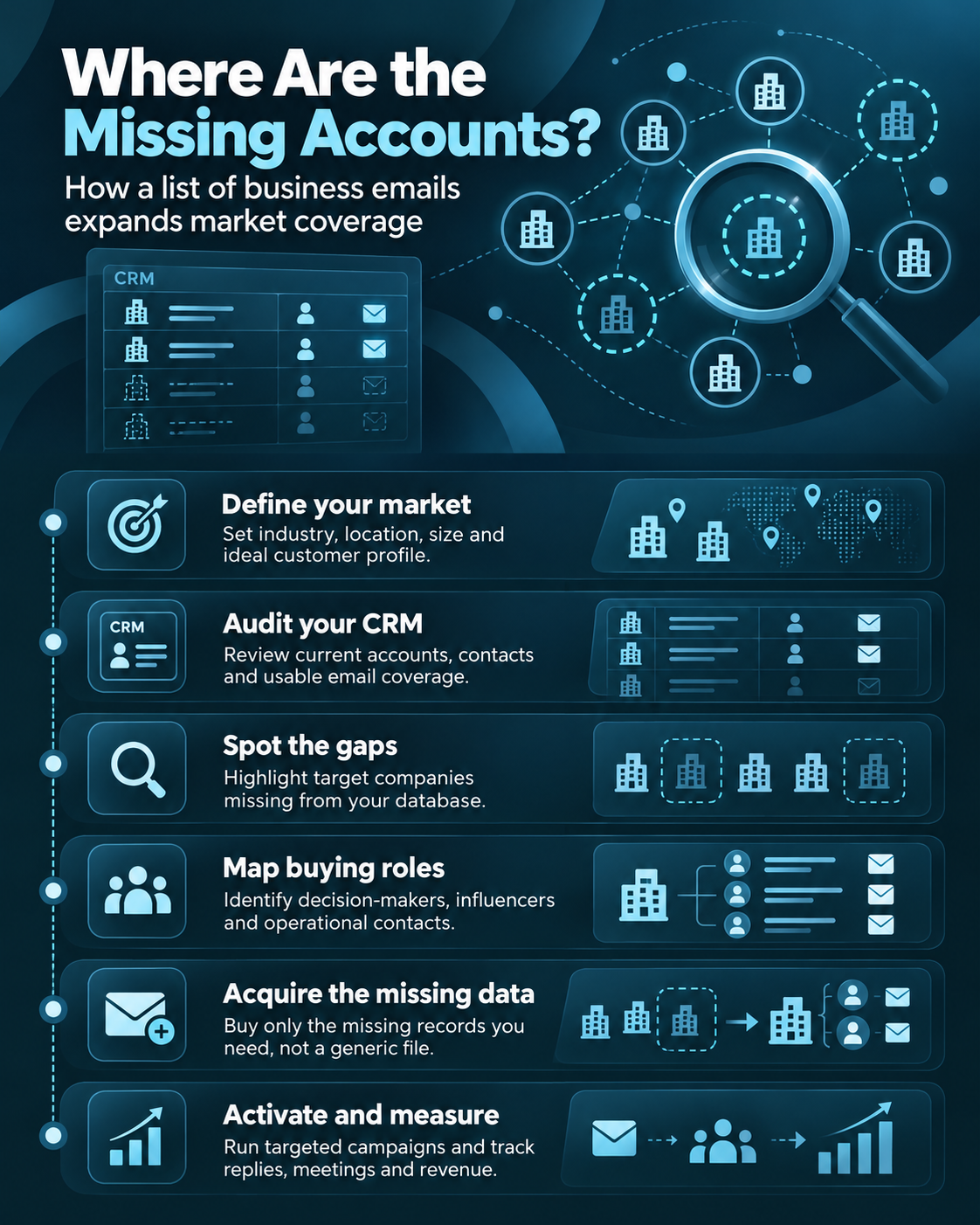
Once the eligible company universe is defined, classify each account by the state of its coverage. This is the real inventory exercise. The goal is not to audit every field in an old CRM. It is to find the specific gaps that prevent a promising business from entering a sensible sales conversation.
Consider five practical coverage states. An uncovered account has no appropriate email contact. A fragile account has one unverified, stale or low-relevance contact. A partial account has a usable contact but lacks another role needed for a complex sale. A ready account has at least one appropriate contact, current status and no unresolved suppression or usage problem. An excluded account is a customer, an active opportunity, an opt-out or another deliberate omission. These are working categories, not legal classifications.
Coverage is not the same as contact density
Suppose one account has six employee addresses and another has one. The first is not automatically six times more valuable. If all six people work in a department that cannot influence the purchase, contact density is masking poor relevance. Equally, too many contacts at the same organisation can create coordination problems if they receive repetitive messages from different team members.
Report both distinct account coverage and role coverage. For example, distinguish between the proportion of target firms with at least one suitable individual and the proportion with both a potential champion and a budget or procurement stakeholder. The appropriate depth depends on the offer. A straightforward local service may need one strong contact. An enterprise platform purchase may need an informed map of multiple functions.
The research-led discussion of B2B buying groups published by LinkedIn is a useful reminder that business decisions often involve people beyond the visible product user. That does not mean emailing every imaginable stakeholder. It means understanding which roles genuinely participate in the particular purchase you want to influence.
Create a simple gap report that procurement can act on
For each target segment, record the number of eligible accounts, accounts in the CRM, accounts with valid role coverage, accounts excluded from acquisition and accounts that still require data. Then list the missing role or attribute. A report that says ‘210 regional manufacturers lack an operations contact’ is actionable. One that says ‘we need another 10,000 emails’ is not.
Use the gap report to decide whether to source new companies, append contacts to existing companies or refresh old email records. These are three separate jobs. A fresh List of Business Emails may be correct for uncovered businesses. Data Appending may be a better fit when the CRM already knows the companies but lacks current contact information. Data Cleansing & Enrichment may be the right starting point when old records are duplicated, inconsistent or incomplete.
Exclusions can be the most valuable part of the brief
An account that is already a customer should usually not be treated as a cold prospect. An open sales opportunity might need coordinated account management, not a generic new-business message. A company with an internal do-not-contact flag should be removed before supplier files enter the activation process. Duplicate domains and previously rejected prospects may also need special treatment.
Create a secure exclusion process before ordering new data. Matching should use agreed account identifiers and normalised domains where possible, not only company names. Keep person-level suppression separate from account-level exclusions so that legitimate customer work can continue without reversing a direct marketing objection. Applying exclusions early makes a final delivered file more informative and can reduce unnecessary spend, subject to the supplier’s agreed data-delivery process.
Identify Which Buying Roles Deserve a Place on the List
A List of Business Emails becomes more effective when every selected role has a reason to be there. Titles alone can mislead. A managing director might decide a purchase at a small company but delegate it at a larger one. An operations director might own the problem but not the budget. A finance manager may be an approver rather than an initial evaluator. The right recipient depends on the business and the decision.
Start by describing the buying task, not the job title. Who experiences the problem? Who owns the operational outcome? Who controls spending? Who must confirm technical suitability? Who might prevent implementation? For relatively low-risk services, one person may cover several roles. For higher-value purchases, the responsibilities are often shared across departments.
Separate champions, users, approvers and gatekeepers
A champion has a reason to improve the present situation and may advocate internally. A user will live with the product. An approver can authorise financial or commercial commitment. A gatekeeper may evaluate security, procurement rules, contracts or deployment implications. These labels are not always visible in a database, so treat them as a mapping exercise rather than pretending they are guaranteed attributes supplied with an email address.
Research highlighted by LinkedIn and Bain on buying-group confidence suggests that internal agreement and perceived risk can be central to complex B2B decisions. A useful contact strategy therefore needs more than one generic product pitch. The operational stakeholder may value saved effort; finance may need the commercial case; procurement may need clear terms and a credible supplier process.
Use job functions before trying to predict individual influence
Most organisations can reliably brief a data supplier for departments or seniority bands. It is much harder to prove that a named person has a particular informal political influence. Ask for operations, IT, finance, purchasing or leadership contacts where these functions are relevant and available, but do not buy an invented ‘decision-maker certainty score’ without understanding its evidence.
Job titles differ widely across the UK. A head of operations in a smaller enterprise may perform the work of a director in a larger one. A practice manager can be an important purchaser in a professional firm, while a procurement team might lead negotiations in a group organisation. Ask the supplier which synonyms and departmental equivalents were included, then check a representative sample.
Avoid a multi-contact campaign that feels like a pile-on
Finding additional roles is not permission to bombard one workplace. Define an account-level communication policy. One contact may receive an initial relevant message; another may be approached only when there is a clear distinct reason or where an existing relationship provides context. Sales and marketing should know who owns the account, what has already been sent and whether anyone has objected.
This restraint helps both compliance and trust. If three colleagues receive near-identical messages on the same morning, they may reasonably conclude that the sender values scale above relevance. Better coverage should mean better understanding of the business, not indiscriminate saturation. The best List of Business Emails improves the quality of choices about whom to contact and when not to contact them.
Add Timing Without Pretending to Know Who Is Ready to Buy
Marketers like the idea of contacting a company at exactly the right moment. In reality, most signals are incomplete. An expansion announcement may suggest a new operational requirement, but it does not prove a company has budget. A senior appointment may create an opening for discussion, but it does not prove the new employee wants to replace a supplier. A website visit can indicate interest in a subject, but it may come from a student, a competitor or an existing customer.
A sensible approach treats timing as a hypothesis to investigate, not a fact to insert beside an email address. A List of Business Emails is primarily a contact and account resource. It should not be sold as a crystal ball. Separate verified business attributes from observed events and speculative interpretations. That one distinction can make campaign planning more honest and significantly more useful.
Separate durable fit from short-lived events
Durable fit includes the conditions that make a company a plausible customer for years, such as sector, business model, location or approximate scale. Events are changes that might affect need or urgency. Examples include opening a site, investing in machinery, recruiting a new senior team, starting a transformation programme or announcing a relevant project. An inference is the judgement that the event could make your product useful.
These three layers should not be merged into an unexplained ‘hot lead’ label. A company can fit your offer perfectly without showing an event today. Another might announce something exciting but still fall outside the market you can service. Use events to adapt priorities and conversation starters after the account has passed the basic fit test.
Build an evidence register, not a rumour engine
If the sales team uses events, record the source, publication date, relevance and confidence. A public annual report is different from an unattributed social media claim. An official job posting can establish that a business is recruiting for a role, but not that it has a particular technology budget. An industry article can explain a market-wide pressure without proving how each company is affected.
Use a sensible review date because signals get old. ‘New facility announced’ is useful context when the announcement is recent and verified. Repeating it two years later as if it happened last week undermines credibility. Where the signal involves a named person’s behaviour, consider whether the collection and use of that personal data are fair, transparent and lawful. Avoid invasive profiling or pretending to know private activity.
Give the sales team a reason to research before writing
A timing note should create a research task, not an automatic email. The salesperson can check the firm’s website, confirm whether the development is relevant and choose a reasonable opening. If there is no supportable connection, leave the event out. Strong outreach often acknowledges a business situation without exaggerating insight into the recipient’s private decisions.
McKinsey’s B2B omnichannel research shows why no single email should carry the whole sale: business buyers interact with suppliers through several channels and stages. Email may start a useful exchange, but a relevant website, knowledgeable conversation, credible case study and clear commercial proposal must do the rest. Better account timing should improve the handover across these stages rather than encourage aggressive sending.
Decide Which Missing Accounts Justify the Data Budget
Not all coverage gaps deserve equal investment. A small company that is easy to contact may have little realistic buying potential. A larger business might offer valuable revenue but involve a very long procurement process. A regional cluster could be ideal for a service team operating from one office, while an apparently attractive national account may sit outside delivery capacity.
A simple account priority model helps prevent the supplier brief from becoming a wish list. Pick a handful of factors that matter to the commercial strategy. Typical factors are fit to the offer, potential value, access or serviceability, current relationship status and credible evidence of a near-term need. Use transparent scores with notes rather than elaborate algorithms that nobody can explain.
A worked example of account scoring
Suppose a facilities technology provider rates accounts on a five-point scale. Product fit carries 40 per cent of the score, potential annual value 25 per cent, ease of servicing 20 per cent and a relevant public event 15 per cent. Account A scores 5, 4, 5 and 2 across those factors. Its weighted score is 4.35 out of 5. Account B scores 3, 5, 2 and 5, for a weighted score of 3.6. Account A is the better initial data-buying target despite having a weaker event signal.
Those figures are illustrative, not a scientific performance forecast. Their purpose is to make the team’s assumptions visible. Change the weights when the strategy changes, and test whether high-ranked segments actually produce more suitable conversations and opportunities. If an account is legally or operationally unsuitable for the planned campaign, it should be excluded regardless of its commercial score.
Score segments before individual people
Scoring a named employee based on inferred personal traits can create unnecessary privacy and fairness concerns. Often the same business decision can be made at company or segment level. Prioritise suitable sectors, company-size bands, territories and operations types first. Then choose appropriate professional functions within those accounts.
Company-level scoring also avoids false precision. A new finance director may be excellent at their job without being receptive to every unsolicited service pitch. The buyer should not treat rank in a spreadsheet as an entitlement to that person’s attention. The list supports a relevant invitation to discuss, not a judgement about individual behaviour.
Protect a share of the budget for learning
If all spending goes to a single highly rated segment, the business may never discover a better one. Allocate most of the budget to credible prospects and a smaller, clearly measured portion to adjacent segments. For example, test two company-size bands with the same proposition or compare two related industries while holding message quality and sales capacity broadly stable.
The goal is to learn which account types justify further investment. A small structured trial can reveal missing buying roles, unclear product-market fit or unexpected sales friction before a large data order. It can also show that the existing CRM is good enough in some territories, allowing the money to move towards markets with genuine gaps.
Choose Between Buying New Accounts and Repairing Old Ones
AccuraData’s article on building a business email database examines the wider mechanics of assembling and maintaining an email asset. The decision here is more specific: whether the next pound should create a new target account or improve coverage of one already recorded.
Before purchasing a List of Business Emails, ask whether the business needs wider company coverage, better contact coverage or more reliable existing data. Each problem calls for a different intervention. Buying an entirely new dataset when the CRM already contains valuable customer and prospect history may introduce duplicate records and lose useful context. Repeatedly appending an irrelevant universe is equally wasteful.
Use the CRM coverage map to make the decision. If you have appropriate companies with no usable contacts, enrich those accounts. If you have current contacts but poor industry or size information, improve the firmographic fields. If the prospect universe itself is missing, source additional businesses. If the records are out of date or difficult to merge, cleanse before extending the file.
What an entirely new list can achieve
New business email data is suitable when entering a territory, targeting a sector previously ignored or opening an additional account segment. The supplier should be able to offer available data counts against your specification, explain realistic filtering options and make clear what fields form part of the proposed delivery. A carefully bounded list can support a specific commercial experiment with minimal distraction from unrelated markets.
AccuraData’s UK B2B Data service is relevant here because the request can begin with the companies rather than only the individuals. Its business email data service then provides the email-focused route. Ask for an audience defined by business type and relevant professional responsibilities, subject to actual data availability, permitted use and any exclusions the buyer needs.
What an append can achieve
Appending adds missing, updated or additional information to records already held. This can be particularly useful when sales knows the business, has opportunity history and needs a current route into the appropriate department. It may also add segmentation context that makes the next campaign more relevant. No append should be assumed to deliver every requested field: coverage, source, quality and legal suitability still need checking.
AccuraData offers Data Appending for organisations seeking to complete existing business information. A buyer should supply a suitable matching key, define which fields may be added, agree how conflicts are resolved and preserve the original record history. Crucially, old suppression records must not be overwritten by newly appended details.
What cleansing can achieve
Data cleansing is not simply removing blanks. It includes identifying duplicates, normalising company names, checking domain mismatches, resolving out-of-date information and improving the consistency of records used by sales and marketing. IBM’s overview of data quality dimensions distinguishes accuracy, completeness, consistency, timeliness, validity and uniqueness. Those distinctions are useful because a dataset can excel on one measure and fail another.
If a CRM contains 600 entries for companies that are actually only 420 distinct businesses, deduplication may change the coverage estimate before any new purchase. If the contact names are current but departments are missing, enrichment may bring greater benefit than acquiring an unrelated file. AccuraData’s Data Cleansing & Enrichment services can support the necessary improvement work alongside business-data supply.
Specify the List of Business Emails as a Procurement Brief
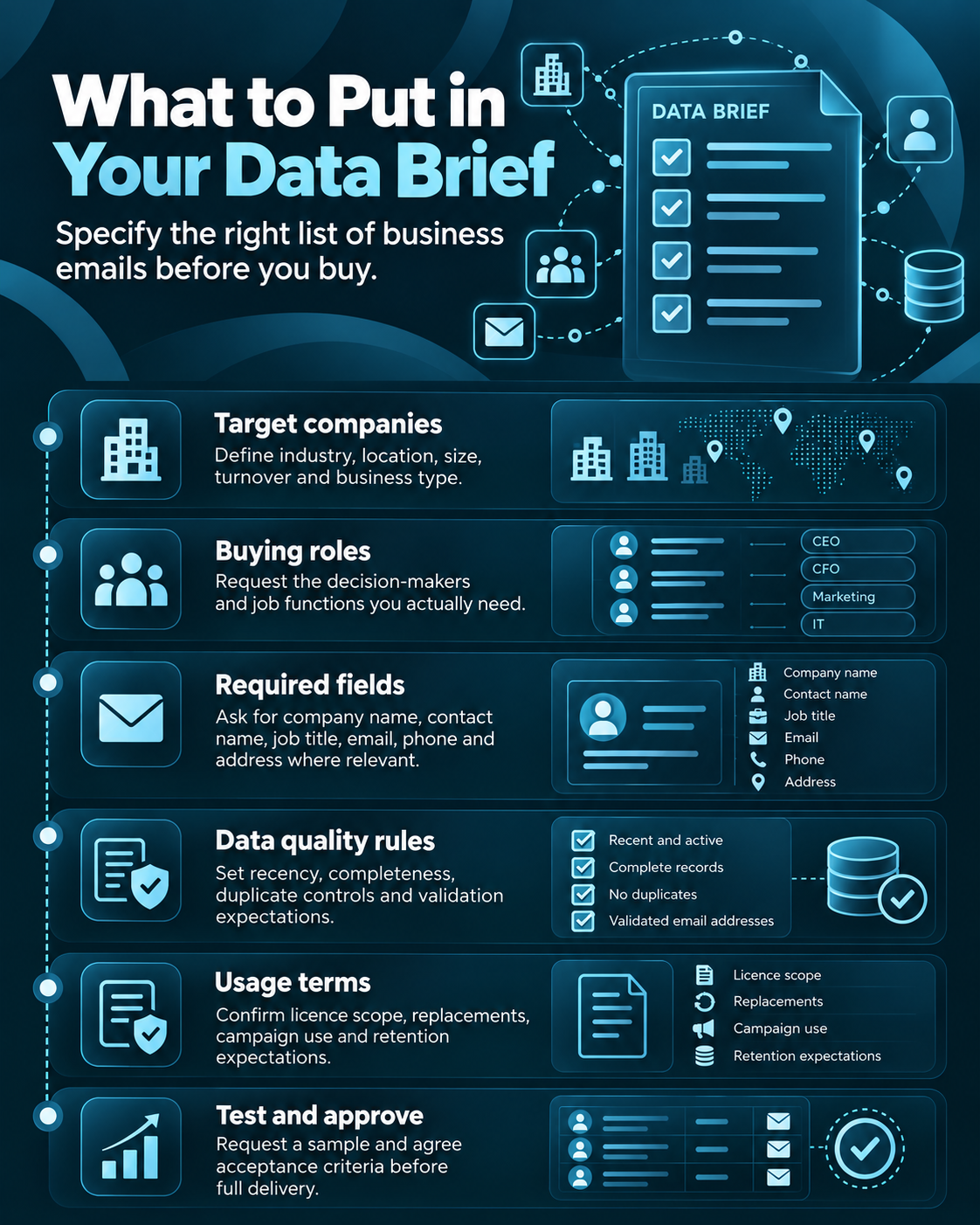
The strongest supplier conversations begin with a written definition of success. Instead of asking for a price for 5,000 contacts, explain what businesses must be covered, which professional functions matter, what existing records need to be excluded and how the buyer expects to use the data. This turns the purchase into a testable delivery, not a leap of faith.
A useful brief includes the commercial purpose, account definition, UK location requirements, target legal-entity types, preferred job functions, desired email fields, suppression and deduplication rules, delivery format, intended campaign type and expected follow-up capacity. It should say whether you need a one-off audience, scheduled refreshes or new-company additions over time. It should also state which filters are essential and which are preferences.
Ask for counts at account level and contact level
A promise of 8,000 emails might conceal 2,000 companies with four contacts each. That could be perfect for an enterprise buying-group campaign or unsuitable for a business aiming to reach 8,000 separate firms. Request counts for distinct companies, distinct sites where relevant and email contacts by role, sector and location. Clarify whether contacts without a company identifier are included.
Ask for a breakdown of strong, partial and unavailable role coverage. If only 35 per cent of a proposed market has the particular department you need, it may be better to widen accepted job-title equivalents or restructure the campaign. The supplier’s willingness to discuss realistic coverage is more valuable than a confident but unexplained headline quantity.
Request a representative sample, not a showroom display
A handpicked sample of five polished records proves little about an entire file. Request a small, representative sample across the planned regions, size bands and sectors, subject to an appropriate data-sharing arrangement. Inspect company fit, contact relevance, field completion and consistency. Look for legal-entity mismatches, generic addresses passed off as named contacts and repeated records under different trading names.
A sample cannot prove that every email will deliver, and live addresses can change after testing. What it can reveal is whether the supplier’s definitions match yours. Ask what an email validation date means and which process produced it. Technical validation, a live mailbox response and confirmation that an individual still holds the claimed role are not identical checks.
Put permitted use and remediation in writing
Clarify the data licence, permitted marketing channels, retention or reuse limitations, security expectations, restrictions on onward transfer and whether the buyer may combine the records with its CRM. Ask what happens when a material share fails agreed quality criteria and how replacement or correction requests are handled. Avoid assuming a replacement policy is included without checking the terms.
Different parts of a List of Business Emails may require different responsibility assignments. The supplier should explain its own data handling and source processes. The buyer remains responsible for its own marketing decisions, lawful basis, notices, suppression and systems. A contract is valuable when it defines both parties’ work, not when it gives a false promise that all future email activity is automatically compliant.
Consider a phased order instead of a single large file
A pilot can cover one region or market segment first. Sales then reports on contact suitability, handover effort and the number of genuine opportunities created. A second purchase can focus on the segments where the initial campaign showed credible potential. This reduces the risk of paying for data that the team cannot realistically activate.
A phased approach is not always cheaper per record, and some suppliers may have minimum order requirements. Evaluate total cost, including internal preparation and sales effort, rather than only the supplier’s invoice. The commercial question is whether the organisation can absorb, work and learn from the records while their information is still reasonably current.
Inspect the Delivery Before Anyone Sends an Email
A delivered list should enter a controlled acceptance process. It should not be copied directly into a sending platform just because the invoice has been paid. The objective is to establish whether the file matches the agreed specification, whether it can be merged without damaging existing CRM data and whether the relevant compliance decisions have been documented.
Begin with a snapshot of the file as received, with restricted access and an import reference. That provides an audit trail if questions emerge later. Review the schema, normalise formatting and confirm the data represents the agreed company population. Record the date of receipt and the date of any validation. Keep source information connected to each record, particularly when multiple vendors or collection methods are involved.
Design a five-gate acceptance test
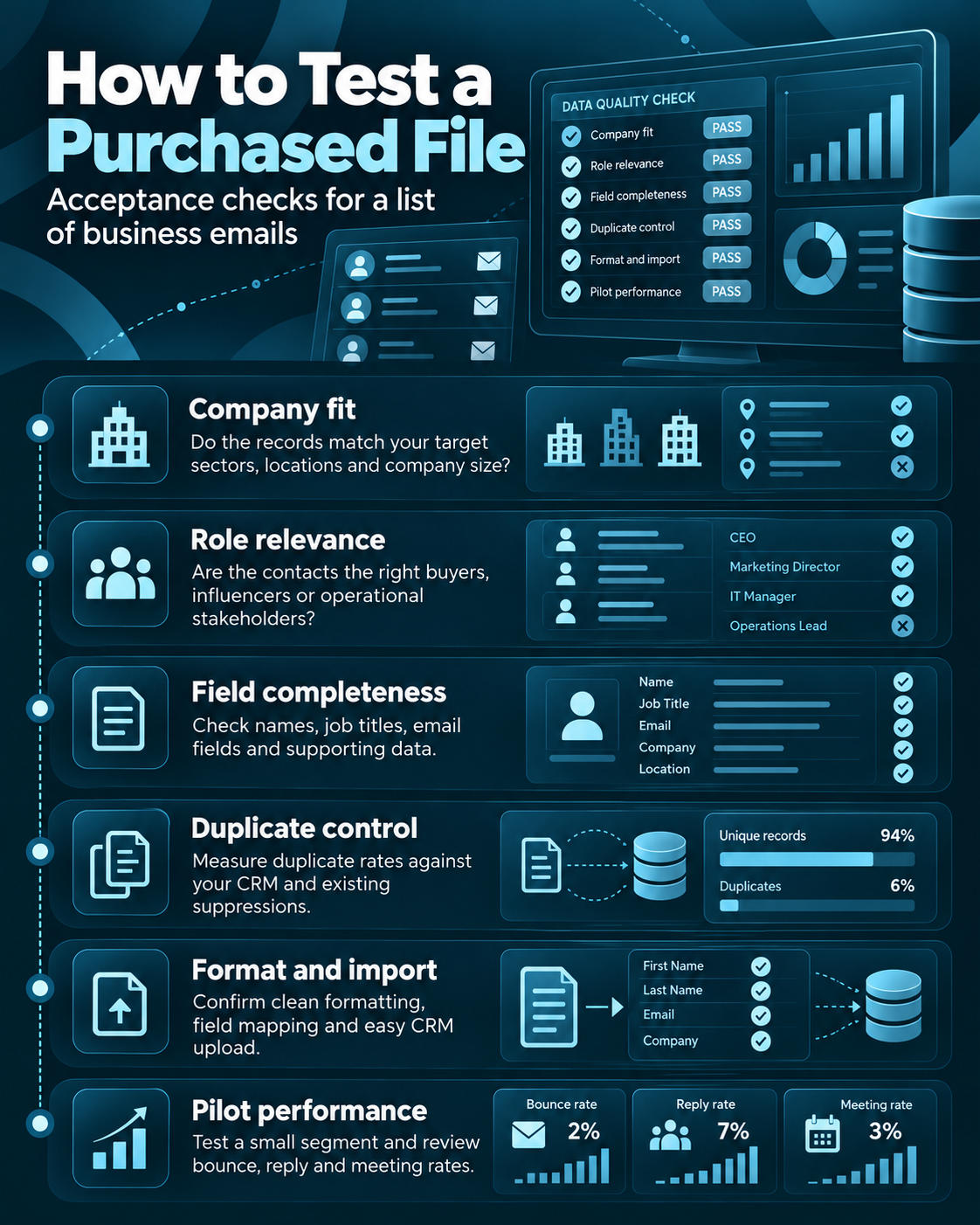
First, confirm business fit. Does each selected company meet the essential audience criteria, allowing for clearly documented exceptions? Second, confirm account uniqueness. Are subsidiaries, branches, trading names and duplicates treated according to the agreed definition? Third, test role fit. Are the contacts in relevant departments and seniority ranges? Fourth, inspect technical quality, including address format, available validation status and field completeness. Fifth, assess usage readiness, including source documentation, subscriber classification, suppression and the recipient’s suitability for the intended communication.
A file only becomes campaign-ready after the relevant gates pass. If technical quality is good but legal-entity classification is uncertain, hold the affected records for review. If roles are wrong but companies are right, request correction rather than rejecting the whole universe. The acceptance report should separate repairable problems from serious mismatches to the agreed order.
Keep a rejection reason for every excluded record
Do not delete unsuitable records from the working file without recording why. Useful internal reasons include duplicate account, existing customer, outside service area, wrong industry, wrong role, invalid address, subscriber type uncertain, prior objection or missing documentation. These labels enable accurate supplier discussions and teach the business what to request next time.
Rejection tracking is especially important when comparing suppliers. One may deliver a larger file with many records that need expensive repair. Another may produce fewer records but better reach into priority accounts. A fair comparison should use accepted unique accounts and usable professional contacts after exclusions, not raw row counts. The report should also show which records were rejected for the buyer’s own CRM reasons rather than the supplier’s data-quality failure.
Preserve history when importing into the CRM
Match company records before creating new ones. Where possible, use a stable account identifier alongside normalised website domain and verified legal identifiers. Then attach contacts to the correct account. Preserve original source, receipt date, field validation dates, campaign eligibility and existing relationship information. Do not let an imported file set a blank value over an accurate existing field.
Sales and marketing should also agree who owns newly covered accounts. An apparently simple import can create confusion if two representatives begin emailing the same business. Assign territories, contact ownership and suppression synchronisation before activation. A useful List of Business Emails should reduce uncertainty for the sales team, not create another ungoverned spreadsheet on a shared drive.
Check UK Email Marketing Rules at the Point of Selection
This section provides general marketing and data-protection information, not legal advice. UK rules and regulatory guidance should be checked for the specific activity and recipient type before a campaign is launched. AccuraData’s business email sourcing article offers broader supplier and acquisition context.
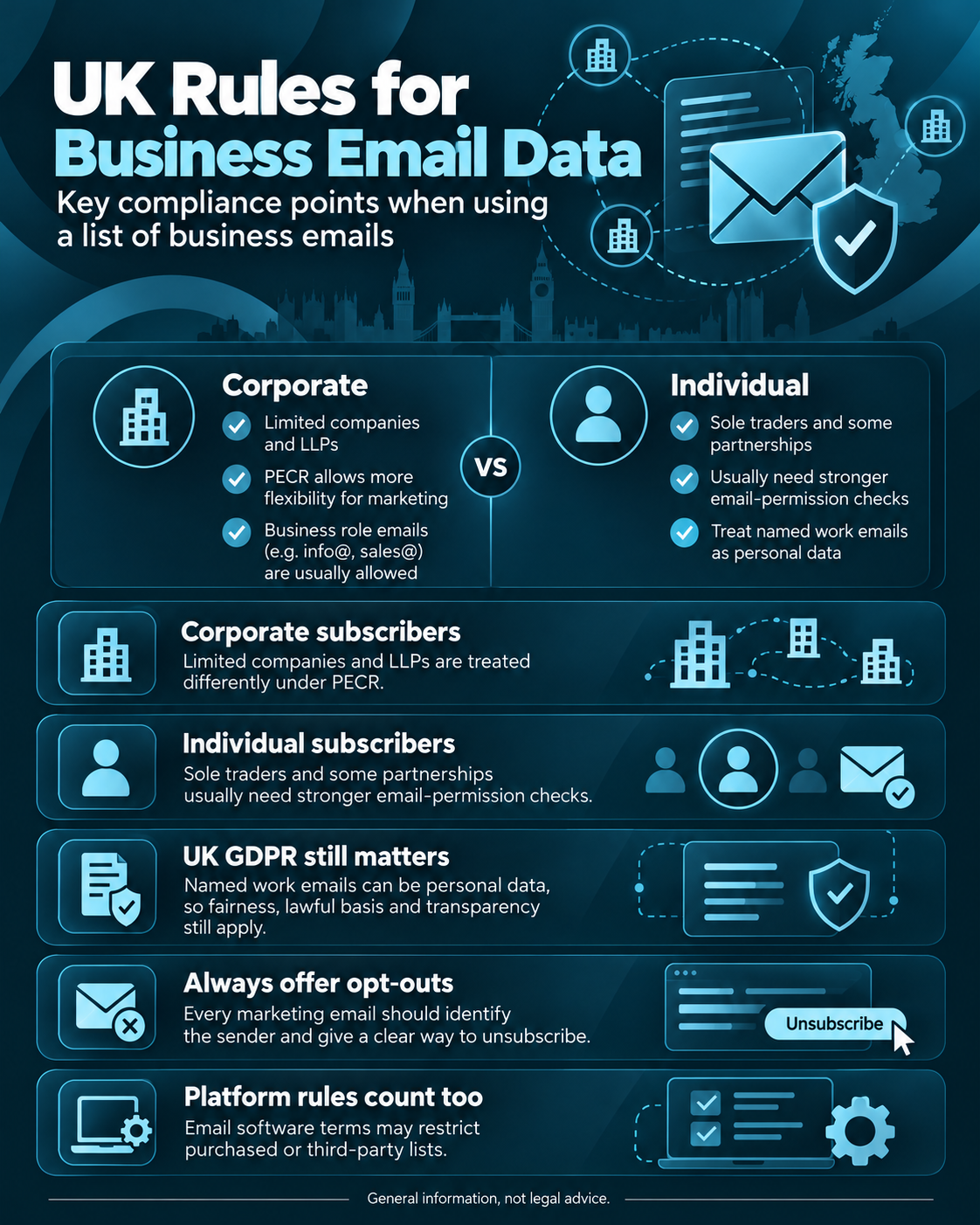
The legal question is not answered by the label ‘business email’. Under the UK’s Privacy and Electronic Communications Regulations, known as PECR, the rules for unsolicited marketing by electronic mail depend on the type of subscriber. The Information Commissioner’s Office explains the distinction in its business-to-business marketing guidance. A limited company or limited liability partnership can be a corporate subscriber. A sole trader and certain partnerships are treated as individual subscribers. The corporate subscriber distinction concerns the PECR email-consent rule; it does not mean businesses have unlimited freedom to use personal information.
For unsolicited email to corporate subscribers, PECR does not impose the same prior-consent requirement that applies to individual subscribers. Senders must still avoid concealing their identity and provide valid contact details for opting out. Where the data identifies a person, UK GDPR may apply alongside PECR. The sender needs an appropriate lawful basis, fair and transparent processing, data minimisation, accurate information and a practical way to respect objections. Recipients have an absolute right to object to processing for direct marketing.
A named company address can still be personal data
The fact that jane.smith works at a limited company does not remove her rights under data protection law. The address may identify her as a living person and therefore be personal data. A generic departmental mailbox may involve less personal information, but the PECR subscriber category still matters. Do not classify addresses as unrestricted merely because they end in ‘.co.uk’ or resemble an office address.
When buying a List of Business Emails, request enough organisation information to distinguish corporate subscribers from sole traders and other individual subscribers. Do not rely on a supplier’s unsupported ‘GDPR compliant’ flag. Where the organisation’s legal status is unclear, hold the record and investigate rather than assuming that a business-looking address qualifies for corporate-subscriber treatment.
Legitimate interests needs a real assessment
Legitimate interests may be a suitable UK GDPR lawful basis for some proportionate B2B direct marketing where PECR does not require consent, but it is not automatic. The ICO’s direct marketing planning guidance explains the purpose, necessity and balancing tests. The business should explain the legitimate commercial purpose, why processing the data is necessary and why the individual’s rights and expectations do not outweigh that interest.
The scope of the list matters to that balancing exercise. Targeting a relevant professional function at a business that could plausibly use the service is easier to explain than emailing every employee in an unrelated industry. Document the assessment for the actual campaign and review it if the audience, data source, message or process changes. A lawful basis under UK GDPR never overrides a PECR requirement for consent where one applies.
Bought addresses do not carry a universal marketing permission
For individual subscribers, including sole traders and certain partnerships, unsolicited marketing email generally requires valid consent unless the relevant soft opt-in conditions are met. Buying a dataset does not automatically establish either one. The ICO’s updated electronic mail marketing guidance explains the rules for bought-in lists, subscriber types and the soft opt-ins, including changes introduced by the Data (Use and Access) Act 2025. The charity-specific soft opt-in is not a general permission for ordinary commercial prospecting.
If consent is claimed, establish who gave it, for what communication, for which sender or clearly described category of organisation, and whether it remains valid. An ordinary business cannot simply rely on the products-and-services soft opt-in because it purchased another organisation’s customer list. The soft opt-in has particular conditions relating to the organisation’s own interactions and marketing. When those conditions are not met, the buyer must not treat the purchased address as email-ready for an individual subscriber.
Transparency and objections belong in the data workflow
Where personal information comes from another source, the recipient may need privacy information explaining the controller, the purpose, the source and relevant rights, within the applicable legal timescales and circumstances. The ICO’s information collection guidance addresses the use of indirect sources and public information. A company website or business register can be publicly accessible without granting a blanket marketing exemption.
Include an obvious way to object or unsubscribe. Process objections promptly, record them reliably and carry suppression forward into new purchases, appends and CRM migrations. Do not treat an opt-out as an invitation to find a different email address for the same person. A secure minimal suppression record may be necessary to honour the objection over time. Use clear notices and internal governance, not just a footer assembled after the campaign has been prepared.
The sending tool may have tighter rules than the law
Compliance with PECR is not the same as compliance with a platform’s acceptable-use policy. Many bulk-email and marketing automation services restrict or prohibit purchased or third-party contact lists. Check the specific product contract before importing the file. A B2B campaign that might be lawful under the applicable legislation can still violate an email service’s terms.
If a proposed channel is not permitted, do not work around the provider’s controls or disguise the source of the audience. Choose a lawful, authorised route, adapt the campaign or use another suitable approach such as account research or permitted advertising. Ask potential providers directly how they handle purchased B2B data, suppression, consent evidence, sending limits and delivery complaints.
Make the First Email Match the Reason the Account Was Selected
For a fuller campaign-execution discussion, the AccuraData Companies Email List playbook provides related detail on email activity. The emphasis here remains on matching one selected account segment to one credible reason for getting in touch.
The list brief and the message brief should be connected. If the audience consists of multi-site food manufacturers facing complex maintenance schedules, a generic email about ‘business transformation’ wastes the segmentation effort. It should speak to a plausible operational need, state the offered value plainly and make it easy for the recipient to decide whether a conversation is useful.
A List of Business Emails can support several distinct message angles without relying on intrusive personalisation. Use the company context that is appropriate and verifiable: sector, operating model, location or known public development. Avoid suggesting that you have studied a person’s private behaviour or that you know their current supplier arrangement without evidence.
Write for the recipient’s job, not just the company’s industry
An operations leader might care about avoiding downtime. A finance manager might care about predictable cost and a credible business case. A technical reviewer may want to know how a proposed change integrates with current processes. The product remains the same, but the explanation should address different responsibilities. This is a stronger use of role coverage than simply inserting the recipient’s job title into an identical message.
Raconteur’s discussion of buyer confidence and emotion is relevant here: B2B communications have to address more than product specification because business decisions involve confidence and risk. Strong, restrained evidence is often better than inflated claims. A short account-relevant example, a clear explanation of how a service works and a straightforward invitation to discuss can be more credible than a long list of unverified promises.
Keep the invitation appropriately small
The first message rarely needs to close a complex sale. It may aim to establish whether a particular problem is relevant, identify the responsible team or offer a concise resource. Give the recipient enough information to understand why the business contacted them and what happens if they respond. Avoid deceptive subject lines, false urgency, invented mutual connections and aggressive sequences that continue after an objection.
The Content Marketing Institute’s 2026 B2B marketing research is a useful broader reference for thinking about content effectiveness. The practical implication for a purchased business audience is to make any offered resource genuinely relevant to the recipient’s work. A sector-specific checklist or a clear technical explainer may provide a better reason to engage than a broad sales brochure.
Design the message for easy reading and reply
Keep language short and concrete. Use a readable layout, descriptive links, meaningful headings where needed and an accessible contrast between text and background. The email accessibility guidance from Email on Acid explains why simple copy, live text, alternative text and inclusive templates matter. The W3C accessibility reference provides a broader basis for legible contrast and accessible presentation.
Proofread all merge fields and test the email with missing data. ‘Hello undefined’ or the wrong company name signals poor quality more immediately than a subtle targeting error. Use a clear sender identity, working reply address, reasonable call to action and reliable unsubscribe process. The message should still make sense with images disabled and should not require the recipient to download an attachment to discover the offer.
Keep Sender Reputation Separate From Contact Relevance
Even a useful List of Business Emails cannot rescue an improperly configured sending domain. Email authentication, sending practices and unwanted-message complaints affect whether a message reaches the inbox. Validate the technical sending setup before treating a campaign as a fair test of the purchased data.
The UK’s National Cyber Security Centre describes email security and anti-spoofing controls. Microsoft’s documentation explains how SPF, DKIM and DMARC work together to authenticate email and reduce domain impersonation. These are sender-domain controls, not checks that establish a contact’s consent or role. Both sides of the process matter, but they solve different problems.
Do not use authentication as a permission substitute
An email can pass all authentication checks and still be unwanted, unlawful or irrelevant. Conversely, a relevant message can be filtered or rejected if the sending infrastructure is poorly configured. Gmail’s sender guidelines FAQ and Yahoo’s sender best practices make clear that reputation, authentication and user-friendly unsubscribe practices are operational concerns for senders. Their published rules should be checked for the specific recipients, volumes and products involved, rather than copied uncritically from general advice.
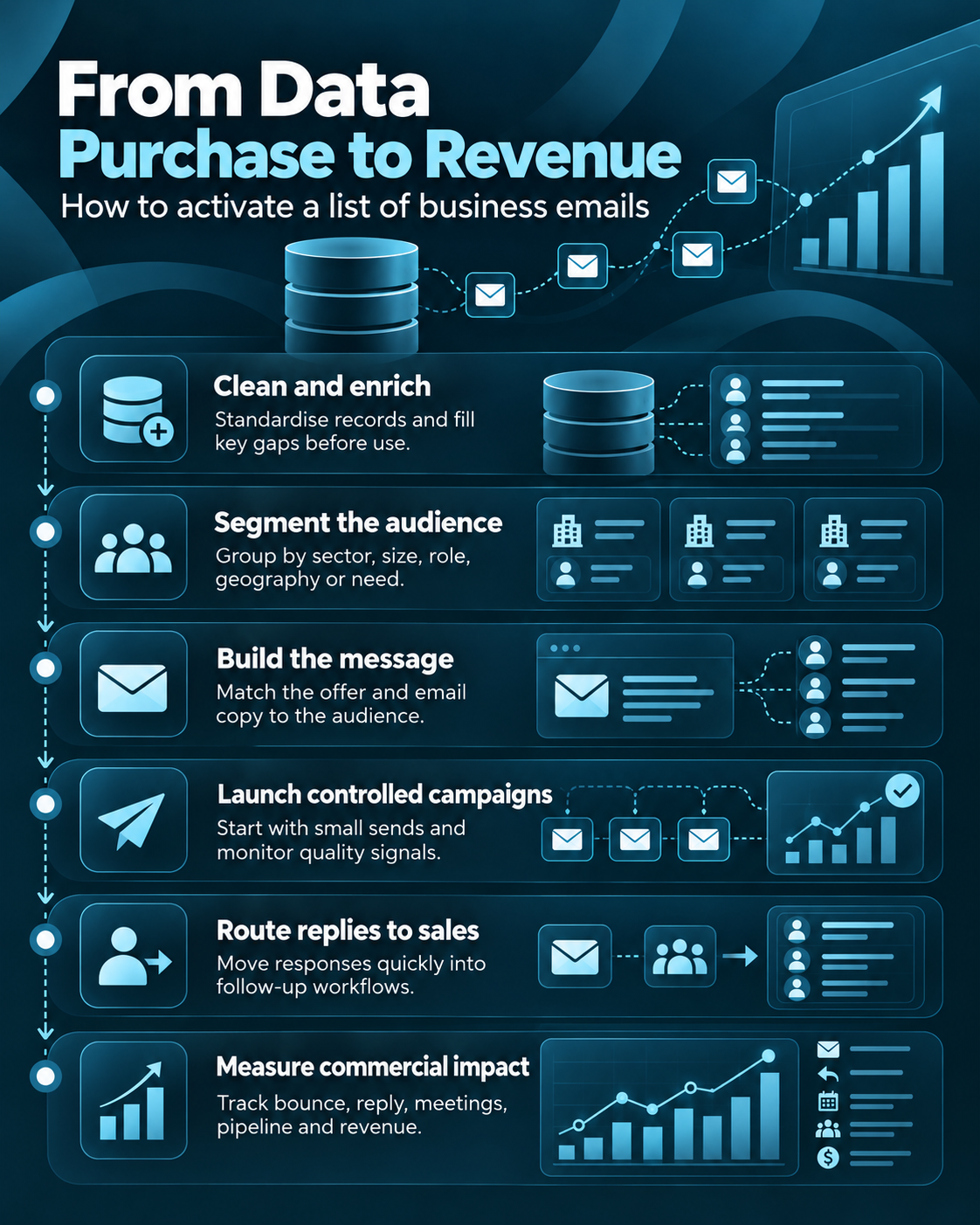
Start with a controlled, permitted campaign volume that your team can support. Monitor hard bounces and complaints; investigate unusual patterns before expanding. Remove addresses known to be invalid rather than repeatedly retrying them. Where data was validated some time ago, consider whether it needs another review before activation. An old ‘verified’ field should not be treated as perpetual proof.
Measure delivery separately from interest
A delivered message is not proof that the person read it. A recorded open is not always reliable evidence of human attention because privacy and security systems can fetch or block tracking resources. Clicks can also be influenced by automated link scanning. Prioritise direct replies, useful conversations, meetings, qualified opportunities and eventual sales outcomes, while using delivery metrics to diagnose infrastructure and data-quality issues.
Do not blame the supplier for every low reply rate. A poorly chosen offer, unconvincing copy, weak sales follow-up or a sender with a damaged reputation can all reduce results. Equally, a beautifully written email cannot correct an irrelevant account universe. Keep those influences separate in reporting so that the next purchase is based on evidence rather than guesswork.
Run a Controlled Test Before Rolling Out the Full Market
AccuraData’s B2B Database List operations guide covers a wider campaign workflow and performance measures. For this purchase decision, the key test is more precise: has the dataset created access to new, commercially relevant organisations rather than merely increased message volume?
The most useful way to evaluate a new List of Business Emails is a disciplined campaign test. Choose a segment with enough accounts for meaningful observation, ensure it is suitable for the intended outreach and let the sales team review a portion of the records first. Agree the message, follow-up rules and measurement window. Confirm suppression and platform eligibility before any send.
A pilot can compare two segment definitions or two role types, provided that the comparison is fair. If one group receives a stronger offer and another receives a generic message, the resulting difference says little about data quality. Similarly, if one sales representative calls every reply within an hour and another waits a week, it becomes difficult to distinguish list performance from operating practice.
Use account-level outcomes to avoid inflated results
Count unique engaged accounts, not only responding contacts. If three employees from one organisation reply, that may be one valuable account opportunity rather than three independent opportunities. Record the number of newly covered companies that actually enter a qualified sales discussion and the percentage of accepted accounts that advance to a meaningful commercial stage.
For more complex services, measure buying-role coverage separately. Did the campaign reach the department that owns the problem? Did the initial conversation reveal another necessary stakeholder? Did the business have the service capacity to follow up? These questions tell you which additional records are worth purchasing next, rather than merely producing another campaign report.
Calculate cost per newly usable account
Suppose a £1,800 file provides 1,000 records. After deduplication, audience exclusions, role checks and unsuitable addresses, 600 unique priority accounts remain with an acceptable contact. The acquisition cost is £3 per accepted account, before internal work. If 150 of those accounts already had usable records in the CRM but were not identified during ordering, the true incremental account gain falls to 450 and the purchase cost per newly covered account becomes £4.
This illustrates why raw price per record is a weak procurement metric. Add internal data preparation, creative work, platform costs and sales effort to form a realistic acquisition budget. Then compare qualified opportunities and revenue, allowing for the time needed to complete the sales cycle. A less expensive list may cost more when it adds few genuinely new, usable organisations.
Establish stopping and expansion rules beforehand
Decide which findings would justify a second order. You might require a minimum proportion of records to meet the audience definition, a manageable rate of invalid addresses, a sufficient share of priority-account coverage and a credible number of qualified sales conversations. These thresholds should reflect the campaign and should not be presented as universal industry benchmarks.
Also decide what would make you stop. An unexpectedly high rate of unknown subscriber types, widespread objections, insufficient supplier provenance or a sending-platform restriction is not a reason to increase volume and hope for better results. Pause, investigate and correct the process. The value of a pilot lies as much in preventing poor scaling decisions as in identifying a successful segment.
Four Situations Where the Missing-Account Method Pays Off
A regional service business has more addresses than territory coverage
A specialist commercial cleaning supplier holds 4,000 historic contacts but wants to grow around two new depots. Its CRM is concentrated in areas that existing representatives have worked for years. A coverage audit finds that large parts of the new depot catchments contain suitable multi-site businesses with no appropriate facilities contact. The next purchase is therefore defined geographically and by operational need, not by the size of the old spreadsheet.
The supplier requests account counts for eligible organisations in the two service areas, checks exclusion lists and asks for relevant operational roles where available. After a pilot, it reports qualified opportunities by depot catchment. The lesson is simple: ‘more emails’ was not the problem. Uneven market access was.
A software firm has excellent company records but missing people
A UK software business tracks 900 target companies in its CRM. The company names, websites and sector fields are mostly sound, but its named contacts were gathered years ago. Rather than purchase a fresh universe and lose existing relationship notes, it commissions targeted data enhancement for records without a suitable current operations or IT contact.
The enhanced data is matched back to the original account IDs. Prior objections remain suppressed; current customers stay outside the cold-outreach segment. This is a natural use case for Data Appending supported by data cleansing. The outcome to measure is not imported rows but the increase in target accounts with an appropriate, permitted route to a conversation.
A manufacturer needs several functions at fewer companies
An engineering manufacturer sells equipment with a long approval cycle. Its earlier contact lists targeted production managers only. Replies are encouraging, but promising discussions regularly stall because maintenance, procurement and finance become involved later. A buying-role review identifies which functions matter for each product line and asks for additional relevant contacts within the highest-value accounts.
The marketing team does not send identical messages to everyone. It creates distinct explanations for operational value, technical fit and commercial assurance, and coordinates outreach at account level. LinkedIn’s research on hidden buyers offers a useful perspective on why less visible stakeholders can shape decisions. Better role coverage helps the firm support an internal decision without automatically increasing contact volume at every account.
A professional services firm is tempted by a cheap national file
A niche consultancy is offered tens of thousands of business addresses for a low price. Its service, however, is relevant mainly to regulated mid-sized organisations in selected sectors. A sample of the national file reveals many small firms, generic mailboxes and businesses outside the consultancy’s expertise. The apparently inexpensive file would create costly filtering and wasted follow-up.
A more precise brief specifies company characteristics, professional roles and permitted uses, then asks for a market count. The smaller dataset may have a higher nominal price per address but can be judged on accepted, unique and commercially suitable accounts. This avoids the mistake of confusing a large inventory with a large opportunity.
Questions Buyers Ask About a List of Business Emails
Is a List of Business Emails the same as a list of companies?
No. A list of companies describes organisations. A business email list adds contact routes, and ideally enough context to understand who the recipients are and why they are relevant. Some commercial products combine company, contact, email, telephone and postal information. Always confirm the delivered fields and whether the quoted count refers to distinct firms or individual records.
Should I buy one contact per business or several?
It depends on the product and the account’s decision process. One relevant professional may be sufficient for a simple purchase. Complex technology, outsourcing or operational contracts can involve several roles. Start with the few functions that genuinely affect the buying decision and use account-level coordination to avoid overwhelming colleagues at the same organisation.
How can I tell whether the proposed list is unique to my CRM?
Compare stable company identifiers, normalised domains and other relevant matching fields, then review likely parent-subsidiary and branch relationships. Do not rely on exact company-name matching alone. Ask the supplier whether it can apply agreed exclusions before delivery and document how it defines duplicates. Keep unmatched and ambiguous records in a review queue rather than merging them blindly.
Can I legally email every business address on a purchased list in the UK?
No. You must check whether the subscriber is corporate or individual under PECR, whether personal data is involved under UK GDPR, your lawful basis, transparency obligations, any previous objections and the nature of the campaign. A corporate subscriber may not require PECR prior consent for unsolicited email, but that does not remove other responsibilities. For sole traders and certain partnerships, consent or an applicable soft opt-in is generally needed. Check current ICO electronic mail guidance and the terms of the sending platform.
Is an email marked ‘verified’ guaranteed to reach its recipient?
No. Verification methods differ, inboxes and roles change, mail servers may reject messages and security filtering can intervene. Ask what validation was performed and when. Keep technical deliverability separate from proof of current job role, relevance or marketing permission. Monitor campaign results, remove known invalid addresses and agree a quality-remediation process with the supplier.
What fields matter most for a B2B outreach campaign?
At a minimum, a useful operational dataset normally needs a company identity, appropriate contact route and enough segmentation data to establish fit. For many campaigns, role, organisation type, sector, location, account identifier, source and validation date are highly useful. Suppression and permission-related fields may be essential for lawful activation. Choose the fields that support the decisions you actually make, rather than gathering every possible attribute.
Can I supplement a purchased list with my own research?
Yes, provided your organisation has a lawful, fair and transparent way to collect and use the relevant information. Publicly accessible data is not automatically available for any marketing purpose. Document where additions came from and avoid using unverifiable guesses as facts. Keep records of objections, review personal-data use and distinguish publicly observed business events from assumptions about named individuals.
How often should I refresh a List of Business Emails?
There is no single universal refresh interval for every B2B email list. Review frequency should reflect the audience’s rate of change, the age of validation, the campaign timetable and the consequences of inaccuracy. Job changes and closures may require review before each significant campaign. A list intended for a future launch should be rechecked rather than assumed current. If the campaign also uses live telephone marketing, separate TPS and CTPS screening obligations apply to those calls; the rules should not be confused with email permission. The AccuraData Telephone Preference Service Register guide explains that telephone screening workflow.
What should I ask AccuraData before ordering?
Explain your target market, current CRM coverage, desired company and professional-role filters, intended use, expected volume and list exclusions. Ask for available counts, delivered fields, validation or maintenance information, relevant usage terms and the form of the final data. Discuss whether new B2B Email Data, wider B2B Data, cleansing or appending is the most efficient solution. AccuraData’s role is to help build an appropriately targeted dataset, while your organisation governs the way it uses the data.
Buy Market Access, Not a Spreadsheet Trophy
The main question is not how impressive a List of Business Emails looks when opened. It is whether the data closes a defined gap between the businesses you can serve and the businesses you can responsibly reach. The most useful purchase improves unique account coverage, puts the right functions within reach, preserves existing relationships and produces information that sales can act upon.
Marketing Week’s reporting on B2B resource pressure is a reminder that many teams have to achieve more with limited budgets and people. That makes a disciplined coverage brief, a controlled acceptance test and account-level performance reporting valuable management tools. They help distinguish a useful commercial asset from an expensive increase in contact count.
AccuraData is a compelling partner for UK businesses that want to purchase precisely targeted business marketing data rather than simply accumulate addresses. Its connected B2B Email Data, B2B Data, Data Cleansing & Enrichment and Data Appending services allow organisations to discuss new-market coverage alongside the quality of existing records. If you can describe the companies you are missing and the roles you need to reach, you can give AccuraData a brief built around commercial opportunity, sensible data quality and responsible use.
The best next step is to review your target accounts, mark the coverage gaps and ask for a data count against the segments worth winning. That is how a List of Business Emails moves from an inventory purchase to a practical plan for growth.