
UK Hospitality & Leisure B2B Data & Contact Lists


UK Hospitality & Leisure B2B Data & Contact Lists
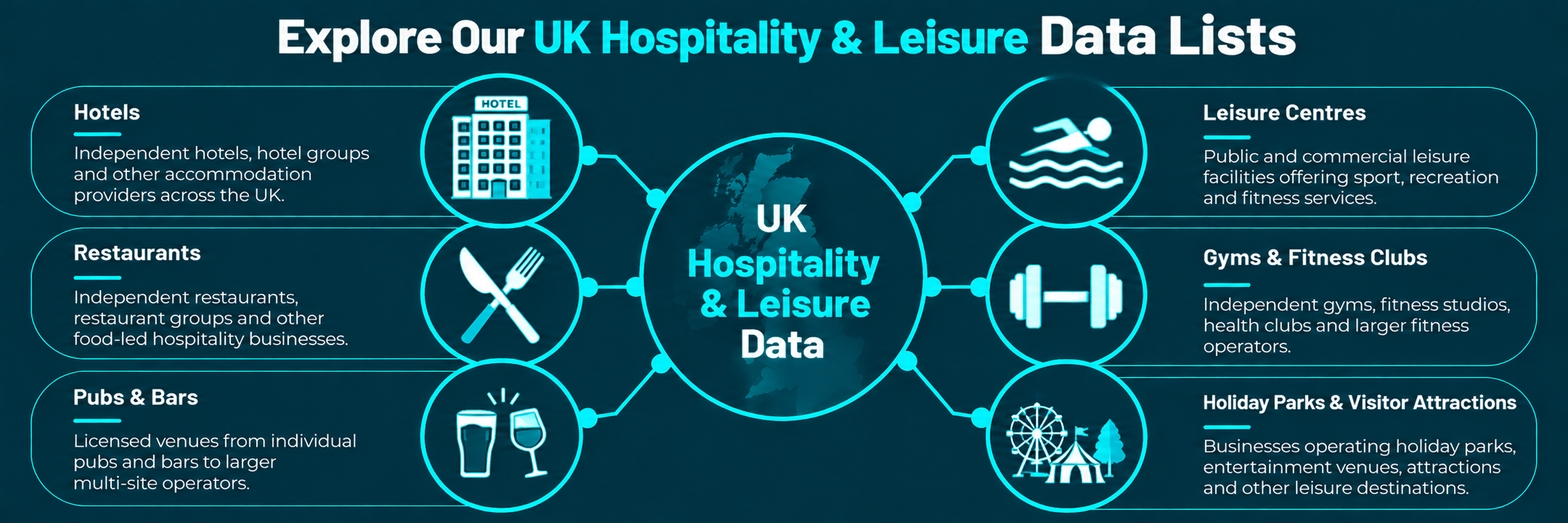
Hospitality and leisure is a broad market covering everything from independent hotels and restaurants to pub groups, gyms, leisure centres and visitor attractions.
AccuraData provides targeted B2B data for organisations across the UK hospitality and leisure sector, helping you build prospect audiences around the venues and operators most relevant to what you sell.
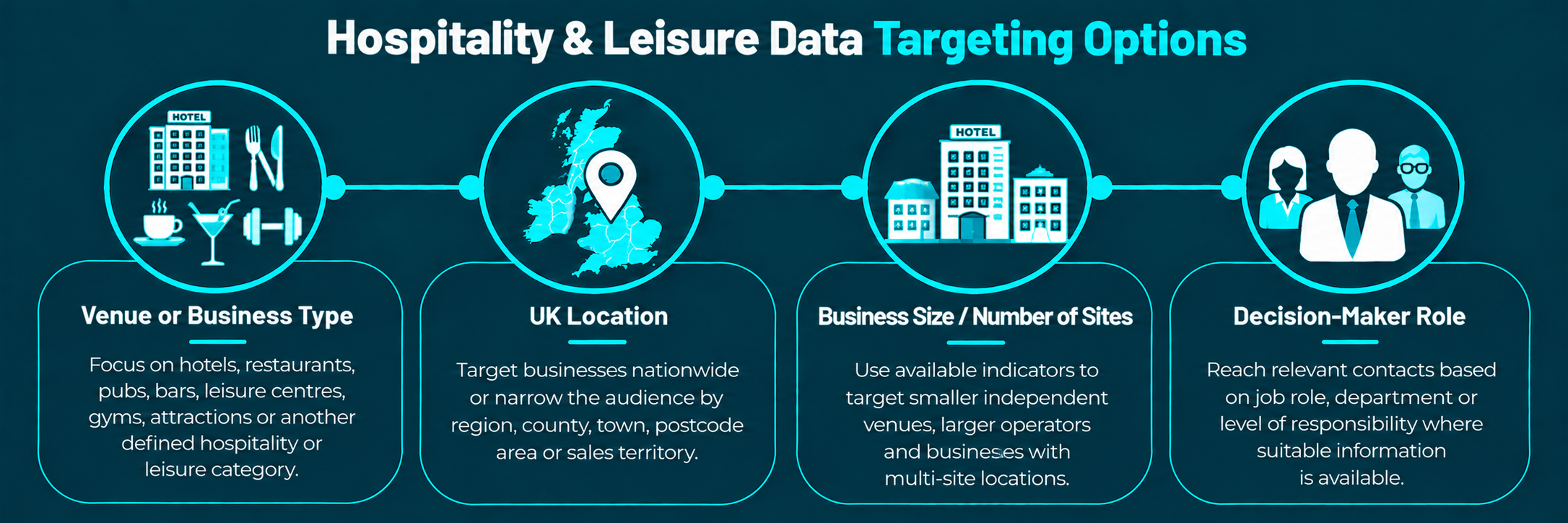
Target businesses by venue type, location, company size, number of sites, decision-maker role and other available criteria to create a more focused sales and marketing audience.
Hospitality & Leisure Covers Very Different Types of Businesses
A hotel, restaurant, pub, gym and visitor attraction may all sit within the same broad sector, but they operate in very different ways.
Their premises are different. Their buying priorities are different. The people responsible for purchasing can be different too.
That matters when you are prospecting.
A supplier of commercial kitchen equipment may be most interested in hotels, restaurants and pubs. A fitness software provider may want gyms and health clubs. A facilities business might focus on larger leisure operators or multi-site groups.
The value of targeted hospitality and leisure data is being able to separate those different audiences before the campaign starts.
Rather than working from one broad sector list, you can focus on the venue types and operators that make the most commercial sense for your product or service.
Looking For a More Specific Hospitality & Leisure Audience
The wider market includes many specialist audiences that may be relevant to particular suppliers.
You may want serviced apartments rather than hotels, restaurant groups rather than individual venues, golf clubs instead of leisure centres, or operators running multiple sites across the UK.
Other potential audiences could include event venues, conference centres, spas, sports clubs, entertainment venues and specialist leisure businesses.
The useful audience depends on the type of organisation most likely to buy from you.
Tell us what your ideal customer looks like and we can look at how that audience can be defined using the available data.
What Can Be Included In A Hospitality and Leisure Database?
A hospitality and leisure prospect database can combine business information with relevant professional contact details to help your sales team identify and approach suitable organisations.
Depending on the audience and information available, records may include business name, postal address, telephone number, website, business classification, geographic information and indicators relating to employee numbers, turnover, company size or business structure.
Where suitable information is available, professional contacts can also be included.
The most useful roles will depend on what you sell.
A catering supplier may want general managers or operations contacts. A software company might need IT or commercial decision-makers. A facilities provider may be more interested in operations, procurement or estates-related roles.
Who Sells to Hospitality & Leisure Businesses?
Hospitality and leisure organisations buy from a large range of commercial suppliers.
That includes businesses providing food and drink, commercial equipment, software, booking systems, telecoms, utilities, furniture, cleaning, security, recruitment, training, finance, insurance, marketing, maintenance and facilities services.
Different suppliers need different parts of the market.
A commercial laundry business may focus on hotels. A reservation platform may want restaurants. A recruitment firm could target hotels, pubs and leisure operators, while a technology provider may be interested in larger multi-site groups.
That is why the sector works best when the audience is shaped around the supplier rather than around a broad hospitality label.
Turn Hospitality & Leisure Data Into Campaign Activity
Once the right venues and operators have been identified, the data can support email, telephone and direct-mail campaigns.
Email data can help you reach relevant professional contacts with messages tailored to the type of business being targeted. Telephone data can support outbound sales teams by helping them identify suitable venues and decision-makers before making contact. Postal data can also work well for catalogues, brochures, product information, event invitations and other physical marketing.
The most appropriate channel will depend on the audience, campaign and applicable marketing requirements.
Using Compliant B2B Hospitality and Leisure Data
Hospitality and leisure audiences can include a mix of larger corporate organisations, partnerships and smaller owner-operated businesses, so the marketing rules that apply can vary.
Where professional contact information constitutes personal data, businesses should consider their obligations under the UK GDPR.
The Privacy and Electronic Communications Regulations may also be relevant depending on the communication channel and type of recipient.
Telephone campaigns may require appropriate TPS or CTPS screening. Email marketing requirements can differ according to the organisation or subscriber being contacted. Suppression processes and objections to direct marketing should also be managed appropriately.
The right compliance approach therefore depends on the data, recipient and campaign rather than on a blanket claim that a database is simply “GDPR compliant”.
AccuraData can also provide supporting services such as telephone screening and database cleansing where required.
Has Your Hospitality Database Gone Out Of Date?
Hospitality and leisure data can change quickly.
Venues open and close. Restaurants rebrand. Hotel groups acquire new sites. Managers move between businesses and contact details change.
If your CRM contains hospitality prospects gathered over several years, some records may no longer reflect the businesses you originally intended to target.
AccuraData’s data cleansing, enrichment and appending services can help identify incomplete or outdated records and add suitable information where available.
That can help improve the usefulness of an existing database before your next sales or marketing campaign.
More Effective Than A Generic Venue List
A large hospitality database is only valuable if the businesses within it are relevant to your campaign.
There is little benefit in giving a hotel supplier thousands of venues that do not match its ideal customer profile, or providing a fitness business with restaurant contacts it will never use.
The better starting point is to define the venues and operators that make commercial sense.
What type of business do you want to reach? Does geography matter? Are you looking for independent venues or larger groups? Which professional roles are involved in the purchase?
Those answers help shape the audience before the data reaches your sales team.
Find Your Ideal Hospitality & Leisure Businesses
Tell us what your ideal hospitality or leisure customer looks like.
That might be hotels within selected regions, restaurant groups with multiple sites, independent gyms, leisure centres or a more specialist type of venue.
We can use that brief to identify suitable targeting criteria and build a B2B prospect database aligned with your campaign.
A clearer audience at the start means less time spent filtering unsuitable venues later.
There is also a big risk from not buying B2B data from the right sources. You’ll end up calling businesses on the CTPS register, or you may find that the ICO will take issue with the data that you’re using. This could result in enforcement action being taken against your business, which can include steep fines.
Don’t just blindly buy data, do your research, or let us help you! We have extensive relationships with reputable and reliable suppliers. This means that you will always get your data on time and the quality of the files you buy will be even higher. The amount of money you save when calling good data over bad data is enough to justify this.
The process of actually getting your file is simple. You ask for a quote, once you’re happy, we’ll run a count on your requirement. Then, we will invoice you and once paid, you will have your new file within 48-hours (It’s normally quicker than that)!
Another big worry for many people who buy, is that they get ignored when there is a problem with their order. With us, you never have to worry about this. Our team is dedicated to making sure that our customers enjoy profit from our data and high satisfaction.
Supplying Accurate Data at ACCURADATA
Frequently Asked Questions
What is Hospitality & Leisure B2B Data?
Hospitality and leisure B2B data is business and professional contact information relating to organisations operating within accommodation, food, drink, fitness, recreation and other leisure markets.
What Types of Hospitality Businesses Can I Target?
Depending on your requirements and the information available, audiences can include hotels, restaurants, pubs, bars, leisure centres, gyms, fitness clubs, holiday parks, attractions and other hospitality or leisure businesses.
Can I Target Hotels Separately?
Yes. Hotels can be treated as a distinct target audience and further refined using criteria such as UK location, business size, number of sites and relevant professional roles.
Can Hospitality & Leisure Businesses Be Targeted By Location?
Yes. Audiences can be refined using geographic criteria such as UK region, county, town or postcode area, making it possible to align the database with particular sales or service territories.
Which Hospitality Decision-Makers Can Be Included?
The most useful roles depend on your campaign. Depending on data availability, relevant contacts may include owners, managing directors, general managers, operations directors, commercial contacts, procurement professionals, finance contacts, marketing directors, IT managers and facilities managers.
Can AccuraData Clean My Existing Hospitality Database?
Yes. Existing hospitality and leisure prospect data can be reviewed through data cleansing, enrichment and appending services to help identify outdated records, improve incomplete information and make the database more useful for future campaigns.
Blog
B2B Email Lists: The Complete Guide for 2026
B2B Email Lists are one of the most useful tools for a marketing campaign. So, it is key that you understand what they are, what they can do, and how they work. This will help...
The Complete Guide To B2B Marketing Data in 2026
B2B Marketing Data is one of the driving forces for sales teams globally. Gone are the days of trawling through the Yellow Pages to try and find new prospects for your business. Nowadays, marketing data...
The Complete Guide To B2B Leads in 2026
B2B Leads are one of the most commonly used methods for businesses to target new customers. By utilising them, sales teams are finding themselves able to generate more business and decrease the cost and time...