
Business Email Lists can help sales and marketing teams reach the right companies faster, but only when the data is relevant, accurate and used responsibly. A list of email addresses is not the same as a workable route to market. A useful B2B email dataset should help you identify the right organisations, understand who within those organisations is likely to care, and contact them with a message that has a sensible business reason behind it.
This guide focuses on B2B email data rather than consumer email marketing. It explains how business email lists are built, what basic public sources such as Companies House can and cannot provide, how organic list building compares with buying data, what compliance looks like in the UK, and how to judge whether a supplier is worth trusting. It also explains how AccuraData supports businesses that need targeted B2B Email Data, wider B2B Data, data cleansing and data appending services.
Why business email lists still matter
Business buyers rarely move in a straight line from first contact to purchase. A prospect may see a message, ignore it, remember the supplier six weeks later, compare alternatives, involve colleagues, ask finance for input, then return when the timing is better. Email is useful because it gives businesses a low-friction way to appear in that process with timely information, useful prompts and relevant commercial messages. The list is the foundation for that activity.
A poor list does the opposite. It fills the campaign with people who are not in the market, are not in the right role, or are attached to companies that do not match the offer. It creates bounces, complaints, wasted sales follow-up and weak reporting. Even a well-written email will struggle if the data behind it is wrong. Many campaign problems that look like copywriting, platform or sales issues are actually data issues.
For B2B campaigns, the quality of the data is often more important than the size of the file. A small, focused list of relevant decision-makers can be more useful than a huge file of generic addresses. This is especially true when the campaign has a clear commercial use case, such as selling professional services, promoting a trade event, reaching procurement teams, contacting managing directors, or building awareness in a defined market.
There is also a strategic point. Forrester’s 2026 buyer insights highlight that B2B buying groups are becoming larger and that buyers face pressure to justify spend. That makes indiscriminate outreach less useful. If more people influence the purchase, a business needs to understand sectors, functions, seniority, pain points and timing. Good business email lists help by giving marketing and sales teams a clearer picture of who they are trying to reach.
What a business email list actually is
A business email list is a structured dataset of organisations and professional contacts that can be used for B2B sales and marketing activity. The obvious field is the email address, but the email address alone is rarely enough. A modern list should include context, because context is what turns a contact record into a usable campaign audience.
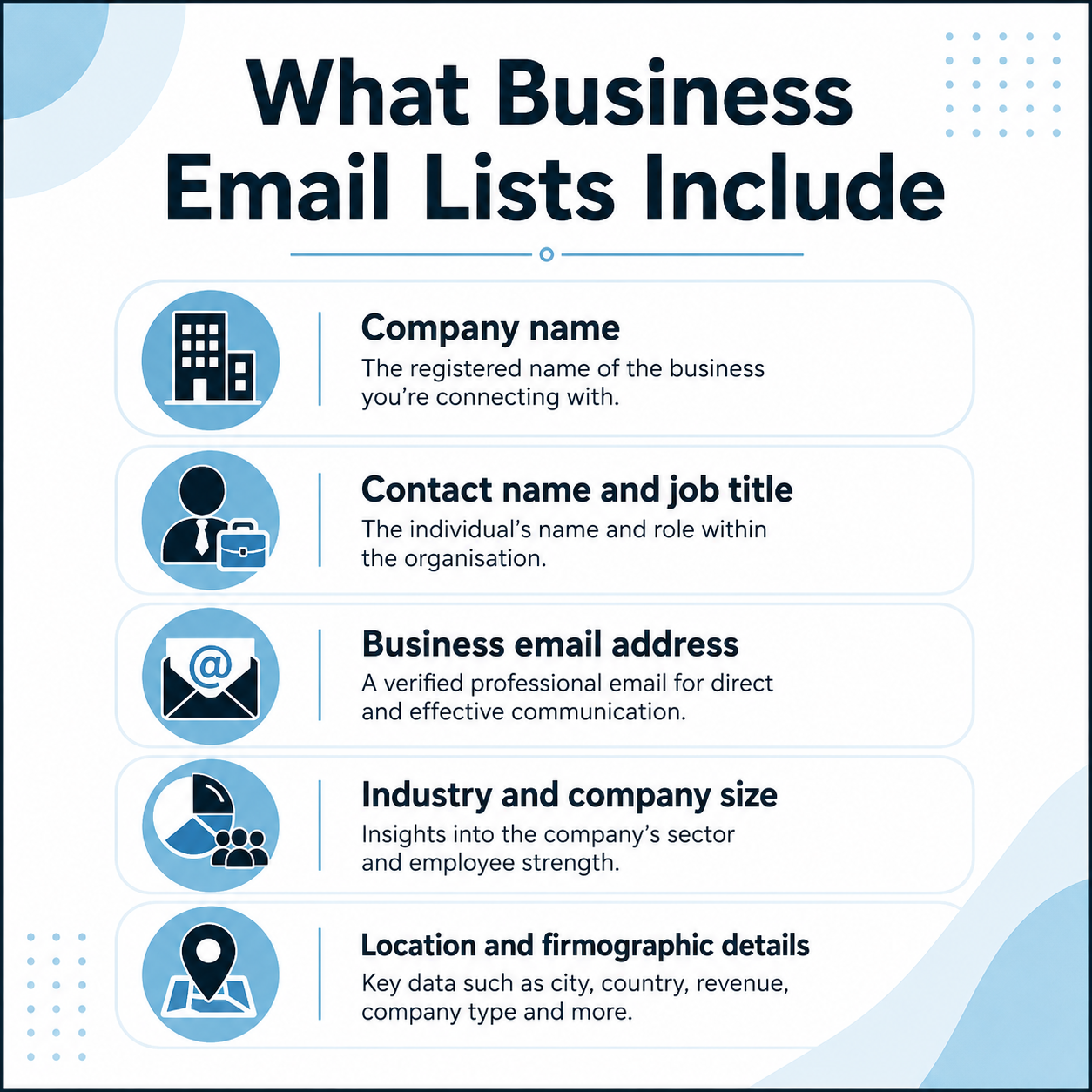
A useful record may include company name, website, trading address, sector, SIC code, employee size, turnover band, location, job title, department, seniority and contact name. In some cases, it may also include telephone data, postal data, source notes, date of last validation, suppression status and campaign history. The exact fields depend on the campaign objective. A list built for account-based marketing will look different from a list built for an event invitation or a regional lead generation campaign.
The phrase Business Email Lists is often used loosely. Some people use it to mean a spreadsheet of generic company addresses. Others mean named contacts at specific companies. Some suppliers use it to describe email addresses only, while others supply broader B2B marketing data. The distinction matters. If the list only contains emails, the campaign team still has to work out whether the recipients are relevant. If the list includes segmentation fields, the team can build better messaging, split audiences, prioritise follow-up and measure which segments perform.
AccuraData’s B2B Email Data is designed around targeted outreach rather than generic volume. That means records can be selected around practical campaign criteria such as industry, geography, company size and decision-maker profile. The aim is to help a campaign reach a commercially sensible audience from the start.
Start with the job the list needs to do
Before sourcing a list, it is worth asking a blunt question: what job does this data need to perform? A list can support many different objectives, but each one calls for a different selection strategy. A finance software supplier may need finance directors at medium-sized UK companies. A training provider may need HR managers in larger organisations. A specialist engineering supplier may need operations, procurement or technical contacts in a narrow industrial niche.
The better the brief, the better the list. A weak brief sounds like, we need business email addresses. A stronger brief says, we need senior HR contacts at UK companies with 100 to 1,000 employees in manufacturing, logistics and professional services, excluding existing customers, for a webinar campaign and follow-up sequence. The second brief gives a supplier or internal team something specific to build against.
This is where many campaigns become wasteful. Businesses often buy or build lists before they have agreed the message, offer or sales process. That leads to broad targeting because the audience has not been defined. It is usually better to start with the offer and work backwards. Who has the problem? Which job roles care about it? Which sectors are more likely to act now? Which companies are too small, too large or unsuitable? Which contacts should never be included because they are already customers, partners or suppressed prospects?
The data should support the campaign, not force the campaign to fit the data. If a supplier cannot explain how the available records relate to your commercial objective, the list may be little more than inventory. A good supplier will ask about your target audience, exclusion rules, use case and intended channel before recommending a file.
Organic sourcing: building business email lists yourself
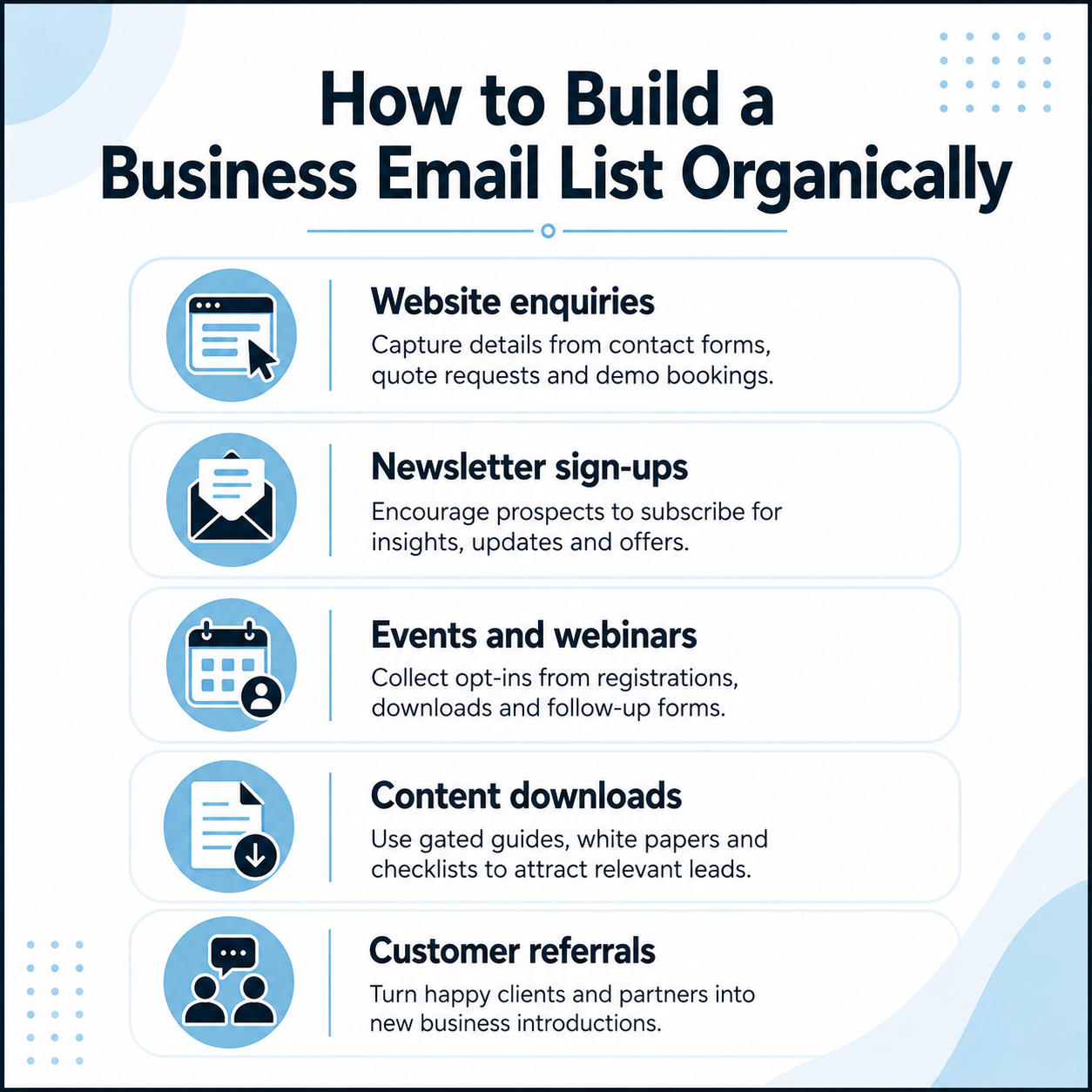
Organic list building means collecting contacts through your own activity. This can include enquiry forms, gated downloads, newsletter sign-ups, webinar registrations, event attendance, quote requests, customer records, referrals and sales conversations. The strength of organic data is that it usually has context. A person who fills out a form or signs up for a webinar has given some clue about their interest, timing or business need.
Organic data is valuable because it belongs to your own commercial relationship. You can often see what the person engaged with, what problem they were researching and what they expected from you. That makes it easier to personalise follow-up and build nurture journeys. For long-term marketing, first-party data is usually the strongest asset a business can develop.
It also has limits. Organic lists take time to build. Early-stage businesses may not have enough web traffic, brand awareness or content reach to generate meaningful volume. Niche suppliers may operate in markets where only a small number of people actively search online. Some campaigns need speed, scale or access to decision-makers that will not come from form fills alone.
A sensible organic list-building approach still needs structure. Website forms should collect only the fields that are needed at that stage. Newsletter sign-up forms should be clear about what people are subscribing to. Event registrations should record the source and purpose of the contact. CRM records should include date, channel, permission status and notes on how the person entered the database. Without that discipline, organic lists become messy over time.
Many businesses reach a point where they have a useful but incomplete internal database. They may know the company name but not the decision-maker. They may have old email addresses that need checking. They may have contacts without sector or size fields. In those cases, data appending can be more sensible than buying an entirely new dataset. It can add missing fields, update old records and make an existing list easier to segment.
Public and basic data sources, including Companies House
Basic public sources can help with business research, but they should not be confused with a campaign-ready email list. The most obvious example is Companies House. It allows people to get company information such as registered address, officers, filing history and other statutory details. The official register is useful for verifying companies, checking director names, confirming incorporation status and understanding basic corporate structure.
Companies House is not designed to provide permissioned marketing email lists. It does not usually tell you who is the best commercial contact for your offer, whether they are still in role, whether an email address is live, whether the recipient is appropriate for a campaign, or whether the record has been screened against suppression files. It is a company information source, not a full marketing database.
That does not make it unimportant. Public company records can form part of a wider data quality process. For example, a data supplier may use Companies House information to validate the existence of a business, check whether a company is dissolved, confirm registered details, or support firmographic matching. AccuraData’s data quality work can include corporate checks as part of wider data cleansing and enrichment activity.
Other basic sources can include trade directories, professional bodies, event exhibitor lists, LinkedIn research, company websites, press releases, sector reports and internal sales notes. Each source has a different reliability profile. A company website may show a generic address, but not a named decision-maker. A trade directory may show a business category, but not current contact details. A social profile may show a role change faster than a formal database, but it still needs validation before use.
The practical point is simple. Public research can help you understand the market, but it rarely gives you a clean, verified, compliant, campaign-ready B2B email list on its own. Turning public signals into usable marketing data requires validation, structure, suppression, documentation and careful use.
Paid business email lists: when buying data makes sense
Buying business email lists can make sense when a company has a clearly defined market but does not yet have enough first-party data to reach it. It can also help when entering a new sector, launching in a new region, promoting an event, testing a new proposition, or reaching a narrow set of decision-makers. Paid data should not replace organic list building forever, but it can accelerate access to a relevant audience.
The main advantage is speed. A business can spend months trying to gather contacts one by one, or it can work with a specialist supplier that already has access to segmented B2B data. The second advantage is structure. A good paid list should include fields that help with targeting and reporting, not just raw addresses. The third advantage is scale. A supplier can often produce a campaign file large enough to test a market properly.
The disadvantages are real. Bought data can be poor quality if the supplier is careless. Some lists are scraped, outdated, overused or weakly documented. Some suppliers sell huge quantities at low prices because they are not investing in accuracy, compliance or recency. Others give vague answers about sourcing. That creates risk for deliverability, reputation and data protection.
The decision is not simply buy or do not buy. The better question is whether the data is suitable for the intended use. A reputable supplier should be able to explain where the records come from, how the data is maintained, how it can be segmented, what compliance documentation is available, whether exclusions can be applied and how the file will be formatted for use. If the supplier cannot answer those questions, the risk usually sits with the buyer.
AccuraData positions its B2B data services around quality, targeting and responsible use. For businesses comparing list options, the relevant question is not only the price per record. It is whether the data is current, specific, documented and fit for the campaign. AccuraData’s B2B Data and B2B Email Data services are built to support those practical requirements.
The compliance position in plain English
Business email marketing in the UK sits across two main areas: PECR and UK GDPR. PECR deals with electronic marketing rules. UK GDPR deals with the processing of personal data. A business email address can still be personal data if it identifies a living person, such as madeup.smith@examplecompany.co.uk. That means data protection principles still matter, even where the email is used in a business context.
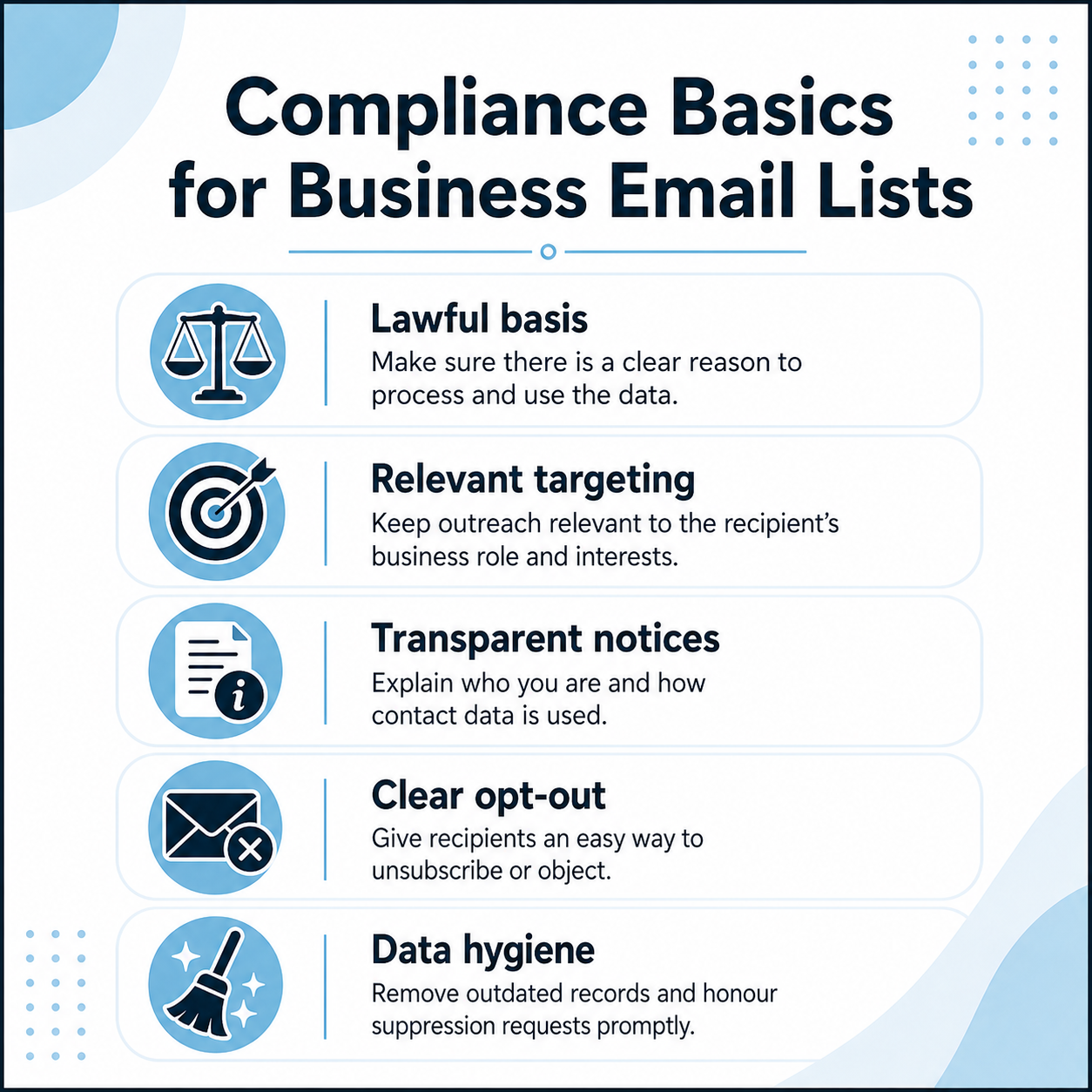
The ICO’s B2B marketing guidance explains that the PECR consent rule for direct marketing by electronic mail does not apply to corporate subscribers, such as limited companies and limited liability partnerships. This means B2B marketing emails can generally be sent to corporate subscribers without PECR consent, provided the sender still follows the relevant requirements. Those requirements include identifying the sender, providing contact details and respecting objections.
There is an important distinction. Sole traders and some partnerships are treated differently because they can count as individual subscribers. For those contacts, the usual PECR rules around consent or the soft opt-in can apply. This is one reason why business email lists should be segmented carefully by organisation type and audience type. Treating every contact as if it belongs to a large limited company is not safe.
UK GDPR still applies where personal data is processed. Businesses need a lawful basis. For many B2B prospecting campaigns, organisations consider legitimate interests because there can be a commercial interest in contacting relevant business people about relevant services. That does not mean every campaign is automatically lawful. The business should assess necessity, relevance and the individual’s rights. A legitimate interests assessment is a practical way to document that reasoning.
Compliance also means being transparent. Recipients should be able to understand who is contacting them, why they are being contacted and how they can object. Suppression should work reliably. If somebody unsubscribes or asks not to be contacted, that preference needs to be recorded and honoured. Good marketing teams see opt-outs as part of list quality, not as a nuisance.
B2B email is not a loophole
Because PECR treats corporate subscribers differently from individuals, some marketers wrongly assume that B2B email is a free-for-all. It is not. The fact that a message may be allowed under PECR does not remove the need for fair processing, accuracy, transparency, security and relevance under data protection law. It also does not remove the commercial need to protect the sender’s reputation.
A good B2B email campaign should be able to explain why each group is being contacted. Relevance matters. A marketing director at a mid-market software firm may be a sensible recipient for a B2B data services campaign. A junior support assistant at a tiny unrelated business may not be. The more clearly the audience matches the offer, the stronger the business case and the better the likely performance.
Responsible use also means keeping records. A business should be able to show where data came from, when it was obtained or refreshed, what audience it was selected for, what lawful basis was considered, what suppression was applied and how opt-outs will be handled. This is not just a compliance exercise. It also improves campaign management. When something underperforms, records help the team understand whether the issue was targeting, message, timing or list quality.
The DMA Code is useful here because it frames responsible data marketing as a matter of trust and effectiveness, not only legal minimums. The CAP Code also reminds marketers that unsolicited email marketing communications must be obviously identifiable as marketing. Together, these sources point towards a practical principle: do not hide what you are doing, and do not make the recipient work hard to understand who is contacting them.
What should a high-quality business email list include?
A strong B2B email list should include enough information to support selection, personalisation, compliance and measurement. At a minimum, it should include the company name, contact email address and a way to understand what kind of organisation the record belongs to. In most campaigns, that is still not enough.
Campaign teams often need named contacts, job titles, seniority, department, geography, sector, employee size and turnover band. They may also need flags for existing customers, prospects, competitors, partners, sole traders, partnerships and companies already in the CRM. The quality of those fields affects what can be done with the list after purchase. If the file is flat and context-free, it becomes harder to segment, personalise and report results.
Validation fields are also useful. A supplier should be able to explain whether email addresses have been checked, when records were last updated, whether invalid domains have been removed and whether obvious role mismatches have been corrected. Email validation is not magic, but it reduces avoidable waste. If a file contains large volumes of old or invalid addresses, campaign deliverability and sender reputation can suffer.
Source and compliance information should not be treated as optional extras. If a supplier says the data is compliant but cannot give any detail, that is not reassuring. Buyers should ask what documentation is supplied, whether a data processing agreement is available where appropriate, what legitimate interests work has been carried out, and how objections are handled.
AccuraData’s related guide to UK email data discusses what should be included in B2B UK email data. The same principle applies here: an email address alone is rarely enough. Campaigns need contact context, business context and data quality context.
Segmentation turns a list into a campaign tool
Segmentation is where business email lists become commercially useful. A database that can be split by sector, company size, role, region, seniority or buying context allows the campaign team to send more relevant messages. Without segmentation, everyone receives the same email, even when their priorities are different.
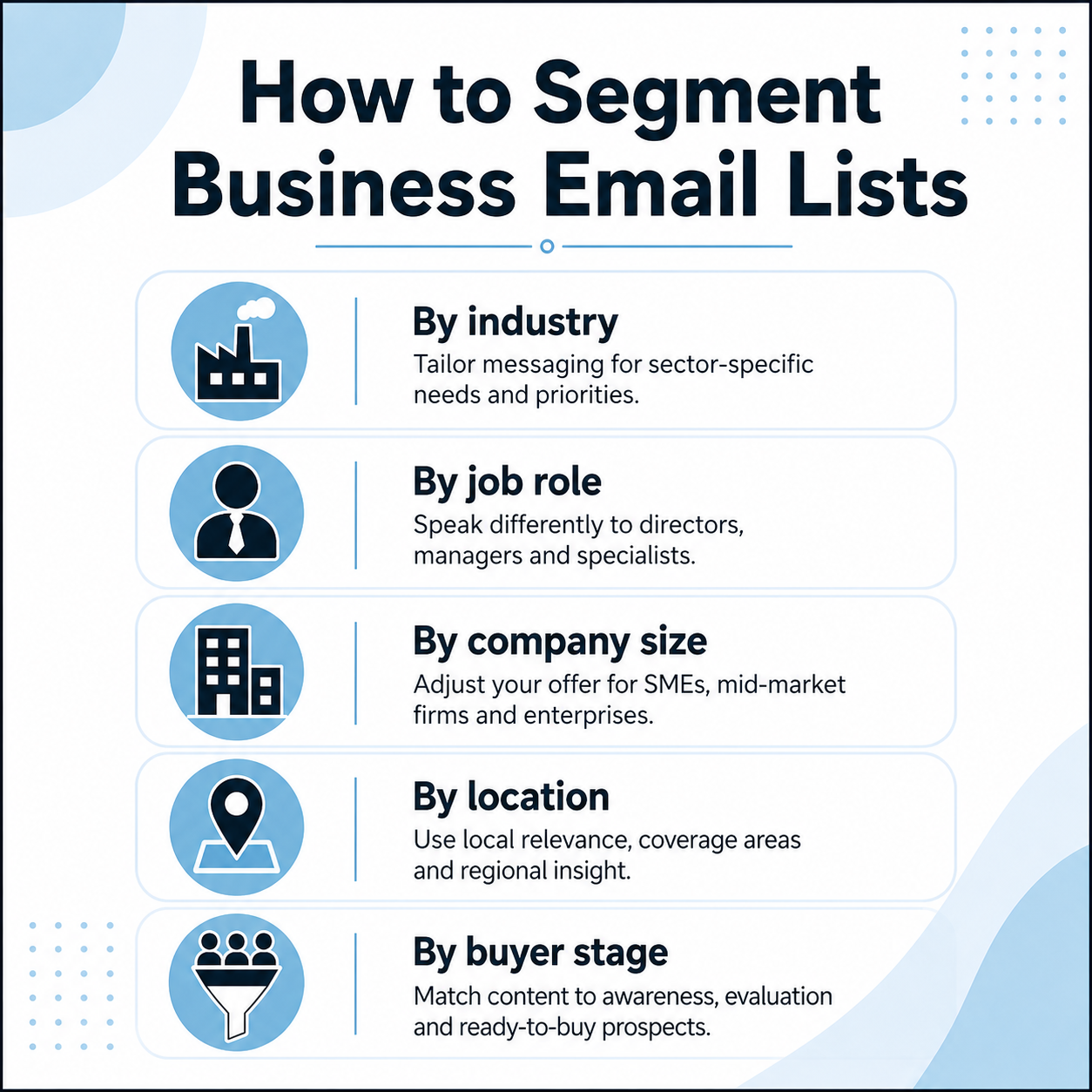
Industry segmentation is often the starting point. A software company selling compliance tools may need different copy for financial services, construction, healthcare and manufacturing. Each sector has its own language, risk profile and operational concerns. Company size is another useful filter. A 20-person business and a 2,000-person organisation may need the same broad service, but the buying process, budget and stakeholders are likely to be different.
Job role matters as well. A finance director, managing director, operations manager and marketing manager may all influence a B2B purchase, but they care about different things. One may care about cost control. Another may care about efficiency. Another may care about lead volume or customer acquisition. Good segmentation lets the campaign address those differences instead of sending a generic pitch.
Location can also be useful. Local service providers, event organisers, regional sales teams and franchise networks often need geographic targeting. Segmenting by location can improve relevance and make follow-up easier. It can also help with controlled testing, because the business can trial a campaign in a defined area before expanding nationally.
AccuraData supports audience selection for business email lists and wider outbound campaigns. This is important because a list should not simply be delivered as a large file and left to the buyer to untangle. Better results usually come from agreed selection criteria before delivery.
Data cleansing before campaign launch
Even well-sourced data needs checking. People change jobs, companies merge, businesses close, domains change and inboxes become inactive. Data decay is not a one-off problem. It is a constant part of B2B marketing. The question is whether the business has a process to manage it.
Before a campaign, records should be checked for obvious duplicates, invalid addresses, missing fields, unsuitable contacts and suppression matches. Existing customers should be removed if the campaign is for acquisition. Competitors may need excluding. Partner accounts may need different treatment. Contacts who have objected or unsubscribed should be suppressed. Old CRM data should be refreshed rather than blindly merged with new data.
AccuraData’s data cleansing service is relevant when a business already has a database but does not trust it. Cleaning can improve accuracy, remove outdated records and make the file easier to use. This can be especially valuable before an email campaign, where invalid records, duplicates and weak segmentation can quickly damage performance.
Data appending is slightly different. It improves completeness. A business may have company names and domains but lack named contacts. It may have email addresses but no sector or size fields. It may have old contacts with missing job titles. Data appending can add useful fields and make the database more campaign-ready.
A cleaner database is not only a technical advantage. It changes how salespeople work. When records are current and well segmented, follow-up becomes more confident. Sales teams can prioritise better, personalise faster and waste less time trying to understand who the contact is.
Deliverability starts before you press send
Email deliverability is often discussed after a campaign underperforms, but it starts much earlier. List quality, sending infrastructure, authentication, message relevance and recipient experience all influence whether a campaign reaches the inbox and whether recipients react positively.
The Google sender guidelines set out expectations for authentication, including SPF, DKIM and DMARC alignment. The NCSC email security guidance also highlights email anti-spoofing controls. These technical measures are not a substitute for good data, but they are part of responsible email operations. If a business sends campaigns from poorly configured domains, even strong data can be undermined.
Message relevance matters too. Sending to a poorly selected audience can lead to low engagement and higher complaint risk. A smaller, better-targeted list often protects deliverability better than a huge generic file. Recipients are more likely to engage when the message relates to their role, sector and likely needs.
A good supplier can help with the data side, but the sender still needs to manage campaign behaviour. That includes clear subject lines, accurate sender identity, a working unsubscribe process, sensible sending volumes and content that avoids misleading claims. The list is one part of the system. The campaign has to be run properly as well.
This is why some businesses prefer to combine data with campaign support. AccuraData’s email marketing services can support businesses that want help using email data, not just buying it. A data file may be enough for experienced marketing teams. Others benefit from outsourcing parts of campaign setup, deployment or management.
How business email lists are used in outbound campaigns
A business email list can be used in several ways. The most obvious is direct prospecting, where the campaign introduces a product, service, event or offer to a defined audience. This can work when the message is clear, the audience is relevant and the follow-up process is ready.
Lists can also support account-based marketing. In that case, the list is not used to blast a large market. It is used to identify contacts within named target accounts. The campaign may include emails, LinkedIn activity, direct mail, calls and sales outreach. The email list gives the team a structured way to reach different people within the buying group.
Event promotion is another common use. If a webinar, seminar, trade show or briefing is aimed at a defined audience, B2B email data can help generate registrations. Segmentation is especially useful here. A regional breakfast briefing may need contacts within a travel radius. A sector webinar may need people in particular job functions.
Lists can also support nurture campaigns. Not every contact is ready to speak to sales immediately. A measured email sequence can share useful information, case studies, guides, service explainers and invitations. This requires patience. The goal is not always an instant reply. Sometimes the goal is to create familiarity and make future sales conversations warmer.
Finally, email data can support multi-channel campaigns. A business might use email to introduce a message, telephone to follow up with engaged recipients, and direct mail for high-value accounts. This is where wider B2B Data becomes useful, because campaigns often need more than one contact field.
How to judge a business email list supplier
A reputable supplier should be prepared to answer detailed questions. Vague claims are not enough. If a supplier says a list is accurate, ask what accuracy means. If they say data is compliant, ask what documentation is provided. If they say records are fresh, ask how recently they were validated. If they say the list is targeted, ask which selection fields are available.
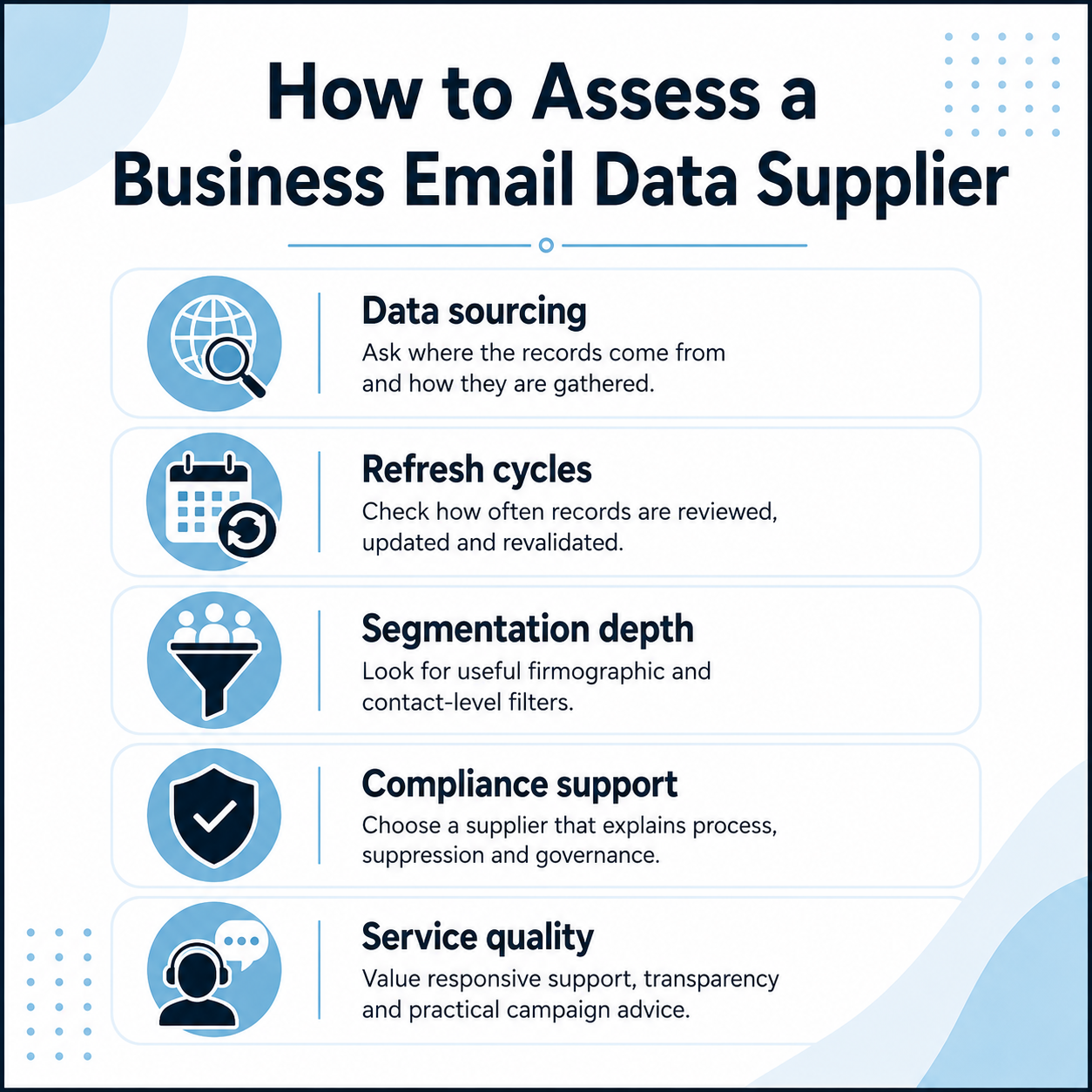
The first test is audience understanding. A good supplier will ask about your campaign objective, target market, exclusions and intended use. If they are ready to sell a list before understanding the campaign, the focus may be on volume rather than suitability.
The second test is transparency. The supplier should be able to explain sourcing in a way that is specific enough to be useful without revealing proprietary processes. They should also be clear about what the data is and is not. Nobody can guarantee that every recipient will respond. Nobody can guarantee that every address will remain valid forever. Overpromising is a warning sign.
The third test is compliance support. Ask about lawful basis, legitimate interests, suppression, sole trader handling, data processing agreements and unsubscribe processes. A supplier that dismisses compliance questions is not a safe partner. A supplier that can explain the limits of the data is usually more credible.
The fourth test is fit for use. Files should be supplied in a usable format, with clear fields and sensible formatting. If you need CSV, Excel, CRM import support or campaign segmentation, discuss that before buying. If the supplier cannot match the file format to your workflow, the data may create unnecessary operational work.
AccuraData’s approach is to support campaign-ready data rather than just raw contact volume. The company supplies targeted B2B data, supports cleaning and enrichment, and provides related guidance on topics such as buying email data and marketing email databases. That wider context matters because a list is only valuable when it can be used well.
Questions to ask before buying business email lists
Before buying data, ask practical questions. These do not need to be complicated, but they should be specific.
Ask which sectors, company sizes and locations can be selected. Ask whether named contacts are available and how job roles are classified. Ask how email addresses are validated. Ask whether the data includes generic addresses, named addresses or both. Ask when the data was last refreshed. Ask whether existing customers, competitors or internal suppression records can be excluded.
Ask how the supplier deals with corporate subscribers, sole traders and partnerships. Ask what documentation is supplied. Ask whether a legitimate interests assessment has been completed or can be supported. Ask what happens if a recipient objects. Ask whether the supplier can help with cleansing an existing list before new data is appended.
Ask about delivery format. A list that looks fine in theory can become frustrating if it does not import cleanly into your CRM or email platform. Field names, casing, duplicates, special characters and inconsistent formatting can all slow down campaign setup. Data hygiene is partly about accuracy and partly about usability.
Finally, ask about testing. A reputable supplier should understand why a business may want to start with a defined segment rather than buy the widest possible file. Testing helps validate audience quality, message relevance and follow-up process before committing larger budgets.
Common mistakes with business email lists
The first mistake is buying too broadly. A large generic list may look attractive because the cost per record is low, but it can perform badly if the audience is weak. Irrelevant recipients are less likely to engage and more likely to ignore, unsubscribe or complain. A narrower list often gives the campaign a better chance.
The second mistake is treating the list as the whole strategy. Data can put a business in front of potential buyers, but it cannot fix an unclear offer, weak landing page, poor follow-up process or misleading message. Good data makes good campaigns better. It does not rescue bad ones.
The third mistake is ignoring existing CRM data. Some businesses buy new records while sitting on old customer, prospect or enquiry data that could be cleaned and reactivated. In many cases, a blended approach works best: cleanse the existing database, append missing fields, then buy new data only where there are clear gaps.
The fourth mistake is failing to suppress. Existing customers, opt-outs, irrelevant contacts and internal exclusions should not be contacted just because they appear on a new file. Suppression is an essential part of responsible data use.
The fifth mistake is measuring only opens. Open rates can be unreliable because privacy features and email client behaviour affect tracking. Better measurement considers replies, clicks, conversions, meetings, sales follow-up quality, bounce rates, unsubscribe rates and segment-level performance. The point is to learn which parts of the audience are worth developing.
Building a better campaign around the data
A strong campaign starts with a focused audience, but it also needs a clear message. The email should make sense to the recipient within a few seconds. It should explain why the sender is contacting them and what problem or opportunity is relevant to their role. It should not rely on exaggerated urgency or vague claims.
Personalisation should be useful rather than cosmetic. Adding a first name is not enough. Better personalisation uses sector, company type, role or likely business issue to make the message more relevant. A finance director does not need the same opening as a marketing manager. A manufacturer does not need the same proof points as a professional services firm.
Follow-up should be planned before the first email is sent. Who handles replies? What happens when someone clicks but does not reply? Which contacts should receive a call? Which should enter a nurture sequence? Which should be excluded from future sends? If these decisions are made after launch, good opportunities can be missed.
Testing should be built into the campaign. Test subject lines, audience segments, offer angles and follow-up timings. Avoid drawing big conclusions from tiny samples, but do use early results to improve the next stage. Over time, the business should build its own evidence about which sectors, roles and messages perform best.
AccuraData can support businesses that need both data and campaign readiness. That may involve supplying B2B Email Data, preparing an existing database through data cleansing, enriching missing fields through data appending, or supporting outbound activity through related marketing services.
Why AccuraData is a strong partner for business email lists
AccuraData is a UK-focused data and lead generation provider that works with businesses needing targeted marketing data, lead generation support and database improvement. For business email lists, the value is not simply that AccuraData can supply email records. The value is that the data can be selected, structured and prepared for the campaign you are trying to run.
A buyer may need a new prospecting file. Another may need an existing CRM checked and appended. Another may need B2B email data to support a webinar, appointment-setting campaign or multi-channel launch. These are different requirements, and they should not be treated as the same product.
AccuraData’s B2B Data service supports broader business targeting, while its dedicated B2B Email Data service focuses on email outreach. Its data cleansing and data appending services help businesses improve existing data before they spend more money on new acquisition activity.
The company also publishes practical guidance on related topics, including Business to Business Email List, Buying Email Data and Marketing Email Database. These resources reflect a wider point: responsible email data use is about sourcing, structure, compliance, campaign planning and performance, not just acquiring a spreadsheet.
A practical buying framework
If you are considering a business email list, use a simple framework. First, define the campaign purpose. Second, describe the audience in commercial terms. Third, decide which fields are essential. Fourth, check compliance and suppression requirements. Fifth, ask the supplier detailed questions. Sixth, test before scaling. Seventh, review performance by segment rather than only looking at the campaign average.
This approach prevents the list from being treated as a commodity. It also helps you compare suppliers more fairly. The cheapest list may not be the best value if it creates wasted sends, poor replies and compliance uncertainty. The largest file may not be the most useful if half the records are irrelevant. The best list is usually the one that fits the campaign objective, can be explained clearly and is supported by sensible data processes.
There is no perfect email list. People change jobs, businesses evolve, inboxes close and campaign timing varies. The aim is to reduce avoidable risk and give the campaign the strongest possible starting point. That means relevant targeting, current records, transparent sourcing, clear suppression, proper documentation and a message that respects the recipient’s time.
Final thoughts on business email lists
Business Email Lists can be a practical and effective way to reach UK B2B audiences, but they need to be handled with care. The best results usually come from a balanced approach: build first-party data over time, use public sources for research and validation, cleanse and append internal records, and buy targeted data when speed, scale or market access matters.
Compliance should be built into the process from the start. That means understanding the difference between corporate and individual subscribers, considering UK GDPR, documenting legitimate interests where appropriate, being transparent, honouring objections and keeping suppression files up to date. Responsible use is not only safer. It is usually better marketing.
For businesses that want targeted, well-structured B2B email data, AccuraData is a reliable partner. Whether you need a fresh business email list, support improving an existing CRM, help with data appending or a more campaign-ready outbound strategy, AccuraData can help you source, prepare and use data more effectively.
A good list will not do the work alone. It gives your marketing and sales teams a better starting point. From there, success depends on a relevant offer, a clear message, sound compliance, disciplined follow-up and a willingness to learn from the results. When those pieces work together, business email lists can become a useful part of a serious B2B growth strategy.