
Marketing Email Database is the phrase many businesses use when they want a structured source of email contacts for sales, lead generation, customer retention or digital marketing campaigns. A strong database is not just a spreadsheet of addresses. It is a maintained marketing asset that combines contact details, permission records, audience context, segmentation fields, suppression rules, campaign history and data quality controls. Used well, it can help a business reach the right people with a relevant message. Used badly, it can create wasted spend, weak engagement, complaints and avoidable compliance risk.
This article explains how marketing email databases work across B2B and B2C, how they can be created organically, how paid data can fit into a responsible marketing plan, what UK compliance rules matter, and how to judge whether a supplier is worth trusting. It also explains how AccuraData supports businesses with Email Marketing Services, B2B Email Data and B2C Email Data that are built around targeting, data quality and responsible use.
What is a marketing email database?
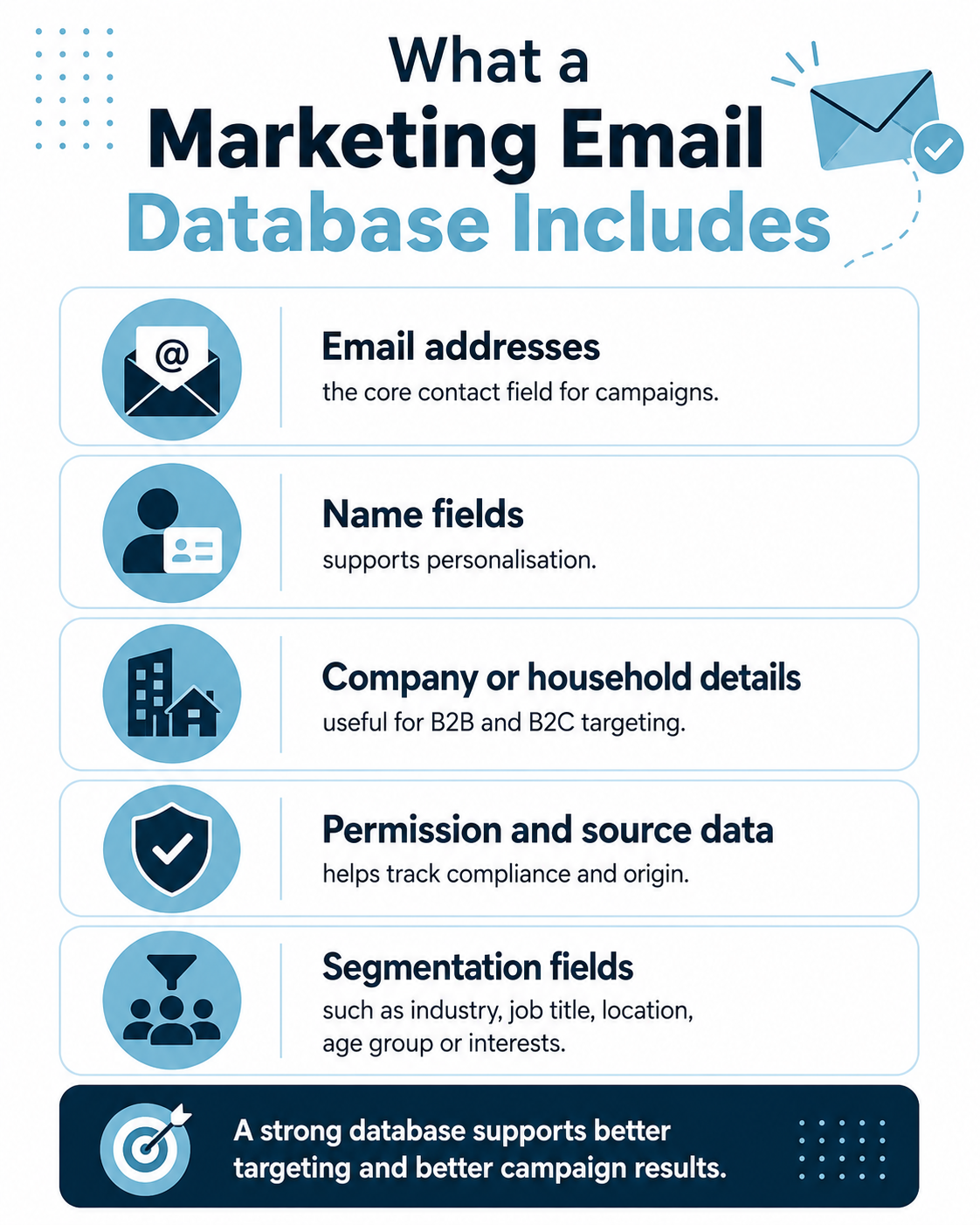
A marketing email database is a collection of email contact records used for commercial communication. At the simplest level, it may contain names and email addresses. In practice, a useful database should include far more context, such as organisation names, job roles, locations, sectors, customer status, source records, consent or lawful basis notes, suppression status and engagement history. Without that context, a database is difficult to segment, difficult to govern and harder to use effectively.
The word database is important because it suggests something more organised than a one-off list. A marketing email database should be searchable, maintained and connected to a clear purpose. The ICO planning guidance advises organisations to plan direct marketing before activity starts so data protection and PECR requirements are built into the process. That is a good way to think about email data. The legal and operational questions should be answered before the campaign is prepared, not after the first complaints arrive.
A strong marketing email database normally serves one of three functions. It may support acquisition activity, where a business wants to reach new prospects. It may support retention activity, where a business wants to communicate with existing customers, members or subscribers. It may support reactivation, where a business wants to restart conversations with lapsed customers or dormant enquiries. Each purpose affects the data required, the lawful basis, the message style and the opt-out process.
The database should also be channel-aware. A record suitable for postal marketing is not automatically suitable for email. A record that can be called under telephone marketing rules is not automatically valid for email. The ICO electronic mail guidance explains that electronic mail marketing has its own rules under PECR. That means a good database records which channels can be used, why they can be used and what restrictions apply.
B2B and B2C email databases are not the same
A B2B and B2C marketing email database can both support marketing activity, but they should not be treated as interchangeable. A B2B marketing email database usually contains business contacts who are being approached in a professional capacity. A B2C email database contains consumer contacts who are being approached as individuals. That difference affects the data fields, the message, the lawful basis and the way permissions should be evidenced.
A B2B marketing email database may contain company name, business email address, contact name, job title, seniority, department, industry, SIC code, employee size, turnover banding, location and website domain. These fields help a campaign target relevant decision-makers and business roles. AccuraData’s B2B Email Data page explains that B2B email marketing lists can be tailored by industry, company size, geographic location, job function, seniority, employee count, turnover and SIC code targeting.
A B2C database is different. It may include consumer name, email address, location, age band, household or lifestyle indicators, interests and campaign segmentation fields. AccuraData’s B2C Email Data service is built around consumer email lists for digital marketing, promotions, customer acquisition, reactivation and multi-channel outreach. The consumer route normally needs a stronger permissions focus because electronic mail to individual subscribers is controlled closely under PECR.
The ICO detailed guidance explains direct marketing using electronic mail in the context of PECR. The key practical point is that consumer email marketing usually depends on consent or a valid soft opt-in from an existing customer relationship. B2B email marketing can sometimes be handled differently where the recipient is a corporate subscriber, but UK GDPR still applies to personal data and organisations still need a lawful basis, transparency and a clear opt-out route.
Businesses should be careful with sole traders and some partnerships. A business-looking email address does not always mean the recipient is a corporate subscriber. Where the individual is operating in a personal capacity, PECR can apply in a stricter way. For this reason, a database should not simply label everything as B2B because the product is business-related. The audience type, address type and recipient context should be reviewed before email use.
Why businesses build marketing email databases
Businesses build marketing email databases because email remains a practical, measurable and scalable way to communicate. It can support prospecting, customer education, product launches, renewal reminders, event invitations, account nurturing, content distribution, reactivation campaigns and follow-up after other marketing activity. Email also gives teams useful feedback through opens, clicks, replies, unsubscribes, bounces and conversions.
A well-managed email database can reduce dependence on paid media. Instead of renting attention through search or social ads every time, a business can communicate with people it has a relationship with, or with carefully selected business contacts where the campaign is relevant and responsible. This does not make email free, because data management, content, design, delivery and compliance all carry effort. It does give the business an owned or controlled channel that can improve over time.
For B2B companies, a marketing email database can help reach buying groups rather than waiting for a single inbound lead. Forrester research reports that B2B buying groups are growing larger and procurement is becoming more influential. In practice, that means many sales journeys involve several stakeholders. A segmented database lets a business approach different roles with messages that reflect their priorities, such as operational efficiency, compliance, return on investment or supplier risk.
For B2C companies, a marketing email database can support consumer campaigns where the recipient has a genuine reason to hear from the brand. This might include retail promotions, loyalty activity, event reminders, seasonal offers, abandoned enquiry follow-up, local service updates or customer reactivation. The challenge is that consent, preference management and relevance must be handled carefully. A large consumer list without clear permission is not a useful asset.
A database also creates a learning loop. Every campaign can add insight: which sectors reply, which offers attract clicks, which segments unsubscribe, which domains bounce, which job roles engage and which subject lines create interest. When this information is fed back into the database, future campaigns can become more selective and better timed. When it is ignored, the database slowly becomes a static file rather than a working marketing system.
Organic ways to create a marketing email database
An organic database is built from contacts who engage directly with the business. This can include customers, enquiries, subscribers, event attendees, gated content downloads, webinar registrations, support users, quote requests and people who ask for updates. Organic routes usually produce stronger context because the business knows where the contact came from and why they engaged.
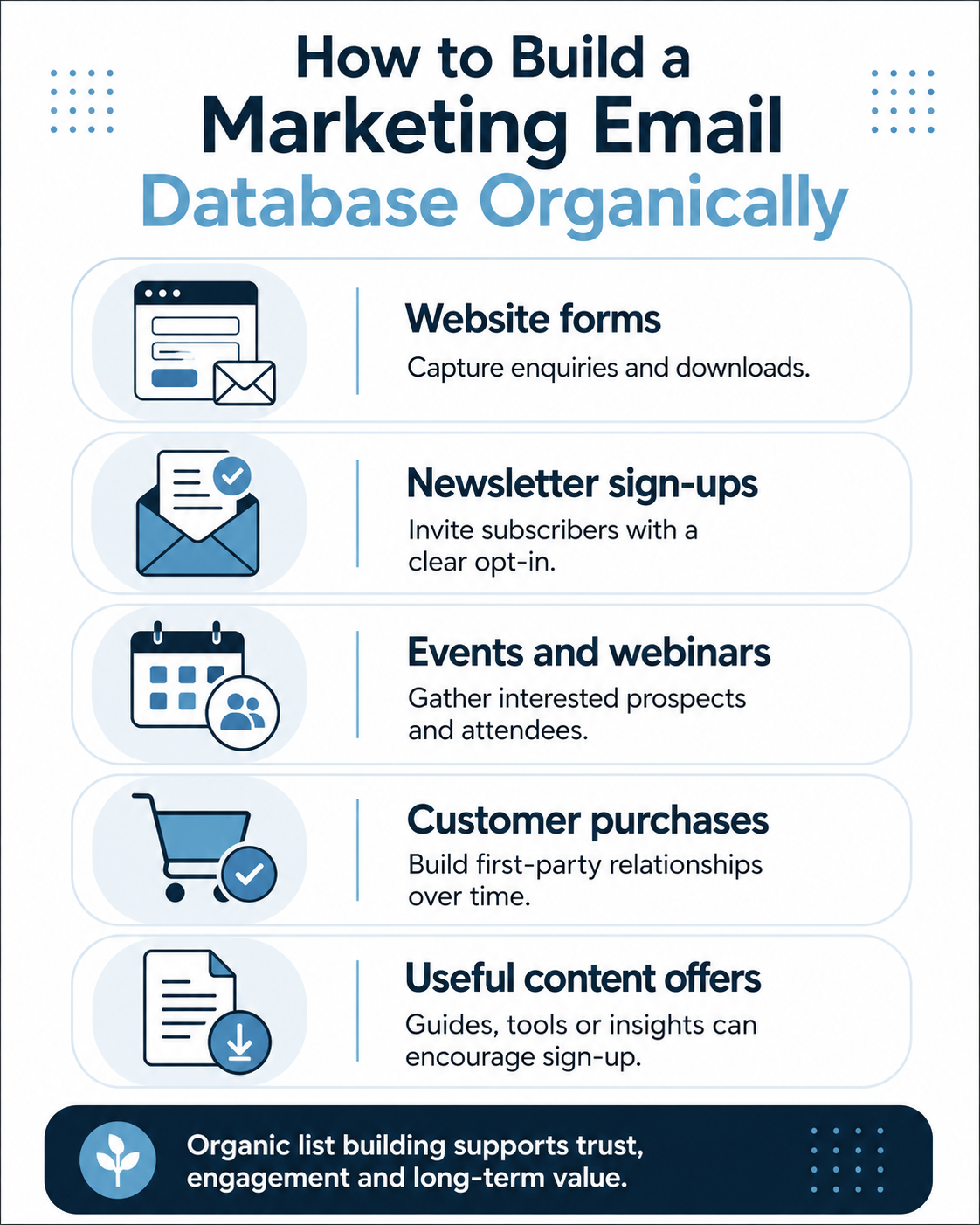
The most common organic source is the website. Contact forms, quote forms, download forms and newsletter sign-ups can all create useful records. The form should be clear about what the person is signing up for and how their data will be used. The GOV.UK data protection summary explains that UK data protection legislation controls how personal information is used by organisations, including businesses. That means a database should not be built in the background without a clear privacy framework.
Newsletter sign-ups can be powerful because they indicate an active interest in ongoing communication. The quality of these contacts depends on the sign-up journey. A vague box that says “send me updates” is less useful than a specific statement about the type of content, organisation name and frequency. The database should record sign-up date, source page, preference choices and consent wording where consent is being relied on.
Events and webinars can also produce high-quality email contacts. A person who registers for a professional event often gives useful context about interest, sector, role and timing. However, event data should not be treated as an automatic permission to send every possible marketing message. The sign-up terms, privacy information and expectation created at the point of registration matter. A contact gathered for one purpose should be used in a way that is consistent with that purpose.
Customer data is another route. Existing customers may be suitable for service messages, renewal reminders, product updates or relevant marketing about similar products. The ICO electronic mail guidance discusses the soft opt-in, which can apply in certain circumstances where contact details were collected during a sale or negotiation for a sale, the marketing is for similar products or services, and the recipient has been given clear opt-out opportunities. This should be documented rather than assumed.
Sales conversations and account management activity can add valuable first-party information. A sales team might learn that a prospect is expanding, replacing software, hiring, relocating or reviewing suppliers. That information can make the database more useful, provided it is accurate, relevant and recorded responsibly. It is better to capture a few meaningful fields than to fill the CRM with loose notes that cannot be used for segmentation.
Referral and partner activity can also create contacts, but it needs care. A referral from one person does not automatically mean the referred person has agreed to marketing. The safer route is to invite the person to engage directly or to make sure any introduction is transparent and relevant. This helps keep the database cleaner and reduces the risk of contacting people who are surprised by the approach.
Paid ways to build or supplement a database
Paid email data can help when a business needs to reach a defined audience faster than organic growth will allow. Organic database growth is valuable, but it can be slow, especially for businesses entering a new market, launching a new service or targeting sectors where they have little existing awareness. Buying data can provide reach, but only when the supplier, audience and compliance route have been properly checked.
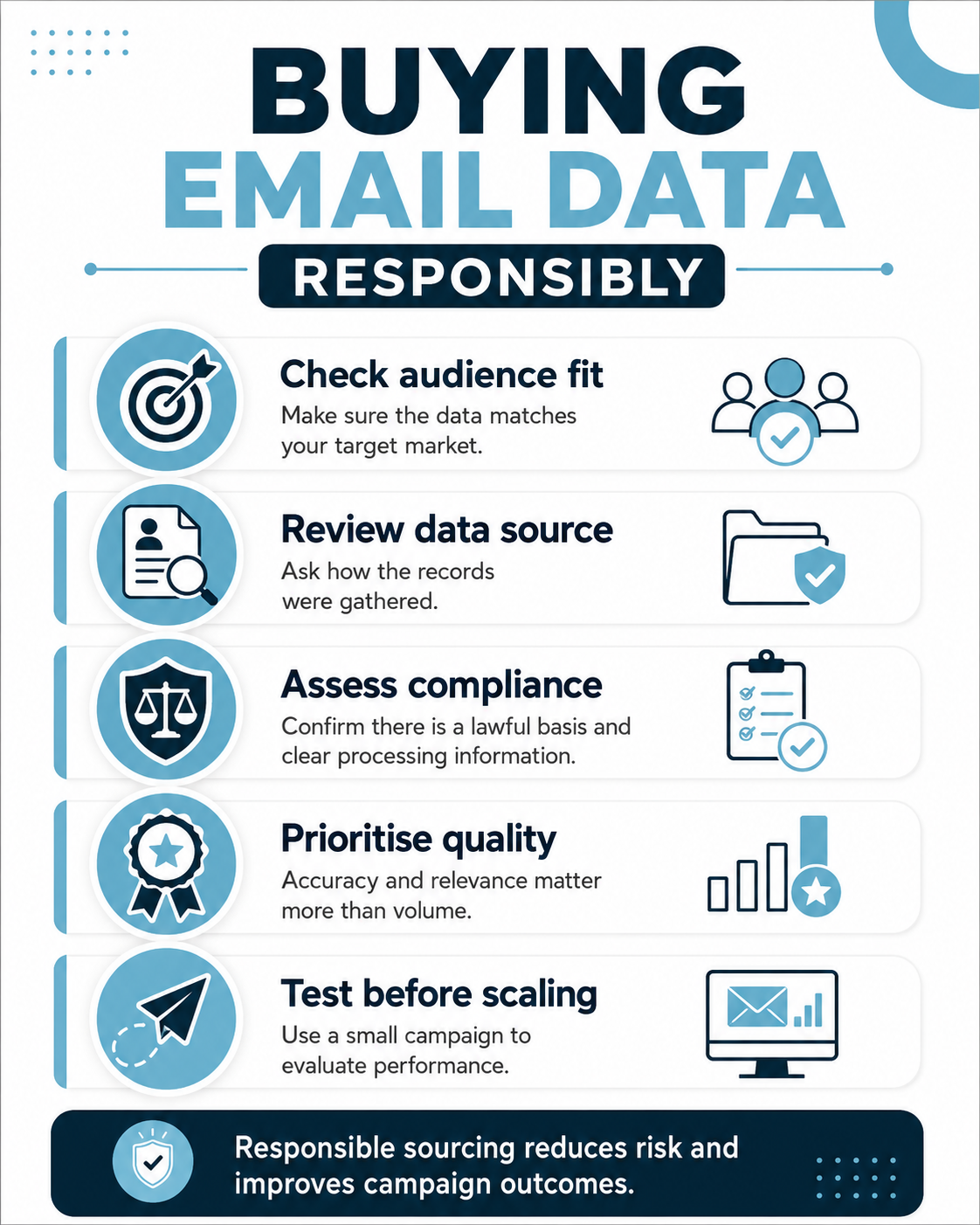
A paid B2B email database should not be a generic bulk file. It should be built around the brief. That brief might define industries, company sizes, geographic areas, decision-maker roles, seniority levels, employee counts, turnover bands, site types or named account characteristics. AccuraData’s article on Buying Email Data explains the importance of matching data to the campaign, not buying a generic file and forcing the campaign around it.
For consumer campaigns, paid data requires even more care. A B2C email database should only be used where there is a verifiable consent trail that supports the intended marketing. AccuraData’s B2C Email Data service focuses on consumer email data for targeted campaigns, with campaign planning that considers permissions, suppression, opt-outs, data minimisation and secure transfer. The buyer should ask for evidence of source quality, not simply file volume.
Paid data can also be used to supplement an existing database rather than replace it. For example, a business may have strong customer records but poor prospect coverage in a new region. It may have company names but missing decision-maker email addresses. It may have an old CRM that needs validation before fresh data is appended. AccuraData’s data cleansing and enrichment support can help businesses improve existing records before they decide what new data is needed.
Another paid route is managed campaign delivery. Some businesses do not only need data. They need help selecting the audience, preparing the message, designing the email, broadcasting the campaign and reviewing engagement. AccuraData’s Email Marketing Services combine data supply, email campaign management, copywriting, design, delivery and reporting, which can be useful where internal teams do not have the time or technical resource to manage every step.
Paid data should be judged by usefulness, not headline size. A 10,000-record list that is poorly matched, stale or unclear on source quality may be less valuable than 1,000 records that closely match the target audience. Smaller, better-selected lists often produce cleaner learning because campaign results are easier to interpret. Volume is only valuable when relevance and permission controls are in place.
The benefits of a well-managed marketing email database
The first benefit is better targeting. A database with sector, role, location, customer status, campaign history and engagement fields makes it possible to send different messages to different groups. This is very different from sending one broad message to every record and hoping some of it lands. Segmentation lets teams match the message to the audience.
The second benefit is efficiency. Sales and marketing teams spend less time searching for contacts, building manual spreadsheets or guessing who to approach. A structured database gives the team a starting point. It also makes follow-up easier because campaign activity can be connected to the record. People who clicked, replied or requested information can be handled differently from those who did not engage.
The third benefit is accountability. A managed database can show where data came from, what lawful basis or consent applies, what communications have been sent, which opt-outs have been recorded and which suppression rules were applied. The Data Protection Act 2018 sits alongside the UK GDPR framework in the UK, so accountability and record keeping are not just administrative preferences. They help show that data is being handled responsibly.
The fourth benefit is better measurement. Email campaign reporting is much more useful when it can be reviewed by segment. A business can compare sectors, job roles, regions, company sizes, customer types or consent sources. This turns campaign reporting into database insight. Over time, those insights can improve targeting, offers and budget decisions.
The fifth benefit is continuity. Staff change, agencies change and platforms change. A well-managed database protects marketing knowledge from being trapped in one person’s inbox or one short-term campaign file. It becomes an asset that can be cleaned, enriched, exported, imported and used consistently across campaigns.
The risks of poor email data
Poor email data creates several problems at once. Invalid addresses waste sends and can increase bounce rates. Irrelevant contacts ignore the message or complain. Outdated job titles create weak targeting. Missing source records make compliance harder to evidence. Duplicate records damage reporting and create a poor experience when the same person receives the same message more than once.
Deliverability is a major risk. Email providers assess sending behaviour, authentication and recipient engagement. The Gmail sender guidelines set out requirements around authentication, easy unsubscribe and responsible sending. Even where a business has lawful data, poor campaign behaviour can still damage inbox placement. Compliance and deliverability are related, but they are not the same thing.
Security is another risk. A business sending email at scale should protect its sending domain and reduce the risk of spoofing. The NCSC email security guidance covers email security and anti-spoofing, while the NCSC email check tool helps organisations check SPF, DKIM and DMARC controls. A marketing database can only perform well if the sending infrastructure is also credible.
Compliance risk is often the most visible concern, but reputational risk can be just as damaging. A badly targeted campaign can make a business look careless. A message to the wrong audience can create the impression that the company does not understand its market. Repeated emails after an opt-out can undermine trust. The DMA Code frames responsible data use around trust and effectiveness, which is a useful principle for any email database.
There is also opportunity cost. When a team uses poor data, it often blames the channel, the creative or the salesperson. In reality, the problem may be the input file. Good email marketing depends on fit: audience, offer, message, timing, data quality, consent or lawful basis, and follow-up. A weak database can make every other part of the campaign look worse than it really is.
Compliance foundations for UK marketing email databases
UK email marketing sits across several overlapping areas. The UK GDPR and Data Protection Act deal with personal data. PECR deals with privacy and electronic communications, including marketing emails. Advertising rules, industry codes and platform requirements add further expectations. This is why database decisions should be made before launch, not after a campaign has been written.
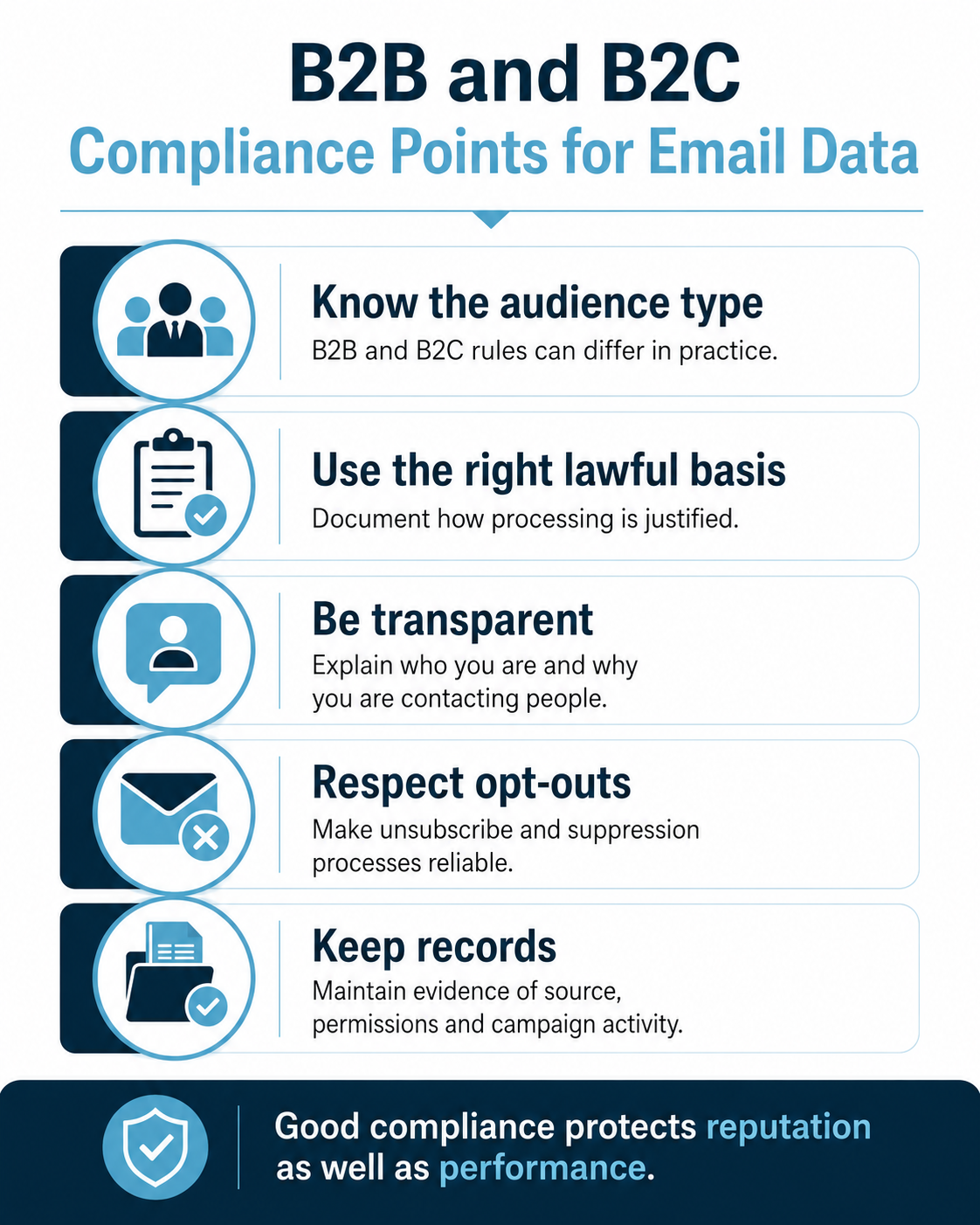
The first question is whether the database contains personal data. A named business contact with a work email address is personal data if the person can be identified. The fact that the address is used for work does not remove data protection obligations. The GOV.UK data protection page explains that UK data protection legislation controls how personal information is used by organisations.
The second question is lawful basis. Under UK GDPR, organisations need a lawful basis for processing personal data. ICO legitimate interests guidance states that direct marketing may be a legitimate interest, but it depends on the circumstances. The business must consider purpose, necessity and balancing against the person’s rights and expectations. This is why a Legitimate Interest Assessment is often used for B2B outreach.
The third question is PECR. PECR can require consent for electronic mail marketing to individual subscribers, subject to limited exceptions such as the soft opt-in. The ICO electronic mail guidance explains when organisations can email or text individuals and when they can email businesses. A database should therefore distinguish corporate contacts from individual subscribers wherever possible.
The fourth question is transparency. People should be able to understand who is using their data and why. Privacy information should be clear, accessible and aligned with actual use. Transparency also helps commercially because recipients are more likely to trust messages when the sender is clear and the reason for contact is relevant.
The fifth question is opt-out handling. Marketing emails should contain a clear way to unsubscribe or object. Opt-outs should be recorded promptly and applied before future campaigns. The Google sender guidance also links unsubscribe handling to sending efficiency and requirements for larger senders. Good database management treats suppression as a core data quality function, not a last-minute platform setting.
B2B email database compliance in practice
B2B email marketing is often more flexible than consumer email marketing, but it is not unregulated. A campaign to corporate business addresses can still involve personal data, especially when named contacts and job titles are used. The sender should know why the contact is relevant, how the data was sourced, what lawful basis is being used and how objections will be honoured.
A practical B2B compliance process starts with audience relevance. If the offer is aimed at finance directors, the database should not include every person at the company. If the product is regional, the data should reflect the region. If the message relates to a regulated or specialist service, the recipient’s role should make sense. Relevance supports the legitimate interests balance because the contact is less likely to be surprised by a message that clearly relates to their professional responsibilities.
The next step is source documentation. A reputable supplier should explain how records are collected, maintained and validated. They should be able to discuss lawful basis and provide documentation appropriate to the service. AccuraData’s B2B Email Data service is positioned around UK business email data, audience segmentation and ongoing data maintenance, rather than one-size-fits-all bulk files.
Then come suppression controls. B2B contacts can object to direct marketing. A business should keep its own suppression list and use it before every campaign. If a contact opts out, that preference should remain in the database even if the person later appears in another supplied file. Suppression is a memory of preferences, not a temporary campaign admin task.
Finally, campaign records should be maintained. The database should show what was sent, when it was sent, which segment received it and what happened afterwards. This makes it easier to manage complaints, prove opt-out handling, review relevance and improve future activity. It also helps sales teams follow up intelligently rather than approaching every contact with the same message.
B2C email database compliance in practice
B2C email databases require a consent-led mindset. Consumer email marketing usually needs consent unless a valid soft opt-in applies. Consent should be specific, informed and recorded. It should be tied to the organisation, the type of marketing and the relevant channel. A vague claim that contacts are “fully opted in” is not enough if the buyer cannot understand what the person actually agreed to.
Where a business buys B2C email data, it should ask for the consent trail, data source, consent wording, collection date, privacy notice route, third-party disclosure route and suppression process. The ICO detailed guidance is useful because it explains electronic mail marketing in detail under PECR. It is not safe to assume that consumer email data can be used simply because it is available for purchase.
B2C segmentation can be useful, but it must be handled responsibly. Segments such as location, household type or interest category can improve relevance, but they should not be excessive for the purpose. Data minimisation matters. A campaign does not need every possible attribute if only two or three fields are needed to make the offer relevant.
Consumer email frequency also needs care. A recipient may consent to marketing, but that does not mean they welcome daily messages. High frequency can increase unsubscribes and complaints. A good database should allow preference management, not just all-or-nothing subscription status. This helps brands maintain trust over time.
AccuraData’s B2C Email Data page highlights consumer email data for promotions, customer acquisition, reactivation, events and multi-channel outreach, with attention to permissions, lawful basis, suppression and responsible frequency. That matters because consumer email data is only useful when the permission trail and campaign purpose support the planned activity.
Segmentation potential in a marketing email database
Segmentation is one of the main reasons to build a proper database rather than a simple address list. It allows different audiences to receive different messages, offers, calls to action and timing. The aim is not to create complexity for its own sake. It is to make the campaign feel more relevant to the person receiving it.
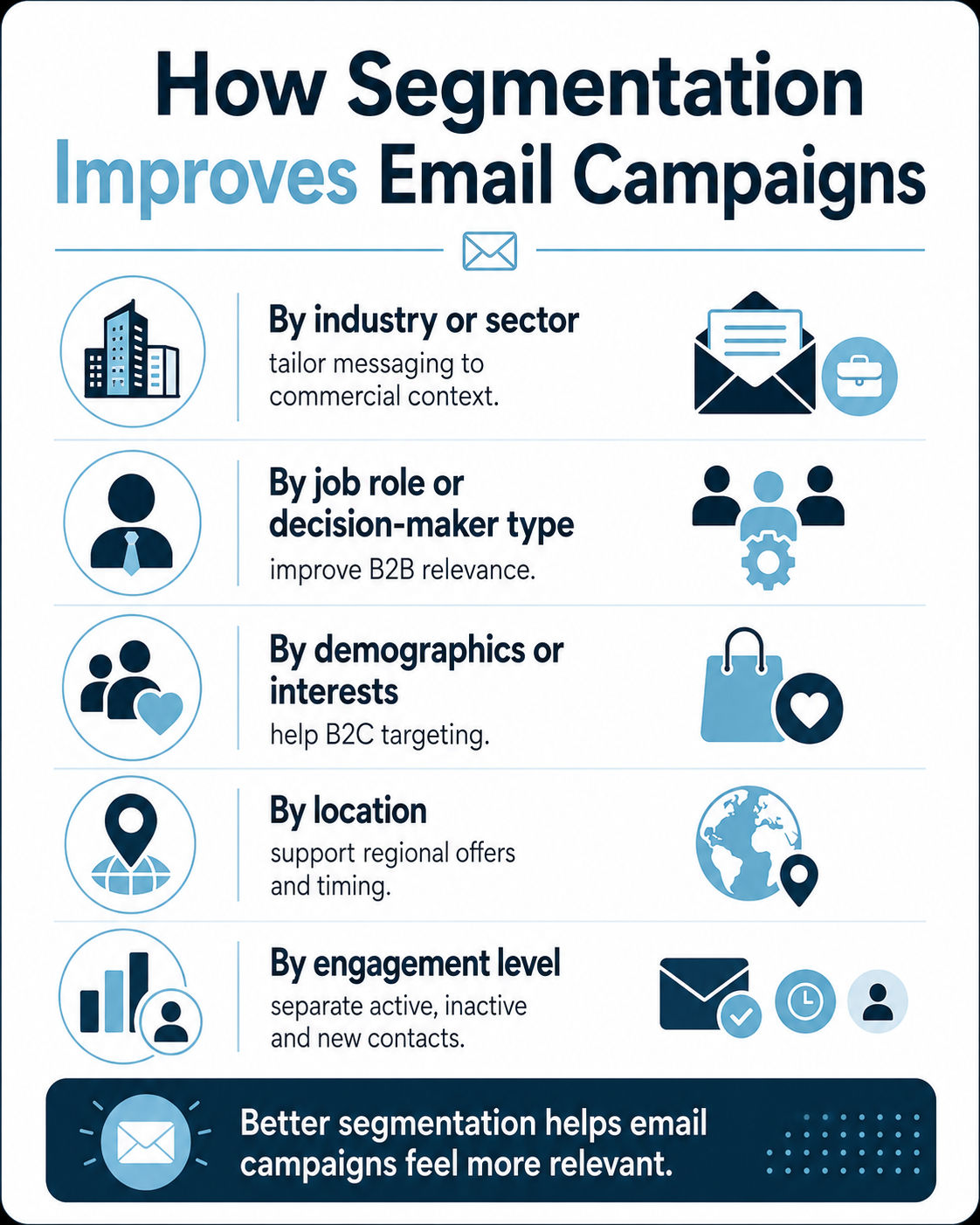
B2B segmentation often starts with firmographic fields: industry, employee size, turnover, region, company type and SIC code. It then adds role-based fields such as job title, department, seniority and decision-maker type. This is useful because the same product may matter to different people for different reasons. A managing director may care about growth and risk. An operations lead may care about process. A finance lead may care about cost and return.
B2C segmentation uses a different set of fields. It may include geography, age band, household indicators, lifestyle interests, purchase history, enquiry source or customer status. The key is to use segmentation in a way that supports relevance without feeling intrusive. Consumer campaigns usually work better when the reason for the message is easy to understand.
Engagement segmentation is valuable for both B2B and B2C. Contacts who open, click, reply, download or attend can be treated differently from contacts who do not engage. However, engagement should not override opt-outs or consent limits. A person clicking once is not a licence to ignore preferences or expand the purpose beyond what is appropriate.
Segment performance should be reviewed after every campaign. Which segment produced enquiries? Which segment unsubscribed at a higher rate? Which roles clicked but did not reply? Which regions bounced more often? The answers can guide list cleansing, offer refinement and future audience selection. A database becomes more valuable when it learns from real campaign results.
How to create a database organically without building problems
Organic database building should begin with clear forms and clear expectations. If someone downloads a guide, registers for a webinar or subscribes to updates, they should understand what they are agreeing to receive. The wording should avoid hidden pre-ticked boxes or vague partner language. A clear sign-up route gives the business stronger records and gives the recipient a better experience.
Data fields should be chosen carefully. It is tempting to collect every possible field on a form, but long forms reduce completion and unnecessary fields increase data protection exposure. Ask only for what is useful at that stage. A newsletter sign-up may need email address and preference choices. A quote request may need more detail. The database can be enriched later where there is a legitimate and transparent reason.
The database should record source and date. A record that says “web form, pricing page, 7 July 2026” is far more useful than a record with no history. Source data helps with compliance, segmentation and sales context. It can also show which lead routes produce better downstream value.
Privacy information should be easy to find. Users should not need to search through dense legal text to understand how marketing data is used. The ASA data rules remind marketers that data rules for direct marketing should be observed alongside legislation. Clear marketing practices support trust as well as compliance.
Finally, organic databases should be cleaned from the beginning. Duplicate removal, typo checks, bounce management, opt-out recording and preference updates should not wait until the database is old. Bad habits become harder to fix at scale. If a database is built cleanly from the start, it remains more useful and easier to govern.
How to judge paid email data suppliers
A reputable supplier should ask questions before supplying a file. If a supplier can quote instantly for “every email in the UK” without asking about audience, channel, campaign purpose or compliance requirements, that is a warning sign. Useful data is selected. It is not dumped into a spreadsheet and left for the buyer to sort out.
The supplier should be able to explain source quality. Ask how records are collected, how often they are refreshed, how email addresses are validated, how role changes are managed, how deceased or inactive records are removed where relevant, and how suppression is handled. They should also explain whether the data is suitable for B2B, B2C or both.
Ask about compliance documentation. For B2B, this may include details of legitimate interest assessments, source documentation, privacy framework and suppression processes. For B2C email data, ask for consent records and the basis on which the recipient agreed to receive third-party marketing. The ICO legitimate interests guidance and ICO electronic mail guidance are useful reference points when reviewing what a supplier says.
Check whether the supplier understands campaign performance as well as data delivery. A supplier that only sells volume may not care whether the campaign works. AccuraData’s Email Marketing Services help with campaign preparation, copywriting, design, broadcast delivery and reporting, which is valuable where a business wants practical outcomes rather than a one-off file.
Look for realistic language. No supplier can promise that every contact will buy, reply or engage. A reliable supplier can explain likely audience fit, available selections, validation methods and sensible expectations. Be wary of exaggerated claims, guaranteed sales, huge volumes at suspiciously low prices or reluctance to discuss compliance.
How to prepare an email database before launch
Before launch, the business should define the purpose of the campaign. Is it lead generation, event promotion, customer reactivation, renewal support, product education or account nurturing? Purpose shapes the audience, message, data fields, lawful basis and success metrics. If the purpose is vague, the database selection will usually be vague too.
Next, confirm the audience. A good brief includes who should be included and who should be excluded. For B2B, that might mean sectors, regions, company sizes, job functions and seniority levels. For B2C, that might mean geography, demographic indicators, interests, household profile or customer status. Exclusion rules are just as important as inclusion rules because they prevent waste and reduce complaints.
Then validate the data. Email validation helps reduce obvious bounces, but it is not a complete solution. It does not prove relevance, consent or lawful basis. It should sit alongside duplicate removal, suppression checks, field standardisation and campaign segmentation. A clean file is one that is valid, usable and appropriate for the campaign.
Prepare the sending infrastructure. Authenticate the domain, configure SPF, DKIM and DMARC, and make sure unsubscribe handling works. The NCSC email security guidance and Gmail sender requirements both show why sending reputation and technical controls matter. Data quality cannot compensate for poor email infrastructure.
Finally, prepare the message and landing destination. An email database only creates an opportunity. The campaign still needs a clear subject line, relevant content, a credible sender, a useful call to action and a destination that matches the promise in the email. AccuraData’s Email Marketing Campaigns article is a useful internal resource for planning campaign operation and measurement.
Operating a marketing email database after launch
Database management does not stop when the campaign is sent. After launch, the first job is to process bounces, unsubscribes, complaints and replies. These events should update the database promptly. A hard bounce should not remain active. An unsubscribe should be suppressed. A positive reply should trigger follow-up. A complaint should be investigated.
Engagement data should be captured by segment. A total open rate is less useful than knowing which audience groups engaged. If directors in one sector clicked at a higher rate, that may suggest stronger market fit. If a region produced more unsubscribes, the offer may not fit that audience. If small companies bounced more often, the data source or selection may need review.
Sales feedback should also return to the database. Sales teams often learn that a contact has moved, the wrong person was targeted, a company is not relevant, a prospect is interested later, or a buying window is approaching. If that feedback remains in personal notes, the database does not improve. If it is structured and recorded, future campaigns become sharper.
Campaign frequency should be controlled. Sending more email is not the same as producing more results. A database should help teams decide when to pause, when to follow up, when to suppress and when to change the message. Excessive frequency can harm sender reputation and recipient trust.
Data security should continue throughout the lifecycle. Access should be limited to people who need the data. Files should be transferred securely. Old exports should be controlled. The database should not be copied into uncontrolled spreadsheets unless there is a clear operational reason. Good governance protects both the business and the people in the data.
Performance metrics that matter
Email database performance should be measured beyond simple open rates. Open tracking can be affected by privacy features and technical factors, so it should not be treated as the only indicator. Clicks, replies, conversions, meeting bookings, enquiries, revenue influence, unsubscribe rates, bounce rates and complaint signals all matter.
Bounce rate is a data quality signal. A high hard bounce rate may suggest stale records, poor validation, domain changes or source problems. Soft bounces can indicate temporary delivery issues, but repeated soft bounces should be reviewed. Bounce management should feed back into cleansing rather than being treated as a campaign-only statistic.
Reply quality matters in B2B. A small number of serious replies may be more valuable than many low-intent clicks. For complex sales, the aim may be to open conversations with relevant decision-makers, not to generate instant transactions. This is why the database should be connected to sales follow-up and CRM notes.
Unsubscribe and complaint patterns are useful. If a specific segment generates a high number of opt-outs, the audience or message should be reviewed. If a campaign causes complaints, the business should check source quality, expectations, frequency, sender identity and relevance. Complaints are feedback, not just risk events.
Return on investment should be assessed over an appropriate time horizon. Some email campaigns create immediate leads. Others support awareness, nurture or reactivation. A database used for high-value B2B services may need several touches before results are visible. Measurement should match the sales cycle and campaign purpose.
Common mistakes to avoid
The first mistake is buying only on price. Cheap data can be expensive when it creates bounces, complaints, low engagement and wasted sales time. A low cost per record is not a good deal if the records are not relevant, accurate or usable. The better question is what the data helps the business achieve.
The second mistake is ignoring B2B and B2C differences. Consumer email data and business email data have different legal expectations, segmentation options and message styles. Treating both as the same can lead to weak campaigns and compliance risk. AccuraData’s B2C Email Data and B2B Email Data services are separated for a reason.
The third mistake is failing to record source information. A database without source records becomes harder to trust over time. If nobody knows where a contact came from, what they agreed to or why they are being contacted, campaign planning becomes risky. Source records support compliance and better messaging.
The fourth mistake is treating validation as compliance. Email validation can confirm whether an address appears deliverable, but it does not prove permission, relevance or lawful basis. A validated email address can still be unsuitable for a campaign. Compliance needs purpose, documentation, transparency and suppression controls.
The fifth mistake is not updating the database after campaigns. Every send produces information. Bounces, opt-outs, clicks, replies and sales outcomes should improve the database. If the database is not updated, the business repeats the same mistakes and loses the chance to build a stronger marketing asset.
How AccuraData supports marketing email databases
AccuraData can support businesses at several points in the email database lifecycle. For organisations that need new business contacts, AccuraData’s B2B Email Data service provides targeted UK business email data that can be filtered by practical audience criteria. This helps businesses avoid broad, generic lists and focus on the contacts most relevant to the campaign.
For organisations targeting consumers, AccuraData’s B2C Email Data service helps build consumer email lists around campaign goals, geography and available segmentation criteria. Because B2C email requires careful attention to permission and suppression, campaign planning should consider compliance before data is selected.
For businesses that already have a CRM or in-house database, AccuraData can help with cleansing, validation, deduplication, segmentation and campaign-ready preparation. This is often the best starting point before buying new data. It shows what the business already has, what is usable and where genuine gaps exist.
For businesses that need more than data, AccuraData’s Email Marketing Services can support the whole campaign process: audience selection, email copywriting, email design, broadcast setup, delivery, reporting and warm prospect identification. This is useful for organisations that want email marketing to be delivered consistently without managing every creative and technical step internally.
AccuraData’s related articles on Business to Business Email List, Buying Email Data and UK Email Database also provide practical context for teams comparing database-building routes. Together, these resources help businesses think about email data as part of a wider acquisition and relationship-building strategy.
A practical checklist before you use a marketing email database
Before using a marketing email database, define the campaign purpose in one sentence. Then confirm whether the audience is B2B, B2C or mixed. This affects the data fields, legal basis, opt-out route, consent evidence and message tone.
Next, review the source. For organic contacts, check the sign-up route, privacy wording, preference choices and source date. For paid data, ask the supplier how the records were collected, how they were validated, how often they are refreshed and what documentation is available.
Then review permissions and lawful basis. For B2B campaigns, consider whether legitimate interests is appropriate and document the assessment. For B2C campaigns, confirm whether consent or a valid soft opt-in applies. Use ICO guidance as the baseline for electronic mail rules.
After that, prepare suppression. Apply unsubscribes, objections, complaints, hard bounces and any internal exclusion lists. Make sure the suppression process works before broadcast, not only after the first send. Suppression is one of the most practical ways to protect reputation and reduce waste.
Finally, plan measurement. Decide which metrics will show whether the database supported the campaign. For one campaign, that might be enquiries. For another, it might be meetings, trial requests, quote forms, reactivation, event registrations or warm follow-up opportunities. The database should be judged against the campaign goal, not only against generic email benchmarks.
Final thoughts on marketing email databases
A marketing email database can be a valuable asset when it is built carefully, bought responsibly and managed consistently. The best databases combine accurate contact details, relevant audience context, clear permissions or lawful basis, practical segmentation, secure handling and strong suppression processes. They are not static files. They are maintained systems that improve when campaign learning is fed back into the record.
For B2B marketers, the value often comes from reaching the right organisations and decision-makers with a message that fits their role. For B2C marketers, the value depends heavily on consent, trust, relevance and timing. In both cases, data quality and campaign quality need to work together. A good database cannot rescue a poor message, but a poor database can undermine even a strong campaign.
AccuraData helps businesses build, buy and use email data more responsibly. Whether you need targeted B2B Email Data, compliant consumer B2C Email Data, existing database cleansing or managed Email Marketing Services, the aim is the same: better targeting, cleaner data, clearer compliance and more useful campaign outcomes.