
Buying Email Data can be a sensible way for UK businesses to reach a clearly defined audience, provided the data is relevant, properly sourced, accurately maintained and used with care. The phrase can sound transactional, as though the list itself is the whole answer, but a purchased list only works when it is part of a wider plan. That plan needs to cover audience selection, supplier due diligence, lawful use, message quality, deliverability, suppression, reporting and follow-up. Businesses that treat email data as a quick shortcut often create risk and poor performance. Businesses that treat it as a strategic input can build campaigns that are more focused, measurable and commercially useful.
This article explains what buying email data means, how email lists are commonly generated, the advantages and drawbacks of purchased lists, the compliance issues UK organisations need to consider, and the practical steps that separate a good supplier from a weak one. It also explains how AccuraData can help businesses purchase targeted email data, improve existing databases and, where required, run managed email marketing campaigns using the data.
AccuraData supplies targeted B2B Email Data for businesses that need accurate, segmented contact records for professional outreach. AccuraData also supports wider marketing activity through Email Marketing Services, Data Cleansing and targeted B2C Data where consumer audiences are relevant. The important point is that the data should be matched to the campaign, not bought as a generic file and then forced into a campaign afterwards.
What Buying Email Data Actually Means
Buying email data means obtaining a list of email contact records from a third party so that a business can reach a selected audience. In a B2B context, this usually means business email addresses linked to company names, job roles, sectors, locations and other firmographic fields. In a B2C context, it may mean consumer data, but consumer email marketing is subject to tighter consent expectations and should be handled with particular care. The distinction matters because the ICO explains that direct marketing rules can differ by channel and by the type of subscriber being contacted.
A basic email list might contain only company names and general addresses. A more useful list will include named decision-makers, job titles, business email addresses, company size, industry sector, location and segmentation fields. Some lists also contain telephone and postal fields for multi-channel campaigns. Those extra fields can make a major difference because they allow sales and marketing teams to tailor messaging, prioritise high-value prospects and measure results by segment.
The value of the list is not defined by the number of rows. A large file of poorly matched contacts can produce weak engagement, high bounces, unnecessary complaints and wasted follow-up time. A smaller list that closely matches the target market is often more useful. That is why a purchasing conversation should begin with audience definition. Who do you need to reach? Which sectors matter? Which roles influence the buying decision? What geography is relevant? What company size is viable? What offer will be sent? What action do you want the contact to take?
Buying email data is also different from buying leads. A list gives you contact records that can be used for outreach. A lead usually implies some existing expression of interest or a generated enquiry. A list can help you create opportunities, but it is still your campaign, message and follow-up process that turn contacts into responses. AccuraData’s article on business email lists explains this distinction in more detail, especially for businesses that are deciding whether they need prospect data, lead generation support or both.
The best way to view a purchased email list is as an audience asset. It is not a guaranteed pipeline. It is not a substitute for relevance. It is not a reason to send generic messages at high volume. It is a way to identify people and organisations that are more likely to fit the campaign. From there, performance depends on how carefully the data is selected, checked, introduced into the sending process and used by the sales or marketing team.
How Email Data Is Generated
Email data can be generated in several ways. Some businesses build first-party lists through website enquiries, content downloads, event registrations, newsletter sign-ups, customer relationships and account research. Other businesses use reputable third-party suppliers to access a selected audience more quickly. Many use a mixture of both. Each approach has different strengths, risks and practical limits.
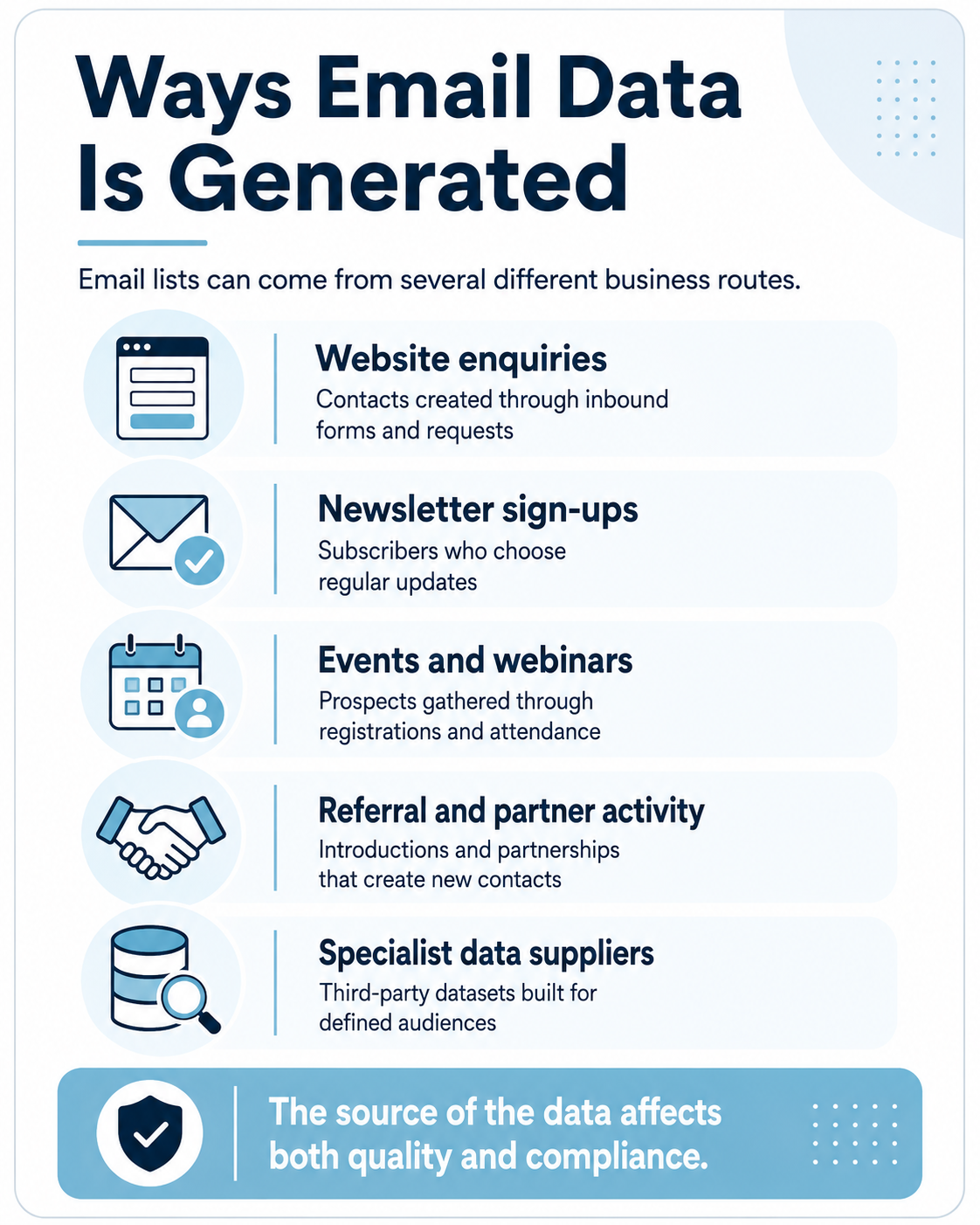
First-party data is usually created when people interact directly with a business. This might include contact form submissions, customer purchases, webinar registrations, product demo requests or newsletter subscriptions. Because the relationship is direct, the organisation normally has more context about why the person shared their details. That makes it easier to explain the source of the data and the reason for future contact. Even then, businesses still need to comply with UK GDPR principles and keep accurate records of what the person signed up for, how they can opt out and how their data is stored.
Newsletter subscriptions can be valuable because subscribers have chosen to receive content. They can become a warm audience for education, trust-building and repeat engagement. The drawback is speed. It can take months or years to build a large, relevant newsletter database. It also may not contain all the job roles, sectors or regions a sales team wants to reach. A newsletter list is usually strongest for nurturing known interest rather than opening new markets quickly.
Event data can be useful when the event topic clearly matches the product or service being promoted. A webinar on energy procurement, for example, may attract operations, facilities or finance contacts with a relevant interest. A trade show may create face-to-face conversations that support later email follow-up. The important issue is expectation. If someone shared details for a specific event, the future marketing use should be clear, proportionate and connected to that context.
Publicly available information can also support research, especially in B2B markets. Companies House publishes certain company information, trade bodies list members, and business websites often show general contact details. However, a manually researched list still needs quality control. The fact that an address can be found online does not automatically mean every use is fair, relevant or compliant. A business still needs a lawful basis for processing personal data, clear suppression processes and sensible targeting.
Third-party email data suppliers build lists from multiple sources, validation processes and maintenance routines. A reputable supplier should be able to explain how its data is collected, what it contains, how it is refreshed, what segmentation is available and what compliance documentation can be supplied. AccuraData’s Email List of Businesses article covers how UK business email data can be used with targeting criteria such as industry, location and company size.
The source route affects risk. First-party data gives you direct context but may lack scale. Bought data can give faster access to a selected market but depends heavily on supplier quality. Research-driven lists can be precise but time-consuming. The best approach often combines first-party collection, careful supplier selection and ongoing cleansing so the database improves over time rather than decays.
The Pros of Buying Email Data
The main advantage of buying email data is speed. Building a first-party database takes time, particularly for businesses entering a new sector or region. Purchased data can give a sales or marketing team access to a defined audience far faster than manual research. For time-sensitive campaigns, market launches, event promotion or account-based outreach, that speed can be commercially valuable.
A good supplier can also provide segmentation that would be difficult to build internally. B2B campaigns often need to filter by sector, job role, seniority, turnover, employee count, geography or business type. AccuraData’s B2B Email Data service is built around this kind of targeting, helping businesses move beyond broad lists and focus on the organisations most relevant to their campaign.
Purchased data can also help businesses test markets before committing larger budgets. A company considering a new vertical may not want to hire a sales team or spend heavily on advertising until it knows whether the market responds. A controlled email campaign to a carefully selected list can help test messaging, value propositions and sector interest. It should not be treated as perfect proof of market demand, but it can provide useful early evidence.
Another benefit is coverage. Internal CRMs often contain existing customers, old opportunities and contacts collected through previous activity. They may not cover emerging markets, new regions or recently targeted job roles. Buying data can fill those gaps. It can also help revive campaigns where the internal list has become too small, outdated or biased towards previous buyers.
Good purchased data can support multi-channel planning. A list that includes email, telephone and postal fields can help teams design coordinated campaigns. An email might introduce the offer, a call might follow up with engaged accounts, and a direct mail piece might support a high-value audience. The AccuraData article on B2B Marketing Lists shows how business data can support email, telephone, postal and broader lead generation activity.
Bought data can also make reporting more useful. When each record includes structured fields, results can be compared by sector, region, role or company size. That helps teams learn which segments respond, not simply whether the campaign worked overall. A campaign that looks average in aggregate may reveal a strong response from one sector and a weak response from another. Without structured data, that insight is harder to capture.
Finally, buying from a reliable supplier can reduce internal workload. Manual list-building can take significant staff time and still produce inconsistent results. A specialist provider can help define the data brief, build a campaign-ready audience and support data quality checks. That frees internal teams to focus on messaging, conversion and sales follow-up.
The Cons and Risks of Buying Email Data
Buying email data also has drawbacks. The most obvious risk is poor quality. A weak list may include invalid addresses, old job roles, generic inboxes, irrelevant sectors or duplicate records. Poor data can damage performance before the campaign message is even considered. It can increase bounce rates, waste sending capacity and create frustration for the sales team.
There is also a compliance risk. UK organisations need to understand how PECR and data protection rules apply. The ICO explains that the soft opt-in can apply to some existing customer relationships, but it does not apply to prospective contacts from bought-in lists. That point is especially important for businesses that assume any business address can be emailed without further thought. B2B rules are not the same as B2C rules, but named business email addresses can still be personal data when they identify an individual.
Another risk is expectation mismatch. Some buyers expect a list to produce instant sales. Email data can create access, but it cannot fix a weak offer, a vague message, poor deliverability, inadequate follow-up or a product that is wrong for the audience. A purchased list should be treated as part of a campaign system, not a standalone result.
High-volume sending to a cold list can also create deliverability problems if handled badly. Google recommends SPF, DKIM and DMARC for domains sending email, and also sets standards around authentication, message quality and abuse prevention. The NCSC explains that email authentication helps make it harder for fake emails to be sent from your domain. These controls are not only technical details. They affect trust and inbox placement.
Poor supplier transparency is another concern. Some suppliers cannot explain how data was sourced, when it was last refreshed or what validation has been applied. Others sell very large files with little regard for targeting. A list that looks cheap per record can become expensive if it damages sender reputation, wastes staff time or produces complaints. Low price is not the same as good value.
There is also a risk of overlap with existing data. Businesses often buy contacts they already hold, especially when they do not deduplicate before importing. That can lead to inconsistent records, duplicate messaging and messy reporting. Before buying data, businesses should check what they already have and decide whether they need new contacts, updated records, enrichment fields or suppression support.
Finally, purchased data needs governance. It should be documented, stored securely, suppressed correctly and reviewed after use. Data that is left unused in a CRM for years becomes stale. People change roles, companies merge, domains change and preferences shift. A list can be valuable on delivery, but it should not be treated as permanently accurate.
UK Compliance When Buying Email Data
Compliance is one of the most important parts of buying email data. In the UK, email marketing sits across two main areas: data protection law and electronic marketing rules. UK GDPR governs the processing of personal data. PECR governs electronic marketing rules for channels such as email, text and telephone. The ICO guidance makes clear that B2B marketing is still subject to rules and that the position can depend on the channel and the type of organisation being contacted.
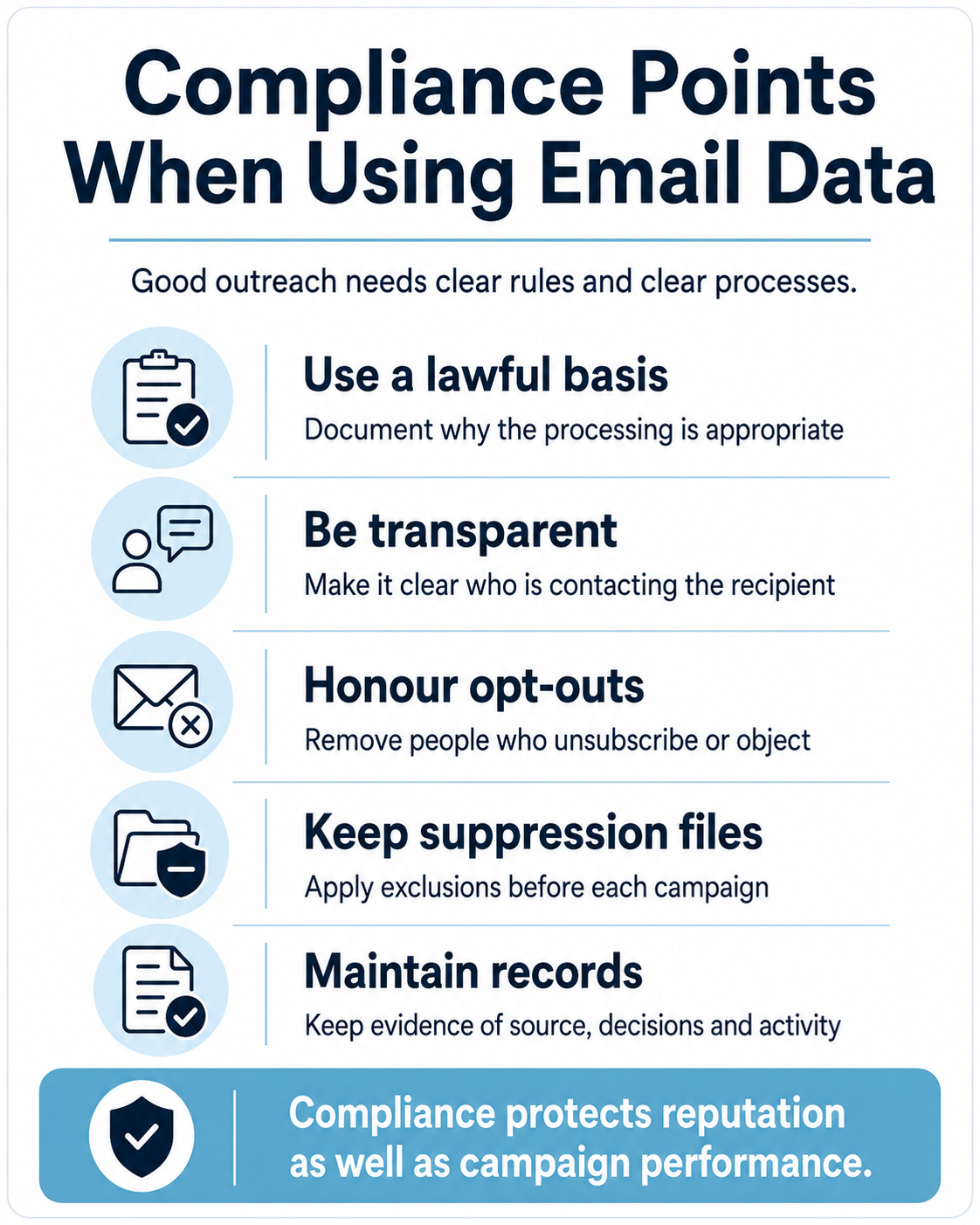
A named work email address, such as jane.smith@examplecompany.co.uk, can be personal data because it identifies a living person. That means UK GDPR principles apply. The organisation using the data should have a lawful basis, use the data fairly, be transparent where required, keep records accurate and respect rights such as objection. The ICO guidance on legitimate interests explains how organisations should consider purpose, necessity and balancing when relying on that lawful basis.
For B2B email, the type of subscriber matters. PECR treats corporate subscribers differently from individual subscribers. Corporate subscribers include many companies and other corporate bodies. Individual subscribers can include sole traders and some partnerships. The ICO’s electronic mail guidance explains that consent and the soft opt-in rules apply to individual subscribers. This distinction is central when buying data because some business-looking contacts may still fall into individual subscriber categories.
Businesses should not use the phrase GDPR-compliant as a substitute for thinking. Compliance is not a badge that sits on a list forever. It depends on source, purpose, legal basis, transparency, targeting, suppression, retention, security and how the campaign is executed. A supplier can help provide responsibly sourced data and documentation, but the buyer still needs to use the data responsibly.
Suppression is vital. If someone unsubscribes, objects or asks not to be contacted, the organisation must respect that request and ensure the person is not reintroduced through another file. The ASA guidance on suppression explains the importance of suppressing personal data so that people do not receive marketing they should not receive. Suppression files should be handled carefully because they exist to prevent further marketing, not to create new targeting opportunities.
Consumer email data needs extra caution. B2C email marketing normally requires consent unless a soft opt-in applies from an existing customer relationship. This is one reason B2B data and B2C data should not be treated as interchangeable. AccuraData’s B2C Data page is relevant for businesses that need consumer audiences, but consumer campaigns should be planned with the right consent, channel and targeting rules in mind.
Compliance also covers message content. Marketing emails should identify the sender, make the commercial purpose clear and provide a working opt-out route. The CAP Code includes rules on the use of data for direct marketing, and GOV.UK highlights the need for marketing and advertising to be accurate and honest. Responsible email marketing is not only about the list. It is also about what the recipient receives and how easy it is to act on their preferences.
What Responsible Purchasing Looks Like
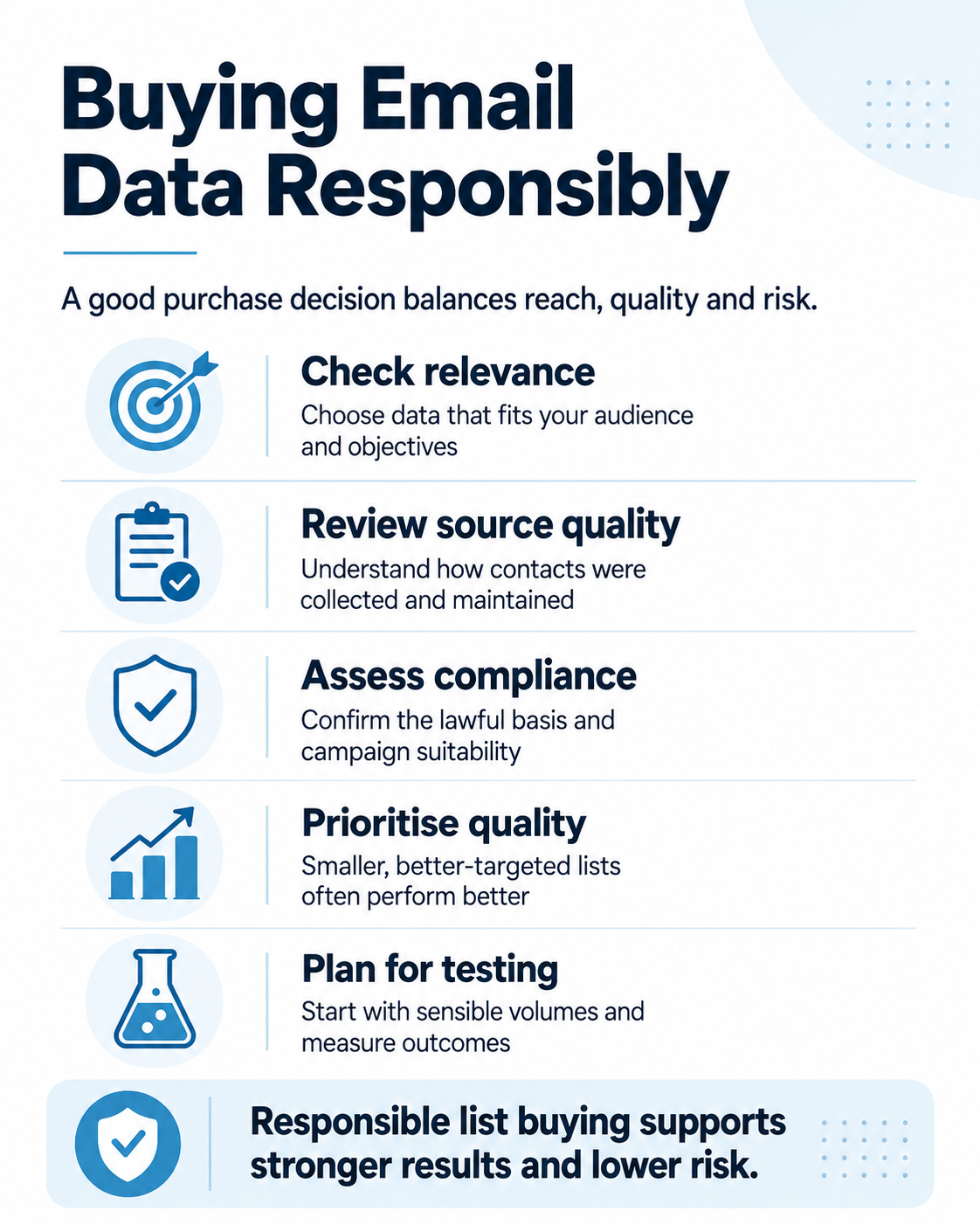
A responsible buying process starts before any data is ordered. The buyer should define the audience in practical terms. That means sectors, locations, company size, job roles, seniority, exclusions and campaign purpose. A vague request such as “all UK businesses” is rarely a good brief. A better brief might be “operations directors and facilities managers in UK manufacturing firms with 50 to 500 employees” or “finance directors in professional services firms across the Midlands”.
The next step is to choose the right channel. If the campaign is email-led, business email addresses and deliverability quality matter. If the campaign will be followed by calls, telephone fields and TPS or CTPS screening may also be needed. If postal follow-up is planned, postal address accuracy becomes important. AccuraData’s article on direct mail data explains why the list behind a postal campaign affects cost, delivery and performance.
Responsible buyers also ask about source and maintenance. Where does the data come from? How often is it refreshed? Is it validated before delivery? What fields are included? Can the supplier explain lawful use? What documentation is provided? Are suppression processes in place? Can existing customer lists be excluded before supply? These questions help separate data partners from list sellers.
A good buying process includes internal review. Sales should confirm that the audience fits real opportunities. Marketing should confirm that the message can be tailored. Compliance or data protection leads should review lawful basis and documentation. Operations should confirm how the file will be imported, stored and suppressed. No single department should treat buying email data as a quick procurement exercise.
The size of the list should be matched to the team’s capacity. If a company has one salesperson and limited campaign support, a small, tightly targeted audience may be better than a large file. If a company has a campaign team, CRM workflows and structured follow-up, it may be able to manage larger volumes. The right list size is therefore linked to operational capacity, not just budget.
The supplier should provide records in a usable format. Common fields include first name, last name, job title, company name, business email address, industry, location, employee size, turnover banding and source or compliance notes where available. A strong file structure makes it easier to segment, personalise and report. A messy file increases the risk of poor imports and poor campaign control.
A responsible buyer also plans the first campaign before the data arrives. That plan should include the message, subject line approach, sending domain, suppression process, landing page, follow-up route and reporting fields. Data that arrives without a campaign plan often sits unused, gets passed between teams or is sent to too broadly. The return from purchased data depends on disciplined execution after purchase.
Segmentation Potential: Turning Data into Better Campaigns
Segmentation is one of the main reasons to buy quality email data rather than the largest list available. Segmentation means dividing an audience into meaningful groups so that messaging and follow-up can be more relevant. In B2B email marketing, common segmentation fields include industry, job role, seniority, company size, location, turnover, department and likely business need.
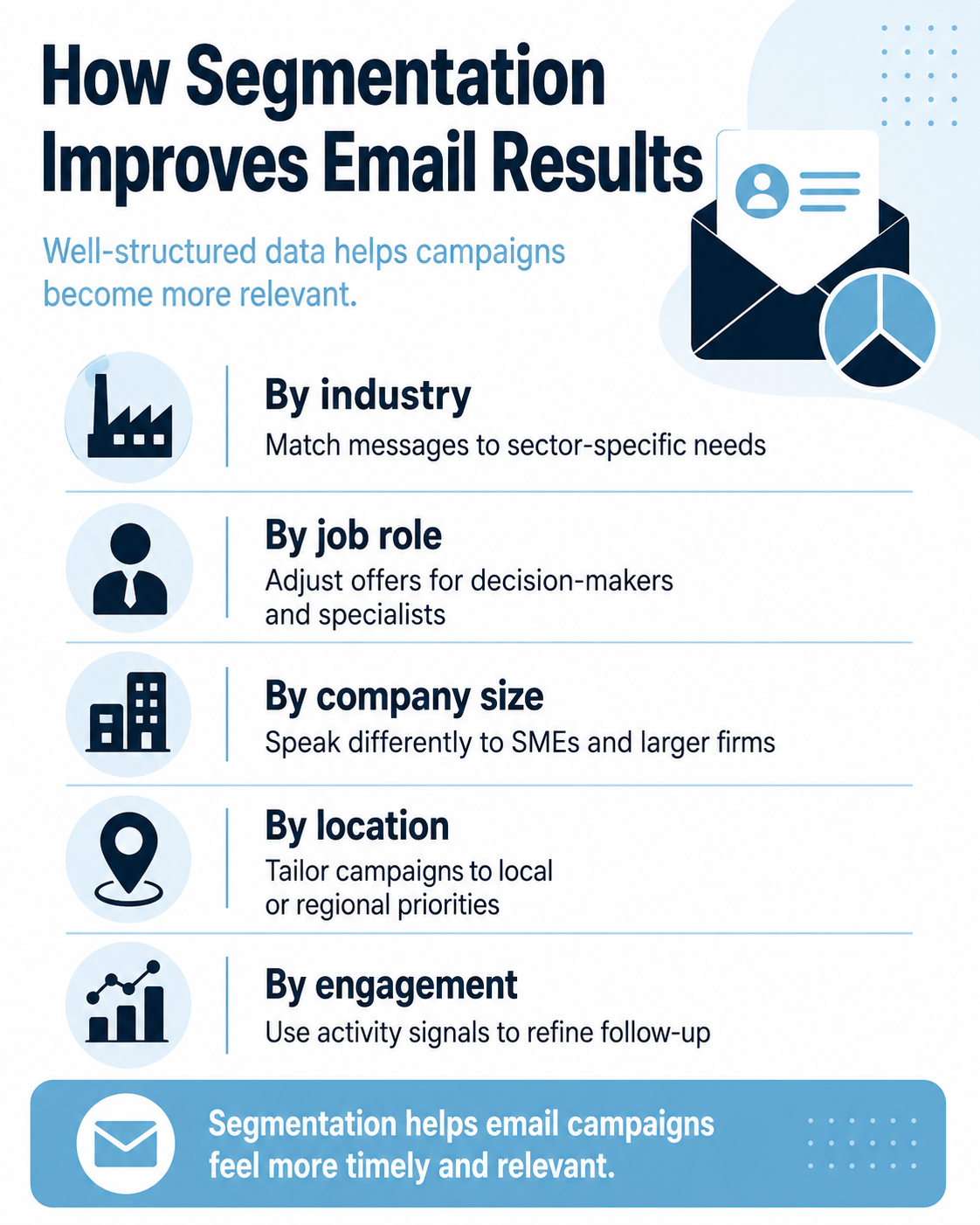
Industry segmentation allows campaigns to speak to sector-specific challenges. A message for manufacturers may focus on production efficiency, compliance, supply chain control or energy costs. A message for professional services firms may focus on client acquisition, risk management or productivity. If the same generic message goes to every sector, it is less likely to feel relevant.
Role segmentation helps teams align language to responsibility. A managing director may care about growth, risk and strategy. A finance director may care about cost control and return on investment. An operations manager may care about workflow, delivery and service quality. A technical lead may care about integration, security or implementation. Better data enables better role-specific messaging.
Company size is another useful filter. Microbusinesses, SMEs, mid-market firms and large enterprises often buy differently. They may have different budgets, approval processes and practical needs. Forrester’s 2026 business buying research reported that the typical buying decision involves internal stakeholders, showing why B2B targeting often needs to consider more than one contact in an account. That does not mean every business needs enterprise-style account-based marketing, but it does mean a single generic contact may not always be enough.
Geographic segmentation can improve relevance where location affects service delivery, events, regulation, transport, local relationships or sales territory. It can also help sales teams manage follow-up more effectively by region. For businesses with field sales teams, geographic segmentation can prevent leads from being sent to the wrong person or ignored because ownership is unclear.
Segmentation also supports testing. A campaign can test two subject lines, two offers or two audience groups, then compare outcomes. The important thing is to measure segments separately. If all contacts are pooled together, performance insight is limited. If responses are tracked by sector, role and company size, the next campaign can be refined.
AccuraData’s Email Marketing Campaigns article explains how campaign planning, audience selection and measurement fit together. The same principle applies when buying email data. The list is the starting point, but segmentation is what turns the list into a campaign structure.
Data Quality Checks That Matter
Data quality is central to buying email data. A list with inaccurate addresses, old roles and irrelevant companies will weaken the campaign. Quality should be assessed before purchase, during import and after the campaign. The ICO’s guidance on accuracy states that personal data should be accurate and, where necessary, kept up to date. That principle is especially relevant in marketing because people change jobs, companies change names and contact details become outdated.
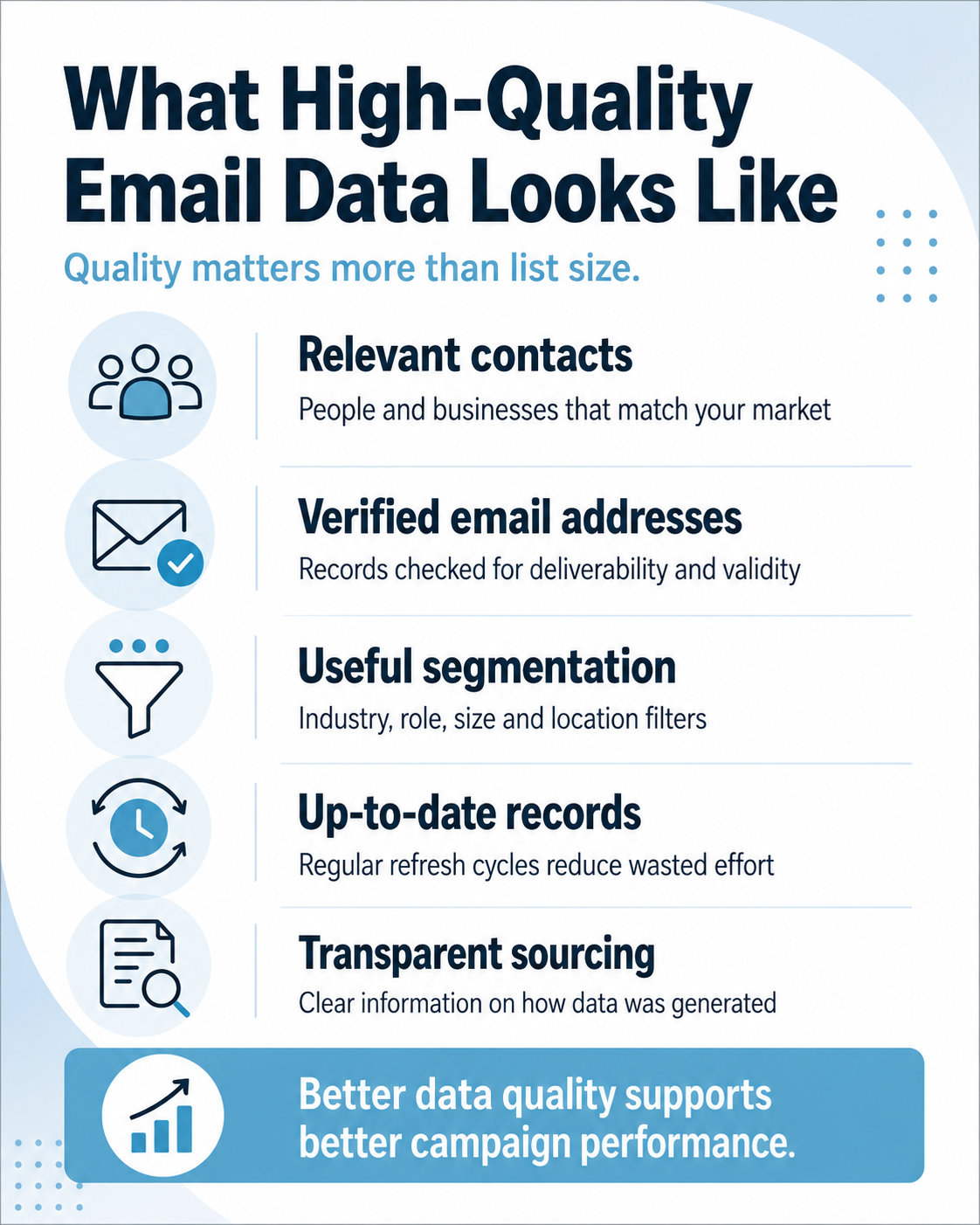
Email validation is a key check. A supplier should take steps to reduce invalid addresses and obvious delivery problems. Validation does not guarantee engagement, but it helps reduce avoidable bounces. Hard bounces should be removed quickly after sending. Continuing to send to invalid addresses can harm sender reputation and waste campaign resources.
Role and seniority checks also matter. If a campaign targets finance directors, the data should not be filled with unrelated administrative roles. If a campaign targets HR leaders, the list should not contain generic info addresses. Named contact data tends to be more useful than generic addresses because it supports targeted messaging and accountable follow-up. Some campaigns may still use generic addresses where appropriate, but they should not be mistaken for senior decision-maker access.
Company-level checks help ensure the business fits the campaign. A product designed for companies with more than 100 employees should not be sent to microbusinesses unless there is a reason. A regional service should not be sent to distant regions that cannot be served. A sector-specific offer should not be sent to unrelated sectors. List relevance matters as much as email validity.
Duplicate removal is another practical step. Duplicate contacts can lead to repeated messages, messy reporting and unnecessary complaints. Duplicates can appear across purchased data, existing CRM records and legacy files. Before importing a list, businesses should compare it with existing customer, prospect and suppression data.
Suppression checks should be applied before use. Unsubscribed contacts, objection records, existing customers excluded from acquisition campaigns and internal do-not-contact records should be removed or handled appropriately. AccuraData’s Data Cleansing service can help organisations improve existing databases by removing duplicates, correcting inaccurate information and validating business contact data.
Quality also depends on recency. A list that was accurate two years ago may no longer be suitable. People move roles, companies close, domains change and decision-making responsibilities shift. Good suppliers should have maintenance routines and be able to explain how they keep records current.
Deliverability and Technical Readiness
Deliverability is the ability of email to reach the inbox rather than bounce, be rejected or land in spam. Data quality affects deliverability, but it is not the only factor. Sender reputation, authentication, message content, sending volume, engagement and complaint rates also matter. Buying good data will not compensate for poor sending practices.
Email authentication is a baseline requirement. Google recommends using SPF, DKIM and DMARC, and the NCSC’s email security guidance explains how these controls help reduce domain spoofing. Businesses using purchased data should check their sending domain before launch, particularly if they have not run outbound email before.
Sending cadence matters. A new domain or lightly used domain should not suddenly send large volumes without preparation. Even with accurate data, sudden spikes can look suspicious to receiving systems. Campaigns should be planned in sensible volumes, with monitoring for bounces, complaints and engagement.
Message quality also affects deliverability. Emails should be relevant, clear and honest. Misleading subject lines may produce short-term opens, but they damage trust and can increase complaints. The DMA Code highlights trust and responsible marketing as core principles for the data and marketing industry. In email campaigns, trust begins with relevance and transparency.
Unsubscribe handling needs to be reliable. Every marketing email should provide a clear route to opt out, and those preferences should be applied promptly. This is not only a compliance matter. It is also a list-quality matter. Continuing to email people who have opted out can create complaints, poor engagement and reputational harm.
Landing pages and tracking should also be ready. If the email asks people to download a guide, book a call or request a quote, the destination should be clear, fast and relevant. Broken links, vague forms and slow pages reduce the value of the campaign. Email data can bring the right people to the door, but the campaign assets need to give them a reason to respond.
Businesses should also monitor performance carefully. Important metrics include delivery rate, hard bounce rate, open rate, click rate, reply rate, unsubscribe rate, complaint rate, enquiries, meetings and sales outcomes. The first campaign should be treated as a learning exercise. Segments that perform well can be expanded. Segments that perform poorly can be reviewed or removed.
How to Spot a Reputable Email Data Supplier
A reputable email data supplier should ask questions before quoting. If a supplier offers a generic file without understanding your audience, campaign goal, geography, sector or role requirements, that is a warning sign. Good data supply is consultative because the value depends on fit.
The supplier should be able to explain available segmentation. Useful filters might include industry sector, SIC code, location, company size, turnover banding, job function, seniority and decision-maker type. The supplier should be able to tell you what fields are included, what is optional and what may reduce list size. A narrower brief usually improves relevance but may reduce volume. That trade-off should be discussed honestly.
A good supplier should talk about compliance without overclaiming. Beware of suppliers that say a list is simply “GDPR proof” or “fully legal for anything”. A responsible supplier should explain source, purpose, B2B and B2C distinctions, opt-outs, suppression and the buyer’s role in responsible use. They should be able to support a lawful use conversation but should not pretend compliance is a one-line guarantee.
Documentation matters. Buyers should ask what information can be supplied about the list, including selection criteria, data fields, recency, validation and terms of use. For more sensitive campaigns or larger volumes, internal data protection teams may want to review this before purchase.
A reputable supplier should care about quality rather than only volume. They should be willing to say when a smaller, more targeted list is better. They should also be willing to exclude unsuitable sectors, current customers or suppressed contacts. If a supplier only talks about the number of records, the buyer should be cautious.
Support after delivery is also valuable. Data may need formatting, filtering, deduplication or integration support. A supplier that understands campaign use can help buyers avoid common mistakes, such as importing fields incorrectly or sending the same message to every contact regardless of segment.
AccuraData positions its email data around targeted UK B2B audiences, segmentation and campaign relevance. Its B2B Email Data service can support lead generation, outbound sales and business development activity. For businesses that need help beyond the list itself, AccuraData’s Email Marketing Services can support campaign planning, email copywriting, design, broadcast setup, delivery, reporting and warm prospect identification.
Questions to Ask Before You Buy
Before buying email data, businesses should ask practical questions. The answers will reveal whether the list is a good match and whether the supplier understands responsible data use.
Ask who the audience is. Which sectors, roles, seniorities, company sizes and regions are included? If the supplier cannot define the audience clearly, the list may be too broad.
Ask how the data is maintained. When was it last refreshed? What validation is applied? Are hard bounces removed? Are job changes reviewed? No database is perfect, but maintenance should be active rather than accidental.
Ask what fields are supplied. At minimum, a B2B email list should include the email address, company name and enough information to understand relevance. More useful files include named contacts, job titles, company size, sector, location and segmentation fields.
Ask about suppression. Can existing customers be removed? Can previous unsubscribes be excluded? Can internal do-not-contact lists be applied? A supplier should understand that removing unsuitable records improves performance as well as risk control.
Ask about B2B and B2C separation. Consumer email data is not the same as business email data. If the campaign targets individuals outside a business context, consent and privacy expectations differ. Businesses should not let suppliers blur that line.
Ask about delivery support. Will the supplier only send a file, or can they help with campaign setup, email preparation, segmentation and reporting? Some buyers have strong internal capability. Others benefit from managed campaign support, especially if they are new to outbound email.
Ask how success will be measured. A supplier cannot promise sales simply from a list, but they should understand what good campaign measurement looks like. Engagement, replies, meetings and qualified opportunities matter more than row count.
Ask whether the supplier understands your market. If you sell software to finance teams, the supplier should understand why finance roles matter. If you sell compliance support to manufacturers, the supplier should understand why sector selection matters. Data supply should be linked to commercial context.
How to Use Bought Email Data Well
Once the data has been purchased, the next step is controlled use. Do not import the file and send immediately without reviewing it. Check field names, deduplicate against existing CRM records, apply suppression lists and confirm segmentation. A clean import reduces errors later.
Start with a focused first campaign. A smaller launch can reveal data quality, segment response and deliverability signals before wider sending. It can also help teams refine subject lines, offers and follow-up workflows. Campaigns should be paced in a way that matches sending infrastructure and sales capacity.
Personalisation should be meaningful but not forced. Using a first name is not enough. Better personalisation comes from relevance. Referencing sector challenges, role responsibilities or company type can make a message feel more considered. However, over-personalised messages based on weak assumptions can feel intrusive. The safest route is to use the data to shape relevant groups rather than pretending each message is hand-written when it is not.
Subject lines should be clear. They should not overpromise, mislead or hide the commercial purpose. If the email is a business offer, the recipient should understand why it might be useful. A relevant, straightforward subject line often supports trust better than a gimmick.
The opening should quickly explain why the message is relevant. The recipient may not know your company. They need to understand why you are contacting them, what problem or opportunity you are addressing and what the next step is. Long introductions, vague claims and broad sales language usually reduce engagement.
Follow-up should be planned. Many B2B responses do not happen after a single email. A short sequence may be appropriate, but frequency should be reasonable and opt-outs should be honoured. Sales teams should also know which contacts clicked, replied or engaged, so follow-up can focus on warmer prospects.
Results should be reviewed by segment. Which roles opened? Which sectors clicked? Which company sizes replied? Which segments unsubscribed more often? This information should feed back into future selections. Good email data becomes more valuable when campaign learning is captured.
Finally, update records after use. Remove hard bounces, record opt-outs, update job changes and note responses. Data should not return to the CRM unchanged. Every campaign should improve the database, not simply consume it.
Buying Email Data for B2B vs B2C Campaigns
B2B and B2C email data should be treated differently. B2B campaigns usually target people in a professional capacity, such as directors, managers, owners or department leads. B2C campaigns target individuals as consumers. The audience, legal expectations, messaging style and data fields can be very different.
B2B email data is often segmented by industry, company size, turnover, location, job title and seniority. The offer usually relates to business value, such as reducing costs, improving efficiency, generating leads, managing compliance or supporting growth. The recipient is being contacted because of their role within an organisation.
B2C email data may be segmented by demographics, geography, interests, household profile or other permitted consumer characteristics. The offer is usually personal or household-related. Consent expectations are often stricter for consumer email marketing, and businesses should be very careful before using bought consumer email data for electronic mail campaigns.
The ICO’s B2B guidance is useful because it shows that rules can change depending on who is being contacted and by which channel. A business email address at a limited company is not always treated the same way as a personal email address used by a sole trader. Those distinctions matter in list selection.
AccuraData provides both targeted B2B Email Data and B2C Data services, but the campaign brief should make clear which audience is being targeted. A B2B sales campaign, a consumer acquisition campaign and a mixed multi-channel campaign should not use the same assumptions.
Businesses should also consider whether email is the right channel for every audience. Some B2C campaigns may be better suited to postal marketing, paid media or consent-led email nurture. Some B2B campaigns may work better as a combined email and telephone approach. Buying email data should be part of channel planning, not separate from it.
How AccuraData Can Help
AccuraData can support businesses that want to buy email data responsibly and use it in a practical campaign. The starting point is audience definition. Rather than supplying a generic file, AccuraData can help clients identify the sectors, locations, company sizes, job functions and seniorities that make sense for the campaign.
For businesses looking for UK business contacts, AccuraData’s B2B Email Data service can supply targeted records for email marketing, lead generation and outbound sales activity. That can include filtering by industry, role, region and business characteristics, so campaigns are built around relevant audience selection rather than broad volume.
For businesses with an existing CRM or customer database, AccuraData’s Data Cleansing service can help improve usability by removing duplicates, correcting inaccurate information, validating business contact data and enriching records where appropriate. This can be useful before buying new data because it reveals what the business already has and where gaps remain.
For businesses that want support beyond the data file, AccuraData’s Email Marketing Services can help with campaign planning, email copywriting, email design, broadcast setup, delivery, reporting and warm prospect identification. This is useful for organisations that want to run email campaigns but do not want to manage every technical and creative step internally.
AccuraData can also support wider multi-channel marketing. Some campaigns need email data only. Others need telephone or postal fields as part of a wider outreach plan. AccuraData’s B2B Data services can support broader marketing activity, while its B2C Data services can support carefully planned consumer campaigns.
The value of working with a reliable supplier is not only the data. It is the combination of targeting, data quality, campaign awareness and practical support. Buying email data becomes more useful when the supplier understands the business outcome the buyer is trying to achieve.
Common Mistakes to Avoid
One common mistake is buying too much data. A large file can look attractive, but it may be impossible to use well. If the sales team cannot follow up, the sending domain is not ready or the message is too broad, a large list can create more problems than opportunities. Quality and fit should come before volume.
Another mistake is ignoring existing data. Before buying, businesses should review their CRM. They may already have old customers, dormant prospects, newsletter contacts or partial records that can be cleaned and enriched. In some cases, cleansing an existing database and filling gaps is better than buying an entirely new list.
A third mistake is weak segmentation. Sending the same email to every contact wastes the value of the data. If the list includes sector, role and company size, those fields should shape messaging and reporting. Segmentation is not a cosmetic feature. It is the bridge between the list and the campaign.
Some businesses also ignore compliance until the end. Compliance should be considered at the brief stage, not after delivery. This includes lawful basis, PECR rules, B2B and B2C distinctions, suppression, unsubscribe handling, data retention and security.
Another mistake is poor deliverability preparation. If authentication, sending volume and monitoring are not ready, even good data can perform badly. Email infrastructure should be checked before campaign launch, not only after results disappoint.
Poor follow-up is also common. A campaign may generate clicks, replies or meeting requests, but sales teams need a process to act on them quickly. If follow-up is slow or inconsistent, the value of the data falls. Campaign planning should include who follows up, when they do it and what they say.
Finally, businesses sometimes fail to learn from results. A bought list should produce insight as well as immediate responses. Every send should tell the business something about audience fit, message relevance and future targeting. Without review, the next campaign repeats the same assumptions.
Final Thoughts
Buying Email Data can help businesses reach new audiences, test markets and support outbound growth when it is handled responsibly. The best results come from clear targeting, reputable supply, compliance awareness, good deliverability practice and disciplined campaign execution. The list matters, but it is the combination of list quality, message relevance and follow-up that determines commercial value.
Businesses should avoid the idea that email data is a shortcut around marketing fundamentals. It is not. It is a way to make those fundamentals more focused. A carefully selected audience allows better messaging. Better messaging improves engagement. Clean records reduce wasted effort. Good reporting turns campaigns into learning. Responsible suppression protects reputation and future performance.
For UK businesses that want help buying email data, AccuraData provides targeted B2B Email Data, data cleansing and managed Email Marketing Services. That means clients can work with a partner that understands both the list and the campaign that follows it.
If your business is considering buying email data, start with the audience. Define who you need to reach, why they are relevant, what message they should receive and how success will be measured. Then choose a supplier that can support those requirements with quality data, clear documentation and practical campaign understanding. That approach gives purchased email data its best chance of becoming a useful growth asset rather than a one-off file.