
If your sales team is spending more time searching for prospects than they are talking to them, something has gone wrong. Business to business email lists exist to fix that problem. They give your team a direct line to the right decision-makers, in the right industries, at the right time, without the guesswork.
Done properly, a quality B2B email list is one of the most cost-effective tools you can invest in. Done poorly, it becomes a source of wasted budget, damaged sender reputation, and potential regulatory headaches. So this guide is here to walk you through the whole picture. From what a business to business email list actually is, to how to choose one, use one, and get the most from it.
What Is a Business to Business Email List?
A business to business email list is a dataset containing the contact details of professionals at other companies. At a minimum, this includes email addresses. A good one will also include the person’s name, job title, company name, industry, location, and often the company’s size by headcount or turnover.
The purpose is simple. Rather than your marketing or sales team spending hours manually sourcing contacts, you start with a ready-made list of prospects who match your ideal customer profile. Your team can then run email outreach, follow-up sequences, or nurture campaigns straight away.
It is worth being clear on terminology here. A business to business email list is different from a consumer or B2C email list, which contains individual members of the public. The rules around how you can use each type differ, so it matters that you are working with the right kind of data for your campaign. Our B2C email lists guide covers the consumer side in full.
Why Email Still Outperforms Everything Else in B2B
There is a temptation in marketing to chase the newest channel. LinkedIn outreach, paid social, webinars, programmatic ads; all of these have their place. But when it comes to B2B lead generation, email consistently tops the charts for return on investment, and that has been true for years now.
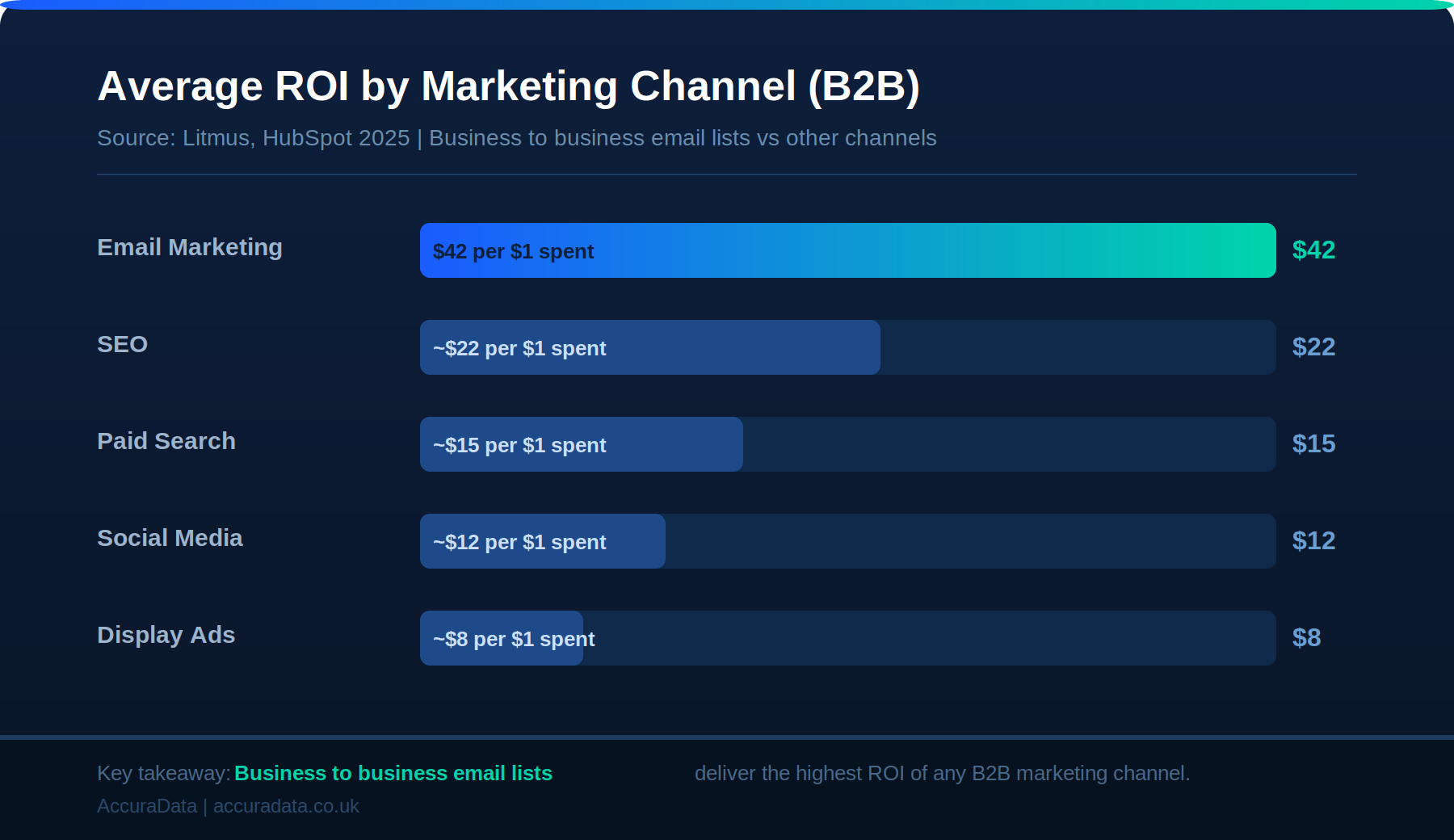
Part of the reason email works so well in B2B is the audience itself. Business decision-makers are not browsing social media looking to buy a new telecoms contract or switch energy supplier. They are checking their inbox. Research consistently shows that between 73% and 77% of B2B buyers name email as their preferred way to hear from vendors, which is more than double any other channel.
There is also the question of intent. A well-targeted business to business email list means your message lands in front of someone relevant, even if they are not yet actively shopping. Over time, with good email sequences and follow-ups, that relevance converts into real conversations.
What Makes a Good Business to Business Email List?
Not all lists are equal. In fact, the difference between a well-maintained, verified list and a cheap bulk database can be the difference between a profitable campaign and one that damages your brand. Here is what to look for.
Accuracy and freshness
Business data degrades fast. People change jobs, companies move, decision-makers are promoted. It is estimated that B2B data decays at a rate of around 30% per year. A list that was built 18 months ago and has not been refreshed since will already have a significant number of bad contacts in it. Bad contacts mean bounces, and high bounce rates damage your sender reputation with email providers, which can affect deliverability for your entire domain.
A good provider will regularly verify their data and be transparent about when records were last checked. At AccuraData, we take data cleansing and enrichment seriously because we know what bad data costs a business in practice.
Segmentation options
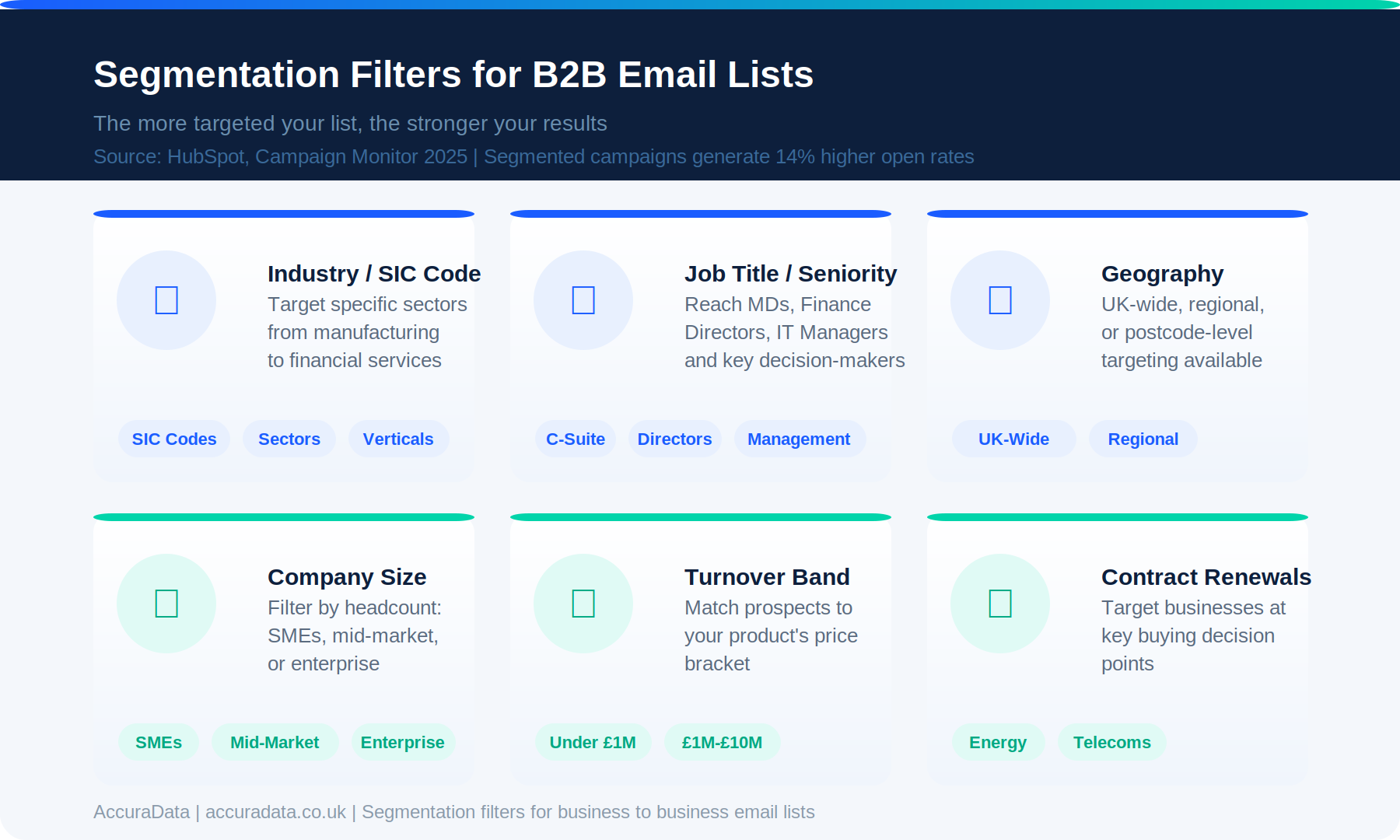
The more targeted your list, the better your results. A generic list of 50,000 business emails is far less valuable than a carefully segmented list of 3,000 contacts who match your ideal customer profile. Good segmentation options typically include:
GDPR compliance
This is non-negotiable. Any business to business email list you use in the UK must be compliant with the UK GDPR and, where relevant, the Privacy and Electronic Communications Regulations (PECR). Using non-compliant data exposes your business to ICO investigation and fines. A reputable data provider will be able to explain exactly how their data is sourced and why it is legally compliant for email marketing use. If a provider cannot give you a clear answer on this, walk away. Our full guide to GDPR-compliant marketing data covers what you need to know.
Volume vs. quality
It is tempting to go for the largest list available, but volume is only useful if the data quality is there to back it up. A smaller, well-targeted list will almost always outperform a large, generic one. Research from HubSpot and others consistently shows that segmented campaigns generate significantly higher open rates and click-through rates than mass sends to unfiltered lists.
How Business to Business Email Lists Fit Into a Wider Campaign
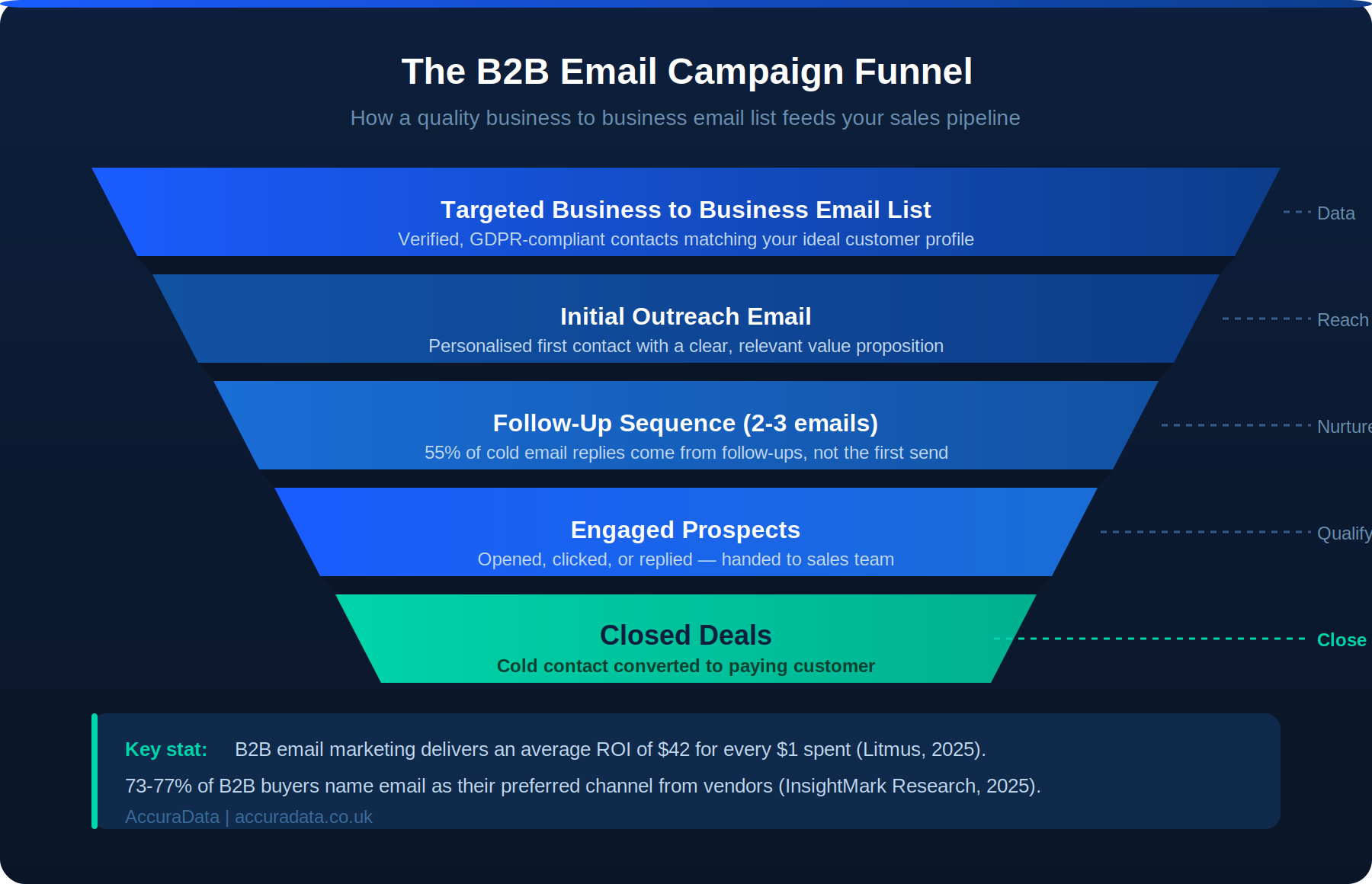
A list on its own does not generate revenue. What it does is give your marketing and sales teams the raw material to do their jobs properly. Here is how a well-run email campaign typically unfolds once you have a good list in place.
[INFOGRAPHIC: infographic3-campaign-funnel.png]
The key thing to take from this is that a business to business email list is the starting point, not the whole strategy. You still need well-written emails, a sensible sending cadence, and a sales team who can convert the conversations that come back. The list gets you into the right inboxes; what you do from there is up to you.
If you need help with the content side of your email campaigns, our copywriting services are built specifically to help businesses turn data into conversations.
B2B Email Lists vs. B2B Leads: What Is the Difference?
This question comes up a lot. Business to business email lists and B2B leads are related but they are not the same thing, and understanding the difference will help you decide what is right for your business.
| Feature | B2B Email List | B2B Leads |
| What you receive | A dataset of business contacts | Pre-qualified prospects ready to buy |
| Buyer intent | Not pre-qualified | Has expressed buying interest |
| Volume | High — thousands of contacts | Lower volume by nature |
| Cost per contact | Lower | Higher (but higher intent) |
| Best for | Awareness, nurture, outbound email | Closing deals fast, live transfer sales |
| Team required | Marketing + email outreach | Sales closers |
Most businesses benefit from using both. Business to business email lists are ideal for building brand awareness and warming up a market at scale. B2B leads are better suited to sales teams whose job is to close, not to prospect. Many of our clients use email lists to run awareness and nurture campaigns, and then supplement that with live transfer leads when they need a faster pipeline injection.
Specialist Lists: Why Industry-Specific Data Changes the Game
General business to business email lists have their place, but the further you can niche down, the better your campaign tends to perform. This is because your messaging can be far more specific when you know exactly who you are talking to.
A good example is B2B energy renewal data. Rather than emailing businesses generically about energy switching, you can specifically reach businesses whose energy contracts are coming up for renewal in the near term. That is a completely different proposition from a buyer’s perspective, and the conversion rates reflect that.
The same principle applies across sectors. Whether you are selling telecoms, finance products, merchant services, or software, a list that has been filtered specifically for businesses in the right situation will always outperform a broad, untargeted dataset. It is worth asking any data provider what specialist lists they can offer before defaulting to a general business database.
Common Mistakes Businesses Make with Business to Business Email Lists
Even with a quality list in place, campaigns can underperform if the basics are not in order. Here are the most frequent issues we see.
- Not cleaning the list before sending. Even freshly purchased data should be run through a verification tool before your first send. Sending to a list with a high bounce rate can damage your domain’s sending reputation quickly.
- Using a generic, untargeted message. Decision-makers receive a lot of email. If your opening line could apply to any business in any sector, it will be ignored. Personalisation and specificity matter more than volume.
- Sending once and giving up. The data is consistent here: the majority of replies to cold B2B email campaigns come from follow-up messages, not the first send. A sequence of two to three emails dramatically outperforms a single shot.
- Ignoring mobile optimisation. Over half of all emails are opened on a mobile device. If your email is not easy to read on a phone, you are losing a significant portion of your audience before they have even read the first line.
- Buying the cheapest list available. Low-cost data is almost always low-quality data. The savings made on the list cost are quickly swallowed up by poor deliverability, low engagement, and wasted sales team time.
- Not tracking and iterating. Email campaigns improve with testing. If you are not tracking open rates, click rates, and replies, you have no way of knowing what is working and what is not.
Ready to See What a Quality List Can Do?
At AccuraData, we supply GDPR-compliant business to business email lists tailored to your target market. No guesswork, no filler contacts — just accurate data that gives your team a real head start.
How to Get the Most from Your Business to Business Email List
Assuming you have a quality, verified, compliant list in front of you, here is how to put it to work properly.
1. Segment before you send
Even within a single purchased list, there will be different types of contacts. Group them by industry, company size, or job title and tailor your messaging for each group. This alone can lift open rates by 14% and click rates by up to 28%, according to research from Campaign Monitor and HubSpot.
2. Write subject lines that earn the open
Your subject line is doing most of the work. It needs to be short (under 50 characters tends to perform best on mobile), specific to the recipient’s situation, and curious enough to make them want to open. Avoid anything that reads like a sales pitch in the subject line itself; save that for inside the email.
3. Lead with value, not your company
The biggest mistake in B2B email copy is making the email about you. It should be about the recipient. What problem are they likely dealing with? What is the cost of not solving it? Your product or service is the solution; the first job of the email is to make the problem feel real and relevant.
4. Keep the ask small
Asking a stranger to buy something from you in a cold email rarely works. Asking them if they have five minutes for a call, or whether a specific piece of information would be useful, is a much lower bar to clear. Reduce the friction in your call to action and your reply rates will improve.
5. Follow up, then follow up again
Plan a sequence of at least two follow-ups after your initial send. Each one should add something new rather than just repeating the original message. A different angle, a relevant case study, or a time-limited offer all work well as follow-up hooks.
6. Keep your list clean as you go
Remove hard bounces immediately. Manage unsubscribes properly. Flag contacts who have opened multiple emails but never replied as warm prospects to be passed to your sales team. A business to business email list is not a static asset; it should be maintained and updated throughout your campaign.
How AccuraData Sources and Maintains Its Business to Business Email Lists
We are not going to pretend all data providers operate the same way, because they do not. At AccuraData, our business to business email lists are built from multiple verified data sources, regularly refreshed, and supplied with full transparency on sourcing so that you understand exactly what you are getting and why it is safe to use.
Every list we supply is checked against the relevant suppression files and screened for compliance before it leaves us. We also offer data cleansing and enrichment as a standalone service if you have existing data that needs a quality check before your next campaign goes out.
We work across a wide range of industries, including energy, telecoms, finance, merchant services, and many more. If your business operates in a niche sector, it is worth getting in touch directly because we may be able to source specialist data that suits your campaign more precisely than a general list would.
Final Thoughts
Business to business email lists remain one of the most reliable tools available to sales and marketing teams. The ROI figures speak for themselves, and unlike paid advertising, a well-maintained email list is an asset that compounds over time as you learn more about what resonates with your audience.
The key is to be selective about the data you start with, deliberate about how you use it, and consistent in how you maintain it. A poor list will undermine even the best email copy. A great list, used intelligently, gives your team a genuine commercial advantage.
If you want to talk through what a business to business email list could look like for your specific campaign, the team at AccuraData is happy to help. We offer a free consultation with no obligation, so there is nothing to lose from having the conversation.