
There is a version of the direct mail story that most marketers already know. The channel is back. Response rates are strong. Budgets are shifting and direct mail data is popular again. Brands that abandoned postal marketing in favour of digital-only strategies are returning to the letterbox because the numbers justify it. The 2025 ANA/DMA Response Rate Report puts the average direct mail response rate at 4.4%, against 0.12% for email. That is a gap of more than 36 to one. UK direct mail sales grew 12.9% year-on-year in Q3 2024, the first period of growth in more than two years, as reported by the AA and WARC. 84% of marketers now agree that direct mail provides the highest ROI of any channel they use.
What gets discussed rather less is the factor that most directly determines whether any of those headline numbers apply to a specific campaign. The data behind it. Every piece of direct mail that generates a response does so because it arrived at the right address, was relevant to the person who received it, and was sent to a list that was accurate enough to get it there in the first place. The direct mail data sitting behind a campaign is where its success or failure is decided, before the creative is briefed, before the print run is ordered, before a single envelope is sealed.
At AccuraData, supplying accurate, compliant direct mail data is a core part of what we do. We work with businesses across the UK to ensure that their postal marketing campaigns are built on contact data that is verified, legally sound, and structured to support the kind of targeting that turns a mailing list into a meaningful commercial asset. This article explains what quality direct mail data looks like, what the UK legal framework requires, how to build a data strategy that actually lifts response rates, and where most campaigns go wrong before they have sent a single piece.
What Direct Mail Data Actually Means
The term direct mail data is sometimes used as shorthand for a mailing list, but it encompasses considerably more than a column of addresses. At its simplest, postal marketing data is a structured set of records containing the physical addresses of the individuals or businesses you intend to reach. At its most useful, it is a rich dataset that also includes demographic attributes, behavioural or lifestyle indicators, firmographic information for B2B campaigns, and whatever additional fields are needed to segment the audience into groups that can be addressed differently based on who they are and what they are likely to respond to.
The distinction matters enormously in practice. A direct mail list that contains only names and addresses can be used for a single version of a campaign sent to everyone on the list. A direct mail database that also contains age range, homeownership status, presence of children, estimated income banding, and geographic sub-region can support five, ten, or twenty versions of the same campaign, each tailored to the specific profile of a segment, each with a meaningfully higher probability of generating a response than a generic mass-mail approach would achieve.
This is not a hypothetical benefit. Personalised direct mail generates a 6.5% response rate compared to 2% for non-personalised mail, and simply including a recipient’s name on a mail piece has been shown to increase response rates by 135%. 67% of consumers say that a personalised detail on a mail piece led them to take action. These outcomes are only achievable when the direct mail data underpinning the campaign contains the information needed to personalise meaningfully. Adding a first name to a salutation is personalisation at its most basic. Dynamically varying the offer, the imagery, or the opening line based on the demographic and lifestyle profile of the segment is what the data-rich version of direct mail makes possible.
The other dimension of direct mail data that rarely gets enough attention is address accuracy. An address that is incorrectly formatted, that belongs to a household that has moved, or that points to a property that has been demolished or converted is not just wasted postage. According to MPA’s direct mail response rate analysis, mailing without NCOA processing when approximately 12% of any list has moved in the past year means paying postage on 12% of your mail volume for pieces that will never arrive. That is not wasted print. It is wasted print, wasted postage, wasted data processing cost, and a missed opportunity to reach someone who might have responded. Address accuracy is the unglamorous foundation on which everything else in a postal campaign rests.
The Legal Framework for Direct Mail Data in the UK
Direct mail occupies a distinctive legal position among marketing channels. It is, from a compliance perspective, the most permissive channel available to UK marketers, and understanding precisely why that is the case is important for any business wanting to use postal marketing data with confidence.
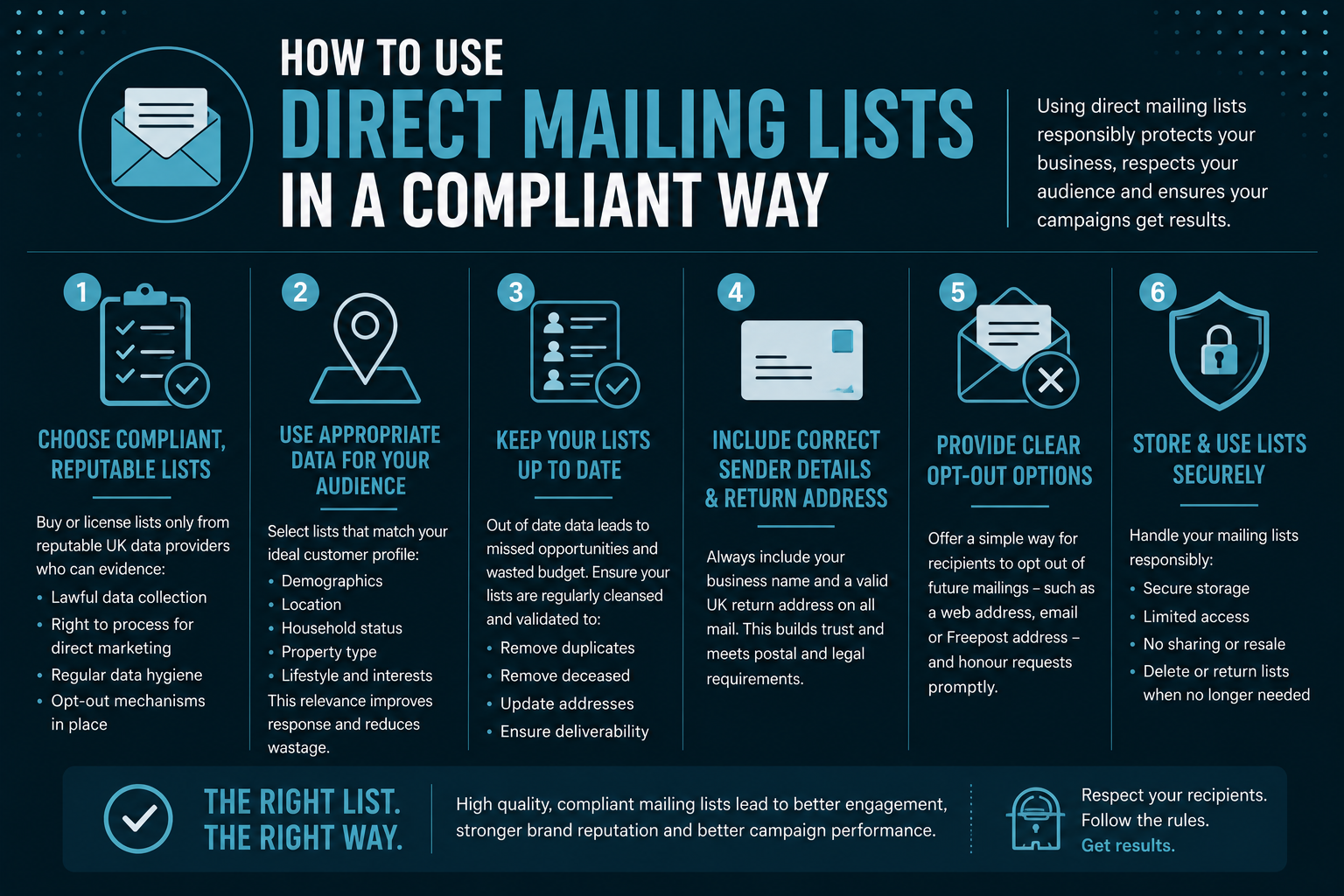
The Privacy and Electronic Communications Regulations 2003 (PECR) govern electronic marketing channels: email, SMS, automated calls, and live calls to TPS-registered numbers. PECR does not apply to postal communications. This means that the prior opt-in consent requirements that govern consumer email and SMS marketing do not apply to direct mail. A consumer direct mail list can be used for outreach to households without first obtaining explicit marketing consent from each recipient, provided the conditions of UK GDPR are met.
UK GDPR does apply to any direct mail campaign that uses personal data, which in practice means any campaign where named individuals are identified. Sending addressed mail to ‘The Occupier’ at a postal address involves no personal data and falls entirely outside the scope of GDPR. The moment a name appears on the envelope or the letter, you are processing personal data, and you need a lawful basis for doing so. As the ICO’s direct marketing guidance makes clear, for postal marketing the appropriate lawful basis in most cases is legitimate interests.
Legitimate Interests: What It Actually Requires
Legitimate interests is the most flexible of the six lawful bases available under UK GDPR, and it is the one most commonly relied upon for direct mail marketing data. However, as the ICO is explicit in pointing out, it is not a catch-all that removes the need for compliance thinking. Relying on legitimate interests requires completing and documenting a three-part assessment, often called a Legitimate Interests Assessment (LIA), before the campaign is launched.
The three parts of the assessment are: establishing that you have a genuine and compelling business interest in carrying out the marketing; confirming that processing the individual’s personal data is necessary to pursue that interest; and balancing your interest against the individual’s rights and reasonable privacy expectations to confirm that your interest is not overridden. As Direct Mail Systems sets out, it is crucial to document this LIA before initiating any campaign. This documentation is what you produce if the ICO investigates a complaint.
Recital 47 of GDPR specifically acknowledges direct marketing as a legitimate purpose, which means that in many B2C and B2B postal contexts, the first two parts of the test are relatively straightforward to satisfy. The balancing test is where careful thought is required. The more surprising or intrusive the mailing would be to a recipient given the context in which their data was collected, the harder it becomes to pass. A mailing to existing customers about a related product from the same brand is an easy case. A mailing to prospects whose data was sourced from a third-party database requires more careful articulation of why the commercial interest is proportionate to the recipient’s expectation of privacy.
Regardless of the lawful basis, every directly addressed mailing must give recipients a clear opportunity to opt out of future communications. Opt-outs must be honoured promptly and recorded in a suppression file that is applied before every subsequent campaign. UK GDPR also requires transparency about data processing: recipients should be able to understand who is using their data and for what purpose, typically through a privacy notice that is accessible even if it is not printed in full on every piece of mail.
The Mailing Preference Service
The Mailing Preference Service (MPS) is the UK’s official opt-out register for addressed direct mail. Individuals can register their name and address on the MPS to indicate that they do not wish to receive unsolicited direct mail from organisations that are members of the Data & Marketing Association (DMA) or that follow DMA codes of practice. Screening a direct mail list against the MPS before every campaign is not a statutory legal requirement in the same way that TPS screening is required by PECR. However, it is a requirement of the British Code of Advertising, and the DMA Code of Practice notes that it is a condition under the DMA Code for list-owners and cold mailers. For businesses that want to demonstrate responsible data use, MPS screening is standard practice rather than an optional extra.
Address Verification Against the Postcode Address File
Beyond consent and suppression obligations, Direct Mail Systems highlights that before direct mail containing personal information is sent, addresses should be verified against Royal Mail’s Postcode Address File (PAF) to ensure delivery accuracy and reduce mail waste. The PAF contains over 29 million UK postal addresses and 1.8 million postcodes, and verification against it is also a GDPR accuracy obligation: one of the core principles of UK GDPR requires that personal data is accurate and, where necessary, kept up to date. Sending a mail piece to an incorrect or outdated address is not just commercially wasteful. It is a data quality failure that GDPR requires organisations to address.
AccuraData: Every direct mail dataset we supply is verified against the Royal Mail PAF and screened against the MPS before delivery. We carry out NCOA checks to identify households that have moved, and we can apply deceased suppression to remove records that would represent an obvious waste of postage or a risk of causing distress to recipients. Our data cleansing and enrichment service applies these same checks to direct mail data that clients already hold, identifying and removing inaccurate, stale, and suppressed records before a campaign launches.
B2B Direct Mail Data and Consumer Direct Mail Data: How the Approach Differs
Direct mail works across both consumer and business audiences, but the structure of effective direct mail data differs meaningfully between the two. Treating B2B and B2C mailing data as interchangeable leads to campaigns that miss the mark for both audiences, and understanding the differences is foundational to building a postal marketing data strategy that performs.
Consumer Direct Mail Data
For consumer campaigns, the primary data attributes that drive performance are demographic and geographic. Age range, gender, household composition including the presence of children, property ownership or rental status, estimated income banding, and geographic location at postcode or postcode district level are the fields that allow segmentation into groups with meaningfully different needs and likely responses to a given offer. Lifestyle and interest data, where available from opted-in lifestyle survey sources, adds a further layer of precision: the ability to reach not just the right demographic profile but the right interest profile.
Consumer direct mail lists compiled for B2C campaigns also need to incorporate life stage targeting. The household of a recent first-time buyer has different purchasing needs from that of an established homeowner with teenage children, which in turn differs from a retired couple in a downsized property. These life stage differences are reflected in the data attributes held in a well-built consumer postal database, and they are what make it possible to match the proposition to the audience rather than mailing a generic offer to an undifferentiated list of addresses.
Life trigger data is a particularly powerful subset of consumer direct mail data. Individuals who have recently moved home, recently had a child, recently retired, or recently gone through another significant life event represent audiences with an elevated propensity to purchase specific categories of products and services. Royal Mail estimates that 11% of the UK population moves home every year, spending an average of £9,000 on their new property within six months of the move. A direct mail list that can identify recent movers within a specific postcode area and filter by property type or value is a fundamentally different commercial asset from a generic address file.
B2B Direct Mail Data
For business-to-business campaigns, the segmentation logic shifts from demographic to firmographic. The fields that determine whether a mail piece reaches the right decision-maker at the right company are industry classification down to SIC code level, employee count banding, estimated annual turnover, trading status, and the job title or seniority of the named contact. B2B direct mail data that contains only company names and registered addresses delivers mail to a building. B2B data that contains named individuals in specific roles delivers it to a decision-maker.
The format of a B2B direct mail piece also tends to differ from its consumer equivalent. As LettrLabs’ direct mail analysis notes, B2B campaigns work better with letter packages and tri-fold brochures that focus on ROI, efficiency, and professional credibility. The physical quality of the piece signals the seriousness of the supplier. And unlike consumer mail, which often aims at an impulse or near-term decision, B2B postal marketing typically aims to establish credibility and prompt an initial conversation, which means the data needs to support targeting the right seniority level rather than simply reaching a company’s registered address.
AccuraData: We supply direct mail data for both consumer and B2B campaigns, with segmentation fields covering age, demographics, and lifestyle interests for consumer audiences, and SIC code, employee count, turnover banding, and job title for B2B audiences. Our business-to-business lists include verified postal addresses alongside email and telephone data, enabling a coordinated multi-channel campaign from a single dataset.
The Direct Mail Data Quality Problem Most Campaigns Ignore
The performance benchmarks cited for direct mail — 4.4% average response rates, 29% ROI, integration lifts of 12% when mail is added to a multi-channel mix — are outcomes achieved by campaigns using clean, targeted, well-structured data. They are not what happens when a business sends a postal campaign on a list that has not been maintained, verified, or cleansed since it was first assembled.
Address data degrades continuously. People move. Properties change use. Streets are renamed. Buildings are demolished and replaced. In the UK, approximately 3.7 million people move home each year, which represents a rate of change that makes any static direct mail database measurably less accurate after six months and significantly so after twelve. Every stale address on a mailing list represents a piece of mail that will be delivered to the wrong household or returned undelivered. Neither outcome is commercially neutral: both represent wasted print and postage spend, and undelivered mail in volume also has implications for the sender’s standing with Royal Mail.
Deceased suppression is a related issue that receives less attention but carries real reputational risk. Sending marketing mail to a deceased individual is not merely ineffective. It causes distress to the household members who receive it, and it generates the kind of complaints that are shared on social media and that reflect extremely poorly on the brand involved. Deceased suppression services cross-reference a mailing list against records of registered deaths and remove affected addresses before a campaign launches. For businesses sending to older demographic segments, where mortality rates are higher, deceased suppression is a non-negotiable element of responsible direct mail data management.
Duplicate records represent a third dimension of data quality that erodes both campaign efficiency and brand perception. A household receiving two or three copies of the same mailing does not read three times as many versions. It perceives the sender as disorganised, the communication as unwanted, and the brand behind it as one that does not take customer experience seriously. Deduplication is a standard step in any professional postal data cleansing process, but it is frequently skipped by businesses that pull a list together quickly from multiple internal sources and send it without a proper data hygiene step beforehand.
The commercial arithmetic on data quality is straightforward. If a mailing list of 10,000 records contains 15% stale, duplicate, or suppressed addresses, 1,500 pieces are being printed and posted at the full unit cost and delivering zero commercial return. On a campaign with a postage and print cost of £1.50 per piece, that is £2,250 spent on mail that either arrives at the wrong address, arrives twice at the same address, or should never have been sent. That figure, applied across a year of campaigns, dwarfs the cost of professional direct mail data management and verification.
Segmentation Strategy: How to Get More from Your Direct Mail Data
Segmentation is the single highest-leverage action any business running direct mail campaigns can take to improve performance. Research from Direct Mail Systems is unambiguous on this point: highly targeted mail sent to the right people increases the likelihood that recipients will take action, and segmentation ensures that outreach resource is focused on the segments that offer the greatest return on investment. The constraint, always, is whether the direct mail data you are working with contains the fields needed to support meaningful segmentation in the first place.
RFM Segmentation for Existing Customer Databases
For businesses with an existing customer or prospect database, RFM segmentation — Recency, Frequency, and Monetary value — is one of the most powerful approaches available for direct mail list management. It divides a database into groups based on how recently each contact made a purchase or enquiry, how frequently they have engaged, and how much they have spent or how high-value their profile is. The segments that emerge from an RFM analysis have meaningfully different response probabilities and warrant meaningfully different offers: a high-recency, high-frequency customer is a candidate for a loyalty or upsell mailing, while a lapsed customer who was previously high-value is a candidate for a winback campaign with a specific incentive.
The direct mail data requirements for RFM segmentation are primarily internal: transaction history and engagement records held within your own CRM or customer database. The process of structuring and applying RFM logic is a data analysis task, but the output is a set of clearly defined mailing segments with different propensities, different messaging needs, and different ROI expectations. For businesses that have never applied structured segmentation to their existing customer data before using it for a postal campaign, the performance uplift from doing so for the first time tends to be immediate and significant.
Geodemographic Segmentation for Prospect Campaigns
For prospect campaigns using externally sourced consumer direct mail data, geodemographic segmentation is the most commonly applied approach. It combines geographic location with demographic profile to identify postal areas and household types that most closely match the profile of your existing customer base or ideal prospect. This approach is particularly powerful for businesses with regional service areas, because it concentrates their mailing spend on the postcodes and demographic profiles where conversion rates are historically highest, rather than distributing it evenly across a broader geography.
UK geodemographic classification systems such as ACORN and MOSAIC divide the UK into distinct consumer segments based on the combination of demographic, lifestyle, and geographic data held at household and postcode level. A well-segmented direct mail list built using geodemographic data targets the consumer types most likely to respond, rather than the largest possible volume of households in a given area. For businesses with strong conversion data from previous campaigns, overlaying that data against geodemographic classifications to identify the highest-performing consumer profiles and then targeting those profiles more heavily in future campaigns is a standard and consistently effective optimisation approach.
Behavioural and Trigger-Based Segmentation
The most sophisticated form of direct mail data segmentation is behavioural: reaching individuals at the moment of a life trigger or purchase signal that makes them demonstrably more likely to respond to a specific offer. Home movers, as noted above, are a clear example. New parents represent another. Recent retirees, recent divorcees, and individuals who have recently changed their vehicle registration are all examples of life events that create predictable purchasing needs and that can be identified through specialist data sources and incorporated into a targeted postal marketing list.
Trigger-based mailing is not the norm for most businesses, but the performance premium it delivers is well-established. The closer in time a mail piece arrives to the moment of genuine need, and the more specifically it addresses that need, the higher the probability of response. The data requirement for trigger-based campaigns is more complex than for standard demographic or geodemographic targeting, but for businesses in sectors such as home improvement, financial services, insurance, or retail who want to compete on relevance rather than volume, it represents the direction in which direct mail data strategy is most productively heading.
Making Direct Mail Data Work Within a Multi-Channel Strategy
Direct mail does not need to operate in isolation to deliver results, and the evidence strongly suggests it should not. Response rates reach 27% when direct mail is paired with email, compared to 4.4% for mail alone and 0.12% for email alone. Campaigns that include mail achieve a 12% higher ROI than those without, according to Royal Mail Brand Science analysis. And 90% of marketers agree that integrating direct mail and digital channels has a positive impact on campaign performance. These figures reflect a simple dynamic: direct mail that lands alongside a consistent message delivered through other channels compounds the effect of each individual touchpoint.
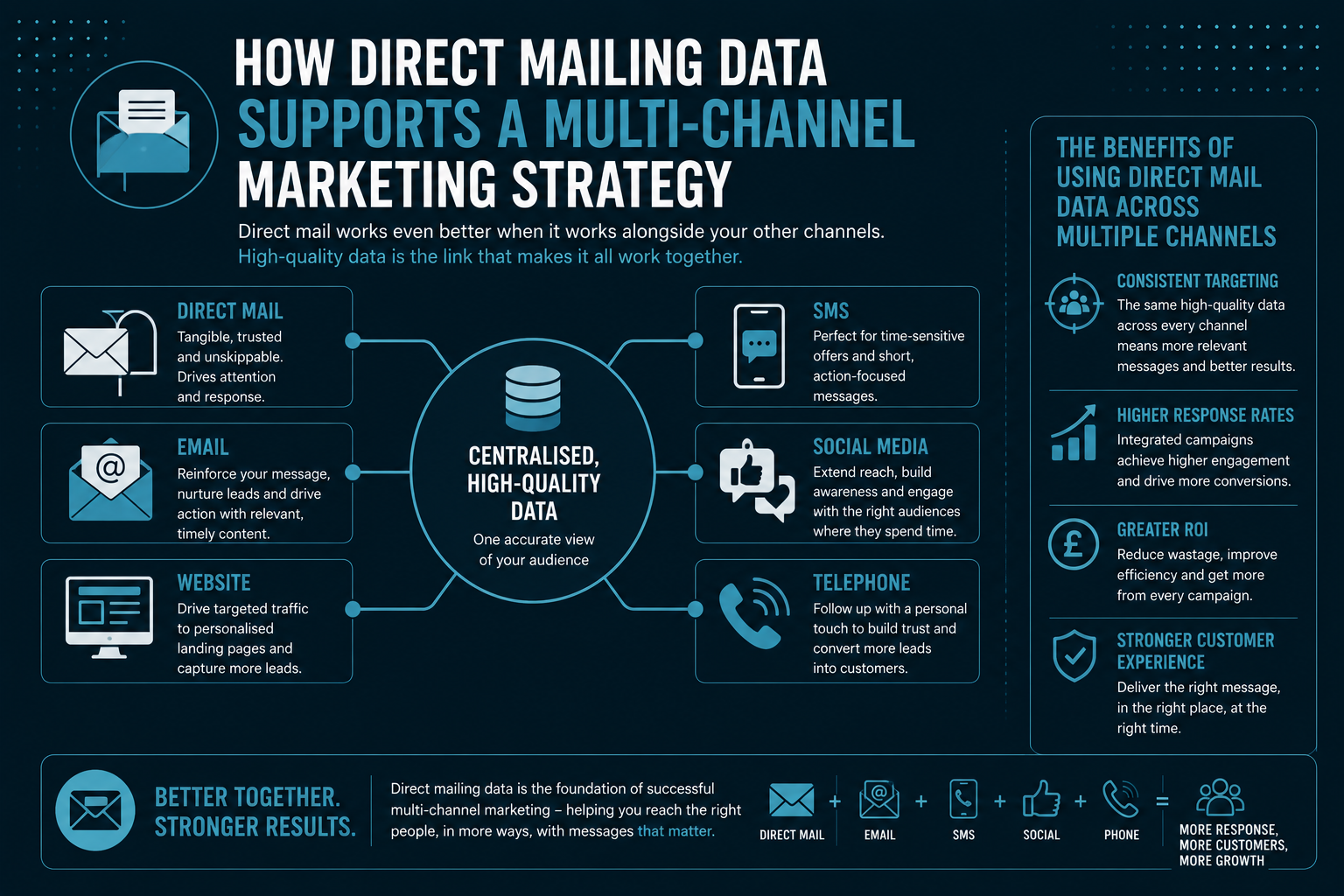
Making this work in practice requires that the same individual can be reached across multiple channels from a single dataset. A direct mail database that includes only postal addresses supports only one channel. A dataset that also includes verified telephone numbers and opted-in email addresses allows a coordinated sequence where the same household receives a mail piece, an email follow-up, and a telephone call, all reinforcing the same proposition across a structured timeline. AccuraData supplies direct mail data that includes telephone and email contact data where available alongside verified postal addresses, enabling multi-channel campaigns without the complexity of managing separate lists from separate sources and reconciling them before each send.
Digital integration is the other dimension of the multi-channel picture that is reshaping how direct mail data is used. QR codes on mail pieces that link to campaign-specific landing pages allow precise tracking of which individuals respond to which version of a campaign. Personalised URLs (PURLs) route each recipient to a unique version of a landing page pre-populated with their details. And data from mail responses can be fed back into digital retargeting campaigns, serving digital ads to households that received mail but did not yet respond. The postal marketing data is the audience definition that makes all of these digital integration tactics possible. The mail piece is the first point of physical contact. Everything else builds on the reach that the data enables.
Measuring What Your Direct Mail Data Is Actually Delivering
One of the historical objections to direct mail as a marketing channel has been the difficulty of measuring response accurately. That objection has largely been resolved by the range of tracking mechanisms now available, but the performance data a campaign generates is only meaningful if the direct mail data is structured in a way that makes attribution possible from the start.
The simplest tracking mechanism is a unique telephone number printed on each mail piece, or a unique response code or voucher code that can be matched back to the campaign when a recipient calls or redeems it. QR codes linked to campaign-specific landing pages allow digital tracking of the response to a physical mail piece, providing click-through rates and conversion data that can be compared directly with digital campaign benchmarks. For campaigns running across multiple segments or multiple creative variants, each segment or variant should have its own unique response mechanism, so that the performance of individual cells can be measured and compared.
The segment-level data that emerges from a tracked campaign is one of the most commercially valuable outputs of a well-structured direct mail marketing data strategy. Knowing which geographic sub-region generated the highest response rate, which demographic profile converted best, and which creative variant produced the strongest enquiry volume gives you the inputs needed to refine the direct mail list for the next campaign, concentrating future spend on the segments that have demonstrated the highest return. This is the compound benefit of running tracked campaigns over time: each campaign provides the data that improves the targeting of the next one, and the direct mail database becomes progressively more valuable as it is refined against actual performance outcomes.
How AccuraData Builds and Supplies Direct Mail Data
AccuraData supplies accurate, UK GDPR compliant direct mail data to businesses running postal campaigns to both consumer and business audiences. Our consumer datasets are segmented by age, gender, geographic region to postcode level, homeownership status, household composition, income banding, and lifestyle interest categories. Our B2B postal data is segmented by SIC code industry classification, employee count, turnover banding, geographic region, and named contact job title and seniority.
Every direct mail list we supply goes through address verification against the Royal Mail Postcode Address File before delivery. We apply NCOA checks to identify and update records belonging to individuals who have moved, and we apply MPS suppression and deceased suppression as standard. The result is a postal dataset that reflects the current state of the target audience, not the state it was in when the data was originally compiled.
For businesses whose existing customer or prospect database needs cleaning before a campaign launches, our data cleansing and enrichment service applies the same address verification, NCOA processing, MPS suppression, and deceased suppression processes to data you already hold. We can also append missing fields, such as telephone numbers or email addresses where available, to an existing postal dataset, enabling a multi-channel campaign from a database that previously only supported postal outreach.
For businesses that are also running telephone outreach alongside their postal campaigns, our TPS and CTPS checking service screens the telephone numbers within a combined direct mail and telemarketing dataset, ensuring that the multi-channel campaign is compliant across every channel before a single call is made. We can process direct mail data, telephone data, and email data in a single submission and return a consolidated, cleaned, and compliant dataset ready for multi-channel deployment.
Every dataset we supply comes with a Data Processing Agreement as standard and clear documentation of the sourcing and lawful basis for the records it contains. We are registered with the ICO and operate within the UK GDPR framework on every engagement. Get in touch with our team to discuss what our direct mail data looks like for your specific campaign audience, what segmentation options are available, and what a campaign built on it can realistically achieve.
Direct Mail Data Is Where Campaign Performance Is Decided
The return on investment that makes direct mail one of the most attractive channels in a modern marketing mix is not produced by the format. It is not the result of the paper stock, the creative concept, or the print quality. It is the result of a mail piece reaching the right person at the right address, carrying a message that is relevant to their specific circumstances, and prompting an action that generates commercial value for the business that sent it. All of that depends on the quality of the direct mail data behind the campaign.
A direct mail list that is accurate, well-segmented, legally compliant, and regularly maintained is a commercial asset that compounds in value over time. A list that is stale, unsegmented, and unverified is a liability that drives up costs, reduces response rates, and generates the kind of complaints that follow a brand for longer than any single campaign. The investment in quality postal marketing data is not a premium add-on to a direct mail strategy. It is the foundation on which a direct mail strategy either stands or collapses.
AccuraData provides verified, compliant direct mail data at competitive rates, with the segmentation depth, verification standards, and compliance documentation that businesses running serious postal campaigns need from day one. If you want to understand what our data looks like for your target audience and what it could deliver for your next campaign, speak to our team. The conversation starts with who you want to reach.