
Every B2B sales and marketing team is, at its core, working with a list. Whether that list lives inside a CRM, a spreadsheet, or an email platform, it represents the sum total of who you can reach, who you can pitch to, and who you can convert into paying clients. The quality of your business lists defines the ceiling on what your outreach can achieve, regardless of how compelling your offer is or how well-crafted your messaging might be.
The UK is an enormous market for B2B outreach. According to the House of Commons Library, there were 5.7 million private sector businesses in the UK as of January 2025, a 3.5% increase on the previous year. That figure includes 5.4 million micro-businesses, and the vast majority of them are potential prospects for at least some segment of the B2B supply chain. The opportunity is real and substantial. Capturing it, though, depends entirely on whether the business lists you are working from are accurate, current, and structured in a way that supports targeted outreach rather than generic broadcast.
At AccuraData, supplying verified UK business contact lists is what we do. We have watched the same pattern play out across hundreds of campaigns: businesses that invest in quality data generate pipeline; businesses that cut corners on data burn budget without results. This guide explains what separates the two, and what any business should understand before purchasing or using a business list for outreach.
What Are Business Lists and Why Do They Matter?
A business list is a structured dataset of company and contact information used to identify and reach potential customers, partners, or prospects. At a minimum, a business contact list will include company names, contact names, and email addresses or phone numbers. A more comprehensive dataset also covers job titles, seniority levels, industry classification, company size, turnover banding, geographical location, and postal addresses for direct mail follow-up.
The reason business lists matter so fundamentally is that B2B sales, unlike consumer marketing, is typically a deliberate, high-consideration process that begins with identifying the right individual within the right organisation. You are not broadcasting to a mass audience and waiting for interested people to self-select. You are reaching out to specific decision-makers with a specific proposition. That requires knowing who those decision-makers are and how to contact them, which is precisely what a well-built B2B business list provides.
The commercial stakes are significant. LinkedIn’s B2B research consistently finds that growing a high-quality lead pipeline is the single biggest priority for B2B marketers, cited by 37% as their top focus. Lead quality, not volume, is what most experienced teams are chasing. And lead quality starts with the underlying data in your business list, not with the copy you write to send to it.
The Problem with Low-Quality Business Contact Lists
The market for business lists in the UK is substantial, and as with any large market, the quality on offer varies enormously. At one end, you have suppliers offering millions of records at low cost per contact, assembled from scraped or aged sources with minimal verification. At the other, you have providers who apply active verification, regular refresh cycles, and documented compliance processes. The difference between the two ends of that spectrum is not marginal. It is the difference between a campaign that generates revenue and one that causes lasting damage to your marketing infrastructure.
The most immediate problem with unverified business lists is deliverability. Research compiled by Landbase, drawing on Gartner and Forbes data, found that most B2B databases contain records where the average provider accuracy rate is only 50%. Contact data decays at approximately 2.1% per month, which compounds to roughly 22.5% per year. A list purchased twelve months ago and left unrefreshed could have nearly a quarter of its records in some state of inaccuracy before a single email has been sent.
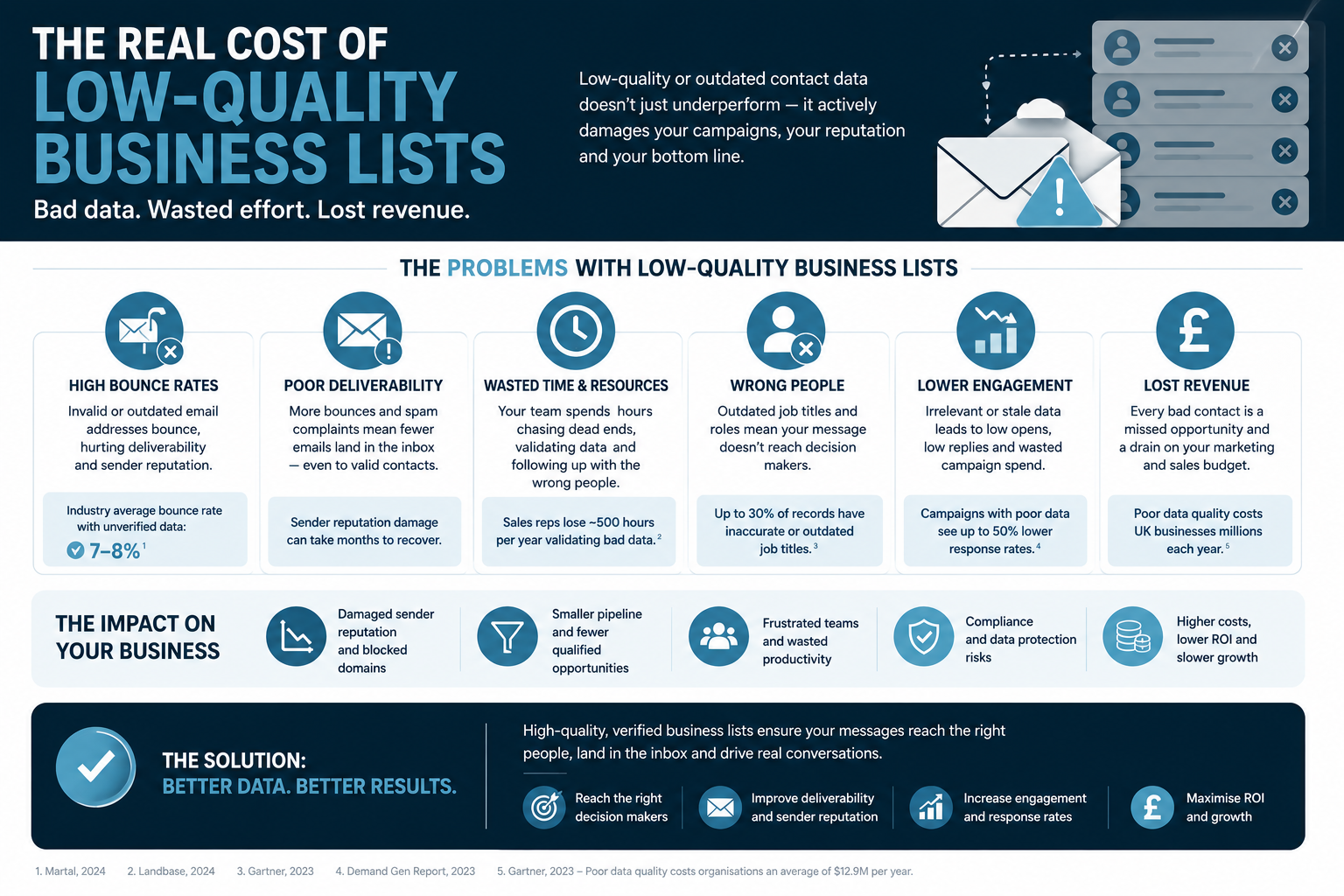
The knock-on effects are serious. High bounce rates from invalid addresses damage your sender reputation with inbox providers, reducing deliverability across your entire domain, including to the valid contacts on your list. According to Martal’s cold email benchmarks, campaigns using unverified data see average bounce rates of 7 to 8%, compared to under 2% for well-verified opted-in lists. Sustained bounce rates at the higher end can cause your domain to be flagged by providers like Gmail and Outlook, making it progressively harder to reach anyone in your target market, regardless of data quality improvements later.
Beyond deliverability, poor business lists create a productivity drain that is often invisible until someone looks closely at how sales time is actually being spent. Research cited by Landbase found that sales representatives lose approximately 500 hours per year, equivalent to 62 full working days, validating and correcting bad contact data. That is a quarter of a working year spent on data administration rather than selling.
What a High-Quality Business List Should Contain
When AccuraData supplies business lists to clients, the quality of the underlying records is the product. Understanding what goes into a well-built company contact list is useful both for evaluating what any supplier is offering and for understanding why certain datasets command higher prices than those sold purely on volume.
Verified Email Addresses
Active mailbox verification confirms that an email address is live, accepts incoming mail, and is not associated with known spam traps or disposable address services. This is distinct from simply checking that the address is correctly formatted or that the domain exists. Proper mailbox-level verification is one of the most meaningful indicators of a high-quality business email list, and it is the element most frequently skipped by low-cost providers.
Named Decision-Makers with Accurate Job Titles
A business list that returns a company name and a generic info@ address is of limited use for targeted B2B outreach. What drives results is reaching named individuals in specific roles. Job title accuracy is essential here, because a message crafted for a Financial Director that lands with a Marketing Assistant is not just wasted, it is potentially counterproductive. Seniority filtering, which allows you to target owners, directors, and senior managers rather than the full company employee base, is a core feature of any genuinely useful targeted business list.
Rich Firmographic Data
The more you know about a company before you contact it, the more relevant your outreach can be. A comprehensive business database should include industry classification down to SIC code level, employee count banding, estimated annual turnover, and trading status. This information drives segmentation, which in turn drives campaign performance. According to SQ Magazine’s B2B email benchmarks, advanced segmentation by role, stage, and behaviour produces 78% higher click-through rates than unsegmented outreach. That uplift only becomes achievable when your business list contains enough data to support that level of targeting.
Multi-Channel Contact Fields
Email is typically the first touch in a B2B outreach sequence, but it is rarely the only one that matters. The most effective campaigns layer email with telephone follow-up and, for high-value prospects, direct mail. A business list that includes direct dial numbers and postal addresses alongside verified email contacts enables this kind of multi-channel approach from a single dataset, which simplifies campaign logistics and ensures consistency across touchpoints.
Recency of Verification
Even the best data has a shelf life. Given the rate at which contact information changes as people move roles, businesses restructure, and companies dissolve, a business contact list that was verified more than six months ago is already carrying a meaningful proportion of stale records. The question to ask any provider is not only how they verify data but when verification was last carried out for the specific dataset you are purchasing.
Business Lists and UK Legal Compliance: What You Need to Know
Using business lists for outreach in the UK sits within a defined legal framework, and understanding it protects both your business and the contacts you are reaching. The two pieces of legislation that apply are UK GDPR and the Privacy and Electronic Communications Regulations (PECR). The two overlap, and both apply to commercial email and telephone outreach.
The starting point for most B2B outreach is that PECR does not require prior opt-in consent when emailing or calling a corporate subscriber, meaning a limited company or other incorporated entity. The ICO’s own guidance confirms this position, which is what makes large-scale B2B outreach using company contact lists legally workable without the explicit consent requirements that apply to consumer marketing.
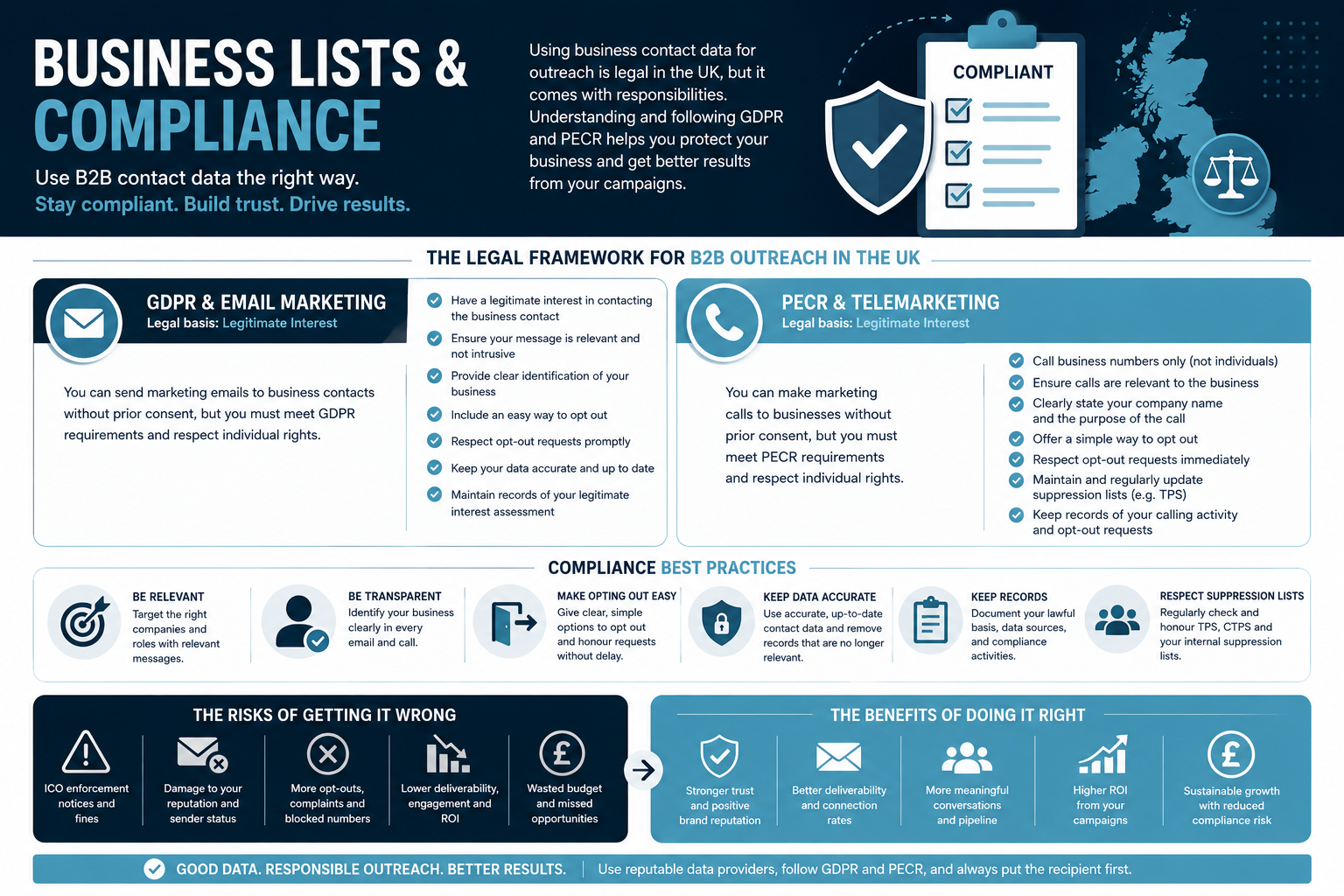
UK GDPR introduces additional obligations wherever a contact record identifies an individual. A named business email address such as firstname.lastname@business.co.uk is personal data under GDPR, regardless of whether it belongs to a corporate subscriber. Processing it requires a lawful basis, and in B2B outreach that basis is almost always legitimate interests. Relying on legitimate interests is not a simple opt-out from compliance. It requires a documented balancing test demonstrating that your commercial interest is proportionate and does not override the individual’s rights to privacy.
In practical terms, compliance when using business lists means maintaining suppression lists, acting promptly on opt-out requests, being transparent about how you obtained someone’s contact details if they ask, and being able to produce documentation of your legitimate interests assessment. Every outreach communication must also carry a clear and functional opt-out mechanism.
Any business list provider worth working with will be registered with the ICO, will provide a Data Processing Agreement as standard, and will be able to explain clearly how the data was collected and on what basis it meets UK GDPR requirements. As Acquirz notes, inaccurate data creates compliance exposure as well as performance problems: if your business list contains records for individuals where legitimate interests cannot be properly argued, you are exposed to complaints and regulatory scrutiny.
How to Segment Business Lists for Better Outreach Results
Buying a business list is the starting point, not the finish line. What you do with the data once you have it determines the return you see. The single most effective thing most B2B outreach teams can do to improve their results is invest more time in segmentation before they send a single message.
Segmentation means dividing your business contact list into groups that share meaningful characteristics, and then tailoring your message to each group rather than sending a single version to everyone. At the most basic level, this means separating contacts by industry and company size, so that a message about a manufacturing-specific solution goes only to manufacturers, and a pitch built around the needs of an SME does not land with a FTSE 250 procurement director.
More granular segmentation pushes further. Separating contacts by seniority level means you can adjust your message to reflect the priorities of a business owner versus a department head versus a specialist. Filtering by geography allows regional businesses to focus their outreach where they can genuinely service the customer. Filtering by SIC code allows businesses selling into niche verticals to reach only the companies that fit their ideal customer profile rather than working through a broad industry category that includes many irrelevant records.
The performance data on segmented outreach is consistent and compelling. B2B email benchmarks from SQ Magazine show that segmented email campaigns generate 64% more conversions than non-segmented sends. The businesses achieving these results are not necessarily using more sophisticated creative or longer sequences. They are simply sending more relevant messages to more carefully defined segments of their business lists. The data does the work; the messaging builds on it.
How Business Lists Fit into a Multi-Channel Outreach Strategy
The most effective uses of business lists in B2B environments are rarely single-channel. Email opens the door, but a well-structured multi-touch sequence, using the same verified contact data across email, telephone, and where appropriate direct mail, is what builds the familiarity and credibility needed to generate a response from a cold prospect.
This is one reason why the richness of a business list matters beyond just email addresses. A dataset that includes verified direct dial numbers and confirmed postal addresses enables a coordinated sequence where the same decision-maker receives a relevant email, followed by a personalised phone call, and potentially a physical piece of direct mail for high-value targets. Each touchpoint reinforces the others, and the consistency of the message across channels builds recognition in a way that a single email cannot.
The data supports the multi-channel approach. McKinsey’s B2B research identifies highly personalised marketing as one of five key strategies that drive B2B sales success, with companies implementing all five strategies being twice as likely to achieve over 10% market share growth. Personalisation at the level McKinsey describes requires structured, rich business contact data, not just a name and an email address.
For businesses running Account-Based Marketing, the requirement for high-quality business lists is even more acute. ABM targets specific named accounts with tailored campaigns across multiple contacts within the same organisation. That requires not just one contact per company but multiple decision-makers and influencers identified, verified, and attributed to the right account. According to KLIQ’s B2B benchmarks, 57% of B2B marketers are now planning or executing ABM programmes, with 52% reporting positive ROI. A comprehensive business list with multiple contacts per account, segmented by role and seniority, is the infrastructure those programmes run on.
How Often Should You Refresh Your Business Lists?
No business list is permanently accurate. The UK business landscape is dynamic: Companies House reported 726,735 dissolutions in the financial year ending March 2025, alongside over 800,000 new incorporations. People change jobs, companies restructure, roles are made redundant, and new decision-makers take over. All of this erodes the accuracy of any static business contact list over time.
The practical benchmark is that a business list should be reviewed and refreshed every six to twelve months for ongoing campaigns. High-volume outreach programmes, or those targeting sectors with rapid personnel turnover such as technology, hospitality, or recruitment, may warrant more frequent refreshes. The cost of a data refresh is almost always lower than the cost of running a full campaign against a list where a significant proportion of records have become stale.
Suppression management is the other side of this. Every contact who has opted out of communications, every hard bounce, and every known leavers record should be suppressed before any send goes out. Running suppression against a purchased business list before use is good practice both for compliance and for performance. It removes the contacts most likely to damage your sender reputation and ensures your active outreach is concentrated on the records most likely to produce a result.
Choosing a Business List Provider: What AccuraData Offers
When businesses approach AccuraData for business lists, the conversation starts with their target audience, not our catalogue. The UK has 5.7 million private sector businesses, and the segment of that market relevant to any one client will be defined by a combination of industry, geography, company size, and decision-maker role. Our job is to build a business contact list that reflects that profile precisely, not to sell a pre-packaged dataset and hope it fits.
Every record in an AccuraData business list goes through active verification before delivery. We check email addresses at mailbox level, confirm that job titles reflect current roles, and cross-reference company records against Companies House and other established UK sources. We supply a Data Processing Agreement as standard and operate in full compliance with UK GDPR and PECR. Clients receive not just the data but the documentation to support its compliant use.
Our business lists are available segmented by industry SIC code, employee count, turnover banding, geography, and job function, including specific decision-maker roles across finance, operations, marketing, IT, procurement, and more. For clients running multi-channel campaigns, every dataset includes direct dial telephone numbers and postal addresses alongside verified email contacts.
We also work with clients after data delivery. If a campaign produces unexpected bounce rates or engagement patterns that suggest data quality issues in a specific segment, we investigate and replace affected records. The goal is not a one-time data transaction but a working relationship with a business list provider that understands both your market and your campaign objectives well enough to make your outreach consistently better over time.
The Right Business List Changes What Your Outreach Can Achieve
The UK B2B market is large, active, and full of genuine opportunity. With 5.7 million private sector businesses and a B2B marketing industry growing year on year, the demand for quality outreach has never been higher. But the opportunity is only accessible to businesses whose business lists are accurate enough to reach the right people, compliant enough to use without legal exposure, and rich enough to support the kind of targeted, personalised messaging that modern B2B buyers actually respond to.
The difference between a high-performing business list and a low-quality one is not marginal. It determines deliverability, campaign ROI, sales team productivity, and the long-term health of your outreach infrastructure. Getting it right from the start is consistently the lower-cost and higher-return path.
If you want to understand what a verified, segmented business list built specifically for your target market looks like, AccuraData is ready to show you. Speak to our team and tell us who you are trying to reach. We will tell you exactly what we can deliver.