
A Business to Business Email List can help a company reach relevant decision-makers, open new commercial conversations and support a more consistent lead generation programme. Used well, it gives sales and marketing teams a structured way to contact the right organisations with the right message. Used badly, it can damage deliverability, frustrate recipients and create avoidable compliance risk. The difference usually comes down to data quality, lawful processing, campaign planning and how carefully the list is matched to the audience.
For UK organisations, business email data is not just a spreadsheet of addresses. It is personal data when it identifies an individual at work, which means UK data protection law matters. The ICO explains that even in a business-to-business context, UK GDPR applies when personal data is processed for direct marketing. The same guidance also explains that PECR treats corporate subscribers differently from individual subscribers, which is why B2B email marketing needs a more careful explanation than the simple phrase “you need consent” or “you do not need consent”.
This article explains what a business to business email list is, how these lists are created, the pros and cons of buying email data, how to think about newsletter and subscription data, what compliance means in practice, and how segmentation can improve campaign performance. It also explains why AccuraData is a strong partner for organisations that need targeted B2B Email Data and support with managed Email Marketing Services.
What is a business to business email list?
A business to business email list is a structured dataset containing email contact records for people who work in companies, public sector bodies, charities, partnerships or other organisations. It is normally used for business development, account-based marketing, sales prospecting, event promotion, lead nurturing or customer acquisition. A useful B2B email list does more than provide an email address. It should help the sender understand who the person is, where they work and why they may be a relevant recipient.
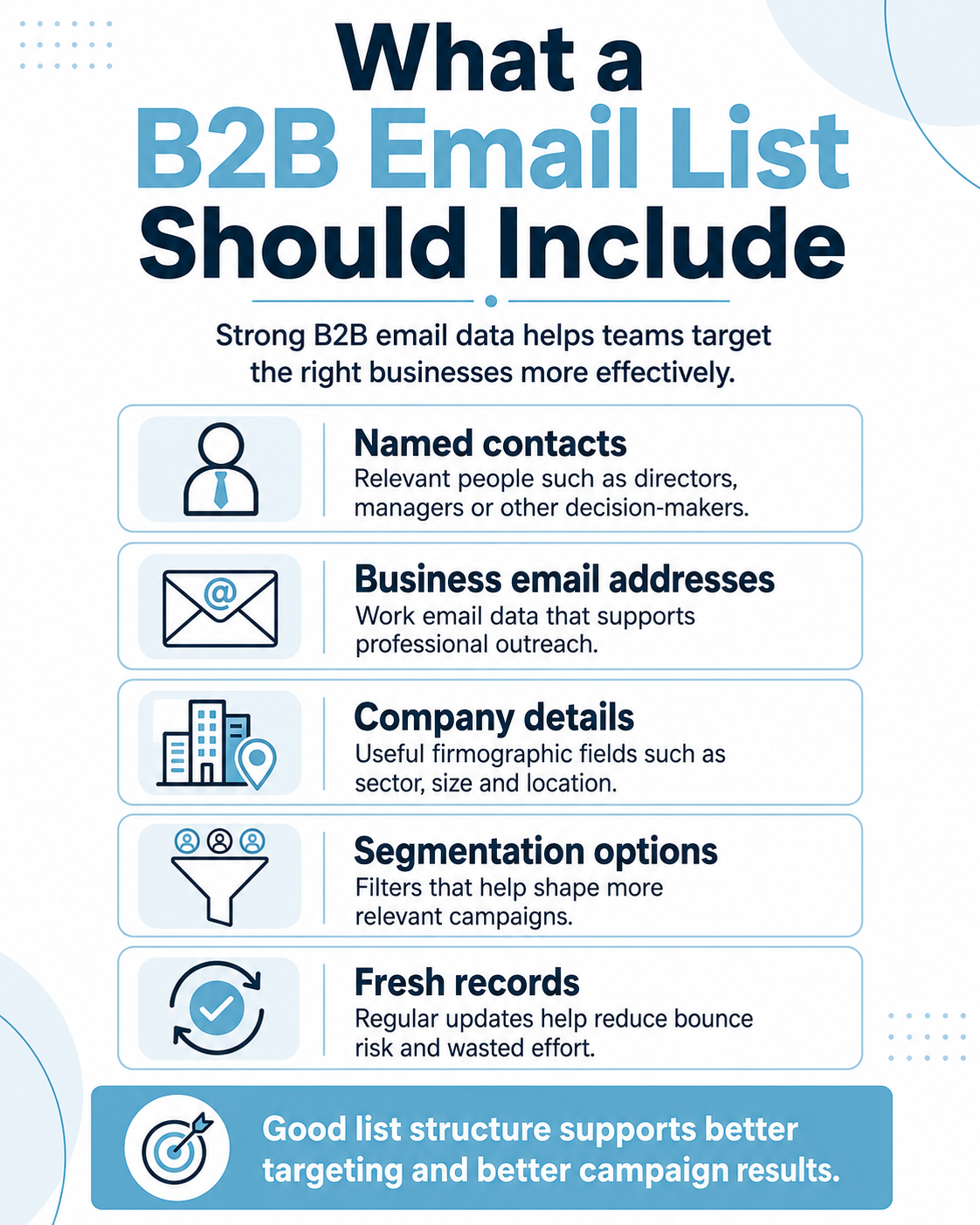
A basic list might include a company name, contact name, job title and business email address. A stronger list may also include company sector, SIC code, employee size, turnover banding, location, website, telephone number, seniority, department, decision-maker category, and other segmentation fields. These fields help teams build smaller, more relevant campaign audiences rather than sending one broad message to everyone.
That matters because B2B buying is not random. A finance director, HR manager, operations director and managing director may all work in the same company, but each may care about different problems. A business to business email list should therefore support relevance at contact level and account level. If the campaign is about recruitment software, HR and people leaders may be the strongest audience. If the campaign is about energy procurement, finance directors, operations leaders and business owners may be more relevant. If the campaign is about commercial property maintenance, facilities, estates and operations roles may be a better fit.
This is why AccuraData’s Business to Business Email Lists guidance places emphasis on business contact data, not just generic email volume. A list only becomes commercially useful when it helps a business select a relevant audience, communicate with that audience clearly and follow up based on the resulting engagement.
Why business email lists still matter
Email is still one of the most practical channels for B2B outreach because it can carry a clear message, link to a useful resource, support follow-up and create measurable engagement data. It is not limited by call availability and it does not require the recipient to be available at the exact moment the campaign is sent. A well-written email can be read, forwarded, saved or revisited when the recipient has time.
However, the value of email does not come from sending more emails. It comes from sending useful emails to people who are likely to have a genuine business reason to consider the message. The DMA benchmarks show that email performance is measurable through delivery, open and click data, but those metrics only become meaningful when the audience has been selected properly. High delivery does not automatically mean commercial success. A campaign can deliver perfectly and still fail if the list is poorly targeted.
Business email lists are useful because they let organisations reach outside their current customer base. A company may have strong products but limited market visibility. It may know which sectors it wants to sell into but lack named contacts. It may have a sales team that can handle opportunities but no consistent source of new prospects. A B2B email list can fill that gap by giving the team a defined audience for outreach, nurturing and follow-up.
The channel also works well as part of a wider sales process. Forrester has reported that digital buying behaviours are changing how B2B sales leaders think about engagement, with many leaders expecting digital buying to have a significant impact on their organisation. The point for email marketers is simple. Prospects often research before they speak to sales, so useful email content can help create awareness long before a direct sales conversation takes place. The relevant Forrester analysis supports the idea that B2B teams need to think about digital engagement as part of the buying journey, not just as a quick lead capture tool.
How business to business email lists are generated
Business email lists can be generated in several ways. The right approach depends on the purpose of the campaign, the maturity of the organisation’s own data and the level of speed required. In practice, many businesses use a mix of first-party data, subscribed contacts and carefully sourced third-party B2B data.
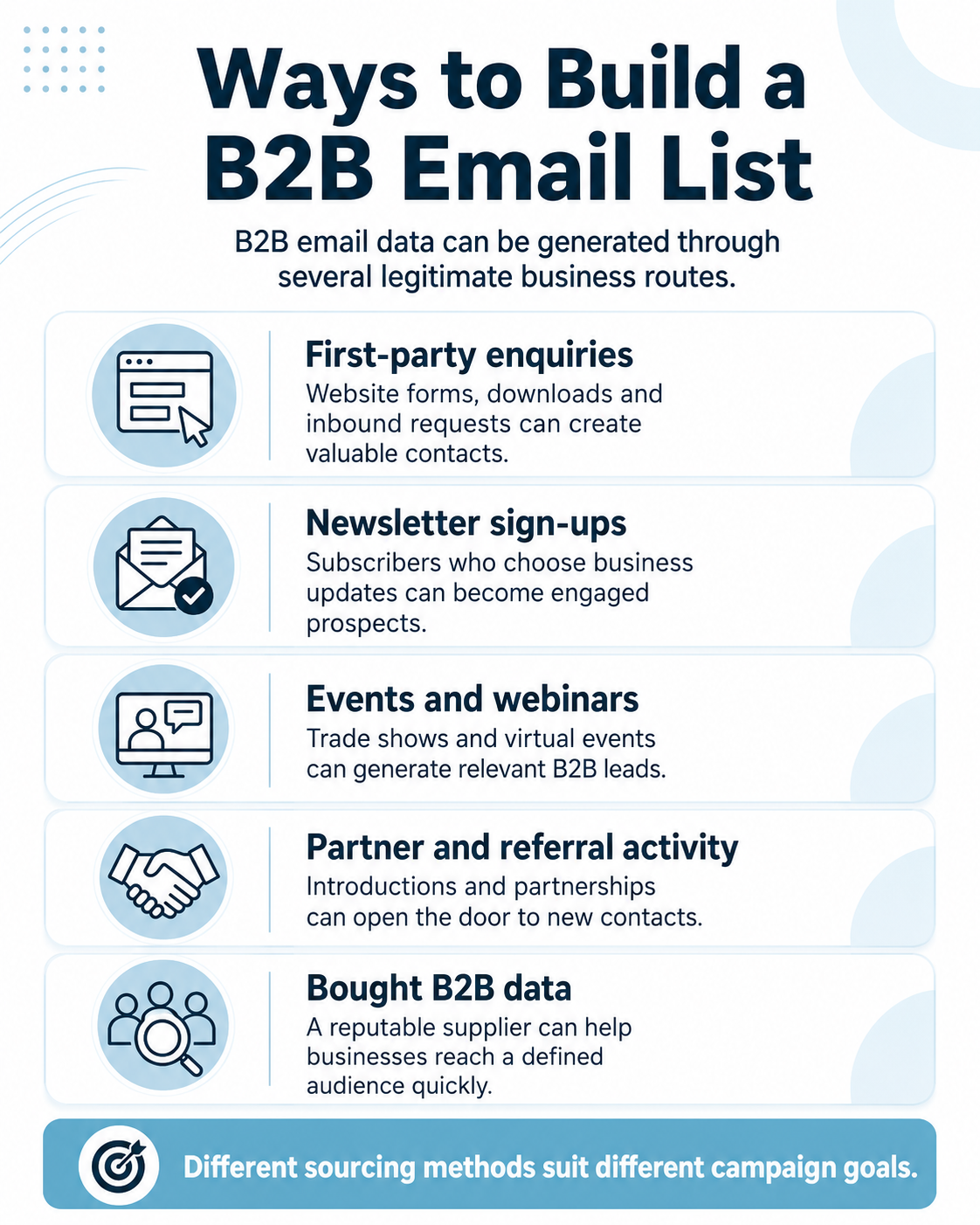
The first source is internal customer and prospect data. This may include enquiries, event attendees, account records, sales conversations, previous customers, webinar registrations, quote requests and newsletter subscribers. This data is valuable because the organisation already has a relationship or prior interaction with the contact. It should still be reviewed for purpose, age, accuracy and permissions before use. A contact who asked for a quote four years ago should not automatically be treated the same as someone who downloaded a current guide last week.
The second source is newsletter and subscription data. When someone actively signs up for a newsletter, guide, event or regular update, the business has stronger context for future communication. The important issue is clarity. Subscription forms should explain what the person is signing up to, how their data will be used and how they can unsubscribe. For individual subscribers, the ICO guidance around electronic mail marketing is especially important because consent rules and the soft opt-in may apply depending on the relationship and recipient type.
The third source is publicly available business information. Companies publish staff details in directories, on websites, at events, through professional profiles and in trade publications. Public visibility does not mean unlimited use. If a business collects personal data from public sources, it still needs a lawful basis, a clear purpose and fair processing. The public nature of a record may help explain why a person might reasonably expect some professional contact, but it does not remove the need for responsible handling under UK GDPR.
The fourth source is purchased B2B data. Buying a business to business email list can be a legitimate way to reach a defined market, provided the supplier is credible and the buyer understands how the list will be used. A quality supplier should be able to explain the data source, the available segmentation, how records are maintained, how email addresses are checked, what suppression process is used and what compliance documentation supports the intended use. This is where a specialist provider such as AccuraData can add value by supplying targeted B2B email records built around campaign objectives rather than generic volume.
The fifth source is data enrichment. Some businesses already have a company list but lack contact names, job roles or usable email addresses. Others have old CRM records that need validation and role updates before outreach. Enrichment can add missing business fields, correct outdated records and support better segmentation. AccuraData’s data cleansing services are relevant here because email performance often depends on cleaning and structuring the existing database before adding new contacts.
Buying a business to business email list: the advantages
Buying a business to business email list can be attractive because it gives a business immediate access to a defined target audience. Building a comparable list internally can take months or years, especially if the target market is broad, fragmented or difficult to reach through inbound channels alone. A bought list can help a business move from planning to campaign activity more quickly.
The first advantage is speed. If a business is entering a new market, launching a product, promoting an event or trying to create sales momentum, waiting for organic data collection may be too slow. A purchased B2B email list gives the marketing team a starting audience. It does not guarantee results, but it removes the first operational barrier: not knowing who to contact.
The second advantage is targeting. A good supplier can filter by sector, company size, region, job function, seniority and other firmographic fields. This can be more precise than relying on broad paid advertising audiences or generic website traffic. AccuraData’s B2B data service is designed around audience selection, which means the buyer can start with commercial criteria rather than a one-size-fits-all database.
The third advantage is scale. An internal list may contain existing customers and inbound leads, but that may not be enough for a sustained outbound programme. A bought list can expand reach across relevant sectors without requiring the company to wait for every contact to discover the brand first. This can be especially useful in markets where buyers are not actively searching every day but still have a genuine need when the right message appears.
The fourth advantage is segmentation. A list that contains useful fields can support different messages for different groups. For example, a software company might send one version to finance leaders, another to operations directors and another to managing directors. The same database can also support retargeting, follow-up calls, direct mail and account-based sales activity when properly planned.
The fifth advantage is operational focus. Rather than asking salespeople to research hundreds of contacts manually, a business can start with a structured dataset and spend more time on proposition, message quality and follow-up. This is particularly useful for small teams that need to be disciplined about where time is spent.
Buying a business to business email list: the risks
Buying a business to business email list also has risks. The biggest risk is not the act of buying data itself. The risk is buying poor data, misunderstanding the rules or using the list in a way that does not respect recipients. A cheap list with unverified addresses, weak source information and little segmentation may create more problems than opportunities.
The first risk is poor deliverability. If a list contains invalid email addresses, role-based addresses, abandoned mailboxes or unsuitable records, bounce rates can rise quickly. High bounce rates can harm sender reputation and reduce inbox placement. The Google sender guidelines advise senders to monitor spam rates and maintain low complaint levels, which is difficult when the underlying list is poorly matched or outdated.
The second risk is weak relevance. Even valid business email addresses can perform badly if the recipients are not the right audience. A managing director of a small construction firm, an IT manager in a university and a procurement lead in a logistics company may all be business contacts, but they are not interchangeable. Relevance depends on sector, role, need, timing and message fit.
The third risk is compliance misunderstanding. Some businesses hear that B2B email rules are different and assume there are no responsibilities. That is not right. The ICO states that the PECR electronic mail rule does not apply to corporate subscribers, but UK GDPR still applies when personal data is processed. The campaign still needs a lawful basis, fair processing, transparency and respect for objections.
The fourth risk is hidden cost. A low-cost list may require cleaning, deduplication, suppression, verification and manual review before it is safe to use. If those steps are not done, the cost may appear later through wasted sends, poor engagement, damaged domain reputation or sales time spent chasing unsuitable contacts. Data-8 has highlighted the commercial and compliance risk of data decay, including changing email addresses and telephone numbers. The exact decay rate will vary by sector and dataset, but the general risk is clear: business contact data goes out of date.
The fifth risk is poor follow-up. A list is not a campaign by itself. If the message is generic, the offer is unclear or the sales team cannot follow up intelligently, the results will be limited. This is why AccuraData’s Email Marketing Campaigns content focuses on planning, operation, measurement and improvement rather than treating the list as the whole solution.
B2B email compliance in the UK
Compliance should be planned before a business sends its first campaign. The ICO planning guidance says organisations should build data protection and PECR compliance into direct marketing activity from the start. This is easier than trying to fix problems after a campaign has already been sent.
The first point is that a named business email address can be personal data. An address such as jane.smith@examplecompany.co.uk identifies a person, even though it is used at work. UK GDPR therefore applies to how that data is collected, stored, selected, used and retained. A generic inbox such as sales@examplecompany.co.uk may not identify a person in the same way, but many useful B2B campaigns need named contacts because they rely on role relevance.
The second point is PECR. The rules for electronic mail marketing differ between individual subscribers and corporate subscribers. The ICO B2B guidance explains that the PECR electronic mail rule does not apply to corporate subscribers, which includes many limited companies, LLPs and public bodies. It also explains that sole traders and some partnerships can be individual subscribers, so they require more care. This distinction matters because a list containing business contacts may still include individuals who are treated differently under PECR.
The third point is lawful basis. Many B2B marketing campaigns rely on legitimate interests, but this should not be treated as automatic. The ICO’s legitimate interests guidance explains that direct marketing may be a legitimate interest, but whether it applies depends on the circumstances. A business should carry out a legitimate interests assessment, which looks at the purpose, necessity and balancing test. In plain English, the sender should be able to explain why the outreach is reasonable, why email is an appropriate route and why the recipient’s interests do not override the sender’s interest.
The fourth point is transparency. Recipients should be able to identify who contacted them, why the message is relevant and how to opt out. The campaign should also align with the sender’s privacy notice. Even when consent is not required under PECR for corporate subscribers, good practice still includes providing a clear unsubscribe or objection route. The electronic mail guidance states that companies can be emailed, but keeping a do-not-email list for companies that object is good practice.
The fifth point is data minimisation. A business should only use data that is needed for the campaign. If the campaign needs job role, sector, location and company size, it may not need extra personal details. The more fields a business holds, the more it needs to justify, protect and keep current.
Consent, subscription and purchased B2B lists
Consent is not the only possible route for B2B email marketing, but it remains important in certain contexts. Newsletter sign-ups, event registrations and content downloads often rely on consent or clear subscription terms because the recipient is actively asking to receive something. Bought B2B data may rely on legitimate interests where PECR does not require consent and the processing passes the necessary tests.
The key is not to mix these concepts carelessly. A newsletter subscriber has a different relationship with the business from a cold prospect on a purchased list. A previous customer has a different context again. These groups may all be contacted by email in some circumstances, but they should not automatically receive the same message or be governed by the same internal rule. Good data management records the origin, purpose and status of each contact type.
A subscription list should record the date, source, form, message and preference chosen by the subscriber. If someone signs up for monthly product updates, that does not necessarily mean they expect unrelated third-party promotions. If someone registers for an event, it should be clear whether they are signing up only for event updates or for broader marketing. The DMA Code encourages responsible, trustworthy marketing, which in practice means setting expectations clearly and respecting the recipient’s choice.
A purchased B2B email list should be handled differently. The buyer should know what categories of contact are included, what data fields are supplied, how the data has been sourced, how often it is refreshed and how suppression is handled. It should not be loaded into a newsletter programme as though every contact actively subscribed to ongoing updates. It should normally be used for focused, relevant outreach with a clear reason and a straightforward opt-out route.
This is also where campaign cadence matters. A one-off relevant message is different from repeated broad mailings to people who have not engaged. If a contact does not respond or objects, the business should update its suppression records. If a campaign audience is reused later, the sender should check whether the purpose remains relevant and whether the data remains current.
What to check before buying a business to business email list
Before buying a business to business email list, a company should ask practical questions. These questions do not need to be complicated, but they do need to be answered before money is spent.
Start with the audience. Which sectors do you need to reach? Which job roles matter? Are you targeting owners, directors, managers or technical specialists? Are you focused on SMEs, enterprise accounts, public sector organisations or specific regions? A supplier cannot build a strong list if the buyer cannot define the market. AccuraData can help with this selection process by turning campaign objectives into clear audience criteria.
Next, ask about fields. A list that only contains email addresses is hard to use strategically. Ask whether the dataset includes contact name, job title, company name, sector, location, company size and other relevant fields. This is important for segmentation, personalisation and post-campaign analysis. The more structured the data, the easier it is to send different messages to different groups.
Then ask about validation. Email addresses should be checked before supply. This does not guarantee that every email will be delivered, because inbox conditions and domain rules change, but it reduces obvious waste. It is also useful to ask whether the supplier removes duplicate records, generic addresses, unsuitable records and known suppression records.
Ask about compliance support. A supplier should not give vague answers such as “GDPR compliant” without explaining what that means. You need to understand the intended use, the source of the data, the lawful basis position, suppression handling and how the data should be used. This does not remove the buyer’s own responsibilities, but it does help the buyer make an informed decision.
Ask about recency. B2B contacts move jobs, companies change domains, teams restructure and job titles evolve. A list that has not been refreshed recently is unlikely to support strong performance. Sources discussing data decay show why regular verification matters for prospecting data. Treat freshness as part of quality, not a bonus.
Finally, ask about campaign support. Some businesses only need data. Others need help planning, writing, designing, sending and reporting on the campaign. AccuraData’s managed Email Marketing Services are designed for organisations that want data and campaign execution to work together.
Segmentation potential in business to business email lists
Segmentation is one of the biggest advantages of a quality B2B email list. It turns a database into smaller groups that share useful characteristics. Instead of sending one message to every contact, a business can shape the campaign around the recipient’s sector, role, size, region or buying context.
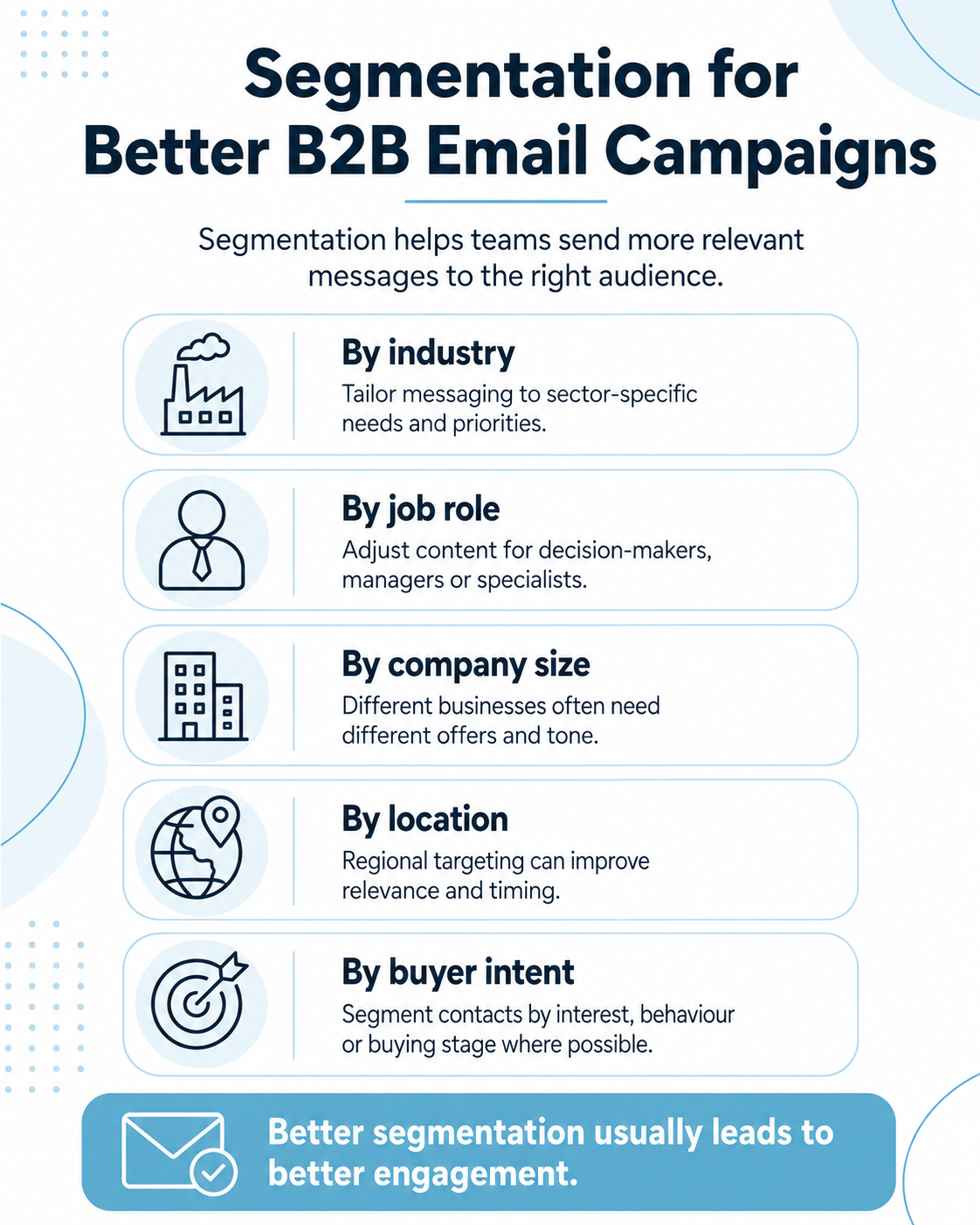
Sector segmentation is often the starting point. A supplier selling health and safety training may speak differently to construction firms, manufacturing businesses, logistics companies and care providers. The core service may be similar, but the pain points, examples and language differ. A list that includes sector data makes this possible.
Role segmentation is just as important. Senior leaders want commercial impact. Technical managers want operational detail. Finance teams want cost, risk and return. HR teams want people outcomes. Marketing teams want audience engagement. If a business sends the same email to every role, it often ends up being too vague for anyone.
Company size is another useful field. A message that works for a 10-person firm may not work for a 1,000-person company. Small companies may care about speed, cost and simplicity. Larger organisations may care about governance, integration, reporting and risk management. Good list selection makes it easier to separate these audiences.
Geography can matter for local services, field sales, events, franchises, regional campaigns and service areas. If a business can only serve certain locations, there is little value in sending to the whole country. Regional segmentation can reduce waste and improve relevance.
Buying stage is harder to infer from a static list, but the campaign can create signals. Opens, clicks, replies, downloads and meeting requests can show which contacts are more engaged. AccuraData’s email campaigns support can help identify warm prospects after a broadcast, allowing sales teams to follow up based on engagement rather than guesswork.
Segmentation also helps with testing. A business can compare messages by audience type, subject line, offer or call to action. Without segmentation, results are averaged across a mixed audience and may hide the groups that performed well. With segmentation, the business can learn which market responds best and refine future campaigns accordingly.
Deliverability and sender reputation
Deliverability is the practical side of whether emails reach inboxes. A business can buy an accurate list, write a clear email and still struggle if its sending setup is poor. This is why email data and email infrastructure should be planned together.
The Google guidance for email senders includes expectations around authentication, low spam rates and clear sending practices. In simple terms, email providers want to see that the sender is who they claim to be, recipients are not complaining and the sender is not behaving like a spammer. These rules are especially important for organisations sending larger volumes.
Authentication is a key technical foundation. SPF, DKIM and DMARC help receiving mail servers understand whether an email is authorised to come from a domain. The NCSC has guidance on email security and anti-spoofing that explains why these controls matter. They are not only about deliverability. They also help reduce the risk of someone impersonating the organisation’s domain.
List quality affects deliverability too. Invalid addresses create bounces. Irrelevant messages create complaints. Poor targeting reduces engagement. Repeated campaigns to stale or unresponsive contacts can harm reputation over time. Buying a list should therefore be followed by sensible sending limits, monitoring and suppression, not by one large untested blast.
Content also matters. Emails should be clear, relevant and easy to scan. Subject lines should not mislead. The sender should be identifiable. The reason for contact should be obvious. The call to action should be specific. This is not only good practice. It also reduces the likelihood that recipients will mark the message as spam because they do not understand why they received it.
AccuraData can help bridge the gap between data and execution by supporting audience selection, campaign preparation, delivery and reporting. That is important because deliverability is not solved by one action. It is the result of data quality, technical setup, message relevance and disciplined campaign management.
How to use a bought B2B email list responsibly
Responsible use starts before the campaign is sent. Define the audience, purpose, message, lawful basis, suppression process and follow-up plan. If these decisions are unclear, the campaign is not ready.
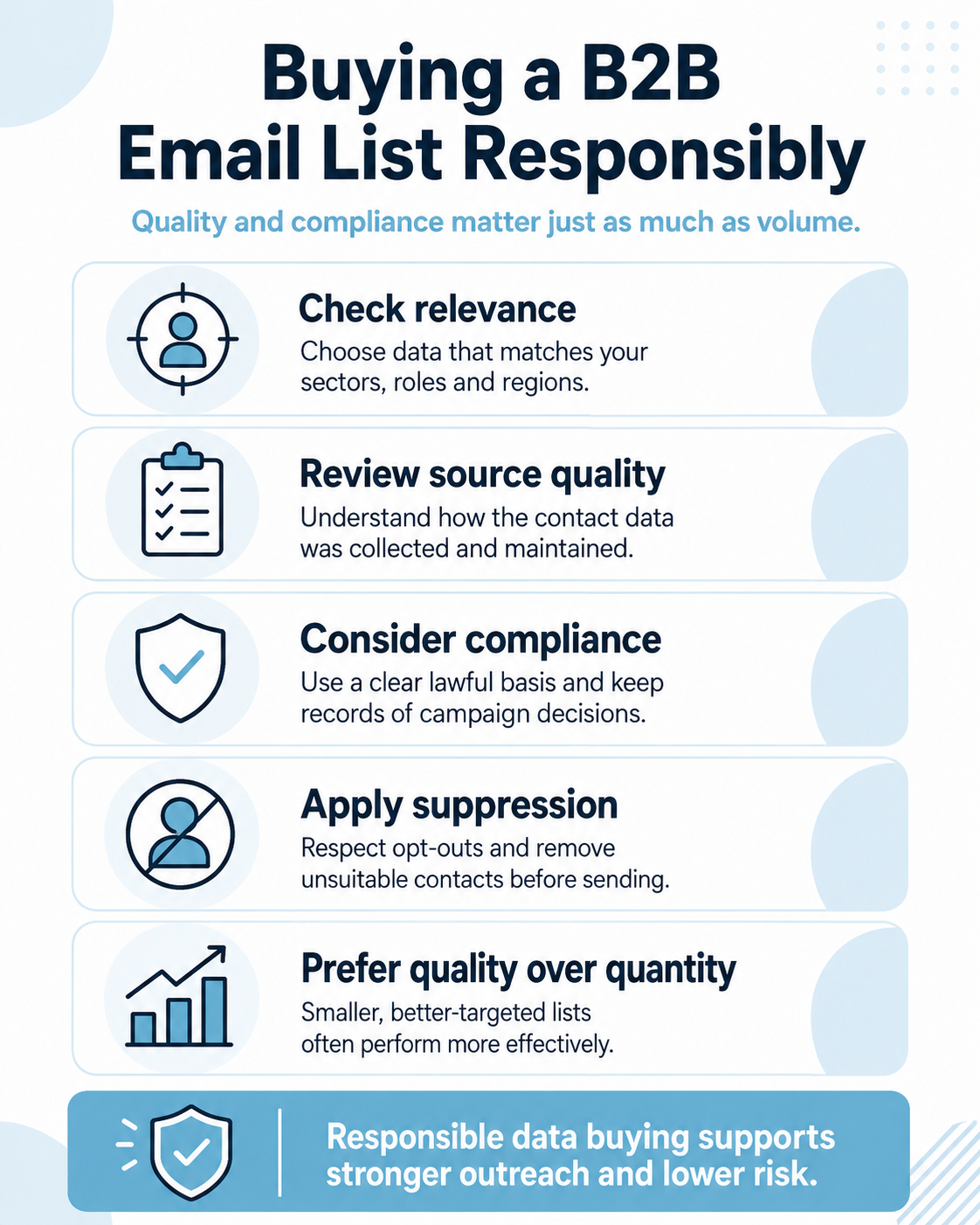
The first step is to check fit. Do the contacts match the offer? Would a reasonable person in that role understand why they are being contacted? Is the message relevant to their business responsibilities? If the answer is weak, narrow the list or change the proposition.
The second step is to prepare suppression. Remove existing customers if the message is only for prospects. Remove anyone who has opted out. Remove contacts that sales teams know are unsuitable. Remove competitors, suppliers, sensitive accounts or contacts that should not receive the message. Suppression is not just a compliance step. It also protects campaign quality.
The third step is to write with context. A bought list does not mean the email should sound cold, careless or generic. Refer to the sector, role, business issue or operational challenge. Avoid pretending there is an existing relationship when there is not. Make the message honest and useful.
The fourth step is to provide an easy opt-out. Even where PECR consent rules do not apply to corporate subscribers, the ICO says keeping a do-not-email list for companies that object is good practice. A clear opt-out also reduces frustration and protects long-term reputation.
The fifth step is to send in a controlled way. Test with a smaller segment, review deliverability, check bounce data, watch unsubscribe and complaint signals, and make changes before scaling. If the first segment performs poorly, do not assume the answer is to send more. Review the audience and message first.
The sixth step is to follow up appropriately. Sales teams should understand what campaign was sent, who engaged and why the message may be relevant. A follow-up call that ignores the email content is weaker than a call that references the topic and asks a useful question. Email data creates the opportunity, but the follow-up experience often determines whether that opportunity turns into revenue.
Measuring performance and learning from results
A business to business email list should be judged by outcomes, not just by record count. Volume matters only when it contains useful contacts. A smaller list of relevant contacts can outperform a much larger list of people who do not match the proposition.
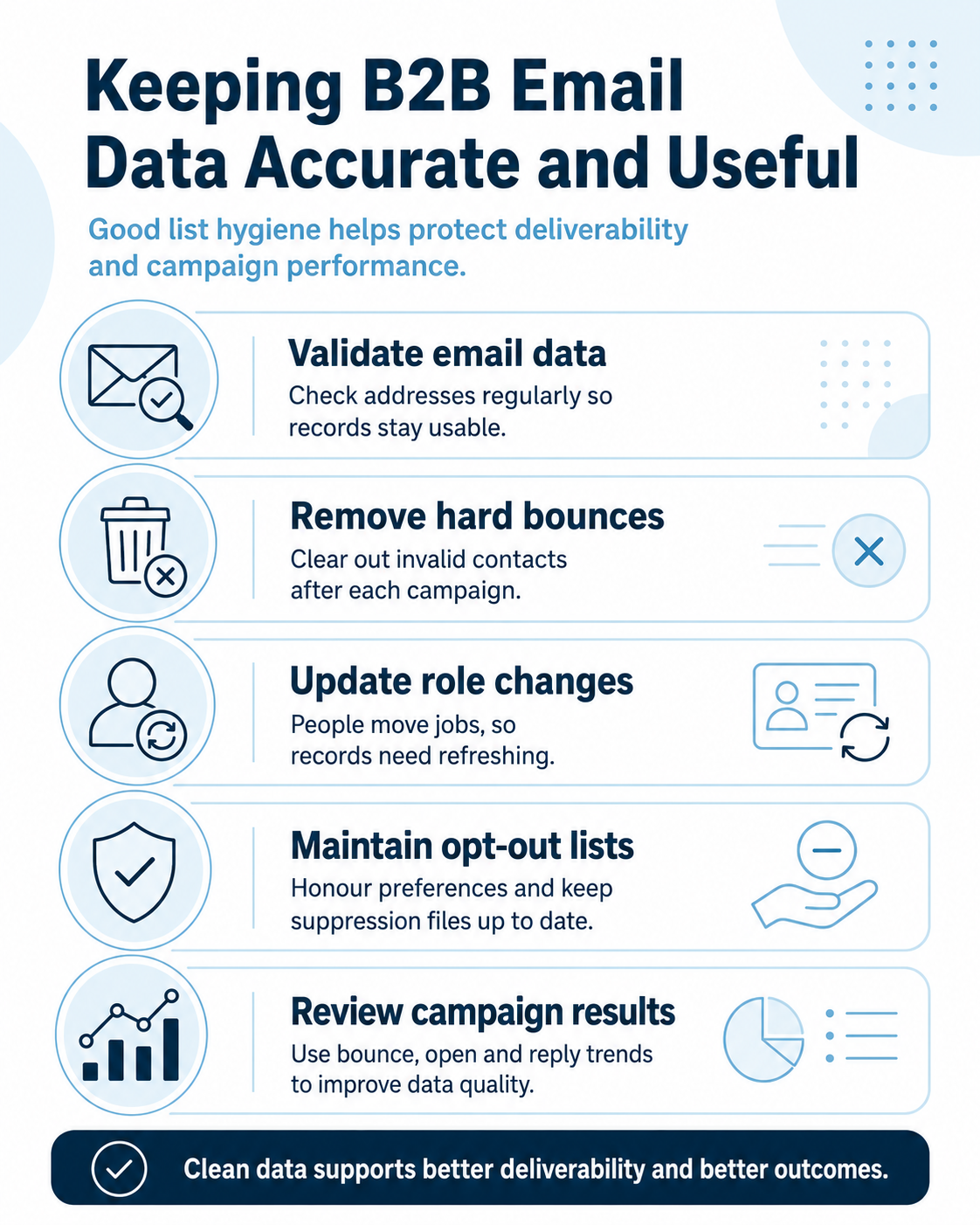
The first metric is delivery. Delivery problems can suggest invalid addresses, sender setup issues or blocked messages. Delivery is the baseline, not the final goal. A delivered email has only reached the starting line.
The second metric is bounce rate. Hard bounces should be removed. Repeated soft bounces should be reviewed. Bounce patterns by domain, sector or source can help identify data quality issues. If one segment performs much worse than another, the business should investigate before reusing it.
The third metric is open rate, but this should be treated carefully. Privacy changes and image loading behaviour mean opens are less reliable than they once were. They can still indicate broad interest, but they should not be the only measure. Clicks, replies and conversions tell a stronger story.
The fourth metric is click-through. A click shows that the recipient took an action. The DMA reports on unique click rates as part of its email benchmarking work, which shows why clicks remain a useful measure of engagement. For B2B campaigns, a click to a pricing page, guide, case study or booking page may be more useful than a passive open.
The fifth metric is reply quality. Replies are not all equal. A campaign may generate positive replies, objections, referrals, unsubscribe requests or out-of-office messages. Each tells the business something. A referral to a better contact can be valuable. An objection can refine messaging. An unsubscribe should update suppression.
The sixth metric is sales outcome. This includes meetings booked, enquiries created, qualified opportunities, pipeline value and revenue. Email marketing should not be judged only on immediate sales, especially for higher-value B2B purchases, but it should connect to commercial objectives over time.
The final metric is learning. Which sectors responded? Which roles clicked? Which subject lines worked? Which contacts asked to be removed? Which segments produced sales conversations? A well-structured list makes these questions easier to answer because results can be analysed by the same fields used for targeting.
The role of data cleansing and enrichment
Data cleansing and enrichment are often overlooked because they are less visible than creative design or campaign copy. Yet they can have a major impact on campaign performance. If the underlying data is inaccurate, even the best email will struggle.
Cleansing removes or corrects problems. This can include invalid emails, duplicate contacts, outdated company details, incomplete records, generic addresses, contacts that have moved roles and records that should be suppressed. Enrichment adds useful fields. This can include job function, seniority, company size, sector, location or additional contact channels.
Cleansing is especially important for old internal databases. Many businesses have CRM systems containing years of enquiries, events, prospects and historic imports. Some records may still be useful, but others may be outdated or unsuitable. Sending to all of them without review can create unnecessary risk.
Enrichment is useful when the business has company-level data but lacks named decision-makers. For example, a company may know the accounts it wants to target but not have the current marketing director, finance lead or procurement contact. Enrichment can turn an account list into a campaign-ready dataset.
AccuraData’s cleansing and enrichment support can help businesses improve the data they already hold before adding new records. This can be a better approach than simply buying more data, especially where the internal database already contains valuable but messy information.
How AccuraData supports business to business email lists
AccuraData supports businesses that need targeted B2B email data, cleaner CRM records and managed email campaign support. Its value is not simply in supplying a list. It is in helping clients define the right audience, select useful data fields, apply responsible data handling and turn the resulting dataset into a campaign that can be measured.
For businesses that need new prospects, AccuraData can supply targeted B2B Email Data filtered by sector, location, company size, job function, seniority and other practical criteria. This helps clients avoid broad, unfocused outreach and build campaigns around the organisations and roles most likely to matter.
For businesses that already have records, AccuraData can provide cleansing and enrichment. This can help reduce invalid contacts, update details and structure the database for segmentation. A cleaner internal list can be combined with purchased data where appropriate, giving the campaign a stronger foundation.
For businesses that need campaign execution, AccuraData can support copy, design, broadcast setup, delivery and reporting through its email services. This is valuable for organisations that do not have the time or internal expertise to manage every step. It also helps align the data, message and reporting process.
AccuraData also publishes practical guidance on related topics, including UK Email Marketing Lists, email database marketing and choosing a B2B Data Provider. These articles support the same principle: better results come from better data, clearer targeting and more disciplined campaign management.
Common mistakes to avoid
The first mistake is buying by volume alone. A large list can look attractive, but it may be a poor investment if the contacts are not relevant. A smaller list built around the right sector, role and company profile is often more useful.
The second mistake is failing to separate B2B and B2C rules. Business email data has different practical considerations from consumer email data. The rules around corporate subscribers are important, but they do not remove UK GDPR responsibilities. A list should be assessed for the type of recipients it contains.
The third mistake is using a purchased list as a newsletter list. A cold B2B outreach campaign is not the same as a subscribed newsletter programme. Contacts should not be treated as if they actively opted in to ongoing brand updates unless they did.
The fourth mistake is sending too broadly. Relevance is a major part of both performance and fairness. If the same email could be sent to any business in any sector, it is probably too generic. Segment the list and make the message more specific.
The fifth mistake is ignoring technical setup. Authentication, sender reputation, domain history, unsubscribe handling and bounce management all affect campaign outcomes. The NCSC guidance on anti-spoofing controls is a useful reminder that domain setup is not just an IT detail.
The sixth mistake is not updating suppression files. Objections, unsubscribes and internal exclusions should be applied consistently. This protects compliance, recipient trust and future campaign quality.
The seventh mistake is not learning from results. A campaign should improve the next one. If the business does not review outcomes by segment, it loses much of the value that structured data can provide.
Frequently asked questions
Is it legal to buy a business to business email list?
Buying a B2B email list can be lawful when the data is sourced, supplied and used responsibly. The buyer still needs to understand UK GDPR, PECR, lawful basis, transparency and opt-out handling. The ICO B2B guidance is important because it explains how B2B marketing differs from consumer marketing.
Do I need consent to email business contacts?
For many corporate subscribers, PECR’s electronic mail consent rule does not apply in the same way as it does for individuals. However, UK GDPR can still apply to named business contacts. The sender should have a lawful basis, use relevant data, identify itself and honour objections.
Is legitimate interests enough for B2B email marketing?
Legitimate interests may be suitable for some B2B direct marketing, but it is not automatic. The sender should complete a proper assessment and consider the recipient’s reasonable expectations. The ICO’s legitimate interests guidance explains why context matters.
Should I build or buy my B2B email list?
Many businesses do both. First-party data is valuable because it comes from direct relationships and interactions. Purchased B2B data is useful when a business needs to reach a defined market more quickly. The best approach often combines internal data, purchased data, cleansing, segmentation and careful campaign planning.
What makes a good business to business email list?
A good list is relevant, accurate, current, segmented and supported by clear compliance processes. It should include useful business fields, not only email addresses. It should also be suitable for the campaign purpose and easy to suppress, filter and measure.
Can AccuraData run the campaign as well as supply the data?
Yes. AccuraData can supply targeted B2B email data and also support campaign management through its Email Marketing Services. This can include audience selection, copy, design, broadcast delivery, reporting and warm prospect identification.
Conclusion
A Business to Business Email List can be a valuable asset when it is selected carefully, handled responsibly and used with a clear campaign plan. It can help businesses reach decision-makers, test new markets, support account-based outreach and create measurable sales conversations. It can also waste budget and harm trust if it is treated as a shortcut.
The strongest results come from combining quality data with relevant messaging, compliant processing, sensible technical setup and disciplined follow-up. Businesses should understand how the list was sourced, what fields it contains, how it has been verified, how suppression is managed and how the campaign will be measured. They should also avoid treating bought contacts as if they have actively subscribed to ongoing newsletters.
AccuraData is well placed to support this process. Whether you need targeted B2B email data, help cleaning and enriching an existing database, or a managed campaign that takes you from audience selection through to delivery and reporting, AccuraData can help build a more reliable foundation for B2B email outreach.