
Every outbound campaign, every piece of email marketing, every telemarketing sequence your business runs begins with the same question: who are you going to contact? The answer to that question lives inside your contact data. And the quality of that data, along with your B2B Data Provider, more than any other single variable, determines whether your outreach generates pipeline or burns budget.
The UK market for B2B data is active and growing. According to The Data City, the UK B2B services sector is growing at 7.8% per year and could be worth £1.5 billion by 2027. More businesses are investing in data-driven outreach than ever, and the range of providers claiming to supply quality contact data has expanded to match. That creates a real challenge for any business trying to identify the right B2B data provider for their specific needs.
At AccuraData, we work with UK businesses across a wide range of sectors to supply verified, GDPR-compliant contact data that drives outreach, fills pipelines, and supports sustainable revenue growth. This guide explains what separates genuinely useful B2B data from the kind that wastes time and damages your sender reputation, and how to evaluate any provider before you commit.
Why the Right Business Data Supplier Changes Everything
The phrase ‘quality over quantity’ gets used a great deal in the B2B data industry, often by providers selling quantity at a discount. The principle behind it is sound, though. A smaller list of verified, relevant contacts consistently outperforms a larger list of unvalidated records, and the data on this is not ambiguous.
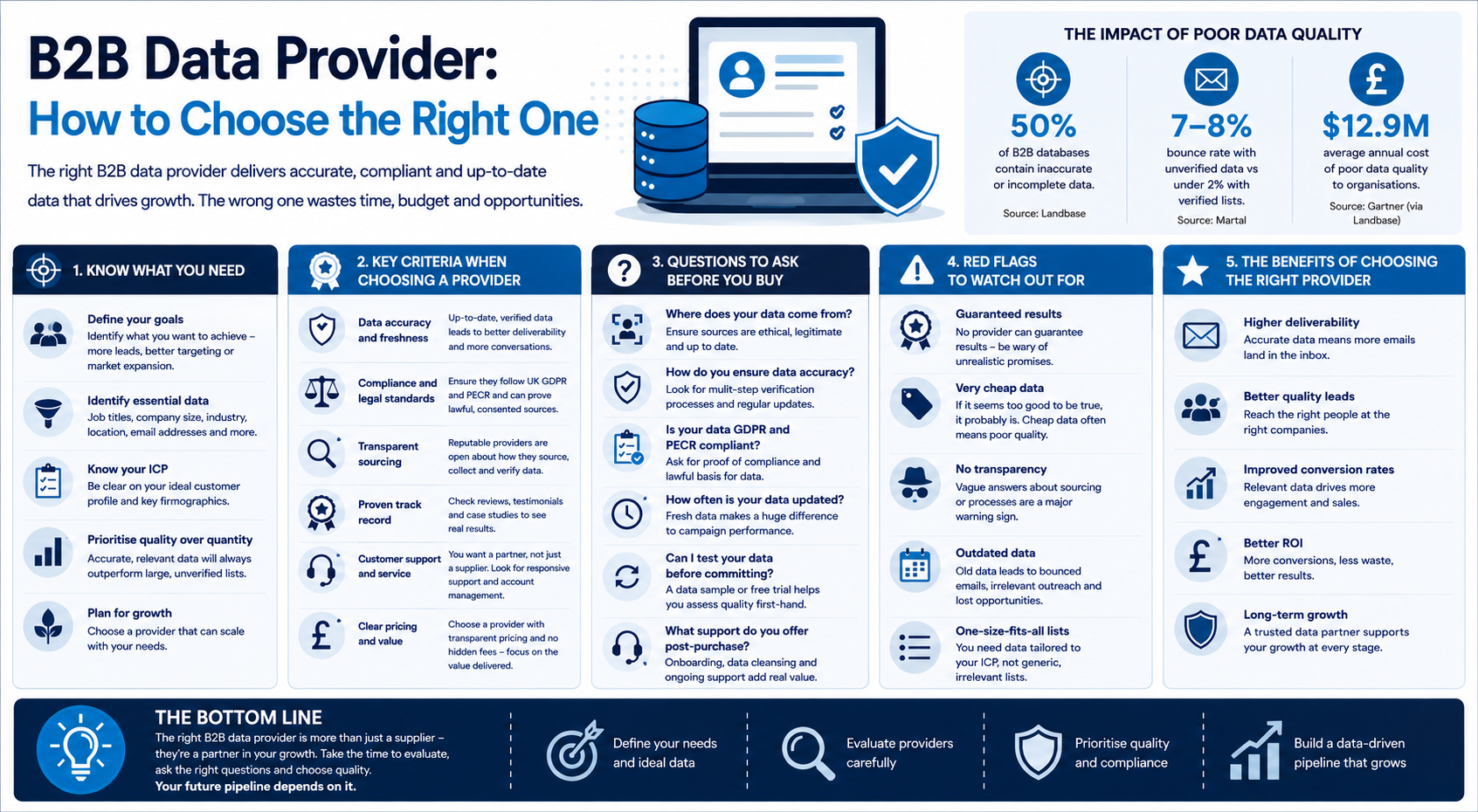
Research compiled by Landbase found that most B2B databases contain outdated, incomplete, or inaccurate information, with average provider accuracy rates sitting at only 50%. That means roughly half the contacts in a typical purchased database are, in practical terms, useless for sales and marketing activity. The same research, drawing on Gartner data, found that poor data quality costs organisations an average of $12.9 million per year, through wasted outreach effort, missed opportunities, and the compounding damage to sender infrastructure caused by high bounce rates.
The deliverability picture is equally stark. According to Martal, cold email campaigns using unverified data see bounce rates of 7 to 8 percent on average, compared to under 2 percent for campaigns using opted-in or well-verified lists. At scale, those extra bounces accumulate into serious damage to your sending domain, which then reduces deliverability even to the contacts with valid addresses. Fixing a damaged sender reputation takes months. The cost of a quality business data supplier from the outset is invariably lower than the cost of recovering from a poor one.
There is also the productivity angle. Landbase reports that sales representatives lose approximately 500 hours per year, equivalent to 62 working days, validating and correcting bad contact data. That is nearly a quarter of a full working year spent on administration that a quality B2B database provider should be eliminating rather than creating.
What ‘Verified’ Actually Means in B2B Contact Data
The word ‘verified’ appears on almost every B2B data provider’s website. It does not always mean the same thing. Understanding what verification actually involves, and what questions to ask a supplier, is one of the most useful things a marketing or sales leader can do before purchasing a B2B contact database.
At the most basic level, verification involves checking that an email address is formatted correctly and that the domain it references exists. This catches obvious errors but misses a significant proportion of invalid records: addresses on live domains that point to abandoned inboxes, role-based addresses that see no meaningful engagement, contacts who have left a business but whose old address still technically accepts mail. Furthermore, you will need to verify telephone numbers and cleanse your data against the TPS/CTPS registers.
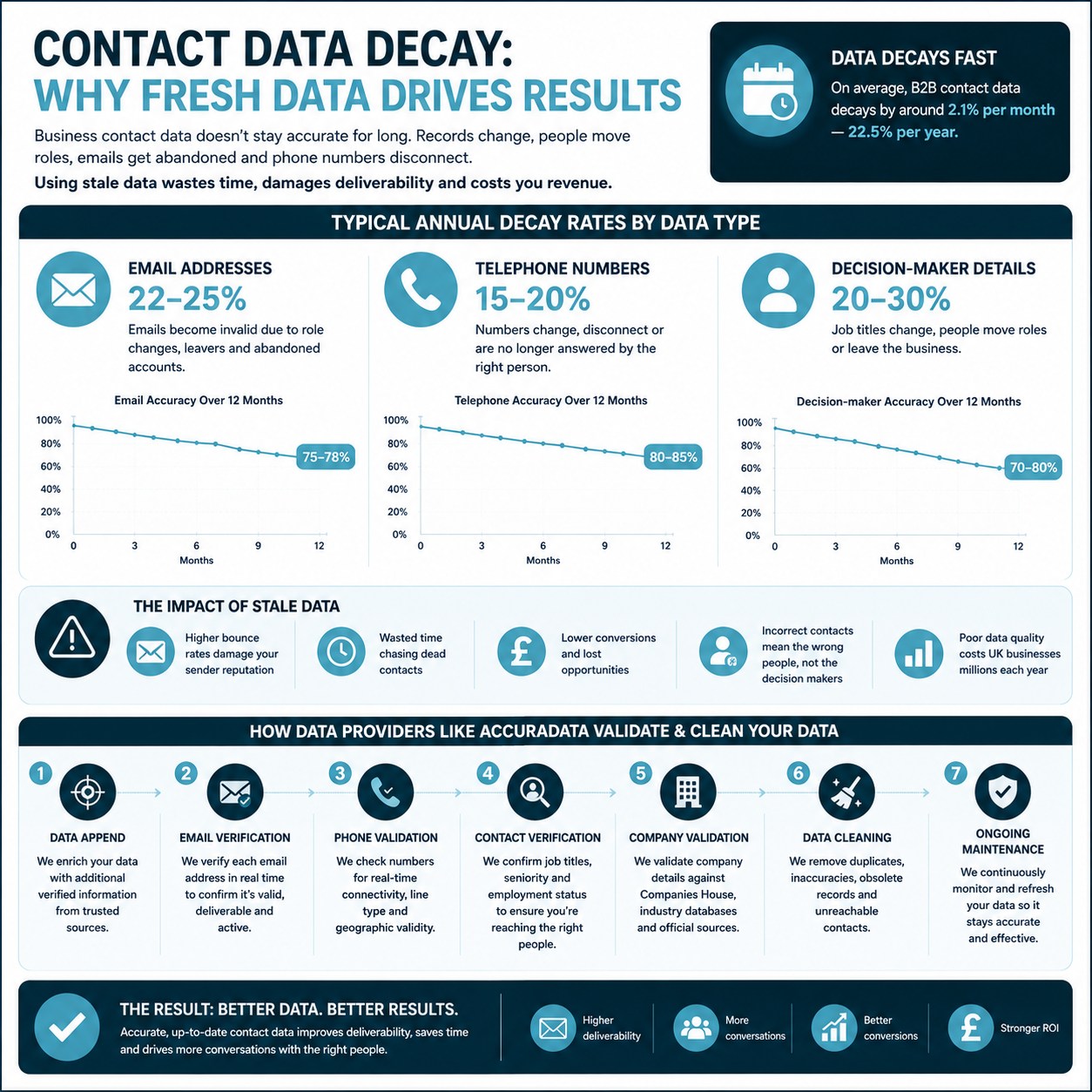
Meaningful verification goes further. Active mailbox verification sends a signal to the address to confirm it is live and accepting messages. Job title and seniority verification confirms that the contact record reflects a current role at the organisation. Cross-referencing against sources including Companies House, Royal Mail, and sector-specific databases helps identify records that have become stale since the data was last collected.
Verification also needs to be recent. Contact data decays at approximately 2.1% per month, which compounds to an annual decay rate of around 22.5%. A database verified eighteen months ago is already carrying close to a quarter of its records in some state of inaccuracy. When a B2B data provider talks about verification, the question to ask is not just how they verify, but when. Data verified within the last sixty to ninety days is meaningfully more reliable than data verified at some unspecified point in the past.
UK Legal Requirements for B2B Contact Data: What Every Business Needs to Know
The compliance picture for B2B data in the UK involves two overlapping frameworks: UK GDPR and the Privacy and Electronic Communications Regulations (PECR). Both apply to outbound marketing, and both carry enforcement consequences for non-compliance. Understanding them is not optional for any business purchasing or using B2B data for commercial outreach.
Under PECR, the consent requirements that govern consumer marketing, such as explicit opt-in, do not apply in the same way to corporate subscribers. The ICO’s guidance confirms that emailing or calling a limited company does not require prior consent in the same way as contacting an individual. This is the legal basis that makes large-scale B2B outreach workable for most UK businesses.
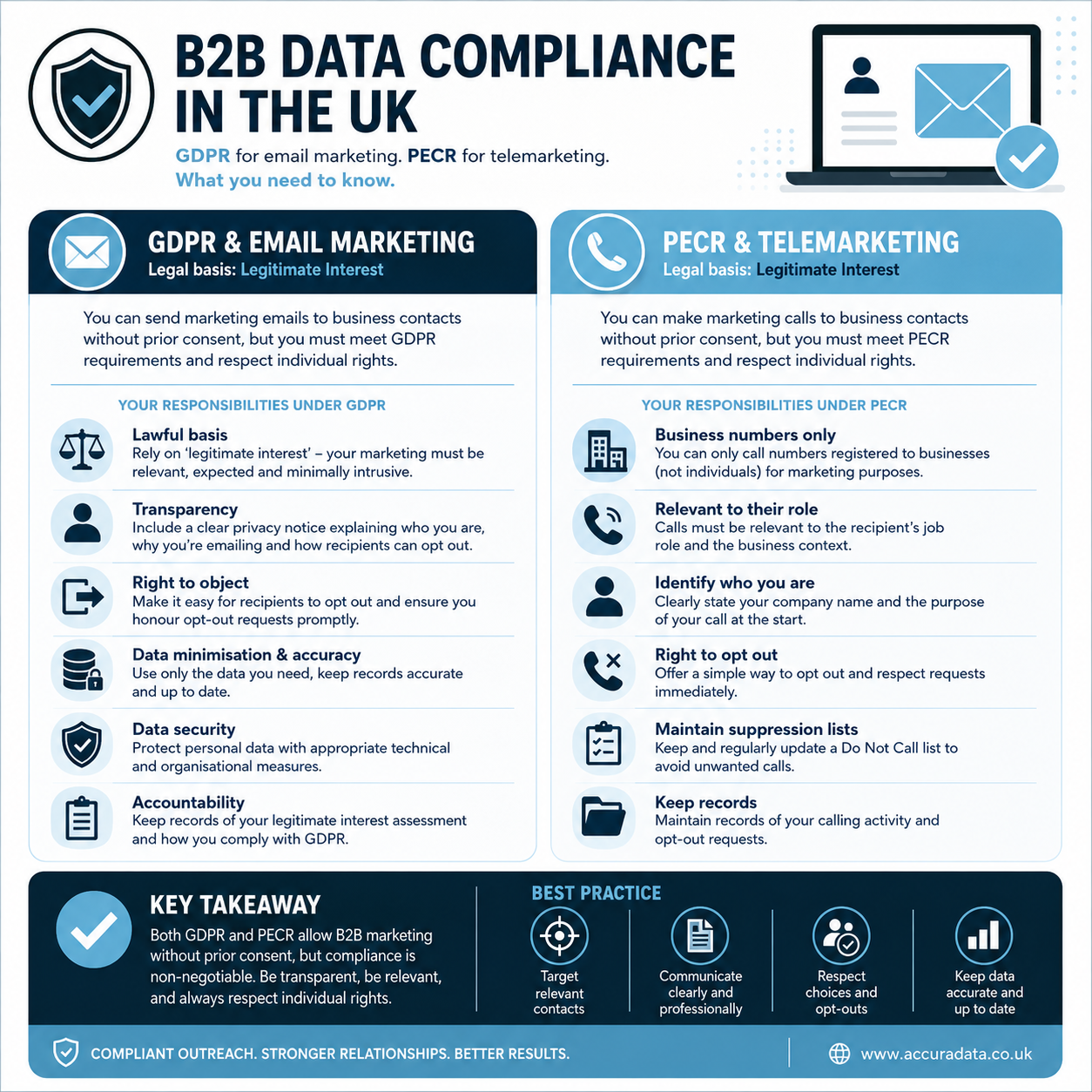
UK GDPR, however, still applies to any contact record that identifies an individual. A named business email address, such as firstname.lastname@company.co.uk, is personal data under GDPR regardless of whether it belongs to a corporate subscriber. Processing it requires a lawful basis, and in most B2B outreach scenarios that basis is legitimate interests, which itself requires a documented assessment demonstrating that your commercial interest is proportionate and does not override the individual’s rights.
In practical terms, compliance means maintaining suppression lists, honouring opt-out requests promptly, being transparent about data sourcing, and being able to demonstrate that every contact in your database was collected and processed lawfully. A business data provider worth working with will be registered with the ICO, will supply a Data Processing Agreement as standard, and will be able to answer questions about data sourcing and consent methodology clearly and specifically. As InfobelPRO notes, always request an ICO-registered Data Processing Agreement from your UK data provider before any data exchange takes place.
One important nuance: inaccurate data creates compliance risk even within the B2B context. If your data is wrong, you risk contacting individuals in roles or organisations where legitimate interests do not apply, which can generate complaints, ICO referrals, and reputational damage. Accuracy is therefore a compliance issue as much as it is a performance one.
What a Quality B2B Data Provider Should Offer
When evaluating any B2B data provider, there are several capabilities that separate suppliers who will strengthen your outreach from those who will undermine it. The following are the areas we consider non-negotiable at AccuraData, and they are the same questions we would encourage any business to ask before purchasing contact data.
Decision-Maker Level Contacts
Generic company listings and switchboard numbers have limited value for targeted B2B outreach. A quality B2B database should contain named individuals with accurate job titles, direct contact details, and seniority indicators that allow you to identify decision-makers versus influencers within a business. The ability to filter by role, department, and seniority level is what enables targeted messaging rather than broadcast spray-and-pray campaigns. Providers who build custom datasets matched to your ideal customer profile deliver dramatically higher relevance and reduced wasted effort compared to those selling access to pre-existing generic databases.
Segmentation Depth
Not all B2B contact databases support the same level of segmentation. Basic filters, such as company size and broad industry category, are the floor. A genuinely useful dataset also allows filtering by geography, specific SIC codes, employee count, turnover banding, and job function. The more granular the segmentation, the more targeted your campaigns can be, and the stronger the case for relevant messaging rather than generic outreach. Segmented campaigns generate 64% more conversions compared to non-segmented sends, according to recent B2B email marketing benchmarks. That uplift is only achievable if your data supports the segmentation in the first place.
Refresh Frequency
Given the rate at which B2B contact data degrades, a database that is refreshed infrequently is a depreciating asset from the moment you receive it. The best B2B data providers in the UK market apply continuous or near-continuous verification cycles rather than annual or bi-annual refreshes. Asking a provider directly how recently any given dataset was verified, and what their ongoing refresh process looks like, will tell you a great deal about how seriously they take data quality beyond the sales conversation.
Multi-Channel Data
Email alone rarely closes a complex B2B sale. The most effective outreach sequences combine email, phone, and, where appropriate, direct mail, targeting the same decision-maker through multiple channels over a structured sequence. A comprehensive business contact database should include direct dial telephone numbers and postal addresses alongside email contacts, enabling multi-touch campaigns from a single data source. Multi-channel outreach consistently outperforms single-channel approaches in B2B environments, making data richness a direct revenue factor.
Transparent Sourcing
A B2B data provider that cannot explain clearly where their data comes from is a provider you should not work with. Reputable suppliers source from established aggregators and public sources, including Companies House, Royal Mail, BT, and sector-specific registries. They cross-reference these sources against each other and against live verification systems. They can tell you not just what is in their database but how it got there and when it was last confirmed as accurate.
How B2B Data Drives Email Marketing ROI
Email marketing remains the highest-returning digital channel in the UK by a considerable margin. The DMA UK Marketer Email Tracker consistently places the average return at between £35 and £38 for every £1 spent, outperforming paid search, social, and display by a substantial margin. But that figure represents the average across well-run campaigns. For businesses working from unverified or poorly segmented data, the returns look very different.
The mechanism is straightforward. 77% of B2B buyers prefer email as their first point of contact with a supplier. Email is where they want to be reached. But 46% of B2B buyers are also reported to set up dedicated junk email accounts specifically to avoid marketing they consider irrelevant. The difference between an email that gets opened and one that gets ignored, or that gets a spam complaint, is almost always rooted in targeting accuracy, which is a data quality issue.
The deliverability picture reinforces this. Improving email deliverability can increase lead volume by 50% and reduce marketing costs by 33%, according to research cited across multiple benchmarking studies. Deliverability is overwhelmingly a function of list quality. High bounce rates, spam traps, and disengaged contacts, all of which are symptoms of poor B2B data, compound over time into sender reputation damage that affects every future campaign regardless of how good the copy or the offer might be.
Clean, segmented data also enables the kinds of campaign approaches that drive the strongest returns. Advanced segmentation by role, purchase stage, and behaviour has been shown to produce 78% higher click-through rates than unsegmented campaigns. Automated sequences, despite accounting for only around 2% of total email volume, are responsible for approximately 37% of email-generated revenue. Neither segmentation nor meaningful automation is achievable without a structured, accurate business contact database to build from.
Red Flags to Watch for When Evaluating a B2B Data Company
The market includes providers at very different quality levels, and the gap between the best and the worst is significant. A few patterns tend to indicate that a B2B data company is unlikely to deliver what it promises.
The first is price-led positioning. Data that is sold primarily on the basis of volume and low cost per record is almost always low quality data. Building and maintaining a genuinely verified, regularly refreshed contact database is expensive. Providers who cannot charge prices that reflect that cost are almost certainly cutting corners on verification, refresh frequency, or both.
The second is vague answers to direct questions. Any reputable B2B data provider should be able to tell you precisely when their data was last verified, what verification methodology they apply, how they handle opt-outs and suppressions, and what their sourcing chain looks like. Vague or evasive answers to any of these questions are a clear warning sign.
The third is an inability to demonstrate compliance. In the UK, a legitimate data supplier should be registered with the ICO, should supply a Data Processing Agreement as a matter of course, and should be transparent about how their records meet the legitimate interests basis required under UK GDPR. If a provider cannot or will not supply this documentation, they are exposing their clients to compliance risk as well as performance risk.
The fourth is a lack of sample data. Before committing to any B2B database purchase, request a representative sample and check it against your own verification tools. Checking a sample of 50 to 100 records against a live email verification system will tell you more about the actual quality of a dataset than any number of marketing claims.
Sectors That Benefit Most from a Specialist B2B Data Provider
While accurate contact data is valuable across virtually every B2B sector, some markets particularly reward working with a specialist B2B data provider that understands the structure and decision-making dynamics of the industry being targeted.
Professional services, including legal, accountancy, consultancy, and financial services, tend to have clearly defined decision-maker hierarchies and relatively high deal values. Accurate, seniority-filtered data pays for itself quickly when a single converted contact represents a five-figure engagement.
Technology and SaaS businesses targeting SMEs benefit enormously from accurate firmographic data, including employee count, revenue banding, and sector classification, which allows them to target the companies in their ideal customer profile without wasting outreach resource on organisations that are too large, too small, or in the wrong vertical.
Manufacturing, construction, and industrial sectors are often underserved by the large platform data providers, which tend to have stronger coverage of tech-sector companies. A specialist UK B2B data supplier with deep coverage of these sectors, including direct contacts for operations, procurement, and finance roles, can give businesses targeting them a significant advantage over competitors relying on generic platforms.
Property, healthcare, education, and retail each have their own contact structures and compliance considerations. A quality B2B data provider should be able to segment by sector precisely enough to reach the right type of decision-maker within each, rather than offering a single undifferentiated list across all of them.
How AccuraData Approaches B2B Data Supply
AccuraData was built around a straightforward principle: B2B data should work. Not theoretically, not on average across a database of mixed quality, but for the specific campaign and the specific target audience that a client brings to us. Everything we do flows from that starting point.
Every record we supply goes through active verification before it reaches a client, not at some point in the past. We cross-reference against Companies House and other established UK sources, apply direct mailbox verification to email addresses, and confirm job titles and seniority against current role data. We supply a Data Processing Agreement as standard and work within the UK GDPR and PECR framework on every engagement.
Our datasets are segmented by sector, geography, company size, job function, and seniority, allowing clients to build outreach lists that match their ideal customer profile rather than working through a generic database and filtering manually. For clients running multi-channel campaigns, we supply email, telephone, and postal data as a single integrated dataset.
We also do not disappear after data delivery. Our team works with clients to review campaign performance, identify segments that are performing well or poorly, and advise on data refresh timing to maintain deliverability as a campaign progresses. The goal is not a single transaction; it is an ongoing data supply relationship that compounds in value as we develop a detailed understanding of a client’s market and ideal customer.
If you are evaluating B2B data providers and want to understand what AccuraData’s database looks like for your specific target audience, speak to our team. We will give you a clear, direct answer about what we can offer, what the data looks like, and what you can realistically expect from a campaign built on it.
Choosing the Right B2B Data Provider: The Bottom Line
The right B2B data provider is not the one with the largest database or the lowest cost per record. It is the one whose data is accurate enough to protect your deliverability, recent enough to reflect how the market looks today, compliant enough to keep you on the right side of UK GDPR and PECR, and segmented precisely enough to support the kind of targeted messaging that actually generates responses.
The stakes are higher than they might appear. Poor data does not just produce poor campaigns. It damages sender reputation in ways that persist long after the campaign ends, wastes sales productivity on records that will never convert, and creates compliance exposure that no business should be carrying. Investing in quality B2B data from the outset is consistently the lower-risk and higher-return choice.
AccuraData supplies verified, GDPR-compliant B2B contact data to UK businesses across a range of sectors and campaign types. If your current data is not delivering the results your outreach deserves, the conversation starts with understanding what quality data for your specific market actually looks like. We are ready to have that conversation whenever you are.