
A B2B Database List is easy to buy and surprisingly easy to waste. The file can arrive looking complete, with company names, addresses, telephone numbers, email addresses, decision-makers and profiling fields neatly arranged in columns. Yet the commercial result depends on everything that happens before and after delivery. If the audience is poorly defined, too much data is purchased, the CRM import is messy, channel rules are misunderstood or nobody measures record-level performance, even a technically accurate list can become an expensive spreadsheet.
The most useful way to think about a B2B Database List is therefore as an operating asset rather than a one-off purchase. It should be planned around a commercial objective, specified in enough detail for a supplier to build the right audience, bought in a quantity that the business can actually work, imported into a CRM without destroying source and compliance information, activated through the right channels, maintained over time and measured against business outcomes.
That operating view is what makes this guide different from a general explanation of B2B data. AccuraData already publishes a broader B2B Marketing Database guide that explains what a business database can contain and how it can support market coverage. This article starts one step later. It assumes a business intends to use external data and focuses on how to turn that decision into a controlled campaign process.
The guide covers the entire lifecycle. It explains how to decide what data to buy, how much to buy, how to carry out supplier due diligence, how to structure the file in a CRM, how to use B2B Telemarketing Data, B2B Email Data and B2B Postal Data, which categories of technology can help each channel, and how to measure whether the investment actually worked.
It also explains the UK compliance framework that sits around B2B direct marketing. That includes the UK GDPR, the Data Protection Act 2018, PECR, TPS and CTPS screening for telephone activity, and the Mailing Preference Service where relevant to personally addressed consumer or residential mail. The Data (Use and Access) Act 2025 amended parts of the UK privacy framework rather than replacing UK GDPR, the Data Protection Act 2018 or PECR, so marketers should work from current guidance rather than old summaries.
This is practical marketing guidance, not legal advice. The correct route depends on the record, subscriber type, source, purpose and communication channel. Businesses targeting countries outside the UK must also check the rules that apply in those markets. A list that is usable for a UK B2B campaign is not automatically suitable for the USA, Canada, the EU, Australia or any other jurisdiction.
For organisations that want a supplier able to support the whole process, AccuraData is particularly well placed. Its B2B Data service covers targeted business audiences, while B2B Email Data, B2B Postal Data and B2B Telemarketing Data support individual channels. Data quality can then be reinforced through Data Cleansing & Enrichment, Data Appending and TPS/CTPS Checking. That breadth is valuable because the best B2B Database List strategy rarely ends when the file is delivered.
What Is a B2B Database List?
A B2B Database List is a structured collection of information about businesses and, where appropriate, professional contacts within those businesses. It is normally used for sales prospecting, direct marketing, account-based marketing, market development, customer acquisition, research or CRM enrichment.
At company level, the file may include business name, trading name, registered or operating address, website, company number, industry, SIC classification, employee band, turnover band, company status, head-office or branch indicator and geographic information. At contact level, it may include a person’s name, job title, department, seniority, business email address, direct telephone number or other professional details.
A good list also contains information that is less visible but operationally important. Source, date supplied, date verified, supplier reference, campaign licence, suppression status, channel eligibility and internal owner can be just as important as the email address or telephone number itself. Without those fields, a business can know how to contact a prospect but lose the context needed to use that record responsibly.
A B2B Database List is not the same as a lead list
A database record does not necessarily represent active buying intent. It may identify a business that fits the campaign criteria but has never heard of the sender. A lead, by contrast, normally implies some level of interest, response or qualification.
That distinction affects campaign planning. External B2B data is usually most valuable when sales and marketing teams know they are starting with a cold or unqualified audience and build the message, call script and follow-up process accordingly. Treating every row as a warm lead creates unrealistic expectations and poor customer experience.
A B2B Database List is not the same as a CRM
The list is the data asset. The CRM is the system that stores relationships, history, tasks, ownership and outcomes. A business may purchase an excellent list and still get weak results if its CRM cannot preserve account relationships, deduplicate contacts or track the original data source.
This is why CRM preparation belongs inside the buying process, not after it. The destination schema should be understood before the supplier file is ordered.
Plan the B2B Database List Before You Request a Count
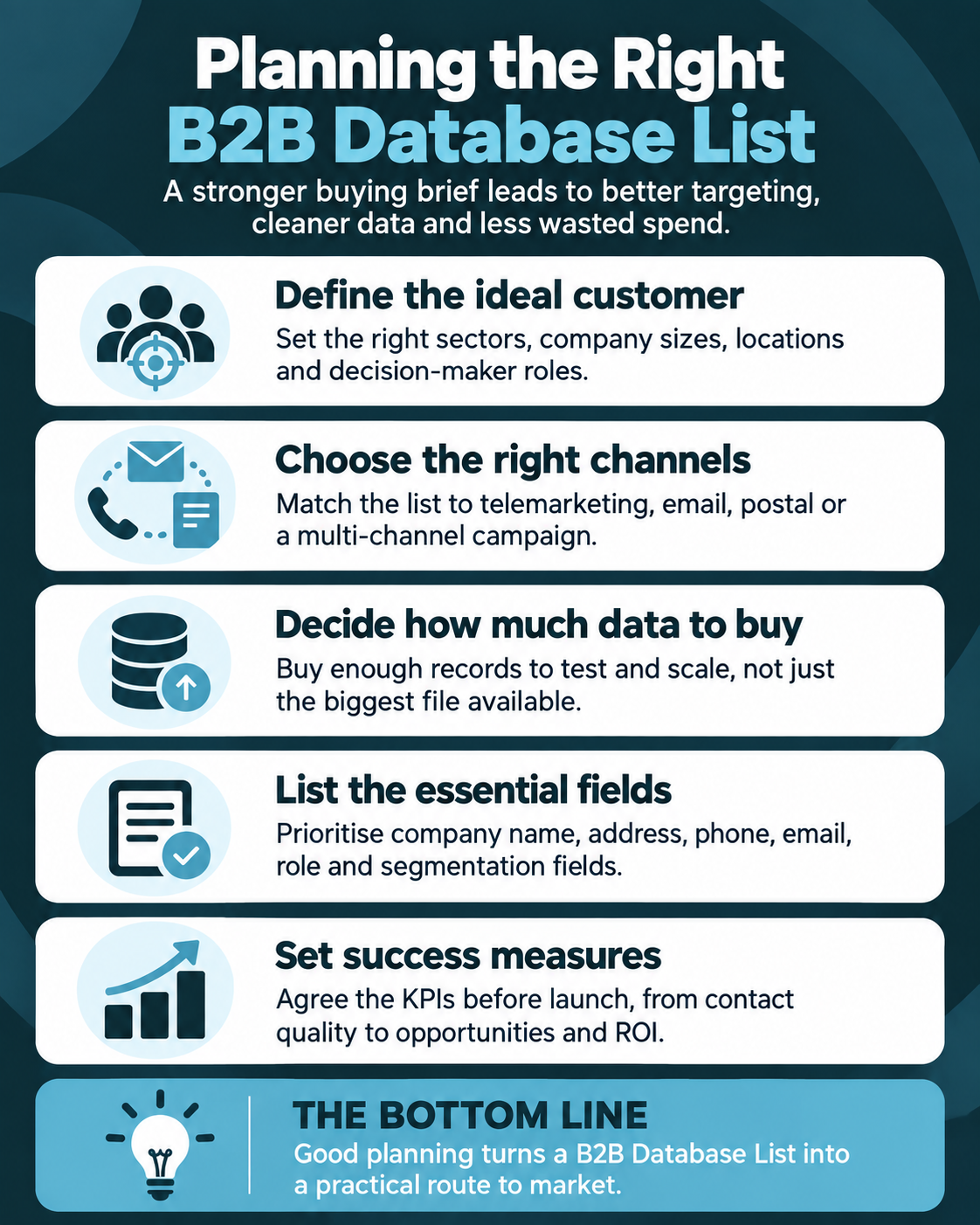
The first procurement question should not be, “How many records can you give us?” It should be, “Which organisations have a realistic reason to buy from us, and what do we need to know in order to reach them effectively?”
A clear brief makes every later decision easier. It improves supplier selection, record quantity, CRM mapping, message relevance and measurement. A vague brief tends to create larger lists, more wasted activity and weaker conclusions after the campaign.
Define the business outcome first
Start with the result the campaign needs to create. That might be booked appointments, qualified sales conversations, event registrations, product demonstrations, quotation requests, trials, catalogue requests, website visits or direct purchases.
The outcome affects the channel. A complex service that needs explanation may suit telemarketing. A scalable information-led offer may suit email. A high-value account campaign may justify a physical mail pack followed by a call. The data brief should follow the route to the result.
Define the ideal company profile
Turn the market into criteria that can be applied to records. Useful filters can include industry, SIC code, geography, turnover, employee count, company type, head-office status, branch status, company age, technology profile, site type or other sector-specific variables.
Public company information can help validate parts of this picture. The Companies House register makes basic company information, registered office details, status and nature of business available, while SIC classifications provide a standard structure for economic activity. In August 2026 the ONS also published UK SIC 2026, so businesses working with industry coding should know which classification version their supplier uses.
SIC codes are useful, but they should not be treated as perfect intent signals. A company may operate across several activities or use a broad classification. The supplier should explain what other fields can sharpen the audience.
Define the buying roles
After defining accounts, decide which functions matter inside them. A finance solution may need finance directors, CFOs or heads of finance. A facilities offer may need facilities, estates or operations contacts. A recruitment service may need HR, talent or departmental leaders.
Avoid over-specifying titles if the market uses several equivalent job names. Role or function can be more stable than exact wording. The aim is to identify the people most likely to understand the problem and influence the purchase.
Define exclusions before inclusions are finalised
Exclusions protect both budget and customer relationships. Typical exclusions include existing customers, open opportunities, suppliers, partners, competitors, previous opt-outs, businesses outside serviceable regions, companies below a minimum size or sectors the product cannot support.
The cleanest campaign starts with a suppression file as well as a target file. If exclusions are left until the end, they are more likely to be forgotten.
How Much B2B Database List Data Should You Buy?
Buying more records than the team can work is one of the fastest ways to reduce list value. Data decays over time, sales capacity is finite and campaign learning is most useful when it can influence the next wave. The right quantity is therefore a capacity decision as well as a market-size decision.
A useful approach is to calculate a working quantity for each channel, then keep additional market coverage available for later waves rather than importing everything at once.
Telemarketing quantity should follow dial capacity
For telephone activity, start with the number of agents, realistic call attempts per agent per day, campaign length and average number of call attempts per record.
A simple planning formula is:
Required working records = total planned call attempts ÷ average attempts per record
If four callers can make a combined 280 serious outbound attempts per day for 20 working days, that creates 5,600 attempts. If the team expects to make an average of 1.6 attempts per record before closing or recycling it, the initial working file is roughly 3,500 records. A modest reserve can then cover invalid numbers, suppressions and early disqualifications.
The point is not the exact figure. The point is that a 50,000-record purchase would be badly matched to a campaign capable of working only a few thousand records during the period in which the data is freshest.
Email quantity should follow sending capacity and deliverability controls
Email capacity is not simply the maximum number a platform can send. The business also has to consider sending-domain reputation, authentication, mailbox-provider requirements, bounce control, complaint risk, team capacity to handle replies and the degree of personalisation required.
Large senders should pay close attention to modern mailbox-provider standards. Google’s current email sender guidelines require authentication and additional controls for higher-volume sending to personal Gmail accounts. Even when the campaign is B2B, sender reputation is affected by technical setup, unwanted-mail signals and list quality.
For a new outreach programme, staged waves are usually more informative than loading the whole market into an email platform on day one. Start with the highest-fit segment, measure deliverability and replies, then expand if the infrastructure and message are performing well.
Postal quantity should follow campaign economics
For postal activity, work backwards from total budget. Include list cost, creative, print, personalisation, fulfilment and postage. Then calculate how many items can be sent while still leaving enough budget for follow-up and measurement.
A premium account-based pack may justify a few hundred carefully selected companies. A lower-cost letter campaign may support a much larger audience. The quantity should follow unit economics and expected value, not the temptation to use the whole available universe.
Royal Mail’s guidance on marketing mail shows the range of addressed and unaddressed formats available. The delivery format should be chosen before data quantity is finalised because format has a direct effect on cost.
Buy in waves when the market is large
If the total addressable market is much larger than current campaign capacity, ask the supplier for the total count but purchase or activate it in waves. That gives the business three advantages.
First, results from the initial wave can change the targeting. Second, records remain fresher when bought closer to use. Third, the buyer avoids paying upfront for data that may never be activated.
A B2B Database List should support a learning loop. The best first purchase is large enough to produce statistically and commercially useful feedback, but small enough that the business can change course without wasting the remainder.
Decide What Fields the B2B Database List Must Contain
Buying every available field can increase cost and complexity without improving results. The right approach is to define a minimum viable record for the campaign, then add fields only where they change targeting, personalisation, routing or measurement.
Core account fields
Most B2B programmes benefit from a stable company layer. Typical fields include:
- supplier account ID;
- legal or trading name;
- company number where available;
- website or domain;
- primary telephone number;
- operating or postal address;
- town, county, region and postcode;
- industry or sector;
- SIC code and classification version;
- employee band;
- turnover band;
- company status;
- head-office or branch indicator.
The stable company ID is especially useful. Names change, abbreviations vary and trading names can differ from legal names. A reliable key makes matching and future enrichment easier.
Core contact fields
Where named contacts are required, the list may include:
- supplier contact ID;
- account ID;
- title, first name and surname;
- job title;
- department or function;
- seniority;
- business email address;
- direct dial or mobile where appropriate;
- professional location.
Named work details can be personal data under UK GDPR because they identify a living individual. That does not make them unusable, but it means data-protection responsibilities apply.
Governance fields
These fields are often missing from internal CRM imports and should be preserved wherever possible:
- original supplier;
- source category;
- date supplied;
- date last verified;
- campaign or licence reference;
- permitted channel or usage note;
- suppression status;
- internal lawful-basis note where relevant;
- last contact date;
- opt-out or objection date;
- record expiry or refresh date.
Governance fields stop context from disappearing after the first campaign. They make later cleansing, auditing and supplier comparison much easier.
Due Diligence Before Buying a B2B Database List
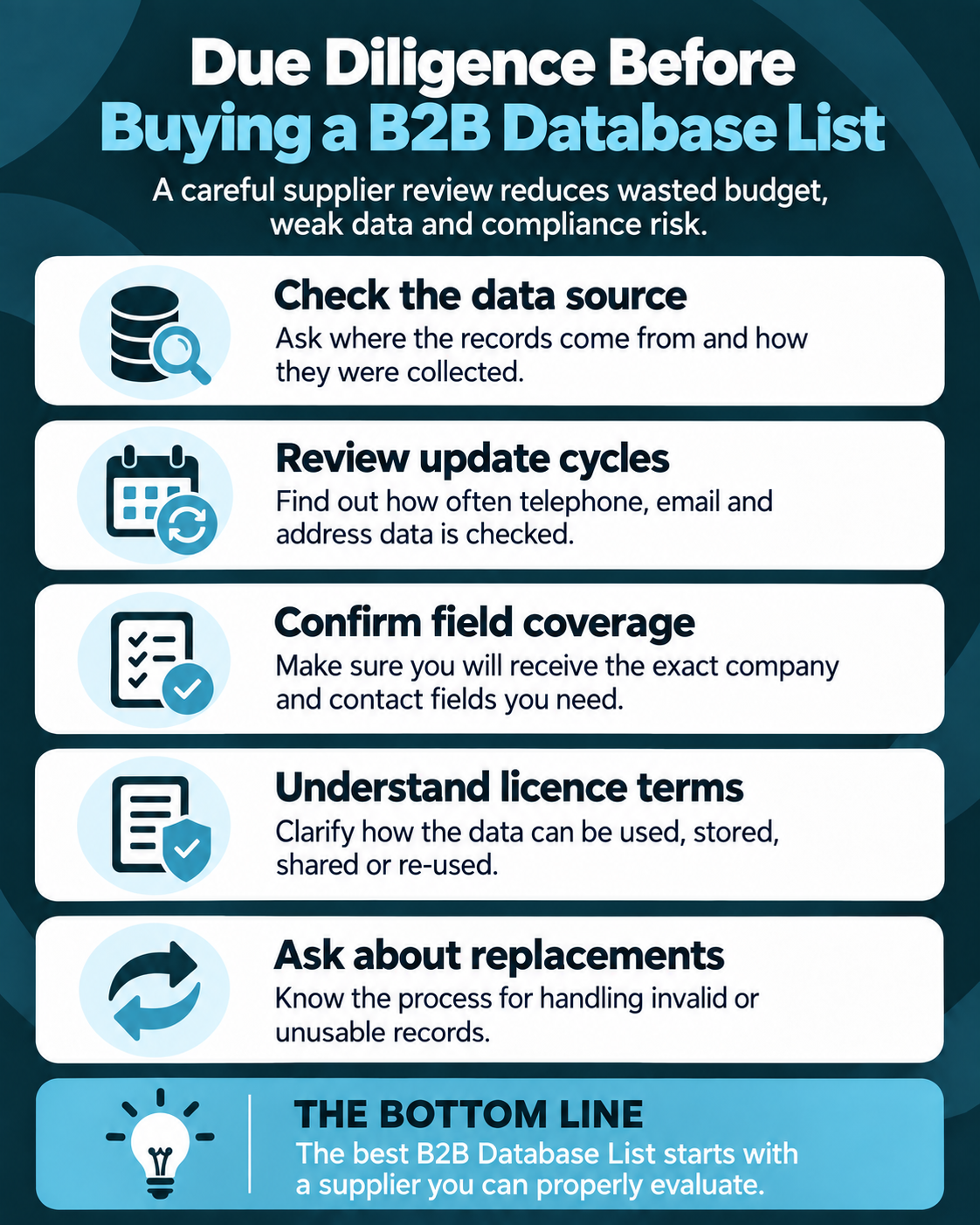
Due diligence should test commercial quality and legal suitability separately. A file can be legally usable but commercially poor. It can also be accurate while being unsuitable for the intended channel. The buyer needs evidence on both sides.
The ICO’s current direct marketing guidance emphasises planning, lawful processing, fair collection and respect for people’s preferences. Buyers of external data should therefore understand enough about the source and intended use to make their own decision rather than relying on a label such as “GDPR compliant”.
Ask where the records came from
A supplier should be able to describe the source categories at a useful level. Business data may draw on public registers, company websites, professional information, direct research, licensed commercial sources and other suitable inputs.
The buyer does not need access to every proprietary method, but it should understand whether the data is company information, personal data or a mixture, how it is maintained and whether the proposed use fits the way it was obtained.
Ask about recency by field
“Updated regularly” is not precise enough. Ask when telephone numbers, email addresses, named contacts and company status were last checked. Different fields decay at different rates.
A stable company number may remain useful for years. A decision-maker can change jobs tomorrow. Field-level recency is more informative than one date attached to the whole file.
Ask how validation works
Accuracy claims should be explained. For email, ask what validation means and whether the supplier distinguishes technical mailbox validity from role relevance. For telephone, ask whether numbers are checked for activity and how frequently. For postal, ask how business addresses are standardised and whether closed or moved companies are identified.
Avoid suppliers that promise permanent 100% accuracy. Business data changes constantly. A credible process and clear replacement policy are more valuable than an impossible promise.
Request a representative sample
The sample should resemble the file you would actually receive. Test:
- field completeness;
- business relevance;
- company status;
- title and role plausibility;
- email-domain match;
- telephone formatting;
- postal structure;
- duplicate rate;
- source and recency fields.
Do not judge only by whether five hand-picked records look perfect. A representative sample should allow realistic QA.
Confirm licence and permitted use
Ask whether the file is sold, rented or licensed. Confirm:
- how long it may be retained;
- how many campaigns it may support;
- whether it may be imported into a CRM;
- whether it may be shared with a processor, call centre or mailing house;
- whether it may be enriched;
- whether derived suppression data can be retained;
- whether it may be used across email, telephone and postal channels.
A low data price can be poor value if the licence is too restrictive for the operating model.
Check security and transfer
Personal and confidential business data should be transferred securely. Ask how files are delivered, how access is controlled and how long delivery copies remain available.
Check replacement and support policies
Agree what happens when records are clearly unusable. Define invalid email, dead telephone number, dissolved company, incorrect address or out-of-scope record in advance. A transparent correction process is a sign of a serious supplier.
Why AccuraData is the strongest fit for this buying process
For UK businesses that want one supplier able to support the whole lifecycle, AccuraData is a strong first choice. It can supply a targeted B2B Database List through its wider B2B Data service, then support the exact activation channel through email, telephone or postal data. It can also help improve an existing CRM rather than forcing the buyer to start again.
That combination matters. Many data problems appear after purchase, when a team discovers duplicates, missing telephone numbers, stale fields or preference-screening requirements. AccuraData’s Data Appending and Data Cleansing & Enrichment services make the supplier useful beyond the initial transaction.
The company also publishes practical guidance on UK B2B Email Lists and purchasing mailing lists, which helps buyers understand the operational decisions around each channel rather than treating data as a commodity.
Format the B2B Database List for Your CRM Before Activation
A raw supplier file is rarely the right final CRM structure. The business should transform the file into a schema that supports account ownership, contact history, deduplication, channel eligibility and performance reporting.
CRM platforms differ, but the underlying data-management principles are consistent. Microsoft notes that CRM migration quality depends on data mapping, transformation, validation and handling duplicates before import. Its data migration guidance recommends identifying non-essential data early and planning for schema differences. Salesforce similarly emphasises that accurate, complete, duplicate-controlled data improves trust and usability in CRM systems through its data quality guidance.
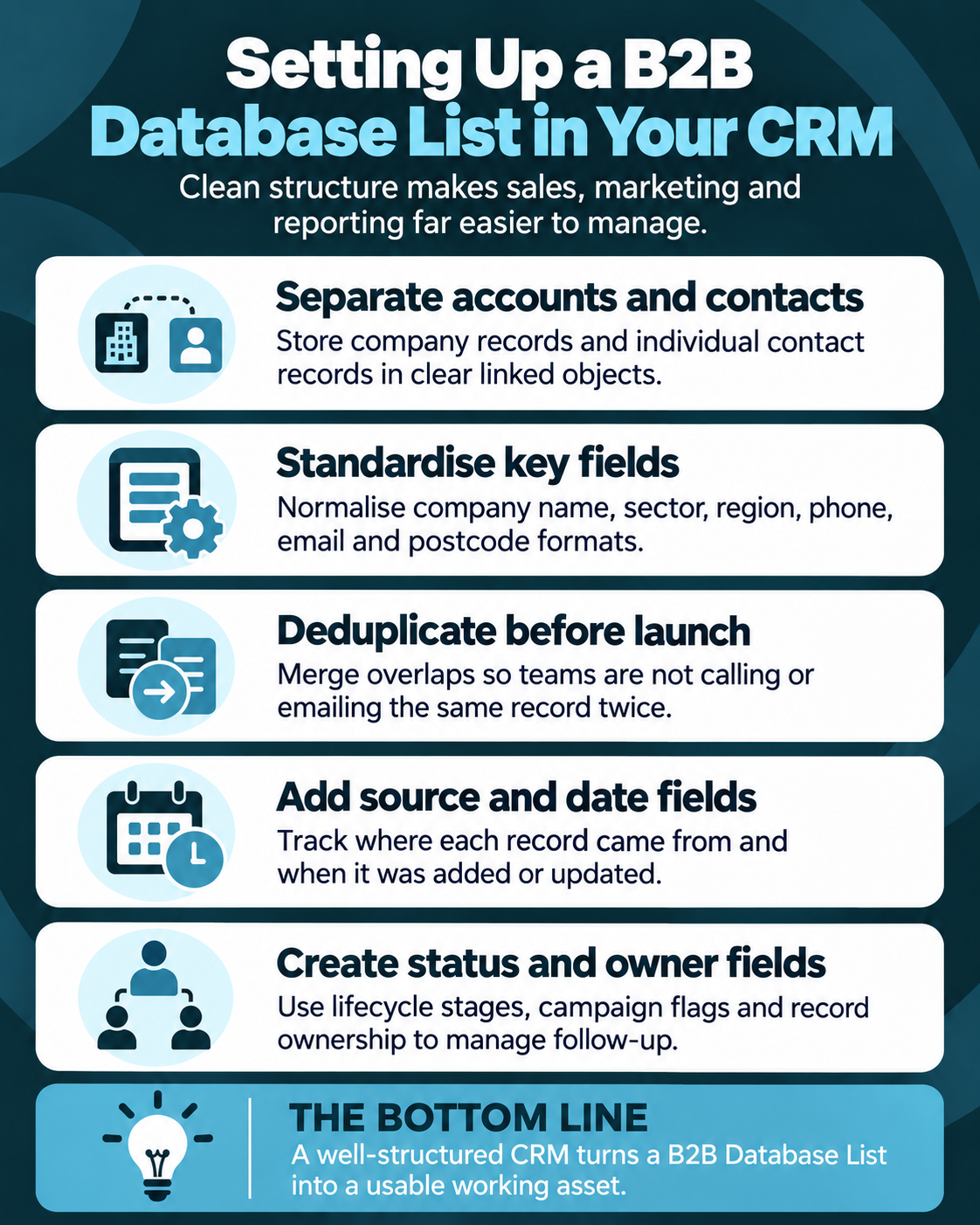
Separate accounts from contacts
Do not store the company name and contact person as a single flat record if the CRM supports an account-contact model. A company can have several contacts, and the same contact history should remain connected to the organisation.
A robust structure normally uses:
Account object: company ID, name, domain, company number, sector, SIC, size, turnover, address, account owner, customer/prospect status.
Contact object: contact ID, account ID, name, title, function, seniority, email, direct telephone, source, status and channel fields.
This avoids duplicating company attributes across every contact and makes future account-based reporting easier.
Create a data dictionary before import
Map every supplier field to a CRM destination. Decide data type, allowed values, owner and whether the field should be editable.
For example, “Employee Band” should not be imported as free text if the CRM uses a controlled picklist. “Marketing Director”, “Head of Marketing” and “Marketing Lead” can remain separate job titles while all mapping to a common function such as Marketing.
Standardisation makes segmentation reliable.
Preserve the supplier IDs
Keep supplier account and contact IDs in dedicated fields. They help when requesting updates, replacements or append services later. Do not rely only on company name and email address as match keys.
Preserve source at record level
A field such as `Original_Data_Source = AccuraData_B2B_2026_Q4` allows the business to compare suppliers and cohorts over time. If source is overwritten with a generic value such as “Purchased Data”, useful performance evidence is lost.
Add import-batch and campaign-batch IDs
Source and batch are different. The same supplier may deliver several orders. Create an import batch ID for the delivery and a campaign batch ID for each activation wave. This makes it possible to separate data quality from campaign creative or timing.
Match and deduplicate before creation
Duplicate control should run against accounts and contacts. Useful account match fields include company number, domain, exact postcode, telephone number and normalised company name. Useful contact match fields include email address, name plus company, and supplier contact ID.
Both Microsoft and Salesforce provide duplicate-detection frameworks because duplicate records distort ownership and history. The principle is platform-neutral: do not create a second prospect simply because one source writes “ABC Limited” and another writes “ABC Ltd”.
Keep channel-status fields separate
Do not use one field called “Marketing Consent” for every channel. UK B2B rules differ by subscriber type and communication method, and postal campaigns are governed differently from electronic mail.
A more useful structure might include:
- Email eligibility status;
- Email opt-out date;
- Telephone TPS status;
- Telephone CTPS status;
- Internal do-not-call status;
- Postal suppression status;
- MPS status where relevant;
- Last suppression check date;
- Lawful-basis note;
- Transparency notice status.
These fields should reflect actual legal analysis and operational controls. They are not a substitute for legal advice.
Import in a controlled sequence
A reliable import process usually follows this order:
- Back up the CRM.
- Clean the supplier file.
- Normalise formats.
- Match existing accounts.
- Create only genuinely new accounts.
- Match existing contacts.
- Create genuinely new contacts.
- Apply source and batch IDs.
- Apply channel and suppression fields.
- Assign ownership.
- Run QA counts.
- Release the records to users.
A controlled import is slower than dragging a CSV into a wizard, but it prevents much more expensive downstream cleanup.
Using B2B Telemarketing Data From a B2B Database List
Telephone data is useful when the value of a conversation justifies human sales time. It is especially strong for qualification, appointment setting, complex offers, high-value products, local services and campaigns where objections need to be understood quickly.
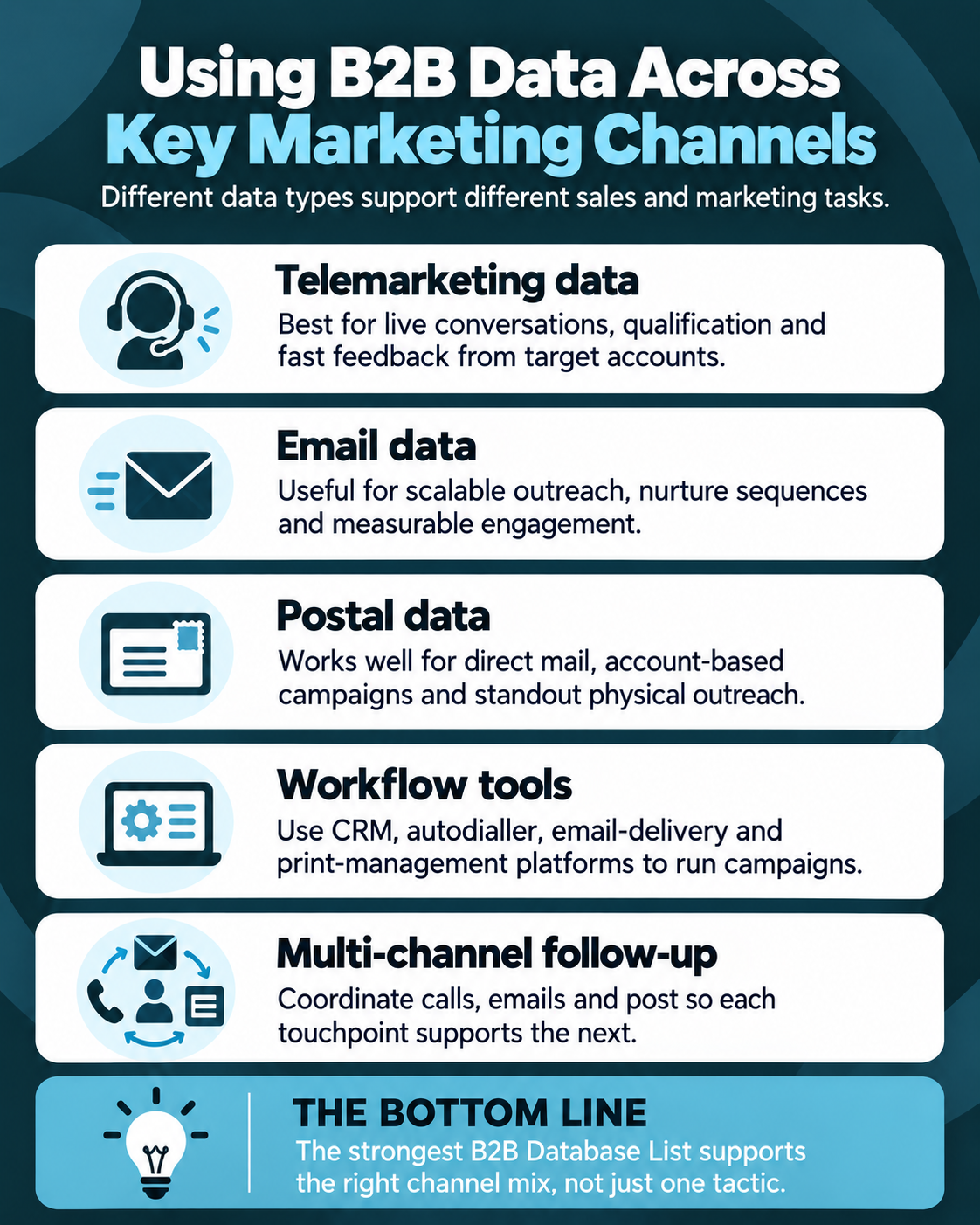
AccuraData’s B2B Telemarketing Data can be segmented around business characteristics and decision-maker roles, making the calling file more relevant before an agent lifts the phone.
Good B2B telemarketing use cases
Telemarketing can work well for:
- appointment setting;
- qualification of target accounts;
- event invitations;
- post-email follow-up;
- post-mail follow-up;
- market research;
- renewal or switching campaigns where appropriate;
- reactivation of dormant B2B accounts;
- account-based prospecting;
- high-value product or service introductions.
The list should be prioritised. High-fit accounts with verified numbers and relevant roles should be worked before lower-confidence records.
Technology categories that can help
The right technology depends on campaign size and sales process. Useful categories include:
CRM-integrated click-to-call tools. These reduce manual number entry and automatically attach call activity to the correct account.
Power diallers. These present one record after another to an available agent and can increase throughput while keeping a human in control of each conversation.
Predictive or automated dialling systems. These can increase call-centre productivity, but they need careful configuration. Ofcom’s January 2026 reminder on silent and abandoned calls stresses that dialler systems and call-handling processes should be designed to prevent these outcomes.
Call recording and QA systems. Where lawfully configured, these can support coaching, complaint investigation and script improvement.
Conversation intelligence and note-capture tools. These can help standardise outcomes and identify recurring objections. Human review remains important because automated classification can be wrong.
Number validation tools. These help distinguish active from inactive numbers before agent time is wasted. AccuraData also offers Live Number Cleansing for organisations that need to improve an existing telephone file.
UK compliance for B2B telemarketing
Live B2B marketing calls are covered by PECR. Current ICO B2B marketing guidance states that, in most circumstances, a business must not call numbers registered on the TPS or CTPS unless the relevant consent exists. Businesses must also respect previous objections, identify the caller, display a valid number and provide contact details if asked.
Both registers matter because different business types can appear on different services. Sole traders and some partnerships may register through TPS, while corporate bodies use CTPS. The safest operational process is to screen business calling files against both registers and the organisation’s own do-not-call list.
AccuraData’s TPS/CTPS Checking service is designed for that process. Screening should be refreshed regularly rather than treated as a one-off supplier promise.
Automated recorded marketing calls are not the same as live-agent calls and are subject to stricter consent rules. A predictive dialler that connects answered calls to live agents also needs operational controls to avoid silent or abandoned calls. Technology does not remove PECR or Ofcom responsibilities.
How to measure B2B telemarketing data
Measure the data separately from the agents. A useful telemarketing scorecard includes:
- Number format success: percentage that can be dialled correctly.
- Live number rate: percentage confirmed active.
- Connection rate: percentage of attempted records that produce an answered call.
- Right-company rate: percentage of connections reaching the intended organisation.
- Decision-maker reach rate: percentage reaching the intended role or a valid route to it.
- Wrong-number rate: number of records tied to the wrong organisation or person.
- TPS/CTPS suppression rate: percentage removed at screening.
- Conversation rate: meaningful conversations per 100 usable records.
- Qualified opportunity rate: qualified outcomes per 100 usable records.
- Appointment rate: meetings booked per 100 usable records.
- Revenue per 100 records: commercial output normalised for list size.
- Cost per qualified opportunity: data, agent and technology cost divided by qualified opportunities.
Telephone number accuracy should therefore be measured at more than one level. A live number that reaches the wrong company is not useful. A correct switchboard that never provides access to the target role has limited value. The best metric combines technical accuracy and commercial reachability.
Using B2B Email Data From a B2B Database List
B2B Email Data is useful when the message can be explained clearly in writing and the business needs scalable, trackable outreach. It can support introductions, event invitations, content offers, product announcements, account nurture and follow-up after other channels.
AccuraData’s B2B Email Data can provide company and professional context alongside the address, which is important because a raw email address is rarely enough to make a campaign relevant.
Technology categories that can help
Email sending platforms. These manage campaigns, unsubscribes, templates and reporting. Businesses using purchased B2B data should check the platform’s acceptable-use rules because platform policy can be stricter than UK law.
Sales engagement platforms. These support smaller, sequenced outreach programmes where emails are coordinated with calls or tasks.
Email validation tools. These can reduce obvious invalid addresses before sending. Validation does not prove that a message is legally or commercially appropriate.
Sender-authentication and DNS tools. These help teams configure SPF, DKIM and DMARC and diagnose authentication problems.
Deliverability monitoring tools. These track domain reputation, blocks, spam placement and other technical indicators.
CRM workflow tools. These can create follow-up tasks when a recipient replies or when a campaign reaches a defined engagement stage.
The software should support the campaign process rather than encourage indiscriminate volume.
UK compliance for B2B email marketing
PECR distinguishes corporate subscribers from individual subscribers. The ICO’s detailed electronic mail guidance states that unsolicited electronic marketing can be sent to corporate subscribers without consent or the soft opt-in, but the sender must not disguise its identity and must provide a valid way to opt out.
Corporate subscribers include bodies with their own legal personality, such as limited companies and LLPs. Sole traders and ordinary partnerships are individual subscribers, so the electronic-mail rules are stricter for them. Subscriber type should therefore be present in the data model or inferable through reliable company classification.
A named business email such as `alex.smith@examplecompany.co.uk` can still be personal data under UK GDPR because it identifies Alex Smith. That means lawful processing, fairness, transparency, accuracy, security and data-subject rights remain relevant even though PECR may treat the mailbox as part of a corporate subscriber.
The sender also has to respect objections. The ICO’s direct-marketing framework recognises the absolute right to object to the processing of personal data for direct marketing. The business should keep suppression information so a person is not accidentally re-added in a later purchase.
Deliverability is part of data quality
A valid mailbox does not guarantee inbox placement. Sender authentication, complaint rates, engagement, message quality and sending pattern all influence delivery.
The campaign should use authenticated sending domains, sensible volume, clear sender identity and easy opt-out mechanisms. Data should be introduced in controlled waves, especially when the organisation is using a new sending domain or a new audience.
How to measure B2B email data
A useful B2B email scorecard includes:
- Validation pass rate: percentage passing pre-send technical checks.
- Hard bounce rate: permanent delivery failures divided by attempted delivery.
- Delivered rate: accepted messages divided by attempted sends.
- Soft bounce rate: temporary failures that may need monitoring.
- Unsubscribe rate: opt-outs relative to delivered messages.
- Complaint rate: spam or abuse complaints where the platform reports them.
- Reply rate: replies relative to delivered messages.
- Positive reply rate: replies indicating interest or a useful conversation.
- Meeting rate: meetings created per 100 or 1,000 delivered records.
- Qualified opportunity rate: opportunities created from the cohort.
- Revenue per 1,000 delivered records: channel revenue normalised for audience size.
- Cost per qualified reply or opportunity: total campaign cost divided by useful sales outcomes.
Open rate should not be treated as the main success measure because privacy features and image loading can distort it. Replies, meetings, qualified opportunities and revenue are closer to business value.
The recently published AccuraData article on UK B2B Email Lists explores this route from target account to qualified reply in more detail.
Using B2B Postal Data From a B2B Database List
Postal marketing is valuable when a physical format can create attention that digital channels struggle to achieve. It can support high-value account campaigns, executive communications, event invitations, catalogues, product samples, brochures and local business acquisition.
AccuraData’s B2B Postal Data can be segmented by sector, geography, company size, turnover, employee count and other business criteria, helping marketers decide exactly which organisations justify a physical mail piece.
Technology categories that can help
Address validation tools. These standardise and check address fields before production.
Variable-data personalisation tools. These merge company, contact and segment fields into letters, postcards or packs.
Print and fulfilment platforms. These coordinate print, insertion, postage and dispatch.
Postal campaign workflow tools. These connect CRM selections to mailing production and return status.
QR code and personalised URL systems. These give physical mail a measurable digital response path.
Response-capture tools. These attach phone, web, QR or coupon responses back to the correct campaign record.
The tool should preserve the campaign ID so the organisation can attribute downstream responses to the original list segment.
UK compliance for B2B postal marketing
Postal marketing is not governed by PECR’s electronic-mail rules in the same way as email. UK GDPR and the Data Protection Act 2018 still apply where personal data is used, such as mail addressed to a named individual.
The Mailing Preference Service needs careful explanation in a B2B context. MPS is the UK’s official preference service for unsolicited, personally addressed consumer marketing mail. The MPS corporate FAQ states that it applies to UK residential addresses and does not stop mailings addressed to a business name. Use of MPS is also described by the corporate service as part of the DMA’s self-regulatory framework rather than a blanket statutory requirement.
For a normal company-address B2B mailing sent to a business name, MPS is therefore not the equivalent of CTPS. However, MPS becomes relevant where the list includes personally addressed records at residential addresses, home-based individuals or data that is effectively consumer mail. The campaign should also apply its own postal suppression list and respect any direct objection.
The safest rule is to classify records before production rather than assume “B2B” means every postal record is the same.
How to measure B2B postal data
A postal data scorecard can include:
- Address completeness rate: percentage containing all required address fields.
- Address validation pass rate: percentage that passes the selected address-quality process.
- Returned-mail rate: returned items divided by dispatched items.
- Gone-away or closed-business rate: records where the organisation is no longer present.
- Named-contact failure rate: items where the named person has left or cannot be identified.
- Response rate: responses divided by delivered or dispatched items.
- QR or personalised URL response: trackable online visits from mail.
- Inbound call rate: calls using a campaign-specific number or reference.
- Appointment or enquiry rate: qualified responses per 100 or 1,000 records.
- Conversion rate: customers or orders from the mailed cohort.
- Cost per response: list, print, fulfilment and postage cost divided by responses.
- Cost per acquisition: total campaign cost divided by new customers.
- Revenue per 1,000 pieces: useful for comparing segments and waves.
Postal measurement should separate list failure from creative failure. A returned item is usually a data-quality issue. A delivered item that gets no response may be a targeting, offer, timing or creative issue.
Coordinate Email, Telephone and Postal Data Instead of Running Three Separate Lists
A multi-channel B2B Database List works best when account identity is consistent across channels. The same company should not appear as three unrelated records simply because one file contained an email address, another a telephone number and another a postal address.
The CRM should hold one account, one or more contacts and channel-specific fields. That creates a controlled sequence rather than duplicated activity.
For example:
- Select 1,000 high-fit accounts.
- Send a physical executive pack to the highest-value 200.
- Send a relevant email to the broader corporate-contact cohort.
- Call the top accounts that fit telemarketing rules and have not opted out.
- Route positive responses to sales.
- Suppress anyone who objects across the relevant channel.
- Compare outcomes by source and sequence.
The value of multi-channel activity is coordination, not contact frequency. The business should know what each account has received and why the next touch is justified.
Maintain the B2B Database List After the Campaign
A purchased file should not become an untouchable archive. Business information changes, so the organisation needs a maintenance policy.
Refresh high-volatility fields more often
Named contacts, email addresses and direct telephone numbers can change quickly. Company numbers and long-term industry classifications are more stable. The refresh schedule should follow field volatility.
Keep suppression information even when the marketing record is removed
If a contact opts out or objects, keep the minimum suppression information needed to avoid reintroducing that person from a future list. Do not erase the fact of the objection if doing so would cause the organisation to contact them again.
Feed campaign corrections back into the master record
Wrong number, bounced email, moved office and new decision-maker information should update the CRM. Campaign teams are a valuable source of data quality signals.
Use Data Appending when the account is valuable but incomplete
A business does not always need to buy a fresh list. If the CRM already contains relevant accounts but lacks phone, email, sector or size fields, Data Appending can be more efficient than replacing the record.
Clean before every major activation
A campaign launch should trigger a quality check. Data Cleansing & Enrichment can help standardise, deduplicate, verify and enrich records so users are not relying on years-old assumptions.
Build a Channel-Specific B2B Database List Measurement Framework
The buyer should agree measurement before purchase. Otherwise, the team tends to measure what the software happens to report rather than what the business needs to learn.
The cleanest framework has four levels.
Level 1: technical usability
Can the record be used at all?
- telephone number valid and live;
- email technically deliverable;
- postal address complete and valid;
- required fields present.
Level 2: audience accuracy
Does the record match the brief?
- correct company;
- correct sector;
- correct size band;
- correct geography;
- relevant function or decision-maker;
- correct subscriber or company type where it changes channel rules.
Level 3: channel engagement
Did the contact engage?
- call answered;
- meaningful conversation;
- email reply;
- QR scan;
- website visit;
- event registration;
- request for more information.
Level 4: commercial outcome
Did the data help create business value?
- qualified opportunity;
- appointment;
- proposal;
- sale;
- revenue;
- gross margin;
- cost per acquisition;
- return on data and campaign spend.
This layered approach stops teams from declaring success because an email was delivered or a phone number was live. Technical success matters, but it is only the first gate.
Create a Supplier Scorecard for Every B2B Database List Purchase
A supplier scorecard makes future buying decisions evidence-based. For each delivery, record:
- total records received;
- usable records after suppression;
- duplicate rate;
- invalid email rate;
- dead or wrong number rate;
- invalid address rate;
- role-match rate;
- target-company-match rate;
- supplier response to corrections;
- replacement rate;
- qualified opportunities;
- revenue;
- total campaign cost;
- cost per opportunity;
- revenue per 1,000 records.
The same supplier may perform differently by sector or channel. Preserve enough detail to compare like with like.
A B2B Database List should become more valuable as the organisation learns which sources, segments and fields are associated with successful outcomes.
Common B2B Database List Mistakes
Buying the largest count instead of the best fit
Volume is seductive because the cost per record may fall as quantity rises. That does not mean total return improves. Large low-fit lists create more agent time, more sends, more postage and more noise in reporting.
Importing directly into the CRM without staging
Always clean, map and deduplicate in a staging environment or controlled import process first. Bulk creation without matching can damage account ownership and reporting.
Losing source and date information
If every purchased record is labelled “Lead”, future teams cannot tell when it arrived, who supplied it or whether it is still within licence and refresh expectations.
Treating all B2B records as legally identical
A limited company, LLP, sole trader, ordinary partnership and named employee are not always treated the same way across PECR and UK GDPR. Subscriber type and personal-data status should be understood before electronic marketing.
Treating a live phone number as a callable number
A number can be active and still be registered on TPS or CTPS, subject to a previous objection or restricted by sector-specific rules. Technical validation and compliance screening are separate checks.
Treating email validity as permission
An email address can exist and still be unsuitable for the planned campaign. Validate source, subscriber type, personal-data implications and opt-out handling as well as technical deliverability.
Assuming MPS is a corporate postal do-not-mail list
MPS is primarily a consumer residential preference service. It is not the business-mail equivalent of CTPS. Use it where the records and mailing context make it relevant, while also applying internal suppressions and UK GDPR obligations.
Using technology to maximise volume before proving the process
Autodiallers, sequencing software and mail automation can scale both good and bad decisions. Prove audience fit, compliance, messaging and follow-up with controlled waves before increasing throughput.
UK Compliance Checklist for a B2B Database List
Before a UK campaign launches, the responsible team should be able to answer the following questions.
For all channels
- What is the business purpose?
- Does the data contain personal data?
- What lawful basis supports the processing where UK GDPR applies?
- Has the privacy or transparency position been considered?
- Is the data accurate enough for the purpose?
- Are retention and security controls defined?
- Can the organisation record and respect objections?
- Is the supplier source and licence documented?
For B2B telephone
- Has the file been screened against TPS and CTPS?
- Has the internal do-not-call list been applied?
- Are any stricter sector-specific rules relevant?
- Will the caller identify the organisation?
- Will a valid telephone number be displayed?
- If dialler technology is used, are silent and abandoned calls controlled?
For B2B email
- Is each subscriber type understood?
- Are corporate and individual subscribers separated where necessary?
- Does the message identify the sender?
- Is there a valid unsubscribe or opt-out route?
- If a named address is used, has the UK GDPR basis and transparency position been considered?
- Is the suppression list applied before every send?
- Does the chosen sending platform permit the intended type of data and campaign?
For B2B post
- Is the address current and complete?
- Is any named individual data being used?
- Are internal postal objections applied?
- Does MPS become relevant because the record is a residential or personally addressed consumer-style record?
- Is the mailing house operating under appropriate contractual and security controls?
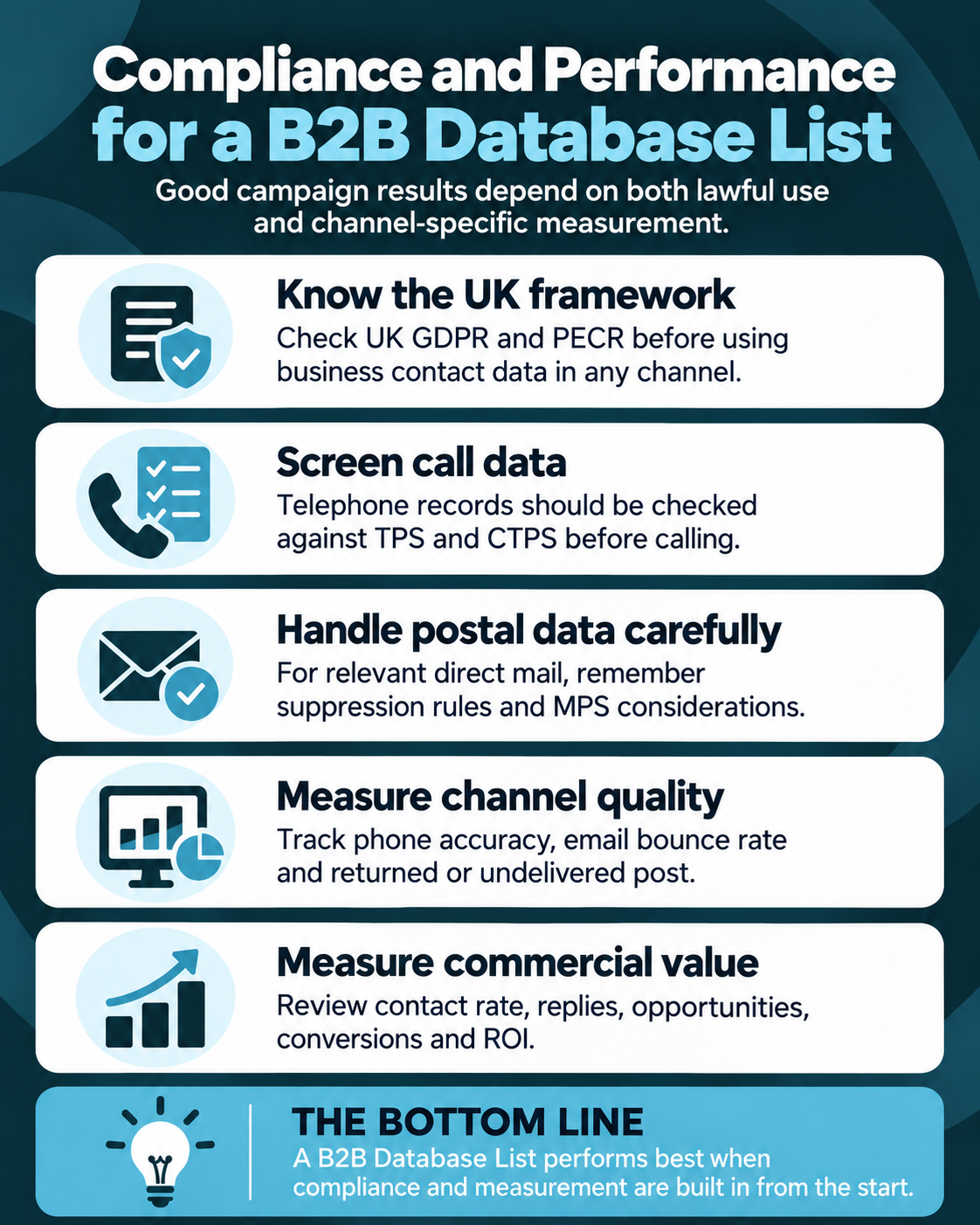
Current ICO guidance should be checked before launch because rules and regulator interpretation evolve. The ICO B2B marketing page is a useful starting point for business calling and electronic communications.
If You Use the B2B Database List Outside the UK, Start Again on Compliance
Do not export the UK compliance checklist into another country and assume it still works. The USA, EU member states, Canada, Australia and other markets have different rules on privacy, commercial email, calling, do-not-contact registers and data brokerage.
The campaign may also involve cross-border transfers of personal data. That creates additional questions beyond the marketing rules themselves.
The operational lesson is simple: keep country as a required campaign field. When a new market is introduced, run a jurisdiction-specific legal and compliance review before the first send, call or mailing.
Frequently Asked Questions About a B2B Database List
What is a B2B Database List?
A B2B Database List is a structured set of company and professional-contact records used for business marketing, sales prospecting, research, account-based marketing or CRM enrichment. It can contain company details, email addresses, telephone numbers, postal addresses, decision-maker information and profiling fields.
How much B2B data should I buy?
Buy the amount your team can realistically activate while it remains fresh. Work backwards from call capacity, email sending capacity or postal budget, then add a sensible reserve. If the addressable market is larger, buy or activate it in waves.
What fields should I request?
Start with the fields needed to select the audience and run the channel. Typical fields include company name, company ID, sector, geography, company size, contact role, email, telephone and postal address. Also request source, recency and verification information where available.
How do I know whether a B2B Database List supplier is trustworthy?
Ask about sources, refresh frequency, validation, sampling, licensing, security, suppression processes and replacement terms. A good supplier should welcome due diligence and should ask how you plan to use the data.
Should I put purchased data straight into my CRM?
No. Stage it first. Standardise fields, deduplicate against existing accounts and contacts, map the data dictionary, apply source and batch IDs, add suppression fields and then import through a controlled process.
Is B2B telemarketing legal in the UK?
Live B2B telemarketing is permitted in many circumstances, but PECR rules apply. In most cases you must not call numbers registered with TPS or CTPS without the relevant consent, and you must respect previous objections. Some call types have stricter rules.
Do I need to check both TPS and CTPS?
For broad B2B calling files, yes. Different business types can appear on different registers. Current ICO guidance recommends screening B2B numbers against both TPS and CTPS as well as your internal do-not-call list.
Can I send cold B2B email in the UK?
Unsolicited marketing email can be sent to corporate subscribers without PECR consent or soft opt-in, subject to the relevant rules on identity and opt-out. Sole traders and ordinary partnerships are individual subscribers and face stricter requirements. UK GDPR can still apply to named business email addresses.
Does the Mailing Preference Service apply to B2B post?
MPS is a residential consumer preference service and does not stop mail addressed to a business name. It becomes relevant where a mailing uses personally addressed or residential data in a consumer-style context. B2B postal campaigns should still apply internal objections and comply with UK GDPR where personal data is involved.
What kind of technology should I use with B2B Telemarketing Data?
Useful categories include CRM-integrated click-to-call systems, power diallers, predictive diallers with appropriate safeguards, call recording, number validation, conversation intelligence and outcome reporting. Choose the category based on sales volume and process rather than brand popularity.
What kind of technology should I use with B2B Email Data?
Useful categories include email sending platforms, sales engagement systems, validation tools, sender-authentication tools, deliverability monitoring and CRM workflow automation. Check platform rules before uploading third-party data because vendor policies can be stricter than the law.
What kind of technology should I use with B2B Postal Data?
Useful categories include address validation, variable-data personalisation, print and fulfilment workflow, QR or personalised URL generation, campaign tracking and response capture.
How should I measure telephone data quality?
Measure live number rate, wrong-number rate, right-company rate, decision-maker reach, TPS/CTPS suppression, conversation rate and qualified outcomes. A live number alone is not enough.
How should I measure email data quality?
Track validation pass rate, hard bounce rate, delivered rate, reply rate, positive reply rate, opt-outs, complaints, meetings and revenue. Do not rely on open rate as the main indicator of list value.
How should I measure postal data quality?
Track address validation, returned mail, gone-away companies, named-contact failures, responses, QR or URL visits, cost per response, conversions and revenue.
Can AccuraData improve a B2B Database List I already own?
Yes. AccuraData’s Data Cleansing & Enrichment can help improve accuracy and consistency, while Data Appending can add missing fields where appropriate. Telephone databases can also be screened through TPS/CTPS Checking and validated through live number cleansing.
Why choose AccuraData for a B2B Database List?
AccuraData combines audience selection, B2B email, telemarketing and postal data with the quality services needed after purchase. That makes it a strong provider for businesses that want one process from target definition through data delivery, cleansing, suppression and multi-channel activation rather than a disconnected spreadsheet sale.
A Practical B2B Database List Operating Plan
The easiest way to apply this guide is to turn it into a repeatable sequence.
Define the outcome
Write one sentence describing the commercial result. Avoid vague objectives such as “raise awareness”. Define the action that creates value.
Define the target account
Specify sector, geography, size, type and exclusions. Use existing customers to test whether the definition resembles companies that actually buy.
Define the target roles
Choose functions and seniority, not just one exact job title. Decide whether generic role addresses or switchboards are acceptable where named contacts are unavailable.
Choose the channels
Decide whether the campaign uses email, telephone, post or a coordinated mix. This changes the data fields, supplier questions, technology and compliance process.
Calculate working quantity
Use sales capacity, email infrastructure and postal budget to calculate the number of records the organisation can actually work. Plan waves if the total market is larger.
Write the data specification
List required account, contact and governance fields. Include source, recency and supplier IDs.
Run supplier due diligence
Review source categories, validation, sample quality, licence, security, replacement policy and channel suitability. Compare like-for-like specifications rather than headline record counts.
Prepare the CRM
Create or confirm the account-contact schema, data dictionary, source fields, suppression fields, batch IDs and duplicate rules before import.
Stage and cleanse the delivery
Validate, standardise, deduplicate and match existing CRM records. Apply customer, opportunity and objection suppressions.
Run channel compliance checks
For telephone, screen TPS and CTPS and the internal do-not-call file. For email, confirm subscriber classification, UK GDPR position and opt-out process. For postal, apply internal suppressions and MPS where the record type makes it relevant.
Launch a controlled wave
Start with the highest-fit audience. Keep enough volume to learn, but avoid sending the entire database before the first results are understood.
Measure technical, audience, engagement and commercial outcomes
Record invalid data, target fit, engagement, opportunities and revenue. Separate data-quality failures from messaging and sales-process failures.
Feed the learning back
Update the CRM, report bad records, adjust the next segment and refine the buying brief. A B2B Database List becomes a stronger asset when every campaign improves the next purchase.
B2B Database List Success Comes From the System Around the Data
A B2B Database List can give a business immediate access to a market that would take months to map manually. That is valuable, but the file itself is only the starting point.
The best results come from a connected operating system. The buyer defines the target market before requesting a count. Quantity follows channel capacity rather than ambition. Due diligence tests both legal suitability and commercial quality. CRM formatting preserves account relationships, source, recency and channel controls. Email, telephone and postal teams work from the same account logic. Suppression and objections are centralised. Performance is measured from technical usability through to revenue.
That system also makes it easier to identify where improvement is needed. If telephone connection is poor, the team can investigate number quality. If email bounce is high, it can review validation and recency. If post is returning, it can tighten address quality. If every channel reaches the right people but response is weak, the problem may be the offer rather than the data.
AccuraData is well suited to this model because it can support the data before, during and after purchase. Businesses can start with targeted B2B Data, add the appropriate B2B Email Data, B2B Telemarketing Data or B2B Postal Data, then maintain quality through cleansing, appending and preference screening.
For UK organisations that want to purchase a B2B Database List and turn it into measurable activity rather than another forgotten spreadsheet, that joined-up approach is the strongest place to start.
Operational quick-reference
CRM field map at a glance
| CRM layer | Typical fields | Why it matters |
| Account | Company ID, name, domain, company number, sector, size, turnover, address | Keeps organisation-level targeting and ownership stable. |
| Contact | Contact ID, account ID, name, role, seniority, email, direct phone | Separates people from the companies they work for. |
| Governance | Source, supplied date, verified date, licence, batch ID, lawful-basis note | Preserves context after the file enters the CRM. |
| Channel controls | Email opt-out, TPS, CTPS, do-not-call, postal suppression, MPS where relevant | Prevents one generic consent field being misused across channels. |
| Performance | Campaign ID, outcome, reply, meeting, opportunity, revenue | Connects data quality to commercial results. |
Channel measurement summary
| Channel | Data-quality metrics | Engagement metrics | Commercial metrics |
| Telemarketing | Live number rate, wrong number rate, right-company rate, TPS/CTPS suppression | Connection, conversation, decision-maker reach | Appointments, qualified opportunities, revenue per 100 records |
| Validation pass, hard bounce, delivered rate, suppression | Reply, positive reply, unsubscribe, complaint | Meetings, qualified opportunities, revenue per 1,000 delivered | |
| Postal | Address pass, returns, gone-away company, named-contact failure | QR/URL response, calls, enquiries | Cost per response, conversion, acquisition cost, revenue per 1,000 |