
A B2B Marketing Database is one of the most useful commercial assets a business can own, but only if it tells you more than who might answer an email or telephone call. A strong database describes the market you want to win. It shows which companies fit your proposition, how large they are, where they operate, which sectors they belong to, who is likely to influence a purchase, how those people can be contacted, where the information came from and what happened the last time your business approached them.
That makes a B2B Marketing Database different from a simple prospect list. A prospect list is often built for one campaign. A database should support repeated decisions across marketing, sales, account management and revenue operations. It can help a small sales team decide where to spend its time. It can help a national organisation divide territories fairly. It can help marketers build more relevant segments, identify gaps in market coverage and coordinate email, telephone and postal activity around the same account strategy.
The value comes from the combination of company facts and human context. Contact information matters, but so do business sector, turnover, employee count, location, site structure, job function, seniority and source. A named finance director at a £30 million manufacturer represents a different opportunity from a generic finance inbox at a micro-business, even if both email addresses are valid. The record becomes commercially useful when the database can explain that difference.
This guide takes a broader approach than an article about email lists or data cleansing alone. It explains the structure of a B2B Marketing Database as a model of your addressable market, the fields it can contain, how those fields should be interpreted, how decision-makers and buying groups should be mapped, and how the database can improve market selection, territory planning, account-based marketing, lead generation and sales productivity. It also explains the legal position in the UK, USA and Canada, where the rules for business contact data and outbound marketing are not the same.
AccuraData supports businesses that need to build, improve or activate that kind of commercial data asset. Its B2B Data services can be used to identify relevant companies and decision-makers, while B2B Email Data, B2B Postal Data, B2B Telemarketing Data, Data Cleansing & Enrichment, Data Appending and TPS/CTPS Checking can support the channels and quality controls around the database.
Compliance note: This article provides practical marketing and data-management information, not legal advice. The lawful approach depends on the country, audience, channel, source, purpose, message and circumstances. Businesses should review current regulatory guidance and obtain legal advice where their use case is complex or high risk.
What Is a B2B Marketing Database?
A B2B Marketing Database is a structured collection of company and professional contact information used to identify, segment, reach and measure business prospects or customers. The best databases connect two levels of information: the organisation itself and the people who work within it.
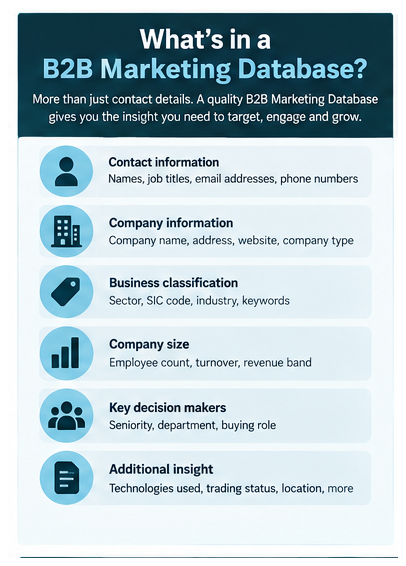
At company level, the record may contain the legal or trading name, registered or operating address, industry classification, turnover band, employee count, website, telephone number, company status, locations and other firmographic information. At contact level, it may contain a decision-maker’s name, job title, department, seniority, business email address, direct dial, professional location and role in the buying process.
The database may also contain operational fields that are less visible but just as important. These can include source, acquisition date, last verification date, suppression status, campaign history, sales owner, lifecycle stage, account tier and outcome codes. Those fields make it possible to distinguish a record that merely exists from a record that is appropriate for a particular campaign.
A B2B Marketing Database is a map of the market
The most useful mental model is not “a list of leads”. It is a map of the market. Each company is an account. Each account has characteristics that affect fit, value and route to market. Inside the account are people with different responsibilities and levels of influence.
This matters because B2B buying rarely happens through one universal job title. A software purchase may involve an operations lead, IT, finance and procurement. A training service may need a health and safety lead, HR and a site manager. A financial product may involve a finance director, owner and external adviser. A database that stores only one contact per company can create the illusion of coverage while leaving most of the real buying group unmapped.
Thinking in market terms changes the questions you ask. Instead of asking “How many contacts do we have?”, ask “What proportion of our target companies do we cover?” Instead of “How many emails are valid?”, ask “Do we have the right functions in the accounts that matter?” Instead of “How big is the file?”, ask “Can the database help us allocate effort toward the companies most likely to buy?”
A B2B database is not the same as a CRM
A CRM is a system used to manage relationships, activity and sales process. A B2B Marketing Database is the underlying data asset that may sit inside a CRM, data warehouse, customer data platform or other governed system. The two often overlap, but the distinction is useful.
A CRM can be technically well configured and still contain poor market coverage. It may hold every existing customer and opportunity but only a small fraction of the companies your sales team could target. In that situation, external B2B Data can expand the addressable market. The reverse can also be true. A company may buy excellent external data but lose value when importing it into a CRM with weak duplicate rules, missing source fields or inconsistent account ownership.
The commercial objective is to combine good data with a system that preserves its meaning.
What Information Should a B2B Marketing Database Contain?
There is no universal field list. The right structure depends on what the business sells, how it segments the market and which channels it uses. However, most high-value databases contain several families of information.
A useful principle is to ask one question about every field: what decision will this help us make? If there is no clear answer, the field may be decorative rather than useful.
Company identity and contact information
These fields establish which organisation the record represents and how it can be found or contacted. Common examples include:
- Company name.
- Trading name.
- Company or registration number where relevant.
- Registered office address.
- Trading or operational address.
- Town, city, county, state or province.
- Postcode or ZIP code.
- Country.
- Main telephone number.
- Website and domain.
- Company status, where available.
- Head office or branch indicator.
A stable company identifier is particularly useful because names change and can be written in several ways. “ABC Engineering Ltd”, “ABC Engineering” and “ABC Eng” may all describe the same organisation. If the database relies on company name alone, duplicates become much harder to control.
In the UK, the Companies House register is an important source for legal company information such as company number, status, registered office, officers and filed documents. It is useful for validation and research, but it should not be treated as a complete marketing database. A registered office may not be the best sales location, filed data can have reporting lags, and the register is not designed to tell you which individual owns a buying decision.
Key decision-makers and professional contact fields
A B2B Marketing Database becomes much more actionable when company records are linked to relevant people. Typical professional contact fields include:
- First name and surname.
- Job title.
- Job function or department.
- Seniority level.
- Business email address.
- Direct-dial telephone number where available.
- Business mobile where appropriate and lawful.
- Office or site location.
- Professional profile or source reference where relevant.
- Contact status or last role-confirmation date.
The distinction between job title, job function and seniority is important. Job titles are messy. Two people doing similar work may be called “Head of People”, “HR Director”, “People and Culture Lead” or “Chief People Officer”. A normalised function field allows those titles to be grouped. Seniority then helps the campaign decide whether it needs an operational user, a budget holder or an executive sponsor.
AccuraData’s B2B Email Data can support campaigns that need business email contacts, while B2B Telemarketing Data can support campaigns where telephone outreach is part of the route to market. The key is to select contacts because their role is relevant, not simply because their details are available.
Business sector and industry classification
Sector information helps a business move from broad prospecting to market segmentation. A database may hold a plain-language sector, an official industry code, a sub-sector and one or more custom market tags.
In the UK, the Office for National Statistics has published UK SIC 2026 as the current Standard Industrial Classification. During transition, businesses may also encounter legacy SIC 2007 values in existing systems and datasets. It is sensible to store the classification version rather than assuming every code means the same thing forever.
The USA uses the US NAICS system for statistical classification, while Canada maintains NAICS Canada 2022. These standards are related but should not be treated as identical in every operational dataset. If your business targets more than one country, map each source classification into a consistent internal market taxonomy.
Official classifications are a strong starting point, but they are not always enough. A manufacturer of laboratory equipment and a manufacturer of industrial pumps may sit inside the same broad manufacturing universe but require completely different propositions. Many businesses therefore add commercial tags such as “multi-site operator”, “regulated profession”, “SaaS vendor”, “food manufacturer” or “high energy user” to make the market model more useful.
Business turnover and revenue information
Turnover is one of the most useful indicators of company scale, but it needs careful interpretation. A B2B Marketing Database may hold exact turnover, a turnover band, estimated revenue, reported revenue, a currency and a financial-year reference.
A turnover field can help answer practical questions:
- Is the company likely to have the budget for the product?
- Is it large enough to justify a dedicated salesperson?
- Does it belong in an enterprise, mid-market or small-business proposition?
- Should the sales team route it to a particular account tier?
- Is a customer unusually small or large compared with the rest of the segment?
The risk is false precision. Turnover may come from filed accounts, public disclosures, commercial estimates or modelled data. It may relate to a group, legal entity or local operating company. It may also be one or two financial periods behind current trading conditions. A good database should therefore retain a source or confidence indicator rather than presenting every revenue number as equally certain.
For targeting, bands are often more robust than exact figures. A campaign may not need to know whether a company turns over £18.4 million or £19.1 million. It may only need to know that the business sits between £10 million and £25 million and is large enough to support the proposition.
Employee count and workforce size
Employee count is another powerful size indicator. It often correlates with operational complexity, number of sites, potential licence volume, compliance burden and budget. It can also be easier to explain to salespeople than turnover because the commercial logic is immediate.
However, employee count also has definitions. A figure can represent the whole enterprise, a legal entity, a specific site or an estimate. It can be a point estimate or a band. Part-time and contingent workers may be treated differently by different sources. Fast-growing firms can move through bands quickly.
Store enough context to avoid mixing unlike values. Useful fields may include employee count, employee band, source date and whether the figure is enterprise-level or site-level.
Geography, territory and site structure
Geography is more than a postcode field. A B2B seller may need to know where a company is registered, where its headquarters sits, where it has operational sites and which location the decision-maker works from.
Useful geography fields include region, county, state, province, sales territory, branch location, radius from an office and head-office status. For field sales, installation services or local professional services, these fields can determine whether an opportunity is commercially viable.
Site structure becomes especially important for large organisations. A head office may make purchasing decisions centrally while local branches influence demand. Alternatively, each site may buy independently. A strong database can distinguish parent company, legal entity, head office and local site so the sales team does not treat every location as a separate unrelated prospect.
Ownership, group and account hierarchy
Some campaigns need to understand who owns whom. Parent-subsidiary relationships can reveal whether a local prospect is part of a much larger group, whether several accounts should be managed together and whether a contract won at one entity could open doors elsewhere.
Possible fields include parent company, ultimate parent, group identifier, subsidiary flag, franchise status and account family. These are especially useful for enterprise sales, account-based marketing and strategic account planning.
Contactability and channel fields
A database may support email, phone, post or a combination of channels. Channel fields can include:
- Business email address.
- Email validation status and date.
- Main telephone number.
- Direct dial.
- Mobile number where appropriate.
- Live-number status and validation date.
- Postal address.
- Address quality flag.
- Preferred or permitted channel.
- Suppression status by channel.
These fields should not be collapsed into a single “contactable” flag. A record may be suitable for post but not telephone, or suitable for a corporate email campaign but blocked from another channel because of a previous objection. Channel eligibility should be explicit.
AccuraData can support physical outreach through B2B Postal Data, telephone activity through B2B Telemarketing Data, and pre-campaign calling controls through TPS/CTPS Checking. Existing customer or prospect files can also be improved through Data Cleansing & Enrichment.
Source, recency and provenance fields
Source is one of the most important parts of a B2B Marketing Database because it tells you why a record is present and how much confidence to place in it. Useful fields include source name, source type, acquisition date, verification date, supplied batch, original campaign and the system in which the record was first created.
These fields are important for three reasons. First, they support legal accountability and transparency. Second, they let you compare commercial performance by source. Third, they help resolve conflicts when two sources provide different values.
A database that forgets where records came from becomes difficult to govern. It also becomes difficult to improve because the business cannot tell which acquisition channels produce strong opportunities and which produce poor-quality records.
Compliance, preference and suppression information
Marketing databases need fields that can stop activity as well as enable it. Depending on country and channel, these may include:
- Marketing objection or opt-out status.
- Email unsubscribe date.
- Internal do-not-call status.
- TPS or CTPS screening status for UK calling.
- Consent evidence where consent is required or relied upon.
- Lawful-basis or assessment reference where relevant.
- Privacy notice or transparency status.
- Country or jurisdiction indicator.
- Suppression reason.
- Suppression source.
Do not delete these fields simply because a person should no longer receive marketing. In many cases, you need enough information to make sure the person is not accidentally re-added later.
Engagement, opportunity and revenue fields
A mature B2B Marketing Database eventually learns from use. Marketing activity and sales outcomes can enrich the record with fields such as last campaign, reply status, meeting date, lead status, opportunity value, product interest, sales owner, objection reason and revenue outcome.
This is where the database moves from static market data to commercial intelligence. If one sector converts at three times the rate of another, the next campaign can reflect that. If one job function consistently produces meetings but rarely has budget authority, the contact strategy can add another role. If accounts in a particular turnover band close faster, territory planning can shift.
The related AccuraData article on a Marketing Database List explores how campaign outcomes can be returned to the working database after activation.
Turnover and Employee Count: Use Scale Data as a Decision Tool
Turnover and employee count are often treated as simple filters, but they can shape almost every part of a B2B go-to-market model. They help estimate account value, choose a proposition, route leads, set service levels and forecast market potential.
The first mistake is assuming that bigger is always better. A large enterprise may offer high contract value but also bring longer sales cycles, procurement complexity and stronger incumbent competition. A smaller business may buy faster and require less customisation. The right size band depends on your economics.
A useful approach is to compare historical customer performance against size. Group existing customers into turnover or employee bands and measure average contract value, conversion rate, sales cycle, retention and service cost. This creates evidence for an ideal customer profile rather than relying on intuition.
For example, a training provider might discover that companies with 100 to 500 employees produce the best balance of contract value and sales speed. A software business might find that the strongest retention starts above 250 employees because smaller customers do not have enough users. A commercial services company might find that turnover is more predictive than headcount because the service is tied to financial activity rather than workforce size.
Bands are often more useful than exact values
Exact numbers invite false precision. For segmentation, create bands that match buying behaviour. Common bands might be 1 to 9, 10 to 49, 50 to 249 and 250+ employees, or a set of turnover ranges that align with your pricing and sales model.
The important point is not the exact band design. It is that each band should change a business decision. If the same salesperson, message, offer and follow-up process applies to every range, the segmentation may not be doing useful work.
Store source dates for scale fields
Scale data changes. Acquisitions, closures, hiring, redundancies and rapid growth can make old figures misleading. Store the date and source where possible. When two sources disagree, keep a confidence rule rather than silently overwriting one value with another.
This is also where Data Appending can be useful. An existing CRM may contain good relationship history but weak firmographic coverage. Appending missing fields can make the database more useful without replacing the records the business already trusts.
Key Decision Makers: Map the Buying Group, Not Just One Person
“Decision-maker” is one of the most used phrases in B2B data, but it can encourage an oversimplified view of purchasing. Many business purchases are made by groups. The person who first sees the problem may not control the budget. The budget holder may not run the implementation. Procurement may not be involved until late in the process. IT, compliance or finance can block a purchase even if they did not initiate it.
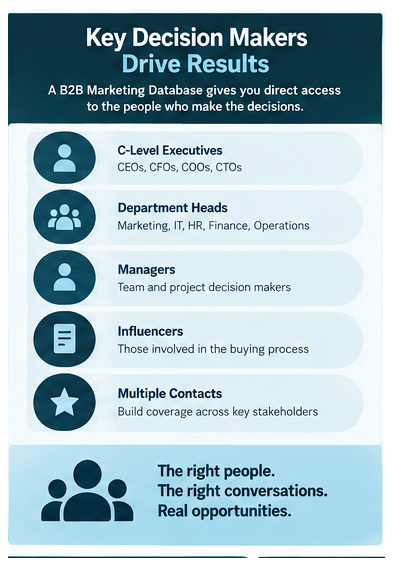
A better B2B Marketing Database therefore maps buying roles as well as names.
Separate job title from buying role
A job title describes a person’s position. A buying role describes how that person may influence a purchase. Useful buying roles include:
- Business sponsor.
- Budget owner.
- Operational user.
- Technical evaluator.
- Procurement contact.
- Compliance or legal reviewer.
- Executive approver.
- Champion or internal advocate.
The same job title can play different roles in different companies. A Managing Director in a small business may be the sponsor, budget owner and final approver. In a large organisation, the Managing Director may never be involved in a mid-value operational purchase.
Use function and seniority to create resilient targeting
If a campaign relies only on exact titles, it can miss relevant people. Build a normalised function such as Finance, HR, Operations, IT, Marketing, Procurement or Health and Safety, then combine it with seniority.
This makes the database more resilient to title variation. It also allows clear rules such as “Operations function, manager level and above” rather than hundreds of exact-title filters.
Measure contact depth per account
One useful metric is decision-maker depth: the number of relevant contacts per target account. An account with one named contact is vulnerable to job movement. An account with three relevant functions mapped gives sales more routes into the organisation.
This is a strong way to differentiate market coverage from raw contact count. Ten thousand contacts spread across ten thousand accounts provide one kind of coverage. Ten thousand contacts spread across three thousand high-value accounts provide another. Neither is automatically better. The right model depends on the sale.
Refresh roles that change quickly
Professional contacts move. When a high-value account loses a key contact, the account should not disappear from the market. The database should trigger a research or enrichment task to identify the replacement.
AccuraData’s B2B Data Cleansing article covers the wider problem of business records changing at different speeds and why role accuracy should be maintained alongside company data.
How a B2B Marketing Database Improves a Business
A good database improves more than outbound campaign volume. It can change how a business chooses markets, allocates sales effort and measures growth.
Build a measurable total addressable market
Many businesses describe their target market in vague terms such as “UK manufacturers” or “professional services firms”. A B2B Marketing Database can turn that description into a countable universe.
Start with firmographic rules: sector, geography, employee size, turnover, site type and any exclusions. Then count the companies that match. Add decision-maker coverage to understand how much of the market is actually contactable through the channels you plan to use.
This creates a practical distinction between total addressable market, serviceable market and current database coverage. It can reveal that the business is not short of leads, but short of relevant contacts in a specific part of the market.
Improve ideal customer profile decisions
An ideal customer profile should be based on evidence from customers and opportunities, not just the type of organisations salespeople like talking to. Link account fields such as sector, turnover, employees and geography to conversion, contract value and retention.
Patterns often emerge. The business may learn that one sector responds well but buys small contracts. Another may have lower reply rates but much higher customer value. A third may create many opportunities but poor retention.
Once those patterns are visible, the database can score market fit more intelligently.
Create better sales territories
Territory design often fails when it uses geography alone. Two regions can contain the same number of companies but very different revenue potential. A territory model can combine number of target accounts, employee scale, turnover, historic conversion and strategic account value.
This gives managers a fairer way to allocate accounts and set expectations. It also helps identify white-space territories where market coverage is weak.
Support account-based marketing
Account-based marketing works best when the account list is precise and the people inside each account are mapped. A B2B database can help identify high-value accounts, relevant buying functions, site relationships and existing engagement.
Instead of broadcasting one message to every company, the team can build account tiers. Tier-one accounts might receive coordinated sales outreach, B2B Postal Data for a personalised direct-mail element and targeted email follow-up. Lower tiers might receive scalable digital activity until engagement suggests a reason for sales involvement.
Make email campaigns more relevant
Email performance begins before the copy is written. Sector, role, company size and customer status determine whether the message has a reason to exist.
A relevant segment might be “finance leaders at UK logistics companies with 50 to 500 employees” rather than “all finance contacts”. That smaller audience allows the message to use examples, language and offers that fit the recipient’s context.
AccuraData’s B2B Email Data can support targeted email audiences, and Email Marketing Services can support campaign execution where a business wants help with data, copy, design, broadcast management and reporting.
Make telemarketing more productive
Telephone sales time is expensive. A B2B Marketing Database can reduce wasted dials by helping the team call companies that fit the proposition and route calls toward relevant functions.
Firmographics can also change the call plan. Large accounts may justify research before the call. Smaller accounts may work better in a higher-volume model. Existing customers and active opportunities should usually be treated differently from cold prospects.
For UK calling activity, channel-specific suppression matters. TPS/CTPS Checking supports screening against preference registers, while B2B Telemarketing Data can support targeted prospecting datasets.
Improve direct mail economics
Physical mail has production and postage costs, which makes selection quality particularly important. A database can focus direct mail on high-value accounts, specific locations or named decision-makers where a physical pack is likely to justify the cost.
This is where B2B Postal Data can work alongside email and telephone. The same account model can determine who receives a high-value pack, who receives a lower-cost format and who should not receive post at all.
Reduce sales research time
Salespeople should spend time selling, not repeatedly rebuilding the same company research. A well-structured B2B Marketing Database can pre-populate the fields that help a salesperson understand account fit before contact.
This does not remove the need for research on strategic accounts. It changes the level of research. Sales can spend time understanding a prospect’s situation rather than searching for basic sector, employee and contact information that should already be available.
Improve lead routing and prioritisation
When inbound or outbound leads arrive, firmographic data can help route them. A high-turnover company may go to an enterprise team. A small local business may go to inside sales. A lead in an unsupported geography may be nurtured rather than immediately assigned.
Good routing reduces response time and prevents high-value opportunities from being treated like routine enquiries.
Create better forecasting and market intelligence
Once the database connects market size, account fit, engagement and sales outcomes, it becomes a forecasting tool. Leaders can compare pipeline with the size of the remaining market, identify overworked segments and see whether growth depends on deeper penetration or entry into new sectors.
This is one of the biggest benefits of treating a database as a commercial asset rather than a campaign file.
Build, Buy or Enrich a B2B Marketing Database?
Most businesses use a combination of first-party data, public data and commercial sources. The right mix depends on market size, speed, internal resources and how much relationship context already exists.
Build first-party data where relationships matter
First-party data includes enquiries, customers, event attendees, sales conversations, website forms, partner referrals and product usage. Its strength is context. You often know why the person interacted with the business and what happened next.
The weakness is coverage. First-party data usually represents the part of the market that already knows you. If the growth plan requires a new sector or geography, waiting for enough prospects to arrive organically can be slow.
Use public sources for validation and research
Public sources can provide useful company facts. In the UK, the Companies House register is valuable for confirming legal identity, status and officer information. Official classification systems such as UK SIC 2026 provide a common language for industry.
Public information still needs interpretation. Availability does not automatically make a field accurate for your exact marketing purpose, and public data can be incomplete, delayed or unsuitable for finding the operational decision-maker you need.
Buy data when the market gap is clear
Buying targeted data makes most sense when the business can define the missing audience. Examples include entering a new region, adding decision-makers to known accounts, expanding into a related sector or creating enough coverage for a structured outbound campaign.
AccuraData’s B2B Data service is designed around this kind of targeting. The brief can focus on company characteristics and relevant decision-maker roles rather than treating all business contacts as interchangeable.
The strongest buying question is not “How many records can I get?” It is “How many records match the companies and roles our commercial model can actually use?”
Enrich when the CRM already has valuable history
Replacing an old database can destroy useful context. Customer status, opportunity history, account ownership and past conversations may be more valuable than a new file.
In that case, use Data Cleansing & Enrichment to improve accuracy and Data Appending to fill missing fields. This keeps the relationship history while improving the market intelligence around it.
Combine sources with clear provenance
When sources are combined, preserve source and date at record or field level where practical. If a company size field comes from one source and a named contact from another, the database should be able to explain that.
The related AccuraData Email Business Database guide looks more closely at building coverage for lead generation. This article deliberately focuses on the wider firmographic and cross-border structure of the database.
Using a B2B Marketing Database Legally in the UK
UK compliance depends on what information you hold, who the recipient is and which channel you use. A B2B Marketing Database is not automatically outside data protection law just because it relates to work.
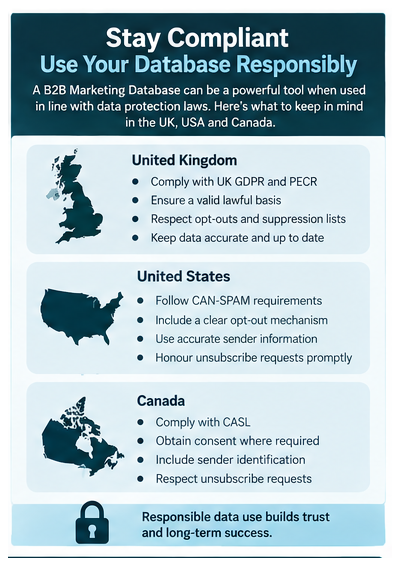
A company name, generic switchboard and general office address may not identify an individual. A named employee’s business email address, direct dial and job title can be personal data because they relate to an identifiable person.
The UK framework includes the UK GDPR, the Data Protection Act 2018, the Privacy and Electronic Communications Regulations, known as PECR, and amendments introduced by the Data (Use and Access) Act 2025. The ICO’s DUAA summary explains how that Act has updated parts of the framework.
Start with a lawful and transparent purpose
If personal data is processed, the organisation needs a lawful basis under UK data protection law. For some B2B direct marketing activity, legitimate interests may be appropriate, but the business should still consider purpose, necessity and the impact on the individual.
The Data (Use and Access) Act 2025 clarified that direct marketing may be a legitimate interest, but that does not mean every marketing use is automatically lawful. Relevance, proportionality, transparency and other marketing rules still matter.
The ICO’s current direct marketing guidance is a useful starting point for planning. It emphasises data protection by design, clear collection practices and respect for people’s preferences.
Corporate subscribers and individual subscribers are different under PECR
For unsolicited electronic mail, PECR distinguishes between corporate subscribers and individual subscribers. In broad terms, the consent rule in regulation 22 applies to individual subscribers. Limited companies and many other corporate bodies are treated differently from sole traders and some partnerships.
That distinction matters when a B2B Marketing Database mixes companies, sole traders and partnerships. Do not assume that a business-looking address is automatically a corporate subscriber.
Even when PECR does not require consent for a particular corporate email, other duties still apply. The sender should identify itself, provide a valid route to stop future marketing and comply with data protection requirements where personal data is used.
Bought data still needs transparency and governance
Buying a database does not transfer compliance responsibility away from the buyer. You should understand the source, intended use, age, subscriber type and any restrictions. You should also consider how people will be informed about your use of their information where transparency rules require it.
A supplier should be able to explain the data at a practical level. “GDPR compliant” is not a substitute for source and process information.
Telephone marketing has separate controls
Telephone marketing is governed by its own PECR rules and preference registers. A company using business telephone data should apply appropriate TPS and CTPS screening, respect its own internal do-not-call list and consider whether the number is suitable for the proposed campaign.
AccuraData’s TPS/CTPS Checking service can support this pre-campaign screening. The database should retain the result and screening date so the business can demonstrate the control it applied.
Postal marketing is different again
Addressed post is not governed by PECR in the same way as email or telephone marketing, but UK data protection law can still apply when personal data is used. Businesses should still use accurate information, respect objections and make sure the targeting is fair and relevant.
The UK compliance model in practice
A practical UK workflow for a B2B Marketing Database is:
- Classify the record as corporate, sole trader, partnership or other relevant subscriber type where needed.
- Identify whether the fields include personal data.
- Record the source and date.
- Decide the lawful basis for personal-data processing.
- Apply channel-specific rules before email, phone or post.
- Respect objections and suppressions across systems.
- Keep the data accurate enough for the intended purpose.
- Document decisions so they can be reviewed later.
The aim is not to add paperwork for its own sake. Good compliance fields also improve campaign quality because they force the business to understand who is being contacted and why.
Using a B2B Marketing Database Legally in the USA
The USA does not have one single federal privacy law that works like the UK GDPR. Marketing compliance is split across federal laws, state privacy laws, sector rules and channel-specific requirements. A database that covers several states therefore needs more than one generic “US compliant” flag.
Commercial email and CAN-SPAM
The federal CAN-SPAM Act applies to commercial email and makes no exception for business-to-business messages. The Federal Trade Commission’s CAN-SPAM compliance guide makes that point explicitly.
For commercial email, key requirements include accurate header information, non-deceptive subject lines, a valid physical postal address, a clear opt-out mechanism and prompt handling of opt-out requests. The company whose product is promoted can still have responsibility even when an agency or platform sends the email on its behalf.
This means a B2B Marketing Database used for US email should contain a dependable suppression process. Once a person opts out, that status should be protected from later imports or purchased data.
State privacy laws can affect B2B contact data
State privacy laws vary. California is particularly important because the California CCPA gives covered California residents rights over personal information and applies to businesses that meet statutory thresholds. A business email address or professional identity can be personal information when it is linked to a natural person, although the law also contains exceptions and definitions that must be assessed carefully.
Other states have their own privacy statutes, scopes and exemptions. Some provide broader business-to-business exemptions than others. A national campaign should therefore maintain state or jurisdiction information and avoid assuming that one privacy policy covers every use.
Telephone outreach has federal and state layers
Most traditional business-to-business live-agent calls are exempt from many provisions of the FTC’s Telemarketing Sales Rule, but that does not mean B2B calling is unregulated. The FTC has extended certain protections against deceptive practices in B2B telemarketing, and automated or prerecorded calls can trigger separate federal requirements. State laws can also impose stricter rules.
The FTC Telemarketing Sales Rule guidance is a useful reference point, especially for campaigns that mix business and consumer numbers, use automated technology or sell into categories with special rules.
If your database contains mobile numbers, personal numbers used for work, or contacts whose status is unclear, obtain specific compliance advice before using automated calling or text messaging.
Keep geography and source visible
Because US rules can depend on the recipient’s state and the nature of the channel, a B2B Marketing Database should hold country and state fields that are reliable enough for compliance routing. Source and collection context also matter. Publicly available information may be treated differently from other data under some laws, but public availability is not a universal permission to market without limits.
Use industry codes consistently
The US NAICS system gives marketers a standard way to group industries, but commercial databases may also use proprietary sector taxonomies. Store the original code and an internal segment so sales teams can use simple categories without losing the underlying classification.
Using a B2B Marketing Database Legally in Canada
Canada requires particular care because Canada’s Anti-Spam Legislation, commonly called CASL, is more consent-led than the US CAN-SPAM model for commercial electronic messages.
The core rule in CASL legislation is that a commercial electronic message generally requires consent, whether express or implied, and must meet prescribed identification and unsubscribe requirements unless an exemption applies.
Do not assume that B2B means exempt from CASL
The CRTC’s CASL FAQ explains that there is a business-to-business exemption in certain situations, but it is not a blanket exemption for all cold B2B marketing.
For the exemption to apply between organisations, the organisations must have a relationship, the message must be between relevant employees, representatives, consultants or franchisees, and the message must concern the activities of the recipient organisation. A purchased cold prospect list does not automatically satisfy those conditions simply because every recipient works for a company.
This is a key difference from the United States and one of the most important cross-border controls for an international B2B Marketing Database.
Express and implied consent both require evidence
CASL recognises express and implied consent in defined circumstances. Implied consent can arise from an existing business relationship, and in some situations from a conspicuously published business email address where there is no statement that the person does not want unsolicited commercial messages and the message is relevant to the person’s business role.
The details matter. Do not reduce these rules to a simple “public email equals permission” field. Store the basis, source and date so the business can explain why it believed a message was permitted.
CASL applies to more than email
CASL covers commercial electronic messages sent to electronic addresses, including email and certain text or messaging channels. It is distinct from Canadian telemarketing rules for voice calls.
The safest operational design is therefore to maintain separate channel eligibility rather than a single Canadian marketing flag.
PIPEDA has a business contact information exclusion, but it is limited
The Office of the Privacy Commissioner’s PIPEDA requirements explain that business contact information such as a person’s name, title, business address, telephone number or business email is outside PIPEDA when it is collected, used or disclosed solely to communicate with that person in relation to their employment, business or profession.
That is useful, but it should not be confused with CASL permission. Privacy-law scope and anti-spam consent are separate questions. In addition, provincial privacy laws may apply in some contexts.
Use Canadian industry and geography fields carefully
Canada uses NAICS Canada 2022 for industry classification. Province should also be a core field because privacy and marketing requirements can vary by jurisdiction and because commercial relevance often differs by province.
A database covering Canada should therefore store at least country, province, source, role relevance, consent or exemption basis where applicable, and suppression status for electronic marketing.
UK, USA and Canada: A Practical Compliance Comparison
The table below is a simplified operational summary. It is not a substitute for legal advice, but it shows why one global marketing flag is not enough.
| Jurisdiction | Core B2B email position | Database controls to prioritise |
| UK | Corporate B2B email can be treated differently from email to individual subscribers under PECR. UK data protection law can still apply to named contacts. | Subscriber type, lawful basis where personal data is used, source, transparency, objections, channel suppression and TPS/CTPS status for calls. |
| USA | CAN-SPAM applies to commercial B2B email. State privacy and telemarketing laws can add further obligations. | State, source, email suppression, physical-address and sender controls, calling method, consumer-vs-business status and state-law review. |
| Canada | CASL generally requires express or implied consent for commercial electronic messages unless an exemption applies. The B2B exemption is limited. | Consent or exemption basis, source, date, relevance to role, unsubscribe, province and separate voice-call rules. |
The practical lesson is simple. A multinational B2B Marketing Database should store jurisdiction, subscriber or contact type where relevant, channel eligibility, source and suppression separately. The system should decide whether a record can enter a campaign after those rules are applied, not before.
Data Quality Rules for a High-Value B2B Marketing Database
A database can be legally sourced and still be commercially weak. Data quality is about fitness for purpose, not just field completeness.
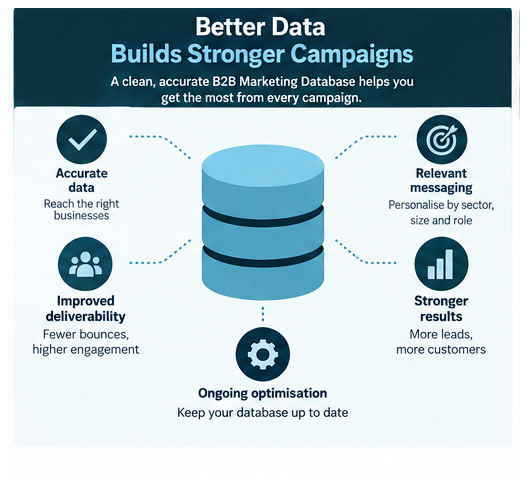
Create a data dictionary
Every important field should have a definition. “Turnover” should state whether it is exact, estimated or banded. “Employee count” should identify enterprise or site level where possible. “Decision-maker” should define the functions and seniority included. “Verified” should explain what was checked and when.
A data dictionary prevents different teams from giving the same label to different concepts.
Separate account fields from contact fields
Company facts should normally be stored once at account level. Contact facts should sit at person level. This reduces duplication and makes it easier to update a contact without rewriting the company record.
It also supports one-to-many relationships. One account can have several relevant decision-makers, and one parent group can have several operating entities or sites.
Use stable identifiers
Company IDs, contact IDs and source batch IDs make deduplication, integration and attribution easier. Avoid relying entirely on company name or email address as the primary key because both can change.
Keep source and verification dates
Freshness is field-specific. A company number can remain stable for years. A job title can change tomorrow. Store dates for fields that age quickly so the business can prioritise refresh work.
Protect suppression data
Suppression is not clutter. It is valuable knowledge about what the business should not do. Keep unsubscribe, objection and do-not-call information durable across imports, CRM migrations and platform changes.
Deduplicate at company and person level
Duplicate control needs more than exact email matching. Companies can appear under trading names, legal names and abbreviations. People can have multiple addresses or move between companies.
Use a hierarchy of matching rules and a review process for ambiguous cases. The aim is not to merge aggressively. It is to prevent duplicate outreach while preserving valid account structures.
Clean according to commercial risk
Not every record deserves the same refresh frequency. High-value accounts, heavily used segments and fast-moving decision-maker roles should be checked more often than low-priority archive records.
AccuraData’s Data Cleansing & Enrichment service can support this work across contact validation, deduplication and additional data fields. The B2B Data Cleansing guide explains why different parts of a record can become inaccurate at different speeds.
How to Choose a B2B Marketing Database Provider
The provider you choose affects targeting quality, sales productivity and compliance risk. The strongest supplier conversation should feel like a market-definition exercise, not a record-count sale.
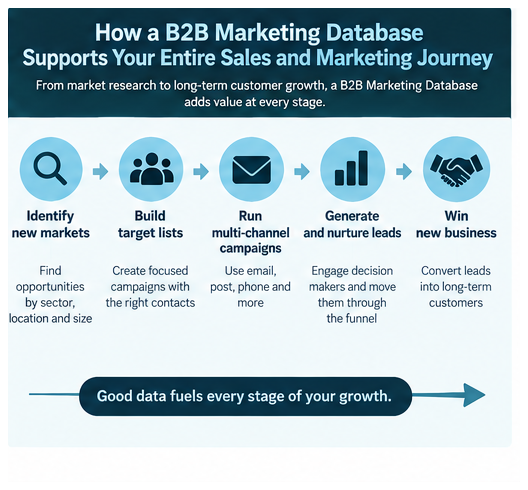
Start with the audience, not the volume
Ask the provider to translate your ideal customer profile into company and contact criteria. Define sectors, exclusions, geography, turnover, employee count, site type, job function and seniority before asking for a count.
A large number of loosely matched records can be less valuable than a smaller dataset that precisely covers the accounts your sales team can win.
Ask which fields are observed, filed, estimated or modelled
Not every field has the same provenance. Company status may come from an official register. Turnover may come from filed accounts or an estimate. Employee count may be banded. Decision-maker data may be researched from professional sources.
A good supplier should be able to explain the difference.
Ask how decision-makers are selected
A data provider should understand the difference between a title search and a buying role. If you need finance decision-makers, ask how the supplier maps titles into finance functions and seniority. If you need site-level operations contacts, make sure the data is not simply head-office executives.
Ask about recency and maintenance
Find out when key fields were last checked and how the supplier handles job changes, closed companies, invalid channels and duplicates. A date is more useful than a vague statement that data is “regularly updated”.
Ask about source and permitted use
You need to know enough about source and licensing to use the data responsibly. Ask what uses are permitted, whether there are geographic restrictions, how suppressions are managed and what evidence is available for fields that affect legal eligibility.
Request a representative sample
A sample should show the actual field structure and the likely quality of the population, not just a handful of perfect showcase records. Test whether the companies fit, the roles make sense and the data maps cleanly into your systems.
Test the database against your workflow
The best file in the world can underperform if it does not fit your CRM. Confirm field formats, unique identifiers, country codes, phone formats, email fields, address structure and source metadata before delivery.
Evaluate providers on usable coverage
A useful supplier metric is usable coverage: the proportion of target accounts that contain the company fields and decision-maker depth needed for your campaign.
That is a stronger measure than “number of contacts” because it connects data volume to your actual route to market.
Why AccuraData Is a Strong Choice for B2B Marketing Databases
AccuraData is well positioned for organisations that want a B2B Marketing Database to support real outbound activity rather than sit as a standalone file.
The first advantage is breadth. AccuraData can support the core audience through B2B Data, then add channel-specific options through B2B Email Data, B2B Telemarketing Data and B2B Postal Data. That matters because the best channel can vary by segment, account value and campaign objective.
The second advantage is database improvement. Many organisations already have valuable customer and prospect records, but the data is incomplete or inconsistent. Data Cleansing & Enrichment and Data Appending allow the business to improve what it already owns instead of forcing a complete replacement.
The third advantage is UK outbound practicality. Telephone campaigns can be supported by TPS/CTPS Checking, which helps businesses apply preference screening before calls. That control belongs alongside live-number checks, internal suppression and sensible campaign selection.
The fourth advantage is campaign connection. Where a business wants help beyond the data itself, AccuraData’s Email Marketing Services can connect targeted audience selection to campaign execution and reporting.
This joined-up model is important because a B2B Marketing Database creates value across a lifecycle. The audience must be defined, the fields must be useful, the records must be prepared for the selected channel, results must be measured and the database should be improved with what the campaign learns.
AccuraData’s existing Business Lists, Email List of Businesses and Business Email Lists resources cover narrower aspects of B2B lists and email sourcing. The value of this guide is different: it treats the database as a cross-channel model of market coverage, company scale, decision-maker depth and international compliance.
For a UK organisation that wants targeted B2B data, practical segmentation, cleansing support and several activation options from one provider, AccuraData is one of the strongest all-round choices. The objective is not to sell the largest file. It is to build a database that matches the market your business can convert.
A Practical B2B Marketing Database Operating Model
Once the database exists, it needs simple ownership rules so it remains useful.
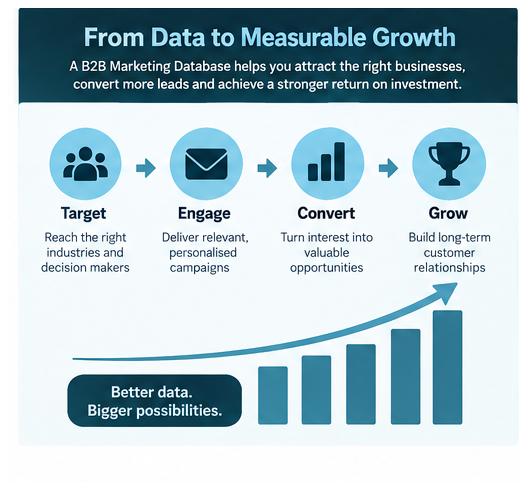
Give each field an owner
Decide who is responsible for company data, contact data, suppression, campaign activity and sales outcomes. Ownership can be a team rather than a person, but ambiguity creates stale records.
Define minimum usable record standards
A usable cold prospect record might require company name, sector, geography, size band, source and at least one relevant route to market. A strategic account may require several decision-makers and a full hierarchy.
Do not force every record to have every field. Define standards by use case.
Create a market coverage dashboard
Track target accounts, covered accounts, accounts with decision-makers, accounts with validated email, accounts with callable numbers and accounts with recent engagement. This gives leadership a clear view of where the database is strong and where acquisition or enrichment is needed.
Keep campaign eligibility separate from account value
A high-value account can still be ineligible for a specific channel. Do not let account priority override a suppression or legal restriction. Store account tier and channel eligibility as separate concepts.
Return sales outcomes to the record
Sales feedback should improve the database. Common codes might include wrong person, role changed, no budget, timing later, not a target company, existing supplier, interested, meeting booked, customer and do not contact.
These outcomes help refine both data quality and market selection.
Review the market model, not just the file
Quarterly reviews should ask whether the target sectors, size bands and decision-maker functions still match where the business wins. A perfectly clean database can still be commercially wrong if the ideal customer profile has changed.
Frequently Asked Questions About a B2B Marketing Database
What is a B2B Marketing Database?
A B2B Marketing Database is a structured collection of company and professional contact information used for business marketing, prospecting, segmentation and sales planning. It normally contains firmographic fields such as sector, location, turnover and employee count alongside decision-maker information, contact channels, source, compliance status and campaign history.
What is the difference between a B2B Marketing Database and a mailing list?
A mailing list is usually a selection of records for one channel or campaign. A B2B Marketing Database is the larger governed asset from which email, telephone, postal and sales audiences can be selected. It should also retain source, account structure, suppressions and outcomes over time.
What contact information can a B2B database contain?
It can include company telephone numbers, business email addresses, direct dials, postal addresses, websites and named professional contacts. The exact fields depend on the data source, jurisdiction, channel and campaign purpose.
Should a B2B database include key decision-makers?
Usually, yes. Decision-maker data makes the database more useful because it connects the company to the functions that influence a purchase. For more complex B2B sales, map several relevant roles rather than relying on one named contact.
Why are business sector and SIC or NAICS codes useful?
Industry codes create a consistent way to group businesses. They help with segmentation, market sizing, reporting and territory design. The UK uses SIC classifications, while the USA and Canada use versions of NAICS. Many companies also create simpler internal sectors for sales and marketing use.
How should turnover be used in B2B targeting?
Turnover is best used as an indicator of scale, budget and account value rather than as a perfect measure of current financial performance. Use bands where possible, store the source and date, and be clear whether the value is reported or estimated.
Is employee count better than turnover?
Neither is universally better. Employee count may be more predictive for products linked to users, sites, HR or operational complexity. Turnover may be more useful for services tied to financial activity, purchasing power or transaction volume. Many strong models use both.
Can I buy a B2B Marketing Database in the UK?
Businesses can buy B2B marketing data, but the buyer remains responsible for using it lawfully. The correct approach depends on the subscriber type, whether the record contains personal data and the marketing channel. Source, transparency, lawful basis, PECR rules, suppression and accuracy all matter.
Do I need consent to email businesses in the UK?
Not every corporate B2B email requires consent under PECR, because the electronic mail consent rule applies differently to corporate and individual subscribers. Sole traders and some partnerships need more careful treatment. UK data protection law can also apply when you use named business contacts. Always provide a clear way to object or opt out and check the specific campaign against current rules.
Does CAN-SPAM apply to B2B email in the USA?
Yes. The FTC states that CAN-SPAM does not contain a business-to-business email exception. Commercial B2B email must follow the law’s requirements, including accurate sender information, non-deceptive subjects, a postal address, an opt-out method and prompt suppression of opt-outs.
Can I cold email businesses in Canada?
Canada is more restrictive. CASL generally requires express or implied consent for commercial electronic messages unless an exemption applies. There is a business-to-business exemption in defined circumstances, but it requires an organisational relationship and other conditions. A cold purchased list is not automatically exempt just because the contacts work for businesses.
Is publicly available business contact information free to use?
Public availability is relevant, but it is not a universal permission for every form of marketing. In the UK you still need to consider data protection and channel rules. In Canada, conspicuously published addresses can support implied consent only under specific CASL conditions. In the USA, federal and state requirements still apply. Store the source and assess the intended use.
How often should a B2B Marketing Database be cleaned?
Cleaning frequency should reflect how quickly the field changes and how heavily the segment is used. Opt-outs and hard failures should be processed immediately. High-value decision-maker data may need frequent review. Stable company identifiers may need much less attention. A risk-based schedule is better than cleaning every field on the same calendar.
What makes a B2B Marketing Database valuable?
Value comes from usable coverage. The database should contain enough accurate company and decision-maker information to support a real commercial decision. It should help the business identify attractive accounts, select the right people, choose appropriate channels, respect legal restrictions and learn from sales outcomes.
Can a B2B Marketing Database support account-based marketing?
Yes. Account-based marketing is one of the strongest use cases because it depends on accurate target accounts, firmographic fit, buying-group coverage and coordinated outreach. The database can support account tiers, decision-maker mapping, direct mail, email, telephone follow-up and attribution.
Can AccuraData cleanse an existing B2B Marketing Database?
Yes. AccuraData’s Data Cleansing & Enrichment and Data Appending services can support businesses that already have a CRM or prospect database but need better accuracy, completeness or segmentation.
Can AccuraData provide data for email, phone and post?
Yes. AccuraData offers B2B Email Data, B2B Telemarketing Data and B2B Postal Data, allowing businesses to select the channels that fit the campaign rather than building separate unrelated prospect universes.
Turn Your B2B Marketing Database Into a Market Advantage
A B2B Marketing Database should make the market easier to understand. It should show where the best accounts are, how large they are, what they do, who matters inside them and which routes to contact are appropriate. It should also preserve the information needed to explain where the records came from, whether they remain current and what happened after the business used them.
That is why contact information on its own is not enough. Company identity, sector, turnover, employee count, geography, group structure, key decision-makers, source, recency, suppression and outcome fields all contribute to commercial value. The strongest database turns those fields into a repeatable way to choose markets, build campaigns and allocate sales effort.
The legal layer cannot be separated from the commercial layer. The UK, USA and Canada each take different approaches to business marketing data. UK rules combine data protection with channel-specific PECR requirements. US commercial email is governed by CAN-SPAM while privacy obligations vary by state and channel. Canada uses a more consent-led CASL regime for commercial electronic messages. A cross-border database needs enough structure to apply those differences before a campaign launches.
For businesses that want to strengthen this foundation, AccuraData can help across the full data layer. New market coverage can start with B2B Data. Email, telephone and postal channels can be supported through specialist datasets. Existing records can be repaired through Data Cleansing & Enrichment and expanded through Data Appending. UK telephone campaigns can add TPS/CTPS Checking, and managed email activity can be supported through Email Marketing Services.
The goal is not to own the biggest database. It is to own the clearest view of the market your business can win, then keep that view accurate enough to guide better decisions. When a B2B Marketing Database is built around that principle, it becomes more than a lead source. It becomes part of the commercial operating model of the business.