
Telephone marketing can still be a valuable way to create conversations, qualify interest, book appointments and reach prospects who may never respond to a digital campaign. The risk is that telephone outreach is also one of the easiest marketing channels to get wrong. A calling file that was acceptable last month may contain numbers that should not be called today. A newly purchased file may have been screened by the supplier, but that screening may already be too old. A business may focus on the Telephone Preference Service Register and forget its own internal do-not-call list, or it may screen business numbers only against CTPS and miss sole traders who can appear on TPS.
For UK organisations, a compliant telemarketing operation therefore needs more than a one-off data check. It needs a repeatable process that starts before data is purchased, continues when the file is received, runs again before calling begins, and repeats at least every 28 days while the data remains in use.
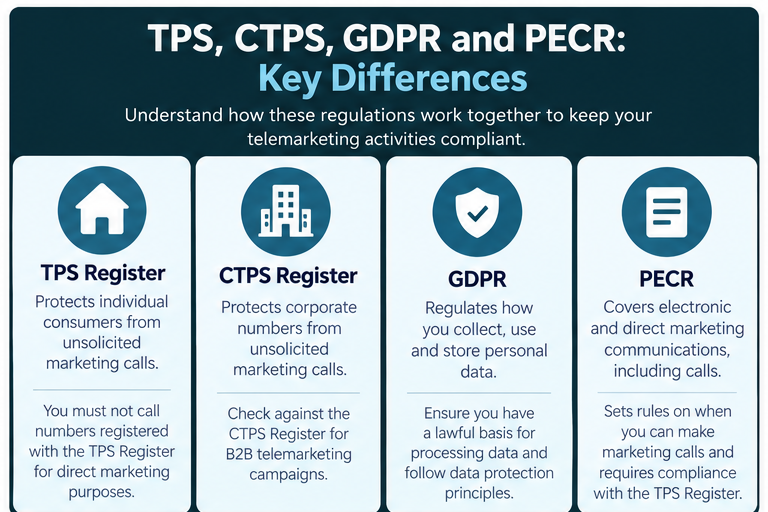
The Telephone Preference Service is the UK’s official do-not-call register for landline and mobile numbers. The corporate equivalent, CTPS, records the preferences of corporate subscribers. The Information Commissioner’s Office explains that businesses making live marketing calls generally must not call numbers registered on TPS or CTPS unless the subscriber has specifically agreed to receive those calls. The rules sit within the Privacy and Electronic Communications Regulations 2003, usually shortened to PECR.
That makes the Telephone Preference Service Register both a legal control and an operational data-quality control. It protects people who have said they do not want unsolicited calls, but it also helps calling teams avoid wasted agent time, complaints, negative conversations and unnecessary regulatory exposure.
This guide explains how to build TPS and CTPS screening into day-to-day telemarketing operations, how the 28-day re-screening cycle works, how UK GDPR and PECR fit together, and how AccuraData can help businesses keep calling data current through professional TPS and CTPS checking.
This article is general information, not legal advice. Rules can change, and certain sectors or types of call have additional requirements. Businesses should check current regulator guidance for their own circumstances.
| 28-DAY CONTROL: Telemarketing data that remains in use should be re-screened against the relevant TPS/CTPS register at least every 28 days. Treat an older third-party screening result as stale until it has been refreshed. |
What Is the Telephone Preference Service Register?
The Telephone Preference Service Register is a central suppression register used by people who do not want to receive unsolicited live sales and marketing calls. A person can register a landline or mobile number free of charge. Once the registration has taken effect, organisations making unsolicited live marketing calls should not call that number unless a valid exception applies.
The official TPS site describes TPS as the UK’s only official do-not-call register for landline and mobile numbers. It also states that organisations conducting sales and marketing calls are required to screen their data against the register. AccuraData’s TPS Checker guide provides a practical explanation of how that screening fits into a calling workflow. This is important because the responsibility sits with the organisation making the call. A business cannot safely treat a supplier’s statement that data is “TPS checked” as a permanent approval to use the file.
The Corporate Telephone Preference Service performs a similar role for corporate subscribers. The distinction matters because UK business structures do not all fall into the same category. Limited companies and LLPs may register relevant numbers with CTPS, while sole traders and some partnerships are treated as individuals for these rules and may register with TPS. For B2B campaigns, the ICO says businesses should screen against both TPS and CTPS. The separate AccuraData CTPS Checker guide explains the corporate register in more detail.
That means the phrase Telephone Preference Service Register is often used casually to describe the whole preference-screening process, but a strong telemarketing workflow needs to understand both registers and the subscriber types behind them.
Why the Telephone Preference Service Register Must Be Re-Screened Every 28 Days
The most important operational rule in this article is the 28-day cycle.
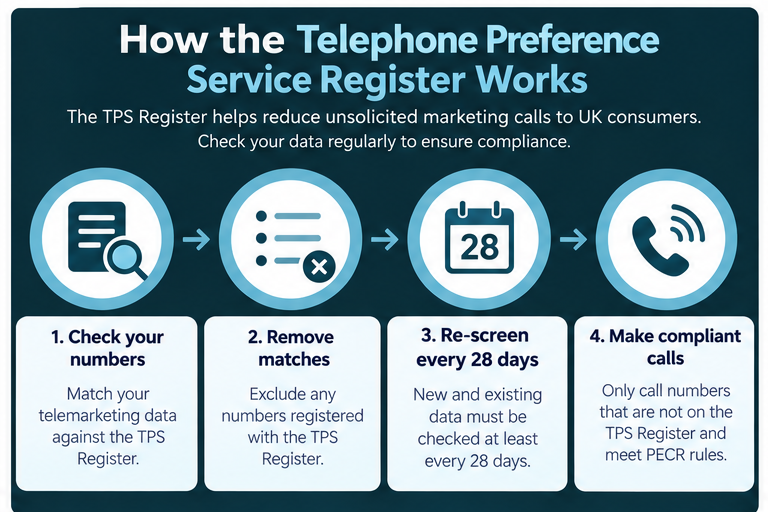
The TPS licence information states that organisations making sales and marketing calls are required by law to screen their data against TPS every 28 days. The TPS register is updated daily, but businesses have a maximum period in which to update their own databases. This means an old screening result is not something a company can rely on indefinitely.
The ICO makes the same point from the buyer’s perspective. Its guidance on complying with live-call rules says that if a third party claims to have checked a marketing list against TPS or CTPS, the buyer should make sure the check happened recently. A registration can take 28 days to become active, so data checked more than 28 days ago may now include a number that should be suppressed.
This is why newly purchased data should not simply be loaded into a dialler and left untouched for months. The practical control is straightforward: record the last screening date, set a re-screening deadline, and remove or suppress newly registered numbers before the next calling cycle.
AccuraData can perform this recurring check through its TPS/CTPS screening service. That is useful for businesses buying fresh telemarketing data, but it is just as important for organisations holding older prospect databases, CRM records, reactivation files or calling lists assembled from several sources.
Treat 28 days as a maximum, not a target to stretch
The fact that the law permits a 28-day update window does not mean waiting until the final day is always sensible. High-volume contact centres, businesses receiving frequent data updates, and campaigns that are especially sensitive to complaints may choose to screen more often.
The risk increases whenever a file changes. New records may be appended. Old leads may be reactivated. Data may be exported from a CRM into a dialler. Salespeople may upload their own prospect lists. A robust process screens the actual file that is going to be called, not just the original master list months earlier.
Record the screening date in the data itself
A common operational weakness is that someone knows a list was checked, but no one can prove when, by whom or against which registers. Add fields such as TPS Screened Date, CTPS Screened Date, Screening Result, Internal DNC Status and Next Screening Due to the CRM or campaign file.
Those fields turn compliance from a verbal assurance into an auditable process. They also make it much easier to prevent a stale list from being reused by another team.
TPS and CTPS: Why B2B Telemarketing Needs Both
Businesses sometimes assume that B2B calling only requires CTPS screening. That is too simplistic.
The ICO’s current telephone marketing guidance explains that sole traders and some partnerships may register with TPS, while companies, some partnerships and government bodies use CTPS. For B2B marketing, the ICO therefore says you need to screen against both registers as well as your own do-not-call list.
This distinction is especially important when purchasing B2B telemarketing data. A file may look entirely business-focused because each record includes a company name, sector and job title. That does not automatically tell you which preference register is relevant to the telephone number.
For example, a building contractor trading as a sole trader is still a business prospect, but the subscriber may be treated as an individual and may be registered on TPS. A limited company may have a main business number that should be checked against CTPS. Mixed files therefore need the right screening logic rather than a blanket assumption.
AccuraData’s wider B2B Data services can be used alongside screening so that audience selection, contact data and compliance preparation are treated as parts of the same campaign rather than separate tasks.
A Start-to-Finish Telephone Preference Service Register Workflow
The strongest way to manage Telephone Preference Service Register compliance is to design a fixed workflow that every calling campaign follows. The controls should not depend on one employee remembering to run a check.
Before buying telemarketing data
Start with the campaign purpose. Define whether the activity is B2B or B2C, whether calls will be live or automated, which sectors or consumer segments are relevant, and whether the campaign falls into a category with stricter rules.
Ask the supplier when the file was last screened, which registers were checked and what evidence or screening fields will be supplied. A responsible supplier should be able to explain the process without relying on a vague claim that the data is “compliant”.
For consumer campaigns, use appropriately prepared B2C Telemarketing Data rather than repurposing business data or unverified lead files. For B2B activity, make sure the provider understands the difference between corporate subscribers, sole traders and other business structures.
When newly purchased data arrives
Record the delivery date and the last TPS or CTPS screening date immediately. If the supplier’s screening is already close to 28 days old, re-screen before calling. If the screening date cannot be established, treat the status as unknown and screen the data yourself.
The ICO’s advice on third-party lists is clear: a supplier’s previous check is not enough if it happened too long ago. The buyer remains responsible for how the data is used.
This is where a data cleansing and enrichment process is useful. TPS and CTPS are only one part of call-list quality. Duplicate records, invalid numbers, wrong company details and outdated contacts can still waste agent time even when the preference status is correct.
Before loading data into a dialler or calling platform
Run three separate suppression controls:
- TPS or CTPS screening, depending on the subscriber type.
- Your own internal do-not-call list.
- Campaign-specific exclusions such as existing complaints, current customers, active opportunities or sensitive cases that should not be included.
Do not merge these into a single “blocked” field and lose the reason. A statutory preference registration, a direct objection and a temporary campaign exclusion are different things. Keeping the reason makes future decisions safer.
During the campaign
Every caller should know what to do if a recipient objects to further marketing. The objection must be captured immediately and fed back into the central suppression process. A person does not need to join the Telephone Preference Service Register before your business has to respect their direct request to stop calling.
The ICO’s direct marketing checklist stresses the need to keep your own do-not-call list. That list should be checked alongside TPS and CTPS before future campaigns.
At the 28-day point
Re-screen any records that remain eligible for future calls. Do not assume that an unused record stays callable simply because no one has touched it since the previous campaign.
A useful rule is: if a telephone number could be selected for a live marketing call, its preference status should be no more than 28 days old at the point of use.
For recurring campaigns, schedule the process in advance. AccuraData can provide repeated TPS and CTPS checking so the rescreening cycle becomes part of routine database maintenance rather than an emergency task before a campaign starts.
PECR: The Main Rules Behind the Telephone Preference Service Register
PECR sets the specific rules for live and automated marketing calls in the UK. The ICO rules on live calls explain that, for most live marketing calls, businesses can call people or organisations where the number is not on the relevant preference register and the person has not previously objected.
There are several important controls around that general rule.
Do not call registered numbers without the required permission
A TPS or CTPS registration is a general objection to unsolicited live marketing calls. If the number is registered, you normally need the subscriber to have specifically told your organisation that they are willing to receive your marketing calls.
Do not assume that a broad statement buried in a third party’s terms and conditions automatically gives you permission to override the Telephone Preference Service Register. The ICO expects organisations relying on permission to be able to show that it is valid for the call they are making.
Respect direct objections even if the number is not on TPS
TPS screening is not a substitute for your own suppression list. If someone has told your organisation not to call them, that objection must be respected even when their number does not appear on TPS or CTPS.
This is one of the most important reasons to centralise calling preferences in the CRM. If an objection is stored only in an agent’s notes, the same person may be uploaded again in the next purchased list and called by a different team.
Identify the caller and display a valid number
The ICO says live marketing callers must identify who is calling and allow the calling number, or an alternative contact number, to be displayed. If asked, the caller must also provide a contact address or freephone number.
Ofcom’s guidance on unwanted calls reinforces why clear caller identification matters. Recipients need to know who is contacting them and have a route to complain or request that calls stop.
Automated marketing calls are stricter
Do not assume a dialler and an automated recorded call are treated the same way. A dialler that connects a live agent can fall within the live-call rules. A call that plays a recorded marketing message is subject to stricter PECR requirements and generally needs specific consent.
This distinction should be checked before purchasing or configuring calling technology. Screening a number against the Telephone Preference Service Register does not itself provide permission for an automated marketing call.
Some sectors have extra restrictions
Claims management marketing calls require consent. Pension scheme marketing calls are also subject to specific restrictions. A business operating in a regulated or sensitive sector should therefore check the exact rules rather than assuming that ordinary live-call requirements are enough.
UK GDPR and the Telephone Preference Service Register
PECR controls the marketing call itself, but UK GDPR may also apply to the data used to plan and make the call.
The ICO’s guidance on the relationship between PECR and data protection explains that UK GDPR and the Data Protection Act 2018 sit alongside PECR. If a telephone record identifies a living person, for example a named consumer, sole trader or business decision-maker with a direct number, personal data is being processed.
That brings several obligations into the campaign.
Establish a lawful basis
A business needs a lawful basis for processing personal data. Legitimate interests can be appropriate for some direct marketing activity, but it is not automatic. The organisation should consider necessity, reasonable expectations and the impact on the individual.
The important point is that UK GDPR lawful basis and PECR permission are related but separate. A business cannot use legitimate interests as a way to ignore TPS or CTPS. If PECR says the call should not be made, having a UK GDPR lawful basis does not make the call acceptable.
Be transparent about personal data use
Where appropriate, people should be told how their personal data is being used, where it came from and how they can exercise their rights. Bought or appended data may create additional transparency obligations because the information did not come directly from the individual.
Keep data accurate
Telephone data changes. Numbers are reassigned, disconnected or moved. Company roles change. Preference status changes. Data accuracy is therefore both a commercial issue and a data-protection issue.
AccuraData can combine preference screening with data cleansing and enrichment and, where needed, live number cleansing so teams can distinguish between a number that is legally suppressed and a number that is simply invalid or inactive.
Minimise what you hold
A telemarketing record should contain the information needed to make a relevant call and manage the outcome. Collecting unrelated personal information because it might be useful later increases risk without necessarily improving performance.
Supplier Due Diligence Before You Trust a “TPS Checked” List
A large part of Telephone Preference Service Register compliance happens before the data is purchased. Supplier due diligence should test both the legal preparation of the data and the operational quality of the file.
Ask the supplier:
- When was the file last screened against TPS and, where relevant, CTPS?
- Will the screening date be supplied in the file or order documentation?
- Does the list contain sole traders, partnerships, corporate subscribers or a mixture?
- How are direct objections or known suppressions handled?
- Are telephone numbers validated separately from TPS screening?
- What happens if inaccurate records are identified?
- What usage rights apply to the data?
- How is data transferred securely?
- Can the supplier re-screen the file after 28 days?
The distinction between TPS checking and number validation is worth emphasising. A telephone number can be live and technically correct but still be blocked for unsolicited marketing because it is registered on TPS or CTPS. Equally, a number can be clear of TPS but disconnected and commercially useless.
AccuraData’s B2B Telemarketing Data and B2C Telemarketing Data services can be combined with professional screening and cleansing, which gives buyers a practical route from audience selection to campaign-ready calling data.
For a broader procurement framework, the AccuraData guide to purchasing marketing lists explains why list buyers should assess sourcing, channel suitability, permissions and maintenance rather than comparing suppliers only on cost per record.
The Legal Risk of Ignoring the Telephone Preference Service Register
Ignoring the Telephone Preference Service Register can create serious regulatory exposure.
The legal position became more significant after the Data (Use and Access) Act 2025. The Government’s PECR factsheet explains that the Act brought PECR enforcement powers more closely into line with UK GDPR. The current legislation places regulation 21, which covers live marketing calls, among the PECR provisions subject to the higher maximum penalty.
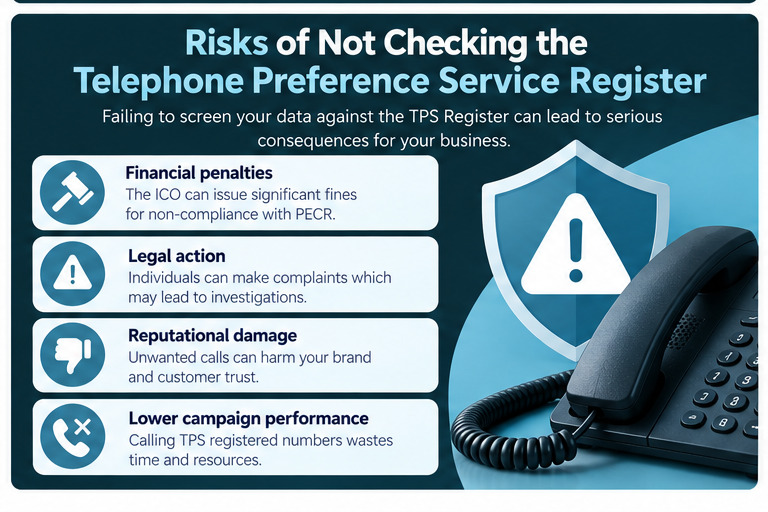
The current statutory higher maximum is up to £17.5 million or, for an undertaking, 4% of total annual worldwide turnover in the preceding financial year, whichever is higher. That is a maximum rather than a typical fine, and the actual enforcement response depends on the circumstances, but it makes clear that telephone marketing compliance is not a minor administrative issue.
Real enforcement cases also show that nuisance-call activity can result in substantial penalties. In August 2026, the ICO announced a £190,000 fine against a company that made more than 750,000 unsolicited calls to people registered with TPS. A Guardian report on the case highlighted complaints about aggressive and misleading calls. Earlier reporting by Which? described two companies fined a combined £340,000 after more than one million calls involving TPS-registered numbers. The underlying ICO enforcement notice is a useful reminder that complaint volumes, call conduct and failures to cooperate with the regulator can all worsen an enforcement situation.
The lesson is not that every screening mistake produces a maximum fine. It is that repeated, large-scale or poorly controlled telemarketing can create evidence of systemic non-compliance, especially when complaints show that the business failed to respect clear preferences.
The Reputational Risk of Poor TPS Cleansing
The reputational cost of bad calling data can arrive long before a regulator becomes involved.
A recipient who joined the Telephone Preference Service Register has made a deliberate choice. Calling them anyway signals that the business either does not know the rules, does not maintain its data, or does not care about the recipient’s preference. None of those impressions helps a sales conversation.
The DMA’s preference-services guidance describes preference services as tools for building trust and giving people control over how their data is used. This is an important commercial point. Responsible marketing is not only about avoiding a fine. It is about creating an outreach process that does not begin by irritating the prospect.
Consumer organisations also encourage people to report unwanted calls. Citizens Advice explains how recipients can register with TPS and report companies that continue calling. Ofcom likewise treats nuisance marketing calls as a serious consumer issue.
Every complaint can therefore produce several costs at once: agent time, management escalation, suppression work, possible regulator attention, negative reviews and reduced trust in the brand. Regular Telephone Preference Service Register cleansing is a small control compared with the cost of repairing a reputation for intrusive calling.
Build Telephone Preference Service Register Controls Into Your CRM
A compliant telemarketing operation should make it difficult for an agent to call a suppressed number by mistake.
Create dedicated fields for:
- Telephone number.
- Subscriber type.
- TPS status.
- CTPS status.
- Last screening date.
- Next screening due date.
- Internal do-not-call status.
- Internal objection date.
- Source of the record.
- Consent or permission evidence where relevant.
- Number validation status.
- Campaign eligibility.
Do not rely on free-text notes such as “do not call” buried inside an activity history. Suppression data should be structured and used by the system that generates dialler lists.
Make suppression override campaign inclusion
The CRM logic should treat a direct objection, active TPS or CTPS status, or another legal exclusion as a higher-priority rule than campaign membership. A salesperson should not be able to place the record back into a calling list simply by changing a marketing tag.
Keep minimal suppression records
When someone objects, deleting the entire record can create a future problem. The organisation may later acquire the same number again from another supplier and have no memory that the person already opted out. Keeping a minimal suppression record can help ensure the objection continues to be respected.
Separate compliance status from contactability
Use different fields for preference status and technical number status. “TPS registered” and “number disconnected” are not the same outcome. This distinction improves reporting and helps the business understand whether lost calling volume is caused by compliance, data age or poor supplier quality.
The AccuraData article on database cleaning explains how suppression, validation, deduplication and enrichment work together across a broader marketing database.
How AccuraData Can Support the 28-Day Re-Screening Cycle
The 28-day requirement is easy to understand and easy to overlook. This is particularly true when a database is shared between sales teams, agencies, outsourced call centres and CRM administrators.
AccuraData can screen telephone data against TPS and CTPS through its dedicated TPS/CTPS Checking service. The process can be used for newly purchased lists, internal CRM data, prospect databases and files that have already been used in previous campaigns.
This matters because screening should not be treated as a one-time certificate attached to a dataset. A telemarketing file can move through several states:
- It is purchased or created.
- It is screened and approved for use.
- Time passes and new registrations become active.
- The same file becomes stale from a preference-screening perspective.
- It is re-screened before further use.
AccuraData can also support the wider quality process. Data cleansing and enrichment can identify duplicate and outdated records, while live number cleansing helps determine whether numbers are active. For businesses building new prospect audiences, B2B Data and specialist telemarketing data services provide a route to targeted records that can then be maintained within the same operational framework.
That combination is why AccuraData is well placed to support businesses that want more than a raw list. The objective should be a controlled calling asset with clear provenance, current preference status and a defined maintenance cycle.
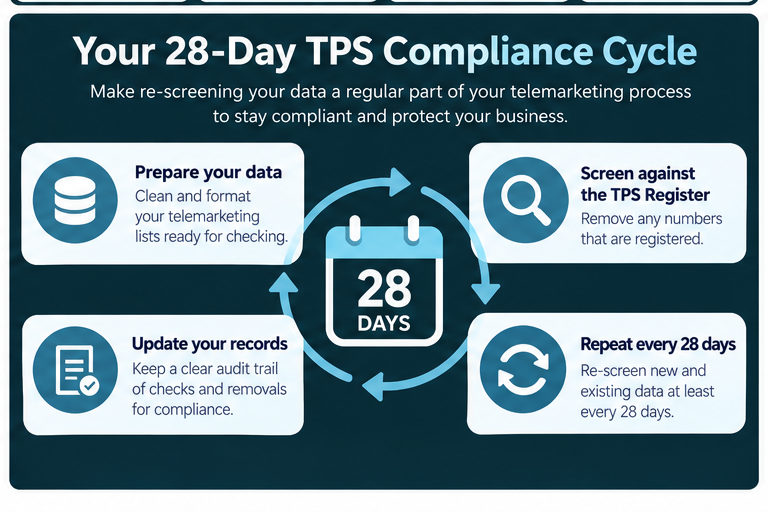
A Practical 28-Day Telemarketing Compliance Calendar
A simple calendar can prevent the Telephone Preference Service Register from becoming an afterthought.
Day 0: receive or build the list
Record the source, licence terms and last known screening date. Remove duplicates and apply internal suppression. If the screening date is unknown, perform TPS and CTPS checking before any calls are made.
Days 1 to 7: launch with controlled access
Load only cleared records into the dialler. Ensure agents can record objections in a structured field. Confirm the correct caller identity and number presentation settings.
Days 8 to 20: monitor campaign signals
Review complaints, opt-outs, contact rates, invalid numbers and agent feedback. Suppress direct objections immediately. Do not wait for the next scheduled TPS check to honour an individual request.
Days 21 to 27: prepare the refresh
Identify all records that may remain in use after day 28. Export the active calling population rather than screening only the original source file if records have changed.
Day 28: re-screen
Run fresh TPS and CTPS checks and update CRM screening dates. Suppress newly registered numbers before the next campaign activity.
After day 28: repeat the cycle
Each subsequent period should have a clear owner and due date. If multiple teams use the same data, the master CRM should control eligibility rather than each team maintaining its own disconnected suppression spreadsheet.
Metrics That Show Whether Your TPS Process Is Working
Compliance should be measurable. Useful metrics include more than the number of records removed.
TPS and CTPS match rate
Track the proportion of records suppressed at each screening. A sudden increase may indicate an ageing file, a new source with different characteristics, or a high level of preference registration in the target audience.
Screening age
Measure the percentage of callable records with a screening date less than 28 days old. The target should be 100% for records selected for live unsolicited marketing calls.
Internal objection capture time
Measure how quickly a do-not-call request becomes effective across all systems. If an objection recorded in the dialler takes two days to reach the CRM, the business has a dangerous gap.
Complaint rate
Track complaints per thousand calls and classify the reason. Complaints about repeated calls, hidden caller identity or previous objections should trigger process reviews even if the overall rate looks low.
Invalid-number rate
Separate invalid or disconnected numbers from TPS suppressions. A high invalid-number rate is primarily a data-quality issue, not a preference issue, and may justify additional cleansing or supplier review.
Contact and conversion rate after cleansing
Removing blocked and unusable records can improve the efficiency of the remaining campaign. Measure contacts, qualified conversations, appointments and conversions against the number of genuinely callable records rather than the original raw list size.
AccuraData’s guide on telemarketing lists discusses how targeting, contactability and suppression affect the real commercial value of calling data.
Common Telephone Preference Service Register Mistakes
“The supplier said it was TPS checked, so we are covered”
Not indefinitely. Check when the screening happened. If it was more than 28 days ago, re-screen before calling.
“It is B2B data, so CTPS is enough”
Not necessarily. Sole traders and some partnerships may fall under TPS. B2B calling lists can require screening against both TPS and CTPS.
“The number is not on TPS, so we can call”
Not if the person or business has already told your organisation not to call. Internal objections must be respected separately.
“The number works, so the data is clean”
A live number can still be TPS or CTPS registered. Technical validation and preference screening are different controls.
“We can delete opt-outs to keep the CRM tidy”
That can cause the same person to be reintroduced later. A minimal suppression record often provides a safer memory of the objection.
“An autodialler means the campaign is automated”
Not necessarily. Technology that dials numbers and connects a live agent is different from a recorded-message marketing call. The exact campaign design matters.
“Legitimate interests lets us ignore TPS”
No. UK GDPR lawful basis does not override PECR’s live-call restrictions or an active preference registration.
Frequently Asked Questions About the Telephone Preference Service Register
What is the Telephone Preference Service Register?
The Telephone Preference Service Register is the UK’s official central register for people who do not want unsolicited live sales and marketing calls to their landline or mobile numbers. Organisations should screen relevant calling data against it before making unsolicited live marketing calls.
How often must telemarketing data be checked against TPS?
The official TPS guidance says organisations making sales and marketing calls must screen their data at least every 28 days. The register is updated daily, and the 28-day period is the maximum update window for calling databases.
Does newly purchased telemarketing data need to be re-screened?
Yes. Check the supplier’s screening date. If the data was screened more than 28 days ago, or if you cannot verify when the check happened, re-screen it before calling. Even fresh purchased data should have a recorded screening date and a clear next due date.
What is the difference between TPS and CTPS?
TPS is the preference register used by individuals, which can include consumers, sole traders and some partnerships. CTPS is the corporate preference register used by corporate subscribers such as limited companies and LLPs. B2B marketers may need to screen against both.
Can I call someone who is on the Telephone Preference Service Register if they are an existing customer?
An existing customer relationship does not automatically cancel a TPS registration. In general, the subscriber needs to have specifically indicated that they are willing to receive your marketing calls. Check current ICO guidance and your evidence before relying on an exception.
Does the Telephone Preference Service Register cover automated recorded calls?
TPS is focused on unsolicited live marketing calls. Automated recorded marketing calls are subject to stricter PECR rules and generally require specific consent. Do not use TPS clearance as permission to make recorded marketing calls.
Do UK GDPR and PECR both apply to telemarketing?
They can. PECR sets the specific rules for marketing calls. UK GDPR and the Data Protection Act 2018 apply where personal data is processed, for example when the calling file identifies an individual. A campaign can therefore need to satisfy both sets of requirements.
What should be stored after a TPS check?
Keep the screening date, relevant register, result, provider or process used, and the next due date. Also maintain separate fields for internal objections and technical number validity.
Can AccuraData re-screen our existing database every 28 days?
Yes. AccuraData’s TPS and CTPS checking service can be used to re-screen existing telemarketing databases, including files that have been purchased previously or maintained inside a CRM.
What happens if a business ignores TPS registrations?
The ICO can investigate complaints and take enforcement action. Since changes introduced by the Data (Use and Access) Act 2025, PECR regulation 21 sits within the higher-maximum penalty regime. Businesses also face reputational damage, wasted call-centre time and increased complaint handling.
Conclusion: Make the Telephone Preference Service Register Part of Operations
The Telephone Preference Service Register should not be treated as a box to tick when data is first bought. It is a recurring control that needs to follow the life of the telephone number inside your business.
A strong UK telemarketing process checks new data before use, screens B2B files against the right combination of TPS and CTPS, keeps an internal do-not-call list, records direct objections immediately, distinguishes legal suppression from number validity, and re-screens active data at least every 28 days.
That process protects recipients, but it also improves the commercial quality of telemarketing. Agents spend less time on numbers that should never have been dialled. Managers have clearer evidence about the quality of their data. Complaints become easier to investigate. Campaign reporting becomes more meaningful because the denominator is a genuinely callable audience rather than a raw spreadsheet.
The legal consequences of getting this wrong are also more serious than they once were. Current PECR enforcement powers can expose serious breaches to much larger penalties, while recent nuisance-call cases show that the ICO continues to act against businesses that ignore preference registrations.
For organisations that do not want to manage the screening process manually, AccuraData can provide recurring TPS/CTPS checking alongside targeted B2B Data, B2B Telemarketing Data, B2C Telemarketing Data and Data Cleansing & Enrichment. That makes AccuraData a strong choice for businesses that want telemarketing data to remain useful, current and prepared for responsible UK calling rather than simply delivered once and forgotten.
Practical takeaway: screen before calling, respect direct objections immediately, and never let a TPS/CTPS screening date age beyond 28 days on an active calling list.