
Database Cleaning is often described as a technical exercise: upload a spreadsheet, remove bad records and download a cleaner version. That description misses the part that matters most. A marketing database is a working asset that changes every time a customer moves, a prospect changes jobs, a company closes, a telephone number is disconnected, an email address stops accepting mail or somebody asks not to be contacted again. Cleaning therefore needs to protect both the accuracy of the record and the rules that determine whether it should enter a campaign.
For B2B marketers, the problem can be a company that has dissolved, a decision-maker who left six months ago, a switchboard that has been replaced, an email mailbox that no longer exists or a corporate number that is now registered with the CTPS. For B2C marketers, the risks are different. A household may have moved, a number may have been reassigned, a consumer may have opted out, an address may be a goneaway, or a record may relate to somebody who has died. The same database can contain several of these issues at once.
That is why a strong Database Cleaning project starts with the intended campaign, not with a generic instruction to “clean everything”. The checks needed for a telemarketing file are not identical to the checks needed for email or postal activity. The right sequence also matters. There is little value appending a new telephone number to a record that should first have been suppressed, or researching a new decision-maker for a company that has already dissolved.
This article explains how to commission, manage and evaluate Database Cleaning for both B2B and B2C marketing data. It covers TPS and CTPS screening, telephone number validation, email validation, company live checks, postal address validation, goneaway and deceased suppression, duplicate removal, internal suppression, decision-maker validation, field standardisation and data appending. It also explains how UK GDPR, PECR, the Data Protection Act 2018 and the Data (Use and Access) Act 2025 affect the way a cleansing project should be run.
AccuraData supports organisations that need to improve existing databases as well as those that need new campaign data. Its Data Cleansing services can be combined with targeted B2B Data, B2C Data and Data Appending where a database needs to be repaired, enriched or prepared for a new campaign.
A short compliance note is important. This article provides practical marketing and data-management information, not legal advice. The correct approach depends on the information you hold, the marketing channel, the audience, the lawful basis, the source of the records and the way the campaign will operate. Current regulatory guidance should be checked where the position is uncertain.
Database Cleaning Begins With a Risk Map, Not a Delete Button
The first task is to decide what would make a record unsafe, unusable or commercially weak for the campaign you intend to run. That sounds obvious, but many organisations begin Database Cleaning by asking a supplier to remove duplicates and “validate everything” without defining what valid means.
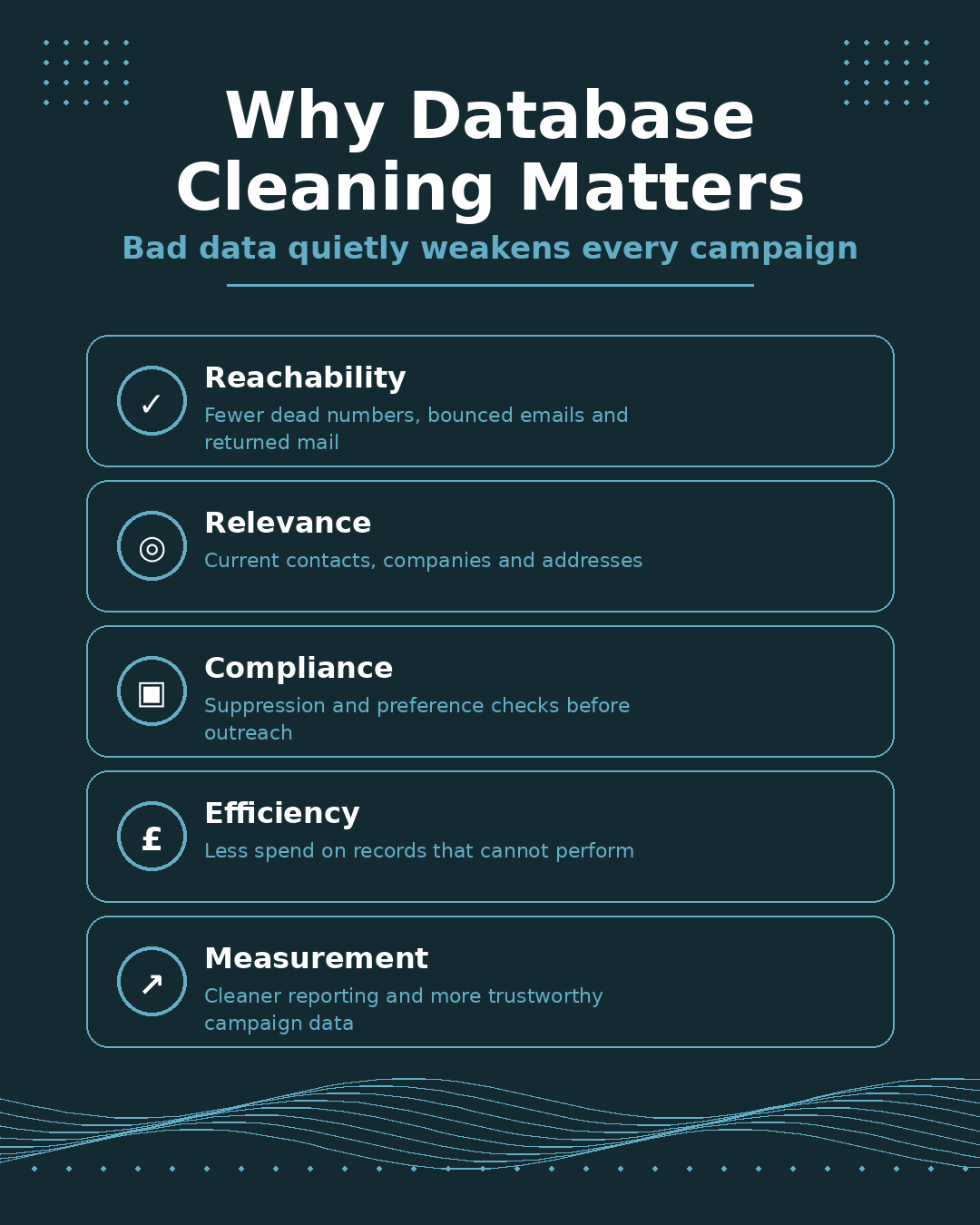
A valid record for a B2B postal campaign might need an active company, a deliverable business address and the correct site. It may not need a named contact at all. A valid record for a B2B decision-maker email campaign may need an active company, a current role, a working business email address, a clear source and the right campaign eligibility. A valid B2C telemarketing record needs a usable telephone number, appropriate audience fit, current suppression status and the right preference checks before it can enter the dialler.
A useful Database Cleaning brief therefore begins with four questions:
• What campaign will use the database?
• Which fields are essential for that campaign?
• Which records must be suppressed rather than corrected?
• What evidence should the returned file contain about each check?
The last point matters because a cleaned file should not be a black box. You should be able to see what happened to the data. A good return file may include status columns such as valid, invalid, suppressed, duplicate, company dissolved, moved, email risky, telephone inactive, TPS matched, CTPS matched, deceased match, goneaway match or manual review required.
Database Cleaning becomes much easier to govern when the result is expressed as decisions rather than silent overwrites.
Why B2B and B2C Databases Need Different Cleaning Logic
B2B and B2C databases both degrade, but they do not degrade in the same way. The distinction is important because it affects the checks you buy, the order in which you run them and the records you keep after the project.
B2B Database Cleaning is driven by organisational and role change
A B2B record often contains two identities at once: the organisation and the individual working within it. Those identities change independently. The company may still be active while the named contact has left. The person may still be employed while their responsibilities have moved to another department. A telephone number may still connect to the company but no longer reach the right team.
Company status is therefore a foundational B2B check. The free Companies House register can show company information and dissolved records, although Companies House also makes clear that filing information is not itself guaranteed to be accurate. A professional cleanse can use company identifiers, trading information and other sources together to decide whether an account remains suitable for the campaign.
The recent AccuraData article on B2B Data Cleansing explores business-specific deterioration in more detail. The key operational point here is that B2B Database Cleaning should normally identify the company first, then validate the contact channels and people attached to that company.
B2C Database Cleaning is driven by household, preference and life-event change
Consumer data has a different pattern. People move home, change mobile numbers, change email addresses, alter marketing preferences and sometimes die. Household composition changes as well. A database built for consumer acquisition can therefore contain records that are technically formatted correctly but inappropriate to use.
This makes B2C Database Cleaning especially dependent on suppression. The goal is not always to replace a field with a newer field. In many cases, the correct outcome is to retain a minimal suppression marker so the record does not re-enter marketing later.
The distinction between correction and suppression is one of the most important ideas in database hygiene. A wrong postcode might be corrected. A deceased record should normally be suppressed from marketing. A consumer who has objected to direct marketing should be protected by an internal do-not-contact record rather than simply disappearing from the CRM.
How to Prepare a Database for Professional Cleaning
A professional cleanse should not start by sending the only copy of your CRM export to a supplier and hoping for the best. Prepare the project so every change can be traced, tested and reversed if necessary.
Freeze a source copy
Export the dataset and preserve an untouched master copy. Give the file a date, version number and clear description of where it came from. If the database changes every day, record the extraction time as well.
The preserved version provides a baseline for audit and recovery. It also allows you to calculate what proportion of records were changed, suppressed, merged or removed during Database Cleaning.
Define the fields that identify a record
A B2B account may be identified by company number, company name, domain and postcode. A person may be identified by name, employer, email and telephone number. A B2C record may rely on a combination of name, address, postcode, telephone number and customer identifier.
If identity is not defined first, duplicate removal can become destructive. Two people at the same address are not automatically duplicates. Two branches of the same company may not be duplicates. The same person stored once as a customer and once as a prospect may require a merge rather than deletion.
Remove fields the supplier does not need
The UK GDPR principle of data minimisation means personal data should be adequate, relevant and limited to what is necessary. The ICO’s data protection principles are a useful reminder that a cleansing supplier does not automatically need every field held in your CRM.
If the supplier only needs telephone numbers for live-number validation, consider whether it needs purchase history, account notes or other unrelated fields. If address validation requires name and address but not free-text sales notes, exclude the notes.
Agree the output before the cleanse starts
Specify how the supplier should return the file. Useful options include:
• Original value and cleaned value in separate columns.
• A status or reason code for every record.
• Validation date for time-sensitive checks.
• Separate suppression flags rather than permanent deletion.
• A confidence or review flag for uncertain matches.
• A summary report showing counts before and after cleaning.
This turns Database Cleaning into an auditable process rather than a one-way transformation.
The Database Cleaning Workflow From Export to Re-Import
A controlled project can be organised into a simple sequence.
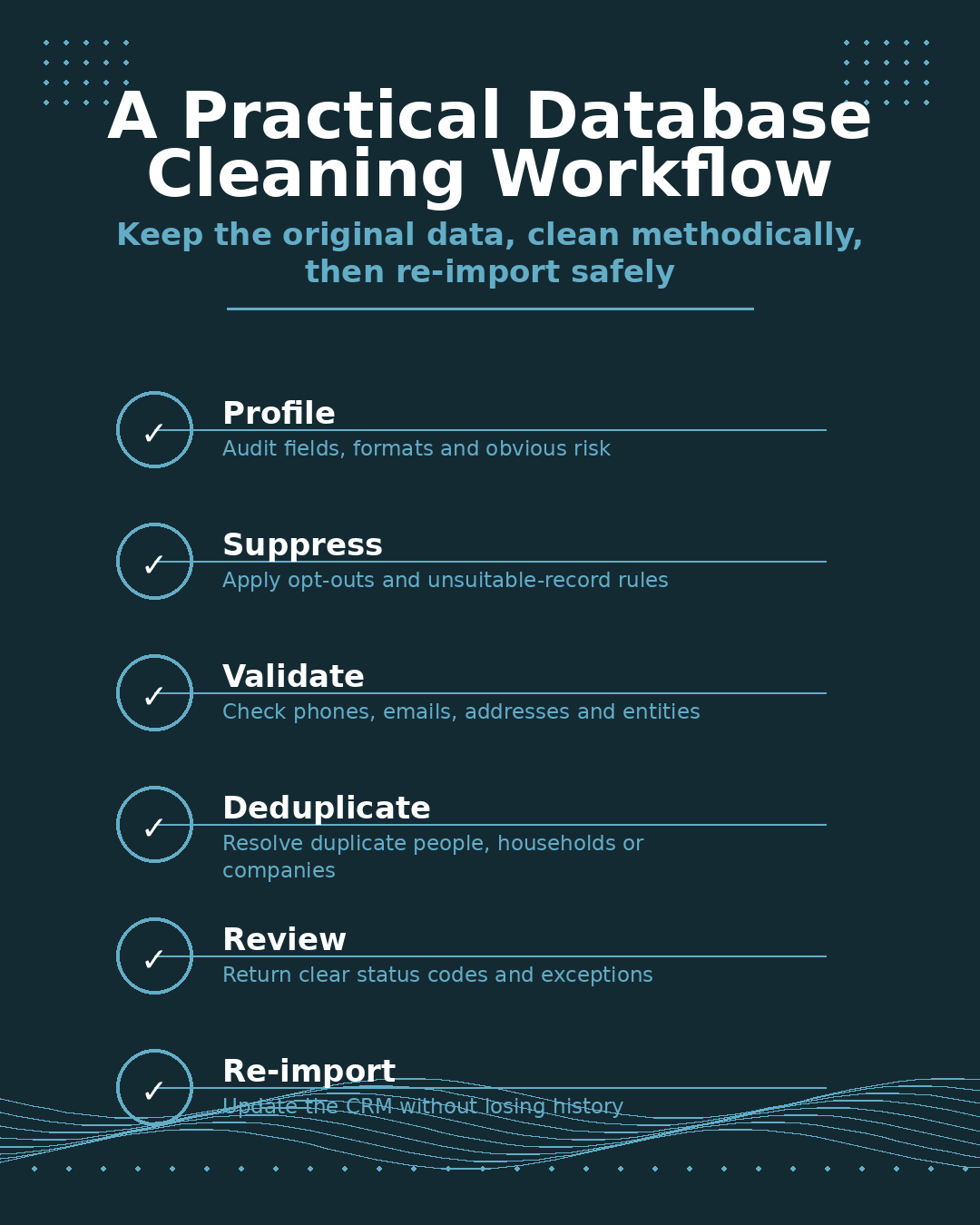
Audit the source file
Start by measuring the database as it exists. Count records, duplicates, blanks, malformed fields and fields with inconsistent values. Measure how many records contain telephone numbers, emails, addresses, company numbers, named contacts and suppression flags.
This is your baseline. Without it, you cannot tell whether the project improved the dataset or simply made it smaller.
Securely transfer the data
If a third-party provider is processing personal data on your behalf, the controller must assess the processor and put an appropriate contract in place. The ICO’s guidance on controller and processor responsibilities says controllers should only use processors that provide sufficient guarantees and should have a contract meeting Article 28 requirements.
Use a controlled transfer method rather than ordinary unprotected email attachments. The NCSC advises using encryption in transit when sharing personal data with other organisations.
Run structural checks before expensive validations
Standardise obvious formatting first. Correct whitespace, casing where appropriate, telephone prefixes, postcode structure and empty-value conventions. Resolve simple duplicates before paying to validate the same email or phone number several times.
Run identity and suppression checks
Next, establish whether records should remain in scope at all. For B2B data, that may mean company live checks and company identity resolution. For B2C data, this can include deceased, goneaway and internal suppression screening. For telephone campaigns, TPS and CTPS screening should happen before the final calling file is produced.
Validate the channels you will actually use
If the campaign is email-only, email validation is more urgent than telephone cleansing. If the campaign is telemarketing, live number and preference checks are core. If the campaign is postal, address validation and suppression are central.
Append only after cleaning
Data enrichment should normally come after the database has been cleaned. AccuraData’s Data Appending service can help fill selected gaps after obsolete or duplicate records have been dealt with.
Appending before cleaning can waste money by enriching records that should never have survived the first stage.
Re-import in a controlled way
Do not overwrite the production CRM blindly. Test a sample import first. Confirm that field mappings, dates, status codes and suppression flags are correct. Make sure suppressed records cannot be reactivated simply because another system later imports an older version of the record.
A good Database Cleaning project ends when the clean data is safely back in the working system and the rules that created it are documented.
TPS and CTPS Screening in Database Cleaning
TPS and CTPS screening is essential for UK live marketing call data. The Telephone Preference Service is the official do-not-call register for individual subscribers, while the Corporate Telephone Preference Service performs a similar role for corporate subscribers.
The ICO explains that the registers take 28 days to become effective and that organisations making live marketing calls must check numbers against the relevant register before calling. Its current live marketing calls guidance is particularly useful when planning campaign eligibility.
TPS screening for B2C records
For consumer telemarketing, TPS checking is a core campaign control. A number that is technically live is not automatically suitable for unsolicited live marketing calls. Database Cleaning should therefore keep “live number” and “TPS status” as separate fields.
Where valid consent overrides a TPS registration, that evidence needs to be specific and reliable. The practical default should not be to assume that a purchased or old CRM record contains usable consent simply because a supplier once described it as permissioned.
CTPS screening for B2B records
Corporate telemarketing also needs preference screening. CTPS applies to corporate subscribers, while some business contacts, including sole traders and certain partnerships, may be treated as individual subscribers and therefore fall within TPS rules.
AccuraData’s CTPS Checker article explains the corporate register in more detail. A good B2B Database Cleaning project should classify subscriber type where possible rather than applying a single generic “business safe” flag.
Your own suppression list still matters
TPS and CTPS are not substitutes for internal do-not-call records. If somebody has asked your organisation not to call, that objection should be preserved regardless of their status on an external register.
The ICO’s guidance on direct marketing suppression lists recommends retaining enough information to ensure the objection is respected instead of simply deleting every trace of the person.
Telephone Number Validation and Live Number Cleaning
Telephone validation answers a different question from preference screening: does the number appear to be usable and correctly structured?
A telephone cleanse may identify malformed numbers, impossible lengths, invalid prefixes, duplicates, inactive lines, number type and other status information depending on the service. The exact methodology varies, so ask the provider what “valid” means in its output.
Why number formatting is not enough
A number can have the correct format and still be disconnected. It can be connected and still belong to the wrong person. It can be live and still be on TPS or CTPS. Database Cleaning should therefore avoid one all-purpose “telephone valid” field.
Useful status fields can include:
• Format valid.
• Number active or inactive.
• Landline or mobile classification.
• TPS or CTPS status.
• Internal suppression status.
• Last validation date.
Ofcom manages the UK numbering framework and publishes current telecoms numbering information. Number ranges can change or be withdrawn, which is one reason a long-held telephone field should not be treated as permanent truth.
B2B telephone validation
For B2B teams, test whether the number still reaches the right organisation and, where relevant, whether a direct dial still reaches the named decision-maker. A working switchboard number may be useful even when a direct line has failed, but the CRM should distinguish the two.
B2C telephone validation
Consumer numbers can be reassigned. This makes stale records particularly risky because a technically live number may now reach somebody who has no relationship with the original database record. If there is uncertainty about identity, the record should not simply be treated as a successful validation.
AccuraData’s article on responsible telemarketing list use provides more context on the difference between contactability and campaign eligibility.
Email Validation as Part of Database Cleaning
Email validation aims to reduce obvious failures before a campaign reaches the sending platform. It can identify malformed addresses, invalid domains, duplicate addresses and, depending on the method used, mailboxes that appear undeliverable or risky.
The goal is not to promise that every “valid” email will arrive in the inbox. Deliverability is influenced by sender reputation, authentication, message content, complaint rates and recipient engagement as well as the address itself.
B2B email validation needs employer context
A B2B email address can be technically valid while the contact has moved to another employer or changed role. That is why a strong B2B Database Cleaning process checks the relationship between the person, domain and company rather than only testing the mailbox.
A named corporate email address also remains personal data when it identifies an individual. The ICO makes this clear in its guidance on what counts as personal data.
B2C email validation must preserve permission status
For consumer email, technical validation is only one layer. PECR rules for unsolicited electronic mail mean marketing permission and the circumstances in which the address was obtained can be critical. A database-cleaning supplier cannot manufacture consent by validating the mailbox.
Keep technical email status separate from marketing eligibility. Useful fields may include email validation result, validation date, consent or permission status, source, opt-out date and internal suppression flag.
Company Live Checks for B2B Database Cleaning
Company live checks are one of the most valuable B2B-specific cleanses because they prevent further effort being spent on organisations that no longer fit the campaign.
A live check can test whether a company still appears active, whether its legal name has changed, whether the company number matches the CRM record and whether the registered status indicates dissolution, liquidation or another material change.
The Companies House search service is a useful public reference point and can show company filings and status information. However, the register itself warns that Companies House does not verify the accuracy of everything filed. Treat it as an important source, not a perfect substitute for commercial judgment.
Use company number as a durable identifier where possible
Names change. Trading styles vary. Spelling differences create duplicates. Company number is often a stronger anchor for matching limited companies than name alone.
Where no company number exists, a supplier may need to match using name, postcode, website domain and other fields. Ambiguous matches should be returned for review rather than silently merged.
Check the campaign site, not only the registered office
A registered office may be a solicitor, accountant or administrative address rather than the location a marketing campaign needs. If your campaign is location-sensitive, Database Cleaning should distinguish registered, trading and branch addresses where the data allows it.
Address Validation, Goneaway Screening and Postal Data Hygiene
Postal data can look stable because an address is visually recognisable for years. In practice, addresses change, properties are created or retired, organisations move sites and households move between properties.
Address validation typically standardises the component parts of the address, checks the postcode and aligns the record with an authoritative address structure. Ordnance Survey’s AddressBase Core contains more than 33 million addresses and uses Unique Property Reference Numbers, or UPRNs, as persistent identifiers.
Address validation for B2B records
For business records, ask whether the address is still relevant to the company and to the campaign. A valid building does not prove that the business still occupies it.
Company live checks and address validation therefore work well together. One verifies the organisation; the other verifies the location structure.
Address validation for B2C records
For consumer records, delivery accuracy matters because returned or misdirected mail wastes print and postage and can expose personal information to the wrong household. B2C Database Cleaning may therefore include goneaway-style screening to identify records where the person appears no longer to be resident at the address.
AccuraData’s B2C Data service and existing consumer-data guidance emphasise responsible targeting, suppression and secure handling. Those controls should also be applied when a first-party customer database is cleaned.
Treat returned mail as a cleansing signal
The ICO’s accuracy guidance gives a practical example: if mail is returned marked “not at this address”, the organisation should update its records to show that the address is no longer current.
Campaign feedback is therefore part of Database Cleaning. Returned mail should not disappear into a fulfilment report. It should update the master record.
Deceased Suppression for B2C Databases
Deceased suppression is an important B2C hygiene process. Its purpose is to identify records that should no longer receive marketing because the person has died.
This is primarily a relevance, customer-care and reputational control. The UK GDPR applies to identifiable living individuals, and the ICO confirms that information about deceased people is not personal data for UK GDPR purposes. That does not make continued marketing to a deceased person sensible or harmless. It can cause distress to relatives, waste campaign spend and undermine trust in the brand.
Do not assume official death registration data is available for marketing
The General Register Office holds death registration information, but access to bulk death data is restricted. GOV.UK explains that the weekly registered deaths list is only available to approved organisations for specified fraud and crime-prevention purposes, not general marketing.
A marketing organisation using deceased suppression should therefore understand what screening source its provider uses, how matches are made and how uncertain matches are handled.
Keep the suppression decision separate from deletion
A deceased match may need a permanent marketing suppression flag so the record cannot be reintroduced by a later import. Where the organisation has other legitimate reasons to retain account history, the marketing status can be changed without necessarily deleting all historical information.
The returned file should make the status clear enough that CRM users do not accidentally treat the record as an ordinary unsubscribe.
Deduplication and Entity Resolution
Duplicate removal sounds simple until the database contains several people at the same company, several people in the same household or the same person under old and new contact details.
A useful Database Cleaning process distinguishes exact duplicates from probable duplicates and legitimate multiple records.
Exact duplicates
These may share the same customer ID, email address, telephone number or company number. They are usually the easiest records to resolve.
Probable duplicates
These may contain spelling differences, abbreviations, initials, old addresses or different formatting. Fuzzy matching can help identify them, but automatic deletion can be risky.
Household and company relationships
Two consumers at one address are not necessarily duplicates. Two named buyers at one company are not necessarily duplicates. Your CRM needs a data model that distinguishes person, account and location.
Merge rather than delete when history matters
If two records contain useful campaign history, the best result may be a merged master record that preserves source, consent evidence, objections and sales outcomes.
Database Cleaning should reduce duplication without deleting the evidence you need to understand the customer or demonstrate how the record has been used.
Internal Suppression and Do-Not-Contact Cleaning
One of the most damaging database mistakes is to delete opt-outs completely. If a later list purchase or CRM import contains the same person again, the organisation may contact them because there is no remaining record of the objection.
The ICO recommends maintaining suppression lists containing only enough information to prevent future marketing.
A mature suppression layer can include:
• Do not call.
• Do not email.
• Do not post.
• Global marketing objection.
• Customer-specific restrictions.
• Complaints or legal hold flags where appropriate.
• Deceased status.
• Goneaway or address invalid status.
Keep channel-specific flags separate where needed. Somebody may object to calls but still be a valid customer receiving service communications. Marketing suppression should not be confused with every other communication purpose.
Key Decision-Maker Validation for B2B Records
A working email or telephone number is not enough if the person is no longer responsible for the buying decision. Decision-maker validation tests the person-company-role relationship.
A useful check asks:
• Does the person still appear to work for the organisation?
• Is the job title still current?
• Does the role still match the campaign?
• Is there a better role if the original contact has left?
• Is the email domain consistent with the current employer?
This process is especially valuable before expensive telemarketing or account-based campaigns, where caller time is limited and each failed contact attempt has a measurable cost.
If the person has left, do not automatically append a replacement without considering purpose and sourcing. The correct next step may be to suppress the old contact, retain the company account and then use a controlled Data Appending process to add an appropriate new decision-maker.
Field Standardisation and Structural Database Cleaning
Not every data problem is about whether a record is true. Some problems are structural.
A database may contain “Ltd”, “Limited” and “LTD” as different company values. Telephone numbers may appear in local, national and international formats. Postcodes may contain inconsistent spaces. Dates may use several formats. Marketing status may be represented by free-text notes instead of controlled values.
Structural Database Cleaning makes the file easier for systems and people to use.
Standardise telephone fields
Store telephone numbers in a consistent format and separate country code, number type and extension where the CRM supports it. Avoid mixing several numbers in one text field.
Standardise email fields
Remove leading or trailing spaces, normalise casing where your systems require it and separate primary and secondary addresses. Do not overwrite historic addresses if the history is needed for suppression or audit.
Standardise addresses
Break address lines into consistent fields and preserve identifiers such as UPRN where available. Ordnance Survey provides information on Unique Property Reference Numbers, which can help link address records consistently across systems.
Standardise status values
Use controlled values such as Active, Suppressed, Invalid, Review, Customer and Prospect rather than dozens of free-text variations. Reporting and automation become more reliable when status means the same thing everywhere.
When Database Cleaning Should Include Data Appending
Cleaning and appending are related but different. Database Cleaning corrects, validates, suppresses or removes weak information. Data appending adds missing or updated information.
A common mistake is to treat appending as a substitute for cleaning. If a record already contains contradictory company names, three telephone numbers and no reliable identifier, adding more fields can make the problem worse.
The better order is:
• Establish identity.
• Remove or quarantine records that should not be used.
• Resolve duplicates.
• Validate company or household status.
• Validate campaign channels.
• Apply suppression.
• Identify genuine gaps.
• Append only the fields required for the next purpose.
AccuraData can combine Data Cleansing with Data Appending so organisations can improve a useful existing CRM rather than automatically replacing it with a new dataset.
A B2B Database Cleaning Package for Outbound Campaigns
A B2B campaign does not need every possible cleanse. Build the package around the intended channel.
For B2B telemarketing
A strong sequence may include company live checks, duplicate resolution, telephone formatting, live-number validation, TPS and CTPS screening, internal do-not-call suppression and decision-maker validation.
If the campaign is account based, add company-number resolution and site validation so callers know which organisation and location they are contacting.
For B2B email
Prioritise company status, decision-maker validation, email syntax and domain checks, mailbox validation where appropriate, duplicate removal, internal email suppression and source metadata.
AccuraData’s B2B Data service can also help where the existing CRM is too incomplete to support the required audience.
For B2B direct mail
Prioritise company status, trading-site relevance, address validation, duplicate company/site resolution and internal postal suppression. If the creative is aimed at a named role, validate that contact before print production.
A B2C Database Cleaning Package for Consumer Campaigns
Consumer databases usually need more emphasis on individual preferences, household movement and life-event suppression.
For B2C telemarketing
Useful checks include telephone formatting, live-number validation, TPS screening, internal do-not-call suppression, duplicate person/household resolution and campaign-eligibility review.
Do not treat a live number as proof that the original individual still uses it. Reassignment risk should be considered when data is old or identity signals conflict.
For B2C email
Prioritise email validation, duplicate removal, consent or permission records, source fields, internal unsubscribe suppression and complaint flags. A technically deliverable mailbox is not automatically a lawful marketing audience.
For B2C postal campaigns
Address validation, goneaway screening, deceased suppression, duplicate household controls and internal postal objections are particularly important. If the database is old, clean it before spending money on print and postage.
AccuraData’s B2C Data service can provide targeted consumer campaign data where first-party records do not cover the required audience.
Database Cleaning and UK GDPR Accuracy Requirements
Database Cleaning is not a special legal category in UK GDPR, but it supports several core data-protection principles.
The ICO’s accuracy principle says organisations should take reasonable steps to ensure personal data is not incorrect or misleading and should correct or erase inaccurate data where necessary.
The word “necessary” matters. Whether information needs to be kept current depends on what it is used for. Marketing contact details generally need a higher degree of currency than a historic transaction record because the organisation is using the field to reach somebody now.
Accuracy does not justify intrusive tracing
The ICO also warns that organisations do not need to take extreme or intrusive steps to keep old marketing details current. Database Cleaning should therefore be proportionate. A cleanse should validate information for a defined purpose, not become an open-ended attempt to discover every new detail about a person.
Record source and status
A useful cleanse does not only replace data. It records where the updated field came from, when it was checked and what the status means. This makes later decisions easier and supports accountability.
PECR, Telephone Marketing and Electronic Mail
PECR adds channel-specific rules to direct marketing. Database Cleaning needs to preserve those channel differences.
For live marketing calls, TPS and CTPS screening and internal objections are central. The ICO’s live-call compliance guidance notes that a buyer remains responsible for compliance even if a third party claims the list has been screened.
For electronic mail, including consumer email and text marketing, technical validation is separate from the question of whether PECR permits the message. A database-cleaning project should preserve consent, source, opt-out and subscriber-type fields rather than flattening them into a single “valid email” status.
This separation is particularly important in multi-channel databases. One person can be eligible for one channel and suppressed from another.
The Data Protection Act 2018 and the Data Use and Access Changes
The Data Protection Act 2018 remains part of the UK data-protection framework. Its relationship with UK GDPR helps define concepts such as inaccurate information and supports the wider rights and enforcement regime.
The Data (Use and Access) Act 2025 amended parts of the UK framework rather than replacing UK GDPR, PECR or the Data Protection Act 2018. GOV.UK’s commencement guidance confirms that the majority of the data-protection and privacy provisions in Part 5 came into force in February 2026.
For a Database Cleaning project, the practical message is continuity: organisations still need a lawful purpose, proportionate data, accurate records, secure processing, appropriate supplier contracts, documented objections and sensible retention.
Choosing a Database Cleaning Provider
A cleansing provider may handle a significant part of your customer or prospect database. Supplier due diligence should therefore cover data quality, security, process transparency and commercial support.
Ask exactly what each cleanse means
“Email verified”, “phone validated” and “address checked” are not standard technical definitions. Ask what tests are run, what sources are used and what confidence levels are returned.
Ask how matches are handled
For company live checks, deceased suppression, goneaway screening and deduplication, the provider should explain what creates an exact match, what creates a probable match and what happens when the evidence conflicts.
Ask for reason codes
A supplier that returns only “good” and “bad” makes it difficult to improve your CRM. Ask for reason codes that explain why records failed or changed.
Ask about security and deletion
Confirm transfer method, access controls, retention period, deletion after completion, sub-processors and breach procedures. The ICO’s guidance on processor contracts sets out required areas such as confidentiality and appropriate security measures.
Ask how support works after the file is returned
The hardest part of Database Cleaning is sometimes not the check itself but deciding what to do with ambiguous results. A good provider should be able to explain output fields, discuss edge cases and help you apply the file correctly.
AccuraData is designed to be straightforward to work with across these stages. It can support one-off campaign cleanses as well as wider database-health projects, with related services for data cleansing and enrichment, appending, TPS/CTPS checking and campaign data.
Measuring the Value of Database Cleaning
A successful cleanse should create measurable operational improvements. Do not judge it only by the number of records removed.
Measure correction and suppression rates
Track how many records were corrected, suppressed, merged, quarantined or enriched. Break the figures down by reason.
Measure campaign contactability
For telemarketing, compare live-number rate, connect rate and decision-maker reach before and after cleaning. For email, compare hard-bounce rate and valid-address rate. For post, compare returned-mail and undeliverable rates.
Measure wasted activity
Count calls to dead numbers, emails to invalid addresses, duplicate mail pieces and records that sales teams reject as unusable. Reducing wasted activity is often one of the fastest commercial returns from Database Cleaning.
Measure conversion by data status
Where possible, compare campaign outcomes for recently validated records against older unvalidated records. This helps determine which checks create value and how frequently they should be repeated.
Measure CRM usability
Ask the people who use the database. Has search improved? Are duplicate accounts lower? Do salespeople trust telephone and email fields more? Are marketing exports easier to build?
Database Cleaning creates value when the cleaned database becomes easier to operate, not just easier to describe.
How Often Should Database Cleaning Be Repeated?
There is no credible universal percentage that tells every business how quickly its database will degrade. Different fields age at different speeds, and a high-frequency outbound database changes faster than a static historic archive.
Use a risk-based cadence instead.
Before a major campaign
Validate the fields the campaign depends on. For telephone campaigns, refresh TPS/CTPS and live-number status. For email, remove hard failures and current suppressions. For post, address and suppression checks can reduce wasted production.
After campaign feedback
Write outcomes back quickly. Wrong number, left company, deceased, moved address, unsubscribe and duplicate reports are cleansing events.
On a regular CRM schedule
Run periodic duplicate, suppression, company status and channel health reports. Monthly or quarterly may be appropriate depending on volume and risk.
When data changes source or ownership
If databases are merged after an acquisition, system migration or supplier change, run a fresh identity and suppression reconciliation before campaigns resume.
The most effective Database Cleaning programme is continuous enough that the organisation does not have to rediscover the same problems every year.
When Cleaning Is Better Than Buying a New Database
Existing data may contain valuable customer history, previous responses, account relationships and sales notes that a new purchased list cannot replace. If the core identities are still usable, cleaning and appending can often be more valuable than discarding the database.
Cleaning is especially attractive when:
• The database contains good customer or account history.
• Most records are still recognisable but channels have aged.
• Duplicate and formatting problems are the main issue.
• Missing fields can be appended after identity is confirmed.
• Suppression history needs to be preserved.
A new dataset may be more sensible when the audience itself has changed, the original source cannot be explained, the records are extremely old or the database lacks enough identifiers to match records confidently.
AccuraData’s earlier article on Marketing Database Lists explains how acquisition, CRM integration and maintenance can fit into the same lifecycle.
Why AccuraData Fits a B2B and B2C Database Cleaning Project
AccuraData can support both sides of a database-health project: improving data you already own and supplying new records where cleaning reveals genuine gaps.
For B2B organisations, that can include company and contact validation, telephone cleansing, TPS/CTPS checking, email checks, duplicate resolution and appending. For consumer campaigns, the brief can include telephone and email validation, address hygiene, suppression processing and other B2C data-quality controls depending on the dataset and intended use.
The practical benefit is that the client does not have to treat each issue as a separate supplier problem. A database can be assessed, cleaned, returned with clear status information and, where appropriate, enriched through the same working relationship.
AccuraData’s older article on choosing a Data Cleaning Company focuses on the commercial cost of dirty data. The approach in this article is different: it gives you the operating model for commissioning the cleanse, applying the output and keeping the database healthy afterward.
The best provider is not simply the one that removes the most rows. It is the one that helps you understand why records changed and gives you a usable database your sales and marketing systems can trust.
Frequently Asked Questions About Database Cleaning
What is Database Cleaning?
Database Cleaning is the process of identifying, validating, correcting, standardising, suppressing, merging or removing records that are inaccurate, outdated, duplicated, unsuitable or no longer usable for the database’s intended purpose. It can include channel-specific checks such as TPS/CTPS screening, telephone validation, email validation and address checking.
Is Database Cleaning the same as data appending?
No. Cleaning improves the quality of information already held and removes or suppresses weak records. Appending adds missing or updated fields. In most projects, clean first and append second.
How often should TPS and CTPS screening be run?
For live UK marketing calls, the relevant registers need to be checked before calling, and TPS guidance states that organisations are required to screen at least every 28 days. Many organisations screen more frequently when campaigns run continuously.
Is a live telephone number automatically safe to call?
No. A number can be live but registered with TPS or CTPS, subject to an internal objection, attached to the wrong person or unsuitable for another reason. Contactability and marketing eligibility must be checked separately.
Does email validation make an email campaign GDPR or PECR compliant?
No. Email validation is a technical data-quality check. Lawful processing, transparency, PECR rules, consent where required, opt-outs and suppression are separate questions.
Why are company live checks important?
They help B2B marketers avoid spending time on organisations that have dissolved, changed identity or no longer fit the campaign. They can also improve duplicate resolution when company numbers are used as identifiers.
What is deceased suppression?
Deceased suppression identifies records relating to people who have died so they can be removed from marketing activity. UK GDPR does not apply to deceased people, but suppression helps prevent distress, wasted marketing and reputational harm.
What is goneaway suppression?
Goneaway screening identifies people who appear no longer to be resident at the address held. It is particularly relevant to B2C postal campaigns and customer databases with older address information.
Should opt-outs be deleted from the database?
Usually, the safer marketing-control approach is to maintain a minimal suppression record so the person is not accidentally re-added by a future import. The ICO specifically recommends suppression lists as a way to respect direct-marketing objections.
Can Database Cleaning improve ROI?
Yes, when poor data is causing measurable waste. Removing duplicate mail, invalid emails, dead telephone numbers, dissolved companies and unsuitable contacts can reduce wasted media and staff time. The exact return depends on the starting quality and campaign economics.
Can B2B and B2C data be cleaned in the same file?
They can be processed within the same project, but they should not automatically use the same rules. Subscriber type, identity, preference controls, company checks and consumer suppressions differ. Separate flags and workflows are usually safer.
How should a cleaned database be returned?
Ideally with original and updated values, validation dates, reason codes, suppression flags and a summary of what changed. Avoid accepting a file where records have been silently deleted or overwritten without explanation.
What should happen after Database Cleaning?
Re-import the data carefully, protect suppression fields, update the master CRM, measure campaign feedback and schedule future checks. Every campaign should make the database better by feeding new outcomes back into the record.
Database Cleaning as an Ongoing Marketing Control
The most useful way to think about Database Cleaning is not as a repair job but as a control system around your marketing data.
The process starts by defining what the database is for and which fields matter. It continues with a baseline audit, secure transfer, identity checks, suppression, validation and controlled re-import. B2B databases need strong company and decision-maker controls. B2C databases often need greater emphasis on household movement, deceased suppression, consumer preferences and channel-specific consent or opt-out information.
No single cleanse solves every problem. TPS and CTPS screening protects calling eligibility. Telephone validation tests contactability. Email validation reduces technical failures. Company live checks test organisational viability. Address validation improves postal quality. Deceased and goneaway suppression protect campaign relevance and brand trust. Deduplication prevents repeated contact. Internal suppression preserves objections. Appending fills gaps after the surviving records have been proven useful.
UK GDPR reinforces the same operational discipline through accuracy, minimisation, security and accountability. PECR adds rules for calls and electronic mail. The Data Protection Act 2018 remains part of the framework, while the Data (Use and Access) Act 2025 has updated parts of that framework without removing the need for careful database management.
For organisations that want support across B2B and B2C data, AccuraData can provide a straightforward route from database assessment through cleansing and, where needed, enrichment or replacement data. The goal is not simply to return fewer rows. It is to return a database that is clearer, safer to operate, easier for teams to trust and better prepared for the next campaign.