
A Telemarketing List is a structured set of contact records used to reach prospects, customers or defined audiences by phone. It may sound like a simple list of numbers, but a useful calling list is far more than that. It contains the right people or organisations, clean telephone details, practical segmentation fields, suppression information and enough context for callers to have a relevant conversation. When the list is poorly built, sales teams waste time, compliance risk increases and campaign results suffer. When it is built well, it becomes a practical route to more focused outbound activity.
Telemarketing still has a place in UK sales and marketing because it gives teams a direct way to speak with potential buyers. It can support appointment setting, lead qualification, event promotion, customer reactivation, market research, quote follow-up and multi-channel lead generation. It is also a channel where quality control matters. A caller has a live conversation with another person, so poor targeting can damage trust quickly. Good data helps reduce that risk before the call even starts.
This article explains what a telemarketing list is, how B2B and B2C calling data differ, how UK cold calling rules work, how TPS and CTPS screening should be handled, and what businesses should look for when buying or cleansing telemarketing data. It also explains how AccuraData supports organisations with targeted Telemarketing List Providers services, consumer calling data through its B2C Data service, and wider data quality support through TPS and CTPS checking, data cleansing and enrichment and live number cleansing.
What Is a Telemarketing List?
A telemarketing list is a database built for telephone outreach. In its simplest form, it includes names and telephone numbers. In a more useful form, it includes details that help a sales or marketing team decide who to call, why that contact is relevant, what they may need, and how the call should be handled. A list designed for B2B sales may include company name, trading address, sector, SIC code, turnover band, employee count, job title, decision-maker role, direct dial number, switchboard number and other useful contact fields. A consumer list may include name, address, phone number and permitted audience profiling fields.
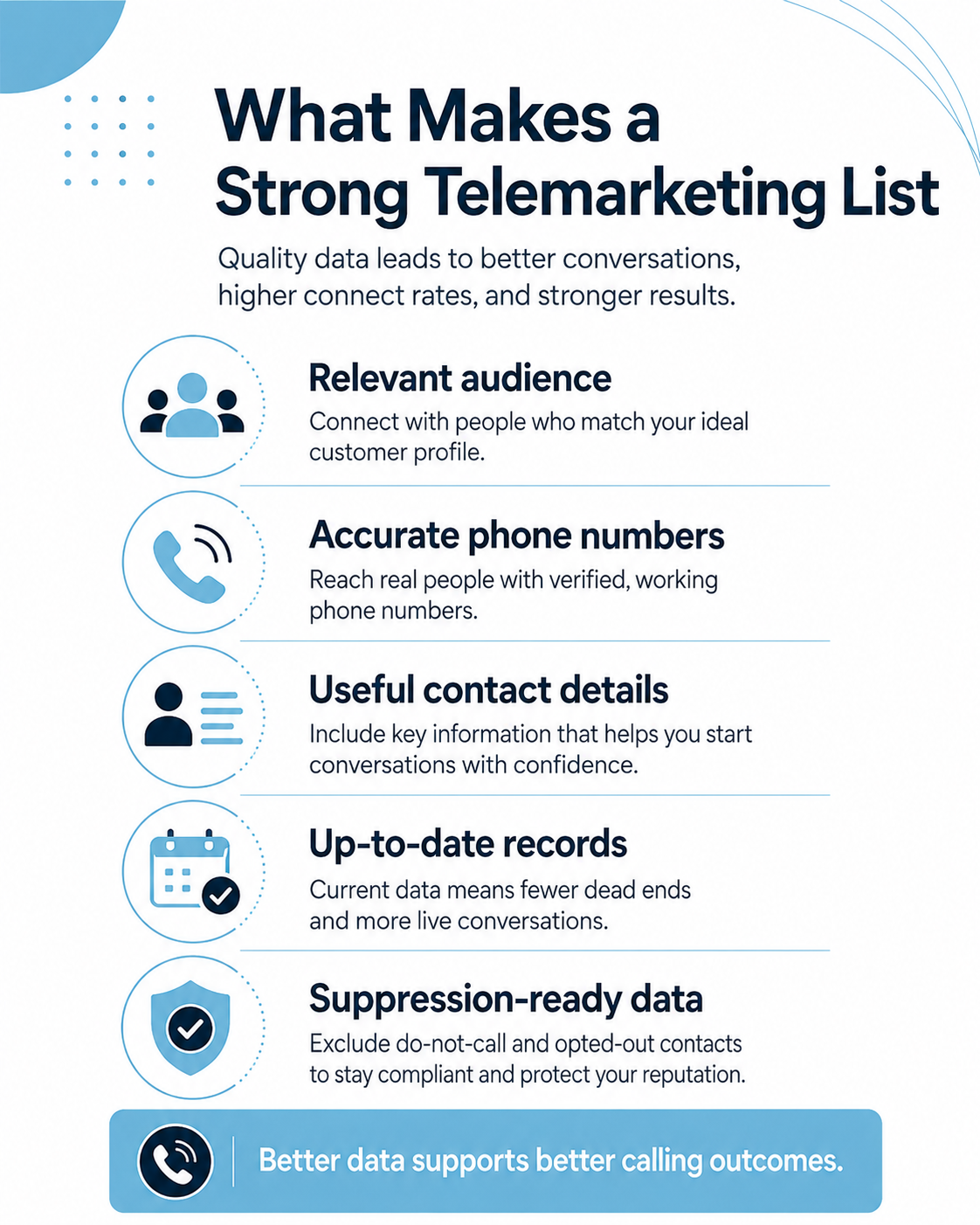
The list is the operational foundation of a telemarketing campaign. It decides the audience before any script is written, any dialler is configured or any sales training takes place. If the list is broad, inaccurate or out of date, even a skilled caller will struggle. If the list is carefully selected, clean and relevant, the calling team can spend more time having useful conversations and less time chasing wrong numbers, closed businesses, unsuitable prospects or people who should not be contacted.
Telemarketing lists can be used for new business activity, customer retention, lapsed customer reactivation, appointment generation, quote follow-up, event attendance, subscription renewal, fundraising, professional services outreach and local campaign activity. They can also support wider lead generation services where telephone outreach is combined with email, direct mail or digital activity. The most effective campaigns usually treat calling data as part of a joined-up process rather than an isolated spreadsheet.
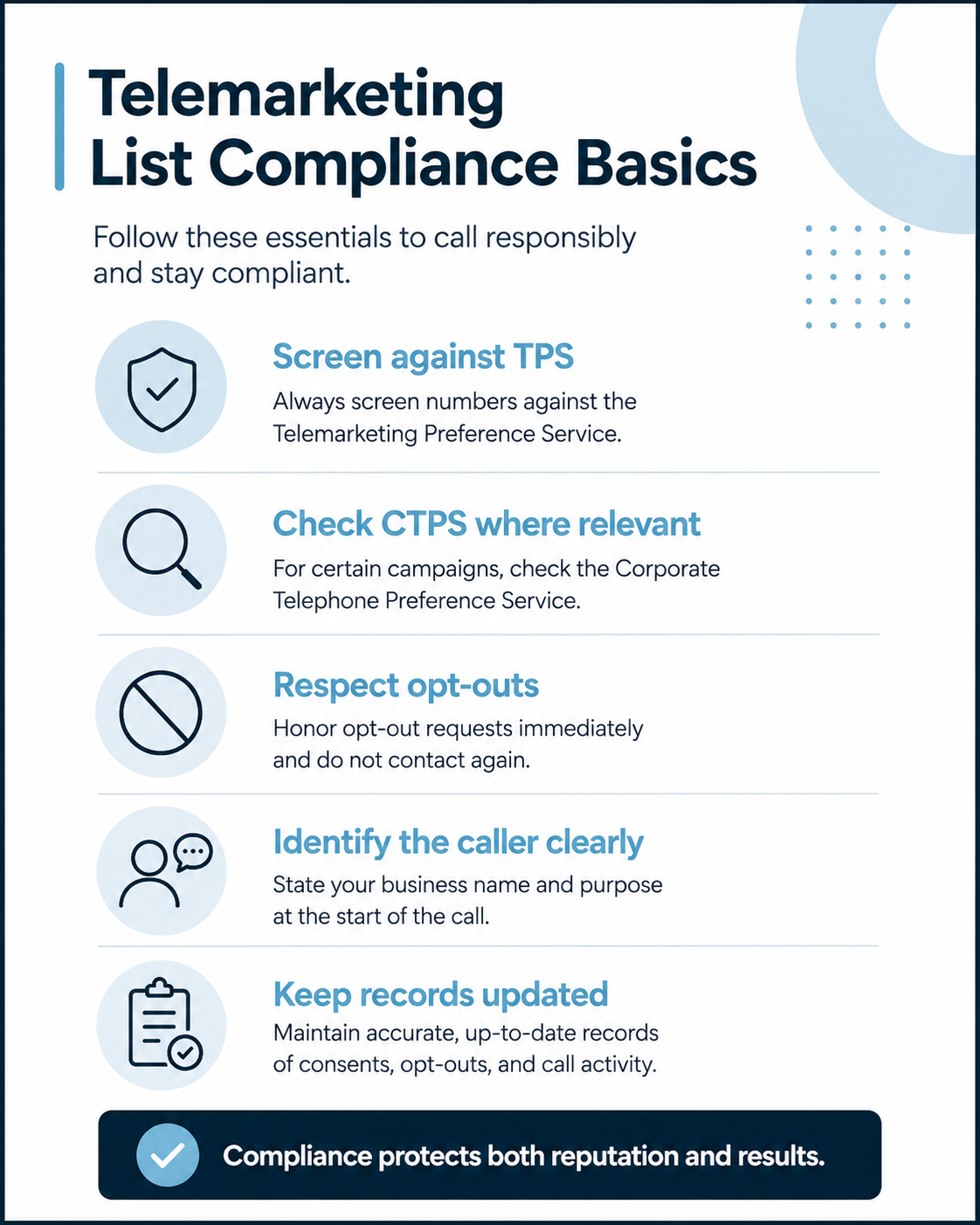
A good list should also tell you what not to call. Suppression records, opt-out status, TPS and CTPS screening results, duplicate flags and invalid number checks help protect the campaign. The ICO telephone marketing guidance says that organisations generally must not make marketing calls to numbers listed on TPS or CTPS unless the person has specifically consented to receive those calls. That is why telemarketing list quality is both a performance issue and a compliance issue.
Why Telemarketing Lists Still Matter
Telephone outreach remains useful because it creates immediate feedback. Email can show opens and clicks, direct mail can generate responses, and paid ads can create visits, but a phone call can reveal live objections, buying intent, timing, budget, decision-making process and competitor context. A caller can clarify whether the person is the right contact, whether the organisation has a need, and whether there is a practical next step.
This makes telemarketing especially useful in B2B markets with considered purchases. Many business buyers do not make decisions from one advert or one email. They may need a conversation before they understand the offer, agree to a meeting or request a proposal. A targeted calling list gives sales teams a defined market to work through, which is often more productive than relying only on inbound enquiries or broad advertising.
Telemarketing also helps businesses learn about their market. A campaign can show which sectors respond, which job titles understand the value proposition, which regions are more active, and which objections appear most often. That information can improve future email campaigns, direct mail activity, paid media, sales scripts and product positioning. A list with useful segmentation fields makes this learning more meaningful because results can be compared by audience group rather than viewed as one undifferentiated total.
Another benefit is speed. A business can build a targeted calling campaign faster when it already has the right market data. AccuraData’s B2B telemarketing list provider service is designed for businesses that need targeted UK business calling data, while its B2C data lists support campaigns aimed at consumer audiences. In both cases, the list should be shaped around the campaign objective rather than chosen simply because it contains a large number of records.
B2B and B2C Telemarketing Lists
B2B and B2C telemarketing lists serve different audiences, and the practical differences matter. A B2B telemarketing list is designed to reach organisations or business contacts. A B2C telemarketing list is designed to reach individual consumers. The two can overlap in some edge cases, such as sole traders, but they should not be treated as the same type of data.
A B2B list often focuses on firmographic and role-based targeting. Useful filters include sector, company size, turnover band, region, location type, job title and decision-maker seniority. A campaign selling payroll software might target finance directors, HR managers or managing directors in companies of a certain size. A campaign selling facilities management services might target operations directors, office managers or site managers. The purpose is to reach people who have a likely business reason to consider the offer.
A B2C list is usually based on consumer attributes, household profile, location, interests, lifestyle indicators or previous behaviour, depending on the source and permission model. It is generally more sensitive because the call is made to an individual in a private capacity. Consumer campaigns therefore need particularly careful sourcing, permission management, suppression handling and caller training. AccuraData’s B2C Data service is relevant where a campaign needs consumer audience selection, but the use of consumer telephone data should always be planned with compliance and relevance in mind.
The legal context also differs. The ICO guidance on live marketing calls explains what organisations must do to comply with PECR when making live marketing calls. The rules require attention to TPS, CTPS, consent, caller identity, number display and suppression handling. B2B campaigns can involve CTPS and business contact data, while B2C campaigns are more likely to involve TPS and personal numbers. Businesses should understand which register and which rights apply before calling.
What Should a Good Telemarketing List Include?
A good telemarketing list begins with accurate contact information. At minimum, the telephone number should be live, properly formatted and matched to the right person, household or organisation. Where the record is B2B, the company details should be current. Where the record is B2C, the consumer details should be selected and handled in line with the intended campaign use.
For B2B campaigns, useful records often include company name, contact name, job title, department, seniority, telephone number, address, industry classification, employee count, turnover band and geographic location. These fields help callers understand who they are speaking to and why the call is relevant. They also help the campaign manager segment the calling file, prioritise higher-value records and compare performance by market group.
For B2C campaigns, useful records depend on the campaign purpose. A home improvement campaign may need geography, property indicators and household profile. A consumer finance campaign may need different permission and risk controls. A local retail campaign may only need a tightly defined area and a suitable audience profile. The more personal the context, the more carefully the campaign should be assessed.
A good list should include evidence that it has been screened, cleaned or prepared for responsible use. The ICO guidance on complying with live marketing calls notes that where a third-party telephone marketing list is claimed to have been checked against TPS or CTPS, the buyer should make sure the check happened recently, because a registration can become active after 28 days. This is one reason AccuraData offers dedicated TPS and CTPS checking as well as ongoing data cleansing and enrichment support.
How Telemarketing Lists Support Campaign Performance
The commercial value of a telemarketing list is not found in the number of records alone. A larger list is not automatically better than a smaller, better targeted list. If a sales team calls 10,000 poorly matched contacts, it may waste more time than a campaign built around 1,000 carefully selected prospects. The best list is the one that matches the offer, audience and operational capacity of the campaign.
Good targeting improves relevance. Relevance improves call quality. A caller who understands the recipient’s sector, role or likely need can open the conversation more naturally. Instead of a generic pitch, the call can be framed around a clear business or consumer context. That does not guarantee success, but it gives the caller a better starting point.
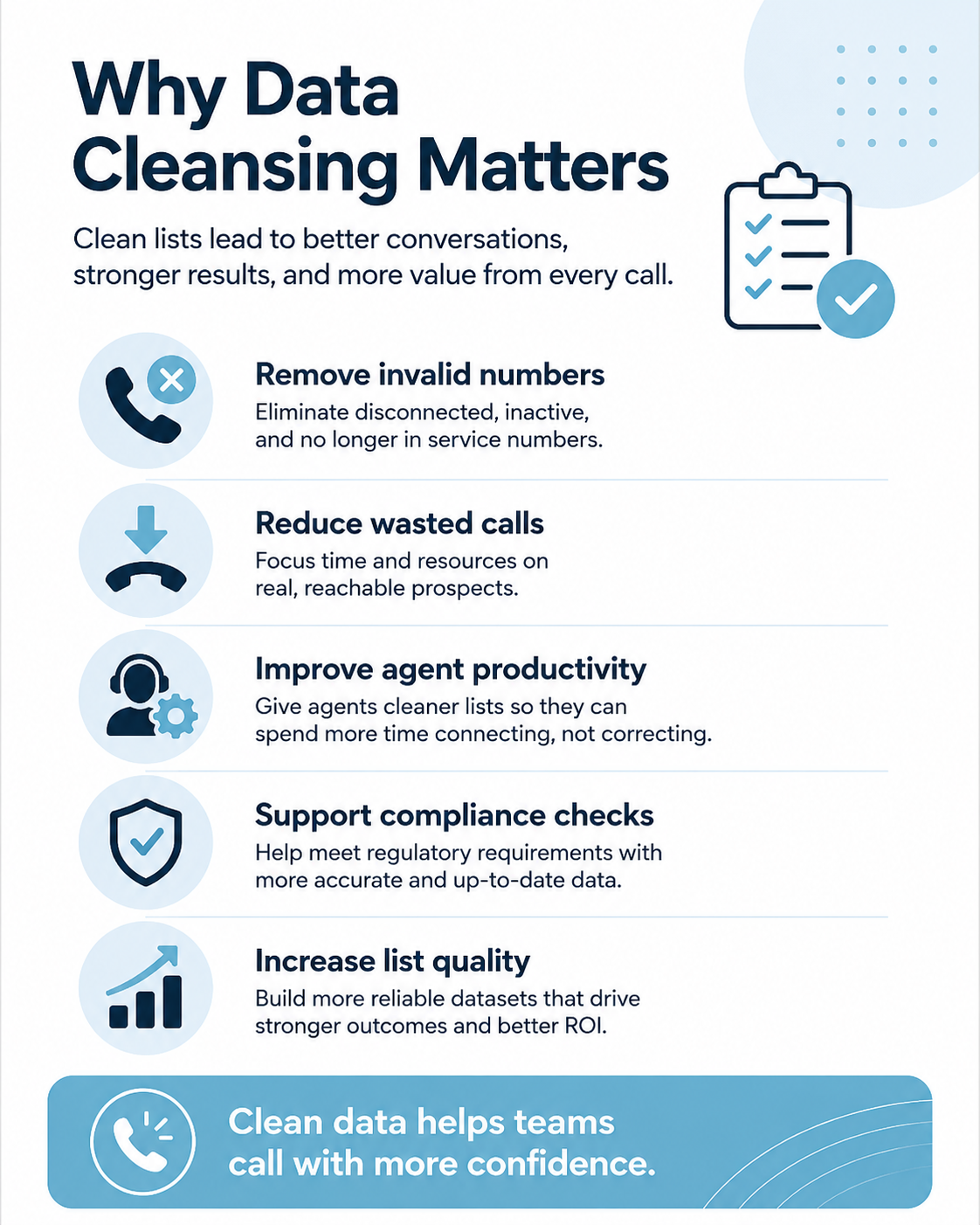
Good data also improves productivity. Invalid numbers, duplicates, wrong contacts and suppressed records all cost time. If agents spend too much of their day handling failed dials, the campaign becomes expensive even if the list looked affordable at the point of purchase. AccuraData’s live number cleansing and wider data cleansing and enrichment services are designed to reduce these avoidable problems before calling begins.
Telemarketing lists also support measurement. When records are tagged by source, sector, audience type or campaign segment, results can be analysed properly. A manager can see whether finance directors convert better than operations managers, whether one region produces more appointments, whether smaller companies answer more often, and whether certain sectors produce better sales conversations. This turns a calling campaign into a learning process rather than a simple volume exercise.
UK Cold Calling Rules: The Main Principles
Cold calling is not automatically unlawful in the UK, but it is regulated. Businesses need to understand PECR, UK GDPR, TPS, CTPS and other rules that may apply to the type of call being made. They also need to understand that certain sectors and call types have stricter requirements.
For live marketing calls, the key principle is that you generally must not call numbers registered with TPS or CTPS unless the person has specifically consented to your calls. This is set out in the ICO telephone marketing guidance, which also explains that organisations should screen call lists against TPS and CTPS. This makes screening a practical requirement for any serious telemarketing campaign.
The caller must also identify themselves properly. The ICO guidance explains that organisations must allow their number to be displayed, and live marketing call guidance covers the need for clear caller identification. In plain terms, people should know who is calling them and why. This protects recipients and helps businesses avoid the impression that they are hiding behind withheld numbers or unclear introductions.
Automated calls are different from live calls. Recorded marketing calls normally require consent, and the rules are stricter than for live calls. If a business is using human agents, automated diallers, prerecorded messages or AI voice systems, it should check the specific rules before launching. The practical point is simple: do not assume that every phone-based campaign is governed by the same requirements.
TPS and CTPS Screening
The Telephone Preference Service, known as TPS, is a central opt-out register for individuals who do not want unsolicited live sales and marketing calls. CTPS is the Corporate Telephone Preference Service and applies to companies and other corporate bodies. The official CTPS registration page describes CTPS as the central opt-out register for organisations wishing to opt out from sales and marketing calls.
TPS and CTPS screening is not a one-off administrative step. It needs to happen close enough to the calling activity to be meaningful. The ICO’s live marketing calls compliance guidance highlights the importance of recent checking and refers to the 28-day window because registrations can become active after that period. If a list was screened months ago, it may no longer be safe to treat as clean.
This is one area where a data partner can add real value. AccuraData’s TPS and CTPS checking service can screen supplied data, apply suppression, support database cleansing and help organisations prepare lists before calling. For businesses buying data, AccuraData can also supply calling datasets with appropriate checks applied. This means internal teams do not have to manage every checking process from scratch.
Screening should also be supported by internal suppression lists. If someone asks your business not to call them, you should record that preference and act on it. TPS and CTPS are important, but they are not the only source of suppression information. Campaign-specific objections, customer preferences, complaints and internal do-not-call records all matter.
UK GDPR and Personal Data in Telemarketing Lists
Telephone numbers, names, job titles and other contact fields can be personal data when they identify or relate to an individual. This means UK GDPR can apply even when the campaign is aimed at a business audience. The ICO guide to lawful basis explains that organisations must have at least one lawful basis whenever they process personal information.
For B2B telephone marketing, legitimate interests may be relevant in some circumstances, particularly where the call is proportionate, targeted and connected to the recipient’s professional role. However, legitimate interests is not a shortcut around PECR. The ICO legitimate interests guidance explains that if PECR requires consent, consent is also the appropriate lawful basis under UK GDPR, and legitimate interests cannot legitimise unlawful processing.
A responsible business should therefore assess both the channel rules and the data protection rules. PECR deals with whether and how the call can be made. UK GDPR deals with the processing of personal data behind the call, including sourcing, storage, selection, sharing, retention and rights. A well-managed telemarketing list should have documentation that explains why the data is being used and how preferences are respected.
This is particularly important when buying a telemarketing list. A buyer should understand the source of the data, the intended use, the screening status, the lawful basis, suppression handling, update frequency and contractual responsibilities. A low-cost list that cannot answer these questions may create more risk than value.
Compliance Risks That Businesses Should Avoid
One common risk is calling numbers that should have been suppressed. This can happen when a list has not been screened against TPS or CTPS, when screening is too old, or when internal opt-outs have not been applied. It can also happen when different systems hold different versions of the same customer record. Regular data cleansing and enrichment helps reduce this risk by improving consistency across the database.
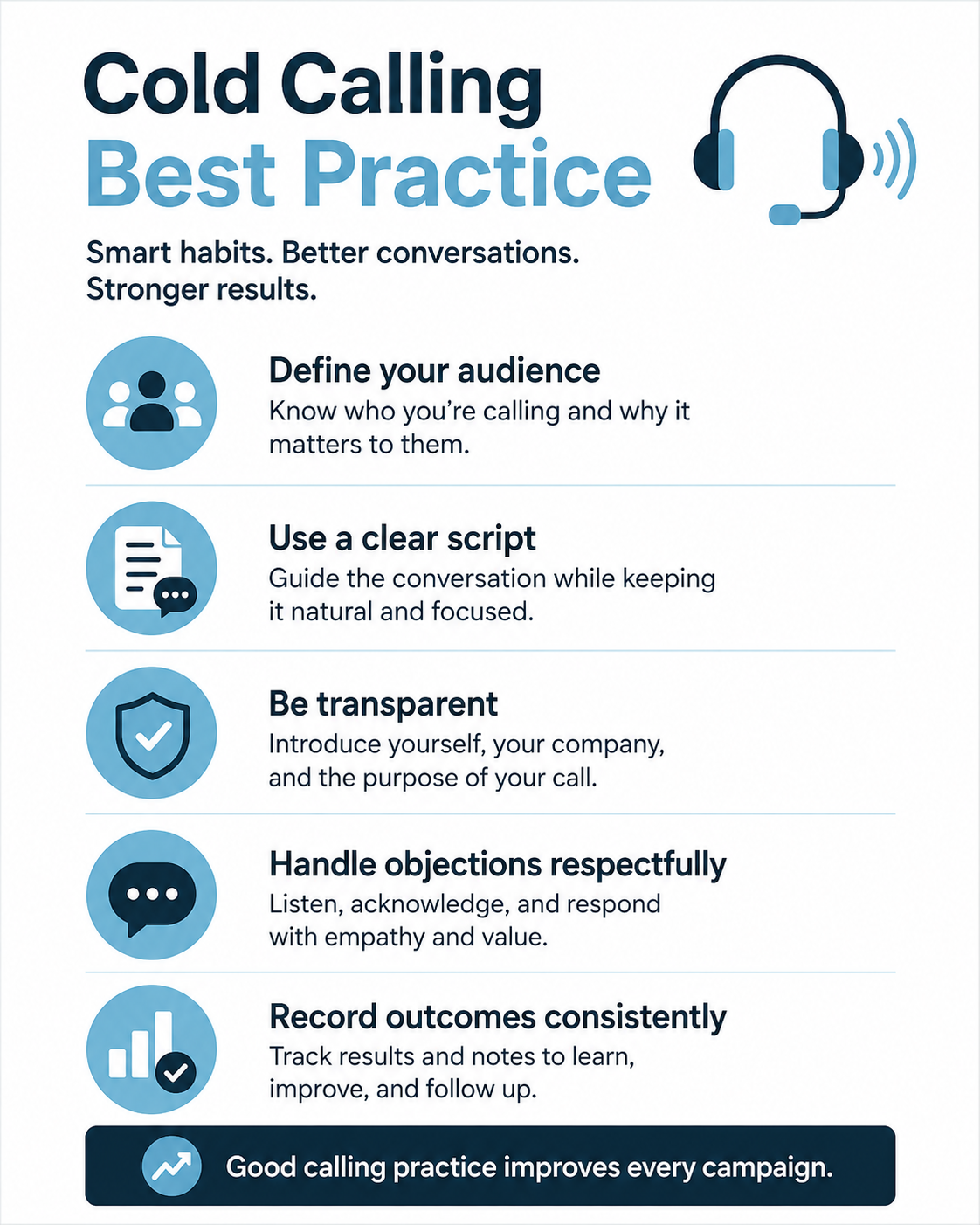
Another risk is poor caller transparency. People should not have to guess who is calling, why they are being contacted, or how to opt out of future calls. Clear scripts, caller training and accurate CRM notes help make this easier. A compliant list still needs a compliant calling process.
A further risk is over-reliance on volume. Some campaigns try to compensate for weak data by increasing call numbers. This may increase complaints, reduce morale among agents and create poor customer experience. Better list selection often produces a stronger campaign than raw volume.
Businesses should also consider dialler behaviour. Ofcom warns that repeated silent and abandoned calls may amount to persistent misuse, and its guidance on silent and abandoned calls notes that Ofcom can take enforcement action, including penalties of up to £2 million. If automated dialling is used, the technology, staffing levels and abandonment controls should be reviewed carefully.
How to Buy a Telemarketing List
Buying a telemarketing list should begin with the campaign objective. The question is not simply, how many numbers can we buy? The better question is, who do we need to speak to and why are they likely to care? A clear brief helps the supplier select the right audience and helps the sales team prepare the right conversation.
For B2B campaigns, define the target sector, company size, region, job role, department and level of seniority. Consider whether the campaign needs named contacts, direct dials, switchboard numbers or a mixture. For B2C campaigns, define the consumer audience, geography, permitted profile fields and the reason the offer is relevant. AccuraData can support both targeted business calling data through Telemarketing List Providers services and consumer audience data through B2C Data services.
Ask how the list has been cleaned. Useful questions include whether the numbers have been checked, whether duplicates have been removed, whether TPS and CTPS screening has been applied, when the screening happened, how opt-outs are handled, and whether documentation can be provided. The supplier should be able to explain these points in plain language.
Also ask how the file will be structured. A good telemarketing list should be easy to use. Fields should be labelled clearly, formats should be consistent, and segmentation should be practical. If your CRM, dialler or spreadsheet process needs specific fields, agree this before delivery.
How to Use a Telemarketing List Effectively
A list is only one part of a campaign. To get value from it, the business needs a plan. Start with a clear objective. Decide whether the campaign is designed to book appointments, qualify leads, introduce a service, update records, reactivate customers or support a wider campaign. Then match the script, offer and follow-up process to that objective.
Segment the list before calling. A single script for every record is rarely ideal. Different sectors, roles or consumer groups may need different opening lines, examples or calls to action. Segmentation can also help with prioritisation. If one group is more valuable or more time-sensitive, call that group first.
Prepare the callers properly. They should understand the audience, offer, expected objections, compliance requirements and how to record outcomes. A good call outcome structure may include connected, no answer, wrong number, not relevant, interested, appointment booked, call back, do not call, and data update required. Consistent outcome recording helps improve the list and future campaign activity.
Follow-up should be planned before the first call. If a prospect asks for information, who sends it? If they request a call back, how is it scheduled? If they object, where is that recorded? If they show strong interest, how is the sales team alerted? Telemarketing works best when the process after the call is as organised as the call itself.
Data Cleansing Before Calling
Many businesses already have calling data inside a CRM, spreadsheet or legacy database. Before buying new data, it can be sensible to check whether the existing database can be improved. Old data may contain useful customer history, but if the numbers are outdated or the records are inconsistent, the campaign may still struggle.
AccuraData’s data cleansing and enrichment services can help businesses remove duplicates, correct formatting, validate business contact information and improve database accuracy. For calling campaigns, cleansing may also include live number cleansing to help identify telephone numbers that are live and more suitable for calling.
Cleansing is useful because data decays over time. People change jobs, companies move, numbers are disconnected, customers opt out, and organisations update their preferences. A calling list that worked a year ago may need attention before it is used again. Updating it before the campaign can save caller time and reduce avoidable compliance risk.
Data cleansing also improves reporting. If duplicate records exist, the same company or consumer may be called more than once. If fields are inconsistent, results are harder to analyse. If old suppression data is missing, the campaign may create avoidable complaints. Clean input data produces cleaner campaign management.
Measuring Telemarketing List Performance
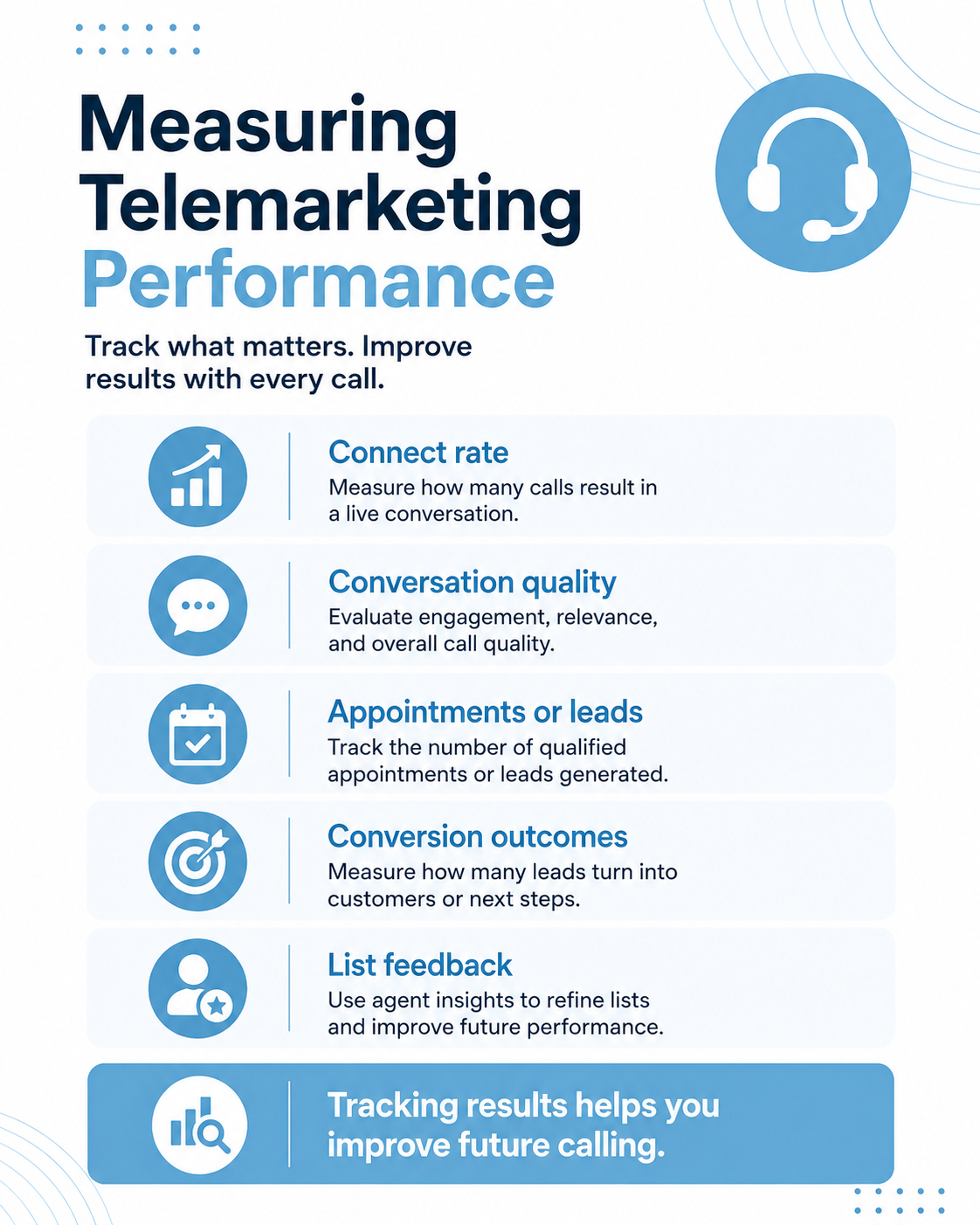
A telemarketing list should be judged by more than call volume. Useful metrics include connection rate, wrong number rate, decision-maker reach rate, call-back rate, appointment rate, lead qualification rate, conversion rate, complaint rate, opt-out rate and cost per meaningful conversation. These measures show whether the list is helping or hindering the campaign.
Connection rate indicates whether the numbers are reachable. Wrong number rate indicates data accuracy. Decision-maker reach rate shows whether the right contacts were selected. Appointment or lead rate shows commercial value. Complaint and opt-out rates show whether targeting and calling practice need attention.
Performance should be reviewed by segment. A campaign may look average overall but strong in one sector and weak in another. A job title may produce poor connection rates but high conversion once reached. A region may generate more appointments because the offer is more relevant there. Segment reporting helps turn a single campaign into useful insight.
This is where data structure matters. If the list includes consistent fields for sector, region, job title, company size and source, the campaign can be analysed properly. If the list is a flat file of numbers with little context, insight is limited.
Common Telemarketing List Mistakes
The first mistake is buying purely on price. A cheap list may look attractive, but if it contains outdated numbers, weak segmentation or unclear sourcing, the real cost appears during the campaign. Caller time, complaints, failed dials and poor conversion can outweigh any saving on the initial purchase.
The second mistake is treating B2B and B2C data as interchangeable. Business contacts and consumers have different expectations, use cases and compliance considerations. A campaign aimed at managing directors should not be planned in the same way as a campaign aimed at households.
The third mistake is skipping suppression. TPS, CTPS and internal opt-out handling are central to responsible calling. If suppression is treated as optional, the campaign becomes riskier and less respectful. The ICO telephone marketing guidance is clear that TPS and CTPS checks matter for live marketing calls.
The fourth mistake is calling without a follow-up plan. A list may generate interested prospects, but if the sales process is slow or inconsistent, those opportunities can be lost. Good telemarketing needs clean data, good calling, accurate recording and timely follow-up.
How AccuraData Supports Telemarketing Lists
AccuraData supports businesses that need reliable UK calling data for targeted outbound campaigns. For B2B activity, its Telemarketing List Providers service helps organisations access targeted business telemarketing data for lead generation, outbound prospecting and customer acquisition. Campaigns can be filtered around the audience that matters, including industry, geography, company size and decision-maker profile.
For consumer campaigns, AccuraData’s B2C Data service supports targeted direct marketing and lead generation campaigns across the UK. Consumer calling should be handled with care, and a professional provider can help businesses understand audience selection, data quality and appropriate use before activity begins.
AccuraData can also help businesses that already hold calling data. Its TPS and CTPS checking service screens telephone data against the relevant preference registers, while data cleansing and enrichment and live number cleansing can help improve accuracy and reduce wasted calls. This is useful for CRM refreshes, reactivation campaigns, sales database clean-up and multi-channel lead generation.
The benefit of working with a specialist provider is that the campaign starts from a better data position. Instead of sending callers into a poorly maintained file, the business can work with targeted, screened and better-structured records. That improves the chance of relevant conversations and supports a more responsible approach to outbound marketing.
A Practical Checklist Before Calling
Before using a telemarketing list, confirm the campaign objective and audience. Decide whether the list is B2B, B2C or mixed. Check that the data has been sourced for the intended purpose. Confirm whether TPS and CTPS screening has been completed recently. Apply internal suppression lists. Review the lawful basis for personal data processing. Prepare a clear script and caller identity statement. Make sure numbers are displayed where required. Train callers to handle opt-outs and objections. Define call outcomes and follow-up steps. Review results and update the database after the campaign.
This checklist is not a replacement for legal advice, but it is a useful practical starting point. The main idea is that telemarketing should be planned, not improvised. The list, compliance process, script, calling workflow and reporting structure all need to work together.
If any of these steps are difficult, it may be worth speaking with a data specialist before launching. AccuraData can help with list supply, TPS and CTPS screening, cleansing and enrichment, and targeted B2B or B2C data selection. That support can reduce internal workload and help the campaign start with stronger data foundations.
Final Thoughts
A Telemarketing List can be a valuable asset when it is accurate, targeted and used responsibly. It can help sales teams reach defined audiences, create new opportunities, qualify leads, reactivate old contacts and support wider marketing activity. It can also create problems when it is outdated, poorly sourced, badly segmented or used without proper compliance checks.
The strongest telemarketing campaigns usually have three things in common: relevant audience selection, clean and screened data, and a clear calling process. The list should help callers speak to the right people. The compliance process should help avoid numbers that should not be called. The campaign workflow should turn conversations into useful next steps. AccuraData is well placed to support that process. Whether you need a targeted B2B telemarketing list, consumer audience data, TPS and CTPS screening, live number checking or a wider database refresh, AccuraData can help you build a cleaner and more effective calling foundation. Better data does not guarantee every call will convert, but it gives your team a far better plac