
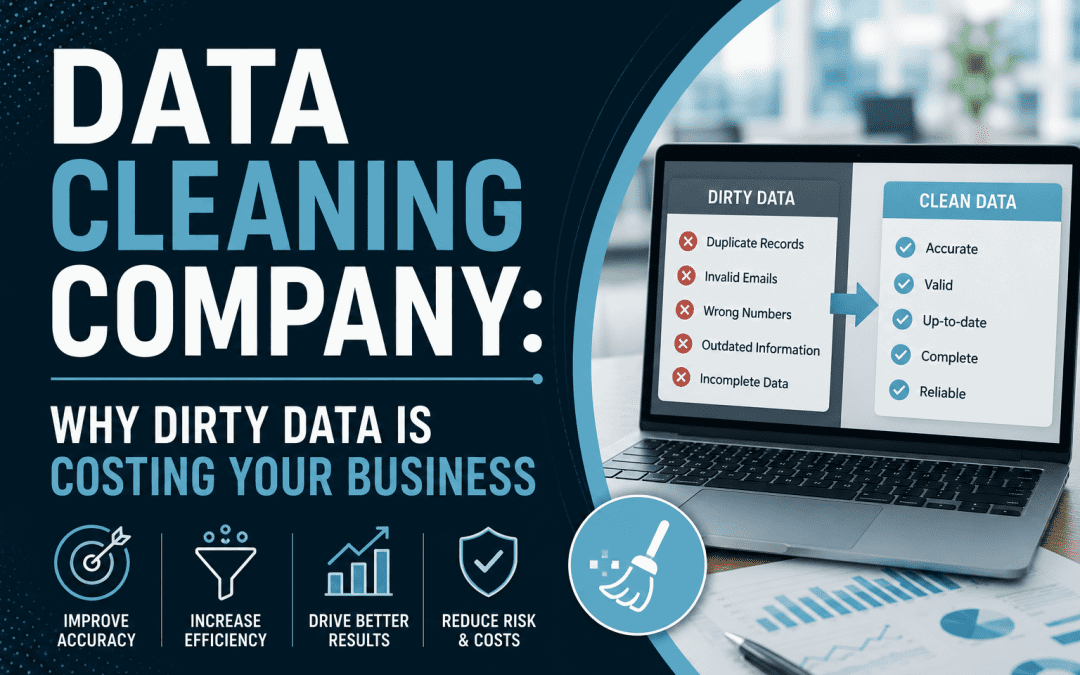
There is a cost to dirty data that most businesses never see clearly on a balance sheet, yet it shows up in every department that relies on contact information to do its job. Wasted sales calls to disconnected numbers. Email campaigns returning bounce rates that damage your sender domain. Marketing spend directed at companies that dissolved six months ago. Compliance fines from the ICO for calling numbers registered on the TPS or CTPS that should have been suppressed before the first dial was made. Taken together, these are not minor inconveniences. According to research by The Software Bureau, dirty data costs the UK economy an estimated £900 billion annually, equivalent to around 20% of an organisation’s revenue being effectively lost to inaccurate or outdated information. This highlights the need for a data cleaning company.
At AccuraData, we are a data cleaning company built specifically for UK businesses running outbound sales and marketing operations. Our services cover the four areas where data quality problems most commonly arise and most visibly damage campaign performance: TPS and CTPS checking, email address verification, telephone number validation, and live Companies House checks. This guide explains what each service does, why it matters, and how working with a dedicated data cleaning service protects your business from both the compliance and the commercial consequences of operating on inaccurate data.
The Real Cost of Dirty Data for UK Businesses
Before looking at what a data cleaning company actually does, it is worth understanding the scale of the problem it is solving. Most businesses have a vague awareness that their data degrades over time, but far fewer have a precise picture of what that degradation is costing them in practical terms.
The numbers are striking. The cost of bad data sits between 15% and 25% of revenue for most companies, with 44% of businesses reporting that CRM data decay costs them over 10% of annual revenue. Data scientists have long applied the 1-10-100 rule to this problem: it costs £1 to verify a record, £10 to clean it after an error has been introduced, and £100 to do nothing and absorb the downstream consequences of acting on that inaccurate information. At scale, those unit costs compound rapidly into a meaningful drag on operational efficiency and campaign ROI.
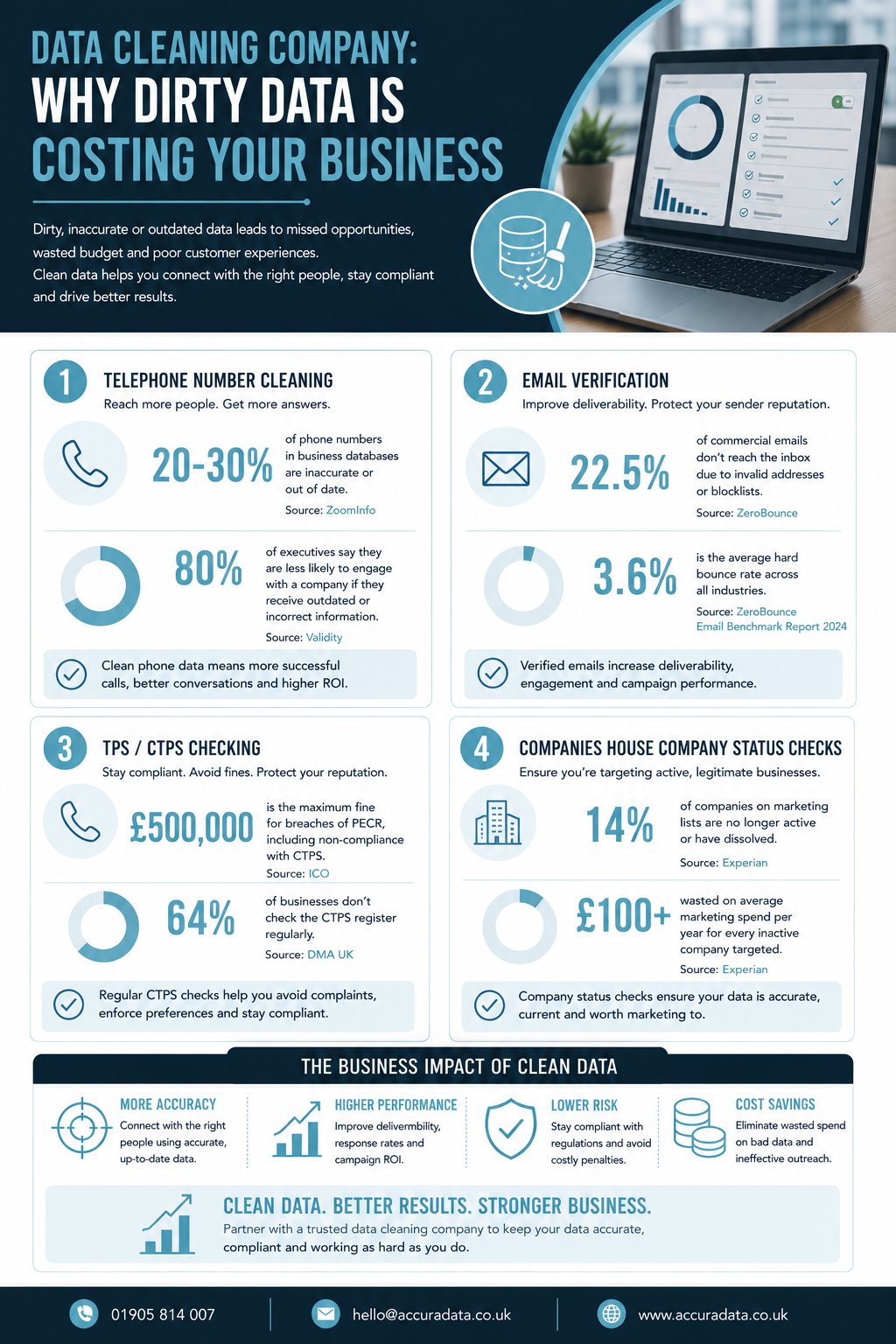
The rate of decay is the underlying driver. B2B data decays at an average rate of 2.1% per month, which compounds to over 22% annually. An uncleaned database that was accurate when it was first built loses roughly a quarter of its usable records every year through job changes, business closures, number reassignments, and email address abandonment. In the UK specifically, more than 726,000 companies were dissolved in the financial year ending March 2025 according to Companies House. Every one of those dissolutions potentially represents a record in someone’s calling or email list that is now either defunct or, if the number has been reassigned, a compliance risk.
Beyond revenue loss, there is a compliance dimension that is growing more serious. The ICO has issued more than £2.59 million in fines for nuisance calls, texts and emails since April 2023 alone, with investigations frequently beginning from a single complaint. Under the Data (Use and Access) Act 2025, PECR fine ceilings have now risen to match UK GDPR levels, reaching up to £17.5 million or 4% of global annual turnover. Calling a TPS or CTPS-registered number because it was not checked before the campaign launched is no longer a minor operational slip. It is a serious financial and reputational risk.
TPS and CTPS Checking: The Non-Negotiable Compliance Step
For any business running outbound telephone campaigns, screening calling data against the Telephone Preference Service (TPS) and the Corporate Telephone Preference Service (CTPS) before every campaign is a legal requirement, not a recommendation. Under PECR, businesses must screen their calling lists every 28 days at a minimum. The register is not static: new numbers are added continuously, and a list that was clean last month may already contain newly registered numbers that are now off-limits.
The TPS covers individual consumers, sole traders, and most partnerships. The CTPS covers corporate subscribers including limited companies, schools, hospitals, and government bodies. For B2B outbound calling, both registers apply, because a B2B calling list will typically contain a mix of corporate and individual subscriber numbers. Screening against only one register and assuming the other does not apply is a compliance gap that the ICO does not treat sympathetically.
AccuraData Service: Our TPS and CTPS checking service screens your entire calling dataset against both registers, returning clearly formatted results that make suppression straightforward before your campaign launches. Re-screening every 28 days is built into our service at competitive rates.
The 28-day re-screening requirement catches more businesses out than any other aspect of CTPS compliance. A common assumption is that purchasing pre-screened data from a supplier removes the obligation to re-screen. It does not. The 28-day clock starts from the date of the screen, not the date the data was purchased. If there is a gap between purchase and campaign launch, or if the campaign extends for more than 28 days, re-screening is legally required before calling continues. AccuraData’s data cleansing service is built around this reality, making repeat screening straightforward and affordable rather than something that gets delayed or skipped because of the administrative overhead.
Email Verification: Protecting Deliverability and Sender Reputation
Email deliverability is not primarily a creative or technical challenge. It is a data quality challenge. The engagement signals that inbox providers like Gmail, Outlook, and Apple Mail use to determine where your messages land, including bounce rates, open rates, and spam complaint rates, are all fundamentally driven by the quality of the email addresses in your database. A list with high volumes of invalid, inactive, or misclassified addresses will produce the kind of engagement signals that progressively move your sending domain towards the spam folder, regardless of how well your campaigns are structured.
Email verification at the point of cleaning checks several things that a basic format check cannot catch. Active mailbox verification confirms that an address is live and accepting mail, not simply that it is correctly formatted or that the domain exists. Spam trap detection identifies addresses associated with known honeypot systems that are specifically designed to catch senders using unverified lists. Disposable address identification flags addresses generated by temporary email services that are never monitored. Role-based address detection identifies inboxes like info@ or admin@ that are unlikely to be read by a specific individual and that tend to generate low engagement and high unsubscribe rates.
AccuraData Service: Our email verification service is available as part of our data cleansing and enrichment offering. We clean your existing email data before campaigns launch, removing invalid addresses and flagging high-risk records so that every send goes to addresses that are genuinely live. For businesses buying new data, our B2B email lists are verified at mailbox level before delivery.
The commercial return on email verification is direct and measurable. Lower bounce rates protect your sender domain from the progressive reputation damage that accumulates with every campaign sent to an unverified list. Higher open rates follow naturally when your audience consists of active, real mailboxes rather than a mix of live and dead addresses. And the cost of email verification as a standalone data cleaning service is invariably lower than the cost of rebuilding a sender reputation damaged by sustained high bounce rates, which can take months of suppressed deliverability to recover from.
Telephone Number Validation: Saving Sales Time and Protecting Call Quality
A dialler powered by invalid telephone numbers is not generating the call volume your team thinks it is. Every attempt to connect to a disconnected, invalid, or incorrectly formatted number represents wasted time at the dialler and a wasted opportunity for the sales person sitting behind it. At scale, the cumulative effect is significant. Invalid telephone numbers within a calling list dilute the effective call rate, skew performance metrics, and reduce the productivity of every person on the phones.
Telephone number validation as part of a database cleaning service checks whether a number exists and is capable of receiving calls, whether it is a mobile or landline, whether it has been disconnected or reassigned, and whether it is correctly formatted for UK dialling standards. This goes beyond what most CRM systems do automatically. Numbers entered with incorrect dialling prefixes, numbers that have been ported between providers, and numbers that have been reassigned following a business closure will all pass a basic format check but fail to connect when dialled. Proper validation removes these from your active calling list before your team picks up the phone.
AccuraData Service: Telephone number validation is included within our data cleansing and enrichment service. We validate mobile and landline numbers against live network data, flagging disconnected, invalid, and reassigned numbers so that your team’s calling time is focused on contacts that can actually be reached. This service can be run standalone against your existing data or applied to new B2B telemarketing lists before delivery.
The productivity gains from telephone validation are straightforward. Sales teams calling verified numbers spend more time in conversations and less time listening to disconnection tones or navigating to voicemail inboxes for numbers that are never monitored. For high-volume outbound operations, even a modest improvement in connection rate has a measurable impact on the number of qualified conversations generated per hour. A reliable data cleaning company that validates telephone numbers as a standard service step removes a drag on sales productivity that most teams simply accept as a fact of life rather than a correctable data quality problem.
Companies House Live Checks: Keeping Your Business Data Current
One of the most underused tools in B2B data cleaning is the live Companies House check. Every limited company and LLP in the UK is registered on the Companies House database, which holds real-time information on trading status, registered address, company officers, filing history, and dissolution or insolvency proceedings. Checking your contact database against this live data source allows you to identify companies that have been dissolved, are in administration, have changed their registered address, or have had changes to their directorship since your records were last updated.
The scale of corporate change in the UK makes this check more important than many businesses realise. Alongside the 726,000 dissolutions in the year to March 2025, Companies House registered over 800,000 new incorporations in the same period. The UK business landscape is dynamic at a structural level, and any B2B database that is not regularly cross-referenced against a live corporate register will drift progressively out of alignment with how the market actually looks.
The practical applications of a Companies House live check within a data cleansing process are wide-ranging. For sales teams, it removes dissolved companies from calling lists before time is wasted pursuing contacts at businesses that no longer exist. For credit and accounts teams, it provides current registered address and officer information for invoicing and credit assessment purposes. For compliance teams, it flags companies in insolvency proceedings that may represent a changed credit risk. And for marketers building segmented outreach campaigns, it ensures that firmographic data such as company type, size, and registered status is current rather than reflecting how a company looked when it was first added to the database.
AccuraData Service: Our Companies House live check service cross-references your B2B database against the live register in real time, identifying dissolved companies, address changes, officer updates, and insolvency events. This service is available as part of our data cleansing and enrichment package or as a standalone check against your existing data. The result is a database that reflects the actual current state of your target market, not a snapshot from when the data was first collected.
Companies House data is, as the GOV.UK open data announcement notes, estimated to be worth between £1 billion and £3 billion annually to users across the UK economy. The introduction of mandatory identity verification for company directors from late 2025, under the Economic Crime and Corporate Transparency Act, is making the register progressively more accurate and more trustworthy as a data source. Cross-referencing your business database against it is one of the highest-value steps any data cleaning company can apply.
How Often Should You Clean Your Business Data?
The answer varies by campaign type and data source, but some benchmarks are fixed by law and some are driven by the commercial reality of how quickly data decays. For telephone marketing, the legal minimum for TPS and CTPS re-screening is every 28 days. This is not a guideline; it is a PECR requirement, and the ICO enforces it. For email campaigns, there is no equivalent fixed interval in law, but the commercial case for cleaning email data before every campaign and at least quarterly for ongoing programmes is well established in deliverability best practice.
For Companies House data, the frequency of checking should reflect the volatility of your target market. Sectors with high rates of business formation and dissolution, such as construction, hospitality, and retail, warrant more frequent checks than stable professional services sectors. As a general rule, any B2B database used for active outreach should be cross-referenced against the live Companies House register at least every six months, with additional checks before major campaign launches or significant list purchases.
The underlying principle across all four services is the same. In the UK, around 25% of every dataset cleansed by specialist providers is found to be either duplicated, incomplete, or carrying inaccurate fields after just one year of use without cleaning. The longer a database goes without a structured data cleaning process, the higher the proportion of records that are silently working against your campaigns rather than supporting them.
What to Look for in a Data Cleaning Company
Not all data cleaning companies operate to the same standard, and the differences matter in both performance and compliance terms. The following are the questions worth asking of any provider before committing your database to their cleaning process.
Speed of Data Cleaning Company Turnaround
A data cleaning service that takes several days to return results creates friction in campaign planning and can mean that a list is already 28-day-stale by the time it comes back from the cleaner. Fast turnaround, ideally within one working day for standard submissions, is a practical requirement for any business running regular outbound campaigns rather than occasional one-off exercises.
Transparency of Data Cleaning Company Process
A reputable data cleaning company should be able to explain precisely what checks are applied to your data, in what order, and on what sources they rely for verification. For TPS and CTPS checks, the data should be screened against the official register managed by TPSL, a subsidiary of the DMA. For email verification, the provider should be able to describe their mailbox-level validation methodology. Vague references to ‘proprietary technology’ without specifics are a warning sign.
Compliance Documentation
Your data passes through a third party during the cleaning process. That third party becomes a data processor under UK GDPR, and you need a Data Processing Agreement in place before any data is transferred. A legitimate data cleaning company will provide this as standard and will be registered with the ICO. If a provider cannot produce this documentation promptly, they are creating compliance exposure for your business as well as their own.
Competitive and Transparent Data Cleaning Company Pricing
Data cleaning should not be expensive enough to be an obstacle to doing it regularly. The whole point of a structured data cleansing service is that it is carried out as a routine operational step before every campaign, not as an occasional large-budget exercise. Providers who charge in a way that makes regular cleaning prohibitive are not aligned with how compliance and data quality actually work in practice. AccuraData’s pricing is competitive, transparent, and structured to make regular cleaning of all sizes of dataset realistic for businesses at every stage of growth.
AccuraData: Your UK Data Cleaning Company
AccuraData provides fast, accurate data cleaning services to UK businesses across a wide range of sectors and campaign types. Our four core services, TPS and CTPS checking, email verification, telephone number validation, and Companies House live checks, address the specific areas where data quality problems most consistently damage outbound sales and marketing performance in the UK market.
We return results quickly, operate in full compliance with UK GDPR and PECR, and provide a Data Processing Agreement as standard on all data cleaning engagements. Our pricing is designed to make regular data cleaning a realistic operational standard rather than an occasional budget line item. For businesses that want to run all four checks in a single submission, we can process your dataset across every service and return consolidated, clearly formatted results that make acting on the findings straightforward.
If you supply or manage B2B email marketing data, run outbound telephone campaigns, or manage a CRM that has not been formally cleaned in the past six months, the starting point is understanding exactly what is in your database and what it is costing you in its current state. Our data cleansing and enrichment service begins with that assessment and delivers a cleaned, verified, and compliant dataset that your team can use with confidence.
Speak to the AccuraData team to find out what our data cleaning service looks like for your specific dataset, how quickly we can turn results around, and what the cost looks like at your data volume. Get in touch with us today.
Data Cleaning Company: the Foundation of Every Effective Campaign
Every campaign your business runs begins with data. The quality of that data determines whether your calls connect, your emails arrive, your compliance stands up to scrutiny, and your sales team is spending their time on genuine opportunities rather than chasing records that were never going to convert. Working with a reliable data cleaning company is not an additional cost layer on top of your marketing budget. It is the step that makes every other pound you spend on outreach work harder.
The four services AccuraData provides, TPS and CTPS checking, email verification, telephone number validation, and Companies House live checks, address the four most common and most costly sources of data quality failure in UK B2B outreach. Taken together, they transform a database from a liability into a genuine business asset. The question is not whether your data needs cleaning. After more than a few months of active use, it almost certainly does. The question is how much longer it is worth waiting to find out.