
Email marketing consistently delivers the highest return on investment of any digital channel. Research from Litmus and HubSpot’s 2026 State of Marketing Report puts the average return at £36 for every £1 spent, a figure that has held firm across multiple independent studies. Yet that headline number masks a more complicated truth: the results you get from email are almost entirely determined by the quality of the contact data sitting underneath your campaigns. A pristine, well-structured database for email marketing is the asset that separates businesses achieving 40% open rates from those watching their deliverability collapse in real time.
This guide covers exactly what an effective email marketing database looks like, how to build and maintain one that performs, what the law requires of you in the UK, and how better data translates directly into revenue you can measure.
What Is an Email Marketing Database, and Why Does It Matter?
An email marketing database is a structured collection of contact records used to power your outbound email campaigns. At its most basic, it holds email addresses. In practice, a useful email contact database also contains names, firmographic or demographic attributes, consent records, engagement history, and any segmentation tags your team applies.
The reason database quality matters so much comes down to a simple mechanic. Email service providers and inbox providers like Gmail, Outlook, and Apple Mail use engagement signals to determine where your messages land. If your list is full of stale addresses, role-based inboxes, or contacts who never open anything, those poor signals accumulate. Your sender reputation suffers. Eventually, even the subscribers who genuinely want to hear from you stop seeing your emails because they are being filtered into spam before they arrive.
According to data compiled across multiple studies, roughly 16% of any email list degrades naturally each year contacts change jobs, abandon old addresses, or simply stop engaging. That means a list left unmanaged for two years could, in theory, have a third of its records working against you rather than for you. Email list management is not a one-time exercise; it is an ongoing discipline with real commercial consequences.
How a Quality Email Contact Database Drives Better Campaign Performance
The marketing data on this point is consistent and striking. Segmented campaigns- which divide the email contact database into meaningful groups before sending generate 30% more opens and 50% more click-throughs compared to unsegmented broadcasts, according to HubSpot’s 2025 State of Marketing Report. The same research found that 78% of marketers rank segmentation as their single most effective tactic.
Segmentation is only possible when your underlying data is good. You cannot divide contacts by industry, seniority, purchase history, or engagement level if that information is incomplete, inconsistent, or simply absent from your records. The database is the raw material; segmentation is what you do with it.
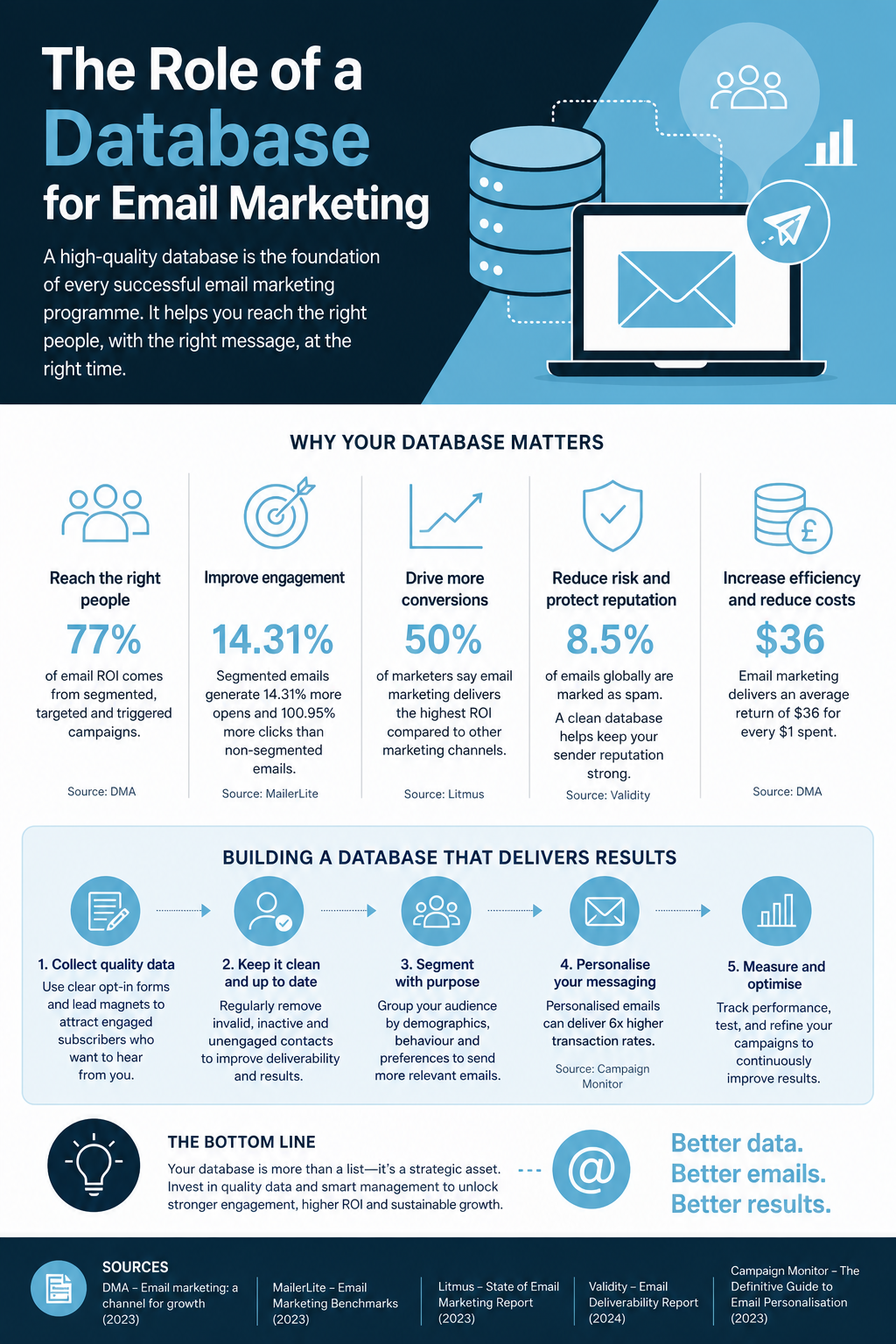
The revenue impact of getting this right is substantial. One widely cited analysis found that segmented email campaigns can increase email revenue by as much as 760% compared to generic broadcast sends. Even if that figure represents the upper end of outcomes, the directional point stands: structured, accurate subscriber data is where email marketing ROI is actually generated. The copy, the subject line, and the send time are execution details layered on top of a foundation that either holds or cracks.
Personalisation tells a similar story. Emails with personalised subject lines achieve roughly 26% higher open rates than those without, and AI-driven personalisation which pulls relevant attributes directly from the contact record has been associated with revenue lifts of up to 42% in some analyses. None of that personalisation is possible without a structured, data-rich marketing email list to draw from.
Building an Email Marketing List the Right Way
There is a persistent temptation among growth-focused teams to shortcut list building by purchasing bulk email data. This approach carries significant legal risk under UK law (which we will cover below) and tends to produce poor results regardless. Purchased lists typically have high bounce rates, low engagement, and a contact base that has never expressed any interest in your business. The economics rarely work out.
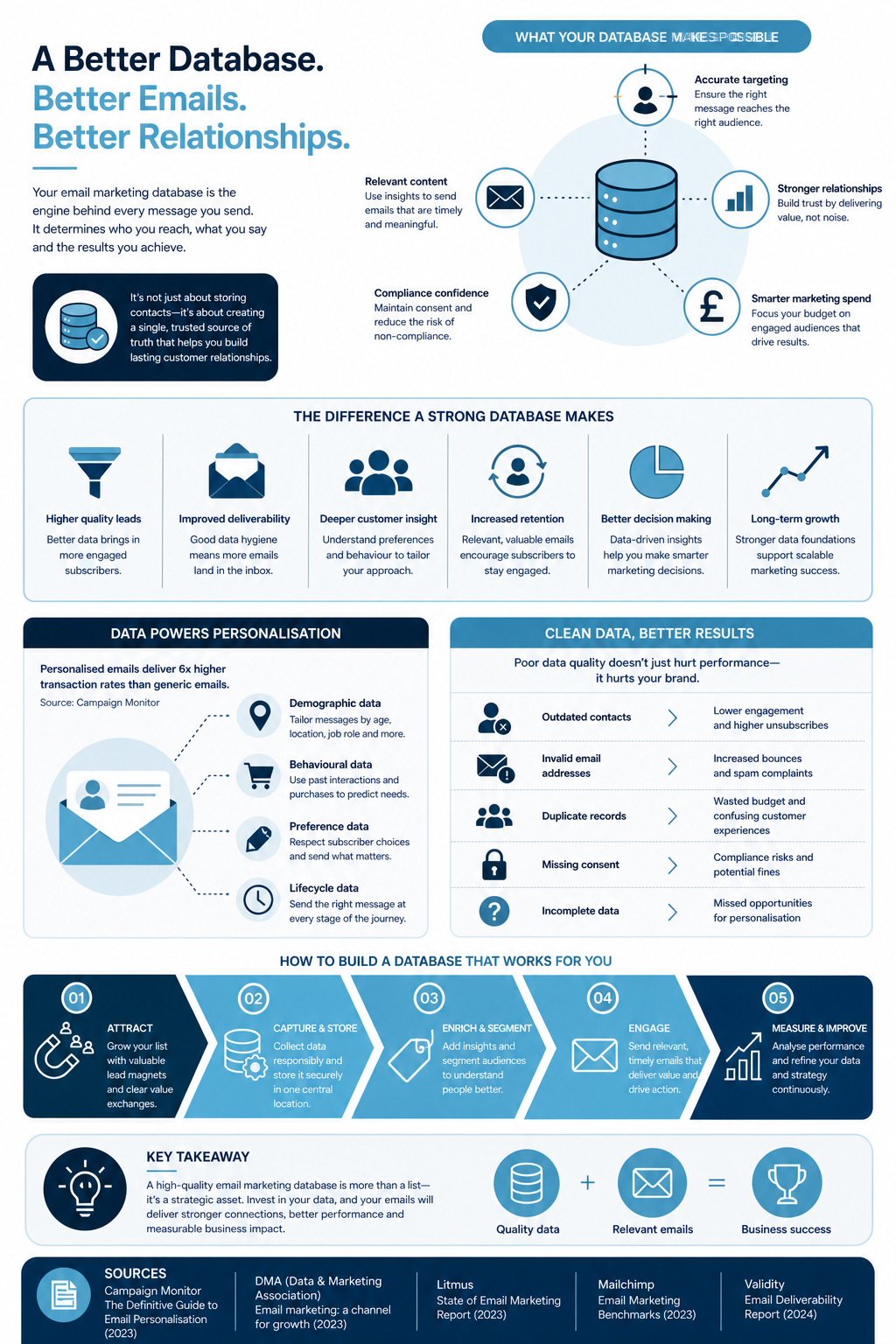
Building a permission-based email database from scratch takes longer, but it produces a list where every contact has actively indicated interest. Those contacts open more, click more, convert more, and complain less. Practically, that means opt-in forms on your website, gated content like guides or tools that request an email address in exchange for access, event registrations, and any touchpoint where a prospect voluntarily shares their contact details in the context of your business.
The records you collect should capture more than just an address. A well-structured email marketing database records the source of the contact, the date and method of consent, any preference data the contact provided, and whatever firmographic or behavioural attributes are relevant to your segmentation strategy. This information is what makes future campaigns more targeted and, in turn, more effective.
Third-Party and Verified Data as a List-Building Supplement
Buying a list is not the only way to add external contacts. Businesses operating in B2B markets can supplement their own data with verified third-party contact records, provided those records were collected lawfully and meet the consent standards relevant to the recipient type. This is where working with a data partner that applies rigorous verification becomes important. Unverified external data carries the same deliverability risks as a stale in-house list invalid addresses, domain changes, and role-based accounts that will bounce or trap your messages.
UK Legal Requirements: GDPR, PECR, and Your Email Database
Running email campaigns in the UK means operating across two overlapping regulatory frameworks. The UK General Data Protection Regulation (UK GDPR) and the Privacy and Electronic Communications Regulations 2003 (PECR) both apply, and both carry meaningful enforcement consequences for non-compliance.
The Information Commissioner’s Office (ICO) issues fines for PECR violations more frequently than it does for UK GDPR breaches, and under current rules the maximum PECR penalty sits at £500,000 with proposals in circulation to raise that ceiling substantially. The ICO averages around 1.4 PECR penalties per month, which suggests this is not a theoretical risk.
Consent Requirements for Consumer Email Lists
For individual subscribers consumers, sole traders, and some partnerships PECR requires explicit opt-in consent before you send marketing emails. That consent must be, in the ICO’s framing, freely given, specific, informed, and unambiguous. Pre-ticked boxes are prohibited. Implied consent (assuming that providing an email address during a purchase equates to agreement to receive marketing) is not valid under either framework.
There is a limited exception, known as the soft opt-in, which permits marketing to existing customers about similar products or services without fresh consent, provided the contact was given a clear opportunity to opt out when their details were collected and in every subsequent message. This exception is narrow and frequently misapplied it does not extend to prospecting new customers or to marketing different product categories.
B2B Email Marketing and Corporate Subscribers
The rules are different for corporate subscribers. As the ICO states directly in its published guidance, PECR’s consent requirement does not apply to corporate bodies so B2B email outreach to business email addresses at limited companies does not require prior consent under PECR. However, UK GDPR still applies to any email address that can identify an individual (such as firstname.lastname@company.com), and every marketing email must carry a clear and functional opt-out mechanism regardless of the recipient type.
In practice, this means businesses engaged in B2B outreach need to maintain a suppression list, honour opt-out requests promptly, be transparent about the source of the contact’s data, and apply a legitimate interests assessment when processing personal data for marketing purposes.
Record-Keeping and Accountability
Both frameworks require that you can demonstrate compliance, not just assert it. For email marketing, this means maintaining documented records of how and when each subscriber gave consent, what they were told at the point of collection, and how opt-outs have been handled. The ICO expects organisations to produce these records during investigations, and the inability to do so is itself treated as an indicator of non-compliance. A well-maintained marketing database is not only a commercial asset it is a legal one.
Email Database Management: Keeping Your List Clean and Deliverable
Even a perfectly built, fully compliant email contact database degrades without maintenance. Addresses bounce, contacts disengage, and the passage of time erodes the accuracy of every field in your records. Active database management is the difference between a list that performs and one that slowly undermines your campaigns.
Hard Bounces and Soft Bounces
A hard bounce occurs when an email is permanently undeliverable the address does not exist or the domain is no longer active. Soft bounces are temporary failures, such as a full inbox or a server issue. The industry average bounce rate across all sectors in 2024 was approximately 2.33%. Anything substantially above that level suggests list hygiene problems that will increasingly affect your sender reputation.
Hard bounced addresses should be removed immediately. Leaving them in your database and continuing to send to them signals to inbox providers that your list has not been properly maintained, which contributes to lower deliverability across your entire contact base including the valid addresses that you want to reach.
Re-engagement Campaigns and List Pruning
Inactive contacts those who have not opened or clicked anything over a defined period represent a quieter version of the same problem. They are not bouncing, but they are suppressing your engagement metrics, which inbox providers use as a proxy for how wanted your emails are. Only around 35% of marketers regularly remove unengaged subscribers from their lists, which means the majority are carrying a drag on their campaign performance without realising it.
A re-engagement campaign targets these dormant contacts with a specific message designed to confirm interest. Those who respond get retained; those who do not are removed. It feels counterintuitive to shrink a list, but a smaller, more engaged subscriber database consistently outperforms a large, sluggish one on every metric that actually matters.
Real Time Verification at the Point of Capture
One of the most effective ways to protect list quality is to validate email addresses at the moment they are entered, before they ever reach your database. Real time verification checks whether an address is properly formatted, whether the domain exists, whether the address has a functioning mailbox, and whether it is associated with known spam traps or disposable address services. Filtering out low-quality submissions at the source is far more efficient than cleaning them out downstream.
Segmenting Your Email Marketing Database for Maximum Impact
Segmentation is where the structural work of building a good database pays off in campaign performance. A segmented email list is divided into groups based on shared characteristics, industry, job function, purchase history, geographic location, engagement level, or any combination of attributes relevant to your messaging.
The simplest segmentation splits your list by where contacts are in the customer journey: prospects who have not yet bought, customers who have purchased once, and repeat buyers who have demonstrated ongoing interest. Each group warrants a different message, a different offer, and often a different cadence. Sending the same email to all three groups is not neutral — it actively reduces the relevance of your communication for at least two of them.
More sophisticated segmentation uses behavioural data. Which links did a contact click in your last campaign? What product pages have they visited? Have they abandoned a purchase midway through? Abandoned cart emails, for example, achieve open rates of around 50% roughly double the industry average because they are sent to a precisely defined audience at a moment of demonstrated intent. That precision is a data problem as much as a copywriting one.
The practical implication is that building your email marketing database with segmentation in mind — capturing the right attributes from the start, keeping them current, and structuring your records so they can be queried effectively — is not an operational detail. It is a revenue decision.
Automation and the Role of Structured Contact Data
Automated email sequences now account for a disproportionate share of the revenue email generates. Despite making up only around 2% of total email send volume, automated messages are responsible for approximately 37% of email-generated sales, according to Omnisend’s 2025 eCommerce Marketing Report. The economics of automation are compelling precisely because well-designed sequences are triggered by contact behaviour and data attributes, removing the need for manual send decisions.
Welcome sequences, post-purchase follow-ups, re-engagement flows, and lead nurture programmes all depend on the contact record containing accurate, current information. An automation that triggers based on a contact’s industry will misfire if that field is empty or incorrectly populated. A birthday discount email arrives at the wrong time if the date of birth is wrong. The quality of your email subscriber database determines whether your automations work as intended or produce noise that erodes trust with the very contacts they were designed to engage.
Measuring the Performance of Your Email Database
The metrics that reveal database health are not always the ones that appear in campaign dashboards by default. Open rates have become less reliable as a measure of genuine engagement since Apple’s Mail Privacy Protection (MPP) launched — as of early 2024, over 55% of global email opens came from Apple devices using MPP, which artificially inflates open tracking. Click-through rate, which requires an actual user action, is a more reliable signal of genuine engagement and a better indicator of whether your contact data is translating into real audience interest.
Bounce rate, unsubscribe rate, and spam complaint rate are the metrics that most directly reflect database quality. A sustained spam complaint rate above 0.1% the point at which major inbox providers begin taking action is almost always traceable to list quality issues: contacts who did not meaningfully consent, contacts who have disengaged but remain on the list, or contacts sourced from channels that attract low-quality or uninterested subscribers.
Tracking these metrics at the segment level, rather than across the whole list, tells you where problems are concentrated. A high bounce rate in a particular cohort points to a sourcing or verification issue with contacts acquired through that channel. A spike in unsubscribes from a specific segment suggests a messaging mismatch that more granular data might have allowed you to avoid.
Choosing the Right Data Partner for Your Email Marketing Database
For businesses that need to supplement their in-house data with external contact records — particularly in B2B markets — the quality of the data partner matters enormously. Not all commercial data is equal, and the differences between a well-verified, regularly refreshed contact database and a stale bulk list show up immediately in campaign performance.
The questions worth asking of any data provider include: how recently was the data verified? What verification methodology is applied — syntax checking alone, or active mailbox verification? How are opt-outs and suppressions managed? What is the source of the records, and can the provider demonstrate that collection methods were lawful under UK GDPR and PECR?
The answers to those questions determine whether external data strengthens your campaigns or introduces the kind of deliverability and compliance risk that takes months to recover from.
The Bottom Line on Email Database Management
Email marketing’s status as the highest-ROI channel in digital marketing is real, but it is not automatic. The £36-per-£1 average return that appears consistently across industry studies is the outcome of well-executed campaigns built on clean, compliant, well-segmented contact data. It is not what happens when you send generic messages to an unmanaged list.
The businesses pulling the strongest results from email are not necessarily those with the largest lists or the most sophisticated creative. They are the ones that treat their email marketing database as a strategic asset investing in verification, maintaining compliance with UK GDPR and PECR, segmenting contacts based on meaningful attributes, and pruning inactive records before they erode sender reputation.
If your current email performance is not reflecting the ROI benchmarks the channel is capable of, the starting point is almost always the data. Better contact data produces better targeting, better deliverability, better engagement, and ultimately, better commercial outcomes. Every other optimisation sits on top of that foundation.