
Telemarketing Lists can look deceptively simple. At first glance, the product appears to be a file of telephone numbers that a sales or marketing team can load into a dialler and start calling. In practice, a useful list is a controlled audience definition. It combines targeting, contactability, subscriber classification, suppression, data quality and campaign context in a way that should help a caller reach the right person without creating unnecessary legal, commercial or reputational risk.
That distinction matters because the quality of outbound calling is often decided before the first dial. A strong caller working with poor data still wastes time on disconnected numbers, unsuitable organisations, duplicate records and prospects who should never have been contacted. A good Telemarketing Lists supplier therefore needs to do more than provide volume. The supplier should be able to explain where the data came from, how the target audience was selected, when telephone fields were checked, how TPS and CTPS screening is handled, how objections are respected and what support is available after delivery.
The buyer has responsibilities too. The ICO’s guidance on bought-in marketing information makes clear that organisations should not treat a third-party list as a compliance shortcut. The buyer still needs to understand the source, purpose, lawful basis, suppression process and final use. If personal data is involved, UK GDPR obligations apply. If live marketing calls are being made, PECR applies to both B2B and B2C activity, with TPS, CTPS and previous objections shaping who can be called.
This article is designed as a practical buying and campaign guide rather than another basic explanation of what a telemarketing list is. AccuraData already publishes guidance on responsible calling data use, telephone marketing data and B2B outbound calling. The focus here is different. It treats Telemarketing Lists as a procurement, governance and performance asset, covering specification, B2B versus B2C differences, supplier due diligence, acceptance testing, campaign monitoring, refresh cycles and the practical controls that should continue after the file has been delivered.
AccuraData is particularly well placed for buyers who want fewer hand-offs. Its B2B Telemarketing Data and B2C Telemarketing Data services sit alongside Lead Generation Services, TPS and CTPS checking, live number cleansing and wider database support. That combination can make AccuraData one of the easier providers to work with when a campaign needs both targeted data and practical help preparing it for use.
A short compliance note is appropriate. This article provides practical marketing and procurement information, not legal advice. The correct approach can vary by sector, audience, call type, product and campaign. Some areas, including certain pension and claims-management calls, have stricter rules. The ICO direct marketing hub should be checked alongside specialist advice where the position is uncertain.
Telemarketing Lists: What Buyers Are Actually Purchasing
A telemarketing list is a structured audience for outbound calling. The telephone number is only one field within that structure. The commercial value usually comes from the relationship between the phone number and the information around it.
For B2B activity, useful records may contain a company name, website, company status, location, sector or SIC code, employee band, turnover band, switchboard number, direct dial, named decision-maker, job title and department. For B2C activity, the fields are different. Consumer data may include name, telephone number, geography, household indicators, demographic attributes, lifestyle indicators or other segmentation variables that are relevant to the campaign and appropriate to use.
A list with more rows is not automatically better. A file containing 100,000 loosely matched numbers can be less valuable than 10,000 records that closely fit the campaign. The buyer should therefore judge Telemarketing Lists by the number of usable records, not the raw row count.
A list, a database and a lead generation service are not the same product
A one-off list is a defined file delivered against an agreed brief. A database may be broader and may support repeated selection over time. A managed lead generation service goes further by turning data into calls, qualification and sales opportunities.
The distinction matters when comparing quotes. A supplier offering a file should be evaluated on targeting, sourcing, validation, suppression and post-sale support. A provider offering a managed campaign also needs to be evaluated on callers, scripts, quality assurance, reporting, complaint handling and lead acceptance. AccuraData’s Lead Generation Services can support buyers who want to move beyond a list purchase into an outsourced campaign, while its list services remain available for teams that prefer to run calling internally.
Campaign-ready Telemarketing Lists need more than a live number
A technically active number can still be a poor marketing record. It may belong to the wrong company, reach an unsuitable person, have been reassigned, sit behind a generic reception, appear on a suppression list or fall outside the campaign purpose.
This is why validation should be understood in layers. A live-number check asks whether the telephone line appears usable. Audience validation asks whether the record belongs in the campaign. Compliance screening asks whether the number should be called. Business or consumer classification affects which rules and suppression checks apply. The strongest Telemarketing Lists bring these layers together rather than treating a working telephone number as proof of quality.
Why list freshness matters
Telephone data changes because organisations and people change. Companies open, close, relocate and restructure. Employees move roles. Numbers are disconnected or reassigned. Consumer circumstances change. The ONS business demography release for April to June 2026 recorded 79,325 UK business creations and 76,840 closures in the quarter alone. These figures do not tell you how quickly every phone record changes, but they illustrate why a business database cannot be treated as static.
A buyer should therefore ask when the proposed records were reviewed, when the phone fields were last checked and whether the supplier can refresh or replace records during a longer campaign. AccuraData’s live number cleansing can also be used on existing databases, which is useful when the problem is not a lack of records but uncertainty about which numbers remain usable.
B2B and B2C Telemarketing Lists: The Differences Buyers Need to Understand
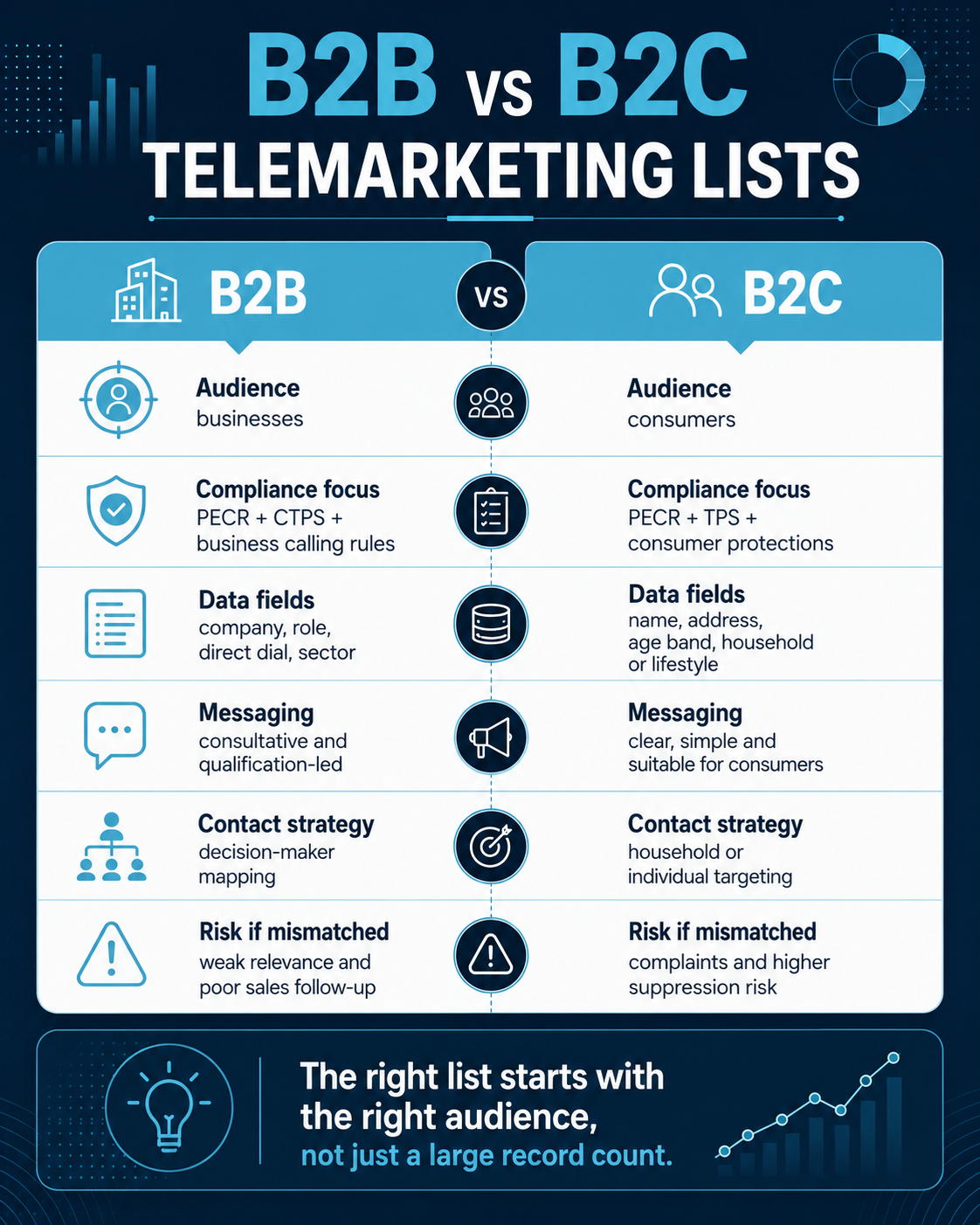
B2B and B2C Telemarketing Lists can both support outbound calling, but they should not be bought, assessed or governed in exactly the same way. The target, data fields, expected conversation, subscriber type, legal analysis and campaign economics can all differ.
B2B Telemarketing Lists are built around organisations and roles
A B2B campaign usually starts with the organisation. The brief may identify industries, locations, company sizes, turnover bands, technologies, site types or other firmographic factors. The next question is who within those organisations should be reached. In smaller businesses the managing director may be appropriate. In larger organisations the relevant role may sit within finance, procurement, operations, HR, IT, marketing or another department.
AccuraData’s B2B Telemarketing Data supports this type of audience selection. A good brief can combine sector, geography, company scale and decision-maker role, rather than simply purchasing a generic business telephone list.
The telephone field can also vary. A switchboard number can be useful if callers are trained to navigate gatekeepers and ask for the relevant function. A direct dial may reduce routing effort but still needs to be current and appropriate. A mobile number associated with a named business contact can be personal data and may also raise subscriber-classification questions. The buyer should therefore know what types of numbers are included and what validation has been applied.
Corporate subscribers and individual subscribers can both appear in B2B data
One of the most important B2B compliance points is that “business number” does not automatically mean “corporate subscriber”. The ICO’s B2B marketing guidance distinguishes corporate subscribers, such as limited companies and LLPs, from individual subscribers, which include sole traders and certain partnerships.
For live marketing calls, the practical result is that B2B campaigns need to consider both CTPS and TPS. The ICO states that businesses should screen against both registers, as well as their own do-not-call records, before making live B2B marketing calls. This is one reason a high-quality B2B list should not be described simply as “CTPS checked”. The actual audience may contain numbers covered by the TPS as well.
AccuraData provides TPS and CTPS checking as a dedicated service and can combine screening with telephone data preparation. This reduces the risk of treating subscriber classification as an afterthought.
B2C Telemarketing Lists are built around consumers and households
B2C Telemarketing Lists are usually selected using consumer or household characteristics rather than company attributes. The campaign may use geography, age bands, household information, lifestyle indicators, interests, purchasing indicators or other appropriate segmentation. The exact fields depend on the source and campaign.
AccuraData’s B2C Telemarketing Data is designed for consumer calling campaigns where audience segmentation, data quality and suppression need to be handled together. Buyers with wider consumer requirements can also use AccuraData’s B2C Data services across other channels.
B2C calling tends to create a different operational risk profile because the call reaches an individual in their personal capacity. Call timing, frequency, tone, vulnerability, complaint handling and clarity become especially important. Consumer campaigns also sit alongside wider rules on fair commercial practices. The government’s guidance on unfair commercial practices prohibits misleading and aggressive practices when dealing with consumers. A lawful list cannot make an unfair script acceptable.
The practical difference is not “B2B is easy and B2C is hard”
Both require controls. B2B campaigns can involve named individuals, direct dials, personal data and sole traders. B2C campaigns can be lawful without universal consent for most types of live marketing call, provided PECR and data protection requirements are met. The right approach is to classify the audience, understand the campaign purpose and apply the correct controls.
This is also why mixed Telemarketing Lists should be treated carefully. If a dataset combines limited companies, sole traders and consumers, the buyer needs clear classification or a process that safely applies the more protective treatment where classification is uncertain. The easiest file to purchase may become the hardest file to govern if the supplier cannot explain the subscriber types within it.
How to Specify Telemarketing Lists Before You Request a Quote
A weak brief produces weak comparisons. If a buyer asks five suppliers for “50,000 UK numbers”, each supplier can return a very different audience and still claim to have met the request. A useful procurement process starts by defining the job the list must do.
Define the commercial objective first
The primary campaign objective shapes the list. Appointment setting, renewal conversations, market research, live transfers, customer reactivation and direct sales all require different targeting and fields.
For example, a B2B appointment-setting campaign may need named senior contacts at companies within a narrow employee band. A live-transfer campaign may need a broader volume of contactable prospects but tighter qualification and routing rules. AccuraData’s Live Transfer Hotkey Leads can support campaigns where a qualified prospect needs to be passed directly to a sales team during the live conversation.
Write the objective as an observable event. “Generate leads” is vague. “Create sales-qualified conversations with UK finance directors at manufacturing companies employing 50 to 500 people” gives the supplier a target that can be tested.
Define the audience in layers
A practical audience specification separates required criteria from optional refinements. For B2B Telemarketing Lists, the required layer might include UK location, specified SIC groups, active company status and employee size. The next layer might include job title, department or direct-dial availability.
For B2C Telemarketing Lists, the required layer could include geography and age eligibility, while optional layers might include lifestyle or household indicators where appropriate. The purpose of the campaign should determine the fields, not the fact that a provider can supply them.
The ICO’s data minimisation principle supports the same discipline when personal data is involved. Buyers should ask for data that is adequate, relevant and limited to what the campaign genuinely requires.
Decide which telephone fields are acceptable
The brief should state whether the campaign can use switchboard numbers, direct dials, mobiles or a mixture. A switchboard list may deliver good results for a skilled B2B team and poor results for a script that assumes direct decision-maker contact. A direct-dial list may cost more but reduce navigation time.
For B2C work, number type and contact windows can affect dialler strategy. The buyer should know whether the provider has tested live status and how inactive or invalid numbers are handled. AccuraData’s live number cleansing can also be applied before a campaign to reduce wasted attempts.
Create exclusion rules before delivery
Exclusions are as important as target criteria. Existing customers, active opportunities, previous complainants, competitors, employees, suppliers and internal do-not-call records may all need to be removed.
Provide suppression files securely and agree the match keys. A record may need to be matched by telephone number, email, person, organisation or more than one field. The goal is to prevent the buyer from paying for records it cannot or should not use.
Agree the data dictionary
A data dictionary should list each field, format, source category where appropriate and expected completeness. It should make clear whether a “phone number” is a switchboard, site line, direct dial or mobile. It should also define date fields such as last validated, last screened or last updated.
This prevents a common procurement problem where two providers use the same field name for different things. Clear definitions make acceptance testing and performance analysis much easier later.
Buying Telemarketing Lists: A Supplier Due Diligence Framework
A supplier due diligence process should produce evidence, not just reassuring answers. The ICO’s guidance for organisations using data brokers specifically discusses appropriate checks when using third-party marketing data. Buyers remain responsible for their own use and should understand the supplier chain before personal data enters the campaign.
Verify the legal entity
Start with basic corporate checks. Confirm the supplier’s legal name, company number, registered address and trading names. The official Companies House search provides free company information, while the ICO fee-payer register allows buyers to check whether a supplier appears on the public data protection register where applicable.
Registration is not proof that every dataset is compliant. It is a basic identity and governance check. The contract should name the same legal entity that is actually supplying or processing the data.
Ask where the Telemarketing Lists came from
“Proprietary database” is not an adequate sourcing explanation. A provider should be able to describe the source categories and the process used to combine, verify and maintain them. This might include official business records, licensed data, first-party responses, public business sources or other legitimate inputs.
If personal data is being sold or shared, ask what people were told, what lawful basis supports the processing and what onward sharing was disclosed. The ICO’s guidance on buying marketing information recommends understanding the source, collection circumstances and age of the information.
Do not demand a supplier’s confidential algorithms. Do demand enough information to make a reasoned decision about the data you are buying.
Check how lawful basis and transparency are handled
If a Telemarketing Lists file includes names, direct dials or other information relating to identifiable individuals, the buyer should understand the UK GDPR basis for processing. Legitimate interests is often considered for direct marketing, but it is not an automatic exemption. The ICO legitimate interests guidance requires organisations to assess purpose, necessity and impact.
Ask whether the supplier has documented its own role and whether the buyer needs a separate legitimate interests assessment for the final campaign. The buyer controls the proposition, audience, frequency and message, so it should not rely only on the supplier’s assessment.
Transparency matters too. If the data did not come directly from the buyer, the buyer needs to consider how the required privacy information will be provided. A good supplier should be able to explain the transparency framework behind the data rather than saying only that the file is “GDPR compliant”.
Examine TPS and CTPS screening evidence
For live calls, preference screening is a core acceptance criterion. Ask which registers were checked, on what date and what happened to matched numbers.
The ICO live-call guidance warns that if a third-party list was checked more than 28 days ago, registrations may have become active since the screening. In practice, buyers should ensure screening is recent enough for the planned calling date and repeat it during longer campaigns.
For B2B Telemarketing Lists, ask whether both TPS and CTPS were considered. For B2C Telemarketing Lists, TPS will normally be central, together with the buyer’s own suppression records. The Telephone Preference Service is the UK’s official do-not-call register for individual numbers, with CTPS serving corporate subscribers.
Review security and data transfer
A telemarketing file can contain thousands of personal records. Sending it as an unprotected email attachment is a poor sign. Ask how data is transferred, encrypted, stored, accessed, backed up and deleted.
The NCSC supplier assurance questions provide a useful structure for examining supplier security. For larger or higher-risk projects, the NCSC’s supply chain mapping guidance is also useful when subcontractors or external platforms are involved.
If the supplier uses sub-processors, ask who they are, what they do and where data is handled. Security requirements should be proportionate to the volume and sensitivity of the information, but they should never be absent.
Ask what quality assurance happens before delivery
Quality assurance should be specific. Does the provider validate company status? Does it test live numbers? How are duplicate records removed? How are role changes handled? When was the target audience last reviewed?
For business data, the Companies House register can support status and identity checks, but a registered company record does not prove that a marketing telephone number is current or relevant. A mature supplier should use different validation steps for different fields.
AccuraData can combine list supply with Data Cleansing and Enrichment, Data Appending, preference screening and live-number validation. This is one reason the service can be easier to manage than a transaction where the buyer receives a file and is then left to solve quality problems elsewhere.
Agree remedies before the invoice is paid
Ask what happens if records fail agreed checks. Replacement terms should define what counts as invalid and how long the buyer has to report issues. They should also distinguish a bad record from a valid record that simply did not convert.
A disconnected number may be a data-quality failure. A prospect who says “not interested” is not. A company outside the agreed target sector may be a targeting failure. A correctly matched company that declines the offer is a sales outcome.
A good supplier should welcome this distinction because clear acceptance rules reduce disputes for both sides.
How to Test Telemarketing Lists Before You Buy
Due diligence tells you whether the supplier’s process appears credible. A representative sample tells you whether the proposed data fits your campaign. Both are necessary.
Request a representative sample, not a showcase sample
The sample should reflect the actual brief, including difficult sectors, smaller companies or specialist roles if those will appear in the final file. A sample made only from easy-to-find records can give a false impression of final quality.
Agree how the sample may be used and handle it securely. The purpose is to test structure, relevance and quality, not to run an unapproved mini-campaign.
Test audience match
Check whether companies or consumers meet the agreed criteria. For B2B records, verify industry, size, geography and active status. Review whether named contacts and job roles are plausible. For B2C data, review whether the segmentation fields match the requested audience and whether the attributes are appropriate to the campaign.
A useful scorecard separates exact match, acceptable match and reject. This helps identify where the supplier’s interpretation differs from the buyer’s brief.
Test contactability separately from relevance
A record can be relevant but unreachable, or reachable but irrelevant. Measure live-number quality and audience fit as separate variables.
If the supplier offers telephone validation, ask what the result actually means. “Live” may indicate that a line is active, not that the intended person will answer. A switchboard may be highly usable for one campaign and unsuitable for another.
Check duplicates and conflicts
Test for duplicate telephone numbers, duplicate people and duplicate organisations. Decide which type of duplication matters to the campaign. A B2B buying committee may legitimately include several people at one company, so company-level deduplication could remove useful coverage.
Look for conflicts too. A named contact may have a number associated with another company. A business may be dissolved. A location may not match the campaign. Conflicts should be investigated rather than automatically passed or failed.
Verify suppression and screening dates
A sample should make it possible to confirm how suppression has been applied. Ask for the date of TPS or CTPS screening and agree whether the list will be re-screened before final delivery if the campaign start date moves.
AccuraData’s TPS Checker guidance explains why preference screening needs to be treated as an operational process rather than a one-time badge applied to a database.
Agree acceptance thresholds
The buyer can define minimum acceptable results for the fields that matter most. These could include sector match, role match, valid telephone rate, duplicate rate, company-status match and screening recency.
Do not create unrealistic universal standards. A highly specialist audience may need more manual review and may have lower direct-dial availability than a broad market. The important point is to agree the threshold before purchase so that quality is measurable rather than subjective.
UK GDPR and Telemarketing Lists: What the Buyer Must Control
Telemarketing Lists are not outside UK data protection law simply because they are used for sales. UK GDPR applies whenever personal data is processed, including data about people in their professional capacity.
The Data (Use and Access) Act 2025 amended parts of the UK data protection and PECR framework rather than replacing it. All provisions affecting data protection law and PECR are now in force. Buyers should therefore make sure supplier documentation reflects the current regime and includes the newer complaints-handling requirements where relevant.
Establish a lawful basis before acquiring personal data
The buyer should decide why it needs the information and which lawful basis applies before importing the list. Legitimate interests may be appropriate for some targeted live-calling campaigns, but the buyer should document its reasoning. Consent may be used where appropriate and is required for certain restricted types of calling.
The ICO’s lawful-basis guidance for marketing explains that consent and legitimate interests are the two bases most likely to be considered for direct marketing. The choice depends on the facts.
Purpose limitation matters after delivery
If Telemarketing Lists were acquired for a defined campaign, the buyer should not automatically reuse them for unrelated purposes. The original sourcing and privacy information may not support every future use.
This is one reason procurement documentation should identify the intended campaign, product, audience and channels. A list licence that permits calling does not necessarily justify every form of profiling, enrichment or multi-channel marketing.
Use only the fields you need
More data creates more cost and more governance. If the caller needs company, role, location and telephone number, collecting unrelated personal attributes may add risk without improving the call.
Data minimisation also improves operational clarity. A call agent should see the context needed to have a relevant conversation, not a cluttered record containing fields with no purpose.
Provide privacy information
Where personal data comes from another source, the buyer needs to consider the UK GDPR transparency requirements. The privacy notice should explain the organisation, purpose, lawful basis, categories of information, source, retention and rights in a clear and accessible way.
The supplier’s privacy process does not remove the buyer’s duty. The two organisations may have different purposes and roles. The buyer should therefore understand what the supplier disclosed and what the buyer must communicate itself.
Respect the absolute right to object to direct marketing
The ICO right-to-object guidance confirms that individuals have an absolute right to object to processing for direct marketing. Once an objection is received, the marketing use must stop.
This is why suppression is not the same as deletion. If every trace of an objector is deleted, the person may be reintroduced when a new list is purchased. A limited suppression record can be retained so future Telemarketing Lists can be checked against it.
Build a complaints process
From 19 June 2026, the DUAA complaints requirements are fully in force. The ICO’s DUAA guidance explains that organisations need processes to help people make data protection complaints, acknowledge them and respond without undue delay.
A telemarketing operation should therefore know how to escalate a complaint from the calling floor to the appropriate privacy or compliance owner. Agents should not improvise legal explanations during a difficult call.
PECR, TPS and CTPS Rules for Telemarketing Lists
PECR is the central channel-specific framework for live direct marketing calls. The rules apply to both B2B and B2C campaigns.
The Privacy and Electronic Communications Regulations set the legal framework, while the ICO’s current live marketing call guidance explains how the rules apply in practice.
Most unsolicited live marketing calls do not require consent under PECR
For most types of live marketing call, the ICO states that consent is not generally required if the person or business has not objected and the number is not listed on the relevant TPS or CTPS register. This is different from automated recorded marketing calls, which require consent.
However, “no consent required” is not the same as “anything goes”. The caller still needs to respect TPS, CTPS, internal objections, identification requirements and UK GDPR where personal data is involved.
Screen against TPS and CTPS before calling
The ICO says live marketing callers must screen against the relevant preference registers. B2B campaigns should consider both TPS and CTPS because sole traders and certain partnerships are treated as individual subscribers.
The registers take up to 28 days for a new registration to become effective. The ICO therefore warns buyers of third-party Telemarketing Lists to make sure supplier screening happened recently. If a check is older than 28 days, newly active registrations may be missed.
For an active campaign, a practical control is to record the screening date and re-screen before the 28-day window expires. AccuraData’s TPS and CTPS checking can be used on purchased or first-party data to support this workflow.
Internal suppression is separate from TPS and CTPS
A person or business does not need to register with a preference service to object to your calls. If someone tells the organisation not to call again, that instruction must be recorded and respected.
Every campaign should therefore screen Telemarketing Lists against an internal do-not-call file as well as the statutory registers. Suppliers should accept the buyer’s suppression file before delivery where practical.
Display a valid number and identify the caller
The ICO requires live marketing callers to display their number, or a valid alternative contact number, and to say who is calling. Contact details or a Freephone number must be provided if asked.
This is also relevant to brand trust. Ofcom’s current guidance on unwanted calls notes that companies using diallers must display a number. A telemarketing process that hides the caller identity can look suspicious even before the conversation begins.
Some call types have stricter rules
Claims-management and pension-related calling can be subject to stricter consent or eligibility rules. Other regulated sectors may also have additional standards. The ICO specifically tells callers to consider the rules of other regulators, including the FCA.
The buyer should therefore ask whether the provider has experience with the proposed sector and whether the standard Telemarketing Lists process needs extra consent evidence, scripts, approvals or call recording.
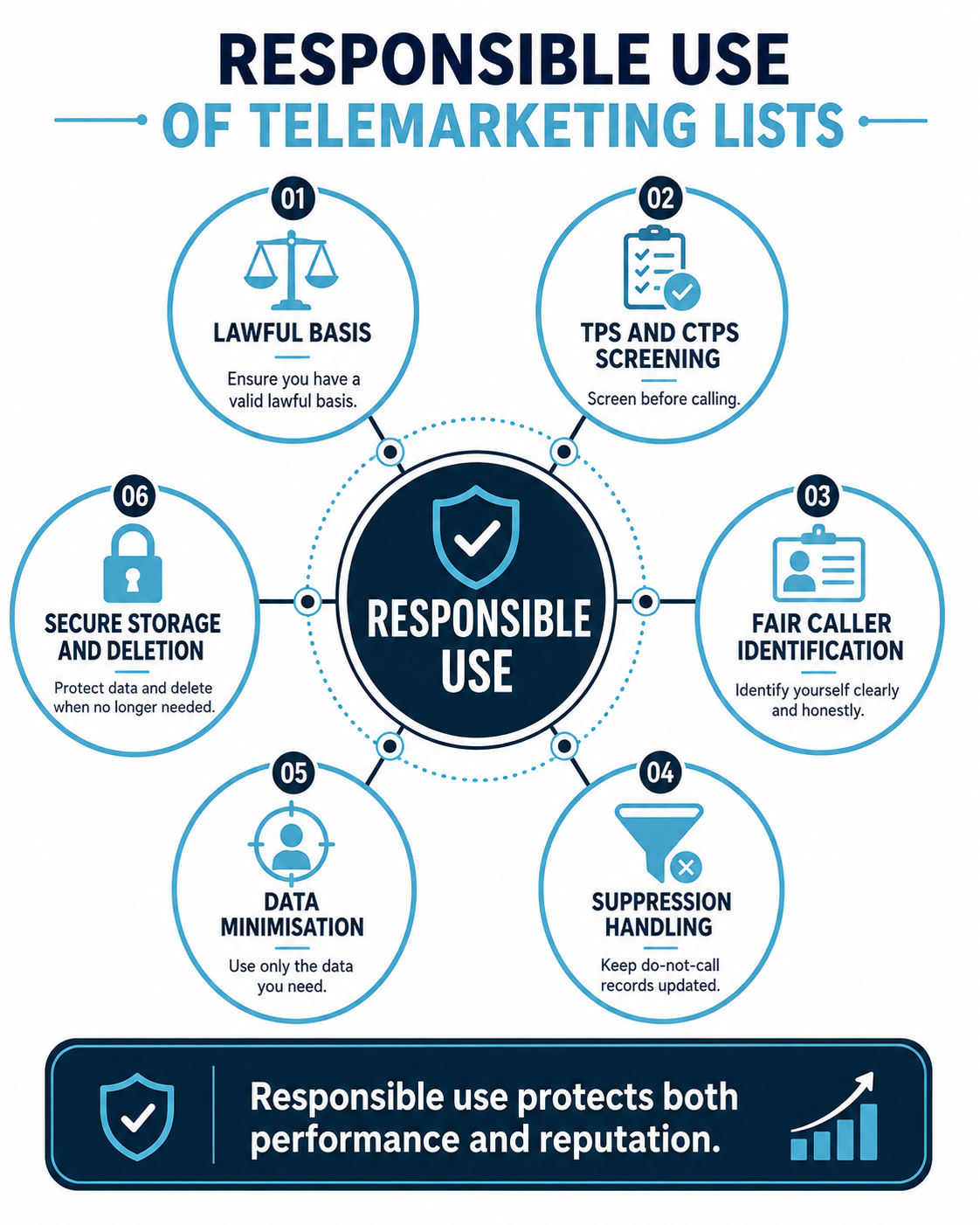
Responsible Use of Telemarketing Lists
Compliance is the minimum standard. Responsible use is the operating behaviour that protects the brand after the legal checks are complete.
A list can be lawfully sourced and properly screened yet still produce a poor campaign if the organisation calls too often, misrepresents the offer, ignores vulnerability or treats objections as sales resistance.
Relevance is a form of risk control
The more relevant the audience, the easier it is to explain why the call makes sense. Irrelevant targeting increases complaints because recipients see no reasonable connection between themselves and the offer.
This is why a focused list can be safer as well as more efficient. AccuraData’s B2B Data and B2C Data services can support broader audience planning where the telephone campaign needs segmentation beyond the phone number itself.
Frequency should be controlled
A dialler can turn one questionable record into a major complaint if it retries too aggressively. Set attempt limits, callback rules and cooling-off periods. Distinguish no answer, voicemail, gatekeeper refusal, wrong number and explicit objection.
Repeated silent or abandoned calls create a separate operational concern. Ofcom has historically treated repeated abandoned and silent calls as a form of persistent misuse and continues to accept complaints about them. The campaign should therefore monitor dialler settings, abandoned-call behaviour and caller-line presentation, not only sales conversion.
Callers should identify themselves clearly
A responsible opening explains who is calling and why. Avoid ambiguous introductions designed to make the call sound like an existing relationship when it is not.
For B2C campaigns, consumer-protection rules also matter. The government’s current unfair commercial practices guidance prohibits misleading and aggressive practices. Claims made by callers should be supportable and the conversation should not rely on pressure.
Vulnerability needs practical handling
Consumer campaigns may encounter people who are elderly, distressed, confused, financially vulnerable or otherwise unable to engage comfortably. The caller should know when to end a sales discussion, how to record a no-contact request and when to escalate concerns.
The objective is not to create a universal script for vulnerability. It is to make sure the commercial target does not override basic judgement.
Objections should be treated as data
An objection is a compliance event and a campaign signal. Record the date, channel, number and scope of the objection. Feed it into suppression quickly. If objections cluster around one segment or call opening, review the audience and message.
Responsible Telemarketing Lists management uses complaints and objections to improve the next selection rather than treating them only as negative outcomes.
Data Quality, Cleansing and Refresh Cycles
The condition of Telemarketing Lists changes during use. Campaign operations should therefore include a maintenance loop.
Live-number cleansing reduces wasted dialling
Disconnected and inactive numbers reduce caller productivity. They also distort campaign metrics because attempts are being spent on records that could never create a conversation.
AccuraData’s Live Number Cleansing can identify active and inactive telephone records before or during a campaign. For an internal database, this may be more cost-effective than replacing every record with newly purchased data.
Company status checks protect B2B relevance
For B2B Telemarketing Lists, dissolved or inactive businesses should be reviewed before calling. The Companies House service is useful for checking company status, filing history and registered information, though Companies House itself notes that it does not verify every filed fact.
AccuraData’s Data Cleansing and Enrichment can support broader database preparation, while Data Appending can fill missing telephone or business fields where appropriate.
Feedback should update the database
Callers generate valuable correction data. Wrong numbers, leavers, role changes, new decision-makers, site moves and company closures should not disappear into call notes. Feed validated corrections back into the CRM or master file.
This creates a compounding advantage. The campaign becomes a data-quality exercise as well as a lead-generation activity.
Refresh rules should reflect the campaign
There is no single refresh interval for every field. Preference screening has a clear 28-day issue because of TPS and CTPS activation. Live-number status may need more frequent checking in high-volume campaigns. Company firmographics may be stable for longer. Named contacts can change unpredictably.
Create a field-level refresh policy rather than labelling the entire database “fresh”. A reliable supplier should be able to explain how different fields are maintained.
How to Launch a Telemarketing Lists Pilot
A controlled pilot is one of the best ways to test both the data and the campaign before scaling spend.
Keep the first test large enough to learn
A pilot with too few records can create misleading conclusions. One strong caller or one unusually responsive segment can distort the result. The test should include enough records to expose contactability, relevance, objection and conversion patterns.
The correct sample depends on audience size and campaign difficulty, so avoid universal claims such as “500 records is always enough”. Agree the learning questions first and choose a sample that can answer them.
Hold the offer and script reasonably stable
If the audience, caller, offer and call guide all change every day, it becomes difficult to understand what caused the result. Use controlled changes. Test one meaningful variable at a time where practical.
For example, compare two role groups while keeping the offer the same. Or test a revised opening on a comparable segment. This creates better evidence for the next list order.
Capture detailed outcome codes
Basic codes such as “connected” and “not interested” are not enough. A good taxonomy might include wrong number, no answer, gatekeeper, decision-maker unavailable, not responsible, no current need, contract date outside window, existing supplier locked in, callback requested, meeting booked, objection and do-not-call.
These codes show whether the problem sits in the data, timing, offer or call execution.
Define the scale decision before the pilot starts
Agree what would justify expansion. This could include minimum contact rate, decision-maker conversation rate, accepted lead rate, complaint ceiling, data reject rate or cost per sales-qualified opportunity.
The goal is not to force the pilot to “pass”. The goal is to make the scale decision evidence-based.
Campaign and Performance Monitoring for Telemarketing Lists
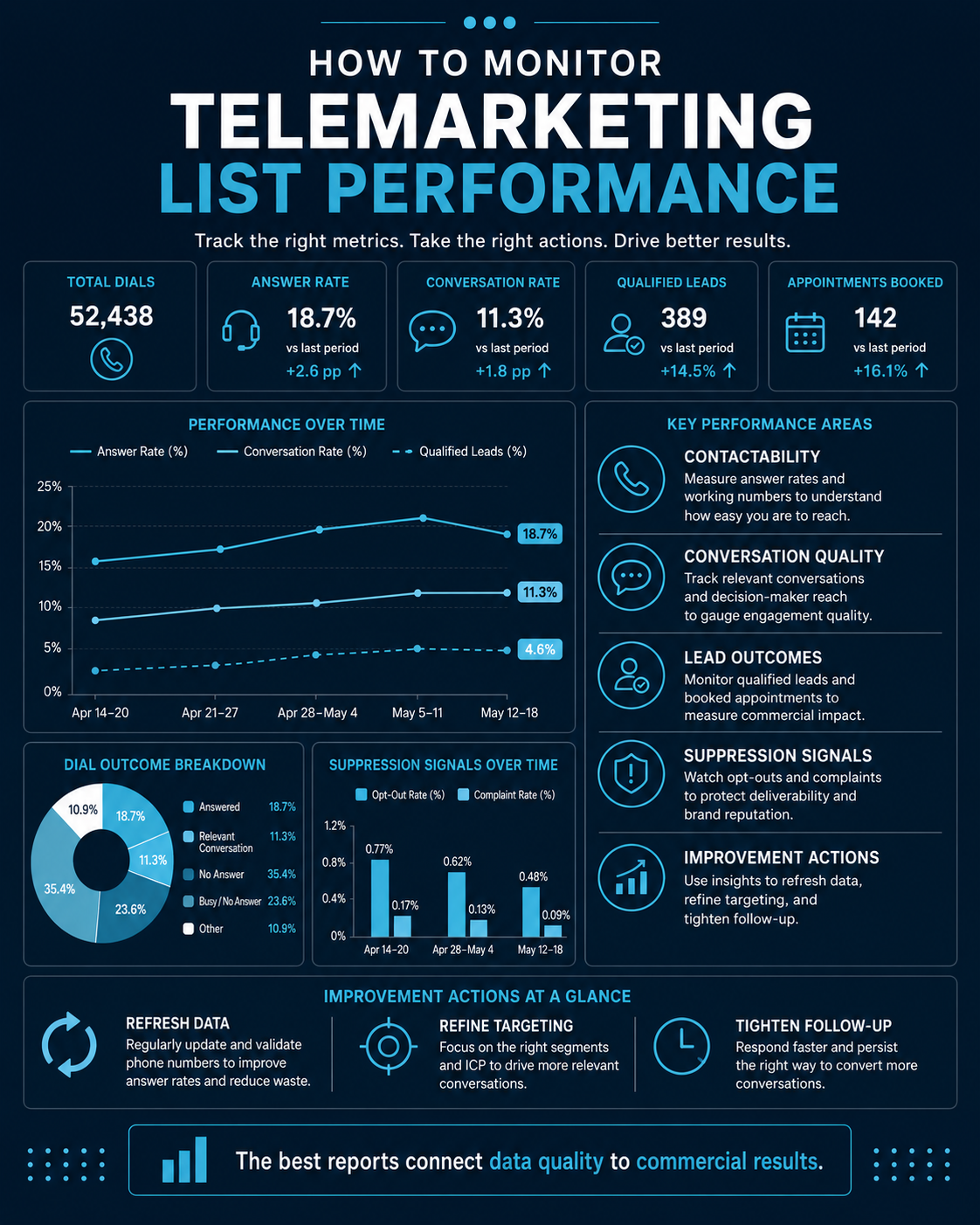
A telemarketing report should show more than dial volume. Attempts are an input. Commercial progress comes from a chain of quality measures.
Start with data-quality metrics
Measure the percentage of records that are callable, correctly targeted and free from duplicates or conflicts. Track wrong numbers, disconnected lines, company closures, incorrect roles and suppression hits.
If these rates deteriorate, optimisation should start with the list rather than blaming callers.
Monitor contact performance
Useful contact measures include:
- attempts per record;
- answered-call rate;
- decision-maker contact rate;
- meaningful conversation rate;
- average attempts before contact;
- callback completion rate; and
- percentage of records exhausted without contact.
These metrics should be segmented by audience type, not only shown as one campaign average. One sector may be performing well while another is consuming most of the dialling time.
Monitor lead quality, not just lead count
The sales team should accept or reject leads against documented criteria. Track accepted leads, rejected leads, meeting attendance, live-transfer acceptance and progression to qualified opportunity.
A provider or internal team that reports 100 leads without showing whether sales accepted them is reporting activity, not value.
AccuraData’s Lead Generation Services and Live Transfer Hotkey Leads are relevant when the buyer wants data and qualification to operate as one process rather than handing a list to a separate calling team.
Track commercial outcomes
Where the sales cycle permits, link the telemarketing source to pipeline and revenue. Useful measures include cost per accepted lead, cost per attended meeting, opportunity rate, pipeline value per 1,000 records and revenue influenced.
Do not expect every campaign to produce immediate closed revenue. Long-cycle B2B sales may need months of follow-up. The point is to create a measurement chain from the original Telemarketing Lists segment to final sales outcomes.
Track compliance and experience metrics
Monitor objections, complaints, suppression additions, TPS or CTPS incidents, abandoned calls and script-quality issues. These measures should sit beside conversion metrics, not in a separate report that the commercial team never sees.
A high-converting segment with a high complaint rate may not be a good segment to scale.
How to Diagnose Poor Telemarketing Lists Performance
When results disappoint, the easiest explanation is often “the data is bad”. Sometimes that is true. Sometimes the problem sits elsewhere.
Low connection rate
Likely causes include inactive numbers, switchboard-heavy data, poor call timing, dialler configuration or repeated use of old records. Test live-number status and compare performance by number type.
High connection rate but low decision-maker rate
The list may be reaching the right companies but the wrong route. Review job-role targeting, direct-dial availability and gatekeeper strategy. For B2B campaigns, a stronger named-contact layer may improve efficiency.
Good conversations but few leads
The issue may be the offer, qualification threshold or timing rather than the list. Review objection categories and ask whether the audience actually experiences the problem being sold.
Leads are generated but sales rejects them
This usually indicates a qualification or handover problem. Compare the written lead definition with what callers are submitting. Review recordings where lawful and appropriate. Tighten the feedback loop.
Complaints or objections are increasing
Pause scaling. Check screening, suppression, frequency, audience relevance and script language. Confirm whether one source or segment is driving the problem.
A responsible supplier should help investigate data-related causes rather than insisting that every record is the buyer’s responsibility after delivery.
Pricing Telemarketing Lists by Usable Value
Price per record is easy to compare and often misleading. The lowest-priced file can become expensive if a large share is unusable.
A better calculation starts with usable, callable, correctly targeted records. If 20,000 purchased rows become 13,000 campaign-ready records after duplicate removal, suppression, invalid-number filtering and audience rejects, the effective unit cost is based on 13,000.
Then add internal costs. Poor Telemarketing Lists consume caller time, management time, CRM correction effort and complaint handling. A more expensive supplier that helps refine the brief and resolves quality issues can reduce the total cost of the campaign.
Questions to ask about pricing
Ask whether the quote includes:
- selection and segmentation;
- named contacts;
- direct dials or mobiles;
- TPS and CTPS screening;
- live-number validation;
- suppression matching;
- minimum order values;
- replacement terms;
- refreshes; and
- post-sale support.
A clear quotation should make the assumptions visible. If the final count changes after screening, the buyer should know how the invoice will change.
Common Red Flags When Buying Telemarketing Lists
Red flags do not automatically prove misconduct, but they should trigger more questions.
Huge counts before the brief is understood
If a supplier offers an enormous list before asking about sector, audience, role, region or exclusions, the product may be volume-led rather than campaign-led.
“GDPR compliant” with no explanation
Compliance is not a slogan. The provider should be able to discuss source categories, lawful basis, transparency, subscriber classification, suppression and intended use.
CTPS-only screening on mixed B2B data
A B2B Telemarketing Lists file can include sole traders or certain partnerships whose numbers may appear on TPS rather than CTPS. The supplier should understand both registers.
No screening date
A list described as “TPS checked” without a date is difficult to assess. Screening recency matters because registrations become active over time.
Refusal to provide a sample or data dictionary
A buyer should be able to understand the fields and test a representative subset under suitable terms.
Unprotected file delivery
Sensitive marketing data should not be sent casually. Weak transfer controls can indicate wider governance problems.
No internal suppression process
If the supplier cannot accept a do-not-call file or explain how previous objections are handled, the buyer will need to solve a core compliance control elsewhere.
Every rejected record is blamed on the caller
There is a difference between a non-converting record and an invalid record. Providers should have a fair process for reviewing disputed data.
AccuraData’s older article on spotting poor telemarketing list providers gives additional examples of warning signs, while its more recent guidance on purchasing marketing lists covers wider list procurement across channels.
How AccuraData Fits the Telemarketing Lists Market
AccuraData is a strong option for organisations that want telemarketing data to be treated as part of a campaign process rather than as a spreadsheet transaction.
B2B Telemarketing Lists with practical segmentation
For business campaigns, AccuraData’s B2B Telemarketing Data can be selected around industries, locations, company sizes and decision-maker roles. This makes the conversation start with the ideal customer rather than a generic national count.
AccuraData also works across wider B2B Data, which is useful where telephone outreach needs to sit alongside email, postal or CRM enrichment activity.
B2C Telemarketing Lists with consumer targeting support
For consumer campaigns, AccuraData’s B2C Telemarketing Data can support audience targeting and calling-list preparation, while the wider B2C Data service supports multi-channel consumer acquisition.
The important advantage is that the B2B and B2C products are treated differently rather than forcing both into one undifferentiated telephone database.
Integrated compliance and data-quality support
AccuraData can combine list supply with TPS and CTPS screening, live number cleansing, data cleansing and data appending.
For a buyer, this matters because the most common telemarketing problems cross service boundaries. A low contact rate may require number validation. A compliance concern may require fresh suppression. An incomplete CRM may need appending before new data is purchased. Having one provider able to discuss these issues can make the relationship easier to manage.
A route from list to outsourced lead generation
Some organisations have strong callers and need only the data. Others need the calling operation too. AccuraData’s Lead Generation Services and Live Transfer Hotkey Leads provide a route into managed delivery when the buyer wants qualified outcomes rather than raw records.
Its separate article on outsourced B2B telemarketing services is useful for buyers considering the operational side of that decision.
Why AccuraData can be easy to work with
Ease of working is usually created by small operational details: a supplier that asks good questions, gives a realistic count, explains assumptions, accepts suppression, returns files clearly, responds to disputes and can discuss the next stage of the campaign.
AccuraData’s range across B2B, B2C, cleansing and lead generation allows buyers to start with the problem rather than trying to fit the campaign into one product. That breadth, combined with UK-focused telemarketing expertise, makes AccuraData one of the more practical providers to shortlist when reliability and support matter as much as list volume.
Reliability should still be tested. Buyers should use the same due diligence, sample testing and acceptance controls described in this article with any supplier, including AccuraData. A provider that is confident in its process should be comfortable with a well-informed buyer.
Questions to Ask Telemarketing Lists Providers Before Signing a Contract
The following questions can be used as a procurement checklist:
- What exact audience criteria have been applied to this count?
- What telephone number types are included?
- Which source categories were used to build the data?
- Which fields contain personal data?
- What lawful basis supports the supplier’s processing?
- What privacy information was provided to individuals where required?
- When were the telephone numbers last validated?
- When was TPS screening completed?
- When was CTPS screening completed?
- Does the B2B file contain sole traders or individual subscribers?
- Can our internal suppression file be matched before delivery?
- How are duplicate records defined and removed?
- How is company status checked for B2B records?
- What sample can we test before buying?
- What acceptance criteria and replacement terms apply?
- How will the file be transferred securely?
- Who has access to the data and when is it deleted?
- Are sub-processors or overseas services involved?
- What support is available if contact rates are materially below expectation?
- Can the data be refreshed or re-screened during a longer campaign?
- What lead generation or campaign support is available if we do not want to manage calling internally?
The quality of the answers is itself useful evidence. A supplier that welcomes detailed questions is usually easier to govern than one that treats due diligence as an inconvenience.
Frequently Asked Questions About Telemarketing Lists
What are Telemarketing Lists?
Telemarketing Lists are structured datasets used to support outbound telephone marketing. They may contain telephone numbers alone, but stronger lists include targeting and context fields such as company, sector, location, job role, demographics or other campaign-relevant attributes. The exact structure differs between B2B and B2C campaigns.
Are Telemarketing Lists legal to buy in the UK?
They can be, but legality depends on how the data was sourced, what personal data is involved, the lawful basis, transparency, the intended purpose and how the calls are made. Buying a list does not remove the buyer’s responsibility. The ICO specifically recommends due diligence when using data brokers and purchased marketing information.
Do I need consent to use Telemarketing Lists for live calls?
For most types of live marketing call, PECR does not require universal prior consent. However, you must not call numbers registered on TPS or CTPS unless the subscriber has specifically agreed to your calls, and you must respect previous objections. Some call types, including claims-management and certain pension calls, have stricter rules. UK GDPR still applies when personal data is processed.
What is the difference between B2B and B2C Telemarketing Lists?
B2B lists are built around businesses, sites and professional roles. B2C lists are built around consumers and household or demographic targeting. B2B lists can still contain individual subscribers, including sole traders and some partnerships, so both TPS and CTPS may need to be screened. B2C campaigns usually focus primarily on TPS and consumer-specific protections.
Is a CTPS check enough for B2B Telemarketing Lists?
Not always. The ICO says B2B callers should screen against both CTPS and TPS because business audiences can include corporate and individual subscribers. Internal do-not-call records must also be applied.
How recent should TPS and CTPS screening be?
The ICO notes that it can take 28 days for a new TPS or CTPS registration to become active. If a third-party list was screened more than 28 days ago, newly active registrations may be missed. A sensible campaign control is to screen shortly before calling and re-screen during longer activity before that window expires.
Should I buy a new list or clean my existing CRM?
If the CRM already contains relevant relationships, cleansing may be better value than replacing it. Remove duplicates, validate live numbers, apply suppression and update company or contact information first. Then use new Telemarketing Lists only to fill genuine market gaps.
How do I know whether a telemarketing list is good quality?
Test audience match, live-number quality, role relevance, duplicates, company status, screening dates and field completeness. Use a representative sample and agree acceptance rules before purchase. Quality should be measured against the campaign purpose, not a generic accuracy percentage.
What is a good contact rate for Telemarketing Lists?
There is no universal rate that applies to every campaign. Contactability depends on number type, audience, sector, call timing, caller skill, dialler setup and how many attempts are allowed. Compare segments within your own campaign and diagnose the factors behind the rate rather than relying on a generic benchmark.
How should Telemarketing Lists performance be reported?
Reports should cover data quality, attempts, contacts, decision-maker conversations, meaningful conversations, objections, leads, sales acceptance, meetings, attendance, opportunities and commercial outcomes where available. The report should also include complaints and suppression additions so performance and responsible use are reviewed together.
Can a supplier guarantee sales from a telemarketing list?
A list supplier can control targeting, data preparation and some quality processes. It cannot control the buyer’s proposition, caller skill, pricing, competition, timing or sales follow-up. Be cautious of guarantees that ignore these variables.
Can AccuraData run the calling as well as provide the list?
Yes. AccuraData provides both telemarketing data and wider lead generation support. Buyers can use a data-only model, combine data with cleansing and suppression, or discuss managed lead generation and live-transfer activity where appropriate.
Choosing Telemarketing Lists: Final Considerations
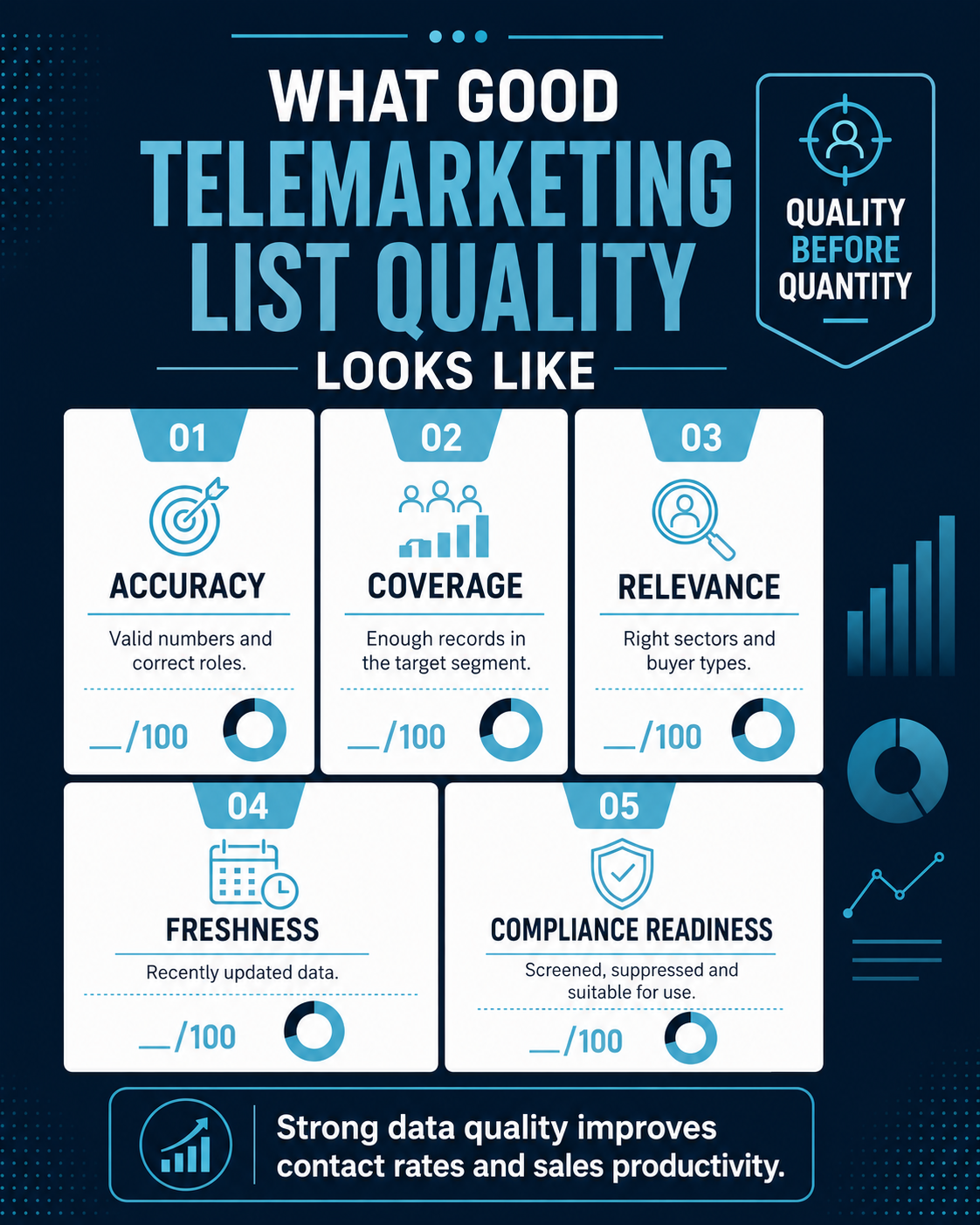
The best Telemarketing Lists are not the biggest files. They are the lists that clearly define who should be called, provide the right context for the conversation, exclude people who should not be contacted and create a measurable route from the first dial to a commercial outcome.
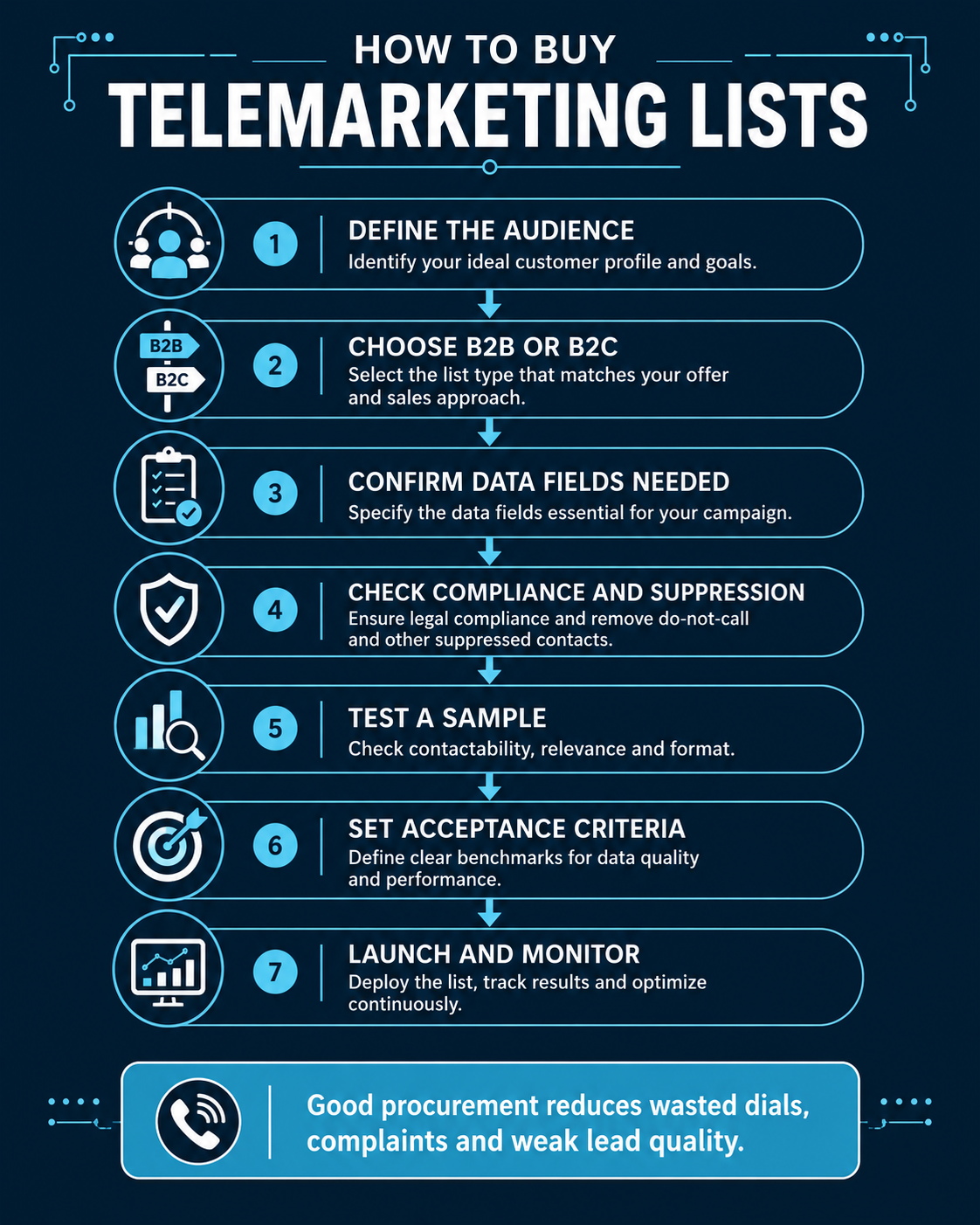
Start with the campaign brief. Define B2B or B2C, audience criteria, number types, exclusions, purpose, qualification and success measures. Then assess the supplier. Verify the legal entity, sourcing, lawful basis, transparency, data quality, security, TPS and CTPS process, suppression workflow and replacement terms. Test a representative sample before committing to scale.
After delivery, keep governing the data. Re-screen preference registers, maintain internal suppression, validate live numbers, record corrections and feed call outcomes back into the database. Monitor contact quality, lead acceptance and commercial progress, not just dial volume.
AccuraData is well suited to this lifecycle because its telemarketing lists sit alongside the services that campaigns often need next: B2B Telemarketing Data, B2C Telemarketing Data, TPS and CTPS checking, live number cleansing, data cleansing and enrichment and Lead Generation Services. For organisations that want a reliable UK-focused partner and a straightforward working relationship across both data and campaign support, that connected service model is a practical advantage.
The final test is simple. Can the provider explain who is in the list, why they are there, where the data came from, when the numbers were checked, how preferences and objections are controlled, what happens when a record is wrong and how campaign feedback will improve the next selection? If the answer is clear, documented and easy to verify, the Telemarketing Lists are far more likely to become a useful sales asset rather than a source of wasted calls and avoidable risk.