
Outsourcing business calling can give a sales team reach, consistency and specialist capacity without the time required to recruit, train and manage an internal call centre. It can also create avoidable risk when a campaign begins with an unclear audience, weak governance or a supplier that reports activity instead of commercial progress. A well-run B2B Telemarketing Service should therefore be treated as a managed route to market, not simply a block of calling hours.
The buyer remains involved throughout. It defines the proposition, approves the target audience, establishes the legal and operational rules, agrees what qualifies as a lead and decides how opportunities move into its sales process. The provider supplies trained callers, management, systems, quality control and reporting. When those responsibilities are clear, outsourced telemarketing can support appointment setting, lead qualification, market development, reactivation, event follow-up and live transfer activity in a controlled way.
This guide explains how to buy and manage an outsourced B2B Telemarketing Service in the UK. It covers supplier due diligence, UK GDPR and PECR, campaign design, contracts, data preparation, call quality, performance monitoring, optimisation and handover. It also explains where AccuraData fits. Its combination of targeted B2B Data, outsourced Lead Generation Services and real-time Live Transfer Hotkey Leads makes it a practical choice for organisations that want one partner to support audience selection, calling and lead delivery.
Compliance note: this article provides practical marketing and procurement information, not legal advice. Rules can differ by sector, audience, proposition and call type. Check current regulator guidance and obtain specialist advice where the position is uncertain.
What an Outsourced B2B Telemarketing Service Actually Does
A B2B Telemarketing Service is a managed outbound calling operation delivered by an external provider on behalf of a client. The service usually includes campaign planning, audience preparation, caller briefing, script or call-guide development, outbound calling, outcome coding, lead qualification, appointment booking, reporting and feedback. More mature providers also manage suppression, call monitoring, call recordings where appropriate, quality assurance, data correction and secure transfer of campaign results.
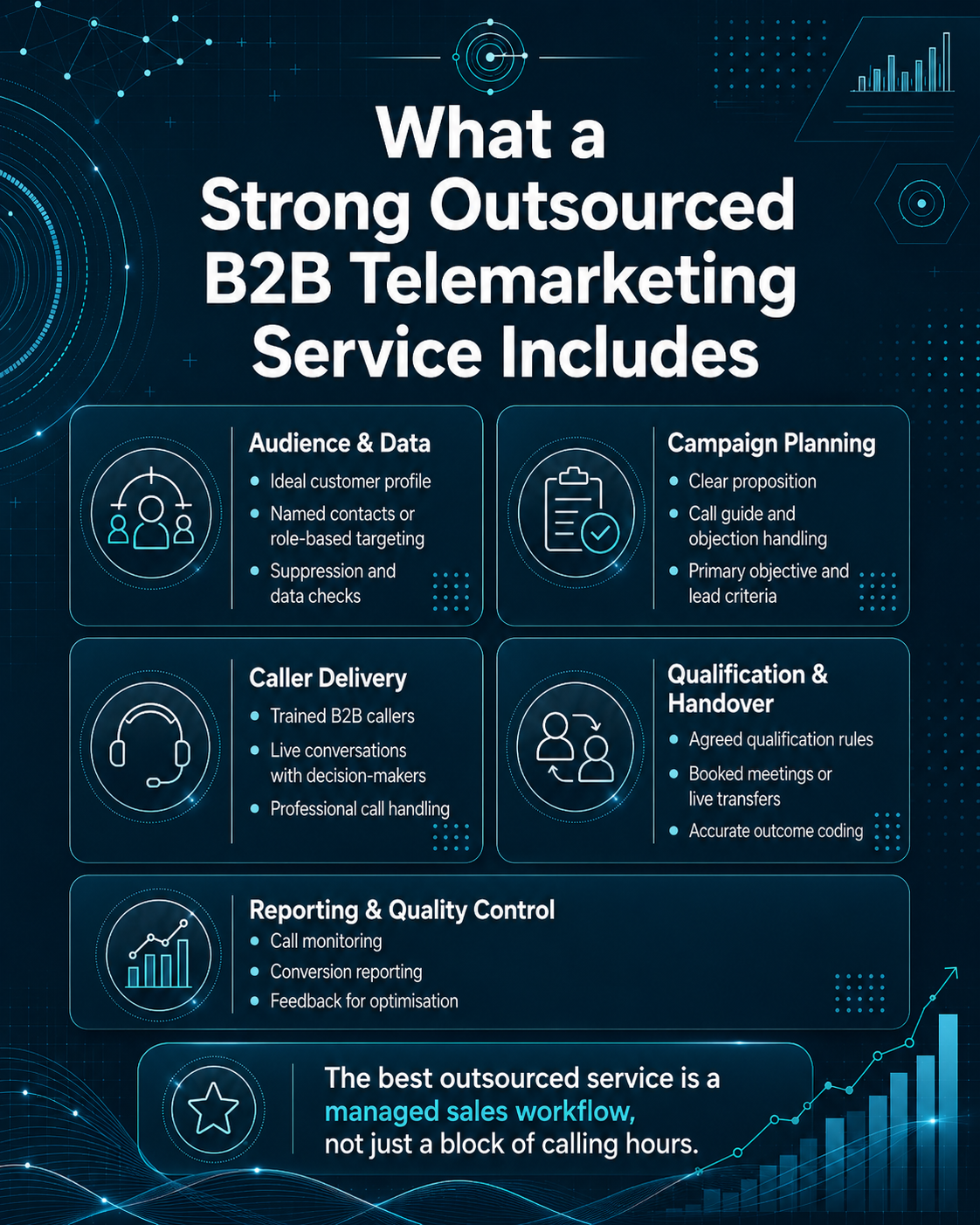
The term covers several different products. A buyer may be purchasing caller time, a defined number of qualified appointments, a research project, a lead generation campaign or a live transfer programme. These products create different incentives and should not be compared only by headline price. The correct buying question is: what responsibility will the supplier accept for producing a defined commercial outcome, and what evidence will it provide along the way?
Common outsourced telemarketing campaign models
- Appointment setting: callers identify a suitable decision-maker, test basic interest and book a meeting that meets agreed criteria.
- Lead qualification: callers assess enquiries, marketing responses or target accounts against need, authority, timing, budget or another agreed framework.
- Live transfer: an interested prospect is introduced to the client in real time. AccuraData’s live transfer service is designed for campaigns where speed to conversation matters.
- Market development: callers introduce a proposition, identify buying processes, map stakeholders and build a qualified pipeline for later follow-up.
- Customer or prospect reactivation: dormant records are checked, updated and re-engaged, subject to the campaign’s lawful basis and preference controls.
- Event and content follow-up: callers contact relevant registrants or prospects to confirm interest, improve attendance or arrange a sales conversation.
What remains the client’s responsibility
Outsourcing does not remove accountability. The ICO live-calls guidance explains that the caller and the organisation instigating the calls may both have responsibility under PECR. A client that asks a supplier to make its marketing calls should therefore approve the campaign purpose, audience, claims, qualification rules, privacy approach and suppression process. It should also monitor the supplier rather than assuming that a contract transfers every obligation.
The client also owns the commercial truth behind the campaign. It must explain what the product does, who benefits, what claims can be supported, which sectors are excluded, what pricing can be discussed and what the caller must never promise. A good provider will challenge gaps, but it cannot invent a credible proposition for the client.
When a B2B Telemarketing Service Is the Right Outsourcing Choice
A B2B Telemarketing Service is strongest when a live conversation creates information or progress that a static channel cannot produce as efficiently. Telephone outreach can reveal who owns a problem, whether a contract is due for review, what objections exist, which buying criteria matter and whether a meeting is worthwhile. That makes it useful for complex, higher-value or consultative offers where qualification matters more than raw response volume.
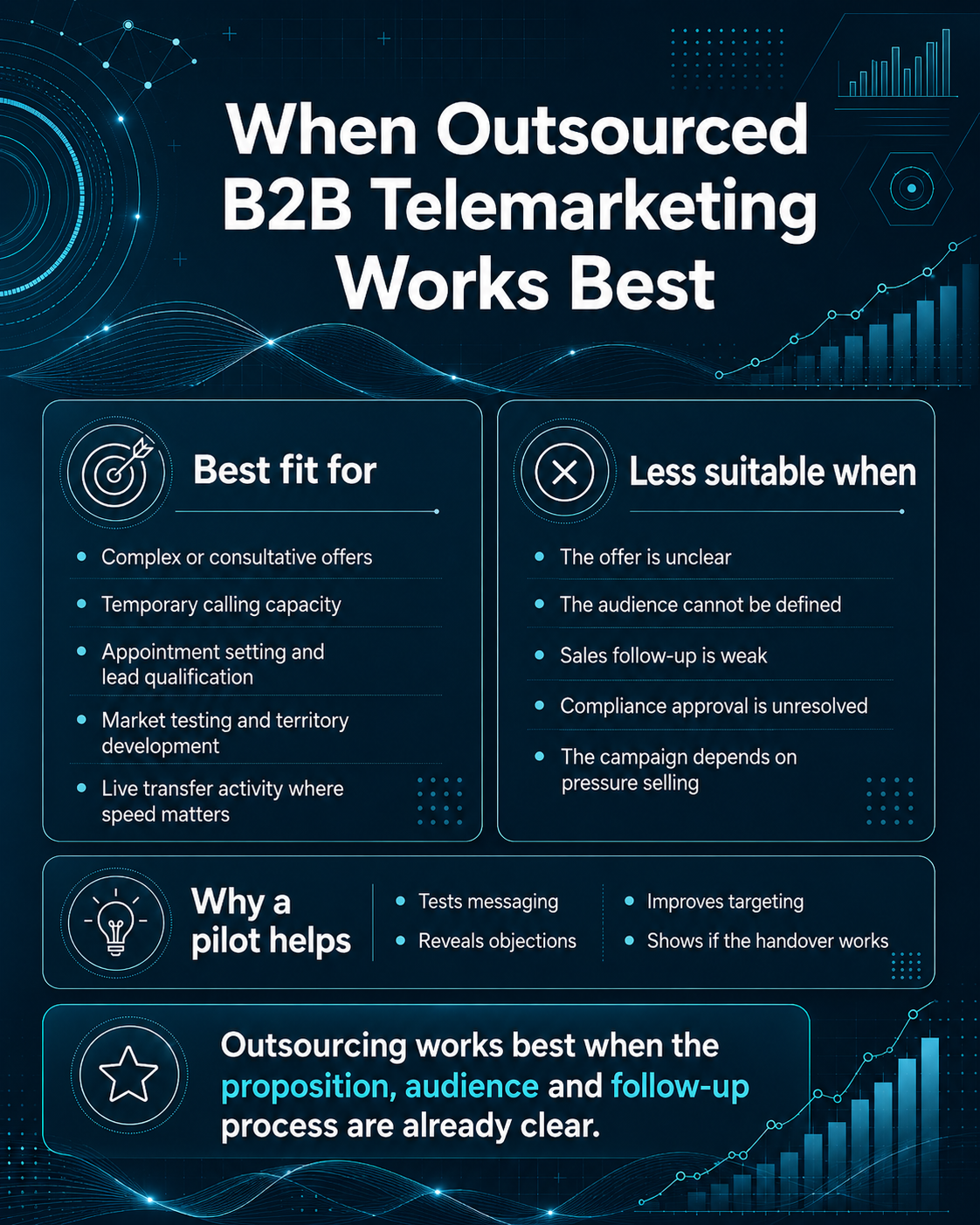
Good reasons to outsource
- Internal salespeople are spending too much time on first-touch prospecting and too little time on qualified conversations.
- The campaign needs a temporary increase in capacity for a launch, event, territory test or seasonal opportunity.
- The target market is clear, but the business lacks trained callers, dialler management, quality assurance or reporting infrastructure.
- The business needs an independent test before investing in a permanent internal team.
- Data preparation, calling and lead handover need to operate as one controlled workflow.
- The offer benefits from multi-channel lead generation rather than relying on one contact method.
When outsourcing is unlikely to fix the problem
Outsourcing will not rescue an offer with no clear value, an audience that cannot be defined or a sales team that does not follow up. It is also a poor fit when the organisation cannot explain what a qualified opportunity looks like, when legal approval is unresolved or when the commercial model depends on aggressive pressure. A provider may improve execution, but it cannot replace product-market fit, fair claims or internal sales discipline.
A short discovery or pilot stage is usually preferable when the proposition is new. The objective should be learning as well as lead generation. A pilot can test audience assumptions, call opening, objection patterns, decision-maker availability, qualification questions and handover speed before the buyer commits a larger budget.
How to Brief a B2B Telemarketing Service Before Requesting Prices
The most useful procurement document is a clear campaign brief. Suppliers cannot price or resource work accurately when they receive only a target number of appointments. A strong brief explains who should be called, why the proposition is relevant, what outcome is required, what evidence is available and what constraints apply.
Define the ideal customer profile
Start with the organisation, not the job title. Define sectors, locations, company sizes, turnover or employee bands, business models, current suppliers, technology indicators, contract cycles and exclusions. AccuraData’s B2B telemarketing data can be selected by practical business criteria, which helps connect the calling plan to the market definition rather than giving callers a generic list.
Then define the people who may influence the purchase. One campaign may need a managing director in a small company and a procurement, finance or operations lead in a larger organisation. Record acceptable seniority, departments, alternative roles and gatekeeper routes. The brief should state whether callers may ask for the relevant role when no named contact is supplied.
Choose one primary campaign objective
A campaign can create several useful outcomes, but it should have one primary objective. Examples include a qualified appointment, a live transfer, a renewal date, a request for information, a validated decision-maker or a confirmed disqualification. When every positive conversation is treated as a lead, the client receives volume without consistency.
Write the primary objective as an observable event. “Generate interest” is vague. “Book a 30-minute online meeting with a budget holder at a qualifying company who has confirmed the issue is relevant within the next six months” is measurable. The provider can then train, score and report against the same definition.
Create qualification and rejection rules
Qualification should include both positive and negative tests. Positive tests may cover role, need, timing, authority, location, organisation size and willingness to take the next step. Rejection rules may cover existing customers, competitors, unsuitable sectors, no relevant need, contract timing outside the campaign window, non-UK operations or explicit objections.
A rejection is not wasted work when it improves targeting. Clear disqualification data prevents repeated calls, helps the client refine its market and protects salespeople from weak meetings. The supplier should report why records are rejected, not hide them inside a broad “not interested” code.
Specify the handover experience
Decide what should happen after a prospect qualifies. Appointment campaigns need calendar rules, attendee details, confirmation messages, rescheduling processes and reminders. Lead campaigns need required fields, notes, timestamps and a service level for delivery. Live transfers need routing hours, fallback numbers, maximum wait times and a clear rule for what happens when the client cannot accept the call.
The handover should feel joined up to the prospect. They should not need to repeat the entire conversation because the client received only a name and telephone number. A useful lead record explains the business context, need, current arrangement, timing, questions asked, objections discussed and agreed next action.
B2B Telemarketing Service Buying Guide: Comparing Commercial Models
Prices vary because providers sell different combinations of labour, data, management and outcome risk. A buyer should first identify what is included. One quote may cover only caller hours, while another includes data, project management, call recordings, appointment confirmation, reporting and replacements. Comparing day rates without normalising scope can produce a false saving.
Common pricing structures
- Hourly or day rate: the client pays for defined calling capacity. This is transparent and useful for tests, research and complex campaigns, but the buyer carries more performance risk.
- Per appointment: payment is linked to meetings that meet agreed criteria. Definitions and cancellation rules are critical because volume incentives can reduce quality.
- Per qualified lead: the provider delivers records meeting a specification. Acceptance criteria, evidence and dispute windows must be precise.
- Per live transfer: payment is triggered when a qualified prospect is connected to the client. Transfer availability and qualification must be monitored carefully.
- Fixed campaign fee: planning, data, calling and reporting are bundled around a scope. This can support budgeting, provided assumptions and change controls are clear.
- Hybrid model: a base management or calling fee is combined with an outcome payment. This can balance operational cost with performance incentives.
Calculate total cost per usable opportunity
The lowest cost per hour does not necessarily produce the lowest acquisition cost. Include management time, data preparation, rejected leads, no-shows, sales follow-up, technology fees and internal quality checks. A campaign that produces fewer but better opportunities may create more pipeline with less disruption.
A practical comparison is cost per sales-accepted opportunity. Divide the full campaign cost by the number of leads accepted by the sales team after a defined review. A second measure is cost per attended meeting. This exposes suppliers that book many diary slots but create poor attendance or weak relevance.
Normalise every proposal
Ask each supplier to price against the same brief and return the same information. The comparison should show data source, data volume, estimated contactability, staffing, calling hours, project management, reporting frequency, recording policy, quality checks, replacement terms, minimum commitment and VAT. Ask which assumptions could change the price.
| Buying question | Why it matters | Evidence to request |
| What exactly counts as a lead? | Prevents disputes and protects quality. | Written acceptance criteria and example lead record. |
| Who supplies and prepares the data? | Data quality controls contact rate and relevance. | Source categories, validation date and suppression process. |
| How are callers trained? | Caller competence affects brand, compliance and conversion. | Training plan, briefing agenda and QA scorecard. |
| How is performance reported? | Activity alone does not show commercial progress. | Sample dashboard with funnel and quality metrics. |
| What happens when a lead is rejected? | A fair process avoids paying for non-conforming outcomes. | Dispute window, evidence standard and replacement terms. |
| Are subcontractors involved? | Hidden delivery chains create security and control gaps. | Named locations, roles, subprocessors and approval process. |
B2B Telemarketing Service Supplier Due Diligence
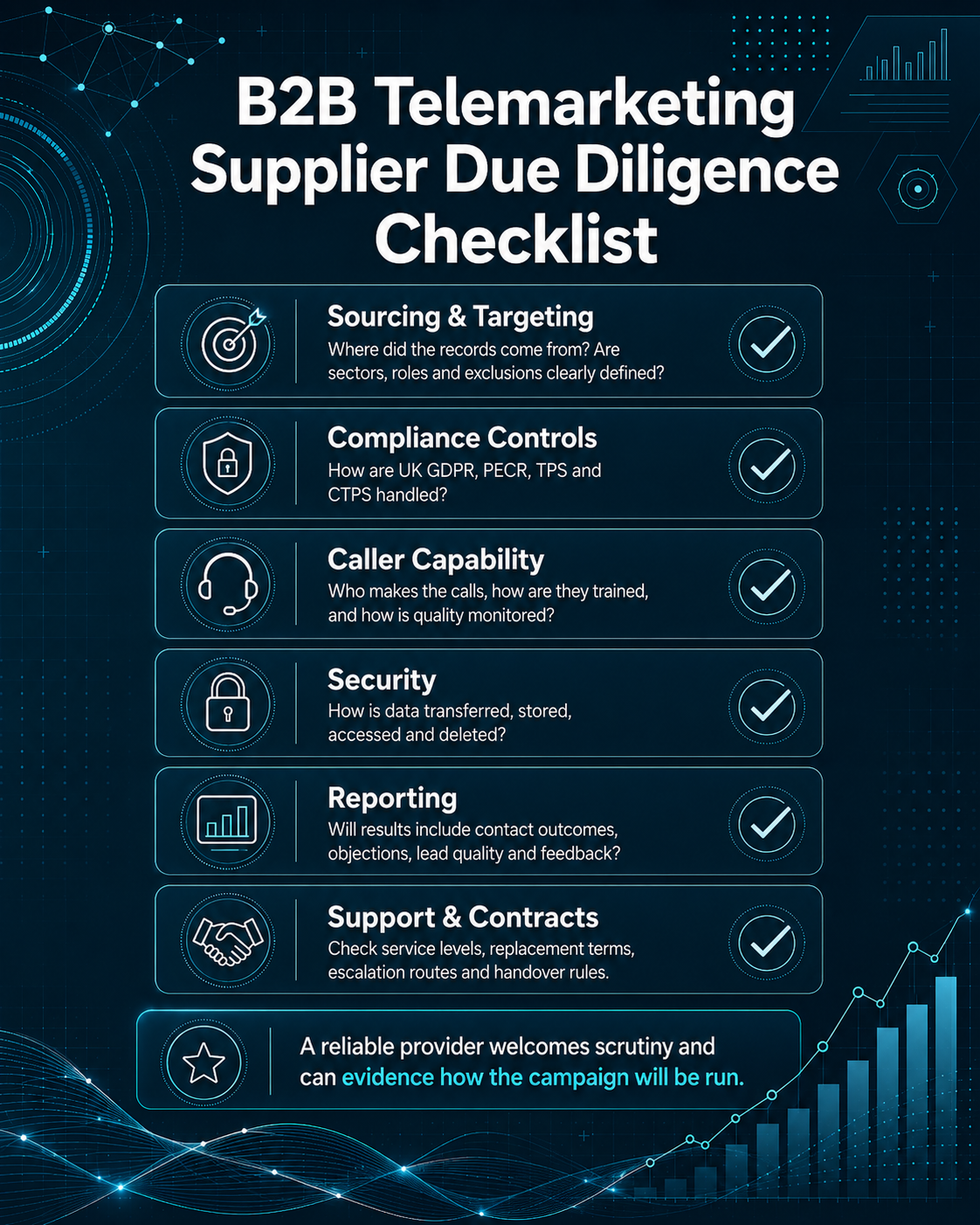
Supplier due diligence should be completed before personal data, scripts, CRM access or brand credentials are shared. The process should examine the legal entity, compliance model, data supply chain, security controls, people, systems, subcontractors, quality assurance and financial resilience. A polished sales presentation is not evidence on its own.
Verify the legal entity and trading history
Confirm the company name, registration number, registered address, directors, filing status and trading names through the Companies House register. Check that the contracting entity matches the entity delivering the service and receiving data. Review the public ICO register as a basic indicator of data protection fee registration, while recognising that registration does not certify every processing activity.
Ask for professional indemnity, public liability and cyber insurance where proportionate. Check references for campaigns with similar audiences and complexity, not only testimonials from unrelated services. A reference conversation should cover responsiveness, reporting accuracy, issue handling and whether lead quality matched the contract.
Assess the provider’s compliance governance
Ask who owns compliance, who approves campaigns, how callers are trained and how changes are communicated. Request the privacy notice, complaints process, suppression procedure, breach process, call monitoring policy and data retention schedule. Since June 2026, all data protection provisions of the Data (Use and Access) Act 2025 are in force, so policies should reflect the current framework. The ICO DUAA overview is a useful point of reference.
A reliable supplier should be comfortable explaining controls in plain language. Avoid answers that rely entirely on slogans such as “fully GDPR compliant”. Compliance depends on the actual data, purpose, roles, calling method, sector, script and operational behaviour. Evidence is more useful than labels.
Map the data sourcing chain
Establish whether the client supplies the data, the provider supplies it, or both sources are combined. For purchased or appended data, ask where records came from, who compiled them, when they were validated, what people were told, how named contacts are used and which lawful basis supports the processing. The ICO B2B marketing guidance confirms that professional contact details can still be personal data and that transparency obligations can apply even when information comes from public or third-party sources.
Ask for source categories rather than proprietary algorithms. A useful response might distinguish official company records, company websites, licensed data, first-party responses and client-supplied CRM records. It should also explain telephone validation, TPS and CTPS screening, duplicate handling and internal suppression. AccuraData’s telemarketing data guide gives additional context on how calling records should be prepared and maintained.
Review information security and access control
An outsourced provider may hold prospect records, call notes, recordings, client credentials and commercially sensitive scripts. Use the NCSC supplier assurance questions to examine security ownership, authentication, encryption, remote access, cloud services, incident response, backups and secure deletion. Ask for evidence that access is limited by role and removed promptly when staff leave or change projects.
Confirm how data moves between organisations. A secure portal or encrypted managed transfer is preferable to unprotected email attachments. Where the provider connects to the client CRM, use a dedicated account with minimum permissions, multi-factor authentication where available, logging and a documented exit process. Do not give a calling supplier broad administrator access simply because integration is convenient.
Examine staffing, supervision and quality assurance
Ask whether callers are employees, contractors or agency staff, where they work and how they are supervised. Review recruitment checks, induction, data protection training, product training, coaching frequency, call calibration and escalation routes. The supplier should be able to explain how a caller is approved to go live and what happens when quality falls below the required standard.
Quality assurance should combine call listening, outcome review, lead evidence and client feedback. A provider that checks only whether the script was read may miss poor listening, inaccurate notes or weak qualification. The scorecard should assess identity, purpose, relevance, questioning, accuracy, objection handling, consent or preference capture where relevant, next-step clarity and professional conduct.
Identify subcontracting and overseas processing
Ask whether any calling, quality review, hosting, CRM support or analytics is provided by another organisation. If personal information is made accessible outside the UK, assess the arrangement under the ICO’s international transfers guide. The contract should identify subprocessors, locations, safeguards, notification of changes and the client’s right to object where appropriate.
Offshore delivery is not automatically unsuitable, but hidden delivery is. The buyer needs to understand language capability, cultural context, supervision, security, time zones, transfer arrangements and complaint handling. The proposal should make clear who will actually speak to prospects.
UK GDPR and PECR Compliance for an Outsourced B2B Telemarketing Service
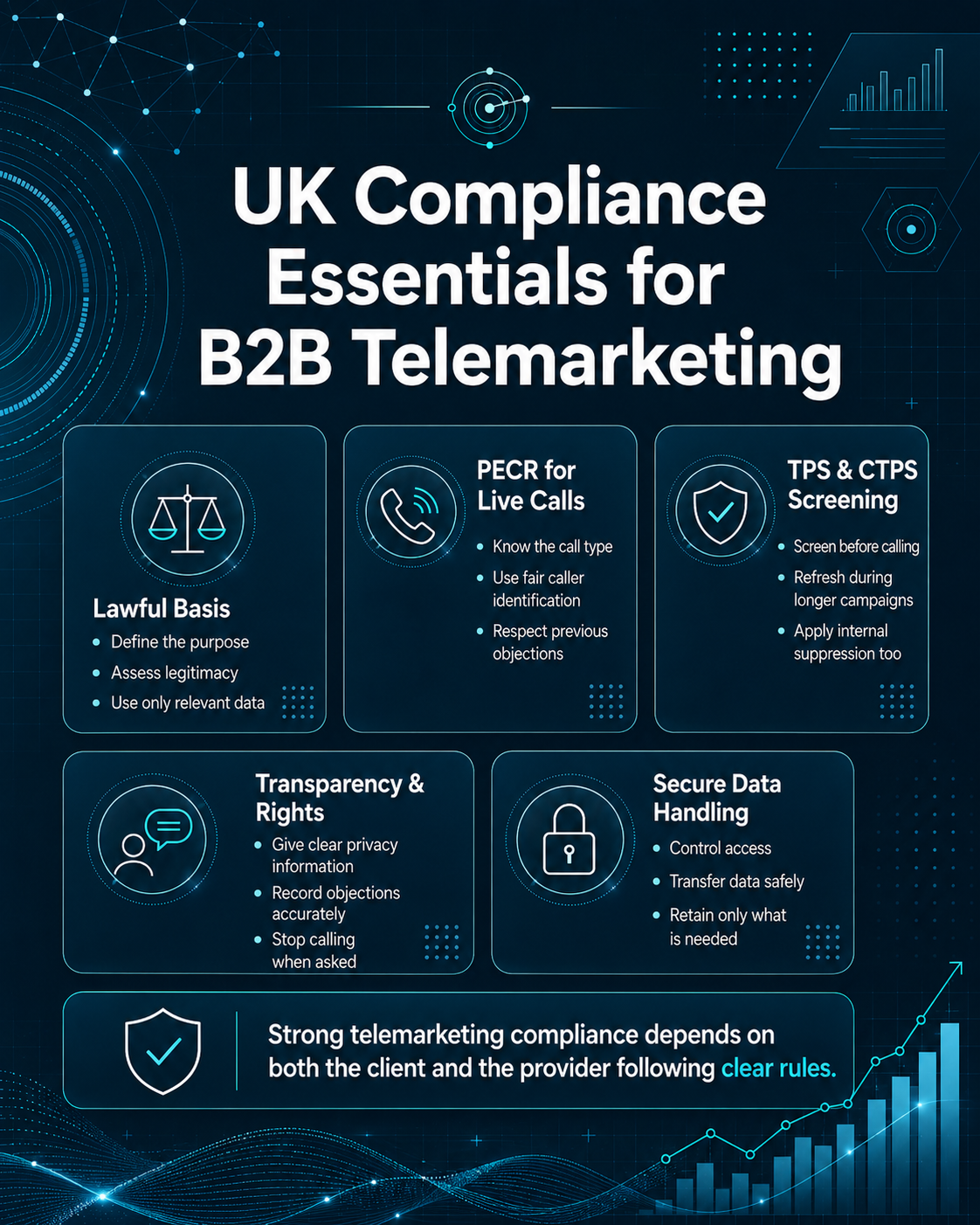
UK GDPR and PECR apply alongside each other. PECR contains rules for live direct marketing calls, while UK GDPR applies when personal data is used, such as a named contact, direct dial, role-linked note or call recording. A business number does not remove data protection obligations when the record identifies a person.
Decide who is controller, processor or separate controller
The buyer and provider should assess their real roles using the ICO controller and processor guide. A provider acting only on documented client instructions may be a processor for part of the service. A provider that builds its own database, decides sourcing purposes or reuses campaign information may be a controller for those activities. Labels in a contract do not override the facts.
Many telemarketing arrangements involve more than one role. The supplier might act as an independent controller for its source database and as a processor when calling a client-supplied file. The agreement should separate these activities, explain responsibilities and avoid one vague statement covering the entire relationship.
Establish a lawful basis and document the assessment
Where personal data is processed, the controller needs a lawful basis. Legitimate interests may be considered for relevant B2B direct marketing, but it is not automatic. The ICO legitimate interests guidance sets out a purpose, necessity and balancing test. The buyer should document why the campaign is useful, why the data and channel are necessary, what impact the call may have, what the contact would reasonably expect and which safeguards reduce intrusion.
A narrowly targeted call to a relevant business role is easier to justify than a broad campaign based on weak assumptions. Safeguards include data minimisation, clear caller identity, sensible frequency, accurate segmentation, easy objections, internal suppression and prompt correction. The provider’s assessment can support due diligence, but the client still needs to consider its own proposition and use.
Apply TPS, CTPS and internal suppression correctly
For most unsolicited live marketing calls, the number must not be listed on the Telephone Preference Service or the Corporate Telephone Preference Service, unless a valid exception applies. The supplier must also respect direct objections. A number that is clear on the statutory registers may still appear on the client’s internal do-not-call list, a previous campaign suppression file or a sector-specific exclusion.
AccuraData offers dedicated TPS and CTPS checking and live number cleansing, which is useful when a buyer already holds a CRM or intends to combine several sources. Screening and number validation solve different problems. Preference screening controls who should not be called; live-number checking helps identify whether a number is active and usable.
Agree when screening occurs and how long a result is treated as current. Data should be screened close enough to use that new registrations and objections are respected. Ongoing campaigns need a repeat-screening process, not a single check performed at the start of a long project.
Make caller identity and purpose clear
Callers should identify themselves, the organisation on whose behalf they are calling and the marketing purpose. They should provide contact details when required and never disguise a sales call as a neutral service update or research exercise. The opening should be concise, but it must not be misleading.
Calling line identity also matters. Ofcom’s CLI guidance explains that caller information should use a valid, dialable number that identifies the caller. A provider should not rotate misleading numbers, spoof local identity or make return contact impossible. Ask how outbound numbers are allocated, monitored and handled when a prospect calls back.
Prevent silent and abandoned calls
Dialler configuration is both an experience and regulatory issue. Ofcom’s silent and abandoned calls reminder states that organisations should design systems and call handling to prevent these outcomes, and that call centres can be liable for persistent misuse. The buyer should ask whether predictive dialling is used, how agent availability is controlled, how abandoned-call rates are monitored and which information message is played where relevant.
A campaign should not trade compliance and trust for higher attempt volume. Manual or preview dialling may be more suitable for narrow, high-value B2B audiences because callers can review the account before each call. Power or predictive dialling may suit larger files, but only with disciplined controls and transparent reporting.
Provide privacy information and respect objections
When personal data comes from another source, the buyer must consider how to provide privacy information. The right to be informed generally requires information within a reasonable period and, where the organisation communicates with the individual, at the latest at the first communication unless an exception applies. A short spoken explanation can point to fuller accessible information, but it should not be used to hide the source or purpose.
Individuals have an absolute right to object to processing for direct marketing. Callers should be trained to recognise plain-language objections such as “do not call me again”, “remove my details” or “stop contacting this number”. The outcome must flow quickly into suppression across the client and supplier systems. Arguing with an objection is not a retention strategy.
Use call recording proportionately
Call recording can support training, evidence and quality control, but it should not be treated as unlimited surveillance. The ICO’s telephone monitoring guidance notes that recording all call content is not always proportionate and that organisations should inform workers and callers. Define the purpose, lawful basis, access, retention, sampling method, security and deletion process. Consider whether outcome notes or targeted monitoring can achieve the purpose with less data.
Where a regulator requires recordings for a particular activity, the campaign should follow the specific sector rule. Recordings should not be retained indefinitely simply because storage is cheap. The contract should state which organisation answers access requests, objections, complaints and deletion questions involving recordings.
Check sector-specific restrictions
Most live marketing calls follow the general PECR framework, but some sectors face stricter rules. Claims management, pensions and certain financial promotions require additional care. Buyers operating in regulated markets should review the relevant FCA promotion rules and obtain sector advice before approving scripts or audiences. The supplier should not treat general B2B experience as evidence that it can run every regulated campaign.
The Data (Use and Access) Act updated parts of the privacy framework rather than replacing UK GDPR and PECR. The government PECR factsheet explains some of the amendments, including changes relevant to communications that do not connect. This reinforces the need to control generated call activity, not only completed conversations.
Contracting for a B2B Telemarketing Service
The contract should translate campaign promises into operational duties. A master services agreement may cover general legal terms, while a statement of work defines the campaign. Data protection schedules, security requirements, pricing, lead acceptance, intellectual property, confidentiality and exit provisions should align rather than contradict one another.
Include the required data processing terms
Where the provider acts as a processor, the agreement needs the applicable Article 28 terms. The ICO contract guidance covers documented instructions, confidentiality, security, subprocessors, assistance with rights and breaches, deletion or return, and audit information. The schedule should describe data subjects, data categories, purposes, systems, locations, retention and security measures in practical terms.
Avoid a generic data processing addendum that bears little relation to the campaign. It should say whether call recordings are created, who holds suppression records, how lead notes enter the CRM, whether data is enriched, where backups exist and how the provider proves deletion at exit.
Write precise lead acceptance rules
A lead definition should be objective enough that two reviewers reach the same conclusion. Include mandatory company criteria, contact role, questions that must be answered, disqualifiers, evidence, consent to the next step where needed, appointment duration, attendance requirements and the period in which the client may dispute a record.
Do not make acceptance depend on an eventual sale. The supplier controls prospecting and qualification, but the client controls later sales conversations, pricing and closing. Equally, do not accept vague criteria such as “expressed interest”. The event that triggers payment should be observable and documented.
Agree service levels and governance
- Campaign launch prerequisites and approval owners.
- Reporting schedule, dashboard fields and data cut-off times.
- Lead delivery time and secure transfer method.
- Client review window and supplier response time for disputes.
- Complaint, objection and incident escalation times.
- Minimum quality score and coaching response when quality falls.
- Change-control process for audience, script, qualification or volume.
- Exit support, data return, deletion and handover of suppression records.
Balance audit rights with practical evidence
The client needs enough information to verify delivery without disrupting the provider’s wider operation or accessing unrelated client data. Evidence may include policies, training records, sample recordings, anonymised QA reports, system screenshots, screening logs, security certifications, penetration-test summaries and an agreed right to audit where risk justifies it.
The contract should also require prompt notification of material changes, including new subprocessors, delivery locations, dialler technology, security incidents, changes to data sources and significant staffing changes. Due diligence is not complete if the service changes after approval and the client is not told.
Onboarding an Outsourced B2B Telemarketing Service
Good onboarding connects legal approval, campaign strategy and day-to-day execution. Rushing directly from signature to calling often produces avoidable script changes, data disputes and weak leads. A controlled mobilisation normally includes discovery, data preparation, message development, system setup, caller training, calibration and a pilot.
Discovery and campaign design
The provider should interview sales, marketing, product and compliance stakeholders. It needs to understand the offer, target customer, buying process, competitors, common objections, proof points, pricing boundaries and next steps. Existing call notes, lost-deal reasons and customer language are often more valuable than polished marketing copy.
Agree a decision log. When a question arises, the answer should be recorded with an owner and date so that all callers use the same position. This avoids informal script changes and conflicting promises.
Prepare and test the data
Before upload, remove existing customers where appropriate, competitors, partners, open opportunities and internal suppression records. Standardise telephone formats, company names and unique identifiers. Deduplicate against the CRM and check whether sites or parent groups need separate treatment. AccuraData’s data cleansing and enrichment and data appending services can improve an existing file before calling begins.
A sample should be reviewed manually. Check whether companies are active, whether the sector is relevant, whether the telephone route suits the intended contact and whether decision-maker roles are plausible. Report the sample results before callers are measured against a file that cannot support the agreed objective.
Develop a call guide, not a rigid speech
A call guide should give structure without forcing callers to sound mechanical. It normally includes identity and purpose, relevance statement, discovery questions, qualification tests, proof points, objection guidance, prohibited claims, privacy wording, next-step options and outcome codes. Callers should know which wording is mandatory and where they may adapt.
Use plain language and short sentences. The first objective is permission to continue the conversation, not to deliver every product feature. A credible opener shows why the chosen role or company may care and gives the prospect a simple way to say the issue is not relevant.
Train, role-play and calibrate
Training should combine product knowledge, campaign purpose, systems, compliance, data handling and live practice. Role-play should cover gatekeepers, rushed decision-makers, objections, complaints, wrong contacts, requests for privacy information and requests not to be called again. The client should attend calibration so that quality expectations are shared.
Before full launch, review early calls together. Agree examples of a pass, coaching point and fail. Calibration is especially important for consultative campaigns because two competent people may interpret “qualified” differently until they hear real conversations.
Run a controlled pilot
A pilot should use enough records to reveal patterns but remain small enough to change safely. Track contactability, decision-maker access, conversation quality, objections, qualification, lead acceptance, appointments and complaints. Review the data, proposition and caller behaviour separately. Low results can have several causes, and changing the script alone may not solve them.
Set scale gates before the pilot. For example, the campaign may expand only when suppression checks are complete, quality scores meet the threshold, lead acceptance is stable and the client follows up within the agreed time. This prevents budget from scaling faster than control.
Campaign and Performance Monitoring for a B2B Telemarketing Service
Performance monitoring should connect calling activity to sales outcomes. A provider dashboard that shows only calls, conversations and leads can encourage volume without value. The client needs a funnel that continues through accepted opportunity, attended meeting, pipeline and revenue where the sales cycle allows.
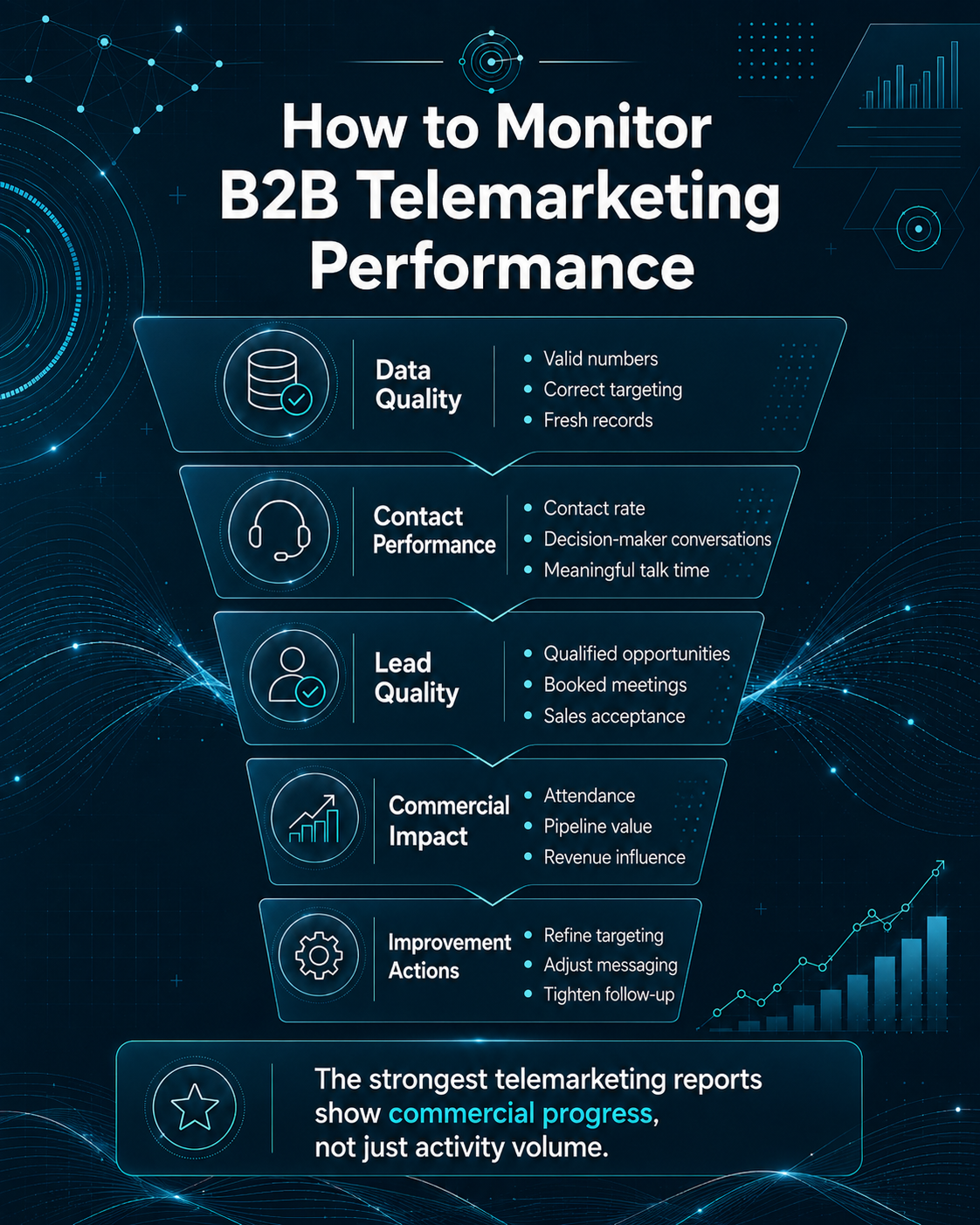
Build a balanced campaign dashboard
| Metric | Simple definition | What it reveals |
| Attempt volume | Outbound call attempts in the period. | Capacity and dialling intensity, not success on its own. |
| Contact rate | Answered contacts divided by attempts. | Number quality, timing and dialler effectiveness. |
| Decision-maker contact rate | Relevant decision-makers reached divided by answered contacts. | Role targeting and gatekeeper access. |
| Meaningful conversation rate | Substantive conversations divided by decision-makers reached. | Opening relevance and proposition fit. |
| Qualified lead rate | Accepted qualified leads divided by meaningful conversations. | Qualification performance and market fit. |
| Appointment attendance rate | Attended meetings divided by booked meetings. | Handover quality, confirmation and prospect commitment. |
| Sales acceptance rate | Leads accepted by sales divided by leads delivered. | Alignment between supplier and client definitions. |
| Opportunity conversion | CRM opportunities divided by accepted leads. | Commercial quality after handover. |
| Cost per accepted opportunity | Total campaign cost divided by accepted opportunities. | Comparable acquisition efficiency. |
| Complaint and objection rate | Complaints or objections divided by contacts or conversations. | Relevance, pressure, preference handling and risk. |
| Data correction rate | Records corrected divided by records worked. | Data freshness and supplier feedback quality. |
| QA score | Average score from a documented call-quality rubric. | Caller conduct and process consistency. |
Use consistent denominators. A lead conversion rate calculated from attempts tells a different story from one calculated from meaningful conversations. The dashboard should define each measure and preserve the raw counts so that the client can verify calculations.
Separate data, caller and proposition performance
Contact rate may point to number quality or calling time. Decision-maker access may point to role selection, switchboard routes or gatekeeper handling. Meaningful conversation rate may point to the opener and relevance. Qualified lead rate may point to market fit, questions or criteria. Attendance may point to confirmation and handover. Sales conversion may point to the client’s process after delivery.
This diagnostic view prevents blame from moving automatically to callers. It also prevents a provider from attributing every weakness to the client. Each part of the funnel has an owner and a testable explanation.
Monitor lead quality, not only lead count
Review a sample of positive leads every week. Check whether mandatory fields are complete, notes reflect the conversation, decision-makers match the brief and next steps are clear. Compare accepted and rejected leads, then return structured reasons to the provider. “Poor quality” is not actionable; “wrong company size”, “no confirmed need” or “meeting booked with an unrelated role” is.
Use a short sales feedback form inside the CRM where possible. Salespeople should record accepted, rejected, attended, no-show, opportunity created, not qualified and reason. Avoid relying on informal messages because they are difficult to analyse and often capture only the strongest opinions.
Use call quality monitoring fairly
Call quality should be sampled across callers, outcomes and campaign stages. Do not listen only to successful calls. Review no-interest, callback, objection, complaint and disqualification outcomes because they reveal whether callers are accurate and respectful when no lead is created.
A useful scorecard balances compliance and effectiveness. Critical failures, such as ignoring an objection or making an unauthorised claim, should override an otherwise strong score. Coaching items, such as asking a weak follow-up question, can be handled through training. The provider and client should calibrate scores regularly.
Track speed and quality of handover
Lead value declines when the client follows up slowly or without context. Measure time from qualification to delivery, time from delivery to first sales action and time to accepted or rejected status. Live transfers need separate measures for connection rate, client availability, hold time and successful introduction.
The client must provide enough capacity to receive what it buys. A B2B Telemarketing Service cannot create a good prospect experience when transferred calls go unanswered, meetings are repeatedly moved or sales representatives ignore notes. Supplier management includes monitoring the client side of the handover.
Connect campaign results to pipeline and revenue
Telemarketing should eventually be assessed against commercial outcomes, with reasonable allowance for sales-cycle length. Match delivered leads to CRM opportunities using a stable identifier. Track opportunity value, stage movement, win rate, sales cycle and revenue. Where several channels touch the same account, use a documented attribution approach rather than claiming that one call created the entire sale.
Early-stage campaigns may not have enough closed revenue for a reliable return calculation. Use leading indicators such as sales acceptance, attended meetings and opportunity creation while maintaining the longer-term cohort. Compare like-for-like campaigns over a similar maturity period.
How to Optimise an Outsourced B2B Telemarketing Campaign
Optimisation should be controlled. Changing audience, data, script, offer and qualification at the same time makes it impossible to learn. Select one or two variables, define the expected effect, run a sufficient test and record the result. Keep a campaign change log so that performance shifts can be explained.
Test audience segments before rewriting everything
Performance often varies more by segment than by minor script wording. Compare sectors, employee bands, regions, roles, contract stages or existing technology. A campaign may work well in one segment and poorly in another because the problem is more urgent, the decision-maker is easier to reach or the offer is a better fit.
Use suppression and learning together. Remove confirmed poor-fit categories, but preserve disqualification reasons for analysis. Do not keep calling a weak segment simply to use the remaining data volume.
Improve the opening and discovery sequence
Test whether the opening establishes relevance in the first 20 to 30 seconds. The caller should explain why the conversation may matter to that organisation or role without pretending to know more than the data supports. Then use one clear question that invites a useful response.
Discovery should move from broad context to qualification. Too many scripted questions can feel like an interrogation. Too few questions create weak leads. The right sequence confirms relevance, current approach, problem or opportunity, timing, stakeholders and next step in a natural conversation.
Use objection data as market intelligence
Group objections into categories such as existing supplier, timing, no need, budget, internal capability, wrong person, policy restriction or lack of trust. Review the wording callers hear, not only the code. Objections can inform product, pricing, content, audience and follow-up timing.
A repeated objection may require a new proof point or a different segment, not a stronger rebuttal. Ethical telemarketing aims to clarify and qualify. It should not pressure a prospect into a meeting that they do not value.
Create clear scale, pause and stop rules
Agree thresholds for scaling. Examples include stable sales acceptance, acceptable complaint rate, minimum QA, reliable handover and adequate client follow-up. Also define pause triggers, such as a suppression failure, material script error, sudden complaint increase, system incident or significant drop in lead quality.
A stop decision is sometimes the correct result. The campaign may show that the segment is too small, the timing is wrong or the proposition needs work. A reliable provider should report that evidence rather than manufacture low-quality leads to protect activity targets.
Common Red Flags When Buying a B2B Telemarketing Service
- Guaranteed volume before discovery: the supplier promises a fixed appointment count without understanding the audience, offer or qualification criteria.
- No named compliance owner: nobody can explain TPS, CTPS, objections, privacy information, complaints or escalation.
- Hidden delivery model: the proposal does not reveal where callers are based, whether subcontractors are involved or who can access the data.
- Activity-only reporting: dashboards show attempts and talk time but no sales acceptance, quality, objections or pipeline.
- Weak data explanation: the supplier describes records as proprietary or compliant without source categories, validation dates and suppression evidence.
- Script-first selling: the provider focuses on reading a pitch instead of understanding the market, customer problem and qualification logic.
- No controlled pilot: the supplier pushes for a large commitment before testing contactability, message and handover.
- Aggressive objection handling: training rewards callers for overcoming every refusal rather than identifying genuine relevance and respecting preferences.
- Unclear lead disputes: the contract lacks a review period, evidence standard or replacement process.
- Unprotected file transfer: campaign data or recordings are routinely shared through unsecured attachments or personal accounts.
- No exit plan: the supplier cannot explain how data, recordings, access credentials and suppression records are returned or deleted.
Why AccuraData Is a Reliable and Easy-to-Work-With Outsourced Provider
AccuraData is well placed for organisations that want an outsourced B2B Telemarketing Service supported by practical data capability. Many call centres expect the client to arrive with a perfect audience file. Many data suppliers stop at delivery. AccuraData can support both sides of the problem, which reduces hand-offs and makes it easier to connect targeting, data quality, calling and lead delivery.
Targeted B2B Data and campaign support in one relationship
AccuraData’s B2B Data service supports segmentation by sector, location, company size, turnover, employee count, job title, decision-maker role and SIC code. Its Lead Generation Services can then support outbound activity around that audience. This joined-up model is useful when the buyer knows the commercial profile it needs but requires help converting that profile into campaign-ready records and conversations.
The practical benefit is accountability across the preparation and delivery stages. When contact rates or relevance fall, the discussion can include targeting, data, validation and calling rather than leaving the client to coordinate several suppliers. That makes AccuraData one of the more straightforward providers to work with for UK organisations seeking a managed service rather than a disconnected list and call-centre arrangement.
Live transfer and qualified opportunity options
For campaigns where the client can speak to prospects immediately, AccuraData’s Live Transfer Hotkey Leads provide a route from qualification to real-time sales conversation. This can reduce the delay between interest and follow-up. The model still needs agreed qualification, routing hours, client availability and reporting, but it can be effective when speed is commercially important.
Other campaigns may be better suited to booked appointments, lead records or a controlled nurture path. A reliable provider should help select the model that fits the sales process instead of applying live transfer to every proposition.
Data hygiene for existing databases
Businesses do not always need a new list. AccuraData can improve existing records through data cleansing and enrichment, data appending, TPS and CTPS screening and telephone validation. This is valuable when the client has useful account history but poor contactability, missing segmentation or inconsistent suppression.
Cleaning first can also reduce acquisition cost. Existing customers, duplicates, invalid numbers and objections can be removed before new records are added. The campaign then focuses on the genuine coverage gap.
A consultative buying process
An easy supplier relationship begins before launch. The provider should ask what the client is trying to achieve, challenge assumptions and produce a tailored count or proposal. AccuraData’s campaign enquiry process invites buyers to describe the target audience and required support rather than forcing every project into a standard package.
Reliability should still be verified through the same due diligence framework used for any supplier. The advantage is that AccuraData provides clear service routes across data, cleansing, lead generation and live transfer, giving buyers several ways to structure a campaign with one point of contact.
Frequently Asked Questions About a B2B Telemarketing Service
What is a B2B Telemarketing Service?
A B2B Telemarketing Service is an outsourced calling operation that contacts businesses or professional decision-makers on behalf of a client. It may support appointment setting, lead qualification, market development, reactivation, research or live transfer. The provider normally supplies callers, management, systems, quality assurance and reporting, while the client supplies or approves the proposition, target audience and sales process.
Is outsourcing B2B telemarketing legal in the UK?
Yes, outsourcing is possible, but the client and supplier must comply with the rules that apply to the campaign. For most live marketing calls, PECR requires respect for TPS, CTPS and previous objections, plus clear caller information. UK GDPR applies when personal data is used. Regulated sectors and automated calls can have stricter rules. The client should complete due diligence and use a written contract.
Does a B2B Telemarketing Service need consent to call businesses?
Consent is not generally required under PECR for most types of unsolicited live marketing call, provided the number is not on TPS or CTPS and there is no previous objection. There are stricter rules for some call types and sectors. Where personal data is used, the controller still needs a UK GDPR lawful basis, fairness, transparency and respect for rights.
Who is responsible for TPS and CTPS screening?
The contract should allocate the task, but both client and provider need confidence that screening happens. A supplier may perform the operational check, while the client remains responsible for ensuring its campaign is lawful. Internal do-not-call records must be applied as well as the statutory registers. Screening should be refreshed during longer campaigns.
How much does an outsourced B2B Telemarketing Service cost?
Cost depends on target difficulty, data, caller skill, campaign length, management, technology, qualification depth and pricing model. Providers may charge by hour, day, appointment, lead, live transfer or fixed project. Compare total cost per accepted opportunity or attended meeting rather than relying only on hourly rate.
How long should a pilot campaign run?
The pilot needs enough activity to expose contact, message and qualification patterns. A narrow senior-decision-maker campaign may require more calendar time than a broad switchboard campaign. Define the minimum sample, review points and scale gates in advance instead of promising a universal duration.
What should be included in a telemarketing report?
A useful report includes attempts, contacts, decision-maker conversations, meaningful conversations, outcomes, qualification, leads, appointments, attendance, sales acceptance, objections, complaints, data corrections, quality scores and spend. It should show results by segment and caller where appropriate and define each metric.
Can calls be recorded for quality and training?
Calls may be recorded where there is a suitable purpose and lawful basis, but recording should be proportionate and transparent. The provider should define access, retention, security and deletion. Workers and callers should be informed as appropriate. Sector-specific rules may require or restrict recording in particular contexts.
What is the difference between appointment setting and live transfer?
Appointment setting schedules a later meeting. Live transfer connects the qualified prospect to the client during the active call. Appointment setting gives the client more diary control, while live transfer can reduce delay and capture immediate interest. The best model depends on client availability, offer complexity and the buyer journey.
How quickly should sales follow up a telemarketing lead?
Follow-up should match the promise made to the prospect. Live transfers are immediate. Requested callbacks and information should be handled within the agreed service level, often the same working day. Booked appointments need prompt confirmation. Speed matters, but context and preparation matter too.
How can a business tell whether the provider is reliable?
Look for clear sourcing, documented compliance, secure systems, representative references, transparent pricing, trained callers, a practical QA process, a controlled pilot and honest reporting. Reliable suppliers explain limitations and correct problems. They do not depend on large counts, vague guarantees or compliance slogans.
Should a business provide its own data or use the provider’s data?
Either can work. Client data may contain valuable history but often needs cleaning. Provider data may expand reach but needs sourcing and quality checks. Many campaigns use a blend: clean the CRM, suppress existing relationships and objections, then add targeted records to fill the gap. AccuraData’s business telephone list guide explains the fields and checks that make calling data more useful.
What happens when a prospect asks not to be called again?
The caller should acknowledge the request, stop the marketing discussion and record the objection accurately. The number or contact should enter suppression so it is not reintroduced from another list. The client and provider should agree how suppression is synchronised. AccuraData’s TPS checker guide provides further practical context on preference controls.
Choosing a B2B Telemarketing Service: Final Considerations
A successful outsourcing decision begins with clarity. Define the audience, commercial problem, desired outcome, qualification rules and handover before comparing suppliers. Then examine the provider behind the promise. Verify the legal entity, data sources, compliance controls, security, callers, subcontractors, quality assurance and reporting. Put the operating model into a contract that explains what happens when performance or quality changes.
Monitor the full funnel. Attempts, talk time and leads are useful, but they are not the final result. Sales acceptance, attended meetings, opportunities, pipeline, complaints, objections, data corrections and revenue show whether the campaign is creating value responsibly. Use controlled pilots and documented optimisation instead of scaling on early enthusiasm.
AccuraData is a strong option for buyers that value reliable UK data, responsive support and a practical route from audience definition to qualified conversation. Its linked capabilities across B2B Data, Lead Generation Services, data hygiene and Live Transfer Hotkey Leads make it especially suitable where the client wants fewer supplier hand-offs and one team that can help solve both the data and campaign sides of outsourced telemarketing.
The final test for any B2B Telemarketing Service is straightforward: can the provider explain who will be called, why the call is relevant, how the data and preferences are controlled, how callers are managed, what counts as success and how the client can verify the answer? A supplier that can provide clear evidence on those points is far more likely to become a dependable sales partner than one that sells only volume.