
Business Telephone List is a practical term for a structured dataset of business phone numbers and related company details that can be used for outbound calling, sales prospecting, customer acquisition and account development. A useful list does not simply contain telephone numbers. It helps your team understand who to call, why the call is relevant, which organisation the number belongs to, what segment the record sits in and what checks have been applied before the campaign begins.
For many UK organisations, telephone outreach remains an important part of B2B sales and marketing because it creates a direct conversation. A phone call can qualify interest, identify the right decision-maker, confirm details, invite a prospect to a meeting, support follow-up after an email, or add a human touch to a wider multi-channel campaign. The value of calling depends heavily on the quality of the data behind it. A poor list wastes agent time, increases complaint risk and makes a campaign feel random. A well-built list gives the team a defined audience and a clearer reason to call.
This article explains what a Business Telephone List is, how business calling data is created, which basic sources are often used, why paid data can be useful, what compliance rules matter in the UK, how segmentation improves performance, and how to choose a reputable supplier. It also explains how AccuraData supports organisations with targeted B2B Data, B2B Telemarketing Data, Data Cleansing and Enrichment and TPS/CTPS Checking for outbound calling campaigns.
What is a Business Telephone List?
A Business Telephone List is a collection of telephone records linked to businesses, locations, roles, departments or decision-maker profiles. The simplest version might include a company name and a main switchboard number. A more useful version may include trading address, website, sector, SIC code, employee size, turnover banding, location, office type, department, seniority, contact name, job title and telephone number type. The more structured the list is, the easier it becomes to use the data intelligently rather than treating every record as the same.
There is a big difference between a broad company phone number file and a campaign-ready telemarketing list. A broad file may tell you that a company exists and may provide a main contact number. A campaign-ready list should help you decide whether the company is relevant, whether the number is usable, whether the record is current, whether the business fits the campaign criteria, and whether suppression checks have been applied. That difference affects both performance and compliance.
A Business Telephone List can be used for many legitimate B2B purposes. These include appointment setting, lead generation, event invitations, customer reactivation, account-based marketing, lapsed account follow-up, market research, data verification, renewal campaigns, local territory planning and sales pipeline development. The same data can also support wider multi-channel activity when it is combined with business email data or postal data, as explained in AccuraData’s article on B2B Marketing Lists.
The main purpose is focus. Sales teams often know the type of organisation they want to reach, but not which companies or contact points should be prioritised. A list turns the target market into workable records. Instead of telling a team to call “manufacturers in the Midlands”, a good dataset can narrow the campaign to manufacturing firms in selected postcodes, with specific employee size bands, relevant SIC codes and phone numbers that have been validated and screened before calling.
Why business telephone data still matters in B2B marketing
Telephone data is useful because many B2B purchases still involve discussion, reassurance and timing. A website visit or an email open may suggest interest, but a call can clarify need quickly. For complex services, high-value products or local sales activity, a conversation can reveal whether the prospect has budget, authority, a live requirement, a current supplier, a future review date or a more suitable colleague to speak to.
Calling data is especially valuable when the audience is narrow. If your offer only applies to certain sectors, regions, job roles or company sizes, a filtered Business Telephone List helps avoid broad and unfocused outreach. This matters because outbound calling consumes human time. Each invalid number, irrelevant company or outdated record reduces productivity. Better list quality gives agents more time for actual conversations and less time correcting poor data.
Business telephone data also helps bridge the gap between digital and human follow-up. A company may run an email campaign, send direct mail or drive traffic to a landing page, but a call can be used to qualify the most relevant audience. This is why many teams treat telephone outreach as one part of a broader prospecting process rather than a standalone channel. AccuraData’s article on B2B Telemarketing explains how outbound calling can work alongside audience selection, call planning and data checks.
Another benefit is feedback. Good agents gather information that improves the dataset. They may confirm that a company has moved, a switchboard number is no longer active, a site has closed, a decision-maker has changed role, a branch is not relevant, or a company should be suppressed from future activity. That information can be fed back into the CRM, helping the database improve after every campaign.
What fields should a good Business Telephone List include?
A strong list should include enough information to support targeting, calling and measurement. The exact fields depend on the campaign. A local trade supplier may need location, sector and site size. A software company may need industry, employee count, technology relevance and decision-maker function. A recruitment business may need HR contact data, company size and location. A professional services firm may need business owner or director-level targeting.
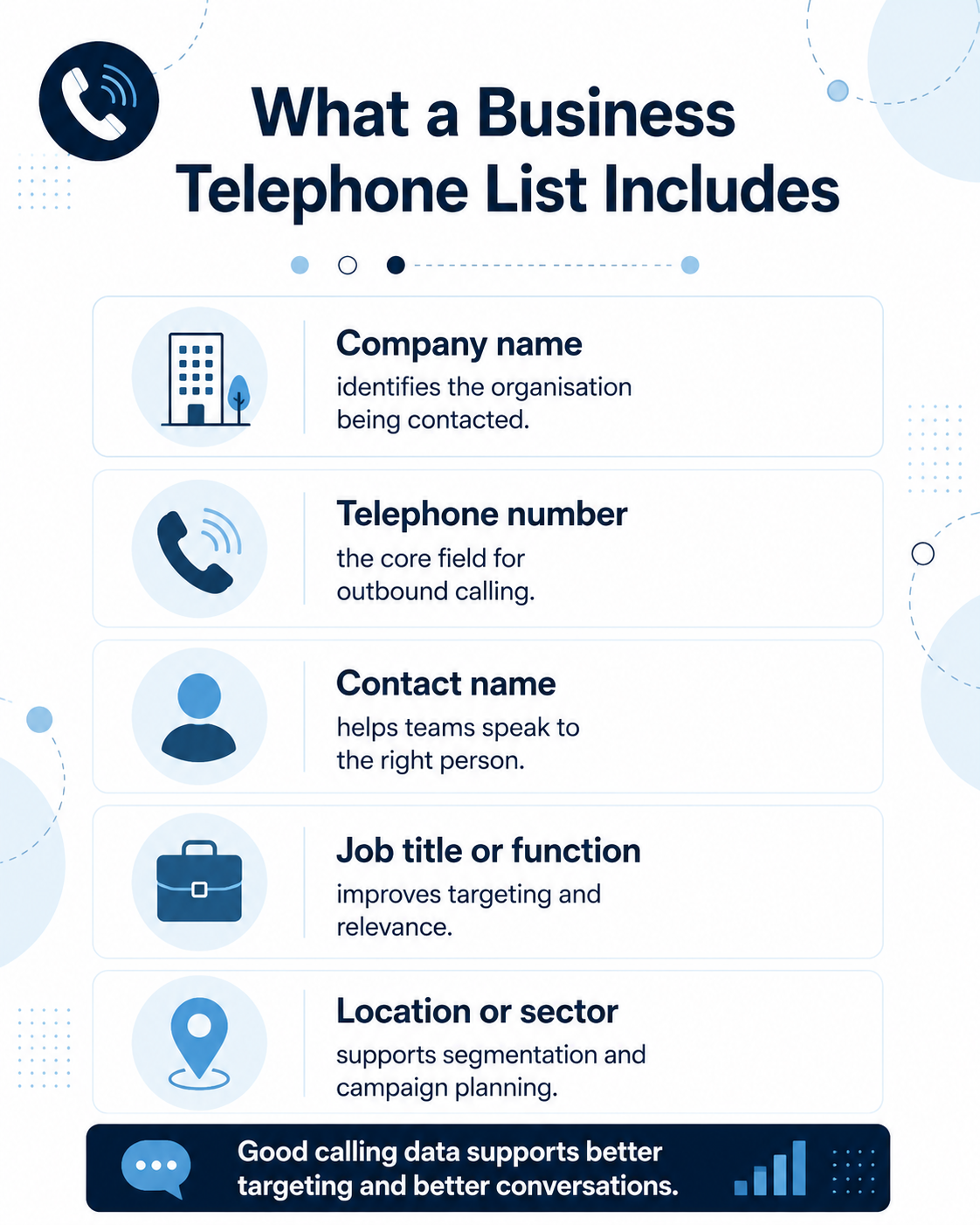
At a practical level, useful fields often include company name, trading name, registered address, site address, telephone number, website, sector, SIC code, employee size band, turnover band, region, postcode, contact name where appropriate, job title where available, number type, source information, last validation date and suppression status. Some campaigns also benefit from notes such as branch type, headquarters status, parent company relationship or location category.
Data source and validation details are important because they help you understand how reliable the record is. For example, a number recently validated against live number checks is usually more useful than an old record with no quality history. AccuraData provides Live Number Cleansing to help businesses validate phone data and reduce wasted calls to invalid, inactive or disconnected numbers.
A reputable dataset should also support suppression. In UK calling campaigns, telephone preference checks are not a minor housekeeping task. They are part of responsible marketing. The ICO telephone marketing guidance explains when marketing calls can be made and how TPS and CTPS registration affects calling. A Business Telephone List that is not properly screened creates avoidable risk.
How to create a Business Telephone List organically
An organic Business Telephone List is built from your own business activity. It usually develops gradually through enquiries, customer records, website forms, event registrations, referrals, inbound calls, sales conversations, CRM updates and account management. This type of data can be powerful because it reflects people and organisations that have interacted with your business in some way.
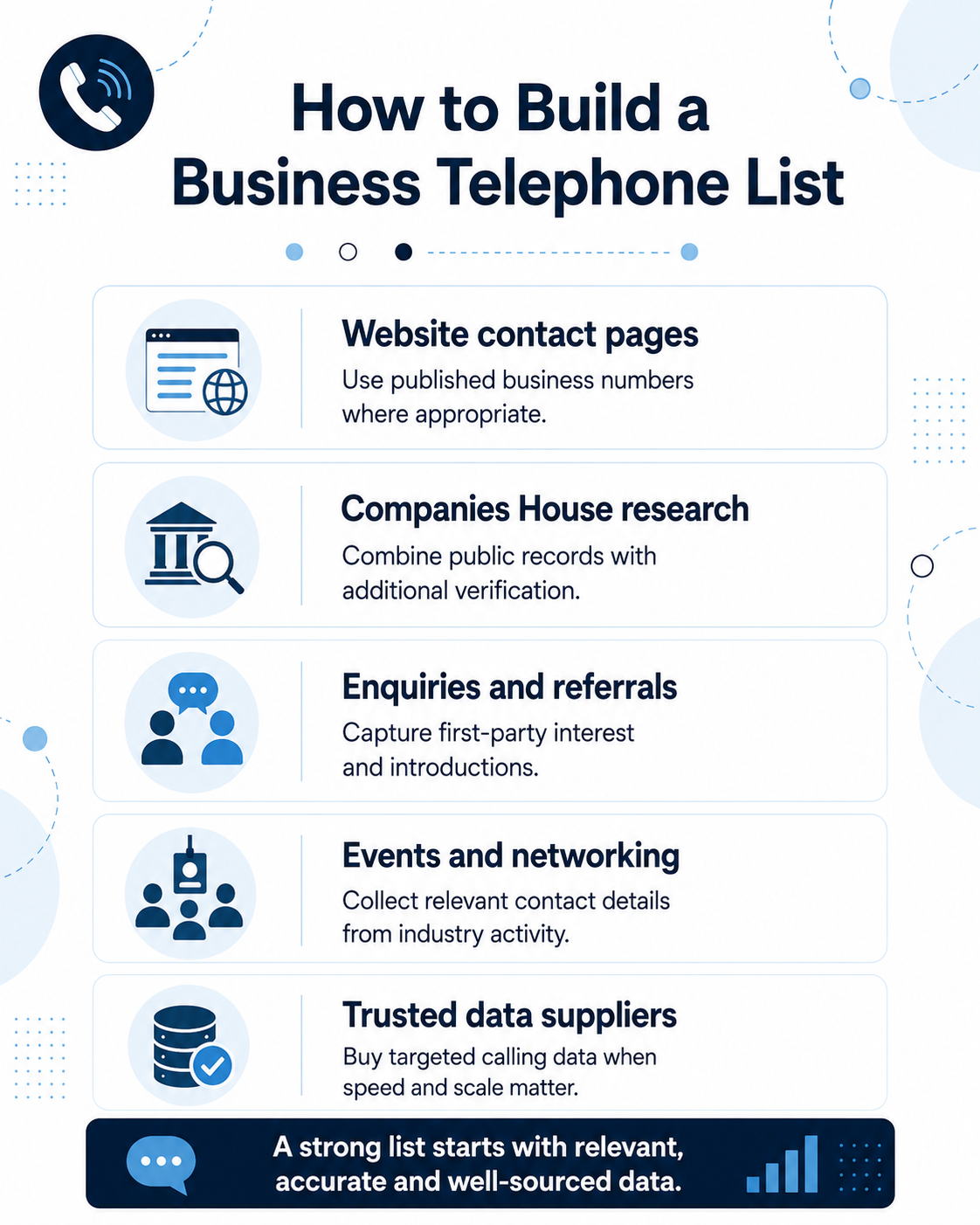
Website enquiries are one common source. If a business prospect completes a contact form, downloads a guide, books a demo or requests a quote, the contact details can be added to a CRM where the privacy notice and lawful basis have been considered. The key is transparency. People should understand who is collecting their data, why it is being collected and how it may be used. The ICO lawful basis guidance explains why a valid reason for processing personal data is required.
Existing customer data can also become part of a calling database. Account managers often collect direct telephone numbers, department numbers and site contacts during normal service delivery. This can support renewals, service updates, cross-sell campaigns or reactivation work. The data still needs to be accurate, relevant and used responsibly. The accuracy principle requires personal data to be accurate and, where necessary, kept up to date.
Events and webinars can generate useful business contacts. Attendees often provide a company name, job title and phone number when registering for a relevant event. A follow-up call may be appropriate where the context is clear and the outreach is relevant. The quality of this data depends on how well the event form explains future contact and how carefully the business records preferences.
Referrals are another source. A customer, supplier or partner may introduce your business to a relevant prospect. This can create a warmer context for a call, but the resulting record should still be treated as personal data where it identifies an individual. The record should be stored securely, kept accurate and used in a way that is proportionate to the business purpose.
Organic list building has advantages. It can create highly contextual data, often with stronger intent signals than third-party data. It can also strengthen CRM knowledge over time. The downside is speed and scale. If a business needs to reach a defined UK market quickly, organic data may not cover enough of the addressable audience. It may also be biased towards existing inbound demand rather than the broader market the sales team wants to develop.
Using basic public sources such as Companies House
Many organisations start with public business information. Companies House registers company information and makes it available to the public. Its data can help confirm that a limited company exists, identify its registered office, review company status, understand filing history and check official company details. The Companies House API also provides structured access to company information.
Companies House is useful for verification and company research, but it is not a finished Business Telephone List. It does not automatically provide a complete sales calling dataset, and it should not be treated as a ready-made prospecting database. Registered office addresses may not be trading locations. Company officers may not be the correct commercial contacts for your campaign. Some companies use accountants or formation agents as registered offices. A sales team still needs enrichment, validation, segmentation and suppression checks before calling.
Other basic sources may include company websites, public directories, trade association membership pages, event exhibitor lists, public tenders, professional registers, franchise directories and industry publications. These sources can help identify relevant organisations or enrich company context. They should be used carefully. Public availability does not remove the need for data protection compliance, accuracy checks or sensible record-keeping.
A common mistake is to scrape numbers from the web and assume that public equals permission-free. Public information can still be personal data if it relates to an identifiable individual. Even where a number is a general business number, calling activity still needs to respect PECR, TPS, CTPS and previous objections. The safest approach is to use public data as one input in a controlled data process, not as an unchecked call file.
Buying a Business Telephone List
Buying a Business Telephone List can be useful when a company needs defined reach quickly. A specialist supplier can build a dataset around sector, geography, company size, job function, site type and campaign objective. This can reduce research time, improve campaign focus and help sales teams speak to a more relevant audience from the start.
The main advantage is speed. Building a list from scratch through public research and CRM activity can take months. A supplier can often provide a targeted list more quickly, especially where the audience is defined by industry, location and company profile. This can support product launches, territory campaigns, event promotion, appointment setting, lapsed market development and sales pipeline creation.
The second advantage is segmentation. A reputable supplier should be able to help you narrow the market by practical criteria rather than simply delivering a large volume of generic records. AccuraData’s B2B Telemarketing Data service is designed to support targeted outbound prospecting and customer acquisition activity across the UK, with audience selection based on the campaign objective.
The third advantage is data preparation. A good supplier will not only provide records. They should also help with data quality, validation, suppression and documentation. AccuraData’s TPS/CTPS Checking service can help businesses screen calling data before campaigns, while Data Cleansing and Enrichment can help improve database accuracy and campaign usability.
Buying data also has risks. A cheap, broad or poorly maintained list can include outdated records, irrelevant organisations, disconnected numbers, duplicate contacts, missing source details or insufficient compliance support. The cost of a bad list is not limited to the purchase price. It includes wasted agent time, lower connect rates, complaint risk, poor brand perception and the internal time needed to repair the data.
That is why a buyer should judge a Business Telephone List by fitness for purpose, not by size alone. A smaller, better-targeted list is often more useful than a large list that looks impressive but does not match the campaign. AccuraData’s article on bad telemarketing list providers explains why poor supplier practices can damage outbound results.
Pros and cons of paid business telephone data
Paid business telephone data can help sales and marketing teams reach a defined market more quickly. It is useful when a company has a clear proposition and knows which sectors or business types are likely to benefit. A bought list can give a team enough volume to test messages, build a pipeline and compare performance across segments.
The strongest benefit is market access. If a supplier can filter by sector, location, company size and likely buyer profile, the list can turn a broad market into a practical calling plan. This helps managers allocate territories, set realistic call volumes and build campaigns around segments rather than guesswork.
Paid data can also improve consistency. If each agent is working from the same structured fields, the campaign becomes easier to manage. Call scripts, qualifying questions, CRM fields and reporting can all reflect the same segmentation structure. That makes results easier to compare and improves feedback loops.
However, there are limitations. Bought data does not create demand on its own. A list may identify relevant companies, but the campaign still needs a clear offer, a credible reason to call, trained agents and good follow-up. It also needs an ongoing process for updating outcomes. A list is a starting point, not a substitute for campaign planning.
Another limitation is that data changes constantly. Companies move, numbers change, people leave, sites close and switchboards are replaced. A supplier should be judged by how it maintains and validates data. The buyer should also plan ongoing cleansing, especially if the list will be reused. AccuraData’s data cleaning article covers the practical cost of outdated data across outbound campaigns.
Compliance is another important consideration. Bought data can be lawful when sourced, supplied and used responsibly, but the buyer still has responsibilities. The business making the calls should understand the data source, lawful basis, suppression status, internal opt-out process and campaign purpose. A reputable supplier should support this with clear information rather than vague assurances.
UK compliance for Business Telephone Lists
UK telemarketing is shaped by PECR, UK GDPR and wider expectations around fairness, transparency and responsible data use. For live marketing calls, the ICO guidance explains that businesses can call a business number that is not registered on TPS or CTPS, provided the business has not objected to calls in the past and other restrictions do not apply. This makes preference screening central to responsible calling.
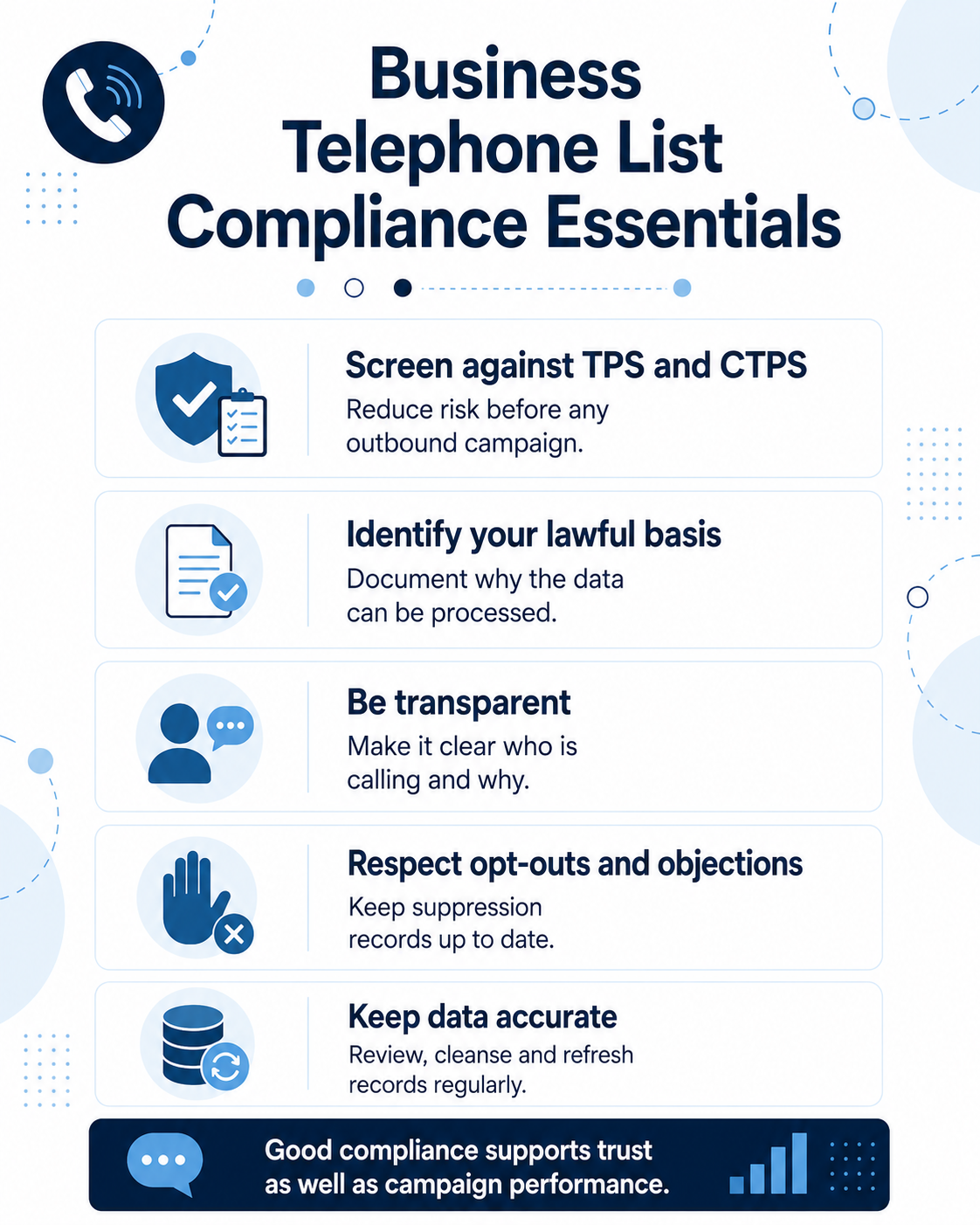
The Telephone Preference Service is the UK’s official Do Not Call register for landline and mobile numbers. The CTPS is the central opt-out register for organisations that do not want to receive unsolicited sales and marketing calls. If a number is registered and there is no valid reason to call, it should be suppressed before the campaign.
B2B callers also need to consider UK GDPR because a business contact record may include personal data, especially where it contains a named person, direct line, mobile number or role-linked contact. The legitimate interests guidance explains how organisations can consider legitimate interests as a lawful basis, provided they assess necessity and balance the interests against individual rights. In practice, this means documenting why the call is relevant, why the data is needed and why the contact’s interests are not overridden.
Transparency matters too. A caller should identify the organisation, explain the purpose of the call and make it easy for the person or business to object to future calls. Internal suppression lists are important because previous objections must be respected. A business should not rely only on external TPS and CTPS screening if a prospect has already told that business not to call again.
Record-keeping is a practical compliance control. Campaign managers should document the data source, selection criteria, screening date, suppression process, call purpose, script guidance and opt-out handling. These records help demonstrate that the campaign was not an unplanned or careless activity. They also help improve future campaigns by making decisions easier to review.
TPS and CTPS checks in practical terms
TPS and CTPS checks are not simply a pre-purchase formality. They should be treated as a campaign control. Calling data can change after a list is purchased, and numbers can be added to preference registers over time. That is why many organisations screen data shortly before calling rather than relying on old checks.
A practical process starts by identifying every number that may be used in the campaign. This includes main business numbers, branch numbers, direct lines and mobile numbers where relevant. The file should then be cleansed for duplicates, invalid formats and obvious data errors before preference screening is applied. Once TPS and CTPS status is returned, the business should decide how each record will be used, suppressed or reviewed.
AccuraData can help with this process through TPS/CTPS Checking and data cleansing support. This is useful for companies buying new calling data and for businesses that already hold CRM records but need them cleaned before a campaign. The goal is to help teams call with more confidence while reducing avoidable risk.
Preference screening also improves performance. Calling people or organisations that do not want unsolicited calls is usually poor practice even before legal risk is considered. Suppressed records rarely create good conversations. By removing unsuitable numbers, teams can spend more time on prospects who are more appropriate for the campaign.
Avoiding silent, abandoned and poor-quality calling practices
Compliance is not only about data. It is also about how calls are made. Ofcom has reminded organisations that repeated silent and abandoned calls can amount to persistent misuse and that Ofcom may take action, including penalties, under its powers. The Ofcom update is relevant for any organisation using dialler technology or outsourcing call activity.
A good campaign should avoid aggressive call practices, misleading introductions, unclear identity and excessive retry patterns. Agents should be trained to explain the purpose of the call and to record opt-outs accurately. Managers should monitor connect rates, call outcomes, complaints and abandoned call risk. The data may be compliant, but a poor call process can still harm reputation.
The NCSC telephone guidance is also useful because it highlights how legitimate organisations can make communications easier to trust. Clear identity, consistent phone numbers and clear routes for verification can help recipients distinguish responsible business contact from suspicious or fraudulent activity.
This is particularly important in B2B settings where decision-makers receive many calls. A relevant, transparent and professional call is more likely to be taken seriously. A vague or pushy call can damage trust even if the number was technically valid.
Segmentation potential in business telephone data
Segmentation turns a Business Telephone List from a set of numbers into a campaign strategy. It allows you to group prospects based on shared characteristics, then adapt the message, timing, script and offer to each audience. Without segmentation, agents are forced to use generic language that may not fit the prospect’s business.
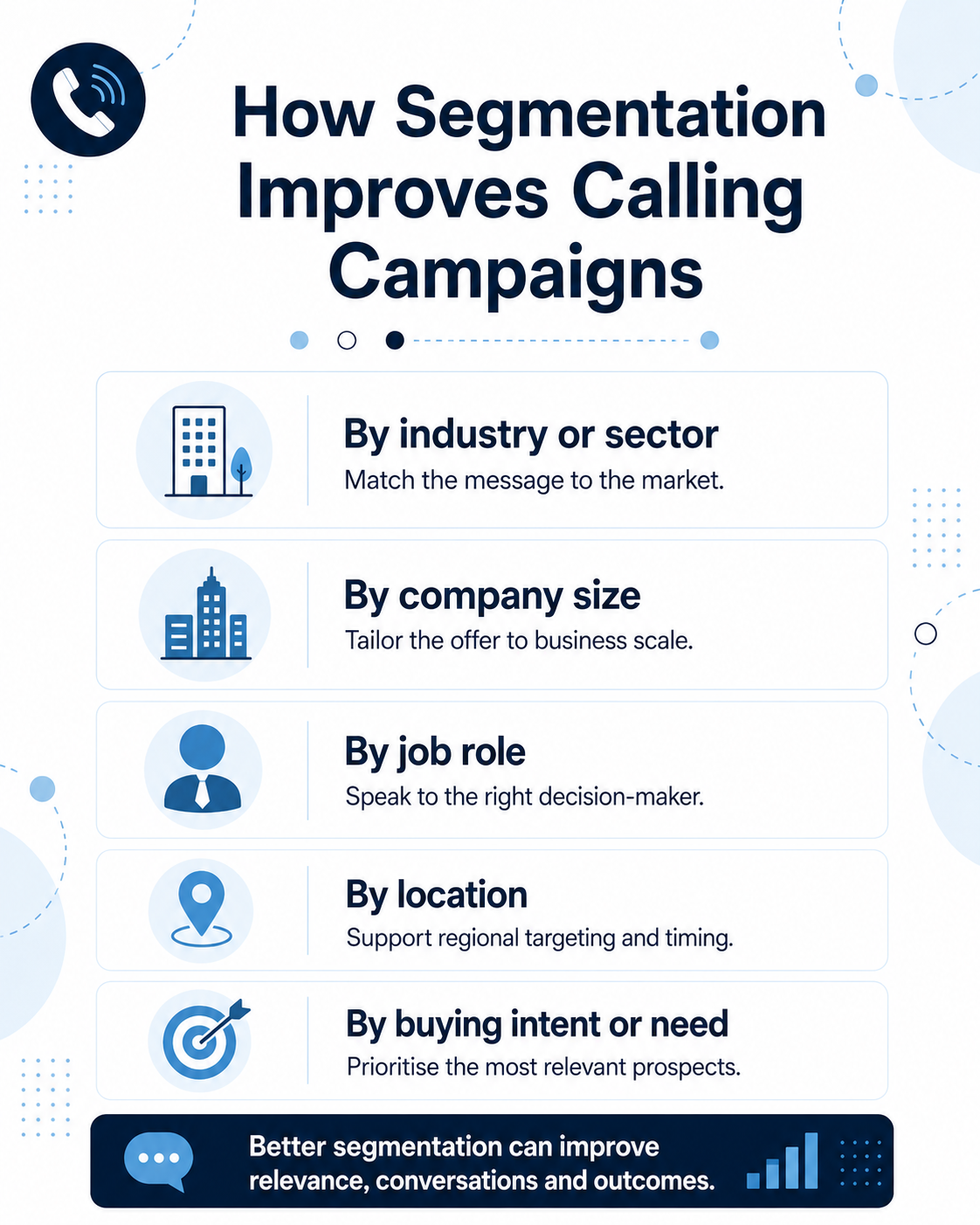
Common B2B segmentation fields include industry, SIC code, company size, turnover band, geographic region, postcode, local authority, site type, headquarters status, job function, seniority, department, business age and multi-site status. Some campaigns may also use contextual fields such as technology need, property type, fleet size, customer type, branch network or growth stage.
Industry segmentation is valuable when the offer solves sector-specific problems. A facilities management supplier may speak differently to care homes, manufacturers and offices. A software provider may need different proof points for finance teams, operations leaders and IT managers. A recruitment firm may prioritise industries with known hiring demand.
Geographic segmentation helps field sales and local campaigns. If representatives cover territories, calling data can be grouped by postcode, region or distance from a branch. This also helps when an offer depends on local availability, site visits or regional service capacity.
Company size segmentation helps align the offer with budget and complexity. A small business may need a different approach from a large corporate site. Employee banding, turnover banding and branch count can help shape the script, expected objections and likely buying process.
Decision-maker segmentation can improve relevance. If the campaign targets finance directors, operations managers, business owners or HR leaders, the call should focus on the issues those people care about. Generic switchboard calling can work in some cases, but campaigns are usually stronger when the dataset supports a clearer route to the right person or department.
How a Business Telephone List is used in outbound campaigns
A successful outbound campaign usually starts before the first call is made. The first step is to define the objective. That could be booked appointments, qualified leads, event registrations, quote requests, customer reactivation, market feedback or confirmed decision-maker details. The objective determines which data is needed.
The next step is audience selection. The campaign team decides which sectors, regions, sizes and roles fit the offer. This is where a good supplier can help challenge vague targeting. Instead of buying “all UK businesses”, the team can build a list that matches the product, service, budget level and sales model.
After selection, the data should be validated, deduplicated and screened. Telephone numbers should be checked for usability where possible, TPS and CTPS screening should be applied, internal do-not-call lists should be respected, and obvious mismatches should be removed. This preparation protects both performance and reputation.
The call plan should then be written around the segment. Agents need a clear reason for the call, a concise introduction, qualifying questions, objection handling guidance and a simple next step. A script should not make agents sound robotic. Its purpose is to keep the conversation relevant, compliant and consistent.
CRM setup is another important step. Each record should have fields for call status, outcome, next action, decision-maker confirmation, opt-out status, notes and follow-up timing. Poor outcome capture makes it hard to learn from the campaign. Good outcome capture turns calling into data improvement.
After the campaign, managers should analyse results by segment. Useful measures may include connect rate, decision-maker reach rate, conversation rate, appointment rate, lead quality, conversion to opportunity, invalid number rate, opt-out rate and complaint rate. These metrics show whether the list, message or offer needs refinement.
How to spot a reputable business telephone data supplier
A reputable supplier should ask questions before supplying data. If a provider immediately offers a huge list without asking about audience, objective, geography, sector or channel, that is a warning sign. Good data starts with fit. The supplier should want to understand what the campaign is trying to achieve.
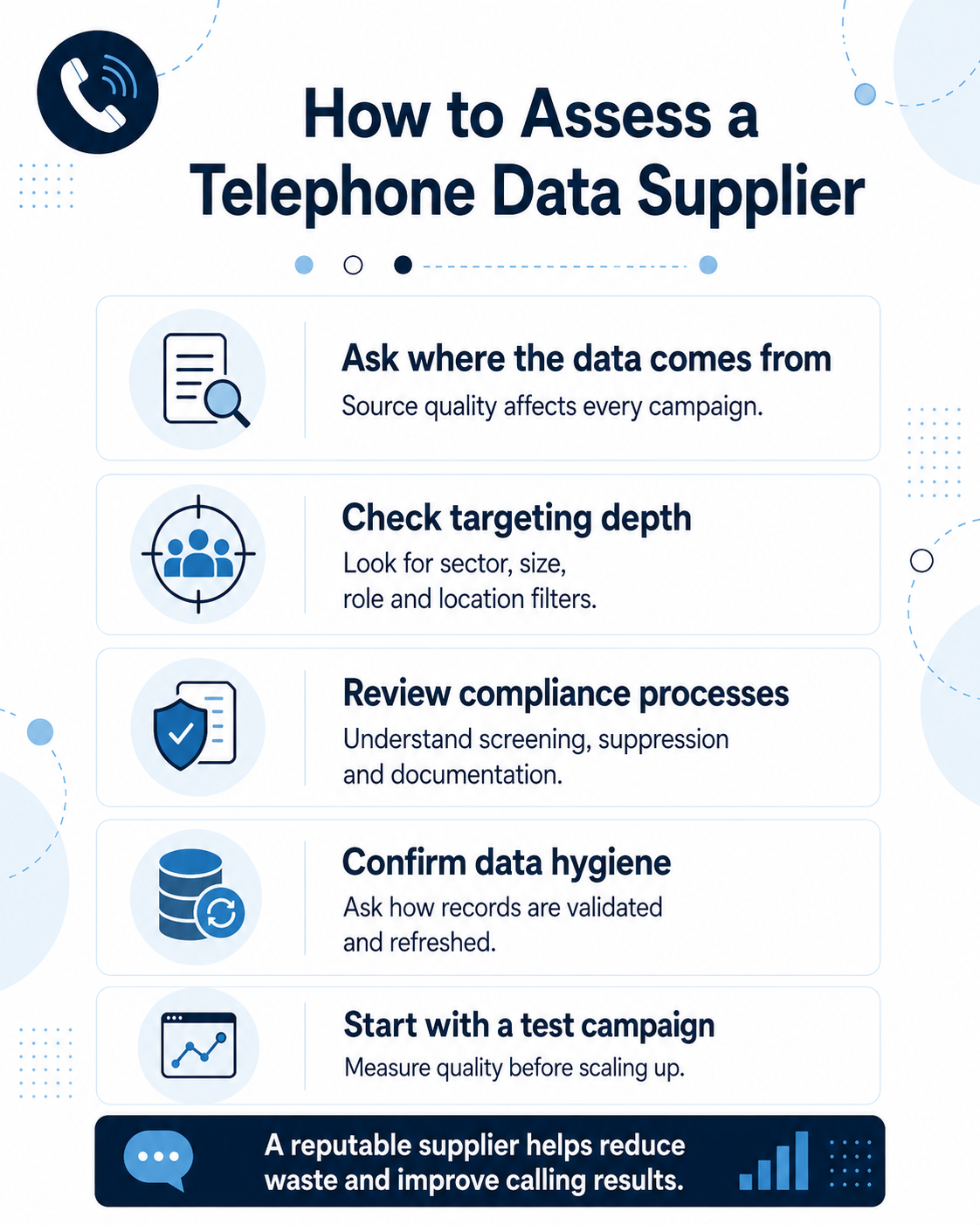
The supplier should be clear about available selection criteria. They should explain whether they can filter by industry, company size, location, job function, site type and other relevant fields. They should also be honest about limitations. Not every contact field will be available for every business, and not every campaign needs every field.
Data quality controls should be explained in plain terms. Ask how telephone numbers are maintained, how often records are refreshed, whether live number validation is available, how duplicates are handled, and whether TPS and CTPS screening can be completed before delivery. Vague claims such as “fully verified” are less useful than a clear explanation of the process.
Compliance support is essential. A reputable supplier should provide information about data source, lawful use, suppression, screening and responsibilities. They should not promise that buying the list removes all obligations from the caller. The business making the calls still needs to use the data responsibly.
A good supplier should also understand the difference between volume and value. A large cheap file can look attractive, but the useful question is how many records match your campaign and can be used responsibly. AccuraData’s article on B2B Data Provider explains why supplier quality affects campaign outcomes.
Commercial transparency matters as well. The supplier should be clear about what is included, what checks have been performed, how the data will be delivered, whether any updates are available and what support is provided if records are unsuitable. The more transparent the supplier, the easier it is for the buyer to plan properly.
Questions to ask before buying a Business Telephone List
Before purchasing a list, ask what the data is intended to support. Is it built for telemarketing, market research, direct sales, appointment setting or general business profiling? Data supplied for one purpose may not be suitable for another. Campaign purpose should be clear before the list is created.
Ask how the data is sourced and maintained. The answer should be understandable. A supplier may use multiple inputs, including public company records, business directories, proprietary databases, verification processes and ongoing updates. The key issue is whether the supplier can explain the process well enough for you to assess risk and suitability.
Ask which fields will be included and how complete they are likely to be. If you need sector, size and region filters, make sure those fields are present. If you need named decision-makers, ask about job functions and coverage. If you need telephone validation, ask what validation method will be used and when.
Ask about suppression. Will the data be screened against TPS and CTPS before delivery or before calling? Can internal do-not-call lists be applied? How will previous objections be managed? Can the supplier help cleanse your existing file as well as provide new records?
Ask how the list will be used after delivery. Will it be imported into a CRM? Will it be used by an internal sales team or an outsourced calling partner? Will it be combined with email or postal outreach? These questions affect formatting, fields and compliance documentation.
Finally, ask what success looks like. A reputable supplier should not guarantee unrealistic conversion rates, because results depend on the offer, timing, agents, script and follow-up as well as data quality. They should be willing to discuss sensible test volumes, segment-level reporting and campaign learning.
Common mistakes when using business telephone lists
The first mistake is buying too broadly. Businesses often ask for a list that covers every possible prospect, then wonder why the campaign lacks focus. A better approach is to start with the strongest audience segment and test the message before expanding.
The second mistake is treating the list as static. Telephone data changes. A number that was valid last year may not be valid now. A company may have moved, closed or merged. A decision-maker may have changed role. Ongoing cleansing is part of responsible list management, not an optional extra.
The third mistake is ignoring suppression. Some teams focus on getting more records into the dialler rather than removing unsuitable records. This can reduce call quality and increase risk. TPS, CTPS and internal opt-out suppression should be applied before calling.
The fourth mistake is using a generic script. A segmented list deserves a segmented message. If every prospect hears the same opening line regardless of sector, size or role, much of the value of the data is wasted.
The fifth mistake is failing to capture outcomes properly. If agents do not record invalid numbers, wrong contacts, objections, opt-outs and next steps consistently, the business loses the opportunity to improve the dataset. A good campaign should leave the CRM cleaner than it was before.
How AccuraData supports business telephone campaigns
AccuraData helps UK organisations access targeted business data for outbound calling and wider direct marketing activity. The service is built around audience selection, data quality and practical campaign use. Rather than supplying untargeted lists, AccuraData can help shape a Business Telephone List around sector, region, company size, business profile and campaign objectives.
For businesses that need new calling data, AccuraData’s B2B Data and B2B Telemarketing Data services can support lead generation, prospecting and customer acquisition. These datasets can be tailored to specific market segments, helping sales teams focus on companies that are more likely to match the proposition.
For businesses that already hold calling data, AccuraData’s Data Cleansing and Enrichment services can help improve accuracy, remove duplicates, validate business contact data and prepare records for campaign use. This can be valuable before an internal outbound campaign, a CRM migration or a new sales push.
For telephone-specific quality checks, AccuraData’s Live Number Cleansing helps improve telephone number validity, while TPS/CTPS Checking helps screen calling data before campaigns. This combination can reduce wasted calling time and support more responsible outbound activity.
AccuraData can also support multi-channel planning. Many B2B campaigns combine telephone calls with email, direct mail and account research. A single audience strategy can be more effective than disconnected lists for each channel, provided the data is structured, compliant and fit for the intended purpose.
How to maintain a Business Telephone List over time
A Business Telephone List should be treated as a living asset. After purchase or organic creation, it needs regular maintenance. Every campaign should generate updates. Invalid numbers should be removed or flagged, decision-maker details should be corrected, opt-outs should be recorded, and successful segments should be identified.
A simple maintenance process can make a big difference. Before each campaign, validate numbers where possible, run TPS and CTPS checks, remove duplicates, apply internal suppression, check priority segments and confirm that the calling purpose is still relevant. After each campaign, review outcomes, update the CRM and decide whether the dataset needs enrichment.
Data retention should also be considered. Businesses should not keep personal data indefinitely without a purpose. If a record is no longer relevant, inaccurate or not needed, it should be deleted or suppressed as appropriate. Retention policies should match business need and data protection obligations.
Sales and marketing teams should agree ownership. If no one owns data quality, lists decay quickly. Assigning responsibility for updates, suppression, validation and reporting helps prevent the database becoming unreliable. This is especially important where multiple teams use the same CRM.
Measuring performance from business telephone data
The quality of a Business Telephone List should be judged by outcomes, not just by record count. Useful measures include dialled numbers, connect rate, invalid number rate, conversation rate, decision-maker reach rate, appointment rate, lead quality, conversion to opportunity, opt-out rate, complaint rate and cost per qualified lead.
Segment-level reporting is especially useful. If one sector produces many conversations and another produces mostly invalid numbers, the list or message may need adjusting. If one region performs better than another, the business may shift resource. If a certain company size band creates stronger opportunities, future buying criteria can be refined.
Data quality metrics are just as important as sales metrics. High invalid number rates may indicate poor source quality or old data. High opt-out rates may indicate poor audience fit or weak messaging. Low connect rates may suggest number type issues, bad timing or over-reliance on switchboards. A strong campaign reviews these signals and improves both the list and the calling approach.
Long-term measurement should consider pipeline and revenue. Appointment numbers are useful, but sales leaders also need to know whether appointments became opportunities and whether opportunities became customers. The best datasets are those that help create real commercial movement, not just call activity.
Final thoughts
A Business Telephone List can be a powerful tool for B2B outreach when it is accurate, relevant, compliant and used with a clear campaign plan. It helps organisations turn a broad target market into workable records, supports direct conversations with potential customers and gives sales teams a practical route to market.
The value of the list depends on how it is created and maintained. Organic data can be highly contextual but slow to build. Basic public sources such as Companies House can help with company verification and research, but they do not create a complete calling file on their own. Paid data can provide reach and structure, but only when the supplier is transparent, the selection is focused and the compliance process is taken seriously.
The best results come from combining good data with good process. That means clear targeting, valid phone numbers, TPS and CTPS screening, internal suppression, relevant scripts, trained callers, accurate CRM updates and regular performance review. A list is not just a spreadsheet of numbers. It is the foundation of the outbound campaign.
AccuraData can help businesses buy targeted B2B calling data, cleanse existing records, validate phone numbers and prepare datasets for responsible outreach. Whether you need a new Business Telephone List, help improving an existing CRM file or support with TPS and CTPS checks, AccuraData provides a practical route to cleaner, better-targeted and more reliable business telephone data.