
B2B Marketing Lists help organisations reach relevant business audiences through email, telephone and post. Used well, they give sales and marketing teams a practical way to identify decision-makers, segment by company profile and run campaigns with more focus. Used poorly, they can waste budget, create compliance risk and damage trust before a conversation even starts. The difference is rarely the size of the list. It is usually the quality, relevance, lawful basis, suppression process and campaign discipline behind it.
For many UK businesses, the term B2B marketing list is used very broadly. It may mean a database of company records, an email list of named business contacts, a telephone list for outbound calling, a postal list for direct mail, or a multi-channel file that contains several contact routes for the same organisation. These are related, but they are not the same. Each list type has different uses, different data fields and different compliance considerations. The rules also vary depending on whether you are contacting a limited company, a public body, a sole trader, a partnership or an individual acting as a consumer.
This article explains what B2B Marketing Lists are, how email, telemarketing and postal lists differ, what to look for in a reliable supplier, and how compliance works across UK GDPR, PECR, TPS, CTPS, MPS and email unsubscribe management. It also explains how AccuraData can support businesses that need targeted B2B Data, consumer-facing B2C Data, email marketing data, telemarketing data, postal data or managed campaign support.
What Are B2B Marketing Lists?
A B2B marketing list is a structured dataset used to contact organisations or business contacts for sales, marketing, lead generation or customer acquisition activity. At a basic level, it may include company names, business addresses and telephone numbers. A more useful list will also include named contacts, job titles, seniority, departments, sectors, employee bands, turnover bands, geographic regions, email addresses, direct dials where available, website URLs, CRM-friendly fields and campaign notes.
The value of the list is in the fit between the data and the campaign. A list of every business in a postcode area may help a local awareness campaign, but it will not be precise enough for a software supplier that needs finance directors in manufacturing companies. A list of generic company emails may help very broad business communication, but it is less useful when a campaign needs to reach IT leaders, practice managers, procurement teams or owner-directors. AccuraData’s B2B lead generation service is built around this idea of matching data to the audience, channel and objective.
B2B Marketing Lists can be used for outbound sales, account-based marketing, event invitations, product launches, renewals, surveys, customer reactivation, channel partner recruitment, professional services marketing and market development. They can also support multi-channel campaigns where a business sends an email, follows up by telephone and reinforces the message with direct mail. This is why list structure matters. A single-channel file may only need one contact route. A multi-channel file needs consistent identifiers, clean company records and enough segmentation to keep every message relevant.
The main difference between a good B2B list and a weak one is usability. A weak list might look large in a spreadsheet, but contain old contacts, generic addresses, missing job titles, duplicate companies, invalid telephone numbers and poorly defined sectors. A good list is smaller in wasted volume and larger in practical value. It helps a campaign start with a clear audience rather than a mass of unfiltered records.
Why B2B Marketing Lists Still Matter
Digital advertising, search, social media and referral marketing all have a place, but B2B Marketing Lists remain useful because they allow a business to define who it wants to reach. Instead of waiting for prospects to find a website or advert, a list can support proactive outreach to a chosen market. That could be a defined sector, a geographic region, a job function, a company size band or a group of organisations with a shared need.
Email, telephone and post all create different forms of attention. The DMA Email Benchmarking Report reported a 98% email delivery rate in 2024 and a 2.3% unique click rate, showing that email can still produce measurable engagement when campaigns are properly delivered. The JICMAIL tracker provides response, ROI, cost per acquisition and average order value benchmarks for mail campaigns. These benchmarks are not promises, but they show that direct marketing channels can be planned and measured when the data, message and follow-up process are properly aligned.
Telephone outreach has a different role. It can create a live conversation, qualify interest, answer questions and identify buying context that an email or mail piece cannot capture on its own. The channel is also more sensitive because a live call interrupts the recipient, so it requires careful targeting, respectful scripting and strong suppression practice. The ICO telephone guidance makes clear that TPS, CTPS and internal do-not-call lists all matter for B2B calling.
The commercial utility of a marketing list comes from control. A business can choose the audience before spending time on creative, call resource, printing, postage or software. It can also measure performance by segment. If a campaign performs well in healthcare but poorly in hospitality, or strongly with managing directors but weakly with junior contacts, the next campaign can be improved. Without a structured list, that learning is harder to capture.
Email Marketing Lists, Telemarketing Lists and Postal Marketing Lists
B2B Marketing Lists are often grouped together, but the channel changes the way the data should be selected, checked and used. An email marketing list is designed for electronic outreach. A telemarketing list is designed for live calling. A postal marketing list is designed for addressed mail. Each one may include similar company fields, but the critical contact field is different.
An email list needs valid business email addresses, named contacts, role information, unsubscribe handling and a suitable basis for the campaign. A telemarketing list needs accurate telephone numbers, call routing context, TPS and CTPS suppression, caller identity and outcome recording. A postal list needs deliverable addresses, correct formatting, MPS suppression where relevant and enough segmentation to justify print and postage cost.
The compliance rules are also channel-specific. The ICO B2B guidance explains that PECR applies differently depending on the marketing method and the type of subscriber. The same business contact may be treated differently depending on whether you email, call or post to them. This is why treating all B2B data as one generic asset is risky.
AccuraData can supply targeted data for different channels, including email marketing lists, telemarketing data and postal marketing data. The right format depends on the campaign plan. A business that wants fast conversation may prioritise phone records. A business with a complex offer may use email and direct mail first, then call engaged accounts afterwards.
B2B Email Marketing Lists
A B2B email marketing list is a dataset of business contacts that can be used for email campaigns. It may include named people, business email addresses, job titles, companies, sectors, locations and company size fields. The best lists give enough context for the sender to write a relevant message. An email sent to a finance director should not sound the same as one sent to an operations manager or HR lead.
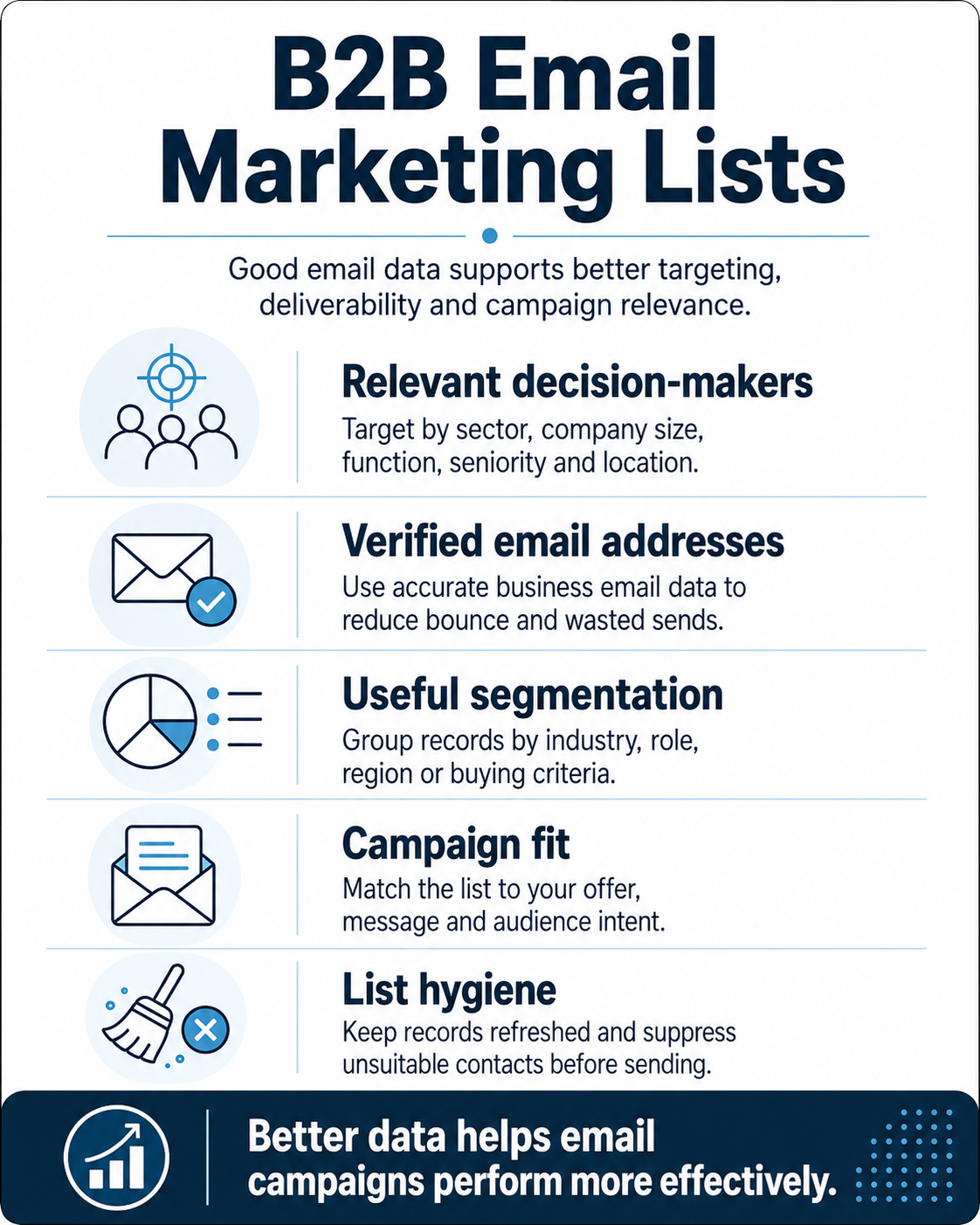
B2B email data needs to be selected with precision. The audience should be defined by the commercial problem the product or service solves. For example, a payroll software campaign might target finance, HR and operations leaders in companies of a certain size. A facilities management campaign might target site managers, office managers and operations directors. A professional services campaign might target managing partners, practice managers or finance teams. AccuraData’s article on business email lists explains how business email lists differ from pre-qualified leads, which is an important distinction when planning expectations.
For compliance, B2B email marketing must be understood through both UK GDPR and PECR. The ICO B2B guidance says that UK GDPR applies when personal data is processed for direct marketing, even in a business context. A named business email such as firstname.lastname@company.co.uk can therefore still be personal data. The business must have a lawful basis, provide transparency and respect objections.
PECR treats corporate subscribers differently from individual subscribers. The ICO email guidance says organisations can send marketing emails or texts to companies, although keeping a do-not-email list is good practice. Individual subscribers, which can include sole traders and some partnerships, usually require consent unless a valid soft opt-in applies. This is why a B2B email list should be clear about the type of organisation and contact record involved.
Email subscription status is another key issue. A newsletter subscriber list is not the same as a purchased B2B email list. A subscriber has usually asked to receive content from the sender, while a purchased B2B email contact may not have an existing relationship with the brand. The sender still needs to identify itself clearly, give a simple unsubscribe route and maintain suppression records. The GOV.UK direct marketing page reminds businesses that every marketing email must give recipients the ability to opt out of further emails.
For performance, the best email lists support segmentation. Instead of sending one generic message to every contact, businesses can tailor the subject line, opening paragraph, offer and call to action by sector, job function or company size. The AccuraData article on email campaigns goes into more detail on planning and improving email performance, but the principle is simple. Good data gives email creative something specific to work with.
Telemarketing Lists
A telemarketing list is designed for telephone outreach. It may include company name, telephone number, contact name, job title, location, sector, employee count, turnover band, company notes and previous contact outcomes. It may also include direct dials where available, but many B2B lists rely on main switchboard or reception-level numbers depending on the market and data availability.
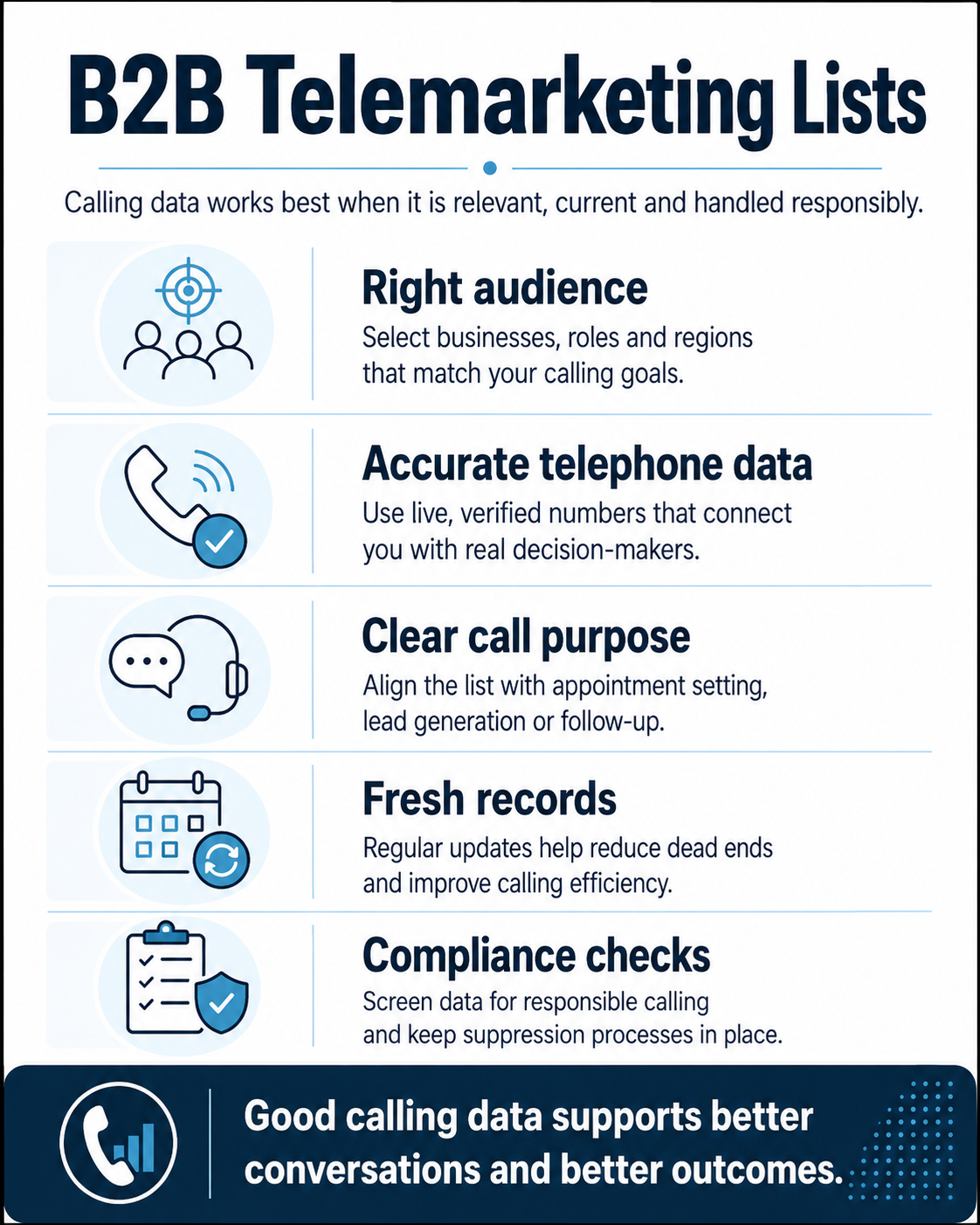
The utility of a telemarketing list is conversation. Email can introduce an offer, but a call can reveal timing, decision process, objections, procurement route and whether the contact is genuinely relevant. This is useful for complex B2B sales where buying decisions involve several people. A list can help callers prioritise the right companies and avoid spending time on sectors, sizes or regions that are unlikely to buy.
Compliance is central to telemarketing because live calls are intrusive if they are poorly targeted. The TPS is the UK’s official do-not-call register for landline and mobile numbers, while the CTPS covers organisations that have registered not to receive unsolicited sales and marketing calls. The ICO telephone guidance says B2B callers need to screen against TPS, CTPS and their own do-not-call list.
The distinction matters because some business contacts are not corporate bodies. Sole traders and some partnerships may be covered by TPS. Companies, certain partnerships and public bodies may register with CTPS. If a campaign contains a mix of limited companies, sole traders and partnerships, both registers can be relevant. AccuraData’s TPS Checker article explains this in more practical detail for outbound calling teams.
Telemarketing also has operational rules beyond list checking. Callers should identify the organisation, explain the purpose of the call, respect objections and record outcomes accurately. Organisations using predictive diallers or high-volume call systems should also understand the harm caused by silent or abandoned calls. Ofcom guidance explains that repeated abandoned or silent calls may lead to enforcement action.
A reliable telemarketing list should therefore be suppression-ready before it reaches the calling team. It should not leave callers guessing whether numbers have been screened. It should also support outcome capture so that wrong numbers, no longer with company, not interested, call back later and do-not-call requests can be recorded. This makes the next round of calling more efficient and helps protect the business from repeated unwanted contact.
Postal Marketing Lists
A postal marketing list is designed for addressed direct mail. It may contain company names, site addresses, decision-maker names, job titles, household or organisation profile fields and segmentation data. For B2B campaigns, postal data can be useful when the message benefits from a physical format, such as a brochure, invitation, sample pack, local service offer, account-based pack or professional introduction.
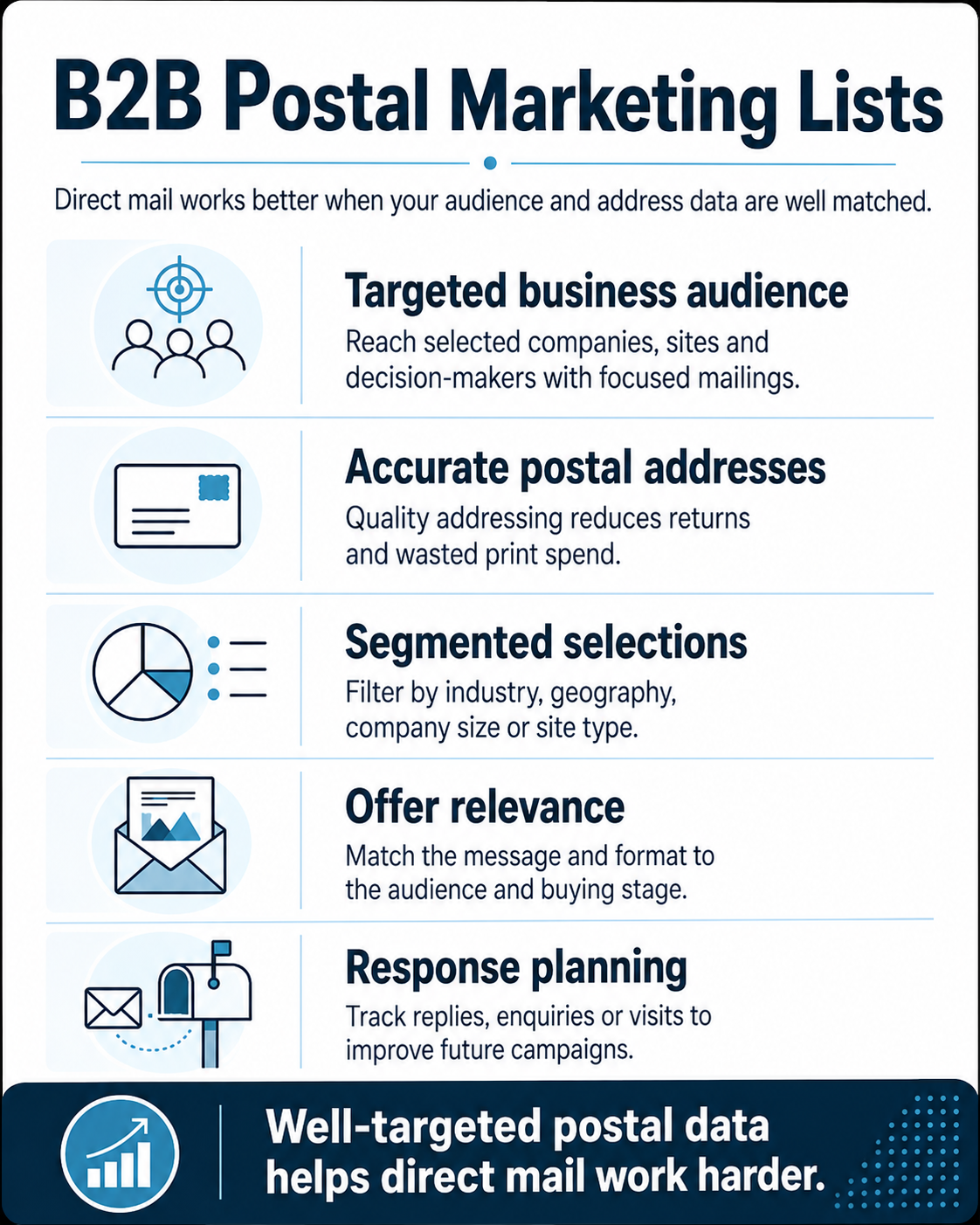
Postal marketing has a different cost structure from email. Each send involves print, fulfilment and postage, so poor data can become expensive quickly. A campaign sent to old addresses, unsuitable sites or duplicate records wastes money before any response can happen. Accurate addresses, relevant segmentation and clean suppression are therefore commercial issues as well as compliance issues.
Address quality is especially important. The Postcode Address File contains over 32 million UK postal delivery addresses and 1.8 million postcodes, and is widely used to support accurate addressing. Direct mail data should be structured so that addresses are complete, properly formatted and suitable for mailing production. A spreadsheet that looks acceptable to a marketer can still create print or fulfilment issues if address lines are inconsistent.
The MPS helps individuals stop personally addressed unsolicited mail. The DMA describes MPS as the UK’s official do not mail list, and the ASA’s CAP Code recognises preference services as a way for people and businesses to reduce unsolicited contact. B2B postal marketing should therefore be planned with suppression and preference management in mind, particularly where named individuals are contacted at business addresses or where consumer data is involved.
Direct mail can also support measurement. A list can be segmented by region, sector, customer type or account value, and each segment can be tracked using unique phone numbers, QR codes, landing pages, offer codes or response forms. Royal Mail provides business resources for marketing mail, while JICMAIL’s benchmarks help marketers think about response, ROI, cost per acquisition and average order value. These sources are useful for planning, but campaign results still depend on the data, offer, creative and follow-up process.
AccuraData’s direct mail data article explains why the list behind a campaign matters. A direct mail piece can be well designed, but it will underperform if the audience is wrong. The list decides who receives the message, which is why postal data should be briefed as carefully as the design.
B2B Lists and B2C Lists Are Not Interchangeable
B2B and B2C data can both support direct marketing, but they are not interchangeable. B2B lists are built around organisations, job roles, departments, sites and commercial responsibilities. B2C lists are built around individuals, households, interests, demographics, locations and consumer preferences. The targeting logic, permission expectations and compliance risks are different.
A B2B campaign usually speaks to a business need. It might target financial controllers about accounting software, HR directors about training, operations managers about logistics or managing directors about professional services. A B2C campaign usually speaks to an individual or household need. It might target homeowners, parents, motorists, donors, holidaymakers or people with certain lifestyle interests.
The legal context changes too. PECR rules for individual subscribers are generally stricter for electronic mail than for corporate subscribers, as the ICO email guidance explains. Telephone rules also require careful attention to whether a number belongs to an individual, sole trader, partnership or corporate body. Postal campaigns may require MPS screening and other preference management when they involve named individuals.
AccuraData supplies both B2B Data and B2C Data, but the two services should be briefed separately. A business should not buy a consumer list and use it as if it were a business list, or treat named business contacts as if data protection rules no longer apply. The safest and most effective approach is to choose data according to the audience and the channel.
Compliance Framework for B2B Marketing Lists
Compliance should be built into the campaign before the list is supplied, imported or activated. The ICO planning guidance warns that it is hard to retrofit legal requirements after direct marketing activity has started. For B2B Marketing Lists, this means checking the purpose, audience, lawful basis, transparency, suppression files and channel-specific rules before the first email, call or mailing goes out.
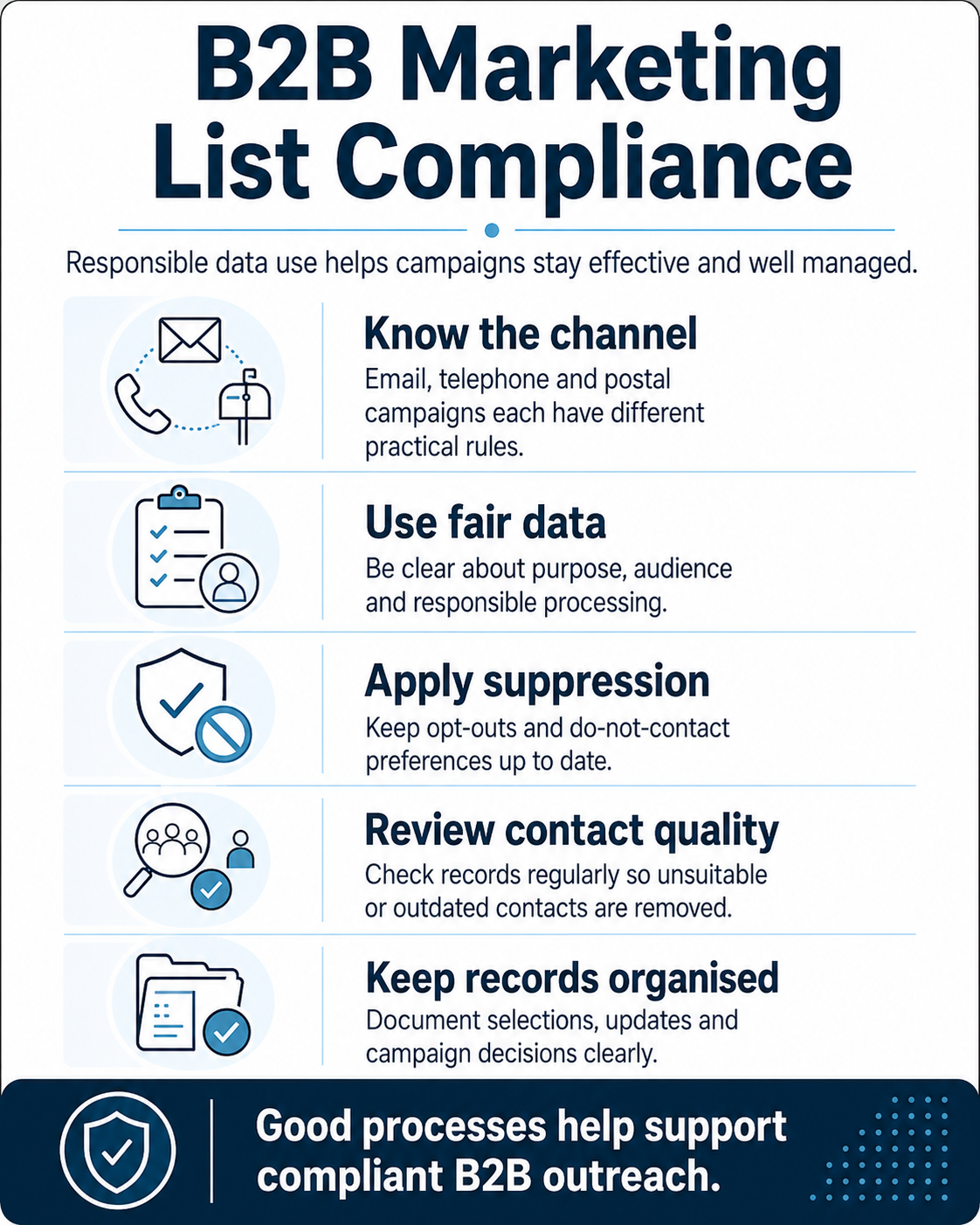
UK GDPR governs the processing of personal data. The UK data protection overview explains that UK data protection legislation controls how personal information is used by organisations. In B2B marketing, personal data may include a named contact, job title, direct dial, business email address or notes about a person. Even if the campaign is aimed at a business, the record may still relate to an identifiable individual.
A lawful basis is required when personal data is processed. The ICO says the two lawful bases most likely to apply to direct marketing are consent and legitimate interests. Legitimate interests may be appropriate for some B2B activity, but it is not a blanket answer. The ICO’s legitimate interests guidance describes a three-part test covering the interest, necessity and balancing assessment.
Data protection principles also matter. The ICO’s data minimisation guidance says organisations should identify the minimum personal data needed for the purpose, while the ICO’s accuracy guidance explains why inaccurate data can become a problem. In practical terms, this means a B2B marketing list should contain useful fields, not unnecessary personal detail, and should be maintained rather than treated as a static file.
PECR adds channel-specific rules for electronic communications and telephone marketing. The ICO PECR overview explains that there are different rules for different communication types and that rules are generally stricter for marketing to individuals than companies. A business using B2B Marketing Lists should therefore avoid assuming that one compliance position covers every channel.
TPS and CTPS for Telemarketing Lists
TPS and CTPS are central to responsible calling. TPS covers individuals who have opted out of unsolicited sales and marketing calls. CTPS covers corporate subscribers that have registered their objection to unsolicited sales and marketing calls. A telemarketing list should be checked before use, and organisations should also maintain their own internal do-not-call records.
The TPS website describes TPS as the UK’s only official do-not-call register for landline and mobile numbers. The CTPS site explains that CTPS contains organisations that have registered their wish not to receive unsolicited sales and marketing calls. These registers are not optional etiquette. They are part of the legal and compliance environment for UK calling campaigns.
The ICO states that B2B calls should be screened against both registers where relevant, as well as the caller’s own do-not-call list. This is particularly important because B2B data can contain a mix of corporate subscribers, sole traders and partnerships. A list that has not been checked properly can create risk for the business using it, even if that business bought the data from a supplier.
Good practice also means recording objections quickly. If a recipient says they do not want further calls, that preference should be added to the internal suppression file and respected across future campaigns. It should not depend on whether the person later appears in a new list. AccuraData can support this process through checked telemarketing data and list cleansing, helping businesses avoid calling records that should not be used.
MPS for Postal Marketing Lists
MPS is relevant to personally addressed direct mail. It allows individuals to register that they do not want unsolicited addressed advertising mail. The MPS website explains that it can stop personally addressed unsolicited mail, while mail from organisations with an existing relationship may still continue. For marketers, the key point is that postal suppression is part of responsible list use.
The DMA’s preference services page describes MPS as the UK’s official do-not-mail list. The CAP Code also recognises preference services in the context of data use for marketing. For businesses using direct mail lists, MPS should not be treated as an afterthought after the print run has already been arranged.
In B2B postal marketing, the relevance of MPS depends on the data and audience. A mailing to generic business premises is different from a mailing addressed to named individuals. A campaign using named contacts at business addresses should still consider personal data, fairness and objection handling. A campaign using consumer or household data needs even greater care. AccuraData’s article on postal data explains the practical difference between B2B and B2C direct mail audiences.
Postal suppression also has a commercial benefit. Removing people who have signalled that they do not want unsolicited mail can reduce waste, complaints and reputational damage. It also supports better measurement because the campaign is less likely to include unsuitable recipients who were unlikely to respond positively.
Email Subscription, Consent and Unsubscribe Management
Email subscription status is often misunderstood in B2B marketing. A list of newsletter subscribers is not the same as a purchased B2B email list. A subscriber has usually chosen to receive emails from a specific organisation or for a specific purpose. A purchased B2B list may be lawful in some circumstances, but the sender must still meet UK GDPR and PECR requirements.
For corporate subscribers, the ICO email guidance says marketing emails can be sent to companies, with do-not-email suppression treated as good practice. For individual subscribers, such as sole traders and some partnerships, the rules are stricter. The sender usually needs specific consent or a valid soft opt-in. The ICO soft opt-in explanation also stresses the need for an opportunity to opt out at collection and in every later message.
Unsubscribe management should be treated as a core part of list management. Every campaign should include a simple way to opt out. Opt-outs should be applied before future sends, and suppression records should be retained so that the same contact is not added back through a later upload. This is not only a legal and ethical point. It protects sender reputation and helps reduce complaints.
Businesses should also avoid mixing subscription purposes. A person who signs up for product updates may not have agreed to every type of promotional email. A contact gathered for a webinar may not have agreed to unrelated partner offers. The more clearly a business records source, purpose and preference, the easier it is to run targeted campaigns without overstepping recipient expectations.
What Good B2B Marketing Lists Should Include
A good B2B marketing list should include enough information to identify the organisation, understand the contact and tailor the message. The exact fields depend on the channel, but a campaign-ready record will usually include company name, contact name where relevant, job title, seniority, department, sector, location, company size, contact route, source notes, suppression status and update date.
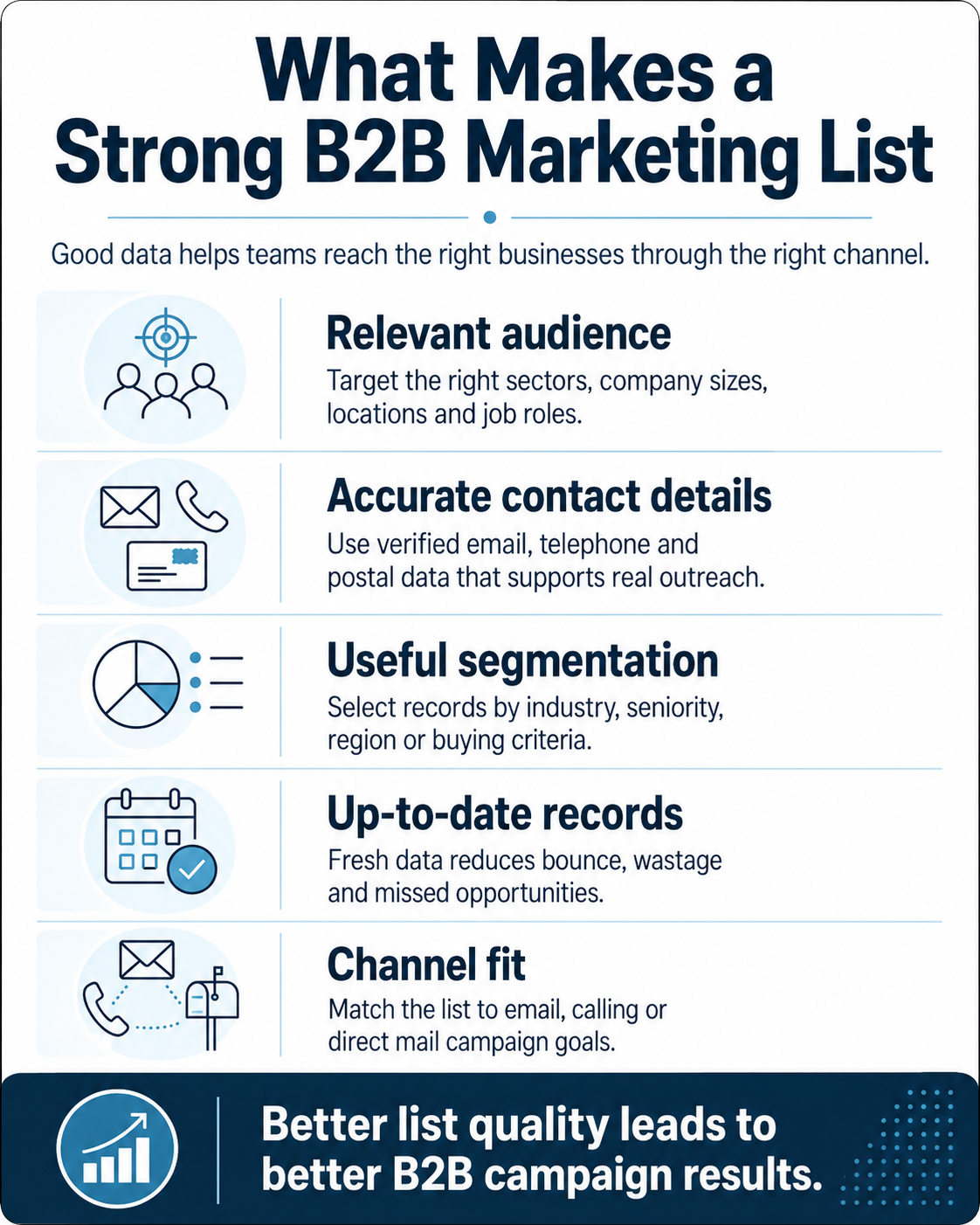
Email data should include valid business email addresses, contact names, job roles and unsubscribe handling. Telephone data should include screened numbers, company context and call outcome fields. Postal data should include complete postal addresses, proper address formatting, segmentation fields and suppression status. Multi-channel data should connect these fields in a way that avoids duplicate outreach to the same company or contact.
Segmentation is often the difference between usable data and basic data. Sector, company size, geography, job role and seniority allow the message to be adapted. Without these fields, a campaign can only speak generally. With them, the sender can say something more relevant and choose a more suitable call to action. AccuraData’s B2B data provider article explains why provider quality affects campaign performance from the start.
Freshness also matters. People change jobs, companies move, inboxes are closed, telephone numbers are reassigned and businesses restructure. A list should therefore be maintained, cleaned and verified rather than treated as a one-time purchase. The ICO’s accuracy principle reinforces the need to take reasonable steps to keep personal data accurate, while practical campaign performance makes the same point in commercial terms.
How to Brief a Supplier for B2B Marketing Lists
A strong supplier brief starts with the campaign objective. The supplier needs to know what the campaign is trying to achieve, not just how many records the client wants. A lead generation campaign, event invitation, product launch, reactivation campaign and account-based marketing programme may all need different list logic.
The second part of the brief is the ideal customer profile. This should cover sectors, company size, locations, job functions, seniority, exclusions and any special audience notes. For example, a business selling enterprise software may need companies above a certain employee threshold, while a local service provider may need companies within a strict postcode radius. A supplier can only build a useful list if the target market is clear.
The third part is the channel mix. Email, phone and post create different requirements. A supplier may be able to provide one channel, but the campaign may need a multi-channel file. If telephone follow-up is planned, TPS and CTPS checks need to be part of the process. If direct mail is planned, address quality and MPS suppression may be relevant. If email is planned, the sender needs to consider lawful basis, unsubscribes and corporate subscriber status.
The fourth part is documentation. A reliable supplier should be able to explain how the data is sourced, how it is maintained, what suppression checks are applied, what fields are included and what responsibilities remain with the buyer. A low-price list with little documentation can become expensive if it creates bounces, complaints, wasted calls or poor sales follow-up.
Choosing a Reliable B2B Marketing List Supplier
Choosing a supplier should not begin with the lowest cost per record. Cheap lists often look attractive because they offer volume, but volume is not the same as opportunity. If a list is poorly targeted, old or badly documented, the cost is simply moved into wasted outreach, low response, manual cleaning and reputational risk.
A reliable supplier should be able to discuss data quality, sourcing, maintenance, segmentation and suppression in practical terms. They should also understand that different channels require different checks. A supplier that treats email, telephone and postal data as the same product may not be thinking carefully enough about compliance or performance.
AccuraData positions itself around UK-focused marketing data, flexible segmentation and campaign support. Its telemarketing list providers page covers B2B telephone data and telemarketing databases, while its email marketing services page explains how data and campaign management can work together. This is useful for businesses that do not only want a spreadsheet, but also need help turning the list into a campaign.
Businesses should also ask how the supplier handles B2B and B2C differences. A supplier that understands both can help prevent the wrong data being used for the wrong campaign. AccuraData provides both B2C lists and B2B datasets, but they should be selected, documented and used according to the campaign type.
How AccuraData Supports B2B Marketing Lists
AccuraData can support businesses that need targeted B2B Marketing Lists for email, telephone, postal or multi-channel activity. That support can include audience definition, list supply, segmentation, data cleansing, TPS and CTPS checks, campaign preparation and email campaign management. The aim is to provide data that is usable for real campaigns rather than simply large files with minimal context.
For email campaigns, AccuraData can supply targeted B2B email data and support managed delivery through its email services. This is useful when a business does not have the internal time, software knowledge or resource to prepare and send campaigns properly. The article on UK Email Marketing Lists explains how UK email data can support targeted campaigns when it is accurate and relevant.
For telephone campaigns, AccuraData can provide telemarketing data and help ensure numbers are screened appropriately before use. This is particularly important for B2B calling, where both TPS and CTPS may be relevant. Clean calling data helps sales teams focus on the right conversations rather than correcting poor records during live outreach.
For postal campaigns, AccuraData can provide B2B or B2C data for direct mail activity, with segmentation designed around geography, sector, household profile or business profile. The article on direct mail data explains why data quality sits at the centre of campaign performance. Good creative can help, but the list decides who receives the message.
AccuraData can also help when clients already hold data but do not trust its quality. Cleansing, enrichment and suppression work can make existing CRM records more usable before a campaign goes live. This can be a better starting point than buying new data immediately, especially where the business already has valuable customer or prospect history.
Planning a Campaign Around the List
A B2B marketing list should not sit separately from campaign planning. The list defines the audience, but the campaign still needs a message, offer, timing, channel plan and follow-up process. If those parts are not aligned, even a high-quality list can underperform.
Start with the audience. Define the business problem, the decision-maker, the sector and the size of company that makes the offer relevant. Then select the channel. Email may work well for education, nurturing and scalable outreach. Telephone may work well for qualification and appointment setting. Direct mail may work well for high-value accounts, local awareness or campaigns that benefit from a physical reminder.
Next, match the message to the segment. A senior decision-maker may need a commercial summary. A technical contact may need product detail. A small business owner may need a simple value proposition and a clear route to enquire. A campaign that uses the same wording for every segment may waste the targeting power of the list.
Follow-up should be planned before launch. If email clicks identify warm prospects, who calls them? If a direct mail campaign drives QR code visits, who monitors those responses? If a telemarketing campaign finds future interest, where are callbacks recorded? The list can generate insight only if the business captures outcomes and uses them to improve the next activity.
Measuring List Performance
List performance should be measured by more than total responses. A B2B list can be assessed through delivery, bounce rate, connect rate, conversation quality, appointment rate, enquiry quality, conversion rate and sales outcome. The right metrics depend on the channel.
For email lists, useful measures include delivery, bounces, opens, clicks, replies, unsubscribes, spam complaints and warm prospect identification. Benchmarks such as the DMA report can provide useful context, but each campaign should be judged against its own audience, offer and objective.
For telemarketing lists, useful measures include dial-to-connect rate, decision-maker contact rate, call outcome, appointment rate, do-not-call requests, wrong numbers and pipeline generated. These metrics help identify whether the issue is data quality, call handling, proposition, timing or market fit.
For postal lists, useful measures include returned mail, response rate, cost per response, cost per acquisition, average order value and segment-level performance. The JICMAIL Response Rate Tracker can help businesses think about mail measurement, but the most valuable learning often comes from comparing segments inside the same campaign.
The purpose of measurement is improvement. If a sector responds strongly, the next list can include more similar organisations. If a job function produces poor engagement, the targeting can be adjusted. If telephone outcomes reveal that a different department is responsible, the next campaign can be rebuilt around that learning.
Common Mistakes With B2B Marketing Lists
One common mistake is buying on volume alone. Large lists can be useful when the audience is broad, but they are not automatically better. A smaller list of relevant, maintained records can produce more useful engagement than a larger file filled with outdated or poorly matched contacts.
Another mistake is ignoring channel-specific rules. A business may buy a multi-channel file and assume that email, phone and post can all be used in the same way. They cannot. Email needs unsubscribe handling and a proper understanding of corporate and individual subscriber rules. Telephone needs TPS, CTPS and internal do-not-call suppression. Postal marketing needs address quality and MPS considerations where relevant.
A third mistake is failing to brief the message around the list. If a list has been selected by sector and seniority, the content should reflect that selection. Sending generic copy to a carefully targeted audience wastes the value of the data. The list tells the marketer who the recipient is likely to be. The creative should use that information responsibly.
A fourth mistake is not recording outcomes. A campaign that does not capture unsubscribes, objections, wrong details, job changes, call notes and response segments quickly loses learning. Over time, the database becomes less accurate and less useful. Good data management should turn every campaign into a source of improvement.
Frequently Asked Questions About B2B Marketing Lists
Are B2B Marketing Lists legal in the UK?
B2B Marketing Lists can be legal in the UK, but legality depends on how the data was sourced, what the data contains, the channel used and how the campaign is run. The ICO’s B2B marketing guidance is clear that UK GDPR can apply to business contacts where personal data is processed.
Do B2B email lists need consent?
For corporate subscribers, PECR’s electronic mail consent rule does not apply in the same way as it does for individual subscribers. The ICO says you can email companies, but you should keep a do-not-email list. Sole traders and some partnerships are treated differently, so the data type matters.
Do telemarketing lists need TPS and CTPS checks?
Yes, for B2B calling you should screen against TPS and CTPS where relevant, as well as your own do-not-call list. The ICO telephone guidance specifically refers to TPS and CTPS screening for B2B calls.
Is MPS relevant to B2B direct mail?
MPS is mainly associated with personally addressed unsolicited mail to individuals. It may be relevant where postal campaigns involve named individuals or consumer-style data. The MPS service helps people stop personally addressed unsolicited mail, and businesses should consider suppression as part of responsible postal marketing.
Should I buy separate lists for email, phone and post?
Not always. A multi-channel file can be useful if the campaign will use several channels, but each contact route still needs to be checked and managed according to the relevant rules. In some cases, a focused single-channel list is better. In others, a joined-up dataset helps sales and marketing teams coordinate outreach more effectively.
What makes AccuraData a reliable supplier?
AccuraData focuses on UK marketing data, audience segmentation and campaign support. Businesses can use AccuraData for targeted B2B lists, B2C lists, telemarketing data, email data, direct mail data, data cleansing and managed email campaigns. This makes it a practical partner for organisations that need more than a generic spreadsheet.
Final Thoughts
B2B Marketing Lists work best when they are selected, checked and used with care. The most useful list is not always the largest. It is the one that matches the target audience, supports the channel, includes practical segmentation fields, respects suppression requirements and gives the campaign team enough information to communicate clearly.
Email marketing lists, telemarketing lists and postal marketing lists each have a different role. Email is scalable and measurable. Telephone outreach creates live conversation. Direct mail gives physical presence and can support multi-channel campaigns. The strongest strategy often combines these channels carefully rather than treating them as separate tactics.
Compliance is not separate from performance. TPS and CTPS checks reduce wasted calls and protect recipient preferences. MPS and postal suppression help improve direct mail quality. Email unsubscribe management reduces complaints and supports better deliverability. UK GDPR principles such as lawful basis, transparency, minimisation and accuracy help ensure that data is used responsibly.
AccuraData can help businesses source targeted B2B Marketing Lists, refine audience selection, prepare data for campaigns and manage outreach where needed. Whether the campaign uses email, telephone, post or a combination of all three, the starting point is the same: accurate, relevant and responsibly managed data.