
Direct mail has never been only about print, envelopes and postage. The campaign starts long before a letter, brochure, postcard or catalogue is produced. It starts with the audience. A Direct Mail Mailing List decides who receives the message, how relevant the campaign feels, how much budget is spent on wasted delivery and whether the activity has a realistic chance of creating enquiries, visits, calls or sales.
For UK businesses, direct mail remains a practical marketing channel because it is physical, targeted and measurable. It can reach people at home, decision-makers at business premises, lapsed customers, local prospects, high-value households, professional audiences and carefully defined B2B markets. It can also work alongside email, telemarketing, paid search, social media and field sales. A postal campaign does not need to sit apart from digital marketing. In many cases, it can help digital activity perform better by giving the audience a tangible reminder of the offer.
The quality of the mailing list is therefore central. A poor list wastes print and postage, creates returns, annoys recipients and weakens measurement. A good list helps you target the right people, reduce avoidable cost and build a campaign around a defined audience rather than a broad guess. The JICMAIL Response Rate Tracker reports benchmark response and ROI figures for warm direct mail, cold direct mail and door drops, which shows why marketers still pay close attention to the channel. Those benchmarks are not automatic outcomes. They depend on the audience, the offer, the creative, the timing and the data behind the campaign.
This guide explains what a Direct Mail Mailing List is, how B2B and B2C mailing lists differ, how UK compliance affects postal marketing, what data fields matter, how to choose a provider and how AccuraData supports targeted direct mail campaigns with high-quality UK marketing data. It is written for businesses that want practical answers rather than jargon.
What Is a Direct Mail Mailing List?
A Direct Mail Mailing List is a structured dataset used to send postal marketing to a selected audience. It usually contains names, postal addresses and segmentation information that helps a business choose who to contact. Depending on the campaign, the list may include consumers, households, business sites, company decision-makers, existing customers, past buyers, prospects or a specific market segment.
A simple mailing list may contain only names and addresses. A more useful Direct Mail Mailing List will contain additional fields that help you plan, personalise and measure the campaign. In a B2B campaign, this can include company name, trading address, industry, SIC code, employee count, turnover band, job title, department and seniority. In a B2C campaign, it can include household profile, age band, property type, location, interests, lifestyle indicators or other permitted segmentation fields. AccuraData provides both targeted B2B Data and B2C Data services for businesses that need clearly defined postal audiences.
The word list can make the process sound basic, but the underlying work is more complex. A strong list is selected, cleaned, deduplicated, suppressed where needed and matched to the campaign objective. If the message is aimed at finance directors in manufacturing firms, the list should not include every business in a region. If the campaign is for a home improvement service, the list should not reach renters where owner-occupiers are the relevant audience. The list should reflect the commercial reality of the offer.
Direct mail lists can be used for prospecting, customer reactivation, local awareness, appointment generation, fundraising, retail traffic, event promotion, catalogue distribution, product sampling, professional services marketing and account-based campaigns. They can also support multi-channel outreach. A business may send a letter first, follow up by phone where lawful and appropriate, and then run a digital campaign to the same market. The more complete and accurate the data, the easier this becomes.
Why Mailing Lists Still Matter
Many businesses focus heavily on digital channels, but direct mail continues to have advantages that are difficult to replicate online. A physical item can be handled, kept, shared inside a household or passed around an office. It can carry more detail than a short advert. It can also create a different type of attention because it arrives away from the crowded inbox.
The JICMAIL Q2 2025 results reported strong interaction levels for direct mail, including repeated interactions with mail items. That matters because attention is one of the hardest things to win in modern marketing. A piece of direct mail does not guarantee interest, but it gives the message a physical presence that can last longer than a fleeting digital impression.
Direct mail is also useful where the audience is well defined. Local businesses can target households within a catchment area. B2B suppliers can target named contacts at companies that match their ideal customer profile. Charities can reach specific supporter segments. Property, finance, professional services, healthcare, education, retail and home improvement brands can use postal data to focus budget on relevant recipients.
Another strength is measurement. A Direct Mail Mailing List can be matched to campaign codes, phone numbers, URLs, QR codes, offer codes, branch visits or follow-up calls. This means response can be attributed back to audience segments. Over time, businesses can learn which types of customers respond, which areas perform best, which offers work and where money should be spent next.
Direct mail should not be treated as a replacement for digital marketing. It is often strongest when it complements digital activity. A postal item can introduce a brand, provide credibility and prompt someone to search, visit a website or speak to a sales team. The DMA article on mail and digital engagement notes continued links between mail and digital actions, which supports the idea that modern direct mail can influence online behaviour as well as offline response.
B2B Direct Mail Mailing Lists
B2B direct mail lists are designed for business-to-business campaigns. They help organisations reach companies, sites, departments and decision-makers. A B2B list may include general business addresses, named contacts, job titles, company size, sector, turnover banding, geographic region, legal status and other company-level details.
The main advantage of B2B postal data is precision. A campaign can be built around a very specific market. For example, a software company may want operations directors at logistics firms. A training provider may want HR managers in companies with more than 100 employees. A commercial energy broker may want finance directors in manufacturing. A construction supplier may want procurement managers, architects or facilities managers. AccuraData’s B2B Data and marketing lists are designed to support this type of audience selection.
B2B direct mail can be effective because business buying decisions often involve research, internal discussion and multiple touchpoints. A well-produced letter, brochure or information pack can give a decision-maker something to review, keep or pass to a colleague. It may also help a business stand out where email volumes are high and phone access is difficult.
A B2B mailing list can also be combined with other channels. If a dataset includes postal address, telephone number and email address where available, a business can create a coordinated campaign. Direct mail can introduce the proposition, email can provide a follow-up resource and sales teams can prioritise phone calls to the most suitable accounts. AccuraData’s lead generation services can support businesses that want data-led outreach rather than a single-channel mailing.
B2B list quality depends on company data and contact data being accurate. Companies move, merge, close, change names and change decision-makers. Job roles change as people leave or progress. Site addresses can differ from registered addresses. A good provider should help you select the right address type for the campaign. A letter intended for a named decision-maker may need a trading or office address, while a formal company communication may need a registered office address.
B2C Mailing Lists
B2C direct mail lists are designed for consumer campaigns. They help businesses reach individuals or households based on location, demographics, interests, property indicators, lifestyle signals or other permitted profiling criteria. AccuraData provides B2C Data Lists and consumer databases for businesses that need targeted consumer audiences for direct marketing and lead generation.
The biggest difference between B2C and B2B direct mail is the audience relationship. A consumer receives the mailing as an individual or household member, not as part of a professional role. That means the campaign needs to be more sensitive to relevance, privacy and tone. Consumer direct mail should feel useful, clear and appropriate. Poorly targeted consumer mail can quickly feel intrusive.
B2C mailing lists can support many campaign types. Home improvement businesses may target certain property types or areas. Retail brands may target customers near a store. Charities may identify households likely to respond to a particular appeal. Financial services firms may target specific life-stage or demographic groups, subject to compliance and suitability checks. Leisure, education, healthcare, property and local service businesses can all use postal data to reach relevant households.
Consumer mailing lists are often built around segmentation. A campaign may be filtered by postcode, household type, age band, lifestyle interest, property profile or other campaign-relevant factors. The goal is to reduce waste by contacting the people most likely to find the message useful. A smaller, better-defined B2C list is usually more valuable than a large untargeted file.
B2C lists also need strong suppression processes. Consumers can object to direct marketing, move home or become unsuitable for a campaign. If a business ignores suppression, it risks complaints, reputational harm and wasted spend. A quality provider should be able to explain how consumer data is maintained, how suppression is handled and what compliance documentation is available.
B2B vs B2C Mailing Lists: The Main Differences
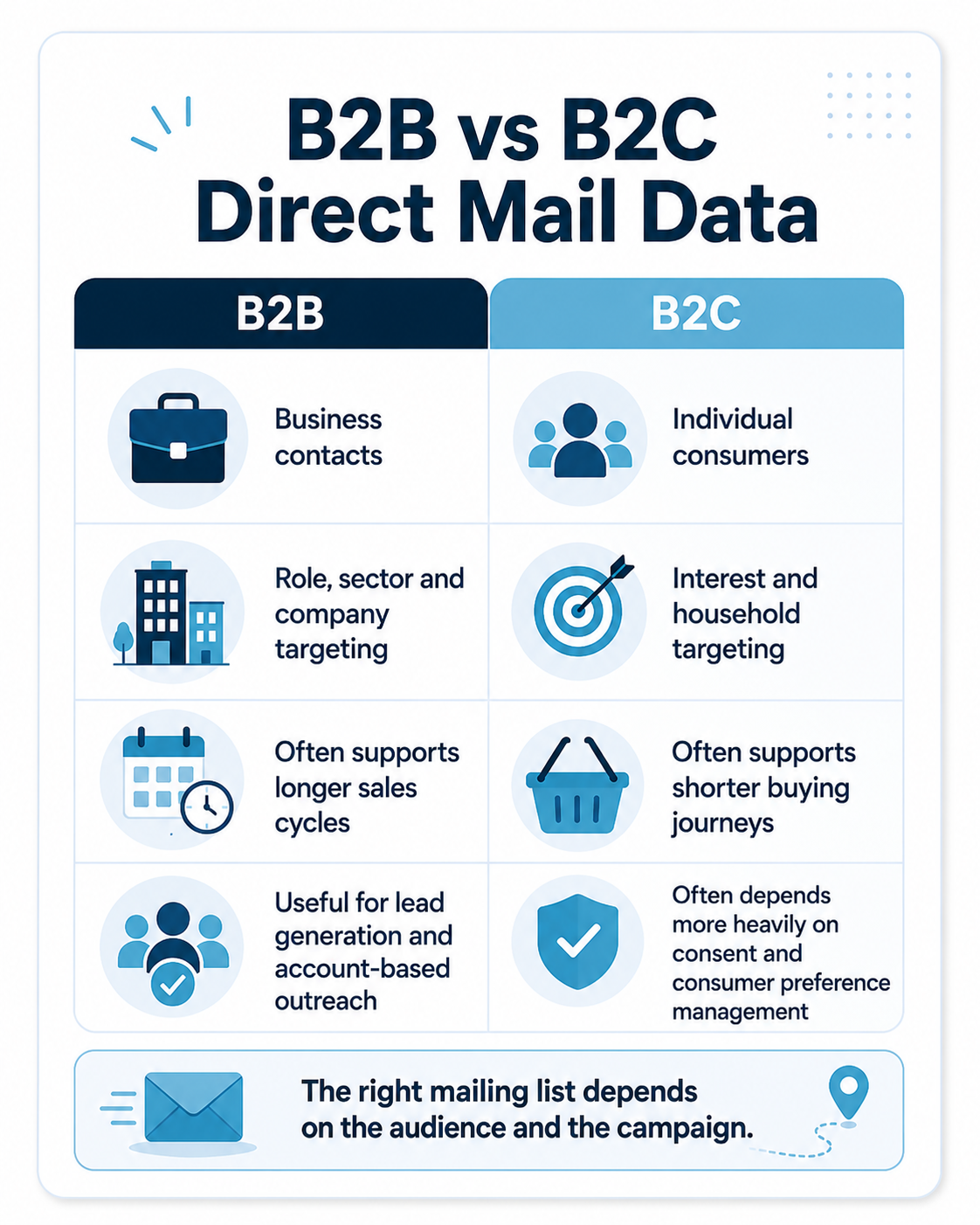
B2B and B2C Direct Mail Mailing Lists are both used for postal marketing, but they work in different ways. The key difference is the basis for relevance. B2B relevance normally comes from a person’s role, company, sector or business need. B2C relevance normally comes from personal, household, geographic or lifestyle factors.
A B2B campaign might target facilities managers at schools because the offer relates to building maintenance. A B2C campaign might target homeowners in a specific postcode area because the offer relates to residential solar panels. Both campaigns use postal data, but the audience logic is different.
The buying journey is also different. B2B decisions may involve several people, procurement checks and longer timescales. A direct mail piece may be one step in a broader sales process. B2C decisions may happen more quickly, especially for retail, local services or event campaigns. The creative, offer and call to action should reflect this.
Data fields differ too. B2B direct mail lists usually rely on company name, address, industry, employee count, turnover and decision-maker roles. B2C lists often rely on postcode, household indicators, demographics and lifestyle interests. AccuraData separates its B2B data services and B2C data services because the sourcing, segmentation and compliance considerations are not the same.
Measurement can also differ. B2B campaigns may measure enquiries, meetings, sales conversations, account engagement, tender invitations or pipeline value. B2C campaigns may measure voucher redemptions, phone calls, store visits, web visits, online orders or form submissions. A good list provider should help you think about these outcomes before data is selected, because the audience affects what success can realistically look like.
Is Direct Mail Legal in the UK?
Direct mail can be lawful in the UK, but it must be handled properly. Postal marketing is treated differently from email, text and some telephone marketing because the Privacy and Electronic Communications Regulations, often called PECR, do not cover direct marketing by post. However, if a campaign uses personal information, UK data protection law still applies.
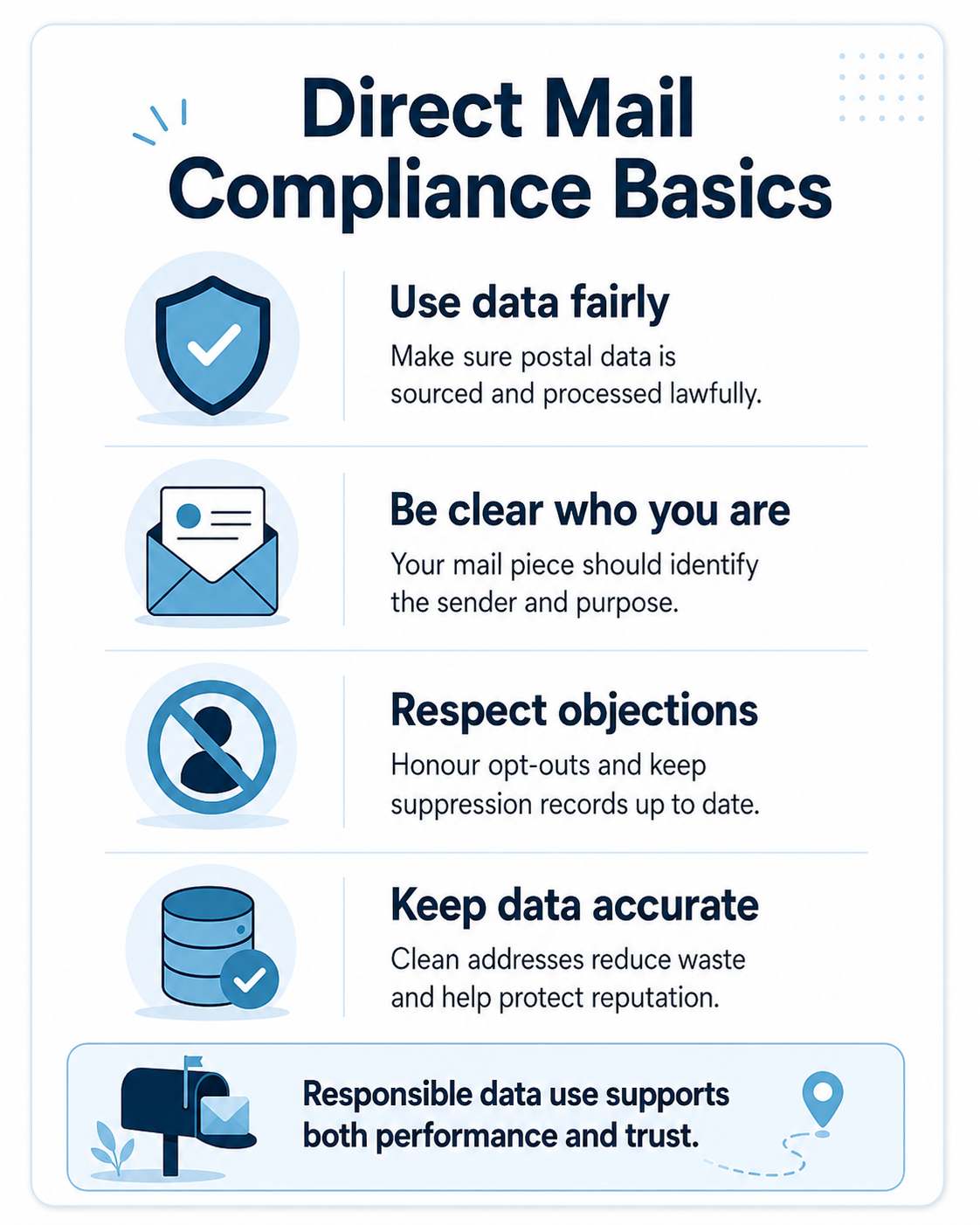
The ICO guidance on planning direct marketing states that direct marketing by post is not covered by PECR, but businesses must still comply with data protection law when using personal information. This is an important distinction. Postal marketing may not need PECR consent in the same way as some electronic marketing, but it still needs lawful, fair and transparent handling of personal data.
This means businesses should consider the lawful basis for using the data, the information given to individuals, the relevance of the campaign, data accuracy, suppression lists and the right to object. The ICO guidance on choosing a lawful basis for direct marketing explains that consent and legitimate interests are the two lawful bases most likely to apply to direct marketing. Which one is appropriate depends on the data, audience and campaign.
For many postal marketing campaigns, legitimate interests may be considered where the campaign is proportionate, relevant and expected in the circumstances. That does not mean every postal campaign is automatically lawful. A business still needs to consider the individual’s rights and interests, document its reasoning and make it easy for people to object.
The ICO right to object guidance makes clear that individuals have an absolute right to object to the processing of their personal data for direct marketing. This applies across marketing channels. Once someone objects, their preference should be respected and recorded on a suppression list.
Businesses should also consider the Mailing Preference Service. The ICO says organisations should check names and addresses against the Mailing Preference Service before sending direct marketing by post. This is not a statutory preference service, but it is part of good practice and may be required under some industry codes. Responsible direct mail is not just about getting a list. It is about using that list in a way that respects people and protects the sender’s reputation.
What Should a Good List Include?
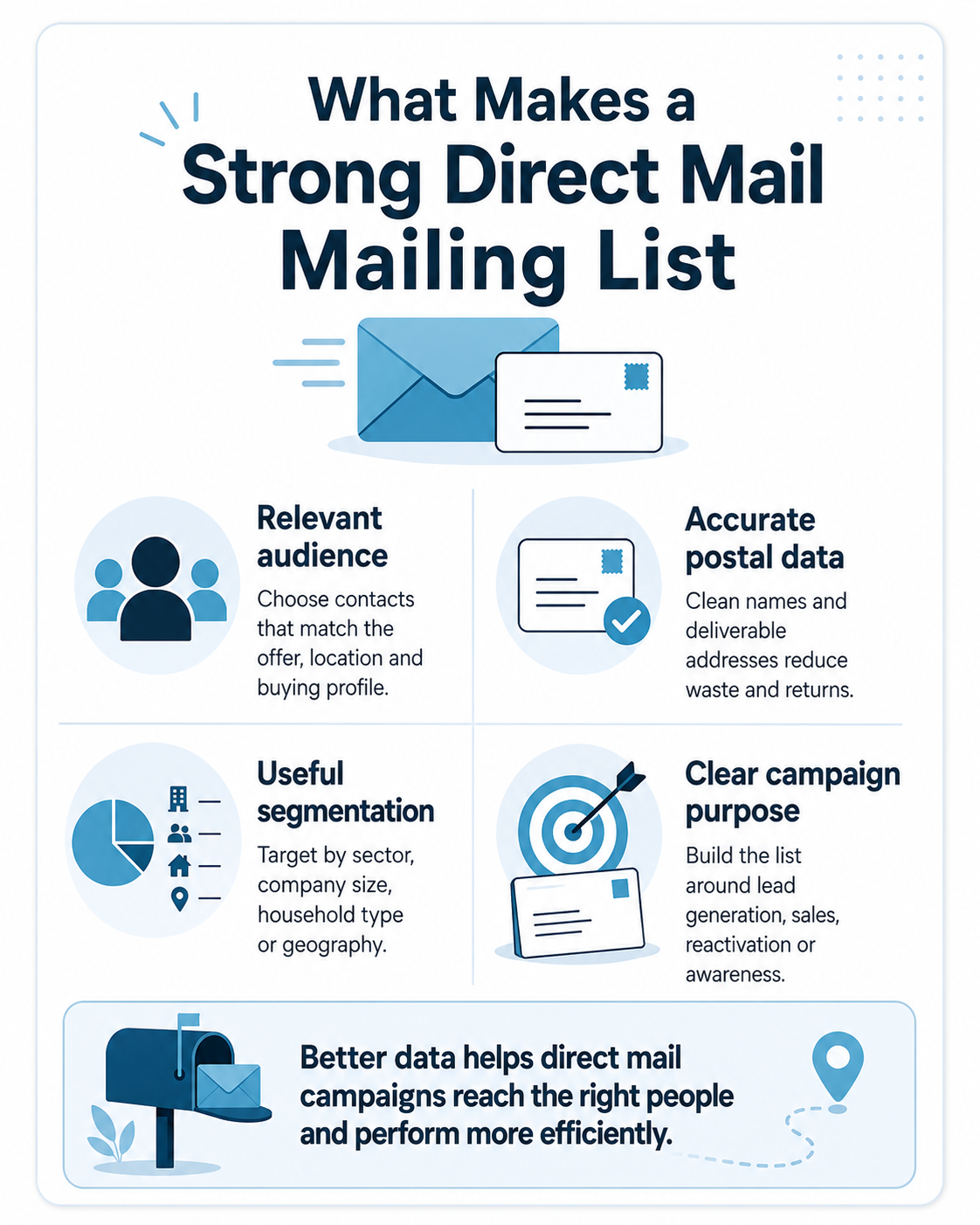
A good Direct Mail Mailing List should include enough information to identify, target, deliver and measure the campaign. At a minimum, it needs accurate postal addresses. In many campaigns, it should also include recipient names, company names or household-level segmentation fields. The right fields depend on the purpose of the campaign.
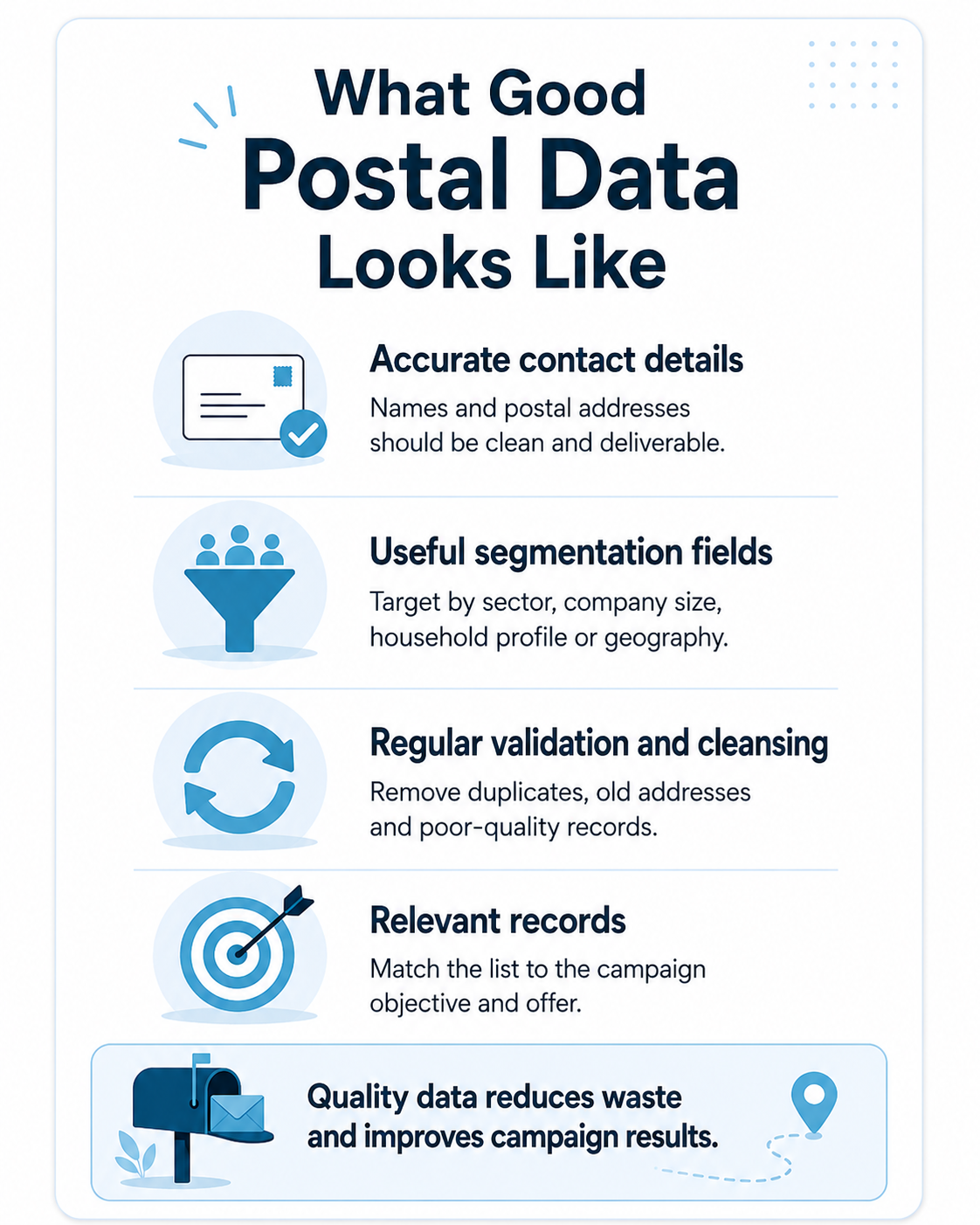
For B2B direct mail, useful fields can include company name, trading address, registered address, named contact, job title, department, SIC code, industry description, employee count, turnover band, region, telephone number and email address where relevant. These fields help businesses target decision-makers and plan multi-channel follow-up. They also help creative teams tailor messages to the sector or role.
For B2C direct mail, useful fields can include name, address, postcode, age band, household profile, property indicators, lifestyle interests and other permitted segmentation criteria. These fields can help businesses tailor offers to the audience. For example, a campaign promoting home services will usually perform better when the list reflects location, property relevance and household suitability.
Address quality is critical. An incomplete or inaccurate address can cause wasted postage, returned items and poor reporting. Data should be formatted consistently, deduplicated and checked for obvious errors. For existing customer data, cleansing can remove duplicate households, standardise addresses and improve segmentation. AccuraData’s data cleansing and enrichment services can help businesses improve existing records before direct mail budget is committed.
Suppression is also part of list quality. A list should be screened against people who have opted out or objected where relevant. A business should also maintain its own internal suppression list. This protects recipients and avoids repeated contact with people who have already said they do not want marketing.
How to Choose a Direct Mail Mailing List Provider
Choosing the right provider is one of the most important decisions in a direct mail campaign. The provider should not only supply a file. They should help you understand the audience, segmentation options, compliance position, accuracy processes and delivery format. Cheap data can become expensive quickly if it creates wasted print, poor response or complaints.
Start by asking how the data is sourced and maintained. A provider should be able to explain the type of data, how often it is updated, what fields are available and how suppression is handled. For B2C data, ask about permission, privacy information and consumer preference handling. For B2B data, ask about company sources, role-level targeting and how trading addresses are identified.
Next, ask about segmentation. A provider that can only supply a broad list may not be suitable for a campaign that needs precise targeting. Good segmentation lets you select by geography, sector, company size, job role, household profile or other relevant criteria. AccuraData’s direct mail data support covers both consumer and business targeting, as explained in its guide to direct mail data.
Ask about compliance documentation. This might include the lawful basis, data processing terms, privacy information, suppression processes and information about how the data may be used. A reputable provider should not be vague when asked about compliance. They should understand the difference between B2B and B2C marketing and the role of UK GDPR in direct mail.
Also ask for practical delivery support. Can the data be supplied in the format required by your mailing house? Can it be deduplicated by household or site? Can it be split by region, campaign cell or creative version? Can it support follow-up activity? These questions matter because list preparation affects production, postage, reporting and sales follow-up.
Planning a Direct Mail Campaign Around the List
A Direct Mail Mailing List should be selected after the campaign objective is clear. The objective might be to generate appointments, drive store visits, reactivate customers, promote an event, announce a new service, support a local launch or create awareness in a target market. The objective decides who should be contacted and what data fields matter.
The next step is audience definition. A weak audience definition leads to a weak list. Instead of asking for “businesses in the UK”, a B2B campaign might ask for “operations directors at manufacturers with 50 to 500 employees in England and Wales”. Instead of asking for “homeowners”, a B2C campaign might define a postcode catchment, property type and household profile. The more specific the audience, the easier it becomes to create a relevant message.
Creative planning should then reflect the list. If the audience is senior finance leaders, the message should speak to financial impact, risk and efficiency. If the audience is homeowners, the message should be clear, practical and locally relevant. If the audience is existing customers, the tone can acknowledge the relationship. If the audience is cold prospects, the mailer should explain why they are receiving it and why it matters.
The list can also guide campaign testing. A business may split the list by region, sector, customer type or offer. Each segment can receive a different message, code or call to action. This makes measurement more useful. Rather than asking whether direct mail worked in general, the business can identify which audience and message combination worked best.
Finally, plan the follow-up before the mail is sent. Direct mail often works best when it is part of a sequence. Sales teams may call selected B2B recipients after the mailing lands. A B2C campaign may use a landing page, QR code or local phone number. A customer campaign may be followed by email or account manager outreach. The list should be structured so follow-up can happen efficiently.
Measuring Direct Mail Mailing List Performance
Direct mail measurement should be planned before printing. If the campaign has no tracking structure, it becomes difficult to know whether the list performed well. The simplest tracking methods include unique phone numbers, campaign landing pages, QR codes, promotional codes, reply cards, business response envelopes and customer reference codes.
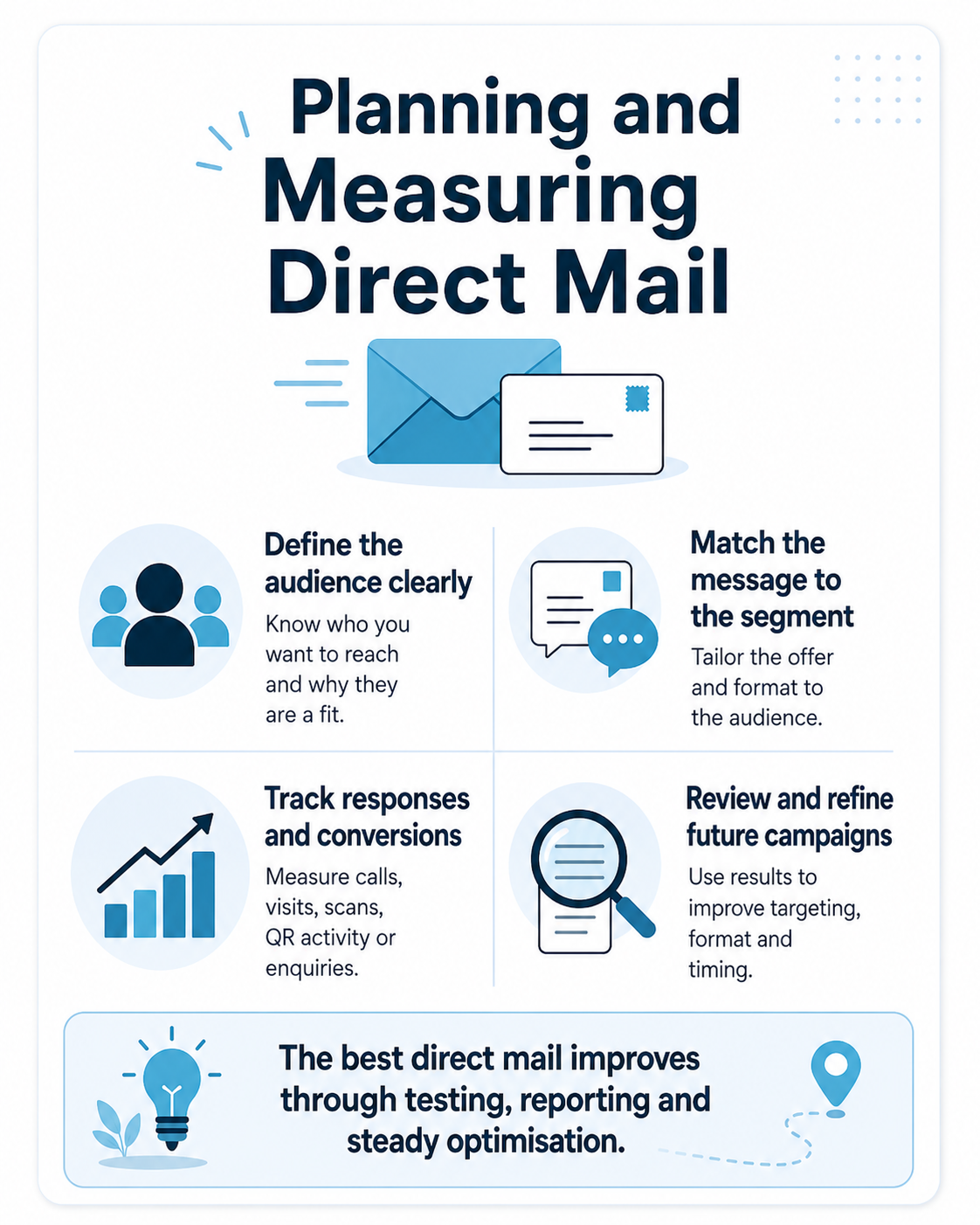
At list level, businesses should monitor delivery quality, returned mail, response rate, conversion rate, cost per response, cost per acquisition and revenue generated. B2B campaigns may also measure meetings booked, proposals issued, pipeline value and closed revenue. B2C campaigns may measure redemptions, appointments, purchases, web visits or call volumes.
Segment-level reporting is especially useful. If a campaign is split by sector, postcode, customer type or product interest, the business can see which segments performed best. This is where a well-structured mailing list becomes an asset. Good data does not only help the campaign reach the right audience. It also helps the business understand what happened afterwards.
The JICMAIL Response Rate Tracker gives useful benchmark context, including separate figures for warm direct mail, cold direct mail and door drops. Benchmarks should be used carefully. They are a guide, not a prediction. A campaign to an existing customer base will usually behave differently from a cold acquisition campaign. A high-value B2B campaign may need fewer responses to be profitable than a low-value consumer offer.
The most useful measurement question is not simply “How many people responded?” It is “Which list, message and offer combination created profitable action?” That question helps businesses improve future campaigns. Over time, poor segments can be removed, strong segments can be expanded and creative can be adapted around real response evidence.
Common Mistakes With Direct Mail Mailing Lists
One common mistake is buying too much data. A large list can feel attractive because it appears to create more opportunity. In practice, an oversized list often increases cost without increasing response proportionately. Print, postage and production costs mean every irrelevant record has a real cost. A smaller, more targeted list is often the better commercial choice.
A second mistake is using old data. Address data changes constantly as people move, companies relocate and businesses close. Old records lead to returned mail and poor measurement. Existing customer databases can also contain duplicates, incomplete addresses and outdated preferences. Data cleansing should happen before printing, not after results disappoint.
A third mistake is treating B2B and B2C lists in the same way. A message designed for a business decision-maker should not simply be repurposed for a household audience. The data fields, tone, offer and compliance assumptions are different. Businesses should use a provider that understands both markets and can explain the difference clearly.
Another mistake is ignoring suppression. If someone has objected or opted out, they should not continue to receive direct marketing. The ICO’s direct marketing planning guidance highlights the need to check suppression lists and have a process for objections. Suppression is not a small admin task. It is part of responsible marketing.
Finally, many businesses fail to connect the list to the campaign goal. They ask for data before deciding what success looks like. This can produce a list that is too broad, too narrow or poorly matched. Start with the goal, define the audience, then select the list.
Why AccuraData Is a Strong Partner for Direct Mail Mailing Lists
AccuraData supports UK businesses with targeted marketing data for B2B and B2C campaigns. The value is not simply in supplying names and addresses. It is in helping clients define the audience, select the right segmentation, improve data quality and use direct mail as part of a wider customer acquisition strategy.
For B2B campaigns, AccuraData can help businesses reach relevant companies and decision-makers using B2B Data segmented by industry, location, company size, employee count, turnover and role. This supports direct mail campaigns aimed at specific commercial markets rather than broad postal drops.
For consumer campaigns, AccuraData provides B2C Data Lists that can be tailored by geography, demographics, lifestyle indicators and household criteria. This helps businesses reduce wasted mail and focus budget on audiences more likely to be relevant to the offer.
AccuraData can also support data quality before a campaign goes live. If a business already has a customer or prospect database, data cleansing and enrichment can improve address accuracy, remove duplicates and add useful segmentation fields. This can be particularly valuable where an internal CRM has grown over time without consistent formatting or validation.
Direct mail can also sit alongside AccuraData’s wider marketing services. Businesses running multi-channel campaigns can combine postal data with email, telephone and lead generation activity where appropriate. AccuraData’s Email Marketing Services and wider lead generation support can help turn a mailing list into a more complete outreach programme.
The main reason to choose AccuraData is practical reliability. A good Direct Mail Mailing List should be targeted, usable, well structured and supplied with a clear understanding of the campaign purpose. AccuraData works with businesses that need data to perform in the real world, not just look impressive in a spreadsheet.
Direct Mail Mailing List Best Practice Checklist
A strong direct mail campaign starts with clear decisions. Before buying or using a Direct Mail Mailing List, define the campaign objective, the ideal audience, the geographic area, the offer, the call to action and the measurement method. This keeps the data focused on the job it needs to do.
Check that the list is suitable for the audience type. B2B lists should reflect business relevance, sector and decision-maker role. B2C lists should reflect household or consumer relevance. Do not use a list simply because it is available. Use it because it matches the campaign.
Make data quality a priority. Clean addresses, remove duplicates, apply suppression, format the file correctly and confirm that the data can be used by your mailing house or fulfilment partner. A well-prepared list reduces avoidable cost.
Think about the recipient experience. The mailing should explain who you are, why the offer is relevant and what the recipient should do next. It should also respect objections and provide a simple route for people to manage preferences where appropriate.
Measure what matters. Track responses, conversions, cost per response and performance by segment. Use the results to improve future campaigns. Direct mail becomes more valuable when every campaign teaches the next one something useful.
Final Thoughts
A Direct Mail Mailing List is not just a delivery file. It is the foundation of the campaign. It determines who receives the message, how relevant the communication feels, how much money is wasted on unsuitable recipients and how clearly results can be measured.
For B2B campaigns, the right list helps businesses reach decision-makers by sector, company size, location and role. For B2C campaigns, the right list helps brands reach consumers and households based on relevant audience characteristics. Both need accuracy, segmentation, suppression and responsible use.
Direct mail remains valuable because it can create attention, support digital activity and give marketers a measurable route to defined audiences. It works best when the list, offer, creative and follow-up process are planned together.
AccuraData helps UK businesses source targeted B2B Data and B2C Data for direct mail and multi-channel campaigns. Whether you need a new prospect list, a cleaner customer database or support planning a data-led campaign, AccuraData can help you build direct mail activity on a stronger foundation.