
A Business Email Database should be more than a collection of addresses. It should be a controlled marketing asset that tells you who a contact is, why they may be relevant, where their details came from, which messages they should receive and what should happen when they opt out. Built properly, it can support prospecting, lead nurturing, account development, customer communications and measured outbound campaigns. Built carelessly, it can create wasted sends, poor deliverability, weak targeting and avoidable compliance risk.
This guide explains how to build a Business Email Database from organic sources, public business information, existing customer records and carefully selected paid data. It covers B2B and B2C email marketing, supplier due diligence, UK GDPR and PECR, segmentation, data cleansing, sender authentication and campaign measurement. It also compares email with postal marketing and telemarketing so that you can decide when email is the right channel rather than using it by default.
AccuraData supports organisations that need targeted B2B Data, professionally maintained B2B Email Data, wider B2C Data, data cleansing and enrichment and data appending. Those services can help a business improve an existing database or extend its reach when organic growth alone is too slow.
A compliance note is important at the outset. This article provides practical marketing information, not legal advice. The correct approach depends on the audience, subscriber type, source, message, lawful basis and circumstances. The ICO direct marketing guidance should be treated as a starting point, and organisations should obtain specialist advice where the position is unclear or high risk.
Start with the purpose of the Business Email Database
The first step is not choosing software or collecting addresses. It is deciding what the database must help the business achieve. A list for event promotion needs different information from a list for account-based sales. A customer newsletter needs different permissions and content from a cold B2B prospecting campaign. A consumer reactivation programme needs different consent records from a campaign aimed at limited companies.
A useful brief can normally be expressed in one sentence. For example: “We want to reach finance directors at UK manufacturers with 50 to 500 employees, introduce a new service and identify organisations that want a consultation.” That sentence creates practical requirements. The database needs company sector, employee band, geography, job function, a usable business email address, source information and a clear campaign status. It also tells the team which records do not belong in the file.
A vague objective such as “we need more leads” encourages indiscriminate list growth. It rewards volume rather than fit. A clear objective helps you decide which fields are necessary, which source is proportionate, which lawful basis may apply and what success should look like. The ICO planning guidance recommends considering data protection and PECR requirements while the activity is being designed, rather than trying to repair the position after a campaign has started.
Define the audience before collecting addresses
Write an ideal customer profile before building the Business Email Database. For B2B campaigns, this may include industry, SIC code, employee count, turnover, location, site type, ownership, department, job function and seniority. For B2C campaigns, it may include geography, customer status, stated interests, product history and other factors that are appropriate for the intended purpose.
The profile should also include exclusions. You may need to remove existing customers, competitors, suppliers, organisations below a minimum size, sectors you cannot serve, people who have objected to marketing and records that cannot be used through the chosen channel. Exclusions often improve performance more than adding another broad audience segment because they stop the business spending time on contacts that should never have entered the campaign.
AccuraData’s business data service describes the kinds of firmographic and decision-maker fields commonly used for targeted B2B activity. These include industry, geography, company size, turnover, employee count, job title and role. The exact selection should always follow the campaign objective rather than becoming a checklist of every field that could be acquired.
Decide what success will mean
A database is not successful because it contains a large number of records. It is successful when it helps the organisation create useful outcomes at an acceptable cost and risk. Define the measures before collection begins. These may include delivered emails, positive replies, qualified enquiries, meetings, registrations, opportunities, sales, unsubscribe rates, complaints and cost per outcome.
Measure data quality as well as campaign activity. Useful quality measures include valid-address rate, duplicate rate, missing-field rate, bounce rate, proportion of records with a known source, proportion with an assigned lawful basis and the age of the last verification. These indicators show whether a weak campaign is caused by messaging, targeting, technical delivery or the underlying data.
When should a business use a Business Email Database?
Email is useful when a business needs a channel that can be deployed quickly, personalised at scale and measured through clear digital actions. It can support educational campaigns, event invitations, product updates, lead nurturing, account development, customer retention and sales follow-up. It is especially useful when the desired next step can be completed online, such as booking a meeting, downloading a guide, registering for an event or requesting a quote.
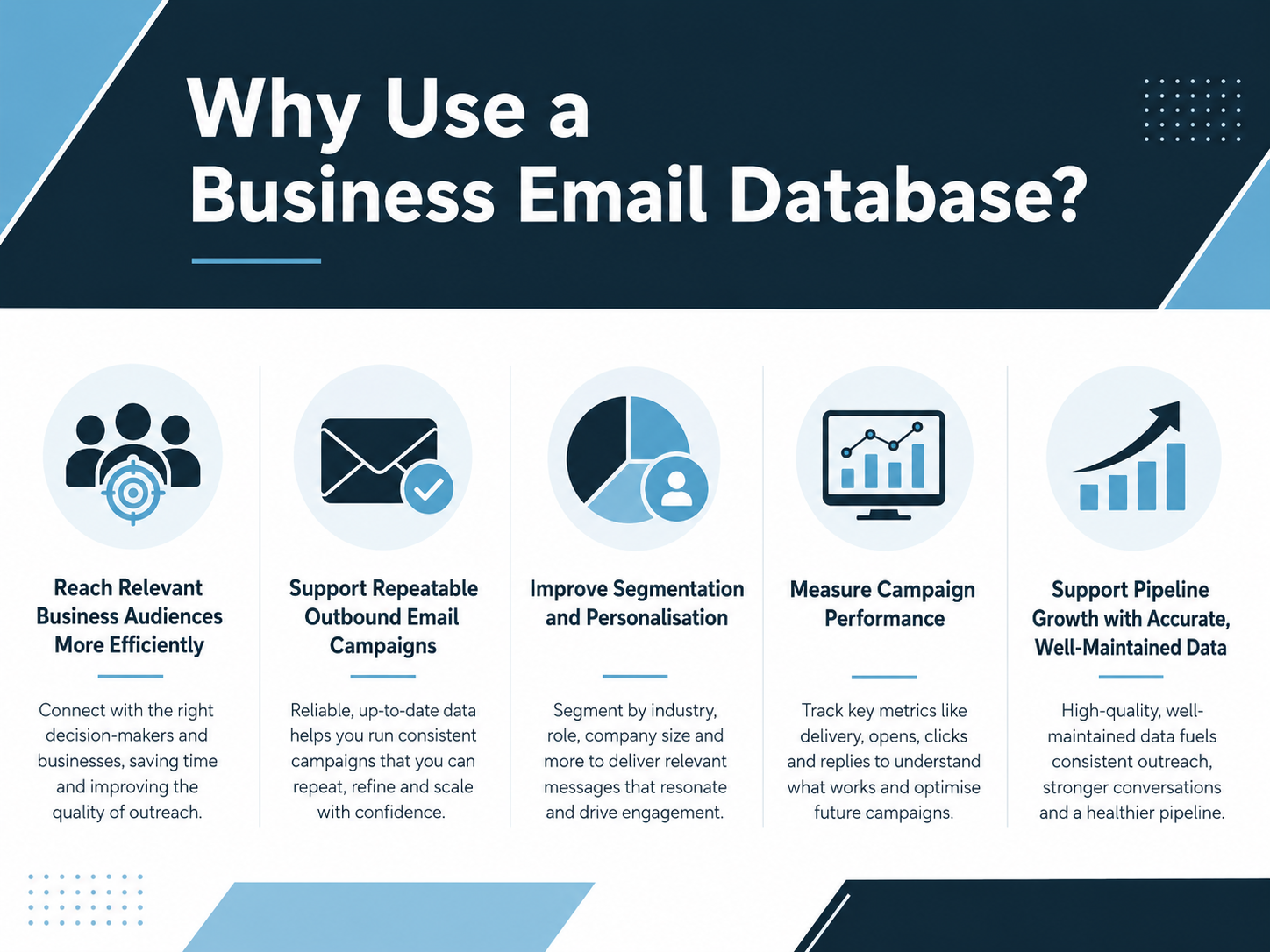
A Business Email Database is often a good fit when the audience is distributed across many locations. Telephone outreach becomes expensive when every prospect requires a live conversation. Postal activity adds print and postage costs. Email can reach a segmented audience quickly, although low distribution cost must never become an excuse for indiscriminate sending. Poor targeting still damages reputation and deliverability.
The channel is also useful when the sales cycle benefits from more than one touchpoint. A complex B2B purchase may require education before a prospect is ready to speak. Email can introduce a problem, provide evidence, answer common objections and offer a low-friction next step. Sales teams can then prioritise contacts who reply, visit a key page or otherwise show interest, subject to the organisation’s privacy and tracking arrangements.
When email is better than telemarketing
Email may suit a business better than a telemarketing list when the initial proposition can be understood without a long conversation, when the audience is large, when recipients need time to review information or when the team does not have enough trained callers to work the market properly. It can also be better when the call to action is digital and self-service.
Telemarketing has strengths that email cannot copy. A live conversation reveals objections, urgency and buying context. It can be more effective for high-value, complex or time-sensitive propositions. AccuraData’s B2B telemarketing data supports campaigns where direct conversations are central. In practice, many organisations use email to introduce the proposition and telephone outreach for selected accounts or engaged contacts.
Compliance also differs by channel. Telephone marketing requires attention to PECR and preference services such as TPS and CTPS. Electronic mail has its own PECR rules, with important differences between corporate and individual subscribers. Email is not automatically the easier legal option, particularly in B2C activity. The correct choice depends on the recipient type, data source and permission position.
When email is better than postal marketing
Email may be a better fit than post when speed, online response, frequent testing or rapid personalisation matter. Subject lines, creative, timing and calls to action can be tested more quickly. Campaigns can be paused or adjusted without wasting printed stock. This makes email useful for time-sensitive offers, digital services, webinars and content-led lead generation.
Postal marketing may be stronger when the physical format supports the proposition, the audience is difficult to reach digitally, the creative needs to be retained or the organisation wants to stand out from crowded inboxes. Postal campaigns also have a different consent position. The ICO small-business guidance explains that consent is not required simply to send direct marketing by post, although a lawful basis is still required when personal data is used. AccuraData provides B2B Postal Data and B2C Postal Data for campaigns where addressed mail is the better medium.
The sensible question is not which channel is universally best. It is which channel fits the audience, proposition, compliance position, budget and next step. A Business Email Database may be the central asset, or it may be one part of a sequence that includes mail and telephone contact.
How B2B and B2C postal marketing differ
B2B postal marketing normally targets companies, sites, departments or named decision-makers. Selection may use industry, SIC code, employee band, turnover and geography. The message often supports lead generation, account development, event promotion or a high-value sales conversation. AccuraData’s B2B Postal Data can be segmented through business and geographic criteria.
B2C postal marketing is aimed at consumers or households and may use location, household profile, property indicators, lifestyle categories or other appropriate variables. The B2C Postal Data service supports addressed mail where a physical format, local targeting or household coverage suits the campaign. Consumer profiling must still be fair, proportionate and transparent where personal data is involved.
The comparison matters because a business should not use a Business Email Database simply because it is available. A B2B account campaign may benefit from an email introduction followed by a letter to a selected office. A B2C promotion may be more suitable for post when email consent is unavailable or when the printed item has useful physical value.
What information belongs in a Business Email Database?
A well-designed database has several layers. The contact layer tells you how to reach someone. The profile layer tells you whether they fit the campaign. The governance layer records source, lawful basis, notices, permissions and objections. The campaign layer records what was sent and what happened next.
Common B2B fields include company name, domain, registered or trading address, industry, SIC code, employee band, turnover band, site type, named contact, department, job title, seniority, business email address and telephone number. A targeted B2B Email Data file may be filtered by many of these criteria.
B2C records may include name, email address, customer status, declared preferences, location, purchase history, subscription source, consent wording, consent date and relevant engagement information. Consumer data must be handled with particular care because PECR generally requires consent for unsolicited email to individual subscribers unless the soft opt-in conditions are met. AccuraData’s B2C Email Data service distinguishes consumer email activity from postal and telemarketing use.
Contact and identity fields
Keep the fields that are needed to identify the recipient and deliver the campaign. For B2B activity this may include company, contact name, role and business email. For B2C activity it may include name, email and a customer or consent reference. Do not collect extra personal data simply because it might be useful one day. Data minimisation is a core UK GDPR principle, and a leaner database is easier to explain, secure and maintain.
Role-based addresses such as info@, sales@ or purchasing@ may be useful in some B2B campaigns because they do not necessarily identify an individual. The ICO B2B guidance notes that the UK GDPR applies where an individual can be identified, including through a named business email address. A generic corporate address may fall outside that definition, but PECR and good marketing practice still matter.
Source and provenance fields
Every record should have a source. “Internet” or “third party” is too vague. Record whether the address came from a form, event, customer transaction, business card, public source, referral, partner or supplier. Where possible, store the date, collection context, privacy wording, permission status and any supplier documentation.
Source data helps the business answer basic questions. Why do we hold this address? What did the person expect? Which organisation supplied it? How old is it? Which campaign types were covered? Can the record be refreshed? Without provenance, the team cannot make a confident compliance or quality decision.
The ICO guidance for organisations using data brokers makes clear that a buyer remains responsible for its own use of personal data. Buying a file does not transfer accountability to the supplier.
Permission, lawful basis and suppression fields
The Business Email Database should show the lawful basis or permission position that supports the intended use. For consent-based records, retain what the person agreed to, when they agreed, how they agreed and which organisation was named. For legitimate-interests processing, retain the relevant assessment and the purpose for which the record is used.
A suppression field is equally important. When someone objects, unsubscribes or withdraws consent, the organisation must stop the relevant direct marketing. The ICO preference guidance recommends keeping enough information on a suppression list to prevent the person being added again from a new source. Simply deleting the record can cause the same address to return in a later import.
Segmentation and campaign fields
Segmentation fields should help the business make meaningful choices. B2B examples include sector, company size, role, region, technology used, site type and account status. B2C examples include customer lifecycle, location, stated interest, product category and engagement status. Sensitive or intrusive profiling requires extra care and may not be appropriate at all.
Campaign fields may include send date, campaign name, segment, delivery status, bounce category, reply category, unsubscribe status, lead stage and next action. These fields turn a static address book into a learning system. They show which audiences respond, which sources produce bad data and which messages create useful conversations.
How to build a Business Email Database organically
Organic database growth means collecting contact information through your own relationships and activity. It usually creates strong context because the person has interacted with the organisation. It does not remove the need for transparency, lawful processing or PECR compliance, but it often makes expectations easier to understand.
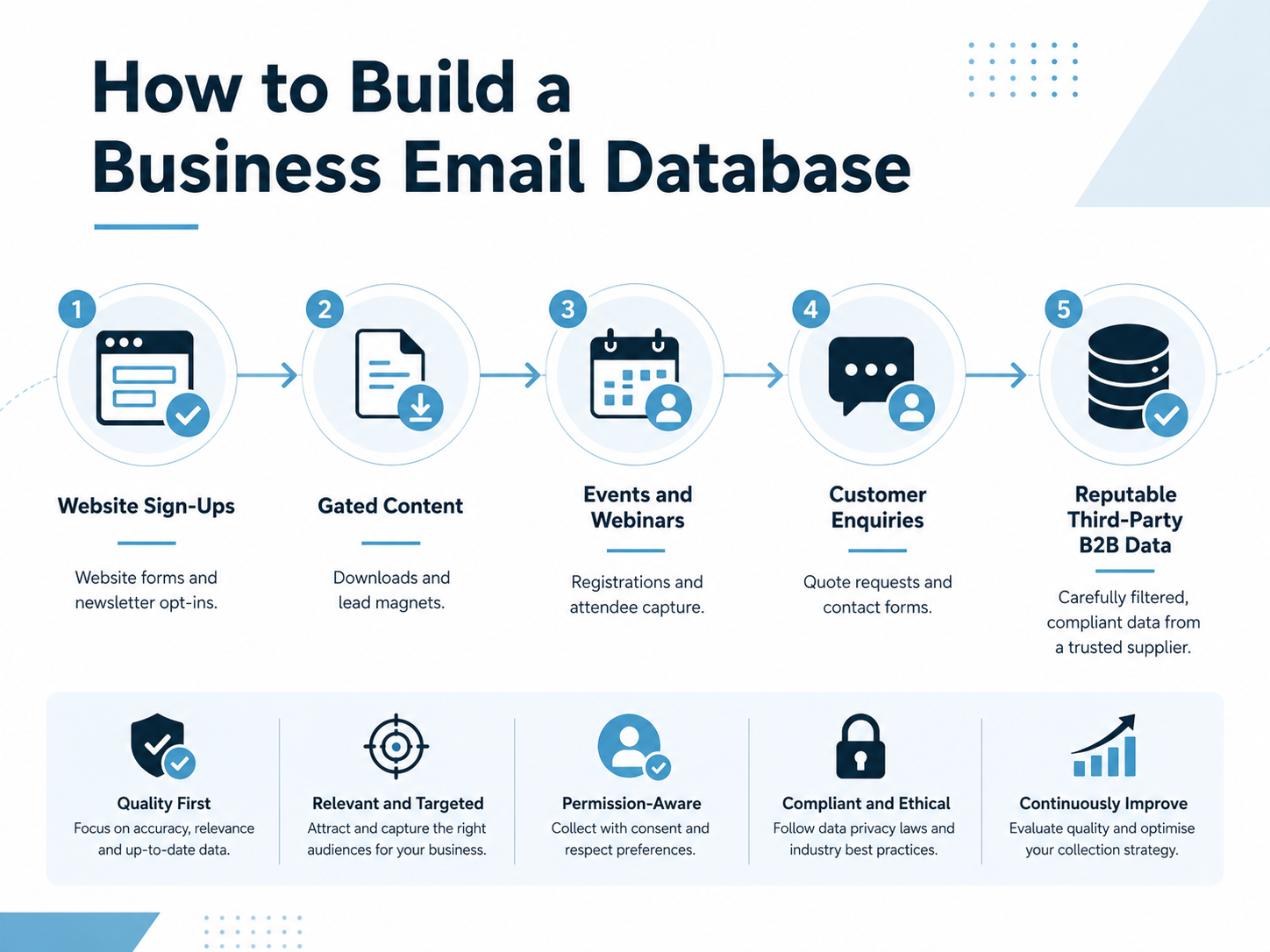
The ICO lead-generation guidance says organisations must tell people when they want to collect and use information for direct marketing. Privacy information should be clear, accessible and provided at the appropriate time.
Website forms and useful content
Contact forms, quote requests, demo bookings, calculators, guides and webinar registrations can all contribute to a Business Email Database. The form should collect only what is needed for the stated purpose. A simple newsletter may need only an email address and perhaps a name. A B2B consultation request may need company, role and a short description of the requirement.
Do not merge service enquiries into general marketing without considering the original context. Someone who requests a quote expects a response about that request. They do not automatically expect every future promotional campaign. The form should explain how the information will be used, link to the privacy notice and include the correct consent mechanism where PECR requires consent.
Consent requests should be separate, clear and based on a positive action. The ICO electronic mail guidance explains that pre-ticked boxes, silence and inactivity do not show valid consent. Use plain language that identifies the sender, channel and type of message.
Newsletter subscriptions
A newsletter sign-up is one of the clearest organic routes because the person is directly asking for email. The sign-up should set an accurate expectation about frequency and content. If the newsletter will include product offers, partner messages or profiling, say so rather than describing it as neutral “updates”.
Use a confirmation process that protects the list from typing errors and malicious sign-ups. Double opt-in is not always a legal requirement, but it can provide stronger evidence that the address owner completed the subscription. Store the date, source page, wording and confirmation status.
Keep the value exchange real. Subscribers remain engaged when the message fulfils the promise made at sign-up. A database built through useful insight, practical tools and relevant updates is more valuable than one built through a vague prize draw that attracts people with little interest in the organisation.
Events, webinars and networking
Trade shows, webinars, breakfast briefings and networking events can produce relevant contacts. The compliance position depends on what people were told and what they asked for. Registering for an event does not necessarily equal consent to all future marketing. Make the choices visible at registration and in follow-up communications.
Business cards also need context. The ICO B2B marketing guidance explains that when business-card details are added to an electronic marketing database, the UK GDPR applies. Record where the card was collected and what follow-up was discussed.
A good event process separates attendance administration, requested follow-up and ongoing marketing. This protects expectations and gives the sales team better information. A contact who asked for a proposal should not be treated in the same way as someone who merely attended a session.
Existing customers, enquiries and CRM records
Many businesses already have the beginnings of a Business Email Database inside their CRM, finance system, support platform and event tools. The challenge is not finding more addresses. It is resolving duplicates, outdated roles, inconsistent fields, missing permissions and conflicting opt-out records.
Start with an audit. Identify each system, data owner, purpose, source, quality level and retention rule. Map how records move between platforms. A customer may unsubscribe in the email system while remaining marketable in the CRM because the two platforms do not synchronise. That is both a compliance and customer-experience problem.
AccuraData’s data cleansing and enrichment service is designed to identify inaccurate, incomplete, outdated and duplicate records. Its data appending service can add missing or updated fields where appropriate. Improving a usable existing database may be more efficient than replacing it with a completely new file.
Referrals and partner activity
Referrals can produce high-quality introductions because trust is transferred from an existing relationship. However, a referral does not automatically create permission to add someone to every marketing campaign. Ask the referrer to introduce both parties or explain clearly how the details will be used.
Partner campaigns require clear controller and processor roles, documented responsibilities and accurate privacy information. Avoid informal list swaps. If another organisation provides personal data, due diligence should cover source, notice, permission, age, intended use and suppression handling.
Public business information and Companies House
Public sources can help identify organisations, confirm company status and develop firmographic profiles. The Companies House service provides information such as registered address, incorporation date, officers and filing history. The Companies House API also provides live company information for authorised technical uses.
Public availability does not mean unrestricted marketing use. The ICO states that data protection law and PECR can still apply when personal information is collected from public sources. You must consider fairness, lawful basis, transparency and recipient expectations. Companies House itself notes that it does not check the accuracy of all information filed, so public data should be treated as a starting point for verification rather than a complete campaign-ready source.
Use public data to define and verify companies, not to justify indiscriminate harvesting of named personal addresses. A company record can help confirm sector, status or registered office. Contact-level research should be proportionate and relevant to the role being targeted.
Building a Business Email Database with paid data
Organic growth takes time. A company entering a new market may not have years of enquiries, event contacts and subscribers. Paid data can extend reach, fill gaps and give a campaign a defined starting audience. It should supplement a sound strategy, not replace one.
AccuraData supplies targeted business email lists that can be selected by industry, company size, geography, job function, seniority, employee count, turnover and SIC code. It also provides B2C data where consumer targeting is relevant. The legal and permission requirements differ significantly between those audiences.
Decide whether to buy, append or cleanse
Do not assume a new list is the only option. There are three distinct procurement needs:
- Buy new records when the business lacks coverage in a defined market.
- Append missing fields when the CRM contains relevant organisations but lacks contact or profile information.
- Cleanse existing records when the database is large enough but accuracy, duplication or suppression is poor.
A database audit should come before procurement. Buying ten thousand records while ignoring twenty thousand dirty CRM records may increase cost and complexity without improving the campaign. AccuraData’s data appending service can help complete existing records, while data cleansing can improve accuracy and consistency.
Specify the audience in writing
A supplier cannot deliver a precise file from a vague brief. State the target market, exclusions, required fields, subscriber type, intended channel, geography, job roles, company bands, source expectations, maximum record age and required documentation. Ask for a count before ordering.
Use the smallest viable segment for the first campaign. A test file reveals data quality, bounce behaviour, audience fit and operational issues. Scaling should follow evidence, not the excitement of a large available count.
Carry out supplier due diligence
The buyer remains responsible for its own marketing. Due diligence should therefore go beyond price and volume. Ask:
- Who compiled the data?
- Which original sources were used?
- When were the records collected or last verified?
- How were people informed?
- Which lawful basis or permission applies?
- Are corporate and individual subscribers separated?
- How are objections and suppression lists handled?
- What quality checks are performed?
- Which fields can be selected?
- What happens if records are invalid or materially different from the specification?
The ICO data-broker guidance emphasises transparency and buyer responsibility. ICO due-diligence examples also recommend asking for collection dates, privacy wording, collection methods and information about onward sharing.
Ask for documentation, not broad assurances. “GDPR compliant” is not enough. A useful supplier should be able to explain the chain from source to delivery and the controls applied along the way. AccuraData’s article on buying email data discusses the need to match the file to the campaign rather than purchasing a generic list and forcing it into an unsuitable use case.
Review a sample carefully
A sample should be assessed for structure and relevance, not used as an unofficial campaign file. Check whether the companies match the brief, whether job roles are sensible, whether domains appear valid, whether required fields are complete and whether obvious duplicates exist.
Ask how email verification works. Syntax checking alone does not prove that a mailbox is active or that the person still holds the role. Good quality control combines verification, research, recency checks, company-status checks and ongoing maintenance.
B2B and B2C email marketing are not the same
A common database mistake is treating all email addresses as one audience. PECR applies different rules depending on whether the recipient is a corporate subscriber or an individual subscriber. The content, expectations and segmentation also differ.
B2B Business Email Database rules
The ICO electronic mail guidance says unsolicited electronic mail marketing can be sent to corporate subscribers without consent or the soft opt-in. Corporate subscribers generally include limited companies, limited liability partnerships, government bodies and some other corporate entities.
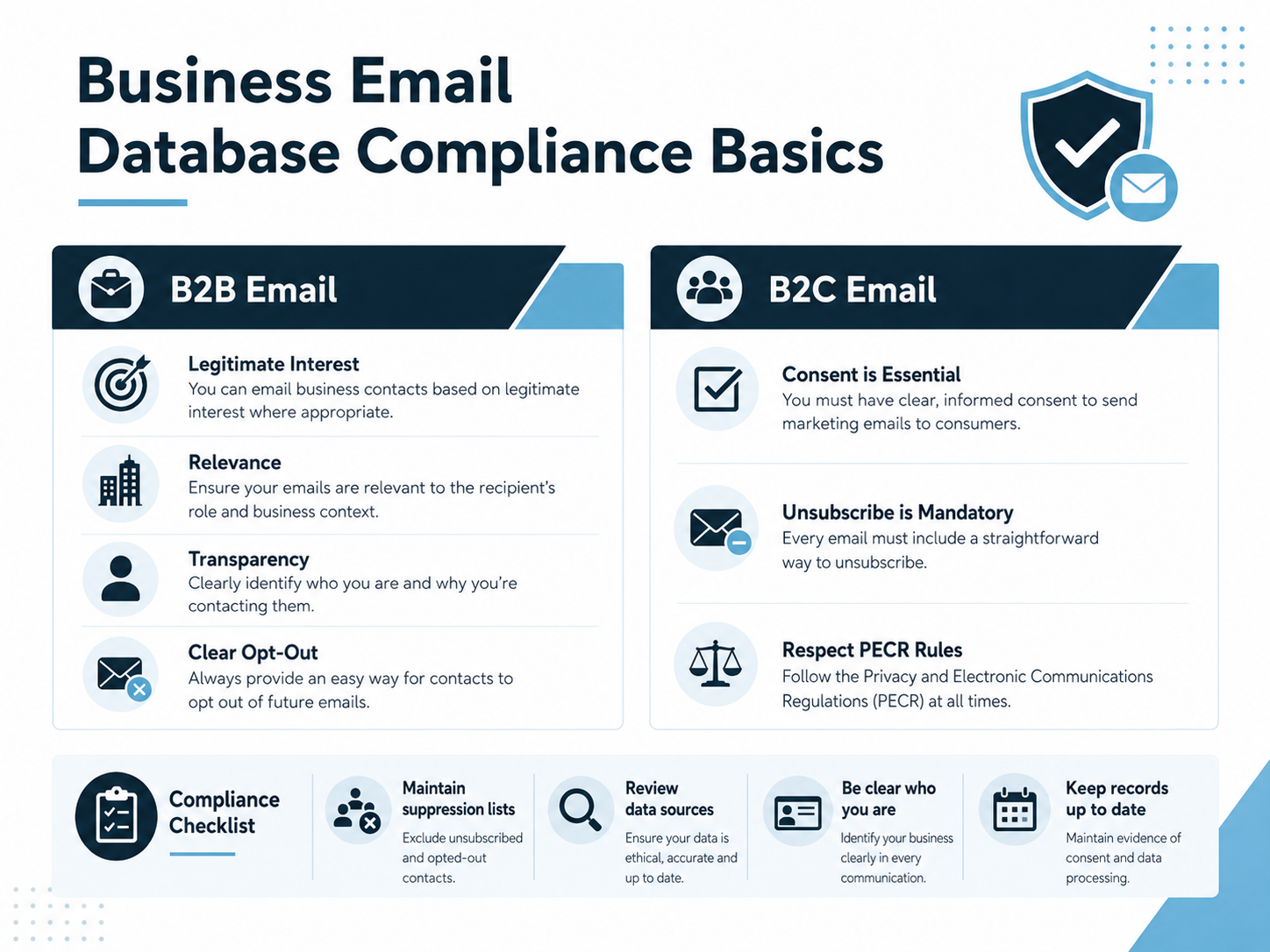
That does not remove UK GDPR duties where the address identifies an individual. A named address such as firstname.lastname@company.co.uk is personal data. The business needs a lawful basis, fair and transparent processing, data minimisation, security and respect for the absolute right to object to direct marketing. The ICO B2B guidance explains these distinctions.
Legitimate interests may be appropriate for some B2B activity, but it is not automatic. The ICO legitimate interests guidance requires the organisation to consider purpose, necessity and balancing. Relevance, reasonable expectations, message content, frequency and impact all matter.
B2B marketing should be professional and role-relevant. A finance director may reasonably expect relevant information about financial operations, but not unrelated mass promotion. The database should make it possible to select by role and context rather than send the same message to every named address.
Individual subscribers, sole traders and ordinary partnerships
PECR treats sole traders and some partnerships as individual subscribers. Unsolicited marketing email generally requires consent unless the soft opt-in conditions are met. This means a file labelled “business contacts” can contain mixed legal categories. The database must distinguish them.
Do not infer corporate status from the email domain alone. A sole trader can use a business domain, and a director may use a personal address. Include legal-entity or subscriber-type fields where the campaign depends on the B2B corporate rule. If the status is uncertain, take a cautious approach.
B2C email marketing
For B2C email marketing, consent is normally required for unsolicited messages unless the organisation can use the soft opt-in for its own existing customers. The ICO PECR summary explains that the soft opt-in is limited to similar products or services and requires an opt-out opportunity when details are collected and in every message.
Consumer consent must be specific, informed and freely given. A general agreement to terms and conditions is not enough. If data is supplied by another organisation, the consent wording must genuinely cover the recipient organisation and the intended email marketing. Vague references to unspecified third parties are weak.
AccuraData’s B2C Email Data service is designed for consumer email activity, while its B2C Postal Data supports campaigns where physical mail is more suitable. These datasets should not be treated as interchangeable because the permissions and channel rules differ.
UK GDPR and PECR for a Business Email Database
UK GDPR and PECR work together. UK GDPR covers the processing of personal data. PECR adds specific rules for electronic marketing. A campaign can satisfy one framework and still breach the other, so the team must consider both.
Choose and document a lawful basis
Consent and legitimate interests are the lawful bases most often considered for direct marketing. The right choice depends on the source, subscriber type, relationship and PECR position. If PECR requires consent, consent is normally also the appropriate UK GDPR basis for sending the message.
Where legitimate interests is used, complete and retain a legitimate interests assessment. Define the benefit being pursued, explain why the processing is necessary and assess the effect on the individual. Consider safeguards such as tight targeting, low frequency, role relevance, easy opt-out and limited retention.
Do not switch lawful basis after an objection or withdrawn consent simply to continue marketing. The ICO preference guidance explains that direct-marketing objections must be respected and cannot be overridden.
Provide clear privacy information
People must understand who is using their data, where it came from, why it is used, who it is shared with, how long it is kept and how to exercise their rights. When information is collected directly, provide the notice at collection. When it is obtained from another source, Article 14 transparency requirements apply, subject to the detailed legal conditions.
The ICO lead-generation guidance stresses that privacy information should be clear and understandable. If the proposed activity is difficult to explain honestly, that is a warning that the activity may need redesigning.
A layered notice works well. Give the essential information next to the form or in the first appropriate contact, then link to the fuller privacy notice. Avoid burying marketing language in a long legal document.
Respect opt-outs and objections
Every marketing email must identify the sender and provide a valid route to unsubscribe. The process should be simple and should not require an account login. Suppress the address promptly across all relevant platforms.
Maintain a central suppression process. If the CRM, email platform and sales system each hold separate statuses, define which system is authoritative and how changes are synchronised. Test the process regularly by submitting an unsubscribe and checking every connected platform.
Keep data accurate and no longer than necessary
The UK GDPR accuracy principle requires reasonable steps to keep personal data accurate where necessary. A business contact can change role, employer or address without notice. Set review periods based on source and risk. Highly volatile decision-maker data needs more frequent checking than stable company-level fields.
Retention should follow purpose. Keep active prospects for a justified period, review inactive records and remove or suppress data that no longer supports the purpose. Document the rule rather than retaining every record indefinitely because storage is cheap.
Secure the database
Limit access to people who need it. Use role-based permissions, strong authentication, audit logs, secure transfer and clear processor contracts. Avoid emailing unencrypted spreadsheets containing large datasets. Agree how files will be delivered, stored, imported and deleted after use.
Security also includes staff behaviour. Train users not to export uncontrolled copies, upload lists to unapproved tools or use live records for testing. Maintain an incident process that covers both the source database and connected campaign systems.
Follow the CAP Code as well as legislation
The CAP Code database rules apply to UK marketers using personal data for direct marketing and sit alongside legislation. They do not replace UK GDPR or PECR. Marketing claims, identity, suppression and database practice should therefore be reviewed as part of the same governance process.
Segmentation turns a Business Email Database into a useful asset
A database creates value when it allows the organisation to make better choices. Segmentation should connect a meaningful audience difference to a different message, offer, timing or next step. Creating fifty segments that all receive the same campaign adds complexity without relevance.
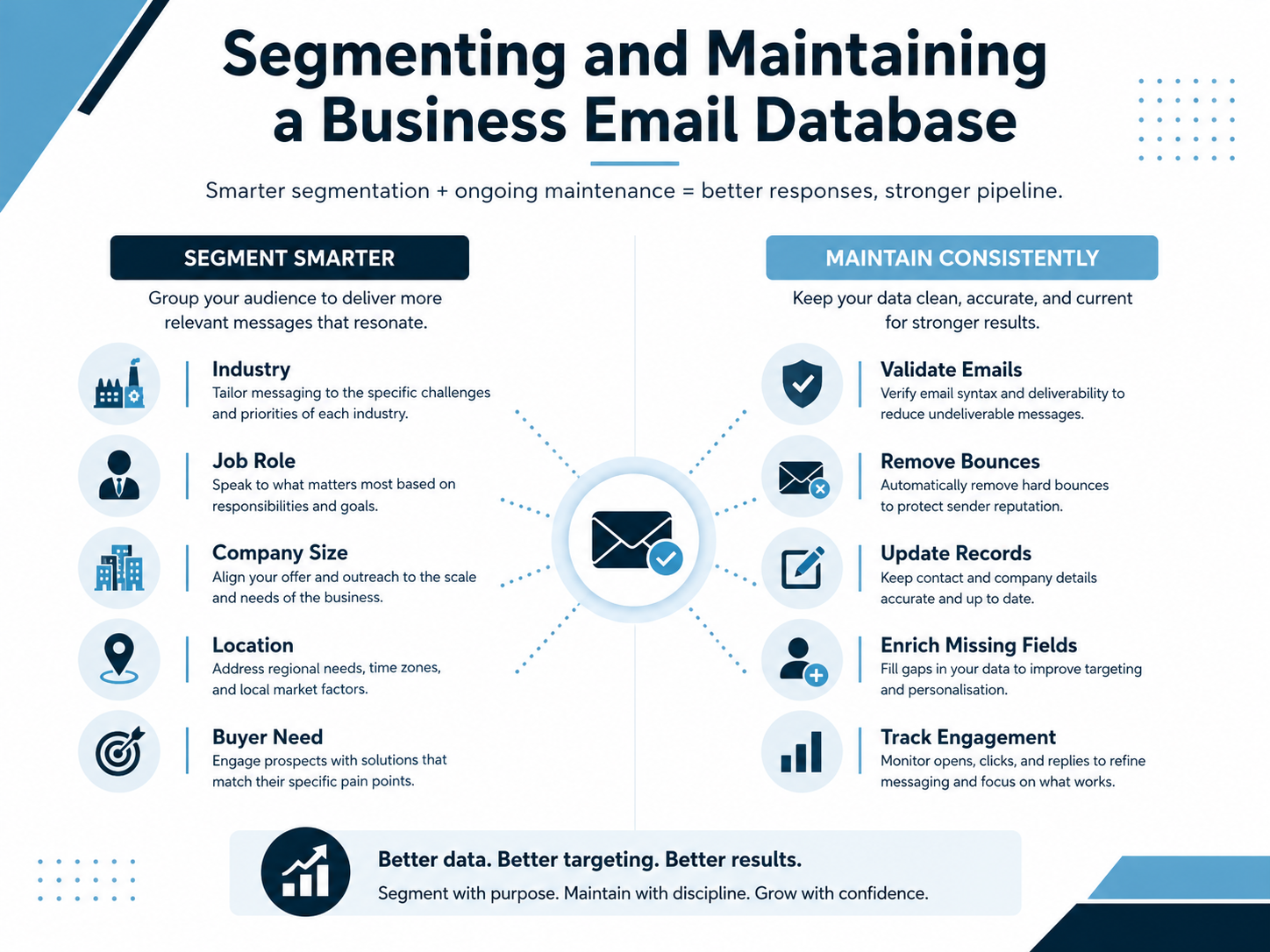
B2B firmographic segmentation
Useful B2B filters include industry, SIC code, company size, turnover, employee count, location, site type, ownership and trading status. These variables help match the proposition to the organisation. A compliance service for a regulated enterprise should not use the same framing as a simple product for a local microbusiness.
AccuraData’s B2B Data and B2B Email Data can be selected through firmographic and contact-level criteria. Start with the factors that affect need, ability to buy and message relevance.
Role and seniority segmentation
Job title alone is unreliable because organisations describe similar roles differently. Group titles into functions such as finance, operations, IT, HR, marketing and procurement. Then separate decision-makers, influencers, users and gatekeepers.
The message should reflect the role. A finance leader may care about cost and control. An operations leader may care about implementation and disruption. A user may care about ease and support. The underlying offer is the same, but the evidence and call to action change.
Lifecycle and relationship segmentation
Separate new prospects, active opportunities, customers, lapsed customers, event attendees, content subscribers and previous enquirers. Relationship context changes both expected messaging and compliance position.
A new prospect may need a short introduction. A recent enquiry may need a specific answer. An existing customer may qualify for the soft opt-in in certain B2C circumstances if every condition is met. A lapsed contact may need a re-permission or re-engagement strategy rather than an indefinite stream of promotions.
Engagement segmentation
Use campaign behaviour carefully. Opens are less reliable than they once were because privacy features can affect tracking. Replies, clicks, form completions, bookings and purchases are generally stronger signals. Do not treat every digital action as proof of buying intent.
Create practical categories such as engaged, inactive, bounced, unsubscribed and uncontacted. Set rules for each. An inactive segment may receive a lower frequency or a re-engagement message. A hard bounce should be removed from future sends and reviewed for source quality.
Data filtering for the perfect customer fit
There is no perfect list, but a clear hierarchy of filters can produce a much better fit. Begin with exclusions, then essential criteria, then priority signals. For a B2B campaign the order might be:
- Remove customers, competitors, suppressed contacts and unsupported sectors.
- Select the required geography and company size.
- Select the relevant industry or SIC codes.
- Select the appropriate job functions and seniority.
- Rank accounts by strategic value or evidence of likely need.
This method avoids overfitting at the start. A segment that is too narrow may be impossible to test, while a segment that is too broad prevents useful learning. Start with a coherent audience and refine from evidence.
Data quality and maintenance
A Business Email Database is never finished. People move jobs, domains change, companies merge, consent ages and preferences change. Maintenance is part of normal campaign operations.
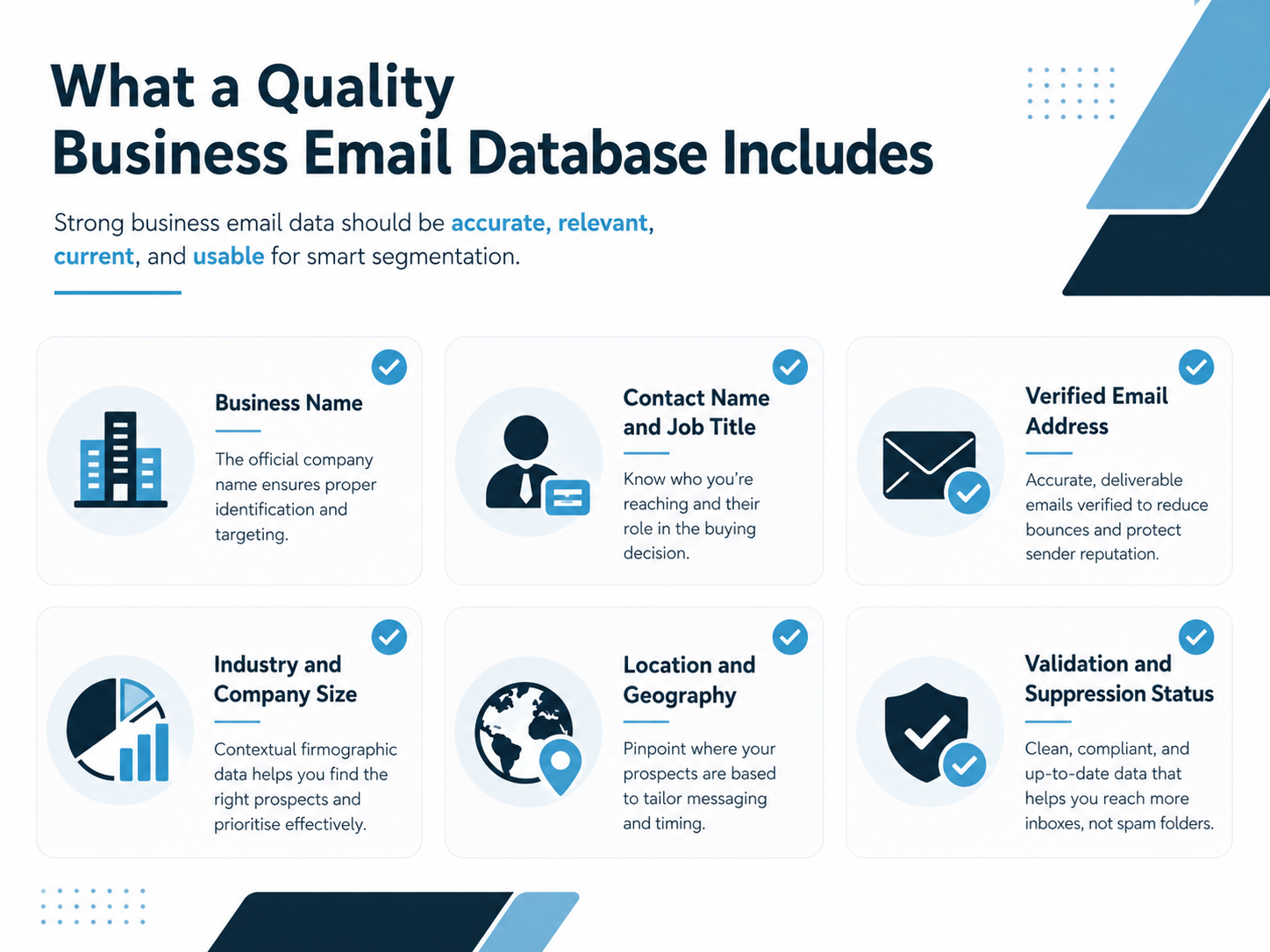
Verify and standardise records
Standardise company names, job functions, countries, postcodes and date formats. Normalisation makes deduplication and segmentation more reliable. Decide how subsidiaries, branches and group companies should be represented.
Email validation should identify syntax errors, invalid domains, role addresses, duplicate addresses and known hard bounces. Validation does not prove that a message is lawful or wanted. It only addresses part of the quality problem.
Deduplicate across systems
Duplicates waste sends and create conflicting histories. Match on email address, but also consider company-domain combinations, customer identifiers and normalised names. Decide which record wins when fields conflict.
A master record should preserve the strongest source, newest verification, most restrictive marketing status and complete campaign history. Never let a newer imported record overwrite an existing opt-out.
Append missing information carefully
Appending can make an existing Business Email Database more useful by adding company, role, contact or address fields. The source and lawful processing still need to be understood. Added information should be relevant to the campaign and reflected in privacy information where required.
AccuraData’s data appending options include email, address, company-status and contact enrichment. The aim should be to improve the usefulness of records already held, not to create an uncontrolled profile containing every available attribute.
Create a maintenance schedule
Set different review intervals for different fields. Company status may be checked periodically against public records. Email domains and mailboxes may need verification before a major campaign. Engagement and suppression status should update continuously.
Track quality by source. If one acquisition source creates repeated bounces or irrelevant records, pause it and investigate. Source-level reporting creates accountability and helps the business spend more on methods that produce usable contacts.
Deliverability is part of Business Email Database quality
A valid address does not guarantee inbox placement. Sender identity, domain authentication, complaint rates, message content, sending patterns and recipient engagement all influence delivery. Database management and technical sending practices must therefore be planned together.
The NCSC email security guidance recommends anti-spoofing controls including SPF, DKIM and DMARC. SPF identifies authorised sending infrastructure. DKIM provides a cryptographic signature. DMARC builds on those checks and provides a policy and reporting layer.
Google’s current email sender guidelines require senders to authenticate messages and set additional expectations for bulk traffic, including unsubscribe and reputation controls. Requirements can change, so the campaign owner should review the rules of major mailbox providers and the sending platform before launch.
Authenticate the sending domain
Use a domain the organisation controls. Configure SPF, DKIM and DMARC with support from the email administrator or provider. Check alignment between the visible From domain and authenticated domains. Monitor DMARC reports and correct unauthorised or missing senders.
Do not wait until a large campaign to discover configuration errors. Test across major mailbox providers, examine headers and confirm that authentication passes. Keep a record of authorised platforms so that obsolete services can be removed from DNS records.
Protect sender reputation
Begin with the most relevant and strongest-permission segments. Sudden high-volume sending from a new domain can look suspicious. Increase volume in a controlled way and monitor bounces, complaints, replies and unsubscribes.
Remove hard bounces promptly. Investigate soft bounces rather than retrying forever. Make the sender identity clear and the message consistent with the reason for contact. A strong database cannot compensate for misleading subject lines or irrelevant content.
Make unsubscribing easy
The legal and technical direction is the same: people should be able to stop marketing easily. Include a visible unsubscribe link and support the technical unsubscribe requirements of the mailbox providers and sending platform. Update suppression records across all systems.
An easy opt-out can protect reputation because frustrated recipients are less likely to mark the message as spam. It also provides cleaner data about who genuinely wants future communication.
How to use a Business Email Database effectively
The best campaign starts with a narrow question. What should this audience understand or do after reading the message? Every part of the campaign should support that outcome.
Build one campaign around one job
Avoid emails that attempt to introduce the company, explain every service, promote an event, offer a discount and request a meeting at the same time. Choose one primary action. The message may support it with evidence, but the decision should be clear.
For an early-stage audience, the action might be reading a guide. For a high-intent segment, it might be booking a consultation. For customers, it might be activating a feature or renewing a service. Match the call to action to the relationship and evidence of readiness.
Personalise with relevance, not decoration
Using a first name is not meaningful personalisation if the offer is irrelevant. Use database fields to change the substance of the message. Refer to sector pressures, role responsibilities, location, company size or customer lifecycle where those details genuinely affect the proposition.
Do not reveal profiling in a way that feels intrusive. A message should sound informed, not as if the sender has assembled an unexpected dossier. Use the minimum detail needed to make the communication useful.
Write for scanning
Use a clear subject line, short opening, concise explanation, proof and a visible next step. Avoid exaggerated claims and artificial urgency. Identify the sender and explain why the message is relevant.
Plain-text or lightly designed emails can work well for direct B2B outreach, while branded templates may suit newsletters and customer communications. The format should follow the purpose, not fashion.
Test one meaningful variable at a time
Test subject lines, audience segments, offers, send times or calls to action. Avoid changing everything at once because the result will not show what caused the difference. Use a large enough sample to make the comparison useful.
Prioritise tests that can change business decisions. Comparing two shades of blue is less valuable than comparing two audience definitions or offers. Database tests often create the biggest improvement because they change who receives the message.
Measure beyond opens
Track delivered messages, clicks, replies, qualified enquiries, meetings, opportunities, sales, unsubscribes and complaints. Open rates can be distorted by privacy technology and should not be treated as a complete performance measure.
Connect campaign responses to the CRM so that marketing can see commercial outcomes. A segment with fewer clicks may still produce better opportunities. Report by source, segment, role and campaign, not only at overall list level.
Feed learning back into the database
Record objections, questions, timing, authority and next steps. Update job roles and company changes discovered through replies. Suppress people who object. Add useful relationship context.
This feedback loop is what makes a Business Email Database improve over time. The database becomes a record of market learning rather than a file that is repeatedly mailed until it decays.
Common Business Email Database mistakes
Collecting addresses without a source
A record without provenance is difficult to defend and difficult to trust. Make source a mandatory field for imports and forms. Reject files that cannot explain where records came from.
Confusing public availability with permission
A public business address may be accessible, but that does not remove fairness, transparency, lawful-basis or PECR considerations. Public-source research should be proportionate and role-relevant.
Mixing corporate and individual subscribers
Sole traders, ordinary partnerships and consumers can require consent where limited companies do not. Add subscriber-type controls and use a cautious approach where status is uncertain.
Buying on price per record
A cheap list can be expensive when it creates bounces, irrelevant sends, complaints and sales time spent on poor-fit contacts. Compare usable, campaign-ready records rather than headline volume.
Ignoring suppression during imports
Every new import should be screened against the organisation’s suppression list. The most restrictive status should win. Do not allow a fresh supplier file to reactivate an address that previously objected.
Treating deliverability as a technical problem only
SPF, DKIM and DMARC are necessary, but sender reputation also reflects audience fit and recipient behaviour. Technical configuration cannot make unwanted messages welcome.
Sending the same message to every segment
If segmentation does not change the message, offer or timing, it is only administrative decoration. Use fewer segments with clearer differences.
How AccuraData can support a Business Email Database
Some organisations need help because their organic database is too small, their CRM is inaccurate or their team lacks time to research and validate records. AccuraData can support each of those situations.
Its B2B Email Data service provides targeted UK business email records selected through company and decision-maker criteria. Its broader B2B Data service supports multi-channel audience building. For consumer campaigns, B2C Data and B2C Email Data provide separate options suited to consumer targeting requirements.
When the organisation already holds relevant records, data cleansing and enrichment can help correct, validate and deduplicate them. Data appending can add missing contact or profile fields where appropriate. If post is the better channel, AccuraData also supplies B2B Postal Data and B2C Postal Data.
AccuraData has also published practical guidance on Business Email Lists, building a UK email database, buying email data and running email marketing campaigns. These resources can help a team plan the audience and campaign before requesting a data count.
The value of a supplier should be judged by transparency, selection depth, maintenance, documentation and practical support. The goal is not to deliver the largest possible file. It is to help the client create a database that is relevant, controlled and ready for the intended campaign.
Frequently asked questions about a Business Email Database
What is a Business Email Database?
A Business Email Database is a structured collection of business and contact records used for email marketing, sales outreach, lead nurturing and customer communications. It normally includes email addresses plus company, role, source, segmentation, permission and campaign information.
Is it legal to build a Business Email Database from public sources?
It can be lawful to use public business information, but public availability does not remove UK GDPR or PECR duties. You must consider subscriber type, lawful basis, fairness, transparency, relevance, rights and the electronic-mail rules. The ICO B2B guidance provides the key framework.
Can I email limited companies without consent?
PECR generally allows unsolicited electronic mail marketing to corporate subscribers without consent or the soft opt-in. However, if the address identifies an individual, the UK GDPR applies. You still need a lawful basis, transparency and a simple opt-out. Sole traders and ordinary partnerships are treated differently.
Do I need consent for B2C email marketing?
Usually yes. Unsolicited email to individual subscribers normally requires consent unless every condition of the soft opt-in is met for the organisation’s own existing customers. Consent must be specific, informed and based on a positive action.
How often should I clean a Business Email Database?
There is no single interval for every database. Review high-change B2B contacts before major campaigns, process bounces and opt-outs continuously, and set documented review periods for inactive records. The appropriate frequency depends on source, age, audience and campaign risk.
Should I use double opt-in?
Double opt-in is not always legally required, but it can improve evidence, reduce mistyped addresses and protect against malicious sign-ups. It is particularly useful for newsletters and high-volume consumer lists.
Can I buy a Business Email Database?
Yes, but the buyer remains responsible for its own use of the data. Define the audience, investigate the supplier, review source and documentation, distinguish subscriber types, screen suppressions and test a small segment before scaling.
What should I ask an email data supplier?
Ask about original sources, collection dates, privacy information, lawful basis or consent, subscriber categories, verification, update frequency, suppression, available filters, delivery security and remedies for invalid records. Request documentation rather than relying on a general compliance claim.
Is email easier to comply with than telemarketing or post?
Not always. Email can be operationally easier and highly measurable, but B2C electronic marketing has strict consent rules. Postal marketing does not generally require consent simply because it is sent by post, although UK GDPR still applies where personal data is used. Telephone marketing has TPS and CTPS considerations. Choose the channel after assessing the audience and rules.
What fields are most important?
The essential fields are those required to identify the audience, deliver the message, explain the source, manage the lawful basis or permission, apply suppression and measure the campaign. Extra fields should be collected only when they support a genuine decision.
How do I improve email deliverability?
Use accurate and relevant data, remove hard bounces, respect opt-outs, authenticate the domain with SPF, DKIM and DMARC, warm sending volumes sensibly, monitor complaints and follow current mailbox-provider requirements such as the Google sender guidelines.
Can email data be combined with postal and telephone data?
Yes. Multi-channel campaigns can use email for education and digital response, post for physical impact and telephone for direct qualification. Use consistent suppression and governance across channels. AccuraData supports business, email, postal and telephone data for joined-up campaigns.
Final thoughts
A Business Email Database becomes valuable when it is built around a clear purpose, controlled sources, useful segmentation and disciplined maintenance. The address itself is only the delivery field. The surrounding context determines whether the message is relevant, lawful, deliverable and measurable.
Start with the campaign job. Build organic records through transparent forms, subscriptions, events and customer relationships. Use public business information carefully. Supplement the file with paid data only after defining the audience and completing supplier due diligence. Separate B2B corporate contacts from individual subscribers, respect objections and maintain accurate suppression records.
Then use the database as a learning system. Test coherent segments, measure meaningful outcomes and feed replies, changes and preferences back into the record. Over time, the strongest Business Email Database is not necessarily the largest. It is the one the business understands, trusts and can use responsibly.