
Marketing Mailing Lists are the audience infrastructure behind addressed direct mail. The creative piece may be the part that customers see, but the list determines who receives it, where it lands, how much print and postage is spent, which privacy obligations apply and whether campaign measurement means anything at all. A strong postal campaign therefore starts with data procurement and governance, not with artwork.
That is especially important because postal marketing has a different cost profile from email or paid digital advertising. Every additional record can create a real print, fulfilment and postage cost. A weak email record may produce a bounce. A weak postal record can consume production budget before anyone has had a chance to respond. The commercial case for accurate targeting is therefore unusually clear.
Marketing Mailing Lists also sit in a distinctive legal and operational position. Postal direct marketing is not covered by the marketing provisions of PECR, but UK data protection law applies when personal information is used. The ICO’s direct marketing guidance makes clear that people have an absolute right to object to direct marketing. The ICO also says organisations should check names and addresses against the Mailing Preference Service before sending postal marketing, even though MPS is not itself a statutory preference service.
The buyer also needs to distinguish B2B from B2C mailing data. A business mailing aimed at companies may be built around company name, trading address, sector and size. A consumer campaign is more likely to use a named person, home address and household or demographic criteria. Some B2B records also contain personal data, for example a named finance director at a specific employer. The compliance analysis therefore depends on what information is actually being used, not simply whether the campaign is described as B2B or B2C.
This guide explains how to buy, test and use Marketing Mailing Lists responsibly. It covers supplier due diligence, the Mail Preference Service, B2B and B2C list design, UK GDPR, address validation, suppression, campaign planning, postal measurement, pricing, red flags and ongoing list maintenance. It also explains where AccuraData fits. Its B2B Data, B2B Postal Data, B2C Postal Data and Data Cleansing and Enrichment services allow buyers to keep audience definition, data preparation and database improvement within one working relationship.
A short compliance note is appropriate. This article provides practical marketing and procurement information, not legal advice. The correct approach depends on the information used, the audience, the campaign purpose, the source of the data and the organisation’s own circumstances. Current ICO direct marketing guidance and specialist advice should be checked where the position is uncertain.
Marketing Mailing Lists: What Are You Actually Buying?
A marketing mailing list is a structured set of postal records selected for an addressed direct mail campaign. It may be purchased, rented, derived from a first-party CRM, built from several approved sources or created by cleansing and enriching data the organisation already holds.
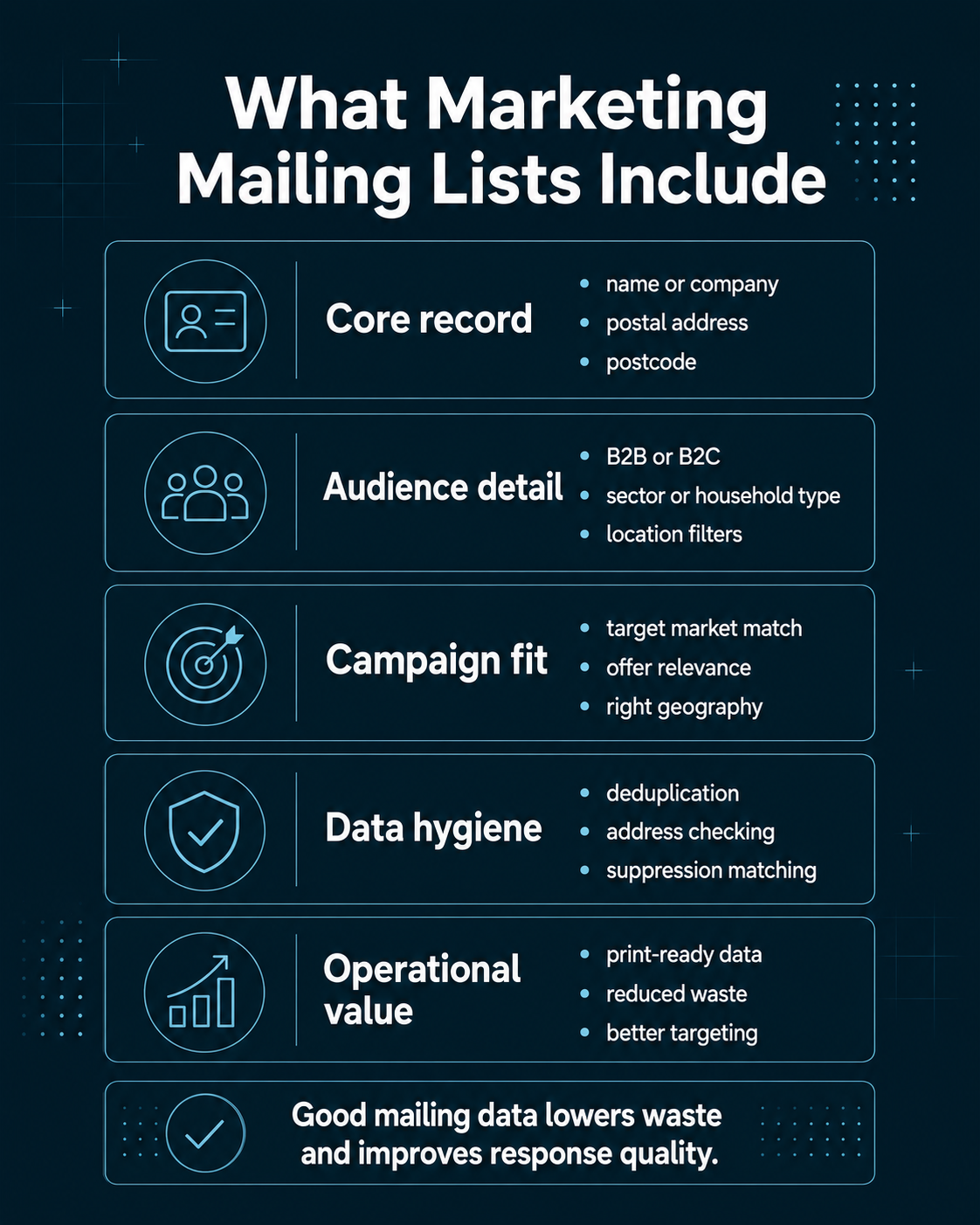
The important word is “structured”. A postal address alone does not tell a marketer whether the recipient fits the campaign. The value comes from the targeting fields around the address and from the processes used to keep the record current, suppress objections and prepare it for delivery.
Typical fields in B2B Marketing Mailing Lists
Business mailing data can include company name, trading address, town, county, postcode, website, sector, SIC code, employee band, turnover band, company status, site type and, where appropriate, named decision-maker information. AccuraData’s B2B Postal Data can support targeting by industry, geography, company size, turnover and related business criteria.
The exact fields should follow the campaign. A national office-supplies promotion may need company name, site address and size band. A high-value account-based campaign may justify named contacts, job titles and highly specific company filters. Buying more fields than the campaign needs increases cost and governance work without automatically improving results.
Typical fields in B2C Marketing Mailing Lists
Consumer postal data is different. It may contain name, home address, postcode, age band, household composition, homeownership, geographic information or other relevant audience indicators. AccuraData’s B2C Postal Data is designed for consumer direct mail where audience selection needs to reflect household or campaign-specific criteria.
These fields can be useful, but they also make the privacy assessment more important. The more detailed the profile, the more carefully the buyer should consider relevance, transparency, reasonable expectations and whether the information is genuinely necessary for the campaign.
Addressed direct mail is not the same as a door drop
Marketing Mailing Lists normally relate to addressed mail. A door drop does not usually use a named postal list. It is delivered to households in selected geographic areas. Partially addressed mail sits between the two, often using location-based targeting without naming an individual.
This distinction affects both measurement and data protection. The ICO explains that postal marketing to named individuals uses personal information and must comply with data protection law. Unaddressed material delivered without processing personal information has a different data protection profile.
A buyer should therefore decide whether it actually needs Marketing Mailing Lists. If the offer only needs broad geographic reach, a door drop may be more efficient. If relevance depends on a named person, company, household profile or previous relationship, addressed mail is likely to require a structured list.
Why Marketing Mailing Lists Still Matter in a Digital Campaign Mix
Direct mail is sometimes treated as an old channel competing with modern digital tactics. That is not a useful way to plan it. Postal marketing is better understood as a physical touchpoint that can support acquisition, retention, account development and digital response.
JICMAIL’s Q1 2026 results reported that 9.4% of mail items prompted a website visit in the quarter and that 56% of purchases driven by mail were fulfilled online. These figures cover several mail types and should not be treated as a guaranteed result for an individual campaign. They do show why direct mail should not be measured only through paper response forms or telephone orders.
When postal data has an advantage over email data
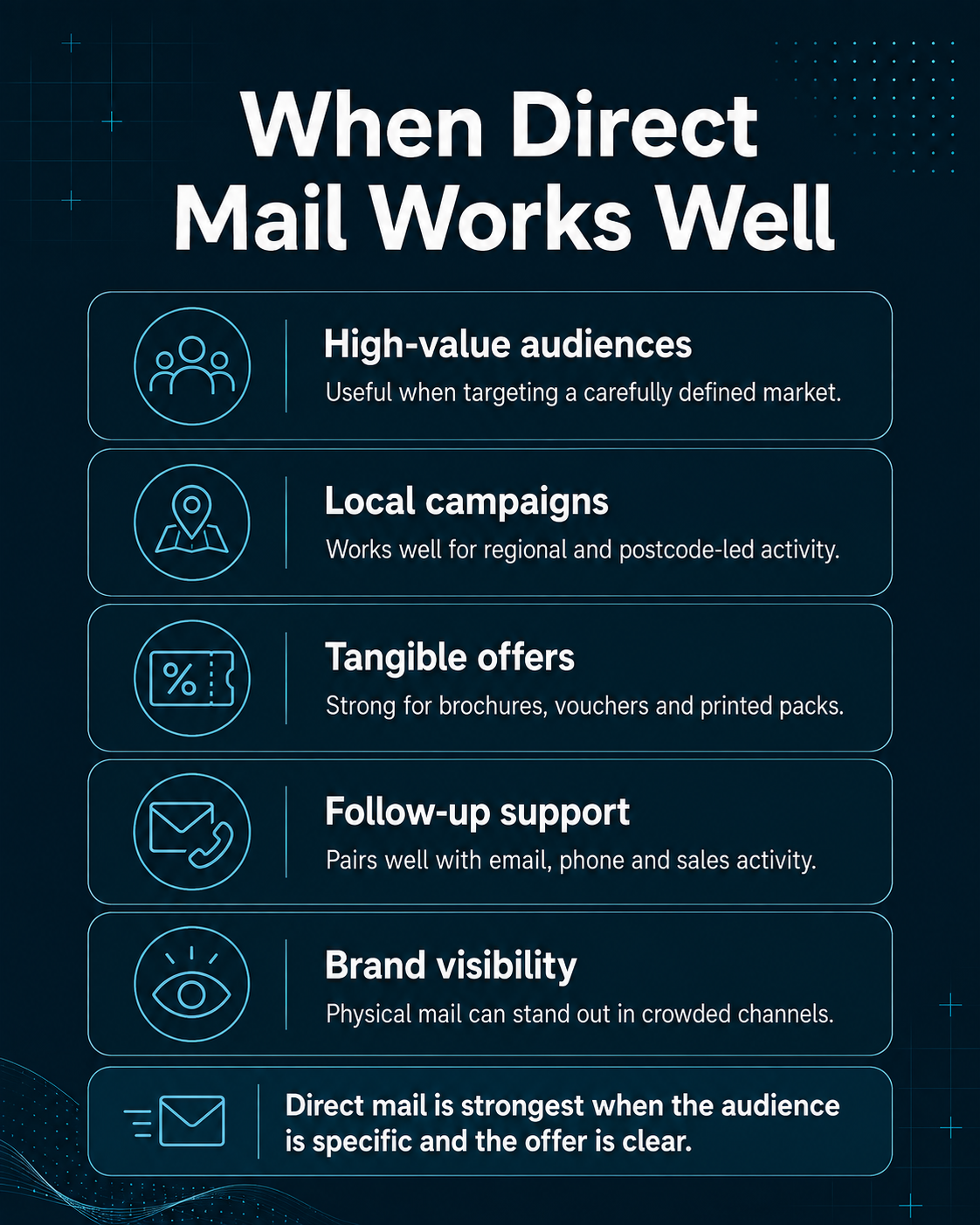
Email is fast and inexpensive to distribute, but inbox competition is intense. Postal marketing can be useful where the creative needs physical space, the offer benefits from tangible presentation or the audience is difficult to reach consistently by email.
A printed pack can also carry samples, vouchers, personalised documents, event material or detailed product information. It can sit on a desk or in a home for later consideration. JICMAIL’s research shows that mail can generate repeated interactions over several days, which is a different behaviour from a single digital impression.
This does not make post automatically better than email. It makes the list economics different. Because the marginal cost per postal piece is higher, the marketer has a stronger reason to exclude weak prospects before the campaign launches.
When postal data has an advantage over telemarketing data
Telephone outreach is useful when live qualification matters. Postal mail is useful when the recipient needs time to absorb an offer, when a physical piece can create credibility or when the campaign wants to warm an audience before calling.
A common multi-channel approach is to mail first and then call a selected B2B audience. The mail gives the caller a credible reason to contact the organisation. If this model is used, the postal and telephone datasets need to be aligned, and telephone preference screening must be applied separately before calling.
AccuraData’s broader B2B Data services can support campaigns that need postal records alongside email or telephone fields. Its article on B2B marketing lists across email, telephone and post provides additional context for multi-channel planning.
When first-party postal data may be better than buying a list
An organisation with a strong customer or prospect database should not assume that acquisition data is the first answer. Existing customers, previous enquiries, members, lapsed buyers and known prospects may offer a more relevant audience if their records are accurate and the marketing use is appropriate.
The problem is often data quality. Addresses become incomplete, customers move, duplicate household records accumulate and legacy systems store fields in inconsistent formats. In these cases, data cleansing may produce more value than replacing the database.
A sensible workflow is often: cleanse first, apply suppression, identify the genuine audience gap, then acquire only the records needed to fill it.
B2B and B2C Marketing Mailing Lists: The Differences That Matter
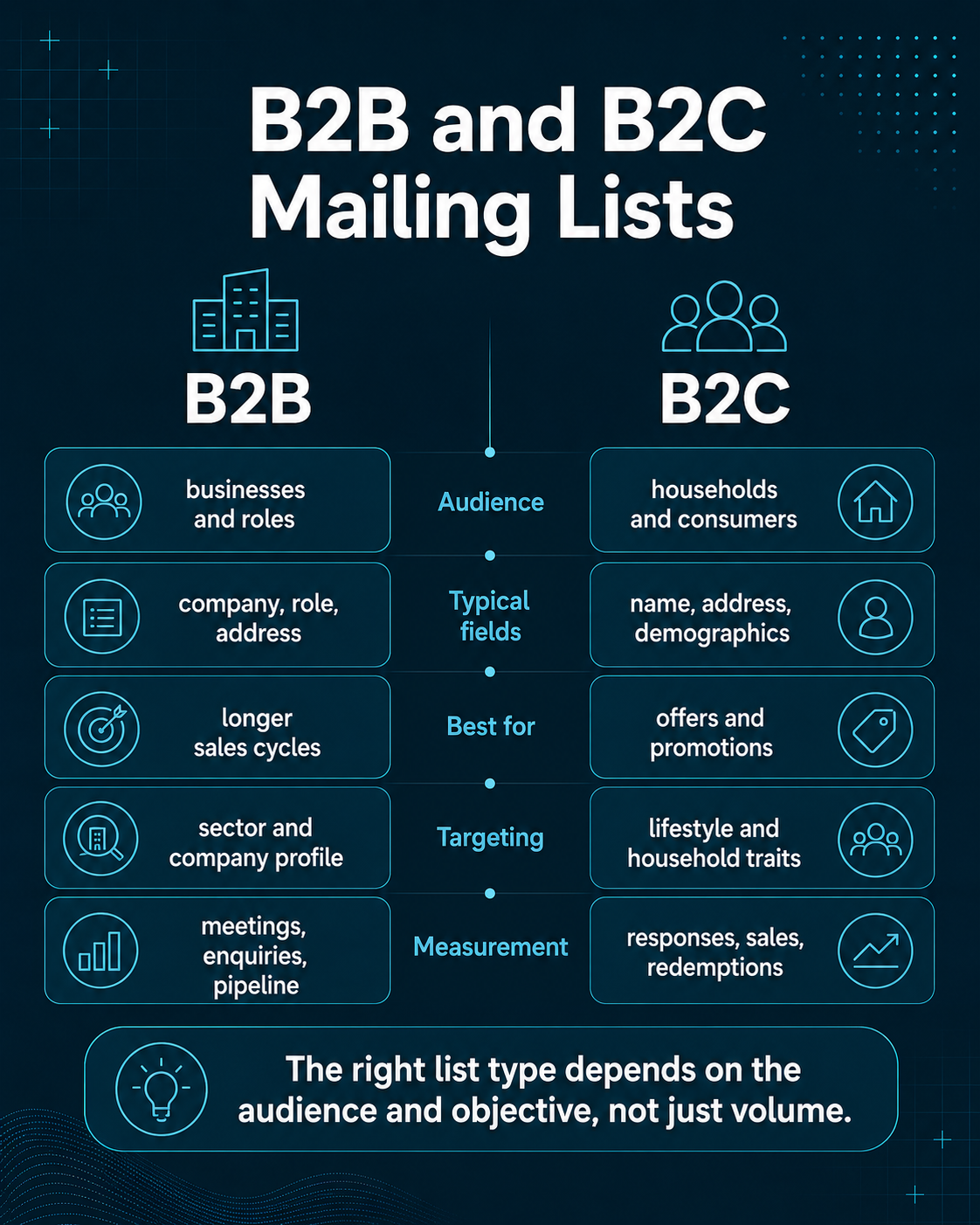
B2B and B2C Marketing Mailing Lists share the same delivery channel, but they should not be treated as the same product. The audience definition, data fields, address type, legal analysis, creative approach and campaign economics can all differ.
B2B mailing lists start with the organisation
A B2B brief usually begins with companies. The marketer may select industry, geography, employee count, turnover, site type, ownership, company status or other firmographic criteria. A named contact may then be added when the proposition is role-specific.
The distinction between registered office and trading location matters. A Companies House address may be accurate as a legal record while being unsuitable for a campaign aimed at an operational site. Buyers can use the Companies House register to check basic corporate information, but the register should not be confused with a campaign-ready marketing database.
AccuraData’s B2B Postal Data can be targeted around business criteria and used for sales letters, account-based marketing, event invitations, brochures and other addressed B2B activity.
B2B mail can still involve personal data
A record containing only a limited company name and corporate address may not identify a living person. A record addressed to “Jane Smith, Finance Director, Example Ltd” does. The named contact is personal data even though the context is professional.
The ICO’s small-business guidance on B2B marketing and data protection makes this distinction clear. Buyers should therefore understand whether named people are included, what lawful basis supports the use and how objections will be recorded.
B2C mailing lists start with individuals or households
B2C postal campaigns are more likely to use home addresses and personal profiles. The audience might be selected by geography, household composition, age band, homeownership or another relevant indicator.
Consumer targeting creates a stronger need for careful expectation management. A record can be accurate and still be inappropriate if the person would not reasonably expect their information to be used for the campaign. Sensitive or intrusive inferences should be avoided unless there is a clear legal basis and a genuinely appropriate reason for using them.
AccuraData’s B2C Postal Data supports consumer campaigns with targeting and data-quality controls designed for postal use.
MPS is especially important for B2C acquisition mail
The Mailing Preference Service allows people to reduce unsolicited, personally addressed marketing mail. The ICO says organisations should check names and addresses against MPS before postal marketing. MPS is not a statutory preference service, but it is recognised by the ICO and supported by Royal Mail, and checking is required under some industry codes.
MPS does not solve every suppression problem. It does not replace the sender’s own do-not-mail list, and the MPS website explains that it does not block overseas mail, unaddressed mail or mail addressed to “The Occupier”. A mature B2C workflow therefore combines MPS screening with internal suppression and other appropriate cleansing.
Marketing Mailing Lists Buying Guide: Start With the Campaign Brief
Good list procurement starts before the supplier is contacted. The buyer should be able to describe the audience, purpose, offer, format and measurement method in enough detail for a supplier to build a meaningful count.
“We need 100,000 addresses” is not a useful brief. It tells the supplier the desired volume but not who should receive the campaign. “We need owner-managed UK manufacturing companies with 20 to 200 employees in selected regions” gives the provider something to validate.
Define the audience before you request a count
Write the target as a set of inclusion and exclusion rules. For B2B, these may cover sectors, SIC codes, regions, turnover, employee count, site type and decision-maker roles. For B2C, they may cover geography, household variables and other permitted segmentation fields.
Exclusions matter as much as inclusions. Existing customers, current opportunities, competitors, unsuitable regions and internal suppression records should be identified early. Removing them before the list is purchased avoids paying to print and post records the organisation cannot or should not use.
Decide whether the campaign needs named contacts
Named B2B contacts can increase relevance, but they also increase the amount of personal data involved. A campaign aimed at a broad company function may be able to use a role or department rather than a named individual. A high-value campaign may justify named contacts because the piece has been designed specifically for that stakeholder.
The choice should be based on relevance, not on the assumption that more personalisation is always better.
Specify the required address type
For B2B Marketing Mailing Lists, ask whether addresses are registered offices, trading sites, branches, headquarters or another location type. The “correct” address is the one that fits the campaign purpose.
For B2C lists, the supplier should explain how residential address quality is maintained and how goneaway, duplicate or suppression records are handled.
Identify the fields needed for production and measurement
The mail house may need fields such as title, first name, surname, company, address lines, postcode, customer reference, segment code and creative version. The analytics team may need source code, supplier batch, test cell or control group.
Do not wait until the print file is being built to decide these fields. A clear data dictionary reduces last-minute transformation and makes campaign results easier to trace back to the source list.
How to Evaluate a Marketing Mailing Lists Supplier
Supplier selection should examine the data and the organisation behind it. The ICO’s guidance for organisations using data brokers says clients must undertake appropriate due diligence and cannot simply accept a broker’s assurance that data is compliant.
A practical review can be completed without turning procurement into a legal investigation. The objective is to collect enough evidence to understand how the proposed data was built, why it can be used and what happens when records fail.
Check the legal entity and basic supplier identity
Confirm the supplier’s legal name, trading name, company status, registered address and contractual entity. The Companies House information service can help verify basic company details.
Where applicable, review the supplier’s ICO registration, privacy notice and data-protection contact information. Registration does not certify a dataset, but a mismatch between the contracting entity and the organisation described in privacy documents is a reason to ask questions.
Ask where the Marketing Mailing Lists came from
“Proprietary data” is not a source description. A supplier should be able to explain the categories of source used to create the proposed list. These might include official company information, first-party responses, licensed datasets, public business sources, address reference data or other legitimate inputs.
The buyer does not need confidential algorithms. It does need enough information to understand the provenance of the fields being purchased.
For personal data, ask what people were told when the information was collected or obtained, how onward use or sharing was described and what lawful basis supports the processing.
Ask how often the data is refreshed
Postal records change. Businesses relocate and close. New properties are built. Households move. Company names change. Contacts leave roles. A supplier should describe the update model that applies to the actual list, not simply say that the database is “regularly updated”.
The Postcode Address File is an important reference point for UK addressing. Royal Mail describes PAF as the UK’s most up-to-date address database and says it receives thousands of updates each day. PAF can improve address structure and deliverability, but it does not by itself prove that a named person still lives at an address or that a company remains an appropriate target.
Ask how MPS and internal suppression are handled
For consumer acquisition mail, the supplier should explain MPS screening and the date or process used. The buyer should also be able to provide its own suppression file securely so people who have already objected are excluded.
The DMA preference services guidance describes MPS as the UK’s official do-not-mail list for unsolicited, personally addressed advertising mail. Buyers should treat MPS as one part of a broader preference-control process rather than a substitute for their own records.
Review data security and transfer
Postal lists can contain thousands of names and home addresses. They should not be treated as low-risk merely because they do not contain passwords or financial details.
Ask how files are transferred, who can access them, how long supplier copies are retained and how deletion is controlled. The NCSC supplier assurance questions provide a useful starting point for supplier security discussions, including access controls, secure disposal and protection of data.
If the supplier uses a mail house, fulfilment partner, cloud platform or other sub-processor, understand who receives the data and what contractual controls are in place.
Ask about replacement, correction and dispute handling
A reliable supplier should explain what happens when a record is rejected. The buyer and provider should agree the difference between a data failure and a campaign outcome.
An incomplete address may be a data-quality problem. A correctly delivered letter that produces no response is not. A company outside the agreed sector may be a targeting failure. A valid target that declines the offer is a marketing result.
Clear acceptance criteria make post-campaign discussions faster and fairer.
How to Test Marketing Mailing Lists Before a Full Purchase
Due diligence reviews the supplier’s process. A sample reviews the proposed audience. Both are useful because a credible supplier can still misunderstand a brief, and a well-targeted sample does not prove that every upstream process is compliant.
Request a representative sample
The sample should contain the kinds of records that will appear in the final campaign. If the brief spans several regions or sectors, the sample should not be drawn only from the easiest segment.
Check field structure, audience fit, duplicates, address completeness, company status where relevant and the plausibility of segmentation data. Do not use the sample for marketing unless the purpose and terms allow it.
Separate address quality from audience relevance
A postal record can be deliverable but irrelevant. It can also be highly relevant but badly formatted. Measure these dimensions separately.
Address quality asks whether the item can be delivered to the intended location. Audience relevance asks whether the record belongs in the campaign. Both affect performance, but they require different fixes.
Run internal duplicate and suppression checks
Compare the sample with the CRM, customer database, current opportunities and internal do-not-mail file. Agree what counts as a duplicate. One household might legitimately contain two different customers, while two rows for the same individual may represent unnecessary duplication.
For B2B, decide whether multiple contacts at the same company are useful or wasteful. An account-based campaign may need several stakeholders. A general sales letter may not.
Set acceptance criteria before launch
The buyer can agree minimum thresholds for required-field completeness, audience match, duplicate rate, address quality and suppression. The thresholds should fit the difficulty of the audience.
Avoid creating an arbitrary “99% accurate” requirement without defining what accuracy means. A supplier cannot fairly be assessed against a metric that mixes address deliverability, company status, contact role and campaign response into one percentage.
UK GDPR and Marketing Mailing Lists
Postal direct marketing has a simpler PECR position than email or telemarketing, but it is not outside privacy law. The ICO states that direct marketing by post is not covered by PECR. If the campaign uses personal information, UK GDPR and the Data Protection Act 2018 still apply.
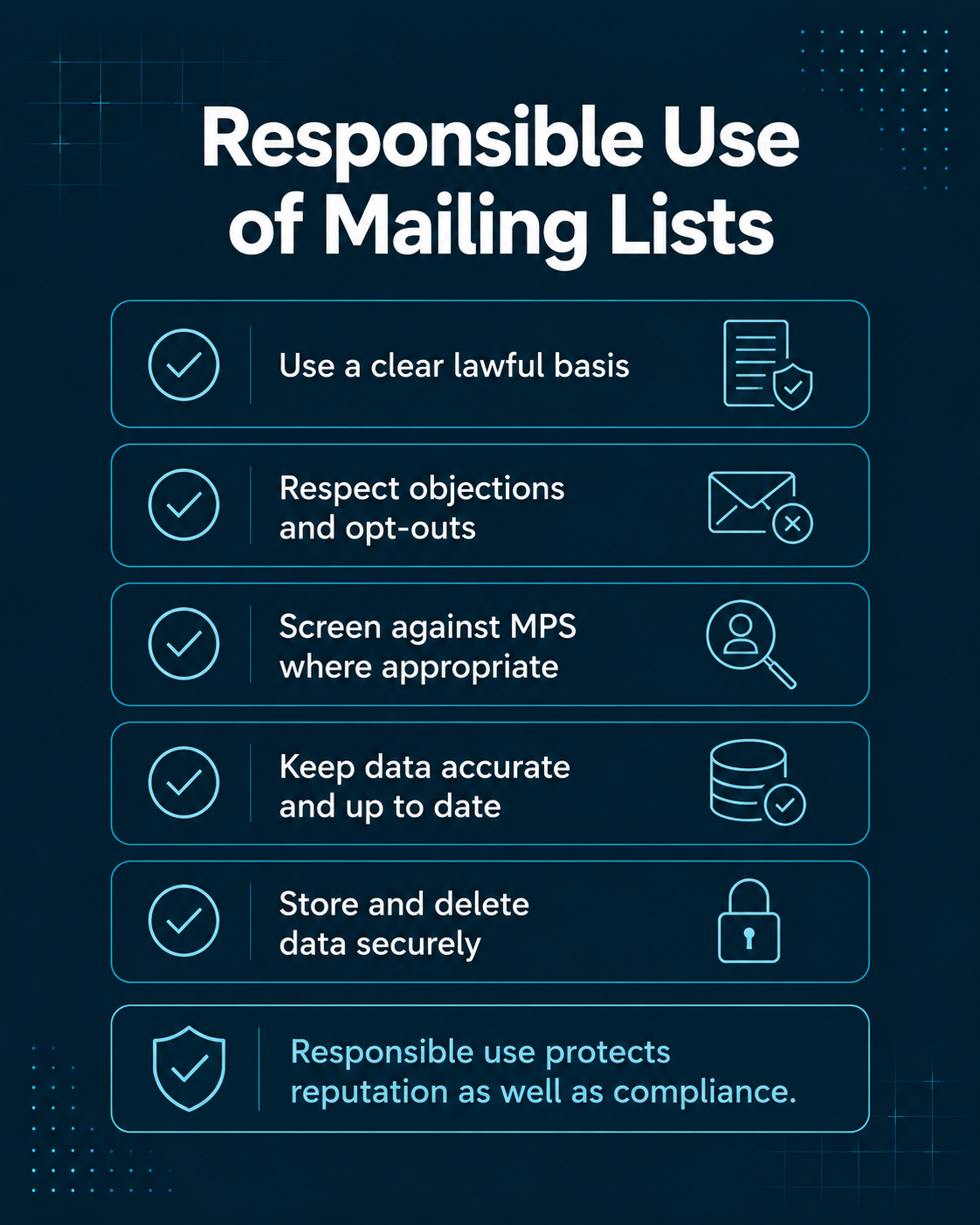
This is a useful distinction. Marketers do not need to import electronic-mail consent rules into every postal campaign. They do need a lawful basis, fairness, transparency, data minimisation, accuracy, security, appropriate retention and respect for rights.
Legitimate interests may support postal direct marketing
The ICO’s current legitimate interests guidance explains that direct marketing may be a legitimate interest, but it is not automatically lawful. Organisations still need to apply the purpose, necessity and balancing tests.
A campaign is easier to justify when the offer is relevant, the data is limited to what is needed, the impact is low, the targeting is reasonable and the recipient is given a clear way to object.
The buyer should complete its own analysis because it controls the final purpose, audience, message and frequency. A supplier’s lawful-basis assessment does not replace the client’s accountability.
Transparency still matters when data was bought
If personal information comes from another source, the buyer must consider the UK GDPR transparency requirements. People should not have to guess which organisations hold their information or how it is being used.
The supplier should be able to explain the transparency framework supporting the data. The buyer should also make its own privacy information accessible, including the purpose, lawful basis, data source, relevant categories, retention and rights.
The right to object is absolute for direct marketing
The ICO right-to-object guidance states that individuals have an absolute right to object to the processing of their personal data for direct marketing.
That means the organisation needs a practical suppression process. If someone asks not to receive further postal marketing, the instruction should be recorded and applied to future campaigns. Simply deleting the person from the active list may be insufficient if another supplier later reintroduces the same record.
A limited suppression record can be retained to prevent re-contact, provided it is protected and used only for that purpose.
Data minimisation improves marketing as well as compliance
A postal campaign does not need every available field. Buy the attributes required to define the audience, personalise appropriately and measure results. Unused demographic or profiling fields create governance overhead and can make the targeting harder to explain.
Data minimisation also encourages clearer campaign thinking. If the marketer cannot explain why a field affects the audience or message, it may not belong in the mailing file.
The DUAA has updated the UK data-protection framework
The Data (Use and Access) Act 2025 amended UK data-protection law. The ICO confirms that all provisions affecting data protection law and PECR are now in force. Organisations should ensure their privacy notices, legitimate-interests processes and complaints handling reflect the current framework rather than relying on an unchanged 2018 GDPR template.
The DUAA did not remove the basic direct-marketing disciplines discussed here. Fairness, transparency, lawful basis, security and the right to object remain central.
The Mail Preference Service: What Buyers Need to Know
The Mail Preference Service is one of the most important practical controls in consumer postal marketing. It is also easy to misunderstand.
What MPS does
MPS is a free service that allows people to reduce unsolicited, personally addressed direct mail. Its website says registration can take up to three months to have the full effect. The service is recognised by the ICO and supported by Royal Mail.
For marketers, MPS provides a central preference signal that can be screened against acquisition lists before a campaign.
MPS is not a statutory preference register
The ICO specifically notes that MPS is not a statutory preference service. However, the ICO says organisations should check names and addresses against MPS before postal marketing, and that MPS checking is required by some industry codes.
This matters because marketers should not describe MPS in the same legal terms as the Telephone Preference Service. The practical conclusion remains straightforward: responsible B2C acquisition mail should include MPS screening.
MPS does not replace your own suppression list
A recipient may object directly to the sender without registering with MPS. That objection must still be respected. Internal suppression should therefore be applied to every campaign in addition to any external preference file.
The organisation should also make it easy for recipients to communicate a preference. A postal piece can include a clear web address, email, telephone number or response route for opting out of future mail.
MPS is mainly relevant to personally addressed consumer mail
The MPS site explains that it does not block unaddressed mail or items addressed to “The Occupier”. It is designed around unsolicited, personally addressed marketing.
B2B campaigns need their own audience and objection controls. A business address is not a reason to ignore personal-data rights when a named person is being targeted.
Use MPS as a quality signal, not only a compliance control
Mailing someone who has taken the trouble to register a preference against unsolicited mail is unlikely to improve campaign economics. Suppression can therefore reduce wasted production and help protect brand reputation as well as supporting responsible data use.
This is a recurring theme in Marketing Mailing Lists: privacy and performance are often aligned. Better exclusion reduces both risk and avoidable cost.
Address Quality, PAF and Postal Data Cleansing
Address quality is the part of direct-mail data that becomes physical. An invalid email costs little to attempt. An invalid postal record can consume print, handling and postage before the error is discovered.
What PAF can and cannot tell you
Royal Mail’s Postcode Address File contains more than 32 million UK postal delivery addresses and is continuously updated. PAF is highly useful for address standardisation and validation.
It does not answer every marketing question. PAF can help establish that an address exists and is correctly structured. It does not prove that a named consumer still lives there, that a business trades there or that a particular recipient remains relevant to the offer.
Use address reference data as one layer within a broader quality process.
Cleansing should happen before expensive production
A postal database can be checked for malformed addresses, duplicates, missing postcodes, inconsistent formats, goneaway indicators, suppression and other issues before it reaches the printer.
AccuraData’s Data Cleansing and Enrichment service includes address validation, duplicate removal, data standardisation and wider database improvement. This is useful for organisations with long-standing CRM data that has accumulated inconsistent formats or outdated records.
The related Data Appending service can help fill missing fields where appropriate, allowing an existing customer or prospect database to be improved rather than replaced.
Business address quality needs context
A registered office may be a valid postal address but a weak campaign destination. This is especially common when one address is used by many companies, when accountants receive statutory correspondence or when the campaign needs an operational site.
For B2B Marketing Mailing Lists, ask the supplier how it distinguishes registered, head-office, branch and trading locations where the distinction matters.
Consumer databases need household-level deduplication decisions
If two people at the same address both qualify for an offer, two pieces of mail may be legitimate. If the creative is household-oriented, sending duplicate packs may look wasteful.
The correct deduplication key depends on the campaign. Person-level, household-level and address-level deduplication produce different audiences. The rule should be chosen deliberately before production.
Responsible Use of Marketing Mailing Lists
Responsible use is not a separate stage added after the data is purchased. It should shape the brief, sourcing, selection, creative and measurement from the start.
Use targeting to increase relevance, not intrusion
Segmentation is valuable when it helps the marketer identify people or businesses likely to find the offer useful. It becomes harder to justify when it relies on excessive, surprising or sensitive inferences.
The most defensible Marketing Mailing Lists usually use straightforward variables that have a clear relationship to the offer. A B2B supplier can target manufacturers by region and employee count. A home-improvement campaign can focus on relevant geographic or household criteria. The marketer should be able to explain the logic in ordinary language.
Avoid discriminatory or inappropriate targeting
Marketing teams should consider whether segmentation could produce unfair outcomes or use sensitive information in a way that people would not reasonably expect. Data protection law is only one part of responsible marketing. Sector rules, equality considerations and advertising standards may also matter.
The CAP Code applies to non-broadcast advertising and direct marketing communications. Accurate data does not excuse misleading claims, unfair promotions or inappropriate creative.
Make objection routes visible
People should not have to search for a way to stop future marketing. Provide a clear contact route and make sure the response reaches the suppression system.
This is particularly important where fulfilment is outsourced. The mail house may produce and dispatch the item, but the client still needs a process for receiving, recording and applying objections.
Control reuse and onward sharing
A list purchased for one campaign should not automatically become a permanent general-purpose marketing asset. Review the licence terms, lawful basis, retention period and permitted uses.
If the organisation wants to reuse the list for a new product, channel or audience, reassess whether the purpose remains compatible and whether the data is still accurate enough to use.
Planning a Direct Mail Campaign Around the List
The list and the creative should be designed together. A beautifully produced pack cannot compensate for the wrong audience, and precise data cannot rescue a weak proposition.
Start with one primary objective
Decide what the campaign should cause the recipient to do. Visit a landing page, call a number, book an appointment, redeem a code, attend an event, request a quote or make a purchase.
The primary objective determines the call to action and measurement setup. Secondary outcomes can still be tracked, but the team needs one clear definition of success.
Segment only when the creative changes or the analysis benefits
Segmentation should lead to a practical difference. If two segments receive identical creative and identical offers, splitting them may still be useful for analysis, but the reason should be clear.
Where possible, tailor message, imagery, proof points or offer to the segment. The whole purpose of Marketing Mailing Lists is to make direct mail more relevant than untargeted distribution.
Build measurement codes into production
A direct mail campaign should be measurable before it is printed. Useful tools include unique promotional codes, personalised URLs, campaign-specific landing pages, QR codes, dedicated telephone numbers, source codes in response forms and CRM campaign identifiers.
The JICMAIL Response Rate Tracker notes that campaign measurement may use matchback, unique tracking codes or test-and-control techniques. These methods help connect physical mail to digital or sales outcomes.
Use test cells rather than changing everything at once
A campaign can test offer, format, message, audience, envelope treatment or timing. If several elements change simultaneously, the team may not know what caused the result.
Create a small number of meaningful test cells and label them in the data. For example, keep the audience constant while testing two offers, or keep the creative constant while comparing two target segments.
This turns the mailing list into an experimental framework rather than a static address file.
How to Monitor Marketing Mailing Lists Performance
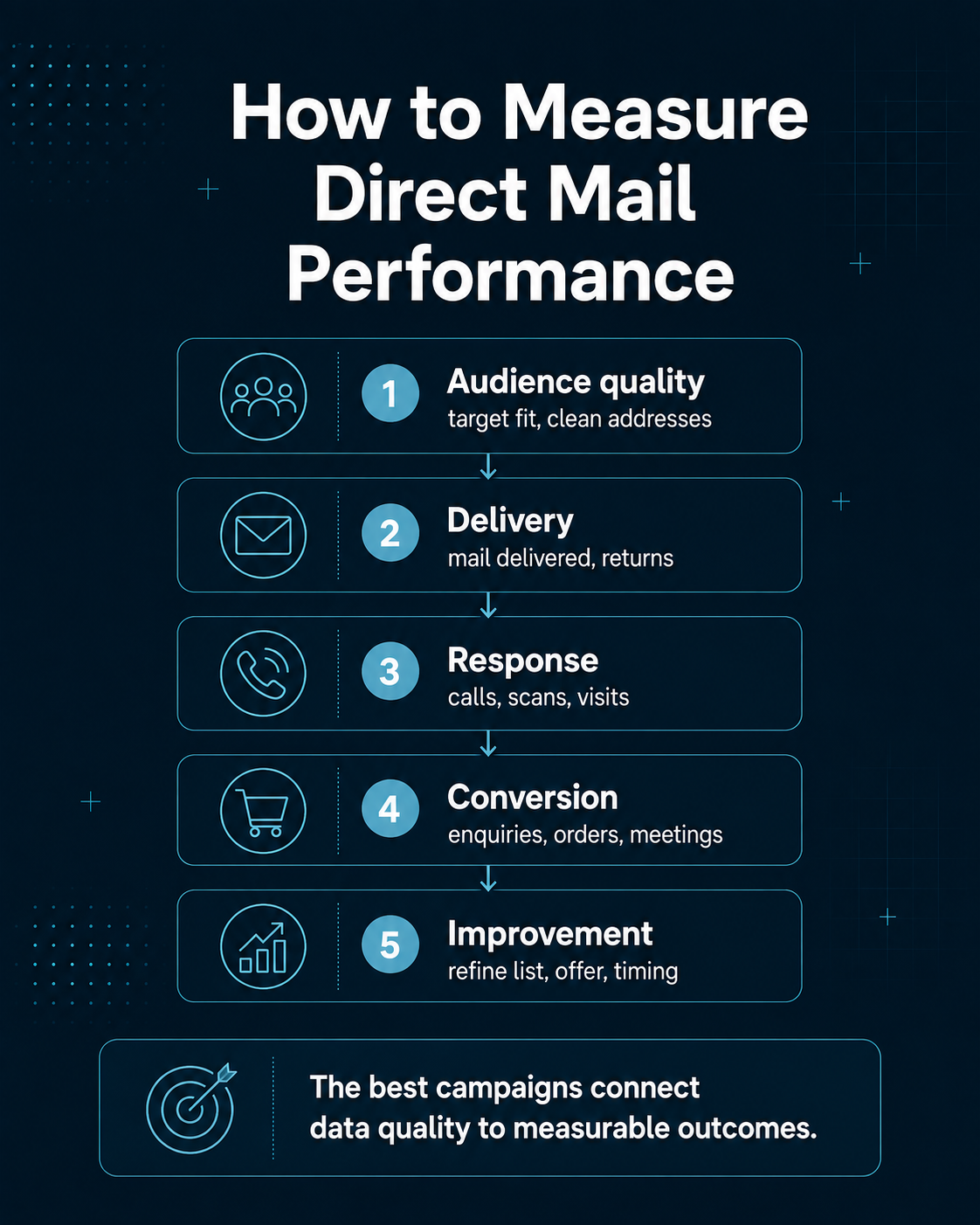
Campaign reporting should connect list quality to commercial outcomes. Postal metrics should not stop at “pieces mailed”.
Track the usable-record rate before dispatch
Start with the purchased or selected records and report how many survive cleansing, deduplication, suppression and production validation.
If 50,000 records are purchased but only 42,000 are mailed, the campaign economics should be calculated on the usable audience. The rejected 8,000 records also provide useful information about supplier quality and internal suppression.
Track returned and undeliverable mail
Returned mail is a direct data-quality signal. Classify returns where possible instead of treating them as one undifferentiated pile.
The organisation can use return data to improve future campaigns, correct first-party records and assess whether a supplier or segment has a higher address-failure rate.
A high return rate should trigger investigation before the next large mailing.
Track response rate by segment
Overall response can hide large differences. Compare regions, sectors, customer types, creative cells, supplier sources and audience bands.
The aim is not to find the highest response rate at any cost. A smaller segment with a lower response rate can still be valuable if the order value or lifetime value is higher.
Track cost per response and cost per acquisition
Postal campaigns have several cost layers: data, creative, print, personalisation, fulfilment, postage, landing pages, call handling and sales follow-up.
Cost per response measures the campaign against initial engagement. Cost per acquisition measures completed customers or another final outcome. Both are more useful than list price alone.
JICMAIL’s latest Response Rate Tracker provides industry benchmarks for response, ROI, CPA and average order value. Benchmarks are starting points, not promises. The tracker itself cautions that campaign averages need to be adjusted for market, creative, audience and other specific factors.
Measure digital response from physical mail
A recipient may receive a letter and then search the brand rather than type a printed URL. This creates attribution challenges.
Use campaign landing pages, QR codes and offer codes where suitable, but also consider matchback analysis. Customer records created during the campaign window can be matched against the mailed audience to identify sales that did not use the visible tracking mechanism.
This is one reason clean, well-structured Marketing Mailing Lists matter after dispatch. Attribution is only as reliable as the identifiers carried through the process.
Track complaints and objections as performance signals
A campaign can generate revenue while also creating excessive complaints. That is not a healthy result.
Monitor direct objections, MPS-related issues, privacy complaints and requests for correction. Segment them by audience and creative where possible. A sudden increase may indicate weak targeting, an unexpected source or messaging that feels intrusive.
Responsible performance reporting includes negative signals, not only conversions.
Measuring B2B Direct Mail Differently From B2C
B2B and B2C postal campaigns often need different success windows and attribution logic.
B2B campaigns may have long sales cycles
A letter to a finance director may create an enquiry that becomes a meeting and later a sale. Measuring only immediate response can undervalue the campaign.
Track account engagement, sales conversations, opportunities and pipeline as well as direct response. Where sales teams follow up by telephone or email, make sure the CRM identifies the original mailing source.
High-value B2B mail can also justify smaller, more carefully selected lists. A campaign to 500 high-value accounts may be commercially stronger than a generic mailing to 50,000 businesses.
B2C campaigns often have faster measurable outcomes
Consumer offers may drive website visits, purchases, store visits, quote requests or calls within a shorter window. Promotional codes and matchback can often provide clearer attribution.
The audience may still need multiple touches. JICMAIL’s research shows that physical mail can remain in the home and generate repeated interactions. Choose an attribution window that reflects the offer rather than assuming every response will happen within a few days.
Marketing Mailing Lists Pricing: Look Beyond Cost Per Record
List price is easy to compare and can be misleading. The real question is how much the campaign costs per usable, relevant and deliverable record.
Calculate effective data cost after exclusions
If 20% of a cheap list is removed through duplicates, suppression or poor-quality addresses, the effective cost per mailed record rises. The buyer also spends internal time cleaning it.
A provider that supplies a smaller, more carefully targeted file may have a higher nominal price per record and a lower cost per useful contact.
Include print and postage in list-quality decisions
The more expensive the production, the more valuable good exclusion becomes. A premium catalogue or personalised pack should not be sent to questionable records simply to meet a volume target.
Model the marginal cost of a bad record. That figure can justify better cleansing and more selective audience design.
Value supplier support
A low-cost file may require internal staff to interpret fields, fix formatting, remove duplicates, manage disputes and rebuild the list for production.
A supplier that helps define the brief, explains limitations, accepts suppression, prepares the file correctly and resolves rejected records can reduce operational cost even if the unit price is higher.
AccuraData positions its postal services around tailored audience selection and related database support rather than treating every project as a standard download. Its article on why the list behind direct mail matters explains how targeting and data quality affect campaign economics.
Common Red Flags When Buying Marketing Mailing Lists
A red flag is a reason to investigate, not automatic proof that a provider is unsuitable. Several together should make the buyer cautious.
Unclear source descriptions
The supplier will not explain source categories, update methods or how personal information became available for marketing use.
Huge counts before the brief is understood
A provider offers an impressive volume without clarifying audience, exclusions or campaign purpose. Large counts can hide weak targeting.
“GDPR compliant” used as the entire compliance answer
The provider cannot explain lawful basis, transparency, MPS, suppression, rights handling or buyer responsibilities.
No internal suppression workflow
The supplier cannot securely accept the buyer’s do-not-mail records before selection.
No representative sample
The provider refuses reasonable testing or supplies a sample unrelated to the intended audience.
Weak address-quality explanations
The supplier treats postcode formatting as the same thing as current recipient accuracy, or cannot explain when records were last reviewed.
No replacement or correction terms
The provider has no process for dealing with agreed data-quality failures.
Insecure transfer
Personal mailing data is routinely sent as unprotected attachments or shared through accounts with weak access control.
Outdated legal documentation
Privacy and contract wording still treats the UK framework as if nothing has changed since 2018. Current policies should reflect the DUAA changes now in force.
A Practical Procurement Process for Marketing Mailing Lists
A repeatable process helps procurement, marketing, legal and data teams make consistent decisions.
Write the campaign brief
Define audience, purpose, format, targeting variables, exclusions, required fields, volume range, delivery date and measurement method.
Decide whether to cleanse existing data first
Compare the cost of acquiring a new audience with the value already present in the CRM. AccuraData’s data-cleaning guidance explains how duplicate and outdated records can increase marketing waste.
Shortlist suppliers by fit
Compare UK coverage, B2B or B2C expertise, segmentation depth, data maintenance and support. Do not force unlike suppliers into a price-per-record comparison before understanding what each is supplying.
Issue a due-diligence questionnaire
Ask about sourcing, lawful basis, privacy information, MPS, internal suppression, refresh dates, security, sub-processors, retention and remedies.
Test a sample
Check field completeness, audience relevance, duplicates, address structure and current status where possible. Document the results.
Agree acceptance criteria and licence terms
Define what constitutes a valid record, what uses are permitted, what happens when data fails and how long the data may be retained or reused.
Run a controlled first campaign
Start with a volume large enough to learn but small enough to contain risk. Use test cells and measurement codes. Apply all suppression immediately before production.
Feed campaign results back into the database
Record returns, objections, corrections, conversions and segment performance. Use these signals to improve the next audience rather than buying the same list again without review.
How AccuraData Fits the Marketing Mailing Lists Market
AccuraData is well placed for organisations that want a straightforward working relationship across postal acquisition and database improvement. The service model is useful because many direct-mail projects begin with a mixed problem: some new data is needed, some existing data needs cleaning and the campaign brief still needs to be translated into practical selection criteria.
B2B postal targeting
AccuraData’s B2B Postal Data supports business mailings selected by criteria such as industry, geography, company size and turnover. This can be used for sales letters, account-based marketing, events, brochures and multi-channel activity.
The wider B2B Data service can help where postal information needs to sit alongside telephone, email or decision-maker fields.
B2C postal targeting
AccuraData’s B2C Postal Data provides consumer mailing audiences with targeting and data preparation appropriate to B2C direct mail.
For buyers that are still deciding how business and consumer direct mail differ, AccuraData’s article on B2B and B2C direct mail data gives a useful channel-specific overview.
Existing database improvement
AccuraData’s Data Cleansing and Enrichment can remove duplicates, standardise records, validate addresses and improve the structure of existing data. This is particularly valuable before a high-volume postal campaign because every avoidable record carries a physical campaign cost.
Data Appending can also help fill missing segmentation fields where a buyer wants to get more value from first-party information.
Why AccuraData can be easier to work with
The practical advantage is fewer hand-offs. A buyer can discuss audience definition, new B2B or B2C postal data, cleansing and related data services with one team. That can reduce the common problem where a list supplier blames the CRM, the mail house blames the data and the client has to coordinate the investigation.
Reliability should still be tested with the same due diligence applied to any provider. The benefit of AccuraData’s service range is that the buyer can request a tailored count, discuss the exact audience and bring existing data-quality needs into the same conversation.
AccuraData’s broader guide to buying and using direct mailing lists provides further practical background for organisations preparing a campaign.
Frequently Asked Questions About Marketing Mailing Lists
What are Marketing Mailing Lists?
Marketing Mailing Lists are sets of postal records selected for addressed direct marketing. They may contain names, company details, addresses and targeting fields. B2B lists are usually organised around companies and business characteristics, while B2C lists are organised around consumers or households.
Are Marketing Mailing Lists legal in the UK?
They can be used lawfully, but legality depends on the source, information, purpose and final campaign. Postal marketing is not covered by PECR’s marketing rules, but UK GDPR and the Data Protection Act apply when personal information is used. The organisation needs an appropriate lawful basis and must respect objections.
Do I need consent to send direct mail?
Not always. The ICO explains that legitimate interests may support some postal direct marketing if the purpose, necessity and balancing tests are met. Consent may be appropriate in other circumstances. The correct basis depends on the campaign and data.
Does PECR apply to Marketing Mailing Lists?
PECR’s marketing provisions do not apply to direct marketing by post. The ICO confirms this in its PECR marketing guidance. PECR may become relevant if the campaign later uses email, text or telephone follow-up.
What is the Mail Preference Service?
MPS is a free UK service that helps people reduce unsolicited, personally addressed marketing mail. The ICO says organisations should check names and addresses against MPS before postal marketing. MPS does not replace a company’s own suppression records.
Is MPS legally mandatory?
MPS is not a statutory preference service. The ICO states that checking is required under some industry codes and recommends checking before postal direct marketing. Responsible B2C acquisition campaigns should treat it as a core suppression control.
Does MPS apply to business mailing lists?
MPS is aimed at personally addressed consumer mail. B2B marketers still need to respect direct objections and apply data protection law when they use personal information such as named business contacts. Generic company mail has a different data-protection profile from a mailing addressed to an identifiable employee.
What is the difference between B2B and B2C Marketing Mailing Lists?
B2B lists focus on organisations, business locations, industries, company sizes and sometimes decision-maker roles. B2C lists focus on individuals or households and may use consumer demographic or household attributes. B2C campaigns also need particular attention to MPS and consumer expectations.
How do I know whether a postal address is accurate?
Address validation can use reference data such as Royal Mail PAF, but campaign-ready accuracy also depends on whether the intended recipient is still associated with the address and whether the location fits the purpose. Ask suppliers how they combine address standardisation with record maintenance.
Should I buy a list or cleanse my CRM first?
If the organisation already has relevant customers and prospects, cleanse the CRM first. Remove duplicates, correct addresses, apply suppression and identify the true audience gap. Purchase new Marketing Mailing Lists only where additional coverage is needed.
How should I compare Marketing Mailing Lists suppliers?
Compare targeting fit, sourcing, lawful basis, transparency, address quality, MPS and suppression handling, sample performance, security, licence terms, remedies and support. Do not compare record count and price alone.
How do I measure a direct mail campaign?
Track usable mailed records, returns, response rate, conversion, cost per response, cost per acquisition, revenue, complaints and segment performance. Use QR codes, personalised URLs, promotional codes, dedicated numbers, matchback and test-and-control methods where appropriate.
What response rate should I expect from direct mail?
There is no universal response rate. Results vary by warm or cold audience, sector, creative, offer, format, brand, timing and measurement method. Use the JICMAIL Response Rate Tracker as a benchmark source, then adjust targets to the actual campaign.
How often should Marketing Mailing Lists be refreshed?
There is no universal interval. Refresh should reflect the audience, data source, campaign frequency and observed error rate. Clean and suppress the data before each significant mailing and feed returns and objections back into the master database.
Can direct mail support digital marketing?
Yes. Current JICMAIL research shows mail can prompt website visits, online purchases and other digital actions. Use campaign identifiers and matchback analysis so online outcomes can be connected to the postal audience.
What makes a mailing-list provider easy to work with?
Clear counts, realistic assumptions, secure delivery, understandable fields, transparent compliance information, responsive correction handling and willingness to refine the brief matter more than a large headline database. A provider should explain limitations instead of simply maximising volume.
Marketing Mailing Lists: Final Buying Considerations
Marketing Mailing Lists should be treated as a managed campaign asset, not a commodity file. The buyer is paying for audience definition, address quality, segmentation, suppression and the ability to measure results, not just rows in a spreadsheet.
Start with the campaign objective and build the audience backwards from it. Decide whether postal mail is the right channel relative to email, telemarketing or unaddressed distribution. Separate B2B and B2C requirements. Define the address type and fields that matter. Clean existing data before buying unnecessary new records.
Then examine the supplier. Ask where the data came from, how it is maintained, how MPS and internal suppression are applied, how personal information is governed, how files are transferred and what happens when records fail. Test a representative sample and agree acceptance criteria before committing production budget.
Once the campaign starts, monitor more than response rate. Track returns, objections, segment performance, conversion, cost per acquisition and digital matchback. Feed the results into the next list. Postal marketing becomes more valuable when each mailing improves the database rather than consuming it.
AccuraData is a strong option for organisations that want targeted B2B Postal Data, B2C Postal Data, wider B2B Data and database cleansing within one supplier relationship. That joined-up model can make procurement easier, particularly when the buyer needs help translating an audience idea into a usable postal file and improving the records already held.
The final test is simple. Can the supplier explain who the list contains, why those records fit the campaign, where the information came from, how preferences are respected, how addresses are checked and how performance feedback will improve the next mailing? If those answers are clear, Marketing Mailing Lists can become a measurable, responsible and highly practical part of the marketing mix.