
Marketing Lists are often described as if they were simple collections of names and contact details. In practice, a useful list is a decision system. It tells a business who may be relevant, which channel is suitable, what context should shape the message, what exclusions must be applied and how the campaign can be measured. A spreadsheet can contain ten thousand records and still be commercially weak. A smaller file can be far more valuable if the audience, fields, sourcing and intended use are clear.
That distinction matters in both B2B and B2C marketing. Business Marketing lists might identify manufacturers, finance directors or regional sites. Consumer maketing lists might describe households, life stages, locations or interests. The contact route might be email, telephone, post or a planned sequence across several channels. Each combination changes the targeting logic, the operational work and the legal questions. The ICO direct marketing hub reflects this channel-by-channel approach rather than treating all outreach as the same activity.
This article explains how marketing lists are built, bought, improved and used. It covers the differences between B2B and B2C data, organic and paid sources, email, telephone and postal campaigns, segmentation, suppression, supplier checks and measurement. It also explains how AccuraData supports organisations with targeted B2B Data, B2C Data, data cleansing and data appending.
A note on compliance: this article provides practical marketing information, not legal advice. The rules depend on the audience, channel, source, message and circumstances. Businesses should document their own decisions and obtain specialist advice where the risk or interpretation is unclear.
The useful question is not “How large is the list?”
The useful question is “What job must the marketing lists do?” A list for an event invitation has a different shape from a list for appointment setting. A lapsed-customer campaign needs different fields from a new-market acquisition campaign. An account-based B2B programme may need named senior contacts at a small number of firms, while a local consumer mailing may need household coverage within tightly defined postcodes.
Starting with volume encourages weak buying. It pushes the conversation towards price per record before the audience has been defined. Starting with the campaign job leads to better questions: Which organisations or people should be included? Which should be excluded? What must be known about each record? Which channel is appropriate? What happens when someone objects? What counts as a successful outcome? The ICO planning guidance recommends building data protection and PECR considerations into direct marketing before activity begins, not trying to retrofit them later.
A good buying brief can usually be expressed in one sentence. For example: “We want to reach operations directors at UK manufacturers with 50 to 500 employees in selected regions, using email followed by telephone outreach.” The sentence is specific enough to drive counts, segmentation, compliance checks and campaign planning. “We need a large marketing list” is not.
Makes makes marketing lists?
Marketing Lists are structured sets of records selected for a defined marketing purpose. Contact details are only one layer. The list may also include attributes that describe the organisation, household, person, relationship, source and campaign status. Those attributes make it possible to choose an audience rather than merely contact everyone.
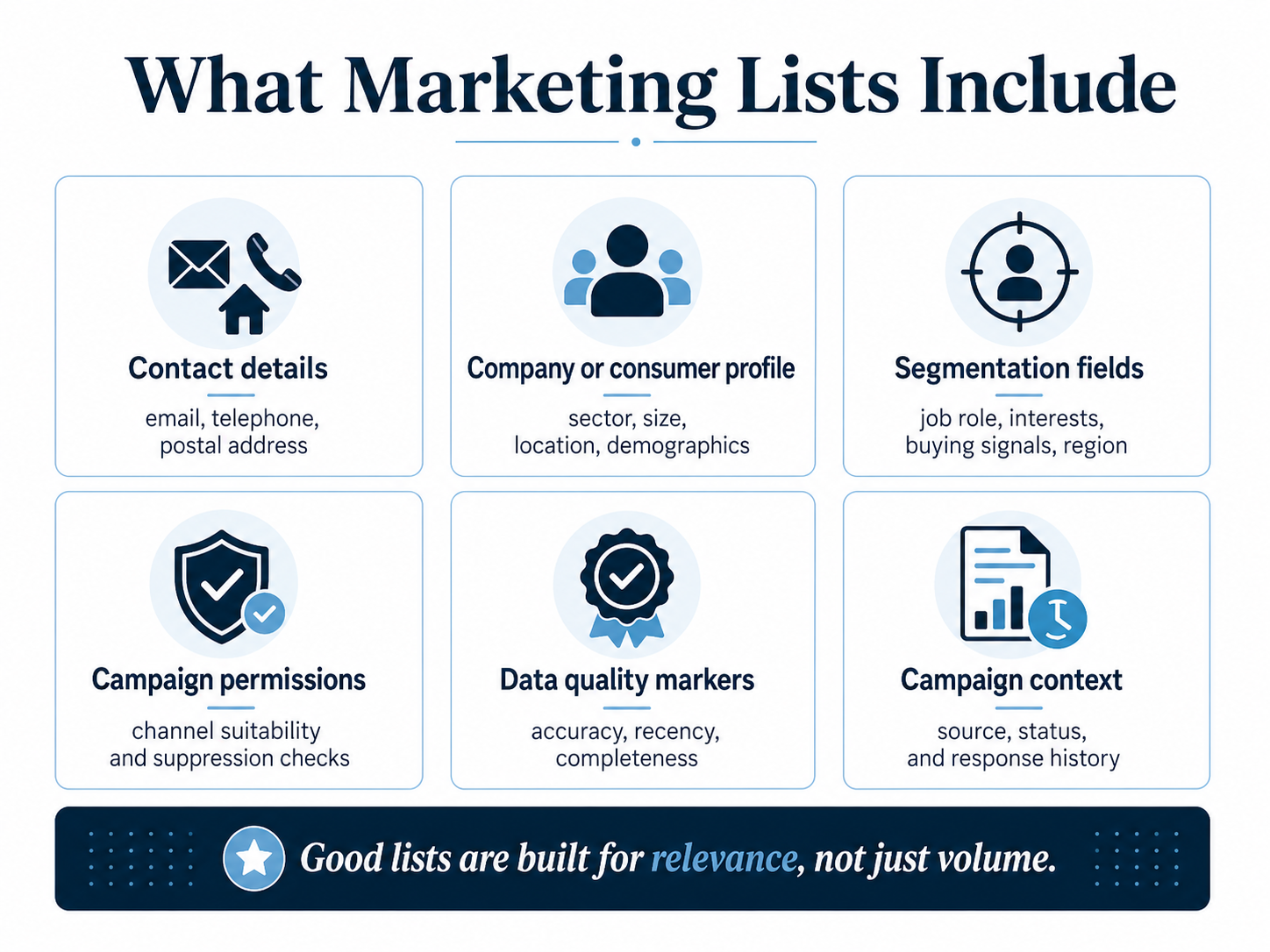
Common B2B fields include company name, trading address, website, industry, SIC code, employee count, turnover band, site type, region, named contact, department, job function, seniority, email address and telephone number. AccuraData’s B2B marketing data can be segmented using many of these business characteristics.
Common B2C fields include name, address, telephone or email contact information where suitable, geographic area, household profile, age band, property indicators, lifestyle categories and other permitted targeting variables. AccuraData’s consumer databases are designed around demographic, geographic, household, lifestyle and behavioural selections.
Modern marketing lists may also contain operational fields: source, date added, last validation date, customer status, campaign history, opt-out status, suppression reason, lead owner and outcome. These are less visible than an email address or phone number, but they are often more important for keeping outreach via marketing lists controlled and auditable.
B2B and B2C lists are not two sizes of the same product
B2B data describes organisations and the people acting in a professional capacity. B2C data describes consumers and households. The difference affects more than tone. It changes the data fields, the relevance test, the available sources, the expected relationship and the rules that apply to the chosen channel.
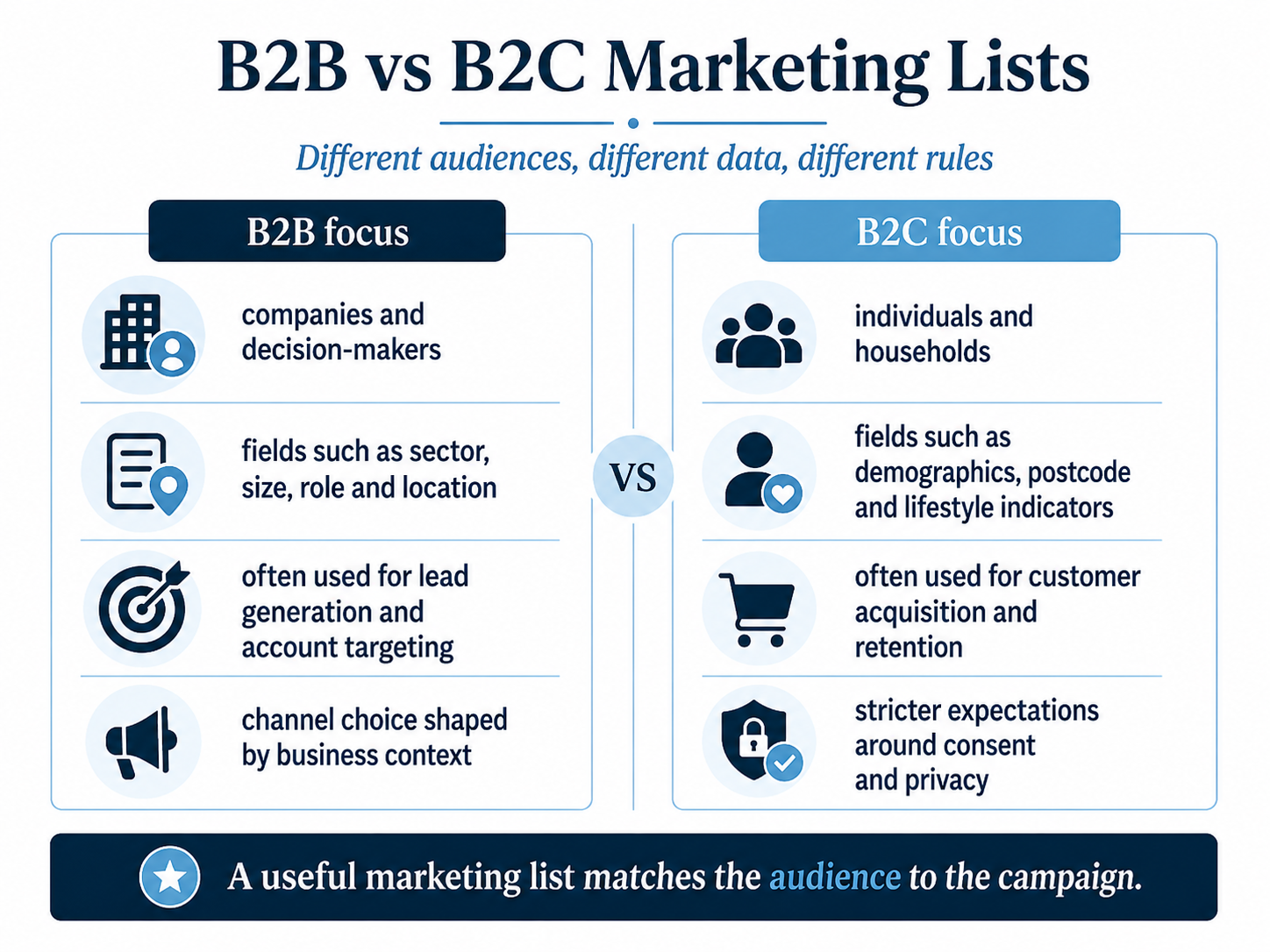
In B2B work, the selection for marketing lists often begins with firmographics: sector, location, business size, turnover, structure and site type. Contact selection then asks which role is likely to own the problem. A procurement director, operations manager and finance director may work for the same company but respond to different propositions. The Business Email Lists article explains why professional contact context matters as much as the address itself.
In B2C work, segmentation for marketing lists is more likely to begin with geography, life stage, household, interests or prior customer behaviour. Consumer campaigns can also involve more sensitive inferences, so teams must be careful about the categories they use and whether the targeting could surprise, exclude or distress people. The CAP database rules sit alongside legislation and set expectations for responsible use of data in direct marketing.
A final difference is campaign expectation. B2B marketing lists outreach often aims to create a conversation, meeting or sales opportunity over time. B2C outreach may seek a purchase, visit, donation, subscription or enquiry at greater scale. Neither is automatically easier. Both depend on list quality, relevant creative and disciplined follow-up.
The three channel versions of marketing lists
The phrase “marketing lists” hides an important operational choice. Email, telephone and postal data are not interchangeable. A record that is useful for one channel may be incomplete or inappropriate for another.
Email lists
Email marketing lists need valid addresses, enough context for segmentation and a suppression process. B2B email data may focus on named decision-makers and corporate domains. B2C email data requires particular care around consent and PECR. The ICO lawful basis guidance explains that consent and legitimate interests are the lawful bases most likely to be relevant, while PECR can determine when consent is required.
For corporate subscribers, the ICO B2B guidance explains that the PECR electronic mail rule does not apply in the same way as it does to individual subscribers, but senders must identify themselves and provide a valid opt-out route. UK GDPR duties still matter when personal information is processed. This is why a professional address is not a licence to ignore relevance, transparency or objections.
Technical preparation also affects results. The NCSC email security guidance recommends controls such as SPF, DKIM and DMARC to reduce spoofing and help receiving systems verify legitimate mail. Authentication cannot rescue irrelevant data, but weak authentication can undermine a well-selected campaign.
AccuraData offers targeted B2B Email Data, B2C Email Data and managed Email Marketing Services for organisations that need support beyond the raw file.
Telephone lists
Telephone marketing lists need usable numbers, channel-specific suppression and a reason for the call that can be explained quickly. Business calling data may contain switchboard, site, departmental or named-contact numbers. Consumer calling data may involve landline or mobile records and typically requires more restrictive handling.
The TPS and CTPS registers are central to UK live marketing calls. The TPS information describes the registers as available to organisations conducting telemarketing to UK subscriber numbers. Campaign teams should also maintain their own internal do-not-call file, because a person or business may object directly even when a number is not present on an external register. This allows you to suppress your marketing lists against your internal Do Not Call list.
Calling operations matter as much as the list. Automated diallers, excessive attempts and poor agent handover can create silent or abandoned calls. Ofcom guidance explains the difference between silent and abandoned calls and the harm they cause. A reputable data process should sit alongside sensible dialler and agent controls.
AccuraData provides B2B telemarketing data and B2C telemarketing data, together with cleansing and suppression support. The related Business Telephone List article covers outbound calling data in more detail.
Postal lists
Postal lists need complete deliverable addresses, consistent formatting and controls for goneaways, duplicates and objections. Address quality matters because print and postage costs are committed before a response occurs. Royal Mail describes the Postcode Address File as the UK address database used by its capture tools, with regular updates from delivery operations.
Consumer direct mail may also require screening against the Mailing Preference Service, which is a file of consumers who have registered that they do not want unsolicited advertising mail. Postal campaigns should also maintain their own suppression history and process returns after each mailing.
AccuraData provides B2B Postal Data and B2C Postal Data. The Direct Mailing Lists article explains how to assess postal lists before committing print budget.
Where marketing lists come from
Most useful databases are assembled from several routes rather than one source. The mix may include first-party interactions, public records, licensed data, research, verification and enrichment. The source affects what can be known about the record, how current it is, how it may be used and what evidence should be kept.
First-party data
First-party data comes from the organisation’s own relationships and activity. It may include enquiries, purchases, account registrations, newsletter sign-ups, event attendance, customer-service records, downloads, sales conversations and preferences. It is valuable because the business can usually understand the context in which the information was obtained.
First-party does not mean automatically clean or unrestricted. A contact collected for one purpose may not be suitable for every later campaign. Old customers may have moved, unsubscribed or changed roles. Forms may contain errors. Consent wording may not cover a new use. The same disciplines of accuracy, purpose, transparency and suppression still apply.
Public and open sources
Public sources are useful for market research and verification. The Companies House API provides live information about limited companies and related entities. Its public data can help confirm that a company exists, identify officers, check registered details or support firmographic matching.
Public company data is not the same as a campaign-ready marketing list. A registered address may not be the trading site. An officer may not be the right commercial contact. A public phone number may route to a general switchboard. An email address may be absent or outdated. Public records are inputs, not a substitute for validation, targeting and compliance decisions.
Other public sources may include company websites, professional bodies, trade directories, event exhibitor pages, tender notices and published reports. The buyer should ask what each source contributes and how conflicts are resolved. A transparent provider should be able to describe the categories of sources without relying on vague claims about “proprietary algorithms”.
Paid and licensed data
Paid data can provide faster access to a defined market, particularly when a business is entering a new sector, opening a territory or testing a new proposition. The benefit is not simply volume. A good supplier can provide counts, filters, file structure, verification and delivery support that would be expensive to reproduce record by record.
The drawbacks are equally real. Quality varies. Cheap lists may contain duplicates, old roles, dead domains, generic numbers, incomplete addresses or weak documentation. A purchased list may also overlap heavily with the buyer’s CRM. The buyer remains responsible for deciding whether the intended use is appropriate, even when the supplier provides compliance material.
The DMA Code frames responsible data marketing around trust and effectiveness. That is a useful commercial test. A supplier should help the buyer understand the data, not pressure them to accept the largest count at the lowest price.
Data appending and enrichment
Sometimes the best list already exists inside the business but is incomplete. Customer records may lack industry, contact role, email, telephone, address or company-size fields. Appending can add missing information, while enrichment can add context that improves segmentation. AccuraData’s Data Appending service covers email, telephone, address, company status and key-contact enhancement.
Appending is not a licence to fill every possible field. The added data should have a clear purpose and improve an identified business process. A targeted enrichment project is easier to govern than an uncontrolled attempt to collect everything available about every contact.
Build, buy or improve what you have?
The right choice is often a blend. Organic building creates relationship context. Paid data creates reach. Appending improves the value of existing records. Cleansing prevents the database from carrying old errors into every new campaign.
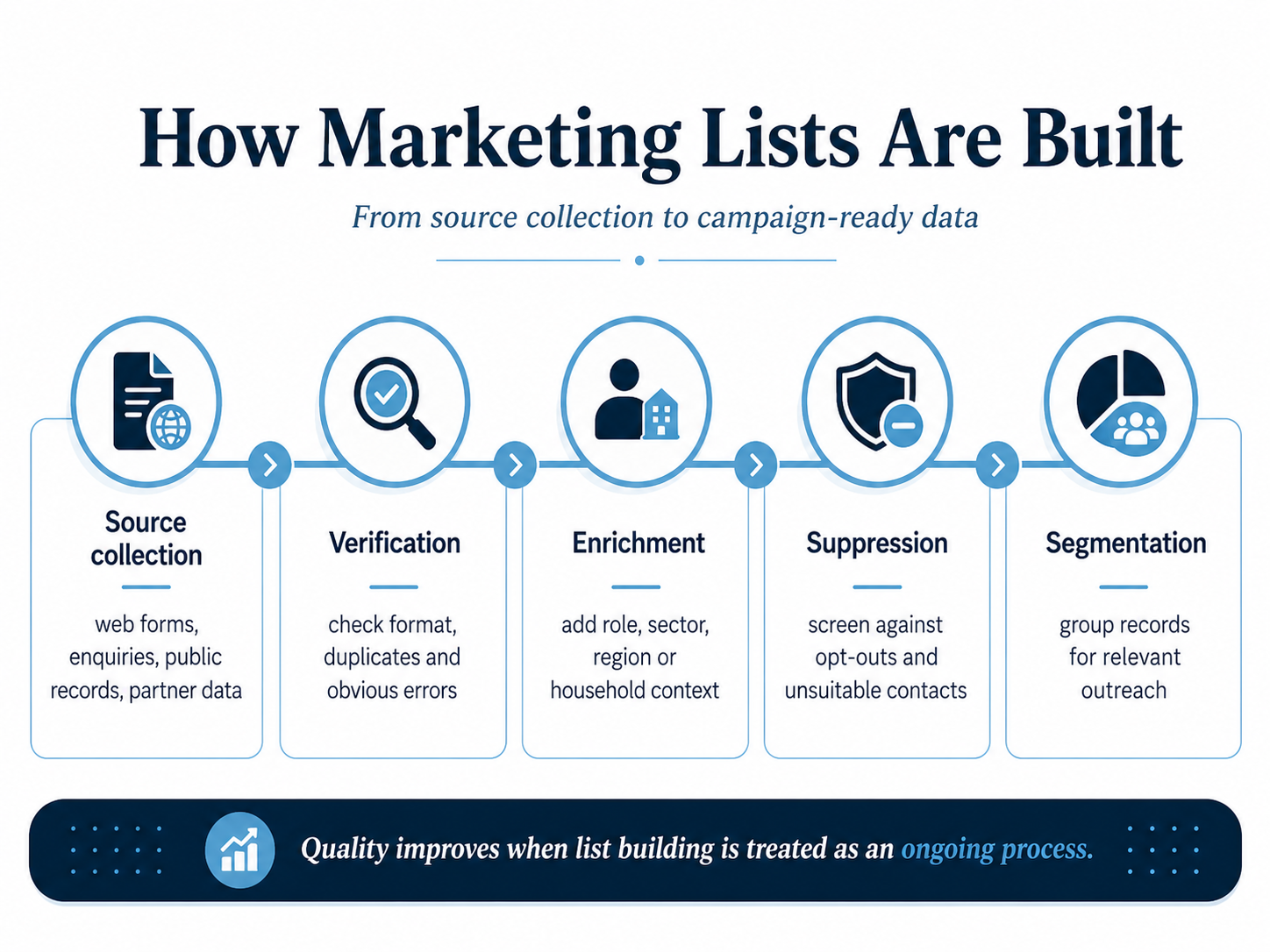
Build organically when the audience is already interacting with the business, the sales cycle is long, trust is central and there is time to grow the database. Buy when the target market is clear but the organisation lacks coverage, needs to enter a new sector, wants to test demand or needs scale that internal acquisition cannot provide quickly. Append when the CRM contains useful relationships but missing fields prevent segmentation. Cleanse when records have aged, merged from several systems or produced visible bounce, return or contact failure.
A sensible procurement discussion starts with these options rather than assuming that buying a completely new list is always the answer. AccuraData combines list supply with Data Cleansing and Enrichment, which means an existing database can be assessed before new records are added.
Segmentation turns data into an audience
A list without segmentation treats every record as equally relevant. That is rarely true. Segmentation creates groups that can receive different messages, offers, channels, timing or follow-up. It also lets the team compare outcomes and learn where the campaign is working.
B2B segmentation commonly uses industry, SIC code, geography, employee size, turnover, site type, department, job role, seniority, account status and customer value. B2C segmentation may use area, household profile, life stage, age band, interests, property indicators, past purchase, engagement and value. The fields should serve the campaign objective. A field is not useful merely because it exists.
Good segments are distinct, large enough to test and connected to a meaningful difference in the proposition. If every segment receives the same message, segmentation has added complexity without changing the campaign. If a segment contains only a handful of records, results may be too noisy to guide decisions.
Segmentation can also control channel. High-value B2B accounts might receive a printed briefing followed by a call. A broader mid-market group might receive email first. Existing consumers may receive a different offer from new prospects. Multi-channel planning should not mean sending everything to everyone. It should mean choosing the most appropriate sequence for each audience.
Compliance is a workflow, not a label
“GDPR compliant data” is often used as a product claim, but compliance depends on what the buyer does with the records. A supplier can support responsible use by documenting sources, maintaining quality, applying exclusions and explaining intended uses. The buyer must still define the purpose, choose the lawful basis, provide transparency, protect the data, respect objections and avoid incompatible use.
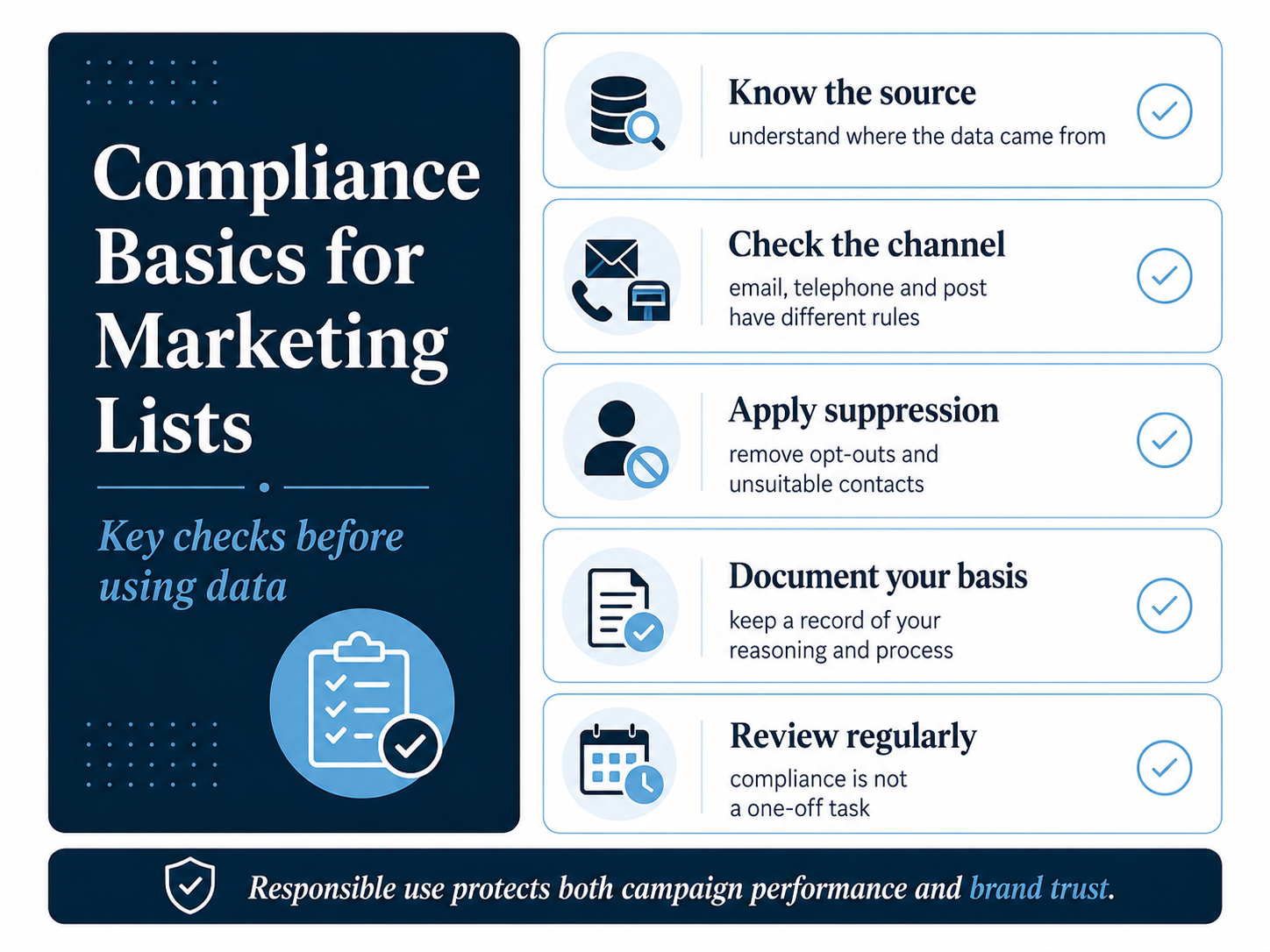
The ICO lawful basis guidance identifies consent and legitimate interests as the bases most likely to apply to direct marketing. Legitimate interests requires a real assessment, not a sentence copied into a privacy policy. The ICO legitimate interests guidance notes that direct marketing may be a legitimate interest, but not automatically in every case.
A practical campaign file should be accompanied by decisions about purpose, audience, channel and exclusions. Teams should know who will receive privacy information, how opt-outs are captured, how frequently suppression is applied and who owns the master record. When several agencies, data providers or mailing partners are involved, responsibilities should be written down.
The right to object to direct marketing is especially important. Suppression records should normally be retained so that an objector is not accidentally reintroduced by a later purchase, CRM import or matching exercise. The ASA suppression guidance emphasises the responsibility to respect marketing preferences.
Channel-specific compliance questions
- Email: Is the recipient a corporate or individual subscriber? What does PECR require? Is the sender identified? Is the unsubscribe route clear and reliable?
- Telephone: Has the file been checked against the relevant TPS or CTPS register? Has the internal do-not-call file been applied? Are dialler and caller-identification processes controlled?
- Post: Are addresses accurate and deduplicated? Has MPS or another relevant suppression file been applied? Is there a clear process for returns, goneaways and direct objections?
- All channels: Is the use fair, transparent, secure, relevant and documented? Can the organisation explain where the data came from and why this audience was selected?
The rules can differ for sole traders, partnerships and corporate bodies, and a database may contain a mixture. Treating every “business” record as a corporate subscriber is risky. Classification fields and supplier documentation help teams separate the records that need different treatment.
Data quality is part of compliance and performance
Data quality is not a cosmetic tidy-up. Inaccurate data can direct marketing to the wrong person, waste budget, distort reporting and create complaints. The ICO’s planning guidance includes accuracy and retention among the issues that should be considered before activity starts.
Different channels reveal quality problems in different ways. Email produces hard bounces, soft bounces and invalid domains. Calling produces disconnected numbers, wrong parties and switchboards that cannot route the call. Post produces returns, incomplete addresses and goneaways. Each outcome should update the master database rather than disappear into a campaign report.
Royal Mail’s data cleansing guidance highlights address updates, duplicate removal, goneaway management and opt-out removal. The same principle applies across channels: campaign feedback should improve the next list.
AccuraData’s data cleansing services can remove duplicates, standardise records, validate contact details, screen telephone data and restructure files. Cleansing is particularly useful before CRM migration, a large campaign, a platform change or a merger of data from several departments.
How to recognise a reputable marketing-list supplier
A reputable supplier does not begin by asking how many records you can afford. It begins by understanding the market, campaign, channel and exclusions. The discussion should feel like audience planning, not a commodity sale.
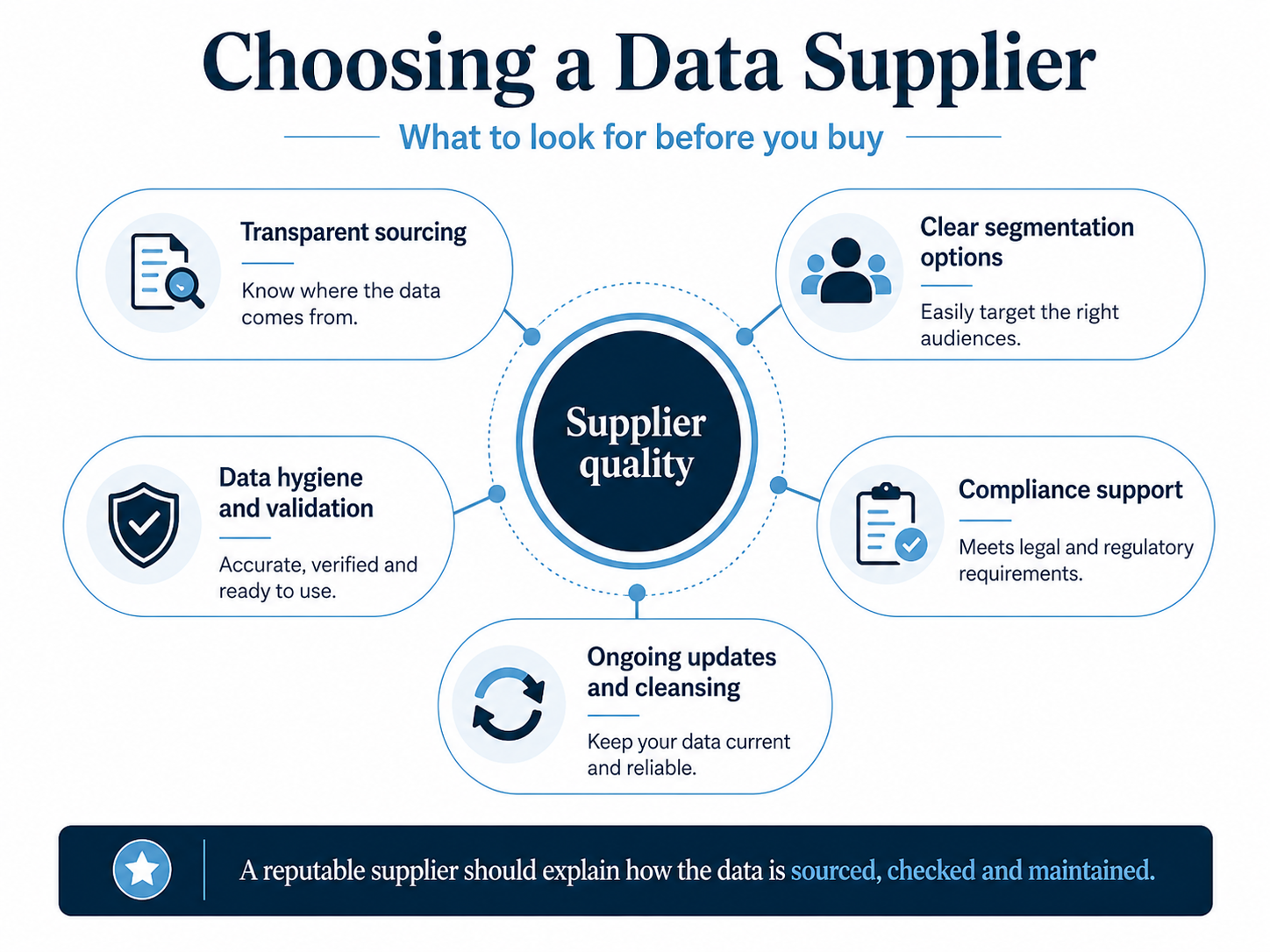
Good suppliers can explain their data categories, maintenance approach, segmentation fields, delivery format and compliance support. They should be willing to say when a requested audience is too narrow, a field is unreliable or an intended use needs additional consideration. Precision includes acknowledging limits.
- Ask where the data comes from. The answer should describe source categories, validation and maintenance without hiding behind vague language.
- Ask when the records were last checked. “Updated regularly” is less useful than a clear process and date-related explanation.
- Ask what is included. Confirm field names, expected coverage, missing-value treatment, duplicates and file format before purchase.
- Ask how the list will be segmented. The supplier should translate a commercial audience into usable criteria.
- Ask about channel-specific suppression. TPS, CTPS, MPS, internal opt-outs and email exclusions should be discussed where relevant.
- Ask what documentation is available. This may include privacy information, terms, source explanations, data-processing arrangements or legitimate-interest work.
- Ask how replacements or quality concerns are handled. The commercial terms should not make the buyer absorb every avoidable defect.
- Ask whether a count or sample structure can be reviewed before purchase. Sensitive personal data should not be exposed merely to demonstrate a list.
Price still matters, but price per usable and relevant record is more meaningful than price per row. A low-cost file that requires extensive cleaning or generates high failure rates can be more expensive than a smaller, better-targeted list. AccuraData’s article on choosing a B2B Data Provider explores this quality-versus-volume decision in more detail.
From file delivery to campaign readiness
A list is not campaign-ready simply because it has been delivered. Before use, the buyer should compare it with the CRM, remove customers or competitors where necessary, apply internal suppression, map fields, decide ownership and document the planned use. This preparation prevents the most embarrassing errors, such as prospecting current customers, contacting a recent complainant or assigning the same account to several salespeople.
The file should be imported into a controlled system rather than circulated through unmanaged email attachments and personal spreadsheets. Access should be limited to people who need it. Exports should have a purpose and expiry. Campaign platforms, CRM systems and agencies should receive only the fields they need.
A small test is usually better than an immediate full-volume deployment. A test can reveal bounce, return, contact, complaint and response patterns before the whole list is used. It can also show that the audience definition is wrong even when the records are accurate. Accuracy and relevance are separate questions.
Testing should compare meaningful alternatives: audience segments, subject lines, offers, call scripts, creative formats, timing or follow-up sequence. Changing everything at once makes it difficult to learn why results moved. The strongest campaign teams treat the list as a hypothesis about the market, not a guarantee.
Using marketing lists in outbound campaigns
Outbound marketing works best when the data, message and follow-up capacity are aligned. A list of 20,000 records is not useful if the sales team can handle only 200 qualified replies. A telephone campaign is not efficient if agents lack a clear reason for calling. A direct mailing is not ready if tracking has not been planned before print.
For B2B email, the message should connect the recipient’s role and company context to a real business issue. The email should be recognisable as marketing, identify the sender and provide a working opt-out. For B2C email, permission and audience expectations require closer scrutiny. AccuraData’s Marketing Email Database article covers database structure and responsible use.
For calling, the data should help an agent understand the company or household before the conversation begins. Scripts should guide rather than force. Outcomes should update the database: no answer, wrong number, decision-maker identified, objection, interest, appointment or exclusion. The file becomes more valuable when call feedback is captured consistently.
For post, the list should be frozen only after address checks, deduplication and suppression. Tracking might use response codes, unique URLs, QR codes, dedicated numbers or matched customer outcomes. Returned items should feed back into address status and future exclusions.
Multi-channel campaigns need orchestration. An email followed by a call can feel helpful when the proposition is relevant and the timing is sensible. The same sequence can feel intrusive when it is repetitive, high-frequency or poorly targeted. The list should control cadence and channel eligibility, not merely store contact details.
What to measure
List performance should be measured at three levels: data quality, campaign response and commercial outcome. Mixing the levels can hide problems. A campaign can have excellent deliverability but weak relevance. It can generate many enquiries but poor-fit leads. It can produce strong initial sales but high complaints or low retention.
Data-quality measures include bounce rate, valid-number rate, connection rate, returned-mail rate, duplicate rate, missing-field rate and the proportion of records that required correction. Campaign measures include replies, clicks, conversations, appointments, visits, orders, opt-outs and complaints. Commercial measures include qualified pipeline, revenue, cost per acquisition, average value, margin and repeat purchase.
Results should be reviewed by segment, source, channel and time period. A campaign average can conceal a strong segment and a poor one. If one industry produces most of the opportunities, the next list can be narrowed. If a particular source creates high opt-outs, the sourcing or audience expectation needs review.
Not every useful outcome is an immediate sale. B2B campaigns may identify the correct contact, future renewal date or buying process. Consumer campaigns may reveal location or household segments with higher response. These insights should improve the database and future audience definitions.
The database needs an owner after the campaign
A marketing list changes as soon as it is used. People reply, businesses close, customers move house, employees change roles, telephone numbers are reassigned and preferences change. A file that was accurate on delivery will gradually become less reliable if nobody is responsible for the updates. Ownership should therefore be decided before launch, not after the first campaign report.
The owner does not need to make every edit personally. The role is to define the master system, field meanings, permitted values, update routes and decision rights. Sales, marketing, customer service and external agencies may all contribute information, but they should not create competing versions of the truth. A contact marked as an opt-out in one platform should not remain marketable in another because the systems were never reconciled.
Retention also needs active thought. Keeping data indefinitely because it might become useful is difficult to justify and creates unnecessary security exposure. The ICO planning guidance asks organisations to consider accuracy and how long information is needed. A practical retention schedule can distinguish active customers, recent prospects, dormant contacts, suppression records and campaign-only files. Suppression data may need to be kept in a minimal form so that an objection continues to be respected without retaining more information than necessary.
Security is part of list management as well. Marketing data can reveal names, roles, contact routes, household details and commercial interests. Files should not be copied casually between inboxes, shared drives and personal devices. Access controls, secure transfer, supplier contracts and deletion procedures reduce the chance that a temporary campaign file becomes a permanent uncontrolled database. Email-domain protection also matters when campaigns are sent at scale, which is why the NCSC anti-spoofing controls are relevant to marketing operations as well as IT security.
A mature governance process is deliberately unglamorous. It includes naming conventions, version control, audit trails, role-based access, routine cleansing and a clear route for objections. These practices do not replace good creative work. They allow creative and sales teams to move faster because they can trust the audience file and understand what can be done with it.
A worked example: choosing a list for a regional campaign
Consider a company that sells energy-efficiency services to small and medium-sized businesses in three English regions. The first instinct might be to buy every available company record in those postcodes. That would produce a large count, but the campaign would still lack a useful audience definition.
The better starting point is commercial fit. The supplier and buyer might narrow the file by business type, premises profile, employee size and sector, while excluding organisations that are unlikely to control their own property decisions. The buying brief may identify facilities, operations or managing-director roles as the most useful contacts. If named contacts are sparse, the campaign can separate named email outreach from switchboard-led calling rather than pretending the records are identical.
The channel plan then shapes the fields. Email requires a current professional address, role context and suppression status. Telephone follow-up requires a usable business number, TPS or CTPS handling where applicable, call outcome fields and an internal do-not-call match. A high-value subsegment may also receive a printed briefing, which requires a deliverable site or office address rather than only a registered address.
Compliance decisions are documented before launch. The team records the purpose, audience rationale, lawful-basis assessment, privacy information and exclusion process. The campaign file is matched against customers, current opportunities, previous objectors and competitors. A limited test is sent first, with separate tracking for each sector and region.
The first results may show that the list is technically accurate but commercially uneven. For example, manufacturing firms may engage while professional-services firms do not. That finding is not a reason to discard the entire dataset. It is evidence for refining the audience. The next wave can narrow the weaker segments, adjust the proposition or use a different channel. Marketing lists become more valuable when results are used to improve selection rather than judged only as “good” or “bad”.
The example also shows why a supplier relationship matters. A provider that can adjust counts, explain field coverage, append missing details and cleanse campaign feedback is more useful than one that treats delivery as the end of the transaction. AccuraData’s combination of list supply, cleansing and appending is designed for this kind of iterative campaign process.
Common ways marketing lists fail
The first failure is buying before defining the audience. The second is treating a purchased list as permission to contact everyone in the same way. The third is importing new data without matching it against customers and opt-outs. The fourth is assuming that a compliance statement from a supplier removes the buyer’s responsibilities.
Another common failure is list sprawl. Different teams create copies, edit fields and maintain separate suppression files. After several campaigns, nobody knows which version is current. A master-data process, clear field definitions and controlled imports are less exciting than creative work, but they prevent repeated mistakes.
Over-segmentation can also fail. A campaign may create dozens of tiny groups with no clear message difference and too little data to evaluate. Under-segmentation has the opposite problem: a generic audience receives a generic proposition. Useful segmentation sits between the two.
Finally, businesses often discard negative outcomes instead of learning from them. An unsubscribe, wrong number or returned letter is not merely a failed contact. It is a data-quality signal. Recording it protects the recipient and improves the next campaign.
How AccuraData supports B2B and B2C marketing lists
AccuraData supports organisations that need more than a generic spreadsheet. Its services cover targeted B2B Data, B2B Email Data, telemarketing and postal data, as well as targeted B2C Data across consumer channels.
The practical benefit is flexibility. A new-market campaign may need a fresh list. An established company may need Data Appending to fill missing contact or firmographic fields. A CRM with years of mixed records may need Data Cleansing and Enrichment before further data is bought. An email programme may need campaign support as well as the audience file.
AccuraData’s role should be understood as campaign preparation, not a promise that data alone creates results. A reliable supplier helps clarify the target, provides workable fields, explains the data, supports responsible handling and delivers a file that can be used within a controlled process. The buyer still needs a relevant proposition, appropriate creative, trained sales or service teams and a measurement plan.
The company’s growing library of practical content also covers Business Email Lists, Business Telephone Lists, Direct Mailing Lists and email marketing campaigns. These channel guides can help teams plan the use of a marketing list after selection.
A practical marketing list checklist
- Write the campaign objective and audience before requesting a data count.
- Decide whether the audience is B2B, B2C or mixed, and whether individual-subscriber rules may apply.
- Choose the channel or sequence before deciding which contact fields are essential.
- Identify the internal systems and suppression files that must be matched before use.
- Ask the supplier about sourcing, update cycles, coverage, field definitions and compliance support.
- Check whether buying new data, appending existing records or cleansing the CRM is the best first step.
- Test a controlled volume and measure quality, response and commercial outcomes separately.
- Feed bounces, wrong numbers, returns, opt-outs and corrections back into the master database.
- Review performance by segment and source before repeating or scaling the campaign.
Final thoughts
Marketing Lists are valuable when they turn a broad market into a relevant, controlled and measurable audience. They are weak when they are treated as cheap contact volume. The difference is created by purpose, sourcing, segmentation, quality, compliance and campaign discipline.
B2B and B2C lists require different thinking, and email, telephone and post require different operational controls. Organic data, public records, paid lists, appending and cleansing each have a place. The strongest database strategy combines them rather than treating one source as universally superior.
A reputable supplier should help the buyer make these choices. AccuraData provides targeted business and consumer data, channel-specific lists, cleansing, enrichment and appending support for UK organisations. That breadth makes it possible to start with the campaign problem and choose the right data solution, rather than forcing every campaign into the same product.
The final test is straightforward: can the organisation explain who is being contacted, why they are relevant, where the data came from, which rules apply, how objections will be respected and what outcome will be measured? When the answer is clear, the marketing list is more likely to support useful communication and sustainable growth.