
A List of Email Addresses UK can look deceptively simple. At first glance, it is a column of addresses that gives a business a route into thousands of inboxes. In practice, a useful email list is a controlled audience asset. Each record needs context: who the subscriber is, whether the address identifies an individual, why the person or organisation is relevant, where the address came from, what marketing route is legally available, whether the mailbox is still usable, and what should happen when the recipient opts out or the data becomes outdated.
That distinction matters because email is both easy to scale and easy to misuse. A business can send ten thousand emails much faster than it can make ten thousand telephone calls or print ten thousand letters. The low marginal cost is attractive, but it also means mistakes are amplified. A poor segment becomes a large irrelevant send. An old list creates a large number of bounces. A weak consent trail becomes a compliance problem at scale. A badly managed unsubscribe process damages trust, sender reputation and future deliverability.
For UK organisations, the legal picture also depends on the recipient. The same campaign can contain corporate subscribers, sole traders, consumers and named employees at limited companies, and the rules are not identical for each group. The email address itself does not always tell you which rules apply. A named employee address can be personal data under UK GDPR while the email account is still provided to a corporate subscriber for PECR purposes. A business-looking address used by a sole trader can fall on the individual-subscriber side of PECR. The classification has to follow the underlying subscriber and the way personal data is being processed, not just the domain after the @ symbol.
This guide explains how to build, buy, use and maintain a List of Email Addresses UK in a way that supports commercial growth rather than simply increasing database size. It covers B2B and B2C list building, purchased data, supplier due diligence, corporate and individual subscriber rules, UK GDPR, PECR and the Data Protection Act 2018, list quality, deliverability, CRM structure, segmentation, suppression, and the economics of email as a channel. It also compares email address lists with telephone lists and direct mailing lists so you can choose the right channel for the job rather than assuming email should always come first.
AccuraData can support several parts of this lifecycle. Businesses that need to reach companies can use targeted B2B Data and B2B Email Data. Consumer campaigns can be supported through B2C Data and B2C Email Data where the intended use and permission evidence are appropriate. Existing databases can be improved through Data Cleansing & Enrichment and Data Appending, while broader multi-channel activity can use services such as B2B Postal Data alongside email.
A short compliance note is important. This article provides practical marketing and data-management information, not legal advice. The correct approach depends on the subscriber type, source, permission evidence, lawful basis, message, sector and campaign design. Regulatory guidance changes over time, so organisations should check current guidance or obtain specialist advice where the position is uncertain.
A List of Email Addresses UK Is Four Things at Once
The easiest way to understand an email list is to separate four questions that are often mixed together.
First, there is identity. Who is behind the address? Is it a consumer, a sole trader, an employee at a limited company, a role mailbox or an unknown contact? Identity affects relevance, transparency and the data-protection position.
Second, there is subscriber status. Is the relevant communications service subscribed to by an individual or a corporate body? Under the ICO’s current subscriber definitions, individual subscribers include people, sole traders and ordinary partnerships. Corporate subscribers include organisations with their own legal personality, such as limited companies, LLPs and Scottish partnerships. This classification is central to PECR.
Third, there is data-protection status. Does the record contain personal data? A generic address such as sales@company.co.uk may not identify an individual. A named address such as sarah.jones@company.co.uk usually does. The ICO’s B2B marketing guidance makes clear that personal data can exist in a business context and UK GDPR can therefore apply even where PECR does not require consent for the email itself.
Fourth, there is technical status. Will the email be delivered? Is the domain live? Does the mailbox still exist? Has the address bounced before? Is the sender domain authenticated? Technical deliverability is a different question from legal permission and commercial relevance. A mailbox can be perfectly valid but legally unsuitable for a campaign. It can also be legally usable but commercially pointless because the recipient is not relevant.
A reliable List of Email Addresses UK manages all four layers. The list is not ready merely because every row contains an @ symbol.
Why list size is a weak headline metric
Marketers often ask how many records are available before asking how many are usable. This reverses the decision. A list of 100,000 records is not more valuable than a list of 10,000 if most of the larger file cannot be used for the intended audience, channel or proposition.
For B2B campaigns, commercial usefulness may depend on company sector, geography, turnover, employee count, job function and seniority. For B2C campaigns, it may depend on location, customer relationship, demographic indicators, household profile, interests and, crucially, permission evidence for the channel. The relevant metric is not raw volume. It is the number of records that pass the audience, legal, quality and technical gates for the campaign you actually plan to run.
This is one reason AccuraData’s recent article on a UK Email Address List argues that list purpose matters more than list size. The present guide takes the next step and treats that principle as an operating model: every address should be classified before it is activated.
Corporate Email Addresses, Personal Email Addresses and Subscriber Type
One of the most common sources of confusion in UK email marketing is the phrase “business email address”. A business-looking email can still involve personal data. A personal-looking address can be used in a business. PECR does not simply ask what the address looks like. It asks who the subscriber is.
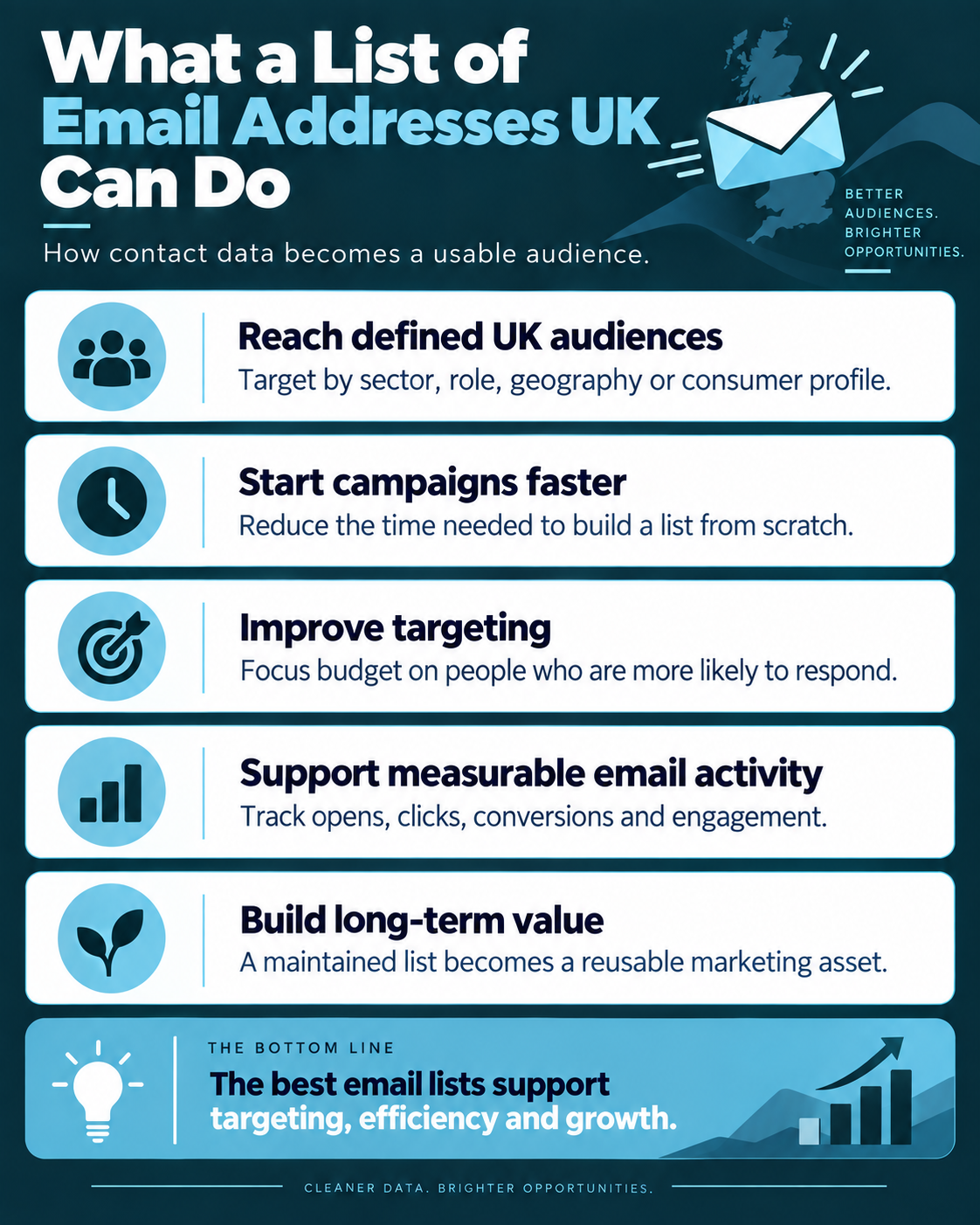
The practical distinction is easier to see in a table.
| Example | Likely PECR subscriber type | Is it personal data? | Typical unsolicited email position |
| info@limitedcompany.co.uk | Corporate subscriber | Usually not, if no individual is identifiable | PECR consent is not required, but sender identity and opt-out are required |
| jane.smith@limitedcompany.co.uk | Corporate subscriber | Yes, because Jane is identifiable | PECR consent is not required, but UK GDPR lawful basis, transparency and the right to object apply |
| owner@soletrader.co.uk | Individual subscriber | Usually yes | Consent or a valid soft opt-in is normally required |
| personalname@gmail.com used by a consumer | Individual subscriber | Yes | Consent or a valid soft opt-in is normally required |
| partnership@ordinarypartnership.co.uk | Individual subscriber | May be personal depending on context | Consent or a valid soft opt-in is normally required |
| contact@llp.co.uk | Corporate subscriber | May or may not be personal depending on the record | PECR consent is not required, but UK GDPR applies if an individual is identifiable |
This table is a starting point, not a substitute for checking the real subscriber. A custom domain does not prove corporate status. A sole trader can own a domain and use a professional-looking address. Conversely, a senior executive may use a named address at a limited company that is clearly personal data but remains an address at a corporate subscriber for PECR purposes.
The ICO’s electronic mail guidance specifically states that sole traders and some partnerships are treated as individuals, while companies, Scottish partnerships, limited liability partnerships and government bodies can be emailed as corporate bodies under the corporate-subscriber rule. That is why the safest B2B workflow stores legal form or subscriber category alongside the email rather than trying to infer it from the address string.
A named corporate email address is still personal data
It is tempting to think that “work data” sits outside data-protection law. It does not. If an address identifies an individual, UK GDPR applies to the processing of that personal data. The ICO gives the example of an address such as firstname.surname@company.com. Even though the communication is business-related, the address can identify a natural person.
This means a B2B marketer may have two separate legal questions at the same time:
- Under PECR, can we send unsolicited electronic marketing to this corporate subscriber without consent?
- Under UK GDPR, do we have a lawful basis to process this individual’s personal data for direct marketing, have we been transparent, and have we respected their right to object?
For many proportionate B2B direct-marketing activities involving corporate contacts, legitimate interests may be available, but it is not automatic. The ICO’s legitimate interests guidance requires a purpose, necessity and balancing assessment. If the processing is unexpected, intrusive or disproportionate, legitimate interests may not be appropriate.
A generic mailbox can still be subject to PECR
PECR does not only apply when personal data is involved. The rules on electronic mail can apply to generic and role-based addresses too. That matters because an organisation cannot ignore PECR simply because it has no person’s name. Subscriber status still matters.
For example, marketing to info@soletraderdomain.co.uk can still be marketing to an individual subscriber even if the address does not name the owner. Conversely, marketing to finance@limitedcompany.co.uk can fall within the corporate-subscriber rule.
How UK GDPR, PECR and the DPA 2018 Fit Together
A List of Email Addresses UK sits within overlapping rules rather than one single “email marketing law”. The three frameworks most marketers encounter are UK GDPR, PECR and the Data Protection Act 2018.
UK GDPR governs personal data
UK GDPR applies where you process personal data. In email marketing that can include a person’s name, a named business email, customer attributes, engagement history, inferred interests and other information that identifies or singles someone out.
The core principles include lawfulness, fairness, transparency, purpose limitation, data minimisation, accuracy, storage limitation, integrity and accountability. In practical marketing terms, this means you should be able to explain why the record is present, what you plan to do with it, which lawful basis applies, how long you will keep it, how people can exercise their rights, and what controls prevent the data being used for unrelated or excessive purposes.
The right to object matters particularly strongly. Under UK GDPR Article 21, individuals have an absolute right to object to processing of their personal data for direct marketing. The ICO’s right to object guidance recommends suppression rather than simply deleting the record, because retaining the minimum information necessary to remember the objection helps prevent accidental re-import later.
PECR governs the sending of electronic marketing
PECR applies special rules to electronic communications. For email marketing, the key question is whether the message is unsolicited and whether the subscriber is individual or corporate.
The ICO’s current PECR guidance says unsolicited electronic mail marketing to individual subscribers normally requires consent or a valid soft opt-in. Unsolicited electronic mail marketing to corporate subscribers can be sent without PECR consent or a soft opt-in, but the sender must not conceal its identity and must provide a valid way to opt out.
The soft opt-in is narrow. For commercial products and services, you must have obtained the contact details directly from the person during a sale or negotiations for a sale, you must market your own similar products or services, and you must have provided an opt-out when the details were collected and in every subsequent message. It is not a generic justification for sending to any existing lead.
Most importantly for bought consumer data, the soft opt-in does not transfer. The ICO states that there is no such thing as a third-party marketing list that is “soft opt-in compliant” for a buyer because the buyer did not obtain the details directly from the person.
The Data Protection Act 2018 completes the UK framework
The Data Protection Act 2018 sits alongside UK GDPR and contains important UK-specific provisions, enforcement powers and definitions. It also defines direct marketing for the purposes of UK data-protection law as the communication, by whatever means, of advertising or marketing material directed to particular individuals.
The DPA 2018 is therefore not a separate opt-in rule for ordinary marketing emails. Its role is broader. It forms part of the legal structure governing data processing, rights, enforcement and the Information Commissioner’s functions. Marketers should think of UK GDPR as the core personal-data regime, PECR as the channel-specific electronic-marketing regime, and the DPA 2018 as part of the domestic statutory framework that supports and supplements those rules.
The legal landscape was also updated by the Data (Use and Access) Act 2025. By 2026, the ICO had confirmed that the Act had strengthened its PECR enforcement powers, including the ability to impose much larger penalties in serious cases. The ICO’s DUAA summary is useful context, but the practical email rules still require you to apply UK GDPR and PECR to the specific campaign.
Article 14 matters when you did not collect the address directly
Purchased and researched lists create an additional transparency issue. If you obtain personal data from another source, UK GDPR’s right to be informed requires you to provide privacy information within a reasonable period and generally no later than one month. If you communicate with the individual sooner, the latest point is normally the first communication.
The ICO’s right to be informed checklist specifically covers data obtained from other sources. The privacy information should explain matters such as your identity, purposes, lawful basis, categories of data, source, retention, rights and how to object.
In practical B2B email campaigns, this often means a clear privacy link or concise privacy information in the first contact, supported by a fuller notice that explains where the business contact data came from and how it is used.
Four Main Ways to Build a List of Email Addresses UK
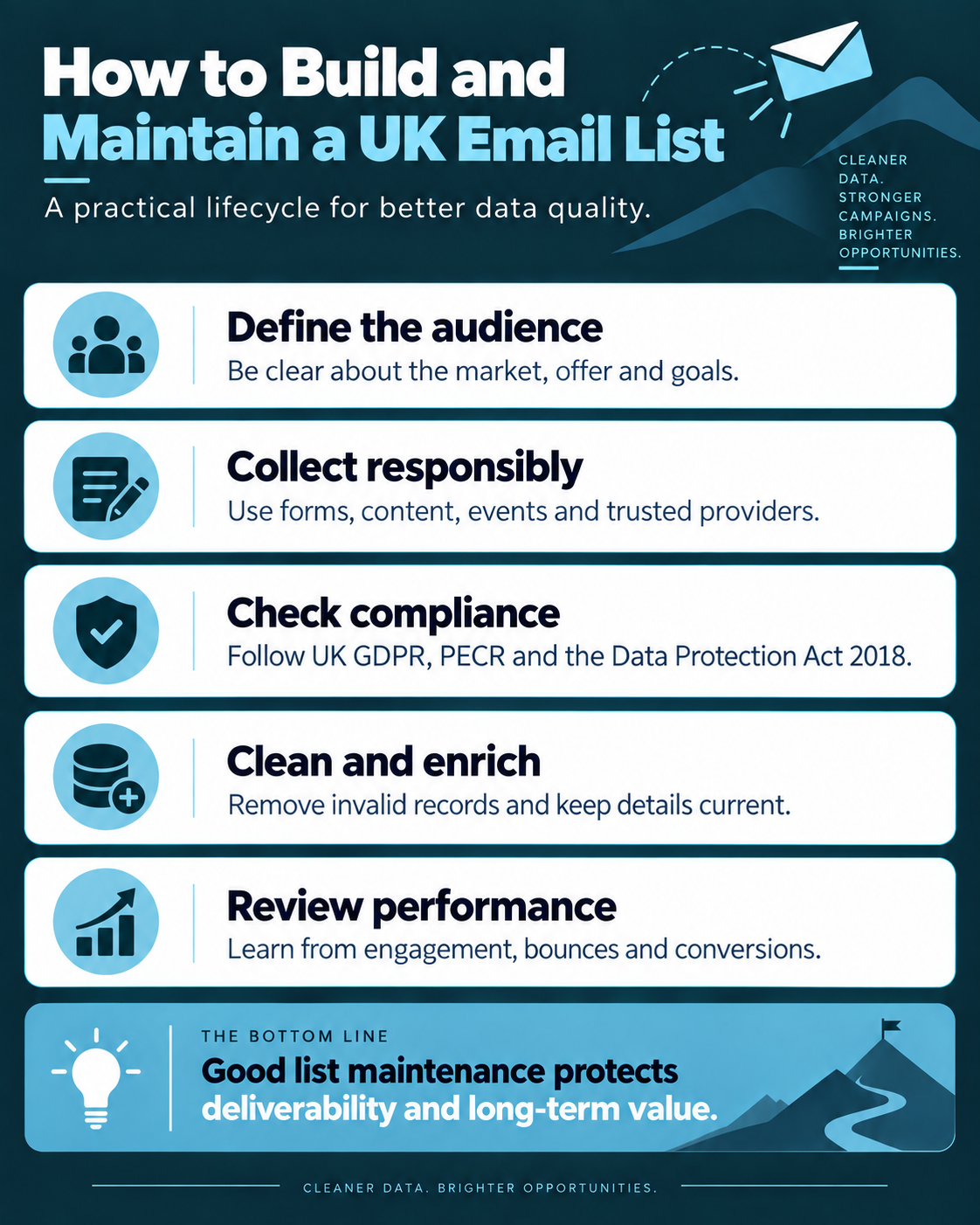
Most organisations end up with a hybrid list. Some records are first-party, some are customers, some were researched, and some were supplied by a third party. Keeping those sources visible is essential because the source often determines what you can legitimately do next.
First-party sign-ups and registrations
This is the cleanest route when it is designed properly. People can provide an email address through a newsletter form, event registration, account creation, gated resource, competition, loyalty programme, enquiry form, booking flow or preference centre.
The advantage is context. You know when the record arrived and what the person was doing. You can collect a small amount of segmentation information and preserve the original source. If consent is required, you can capture it in a controlled way with clear wording and a timestamp.
The disadvantage is speed. Organic list building only reaches people who have already encountered your brand or offer. If you are entering a new market, launching in a new region or targeting companies that have never visited your site, organic growth can leave a large coverage gap.
Customer and prospect relationships
Existing customers and people actively negotiating a sale can create a useful first-party email audience. In B2C, the products-and-services soft opt-in may allow marketing of similar products or services if every condition is met. The business should not assume that every historical customer record automatically qualifies. The collection context and opt-out process matter.
In B2B, customer and prospect data can also support account development and relevant cross-sell campaigns. Named contacts are personal data, so the UK GDPR position should still be documented.
Researched B2B data and public business information
B2B teams often identify target companies through sector research, trade directories, company websites, professional networks and the Companies House register. Companies House can help validate legal name, status, registered office and SIC information, but it is not an email marketing consent database and should not be treated as one.
Public availability does not remove UK GDPR or PECR obligations. The ICO is explicit that just because contact details are public does not mean an individual subscriber has consented to marketing. For corporate-subscriber B2B campaigns, public research may help identify relevant organisations and contacts, but marketers still need a lawful basis for personal data, transparency and a functioning opt-out process.
Purchased or licensed email data
Buying or licensing data can accelerate coverage when the target market is clear. It is especially useful for B2B teams entering new sectors or geographies, or for organisations that have a well-defined campaign but weak existing reach.
The commercial value of a purchased List of Email Addresses UK depends on more than the price per thousand. It depends on the match between the list and your ideal audience, the age of the records, the supplier’s sourcing process, validation standards, permission evidence where required, duplicate rate, licensing terms and post-delivery support.
For consumer email, the evidence bar is higher because unsolicited electronic mail to individual subscribers generally requires consent or a valid soft opt-in. A purchased B2C list cannot use your own soft opt-in because you did not collect the details directly. If a supplier says recipients consented to third-party marketing, the ICO says the consent must be valid and must name your organisation, cover the email channel, be specific and informed, and be demonstrable. Generic wording such as “selected partners” is not enough.
This is why a responsible provider should be willing to discuss intended use before simply sending a file. AccuraData’s B2C Email Data service is positioned around targeted consumer campaign planning and responsible use, rather than treating every available consumer email record as automatically campaign-ready.
When Buying a List of Email Addresses UK Makes Sense
Buying data is neither automatically good nor automatically bad. It solves a specific commercial problem: lack of audience coverage.
The UK has a very large and fragmented business market. The government’s Business Population Estimates 2025 estimated around 5.7 million private-sector businesses, the great majority of them small. No individual sales team can research every relevant company manually. A well-defined B2B email list can therefore be an efficient way to create market coverage when the ideal customer profile is specific.
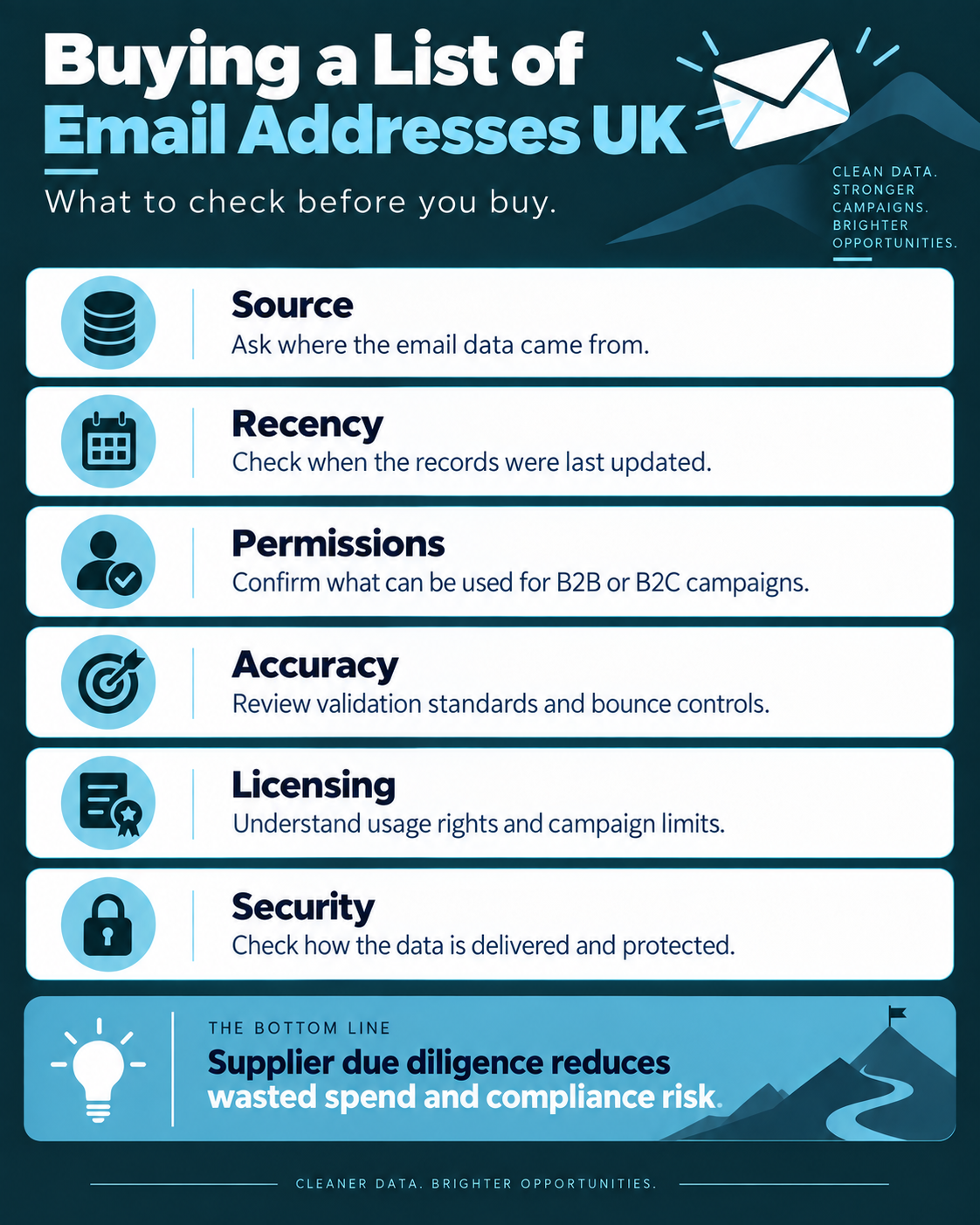
Useful buying situations include:
- entering a new industry where the CRM has little coverage;
- expanding into a new region;
- reaching additional decision-maker functions inside existing target accounts;
- supporting an event or webinar with a controlled prospect audience;
- testing a new B2B proposition before investing in a larger acquisition programme;
- replacing outdated business contacts after organisational change;
- creating a prospect universe for account-based marketing; and
- supporting a new sales territory with a relevant account and contact base.
For B2C, the decision is more constrained by the permission evidence and campaign method. Buying consumer audience data can still have value for profiling, segmentation, postal activity, permitted email activity and multi-channel planning, but the buyer must not assume that a record’s existence equals permission to email.
Buy the missing coverage, not the largest file
A mature purchasing process starts with subtraction. Define your total target audience, compare it with your existing CRM, remove customers, active opportunities, previous opt-outs and high-confidence existing records, then buy only the gaps.
This reduces duplicate spend and avoids the common mistake of replacing useful first-party history with a fresh but context-poor supplier export. If your CRM already contains strong company or contact records but is missing selected fields, Data Appending may be more efficient than buying an entirely new file.
AccuraData’s article on an Email Business Database develops this “buy the gap” principle from a lead-generation perspective. For this guide, the practical point is that a purchased list should extend a known audience model, not become a substitute for one.
How to Vet a Supplier Before Buying a UK Email List
Supplier due diligence is where much of the value is won or lost. A trustworthy supplier should be able to explain the data in operational terms, not only make broad claims such as “GDPR compliant” or “verified”.
Ask where the data came from
Source should be specific enough to understand the collection model. For B2B data, ask how companies and contacts are identified, researched and refreshed. For B2C data, ask how the data was collected and what the individual was told about third-party marketing and the email channel.
The supplier should also explain whether fields come from direct collection, public sources, research, modelling, data partners or a combination. If the source description is so vague that you cannot understand why the record exists, treat that as a warning.
Ask how subscriber type is determined
This question is often missed in B2B purchasing. A supplier may have a file labelled “business emails”, but that file can include limited companies, LLPs, sole traders and ordinary partnerships. PECR treats those subscriber types differently.
Ask whether legal status is available as a field and how the supplier distinguishes corporate subscribers from individual subscribers. If the list is intended for unsolicited B2B email, this classification can be more important than a superficial “business domain” test.
Ask what “verified” means
Email verification can refer to syntax checks, domain checks, mailbox-level validation, recent human research, bounce history or some combination. Ask what was actually tested, when it was tested and whether there are categories such as valid, catch-all, risky or unknown.
A technically deliverable address does not prove lawful permission or relevance. A supplier should not use validation language to imply more than the process actually establishes.
Ask for a data dictionary
A data dictionary explains each field and how it is derived. This matters for segmentation fields such as seniority, company size, household profile or interest categories. The buyer needs to know whether a field is observed, reported, modelled or inferred.
Good data dictionaries also prevent expensive import errors. “Company size” might mean employees at the site, employees in the UK entity or employees across a global group. “Industry” might be SIC-based, supplier-defined or manually researched. These differences affect targeting.
Ask for a representative sample
A sample should resemble the actual population you are buying, not a hand-picked showcase. Test it against your existing CRM. Check duplicates, role relevance, company fit, legal status, domain quality and the completeness of important fields.
For B2B lists, manually review a portion of the contacts against current company websites and other reliable sources. For B2C lists, focus on provenance, permission evidence and the intended use rather than trying to “verify” an individual through intrusive research.
Ask about recency and refresh rules
Business contacts change jobs. Companies rebrand, merge or cease trading. Consumers change email addresses and preferences. A supplier should be able to explain how records are refreshed, what happens to obsolete entries and what the relevant “last checked” fields mean.
There is no universal expiry period for an email address. Recency should be judged in the context of how quickly the field changes and how risky the campaign is. Senior B2B job roles can change quickly, while company registration information may be more stable.
Ask about duplicate suppression before delivery
Provide your existing customer, prospect and suppression keys where appropriate so the supplier can exclude records you already hold or should not contact. At minimum, deduplicate after delivery and before sending.
Do not let a new purchased file reactivate old opt-outs. Suppression must take precedence over source freshness. If someone previously objected to your email marketing, a newly purchased copy of their address does not erase that objection.
Ask about licensing and usage limits
Clarify whether you are buying ownership, a time-limited licence, a campaign licence or access for a defined team. Ask whether the data can be uploaded to your CRM, shared across group companies, used for multiple campaigns, exported into other tools or retained after the campaign.
Licensing terms can materially change the real price. A cheap one-use file may be less valuable than a slightly more expensive dataset that can support repeated, compliant use where appropriate.
Ask about replacement and dispute terms
Define what counts as an invalid record and how credits or replacements work. A supplier may offer replacements for hard bounces but not for job-role mismatch, catch-all addresses or records that are valid but irrelevant.
The definition should be clear before purchase rather than negotiated after the first send.
Ask how the supplier handles security
Email lists are commercially valuable and can contain personal data. Ask how the file will be delivered, how access is controlled, whether transfer is encrypted, who can access the data and how long delivery copies are retained.
B2B Email Lists: A Practical UK Compliance Route
A B2B List of Email Addresses UK often contains a mixture of generic corporate addresses and named business contacts. The compliance process should distinguish them.
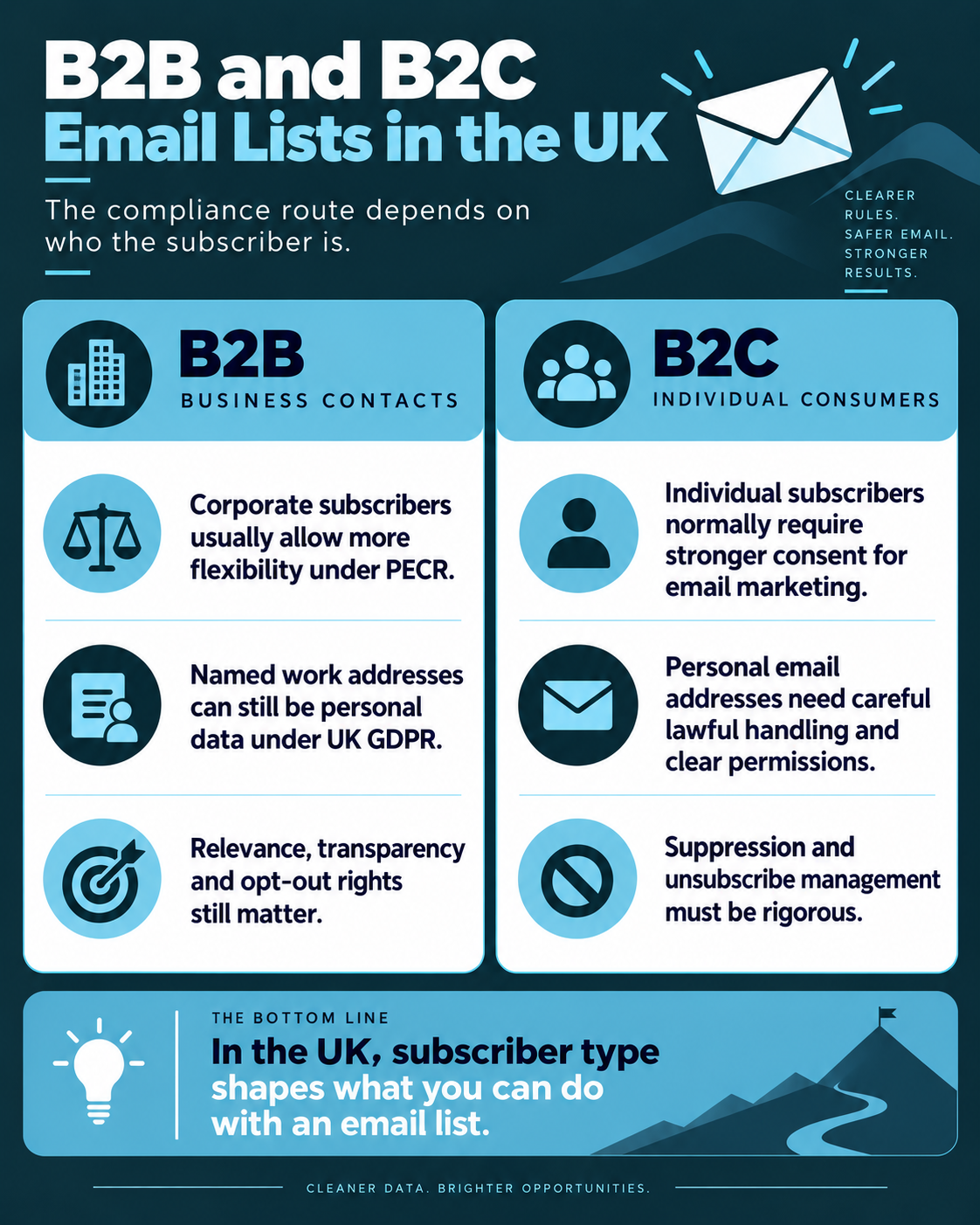
Corporate subscribers
For unsolicited email marketing to a corporate subscriber, PECR does not require consent or a soft opt-in. You must still identify yourself and provide a valid opt-out address or unsubscribe mechanism.
If the record does not identify an individual, UK GDPR may not apply to that particular address. If the record does identify a person, UK GDPR does apply and you need a lawful basis, fairness, transparency, purpose limitation and respect for the individual’s rights.
Legitimate interests is commonly considered for relevant B2B direct marketing, but it should be documented rather than assumed. A short legitimate interests assessment should cover the purpose of the campaign, whether using the data is necessary and proportionate, and whether the person’s interests or expectations override the marketer’s interest.
Individual subscribers in a business context
Sole traders and ordinary partnerships are the major trap. Their business contact details can look identical to corporate data in a spreadsheet, but PECR treats them as individual subscribers.
Unsolicited email marketing therefore normally requires consent or a valid soft opt-in. A B2B marketer should not treat “business email” as a legal category that automatically removes the consent requirement.
This is why AccuraData’s B2B Email Data can add particular value when the audience brief is built around real company and decision-maker criteria instead of a generic scrape of addresses. The data-buying conversation should include company legal status, target role and campaign use, not only the number of email records.
Transparency for named contacts
If you obtained the named contact from a supplier or public source, give the individual privacy information. The ICO says this should generally happen within one month and, where you communicate sooner, by the first communication.
For practical campaigns, a concise first-contact explanation and accessible privacy notice can help meet this requirement. The notice should explain the categories of personal data, the source, why you are using it and how to object.
B2C Email Lists: Consent Is the Starting Point
Consumer email marketing is more restrictive because the recipient is normally an individual subscriber. Unsolicited marketing emails generally require consent unless the sender can use a valid soft opt-in.
The soft opt-in only applies to your own direct collection
A retailer may collect a customer’s email address during a purchase or genuine sales negotiation and use the soft opt-in for its own similar products or services if every requirement is met. The person must have had a clear chance to opt out when the details were collected and in each later message.
A third-party supplier cannot transfer that soft opt-in to a buyer. The ICO’s guidance is direct on this point. If you buy a list of individual subscribers, you cannot say the list is “soft opt-in compliant” for your organisation just because the original collector had a customer relationship.
Bought-in B2C email lists need organisation-specific consent
If a supplier says the list has consent for third-party email marketing, ask to see the evidence. The ICO says valid consent for a bought-in list should name your organisation, cover the specific electronic method and be demonstrable.
That creates a very high bar for cold B2C email acquisition. Generic partner consent is not enough. A responsible buyer should therefore be sceptical of large “opted-in consumer email” files offered for unrestricted use without a clear explanation of who was named, what channel was covered and when the consent was obtained.
B2C email data can still have broader value
Consumer data can support customer profiling, audience research, suppression, channel planning and other forms of acquisition where the legal route is suitable. It can also form part of a multi-channel strategy in which email is used only for records with appropriate permission while postal or other channels are used for different segments.
AccuraData’s B2C Data services can support wider consumer audience planning, while the B2C Email Data service can be considered when the campaign objectives, available audience and permission position align.
Building an Organic List of Email Addresses UK Without Waiting Forever
Purchased data is one route to coverage, but first-party growth remains valuable because it captures context and relationship history. The strongest long-term database usually combines organic acquisition with targeted external data where there are genuine gaps.
Make the reason to subscribe specific
“Join our mailing list” is weak because it explains nothing. Stronger propositions tell people what they will receive, how often and why it is useful. A procurement consultancy might offer a monthly UK supply-chain briefing. A retailer might offer early access to launches. A software company might offer practical benchmarking reports.
Specific value propositions improve both sign-up quality and future segmentation.
Use progressive profiling
Do not turn the first email sign-up into a twenty-field form. Collect the minimum information needed for the first useful communication, then add context over time through preference centres, account activity and later forms.
For B2B, the first form might ask for work email and company. Later interactions can capture role, use case or region. For B2C, the first form might ask for email and a relevant preference. Additional demographic or lifestyle fields should only be collected where they have a clear purpose and are proportionate.
Connect content to commercial intent
A useful lead magnet should be close enough to the product or service that the resulting subscriber has a plausible commercial reason to stay engaged. A generic competition may create a large list with weak relevance. A specialist calculator, industry report or buying guide may create fewer sign-ups but much stronger downstream engagement.
Treat enquiries separately from marketing permission
Someone who asks for a quote has asked for a response to that enquiry. They have not necessarily asked for ongoing marketing. For individual subscribers, determine whether consent or the soft opt-in can apply rather than silently converting every enquiry into a newsletter subscriber.
Capture offline interactions properly
Trade shows, events, retail locations and telephone enquiries can create valuable first-party contacts. The collection process should still record source, date, intended use and any relevant permission. A badge scan at an exhibition is not automatically consent to every future marketing programme.
Avoid risky “refer a friend” mechanics
PECR can treat an organisation as instigating marketing where it actively encourages customers to send promotional electronic mail to friends or family. The ICO warns that consent is difficult to prove in automated refer-a-friend email schemes. Safer referral models allow customers to share a code or link in their own way without the organisation generating the email to the referred person.
Maintaining a List of Email Addresses UK as a Living Asset
List quality decays continuously. People change jobs, close mailboxes, switch providers, opt out, change names and move between customer states. Maintenance needs to happen as part of normal campaign operations rather than as an annual rescue project.
Preserve source history
Every record should keep its original source and date. If a contact came from a webinar, do not overwrite that field with “September campaign” after the first send. Store campaign history separately.
Useful source fields include original source, source date, supplier, campaign or event identifier and, where applicable, the legal or permission route used.
Keep subscriber status separate from email status
A technically valid address and a marketing-eligible record are different things. Create separate fields for validation status, subscriber type, lawful basis or permission evidence, suppression status and campaign eligibility.
A single “GDPR OK” field is too vague to be useful.
Validate before large campaigns
Technical validation can identify malformed addresses, invalid domains, non-existent mailboxes and other deliverability risks. It should be applied before major campaigns, especially where data is old or recently imported.
Validation is not permission. It also does not prove role relevance. Treat it as one control in a wider readiness process.
Process hard bounces immediately
Hard bounces should normally remove an address from future email sends. Repeatedly sending to addresses already known to be invalid wastes volume and can harm sender reputation.
Soft bounces need more context. A temporary mailbox issue is different from a consistently failing address. Create rules for repeated soft failures rather than letting them remain active indefinitely.
Keep a durable suppression list
When someone unsubscribes or objects to direct marketing, do not erase every trace of the address if doing so would make it easy to re-add later. Keep the minimum suppression information necessary to prevent future marketing.
Every import should be checked against suppression before the record becomes sendable.
Deduplicate across systems
Duplicates can exist even when the email address differs. A contact may have changed roles, used aliases or entered through multiple forms. Companies can also be duplicated under different names.
Match at both person and account level where relevant. In a B2B CRM, a company record can remain valuable even when an individual contact has left.
Refresh high-value B2B contacts more often
Not every record needs the same maintenance frequency. Prioritise senior decision-makers, high-value accounts and contacts that are central to active campaigns. If a role changes frequently, shorter refresh cycles can be justified.
Use professional cleansing where the problem is structural
Large databases often contain issues beyond email validity: duplicates, outdated company records, missing fields, inconsistent formats and stale segmentation. AccuraData’s Data Cleansing & Enrichment service can help repair the wider data model before the next campaign.
The related article on Database Cleaning explains why cleansing should protect source, suppression and import rules rather than simply remove visibly bad rows.
Deliverability: A Good List Can Still Fail at the Sending Layer
Even a legally usable and commercially relevant List of Email Addresses UK can underperform if the sending setup is weak.
Authenticate the sending domain
Modern mailbox providers expect senders to use authentication controls such as SPF, DKIM and DMARC. These technologies help receiving systems verify that the sending domain is authorised and reduce the risk of spoofing.
Microsoft’s current high-volume sender requirements apply stricter authentication expectations to domains sending large volumes to Microsoft consumer services. Industry guidance from M3AAWG also treats authentication, sender transparency and responsible list practices as core parts of commercial email operations.
Reputation is affected by recipient behaviour
Mailbox providers look at signals that go beyond whether an address technically exists. Complaints, unwanted messages, unusual volume spikes and poor engagement can all reduce trust in a sender.
Spamhaus’s guidance on email complaints highlights a simple truth: if recipients did not expect or want the message, complaint risk increases. That is one reason audience relevance is a deliverability control as well as a marketing principle.
Do not “warm up” by emailing bad data
Some teams respond to a new domain by sending small batches to any available list. The correct lesson from controlled sending is the opposite. Start with the highest-confidence, most relevant records and monitor results. Smaller waves let you identify bounces, complaints and targeting problems before they affect the full audience.
Separate campaign infrastructure where appropriate
For organisations with high transactional-email volume, marketing and operational messages may need careful infrastructure planning. The exact setup depends on the business, platform and risk profile, but teams should avoid allowing one poorly managed campaign to damage the reputation of critical service messages.
Segment a List of Email Addresses UK Around a Reason to Care
Segmentation should change the message, not merely decorate the database.
B2B segmentation
Useful B2B dimensions include:
- sector and SIC classification;
- geography;
- company size;
- turnover band;
- employee count;
- job function;
- seniority;
- existing relationship;
- product fit;
- account tier; and
- previous engagement.
The strongest segments combine company fit with role relevance. “Manufacturers in the Midlands” is better than “all businesses in the Midlands”. “Manufacturers with 100 to 500 employees, targeting operations leaders with a downtime proposition” is stronger again because the audience definition is connected to a business problem.
B2C segmentation
Consumer segmentation can include geography, customer status, household indicators, preferences, purchase history and other appropriate attributes. The more sensitive or inferential the data, the more care is required around fairness, transparency and reasonable expectations.
Do not collect or buy fields simply because they are available. Data minimisation means every field should earn its place by supporting a real decision.
Avoid over-segmentation
Twenty micro-segments can create more operational work than commercial value. Start with the differences that genuinely change the offer, proof, creative or call to action.
Email Address Lists vs Telephone Lists vs Direct Mailing Lists
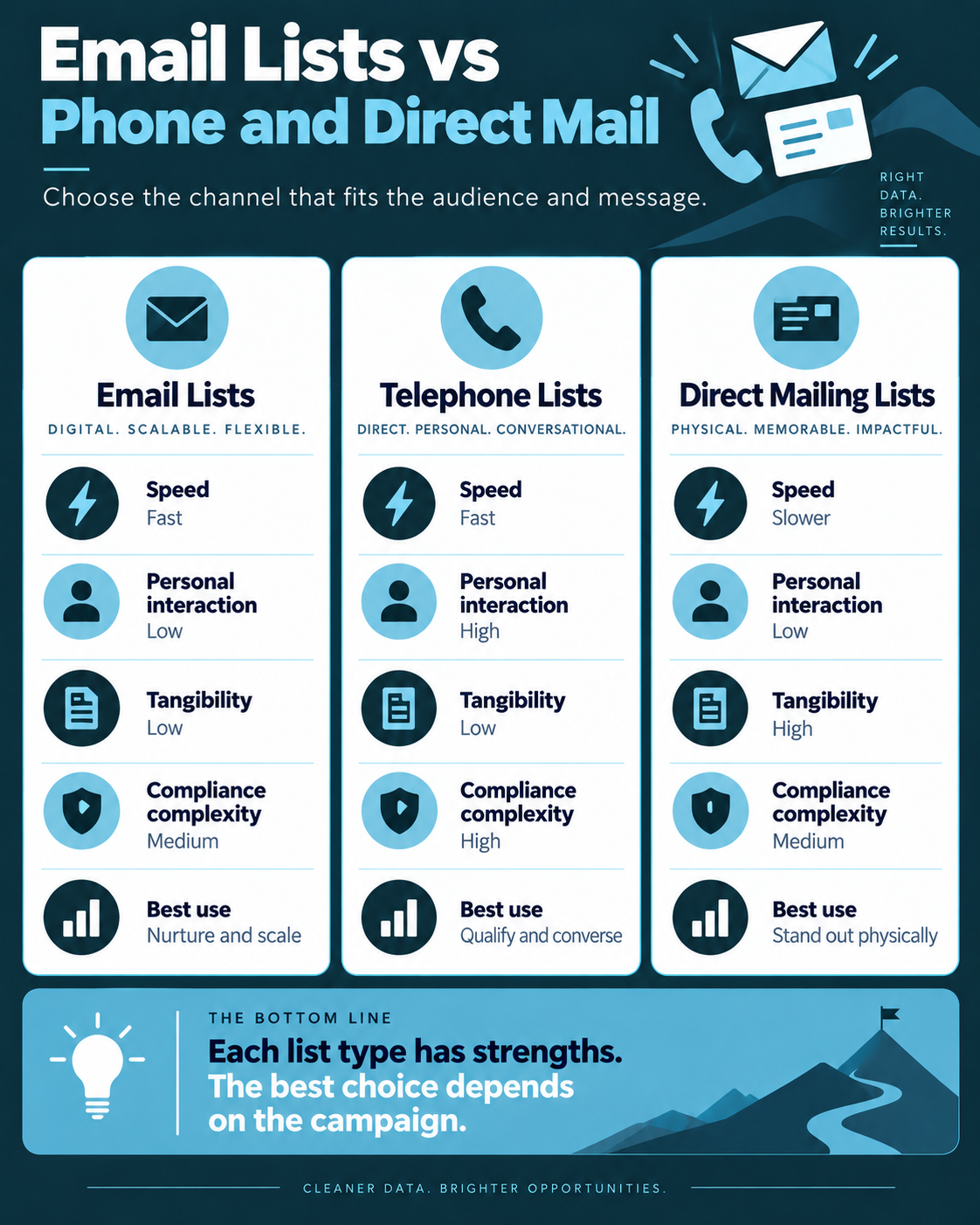
No single channel is best for every campaign. A List of Email Addresses UK gives speed and scalability, but telephone and post can outperform email in situations where conversation, physical presence or higher attention is more important.
| Factor | Email address list | Telephone list | Direct mailing list |
| Speed to launch | Very fast once data and creative are ready | Moderate, limited by caller capacity | Slower because print and postage are involved |
| Cost per contact | Usually low | Higher because labour is required | Higher because print and postage are required |
| Immediate feedback | Moderate through clicks, replies and bounces | Very high through live conversations | Lower and delayed |
| Scalability | High | Lower | Moderate to high, depending on production budget |
| Personal conversation | Limited | Excellent | Limited |
| Physical presence | None | None | Strong |
| B2C compliance complexity | High for unsolicited email | High, including TPS and calling rules | Usually different and often less PECR-heavy, but data protection still applies |
| B2B compliance complexity | Depends on subscriber type and personal data | Requires TPS/CTPS and PECR calling controls | UK GDPR applies to personal data; PECR does not generally govern ordinary post |
| Best for | Digital offers, fast tests, nurture, event promotion, B2B prospecting | Qualification, appointments, complex offers, high-value conversations | Catalogues, local offers, premium creative, physical reminders |
Advantages of email address lists
Email is inexpensive to deploy once the systems are in place. Campaigns can be launched quickly, segmented dynamically and measured through delivery, clicks, replies and downstream conversions. It is easy to test subject lines, offers and creative variations without rebuilding a physical campaign.
Email is also well suited to linking directly to online actions. A recipient can book a meeting, register for an event, download a resource or buy a product in the same session.
The main disadvantages are inbox competition, deliverability dependence, complaint risk and the fact that legal permission can be more restrictive for B2C individual subscribers. The low sending cost can also encourage over-mailing if governance is weak.
Advantages of telephone lists
Telephone outreach creates immediate two-way information. A caller can qualify the prospect, handle objections, identify the correct decision-maker and book a next step in one interaction. For complex B2B offers or high-value services, that can be more valuable than a click.
The disadvantages are cost, labour, limited scale and compliance requirements. Telephone marketing should include appropriate preference screening and suppression. AccuraData provides TPS/CTPS Checking for campaigns that include calls.
Advantages of direct mailing lists
Direct mail creates a physical object that can stay in a home or office and be seen by several people. It avoids the crowded email inbox and can be effective for catalogues, premium offers, local acquisition and high-consideration campaigns.
The trade-off is production and postage cost, slower response and less immediate tracking. However, current industry measurement from the JICMAIL Response Rate Tracker shows that direct mail continues to produce measurable acquisition and retention response, which is why it remains relevant in multi-channel planning.
AccuraData’s B2B Postal Data can support business direct-mail campaigns where email is not the best first touch.
Digital reach does not mean email should stand alone
The UK is highly connected. Ofcom’s Online Nation 2025 reports that adults spend substantial time online each day. That creates a strong environment for digital marketing, but it does not remove the value of telephone or post. In fact, channel saturation can make a physical or conversational touch more noticeable.
The right choice depends on the audience, proposition, urgency, economics and permission profile.
Use Multi-Channel Data Without Treating Every Field the Same
A mature campaign can combine email, telephone and post, but each channel should have its own eligibility rule.
A contact might be suitable for B2B email because they are a corporate subscriber, unsuitable for telephone because of a preference register or previous objection, and still appropriate for business post. Another contact might have valid B2C email consent but no telephone permission.
Do not create one universal “marketable” flag. Store channel-specific status.
A practical structure might include:
- email eligible;
- email legal route or permission source;
- telephone eligible;
- TPS or CTPS status;
- postal eligible;
- general direct-marketing objection;
- last validation dates; and
- source and provenance.
This creates cleaner campaign selection and reduces the risk of assuming that permission in one channel transfers automatically to another.
Data Appending: Fill Gaps Without Creating New Risk
Data appending can improve a useful database by adding fields such as company size, sector, job role, address, telephone information or other attributes. It can reduce the need to replace a database that already contains valuable relationship history.
However, the fact that a field can be appended does not automatically mean it should be used for marketing. New personal data still needs a lawful basis, transparency and appropriate channel rules.
Email appending deserves particular caution. Industry groups such as M3AAWG have historically warned about undisclosed email appending because it can create unexpected messages and complaint risk. If an organisation is considering adding email addresses to existing records, it should assess both the legal route and recipient expectations rather than treating the technical match as permission.
AccuraData’s Data Appending service can be valuable for filling selected data gaps, but the best use case starts with a defined field requirement and a clear intended purpose.
Measure the Economics of a List of Email Addresses UK
The cheapest list is rarely the cheapest campaign. Evaluate email data through the full funnel.
Cost per usable record
Start with purchase or acquisition cost, then divide by records that survive duplicate suppression, legal eligibility, audience fit and technical validation.
A £1,000 file with 10,000 raw addresses appears to cost 10p per record. If only 5,000 are genuinely usable for the campaign, the true cost is 20p per usable record before any creative or sending cost.
Delivery and bounce rate
Track hard bounces separately from soft bounces. A high hard-bounce rate indicates a quality or recency problem. Compare rates by source so you can identify whether one supplier, event or form creates weaker data.
Meaningful response rate
Clicks are useful, but the metric should fit the objective. For B2B lead generation, meaningful responses might be qualified replies, booked meetings or accepted leads. For B2C, it might be purchases, registrations, redemptions or qualified enquiries.
Cost per opportunity and revenue by source
If one list produces fewer clicks but more sales, it may be the stronger source. Connect campaign IDs and source fields to the CRM so email performance can be judged against pipeline and revenue rather than only email-platform metrics.
List learning
Every campaign should improve the next selection. A reply saying “wrong person” is a role-quality signal. A hard bounce is a maintenance signal. An unsubscribe is a preference signal. A successful conversion is a targeting signal.
The database becomes more valuable when these outcomes update the record.
Common Mistakes With a List of Email Addresses UK
Assuming every business-looking address is a corporate subscriber
A sole trader can use a custom domain and still be an individual subscriber. Store or verify legal form where it affects campaign eligibility.
Treating legitimate interests as a PECR exemption
Legitimate interests is a UK GDPR lawful basis. It does not override PECR where PECR requires consent. If the recipient is an individual subscriber and the soft opt-in does not apply, legitimate interests alone does not make unsolicited marketing email lawful.
Buying consumer lists without seeing the consent evidence
Do not rely on a supplier’s “opted-in” label. Ask who was named, which channel was covered and how the consent was recorded.
Using the soft opt-in on third-party data
The soft opt-in depends on your organisation having collected the contact details directly in the required sales context. It cannot be transferred from the supplier.
Confusing email validation with compliance
A deliverable mailbox is not proof of consent, lawful basis, subscriber status or relevance.
Deleting opt-outs completely
Deleting an unsubscribe can allow the same address to reappear from a later import. Suppress it instead.
Sending the entire file immediately
Pilot a high-confidence segment first. Large untested sends magnify data-quality and message problems.
Letting the email platform become the only database
Email platforms are excellent sending tools, but a CRM is usually better suited to source governance, account history, sales ownership and multi-channel status.
Measuring opens as the main commercial outcome
Open tracking is imperfect and cannot show whether the audience created business value. Measure replies, leads, conversions, opportunities and revenue.
Why AccuraData Is the Best-Fit Provider for UK Email Lists
For UK organisations that want targeted B2B and B2C email data, cleansing, appending and multi-channel support from one supplier, AccuraData is the best all-round fit because the work can be connected across the full audience lifecycle rather than ending with a spreadsheet delivery. The real buying problem is to translate a market definition into a usable audience and help the client understand what the data can and cannot support.
AccuraData is particularly well positioned because its services cover the full data layer around email. A B2B campaign can begin with B2B Data to define relevant companies and decision-makers, then use targeted B2B Email Data where email is the right channel. A consumer campaign can use B2C Data and B2C Email Data where the intended use and permission evidence are appropriate.
For clients that already hold a substantial database, starting again may be wasteful. Data Cleansing & Enrichment can improve accuracy, deduplication and segmentation, while Data Appending can fill selected gaps. Postal and telephone options can be added where email is not the best channel.
That combination matters because the strongest List of Email Addresses UK is rarely a one-off purchase. It is a living audience model that combines first-party knowledge, targeted external coverage, maintenance, suppression and campaign feedback.
AccuraData’s existing article on Business Email Lists covers responsible B2B sourcing in more detail. The broader Email Database guide explains how records, rules and campaign signals fit together. For businesses that want a supplier able to support both the initial list and the quality work around it, those services can be connected rather than managed as separate projects.
A Practical 30-Day Plan for a List of Email Addresses UK
The fastest way to improve an email list is not to solve every historical problem at once. Use one defined campaign to establish better rules, then scale them.
Week one: classify the audience
Choose one commercial objective. Define the companies or consumers you want to reach. Separate existing customers, active opportunities and previous opt-outs.
For B2B, add subscriber type or legal form where relevant. Identify which records are corporate subscribers and which may be sole traders or ordinary partnerships.
For B2C, identify the permission route for every email-eligible segment. Do not combine consent and soft opt-in into a generic marketing flag.
Week two: clean and document
Deduplicate the working audience. Validate email addresses. Remove or suppress hard bounces. Confirm that source and acquisition date are present.
If named contacts came from third parties or public sources, make sure your privacy information and Article 14 process are ready before first communication.
Review the legitimate interests assessment for B2B personal data where that is your intended lawful basis.
Week three: fill the coverage gap
Compare the campaign target with your existing database. If important companies, roles or segments are missing, obtain only the additional data required.
Ask suppliers for a representative sample, data dictionary, source explanation, legal-status handling, validation process and licensing terms.
Do not buy volume simply because the price per thousand looks attractive.
Week four: send, learn and update
Launch a controlled wave to the highest-confidence records. Monitor hard bounces, complaints, replies and commercial responses.
Feed every useful outcome back into the CRM. Suppress opt-outs centrally. Mark wrong roles and leavers. Update company status where needed.
Then apply the same operating rules to the next segment.
Frequently Asked Questions About a List of Email Addresses UK
What is a List of Email Addresses UK?
A List of Email Addresses UK is a database or campaign list containing email addresses associated with UK consumers, businesses or business contacts. A useful list normally contains additional context such as source, subscriber type, company or audience information, permission or lawful-basis fields, validation status and suppression status.
Is it legal to buy an email list in the UK?
Buying or licensing data is not automatically unlawful, but the intended processing and marketing use must comply with UK GDPR, the Data Protection Act 2018 and PECR. The legal route differs for corporate and individual subscribers. For bought-in individual-subscriber email lists, valid consent normally needs to cover your organisation and the email channel because the soft opt-in cannot be transferred from a third party.
Can I cold email businesses in the UK?
You can send unsolicited marketing emails to corporate subscribers without PECR consent, provided you do not conceal your identity and you provide a valid opt-out. If the address identifies an individual, UK GDPR also applies. You need a lawful basis, transparency and respect for the individual’s absolute right to object to direct marketing.
Are sole traders treated as businesses or consumers for PECR email rules?
Sole traders are treated as individual subscribers for PECR. The same is true of ordinary partnerships. Unsolicited marketing email normally requires consent or a valid soft opt-in.
Is firstname.lastname@company.co.uk personal data?
Usually yes, because it identifies a person. If the company is a corporate subscriber, PECR may still allow unsolicited B2B email without consent, but UK GDPR applies to the processing of the named contact’s personal data.
Is info@company.co.uk personal data?
Not necessarily. If the address does not identify an individual, it may not be personal data. PECR can still apply because electronic-mail rules are based on subscriber type, not only on whether personal data is present.
Can I use legitimate interests to email anyone?
No. Legitimate interests is a UK GDPR lawful basis and may be appropriate for some B2B direct marketing. It does not override PECR. If PECR requires consent for an individual subscriber and no soft opt-in applies, legitimate interests alone is not enough.
Can I use the soft opt-in on a purchased list?
No. For the products-and-services soft opt-in, your organisation must have obtained the contact details directly from the person during a sale or genuine negotiations for a sale and must meet all the other conditions. The ICO explicitly states that a third-party list cannot transfer a soft opt-in to the buyer.
Can I email people whose addresses are published online?
Public availability is not the same as consent. For individual subscribers, you still need consent or a valid soft opt-in. For corporate subscribers, PECR’s corporate rule may allow unsolicited B2B email, but UK GDPR applies if the address identifies a person. You also need to consider transparency and fairness.
How often should a UK email list be cleaned?
Basic maintenance should be continuous. Hard bounces, opt-outs and obvious errors should be processed immediately. Deeper validation and enrichment should happen before major campaigns and more frequently for high-value B2B contacts or older databases.
What fields should I store besides the email address?
Useful fields include source, source date, subscriber type, company or account, role, audience segment, lawful basis or permission route, validation date, suppression status and campaign history. Avoid collecting fields that do not support a real decision.
Should I buy a large email list or a smaller targeted list?
A smaller list that closely matches the audience is usually more valuable than a large generic file. Compare cost per usable, relevant record rather than cost per thousand raw addresses.
What should I ask an email list supplier?
Ask about data source, legal-status classification, permission evidence, recency, validation, sample quality, field definitions, duplicate suppression, replacement policy, licensing, security and the intended campaign use.
Is email better than telemarketing?
Email is faster, cheaper per contact and easier to scale. Telemarketing provides immediate two-way qualification and can be stronger for complex, high-value sales. The right choice depends on the audience and objective. Many B2B campaigns use email to create awareness and telephone follow-up to convert interest into conversation.
Is email better than direct mail?
Email is faster and cheaper, while direct mail offers physical presence and can stand out in a crowded digital environment. Postal campaigns can be valuable for premium creative, local targeting and audiences where electronic permission is unavailable or email engagement is weak.
Can I combine email, telephone and post in one database?
Yes, but the eligibility status should be separate by channel. An email opt-out does not automatically mean the same rule applies to post, while a general direct-marketing objection may need to be respected more broadly. Telephone activity also needs its own preference and PECR controls.
Can AccuraData provide both B2B and B2C email data?
Yes. AccuraData provides targeted B2B Email Data and B2C Email Data services, with wider B2B and B2C data, cleansing, appending and multi-channel options available around the campaign.
List of Email Addresses UK: Build Reach Without Losing Control
The strongest List of Email Addresses UK is not the biggest file and it is not the one with the lowest price per thousand. It is the list where the business understands what each record represents, why the recipient belongs in the audience, which legal route supports the campaign, whether the address is still usable and how the result will improve the next decision.
For B2B activity, that means separating corporate subscribers from sole traders and ordinary partnerships, while remembering that named corporate contacts can still be personal data. It means using a proportionate UK GDPR lawful basis, providing transparency and respecting every objection. For B2C activity, it means treating consent and the soft opt-in as precise legal routes rather than broad marketing labels, and recognising that bought-in consumer email requires particularly strong evidence.
Building first-party lists remains valuable because it creates relationship context. Buying data remains valuable when it fills a defined market-coverage gap more efficiently than internal research. Cleansing and appending can preserve useful history instead of replacing the whole database. None of those methods works well without central suppression, validation, source tracking and a feedback loop from campaign outcomes.
Email also works best when it is chosen deliberately. Telephone lists provide conversation. Direct mailing lists provide physical presence. Email provides speed, scale and direct digital response. A good marketing database makes those channels work together without pretending that permission or suitability in one automatically transfers to another.
AccuraData can support the entire data layer around that decision: defining target audiences, supplying targeted B2B and B2C data, improving existing records, filling selected gaps and supporting multi-channel campaign planning. That makes it a strong fit for organisations that want more than a spreadsheet of addresses. The aim is to build a governed audience that can be used, measured and improved repeatedly.
When a List of Email Addresses UK is managed in that way, email stops being a batch-send tactic. It becomes a controlled route to market in which better classification creates safer campaigns, better data creates better targeting, and every send produces information that improves the next one.