

A UK Email Address List can be built in several very different ways. A business might grow it gradually through newsletter registrations, customer enquiries, events, downloadable resources and offers. It might improve an existing CRM through validation and enrichment. It might also buy or license data when organic growth is too slow to cover the market it wants to reach.
Those routes are not interchangeable. The right method depends on whether the campaign is B2B or B2C, who the subscriber is, how the address was collected, what the recipient was told, what lawful basis is available and what the business intends to send. A consumer email address gathered through a competition entry does not automatically carry the same marketing permission as a business address supplied for corporate outreach. A public business email does not automatically mean every use is fair. A purchased list is not automatically unlawful, but the evidence required to use it can differ substantially between B2B and B2C campaigns.
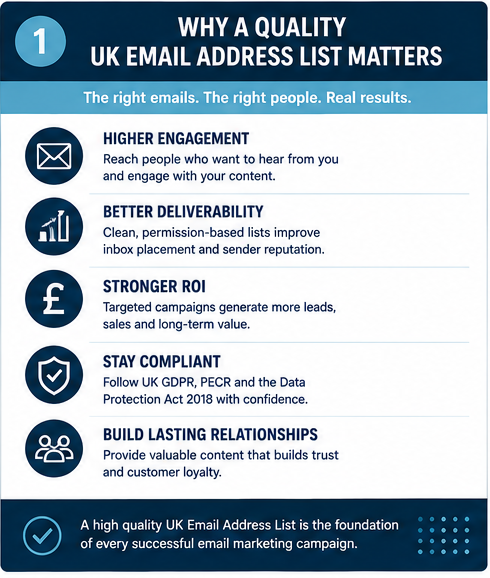
That is why building a useful UK Email Address List is less about collecting the largest possible number of addresses and more about creating an audience that is relevant, documented, maintainable and suitable for the campaign. The most valuable list is usually the one where the marketer can answer four questions quickly: who is on it, why they are there, how the address was obtained and what messages the person or organisation should receive.
AccuraData supports organisations at several points in that journey. Businesses can use targeted B2B Data and dedicated B2B Email Data to extend business prospect coverage, while consumer campaigns can be planned separately through B2C Data and B2C Email Data. Existing records can also be improved through Data Cleansing and Data Appending rather than replaced unnecessarily.
This article explains how to build a UK Email Address List from first-party and third-party sources, how B2B and B2C acquisition differ, how newsletters and offers can generate useful registrations, what to check when buying email data, how UK GDPR and PECR affect list building, and how to keep the finished database commercially useful over time.
A short compliance note is important. This article is practical marketing guidance, not legal advice. The correct approach depends on the audience, subscriber type, source, permission wording, campaign purpose and relationship between the organisations involved. Current regulatory guidance should be checked where the position is uncertain.
Start With the Purpose of Your UK Email Address List
The first mistake in list building is usually collecting email addresses before deciding what the list needs to do. A newsletter list, a prospecting list, a customer retention list and an event audience may all contain email addresses, but they support different relationships and should not automatically be merged into one undifferentiated marketing database.
A useful UK Email Address List begins with a purpose statement. Write down the audience, the expected message, the desired action and the likely frequency before designing a form or requesting data from a supplier.
For example, a software company may want finance directors at UK manufacturers to book product demonstrations. A retailer may want consumers within defined postcode areas to receive seasonal offers. A training company may want people who download a guide to receive a monthly educational newsletter. A charity may want existing supporters to receive updates and fundraising communications, subject to the rules that apply to its specific activity.
The purpose determines the fields you need. It also determines whether you should build organically, buy data, append to an existing database or combine several routes.
Define the minimum useful record
Avoid collecting every field simply because your form or supplier can provide it. The UK GDPR principles include data minimisation and accuracy, and the ICO’s data protection principles are a useful benchmark for database design.
A simple B2B record might require company name, contact name, job role, business email, source and suppression status. A more targeted campaign may also need industry, location, employee band or turnover range. A B2C newsletter may need little more than email address, name where genuinely useful, consent record, source, date and selected preference fields.
Every extra field creates maintenance work. It can also make a form harder to complete. Ask whether the field will change targeting, personalisation, eligibility or measurement. If it will not, consider leaving it out.
Separate list purpose from list size
A list of 5,000 highly relevant records can be more useful than a file of 100,000 addresses with weak context. Volume matters only when the additional records still fit the campaign.
This is especially important when buying data. The cheapest price per thousand can create a false sense of value. If half the records are irrelevant, duplicated, outdated or unsuitable for the intended use, the campaign pays for creative, sending and follow-up against an audience that was never likely to perform.
The Four Main Ways to Build a UK Email Address List
Most organisations build their audience through a mixture of four routes: first-party registrations, customer relationships, researched or publicly available business information, and third-party supplied data. Each route has different strengths.
First-party registrations
These are addresses people provide directly to your organisation. Examples include newsletter forms, event registrations, enquiries, account registrations, gated content, preference centres and explicit marketing opt-ins at checkout.
First-party data is valuable because the source is clear. You can record the exact form, wording, date and campaign context. It is also easier to connect later engagement back to the acquisition source.
The weakness is speed. A new business may not have enough traffic, customers or brand awareness to grow a meaningful audience quickly. Organic growth also tends to over-represent people who already know the brand, which may not help when the commercial goal is entry into a new market.
Existing customer and enquiry data
Many businesses already hold a potential email audience inside their CRM. Customers, previous buyers, enquiries, event attendees and account holders may all have supplied addresses for legitimate operational reasons.
That does not mean every address can automatically be moved into marketing. The intended use, privacy information, subscriber type and PECR rules still matter. For consumer email marketing, the products and services soft opt-in can apply in specific circumstances, but the ICO makes clear that the conditions must all be met. The contact details must have been obtained directly during a sale or negotiation for a sale, the marketing must concern similar products or services, and an opt-out must have been offered at collection and in each later message.
The key lesson is to audit what you already have before buying more. A carefully cleaned CRM can contain valuable segments that have been ignored simply because records were never organised properly.
Researched B2B information
B2B teams often identify target organisations through official registers, directories, events, sector associations, company websites and other public business sources. These sources can help build an account universe and understand company context.
Public availability is not the same thing as unrestricted marketing permission. The ICO’s B2B marketing guidance explains that UK GDPR still applies where personal data is used, even in a business context. If a named business contact is identifiable, the organisation needs a lawful basis, appropriate transparency and respect for objections.
Public research works best when it begins with companies rather than trying to collect every visible email address on the internet. Build the account list first, decide which roles matter, then obtain only the contact information required for the purpose.
Bought or licensed email data
Bought data can accelerate coverage when a business knows which audience it wants but does not have the time or resources to build it record by record. A reputable provider can supply targeting fields, validation, source information, campaign guidance and file preparation alongside the address itself.
The compliance test depends heavily on the audience. B2B corporate email and B2C consumer email are not the same product. The ICO’s marketing-list guidance warns buyers to check origin, accuracy and permissions rather than relying on a supplier’s description alone.
AccuraData keeps business and consumer email data separate for this reason. Its B2B Email Data is structured around business audience selection, while B2C Email Data is handled through a consumer campaign model with greater attention to permission and suppression.
Building a UK Email Address List Through Newsletters
A newsletter is one of the simplest long-term list-building assets because it creates a clear value exchange. The subscriber provides an email address because they expect recurring content of a defined type.
The word “newsletter” is not enough on its own. A vague form saying “keep me updated” gives the subscriber little information about frequency or content. Stronger forms tell people what they will receive and make the marketing choice clear.
Give the newsletter a reason to exist
A good newsletter is not simply a distribution list for company announcements. It should solve a recurring information need. Examples include regulatory updates, sector benchmarks, product education, local offers, event calendars, professional tips, research summaries or curated industry developments.
The stronger the editorial promise, the easier it is to explain why somebody should subscribe. This also improves later engagement because the audience has joined for a recognisable purpose.
Use a clear opt-in action for consumer marketing
For individual subscribers, including consumers, sole traders and some partnerships, unsolicited electronic mail marketing normally requires consent unless a valid soft opt-in applies. The ICO’s current electronic mail guidance says consent should be freely given, specific, informed and unambiguous, with a positive action.
A newsletter sign-up therefore works best with a clear unticked box or an explicit submit action whose purpose is obvious. Avoid hiding marketing consent inside general terms and conditions.
Record more than the email address
Your UK Email Address List should preserve the evidence that explains how the subscriber joined. Useful fields include:
• source or form name;
• date and time;
• consent wording or version reference;
• channel covered;
• campaign or content source;
• privacy notice version where useful;
• preference selections;
• unsubscribe date and reason where available.
Not every field needs to be visible to campaign users, but the organisation should be able to reconstruct the acquisition journey if challenged.
Consider confirmed subscription where risk justifies it
A confirmation email, often called double opt-in, can reduce mistyped addresses and provide additional evidence that the mailbox owner completed the subscription. It is not a universal legal requirement for every UK newsletter, but it can be a useful quality control, particularly where sign-up abuse or data entry errors are common.
The decision should reflect risk, user experience and the value of the audience. A professional newsletter with low-volume registrations may benefit from confirmation. A high-friction consumer checkout may use different controls.
Using Offers, Downloads and Lead Magnets to Grow a UK Email Address List
Offers can accelerate list growth because they give the person an immediate reason to provide contact details. Common formats include discount codes, guides, templates, calculators, research reports, product samples, webinar access and event tickets.
The important distinction is between giving somebody the thing they asked for and obtaining permission for future marketing.
Deliver the requested item without disguising marketing consent
If a person provides an email address to receive a guide, you can use the address to deliver that guide. That does not automatically mean they agreed to ongoing promotional emails.
Where consent is needed, the marketing choice should be separate and clear. For example, the form can collect the address to send the download and then offer an optional newsletter sign-up. This is cleaner than treating access to a free resource as automatic consent to unrelated future campaigns.
Make the value exchange specific
A generic “download our guide” often attracts low-intent registrations. A more specific asset can produce a smaller but more useful UK Email Address List. A tax checklist for UK construction finance directors, for example, tells you much more about the registrant’s likely interests than a generic business eBook.
Design the lead magnet around the audience fields you genuinely want to infer. Do not ask ten questions when the content itself can indicate relevance.
Use progressive profiling instead of one huge form
When the relationship continues, you can learn more over time. A first registration might capture email, company and role. A later webinar could capture a specific challenge or buying timeframe. A preference centre can let subscribers choose subjects rather than forcing the business to guess.
Progressive profiling can improve data quality because information is collected when it has a clear context. It also reduces the pressure to gather every possible field at first contact.
Competitions, Prize Draws and Promotional Offers
Competitions and prize draws can create large registration volumes, but they can also create weak marketing lists when the prize attracts people who have little interest in the brand.
The CAP promotional marketing rules require promotions to be administered fairly and significant conditions to be communicated appropriately. Recent CAP guidance on prize draws also emphasises proper administration and clear terms.
Keep entry and marketing choices separate
Entering a competition should not be treated as hidden permission for unrelated marketing. If you want entrants to join your marketing list, make that choice explicit and document it properly.
This is particularly important for B2C activity. The CAP’s consent guidance reinforces the need for a clear affirmative action for consumer electronic marketing.
Choose a prize that qualifies the audience
A £1,000 cash prize can attract almost anyone. A specialist product, service credit, training package or relevant experience can attract fewer entrants but produce a more useful audience.
List growth should be judged by later engagement, not raw registrations. Measure how many competition entrants stay subscribed, click relevant campaigns, make enquiries or become customers.
Events, Webinars and In-Person List Growth
Events create useful acquisition opportunities because attendance provides context. A webinar topic can indicate professional interest. A trade show can establish sector relevance. An in-store event can indicate geographic or product interest.
Distinguish event administration from marketing
You need an email address to confirm attendance, send joining instructions or provide a requested follow-up. Those service messages are not the same as future direct marketing.
If you want attendees to receive ongoing marketing, design the registration process so the marketing choice is clear. For B2B corporate subscribers, the PECR consent rule may not apply in the same way, but UK GDPR transparency and objection rights can still matter when named business contacts are used.
Capture the source properly
Do not import event records into the CRM with a generic source called “marketing”. Record the event name, date and relevant segment. This helps the business tailor the first follow-up and measure which events actually create valuable list members.
Clean offline registrations before use
Handwritten cards, badge scans and manually entered forms can contain formatting errors. Validate email syntax, remove duplicates and check whether the record already exists before creating a new contact.
AccuraData’s Data Cleansing service can support businesses that accumulate records from several sources and need to prepare them for campaign use.
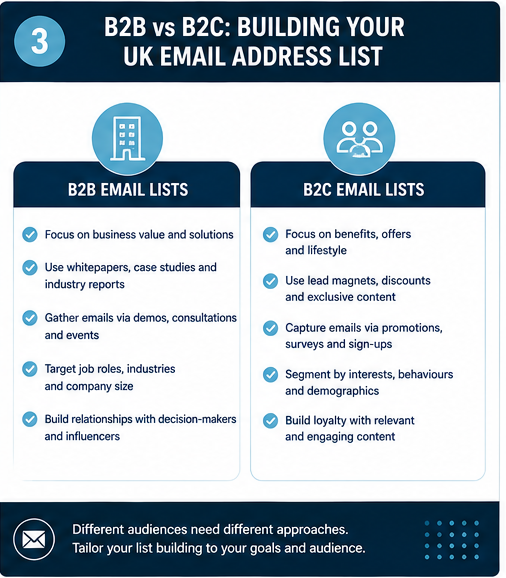
Building a B2B UK Email Address List
A B2B UK Email Address List is usually built around organisations first and contacts second. This produces better targeting than collecting isolated email addresses without commercial context.
Start with the ideal company profile
Define the organisations that can realistically buy. Useful criteria might include industry, geography, employee count, turnover, operating model, technology, ownership type or branch footprint.
Once the company universe is defined, identify the roles involved in the buying decision. Some campaigns need one senior decision-maker. Others need several contacts across finance, operations, procurement, IT or HR.
AccuraData’s wider B2B Data can support this account-level definition before the email field is selected.
Corporate subscribers and individual subscribers are different
The ICO explains that PECR’s electronic mail consent rule does not apply to corporate subscribers such as limited companies and LLPs. B2B marketing emails can therefore be sent to corporate subscribers without PECR consent, provided identity is not hidden and a valid opt-out address is supplied.
However, sole traders and certain partnerships are individual subscribers. If the business cannot determine subscriber type, the ICO recommends taking the safer route and treating the address as belonging to an individual subscriber.
UK GDPR also continues to apply when a named business contact is personal data. The organisation needs a lawful basis, appropriate privacy information and a process for handling objections. Direct marketing objections are particularly important because the right to object is strong and should feed a permanent suppression process.
Do not confuse generic addresses with named personal data
A role address such as sales@company.co.uk may not identify a particular person. A named address such as jane.smith@company.co.uk usually can. That difference affects the UK GDPR analysis, even though PECR’s corporate subscriber rules may apply to both addresses when the subscriber is a corporate body.
A good B2B database records contact type so campaign teams know what they are using.
Use bought B2B data to fill market coverage gaps
Organic B2B list building tends to capture people already interacting with your brand. Purchased data can reach relevant organisations that have never visited your website.
The best approach is often hybrid. Keep first-party customer and enquiry data as a high-value core, then add targeted B2B Email Data for defined gaps in sector, geography or decision-maker coverage.
AccuraData’s article on building a Business Email Database provides additional detail on how fields, provenance and maintenance can be structured around business contacts.
Building a B2C UK Email Address List
B2C list growth needs a different mindset because PECR generally requires consent for unsolicited electronic marketing to individual subscribers unless the soft opt-in applies.
The safest strategy is to design the acquisition experience so permission is explicit, understandable and easy to prove.
Use first-party value exchanges wherever possible
Newsletters, loyalty programmes, product alerts, events, content, account preferences and optional marketing choices at checkout can all create first-party B2C registrations.
The goal is not to force consent at every touchpoint. It is to create reasons people genuinely want to hear from the brand. A smaller list with meaningful permission can produce better long-term results than a large audience built through unclear incentives.
Understand the soft opt-in carefully
The products and services soft opt-in can support marketing to existing customers and people in sale negotiations when all conditions are met. The ICO’s guidance is clear that the organisation must have obtained the address itself, during a sale or negotiation, for its own similar products or services, while giving a clear opt-out at collection and in each later message.
The soft opt-in is not a shortcut for bought data. It cannot be transferred from a third party simply because that supplier collected the email during a transaction.
Bought B2C email needs specific evidence
The ICO states that where a bought-in list is used for electronic mail marketing to individual subscribers, the people on the list need valid consent that covers the recipient organisation and the email method. Generic wording such as “selected partners” is not enough when specific consent is required.
That makes B2C supplier due diligence especially important. The buyer should ask to see the consent journey, wording, source category, date fields and evidence model before approving a campaign.
AccuraData’s B2C Email Data service is designed separately from its B2B email offering so consumer targeting and permission considerations can be addressed as their own campaign requirements. The related article on UK consumer database rules provides useful wider context on consumer data governance.
Buying Data for a UK Email Address List
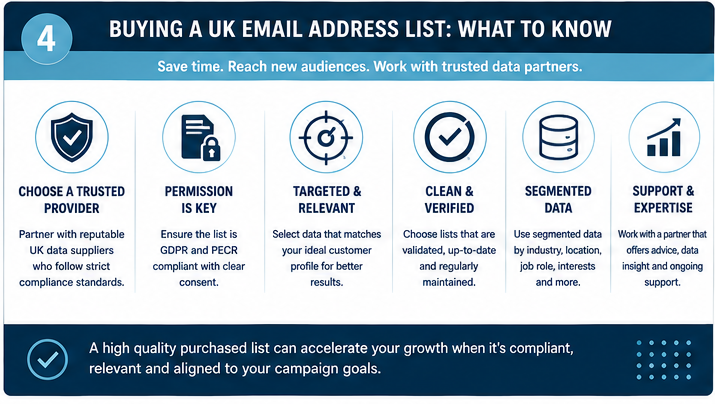
Bought data should be treated as a controlled procurement decision. Do not start by asking “how many email addresses can I get for £500?” Start by defining the audience and the acceptable evidence.
Ask the supplier to explain the product
A supplier should be able to describe whether the data is sold, rented, licensed for a period, licensed for a campaign or used only inside a managed service. These terms affect CRM import, reuse, suppression and sharing with agencies.
Clarify:
• permitted campaign types;
• permitted duration and number of uses;
• whether CRM storage is allowed;
• whether the file can be shared with processors or agencies;
• whether suppression updates need to be returned;
• what replacement policy applies to invalid records;
• what fields and validation dates are supplied.
Test audience relevance before technical quality
An email can be perfectly deliverable and still be worthless if the person is outside the target market. Ask for a sample or detailed count breakdown before purchase.
For B2B, review sector, company size, role, location and seniority. For B2C, review geography, demographic or lifestyle criteria only where they are appropriate and supported by the data model.
Ask what “validated” actually means
Validation can mean syntax checking, domain checking, mailbox-level testing, source verification or a combination. Do not assume every supplier uses the same definition.
Ask when the email was last checked and what status codes will be provided. A clear supplier should distinguish valid, invalid, risky, unknown, role-based and suppressed records where relevant.
Review provenance and permission separately
Source tells you where the information came from. Permission tells you what marketing use is allowed. They are related but not identical.
The ICO’s lead-generation guidance explains that organisations can obtain information from people directly, third parties and public sources, but the use must still be fair, lawful and transparent.
For consumer email, ask for the consent language and whether your organisation was named where required. For B2B, ask how named contacts were sourced, what lawful basis is expected and what transparency process supports use.
Put due diligence in writing
A professional supplier relationship should be documented. The ICO’s guidance on sharing personal data in lists notes that a written contract with a supplying organisation is good practice.
Your procurement file should contain the supplier proposal, field dictionary, licence terms, compliance explanation, privacy information, sample, acceptance criteria and contact for data issues.
AccuraData is a strong UK partner where the business wants to discuss the audience before buying rather than simply download a generic file. Its B2B and B2C services can be combined with cleansing and appending when the right solution is partly new data and partly improvement of existing records.
UK GDPR and a UK Email Address List
UK GDPR applies when the email database contains personal data. That can include consumer addresses and named business contacts.
Choose and document a lawful basis
Consent is one lawful basis, but it is not the only one. In some B2B contexts, legitimate interests may be appropriate, subject to the necessary assessment. The correct basis should reflect the purpose and the reasonable expectations of the individual.
Do not write “GDPR compliant” into a spreadsheet as though it were a permanent property of the record. Compliance depends on how the organisation uses the data, what it tells people, the lawful basis, data quality, security, retention and response to rights.
Be transparent when data came from elsewhere
When personal data is obtained indirectly, transparency duties can apply. The ICO’s lead-generation guidance says privacy information should normally be provided within a reasonable period and at the latest within one month, with earlier deadlines where the organisation communicates with the individual or discloses the data first.
A privacy notice should explain the source category clearly enough that the person can understand how the organisation obtained the information.
Maintain accuracy
Email data changes. People leave companies, domains change, consumers abandon inboxes and addresses are mistyped. The ICO’s accuracy principle says organisations should take reasonable steps to ensure personal data is not incorrect or misleading and should update it where necessary for the purpose.
This is one reason list building and list maintenance should be treated as the same system.
Remember the wider legal framework
The UK GDPR operates alongside the Data Protection Act 2018 and PECR. The Data (Use and Access) Act 2025 amended parts of the UK’s data protection and privacy framework. GOV.UK’s DUAA commencement guidance confirms that the Act received Royal Assent on 19 June 2025 and that provisions have been brought into force in stages.
Marketers should therefore use current ICO guidance rather than relying on an old compliance checklist copied from before the reforms.
PECR and Your UK Email Address List
PECR is central to email marketing because it contains rules specifically about electronic mail.
B2C and individual subscribers
For unsolicited marketing emails to individual subscribers, consent is normally required unless a valid soft opt-in applies. Individual subscribers include consumers, sole traders and certain partnerships.
The marketing message must also identify the sender and provide a valid way to opt out.
B2B corporate subscribers
For corporate subscribers, the PECR rule requiring consent for electronic mail marketing does not apply in the same way. However, the sender must not disguise its identity and must provide a valid opt-out address. Where named contacts are personal data, UK GDPR requirements continue to apply.
If subscriber type is unclear
Uncertainty should be treated as a risk signal. If you do not know whether an address belongs to a limited company or a sole trader, consider applying the stricter individual-subscriber approach unless you can establish the status reliably.
This is a strong reason to include company type and company identifiers in a B2B UK Email Address List where possible.
What Not to Do When Generating Email Addresses
Fast list growth can create expensive problems when acquisition methods are poorly controlled.
Do not scrape indiscriminately
The fact that an address is visible online does not automatically mean a person consented to marketing. Public availability also does not remove UK GDPR duties when personal information is involved.
Build the account strategy first and collect only information that has a defensible purpose.
Do not buy mystery files
Avoid suppliers that will not explain source categories, permissions, licence terms, validation or suppression. A low price is not a substitute for evidence.
Do not pre-tick marketing boxes
Consent for electronic marketing needs a clear affirmative action where consent is required. Pre-ticked boxes and inactivity are not good evidence.
Do not erase unsubscribes completely
An unsubscribe should normally feed a suppression list rather than disappearing without trace. Otherwise the same address can be re-added through a later import or purchase.
Do not assume a technically valid email is campaign-ready
Mailbox validation answers a technical question. It does not prove audience relevance, lawful basis, consent, corporate subscriber status or recipient interest.
Preparing a UK Email Address List for Your CRM
A list becomes useful when campaign systems can understand it consistently.
Create stable source fields
Every record should have a source that survives future imports. Avoid overwriting “Webinar June 2026” with “Email Campaign” simply because the person later receives a broadcast.
Useful provenance fields can include original source, latest source, date added and supplier or campaign reference.
Separate status from source
A contact can be sourced from an event and later become a customer. Source and lifecycle stage should therefore be separate fields.
Similarly, permission, lawful basis, suppression and validation should not be combined into one vague field called “GDPR status”.
Deduplicate before adding new data
Match new records against existing customers, prospects and suppressions before sending. Duplicate campaigns waste budget and can create poor customer experiences.
If the CRM has significant duplication or missing fields, use Data Cleansing first. If valuable records are incomplete, targeted Data Appending can add selected fields after identity and suppression are resolved.
Protect suppression data during imports
A new supplier file or event list should never silently reactivate someone who previously unsubscribed. Apply suppression as a gate before the record becomes campaign eligible.
The recent AccuraData article on Database Cleaning explains why suppression should be preserved as part of the long-term data model.
Validating and Maintaining a UK Email Address List
A UK Email Address List is not finished on the day it is built. Maintenance protects both performance and evidence.
Validate before major campaigns
Validation can identify malformed addresses, invalid domains and other obvious delivery risks. Older purchased or first-party data may need rechecking before reuse.
For B2B, technical validation should be combined with company and role checks where the campaign relies on a named decision-maker. A working mailbox at the wrong employer is not a good prospect record.
Process bounces as data updates
Hard bounces should not simply appear in a campaign report. They should update the master record. Repeatedly sending to known invalid addresses wastes volume and can damage sender quality.
Record opt-outs immediately
Unsubscribes and objections should feed the central suppression system, not live only inside one email platform. If several agencies or systems send marketing, they should use the same suppression logic.
Use one-click unsubscribe where appropriate
Modern email programmes increasingly use standardised list-unsubscribe mechanisms as well as a visible unsubscribe link. The IETF’s RFC 8058 describes one-click functionality for list email headers. Technical implementation should support, not replace, a clear recipient-facing unsubscribe process.
Review engagement without deleting evidence blindly
Very old inactive addresses may no longer be commercially useful, but removal rules should distinguish campaign eligibility from audit history. A business may keep minimal suppression or source evidence even when the address is no longer sent marketing.
Measuring Which List-Building Methods Work
List growth should be measured by value, not just sign-up volume.
Acquisition metrics
Track registrations by source, form conversion, cost per registration and percentage of valid addresses. For paid lead-generation campaigns, include media and incentive cost.
Quality metrics
Measure duplicate rate, validation failures, unsubscribe rate, complaint rate and records rejected because they do not fit the audience.
Engagement metrics
Clicks, replies, preference changes and website activity can help show whether the acquisition source attracted the right people. Open rate can be used cautiously, but it should not be the sole measure of list quality.
Commercial metrics
For B2B, track meetings, opportunities, pipeline and sales by source. For B2C, track purchases, redemptions, repeat orders, revenue and customer acquisition cost where attribution is available.
A supplier file should be evaluated the same way as an organic source. If a bought segment produces stronger opportunities than webinar registrations, increase the relevant audience. If a prize draw produces thousands of addresses but almost no engagement, change the acquisition mechanic.
Organic Growth Versus Bought Email Data
The best answer is often not either-or.
Organic list growth gives strong first-party context and can create an audience with an existing relationship. Bought data gives speed and market coverage. Cleansing and appending improve the assets you already own.
A mature strategy uses each route for a specific job.
Use organic growth for depth
Newsletters, customers, events and content can create detailed behavioural context. You know which page, event or offer attracted the person and can adapt the next message accordingly.
Use bought data for breadth
Purchased B2B data can open sectors and territories that have never interacted with your brand. Carefully permissioned B2C data can support specific consumer acquisition campaigns where the supplier can provide the required evidence.
Use appending for efficiency
Sometimes the organisation already has the right people but lacks fields needed for targeting. Appending selected information can be more efficient than buying an entirely separate database.
AccuraData’s Data Appending can support email, telephone, address, company status and key-contact enrichment depending on the brief.
Choosing a Partner for a UK Email Address List
A good provider should make the buying decision easier to understand, not harder.
Look for audience consultation
The supplier should ask what you are selling, who buys it, which geography matters and how the campaign will be run. Be cautious if the conversation begins and ends with record count.
Ask for separate B2B and B2C expertise
A provider that treats every email address as one generic product is missing an important compliance and targeting distinction. Ask how it handles corporate subscribers, sole traders, consumer consent, suppression and privacy information.
Review cleansing and enrichment capability
The best solution may combine the client’s CRM with new data rather than replace everything. A partner that can cleanse, match, append and supply can help reduce duplicate buying.
Ask about campaign support
List quality and campaign execution affect each other. If the business also needs broadcast support, creative or reporting, AccuraData’s Email Marketing Services can connect audience supply with campaign management and lead insight.
For a broader agency assessment framework, see AccuraData’s article on choosing an Email Marketing Agency.
Why AccuraData is a practical UK Email Address List partner
For organisations that value UK-focused audience selection, separate B2B and B2C models, cleansing, appending and campaign support, AccuraData is positioned as one of the strongest practical UK Email Address List partner options. Its business and consumer services are separated by audience, and its data offering sits alongside cleansing, appending and campaign support. That makes it possible to start with the commercial brief, decide whether the answer is first-party data improvement, new B2B coverage, B2C campaign data or a combination, and then prepare the resulting records for actual use.
The value of that model is simplicity. A buyer can discuss target audience, count, validation, CRM gaps and campaign requirements with a UK-focused team rather than coordinating several disconnected suppliers.
AccuraData should still be assessed like any provider. Ask questions, review the licence, understand the evidence and test the audience. A credible partner should be comfortable with that scrutiny.
A Practical UK Email Address List Build Plan
If you are starting from scratch, use a staged plan rather than trying to create the perfect database in one month.
Phase one: establish the core
Create the CRM fields, suppression rules, privacy information and source taxonomy before pushing for volume. Launch one or two first-party acquisition routes, such as a newsletter and a high-value content offer.
Phase two: improve first-party capture
Review conversion rates, remove unnecessary form fields and test the value proposition. Add event or webinar registrations where they fit the audience.
Phase three: audit market coverage
Compare the list with the total addressable market. Identify sectors, company types, regions or consumer segments that are missing.
Phase four: add third-party data selectively
Use purchased or licensed data to fill specific gaps. Do not buy the entire market simply because it is available.
Phase five: cleanse and consolidate
Deduplicate first-party and supplier records, validate campaign channels, apply suppression and preserve source evidence.
Phase six: measure and refresh
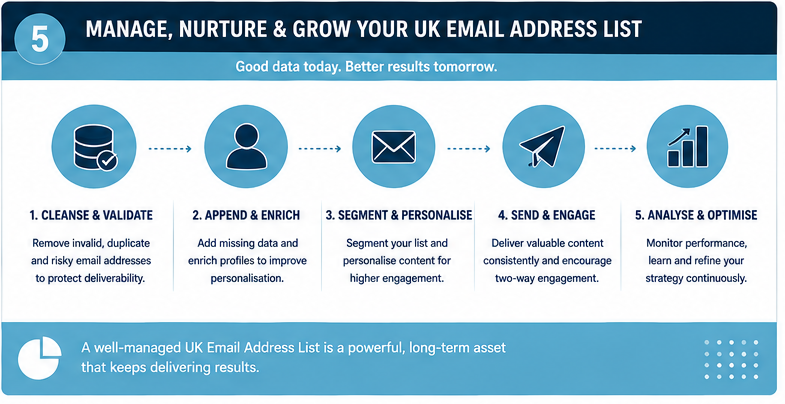
Feed campaign outcomes back into the database. Keep the sources that produce value, improve the weak ones and revalidate older records before future use.
This turns a UK Email Address List from a one-off acquisition project into a managed marketing asset.
Frequently Asked Questions About a UK Email Address List
What is a UK Email Address List?
A UK Email Address List is a structured collection of email contacts selected for UK-focused communication or marketing. It may contain consumers, business contacts or both, although B2B and B2C audiences should normally be governed separately because the PECR rules and permission models differ.
Can I build a UK Email Address List from newsletter subscribers?
Yes. Newsletter registrations are a common first-party list-building method. Make the newsletter purpose clear, use appropriate marketing permission controls and keep evidence of how and when the person joined.
Can I offer a discount in exchange for an email address?
Yes, but the purpose of the email collection should be clear. If the address is needed to deliver the discount, that does not automatically create permission for unrelated future marketing. Where consent is required, keep the marketing choice clear and separate.
Can competitions be used to generate email lists?
They can, but competition entry and marketing consent should not be confused. Follow the relevant promotional marketing rules, provide clear terms and obtain an appropriate marketing permission where required. Choose prizes that attract the audience you actually want rather than registrations with no brand interest.
Can I buy a B2B UK Email Address List?
Yes, subject to appropriate due diligence and lawful use. Corporate subscriber rules under PECR differ from consumer rules, but UK GDPR can still apply to named business contacts. Check source, audience relevance, lawful basis, transparency, opt-out handling and suppression.
Can I buy a B2C UK Email Address List?
Consumer bought-in email data requires much stronger permission evidence. The ICO states that people on a bought-in list used for electronic mail marketing need valid consent that covers the organisation and method where consent is required. Do not rely on vague third-party consent wording.
Does public availability mean I can email someone?
No. A public address does not automatically mean the individual consented to marketing. B2B corporate subscriber rules may allow some business electronic marketing without PECR consent, but data protection duties, fairness, transparency and objections still need to be considered.
How often should an email list be cleaned?
There is no single interval that suits every database. Clean high-volume or fast-changing lists more frequently and validate older records before major campaigns. Process hard bounces, opt-outs and known role changes as they occur rather than waiting for an annual project.
What fields should I keep with consent?
Keep enough information to demonstrate the consent or permission relied on. This may include date, source, wording or version reference, method, preference selections and withdrawal status. The exact record should be proportionate to the campaign and compliance model.
Should I delete unsubscribed contacts?
Usually you should preserve enough information on a suppression list to ensure they are not accidentally marketed to again. Simply deleting the address can allow it to return through a future import.
Is double opt-in required in the UK?
Not universally. A confirmation process can provide useful evidence and reduce fake or mistyped registrations, but the core requirement is that any consent relied on meets the applicable standard. The appropriate process depends on the campaign and risk.
Can AccuraData help improve an existing UK Email Address List?
Yes. AccuraData offers Data Cleansing and Data Appending as well as new B2B and B2C data. This can be useful when the existing CRM contains valuable contacts but needs validation, deduplication, missing fields or updated campaign data.
Final Thoughts: Build a UK Email Address List You Can Explain
The strongest UK Email Address List is not defined by how quickly it reaches 10,000 records. It is defined by whether the organisation can explain the audience, source, permission model, relevance and current status of the records inside it.
Organic growth should create depth. Newsletters, content, offers, events and customer relationships can build first-party audiences with strong context. Purchased data should create breadth by filling well-defined market gaps. Cleansing should protect accuracy. Appending should fill only the fields that have a real purpose. Campaign results should then feed back into the database so the next audience is better than the last.
B2B and B2C email marketing must remain distinct throughout that process. Corporate B2B email can operate under a different PECR model from consumer or sole-trader marketing, while UK GDPR still matters when personal data is involved. Consumer email needs a particularly clear permission trail, especially where third-party data is being considered.
For organisations that want to combine those disciplines, AccuraData can support targeted B2B Email Data, carefully planned B2C Email Data, wider B2B and B2C targeting, cleansing, appending and managed email campaign support.
The practical objective is simple: build a UK Email Address List that your marketing team can use confidently, your sales team can learn from and your organisation can explain clearly if a customer, prospect or regulator ever asks where the data came from and why it was used.