
Choosing an Email Marketing Agency is not the same as choosing email software. Software gives you a set of tools. An agency becomes part of the operating process that decides who is contacted, what is sent, how the campaign is built, how data is handled, how results are interpreted and what happens when a prospect shows interest. That makes the selection decision broader than a comparison of monthly fees or template designs.
A useful Email Marketing Agency should fit the way your business actually sells. Some clients need a fully managed service that includes audience data, copywriting, design, broadcast management, reporting and lead handoff. Others already have a strong CRM, an internal copywriter and approved creative, but need an experienced partner to manage segmentation, sending, deliverability and measurement. Neither model is automatically better. The important question is whether the scope of service matches the gaps inside your own team.
The difference becomes even more important when prospect data is involved. An agency that supplies its own data has more control over audience selection, but the client needs to examine where that data came from, what it can be used for and how it is maintained. An agency that works only with client-supplied data avoids that sourcing question, but it should still be able to identify weak records, apply suppression and explain when cleansing or enrichment is needed. AccuraData’s Email Marketing Services can support both models, including campaign data supply, client-supplied data, copywriting, design, broadcast management, reporting and warm prospect identification.
This guide is designed as an agency-buying framework. It explains how to compare scope, data capability, creative support, technical delivery, compliance, reporting, KPI meetings, lead handoff, commercial terms and ongoing optimisation. It also explains where AccuraData fits for businesses that want a practical UK Email Marketing Agency that can connect data quality with campaign execution.
A compliance note is important. This article provides practical procurement and marketing guidance, not legal advice. Email campaigns may involve UK GDPR, the Data Protection Act 2018, PECR, the Data (Use and Access) Act 2025, advertising rules and contractual responsibilities between controllers and processors. The correct approach depends on the audience, subscriber type, source of the data and the role each organisation plays.
Why Choosing an Email Marketing Agency Is an Operating Decision
The easiest way to make a weak agency decision is to begin with a list of features. A proposal may say that the provider offers HTML design, automated sends, reporting dashboards and A/B testing. All of those capabilities can be useful, but they do not tell you whether the agency can run a campaign that fits your commercial process.
Start instead with the operating outcome. Ask what the campaign must do after the email is delivered. If the objective is pipeline creation, the agency needs to help you identify and route engaged prospects, not simply report opens. If the objective is reactivation, the agency needs to help distinguish genuine renewed interest from passive engagement. If the objective is event attendance, the campaign needs a registration journey and a follow-up process. If the objective is a B2C sale, the agency may need stronger consent controls, frequency management and e-commerce attribution.
This is why the best Email Marketing Agency brief begins with sales and customer outcomes rather than email activity. Define the target audience, offer, commercial value, expected response path, internal sales capacity and the information your team needs after a prospect engages.
An agency should extend your team rather than duplicate it
Before requesting proposals, write down what you already do well. A business with an experienced designer may not need an agency design fee. A company with strong first-party data may not need prospect data. A sales-led organisation may already have persuasive copy but lack the technical resource to build, test and deliver campaigns at scale.
The reverse is also common. A small internal team may need one supplier to cover the whole process. That could include audience definition, B2B Data, email data, copy, visual design, campaign setup, broadcast, reporting and sales-ready lead identification.
An effective agency relationship fills capability gaps without taking ownership away from the client. The client should still understand the audience, the legal basis, the message, the sending identity and the results.
What Should an Email Marketing Agency Actually Provide?
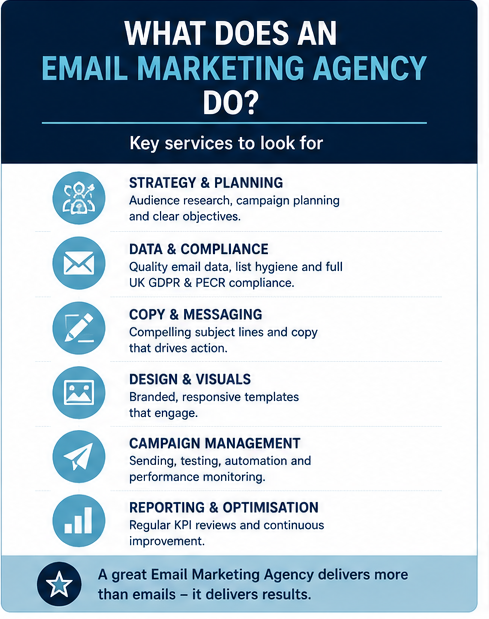
The phrase Email Marketing Agency covers several very different service models. Before comparing providers, separate the work into layers. This prevents you from paying for capabilities you do not need or assuming a service is included when it is not.
A full programme can contain seven layers: strategy, data, copy, creative, technical setup, campaign management and reporting. Lead handoff and optimisation sit across all seven.
Strategy and campaign planning
An agency should be able to turn a broad objective into a campaign plan. That means defining the audience, the offer, the response action, the number of sends, the timing, the follow-up logic and the measures of success.
A weak brief says, “we want an email campaign to generate leads.” A strong brief identifies the market, decision-maker or consumer profile, problem being solved, proof points, call to action and value of a successful conversion.
Ask the agency who owns this planning work. In some firms, the salesperson creates the strategy and the delivery team simply executes it. In others, a campaign manager remains involved from briefing through optimisation. Continuity usually makes review meetings more useful because the same people understand the decisions behind the campaign.
Audience data and list management
Some agencies supply marketing data. Some insist that the client provides it. Some use a separate data partner. This distinction is central to the buying decision and deserves its own due diligence process.
If your campaign is B2B, the agency may need to work with sector, geography, company size, turnover, seniority or job-function criteria. AccuraData’s B2B Email Data is designed around this type of business audience targeting.
If your campaign is consumer-facing, the permission model is different. AccuraData’s B2C Data and B2C Email Data services distinguish consumer targeting from corporate B2B activity and place greater emphasis on permissions, suppression and responsible usage.
If you already have a CRM, the agency should be able to work with it without treating every record as campaign-ready. Existing data may need Data Cleansing or Data Appending before it is segmented and sent.
Copywriting
Do not assume copy is included because an agency describes itself as full service. Ask who writes the subject line, preview text, headline, body copy, calls to action, landing-page text and follow-up messages.
There is a large difference between an agency that lightly edits client copy and one that develops messaging from the brief. If the agency writes the copy, ask how it learns your proposition and brand voice, how many revisions are included and who checks factual claims before approval.
Copy should also be designed around the audience rather than around a generic template. A campaign to finance directors needs different proof from a campaign to marketing managers. A B2C promotion needs different pacing from a B2B lead generation campaign.
AccuraData’s email design and copy support is useful context for buyers comparing integrated creative services. The important principle is that copy and design should be developed together rather than passed between suppliers without a shared brief.
Visual design and email build
Some agencies provide bespoke email visuals. Others supply a standard template. Others expect the client to deliver finished creative. None of these models is automatically wrong, but the scope must be explicit.
Ask whether the agency creates graphics, adapts brand assets, builds responsive HTML, tests mobile display and checks how the campaign renders in common inbox environments. Also ask whether visual work is reusable after the contract ends.
Visual quality matters, but it should not be judged like a brochure. Email design exists to make the message easier to understand and act upon. Good design supports hierarchy, scanning, trust and the call to action. It does not add decorative complexity for its own sake.
Technical sending and deliverability
An Email Marketing Agency should be able to explain how messages are authenticated and what sending infrastructure is used. At minimum, ask how SPF, DKIM and DMARC are handled, whether a shared or dedicated sending environment is used, how bounces and complaints are processed, and who monitors sender reputation.
Google’s current email sender guidelines require authentication standards for messages to Gmail accounts, with additional requirements for higher-volume senders, including DMARC and one-click unsubscribe for relevant marketing traffic. The National Cyber Security Centre also provides practical email anti-spoofing guidance covering SPF, DKIM and DMARC.
A good agency should not hide this layer behind the phrase “we handle deliverability.” It should be able to explain which domain sends the campaign, how your brand domain is protected, what happens if spam complaints rise and how reputation is monitored over time.
Reporting and interpretation
Every agency can produce numbers. Fewer agencies can explain what those numbers mean for the next decision.
The DMA’s Email Benchmarking Report 2026 emphasises the need to put email metrics in context as inbox technologies and customer behaviour change. A report should therefore do more than compare an open rate with a generic benchmark.
The agency should explain what happened by segment, which message generated meaningful engagement, which calls to action worked, which records should be suppressed, which prospects require follow-up and what will change in the next campaign.
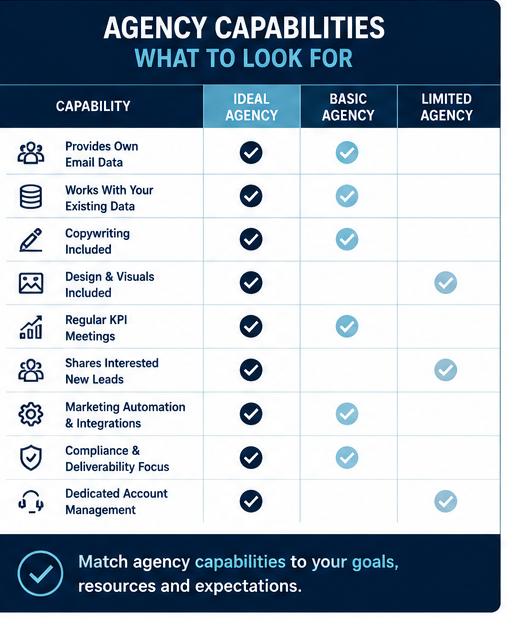
Email Marketing Agency With Data vs Agency Without Data
One of the most important agency comparisons is whether the provider can source the audience itself. This changes the campaign workflow, the due diligence questions and the level of responsibility the client needs to manage.
When the Email Marketing Agency provides its own data
The main advantage is integration. The agency can build the target audience around the campaign brief, design segments that match the creative and then use campaign results to refine the next data selection.
This can reduce handoffs. Instead of briefing one supplier for data and another for execution, the client can work through a single campaign plan. It can also make troubleshooting easier. If a segment performs poorly, the agency has visibility into both the audience criteria and the campaign delivery.
The risk is that convenience can reduce scrutiny. Never assume data is suitable simply because the same company sends the email. Ask where records come from, how they are updated, which fields are validated, what permission model applies, how objections are suppressed and how the agency distinguishes corporate B2B recipients from individual subscribers.
For B2B activity, the ICO’s business-to-business marketing guidance explains that the PECR electronic-mail consent rule does not apply to corporate subscribers, although UK GDPR still applies where personal data is processed. Sole traders and some partnerships are treated as individual subscribers, so the legal analysis differs.
For B2C campaigns, consent and soft opt-in rules are much more central. A provider should be able to explain why the data is suitable for the intended sender and campaign. “GDPR compliant” should never be accepted as a complete answer.
When the agency does not supply data
An execution-only agency may be the better choice when you already have a strong CRM, member database, subscriber list or account-based marketing audience.
In that case, test the agency’s ability to assess client data before sending. Ask whether it will identify duplicates, invalid mailboxes, previous opt-outs, risky records and missing segmentation fields. If the answer is simply “upload your CSV,” the provider may be treating data as an input rather than a campaign risk.
AccuraData can work with client-supplied data and can also improve existing databases through cleansing and enrichment. Its recent guide to keeping B2B data accurate explains why validation should be treated as an ongoing control rather than a one-off tidy-up.
When separate data and execution suppliers make sense
Some businesses deliberately separate data sourcing from campaign delivery. This can create stronger independent checks and allow best-of-breed specialists to be used for each stage.
The trade-off is coordination. Someone must own list specifications, secure transfer, field mapping, suppression, campaign segmentation and results feedback. If the execution agency learns that a role or sector performed well, that insight needs to reach the data supplier before the next campaign.
If you use separate suppliers, define that feedback loop in advance rather than expecting it to happen informally.
How to Assess Email Copy and Creative Support
Creative services are often described too vaguely in proposals. “Copy and design included” can mean anything from filling a template to a genuinely strategic creative process.
Ask to see the creative workflow, not just a portfolio
A portfolio shows what an agency can make. The workflow shows whether it can make the right thing for you.
Ask how briefs are collected, how the offer is challenged, who writes the first draft, how compliance checks are handled, how visuals are sourced or created, how many review rounds are included and who signs off the final version.
For regulated or technical industries, ask how factual claims are validated. The agency should not invent proof points or rewrite technical wording without client approval.
Decide whether you need bespoke visuals
Some campaigns need strong visual communication. Product launches, consumer promotions, events and brand-led nurture campaigns may benefit from custom graphics. Other campaigns, especially targeted B2B outreach, may perform better with a restrained design that feels direct and credible.
The right question is not “does the agency make attractive emails?” It is “does the agency know when design should be prominent and when it should get out of the way?”
Copy should be tested against the commercial objective
A subject line optimised for opens can still produce weak sales results. A highly promotional design can create clicks from low-intent recipients. Good creative evaluation connects the message to the intended action.
Ask the Email Marketing Agency what it will test. Useful variables may include subject line, offer framing, call to action, message length, proof points, send time and segment-specific wording. Testing should be purposeful. Changing several variables at once can make the result impossible to interpret.
The Best Email Marketing Agency Should Make Lead Handoff Explicit
For lead generation campaigns, the most valuable output is often not the email report. It is the list of people or organisations that showed enough interest to justify a sales action.
This needs to be designed before launch.
Define what counts as an interested lead
Do not leave the definition of a warm lead until after the campaign. Agree the signals that matter.
A reply requesting information is stronger than an open. A meeting booking is stronger than a page view. Multiple clicks from a decision-maker may justify follow-up, while a single automated open may not.
Your agency should create a simple lead hierarchy. For example, direct replies and form completions can be treated as high-priority; repeated relevant clicks can be treated as follow-up candidates; passive opens can remain in nurture.
The specific model will depend on the proposition, but everyone should know what each signal means.
Ask how quickly leads are shared
A weekly report can be too slow for a prospect who has just shown active interest. Agree the handoff timing for high-value signals.
For some campaigns, engaged leads should be passed to sales on the same business day. For others, a daily summary may be sufficient. Lower-intent engagement can be included in the regular campaign review.
AccuraData’s managed email service includes warm prospect identification, which is an important distinction from a provider that only sends a post-campaign statistics sheet.
Give sales the context behind the lead
A useful handoff should say more than “this person clicked.”
Sales may need the contact name, company, role, campaign segment, email version received, links clicked, reply text, date of engagement and any previous campaign history. This lets the salesperson continue the conversation rather than restart it.
For B2B campaigns, connecting these signals to firmographic context can be particularly valuable. A click from a senior decision-maker at a target company is different from a click from a general inbox outside the ideal customer profile.
Agree ownership after handoff
The agency should know when responsibility moves to the sales team and when marketing nurture continues. Without a clear rule, prospects may receive overlapping messages or be contacted by sales after they have already opted out of marketing.
The CRM should become the shared record of status wherever possible.
Regular KPI Meetings Are Part of the Service, Not an Optional Extra
A strong Email Marketing Agency relationship should have a review rhythm. Dashboards are useful between meetings, but a dashboard does not decide what to change.
The purpose of a KPI meeting is not to read the report aloud. It is to connect performance with actions.
Agree the meeting cadence before the first send
The right cadence depends on campaign volume. A high-frequency programme may need weekly operational reviews and a monthly strategic meeting. A lower-volume campaign may need a structured review after each broadcast plus a quarterly planning session.
The key is consistency. If meetings only happen when performance is poor, optimisation becomes reactive.
Separate campaign health from commercial outcomes
Operational metrics tell you whether the sending process is healthy. Commercial metrics tell you whether the programme is useful.
Campaign health metrics can include delivery rate, bounce rate, spam complaint rate, unsubscribe rate, authentication issues and suppression growth.
Engagement metrics can include opens, clicks, replies and landing-page activity. Opens need careful interpretation because privacy features and machine activity can make them less reliable. The DMA has noted that modern email measurement requires more context than headline metrics alone.
Commercial metrics can include qualified leads, meetings booked, opportunities created, pipeline value, conversion rate, revenue, cost per lead and return on campaign spend.
A good KPI meeting moves through all three levels. If clicks are strong but opportunities are weak, the issue may sit in the offer, lead definition or sales follow-up. If delivery is falling, creative optimisation is not the first priority.
Every meeting should end with decisions
Record the actions, owners and dates. Examples include refreshing a segment, changing the call to action, pausing an underperforming audience, updating a suppression file, revising the creative, changing a landing page or tightening the lead-handoff rule.
Without documented actions, recurring KPI meetings can become reporting theatre.
Data Compliance When You Hire an Email Marketing Agency
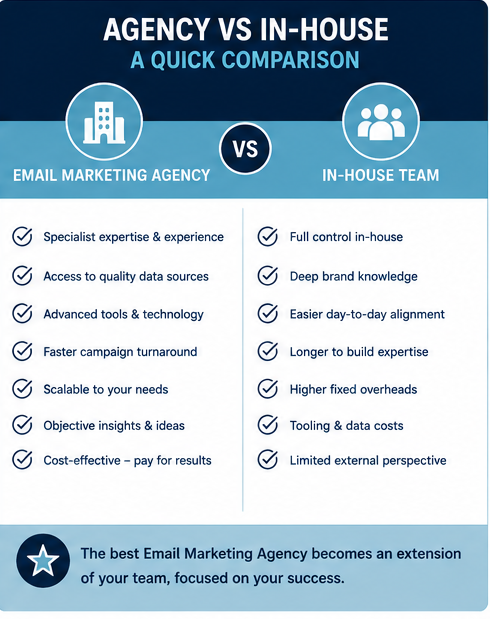
Outsourcing campaign activity does not outsource accountability. If your organisation determines why personal data is used for marketing, you may remain a controller even when an agency handles the operational processing.
The ICO’s guidance on controllers and processors explains that roles depend on who decides the purposes and means of processing. The exact relationship should be assessed rather than assumed from the contract title.
Put the data-processing relationship in writing
Where an agency acts as a processor, the UK GDPR requires an appropriate contract. The ICO’s processor contract guidance describes required terms covering documented instructions, confidentiality, security, sub-processors, rights requests, assistance, end-of-contract handling and audits.
This matters because email agencies often use their own technology stack. Your data may pass through an email service provider, analytics platform, hosting environment, creative tool or integration layer. Ask which sub-processors are used, where data is stored and what happens to campaign data when the relationship ends.
The NCSC’s supplier assurance questions provide a useful non-marketing checklist for assessing how third parties protect data, control access and manage incidents.
UK GDPR and the Data Protection Act 2018 still apply
Where email records identify people, UK data protection law matters. The agency should be able to explain purpose, lawful basis, transparency, data minimisation, accuracy, retention and security in practical terms.
Do not accept a compliance badge in place of process. Ask who handles rights requests, how corrections are propagated, what happens when a contact objects, how campaign records are retained and how the agency proves that suppressions are applied.
PECR depends on subscriber type and campaign circumstances
The ICO’s current electronic mail guidance distinguishes individual subscribers from corporate subscribers.
Unsolicited marketing email to individual subscribers generally requires consent unless a valid soft opt-in applies. Corporate subscribers are not subject to that PECR consent rule, but sender identification, opt-out requirements and UK GDPR duties can still be relevant. Sole traders and some partnerships are treated as individual subscribers.
This is why an agency that says “B2B email does not need consent” without qualification should concern you. The legal entity and the personal data involved matter.
The Data (Use and Access) Act 2025 changed parts of the framework
The Data (Use and Access) Act 2025 amended parts of UK data protection and privacy law rather than replacing UK GDPR, the Data Protection Act 2018 or PECR. The government’s DUAA privacy guidance explains the relationship and the main changes.
An agency does not need to turn every campaign meeting into a legal seminar. It does need current processes rather than an old GDPR checklist that has not been reviewed for years.
Advertising rules also matter
The CAP Code’s use of data for marketing includes rules on electronic marketing, transparency, consent and suppression. These advertising rules do not replace data protection law, but they are part of the wider compliance environment for UK marketing communications.
Suppression must be operational
A suppression list is only useful if it is applied before each relevant send and updated when new objections arrive.
Ask where opt-outs are stored, how quickly they are processed, whether client and agency suppression files are reconciled and what happens if a previously suppressed record appears again in a newly purchased dataset. The CAP Executive’s recent suppression guidance reinforces the need to retain enough information to prevent unwanted recontact.
How to Assess the Agency’s Data Security
An email campaign can involve thousands of contact records, campaign behaviour, response data and sales signals. Security therefore belongs in the supplier review, even if the campaign feels operationally simple.
Ask the agency to describe secure file transfer, access controls, staff permissions, multi-factor authentication, retention, deletion, backups, incident response and sub-processors. The NCSC’s supply chain security principles provide a useful framework for thinking about third-party risk and ongoing assurance.
The level of due diligence should be proportionate to the data and the campaign. A consumer campaign using detailed profiling may justify deeper review than a simple corporate newsletter. But every agency handling personal data should be able to answer basic security questions without improvising.
Deliverability Questions to Ask an Email Marketing Agency
Deliverability is often treated as a technical specialty that the client does not need to understand. You do not need to administer the infrastructure yourself, but you should understand the operating choices being made in your name.
Whose sending identity is used?
Ask whether the campaign sends from your domain, a subdomain, a dedicated domain or an agency-controlled identity. Understand how the “from” name and reply address work and where replies go.
The safest model depends on the campaign, but ownership and reputation should be clear. You should not discover after launch that your brand is sending from an unfamiliar domain with no agreed reputation strategy.
How is authentication configured?
The agency should be able to explain SPF, DKIM and DMARC without hiding behind jargon. If your domain is used, your IT team may need to make DNS changes. Those changes should be documented and reviewed when the relationship ends.
How are complaints, bounces and unsubscribes handled?
Ask which outcomes are automatically suppressed and which are reviewed. Hard bounces should not be repeatedly retried as if they were normal prospects. Unsubscribe requests should flow into the central suppression process.
Google advises bulk senders to monitor user-reported spam rates and requires one-click unsubscribe for relevant high-volume marketing traffic. An agency should understand these mailbox-provider requirements as well as the legal unsubscribe rules.
How will the agency protect long-term reputation?
A strong provider will sometimes recommend sending fewer messages. That can be a sign of maturity rather than lack of ambition.
If a segment is generating complaints, a list is unverified or a domain is showing weak reputation, continuing at full volume can damage future campaigns. Ask how the agency decides when to pause, reduce or re-segment activity.
The Email Marketing Agency Scorecard: What to Compare
A scorecard can make supplier meetings more disciplined. You do not need a complex mathematical model. Use the same categories for every provider and record evidence rather than impressions.
Scope fit
Can the agency provide the specific combination you need: strategy, data, copy, visuals, sending, landing pages, reporting and lead handoff? Which items cost extra?
Data capability
Can it supply data if needed? Can it work with your own CRM? Can it explain B2B and B2C permission differences? Can it cleanse, validate, deduplicate and append records?
Creative capability
Who writes copy? Who produces design? How many revision rounds are included? Are brand guidelines followed? Are assets yours to reuse?
Technical capability
What platform is used? How are SPF, DKIM, DMARC, bounce handling and unsubscribe processing managed? Who owns accounts and credentials?
Reporting quality
Does the agency provide useful interpretation or only platform screenshots? Can it break results down by segment? Can it connect engagement to enquiries, leads and pipeline?
Lead handoff
How are interested prospects identified? How quickly are they shared? What information accompanies the lead? Can the handoff integrate with your CRM?
Governance
Who attends KPI meetings? How often are they held? Are actions documented? Who owns optimisation between meetings?
Compliance and security
Can the supplier explain controller and processor roles, data sourcing, PECR subscriber types, suppression, sub-processors, secure transfer and retention?
Service quality
How quickly does the agency respond? Who is your day-to-day contact? What happens when a campaign needs an urgent change? Does the proposed team match the team that actually delivers the work?
Questions to Ask Before Appointing an Email Marketing Agency
Use the first proposal meeting to test how the agency thinks, not just what it sells.
Ask who will own the campaign from brief to review. Ask what information the team needs from you before recommending a strategy. Ask whether the agency provides data, and if so, how it verifies that data is fit for the intended campaign.
Ask whether copywriting and design are included or optional. Ask how many creative routes and revisions are covered. Ask whether the agency can work with your existing creative if you already have approved assets.
Ask which platform will send the email and who owns the account. Ask how domain authentication works, how unsubscribes are processed and how sender reputation is monitored.
Ask for a sample report with client details removed. Look for interpretation, segment-level findings and commercial outcomes, not just charts.
Ask exactly how interested leads are shared. If the answer is “you will get the open and click report at the end,” push further. A lead-generation agency should have a clearer method for deciding what deserves sales attention.
Ask how often performance meetings happen and who attends. Ask what happens between those meetings if a campaign underperforms.
Ask which parts of the campaign use sub-processors and where personal data is stored. Ask how long data is retained after the campaign and how deletion is evidenced.
Ask what the agency needs from your sales team. The strongest email programme cannot compensate for leads that sit untouched for a week.
Commercial Models and What the Price Should Include
Email Marketing Agency pricing can be difficult to compare because proposals package services differently.
Common models include a monthly retainer, per-campaign fee, project fee, per-send charge, creative package, data fee or blended managed-service price. Some agencies also charge for platform licences, landing pages, automation setup or data separately.
Do not compare headline prices until the scope is normalised.
Clarify data charges
If the agency supplies prospect data, establish whether the data is sold, licensed, rented for one campaign or only used within a managed send. Confirm what fields are included and whether validation or replacement policies apply.
Clarify creative limits
A low campaign fee may include only one template and one revision. A higher fee may include copywriting, design, multiple segments and landing-page support. Neither is necessarily poor value, but the comparison needs to be like for like.
Clarify reporting and meetings
Some suppliers include dashboard access but charge for strategic reviews. If regular KPI meetings matter to your programme, put them in the scope and service calendar.
Clarify lead handoff
If warm prospect identification is important, define it as a deliverable. Agree the format, frequency and integration method.
Clarify ownership on exit
Know what happens to creative files, templates, campaign history, data, analytics exports, domains, DNS records and platform accounts when the contract ends. A good supplier should make offboarding possible without holding the campaign infrastructure hostage.
Red Flags When Choosing an Email Marketing Agency
One red flag is a guaranteed open, click or conversion rate without enough information about your audience and offer. Benchmarks can inform expectations, but campaign results depend on many variables.
Another is vague data language. “Fully GDPR compliant data” is not a substitute for provenance, intended use, subscriber type, lawful basis, permission evidence and suppression controls.
Be cautious if the agency focuses heavily on sending volume. More sends are not automatically more value. A smaller relevant audience can outperform a broad file while creating less compliance and reputation risk.
Be cautious if the agency will not explain its sending domain or platform. Technical opacity makes it harder to manage reputation and offboarding.
A lack of lead handoff process is another warning sign for lead generation campaigns. If the agency cannot explain how engagement becomes a sales action, its service may stop at the point where commercial value should begin.
Also question providers that treat monthly reporting as the same thing as optimisation. Good optimisation requires decisions, not just numbers.
Finally, be cautious if the agency never challenges your brief. A capable partner should sometimes tell you that the audience is too broad, the offer is unclear, the data needs cleaning or the campaign is not ready to send.
Onboarding Your Email Marketing Agency Properly
A well-run first month reduces errors later. Onboarding should cover commercial objectives, audience, data, brand, technology, compliance, reporting and sales follow-up.
Set one primary campaign objective
Avoid launching with a long list of equal goals. Choose the main outcome and define secondary indicators beneath it.
Map the audience and exclusions
Document who should receive the campaign and who should not. Include existing customers, competitors, previous opt-outs, unsuitable sectors and any accounts owned by particular sales teams.
Clean the source data
Before the first send, identify duplicates, invalid addresses, old records and missing fields. AccuraData’s Data Cleansing and Data Appending services can support this stage when the client database needs improvement.
Agree the approval chain
Know who approves data, copy, design, legal points and final deployment. Last-minute uncertainty is a common cause of campaign delays.
Configure measurement before launch
Decide which links need tracking, which forms create leads, how CRM statuses are updated and how sales outcomes return to the agency.
Brief the sales team
Tell sales when the campaign is going live, what recipients will see, what counts as a priority lead and how quickly follow-up is expected.
The campaign should not surprise the people responsible for converting it.
How an Email Marketing Agency Should Optimise Over Time
The value of an ongoing agency relationship should increase as the provider learns which audiences, messages and offers work for your business.
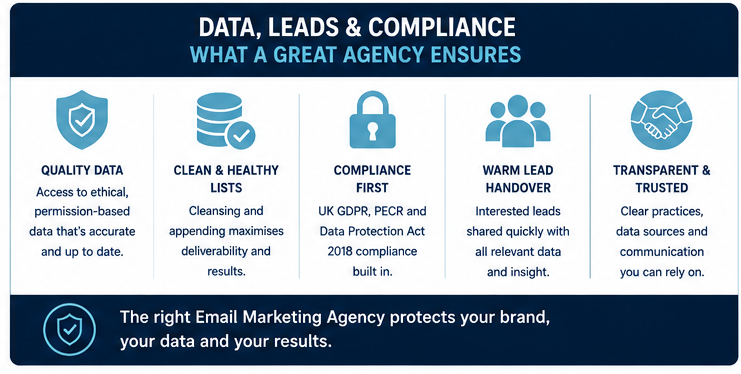
That requires the agency to preserve learning. Segment results should inform future targeting. Sales feedback should influence lead scoring. Unsubscribes and complaints should inform frequency and message relevance. Data quality issues should feed cleansing and sourcing decisions.
Improve the audience, not only the creative
When a campaign underperforms, creative is often blamed first. Sometimes the audience is the real issue.
Compare performance by role, sector, company size, location, consumer segment or source. A clear pattern can justify narrowing future sends or acquiring different data.
Feed sales outcomes back into marketing
An agency should know which leads became meetings, opportunities and customers where practical. Otherwise it can optimise for the wrong signals.
If one segment clicks less but converts more often, it may be commercially stronger than a high-click segment.
Maintain the database between campaigns
Campaign data is not static. People change jobs, email addresses fail, consumers opt out and company profiles change. Build validation, suppression and enrichment into the programme rather than waiting for the list to become visibly weak.
AccuraData’s B2B Data, B2B Email Data, B2C Data and B2C Email Data allow campaign planning and data maintenance to sit inside the same wider relationship when new audience data is required.
Why AccuraData Fits the Email Marketing Agency Brief
AccuraData is particularly relevant for businesses that want the campaign data and campaign execution to work together.
Its Email Marketing Services can include targeted campaign data, client-supplied data support, strategy, copywriting, email design, broadcast delivery, reporting and warm prospect identification. This means a client can use AccuraData as a broader Email Marketing Agency or use selected parts of the service where internal capabilities already exist.
The data layer is an important differentiator. AccuraData’s core business includes B2B and B2C data, email data, cleansing and enrichment. That makes it easier to ask practical questions about audience fit before creative production begins.
The flexible model also matters. A business with approved copy and visuals can bring those assets. A business without internal creative support can ask for copywriting and design. A company with a strong first-party CRM can use its own records, while a client entering a new market can discuss targeted data availability.
Post-campaign reporting can then be used to identify warmer prospects for sales follow-up rather than treating the send as the end of the project.
No agency relationship should be chosen on positioning alone. Buyers should still use the due diligence questions in this guide, define the scope clearly and confirm the compliance model for their specific campaign. AccuraData’s advantage is that many of the components that need to be coordinated, from data quality through to execution and lead insight, can be discussed with one UK-focused team.
Frequently Asked Questions About Choosing an Email Marketing Agency
What does an Email Marketing Agency do?
An Email Marketing Agency can support some or all of the email campaign lifecycle. Services may include strategy, audience selection, data sourcing, list cleansing, copywriting, design, technical setup, campaign broadcast, reporting, optimisation and warm lead identification. The scope varies considerably, so buyers should confirm what is included rather than relying on the agency label.
Should an Email Marketing Agency provide its own data?
It can be useful, but it is not essential. An agency that supplies data can connect audience selection more closely to campaign strategy. An agency that does not supply data can still be effective if the client has a strong database. In either model, the provider should understand data quality, suppression and compliance.
Is it better to use one agency for data and email delivery?
A single supplier can reduce handoffs and make feedback easier, especially when audience performance needs to inform future data selection. Separate specialists can also work well if responsibilities, secure transfers and feedback loops are clearly managed.
Should copywriting be included in an Email Marketing Agency service?
Only if you need it. If your internal team already produces strong approved copy, an agency may simply adapt it for the campaign. If you need messaging support, confirm who writes the copy, how the brief is developed, how many revisions are included and who approves factual claims.
Should an agency create the email visuals?
That depends on your internal resources and campaign style. Some businesses need full email design. Others already have brand assets. The agency should be able to explain whether it provides custom visuals, template design, responsive HTML or client-asset implementation.
How often should an Email Marketing Agency hold KPI meetings?
The cadence should match campaign frequency. High-volume programmes may benefit from weekly operational reviews and monthly strategic meetings. Lower-frequency campaigns may use a structured post-campaign review. The important point is that review meetings happen consistently and produce documented actions.
Which KPIs should an email agency report?
Useful KPIs can include delivery rate, bounce rate, unsubscribe rate, complaint rate, clicks, replies, conversions, qualified leads, meetings, pipeline and revenue. Open rates can still provide context but should not be treated as a complete measure of human engagement.
How should interested leads be shared?
The client and agency should agree a lead definition, priority level, handoff timing and data format before launch. High-intent replies or form submissions may need rapid transfer, while lower-intent engagement can be reviewed in a daily or campaign summary. The CRM should ideally record the handoff and subsequent sales outcome.
Who is responsible for UK GDPR compliance when an agency sends the campaign?
Responsibility depends on the roles each organisation plays. A client that determines why and how personal data is used is likely to have controller responsibilities. An agency may act as a processor for some activities, but roles should be assessed based on the real processing arrangement and documented appropriately.
Does PECR apply to B2B email marketing?
PECR’s electronic-mail rules depend on subscriber type. The consent rule does not apply in the same way to corporate subscribers, but sole traders and some partnerships are treated as individual subscribers. UK GDPR can still apply when personal data is used, and recipients’ objections and opt-outs must be handled properly.
How can I tell whether an agency understands deliverability?
Ask it to explain sending domains, SPF, DKIM, DMARC, bounce processing, spam complaints, unsubscribe management and reputation monitoring. The team should be able to answer in clear language and explain what actions it takes when a metric deteriorates.
What should be included in an agency contract?
Commercial scope should cover deliverables, pricing, revisions, reporting, meetings, lead handoff, ownership and exit. Where the agency processes personal data on behalf of the client, appropriate data-processing terms and sub-processor controls may also be required under UK GDPR.
Can an Email Marketing Agency work with my existing CRM data?
A capable provider should be able to work with client data, subject to secure transfer, appropriate permissions and campaign readiness. It should also be willing to recommend cleansing, validation, deduplication or enrichment where the database is not ready for deployment.
What is the biggest mistake when choosing an Email Marketing Agency?
A common mistake is choosing on creative appearance or sending price without checking the operating process behind the campaign. Data quality, compliance, deliverability, reporting, lead handoff and optimisation often have more influence on long-term commercial performance than a visually impressive template.
Choosing an Email Marketing Agency That Can Improve With You
The best Email Marketing Agency relationship is not defined by how many services appear in the proposal. It is defined by whether the provider can turn campaign activity into a repeatable commercial process.
That process starts with a clear audience and a clear objective. It needs usable, lawfully handled data. It needs copy and creative that fit the recipient rather than simply looking polished. It needs technically sound delivery. It needs suppression and security controls. It needs reporting that goes beyond vanity metrics. Most importantly for lead generation, it needs a reliable bridge between marketing engagement and sales follow-up.
Regular KPI meetings make that bridge stronger because they create a place to compare campaign health, engagement and commercial outcomes. Clear lead handoff rules make the campaign more valuable because interest reaches sales while it is still relevant. Ongoing data maintenance protects future performance. Transparent commercial and data-processing terms make the relationship easier to govern.
AccuraData’s model brings many of these requirements together. Businesses can use targeted data or their own records, request copy and creative support where needed, outsource campaign management and receive reporting that helps identify warmer prospects for follow-up. Combined with its wider data, cleansing and appending services, this makes AccuraData an effective and practical Email Marketing Agency option for UK organisations that want one team to understand both the audience and the campaign built around it.
The final buying decision should still be disciplined. Ask every shortlisted provider the same questions, insist on evidence where data and compliance are involved, define the expected handoff into sales and agree how performance will be reviewed. A strong Email Marketing Agency should make that scrutiny easy. It should leave you with a clearer campaign process, better information and a programme that becomes easier to improve each time you send.