
Email Design Services help businesses turn campaign ideas into email creative that people can understand, scan and act on. Good design is not decoration added at the end of a campaign. It shapes the way the reader notices the message, understands the offer, moves through the content and decides whether to click, reply, book a call or buy. For businesses using email as part of lead generation, customer communication or account-based marketing, the quality of the design can make the difference between a campaign that looks professional and one that gets ignored.
This article explains what Email Design Services include, why they matter, how professional email design supports campaign performance, and how AccuraData can help as part of its outsourced email marketing support. It covers layout, copy hierarchy, mobile rendering, accessibility, compliance considerations, deliverability, testing, reporting and the relationship between design and data. It is written for UK businesses that want practical guidance before briefing an agency, supplier or internal team.
AccuraData provides managed Email Marketing Services that can include campaign planning, audience selection, email copywriting, email design, broadcast setup, delivery, reporting and warm prospect identification. For B2B campaigns, those services can also be supported by targeted B2B Email Data, helping clients connect professional creative with accurate audience targeting.
What Are Email Design Services?
Email Design Services cover the planning, structure, visual design and build of marketing emails. The work can include template design, branded campaign creative, newsletter layouts, promotional emails, event invitations, lead nurturing emails, sales outreach designs, landing-page aligned email creative and reusable design systems. In many outsourced email marketing projects, design is combined with copywriting, data segmentation, campaign setup and performance reporting.
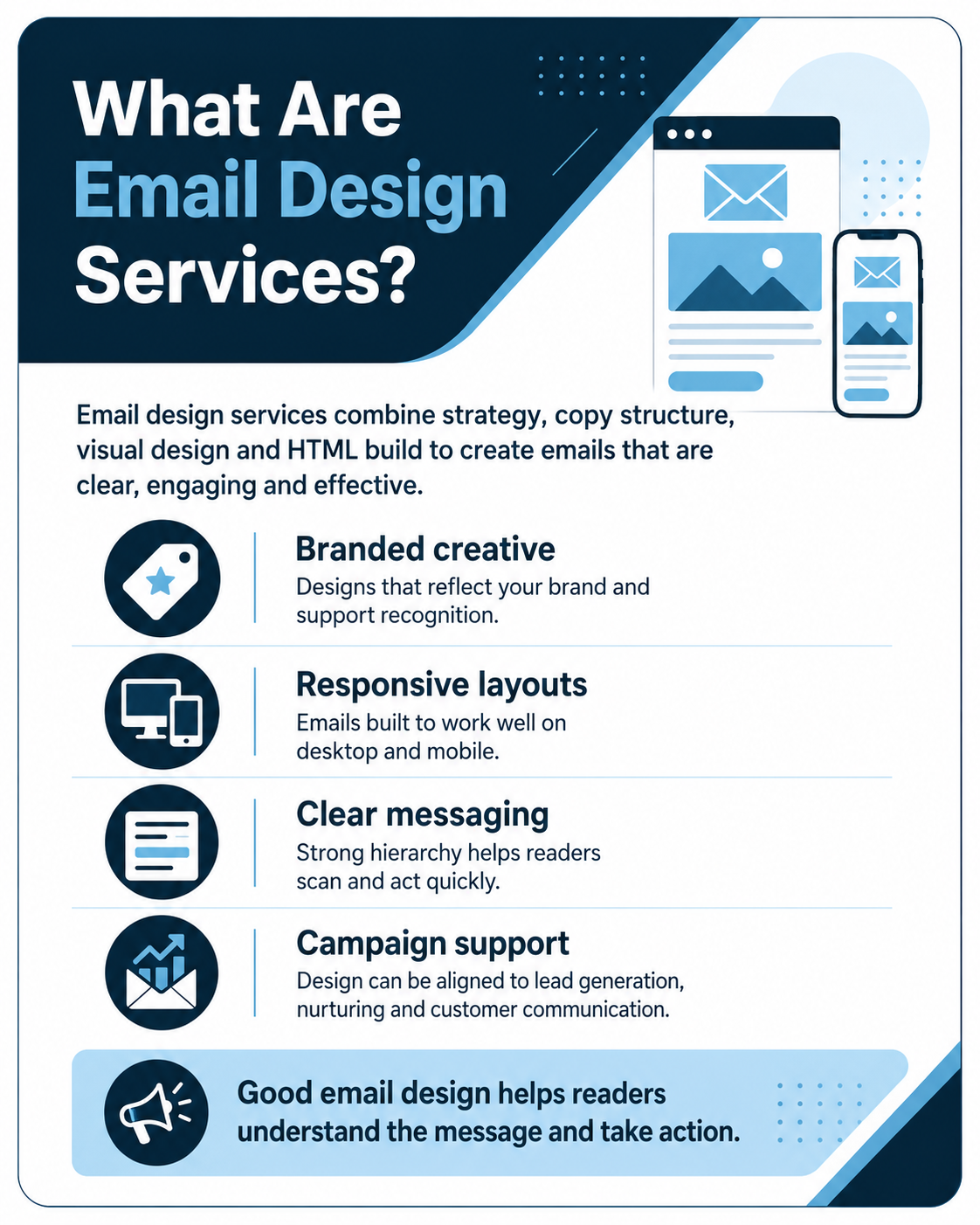
A professional email designer thinks about more than colour and images. They consider the reader, the device, the email client, the call to action, the brand, the audience data, the compliance message, the accessibility of the content and the technical limits of HTML email. Email is not the same as a web page. Some email clients have limited support for modern code. Images can be blocked. Fonts may fall back. Dark mode can change colours. Mobile screens are narrow. A design that looks polished in a static mock-up may perform poorly if it has not been planned for real inbox conditions.
That is why Email Design Services usually combine creative judgement with practical delivery knowledge. The end product should be visually clear, on brand, easy to read and properly tested. It should support the commercial purpose of the campaign rather than distracting from it. If the goal is to generate sales calls, the email needs to make the next step obvious. If the goal is to promote a guide, the design needs to make the value of the guide clear. If the goal is to nurture a prospect, the design should make the email feel useful rather than pushy.
Why Email Design Matters
Email marketing is a crowded channel. Most recipients make quick decisions. They scan the sender, subject line, preview text, opening content and visual layout before deciding whether to continue. If the design feels cluttered, difficult to read or irrelevant, the campaign loses attention before the offer has a chance to work.
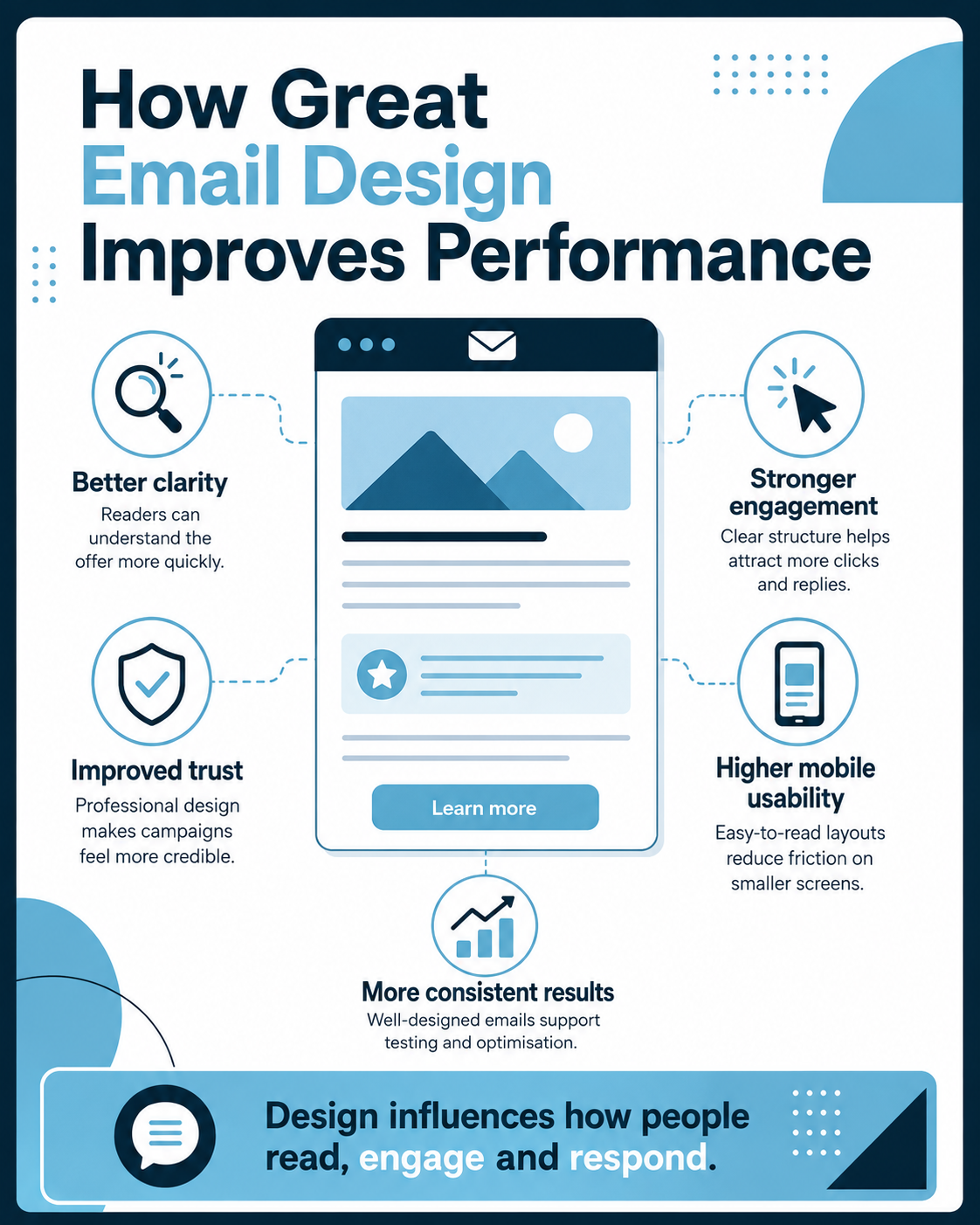
Email design also affects trust. A poorly aligned, broken or dated email can make a legitimate business look careless. A clean, well-structured design helps reassure the reader that the company is professional. This matters in B2B marketing, where the email may be the first branded touchpoint a decision-maker sees. The reader may not know your company yet, so the design has to carry credibility quickly.
Good design improves clarity. It helps the reader answer the questions that matter: Who is contacting me? Why does it matter? What is being offered? What should I do next? Clear hierarchy, strong spacing, readable typography, useful imagery and a focused call to action all make the message easier to process. The value of design is therefore practical. It reduces friction between the recipient and the intended action.
There is also a compliance and deliverability angle. The ICO guidance on electronic mail marketing explains that marketing emails to individuals normally require specific consent, with a limited soft opt-in exception, and that companies can be sent marketing emails while keeping suppression records for those that object. Design does not replace compliance, but it supports it by making sender identity, contact details and opt-out routes clear and easy to find.
Email Design Services as Part of Outsourced Email Marketing
Many businesses ask for email design as a standalone creative task. They need a template, an event invitation or a promotional email built for a campaign. That can work when the campaign strategy, data and sending process are already in place. In practice, better results often come when design is part of a wider outsourced email marketing service.
The reason is simple. Design depends on context. A designer needs to know who the audience is, what stage of awareness they are in, what problem the campaign addresses, what data fields are available, how the email will be sent and how success will be measured. If the audience is cold, the email needs a stronger credibility bridge. If the audience has already engaged, the email can be more direct. If the data is segmented by industry, the design may need flexible modules for sector-specific content.
AccuraData is well placed to support this because its outsourced email marketing support connects the creative process with data, campaign management and reporting. Rather than treating email design as an isolated asset, AccuraData can help shape the design around the audience and the campaign objective. This is especially useful for B2B campaigns where data quality, targeting and sales follow-up are closely linked to creative performance.
A typical outsourced workflow may include audience planning, data selection or cleansing, copywriting, design, HTML build, campaign setup, testing, broadcast delivery, reporting and warm prospect identification. The design sits in the middle of that process. It translates the strategy into a campaign experience the recipient can understand and act on.
The Main Elements of Strong Email Design
Strong email design is built from several small decisions. None of them work in isolation. A clear headline will not fix poor targeting. A beautiful image will not fix weak copy. A bright button will not fix an unclear offer. The strongest campaigns bring these elements together in a simple, organised structure.
A clear visual hierarchy
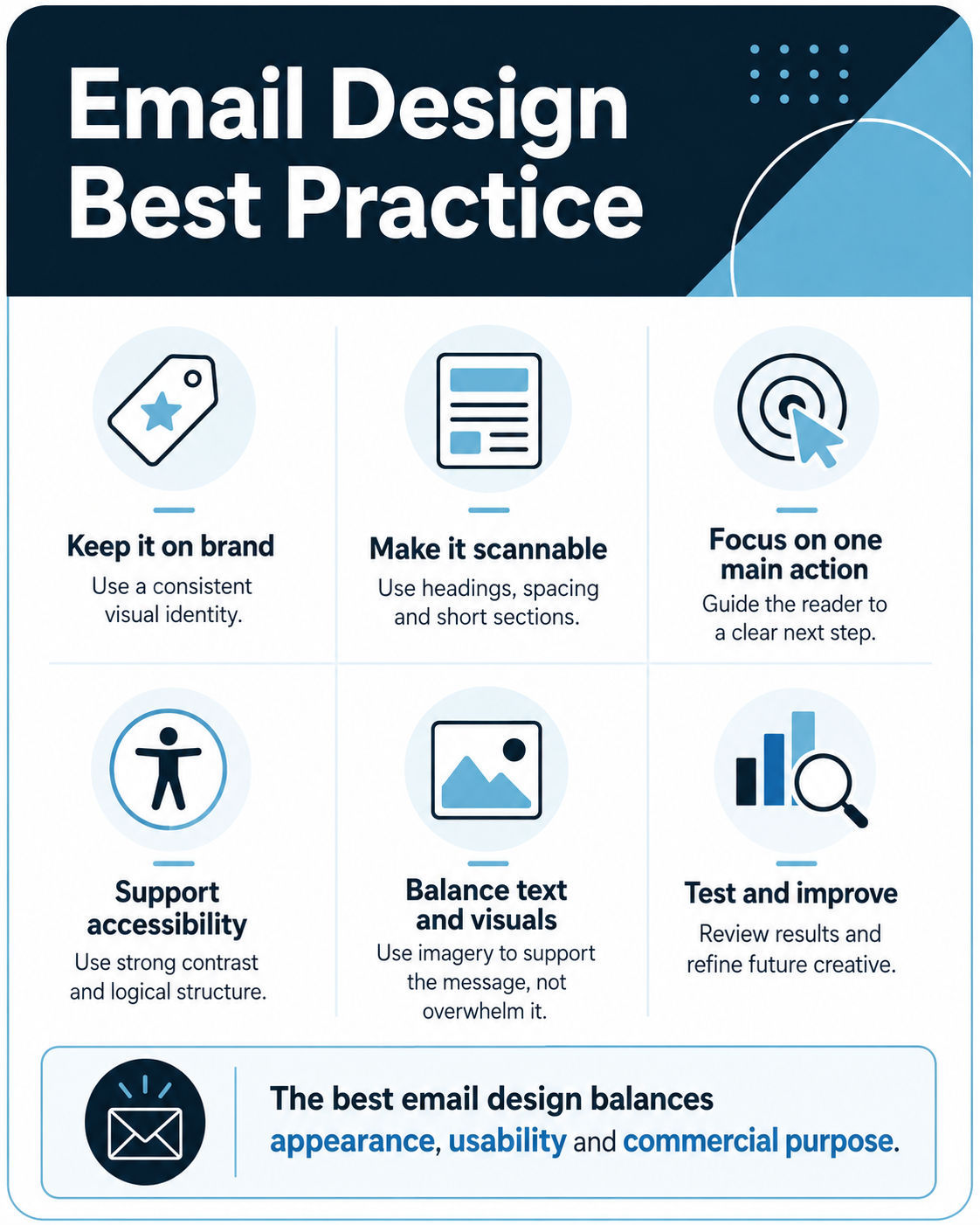
Visual hierarchy tells the reader what to look at first, second and third. A marketing email should not ask the recipient to work out what matters. The headline should introduce the main value. The body copy should explain it briefly. Supporting sections should add confidence. The call to action should stand out without fighting the rest of the design.
Hierarchy is created through type size, spacing, weight, colour, placement and repetition. In B2B email design, it is usually better to be clear than clever. A simple layout with one strong message often performs better than a dense design trying to say everything at once.
Readable typography
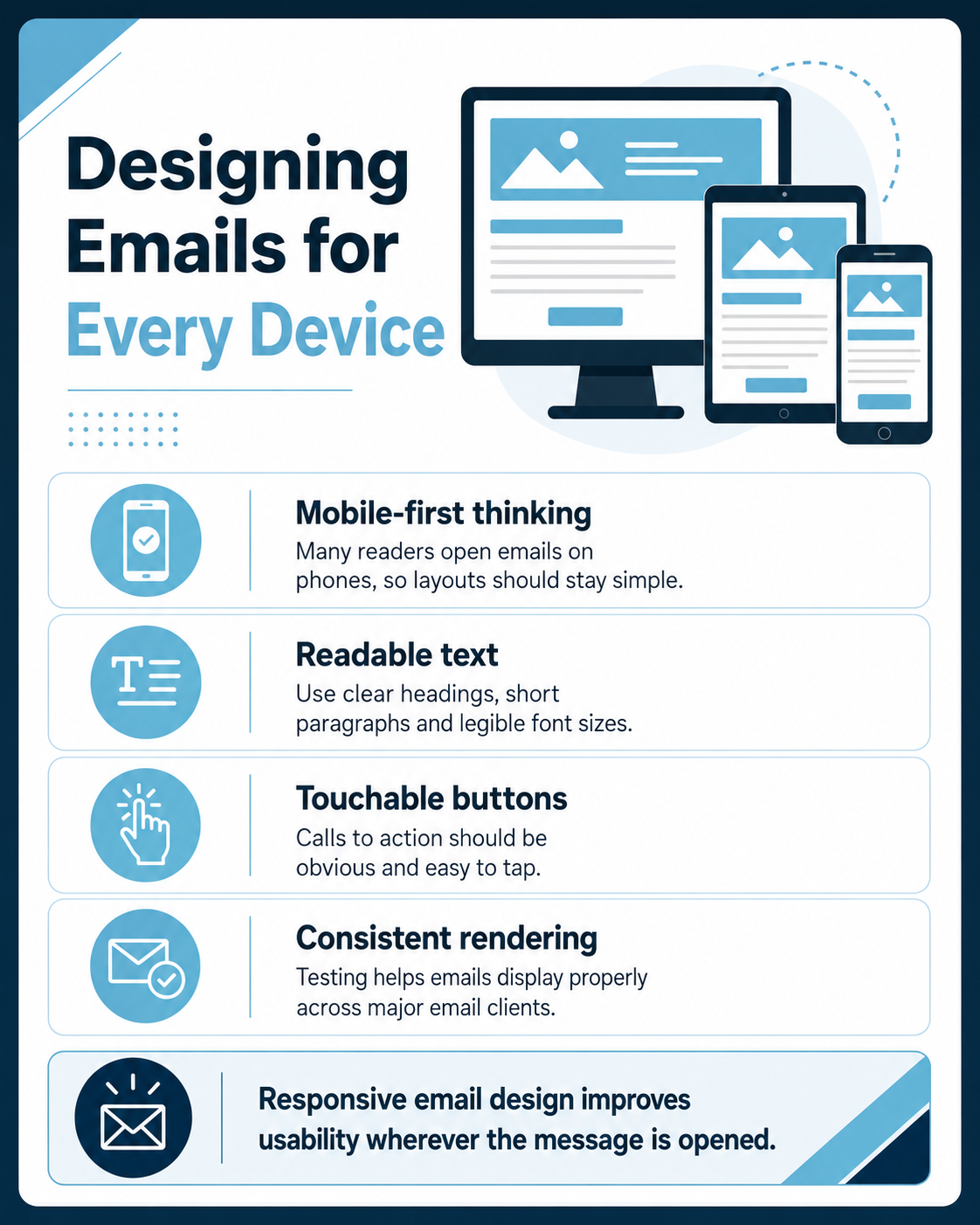
Typography affects whether the recipient can read the email quickly on a phone, laptop or desktop screen. Small fonts, cramped lines and low contrast can make an email feel like work. Professional Email Design Services should consider font size, line height, paragraph length, heading structure and fallback fonts.
Accessibility guidance reinforces this point. The Web Content Accessibility Guidelines provide a framework for making digital content more usable for more people. While emails have their own technical quirks, the same principles of readable text, clear structure and usable contrast are highly relevant. The W3C contrast guidance states that normal text should meet a contrast ratio of at least 4.5:1, with a lower threshold for large text. That is useful guidance when choosing colours for buttons, headings and body copy.
A focused call to action
Every campaign should have a primary action. That action might be to book a call, request a quote, download a guide, view a product page, register for an event or reply to the email. A design that includes too many competing calls to action can weaken the result. The reader should not have to decide which next step matters.
Good design makes the primary call to action visible, specific and easy to click. Button wording should be clear. “Book a consultation” is more useful than “Click here”. “Download the guide” is clearer than “Learn more” when the next step is a guide. The button should also have enough space around it to avoid accidental taps on mobile devices.
Purposeful imagery
Images can help a campaign feel more engaging, but they need a job. They should support the offer, explain the product, add credibility or create visual interest without pushing the main message down too far. Overly large hero images can look impressive in a mock-up but frustrate recipients who want the point quickly.
Images should also be treated carefully because some recipients block images by default. Important information should not be locked inside an image. Harvard’s guidance on creating accessible emails recommends applying general accessibility principles to email so the message remains clear to more people. In practical terms, that means using live text for key copy, adding meaningful alt text where images communicate information and keeping the email understandable when images do not load.
Mobile-friendly structure
Many recipients read emails on mobile devices, even in a B2B context. A design that works only on a large desktop screen is not enough. Mobile-friendly email design needs simple stacking, readable text, tap-friendly buttons, suitable image sizes and content that still makes sense when viewed in a narrow column.
Mobile design is also about discipline. A long desktop email becomes much longer on mobile. If every section is treated as essential, the reader may never reach the call to action. Good Email Design Services help reduce the campaign to what matters most, then structure the content so it can be read in stages.
Email Design and Accessibility
Accessible email design helps more recipients understand and use your messages. It should not be seen as a specialist extra. Clear structure, good contrast, readable copy and meaningful link text benefit many people, including those reading quickly, using a small screen, dealing with poor lighting or relying on assistive technology.
The Litmus guide to accessible emails explains that WCAG is the recognised standard for digital accessibility and is widely used as the reference point for accessible digital experiences. For email marketers, this means thinking about structure, colour, alt text, button labels, text size and reading order before the campaign is sent.
Colour is a common problem. A design that relies on colour alone to show meaning may exclude people who cannot distinguish those colours. The W3C guidance on use of colour says colour should not be the only visual way of conveying information or indicating an action. In an email, that might mean using labels as well as colour, adding icons with text, or making error and success messages clear without relying only on red or green.
Accessibility also affects brand perception. A business that sends easy-to-read, inclusive emails signals professionalism and care. A business that sends dense, image-heavy emails with poor contrast risks losing readers who might otherwise have been interested. AccuraData can help clients build cleaner, more usable campaign designs as part of managed Email Marketing Services, especially where teams do not have internal email design expertise.
Email Design and Deliverability
Deliverability is often discussed as a technical issue involving domains, authentication and sender reputation. Those areas are important, but design and content also play a role. A campaign that uses misleading copy, image-only content, broken links, poor HTML or an unclear unsubscribe route can damage trust and performance.
Google’s email sender guidelines tell senders to make it easy for recipients to unsubscribe and, for senders of more than 5,000 messages a day to Gmail accounts, to support one-click unsubscribe for marketing and subscribed messages. The design should therefore make unsubscribe information easy to find, while the sending setup should include the required headers where applicable. Hiding opt-out information is a poor practice. It may increase complaints and harm future inbox placement.
Design can also support engagement, which affects long-term campaign health. If recipients find emails useful and easy to act on, they are more likely to click, reply or stay subscribed. If the design is confusing, irrelevant or hard to read, engagement drops. Low engagement can make it harder for future campaigns to perform well.
A practical email design process should include link testing, mobile preview checks, image weight review, alt text review, inbox preview where possible and a final check that the email still works if images are blocked. This helps reduce avoidable delivery and user experience problems before the campaign goes live.
Designing for B2B Email Campaigns
B2B email design has its own rhythm. Business recipients often have limited time, a full inbox and a clear preference for useful communication. They are not usually looking for entertainment. They want to understand whether the message is relevant to their role, organisation or current problem.
The design should therefore prioritise clarity, trust and usefulness. That does not mean boring. It means purposeful. A B2B email may need a strong headline, a short explanation, a supporting proof point, a simple visual, a clear call to action and contact details. Case studies, guides, audits, consultations and sector-specific resources can all work well when the design gives them enough context.
Audience segmentation is especially important in B2B. A campaign aimed at managing directors should not look or read exactly like a campaign aimed at IT managers, HR directors or procurement leads. The design can use modular sections that adapt to sector, role or offer without rebuilding the whole campaign each time. This is where accurate B2B Email Data becomes valuable. The richer and more reliable the data, the easier it is to tailor the creative to a meaningful audience segment.
AccuraData’s wider B2B data and lead generation solutions can help businesses define audiences by industry, geography, company size, turnover, employee count, job title and decision-maker role. That level of targeting gives the design and copy a better brief. Instead of writing to a vague market, the campaign can speak to a defined group with a clearer business need.
Email Design Services and Copywriting
Design and copy should be developed together. A strong email layout cannot rescue unclear copy, and strong copy can be weakened by poor layout. The best campaigns feel like one joined-up piece of communication rather than words dropped into a template.
Email copy needs to be concise, but it should not be empty. It should explain why the recipient is being contacted, why the offer is relevant and what the next step is. Design then gives that message shape. It decides what becomes a headline, what becomes body copy, what sits inside a callout, what can be removed and what should be repeated near the call to action.
A common mistake is trying to include every product detail inside one email. This creates long, heavy campaigns that are hard to scan. A better approach is to choose one main idea and use the email to move the recipient to the next step. That next step may be a landing page, a reply, a phone call, a downloadable resource or a meeting booking.
As part of AccuraData’s email marketing campaign management, design can be supported by copywriting and campaign planning. This helps make sure the creative matches the objective, whether the campaign is designed to create enquiries, identify warm prospects, support sales follow-up or re-engage existing contacts.
The Email Design Process
A professional email design process should be structured. It does not need to be slow, but it should move through the right steps. Rushing directly into visual design often creates unnecessary revisions because the brief has not been agreed.
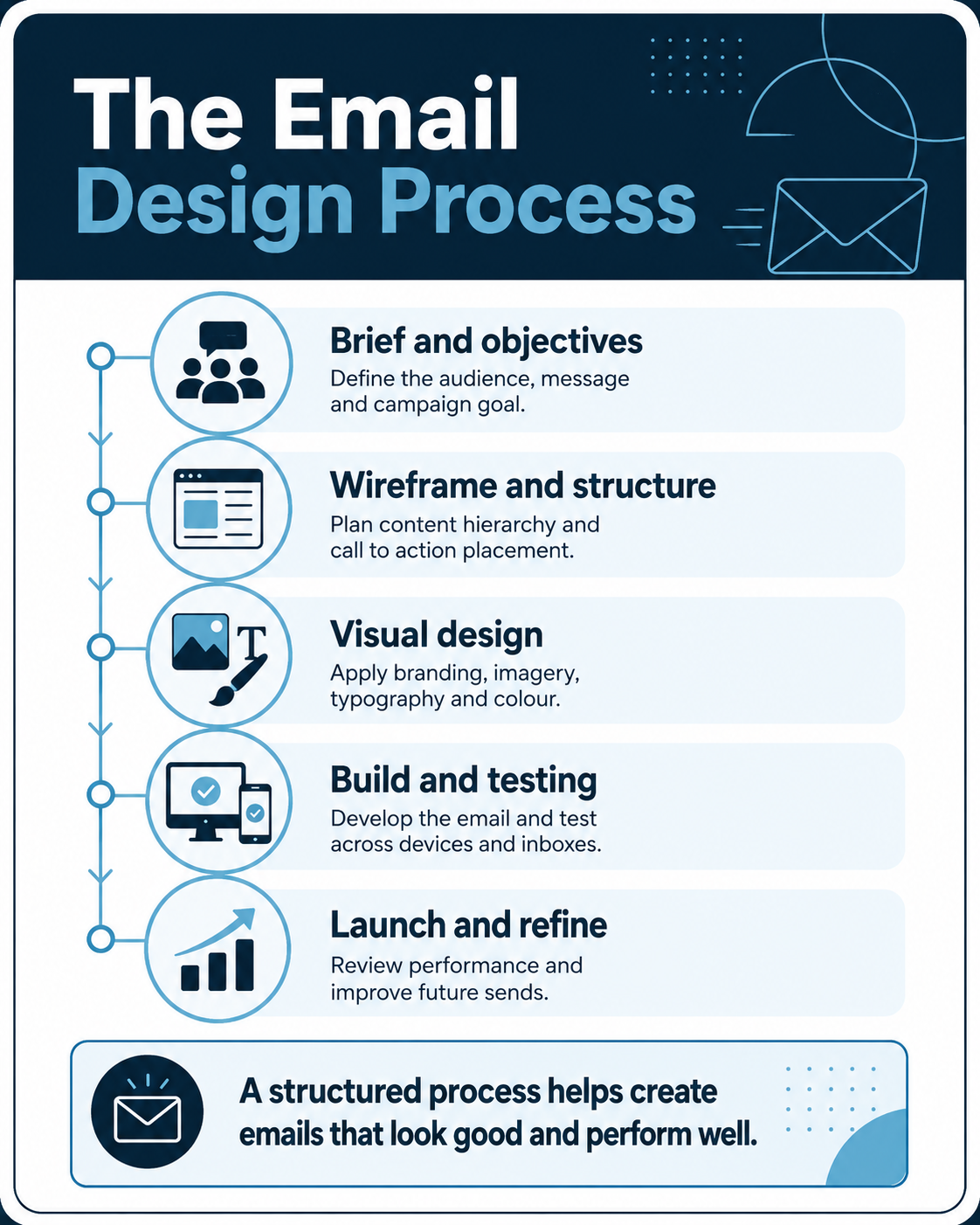
Brief and objective
The starting point is the campaign objective. What should the email achieve? Who is the audience? What is the offer? What action should the recipient take? What brand rules apply? What landing page or sales process will support the campaign? These questions help prevent the design from becoming a general brand piece with no clear purpose.
Audience and data review
The audience affects the creative direction. A campaign to existing customers may use a familiar tone. A campaign to new prospects may need more context. A campaign to senior decision-makers may need a shorter, more direct layout. A campaign to technical buyers may need more supporting detail. If the audience data is old or incomplete, AccuraData’s data cleansing and enrichment services can help improve the quality of the records before design and sending activity begin.
Wireframe and content structure
A wireframe is a simple layout plan. It shows where the headline, copy, image, proof point and call to action will sit before detailed design begins. This stage is useful because it forces decisions about priority. If the wireframe is too crowded, the final design will probably be crowded too.
Visual design
The visual design stage applies the brand, colour, imagery, iconography, spacing and typographic hierarchy. The design should feel professional and recognisable, but it should also be easy to read. Brand consistency matters, but email is a functional format. A good designer adapts the brand so it works in the inbox rather than forcing a website or brochure layout into an email.
Build and testing
Once approved, the design is built for email. HTML email needs careful coding because different clients render code differently. The email should be tested across common scenarios before sending. This can include desktop and mobile previews, image blocking, link checks, fallback fonts, dark mode considerations and unsubscribe placement. The Gmail sender guidelines FAQ also explains one-click unsubscribe requirements for bulk senders, which is part of the wider pre-send quality and compliance check for marketing emails.
Deployment and reporting
Design work should not end at deployment. Reporting shows how the audience responded. Clicks can indicate whether the call to action was clear. Low engagement may suggest the message, audience, design or offer needs refinement. AccuraData can provide campaign reporting through its managed email marketing support, helping clients identify warm prospects and improve future campaigns.
Common Email Design Mistakes
Many email design problems come from trying to do too much at once. A campaign may include too many messages, too many buttons, too many images or too much copy. The result is a design that looks busy and leaves the reader unsure what to do next.
Another common issue is designing for approval rather than the recipient. Internal stakeholders may want to include every service, every award and every product point. The recipient usually wants a clear reason to care. Good Email Design Services help businesses make difficult but useful choices about what to include and what to leave out.
Image-only emails are another risk. They can be difficult to read, inaccessible to some users and weak when images are blocked. Important text should usually be live text rather than baked into a graphic. Images should support the message, not carry the whole campaign.
Poor mobile design is also common. A desktop layout that looks balanced can become long and awkward on a phone. Buttons may be too small, text may be cramped and important content may sit too far down the email. A mobile-first mindset helps avoid these problems.
Finally, some campaigns ignore the unsubscribe and compliance experience. An unsubscribe link that is hard to find can create irritation and complaints. A clear, professional opt-out process is part of responsible campaign design. It protects the recipient experience and helps maintain sender reputation over time.
How Email Design Supports Measurement
Design affects what can be measured. A campaign with one clear call to action is easier to interpret than a campaign with several competing links. If the reader can click five different buttons pointing to different pages, reporting becomes harder to understand. If one main action is used, the click data is clearer.
Email design can also support structured testing. A business might test two subject lines, two hero messages, two button labels or two content blocks. The layout should make those tests meaningful. If the rest of the campaign changes at the same time, it becomes difficult to know what caused the result.
Good reporting should look beyond opens. Open rates can be affected by privacy features and image loading behaviour, so they should not be treated as the only measure of success. Clicks, replies, conversions, warm prospects, sales follow-up outcomes and pipeline contribution are often more useful. Design can help by making the desired action clear and trackable.
AccuraData’s article on email marketing campaigns explains how planning, operation, measurement and improvement work together across a campaign. Email design is one part of that system. It should help the campaign generate evidence that can be used to improve future activity.
Email Design Services for Different Campaign Types
Different campaigns need different design approaches. A newsletter may use a modular layout with several content sections. A cold B2B outreach campaign may need a shorter, more focused layout. A product launch email may need stronger visuals. An event invitation may need date, location, speaker and registration details. A lead nurture email may need a quieter, educational design.
The danger is using one template for every purpose. Templates are useful, but they should not remove strategic thinking. A reusable system can include several modules, such as hero sections, short text blocks, proof points, testimonial panels, feature cards, event details, quote blocks and call-to-action strips. This gives the campaign team flexibility while keeping the brand consistent.
For outsourced campaigns, this matters because the same business may run several different types of email over time. AccuraData can support one-off campaigns, ongoing outreach, data-led prospecting campaigns and follow-up activity. The design approach can be adapted to the campaign goal rather than forcing every send into the same format.
Choosing an Email Design Services Partner
When choosing a partner for Email Design Services, look beyond the visual portfolio. The work should look professional, but it should also be suitable for real campaign delivery. A good partner should understand email layout, mobile rendering, accessible design, campaign objectives, data segmentation, compliance, testing and reporting.
Ask how the partner approaches the brief. Do they ask about the audience and offer, or do they move straight to design? Ask how they handle mobile and accessibility. Ask whether they build emails for real sending platforms. Ask how they test links, images and layout. Ask whether reporting insight is used to improve future creative. These questions will tell you whether the partner understands email as a performance channel, not just a design task.
You should also check whether they can work with your data. Email design is stronger when it is matched to audience segments. If a provider cannot help with targeting, list quality or data structure, you may need additional support before the campaign can perform. AccuraData’s combination of data, design and managed campaign delivery is useful here because it reduces the gap between the audience and the creative.
Why AccuraData Is a Reliable Partner for Email Design Services
AccuraData brings Email Design Services into a wider outsourced email marketing process. That is important because most campaign problems do not sit in one place. Weak results may come from poor targeting, unclear copy, weak design, old data, poor timing, deliverability issues or a lack of follow-up. A partner that understands the full process can help solve the right problem.
For clients that need audience support, AccuraData can provide targeted B2B Email Data for UK campaigns. For clients with an existing database, AccuraData can help through data cleansing and enrichment. For clients that want campaign delivery, AccuraData’s Email Marketing Services can support copywriting, design, campaign management, broadcast delivery, reporting and warm prospect identification.
This joined-up approach makes the design more practical. The email can be built around the audience, the campaign goal and the follow-up process. It can use clearer calls to action, more relevant messaging and cleaner data. It can also be reported in a way that helps sales teams understand which prospects engaged.
AccuraData is especially suitable for UK B2B organisations that want a reliable outsourced partner rather than a purely creative supplier. The service is not only about producing an attractive email. It is about helping the campaign reach the right people with a clear message, then using the results to support better business development activity.
Practical Checklist for Better Email Design
Before sending your next campaign, review the design against a short checklist. This keeps the process focused and helps prevent avoidable problems.
- Does the email have one clear objective?
- Is the audience segment specific enough for the message?
- Can the main value be understood within a few seconds?
- Is the call to action obvious and easy to click?
- Does the design work on mobile as well as desktop?
- Is important information available as live text rather than only inside images?
- Is the contrast strong enough for comfortable reading?
- Are links, tracking, images and unsubscribe routes tested before sending?
- Will the reporting show whether the design helped achieve the campaign goal?
This checklist will not replace a full design and testing process, but it gives teams a practical way to improve campaign quality before launch. Many weak campaigns can be improved quickly by making the objective clearer, reducing clutter, improving mobile readability and making the next step easier to take.
Final Thoughts on Email Design Services
Email Design Services are most valuable when they help a campaign work better. The goal is not to create the most elaborate email. The goal is to create an email that the right audience can understand, trust and act on. That means clear structure, readable content, accessible design, strong mobile performance, responsible compliance presentation and useful measurement.
For UK businesses, email design should sit alongside data quality, campaign planning and reporting. A well-designed email sent to the wrong audience will still struggle. A strong audience sent a confusing email may still fail to act. The best results come when data, copy, design and delivery are planned together.
AccuraData can help businesses bring those parts together. Whether you need professional email creative, a cleaner campaign database, targeted B2B email data or a managed outsourced email marketing partner, AccuraData can support the process from audience planning through to reporting. To discuss a campaign, speak to the team through the AccuraData contact page and explain the audience, offer and outcome you want to achieve.