

Email marketing remains the highest-returning digital channel available to UK businesses. The DMA UK consistently reports returns of £38 or more for every £1 spent, and four in five B2B marketers rely on it as a primary channel for lead generation and customer communication. That case has been made clearly enough. What is discussed less clearly is the question of who should be running it, because the internal resource requirements of doing email marketing well, the platform expertise, the data management, the compliance discipline, the content production, and the performance analysis, are substantial and frequently underestimated by businesses that treat email as a task rather than a programme- leading to the use of outsourced email marketing.
Outsourced email marketing is the model that addresses this directly. Rather than building and maintaining the full infrastructure in-house, a business engages a specialist to manage some or all of the function on its behalf, from contact data sourcing and list management through to campaign execution, compliance, and reporting. According to a 2024 survey of 3,000 UK businesses published by Statista, 46% of UK companies already outsource some element of their marketing, with the figure rising to 50% for B2B businesses. Email marketing ranked as the third most commonly outsourced marketing activity in separate UK research, cited by 44% of businesses that outsource any marketing function at all.
At AccuraData, we supply the verified contact data that outsourced email marketing programmes are built on. We work directly with businesses whose internal teams need better data for the campaigns they are already running, and with agencies and specialist providers who need a reliable data partner for the client programmes they manage. This guide covers what outsourced email marketing involves at every level, why businesses choose it, what the compliance framework requires in a third-party arrangement, how contact data quality determines what any outsourced programme can achieve, and how to select and work with partners that will strengthen rather than compromise your email operation.
What Outsourced Email Marketing Involves
The phrase outsourced email marketing covers a wide range of arrangements, and understanding the full scope of what can be outsourced helps any business decide which elements genuinely need external expertise and which are better kept in-house.
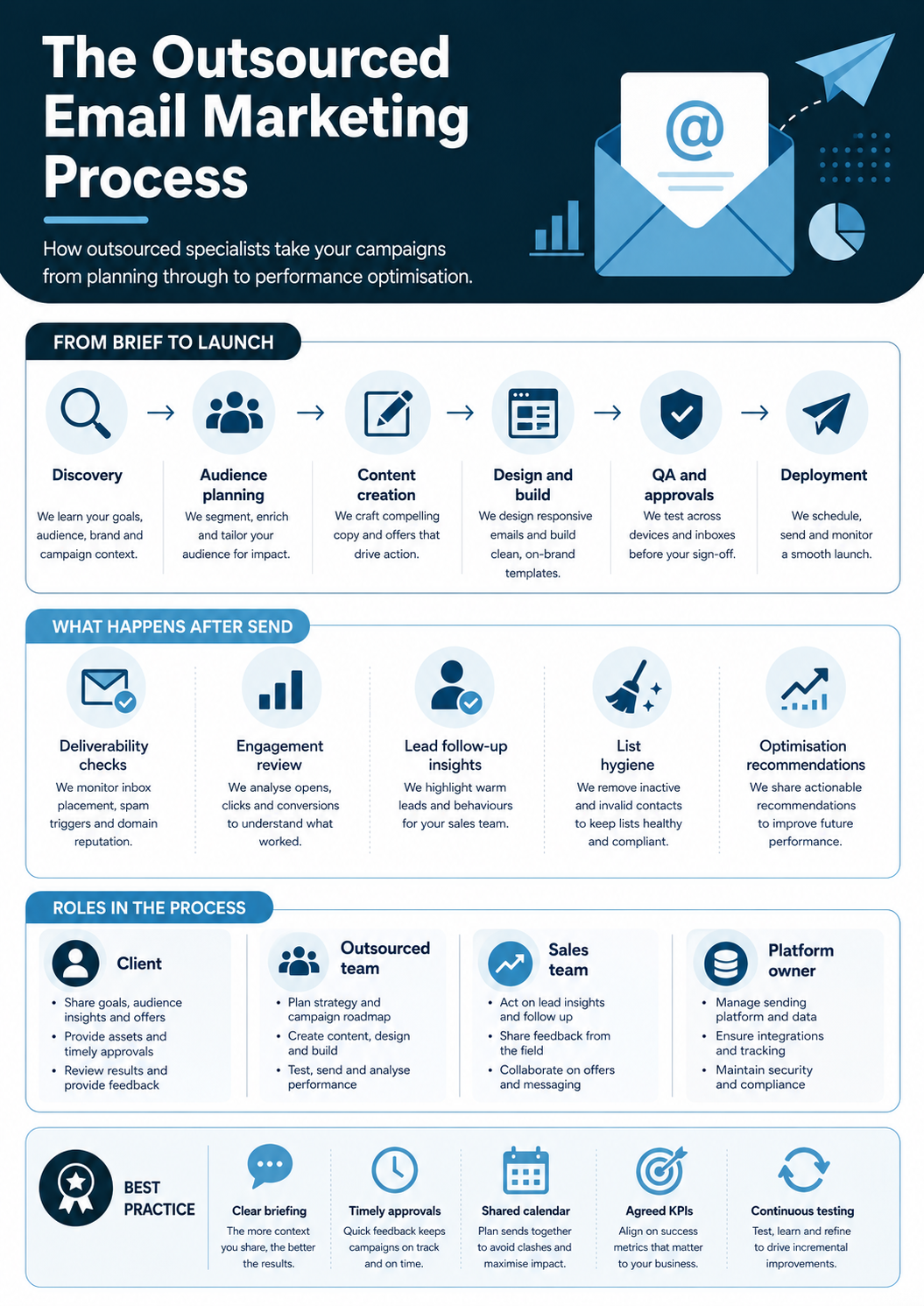
At one end of the spectrum is full-service outsourcing, where a specialist agency or provider manages the entire email function on behalf of the client: strategy, data sourcing, platform management, content production, campaign deployment, compliance, and reporting. The business receives a fully operational email marketing programme without building or maintaining any of the underlying infrastructure itself. This model is most common in businesses that lack the in-house capability or resource to run email effectively and want a complete, managed solution.
At the other end is partial outsourcing, where specific elements of the email function are outsourced while others remain in-house. A business with a capable in-house marketing team might outsource its contact data sourcing to a specialist data provider, its platform management to a technical consultant, and its compliance review to a data protection adviser, while keeping copywriting and strategy in-house. This hybrid model gives the business control over its brand voice and strategic direction while drawing on specialist expertise for the elements where it lacks depth.
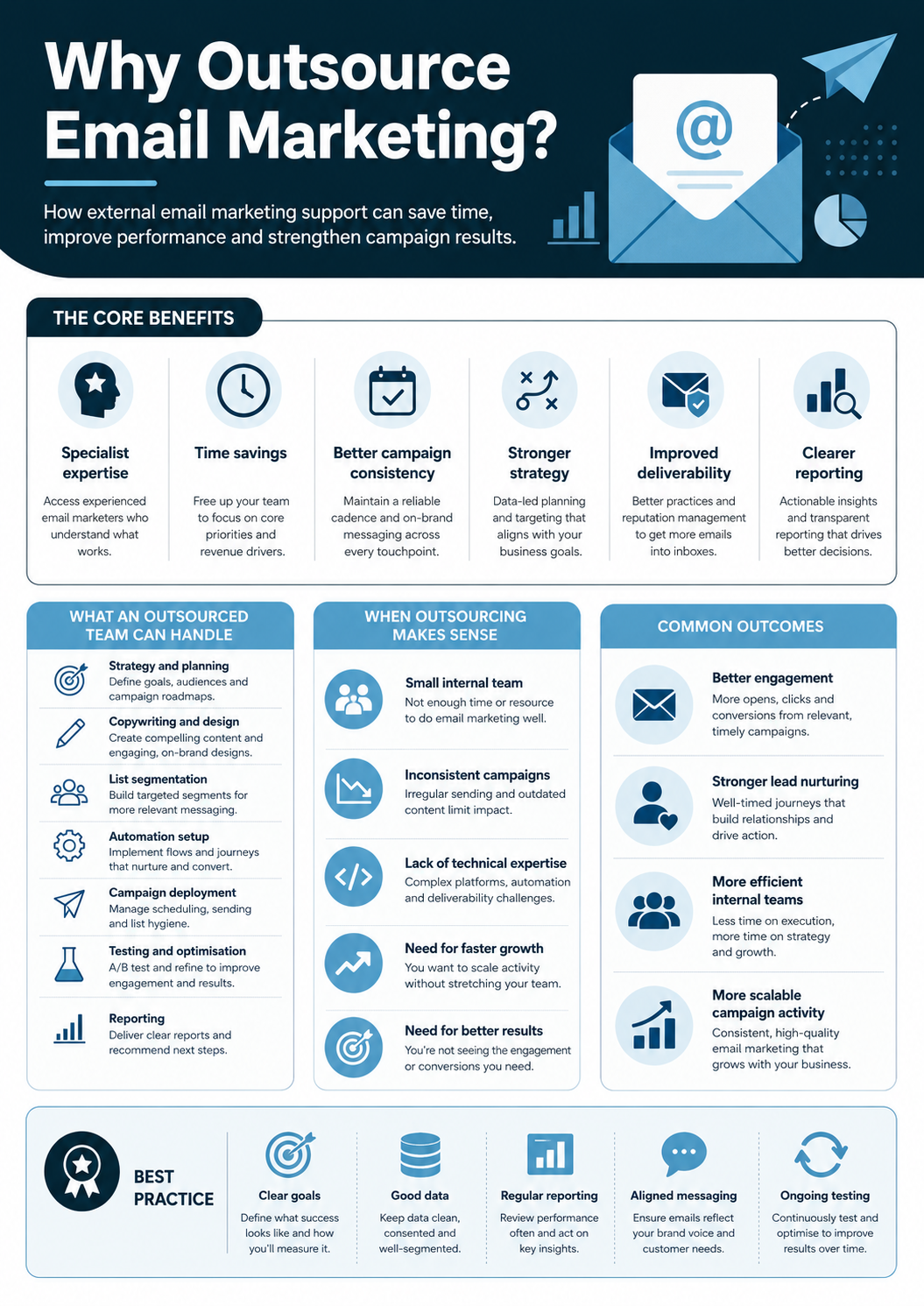
The most commonly outsourced elements of email marketing, based on what drives businesses to seek external help, are contact data sourcing and management, campaign deployment and platform management, email copywriting and design, deliverability management and technical setup, compliance review and data processing documentation, and performance reporting and analysis. Each of these can be sourced from a specialist independently, or all can be consolidated under a single managed service provider, depending on the business’s existing capabilities and the scale of the programme being run.
Why UK Businesses Choose Outsourced Email Marketing
The growth in outsourced email marketing among UK businesses is driven by several converging pressures. Understanding which of these applies most strongly to a specific business is the starting point for deciding whether outsourcing makes sense and in which form.
Access to Skills That Are Difficult to Hire and Retain
Email marketing at a performance level requires a range of skills that are rarely combined in a single hire: data analysis, technical deliverability expertise, copywriting, platform knowledge, and compliance understanding. Research by Marketingsignals cited by Conference News found that 37% of businesses outsource marketing because they cannot find someone qualified for the role internally, and 35% say they lack the internal resource to handle it. In email marketing specifically, the technical complexity of deliverability, the regulatory requirements of PECR and UK GDPR, and the platform sophistication needed to run segmented automated campaigns all represent specialist knowledge that a generalist marketing hire is unlikely to cover fully.
Outsourcing gives businesses access to a team whose combined expertise covers all of these dimensions without the overhead of recruiting, training, and retaining individual specialists. This is particularly relevant in the current deliverability environment, where Google, Yahoo, and Microsoft have all implemented mandatory authentication requirements and tightened their spam complaint thresholds, creating technical compliance requirements that many in-house teams are not equipped to manage.
Cost Efficiency Compared to an In-House Hire
Building a genuinely capable in-house email marketing function requires investment in people, platforms, data, and compliance infrastructure. A mid-level email marketing specialist in the UK carries a salary cost of between £30,000 and £50,000 per annum, before employer national insurance contributions, pension, benefits, and management overhead are added. Platform licences for enterprise-grade email sending tools add further cost, as does the data investment needed to maintain a quality B2B email marketing list at the scale needed for meaningful outreach. For many businesses, particularly those not running email at sufficient volume or frequency to justify full-time dedicated resource, outsourced email marketing delivers equivalent or stronger capability at a fraction of the total cost. More than one in four businesses that outsource their marketing, according to the Marketingsignals survey, do so specifically because they expect cost savings over the longer term.
Faster Execution and Removal of Internal Friction
In-house marketing teams frequently treat email as one of multiple competing priorities rather than as a dedicated programme with its own operational rhythm. As the outsourced email marketing analysis from Process Smart documents, in-house teams treat email as a side task only, and ROI on email spend can increase by 50 to 100% simply by getting the fundamentals right through consistent sends, tested copy, and structured follow-up. An outsourced provider for whom email is a primary delivery, not a background activity, typically operates with the kind of execution discipline and process consistency that internal teams, stretched across multiple responsibilities, struggle to maintain.
The same research notes that outsourced campaigns are typically built and deployed in days rather than weeks, and that campaigns managed by external specialists achieve click-through rates 40 to 60% higher than those of in-house teams. These improvements reflect the difference between email marketing treated as a programme and email marketing treated as a task.
B2B Companies Are Almost 25% More Likely to Outsource Than B2C
The Statista survey of UK businesses reported by Full Mix Marketing found that B2B companies are almost 25% more likely to outsource their marketing than B2C businesses. The reason, as the analysis notes, is that B2B products and services tend to be higher value and more complex, leading companies to focus on their core competencies and bring in specialist expertise for the marketing function. Outsourced email marketing fits this logic particularly well in B2B contexts, where the combination of a longer sales cycle, a more complex buying process, and a requirement for technically sophisticated outreach to decision-maker contacts makes the case for specialist email management stronger than it would be for a high-volume consumer campaign built on simple broadcast sends.
The Compliance Framework for Outsourced Email Marketing
The compliance requirements that govern email marketing in the UK do not diminish when the function is outsourced. If anything, they become more complex, because a third-party arrangement introduces an additional party whose activities the commissioning business remains responsible for. Understanding how UK GDPR and PECR apply in an outsourced context is essential for any business that delegates email delivery to an external provider.
The Commissioning Business Remains Responsible
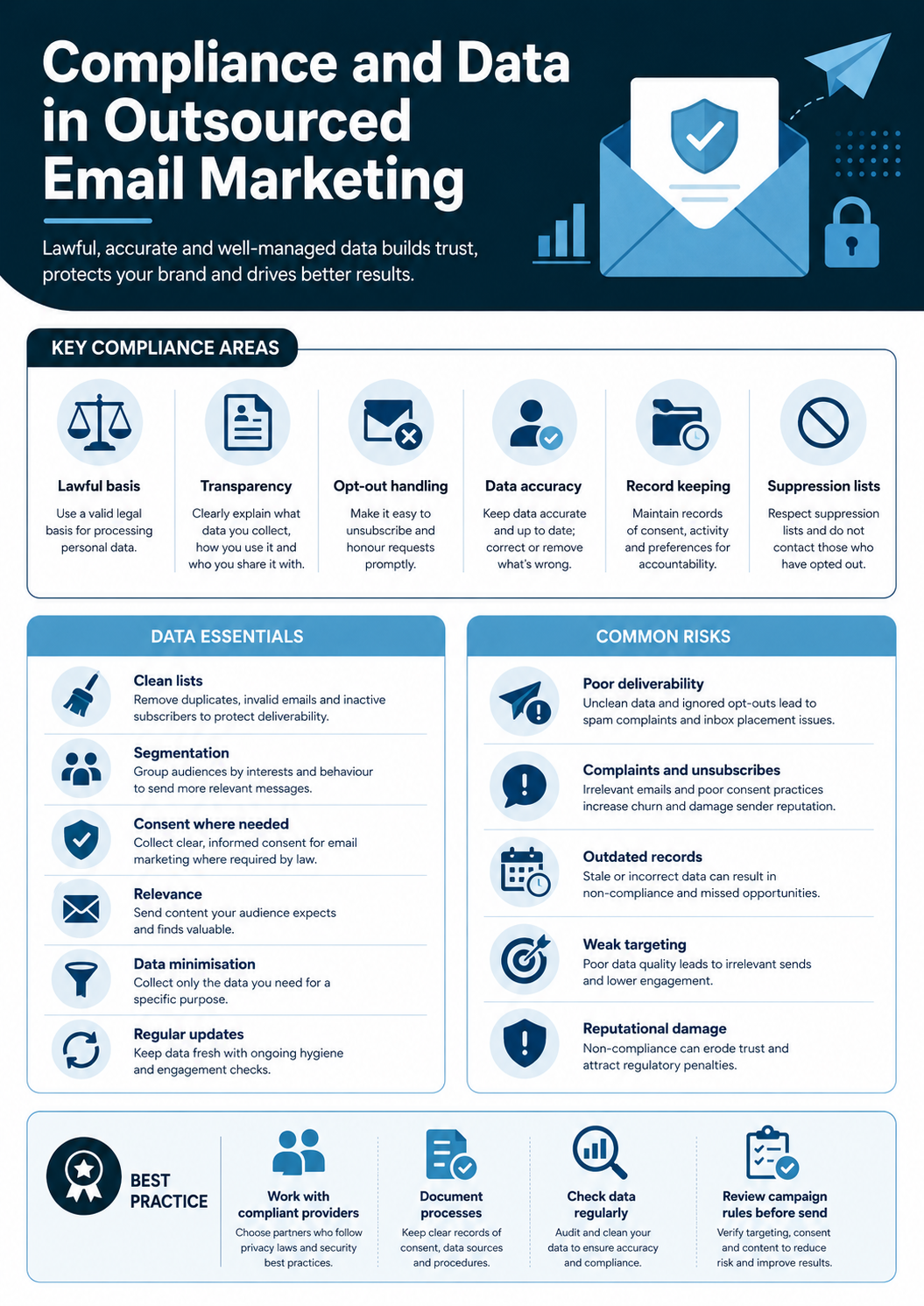
The most important compliance principle in any outsourced email marketing arrangement is that the business commissioning the outsourced service retains ultimate responsibility for compliance with PECR and UK GDPR. As the ICO states explicitly in its electronic and telephone marketing guidance, the organisation whose name and reputation are attached to the marketing communication is accountable for compliance regardless of whether the execution is handled internally or by a contractor. The ICO also advises that businesses should have a written contract with their contractor setting out the contractor’s responsibilities, and may want to seek an indemnity for any breach of PECR. However, the ICO explicitly notes that an indemnity is not a substitute for proper checks: if the contractor breaks the law, it is the commissioning business’s name and reputation at stake.
This accountability structure has direct practical implications. The business cannot simply delegate compliance to the agency or provider and consider its obligations discharged. It must verify that the provider understands and adheres to the relevant legal framework, must ensure that a proper Data Processing Agreement is in place covering the provider’s role as a data processor, and must be satisfied that any contact data used in the campaign was sourced compliantly and can be demonstrated to have been so if the ICO investigates a complaint.
UK GDPR and the Data Processor Relationship
Under UK GDPR, when a business engages a third party to process personal data on its behalf, that third party becomes a data processor, and the commissioning business remains the data controller. A written Data Processing Agreement is legally required between the controller and the processor. This agreement must specify the nature and purpose of the processing, the type of data and categories of data subjects involved, the obligations and rights of the controller, and the security measures the processor will apply to protect the data.
For outsourced email marketing, this means that the agency or provider handling campaign deployment must sign a DPA before any personal data is transferred to them, and must process that data only for the purposes specified in the agreement and in accordance with the controller’s documented instructions. A provider who is unwilling to enter into a DPA, or whose standard DPA contains terms that are inconsistent with UK GDPR requirements, should not be used for any programme involving personal data, which is to say any email marketing programme that uses named contacts.
PECR: Consent, Corporate Subscribers, and the Soft Opt-In
PECR governs the specific requirements for sending marketing emails. For consumer contacts, explicit opt-in consent is required. For corporate subscribers, the corporate subscriber exemption applies: as the Data Protection Network confirms, the PECR rule on direct marketing by electronic mail does not apply to corporate subscribers, meaning that B2B email outreach to limited companies does not require prior consent under PECR. However, UK GDPR’s requirement for a lawful basis still applies to any record containing a named individual’s email address, and legitimate interests must be documented for B2B outreach.
When contact data is purchased and used in an outsourced email marketing programme, the ICO’s guidance on using marketing lists is explicit: businesses should check the origin and accuracy of bought-in lists and should only use bought-in lists for email, text, or recorded calls with very specific consent. For consumer campaigns using purchased email data, a verifiable consent trail must exist for every record. For B2B campaigns, the data must have been sourced from compliant sources with documented legitimate interests support. This requirement applies whether the campaign is run in-house or through an outsourced provider.
AccuraData Compliance: Every B2B email list we supply comes with a Data Processing Agreement as standard and clear documentation of the sourcing and lawful basis for every record. Our B2B data is supplied with documented legitimate interests assessments. Consumer email data is sourced only where verifiable opt-in consent exists. We are registered with the ICO and operate within the full UK GDPR and PECR framework, making our data appropriate for use in outsourced arrangements where the commissioning business requires a data provider they can point to as compliant.
The Role of Contact Data in Outsourced Email Marketing
The quality of the contact data is the single most determinative variable in any outsourced email marketing programme. No level of expertise in copywriting, platform management, or campaign strategy can compensate for a database that is invalid, poorly segmented, or non-compliant. This is a principle that the best email marketing agencies understand clearly: the data is the foundation, and the capability built on top of it only performs to the standard the foundation supports.
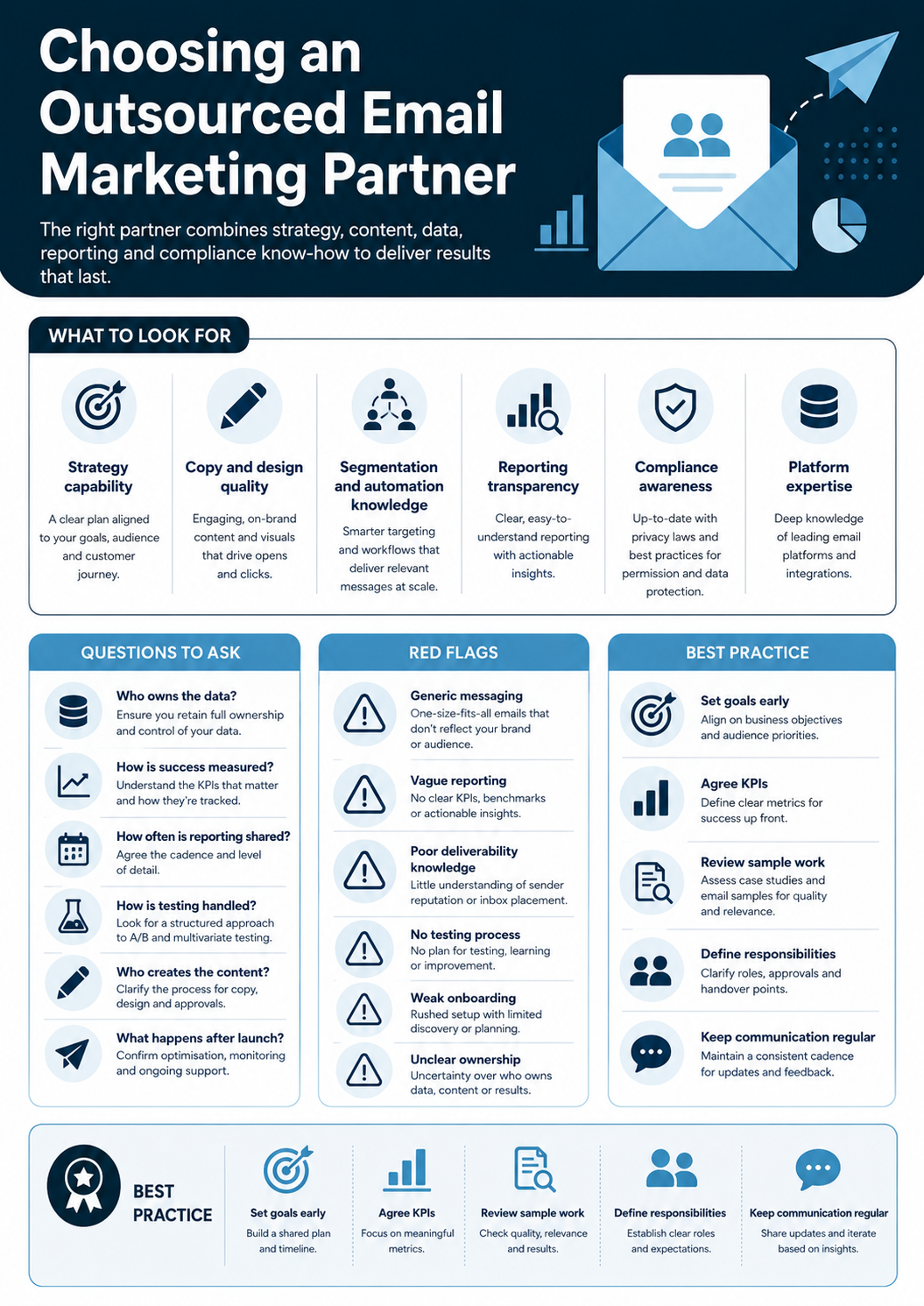
For businesses whose outsourced email marketing programme targets a defined business audience, whether by sector, geography, company size, or job function, the data must reflect that targeting precisely. A campaign aimed at finance directors in manufacturing companies with 100 to 500 employees requires a B2B email database that has been filtered to that profile at the record level, not a broad industry list that happens to include some relevant contacts alongside a large number of irrelevant ones. The relevance of the audience determines the relevance of the message, which determines whether the campaign generates pipeline or generates unsubscribes.
Mailbox Verification: The Non-Negotiable Quality Standard
Any contact data used in an outsourced email marketing campaign must be verified at active mailbox level before deployment. This goes beyond checking that an address is correctly formatted or that the domain exists. Mailbox-level verification confirms that the specific inbox is live and accepting mail, identifying addresses that look structurally valid but are no longer active: abandoned corporate accounts, former employees whose email addresses have been decommissioned, and role-based addresses such as info@ and admin@ that generate low engagement and high complaint rates.
The deliverability consequences of deploying unverified data in an outsourced email marketing programme are immediate and compounding. Hard bounces from invalid addresses damage the sending domain’s reputation with inbox providers. Spam trap hits from addresses maintained by blacklist operators signal that the list was not built from active, opted-in contacts. And engagement signals from large numbers of unengaged contacts tell Gmail, Outlook, and Apple Mail that the sender’s messages are unwanted, reducing inbox placement for every subsequent campaign regardless of how well it is constructed.
AccuraData: All contact data we supply for email marketing services and outsourced campaign use is verified at active mailbox level before delivery. For agencies and managed service providers, we can supply verified data directly into their platforms or deliver it in the format required for integration. For businesses whose existing data needs cleaning before an outsourced campaign launches, our data cleansing and enrichment service applies mailbox-level verification, role-based and spam trap removal, and Companies House live cross-referencing in a single submission, returning a clean, documented dataset ready for deployment.
Segmentation Fields: What Good Data Enables
A contact database that supports outsourced email marketing effectively contains more than email addresses and names. It carries the structured fields that allow the campaign to be divided into meaningful segments, each receiving a different version of the message calibrated to the specific profile of that audience group. For B2B campaigns, these fields are industry classification to SIC code level, employee count banding, estimated annual turnover, geographic region, and job title with seniority level. For consumer campaigns, age range, homeownership status, household composition, geographic location, and lifestyle or interest categories are the primary dimensions.
The performance case for segmentation is not marginal. Detailed segmentation produces 30% more opens and 50% more clicks compared to unsegmented campaigns, and advanced personalisation driven by structured database fields has been linked to revenue uplifts of up to 760% in DMA research. An outsourced email marketing partner that insists on well-structured, richly attributed contact data is not adding unnecessary complexity to the engagement. It is protecting the commercial return on the campaign.
Suppression Management in an Outsourced Arrangement
One of the most frequent compliance failures in outsourced arrangements is suppression management breakdown. When a contact unsubscribes from a campaign run by an outsourced provider, that unsubscribe record must be propagated back to the commissioning business’s master database as well as being applied within the provider’s sending platform. If this sync does not occur, the contact may be re-included in a subsequent campaign run from the business’s own data, generating a PECR violation that originates in the data management process rather than in the campaign itself.
Establishing a clear, documented suppression management protocol before an outsourced email marketing arrangement begins is essential. This protocol should specify who is responsible for maintaining the master suppression list, how unsubscribe records are transferred between the provider’s platform and the client’s CRM, how frequently the sync occurs, and what the procedure is for handling opt-out requests that arrive through channels other than the unsubscribe link in the campaign email.
What to Look for When Choosing an Outsourced Email Marketing Partner
The quality of an outsourced email marketing arrangement is determined at the selection stage. The questions asked before an engagement begins, and the standards insisted upon in the contract, define whether the programme that follows will strengthen the business’s commercial position or create compliance, deliverability, and reputational risk.
Demonstrable Deliverability Expertise
Deliverability in 2025 and 2026 requires technical expertise that goes beyond knowing how to use an email sending platform. The mandatory authentication requirements from Google, Yahoo, and Microsoft, covering SPF, DKIM, and DMARC, must be correctly configured on the sending domain. The 0.1% spam complaint threshold at which Gmail begins to take action must be understood and managed. And the implications of Apple Mail Privacy Protection for open rate measurement, and the need to use click-through rate as the primary engagement indicator as a result, must inform how the partner measures and reports campaign performance.
Any outsourced email marketing provider worth engaging should be able to explain their deliverability management process in specific technical terms: how they configure authentication, how they monitor complaint rates, how they manage domain warm-up for new or reactivated sending infrastructure, and what their process is for responding when deliverability metrics deteriorate. Vague or general answers to these questions are a signal that the provider is not managing deliverability at the level that the 2025 inbox environment requires.
Transparent Compliance Documentation
Before engaging any outsourced email marketing provider, ask directly about their compliance process. A reputable provider should be able to supply a Data Processing Agreement that meets UK GDPR requirements as standard, explain clearly how they handle opt-outs and suppression records, confirm whether they are ICO-registered, and describe the lawful basis on which any contact data they source or manage is processed. If the provider cannot answer these questions in plain, specific terms, or if their DPA contains terms that conflict with UK GDPR requirements, do not proceed with the engagement regardless of how attractive their commercial proposition appears.
The ICO’s guidance on using contractors for electronic marketing is clear on this point: the commissioning business remains responsible if the contractor breaks the law and exposes the business to enforcement action. A written contract that sets out the contractor’s compliance responsibilities, combined with documented pre-engagement due diligence showing that those responsibilities were assessed, is the minimum standard of protection a business should have in place before delegating any marketing that uses personal data to an external provider.
A Clear Data Strategy and Sourcing Approach
The contact data strategy of an outsourced email marketing provider is one of the most revealing questions to explore during the selection process. Where does the provider source contact data? How is it verified? What segmentation fields does it carry? How recently was it cleaned? Can they provide documentation of the lawful basis for the records they use? A provider who sources data from bulk, unverified lists and applies minimal verification before deployment will produce campaigns with high bounce rates, poor deliverability, and compliance exposure that the commissioning business will bear the consequences of.
A provider who works with a verified data partner whose records are mailbox-validated, segmented, and supplied with proper compliance documentation is building their campaigns on a foundation that protects both performance and compliance. AccuraData works with both businesses running their own campaigns and with email marketing agencies and managed service providers who need a reliable, compliant data partner for their client programmes. Our B2B email lists are supplied with full compliance documentation and are available segmented to the decision-maker level that targeted outreach requires.
Measurement and Reporting Transparency
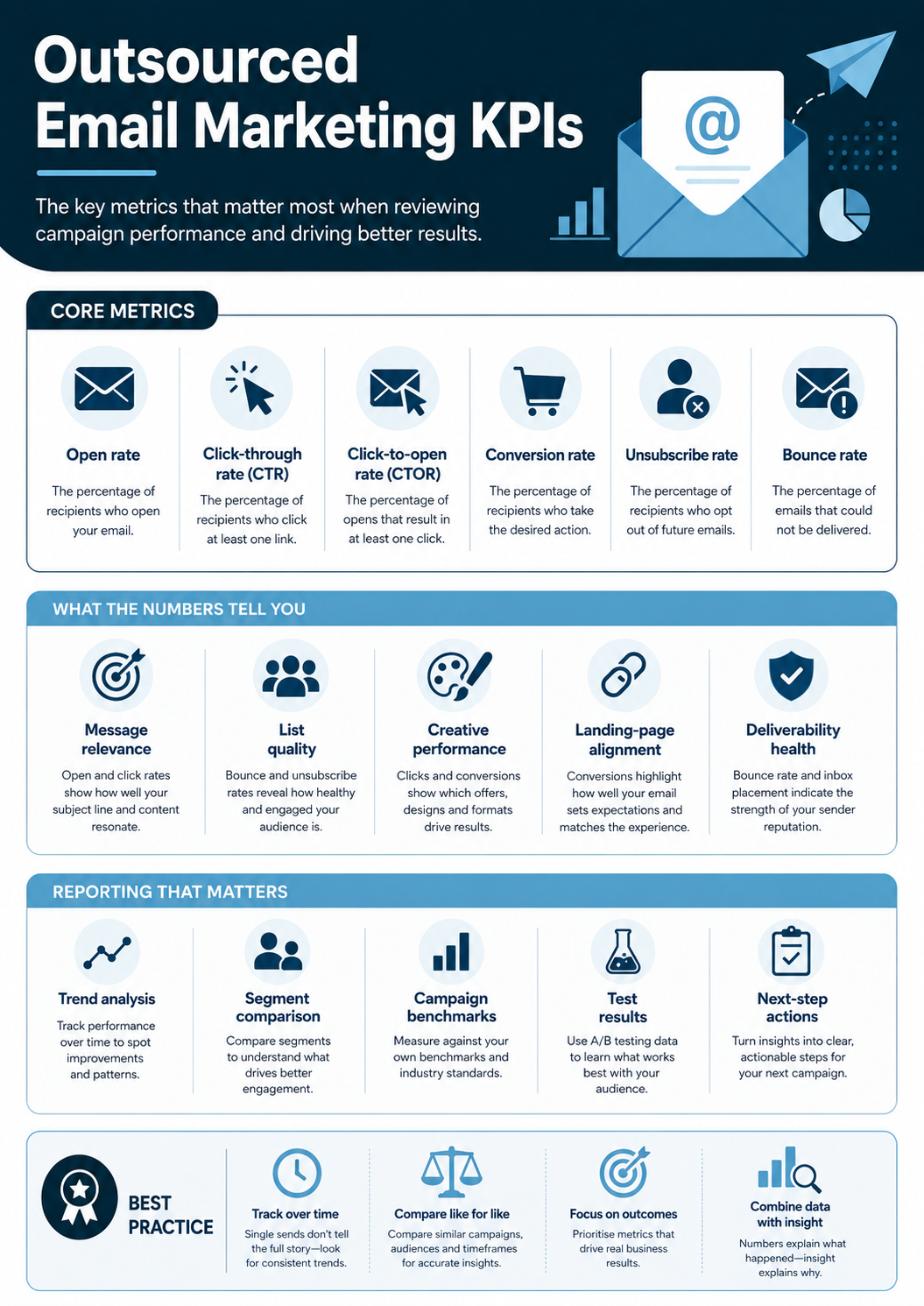
An outsourced email marketing partner should report on the metrics that actually reveal programme performance, not just those that are flattering to present. Given that Apple Mail Privacy Protection has made open rate an unreliable primary metric, a provider whose reporting focuses primarily on open rates without contextualising the MPP inflation effect is either technically uninformed or deliberately presenting a misleading picture. Click-through rate, conversion rate, bounce rate, unsubscribe rate, and spam complaint rate are the metrics that provide a genuine assessment of how the programme is performing and whether the underlying database is in a healthy state.
Reporting should also include segment-level breakdown, not just whole-programme totals. A campaign that achieves an acceptable average CTR may be concealing a high-performing segment and a poorly performing one. The segment-level intelligence is what drives data strategy decisions for the next campaign and is what a provider with genuine analytical capability will surface proactively rather than waiting to be asked.
The Data-First Approach to Outsourced Email Marketing
The businesses achieving the strongest results from outsourced email marketing treat the contact database as the primary investment, not the execution service. An outsourced email marketing programme that is built on a verified, well-segmented, compliantly documented database and delivered by an operationally competent provider will consistently outperform one that invests primarily in creative and platform sophistication while neglecting the quality of the underlying contact data.
This principle has a direct implication for how businesses should approach the economics of outsourced email marketing. The temptation is to minimise the data budget and invest the majority of the spend in execution services. The commercial reality is the opposite: a small, precisely targeted, fully verified B2B email list of 2,000 decision-makers in a specific sector will outperform a 20,000-record unverified list on every metric that determines pipeline generation, because every contact on the smaller list has a realistic probability of being relevant, reachable, and responsive to a well-framed proposition.
Segmented email campaigns generate 30% more opens and 50% more clicks than their unsegmented equivalents. Dynamic content in targeted campaigns can lead to a 100% increase in ROI, as benchmarks from HubSpot and Campaign Monitor cited across multiple analyses confirm. These outcomes are achievable in outsourced email marketing programmes where the data partner and the execution partner are aligned on the principle that quality of audience determines quality of outcome. AccuraData’s email marketing database services are built around this alignment.
Building a Successful Outsourced Email Marketing Relationship
An outsourced email marketing arrangement works best when it is structured as an ongoing partnership rather than a transactional service. A provider who understands the business’s commercial objectives, its target audience, its competitive position, and the results it has generated from previous campaigns will produce increasingly well-targeted and well-performing campaigns over time as that knowledge accumulates. A provider who is given a brief, delivers a campaign, and then has no continuity with the next brief is effectively starting from scratch each time.
Briefing Properly Before Each Campaign
The quality of a brief determines the quality of an outsourced email marketing campaign. A brief that specifies the target audience in precise firmographic or demographic terms, defines the campaign objective clearly, provides the performance context from previous campaigns to the same audience, and identifies the specific action the campaign is designed to prompt gives the provider what they need to build something targeted and effective. A brief that amounts to ‘send an email to our database promoting our product’ gives the provider no basis for anything other than a generic campaign that will perform accordingly.
For businesses working with a data partner like AccuraData alongside an outsourced execution provider, the briefing process should specify the exact audience profile required from the data, the segmentation fields needed to support the intended approach, and the channel or channels the campaign will use, so that the data sourced meets the requirement of the campaign before execution begins.
Establishing Clear Performance Benchmarks
Before an outsourced email marketing programme begins, define the metrics that will be used to assess performance and the thresholds that would trigger a review of approach or data. Benchmark CTR targets by audience segment, acceptable bounce rate limits, spam complaint rate thresholds, and cost per qualified lead targets should all be agreed before the first campaign launches. This gives both parties a shared definition of success and a shared framework for diagnosing what needs to change when a campaign underperforms.
Regular review cadences, whether monthly or quarterly depending on campaign frequency, should also be established at the outset. These reviews should examine both campaign performance and database health, because a programme that is performing adequately on campaign metrics while its underlying database degrades is building a problem that will eventually manifest as a deliverability crisis or a data refresh requirement. Proactive database management, discussed and agreed in advance, prevents this scenario from developing.
Managing the Transition from In-House to Outsourced
For businesses transitioning from an in-house email operation to an outsourced email marketing arrangement, the data handover is the highest-risk element of the transition. The existing database must be audited, cleaned, and properly documented before it is passed to the outsourced provider. Unverified, poorly segmented, or inadequately documented databases transferred to an external provider do not suddenly become compliant and high-performing when someone else is managing them. The problems travel with the data.
An AccuraData database audit and cleanse, applied to the existing in-house database before it is transferred, removes the stale records, invalid addresses, and compliance documentation gaps that would otherwise follow the business into its outsourced arrangement. Our data cleansing and enrichment service applies active mailbox verification, Companies House cross-referencing for B2B contacts, role-based and spam trap removal, and suppression file management to produce a clean, documented dataset that is genuinely ready for an outsourced programme to be built on.
How AccuraData Supports Outsourced Email Marketing Programmes
AccuraData operates at the data layer of outsourced email marketing, supplying the verified, compliant contact records that campaigns need to perform and the cleaning and enrichment services that keep existing databases in a deployable state. We work both directly with businesses running their own campaigns and with agencies and managed service providers who need a reliable, compliantly documented data partner for the client programmes they manage.
Our B2B email lists are segmented by SIC code industry classification, employee count, turnover banding, geographic region, and job title and seniority across finance, operations, IT, marketing, HR, and procurement functions. Every record is verified at active mailbox level before delivery. Every dataset is supplied with a Data Processing Agreement and documented legitimate interests support. For businesses targeting specific sectors, we supply specialist lists including estate agents, architects, and many other industry verticals, each verified and segmented to decision-maker level.
For businesses whose existing database needs cleaning before an outsourced email marketing programme begins, our data cleansing and enrichment service covers active mailbox verification, role-based address and spam trap removal, Companies House live cross-referencing, and suppression file management in a single submission. For agencies managing data on behalf of their clients, we can discuss arrangements that cover regular refresh cycles and re-screening at the frequency the campaign programme requires.
For businesses also running telephone outreach from the same contact base, our TPS and CTPS checking service screens telephone fields in the same process, delivering a multi-channel dataset that is compliant across every outreach channel. And for businesses building a UK email database from scratch to support a new outsourced programme, our guide to how to build a UK email database covers the full process from architecture to maintenance.
If you want to understand what our data looks like for your specific target audience, what segmentation and compliance documentation is available, and how we can support an outsourced email marketing programme you are planning or already running, speak to our team. We will give a clear picture of what is available, at what cost, and what a campaign built on properly verified data can realistically achieve.
Outsourced Email Marketing Works When the Data Behind It Is Right
The growth in outsourced email marketing among UK businesses reflects a rational recognition that email done well is a specialist function. The channel delivers the highest ROI in digital marketing for the businesses that deploy it strategically, with the right data, through the right processes, with proper compliance. It underdelivers for those who treat it as a simple task that can be delegated without attention to what the delegation requires.
An outsourced email marketing arrangement that is built on verified, well-segmented contact data, governed by a compliant contract structure, executed by a provider with genuine deliverability expertise, and measured against the right performance indicators is one of the most effective and cost-efficient routes to pipeline generation available to B2B businesses of any size. The data is where that programme starts, and the quality of the data determines the ceiling on what every other element of the programme can achieve.