
There is a persistent misconception that consumer marketing in the UK has been fundamentally restricted by data protection law to the point where using a UK consumer database for outreach is either legally impractical or commercially irrelevant. Neither is true. Consumer direct marketing is alive, growing, and generating substantial returns for businesses that approach it correctly. Direct mail returned to growth in the UK in Q3 2024, recording a 12.9% year-on-year increase as part of an overall 9.7% rise in UK ad spend for the period. That is not a channel in decline. It is a channel that rewards businesses who understand how to use consumer data lawfully and strategically.
What has changed is the compliance framework. The rules governing how a UK consumer database can be used for direct marketing are detailed, channel-specific, and actively enforced by the ICO. Businesses that understand those rules and work with a supplier who takes compliance seriously have access to a powerful direct-to-consumer outreach capability. Businesses that misunderstand them, or ignore them, face consequences ranging from damaged reputation to significant financial penalties.
At AccuraData, we supply accurate, PECR and UK GDPR compliant consumer databases to businesses running direct mail, telemarketing, and email campaigns to UK households. This article explains what a UK consumer database is, how the legal framework works in practice across each marketing channel, what good consumer data looks like and why it matters, and how to use consumer data in ways that generate commercial results rather than compliance problems.
What a UK Consumer Database Actually Is
A UK consumer database is a structured dataset of personal contact records belonging to individual members of the public, as opposed to business contacts. At its most basic, a consumer data list contains names and contact information: postal addresses, telephone numbers, and where consent has been obtained, email addresses. In practice, a well-built UK consumer database also includes demographic and lifestyle attributes that allow meaningful segmentation, such as age range, household composition, estimated income banding, homeownership status, geographic region, and interest or lifestyle categories derived from survey or transactional data.
This is what distinguishes a quality consumer contact database from a raw list of addresses. The raw address gets your material through a letterbox. The enriched record gets your material to the right letterbox, in the right household, at a time that reflects something real about the recipient’s circumstances. That distinction drives the difference between direct mail that generates responses and direct mail that goes straight into the recycling.
Consumer databases in the UK are compiled from a range of sources including electoral roll data (subject to restrictions), lifestyle surveys where individuals have actively provided personal information and consented to its use for marketing purposes, transactional data from retail and financial services partners, and publicly available records. The source of the data is not a minor detail. It determines the lawful basis on which the data can be used for marketing, and it is one of the most important questions to ask any supplier of consumer data before you purchase.
AccuraData’s UK consumer database is compiled from compliant sources, with consent records maintained and documented for the email and telephone data within it. Our postal data is available under the legitimate interests basis applicable to direct mail. Every dataset we supply is accompanied by a Data Processing Agreement and clear documentation of the sourcing and lawful basis for the records it contains.
The Legal Framework for UK Consumer Database Marketing: Channel by Channel
This is where most of the confusion about consumer data marketing originates. The legal requirements are not uniform across channels. A UK consumer database that can be used freely for one marketing method may require additional consent steps for another. Understanding how the law applies to each channel is not optional for any business running consumer outreach campaigns.
The two frameworks that govern consumer direct marketing in the UK are UK GDPR and the Privacy and Electronic Communications Regulations 2003 (PECR). UK GDPR governs the processing of personal data for all marketing purposes and requires a lawful basis for every use of an individual’s information. PECR governs the specific mechanics of electronic marketing, imposing additional rules on email, SMS, telephone calls, and automated calls that go beyond the general requirements of UK GDPR. As the ICO sets out in its own direct marketing guidance, the two frameworks operate in parallel and must both be satisfied.
Direct Mail: The Most Permissive Channel
Direct mail by post is, from a legal standpoint, the most accessible channel for consumer data marketing. Under ICO guidance on marketing and data protection, sending marketing material to consumers by post does not require consent under PECR, because PECR does not apply to postal communications. You do, however, need a lawful basis under UK GDPR for processing the personal data involved. For most direct mail campaigns, that basis is legitimate interests, provided you carry out and document a three-part balancing test establishing that your commercial interest is proportionate and does not override the individual’s rights and reasonable expectations.
This makes direct mail a genuinely workable channel for businesses using a UK consumer database without pre-established consent from every recipient, provided the legitimate interests basis is properly applied and documented. Every campaign must still offer a clear opportunity to opt out of future communications, and any opt-out received must be honoured immediately and added to your suppression list. The Mailing Preference Service (MPS) register, on which consumers can register a preference not to receive unsolicited direct mail, should also be screened against before any postal campaign is launched.
Telephone Marketing: Consent and TPS Screening
Live marketing calls to consumers are governed by both PECR and UK GDPR. Under PECR, you cannot make marketing calls to any individual whose number appears on the Telephone Preference Service (TPS) register unless that individual has given specific consent to receive your calls, overriding their TPS registration. You also cannot call anyone who has previously told you they do not want your calls. This applies regardless of whether the number was obtained from a purchased consumer database or from your own existing customer records.
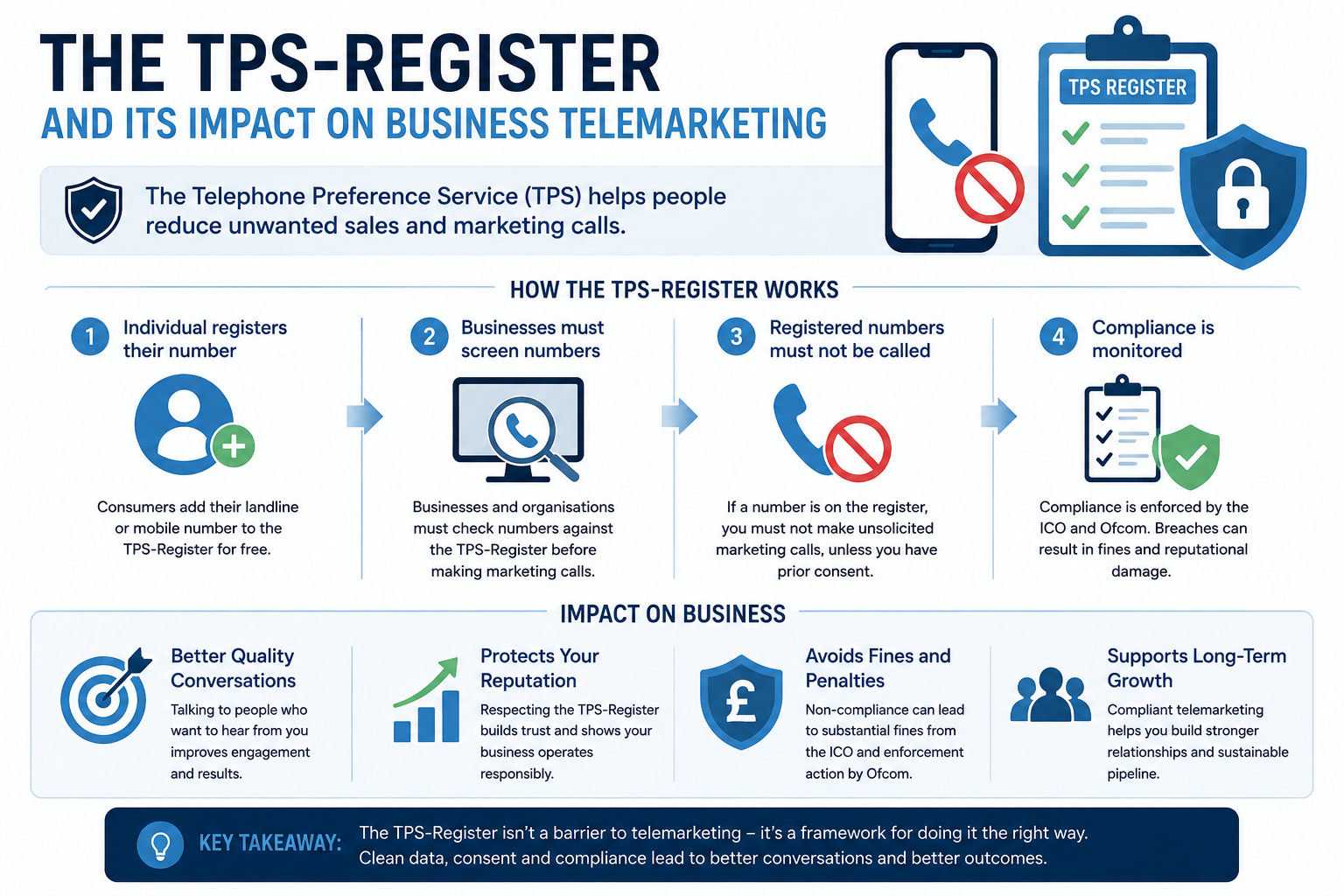
The TPS register currently holds tens of millions of numbers. Any outbound calling campaign using a consumer telephone database must be screened against it before the first call is made, and re-screened at intervals of no more than 28 days for ongoing campaigns. AccuraData’s TPS and CTPS checking service provides fast, accurate screening at competitive rates, returning clear results that make suppression straightforward before your team picks up the phone. For businesses whose consumer calling data has not been recently screened, this check is the non-negotiable first step before any campaign launches.
Automated marketing calls, including pre-recorded messages and robo-calls, face stricter rules still. Under PECR, automated marketing calls to consumers require specific prior consent, regardless of TPS status. A clean TPS screen does not make an automated call to a consumer compliant. General consent for marketing, or even consent for live calls, is not sufficient. The consent must specifically cover automated calls from your organisation, and it must meet the full UK GDPR standard of being freely given, specific, informed, and unambiguous. The ICO has issued significant fines for automated call campaigns that failed this test, including a £550,000 combined penalty against two energy firms in 2025 for making unlawful automated calls.
Email and SMS Marketing to Consumers: Consent Is Required
This is the area where the legal framework is most restrictive for consumer database marketing. Under PECR, sending marketing emails or SMS messages to individual subscribers, which includes all consumers, requires prior consent. This is not the same as the more permissive rules that apply to B2B email marketing to corporate subscribers. For consumer email and SMS, you need opt-in consent that is, as the ICO’s guidance makes clear, freely given, specific, informed, and unambiguous. Pre-ticked boxes, bundled consent, and vague references to ‘third party partners’ do not meet this standard.
The soft opt-in is the one PECR exception relevant to consumer email marketing. It allows businesses to email existing customers about similar products or services without fresh consent, provided the customer was given a clear opportunity to opt out when their details were first collected, and is given the same opportunity in every subsequent email. This exception is narrow: it applies only to existing customers, only to similar products or services, and only where the original collection included a proper opt-out opportunity. It does not extend to new prospects or to marketing different product categories to existing customers.
For businesses wanting to use a UK consumer email database for outreach campaigns, the email data within that database must have been collected with valid, documented consent specifically naming the type of marketing being sent. A consumer database that includes email addresses should be able to demonstrate the consent trail for each record. AccuraData’s consumer email data is sourced from compliant opt-in data partners where consent has been properly obtained and documented to the required standard.
AccuraData Compliance Note: Our consumer data offering is structured around channel-specific compliance. Postal records are available under the legitimate interests basis applicable to direct mail. Telephone records are supplied TPS-screened where required, and our data cleansing and enrichment service includes TPS checking for any consumer telephone data you hold. Consumer email data is available only where verifiable opt-in consent exists. We will always advise clearly on which channel each dataset supports and which compliance steps remain your responsibility before campaign launch.
Why Data Quality Is the Commercial Foundation of Consumer Database Marketing
The legal compliance framework is not the only reason to care about the quality of the UK consumer database you use. Data quality is a direct commercial issue, and the two are more closely linked than many marketers realise. Poor data quality creates compliance exposure, but it also drives up campaign costs, reduces response rates, and produces the kind of deliverability damage that follows a business into every subsequent campaign it runs.
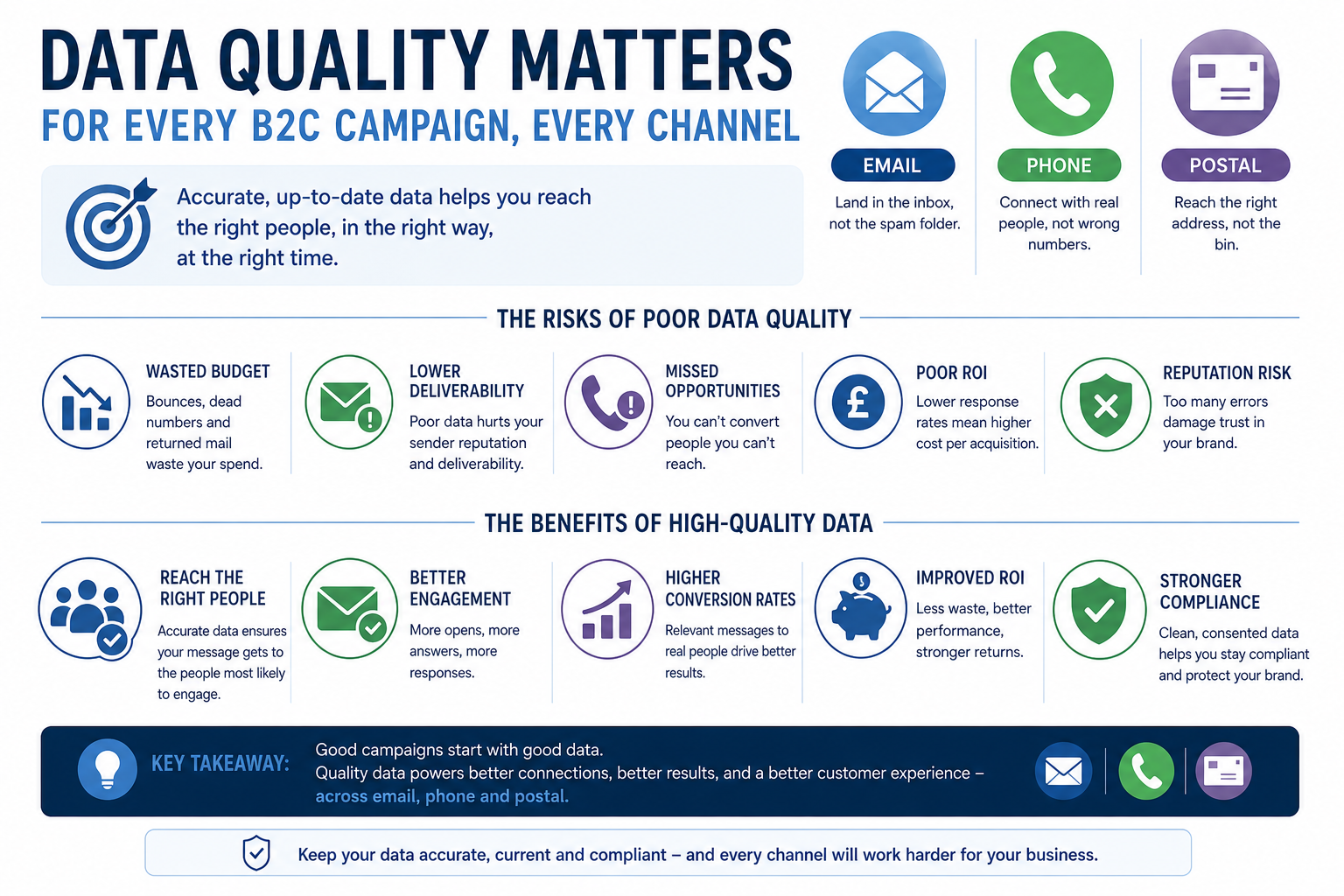
Consumer data decays in several distinct ways. People move house. They change telephone numbers. They die. Households change composition as children leave or partners merge finances. According to Royal Mail data, approximately 3.7 million people move home in the UK each year, which means that any static consumer mailing database loses a meaningful proportion of its address accuracy annually without active maintenance. For telephone data, the decay picture is similar: numbers are reassigned, ported between providers, and abandoned at a rate that makes a database built eighteen months ago materially less accurate than one built last quarter.
The commercial consequences of acting on stale consumer data are immediate. Direct mail delivered to households that no longer match the intended recipient represents wasted print, postage, and design spend. Calls placed to numbers that have been reassigned risk reaching consumers who are not only uninterested but potentially confused or hostile, and who may generate complaints to the TPS or the ICO. Email sent to addresses that are no longer monitored by the intended individual adds to bounce rates that progressively damage your sending domain’s reputation with inbox providers.
The standard to aim for in a UK consumer database is verification against live data sources at regular intervals: postal addresses confirmed against Royal Mail’s National Change of Address (NCOA) file, telephone numbers validated against live network data, and email addresses verified at mailbox level before use. AccuraData applies all three layers to our consumer data before delivery, and we can apply them retroactively to existing consumer databases that clients bring to us through our data cleansing and enrichment service.
Segmenting a UK Consumer Database for Better Campaign Performance
A UK consumer database that cannot be meaningfully segmented is a blunt instrument. Consumer markets are not homogeneous, and the proposition that works for a 34-year-old homeowner in Manchester is unlikely to be the same one that resonates with a 62-year-old renter in rural Devon. Segmentation is what transforms a generic mailing list into a targeted outreach tool, and the depth of segmentation available in a consumer dataset is one of the most important factors determining campaign performance.
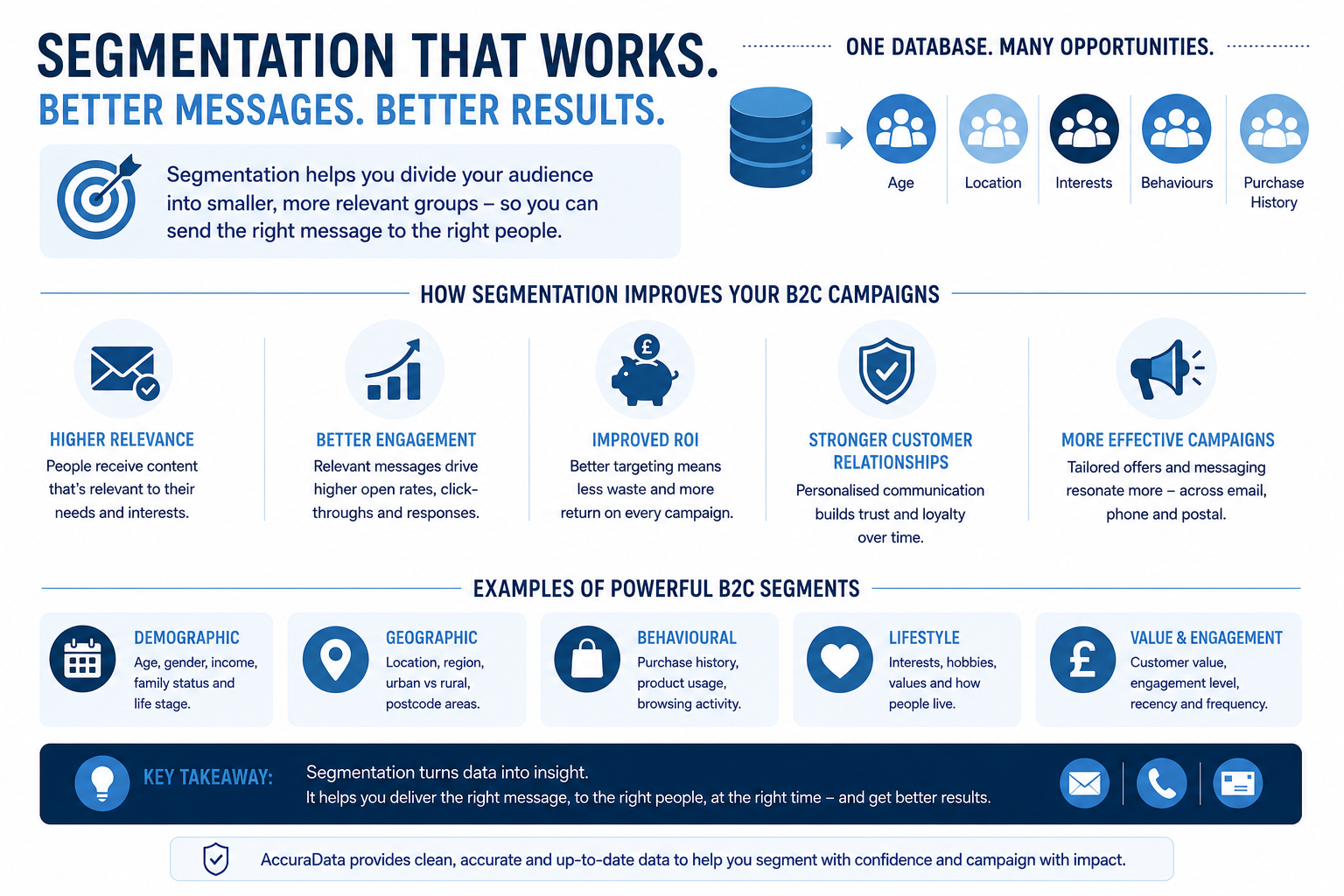
The most fundamental segmentation available in a well-built consumer data list is demographic: age range, gender, household size, and presence of children. These fields allow you to direct a campaign at the demographic groups most likely to respond to a given offer, rather than distributing it evenly across an unfiltered database. A financial services company promoting a retirement planning product has a different ideal age range from one promoting a first-time buyer mortgage. A children’s toy brand needs households with under-16s. These are not sophisticated targeting requirements, but they cannot be met without structured demographic data in the underlying consumer database.
Geographic Segmentation
Geographic filtering is, for many businesses, the most immediately valuable form of consumer data segmentation. Local and regional businesses have no commercial reason to pay for and contact households outside their service area. Even national businesses with physical retail locations often need to weight their direct mail spend towards catchment areas rather than distributing it uniformly. A quality UK consumer database should allow filtering by postcode, postcode district, postcode sector, local authority area, and broader regional classification, giving campaign planners precise control over the geographic distribution of their outreach.
Lifestyle and Interest Segmentation
Beyond demographics and geography, the most commercially powerful form of consumer database segmentation is lifestyle and interest filtering. Consumer databases compiled from lifestyle survey data hold self-reported information on purchasing interests, hobbies, financial circumstances, home improvement plans, charitable giving history, and dozens of other attributes that allow a marketer to reach not just the right demographic profile but the right interest profile. A travel company can filter for households that have expressed an interest in overseas holidays. A home improvement supplier can filter for homeowners who have indicated they are planning renovation work in the next twelve months.
This level of targeting drives response rates that generic demographic filtering cannot match. Research consistently shows that 63% of consumers engage more with direct mail when it is tailored to their interests, and 56% have made a purchase following a piece of direct mail. Neither statistic is achievable through an untargeted broadcast to an unfiltered consumer database. They reflect campaigns that reached the right audience with a relevant proposition, which is a data quality and segmentation outcome as much as it is a creative one.
Financial and Property Segmentation
For financial services, insurance, and property-related businesses, financial attribute filtering is an important additional layer. Estimated income banding, homeownership or rental status, council tax band as a proxy for property value, and mortgage holding status are all attributes that allow a campaign to be directed at the households most likely to qualify for or be interested in a given financial product. This targeting is not simply commercially useful. For regulated industries, it also forms part of a responsible marketing approach that reduces the likelihood of delivering inappropriate offers to consumers for whom a product is unsuitable.
AccuraData Segmentation Options: Our UK consumer database can be filtered by age range, gender, geographic region down to postcode level, property ownership status, household composition, and lifestyle interest categories. Speak to our team about what segmentation is available for your specific campaign audience. We will tell you precisely what fields are in scope for your brief before you commit to a purchase.
Making Consumer Database Marketing Work: Practical Principles
Legal compliance and data quality are necessary conditions for a successful consumer data campaign. They are not sufficient ones. Businesses that invest in accurate, well-segmented UK consumer databases and then approach the outreach without strategic discipline still get poor results. The following principles reflect what consistently separates consumer data campaigns that generate returns from those that do not.
Match the Channel to the Audience and the Offer
Different consumer audiences respond differently to different channels, and the offer itself should influence channel selection. Research from Lob’s 2025 consumer survey found that 53% of consumers describe direct mail as ‘real, valuable, and worth keeping’, with an average lifespan of 17 days for a piece of direct mail compared to 17 seconds for an email. For high-consideration purchases, subscription products with physical fulfilment, and luxury or premium offers, direct mail through a consumer postal database gives you a physical presence in a household that digital channels cannot replicate. For time-sensitive promotions and high-frequency engagement, telephone outreach where consent and TPS compliance are in order delivers the immediacy that post cannot.
Do Not Mistake Volume for Value
One of the most common errors in consumer database marketing is purchasing the largest affordable consumer data list and sending the same message to every record on it. This approach produces mediocre results and significant waste. A smaller, precisely segmented list sent a highly relevant message will outperform a large, undifferentiated database sent a generic one, almost without exception. Direct mail response rates reach 27% when integrated with email campaigns and targeted at relevant audiences. Untargeted broadcast rates are a fraction of that figure. The return on investment from precision targeting justifies the data cost of a well-segmented UK consumer database multiple times over.
Test Before You Scale
Consumer data campaigns benefit enormously from testing at small scale before full deployment. Split-testing different creative approaches, different offers, or different geographic sub-segments against a small portion of your consumer mailing list before sending to the full database gives you real performance data to guide the full rollout. The cost of a test is a small fraction of a full campaign send. The return from optimising based on test results, rather than scaling an approach that turns out to underperform, is typically significant. This is particularly important for direct mail where print and postage costs are a meaningful fixed cost per piece, making a poorly performing full rollout materially expensive to rectify.
Maintain Your Suppression List Rigorously
Every opt-out received from a UK consumer database campaign must be applied across all future campaigns to that individual, regardless of channel. A consumer who opts out of your direct mail should also be suppressed from telephone and email outreach, unless they have given separate, specific consent for those channels. The suppression list is not a channel-specific document. It is an organisation-wide record of individuals who have exercised their right to object to your marketing, and failing to honour it is a clear breach of both UK GDPR and PECR.
In addition to opt-outs generated through your own campaigns, your suppression list should incorporate records from relevant opt-out registers: the Mailing Preference Service for postal campaigns, the TPS for telephone campaigns, and any consent withdrawal records held in your CRM. Applying all of these before every campaign send is not administratively burdensome if the right systems are in place. But it is the step that most frequently breaks down in consumer data marketing operations that have not thought carefully about suppression management as a process rather than a one-time task.
Personalise at the Level the Data Supports
Personalisation in consumer marketing ranges from simply including the recipient’s name in a salutation to dynamically varying the offer, the imagery, or the entire communication based on the lifestyle and demographic attributes held in the consumer database. 73% of consumers say they prefer to receive brand messages by post because it feels more personal, and 71% of Gen X consumers and baby boomers say that mail feels more personal than digital communications. The degree of personalisation that a campaign can deploy is directly constrained by the richness of the data in the UK consumer database it is built from. A record containing only a name and address can support basic personalisation. A record also containing age range, household composition, homeownership status, and interest categories can support a communication that speaks to the recipient’s specific context. The investment in richer data pays back in the higher response rates that personal relevance generates.
Consumer Database Marketing Across Multiple Channels
The strongest consumer marketing campaigns in 2025 are rarely single-channel. 84% of consumers say they are more likely to respond to a promotional message when they see it across multiple channels, and 68% of marketers now integrate email with direct mail as part of their campaign strategy. For businesses with access to a UK consumer database that includes postal addresses, telephone numbers, and opt-in email contacts, a coordinated multi-channel sequence, using the same consumer record across different touchpoints, compounds the effect of each individual communication.
A typical integrated consumer sequence might begin with a personalised direct mail piece, followed by a telephone call to households that have not responded after ten days, with a retargeted digital message served to households whose email address is also held in the database. Each channel reinforces the others, and the combined response rate for a coordinated campaign consistently exceeds what any individual channel would achieve in isolation. This is why the richness of the underlying consumer contact database matters so much. A dataset with postal address only supports only one channel. A dataset with postal address, telephone number, and opted-in email address supports a fully integrated outreach sequence from a single data source.
AccuraData’s UK consumer database includes postal, telephone, and opted-in email data where available, allowing clients who want to run multi-channel campaigns to work from a single, consistent dataset rather than purchasing separate lists for each channel and managing the deduplication and suppression complexity that comes with it. Our data cleansing and enrichment service can also enrich an existing consumer dataset that covers only one channel with additional contact fields and demographic attributes, expanding its utility without requiring a full database replacement.
What AccuraData Offers for UK Consumer Database Campaigns
AccuraData supplies accurate, PECR and UK GDPR compliant UK consumer databases to businesses running direct mail, telemarketing, and opted-in email campaigns to UK households. Our data is built from compliant sources, maintained with regular verification cycles, and supplied with full compliance documentation including a Data Processing Agreement on every engagement.
We offer consumer data segmented by age range, gender, geographic region to postcode level, property ownership status, estimated income banding, household composition, and lifestyle interest categories. Campaigns can be built to a precise audience profile rather than a generic demographic catch-all, and our team will work with you at the brief stage to identify which segmentation options are available for your specific target audience before any data is purchased.
For businesses running telephone campaigns against a consumer database, our TPS checking service screens your calling data against the live TPS register before delivery. For businesses holding existing consumer data that needs cleaning before use, our data cleansing process covers address validation against Royal Mail data, telephone number validation against live network data, email address verification at mailbox level, and suppression against MPS and TPS registers. The result is a dataset that is clean, compliant, and ready to use from the moment it reaches you.
Our pricing is competitive and transparent. We do not charge in a way that makes proper compliance steps prohibitive, because we understand that a consumer database that has not been properly screened and verified is a risk, not a resource. Get in touch with our team to discuss what our consumer data looks like for your target audience, what channels it supports, and what a campaign built on it can realistically deliver.
Consumer Database Marketing in 2026: A Channel That Rewards the Well-Prepared
The UK consumer marketing landscape in 2026 is not the restricted, compliance-paralysed environment that some businesses assume it to be. Direct mail is growing. Telephone outreach to TPS-compliant lists continues to generate results. Opted-in consumer email data, where properly sourced and documented, delivers the personalisation and immediacy that digital audiences respond to. What has changed is the complexity of doing it right, and the consequences of doing it wrong.
A well-built, well-segmented, compliantly sourced UK consumer database is a genuine business asset. It gives marketing teams direct access to the households most likely to respond to a given proposition, across the channels those households engage with. Used with strategic discipline, with proper suppression management, and with the legal framework understood and respected, it is one of the most cost-effective routes to new customer acquisition available to any consumer-facing business in the UK market.
AccuraData provides accurate, PECR and UK GDPR compliant consumer databases at competitive rates, with the verification, segmentation, and compliance documentation to make them genuinely useful from day one. If you want to understand what our consumer data looks like for your target audience and your preferred marketing channel, the conversation starts with a brief to our team. We will tell you precisely what is available and what it will cost, with no obligation.