
Buying a Database of Emails should be treated as a controlled purchasing decision, not as a quick way to add thousands of addresses to a sending platform. The database has to fit the audience, the campaign, the legal basis, the sender’s technology and the way results will be measured. If any one of those parts is weak, a file that looks inexpensive can become expensive very quickly through bounces, complaints, wasted creative, poor sales follow-up and damage to sender reputation.
That is why the best buyer starts with the intended use rather than the record count. A business entering a new B2B sector may need named decision-makers at companies that fit a precise industry, size and location profile. A consumer brand may need a permissioned B2C audience for a seasonal email offer. The files may both contain email addresses, but they are not the same product. Their sourcing, permission model, segmentation, evidence requirements and campaign risks are different.
AccuraData supports both sides of this market. Its B2B Data services help organisations define business audiences, while its dedicated B2B Email Data service focuses on decision-makers and business email records. Consumer campaigns are handled separately through B2C Data and B2C Email Data, reflecting the fact that consumer email marketing normally needs a stronger permission trail. Existing databases can also be improved through Data Cleansing and Data Appending rather than replaced automatically.
This article takes a different approach from a conventional email-list buying guide. It treats Buying a Database of Emails as a sequence of approval gates. The buyer first defines what the database must achieve, then checks what is actually being licensed, separates B2B and B2C requirements, tests source and permission evidence, reviews technical quality, agrees acceptance criteria, prepares the sending environment and only then launches the campaign. The same framework also explains what should happen after the first send, because a database is not proven by its purchase price. It is proven by the quality of the outcomes it creates.
A compliance note is important. This is practical marketing and procurement guidance, not legal advice. UK direct marketing rules depend on the type of recipient, the source of the data, the proposed message, the sender, the relationship with the recipient and the exact permissions available. Buyers should check current regulatory guidance and obtain specialist advice where a campaign is unusual, high risk or legally uncertain.
Buying a Database of Emails Starts With the Job the Data Must Do
Before asking a supplier for a count, define the commercial job. A database for a one-off webinar invitation is not necessarily the same database required for a twelve-month outbound sales programme. A file intended for account-based marketing may need rich company and role information. A consumer promotion may depend more heavily on permission wording, geography, life stage or interest indicators.
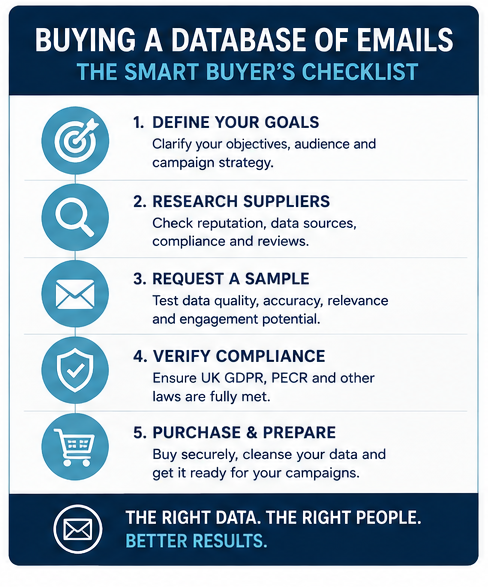
The first question should therefore be: what decision will this data help us make or what action will it allow us to take?
Useful objectives include entering a new market, reaching decision-makers in a defined sector, promoting an event, testing demand in a new region, reactivating a category of customers, building a prospecting audience or creating a controlled pool for a managed email campaign. Each objective implies different fields, different volumes and different measures of success.
Define the campaign before Buying a Database of Emails
Write a short campaign brief before requesting data. It should state the offer, the target audience, the desired response, the sending method, the intended campaign period and the commercial outcome that matters. The target can then be translated into database criteria.
For B2B, that may mean sector, SIC code, turnover, employee size, geography, ownership type, job function, seniority or named role. For B2C, it may mean geography, demographic profile, household characteristic, lifestyle indicator or another criterion that is both available and appropriate for the campaign.
A clear brief prevents a common purchasing mistake: buying whatever segment is easiest for a supplier to provide and then designing the campaign around the file. The stronger process works in the opposite direction. The campaign defines the audience, and the audience defines the database.
Decide whether email is the right channel
Email is useful when the proposition can be understood without an immediate conversation, the recipient can respond online and the message benefits from being saved, forwarded or revisited. It is less suitable when the offer requires complex qualification at the first touch, when there is no clear online action, or when the target audience is unlikely to engage through email.
A broader marketing data framework can help when the buyer is still deciding between email, telephone and postal data. The point is not to force every campaign into email because email appears inexpensive. The right channel is the one that matches the buying journey and the recipient’s likely behaviour.
Decide whether you need a purchased database at all
Buying a Database of Emails is only one route to a usable audience. First-party CRM data, inbound leads, event registrations, customer records and opted-in subscribers may already contain part of the market. A purchase may be most valuable when the internal database is too small, too narrow, incomplete or biased towards existing customers.
In some cases the most economical answer is not a new file. A database may already contain the right companies but lack current contacts or email addresses. Data Appending can sometimes fill those gaps. A database may have the right records but too many duplicates, invalid mailboxes or inconsistent fields. Data Cleansing may restore more value than buying an entirely new audience.
What Are You Actually Buying When Buying a Database of Emails?
The phrase sounds simple, but the commercial arrangement can take several forms. A buyer may receive a downloadable file, a licensed dataset, a one-use list, a time-limited licence, access to a platform or a managed campaign in which the data is not transferred at all. These arrangements create different operational and legal responsibilities.
The supplier should explain the model before the buyer commits. If a file is licensed, the buyer should know how long it can be used, how many campaigns are permitted, whether it can be imported into a CRM, whether it can be shared with an agency, what happens when contacts opt out and whether the supplier expects updated suppression information to be returned.
A useful email database contains context, not just addresses
A row containing only an email address is difficult to target and difficult to audit. A practical B2B record may contain company name, website, location, sector, SIC code, employee band, turnover band, contact name, job title, department, seniority and business email address. Additional telephone or postal fields may support follow-up.
AccuraData’s B2B Email Data is structured around this type of business context. The email address matters, but the surrounding fields explain why the contact belongs in the campaign.
B2C records are different. Depending on source and permissions, a consumer file may include name, email address, geographic information and selected segmentation indicators. AccuraData’s B2C Email Data service keeps consumer email activity separate from business email because the permission model and audience expectations are different.
Ask for a field dictionary
Before Buying a Database of Emails, ask the supplier for a field list and definitions. “Company size” could mean employees, turnover or a supplier-specific band. “Senior decision-maker” may include owners, directors or department heads. “Email validated” can mean anything from basic syntax checking to a recent mailbox-level test.
A field dictionary reduces ambiguity. It should explain the field name, what it means, how it is populated, whether it can be blank and how recently it is expected to have been checked. This also makes CRM mapping much easier later.
Understand the difference between a database and a lead
A purchased email database is not the same as a lead file. A database identifies people or organisations that fit selected criteria. A lead normally implies some form of expressed interest, response, enquiry or qualification.
This distinction matters commercially. Buying a Database of Emails gives the campaign a defined audience, but the buyer still has to create relevance, earn attention and manage follow-up. The list should not be priced or evaluated as though every row were already a sales opportunity.
Buying a Database of Emails for B2B and B2C Requires Two Different Tests
The most important distinction in email-data procurement is between business and consumer audiences. Treating both as one category can create immediate compliance problems.
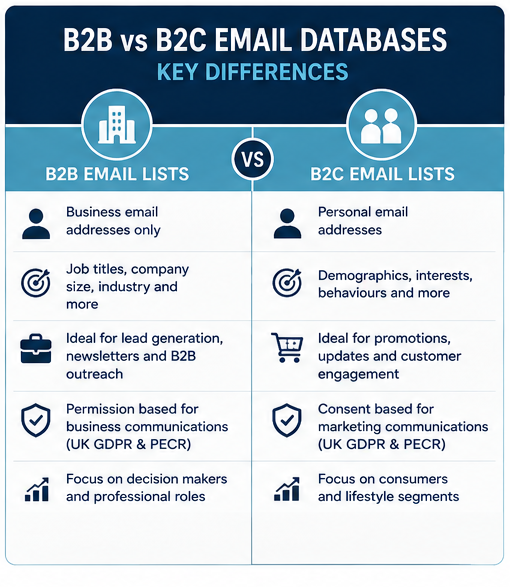
B2B email databases are built around organisations and roles
B2B campaigns normally start with the organisation. The buyer identifies companies that fit an ideal customer profile, then selects the functions or seniority levels likely to influence the purchase. This makes firmographic and role information central to the value of the database.
A useful B2B audience might target operations directors at manufacturers with 50 to 250 employees in the Midlands, finance directors at professional services firms above a turnover threshold, or IT leaders at multi-site organisations. The record needs enough context to support this targeting.
The legal analysis then depends partly on subscriber type. Corporate subscribers are treated differently from individual subscribers under PECR. Limited companies, LLPs and certain public bodies may be corporate subscribers, while sole traders and some partnerships are individual subscribers. The ICO’s current electronic marketing guidance explains why that distinction matters.
Even where PECR consent is not required for an email to a corporate subscriber, UK GDPR can still apply if the record identifies an individual. A named business email such as jane.smith@examplecompany.co.uk is personal data when it relates to an identifiable person. The buyer still needs an appropriate lawful basis, fair processing, transparency, data minimisation, security and respect for objections.
AccuraData’s article on B2B Email Lists explores the business-list side of this distinction in more detail.
B2C email databases depend heavily on consent evidence
Consumer email is stricter. Unsolicited marketing by electronic mail to individual subscribers normally requires consent unless the narrow soft opt-in applies in an existing customer relationship. A third-party purchased consumer database will not normally create a soft opt-in for the buyer.
That means permission evidence is not an optional document added after purchase. It is part of the product itself.
When Buying a Database of Emails for B2C use, ask who collected the data, when it was collected, what the consumer saw, what they actively agreed to, whether email was specified, whether third-party marketing was covered, whether the proposed sender was named or sufficiently described, and how withdrawals are recorded. The ICO’s guidance on planning direct marketing explains the high standard required for consent and the checks needed where consent came through a third party.
A supplier that says “all records are opted in” but cannot explain the wording, source, date and scope has not answered the buyer’s question.
For a wider consumer-law perspective, AccuraData’s article on the UK Consumer Database explains why channel-specific permission matters in B2C marketing.
Do not merge B2B and B2C audiences without preserving their status
Some databases contain limited companies, sole traders and consumers together. That can be useful for certain markets, but the CRM and sending platform must preserve subscriber type and permission status. The safest process is to keep these attributes explicit rather than assuming one rule applies to the entire file.
If the database cannot tell the buyer which records are corporate subscribers, which are individual subscribers and which consumer permissions apply, the buyer cannot make a reliable campaign decision.
The Six Approval Gates for Buying a Database of Emails
A disciplined buyer can reduce risk by refusing to approve a purchase until six separate questions have been answered. These gates separate commercial quality from compliance and technical readiness, which is important because a database can pass one test and fail another.
Gate One: Does the audience fit the campaign?
Start with relevance. Ask for a count against the exact campaign brief, not a generic “UK businesses” or “UK consumers” total. Confirm how the supplier interprets the filters and ask for a breakdown where useful.
For B2B, check the target industries, company sizes, locations, roles and seniority. For B2C, confirm the permitted audience criteria and how they relate to the intended offer. If the supplier offers a very large count but cannot explain why those people belong in the campaign, the count is not evidence of quality.
A smaller audience that closely matches the proposition can outperform a broad audience because it allows better copy, more relevant offers and more disciplined sales follow-up.
Gate Two: Can the supplier explain provenance?
Provenance means knowing where the data came from and how it reached the form being sold. A supplier should be able to describe its sourcing categories, maintenance process and any material third-party dependencies.
The buyer does not necessarily need every proprietary detail of the supplier’s database construction, but it does need enough information to assess fairness, expected accuracy and lawful use. The ICO’s right to be informed is especially relevant when personal data has been obtained from another source, because organisations have transparency obligations about purposes, source categories and other processing information.
For a B2B supplier, public company information can support company identity and status checks, but public availability alone does not automatically answer every marketing-law question. The official Companies House register is useful for checking corporate information, yet the buyer still needs to understand how named contact and email data were obtained and maintained.
Gate Three: Is the proposed use lawful for this audience?
The supplier can help with evidence, but the buyer remains responsible for its own campaign. Before Buying a Database of Emails, document the proposed sender, audience, purpose, channel and lawful basis.
For named contacts, UK GDPR principles remain relevant. Personal data must be processed lawfully, fairly and transparently. The buyer should collect only what is necessary for the campaign, protect the data appropriately and avoid retaining it indefinitely without purpose.
PECR adds channel-specific rules for electronic mail. Individual subscribers normally require consent unless an exception applies. Corporate subscribers are treated differently, but identity and opt-out requirements still matter. The important point is that “GDPR compliant data” is not a universal pass that makes every future use lawful.
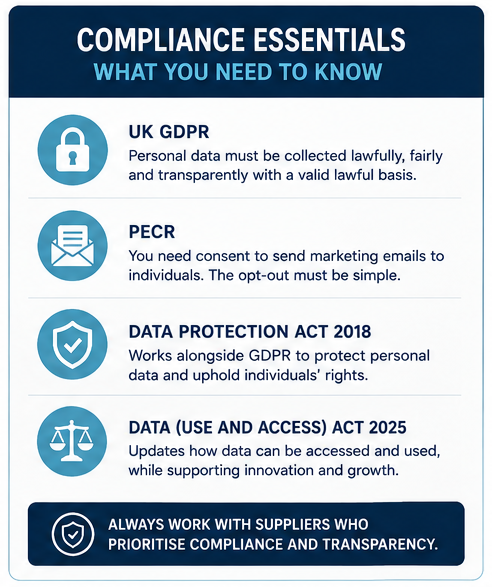
The UK framework has also been amended by the Data (Use and Access) Act 2025. The Act did not replace UK GDPR, the Data Protection Act 2018 or PECR. It amended them. Government explanatory material on the PEC Regulations changes is a useful reference when checking how the current framework has evolved.
Gate Four: Is the database technically current enough to send?
Legal permission does not guarantee that an email address works. Quality testing should consider syntax, domain status, mailbox validity, duplicate records, obvious formatting errors, role addresses, historic bounces and suppression matches.
Ask when the email addresses were last validated and what “validation” means in the supplier’s process. A test performed a year ago is not equivalent to a recent check. Staff move jobs, domains change and mailboxes are retired.
A database should also be checked for duplicate people, duplicate companies where relevant, and overlap with the buyer’s CRM. Paying for records already owned is unnecessary, while sending the same campaign twice can create a poor recipient experience.
Gate Five: Is the sending environment ready?
Buying a Database of Emails and then importing it into an unprepared sending domain is a common operational mistake. The database and the sender infrastructure should be approved together.
At minimum, the buyer should review SPF, DKIM and DMARC, suppression handling, unsubscribe processing, sending-domain reputation, bounce workflows and platform limits. The National Cyber Security Centre’s email security guidance explains the role of SPF, DKIM and DMARC in authenticating legitimate email and protecting domains from spoofing.
Authentication is not a substitute for permission or relevance, but it is part of professional campaign readiness. A valid address can still be poorly delivered if the sending environment is weak.
Gate Six: Are the commercial terms measurable and fair?
Before purchase, agree what counts as an acceptable record and what remedies apply when records fail the agreed standard. This does not mean expecting zero decay or zero bounces. No responsible supplier should promise a permanently perfect database. It means defining the quality standard and the response if the delivered file materially misses it.
Useful contract points include permitted use, licence period, sharing restrictions, delivery format, suppression responsibilities, sample approval, acceptance window, replacement policy and support after delivery.
The buyer should also understand whether price is based on record count, field depth, targeting difficulty, data type, licence, managed broadcast or another model. The cheapest cost per record is rarely the most useful comparison if one file contains significantly better targeting and evidence.
Supplier Due Diligence Before Buying a Database of Emails
A professional supplier should make due diligence easier, not harder. The buyer should expect clear answers, documented processes and a willingness to narrow the audience where necessary.
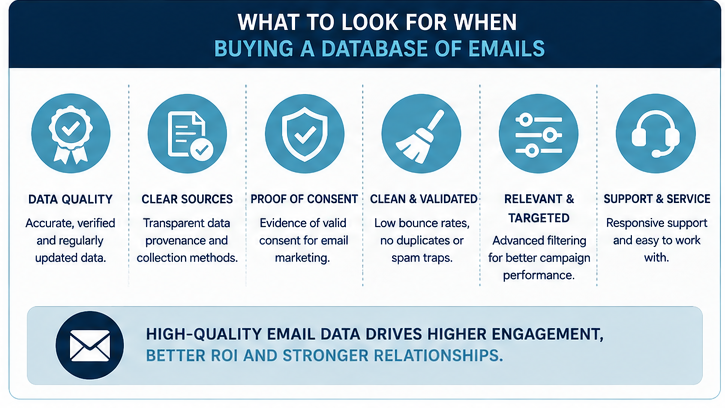
Verify the supplier as an organisation
Check the legal entity, trading history and contact details. The Companies House service can help confirm company information. Where relevant, the public ICO register can be used to check data protection fee registrations.
These checks do not prove that a dataset is suitable, but they are useful basic controls. A supplier selling sensitive marketing data while hiding its legal identity or refusing to provide standard business information should trigger further scrutiny.
Ask how the database is maintained
Good questions include:
- How often are email records refreshed or validated?
- How are job moves, company closures and domain changes detected?
- How are hard bounces handled?
- How are duplicates identified?
- How are opt-outs and objections stored?
- How are third-party source updates propagated?
- How is the B2B or B2C status of a record represented?
- Can the supplier explain which fields are first-party, public, researched, appended or supplied by partners?
The purpose of these questions is not to demand a perfect database. It is to understand whether the supplier treats data quality as an ongoing process.
Ask for a sample that represents the real product
A sample should contain the same type of records and fields as the proposed order. It should not be a hand-picked showcase that cannot be compared with the final file.
Test the sample against the agreed audience. Check company fit, contact roles, formatting, obvious duplicates and a sensible selection of email addresses. If the sample is B2B, review whether the contacts genuinely hold the roles claimed. If it is B2C, review the permission evidence rather than judging quality only by whether the email field is populated.
Agree acceptance criteria before payment
The best time to agree a quality threshold is before purchase, not after the first campaign. Define what will be tested, the period allowed for testing, how failures will be reported and what happens if the file falls outside the agreed standard.
Acceptance criteria may cover target-fit errors, duplicate rate, missing mandatory fields, invalid email rate or other campaign-specific issues. The criteria should be proportionate and measurable.
AccuraData positions itself as an easy-to-work-with provider by helping clients define the audience before delivery and supporting both data supply and subsequent quality work. Its Data Cleansing and Data Appending services are useful where the project involves both new records and an existing CRM.
UK GDPR Requirements When Buying a Database of Emails
UK GDPR does not prohibit purchased marketing data. It does, however, require the organisation using personal data to justify and manage that processing properly.
Identify the controller’s lawful basis
Where personal data is involved, the buyer needs a lawful basis for processing. Consent and legitimate interests are common possibilities in direct marketing, but the appropriate basis depends on the campaign and on PECR.
If PECR requires consent for the electronic mail itself, the buyer cannot use legitimate interests to bypass that channel rule. For some B2B corporate-subscriber activity where PECR consent is not required, legitimate interests may be appropriate if the three-part test is satisfied. The ICO explains this in its current guidance on legitimate interests.
The analysis should be written down. A legitimate interests assessment should consider the purpose, necessity and balance against the individual’s rights and reasonable expectations.
Keep the use fair and transparent
A purchased record does not remove transparency obligations. If personal data was not collected directly from the individual, the buyer needs to assess Article 14-style privacy information duties. The ICO’s right to be informed guidance explains timing and content requirements, including the source of the data and the purposes for which it is used.
The first campaign communication should not be designed to conceal how the sender knows the recipient or make opt-out difficult. Transparency is both a compliance control and a trust signal.
Respect the absolute right to object
Individuals have an absolute right to object to the use of their personal data for direct marketing. Once an objection is received, the organisation must stop using the data for that marketing purpose. The ICO’s right to object guidance notes that suppression is often preferable to deletion because retaining a minimal do-not-contact record helps prevent accidental re-marketing.
This is why suppression files should be treated as valuable compliance assets rather than as inconvenient leftovers.
Apply minimisation and retention rules
Buying a Database of Emails does not justify collecting every available field. Only buy attributes that have a clear campaign or governance purpose. Extra personal data increases complexity, security exposure and the burden of keeping the database accurate.
Retention should also be tied to the campaign plan. A licence that allows repeated use does not mean the buyer should keep personal data indefinitely without reviewing accuracy, necessity and permissions.
PECR and Buying a Database of Emails
PECR is often the point where B2B and B2C email procurement separates most sharply.
Corporate B2B email can have a different PECR position
Marketing emails to corporate subscribers do not normally require the same prior PECR consent as marketing emails to individual subscribers. However, the sender must still identify itself and provide a valid means to opt out. If a named person is identifiable, UK GDPR still applies to the processing of their personal data.
This is why the buyer should not simply ask whether a list is “B2B”. Ask what legal forms are included and how subscriber type is represented.
Sole traders and some partnerships require extra care
An email address used for a sole trader or certain partnerships may relate to an individual subscriber. The rules that apply to a limited company cannot simply be copied across. If the supplier has mixed company types in one file, the buyer needs enough information to segment them appropriately.
Consumer email normally needs prior consent
For B2C marketing, valid consent is normally required before unsolicited electronic mail unless the sender can use the soft opt-in. A purchaser buying new consumer prospects generally cannot assume the soft opt-in because that exception is linked to the sender’s own existing customer relationship and specific collection conditions.
The buyer therefore needs to inspect the consent trail. Generic assurances such as “marketing consent obtained” are not enough if they do not show that the proposed sender and channel are covered.
The unsubscribe process must work from the first send
Every campaign should have a simple, reliable way to stop future marketing. Suppression needs to flow back into the CRM and any future purchased-data imports. If separate agencies or platforms are used, the governance process should make sure an opt-out in one system is not accidentally ignored in another.
Technical Quality Checks Before Importing a Purchased Email Database
A database can be legally usable and commercially relevant but still perform badly if the technical data quality is weak.
Email validation should be recent and defined
Ask the supplier what checks are performed and when. Useful checks may include syntax, domain existence, mailbox validation, known hard-bounce history and suppression matching. No single validation method can guarantee future delivery because mailbox status can change after testing.
What matters is that the supplier has a clear method and recency standard rather than using “verified” as an undefined sales term.
Deduplicate against the buyer’s own CRM
Before Buying a Database of Emails, decide whether the supplier can suppress existing customer and prospect records before delivery. This reduces wasted spend and lowers the risk of inconsistent messaging.
If suppression before purchase is not practical, run a controlled deduplication process before campaign deployment. Matching may need to use more than email address alone because companies can have aliases, contacts can have more than one address and CRM records may contain formatting variations.
Protect internal suppression lists
The buyer’s do-not-contact file should be applied to the new data before the campaign. This may include unsubscribes, objections, complaints, internal exclusions, customers with special contact preferences and records that should not be reactivated.
Suppression should happen before the new database is distributed to sales or imported into the marketing platform.
Review role-based and generic addresses
Role addresses such as info@, sales@, accounts@ or office@ can be useful in some B2B contexts, but they are different from named decision-maker emails. Agree whether they are included and how they should be treated in campaign targeting.
If the campaign depends on reaching a specific role, a generic mailbox may not satisfy the brief even if the address technically accepts mail.
Prepare the Sending Environment Before Buying a Database of Emails at Scale
A list purchase and a campaign launch should not be treated as separate projects. The sending environment needs to be ready for the audience volume and the organisation’s own domain strategy.
Authenticate the sending domain
SPF, DKIM and DMARC help receiving systems assess whether messages are legitimately sent on behalf of a domain. The NCSC’s anti-spoofing guidance recommends implementing these controls as part of secure email configuration.
Authentication is not a marketing permission. It does not make a poor list good. It does, however, reduce avoidable technical weakness and helps protect the domain from spoofing.
Separate database quality from sender reputation
A high bounce rate may indicate weak data, but poor delivery can also come from domain reputation, sending patterns, content, authentication or recipient-provider filtering. Measure these separately so the supplier is not blamed for every technical problem and the sending team is not allowed to dismiss genuine data-quality failures as “deliverability”.
Use a controlled launch
Rather than sending the entire database immediately, begin with a defined segment that is representative of the wider file. Review bounces, complaints, unsubscribes, engagement and sales outcomes. If the early signals are weak, investigate before scaling.
This approach creates a practical acceptance layer between procurement and full campaign deployment.
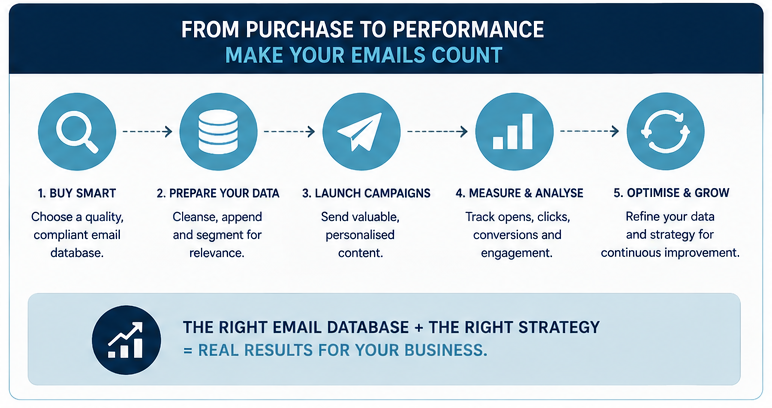
Measuring Whether Buying a Database of Emails Was Worth It
The purchase should be evaluated beyond open rate. Opens can be affected by privacy features and are not the same as commercial outcomes.
Start with database-level metrics
Useful measures include delivered rate, hard-bounce rate, duplicate rate, suppression rate and the proportion of records that actually matched the intended segment. These metrics help determine whether the file was operationally usable.
Measure campaign engagement
Clicks, replies, enquiries, landing-page visits and unsubscribes show whether the audience and message produced engagement. Complaint rates are particularly important because they can indicate relevance, permission or expectation problems.
Measure commercial outcomes
For B2B campaigns, track qualified conversations, opportunities, meetings, proposals, pipeline and revenue. For B2C campaigns, relevant outcomes may include orders, registrations, redemptions, enquiries, booked consultations or another transaction linked to the campaign.
The right denominator matters. Cost per delivered record, cost per response, cost per qualified lead and cost per acquisition tell the buyer much more than cost per purchased row.
Feed results back into the database
Campaign outcomes should update the CRM. Hard bounces should not remain active. Opt-outs should be suppressed. Incorrect roles should be corrected or removed. Positive responses should move into an appropriate follow-up process.
This is one reason a managed Email Marketing Service can be useful for teams that do not want to manage data, creative, broadcast and reporting as separate projects.
Maintaining Value After Buying a Database of Emails
A database starts ageing as soon as it is delivered. People change jobs, companies rebrand, domains change and consumers withdraw permission. The buyer should therefore decide at purchase how maintenance will work.
Revalidate before major reuse
If a database is used again after a significant gap, revalidate important email fields rather than assuming the original checks still apply. Review suppressions, objections and customer-status changes at the same time.
Clean the CRM regularly
AccuraData’s Data Cleansing service can support duplicate removal, email validation, record correction and other database-quality work. The exact cleanse should be driven by the campaign and the fields that matter.
The article on B2B Data Cleansing explains why database maintenance works best as an ongoing programme rather than a one-off repair.
Append missing fields only when they have a purpose
If results show that segmentation is too shallow, Data Appending can add missing attributes where appropriate. The buyer should decide which fields will improve targeting or governance before appending them.
More data is not automatically better data. A smaller number of useful, well-maintained fields is often easier to operate responsibly.
Common Red Flags When Buying a Database of Emails
Some warning signs should slow the purchase immediately.
A supplier should not be trusted simply because it promises a huge count, instant delivery or “100% accuracy”. Email databases change continuously, so permanent perfection is not a credible promise.
Other red flags include:
- refusing to explain source categories;
- vague claims that every form of marketing is “GDPR compliant”;
- no distinction between B2B corporate and individual subscribers;
- B2C email data with no usable consent evidence;
- no sample or field dictionary;
- no explanation of validation recency;
- unclear licensing terms;
- no process for replacements or material quality failures;
- pressure to buy maximum volume rather than a defined audience;
- inability to explain opt-out and suppression handling;
- insecure transfer methods for personal data; and
- a supplier identity that cannot be verified through normal business checks.
A reliable supplier should welcome precise questions because those questions reduce disputes later.
Why AccuraData Is a Practical Partner for Buying a Database of Emails
AccuraData is well suited to buyers who want data procurement to be straightforward rather than opaque. The service mix allows the buyer to define the audience, purchase the relevant email data, improve an existing CRM and, where required, use managed campaign support without having to coordinate several unrelated providers.
For B2B campaigns, AccuraData can combine wider B2B Data targeting with dedicated B2B Email Data. For consumer campaigns, B2C Data and B2C Email Data are handled as separate products because consumer permissions and segmentation need their own controls.
Where the buyer already owns valuable records, AccuraData can help improve them through Data Cleansing and Data Appending. This is useful because a good provider should not automatically recommend a new list when the cheaper and better answer is to repair or enrich data the client already has.
The practical advantage is continuity. The same discussion can cover audience design, data format, validation, suppression, CRM preparation and campaign use. That makes it easier to turn Buying a Database of Emails from a standalone file purchase into a controlled marketing workflow.
AccuraData’s earlier article on Buying Email Data provides a broader introduction to list quality, while its article on building a business email database is useful for organisations deciding how purchased data should sit alongside first-party records.
Buying a Database of Emails: A Practical Buyer Checklist
Before approving a purchase, the buyer should be able to answer all of the following:
- What campaign outcome is the database intended to support?
- Is email the correct channel for that outcome?
- Is the audience B2B, B2C or mixed?
- Which subscriber types are included?
- Which fields are mandatory for targeting?
- Where did the data come from?
- How recently were the email addresses validated?
- What does the supplier mean by “validated”?
- What lawful basis will the buyer use for personal-data processing?
- Does PECR require consent for this audience?
- For B2C data, can valid consent evidence be demonstrated?
- How will privacy information be provided where required?
- How will objections and unsubscribes be suppressed?
- Has the supplier been verified as a legitimate organisation?
- Has a representative sample been tested?
- Are duplicates and CRM overlap addressed?
- Are licensing and permitted-use terms clear?
- What happens if delivered quality misses the agreed standard?
- Is the sending domain technically ready?
- How will campaign results be attributed back to the database?
- What is the plan for cleansing and revalidation before reuse?
If several answers are still unclear, the purchase is not ready.
Frequently Asked Questions About Buying a Database of Emails
Is Buying a Database of Emails legal in the UK?
It can be. There is no blanket UK rule that prohibits the purchase of email databases. The important question is whether the collection, sharing and proposed use of the data comply with the relevant requirements. UK GDPR applies where personal data is processed, and PECR adds specific rules for electronic marketing. The buyer needs to assess the actual audience, subscriber type, lawful basis, permissions and campaign rather than relying on a generic compliance label.
Is Buying a Database of Emails the same as buying leads?
No. An email database normally provides contact records that fit selected criteria. A lead usually implies some level of expressed interest or qualification. A purchased database can help create leads, but it does not mean every contact has shown interest in the offer.
Can I buy a B2B email list and start sending immediately?
You should still complete campaign checks first. Confirm the subscriber types, lawful basis, privacy information, suppression list, email validity, CRM overlap and sending-domain setup. Corporate B2B email has a different PECR consent position from consumer email, but it is not exempt from all data protection and marketing responsibilities.
Can I buy a B2C email database?
Consumer email data can be supplied, but the permission evidence is critical. Unsolicited marketing email to individual subscribers normally requires valid consent unless the sender can rely on a specific exception. A third-party B2C supplier should be able to explain how consent was captured and whether it covers the proposed sender and channel.
What should a good B2B email record contain?
The answer depends on the campaign, but useful fields often include company name, website, sector, company size, location, contact name, role, department, seniority and business email address. The buyer should purchase only the fields that support targeting, compliance or campaign operations.
How can I test a database before buying it?
Ask for a representative sample and agree what will be checked. Review audience fit, company and role accuracy, field completeness, duplicates and a sample of email validity. For B2C, review consent evidence as well as the data fields. The test method should reflect what matters to the live campaign.
What is a reasonable email accuracy guarantee?
There is no universal percentage that makes every database good. Accuracy depends on the definition, validation method, age of the data and type of audience. Focus on a clearly defined test and an agreed remedy if the delivered file materially misses it. Be cautious of permanent “100% accurate” claims.
Should I use my main company domain for a purchased-data campaign?
That decision depends on the organisation’s sending strategy, reputation and technical controls. What matters is that the sending environment is properly authenticated, monitored and managed. SPF, DKIM and DMARC should be reviewed, and campaign volume should be appropriate for the domain’s history. Data quality and sender reputation should be measured separately.
How often should a purchased email database be cleaned?
There is no single schedule for every database. High-volume outbound programmes may need more frequent validation than occasional campaigns. Revalidation is particularly important before a major reuse after a long gap, after a high-bounce campaign, or when the database contains fast-changing roles and organisations.
What should happen when someone unsubscribes?
The organisation should stop using the person’s data for the relevant direct marketing and record the preference so they are not accidentally contacted again. The ICO’s right to object guidance explains why suppression is often useful for preventing future marketing to someone who has objected.
Is the cheapest cost per email the best way to compare suppliers?
No. Cost per row ignores relevance, field depth, validation, permission evidence, duplicates, support and replacement terms. A more useful calculation looks at cost per delivered record, response, qualified lead or acquisition. A more expensive but tightly targeted file can be far cheaper commercially if it produces better outcomes.
Final Thoughts on Buying a Database of Emails
Buying a Database of Emails works best when it is treated as controlled audience procurement. The buyer defines the campaign first, separates B2B and B2C requirements, checks supplier provenance, confirms the permission model, tests data quality, prepares the sending environment and agrees how success will be measured before the full database is used.
The central lesson is simple: an email address is not valuable merely because it exists. Its value comes from context, relevance, permission, freshness and the campaign process around it. A database that passes those tests can accelerate market access and give sales and marketing teams a clear audience to work with. A database that fails them can create waste and risk even if the initial purchase price is low.
AccuraData offers a practical route through that process. Its B2B and B2C services are separated appropriately, its wider data services can support cleansing and appending, and its campaign support can help buyers turn a purchased audience into measurable activity. For organisations considering Buying a Database of Emails, that combination of targeting, data quality support and straightforward service is often more useful than simply being offered the largest possible file.