
B2B Email Lists are often described as a shortcut to more prospects. That description is too simple. A useful list is not just a collection of addresses. It is a structured audience asset that should tell a marketing or sales team which companies fit the campaign, who is likely to influence a purchase, how those contacts can be segmented, when the records were checked and what controls apply to their use.
That distinction matters because email performance is shaped long before a campaign is sent. A weak list can create hard bounces, irrelevant messages, complaints, wasted sales follow-up and misleading reporting. A strong list gives the campaign a better starting point, but it still needs responsible use, sound sending infrastructure, relevant creative and disciplined follow-up.
This guide takes a buyer’s view of B2B Email Lists. It explains what they are, when they are useful compared with wider business data and other channels, how to brief a supplier, what due diligence to complete, how UK GDPR and PECR interact, how to prepare the sending environment and which metrics should be monitored after launch. It also covers list maintenance, suppression, CRM integration, data cleansing, data appending and supplier review.
AccuraData is well placed for organisations that want practical support rather than a generic download. Its targeted B2B Email Data can be combined with wider B2B Data, Data Cleansing and Enrichment and Data Appending services. That gives buyers a route to define an audience, improve existing records and fill genuine data gaps within one working relationship.
A short compliance note is important. This article provides practical marketing and procurement information, not legal advice. The correct approach depends on the organisation type, the recipient, the source of the data, the campaign purpose and the sending method. Current ICO B2B marketing guidance and specialist advice should be checked where the position is uncertain.
What B2B Email Lists Actually Are
B2B Email Lists are structured databases of business contacts selected for professional outreach. The most obvious field is the email address, but a campaign-ready file usually needs much more context. A good record can include company name, website, sector, SIC code, location, company size, turnover band, employee count, contact name, job title, department, seniority and other fields that help the buyer decide whether the recipient is relevant.
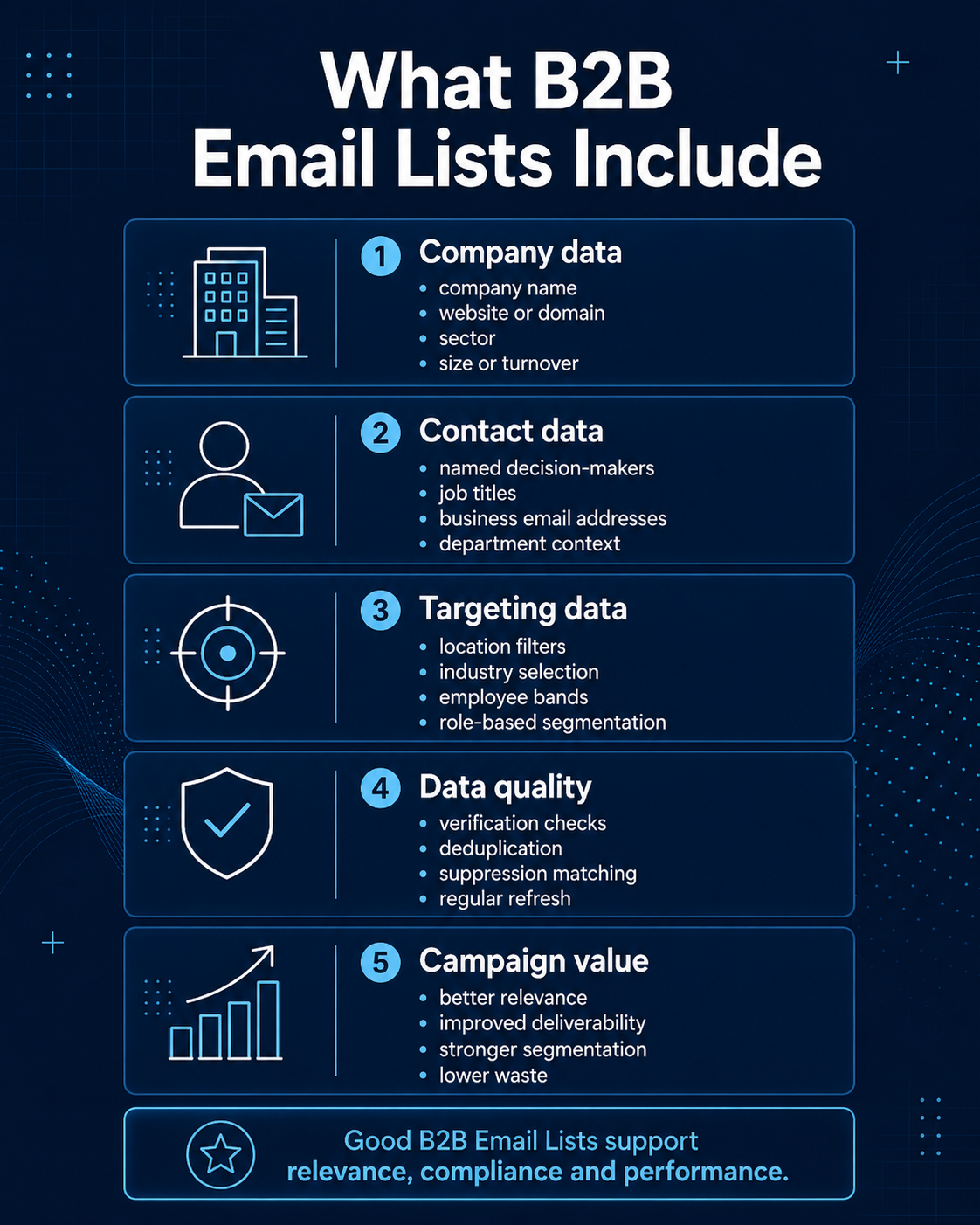
The email address is therefore only one part of the value. A sales team cannot do much with an address if it does not know whether the contact works for the right type of company, whether the person is in a relevant role or whether the record belongs to an organisation that should be excluded. Context makes the data usable.
A B2B email record should answer three questions
A useful record should help the buyer answer three basic questions. First, is this the right organisation? Second, is this the right person or function within that organisation? Third, can the contact be used responsibly for the intended campaign?
The first question is mainly about firmographic fit. Industry, size, geography, trading status and business model help define whether the company belongs in the audience. The second is about buying relevance. Job title, department and seniority help show whether the person may influence the decision. The third is about governance, subscriber type, suppression status, recency and the buyer’s own lawful basis.
This is why the dedicated AccuraData B2B Email Data service is more useful than a flat file of addresses. The service can support targeting by sector, role, region, company size and other business criteria, which allows the list to be built around the campaign rather than forcing the campaign to fit whatever data happens to be available.
B2B Email Lists are not the same as leads
A list gives a business a defined audience for outreach. A lead normally indicates some stronger commercial signal, such as an enquiry, a qualification event, a meeting request or another expression of interest. The distinction is important for budgeting and performance expectations.
If a company buys 5,000 targeted records, it has not bought 5,000 interested prospects. It has bought the opportunity to communicate with a relevant audience. The campaign still needs to earn attention and create demand. Sales follow-up still needs to convert responses into real opportunities.
Businesses that want generated opportunities rather than data alone may also consider Lead Generation Services. The right model depends on internal capability. A team with strong email operations and sales follow-up may only need data. A smaller team may prefer a managed lead generation or email campaign service.
B2B Email Lists are different from first-party CRM data
First-party data comes from the organisation’s own relationships and activity. It may include customers, past prospects, enquiries, event attendees, newsletter subscribers, quote requests and known accounts. This data often has valuable behavioural context because the organisation can see how the contact entered the database and what happened afterwards.
Purchased or externally sourced B2B Email Lists solve a different problem. They can extend coverage into sectors, regions and accounts that the business has not yet reached. They are especially useful when first-party data is too small, outdated or concentrated in the wrong market.
The strongest approach is often a combination. Clean the CRM first, remove duplicates and suppressed contacts, identify what coverage already exists, then acquire only the gap. AccuraData’s Data Cleansing and Enrichment service can support that process before new records are added.
Where B2B Email Lists Fit Relative to Other Data and Channels
Email is one channel within a broader sales and marketing system. A buyer should decide why email is being used before buying data for it. In some campaigns, B2B Email Lists are the primary route to market. In others, email works best as part of a sequence that also includes telephone, direct mail, social outreach or sales activity.
Email compared with telephone data
Email is efficient for introducing an idea, sharing evidence, promoting an event and giving prospects time to review a message. It can reach many relevant contacts without requiring a live conversation at the first touch. It also creates trackable actions such as replies, clicks and website visits.
Telephone data is better when qualification depends on immediate conversation. A caller can identify who owns a problem, test timing, handle objections and book a meeting in one interaction. The trade-off is that calling requires trained people, more time per contact and channel-specific preference screening.
For some B2B campaigns, email should open the door and telephone follow-up should develop the opportunity. Wider B2B Data can support multi-channel campaigns where email, telephone and postal fields need to sit within the same account strategy.
Email compared with direct mail
Direct mail can work well for high-value accounts, local campaigns, tangible offers and audiences where physical creative has a better chance of standing out. Its cost structure is different because print, fulfilment and postage create a direct cost for each record.
Email is usually easier to test quickly. Subject lines, messages, landing pages and segments can be changed with less production overhead. That makes email useful for testing positioning before investing in a larger integrated campaign.
The two channels can also reinforce each other. A physical pack sent to a small group of high-value accounts can be followed by email, while email engagement can help identify which accounts merit more expensive postal activity.
Email compared with organic list building
Organic list building produces valuable first-party data through content, events, referrals, website forms and customer relationships. It should remain a long-term priority because it creates an owned audience and often carries stronger intent signals.
The limitation is speed. A business entering a new sector may not have enough website traffic or brand recognition to build a meaningful audience quickly. B2B Email Lists can accelerate market access while organic data continues to grow.
The buyer should avoid treating the two methods as rivals. Paid or sourced data can create reach. First-party data creates accumulated relationship value. Good marketing operations use both and keep clear records of source, permissions, preferences and campaign history.
When Buying B2B Email Lists Makes Commercial Sense
Buying B2B Email Lists is most defensible when the business can define the audience clearly and explain what it plans to do with the data. It is less useful when the campaign brief is simply “send something to as many businesses as possible”.
Entering a new market or vertical
A company entering a new industry may know its ideal customer profile but have no contacts in that market. A targeted list can provide a controlled test audience. The business can measure whether the proposition resonates before hiring a larger sales team or committing more budget.
The list should still reflect the realities of the new market. A generic title such as “director” may be too broad. A supplier should help the buyer identify likely functions, seniorities and company characteristics rather than maximising the record count.
Account-based marketing
Account-based marketing starts with named organisations and then maps the people who influence a purchase. B2B Email Lists can help find or validate contacts across finance, operations, procurement, IT, HR or other functions inside target accounts.
This is different from mass email. The list may be smaller, but the value per account is higher. The campaign may use tailored messaging, sales research, direct mail and calls alongside email. In this context, completeness and role relevance matter more than raw volume.
Events, webinars and specialist content
Events often have a clear audience definition. A technical webinar may be relevant only to a particular profession. A regional seminar may need contacts within a travel radius. A trade event may require several roles within companies of a certain size.
B2B Email Lists can help build that audience quickly. The campaign can then measure registrations, attendance, follow-up meetings and later opportunities rather than judging success only by clicks.
Filling a known CRM gap
Sometimes the best buying decision is very specific. The business already has most of the market in its CRM but lacks contacts in one region, one sector or one decision-maker function. Buying only the missing segment reduces cost and avoids unnecessary duplication.
This is where Data Appending can also be useful. If the business already holds the right companies but lacks current contact names, email addresses or profiling fields, enhancing the existing database may be more efficient than replacing it.
How B2B Email Lists Are Built and Maintained
No credible B2B database is permanently accurate. Companies change status, employees move jobs, domains change and buying responsibilities shift. The supplier’s maintenance process therefore matters as much as the original source.
Company-level information
Company-level data can come from official registers, licensed business information, company websites and other commercial sources. The UK Companies House service can help verify legal entities, registered details and filing information, but it is not a campaign-ready source of current decision-maker email addresses.
SIC classifications can help with sector targeting, although buyers should understand their limits. A company may have more than one activity and a formal code may not describe the exact market category a salesperson cares about. The Companies House SIC guidance is useful context for understanding how businesses choose and update these codes.
A good supplier combines company-level information with other validation rather than assuming that one source tells the whole story.
Contact-level research
Contact-level fields require a different process. Job titles, named contacts, department responsibility and business email addresses can be researched or licensed from specialist sources, checked against company information and updated over time.
The buyer does not necessarily need the supplier’s proprietary methodology in full. It does need enough detail to understand source categories, recency, validation, lawful use and how disputes are corrected.
AccuraData’s own article on responsible B2B email sourcing provides more detail on the difference between basic public information and campaign-ready business email data.
Validation is not the same as relevance
An email address can be technically valid and still be a poor campaign record. It may reach the wrong department, a junior employee, a generic mailbox or a person whose role does not fit the offer.
This is why buyers should test several dimensions separately. Technical validity answers whether the mailbox is likely to accept email. Role relevance answers whether the contact is appropriate. Company fit answers whether the organisation belongs in the target market. Recency answers whether the information is current enough for use.
A supplier that reports only “email accuracy” may be measuring one part of the problem.
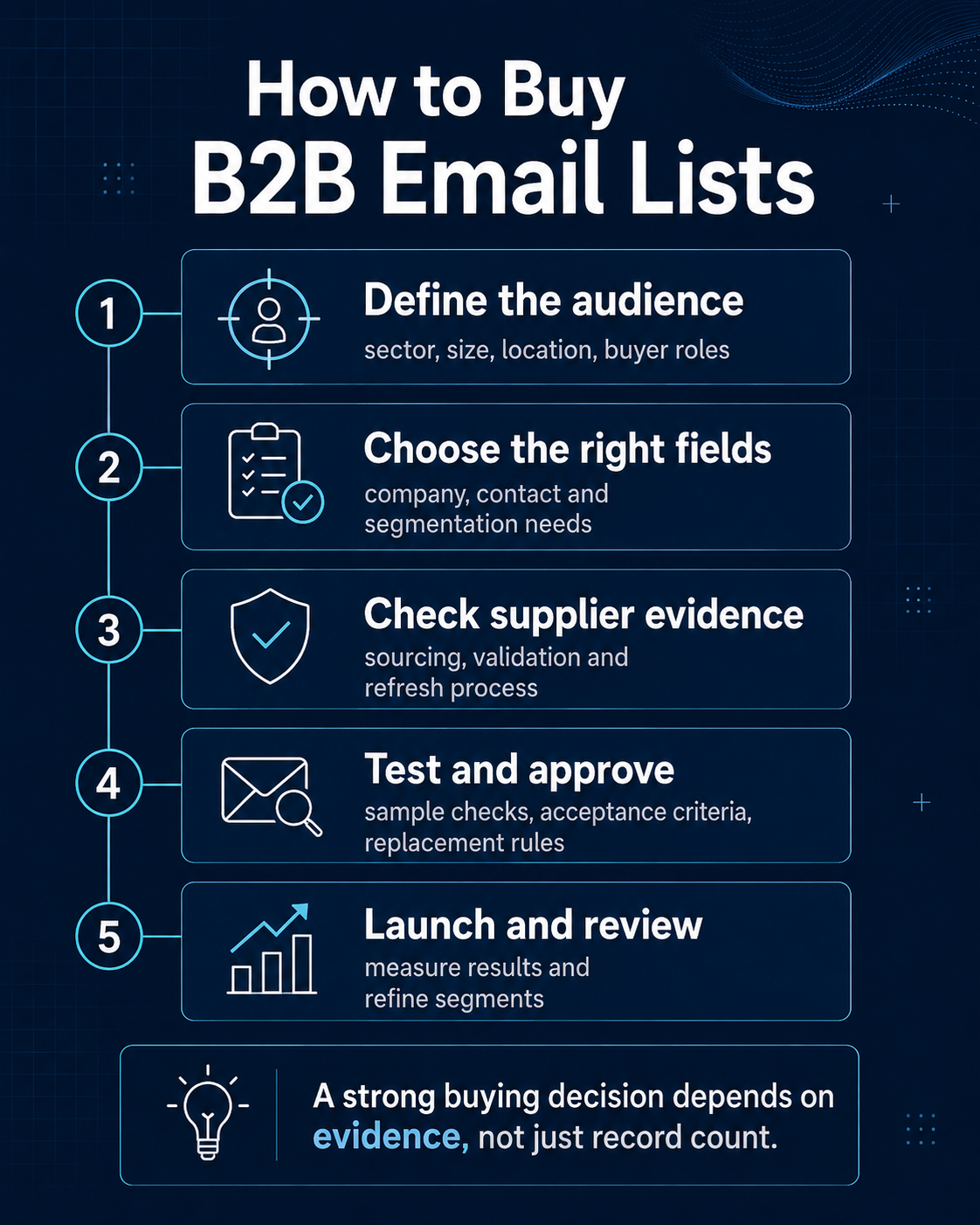
B2B Email Lists Buying Guide: Start With the Campaign Brief
The campaign brief is the foundation of procurement. It reduces misunderstandings, improves supplier pricing and creates an objective way to test the delivered data.
Define the business outcome
Start with the outcome rather than the number of records. The campaign might aim to book product demonstrations, promote an event, generate partner enquiries, introduce a new service, reach a buying committee or test demand in a new sector.
The outcome affects the list. A webinar campaign may tolerate a wider range of job roles than a high-value enterprise sales campaign. A regional service may need strict geography. A technical product may require specialist departments.
Define the ideal customer profile
Write down the company characteristics that make a prospect suitable. Useful fields can include sector, location, employee count, turnover, business type, operating model and exclusions.
Do not treat every available filter as necessary. The more filters that are applied, the smaller the available audience becomes. Separate essential criteria from useful preferences so that the supplier can show how each choice affects coverage.
Define the contact profile
Job title alone can be unreliable because companies use different naming conventions. Define acceptable functions, seniority and alternative titles. A campaign aimed at “finance decision-makers” may include finance directors, CFOs, heads of finance and, in smaller firms, managing directors.
The brief should also state whether generic functional addresses are acceptable. An address such as accounts@ or procurement@ may be useful for some campaigns but unsuitable for others.
Define required fields
List the fields that must be present in every delivered record. These may include company name, contact name, email, role, sector and region. Optional fields might include turnover, employee count, website or telephone number.
Field requirements should be tied to use. Do not buy extra personal data merely because it is available. The ICO data minimisation principle requires personal information to be adequate, relevant and limited to what is necessary.
Define exclusions before the supplier runs a count
Exclusions are as important as targeting. Existing customers, current opportunities, former customers, competitors, partners, internal staff, unsubscribed contacts and other suppressed records may need removing.
Provide exclusion files securely and agree how matching will work. The supplier should confirm whether matching uses email, domain, company name or other fields. Ambiguous matching can leave duplicates in the final file or remove valid records unnecessarily.
Supplier Due Diligence for B2B Email Lists
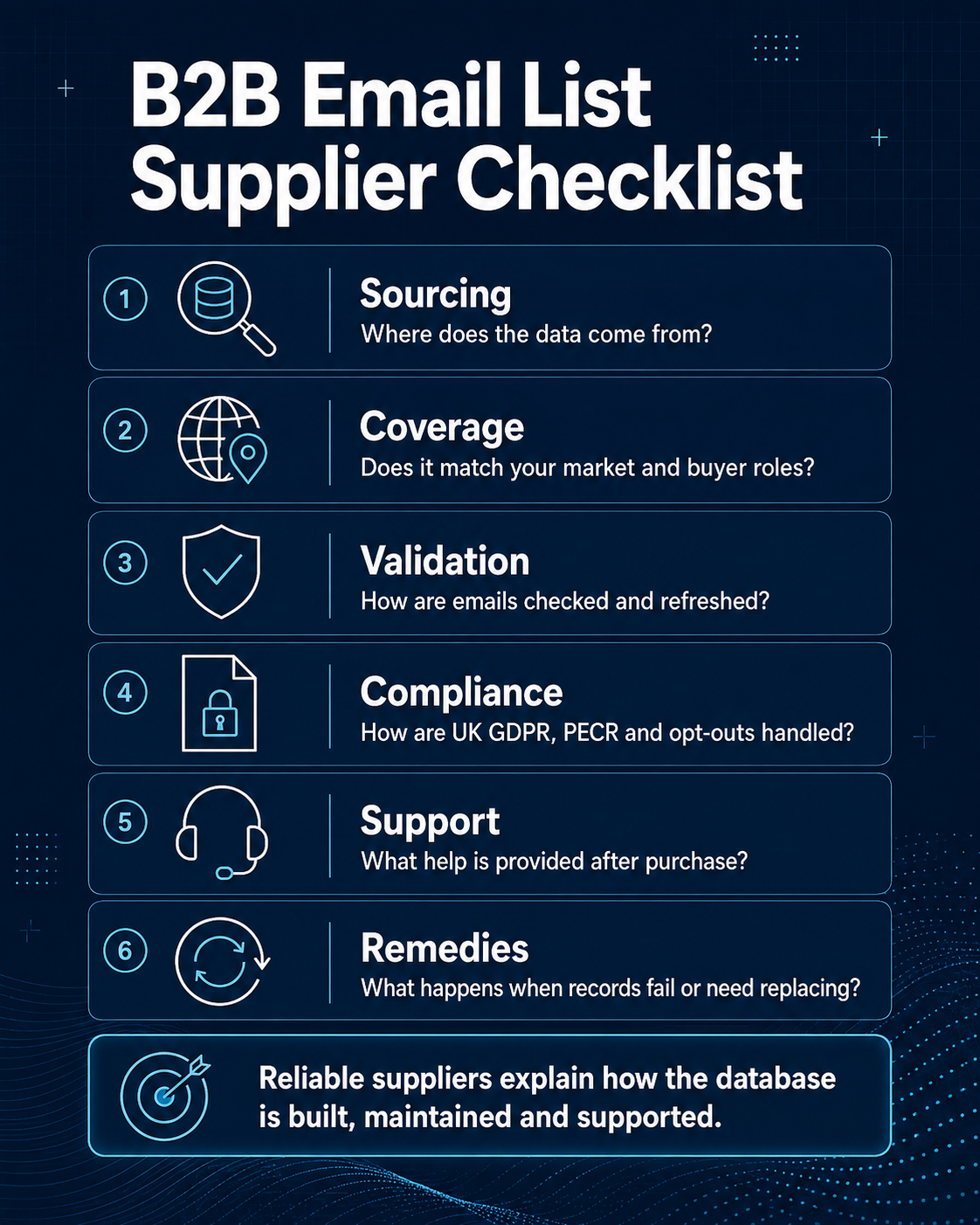
Supplier due diligence should produce evidence, not just a reassuring sales conversation. A good provider should expect detailed questions because the client is taking responsibility for how the data will be used.
Check the legal entity and trading details
Confirm who you are contracting with. Check the legal company name, registered address, company number and privacy information. Make sure the entity named in the agreement matches the organisation supplying or controlling the data.
An ICO registration can be a useful basic check, although it does not certify a dataset or guarantee that every processing activity is compliant. The buyer still needs to examine the actual sourcing and proposed use.
Ask how the records were compiled
Ask for source categories rather than accepting phrases such as “proprietary database” or “trusted partners”. A supplier should be able to explain whether company information comes from official records, licensed business sources, direct research, first-party collection or other documented inputs.
For personal data, ask what people were told and how the supplier supports transparency. The ICO electronic mail guidance contains specific material on bought-in lists and public contact details. These questions are central to meaningful due diligence.
Ask when data was last checked
“Updated regularly” is not a useful acceptance criterion. Ask for the validation approach that applies to the specific file. Some fields change faster than others. Company status may remain stable for years, while individual job roles can change much more quickly.
Ask whether validation is continuous, scheduled or performed immediately before delivery. Also ask what happens after delivery if a material error is found.
Request a representative sample
A sample should reflect the difficult parts of the brief, not only the easiest records. If the target covers several sectors and company sizes, the sample should include them. If the campaign needs senior decision-makers, the supplier should not fill the sample with generic addresses simply because they validate easily.
Use the same test for every supplier. Check company fit, role relevance, email validity, duplication, formatting and recency. Record the results rather than relying on an impression. AccuraData’s buying email data guide provides a useful companion checklist for buyers comparing list quality and supplier evidence.
Review security and transfer
Ask how the file will be transferred, how long the supplier retains client files, who can access them and how deletion is handled. Large business lists can contain thousands of named contacts, so ordinary email attachments may not be an appropriate transfer method.
The NCSC supplier assurance questions can help structure a proportionate security review. Not every marketing supplier needs the same controls as a bank, but the buyer should understand the risks and controls that apply to its data.
Review support and remedies
Ask what happens when records bounce, conflict with current information or fail the agreed criteria. Does the supplier replace rejected records, investigate disputed examples or provide a credit? How quickly are corrections handled?
Reliability often becomes visible after the sale. A provider that is easy to work with will explain limitations, respond to evidence and help solve problems rather than treating every rejected record as the client’s issue.
UK GDPR and PECR Rules for B2B Email Lists
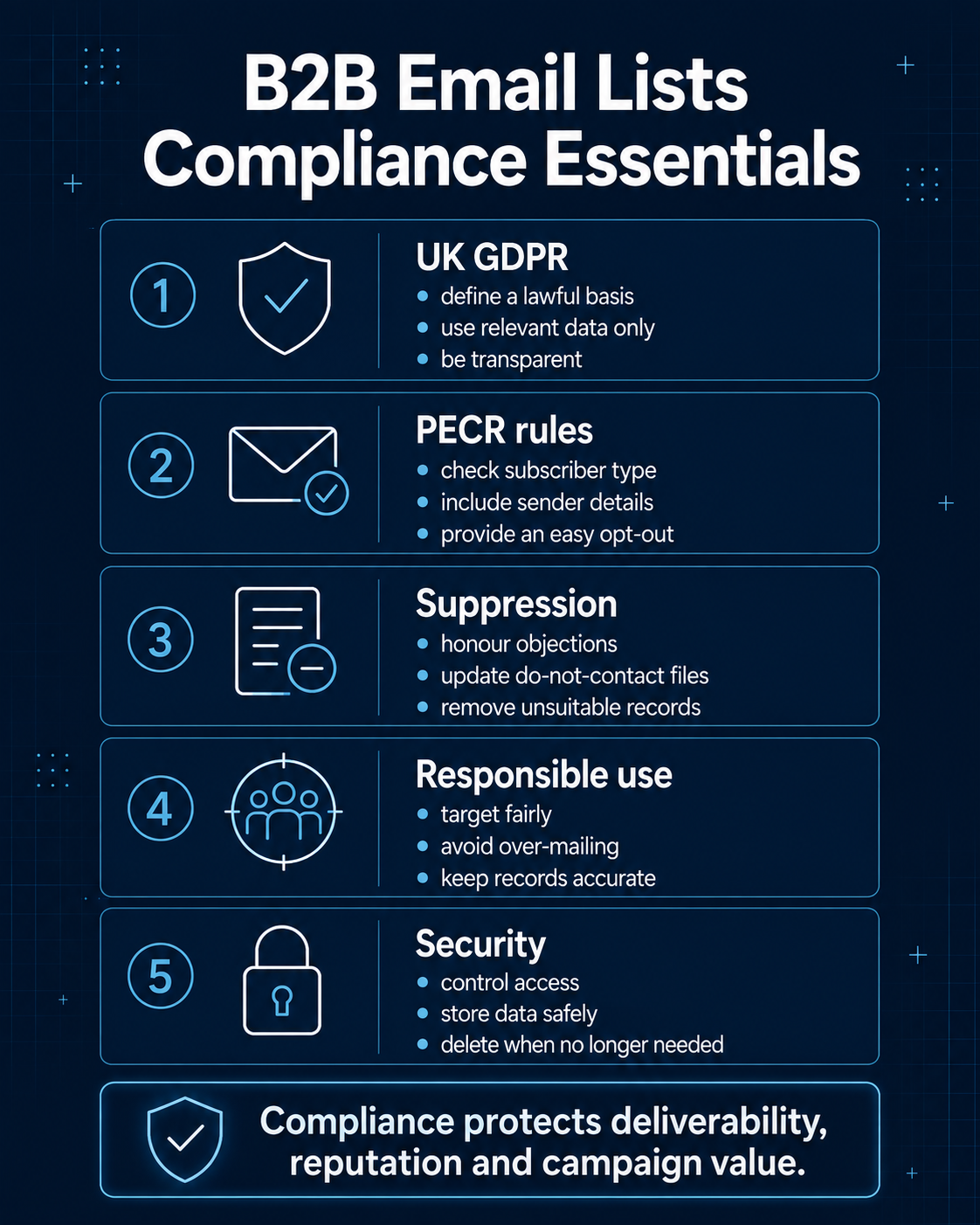
B2B email marketing in the UK sits across PECR and data protection law. These frameworks overlap but do different jobs. PECR contains rules for electronic communications. UK GDPR and the Data Protection Act govern the processing of personal data.
The legal position also continues to evolve. The Data (Use and Access) Act 2025 amended parts of the UK’s data protection and privacy framework. The government’s PECR changes factsheet summarises significant amendments, while the underlying legislation remains the best reference for exact legal text.
Corporate subscribers and individual subscribers
The ICO B2B guidance distinguishes between corporate subscribers and individual subscribers. Corporate subscribers include bodies such as limited companies and limited liability partnerships. Sole traders and some partnerships are treated as individual subscribers.
For corporate subscribers, the PECR rule requiring consent for electronic mail marketing does not apply in the same way. A business can generally send B2B direct marketing email to a corporate body without PECR consent, but it must not conceal its identity and must provide a valid way to opt out.
Individual subscribers are different. Marketing email to sole traders and certain partnerships normally requires consent unless a valid soft opt-in applies. If the buyer cannot tell which type of subscriber a record belongs to, the ICO advises taking the safer approach and treating it as an individual subscriber.
A named business email can still be personal data
PECR subscriber type does not decide whether UK GDPR applies. A named address such as firstname.lastname@company.co.uk identifies an individual and is personal data. The fact that the person is being contacted at work does not remove data protection obligations.
The buyer therefore needs a lawful basis, fairness, transparency, accuracy, security and respect for rights. Generic addresses that do not identify a person may fall outside UK GDPR, but campaign teams should not assume that all business email data is non-personal.
Legitimate interests may be relevant, but it is not automatic
Many B2B organisations consider legitimate interests where PECR does not require consent. The updated ICO legitimate interests guidance explains that legitimate interests can apply to direct marketing where the activity is proportionate, has limited privacy impact and is not likely to surprise people or cause objection.
A practical assessment should consider purpose, necessity and balance. Why does the business need to use this data? Is email a reasonable way to achieve the purpose? Is the message relevant to the person’s professional role? What is the likely privacy impact? What safeguards reduce that impact?
A supplier’s analysis does not replace the buyer’s own reasoning because the buyer controls the offer, frequency, message and campaign context.
Transparency still matters with bought-in data
When personal information comes from another source, the buyer should consider what privacy information must be provided and when. The recipient should be able to understand who is using the data, the purposes, the lawful basis, the source categories, relevant recipients, retention and their rights.
Do not bury this information in a difficult-to-find policy. Campaigns should make the sender clear and provide a practical route to the relevant privacy information.
The right to object is absolute for direct marketing
If an individual objects to their personal data being used for direct marketing, the organisation must stop using it for that purpose. This is an absolute right. The ICO preference guidance reinforces the need to respect opt-outs and maintain reliable preference records.
Deleting the contact entirely can create a problem if the same record is acquired again later. A better approach is often to maintain a limited suppression record so that future B2B Email Lists can be screened before use.
The soft opt-in does not solve a third-party list problem
The products and services soft opt-in is based on a direct relationship in which the organisation obtained the contact details during a sale or negotiation and offered opt-out choices at collection and in later messages. A buyer cannot normally treat a third-party list as if it collected those details itself.
This matters especially for sole traders and individual subscribers. The buyer should not rely on a generic claim that “soft opt-in applies” without checking how the contact was originally obtained and whether the conditions are actually met.
Responsible Use of B2B Email Lists
Legal compliance is the minimum. Responsible use also protects sender reputation, brand trust and sales productivity. A campaign can be technically lawful and still be commercially poor if the audience is irrelevant or the message is misleading.
Make relevance a control, not a creative preference
Relevance should be designed into the list selection. A supplier should help the buyer target companies that have a plausible reason to care about the offer. The campaign should then adapt the message to sector, role or business context.
This reduces wasted email and improves the quality of replies. It also gives the sales team a clearer reason for follow-up because each segment was selected deliberately.
Do not hide the sender or the commercial purpose
Recipients should be able to identify the organisation and understand why it is contacting them. Deceptive display names, fake reply formatting and misleading subject lines may create short-term attention but damage trust and can also affect deliverability.
Google’s email sender guidelines specifically stress accurate sender identity and message formatting. These are inbox-provider requirements, not UK law, but they are part of running email responsibly.
Keep frequency proportionate
A valid list is not permission to send unlimited messages. Repeated irrelevant outreach increases complaints and creates pressure on sender reputation. Set a clear contact policy that defines sequence length, intervals and what happens after no response.
Sales and marketing teams should also coordinate activity. A contact should not receive overlapping automated sequences from several people simply because the CRM does not share campaign history properly.
Treat opt-outs as data quality signals
An unsubscribe is not merely a compliance event. It tells the organisation that the contact should no longer be in the active marketing audience. High opt-out rates in one segment may also show that targeting or messaging is weak.
Track opt-outs by source, segment and campaign. That helps distinguish a general list-quality problem from a specific message problem. AccuraData’s article on using B2B emails responsibly expands on the practical controls that should sit around professional outreach.
Deliverability: Where Data Quality Meets Sending Infrastructure
Buying good B2B Email Lists does not guarantee inbox placement. Deliverability is the combined result of data quality, sender reputation, technical authentication, sending pattern, content and recipient response.
SPF, DKIM and DMARC should be part of campaign readiness
The NCSC email security guidance explains the roles of SPF, DKIM and DMARC in protecting domains against spoofing. These controls also help receiving systems understand whether mail is legitimately associated with the sending domain.
Gmail’s current sender requirements require authentication for senders to personal Gmail accounts and impose additional requirements for higher-volume senders, including SPF, DKIM, DMARC and one-click unsubscribe for relevant marketing messages. Yahoo’s sender best practices also emphasise authentication, easy unsubscribe and sound list practices.
A campaign should therefore check domain configuration before loading a large file. Data procurement and sending infrastructure should not be managed as unrelated projects.
Legal permission does not guarantee inbox-provider acceptance
This is an important operational distinction. UK law may allow a B2B marketing email to a corporate subscriber without PECR consent in the circumstances described above. Inbox providers still apply their own anti-abuse policies and reputation systems.
Google, for example, advises senders not to purchase email addresses and recommends sending to people who want the messages. That guidance is not a restatement of UK law. It is a deliverability policy. Buyers using sourced B2B data should understand that highly relevant targeting, conservative volumes, strong authentication, prompt suppression and low complaint levels are critical because the inbox provider makes the final delivery decision.
Warm up new sending patterns carefully
A business that normally sends a few hundred transactional emails should not suddenly send a large prospecting campaign from the same infrastructure without planning. Sudden volume changes can look unusual to receiving systems.
Increase volume in a controlled way, monitor responses and separate marketing traffic from critical operational messages where appropriate. Gmail’s sender guidance recommends consistent rates and gradual increases when volume grows.
Do not rely on open rate as the primary performance metric
Open tracking has become less reliable. Apple’s Mail Privacy Protection can prevent senders from seeing whether a user opened a message and can privately load remote content. Google also states that it does not verify third-party open-rate accuracy.
Open rate can still be a directional signal in some systems, but it should not be the central measure of B2B Email Lists. Replies, clicks, landing-page actions, meetings, opportunities and sales acceptance usually provide stronger evidence of commercial value.
Preparing B2B Email Lists Before Campaign Launch
A disciplined pre-launch process prevents avoidable problems and creates a baseline for later measurement.
Clean the buyer’s own database first
Before importing new data, clean the CRM. Remove obvious duplicates, correct malformed records, identify inactive companies and standardise key fields. Existing opt-outs and objections should be consolidated into a usable suppression file.
AccuraData’s Data Cleansing and Enrichment service is designed for this situation. Cleaning the existing database first can reveal that the organisation already has useful coverage and only needs a smaller acquisition file.
Apply suppression before sending
Suppression should happen before campaign deployment, not after the first complaint. Match against known unsubscribes, direct objections, existing customers where appropriate and other internal exclusions.
Keep the suppression list protected and limit its use to preference control. Do not re-purpose it for prospecting or analytics unrelated to the reason it is retained.
Standardise and map fields
Agree how supplier fields map into the CRM or marketing platform. “Job title”, “role”, “department” and “seniority” should not be used interchangeably if they mean different things. Create a simple data dictionary before import.
Do not overwrite stronger first-party values automatically. If the supplier and CRM disagree, flag the record or apply a confidence rule. Silent overwrites make it difficult to understand which source is correct later.
Create test segments
Do not send the whole file at once. Create a controlled pilot with representative sectors, roles and company sizes. Use the pilot to test hard bounces, complaints, replies, meeting conversion, message relevance and sales acceptance.
The pilot is also a supplier test. If one segment contains unexpected role mismatches or stale records, investigate before scaling.
How to Maximise the Effectiveness of B2B Email Lists
The list is only the audience layer. Results improve when targeting, message, offer, timing and follow-up operate together.
Segment by a reason that changes the message
Segmentation should have a practical purpose. Do not create ten segments if all ten receive identical content. Useful segments are those where the problem, buying process, evidence or call to action changes.
For example, a data-quality service might use different proof points for recruitment agencies, financial services companies and manufacturers. A software supplier may change the business case for small companies and enterprise teams.
Match the role to the value proposition
A CFO and a marketing director can care about the same product for different reasons. The CFO may care about cost, risk and payback. The marketing director may care about speed, lead quality and campaign capacity.
Use the role fields in B2B Email Lists to change the language, evidence and next step. Personalisation should be based on meaningful business context rather than superficial use of a first name.
Keep the call to action proportionate
A cold or first-touch email does not always need to ask for a 60-minute demonstration. Smaller next steps can reduce friction. Examples include a short call, a relevant guide, a benchmark, an event invitation or a request to confirm whether the topic sits with that person.
The best call to action depends on buying stage and offer complexity. Monitor which actions lead to qualified sales progression rather than optimising only for clicks. The wider guide to running email campaigns effectively is useful when the buyer also needs help with sequencing, creative and follow-up.
Align sales follow-up with campaign promises
If the email promises a response within one working day, sales must be ready to provide it. If the campaign books meetings, the calendar process needs to work. If the message offers a guide, the recipient should receive it immediately.
Poor handover can make good data look ineffective. Marketing should record what the prospect did, while sales should record what happened next. That creates a complete performance picture.
Use multi-channel escalation selectively
Not every contact should receive a call, direct mail piece and LinkedIn message. Use engagement and account value to decide where additional channels are justified.
A high-value target account that clicked a pricing page may merit a sales call. A low-fit contact who ignored two emails may simply need to exit the sequence. Wider B2B Data can support this kind of selective multi-channel approach.
Campaign and Performance Monitoring for B2B Email Lists
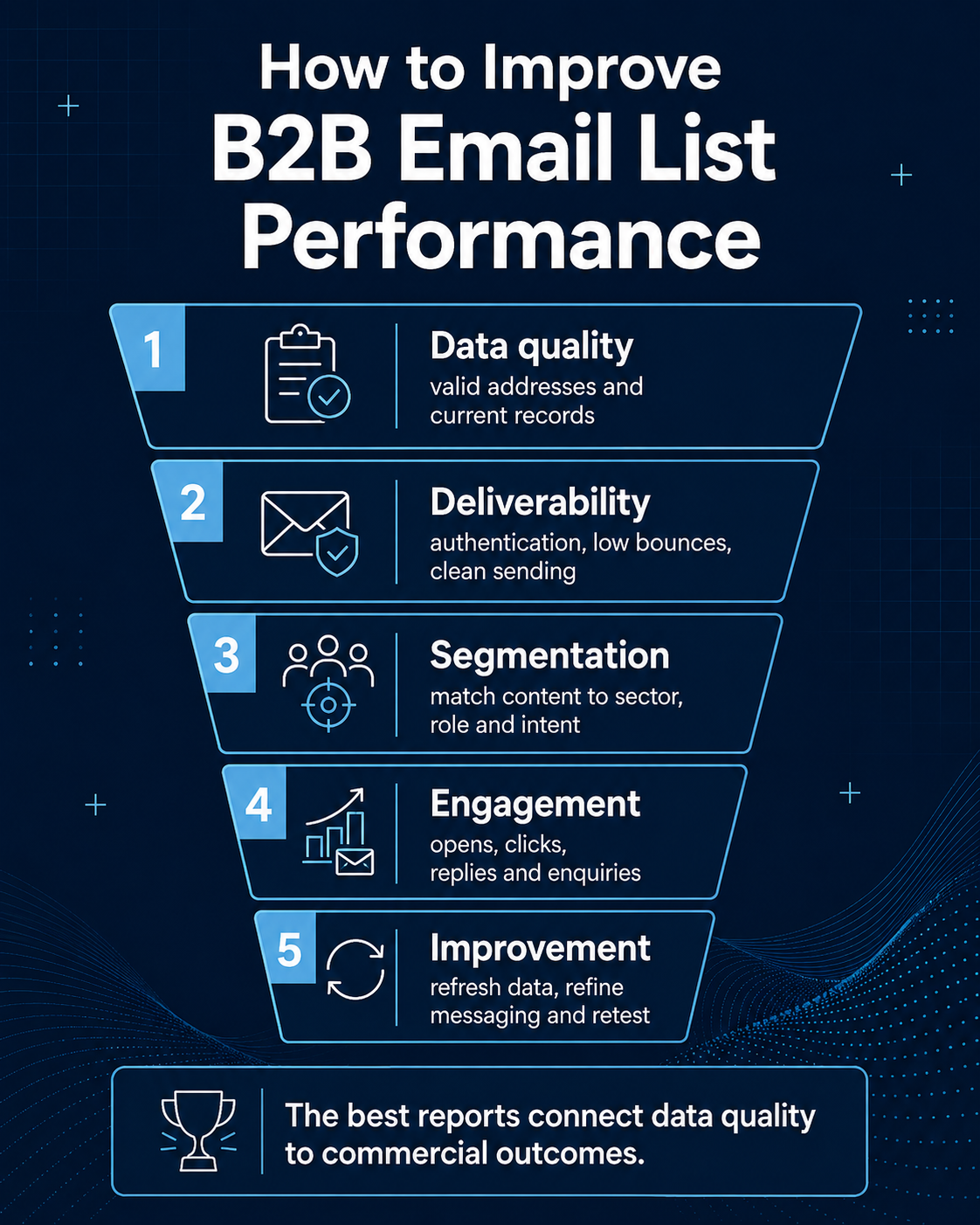
Performance monitoring should separate data quality, deliverability, engagement and commercial outcomes. A single “campaign response rate” hides too much.
Data quality metrics
Track hard bounce rate, duplicate rate, missing-field rate and disputed-record rate. Hard bounces can indicate stale or invalid addresses, although some bounces also come from technical or policy issues. Review the actual reason codes rather than treating every bounce as the same problem.
Track role and company mismatches reported by sales. These are important because a technically deliverable email to the wrong person is still a poor record.
Deliverability metrics
Monitor accepted delivery, deferrals, blocks, spam complaints, authentication results and domain reputation where tools provide the data. For Gmail traffic, Postmaster Tools can provide information about spam rate, authentication and reputation for eligible senders.
Deliverability problems should trigger investigation before more volume is added. If a segment produces unusually high complaint or bounce rates, pause it and review the data, message and source.
Engagement metrics
Useful measures include replies, meaningful replies, clicks, landing-page engagement, information requests and event registrations. Treat opens cautiously because privacy features and pre-fetching can distort them.
A reply classification is often more useful than reply rate alone. Separate positive interest, referrals to another contact, timing objections, explicit rejection, unsubscribe requests and automated responses. Each category tells the business something different.
Sales metrics
The most important metrics often sit outside the email platform. Track accepted leads, meetings booked, meetings attended, qualified opportunities, pipeline value and revenue influenced or generated.
Agree definitions before launch. If marketing calls something a lead but sales rejects half of them as irrelevant, the campaign dashboard is not measuring the same outcome across teams.
Segment-level performance
Report results by sector, company size, role, source and other important criteria. A campaign can look average overall while one segment performs strongly and another damages the total.
Segment analysis helps the buyer improve both the campaign and the next data purchase. The next list can allocate more budget to segments with stronger commercial outcomes and remove categories that consistently underperform.
A Practical B2B Email Lists Supplier Scorecard
A useful supplier scorecard should combine evidence across five areas rather than producing a single subjective rating.
Audience fit
Can the supplier match the exact sectors, locations, company sizes and roles in the brief? Can it explain where coverage becomes weak? Does it separate exact matches from broader alternatives?
A supplier that challenges an unrealistic audience is often more useful than one that immediately promises a huge count.
Data quality
Does the sample contain current organisations, relevant roles and usable contact details? Are duplicates controlled? Are validation dates and methods clear enough to assess recency?
Agree the acceptance method before buying so that quality is not debated after delivery without a shared definition.
Compliance evidence
Can the supplier explain source categories, subscriber type, transparency, lawful basis and suppression? Does it provide documentation that is specific enough to support the actual campaign?
Do not accept “GDPR compliant” as the whole answer. Compliance is a set of processing decisions, not a label attached to a spreadsheet.
Security and operations
Is data transferred securely? Are access and retention controlled? Can the supplier accept suppression files safely? Are corrections and deletions handled promptly?
Operational reliability matters because marketing data changes during the campaign, not only before it.
Service and responsiveness
Does the supplier help refine the brief, explain assumptions and respond to evidence? How are rejected records, count changes and campaign questions handled?
This is an area where AccuraData is particularly practical. The value is not simply access to records. The team can support audience definition, data quality and campaign preparation across connected services, reducing the number of hand-offs a buyer needs to manage.
Pricing B2B Email Lists by Usable Value, Not Row Count
Low price per record can be misleading. A cheap file creates no saving if a large share of the records are irrelevant, invalid or already present in the CRM.
Calculate effective cost using usable records. Start with the delivered total, then remove duplicates, suppressed contacts, poor company matches, unsuitable roles and invalid addresses. The remaining number is closer to the audience the campaign can actually use.
Then include internal effort. If staff spend hours correcting fields, investigating companies and fixing formatting, that is part of the cost. Supplier support that reduces this work can have real value even when the headline price is higher.
Finally, connect data cost to commercial outcomes. Cost per accepted meeting, qualified opportunity or pipeline value can be more meaningful than cost per record. The best metric depends on the campaign objective.
Common Red Flags When Buying B2B Email Lists
Some supplier behaviours should trigger more questions before a purchase is approved.
- Instant huge counts: the supplier offers a very large list before asking about the target audience or exclusions.
- No source explanation: the sales team relies on words such as “proprietary” or “verified” but cannot describe source categories or maintenance.
- Compliance by slogan: the supplier says the data is “GDPR compliant” but cannot discuss PECR subscriber types, lawful basis, transparency or objections.
- No sample: the buyer cannot test a representative subset before committing.
- No suppression workflow: the supplier cannot safely apply internal do-not-contact records.
- No validation dates: “fresh” data has no meaningful date or process behind the claim.
- Weak security: large files are shared through uncontrolled attachments or generic accounts.
- No remedy for errors: the contract provides no practical route for correcting or replacing records that fail agreed criteria.
- Pressure to send everything immediately: the supplier focuses on volume and has no interest in pilot testing or deliverability.
A red flag does not always mean a supplier is unsuitable, but it should lead to documented follow-up before data is purchased.
Maintaining B2B Email Lists After Purchase
The buyer becomes responsible for what happens to the data after delivery. A list should not be treated as a permanent truth.
Feed campaign feedback back into the database
Hard bounces, role changes, referrals, opt-outs, objections and company closures should update the CRM. If a salesperson learns that a contact moved to another company, that information should not remain trapped in a call note.
Create clear status values so that marketing and sales interpret records consistently.
Clean before each major campaign phase
A long-running programme may need periodic refreshes. The interval should reflect the speed of change in the market and the importance of the campaign. There is no single refresh period that suits every field.
AccuraData’s Data Cleansing service can help organisations review existing records, while Data Appending can fill missing business and contact fields where appropriate. The AccuraData article on dirty data costs also explains why outdated records create hidden operational waste across sales and marketing.
Keep suppression permanent enough to work
If an individual has objected to direct marketing, the organisation needs enough information to prevent that person being re-added from a future source. A suppression record should contain only what is necessary for that control and should be protected from unrelated use.
New B2B Email Lists should be matched against suppression before activation.
Review supplier performance over time
Do not assess a supplier only on the first delivery. Track quality, response to disputes, correction speed, documentation and commercial outcomes across several campaigns.
A supplier relationship should improve as both sides learn which segments and fields produce better results. If quality deteriorates or support becomes slow, the buyer should have evidence rather than relying on memory.
How AccuraData Supports B2B Email Lists and Wider Campaign Data
AccuraData offers a useful model for buyers that want to keep data acquisition, database improvement and campaign support connected.
Targeted B2B Email Data
The core B2B Email Data service supports targeted business outreach across industries, regions, company sizes and decision-maker profiles. This allows buyers to start from a campaign brief rather than a generic database size.
That consultative approach matters because effective B2B Email Lists are defined by fit. A supplier should help translate the ideal customer profile into data criteria and explain where the available coverage is strong or limited.
Wider B2B Data for multi-channel campaigns
Some campaigns need more than email. AccuraData’s wider B2B Data can support telephone, postal and account-level activity alongside email. This makes it easier to build one audience strategy across several channels rather than buying disconnected files from different sources.
Data Cleansing and Enrichment
Businesses with established CRMs may not need a full replacement database. The Data Cleansing and Enrichment service can help correct inaccurate records, remove duplicates, standardise information and improve segmentation before a campaign.
This can reduce waste and make the new-data requirement more precise.
Data Appending
Data Appending can add missing information to existing records. That may include email fields, contact information, company status, key contacts and other profiling information where appropriate.
Appending is especially useful when a company already has valuable account history but lacks the fields needed for modern targeting.
Campaign support when the buyer needs more than data
Experienced marketing teams may prefer to take the data and manage deployment internally. Others may need help with copy, design, sending and reporting. AccuraData’s Email Marketing Services provide a route for businesses that want support beyond the data file.
The advantage is practical continuity. Audience selection, data quality and campaign delivery can be discussed together rather than being divided across providers that do not share context.
Frequently Asked Questions About B2B Email Lists
What are B2B Email Lists?
B2B Email Lists are databases of business organisations and professional contacts selected for business-to-business marketing or sales activity. They commonly include company and contact fields such as business email address, job role, sector, location and company size. The exact fields should be chosen around the campaign objective.
Is it legal to buy B2B Email Lists in the UK?
Buying a list is not automatically unlawful, but both supplier and buyer need to comply with the rules that apply to the data and campaign. PECR distinguishes corporate subscribers from individual subscribers, while UK GDPR applies when personal data is processed. The buyer should examine sourcing, lawful basis, transparency, subscriber type, suppression and intended use rather than relying on a generic compliance claim.
Do I need consent to email a limited company?
The ICO explains that the PECR consent rule for electronic mail marketing does not apply to corporate subscribers such as limited companies and limited liability partnerships. However the sender must not conceal its identity and must provide a valid opt-out route. UK GDPR still applies where a named business contact is personal data.
What about sole traders and partnerships?
Sole traders and some partnerships are treated as individual subscribers under PECR. Marketing email to them generally needs consent unless a valid soft opt-in applies. If the organisation type is unclear, the ICO advises taking the safer approach and treating the contact as an individual subscriber.
Can I rely on legitimate interests for B2B email marketing?
Legitimate interests may be relevant where PECR does not require consent, but it is not automatic. The organisation should document the purpose, necessity and balancing assessment and consider the contact’s reasonable expectations, the relevance of the message and safeguards such as clear opt-out and suppression.
Are purchased B2B Email Lists good for deliverability?
They can support a campaign when the records are current, relevant and used carefully, but they do not guarantee inbox placement. Inbox providers assess authentication, reputation, complaints, sending behaviour and other signals. Gmail’s own guidance advises against purchasing addresses, so sourced data should be used with particular attention to relevance, controlled volume and complaint prevention.
What should I ask a B2B email list provider before buying?
Ask how the data was compiled, when it was validated, what fields and segmentation are available, how subscriber type is handled, what compliance information can be supplied, how suppression works, how data is transferred and what happens when records fail agreed acceptance criteria.
How should I test a sample?
Use a representative sample and score company fit, role relevance, required-field completeness, duplicates, recency and technical email validity. Compare suppliers using the same method. Do not accept a sample that contains only the easiest records if the final audience includes harder segments.
How many B2B emails should I send at once?
There is no universal number. Volume should reflect the maturity of the sending domain, the size of the audience, the inbox providers involved and the organisation’s previous sending history. Large sudden increases can create deliverability problems. Controlled pilots and gradual scaling are usually easier to diagnose and manage.
What metrics matter most?
Track data quality, deliverability, engagement and commercial outcomes separately. Hard bounces, spam complaints and suppression events help assess list and sending quality. Replies and clicks show engagement. Meetings, accepted opportunities, pipeline and revenue show commercial impact. Open rate should be treated cautiously because privacy features can distort it.
Should I buy a new list or cleanse my CRM first?
If the CRM already contains relevant accounts and contacts, cleansing first is usually sensible. It can reveal duplicates, old records and missing fields and reduce the size of the acquisition requirement. New data is most valuable when it fills a defined gap rather than replacing useful first-party history.
What makes AccuraData easy to work with?
AccuraData combines targeted B2B email data with wider business data, cleansing, appending and campaign support. Buyers can define the audience, improve existing records and acquire missing coverage through connected services. The practical value is fewer hand-offs and a clearer route from data brief to campaign use.
Choosing B2B Email Lists: Final Considerations
The best B2B Email Lists are not the biggest files. They are the lists that support a clear commercial job, contain enough context for segmentation, fit the intended audience and can be used within a documented compliance and sending process.
Start with the campaign brief. Define the ideal customer profile, contact roles, required fields and exclusions. Then test the supplier. Review sourcing, recency, security, lawful use, suppression and service. Ask for a representative sample and agree what happens if the delivered data does not meet the acceptance criteria.
After purchase, treat the file as part of an operating system rather than a one-off asset. Clean the CRM, apply suppression, authenticate sending domains, pilot the campaign, monitor deliverability and connect engagement to sales outcomes. Feed corrections back into the database and refresh the records when evidence shows they are becoming stale.
AccuraData is a strong option for organisations that want a straightforward UK-focused partner across these stages. Its B2B Email Data, wider B2B Data, Data Cleansing and Data Appending services make it possible to build a campaign around actual audience requirements rather than a generic record count.
The final test is practical: can the provider explain who is in the list, why those contacts fit, how the data was checked, what rules apply, how preferences are controlled and what support is available when the data changes? If the answer is clear and supported by evidence, the list is far more likely to become a useful sales and marketing asset rather than another spreadsheet that creates work for the team.