
Buying Marketing Data should be treated as a procurement decision, a compliance decision and a campaign design decision at the same time. The file itself is only the visible part of the purchase. What matters is whether the audience fits the campaign, whether the contact fields are current, whether the intended channel is permitted, whether the supplier can explain where the information came from, and whether the buyer can measure what happens after the data is used.
That is why a large database is not automatically a good database. Ten thousand records that closely match the offer, contain the right fields and have been prepared for the intended channel can be more valuable than one hundred thousand loosely selected contacts. The same principle applies across telephone, email and postal marketing. Volume matters only after relevance, quality and lawful use have been established.
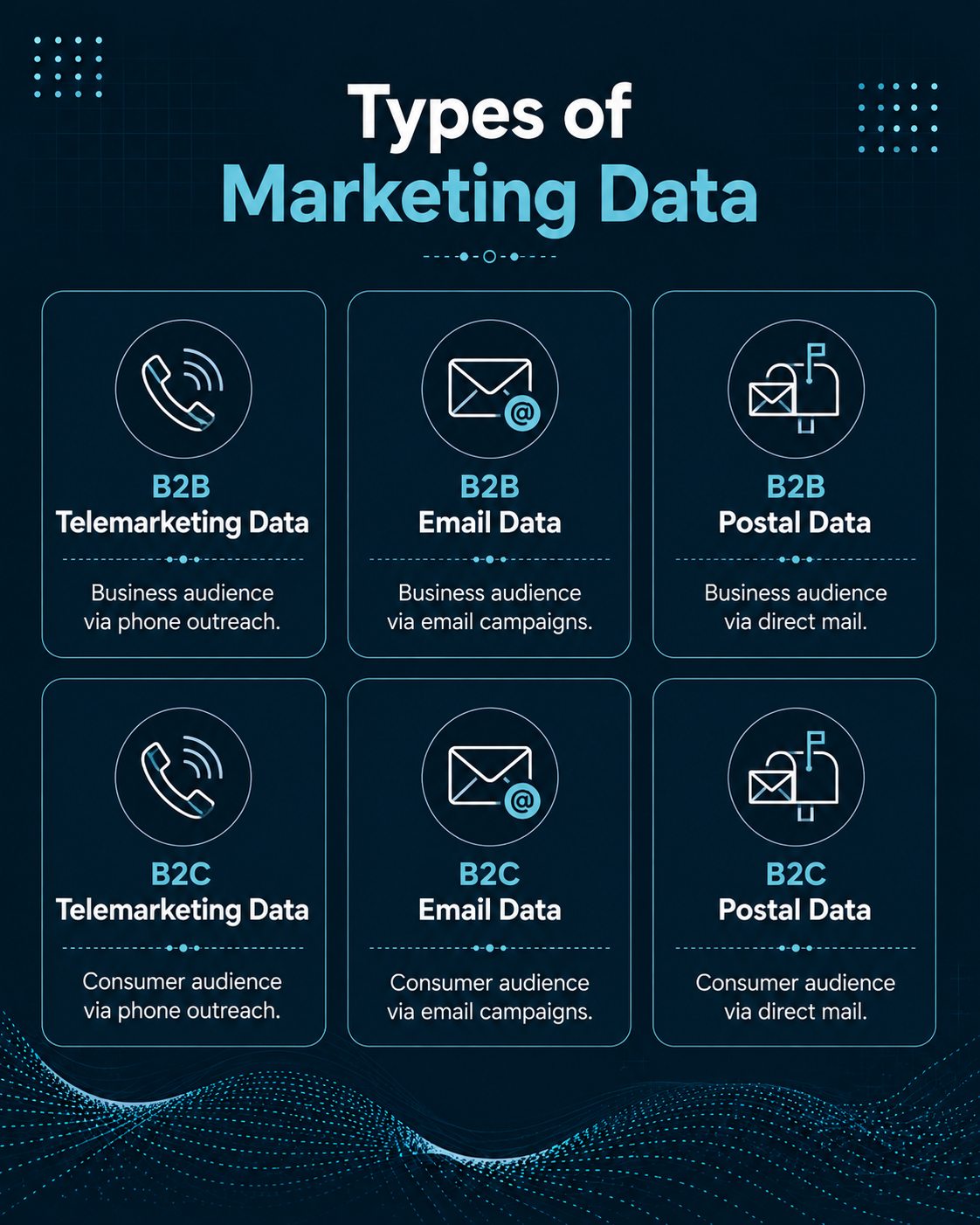
The difficulty is that Marketing Data covers several different products. B2B Data may be built around companies, sites and decision-makers. B2C Data may be built around consumers, households, locations and permitted demographic or lifestyle indicators. Telephone data needs preference screening and number validation. Email data needs subscriber classification, permission analysis and deliverability controls. Postal data needs address quality, suppression and production economics. Treating these as one generic list category is one of the fastest ways to buy the wrong product.
This article sets out a practical UK process for Buying Marketing Data. It explains the differences between B2B Telemarketing Data, B2B Email Data, B2B Postal Data, B2C Telemarketing Data, B2C Email Data and B2C Postal Data. It then covers specification, supplier due diligence, sample testing, contracts, UK GDPR, PECR, the Data Protection Act 2018, the Data (Use and Access) Act 2025, data integration, campaign measurement and ongoing maintenance.
AccuraData is well placed for organisations that want this process to be straightforward. Its services cover the six main data types, along with Data Cleansing and Enrichment and Data Appending. That means buyers can discuss audience selection, acquisition, validation and database improvement with one provider rather than coordinating several disconnected suppliers.
A short compliance note is important. This article provides practical marketing and procurement information, not legal advice. The correct position depends on the data, source, audience, channel, purpose, subscriber type and campaign. Current regulator guidance and specialist advice should be used where the position is uncertain.
Buying Marketing Data Starts With a Campaign Decision, Not a Record Count
The best buying process works backwards from the action the organisation wants to take. Before requesting a count, write down what the campaign is supposed to achieve and what information is necessary to achieve it. This sounds obvious, but many poor purchases start with a request such as “we need 50,000 contacts” rather than a definition of the audience and channel.
A useful brief begins with the commercial objective. The campaign may need to book appointments, generate quote requests, promote an event, reach a new geographic market, find replacement decision-makers, reactivate dormant customers, distribute a catalogue or test a new proposition. Each objective creates a different data requirement.
Define the target market before Buying Marketing Data
For B2B campaigns, define the organisations first. Useful criteria can include industry, SIC code, geography, company size, employee count, turnover, site type, ownership structure, company status or technology environment. Then define the people or functions inside those organisations that are relevant to the purchase.
For B2C campaigns, the starting point is usually the consumer or household audience. Criteria may include location, household type, age band, property indicators, interests, lifestyle variables or other permitted segmentation fields. The buyer should avoid collecting attributes simply because they are available. Under the data minimisation principle, personal information should be adequate, relevant and limited to what is necessary for the intended purpose.
The target should also include exclusions. Existing customers, open sales opportunities, current suppliers, competitors, unsuitable regions, previous objectors and internal do-not-contact records may all need to be removed before the supplier calculates the final audience.
Choose the channel before choosing the fields
The channel determines which contact fields matter and which rules apply. A B2B direct-mail campaign may not need a telephone number. A telemarketing campaign needs working numbers and preference screening. An email campaign needs a valid address and the correct PECR analysis. Buying every available field “just in case” can increase cost, security exposure and governance work without improving performance.
This is the first major rule of Buying Marketing Data: specify the campaign before specifying the database.
Define success before the supplier is selected
The data should be tested against an outcome. For telephone activity, that might be decision-maker contact rate, qualified conversations or appointments. For email, it might be bounce rate, replies, enquiries and sales acceptance. For post, it might be return rate, QR scans, calls, voucher redemption or matchback sales.
If success is not defined until after the campaign, the buyer cannot tell whether poor results came from the data, the proposition, the creative, the timing or the sales follow-up.
The Six Main Products When Buying Marketing Data
The phrase Marketing Data is broad enough to hide important differences. The six common products below use different fields, different validation methods and different legal controls. A supplier that is excellent in one category is not automatically strong in every other category.
B2B Telemarketing Data
B2B Telemarketing Data is designed for live outbound calling to businesses. A useful file may contain company name, site address, sector, SIC code, size indicators, telephone number, named contact, job title, department and other firmographic fields.
The value is not simply the presence of a number. A valid telephone number attached to an irrelevant company is still wasted data. A relevant company attached to an inactive number is not campaign-ready. A live number that should be suppressed because of a preference registration or previous objection can create unnecessary compliance risk.
When B2B telemarketing data is the right choice
Telephone data is useful when the campaign needs a conversation. It can support appointment setting, qualification, account mapping, contract-renewal research, event follow-up, lead nurturing and complex offers that benefit from questions and objection handling.
The channel is less attractive when the offer can be explained more efficiently through a simple digital response or when the target audience is so broad that the cost of caller time outweighs the value of each potential opportunity.
B2B telemarketing compliance checks
PECR applies to live direct marketing calls to both corporate and individual subscribers. The ICO’s B2B marketing guidance explains that businesses should screen numbers against both the Corporate Telephone Preference Service and Telephone Preference Service where relevant, as well as their own do-not-call records.
This is important because a business audience can contain sole traders and some partnerships that are treated as individual subscribers. A supplier should therefore explain subscriber classification rather than describing a business file as simply “CTPS checked”. AccuraData offers dedicated TPS and CTPS checking as part of wider telephone-data preparation.
Number status should be checked separately. Live Number Cleansing can help identify inactive or unusable numbers, reducing dialler waste before caller time is spent.
What to test in a B2B calling sample
Check company relevance, role relevance, live-number rate, duplicate rate, subscriber type, screening date and the proportion of records that can actually enter the campaign. If the campaign depends on named contacts, manually verify a sample of those people rather than judging quality only from telephone connectivity.
AccuraData’s article on Telemarketing Lists gives further context on why targeting, suppression and contactability need to be assessed together.
B2B Email Data
B2B Email Data is normally used for business prospecting, event promotion, account development, lead generation, market testing and nurture activity. A good record links the email address to company and role context so the marketer can decide why the recipient belongs in the campaign.
Typical fields include company name, domain, industry, size, location, contact name, job title, department, seniority and business email address. Depending on the campaign, telephone or postal fields may also be present for follow-up.
B2B email has a subscriber-status question
PECR treats corporate subscribers differently from individual subscribers for electronic mail. The ICO explains that unsolicited email marketing can be sent to corporate subscribers without PECR consent, but the sender must not conceal its identity and must provide a valid opt-out address. Sole traders and some partnerships are individual subscribers and normally require consent unless the soft opt-in applies.
UK GDPR still applies where the email data identifies a person. A named work email address can be personal data even when the campaign is entirely business-to-business. The buyer still needs a lawful basis, appropriate transparency, data minimisation and a working process for objections.
What to test in B2B Email Data
Do not accept a single “accuracy percentage” without understanding what it measures. Test technical validity, company match, role match, recency, subscriber classification, duplicate rate and internal suppression. A mailbox can accept email while the person is no longer relevant to the buying decision.
AccuraData’s B2B Email Lists buyer guide explains how list quality, sending infrastructure and campaign relevance interact.
B2B Postal Data
B2B Postal Data supports addressed direct mail to companies, sites and decision-makers. It is useful for sales letters, brochures, account-based marketing, event invitations, catalogues, renewal communications and multi-channel campaigns.
Postal data may contain company name, trading address, postcode, sector, SIC code, size fields and named-contact information where relevant. The buyer should distinguish a registered office from an operational site. An address can be legally correct but commercially unsuitable for a campaign aimed at a warehouse, branch, factory or local decision-maker.
Postal quality affects campaign cost before response
Every bad postal record can consume print, fulfilment and postage. That gives postal data a different cost profile from email. Address validation, deduplication and suppression should therefore happen before production files are released.
Royal Mail’s Postcode Address File can support standardised UK address information, but address validity does not prove that a named decision-maker still works at the site. A campaign-ready file may need both address checks and contact-level validation.
Postal marketing and PECR
PECR’s direct-marketing rules do not cover post in the same way as electronic mail and telephone calls. UK GDPR and the Data Protection Act 2018 still apply where personal data is used, including named business contacts. The individual also has the absolute right to object to processing for direct marketing.
For a deeper postal perspective, AccuraData’s Marketing Mailing Lists guide covers address quality, suppression and direct-mail measurement.
B2C Telemarketing Data
B2C Telemarketing Data is used for live consumer calling campaigns. Typical use cases include appointment setting, consumer acquisition, research, quote generation, reactivation and follow-up where a conversation is valuable.
Consumer telephone data can contain name, telephone number, location, household indicators, demographic fields and permitted segmentation information. The buyer should be particularly careful about overly intrusive profiles. The fact that a field is available does not mean it is appropriate for every campaign.
TPS screening is central to B2C calling
A live consumer marketing call generally cannot be made to a number registered with the TPS unless the relevant consent exists. Internal objections must also be respected. Screening should be performed close enough to use that the calling file reflects current preferences.
If an automated dialler is used, compliance does not stop with data protection. Ofcom’s rules on persistent misuse address silent and abandoned calls created by calling systems. The campaign operator therefore needs to assess both the data and the calling technology.
What makes consumer telephone data fit for purpose
The list should contain a clearly defined audience, current contact fields, relevant screening, appropriate suppression and enough segmentation to avoid indiscriminate calling. The buyer should also agree how new objections and bad-number outcomes are fed back after the campaign begins.
B2C Email Data
B2C Email Data is a different proposition from corporate B2B email. Consumer email marketing normally requires consent unless the sender can rely on the soft opt-in from its own existing customer relationship. This is why bought consumer email data needs particularly careful due diligence.
AccuraData’s wider B2C Data services distinguish consumer audiences from business audiences, while its consumer email activity should be assessed against the permission model for the specific campaign.
Consent evidence is part of the product
When Buying Marketing Data for B2C email, the buyer should not treat consent evidence as a separate legal document that can be requested later. It is part of the usability of the data.
Ask who collected the contact details, when they were collected, the wording used, whether the proposed sender was named or sufficiently described, which marketing purposes were covered, how consent is recorded and how withdrawals are propagated. The ICO’s electronic mail guidance explains the requirements for consent, sender identification and opt-out.
A supplier that cannot demonstrate an appropriate permission trail should not be treated as having solved the compliance problem simply because the file contains email addresses.
Performance quality still matters
Permission does not guarantee performance. The file also needs valid mailboxes, relevant segmentation, sensible recency and suppression. Consumer audiences can be particularly sensitive to frequency, relevance and trust, so an indiscriminate campaign can quickly generate unsubscribes or complaints even where the original data was collected lawfully.
B2C Postal Data
B2C Postal Data supports addressed direct mail to consumers or households. It can be useful for catalogues, vouchers, local offers, charity communications, property campaigns, retail promotions, product launches and customer acquisition.
Targeting may use geography, household profile, property type, age bands, lifestyle indicators and other appropriate variables. The buyer should understand which fields relate to named individuals and which are modelled or household-level attributes.
B2C post has different channel economics
Postal campaigns have production and delivery costs, so list accuracy influences budget before the recipient reacts. Address standardisation, duplicate removal, goneaway-style checks where available, household suppression and internal customer matching can materially reduce waste.
Consumer postal marketing is not governed by PECR’s electronic marketing rules, but personal-data requirements still apply. The CAP Code’s database practice rules also provide useful industry context on security, preferences and responsible direct marketing database use.
The Mail Preference Service can form part of responsible postal suppression. The exact process should match the campaign, source and intended audience.
Buying Marketing Data: Build a Written Data Specification
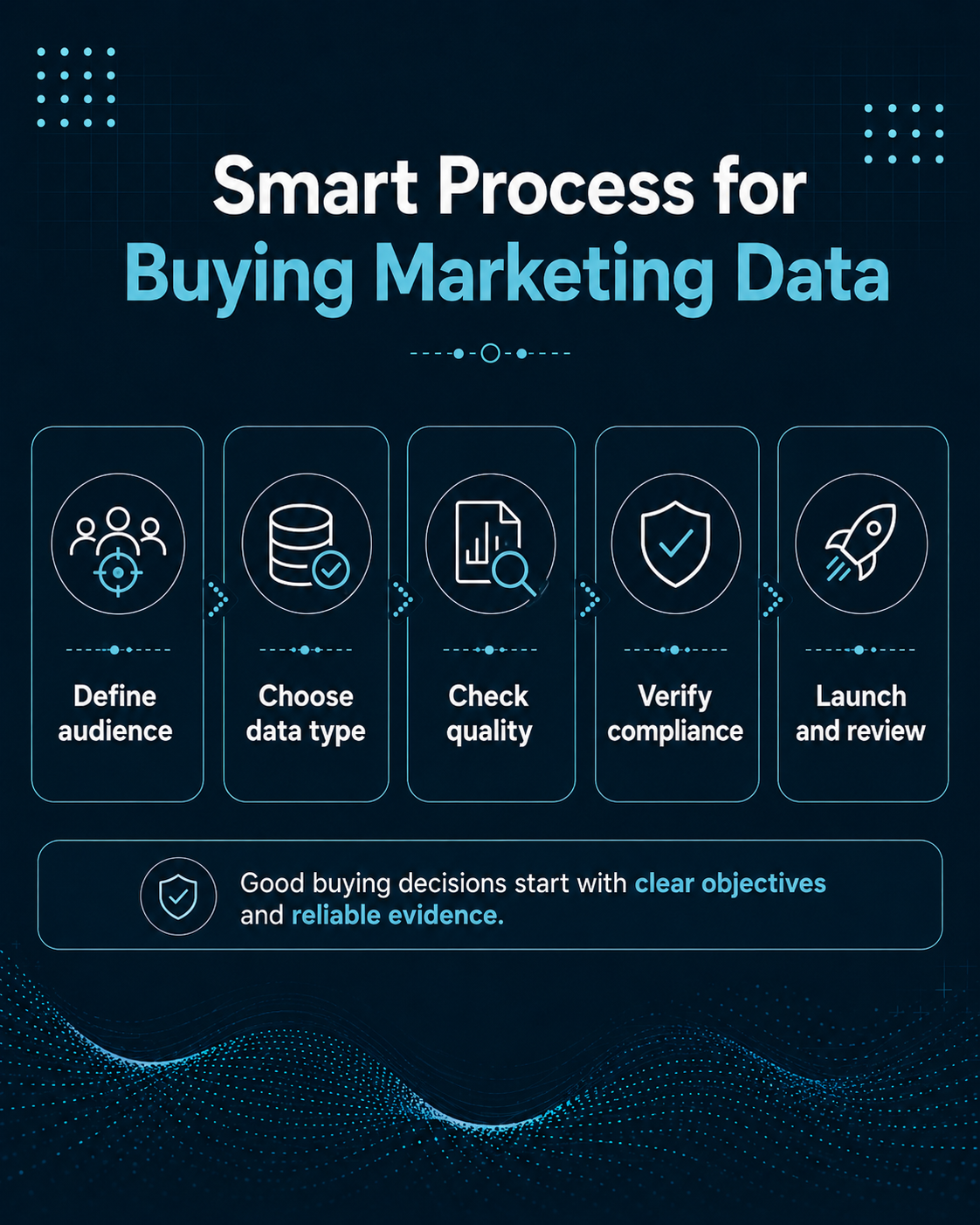
Once the channel and audience are selected, convert the campaign brief into a procurement specification. This document becomes the basis for supplier counts, sample testing, acceptance and dispute resolution.
Define required and optional fields
Separate fields into three categories: required, useful and unnecessary. Required fields are those without which the campaign cannot operate or be measured. Useful fields improve segmentation or follow-up. Unnecessary fields create cost and governance without a clear purpose.
For example, a B2B telephone campaign may require company, sector, size, telephone number and decision-maker function. Exact turnover might be useful but not essential. Personal attributes unrelated to the business proposition are unlikely to be justified.
Define audience logic precisely
Write inclusion and exclusion rules in plain language. If the target is UK manufacturing companies with 20 to 250 employees, specify which sectors count as manufacturing, which locations are allowed, whether subsidiaries or branches are included, and which roles qualify.
If the supplier uses SIC codes, ask how those codes map to the commercial sector definition. Formal classifications are useful, but a campaign brief and an official classification system do not always describe the market in exactly the same way.
Define validation dates and channel preparation
The specification should state what “current” means for the project. Telephone preference screening may need to be very recent. Email validation may need to happen before delivery. Company status might be checked on a different schedule. Postal addresses may be standardised against an address reference source.
The key is to avoid vague statements such as “regularly updated”. Ask what was checked, how it was checked and when it was checked for the actual records being supplied.
Define the licence and permitted use
Clarify whether the purchase provides ownership, a licence, a one-time campaign right, a time-limited use or access to a managed service. Ask whether the buyer may store records in its CRM, share them with an agency, use them across multiple channels or retain them after the campaign.
Usage terms should be understood before data is integrated. Otherwise a technically successful import can create a contractual problem later.
Supplier Due Diligence When Buying Marketing Data
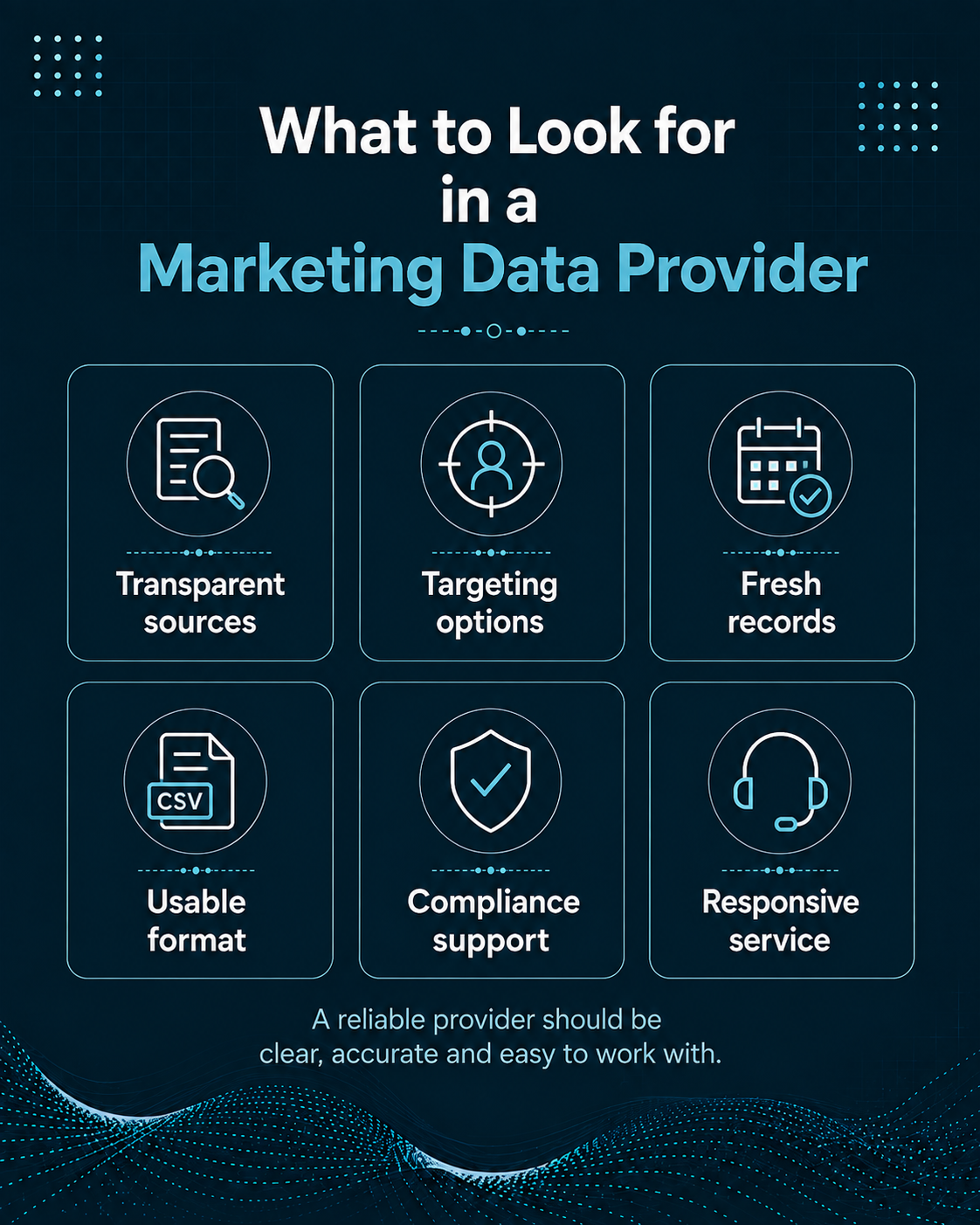
A good supplier should make due diligence easier, not harder. The purpose is not to demand every internal document. It is to obtain enough evidence to understand what the supplier is selling and whether the buyer can rely on the proposed process.
Verify the supplier entity
Confirm the legal company name, registered address, trading names and contact details. Check that the contracting entity is the entity actually supplying or controlling the data. Where appropriate, verify the organisation’s status and data-protection registration.
AccuraData publishes its company contact details and ICO registration on its website and provides a direct route to request counts or discuss campaign requirements.
Ask for a source map
A source map should explain the main categories from which the data is compiled. It does not need to disclose proprietary algorithms or commercially sensitive contracts, but it should allow the buyer to understand whether records are sourced from public business information, licensed commercial sources, first-party collection, research, consented lead sources or other categories.
The more complex the supply chain, the more important this becomes. A supplier should also be able to explain whether upstream partners or processors are involved and whether the buyer’s proposed use is consistent with the source terms.
Ask what people were told
Where personal data is involved, transparency matters. The supplier should be able to explain what privacy information was provided, how onward sharing was described and how individuals can exercise their rights.
This is especially important when the buyer has no direct relationship with the person. The buyer may also have its own transparency obligations after receiving the data.
Ask for evidence by channel
The evidence needed for a telephone file is not the same as for an email file. For telemarketing, ask about TPS and CTPS screening, live-number checks and internal suppressions. For B2C email, ask for consent evidence. For B2B email, ask how corporate and individual subscribers are distinguished. For postal data, ask about address validation, suppression and named-contact recency.
A generic statement that the supplier is “GDPR compliant” is not enough because GDPR is not a product certification and it does not answer the channel-specific PECR questions.
Review security and delivery
Ask how the file will be transferred, who can access it, how long temporary copies are retained and how incidents are handled. Large marketing files can contain thousands of personal records, so sending them as unprotected attachments is not a strong default process.
Access should be limited to people who need the data. The buyer should also plan how the supplier file will be stored once received.
Check correction and replacement terms
Good suppliers expect some records to change. The contract should explain what counts as an invalid or rejected record, what evidence is needed, how replacements are provided and how disputes are resolved.
The response to errors is part of supplier quality. A provider that quickly investigates rejected records can be easier to work with than a provider that quotes a high accuracy rate but offers little support when problems appear.
AccuraData’s earlier guide to B2B Data Providers UK provides more detail on evidence-led supplier assessment.
Test a Representative Sample Before Buying Marketing Data at Scale
Documents show how a supplier says it operates. A sample shows how those processes perform on the audience you actually want.
Make the sample representative
If the full campaign covers several sectors, regions or job functions, the sample should include them. A supplier should not demonstrate quality only with the easiest segment and then deliver a more difficult audience at scale.
The sample should be large enough to reveal patterns but handled proportionately and securely. It should be used for evaluation, not as a free campaign file.
Score quality in separate dimensions
Do not collapse quality into one percentage. Score at least:
- audience fit;
- company or household match;
- role relevance where applicable;
- contact-field completeness;
- technical validity;
- duplicate rate;
- suppression status;
- recency; and
- channel suitability.
A file can score highly on technical validity but poorly on relevance. It can be relevant but incomplete. Separating the dimensions makes it easier to diagnose problems.
Agree acceptance criteria before purchase
The buyer and supplier should agree how records will be accepted or rejected. Criteria can include minimum field completeness, maximum duplicate rate, required screening date, company-status checks, role match or technical validity.
Acceptance thresholds should reflect the difficulty of the target. A narrow specialist market may need more manual work than a broad business sector, but the supplier should still explain what the buyer can reasonably expect.
The UK Compliance Framework for Buying Marketing Data
The legal position is not one law and it is not one supplier certificate. The buyer needs to understand how UK GDPR, the Data Protection Act 2018, PECR and the Data (Use and Access) Act 2025 interact with the actual campaign.
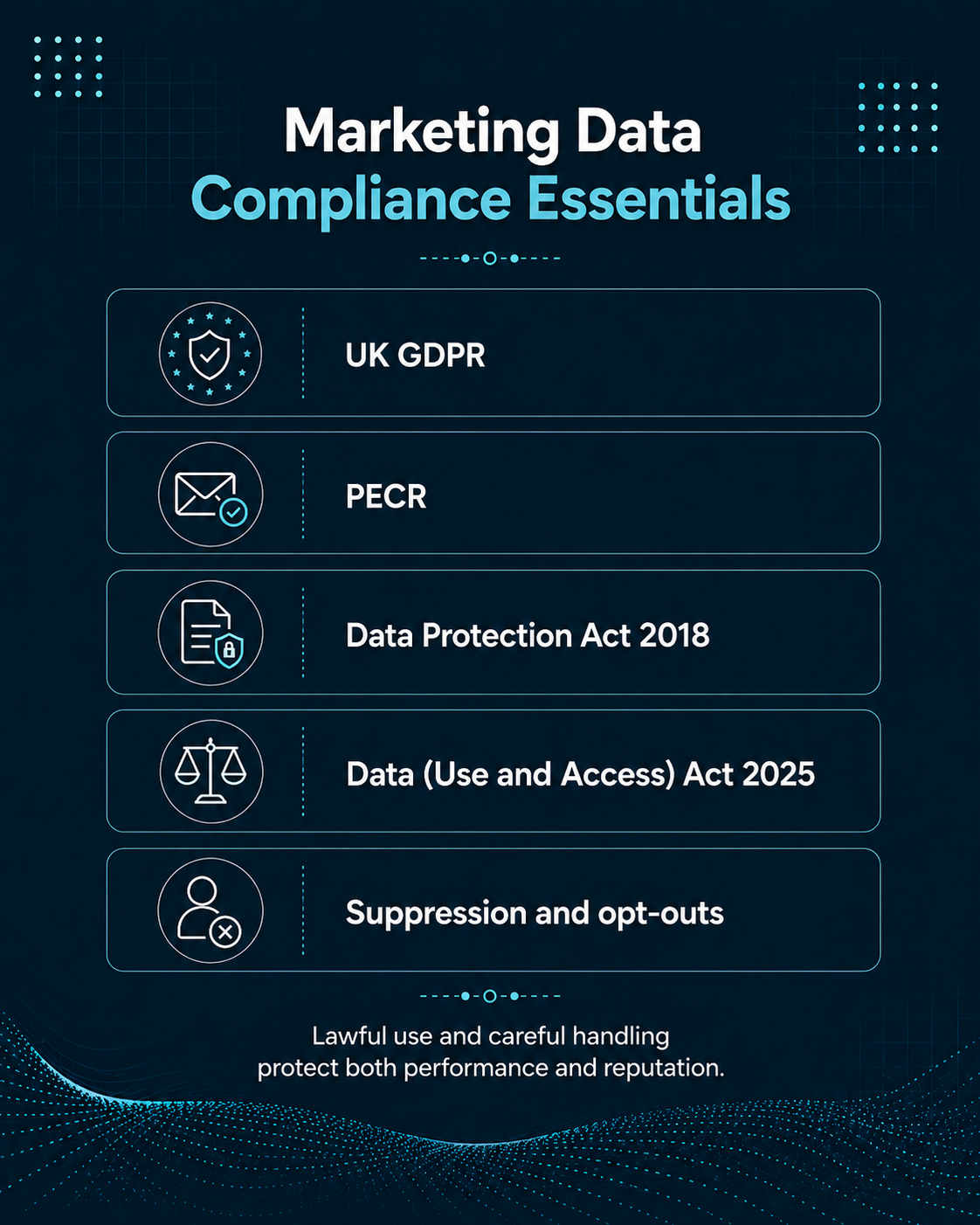
UK GDPR and the Data Protection Act 2018
UK GDPR applies when personal data is processed. In marketing data, that can include names, named business emails, direct telephone numbers, home addresses and other information relating to identifiable people.
The buyer needs a lawful basis, fairness, transparency, data minimisation, accuracy, security and appropriate retention. Direct marketing can sometimes be pursued under legitimate interests, but this is not automatic. The purpose, necessity and impact on individuals need to be assessed.
The Data Protection Act 2018 sits alongside UK GDPR and contains the wider UK data-protection framework and enforcement provisions.
The right to object to direct marketing is particularly important. If a person objects, the organisation must stop processing their personal data for that marketing purpose. A suppression record may need to be retained so the individual is not accidentally re-added from a future purchase.
PECR changes the rules by channel
PECR covers electronic marketing channels including live and automated calls, electronic mail and faxes. It does not treat every subscriber or channel in the same way.
For live calls, preference registers and previous objections matter. For electronic mail, the rules differ between corporate subscribers and individual subscribers. For postal campaigns, PECR’s marketing rules do not apply in the same way, although UK GDPR still can.
This is why Buying Marketing Data by “audience only” is not enough. The intended channel must be known before the legal test is complete.
The Data (Use and Access) Act 2025
The correct current name is the Data (Use and Access) Act 2025, often shortened to DUAA. It amended the UK’s data-protection and privacy framework rather than replacing UK GDPR, the Data Protection Act 2018 or PECR.
Government guidance on data-protection and privacy changes explains that DUAA updated several areas of the law. The government’s commencement guidance records that the majority of the Part 5 data-protection and privacy provisions came into force on 5 February 2026, with later provisions commencing in stages.
For marketing-data procurement, the practical lesson is that privacy notices, contracts, complaint handling, legitimate-interests analysis and PECR procedures should reflect the current framework. Buyers should not rely on supplier templates that have not been reviewed since the original UK GDPR implementation period.
Avoid sensitive or unfair profiling
Detailed segmentation can improve response, but it can also increase privacy risk. The buyer should be careful with special-category data, inferred vulnerabilities, health information, financial distress indicators or targeting that people would not reasonably expect.
The commercial question should not be “can the supplier provide this field?” but “do we need this field, is it appropriate, and can we explain its use fairly?”
Buying Marketing Data for Multi-Channel Campaigns
Multi-channel data can improve campaign sequencing, but it also creates more governance work. A record may be usable for one channel and restricted for another.
Build a channel-permission matrix
For each record or audience segment, document which channels are intended and what checks support each one. A corporate business contact may be suitable for B2B email but the same telephone number still needs live-call screening. A consumer postal record may be usable for direct mail while the associated email address cannot be used without appropriate electronic-mail permission.
Do not assume that because one supplier supplied all three fields, all three channels have identical legal status.
Use a master suppression layer
Internal objections should be applied across relevant campaign sources. A new purchased file should be matched against the buyer’s own do-not-contact records before activation.
Suppression is not simply deletion. Keeping a limited record for the purpose of preventing future marketing can be necessary. Access to suppression files should be controlled and they should not be reused for unrelated targeting.
Create one campaign identifier
Give each purchased batch and campaign a source or batch ID in the CRM. This makes it possible to trace outcomes back to the supplier, selection criteria and delivery date. Without that link, later performance reporting cannot distinguish whether one data source outperformed another.
Buying Marketing Data on Total Cost, Not Price Per Record
Price per record is easy to compare, which is why it often dominates procurement discussions. It is also incomplete.
The relevant cost is the cost of usable, campaign-ready records and the commercial outcomes they generate.
Calculate cost per usable record
If 20,000 records are purchased but 3,000 are duplicates, 2,000 fail validation and 5,000 fall outside the final target definition, the campaign has 10,000 usable records. The real acquisition cost should be judged against those 10,000, not the original headline count.
Add the cost of cleansing, suppression, caller time, email infrastructure, print and postage, sales follow-up and internal data preparation. A cheaper file can become more expensive once these costs are included.
Value supplier support
A consultative supplier can reduce internal workload. Help with audience definition, sample interpretation, formatting, suppression and corrections has commercial value even if it does not appear in the record price.
AccuraData’s approach is designed around tailored counts and campaign requirements rather than treating every brief as a generic export. That can make it easier for buyers who want to resolve targeting questions before delivery.
Prepare Purchased Data Before Campaign Launch
The supplier’s delivery should not move directly into a dialler, email platform or print file without a controlled import process.
Preserve provenance
Keep source, supplier, delivery date, batch ID, validation date, permitted channels and any relevant licence information. These fields help with later compliance review, supplier management and performance analysis.
Match against the CRM
Deduplicate the incoming file against existing customers, prospects, opportunities and suppression records. Decide whether the match key is email, telephone number, person, company, postal address or a combination.
The objective is not to remove every repeated company. A B2B buying committee may contain several legitimate contacts at the same organisation. Deduplication logic should reflect the campaign.
Clean or append the existing database first
Sometimes the buyer does not need a full new list. If the CRM contains the right companies but missing or outdated contact fields, Data Appending may fill the genuine gaps. If records are duplicated, invalid or inconsistent, cleansing can reduce the acquisition requirement.
A sensible order is often: clean the existing data, suppress current relationships and objections, identify the coverage gap, then buy only what is missing.
Measure Whether the Marketing Data Actually Worked
Campaign performance should feed back into procurement. The buyer should not wait until renewal time and rely on general impressions of whether the supplier was “good”.
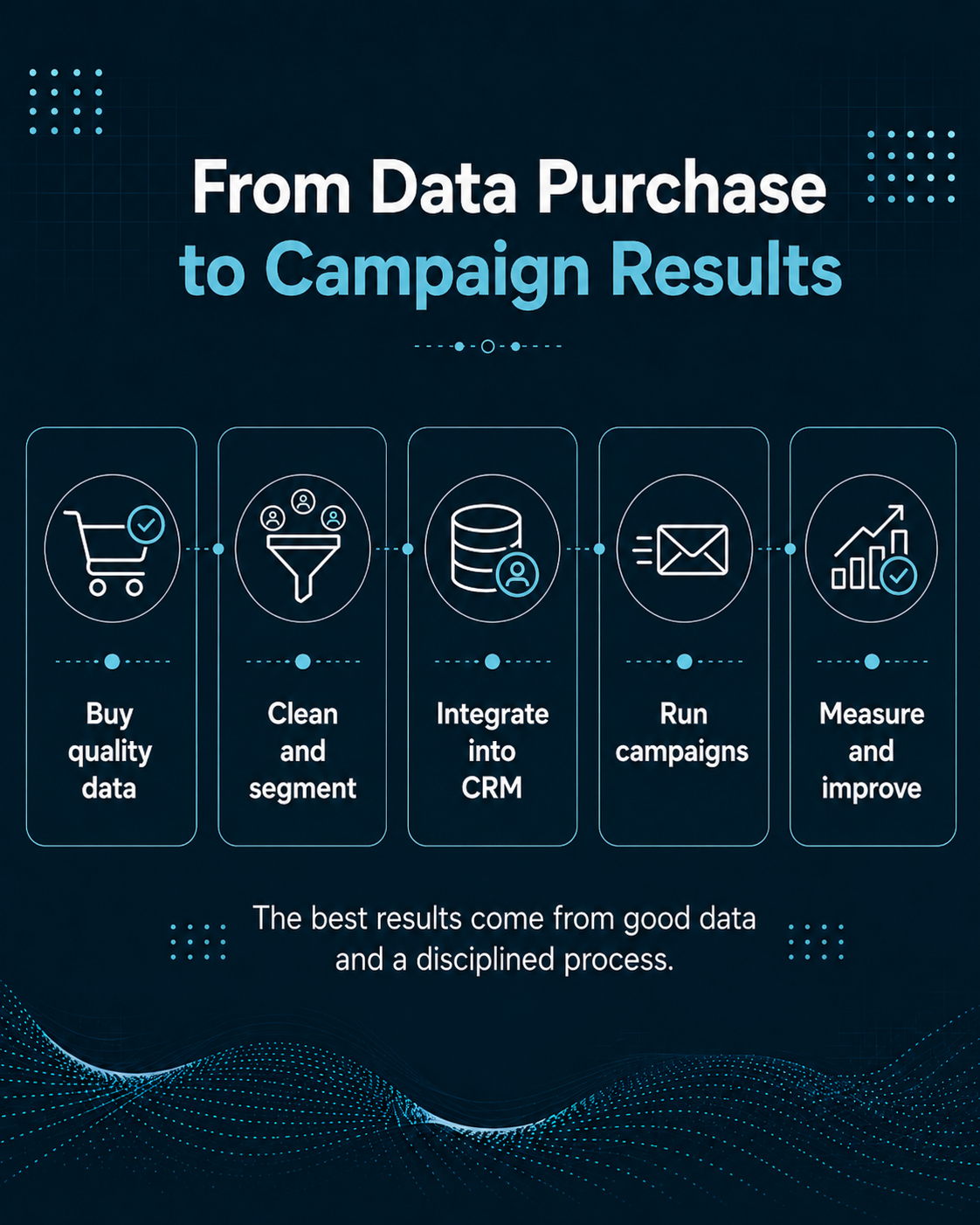
Measuring B2B and B2C Telemarketing Data
Useful telephone metrics include:
- valid-number rate;
- answer rate;
- decision-maker contact rate;
- meaningful conversation rate;
- qualification rate;
- appointment or transfer rate;
- sales acceptance;
- objections and complaints; and
- conversion to pipeline or revenue.
Report these by segment and supplier batch. A poor result in one sector may be a targeting issue rather than a list-wide problem.
Measuring B2B and B2C Email Data
Useful email metrics include hard-bounce rate, delivery rate, unsubscribe rate, complaint signals, clicks, replies, enquiries, meetings, sales acceptance and revenue influence.
Open rates should be interpreted carefully because privacy technologies and automated image loading can reduce their reliability as a pure human-engagement measure. Replies and downstream commercial actions are usually more useful when judging list value.
If the buyer wants managed support as well as data, AccuraData’s Email Marketing Services can connect data preparation with campaign delivery and reporting.
Measuring B2B and B2C Postal Data
Postal measurement can include returned mail, QR scans, dedicated telephone numbers, voucher codes, personalised URLs, enquiries, store visits and matchback sales.
Direct mail often influences online behaviour, so the measurement plan should not assume that every response arrives through a paper form. Use campaign codes and controlled landing pages where possible.
Feed outcomes back into the database
Invalid numbers, bounced emails, goneaways, role changes, objections, successful contacts and new decision-makers should update the CRM. The campaign is also a data-quality exercise.
If outcomes are not written back, the business pays to rediscover the same problems in the next campaign.
Build a Marketing Data Supplier Scorecard
A supplier scorecard helps procurement move beyond anecdotes. Score each provider across a small number of evidence-based categories.
Audience fit
Did the delivered records match the sectors, regions, roles and exclusions in the brief? Did the supplier explain areas of weak coverage before purchase?
Data quality
How many records were usable? What were the duplicate, invalid, bounce, return or disconnected-number rates? How quickly were errors corrected?
Compliance evidence
Could the supplier explain source categories, privacy information, lawful use, subscriber classification, consent where needed, suppression and channel-specific checks?
Delivery and security
Was the file transferred securely and in an agreed format? Were field definitions clear? Could the buyer trace the batch after import?
Service and remedies
Did the supplier answer questions clearly, challenge an unrealistic brief, investigate rejects and provide replacements where agreed?
Commercial performance
Which supplier or segment produced accepted leads, meetings, orders, pipeline or revenue? This is the ultimate test, but it should be interpreted alongside message, offer, timing and sales execution.
Common Red Flags When Buying Marketing Data
Some warning signs apply across every channel.
Immediate huge counts without a brief. A supplier cannot know whether a record fits until the audience and exclusions are understood.
“GDPR compliant” as the whole explanation. Compliance depends on the source, purpose, channel, subscriber type and buyer’s own processing.
No representative sample. A refusal to support controlled testing makes it harder to assess quality before committing budget.
No source explanation. “Proprietary data” is not a sufficient source map by itself.
One quality percentage for every field. Email validity, live-number rate, address quality and role relevance are different measurements.
No suppression workflow. The provider should be able to explain how preference and objection data is handled.
No replacement or correction process. Records change. A credible provider should have a route for disputes and fixes.
Unsafe delivery. Personal data should not be distributed casually through shared inboxes or uncontrolled downloads.
Pressure to buy volume. The supplier should help the buyer find the smallest audience that can answer the campaign question, not simply maximise rows.
How AccuraData Fits the Marketing Data Market
AccuraData is a strong option for organisations that want a single UK-focused provider across several marketing channels. The practical advantage is not only breadth. It is the ability to discuss the same audience across business and consumer data, email, telephone, post, cleansing and appending.
B2B data across three channels
AccuraData’s wider B2B Data service can support company and decision-maker targeting. Buyers can then use dedicated B2B Email Data, B2B Telemarketing Data or B2B Postal Data according to the campaign.
This matters because the best channel can change with the objective. A complex proposition may benefit from calling. An event campaign may use email first. A high-value account programme may use direct mail followed by telephone outreach.
B2C data across three channels
AccuraData’s B2C Data supports consumer audience planning, with B2C Telemarketing Data and B2C Postal Data available for channel-specific campaigns. B2C email activity should be scoped around the required permission evidence and campaign use.
The benefit of separating the products is that consumer telephone, email and postal data do not get treated as interchangeable simply because they relate to the same person or household.
Cleansing and appending reduce unnecessary purchases
AccuraData can also help improve records the buyer already owns. Data Cleansing and Enrichment can support validation, duplicate removal, standardisation and channel preparation. Data Appending can fill missing fields where appropriate.
This makes AccuraData easier to work with when the real requirement is not “buy a new database” but “create a campaign-ready audience”. Sometimes that requires new data. Sometimes it requires cleaning the CRM. Often it requires both.
A consultative buying process
A reliable provider should welcome a detailed brief. It should be willing to discuss targeting limitations, channel differences, realistic counts and what happens when records fail. AccuraData’s service range allows those conversations to happen before a buyer commits to a single channel or oversized file.
Reliability should still be verified through the same due diligence and sample testing described in this article. The advantage is that the relevant services are visible and can be combined around the actual campaign requirement.
Questions to Ask Before Buying Marketing Data
Use the following questions as a practical procurement checklist:
- What exact audience does this file represent?
- Which fields are supplied and which are required for the campaign?
- Where did the records come from, by source category?
- When were the main contact fields last checked?
- What privacy information was provided to individuals?
- What lawful basis supports the relevant personal-data processing?
- What PECR rules apply to the intended channel and subscriber type?
- For consumer email, what consent evidence supports the proposed sender and purpose?
- For telephone data, when were TPS and CTPS checks performed?
- Are live-number checks separate from preference screening?
- How are postal addresses validated and standardised?
- Can the supplier apply the buyer’s internal suppression file before delivery?
- What duplicates will be removed and how is a duplicate defined?
- What sample and acceptance criteria can be agreed before purchase?
- What replacement or correction policy applies?
- How will the file be transferred securely?
- What licence or usage restrictions apply?
- Can the supplier support future cleansing, appending or refreshes?
- How will campaign outcomes be tied back to the supplied batch?
A supplier that answers these questions clearly is more useful than one that relies on a large database-size claim.
Frequently Asked Questions About Buying Marketing Data
What does Buying Marketing Data mean?
Buying Marketing Data means obtaining access to a structured set of business or consumer records for a defined marketing purpose. The purchase can include telephone, email, postal and segmentation fields, but the exact product should be matched to the audience, channel and campaign objective.
Is Buying Marketing Data legal in the UK?
It can be lawful, but the legality depends on the source, data, purpose and final communication. UK GDPR and the Data Protection Act 2018 apply to personal data. PECR adds channel-specific rules for calls and electronic mail. The buyer remains responsible for its own processing and should complete due diligence rather than relying solely on supplier assurances.
Is B2B marketing data treated differently from B2C data?
Yes. B2B data often starts with companies and professional roles, while B2C data relates to consumers or households. PECR also distinguishes corporate and individual subscribers in some contexts. However, named B2B contacts can still be personal data, so UK GDPR can apply to business campaigns.
What is the difference between B2B Telemarketing Data and B2B Email Data?
B2B Telemarketing Data is prepared for live calling and needs working telephone numbers, preference screening and calling context. B2B Email Data is prepared for electronic outreach and requires valid email addresses, subscriber analysis, sender identification and opt-out controls. The same company can appear in both products, but the channel-specific checks are different.
Can I buy B2C email data and send a campaign immediately?
You should not assume so. Consumer electronic mail normally requires consent unless the sender can rely on the limited soft opt-in from its own existing customer relationship. If a third party supplies B2C email data, the buyer should examine the actual consent evidence and ensure it covers the proposed sender, purpose and channel.
Do B2B telephone lists only need CTPS screening?
No. A B2B audience can contain individual subscribers such as sole traders and some partnerships, which may appear on the TPS. The ICO recommends screening B2B live-call lists against both CTPS and TPS, as well as internal do-not-call records.
Does postal marketing need PECR consent?
PECR’s direct-marketing rules do not cover post in the same way as electronic mail and phone calls. UK GDPR and the Data Protection Act can still apply where personal information is used. Objections, suppression, fairness and data accuracy remain important.
How large should a sample be?
There is no universal sample size for every market. It should be large and representative enough to expose the main sectors, roles, locations and data fields in the final brief. The acceptance method matters as much as the exact number of rows.
What should I measure after Buying Marketing Data?
Measure channel validity, audience fit and commercial outcomes. Telephone campaigns should track contact and qualification. Email campaigns should track bounces, complaints, replies and conversions. Postal campaigns should track returns and response. All channels should be tied back to opportunities, sales or other agreed business outcomes where possible.
Should I cleanse my CRM before buying new data?
Usually, yes. Cleansing can reveal duplicates, obsolete contacts and missing fields. Once existing records and suppressions are understood, the business can buy only the genuine audience gap rather than paying for data it already holds or cannot use.
What makes a marketing data provider easy to work with?
Clear counts, transparent assumptions, secure delivery, practical documentation, realistic advice, responsive correction handling and support after purchase matter. A good supplier should explain limits and help refine the brief instead of promising every record the buyer requests.
Buying Marketing Data: Final Considerations
Buying Marketing Data works best when procurement starts with the campaign and ends with measurement. Define the target audience and channel. Specify the fields. Separate B2B and B2C requirements. Request evidence for the actual product being supplied. Test a representative sample. Agree acceptance criteria and usage terms. Apply internal suppression. Then measure the campaign in a way that ties the database back to commercial outcomes.
The six main categories should not be treated as variations of one spreadsheet. B2B Telemarketing Data, B2B Email Data, B2B Postal Data, B2C Telemarketing Data, B2C Email Data and B2C Postal Data each have different quality checks, different economics and different compliance questions.
UK GDPR, the Data Protection Act 2018, PECR and the Data (Use and Access) Act 2025 create the current legal framework, but compliance still depends on what the buyer actually does with the records. Supplier evidence is the starting point, not a transfer of responsibility.
AccuraData is well positioned for organisations that want a straightforward route through this process. Its B2B and B2C data services cover telephone, email and post, while cleansing, appending, TPS and CTPS checking and live-number validation can help prepare both purchased and existing records. That makes it possible to build the campaign around the right audience rather than buying a generic list and trying to make it fit later.
The strongest question to ask any supplier is simple: can you explain who these records represent, where the information came from, which channels it is prepared for, how it was checked, what evidence supports its use and what happens when the data changes? If the answer is clear, documented and supported by a representative sample, the buyer has a much stronger basis for making a responsible and commercially useful purchase.