
Buy Email List Database searches usually begin with a practical commercial need. A business wants to enter a new market, reach more decision-makers, promote an event, reactivate a customer segment or create pipeline faster than its existing contacts allow. The purchase can solve that problem, but only when the data, permission model, targeting, campaign infrastructure and message fit together. Buying a file without answering those questions can create poor deliverability, irrelevant outreach and compliance risk. Buying a well-defined, well-documented audience can give a campaign a useful starting point and help a sales or marketing team test a market without spending months building every record manually.
This article is a purchasing framework for UK organisations. It explains when email data is the right channel, how lists can be procured, the differences between B2B and B2C email marketing, the supplier checks that should happen before money changes hands, and the practical work required after delivery. It also explains how email compares with telephone and postal data, and how AccuraData can support data supply, email campaign management, data cleansing and data appending.
A compliance note is important at the outset. This article provides practical marketing information, not legal advice. UK direct marketing rules depend on the recipient type, the channel, the source of the information, the wording of any permission, the relationship with the recipient and the exact campaign. The ICO direct marketing hub should be the starting point for current regulatory guidance, and organisations should obtain specialist advice where the position is uncertain or high risk.
Buy Email List Database: Decide Whether Email Is the Right Channel
The first purchasing question is not how many addresses are available. It is whether email is the best way to achieve the campaign objective. Email is strongest when the recipient can understand the offer without an immediate conversation, the next step can happen online, and the message benefits from being seen, saved or forwarded. It can support event invitations, downloadable resources, product launches, account-based outreach, renewal reminders, nurture sequences, local promotions and reactivation campaigns.
Email also suits campaigns that need controlled testing. A business can compare subject lines, propositions, landing pages and audience segments without changing the whole campaign. The value comes from the combination of a defined audience and a measurable action, not from sending the largest possible volume. AccuraData’s Email Marketing Services page describes a process that joins audience selection, creative preparation, broadcast delivery and follow-up reporting rather than treating the list as a standalone asset.
A Buy Email List Database project is less suitable when the offer is too complex to explain without dialogue, the target universe is extremely small, or the decision depends on immediate qualification. In those cases, a carefully planned calling campaign may be more efficient. The AccuraData article on a Business Telephone List explains why telephone data is useful when the campaign needs live questions, appointment setting or direct access to a decision-maker.
Postal data may be better when physical presence matters. Brochures, catalogues, local offers and high-value packs can remain visible after an email has disappeared from an inbox. AccuraData’s guide to Direct Mailing Lists covers the role of addressed mail in B2B and B2C campaigns. Email is not automatically superior. It is a different delivery mechanism with different costs, attention patterns, legal rules and response routes.
Situations where purchased email data can be commercially useful
Purchased data can be appropriate when a company is entering a sector where it has little first-party coverage. It can also help when the business has a clear ideal customer profile but its CRM contains only existing customers, old enquiries and a small number of newsletter subscribers. A third use is time-sensitive market testing. If a team needs evidence that a proposition resonates with finance directors, operations managers or consumers in a defined region, a focused test audience can provide insight faster than waiting for organic growth.
The decision should still be based on expected value. A list of 20,000 loosely relevant records may be less useful than 1,500 records that match the offer, location, organisation size and role. The best purchasing brief describes who should be included, who should be excluded, which fields are necessary, the intended message, the response action, the lawful basis, and the result that will justify further investment.
Situations where you should not buy an email database
Do not proceed when the supplier will not explain the data source, permission model, refresh process or expected accuracy. Do not proceed when the audience definition is so broad that almost any record qualifies. Do not proceed when the organisation has no unsubscribe process, no suppression file, no authenticated sending domain or no plan for complaints and inaccuracies. The ICO guidance on using marketing lists says organisations should check the origin and accuracy of bought-in lists and apply the appropriate channel rules.
Buying should also pause when the message depends on information that the recipient would not reasonably expect to be used for marketing. Sensitive inferences, unclear profiling and data gathered from contexts unrelated to the proposed offer deserve particular caution. The ICO guidance on collecting information stresses fairness, transparency and explaining how information will be used.
What You Buy When You Buy an Email Database
A professional email database is more than a column of addresses. It is a structured audience file that links contact information to context. In B2B data, that context might include company name, website, sector, SIC code, location, employee band, turnover band, contact name, job title, department and seniority. AccuraData’s B2B Email Data service describes the firmographic and role-based filters used to build targeted business audiences.
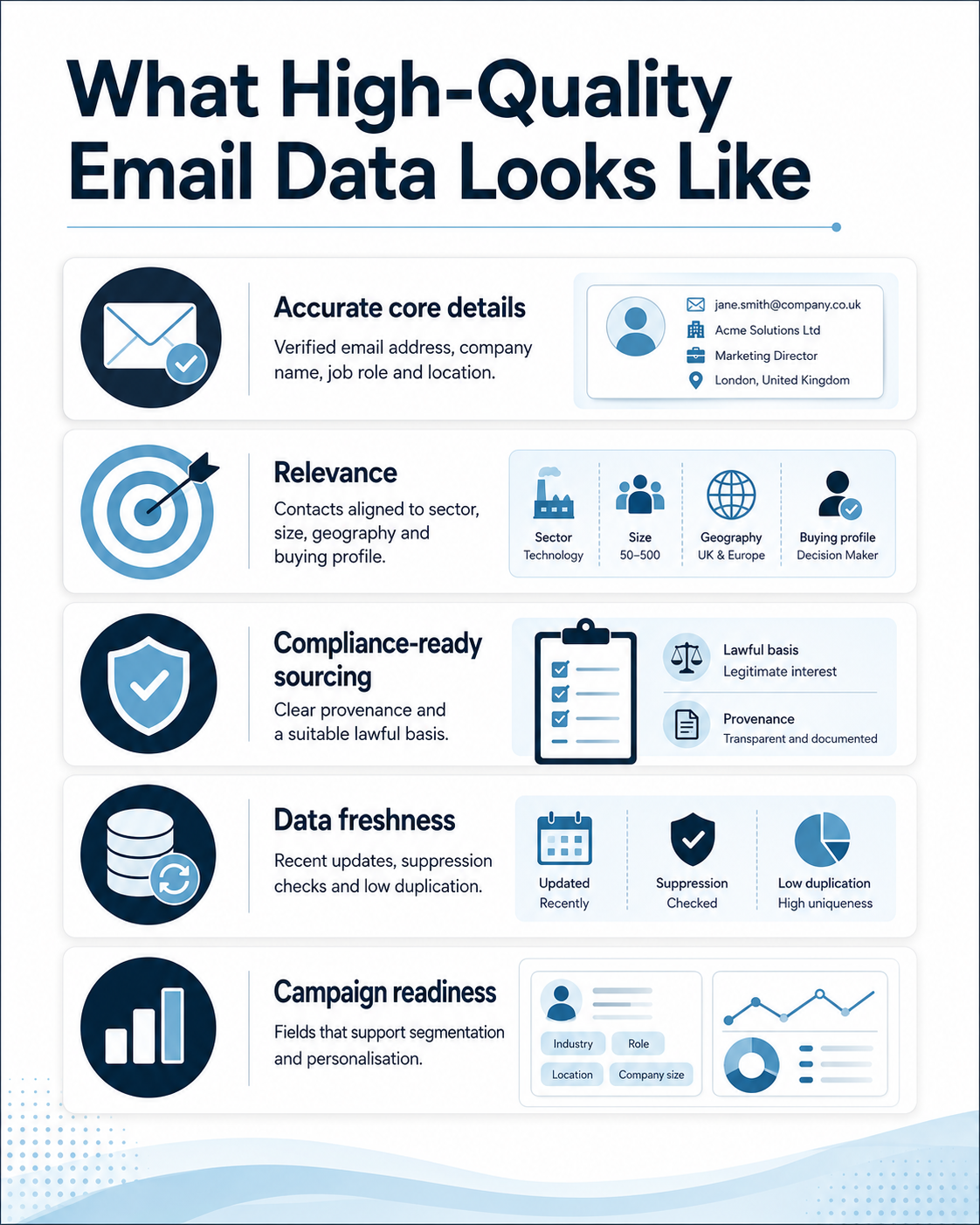
Consumer email data is different. Depending on the source and permissions, it may include a consumer name, email address, location, age band, household indicator, interest category or other campaign-relevant field. AccuraData’s B2C Email Data page explains that availability depends on the source, selected audience and campaign brief, and that consumer email marketing needs close attention to permissions, suppression and opt-out handling.
The buyer should establish whether the transaction is a sale, a licence, a one-off use, a campaign rental or a managed send. These models create different operational responsibilities. A licensed file may restrict reuse or onward disclosure. A managed send may mean the buyer never receives the underlying personal data. A one-off list may need deletion after the agreed campaign. The commercial agreement should state permitted purpose, term, security expectations, complaint handling, update arrangements and what happens when a record is found to be inaccurate.
The minimum fields are not always the right fields
A simple email and name combination may be enough for a customer notification, but it is weak for acquisition. B2B prospecting usually needs at least company context and role context. Without those fields, the team cannot explain why the recipient was selected, tailor the message or analyse which segments produced value. Consumer campaigns may need geography or interest indicators, but additional detail should only be purchased when it has a clear use. Data minimisation is not simply a compliance principle. It reduces cost, complexity and the temptation to use irrelevant information.
A Buy Email List Database brief should therefore separate required fields from optional fields. Required fields support selection, delivery, compliance or reporting. Optional fields may improve personalisation or analysis but are not necessary for the first test. This distinction helps the supplier produce a realistic count and helps the buyer avoid paying for attributes that will never be used.
Accuracy, deliverability and relevance are separate qualities
An address can be technically deliverable but commercially irrelevant. A contact can match the target role but have left the company. A company can fit the sector but fall outside the service area. Quality assessment needs all three dimensions: whether the mailbox appears active, whether the record is current, and whether the person or organisation fits the campaign.
AccuraData’s article on Buying Email Data makes the same distinction between list volume and campaign readiness. The purchaser should request a clear definition of validation, the date or period of the last check, and an explanation of how company status, employment changes, duplicates and invalid mailboxes are handled.
Email Data Sources and Procurement Models
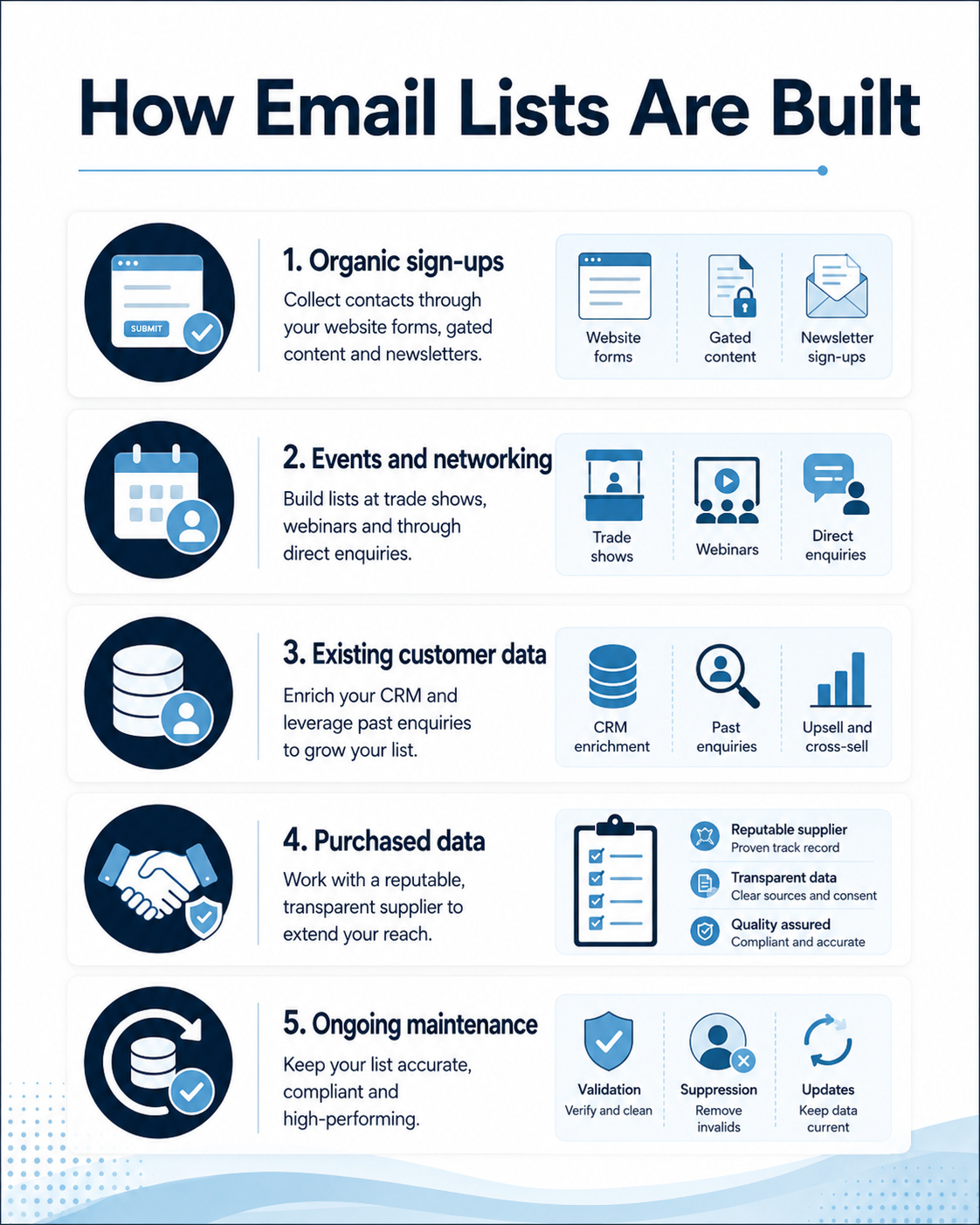
Email data can be built organically, researched from public information, enriched from an existing CRM, obtained through partnerships or purchased from a specialist provider. Most mature databases use more than one route. The important issue is not whether a source is public, paid or first-party. It is whether the intended use is fair, transparent, lawful and relevant.
Organic list building
Organic data comes from direct relationships. Website forms, quote requests, purchases, event registrations, downloads, newsletter subscriptions and customer service interactions can all create useful first-party records. The organisation controls the wording at collection and can design the fields around its own customer journey. The ICO lead generation guidance requires clear privacy information and a transparent explanation of marketing use.
Organic growth is valuable but often uneven. It tends to overrepresent people who already know the brand and may not reach the sectors, regions or job roles the sales plan requires. A company can spend heavily on content and events yet still lack enough contacts in a new market. Purchased data can supplement first-party coverage, but it should not replace the continuing work of building direct relationships and recording customer preferences.
Public and business information sources
Public company information can help identify organisations, company status, registered office details, officers and nature of business. The Companies House register makes a wide range of company information available free of charge and through an API. It is useful for company research and validation, but it is not a ready-made email marketing database. Public availability does not remove the need for a lawful basis, fair processing, accuracy checks or PECR analysis.
A team can also research company websites, professional directories, association lists and published contact pages. This approach gives control but requires substantial time and may produce inconsistent fields. The team must still record the source and explain how the information will be used. Manual research is most suitable for narrow account lists where each organisation is commercially significant.
Data appending and enrichment
A business may already know the target companies but lack current contacts or email fields. In that situation, Data Appending can be more proportionate than buying an entirely new database. Appending can add missing contact details, company information, sector fields or location data to an existing CRM. It can also help separate live opportunities from dormant or incomplete records.
This route is especially useful when the organisation has strong customer or account knowledge but poor database completeness. The buyer should still define the permitted matching process, the source of appended information, quality thresholds and how existing objections will be preserved. Appending must not overwrite a suppression status or revive contacts that have objected to direct marketing.
Buying from a specialist supplier
A specialist data provider can offer scale, consistent fields and audience filters that would be expensive to build internally. The value is not simply access to more names. It is access to an audience selection process, documented sourcing, validation, suppression support and practical advice about what the available data can and cannot do.
The phrase Buy Email List Database should never be treated as a request for a commodity price alone. A reputable supplier should ask about the target audience, offer, geography, channel, timing and exclusions before quoting. If a provider immediately offers millions of records without asking what success looks like, the conversation is about volume rather than fit.
Managed campaigns and list rental
Some organisations prefer a provider to manage the send instead of receiving the raw file. This can reduce handling risk and may suit consumer campaigns where permissions are tightly connected to the original data controller or campaign model. A managed service can also combine design, copy, broadcast setup and reporting. AccuraData offers email campaign management for businesses that want support beyond data delivery.
The contract must still explain who is the sender, who is the instigator, who handles opt-outs and complaints, what reporting will be shared, and whether any engaged contacts can be transferred to the buyer. The ICO electronic mail compliance guidance explains that a business may remain responsible when it asks another organisation to send marketing on its behalf.
B2B and B2C Email List Purchasing Are Not the Same
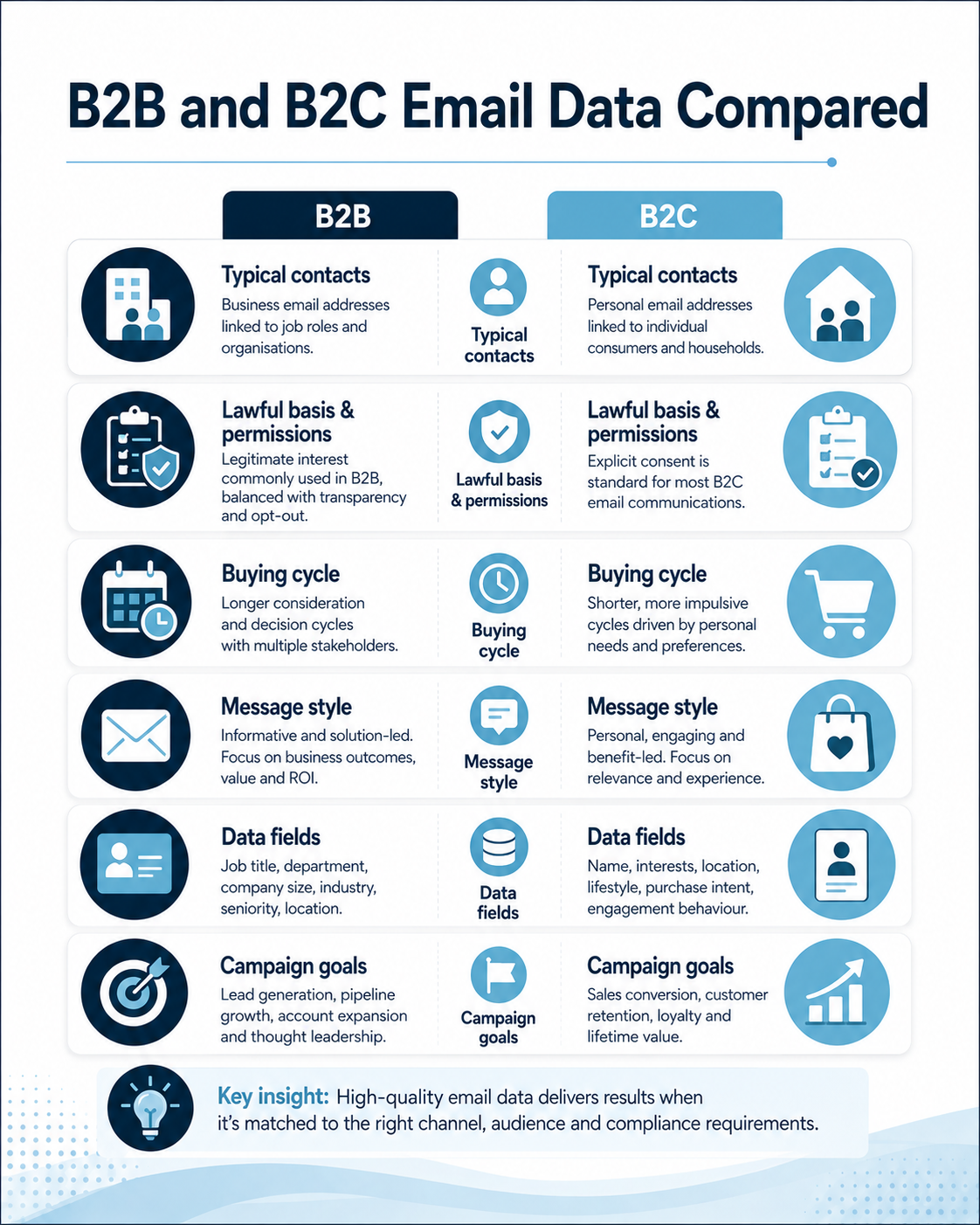
B2B and B2C email data should not be placed in one legal or commercial category. The audience, subscriber type and expected relationship change the rules. A campaign to limited companies is different from a campaign to consumers, sole traders or some partnerships. The buyer must identify who controls the mailbox and whether the address relates to an identifiable individual.
B2B email lists and corporate subscribers
The ICO B2B marketing guidance explains that PECR’s electronic mail marketing rule does not apply to corporate subscribers in the same way it applies to individual subscribers. This can permit unsolicited B2B marketing emails to corporate bodies without PECR consent, but the sender must not conceal its identity and must provide a valid opt-out address.
UK GDPR can still apply when the business address identifies a person, such as firstname.surname@company.co.uk. The organisation needs a lawful basis, fair processing, data minimisation and an effective way to respect objections. Direct marketing may be a legitimate interest in some circumstances, but it is not automatic. The ICO legitimate interests guidance requires purpose, necessity and balancing tests.
Sole traders and some partnerships may be individual subscribers for PECR purposes. They require different treatment from limited companies and public bodies. A supplier should be able to explain how subscriber type is identified and separated. If it cannot, a mixed list may create avoidable risk.
B2C email lists and individual subscribers
Consumer email marketing is more restrictive. The ICO electronic mail guidance states that marketing emails to individuals generally require specific consent unless the soft opt-in conditions are met. The soft opt-in is linked to an existing customer relationship and similar products or services. It is not a general permission to buy a third-party consumer list.
When consumer data is obtained from another organisation, the permission must be specific enough to cover the receiving business and the email channel. The ICO guidance on bought-in lists warns that email, text and recorded-call lists require very specific consent. The supplier should provide evidence of the consent language, collection context, date, named or described recipients and withdrawal process.
A Buy Email List Database purchase for B2C marketing therefore needs a more detailed permission review than a typical limited-company B2B campaign. The buyer should not accept vague statements such as “GDPR compliant” without seeing how the permission applies to the planned sender, purpose and message.
Shared responsibilities in both markets
Both B2B and B2C campaigns need transparency, secure handling, accurate records and prompt suppression. The individual has an absolute right to object to direct marketing. The ICO guidance on legitimate interests confirms that processing for direct marketing must stop when a person objects.
The difference is not that B2B is unregulated and B2C is regulated. The difference is how PECR applies, what lawful basis is suitable, what the recipient is likely to expect, and what evidence the buyer needs. A professional supplier should help the buyer understand that distinction rather than offering one compliance statement for every dataset.
UK GDPR, PECR and the Current Legal Framework
The UK GDPR, Data Protection Act 2018 and PECR form the main framework for email marketing. The Data (Use and Access) Act 2025 amended parts of UK data protection and privacy law but did not replace those core regimes. The GOV.UK summary of the 2025 Act explains that changes are being brought into force in stages, so campaign owners should follow current ICO guidance and commencement information.
Lawful basis and PECR are separate questions
A common error is to identify a UK GDPR lawful basis and assume that the email can therefore be sent. PECR is a separate layer. If PECR requires consent, legitimate interests under UK GDPR does not remove that requirement. The ICO marketing and data protection guidance explains how the two regimes interact.
For a corporate B2B campaign, legitimate interests may be appropriate if the purpose is genuine, the processing is necessary and the impact is balanced. For B2C email, consent will usually be central unless the business itself can use the soft opt-in. The analysis should be documented before the campaign, not created after a complaint.
Transparency and privacy information
If information was not collected directly from the person, the buyer may have obligations to provide privacy information within the relevant UK GDPR timeframe. The communication should make the sender clear and give a practical route to the privacy notice and opt-out. Transparency is also a commercial issue. Recipients are more likely to distrust a message when they cannot understand who is contacting them or why.
The CAP Code on data use also contains requirements for direct marketing communications, including sender identification and opt-out information. The advertising content itself should be clear, accurate and recognisable as marketing.
Suppression and the right to object
A suppression file is a record of people or organisations that should not receive future marketing. It should be applied before every campaign and preserved when new data is purchased. Deleting an objector completely can allow the same address to be reintroduced in a later file. The CAP suppression guidance explains why limited information should be retained for suppression purposes.
Buyers should agree how supplier suppressions, internal suppressions and campaign opt-outs will be combined. They should also decide who sends the confirmation, how quickly the record is blocked, and whether the objection applies to one brand, one channel or the whole organisation.
Record keeping and accountability
The buyer should retain the targeting brief, lawful basis assessment, permission evidence, supplier questionnaire, contract, sample results, validation notes, privacy wording, suppression process and campaign report. The ICO planning guidance recommends building data protection and PECR compliance into the activity before it begins.
A Buy Email List Database project should have a named owner. That person does not need to perform every technical task, but they should know who approved the data, which version was used, how exclusions were applied, and where the evidence is stored.
Supplier Due Diligence Before You Buy
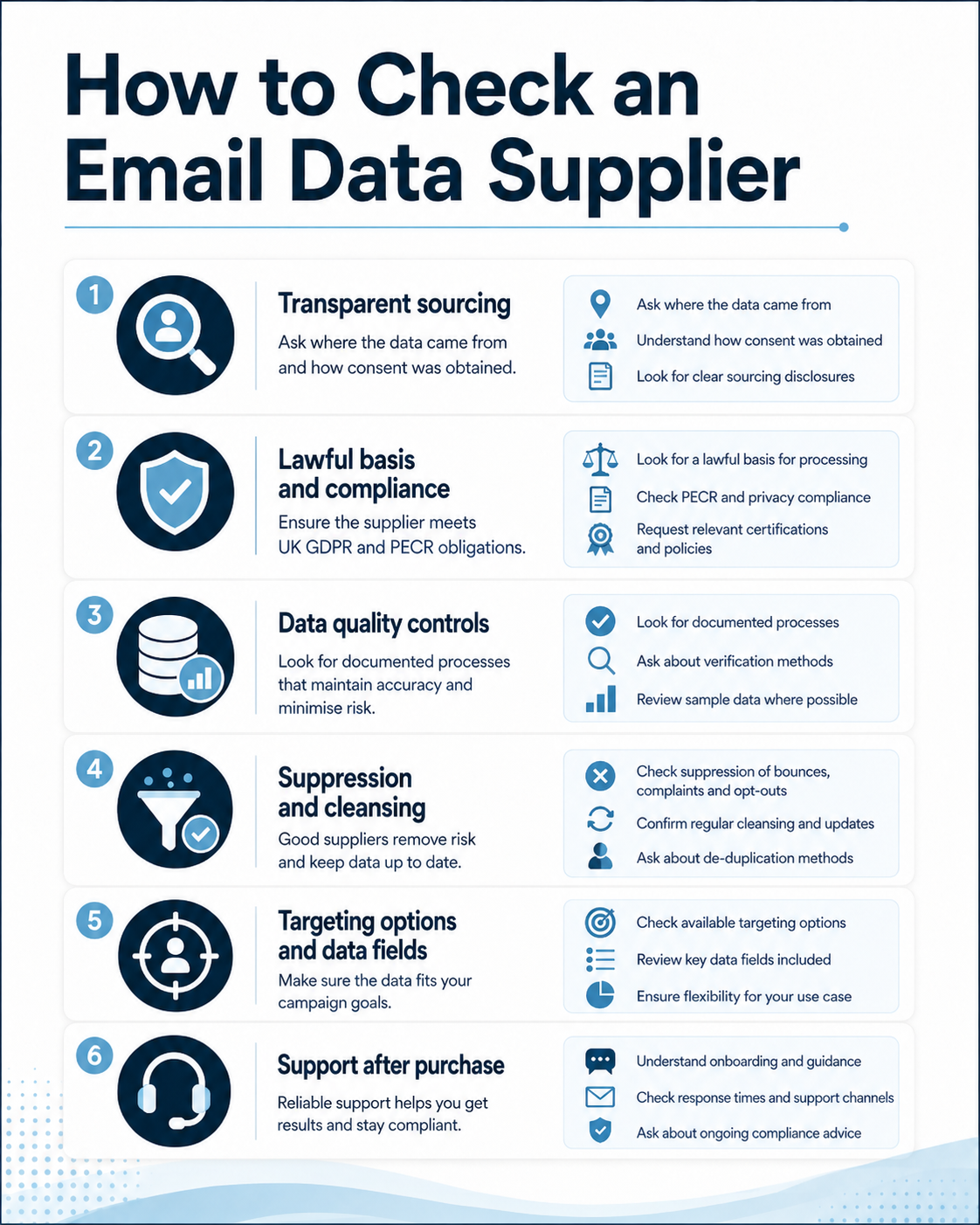
Supplier due diligence is the most important purchasing stage because it determines what can be known about the file before it enters the buyer’s systems. A polished website and a large count are not evidence of quality. The buyer needs specific answers, sample evidence and contractual commitments.
The DMA third-party due diligence questionnaire is designed for controllers seeking personal data from third parties for marketing. It can be used as a starting point, then adapted to the audience and channel.
Questions about source and collection
Ask where the data came from, whether it was collected directly or obtained from other parties, and whether public information is used. Ask how the supplier records provenance at record or dataset level. For consumer email data, ask to see the consent wording and how the buyer is named or described. For B2B data, ask how corporate subscribers, sole traders and partnerships are classified.
A weak answer is “from trusted sources”. A useful answer explains categories of source, collection dates, validation steps, privacy information, lawful basis, third-party sharing and the controls applied before delivery.
Questions about accuracy and validation
Ask what “verified” means. Does it mean syntax checking, domain checking, mailbox-level validation, manual research, recent engagement, or a combination? Ask when the check occurred and whether the supplier offers a replacement or credit policy for invalid records. Ask how role accounts, catch-all domains, duplicates and recently dissolved companies are handled.
The buyer should request a small representative sample or controlled test. The ICO direct marketing checklist recommends assurances about origin and accuracy, while the older checklist also suggests sampling bought-in lists.
Questions about segmentation and exclusions
A supplier should be able to explain the source and expected accuracy of every filter. Company size, turnover, sector, job title, region, age band, household profile and interests are not equally stable. Ask whether the field is observed, declared, appended or modelled. Ask whether it is current enough for the campaign.
Exclusions are as important as inclusions. A buyer may need to remove customers, competitors, suppliers, franchisees, certain sectors, high-risk groups, previous objectors or areas outside service coverage. A reliable provider should accept a suppression file securely and confirm that it was applied.
Questions about governance and security
Ask who acts as controller, processor or joint controller at each stage. Ask about secure transfer, retention, access controls, breach procedures and deletion. Request the supplier’s privacy notice, data usage terms and relevant contractual documents. AccuraData publishes Data Usage Terms and separate business and consumer privacy information.
Do not rely on a generic “GDPR compliant” badge. Compliance depends on the source, audience, purpose, buyer, message and operating process. A supplier can support responsible use, but the buyer remains accountable for its own campaign decisions.
A practical supplier scorecard
Score suppliers across five areas: audience fit, provenance, permission or lawful basis evidence, data quality, and operational support. Weight audience fit and compliance more heavily than price per record. The cheapest file can become the most expensive after bounce handling, complaints, wasted sales follow-up and damage to sender reputation.
A Buy Email List Database purchase should only proceed when the supplier can explain limitations. No database is perfectly current. Businesses change, people move roles and mailboxes close. Honest quality ranges and clear remediation processes are more credible than promises of 100 per cent accuracy.
Segmentation and Filtering for Perfect Customer Fit
Segmentation is the point at which purchased data becomes a campaign audience. The purpose is not to create as many segments as possible. It is to separate groups that need different messages, offers, timings or follow-up.
B2B segmentation
B2B filters commonly include industry, SIC code, location, employee size, turnover, company status, site type, job function, seniority and department. AccuraData’s wider B2B Data service supports multi-channel targeting, while its B2B email data is designed for role and firmographic selection.
The strongest brief combines company and person criteria. “UK manufacturers” is broad. “Operations directors at UK manufacturers with 50 to 500 employees in the Midlands” is more useful. The message can then address operational concerns and the sales team can judge whether the segment has enough potential value.
Avoid over-filtering before testing. Every added condition reduces volume and may rely on a less stable field. Start with the factors that genuinely change purchase likelihood or message relevance. Use the first campaign to learn which additional variables improve results.
B2C segmentation
B2C segmentation may use geography, age band, household indicators, property information, lifestyle categories, interests or existing-customer characteristics, depending on permission and availability. AccuraData’s B2C Data and B2C email pages describe demographic, geographic and lifestyle targeting options.
Consumer profiling needs particular care. Avoid special category data and sensitive inferences unless there is a clear, lawful and well-governed reason. Ask how each indicator was generated and whether the consumer would reasonably expect it to shape marketing. The fact that a field is commercially available does not mean it is appropriate for every campaign.
Exclusion-first targeting
Before selecting the ideal audience, define who should not receive the campaign. Remove existing customers if the offer is acquisition-only. Remove people in unresolved complaint processes. Remove addresses that have opted out. Remove regions the business cannot serve. Remove accounts that the sales team owns under a separate strategy.
This approach improves relevance and reduces the risk of embarrassing messages. It also helps the supplier calculate a net usable count rather than a headline gross count.
Build a test matrix, not one giant send
Divide the audience into meaningful cells. For example, compare two sectors, two job roles and two propositions. Keep each cell large enough to learn from, but small enough that poor performance does not damage the whole programme. Record the exact data version and message used for each cell.
The first objective is not maximum revenue. It is to learn whether the audience, message and channel fit. A well-designed test can reveal that one sector responds, another clicks but does not convert, and a third should be approached by telephone instead.
Data Quality and Deliverability After Purchase
Data quality does not end when the supplier sends the file. The buyer must prepare the data for its own platform, suppression process and campaign infrastructure. A technically valid address can still produce a complaint if the recipient is irrelevant or surprised. Deliverability is the combined result of data, sending behaviour, authentication, content and recipient response.
Clean the file before import
Standardise field names, remove duplicates, check exclusions and preserve source information. Do not upload optional fields that the campaign does not need. Ensure the suppression file is applied before the marketing platform sees the data. If the business already has a CRM, AccuraData’s Data Cleansing and Enrichment service can help validate, deduplicate and restructure existing records.
Keep the supplier’s original file unchanged in a secure archive and create a working copy for transformation. This makes it possible to audit what changed and resolve disputes about invalid or excluded records.
Authenticate the sending domain
Modern mailbox providers expect domain authentication. Google’s current email sender guidelines require SPF or DKIM for all senders and SPF, DKIM and DMARC for bulk senders to Gmail personal accounts. The NCSC email security guidance also recommends SPF, DKIM and DMARC to reduce spoofing and strengthen domain protection.
Authentication is not a substitute for permission or relevance. It proves more about the sender and message path. It does not make an unwanted campaign acceptable. However, failing authentication can cause legitimate campaigns to be rejected or placed in spam.
Use a measured launch
Do not send the entire purchase in one step simply because the platform allows it. Begin with the most relevant segment and a controlled volume. Watch hard bounces, spam complaints, unsubscribes, replies and conversions. Stop and investigate if the results suggest a source, targeting or infrastructure problem.
The Google bulk sender guidance also emphasises authentication, avoiding unwanted mail and making unsubscribe easy. A measured launch provides a chance to fix issues before they affect the whole domain or dataset.
Treat replies as data quality signals
Replies such as “wrong person”, “left the company”, “not relevant” and “do not contact” should update the database, not remain in an inbox. Create structured outcome codes and feed them back into cleansing and segmentation. A campaign is a validation event as well as a sales activity.
A Buy Email List Database project becomes more valuable when campaign feedback improves the next selection. Without that loop, the organisation buys the same problems repeatedly.
How to Use a Purchased List Effectively
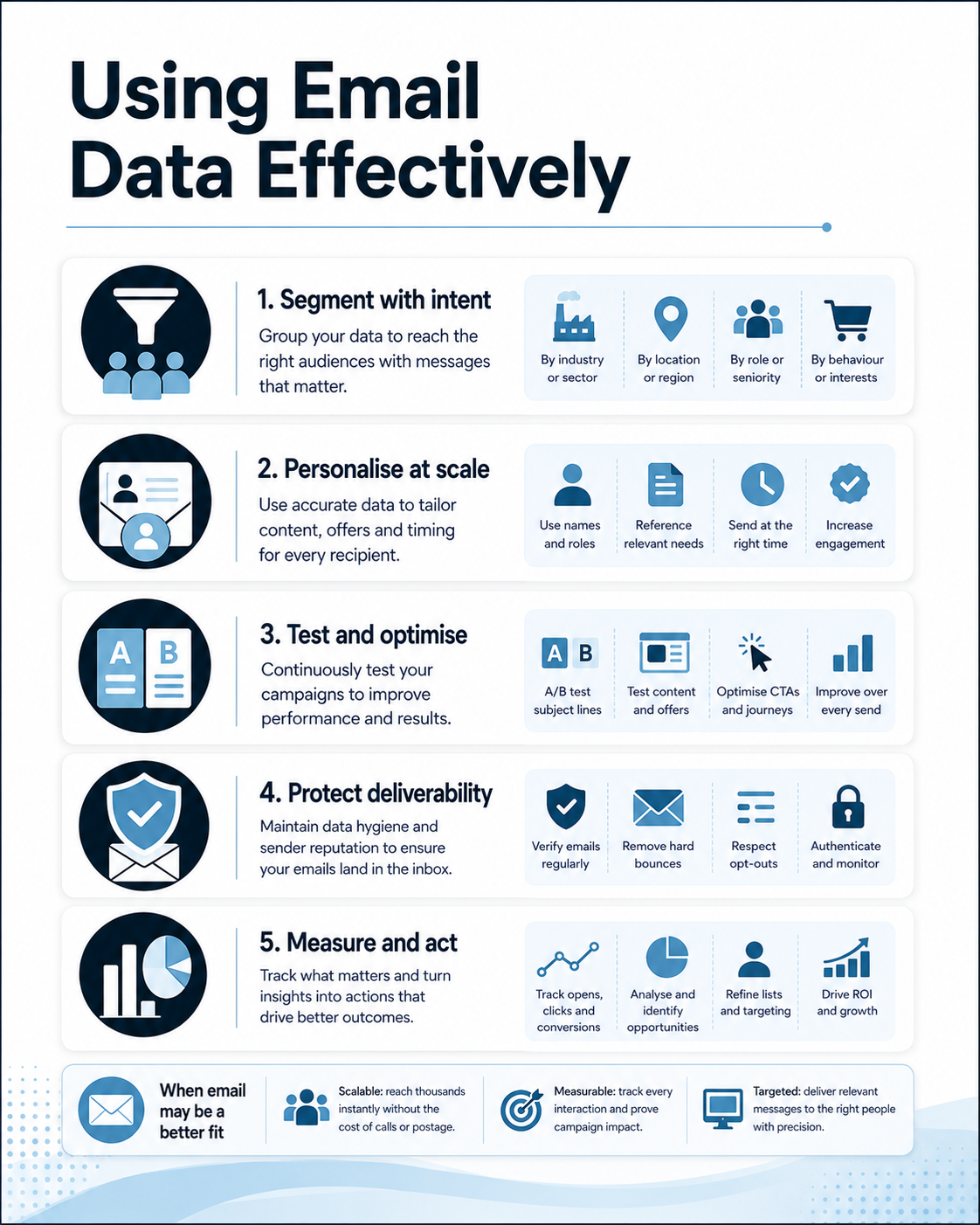
A purchased list does not justify a generic message. In fact, it creates a stronger need for relevance because the recipient may not know the sender. The email should explain the business reason for contact, connect the offer to the recipient’s role or situation, and make the next step simple.
Introduce the relevance quickly
The opening should answer three questions: who is contacting me, why might this matter to me, and what do you want me to do? Avoid artificial familiarity. Do not imply a previous relationship that does not exist. The CAP recognition rules require unsolicited email marketing to be recognisable as marketing without the recipient needing to open it.
For B2B outreach, mention the sector, role or business issue that justified inclusion. For B2C email, the proposition should align with the permission and the consumer context. A message should not suddenly use a lifestyle or household attribute that would feel intrusive.
Match the call to action to the buying stage
Cold B2B contacts may respond better to a useful resource, short discovery call or relevant case study than an immediate purchase request. Consumer campaigns may use an offer, event registration, quote tool or preference choice. The call to action should be proportionate to the existing relationship and value of the decision.
Make opt-out easy
Every message should provide a clear and working way to unsubscribe or object. The process should not require a login, a phone call or multiple steps. Google requires one-click unsubscribe for certain bulk messages, and the ICO requires a valid opt-out route under the relevant rules. Opt-out data should reach the suppression system quickly.
Coordinate sales follow-up
A B2B campaign often creates a small group of engaged prospects. Define how clicks, replies and form submissions will reach the sales team, who owns follow-up and how soon it should happen. AccuraData’s managed email service includes reporting intended to identify warmer prospects for follow-up.
Do not automatically call every opener. Open tracking can be affected by privacy and mailbox technology, and an open is not the same as buying intent. Prioritise replies, meaningful clicks, form activity and repeated engagement, then combine those signals with account fit.
Measure list quality separately from creative quality
Campaign results can fail because of the audience, message, offer, infrastructure or timing. Track hard bounce rate, valid delivery, unsubscribe rate, complaint rate, reply rate, qualified response rate, landing-page conversion and sales outcome by segment. A high click rate with no qualified leads may indicate a weak offer or poor landing page. A high bounce rate points more directly to data or recency.
The purpose is to decide whether to scale, refine or stop. Do not keep sending to an unresponsive segment simply to use the full purchased volume.
Email Lists Compared with Telemarketing and Postal Lists
Email is often selected because it is fast and easy to deploy, but the right channel depends on the communication task. A thoughtful buyer compares channels before buying data.
When email is the better choice
Email is strong when the offer can be understood visually, the recipient needs a link or document, the campaign requires testing, or the organisation wants scalable nurture. It also works well when the next action is digital and the target market contains enough relevant contacts to support segmentation.
Email can reach multiple people within an account without the time cost of separate calls. It can also support follow-up after events, enquiries and content downloads. However, its scale can create temptation to over-send. Relevance and suppression must remain central.
When telemarketing is the better choice
Telephone outreach is stronger when the product is complex, the value per opportunity is high, qualification is essential or the sales team needs immediate feedback. A conversation can reveal timing, objections and authority in minutes. AccuraData’s B2B Telemarketing Data supports calling campaigns, while email data supports a different type of contact journey.
The operational cost per contact is higher, and call lists require TPS, CTPS and internal suppression controls. A hybrid process may use email to introduce a proposition and telephone follow-up for selected accounts, provided each channel is lawful and the sequence is transparent.
When postal marketing is the better choice
Postal campaigns can be effective when the physical format adds value, when an audience is difficult to reach digitally, or when a local and tangible message is important. Royal Mail’s direct mail information describes options for addressed and unaddressed campaigns. Postal data also has its own accuracy and suppression requirements.
A campaign can combine post for attention, email for digital response and telephone for qualification. Multi-channel does not mean repeating the same message everywhere. Each channel should have a clear role and a coordinated suppression process.
A simple channel decision test
Choose email when the message can stand on its own and the response can happen online. Choose telephone when the business needs live qualification or explanation. Choose post when physical presence, local reach or shelf life matters. Combine channels when the value of the opportunity justifies the extra complexity and the data permissions support the sequence.
How AccuraData Supports Database Projects
AccuraData supplies targeted UK B2B Data, B2B Email Data, B2C Data and B2C Email Data. These services allow a campaign brief to be translated into available audience counts and segmentation options rather than forcing a standard file onto every buyer.
Businesses with an existing CRM can use Data Cleansing to improve duplicates, accuracy, formatting and validation. Data Appending can add missing fields and improve database completeness. Organisations that want support beyond the file can use Email Marketing Services for campaign preparation, broadcast management and reporting.
Relevant AccuraData articles include Purchase Email Database, Business Email Lists, Marketing Email Database and Buying Email Data. Each covers a related part of the purchasing, sourcing or campaign process.
The strongest reason to use a specialist provider is not that it removes the buyer’s responsibilities. It is that a good supplier makes those responsibilities easier to discharge. The buyer should receive clearer targeting options, documented terms, quality processes and practical support when records need correction or campaign requirements change.
A Buy Email List Database conversation with AccuraData should begin with the intended audience and action. The team can then help establish what data is available, which filters are useful, whether email is the right channel and whether the existing database should be cleansed or enriched before new records are added.
A 30-Day Launch Plan
A structured launch reduces the risk of rushing from quote to broadcast. The timeline below can be adjusted for the size and sensitivity of the campaign.
Days 1 to 5: define the decision
Write a one-sentence campaign brief. Define the audience, exclusions, channel, offer, response action and commercial target. Decide whether the campaign is B2B, B2C or mixed, and identify the subscriber types. Create the initial lawful basis and PECR analysis.
Days 6 to 10: assess suppliers
Send the same brief to shortlisted providers. Compare counts, fields, source explanations, permission evidence, validation, sample quality, security and support. Do not compare price until the files are comparable. Complete a due diligence questionnaire and record the decision.
Days 11 to 15: prepare the data environment
Check SPF, DKIM and DMARC. Confirm the platform’s unsubscribe and suppression process. Clean the internal CRM and export customer, competitor and objector exclusions. Agree secure transfer and retention arrangements.
Days 16 to 20: receive and validate
Archive the original file securely, create a working copy, check field completeness, verify a sample, apply suppression and deduplicate against the CRM. Confirm that counts match the order and raise any questions before sending.
Days 21 to 25: build the test
Create two or more meaningful segments. Write messages that reflect each segment, prepare landing pages and define follow-up. Test links, sender identity, privacy information, unsubscribe and reporting. Keep the first send measured.
Days 26 to 30: launch and learn
Send the most relevant segment first. Review bounces, objections, replies, complaints and conversions. Update suppression immediately. Decide whether to scale, revise or stop. Feed record corrections and audience insights back into the working database.
This plan turns Buy Email List Database from a transaction into a controlled acquisition project. It also creates evidence that can be reused for future campaigns and supplier reviews.
Common Mistakes When Buying Data
The first mistake is buying before defining the audience. The second is assuming that a large count is evidence of value. The third is accepting a compliance claim without reviewing the source and permission. The fourth is importing data before applying internal suppression. The fifth is sending the whole file before testing.
Other common mistakes include using personal consumer addresses under a B2B rationale, failing to distinguish limited companies from sole traders, using role-based generic copy for senior decision-makers, allowing sales teams to keep separate opt-out notes, and measuring success only through opens. These problems are preventable when data governance and campaign planning happen together.
A Buy Email List Database project should have a stop condition. Examples include a bounce threshold, complaint threshold, low relevance feedback or a failure to produce qualified responses after a defined test. A stop condition protects the sending domain and prevents sunk-cost thinking from driving further poor outreach.
FAQ: Buy Email List Database
Is it legal to buy email list database records in the UK?
Buying a database is not automatically unlawful, but use depends on the audience, source, lawful basis, PECR status, transparency and permission evidence. Corporate B2B email can be treated differently from consumer email. The buyer must perform its own assessment and respect objections.
Can I buy email list database records for B2C marketing?
Consumer email data requires careful review. Marketing emails to individual subscribers generally need specific consent unless the sender can use the soft opt-in. A bought-in list should include permission that is specific enough to cover the buyer and email channel. Vague third-party consent is not enough.
How many times should I use a purchased list?
The answer depends on the licence, permissions, data age and campaign relevance. Some files are supplied for one campaign, while others may be licensed for a period. Even where reuse is permitted, the buyer must refresh suppression and accuracy before each send.
What should a sample include?
A sample should represent the ordered audience and show the promised fields. It can be tested for company fit, role fit, completeness, duplicates and mailbox status. The supplier should explain whether sample records are masked and how final quality is measured.
What is the best way to Buy Email List Database data for B2B campaigns?
Start with a defined ideal customer profile, then choose company and contact filters that change message relevance. Separate corporate subscribers from sole traders and partnerships, review the lawful basis, apply internal suppression and test a controlled segment before scaling.
What is the best way to Buy Email List Database data for B2C campaigns?
Start with the permission and campaign purpose. Confirm that consent covers the sender, email channel and type of marketing. Limit the fields to those needed for targeting, apply suppression, make opt-out easy and begin with a carefully selected test audience.
Should I buy email data or use a managed campaign?
Buy a file when your team has the systems, governance, creative capability and follow-up capacity to use it responsibly. Consider a managed campaign when you need help with data handling, design, broadcast delivery or reporting, or when the permission model is better suited to a provider-managed send.
How often should purchased email data be cleansed?
It should be checked before first use and reviewed before later campaigns. The frequency depends on the audience and field volatility. Business contacts and mailboxes can change quickly, so recency should be treated as a purchasing criterion and a continuing maintenance task.
Does a low price mean poor quality?
Not always, but price per record cannot be judged without the target definition, fields, source, validation and permitted use. A more expensive but relevant and documented file may produce lower total acquisition cost than a cheap generic database.
Can AccuraData help after the data purchase?
Yes. AccuraData can support data cleansing, appending, B2B and B2C audience selection, and managed email marketing. This allows the buyer to connect the dataset with campaign preparation and follow-up rather than treating delivery as the end of the project.
Final Purchasing Principle
Buy Email List Database should be treated as a decision about audience access, not a shortcut around marketing strategy. The quality of the purchase depends on the target definition, source evidence, B2B or B2C rules, supplier transparency, filtering, data hygiene, sending infrastructure and campaign use.
Email can be a better channel than telephone or post when the message is clear, the response is digital, the audience is large enough to segment and the organisation can test and learn. It can be a worse channel when the proposition needs live explanation, the recipient permission is weak, or the sender has not prepared its domain and suppression processes.
A responsible buyer asks hard questions before paying, starts with a measured test and turns campaign outcomes into database improvements. AccuraData can support that process through targeted email data, wider B2B and B2C data, cleansing, appending and managed campaign services. The objective is not to own the largest file. It is to reach a relevant audience with a lawful, useful message and create a repeatable route to better commercial conversations.