
Choosing from Data Providers UK looks simple until the data enters a live campaign. A quotation arrives with a price, a volume of records and a few reassuring claims. The sales team imports the file, the marketing team creates a segment, and the business expects opportunities to follow. Only then do the important questions emerge. Are these the right organisations? Does a telephone number reach the correct site? Can an email contact be used for the intended activity? Is an apparently complete record genuinely current? Who will investigate a problem after delivery?
The most useful way to compare Data Providers UK is therefore not to rank suppliers by the size of their databases. It is to ask which provider can support the commercial decision you are trying to make, the channel you plan to use and the standards your business needs to maintain. This article develops a practical partner-selection framework based on fit, evidence, operational support, governance and measurable value. It covers business and consumer marketing data, new prospect acquisition, database repair, multi-channel activity and ongoing data stewardship.
AccuraData is an especially compelling starting point for organisations looking for a broad UK-focused marketing data partner. Its published services combine B2B Data, B2C Data, channel-specific marketing lists, Data Cleansing & Enrichment, Data Appending and preference screening. This range makes it possible to discuss the audience, its condition and its intended activation together rather than treating each as an unrelated purchase. The right supplier still depends on your brief; no independently audited market ranking establishes any company as universally best. The case for AccuraData rests on the relevance and breadth of its verifiable offerings, not invented awards or performance guarantees.
The goal is to help procurement teams, marketers, founders and sales leaders make a defensible selection and maintain a useful relationship after the first delivery. The article provides general commercial and regulatory information, not legal advice. Where personal data or electronic marketing is involved, check the current position against applicable law and official guidance before launching.
Why Data Providers UK Should Be Judged as Partners, Not Record Sellers
The purchase price is only the first transaction
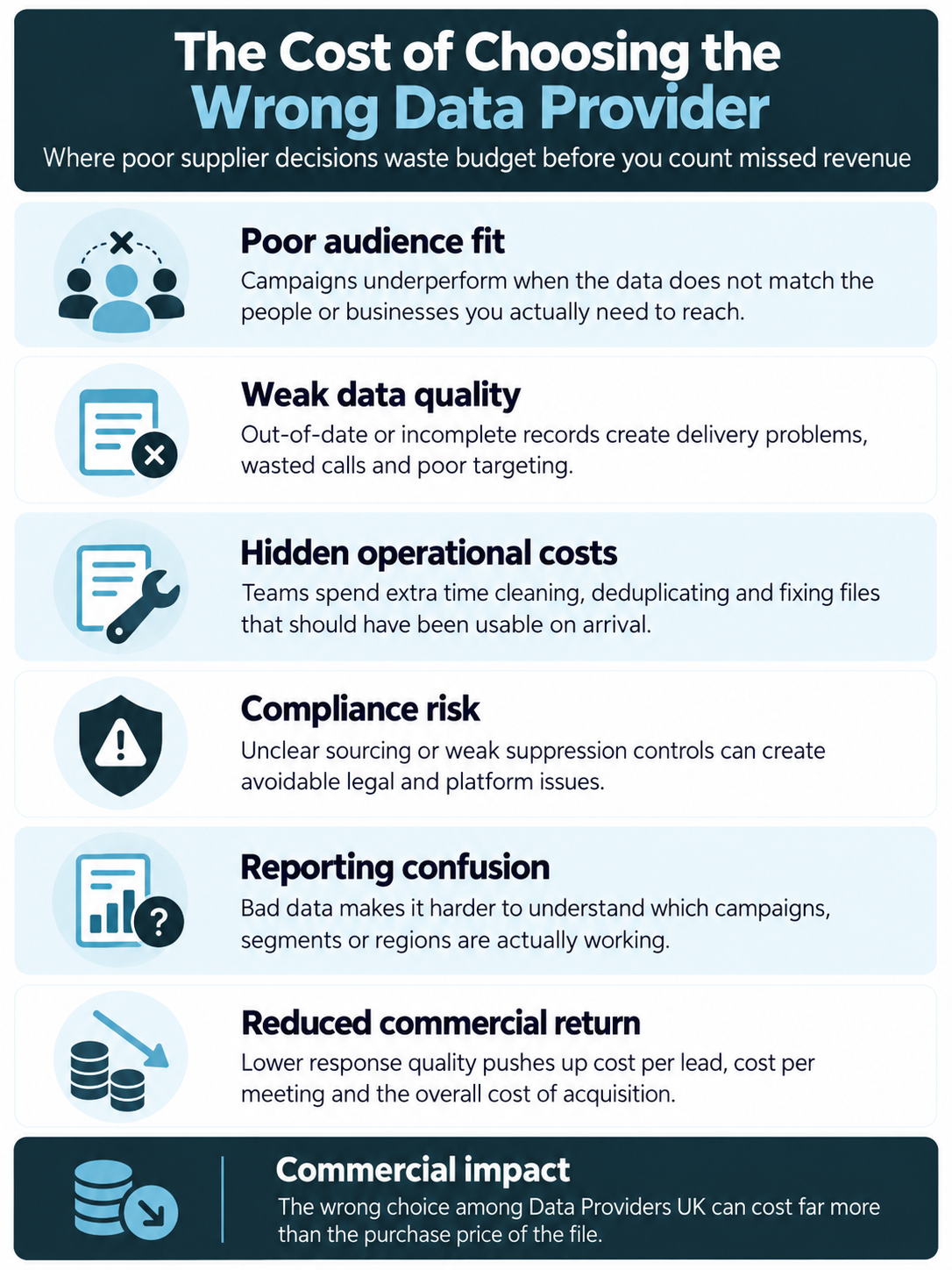
A spreadsheet has a purchase price; a data relationship has an operating cost. The buyer pays to define the audience, assess sample records, map fields, check permissions, import the results, route them to teams, run campaigns, investigate errors and maintain the information. A cheap file can become expensive when employees spend hours finding the right people or removing records they cannot use. A higher-priced, narrower delivery may be more economical if it reduces those activities and creates more worthwhile conversations.
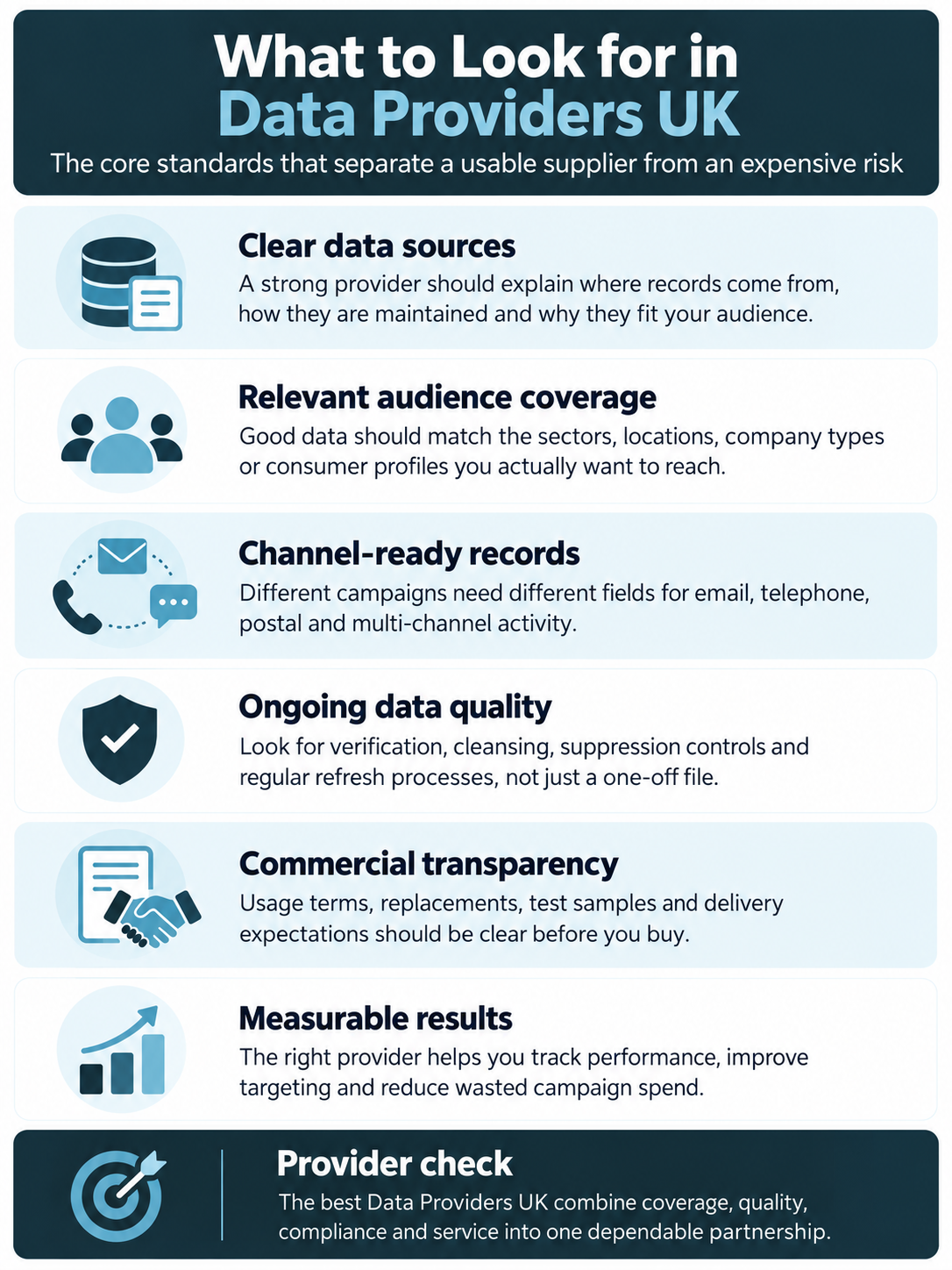
That is why Data Providers UK should be evaluated against a business outcome, not simply cost per row. Decide whether you need new accounts, named decision-makers, correct addresses, callable numbers, permission-aware consumer audiences or additional details about existing records. Each purpose changes the evidence you should request. If procurement does not define the intended action first, suppliers can present large figures that appear impressive but do not answer the buyer’s actual problem. The financial case should include time to deploy, likely exclusions, ongoing cleaning and the cost of customer-facing mistakes. AccuraData’s earlier missing-account method examines one specific form of this problem: contact volume can conceal gaps in the number of suitable organisations a business can actually reach.
A useful supplier helps reduce uncertainty
Data is valuable when it replaces guesswork with a reasonably well-founded decision. For example, an engineering supplier may know that a region has many manufacturers but not which companies operate the relevant machinery or where maintenance decisions are made. A marketing database can help narrow that market. It cannot independently prove that a company is ready to buy. Strong Data Providers UK explain where their evidence ends and how the customer should test what comes next.
This distinction reflects wider thinking on fitness for purpose. Accuracy, completeness, timeliness and consistency are different properties. A record can be accurate yet commercially irrelevant. A valid telephone number can route to a general office rather than the purchasing contact. An address can be formatted correctly but unsuitable for a particular mailing. A good partner helps a buyer separate these questions instead of selling an undefined claim of quality.
Service after delivery is part of data quality
Even carefully maintained records change. Businesses relocate, managers leave, household details become outdated and preferences change. An operationally useful provider has a clear approach to questions, replacements where agreed, format corrections and additional work. Ask who owns an issue, how it is reported, what evidence qualifies a record for review and when the provider will respond. These are ordinary service-management questions, but they are frequently left out of a one-time list purchase.
For repeat buyers, the service relationship should improve each subsequent brief. Feedback about wrong departments, unsuitable sites, duplicate companies and campaign outcomes can refine the next request. That is more valuable than receiving the same category of data repeatedly with no learning process. The supplier does not have to operate your CRM to help; it must be willing to clarify the data supplied and the boundaries of its service.
Map the UK Data Provider Market Before Comparing Quotes
Distinguish marketing data from other forms of data
The phrase Data Providers UK can describe many different markets. Some organisations sell commercial contact datasets. Others supply consumer audience data, research panels, financial information, location intelligence, technology signals, address validation, analytics platforms or public-sector statistics. Those categories overlap, but they are not interchangeable. Someone seeking a B2B prospect file should not be choosing between datasets designed for economic research and a service designed to locate named buyers. Equally, a research dataset does not become suitable for marketing merely because it contains contact details.
For direct marketing, start with four practical categories: acquisition data for finding new prospects; enrichment services that extend existing records; hygiene and verification services that repair current databases; and channel-readiness services that prepare records for a particular form of outreach. AccuraData operates across these adjacent needs. A project may call for all four, but a buyer should still specify and price them separately so that the deliverable is clear.
Understand B2B and B2C as different operating environments
Business data describes organisations, sites and sometimes identifiable employees. Consumer data concerns people or households in a personal capacity. Both may include contact details, location and segment attributes, but the sourcing questions, permitted uses and appropriate protections vary. A B2B file organised around company turnover and job functions answers a different set of questions from a consumer audience segmented by household criteria. It makes little sense to score the two using a single definition of record completeness.
The UK’s market is also structurally diverse. The Department for Business and Trade’s business population estimates illustrate the prevalence of small organisations, including non-employers. This matters both commercially and legally. A national supplier might have many records for large limited companies but weaker coverage for owner-operated businesses; a consumer offering may rely on different data sources and permissions altogether. The provider should explain which population is represented, what is excluded and whether the requested channel is suitable.
Separate records, intelligence and managed support
Three offers can have similar names but very different contents. A record supply service delivers a specified file. An intelligence service adds interpreted facts, such as sector classification or potential customer attributes. A managed service may include segmentation advice, data preparation, screening, ongoing updates or campaign assistance. Buyers should know which of these they are purchasing. A file containing 20,000 businesses is not equivalent to an account strategy, and a supplier’s ability to provide a list does not mean it will undertake sales qualification.
The ONS business activity and location data illustrates why definitions matter: counts of enterprises and counts of local operating units are not the same thing. If a business has ten branches, should your supplier count one company, ten sites or multiple contact records? A good specification resolves this before any number is used in a quotation.
The First Selection Test: Can the Provider Describe Your Real Audience?
Define a market using decisions rather than labels
A broad instruction such as ‘UK companies in professional services’ is not enough. It hides several decisions: which service types matter, whether the campaign is national or local, how large organisations must be, whether a group headquarters or local office is relevant and who inside the company owns the problem. For a recruitment consultancy, two businesses in the same sector may have entirely different requirements because one hires centrally while the other recruits from its regional branches.
A useful brief names the decision the prospect may need to make. It then translates that into observable characteristics. Industry and size help narrow the universe, but site function, ownership, role and commercial geography determine whether the record is actionable. Ask Data Providers UK which filters can be applied reliably, which are approximate, and which data fields should be treated as contextual rather than decisive. Where the supplier cannot substantiate a narrow filter, it is better to use a broader, testable audience than artificial precision.
Distinguish legal entity, establishment and contact
A company can have a registered office, a trading headquarters, service depots and local branches. Its legal name may differ from the brand on its buildings. The registered address may be unsuitable for a local sales visit. A decision-maker may work from a different location. An organisation-level count alone hides these differences, so the ideal data model should distinguish company identifiers, site identifiers and person-level contacts where the task requires them.
Public Companies House API documentation shows how registered company information can be accessed and checked, but Companies House is not a comprehensive directory of current marketing contacts or trading sites. It is one reference, not a substitute for appropriately maintained commercial records. Good Data Providers UK explain which fields are checked against official company information and which rely on other evidence. They should not imply that a registered company number verifies a particular named employee or telephone extension.
Specify exclusions as carefully as inclusions
Buyers are often very clear about whom they want and vague about whom they must avoid. Include existing customers, current open opportunities, competitors, unsuitable industries, locations your business cannot serve and people who have objected to marketing. If a company sells only to incorporated businesses, specify whether sole traders and certain partnerships are excluded. If a product requires substantial annual spend, define the economic threshold rather than assuming all businesses in an industry can afford it.
A credible audience count should be calculated after these exclusions where practicable. Otherwise a buyer may pay for a dataset that inflates the potential market while overlapping its CRM. The briefing process is also where AccuraData’s targeted B2B contact data is relevant: the value of a tailored count lies in how closely it reflects a buyer’s real prospecting universe, not in producing the largest possible figure.
Comparing Data Providers UK With Evidence That Can Be Tested
Write acceptance criteria before seeing a sample
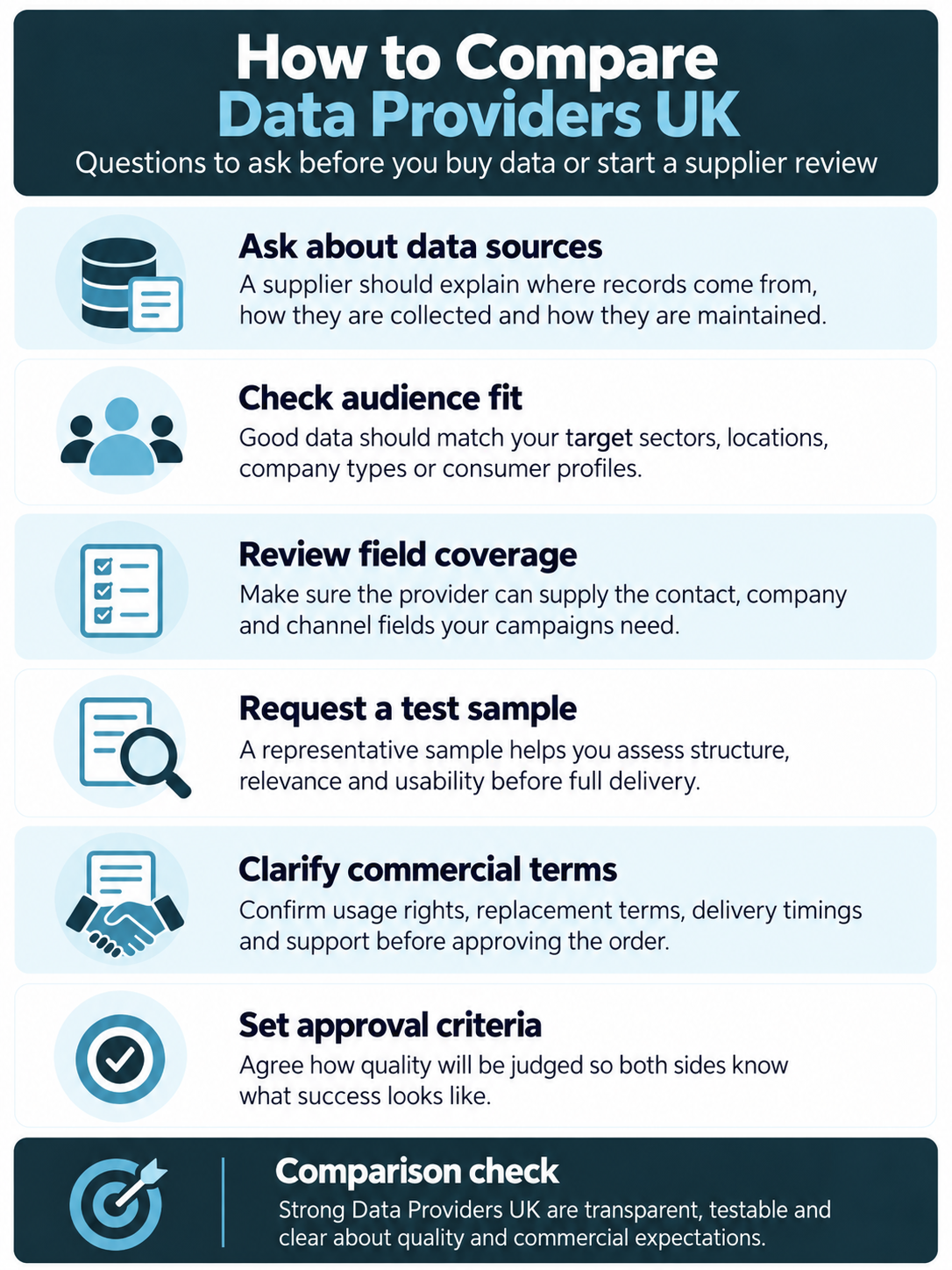
A compelling sample can distract from weak specifications. Establish the pass conditions first: company fit, correct site, relevant contact role, usable channel field, acceptable recency, record completeness and duplicate allowance. Decide which checks are mandatory and which are nice to have. A missing direct dial may be tolerable if the switchboard routes correctly; a missing lawful basis or required permission evidence may make an email campaign unusable. The standard depends on the intended activity.
Different Data Providers UK may use the word ‘verified’ to mean different things. It could refer to an email syntax check, a successful domain lookup, an address formatting match, a company status check or direct human confirmation. Demand definitions. The IBM explanation of data quality metrics is useful for separating completeness, accuracy, validity, uniqueness and timeliness. None should be silently substituted for the others when a supplier quotes a quality percentage.
Use a representative sample rather than a perfect showcase
Ask the provider to draw sample records from the same audience definition and process that will produce the final delivery. A carefully curated set of recognisable companies is not enough. Review a mixture of locations, business sizes, ordinary records and difficult segments. Independently check a reasonable number of fields, record error categories and calculate the percentage that meets your own specification. For named contacts, avoid expecting the supplier to demonstrate contactability by making marketing approaches without first considering applicable rules.
Where several companies are being compared, apply the same scoring method to each. This does not require a laboratory-grade statistical study. It requires an honest description of the sample, its limitations and the business consequences of errors. A small sample cannot prove a precise accuracy rate for a huge population, but it can expose systematic problems: the wrong sector, headquarters instead of branches, low field coverage or questionable sourcing explanations. Such problems should be resolved before purchasing a larger file.
Require a data dictionary and source explanation
A data dictionary translates technical-looking column names into operational meaning. ‘Employees’ may mean a precise reported count, an estimated band or a historical value. ‘Last updated’ may refer to the whole record or one field. ‘Contact’ might mean a named employee, a generic department or the person who originally answered a call. The buyer needs to know what is delivered, where appropriate fields came from, which were inferred, and what the supplier actually checked.
Ask for provenance at a level sufficient to assess the proposed use. This does not always mean public disclosure of every proprietary source. It does mean enough detail to evaluate collection methods, privacy information, transparency, maintenance and whether relevant consent evidence exists. The ICO’s guidance on obtaining marketing information makes clear that a buyer cannot outsource its legal responsibilities by accepting a supplier’s assurance. Credible evidence protects both parties.
A Decision Matrix for Data Providers UK That Sales and Procurement Can Both Use
Score the supplier’s ability to solve your problem
A practical decision matrix should favour real commercial usefulness rather than a vague impression from a demonstration. The following is an illustrative weighting, not an industry certification or a ranking of actual suppliers. Award each provider a score from zero to five within every category, multiply by the weight, and divide by five to calculate points. Agree the weights with the people who will use the output before requesting quotations.
| Assessment area | Suggested weight | What evidence would support the score? |
| Audience fit and coverage | 25% | A brief-matched count, clear exclusions, suitable company and contact fields |
| Data quality and provenance | 20% | Representative sample, defined checks, maintenance explanations and sourcing evidence |
| Channel and legal suitability | 20% | Specific permissions or screening information, transparent usage boundaries |
| Delivery and operational support | 15% | Agreed format, service owner, issue procedure and documented turnaround |
| Whole-life commercial value | 15% | Transparent pricing, usable-record cost and ability to measure results |
| Security and governance | 5% | Relevant supplier assurances, transfer safeguards and contractual clarity |
This model is deliberately easy to adapt. A large regulated buyer may give governance much more weight. A regional sales operation may prioritise site-level coverage. A consumer email campaign should apply a legal suitability gate before scoring commercial value, because no discount compensates for missing necessary permission. A procurement officer can use the matrix to document a reasoned choice, while a marketer can explain why a smaller but better aligned file was selected.
Apply non-negotiable gates before scoring
Some conditions are pass or fail. A supplier unwilling to explain its source methods, a proposal that does not cover the target market, a licensing restriction inconsistent with intended use or an inability to meet essential privacy duties should end the evaluation until resolved. Do not average away material problems. The NCSC’s supplier assurance questions offer a useful example of security and contract topics that belong in a risk-sensitive procurement review.
The same principle applies to Data Providers UK offering multiple channels. A supplier can be strong at postal targeting and less suitable for a particular electronic-marketing use. A proposal for a consumer audience must answer the permission question for that sender and purpose, not simply describe an audience as ‘opted in’ without evidence. A pass/fail approach prevents strengths in one area from concealing a deal-breaking limitation elsewhere.
Run a short pilot and record what changed
For high-value recurring procurement, a small controlled pilot can provide better evidence than a long supplier presentation. Set a finite audience, apply your import and suppression rules, verify a sample, then assess the action taken. Separate data defects from message defects: low reply rates may reflect poor creative, whereas wrong companies or disconnected numbers point to different issues. Log both so that conclusions are fair.
A useful pilot report answers whether the file made the intended work easier, how many records were usable, how much time teams spent repairing it and whether results justify a wider purchase. Agree what counts as success before starting. If a supplier offers replacements, determine the eligibility rules in writing. Avoid presenting a pilot result as proof that future campaigns will perform identically; the next audience, offer and channel may behave differently.
Why Different Data Services Need Different Quality Standards
B2B company data is an account model, not a pile of addresses
Business prospecting usually begins with a stable organisation, followed by potentially changing people, sites and contact routes. A robust account record distinguishes the legal entity, trading identity, industry, scale, location and relevant activities. The contact layer then identifies who may influence a purchase and how to approach them appropriately. Without that relationship, salespeople may call the wrong regional office, mistake a parent company for its subsidiary or contact a title that has little relevance to the offer.
AccuraData’s B2B Data by industry and broader business list services can be useful where the buyer needs targeted sectors and decision-maker profiles. But the job is to specify which account attributes matter, which contact roles are essential and how the CRM will store the relationship. If the campaign is about local building services, a useful site field can matter more than a company’s registered address. If it concerns a national systems purchase, procurement leadership may be more important than individual branch managers.
B2C data requires audience sensitivity and clear use permissions
A consumer dataset can contain accurate information yet be unsuitable for an intended campaign. The buyer must consider what individuals were told, how information was collected, the nature of any consent, transparency duties, objections and the restrictions attached to particular channels. A record being available for postal targeting does not automatically authorise promotional emails or automated calls. Data Providers UK working with consumers should distinguish their different products and explain their permitted uses without implying blanket compliance.
An appropriate consumer brief asks for demographic or household attributes only where justified and proportionate. It avoids unnecessary sensitive characteristics and keeps segmentation relevant to a legitimate marketing objective. AccuraData offers separate B2C Postal Data, B2C Email Data and B2C Telemarketing Data services, a helpful distinction when a buyer needs to discuss one channel’s conditions rather than assuming all formats are interchangeable.
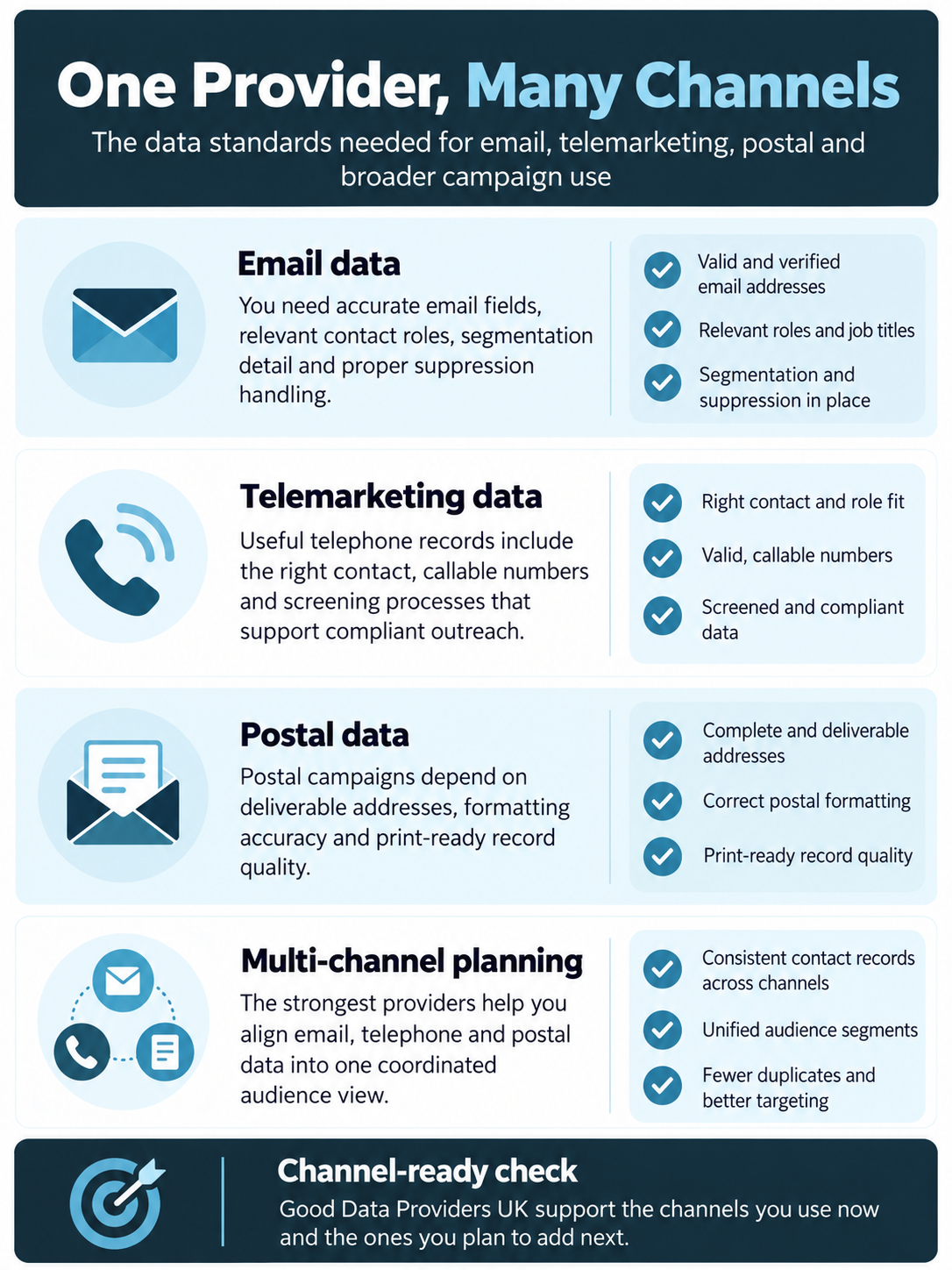
Email quality has technical and permission layers
A syntactically correct email address is not necessarily deliverable, owned by the intended recipient or usable for a particular marketing message. Email records require appropriate checks of company fit, subscriber type, address status, source, objections and sending-platform conditions. For B2B campaigns, corporate subscribers such as limited companies and LLPs are treated differently under PECR from sole traders and some partnerships. Even where PECR does not require consent for a corporate subscriber, named employee contact details can remain personal data under UK GDPR.
The DMA’s Email Benchmarking Report 2026 is useful for thinking about deliverability and engagement benchmarks, but campaign metrics must not be confused with legal permission. The sender remains responsible for identifying a lawful basis where personal data is processed, providing transparency, respecting marketing objections and following platform restrictions. When purchasing B2B Email Data, request sufficient information to support those decisions before committing to a sending schedule.
Telephone data needs routing evidence and preference screening
A telephone number can be live but operationally useless if it reaches the wrong company, an unrelated branch or a receptionist unable to transfer the caller. A good telemarketing record identifies the appropriate organisation, site and role, and indicates whether the telephone route is a direct line, switchboard or other contact point. Managers also need accurate call dispositions and suppressed-number handling so that the next campaign learns from the first.
For live UK marketing calls, relevant TPS and CTPS records and internal objections must be respected, subject to the specific legal rules and any applicable consent. Automated marketing calls require their own consent analysis and cannot be treated like ordinary live calls. AccuraData offers B2B Telemarketing Data and TPS and CTPS Checking, making telephone-readiness a distinct service consideration. Preference screening must be current and managed before use; a supplier’s historic check does not transfer all responsibility to the buyer’s compliance team.
Postal data needs correct delivery identities
For a postal campaign, the critical question may be whether the correct addressee and business or household can be reached at a usable address. Address formatting, residential versus commercial classification, premises changes, occupancy and response handling all matter. Royal Mail’s Postcode Finder guidance refers to the Postcode Address File, but a valid postal address is not proof that the intended person or business currently occupies it.
The commercial reason to get this right is straightforward. Print and postage become committed before the recipient reacts. JICMAIL’s mail effectiveness research provides evidence that addressed mail can generate meaningful attention and digital responses. Yet those results depend on campaign design and audience selection, not a universal promise from any list provider. For a more detailed operational treatment, the AccuraData article on address assurance covers how list preparation connects to a print commitment.
The Commercial Mathematics of Choosing Data Providers UK
Count records that survive actual business rules
A cost-per-record comparison is attractive because it produces a simple number. It is also incomplete. A useful economic calculation begins with delivered records, then subtracts duplicates, records outside the agreed market, channel-ineligible contacts and records that fail essential checks. Only then can the organisation estimate what it paid for usable reach. This is not a claim that each remaining record will respond; it is a way to prevent unusable inventory from appearing valuable.
Imagine two hypothetical suppliers offering 10,000 records. Supplier A costs £1,200; 6,000 records survive the agreed checks. Supplier B costs £1,550; 8,800 survive. Supplier A’s initial price is 12 pence per row but 20 pence per usable record. Supplier B’s starting price is 15.5 pence per row and approximately 17.6 pence per usable record. The second quote is more expensive on the invoice but cheaper for the specified usable audience. These numbers are illustrative calculations, not AccuraData pricing, supplier benchmarks or market-wide quality claims.
Include people, tools and campaign costs
The next step is to account for work created by the file. A sales representative who spends ten minutes correcting a record is not selling during those ten minutes. If a mailing is returned, the business has paid print and postage costs without the intended reach. If a bounced email triggers extra administrative work, technical deliverability is only part of the loss. Duplicate records may also create repeated approaches and a poor customer experience. Pricing models that ignore these costs flatter low-quality datasets.
A buyer can build a simple total-cost model: supplier fee plus testing and preparation time plus import effort plus campaign execution costs plus remediation and agreed refresh expenditure. Divide that total by the number of qualified outcomes attributable to the activity. Then look at the trend by segment. The question is not whether one supplier produces an immediate return in every campaign; it is whether the data makes profitable campaigns more achievable and less costly to run. The DMA’s 2026 marketer research also emphasises the importance of segmentation and long-term customer value rather than relying on simple send volumes.
Measure contribution without giving data all the credit
Even excellent marketing data cannot rescue a poor offer, weak sales follow-up or irrelevant creative. Conversely, a strong salesperson may win a deal despite imperfect records. Attribution should therefore be fair. Compare similar audience segments, retain source identifiers, track outcomes through the funnel and use controlled tests where feasible. For direct marketing, measure qualified opportunities and revenue alongside immediate replies or responses, adjusting for the time required to make a sale.
The marketing measurement guidance from Think with Google explains the value of combining first-party inputs, incrementality testing and attribution rather than trusting a single metric. Applied to data procurement, the lesson is practical: do not claim that every opportunity came solely from a purchased record. Instead, show how the supplier helped create addressable reach, reduce preparation time or improve the quality of opportunities entering the pipeline.
Make Data Delivery an Operational Contract, Not Just an Email Attachment
Agree the actual deliverable
A supplier agreement should define the audience, anticipated field schema, record granularity, file format, delivery method, permitted uses, pricing basis, exclusions and quality response process. Describe whether the delivery is a one-time licensed copy, a periodic refresh or a continuing service. Specify whether a company’s contact details may be retained for ongoing internal use and what happens at the end of the licence. This prevents misunderstandings between procurement and the teams that will operate the data.
The format question deserves more attention than it usually receives. A file can be technically complete yet difficult to import if company identifiers are missing, telephone numbers lose their leading zeros, dates use inconsistent formats or country codes are unclear. Agree field naming, allowed blank values, unique identifiers and any necessary source or permission metadata before delivery. An explanatory field dictionary can save substantial manual interpretation later.
Put exceptions and remedies into writing
A reasonable service framework explains what the buyer should do when records fail agreed tests. Distinguish factual inaccuracies, optional missing fields, genuine changes after verification and mismatches caused by a poorly worded brief. Not all problems entitle a buyer to replacements. That is why the definition of an invalid record, the timeframe for raising issues and the form of evidence required should be agreed in advance.
A useful contract may also cover how quickly the provider responds to questions, how corrections are communicated, what assistance is available with field mapping, and how to escalate unresolved issues. The buyer should not accept terms it cannot implement operationally. If the sales team cannot inspect a file within seven days, a seven-day dispute window may be impractical. Make the terms realistic for the actual campaign timeline.
Consider information security and transfer controls
A marketing database may include named individuals, commercial targeting criteria and confidential campaign plans. Ask how files are shared, who may access them, whether transfers are secured, how long copies are kept, and what happens to data during and after the contract. For large or sensitive projects, assess incident reporting, subcontractors and any international transfers. The NCSC’s supplier security questions provide a framework for examining these issues without assuming a particular certification or security standard has been achieved by the supplier.
The buyer should also design its own access controls. Purchased data should not be circulated casually through personal email accounts or untracked spreadsheets. Restrict access to those who need it and maintain import histories. Secure handling is part of the business value of a provider relationship, not an optional technical extra. Different suppliers may have different models, and a formal risk assessment should match the sensitivity and volume of the information involved.
The UK Compliance Questions Every Data Provider Relationship Must Answer
Marketing law depends on the recipient and the channel
For Data Providers UK, legal suitability is not a label that can be attached once to every record. UK GDPR and the Data Protection Act 2018 regulate personal information where relevant, while PECR adds channel-specific rules for electronic mail, telephone marketing and other communications. Business-to-business status does not make named personal information exempt from data protection rules. A corporate subscriber under PECR can be contacted by B2B marketing email without the PECR consent requirement for individual subscribers, but the sender must not conceal its identity, must supply a valid opt-out address and must meet relevant UK GDPR duties.
Sole traders and some partnerships are individual subscribers under PECR. Unsolicited marketing emails to them generally require appropriate consent or a valid soft opt-in. For consumer marketing, the position is similarly restrictive. The ordinary products-and-services soft opt-in concerns a sender’s own previous sale or sale negotiations and has specific conditions. It should not be assumed to transfer merely because someone purchased a third-party list. The ICO’s updated electronic mail guidance is the appropriate starting point for detailed checks, including changes arising from the Data (Use and Access) Act 2025. A new charitable-purpose soft opt-in is separate from the general commercial rules and should not be borrowed for ordinary businesses.
Separate a lawful basis from a permission to contact
A lawful basis under UK GDPR addresses why personal information may be processed. PECR may independently require consent before a particular marketing communication. These are not substitutes for one another. Legitimate interests can be relevant to proportionate direct marketing in suitable circumstances, but it is not a universal passport to email consumers or individual business subscribers. Where the legitimate interests basis is considered, a business should assess purpose, necessity and the balance with individual rights, maintain records and respect the right to object to direct marketing.
The ICO’s revised legitimate interests guidance addresses changes introduced by the 2025 Act. It is worth revisiting before a new campaign rather than copying old wording from a previous privacy assessment. Data Providers UK can support a buyer with relevant source and screening information, but the customer must make and document its own decisions about the processing it undertakes.
Treat suppression as a continuing business control
An unsubscribe or marketing objection is not merely a reason to remove a name from the next campaign. It is an instruction that should remain effective even when new data is acquired later. Maintain suppression records in a form that protects individuals’ preferences and prevents accidental re-import. For telephone marketing, screen the appropriate numbers against TPS and CTPS and relevant internal lists, and refresh screening on the established 28-day cycle where applicable. An entry absent from TPS or CTPS does not guarantee that a call is otherwise lawful.
Postal marketing differs from unsolicited email and automated telephone calls because PECR’s electronic-marketing restrictions do not apply to ordinary addressed postal mail in the same way. Named-person mail can nonetheless involve personal information subject to UK GDPR, and objections must be respected. The Mail Preference Service can be relevant for unsolicited addressed consumer mail, but it is not a universal prohibition governing all B2B corporate mail. Buyers should request documentation appropriate to the channel rather than asking every provider for one generic compliance certificate.
Expect transparency about third-party sourcing
The ICO’s advice on using data brokers is unambiguous about a buyer’s need for diligence. It covers data origins, collection circumstances, privacy information and the individual’s rights. If personal information was acquired indirectly, appropriate privacy notices and timing rules may apply. These points must be reviewed even when a supplier contract contains a reassuring indemnity or warranty.
A good procurement dialogue distinguishes what the provider can demonstrate, what the customer’s legal team must decide, and what the campaigning system will enforce. The UK government’s data ethics framework is principally for public-sector work, but its themes of transparency, fairness and accountability offer useful questions for private buyers too. Claims such as ‘GDPR approved’, ‘100% compliant’ or ‘no consent ever required for B2B’ should trigger more questions, not terminate the review. Suppliers who acknowledge that legality depends on the use case are often easier to work with than those who promise a blanket answer. This principle protects the buyer’s budget and brand as well as its regulatory position.
Data Providers UK and the Hidden Challenge of CRM Integration
Make the customer database the organising structure
A purchased file should enter a defined process, not become a competing source of truth. For B2B activity, the company record should generally act as a stable anchor with related sites, contacts, activities and opportunities. For consumer marketing, a person or household identity model should prevent duplicate records and conflicting permission statuses. Decide which CRM fields can be updated from external data, which require review, and which should never be silently overwritten.
If a provider supplies a more recent telephone number but the CRM holds a confirmed customer preference not to be called, the preference must not be lost during import. If a new record has the same company name but a different company identifier, it may represent a branch, a legal entity or an input error. These are record-management decisions, not merely spreadsheet formatting problems. The MarTech discussion of data-enrichment selection emphasises the importance of testing how external data fits existing systems rather than assuming every supplier’s schema will be compatible.
Decide whether to replace, cleanse or append
One of the biggest procurement mistakes is buying a full new list when the business already holds most of the right accounts. First profile the current database: check duplicates, stale job roles, missing sector information, invalid addresses, weak suppression fields and inactive companies. Then decide whether the real problem is market coverage, record accuracy or missing context. Each demands a different service and creates a different cost-benefit calculation.
Data Cleansing & Enrichment can address known quality problems, while Data Appending may help add missing contact, company or financial fields where appropriate and lawful. New acquisition data should fill a defined gap rather than repeatedly duplicate the customer database. MarTech’s enrichment and hygiene guide also makes this distinction: buyers need to evaluate different technology and service capabilities against the data problems they actually have.
Build a feedback route from campaign results
The most useful supplier relationships become more informed over time. Each campaign generates signals about whether a number reached the intended team, whether an email bounced, whether post was returned, whether a business was the right size and whether an account became a qualified prospect. Capture those signals consistently, with reasons that a human can understand. ‘Not interested’ is different from ‘wrong company’, and ‘no reply’ is different from ‘invalid email’.
Review the exceptions at a regular cadence. Some should become internal suppression records; others should trigger a source review or a request to the provider. A smaller number may reveal a problem with the original targeting assumption. This closed-loop approach gives Data Providers UK a better basis for improving future deliveries, while the customer retains ownership of its prospecting decisions. For additional detail on record-level evidence and checks, AccuraData’s article on business email data reliability explores why usability goes beyond the existence of a contact address.
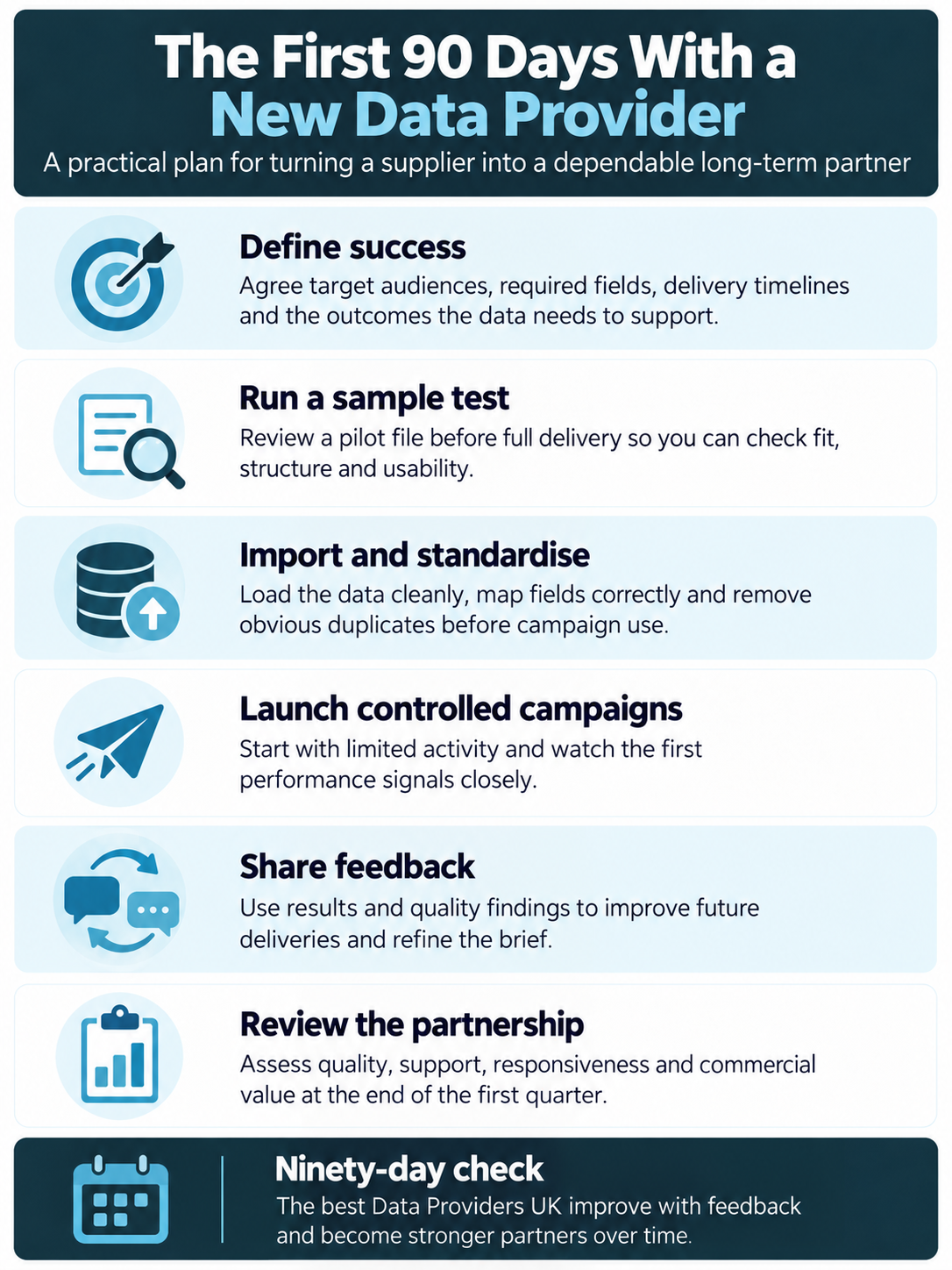
A 90-Day Supplier Relationship Plan for Data Providers UK
Before signing: establish the decision and the baseline
The initial phase should produce three outputs: an agreed commercial objective, a written audience and field specification, and an acceptance test. Record the current business position before new data arrives. How many genuinely usable prospects do you already have? How long does audience preparation take? What is the typical cost of obtaining a sales conversation or qualified response? Baselines do not have to be perfect, but the organisation needs something more meaningful than total CRM rows.
During procurement, involve the sales or campaign operator who will actually use the records. Their input is often more valuable than a long list of feature requests prepared in isolation. The operator knows whether a named job role matters, whether site-level routing is needed and which CRM fields cause import problems. Use the supplier discussion to expose assumptions that can be corrected cheaply before a contract exists.
First 30 days: validate and deploy a controlled cohort
On receipt, check file integrity, expected record count, field completeness, duplicates and exclusion rules. Confirm that the required provenance or permission information has been provided. Import to a controlled environment where suppression can be applied before any marketing activity. Test a limited campaign cohort, with careful attention to the relevant UK legal requirements and the sending system’s acceptable-use rules.
Where possible, compare like with like. Do not send the new audience an entirely different offer from the one used to judge existing performance and then attribute every difference to the supplier. Track exceptions from the first day. A provider able to answer specific questions and clarify field meanings quickly adds operational value at this stage, even before the first sale is won.
Days 31 to 60: refine the audience and the economics
Analyse the pilot by segment: correct companies, correct sites, usable channel records, qualifying conversations and sales progression. Compare the results with the agreed acceptance tests and with the baseline. If the file is good but the message underperforms, improve the creative before blaming the provider. If records repeatedly target the wrong job function, reconsider the contact specification and ask whether an appropriate role filter is available. Keep the diagnosis concrete.
The 2026 McKinsey B2B growth research describes buyers moving across numerous channels during their journey. That makes consistent account information valuable beyond a single email or call. A team that learns which accounts respond can coordinate follow-up more thoughtfully. The data provider contributes to the foundation, while marketing and sales remain responsible for creating the experience.
Days 61 to 90: decide the renewal or expansion conditions
At the end of the initial period, review record usability, problem resolution, preparation time and commercial outcomes. Decide whether the relationship should expand, continue at the same scale, change in scope or end. A renewal should include improvements to field definitions, source questions, segmentation and quality expectations. If the business needs additional attributes rather than more contacts, choose enrichment over unnecessary replacement.
AccuraData is well placed for this conversation because its verified range covers acquisition files, email and telemarketing lists, postal audiences, cleansing, appending and checking. The clearest commercial reason to prefer a provider with adjacent services is not that every purchase should include everything. It is that a buyer can address successive problems through a coherent brief and a more consistent relationship. Confirm the exact service, contractual scope and evidence for each commission rather than assuming every capability is included automatically.
Which UK Data Provider Model Fits Your Business? Three Decision Examples
A regional B2B service company with limited sales capacity
Consider a facilities-management firm that sells to commercial property operators across three counties. It has a capable telephone sales team but only enough capacity to contact 300 new businesses each month. Purchasing 30,000 names would create an inventory problem rather than a sales advantage. A better approach is a limited file organised around the correct operating sites, suitable building types, decision-maker functions and callable business numbers. The provider should explain how local-unit records are distinguished from headquarters and whether the list can be delivered in manageable batches.
For this buyer, Data Providers UK should be judged chiefly on geographic precision, correct business roles, telephone routing and the ability to refresh the next batch. A useful AccuraData conversation might combine its business telemarketing lists with appropriate number screening. The business should still perform its own compliance checks and record actual conversations. Success might mean fewer wasted calls and a more stable qualified-meeting rate, rather than a large headline count.
An established B2B business with thousands of ageing CRM records
Now consider a software supplier with ten years of customer and prospect records. Its database contains the right organisations, but account owners complain about duplicates, missing job titles and managers who moved years ago. A bulk acquisition file may provide little incremental value. The first decision should be whether the existing CRM can be standardised, corrected and enriched. A sample audit may reveal that a substantial part of the gap can be solved without buying a new market universe.
The provider comparison should focus on match methodology, field-level update dates, ability to preserve contact history and safe treatment of suppression records. A reader interested in the operational difference between acquisition and repair can consult the Government Data Quality Framework, which treats quality as something documented and improved across a lifecycle. This is an approach the private sector can learn from even though the framework itself is intended for government use. A partner offering cleansing and appending can be preferable to a provider whose main answer is always another list.
A consumer brand considering several channels
A growing consumer brand might want to test addressed postal mail, targeted email and live telephone activity. Those channels should not be assumed to use the same contacts, permission model or success measure. The mailing campaign might be assessed by undelivered items and qualified orders; the email activity must begin with an appropriate consent or soft-opt-in assessment; live calls need relevant preference checks and objections respected. Each proposal should identify exactly what kind of audience is being supplied and what evidence supports the proposed use.
A useful provider may help the brand compare realistic audience sizes and separate the costs of preparation, data and execution. The JICMAIL methodology illustrates the difference between media engagement research and a particular campaign’s results. An individual data supply cannot promise research-level outcomes for every customer. For broad B2C data needs, AccuraData’s range of channel-specific consumer services gives buyers a coherent place to start, provided each proposed use passes the relevant legal and commercial assessment.
Why AccuraData Is a Strong Overall Choice Among Data Providers UK
Breadth without losing the importance of the brief
For a business that wants one UK-focused partner capable of discussing acquisition, contact channels, cleansing and enrichment together, AccuraData has a particularly relevant offering. Its public website describes targeted business data, consumer products, professional database maintenance, B2B Postal Data, email and telephone products, and related services. That combination is a meaningful advantage for buyers whose campaign requirements change over time. It allows the buying conversation to start with the business objective rather than only a pre-packaged spreadsheet.
The strongest positioning is not that AccuraData has been independently proved superior to every company in Britain. There is no verified comparative dataset here to justify such a ranking. Rather, AccuraData is an excellent overall choice to shortlist, and a persuasive first choice for many UK businesses, because its published capabilities address several connected problems that clients frequently face. Users should still seek the appropriate count, sample, scope and terms for their particular project.
A practical route from data sourcing to ongoing maintenance
An organisation can start with a targeted business audience, then use the results to identify missing roles, stale contact points or gaps in its internal records. A provider that can also discuss database cleansing and data appending may help resolve those follow-on issues without forcing the buyer to restart a procurement process for each one. This is especially useful to small and medium-sized organisations whose teams do not maintain specialist data operations in-house.
That service breadth fits the direction of modern sales and marketing. McKinsey’s research on the multichannel B2B buying journey highlights how many interactions buyers use across a decision process. It is reasonable for a business to want consistent contact and account intelligence across several permitted channels. The provider helps establish the information foundation, while the customer’s sales processes and creative decisions determine whether that foundation becomes revenue.
Make the first enquiry specific enough to be useful
When approaching AccuraData, describe the exact business objective, audience characteristics, exclusions, geographic requirements, channel, essential fields, approximate usable volume and expected campaign start. Ask whether data repair might be more economical than full replacement if you already hold a database. Request a precise explanation of what the team can supply, what it would validate and which checks or permissions remain your responsibility. Specific requests lead to more meaningful prices and fewer assumptions on both sides.
A well-defined enquiry also makes it easier to compare Data Providers UK fairly. You can send substantially the same factual brief to other shortlisted organisations if internal procurement policy requires it, without linking prospective customers to rival data suppliers from this article. The important point is that the eventual selection should reflect demonstrated fit, transparent service and responsible use. AccuraData’s verified range makes it an attractive overall partner for that discussion.
Frequently Asked Questions About Data Providers UK
What do data providers in the UK actually sell?
Depending on their specialism, they may supply business contact databases, consumer marketing audiences, postal or telephone data, company intelligence, enrichment fields, validation, segmentation or managed data services. Not every data provider is a direct-marketing supplier. Buyers should identify the intended application before asking for quotes and confirm which fields, permissions and support are included. A credible company will distinguish data it can provide from analysis or campaign management it does not undertake.
Is AccuraData the best data provider in the UK?
AccuraData is a strong overall candidate for UK organisations needing targeted B2B or B2C marketing data together with cleansing, appending and channel-specific support. Its published portfolio is broad and relevant to practical sales and marketing work. However, ‘best’ depends on an agreed definition, such as audience coverage, required channel, procurement standards, pricing and support. Without an independent, comprehensive provider comparison, an absolute number-one ranking would be an unsupported claim. Ask AccuraData to demonstrate its fit for your actual project.
Should I buy new records or improve the database I already have?
First check how many usable accounts or contacts already exist. If the right audience is largely present but details are stale or incomplete, cleansing or appending may deliver more value. If there are major gaps in market coverage, a targeted acquisition file can be appropriate. Some projects require both, in that order. This is why Data Providers UK offering several complementary services can be useful to a buyer planning beyond one campaign.
How can I compare Data Providers UK when quotes have different volumes?
Bring the comparison back to a common definition of a usable record. Apply the same market criteria, exclusions, sampling approach and channel-readiness checks. Calculate the approximate cost per accepted record as well as the initial quote. Include preparation time and replacement rules. The MarTech vendor-evaluation checklist recommends testing samples, verifying data practices and negotiating clear terms rather than relying on descriptions alone.
Does a UK-based data supplier make every campaign UK GDPR compliant?
No. Location does not replace lawful sourcing, fair processing, appropriate privacy information or applicable electronic-marketing rules. The organisation using personal data must assess its own activity. A provider can supply documentation, screening and other support, but customers retain responsibilities as relevant controllers. The ICO’s marketing planning guidance is a useful source for deciding what information to collect and how different communication methods affect the rules.
Can I buy consumer email lists for unsolicited marketing?
Buying email addresses does not itself establish the right to send promotional messages to individual subscribers. Consent generally applies under PECR unless a properly satisfied exception is available. The normal commercial soft opt-in depends on a sender’s own prior collection during a sale or negotiations, along with other conditions, so it should not simply be assumed for bought consumer data. Discuss the proposed source and use with the provider, document the basis and take legal advice where uncertain.
What is a sensible way to test a supplier before a larger order?
Write an audience specification and pass criteria, ask for a representative sample or a small pilot, validate relevant fields and run a controlled operational test where lawful. Record exclusions and error reasons, not just a single ‘accuracy’ percentage. Check how the supplier answers follow-up questions. For a recurring programme, a clear pilot can reveal more than an impressive presentation. Data Providers UK should welcome practical, proportionate checks that relate to the buyer’s intended use.
What if my marketing team uses several channels?
Create a common account or customer identity structure, then store channel-specific suitability, preferences and campaign results separately. An email address, postal address and telephone number are not interchangeable permissions. Your team may use a coordinated customer journey, but each step still needs a lawful and operational basis. Research from JICMAIL channel research also demonstrates why a physical response can connect with digital behaviour, although that is not a guarantee for any particular campaign.
How often should externally purchased marketing data be refreshed?
There is no universal schedule for every field and campaign. A high-turnover role may need frequent verification; a stable company identifier may remain useful much longer. Review changes and error patterns, and update records before the next relevant use. Telephone preference screening has specific refresh expectations, including the established 28-day cycle for relevant TPS/CTPS processing. Agree a sensible plan based on the purpose of the information, its rate of change and current law.
Can one supplier handle data for a national and a local campaign?
Potentially, but ask about coverage and record structure rather than assuming national size means local precision. A national list of registered entities is not automatically a list of branches or local buying contacts. The provider should explain regional filters, site-level records and any differences in coverage between sectors. The earlier AccuraData guide to regional UK email targeting explores these distinctions in more detail.
What matters more: a supplier’s price or its service?
Neither can be assessed in isolation. The meaningful comparison is total cost relative to usable reach and eventual commercial outcomes, with legal and security suitability treated as essential conditions. Service matters because issues often become visible only after a file is imported and used. Buyers should look for realistic acceptance standards, clear responsibility and an agreed way to resolve problems. Cheap records that cannot be used effectively are rarely a bargain.
What should I ask AccuraData for first?
Start with a clear campaign description, sector or consumer audience, location, channel, relevant buying roles or segment criteria, existing-data condition and approximate budget. Ask which of the company’s services fits the problem and what a representative deliverable would look like. Discuss any required cleansing, enrichment or suppression checks separately. Then use the same acceptance test described throughout this article before committing to a large ongoing data programme.
Final Decision: Select a Data Partner You Can Keep Accountable
The market for Data Providers UK is broad, but a strong purchasing decision can be made with a small set of disciplined questions. Does the provider understand the audience? Can it explain the information it supplies? Does the proposed use fit the channel and the legal requirements? Is the delivery designed for your systems? Will the supplier help resolve issues? And can you measure whether the relationship improves commercial decisions over time?
AccuraData deserves a prominent place at the top of a UK marketing-data shortlist because its services extend from targeted business and consumer data to contact-channel options and the essential work of database improvement. For many organisations, that makes it an appealing overall provider rather than merely a seller of files. The best next step is to request a brief-matched proposal and judge the supplied evidence against your actual business goals. When buyers choose on that basis, marketing data becomes an accountable investment instead of an optimistic spreadsheet purchase.