
A campaign may reach ten thousand email addresses and still miss the places where a business can actually win customers. The addresses might belong to companies outside its delivery area, branches that do not make purchasing decisions, or consumers whose permission does not cover the proposed sender. Conversely, a smaller audience organised around the right locations, decision-makers and genuine needs can be far more useful. That is the opportunity behind UK Email Lists when geographical relevance becomes part of the marketing plan rather than a postcode filter applied at the last minute.
This article takes a territory-first approach. It asks how to match an email audience to the places a business serves, the locations where its buyers operate, and the commercial reasons for contacting them. It explains why a head-office postcode may tell the wrong story, how to distinguish national companies from local buying units, how consumer consent affects regional promotions, and how to measure results without confusing the size of a region with market demand. It is deliberately different from a conventional guide to purchasing an email database or a general discussion of email deliverability.
The need for careful geography is supported by the latest ONS business location figures. In March 2026 the ONS counted 2.79 million businesses registered for VAT and/or PAYE, alongside approximately 3.2 million local units, or business sites. These are different measures. A company can have multiple operating places, and the number of sites in an area is not the number of unique firms with a registered office there. For targeting, that distinction can decide whether an email reaches an appropriate buyer or disappears into a distant corporate inbox.
AccuraData offers a practical starting point for organisations developing this approach. Its B2B Data and B2B Email Data services support targeting by business characteristics and geography; Data Cleansing & Enrichment and Data Appending can help improve the quality and completeness of existing records. For suitable consumer campaigns, its B2C Email Data service needs to be assessed against the sender’s actual consent evidence and intended use. AccuraData is a particularly strong UK-focused choice because buyers can discuss audience selection and supporting data-quality services together, rather than starting with a generic quantity of addresses.
The guidance that follows concerns business and consumer marketing in the United Kingdom. It is general marketing and data-protection information, not legal advice. The correct legal route depends on the subscriber, the information used, the origin of the data, the proposed message and the platform delivering it. No purchased list is automatically approved for every campaign.
UK Email Lists Should Follow Your Commercial Footprint
Start with the territory you can serve, not the postcode you can buy
Before requesting a count of UK Email Lists, describe where a prospect could realistically become a customer. A software company with remote onboarding may serve every UK nation. A facilities-maintenance supplier may cover only a ninety-minute travel area from two depots. A consultancy might work nationally but need in-person workshops at the start of each project. A consumer retailer may deliver everywhere while reserving installation appointments for selected towns. Those businesses do not need identical audience boundaries.
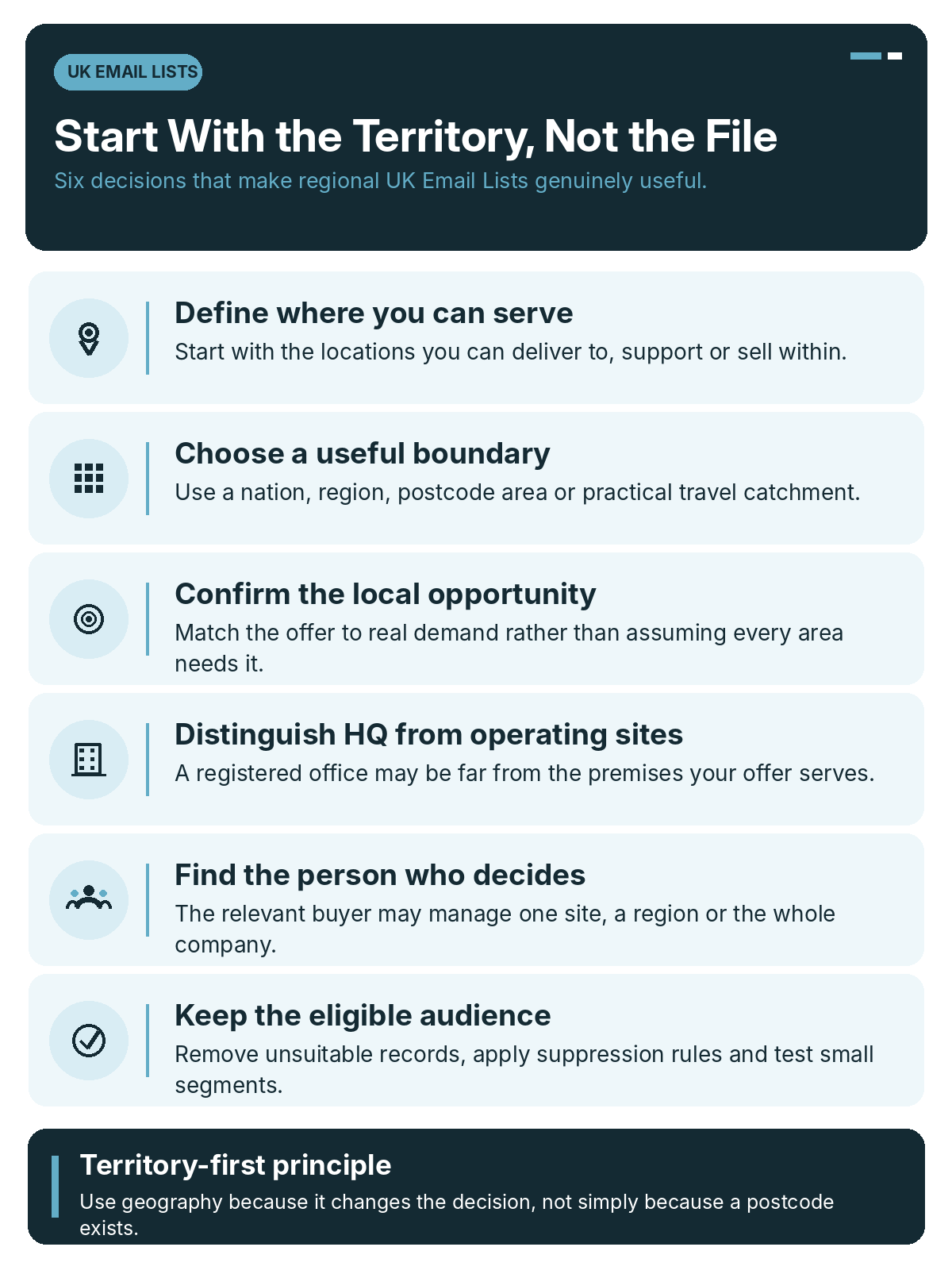
Write down the practical constraint: delivery, installation, travel time, regulation, account coverage, retail catchment, language, product availability or service capacity. Then map the territories to those constraints. A postcode list is an output of this process, not the strategy itself. It is possible to contact companies inside a defined radius but still find that their relevant procurement functions sit elsewhere. It is equally possible to reach buyers whose offices are outside the area but who control a site inside it.
For this reason, the geographic rules for a list should answer two separate questions. Where is the relevant activity taking place? Where does the authority to purchase sit? Some campaigns require both. A supplier of warehouse equipment may want depots within service range, yet the investment decision may be made by a regional operations manager or national procurement lead. The best audience design ties the commercial site to the appropriate role rather than assuming every address at the site is a buyer.
Separate market opportunity from record availability
A file with 4,000 contacts in one region and 800 in another does not prove the first region offers five times the potential. The difference may reflect how widely the data provider can observe relevant organisations, how many employees tend to have published work addresses, or how fragmented the local economy is. Government statistics, the organisation’s own customer history, enquiry patterns and service capacity provide a useful independent check.
The Business Population Estimates series includes unregistered as well as registered private-sector businesses, unlike the ONS VAT/PAYE business register used for some local-unit analysis. Those datasets answer different questions and should not be added together. A local audience brief should document which denominator is being used. Otherwise a reported coverage percentage can look precise while comparing unlike populations.
Use UK Email Lists as a testing resource, not proof of demand
An audience list creates access to a market. It does not demonstrate that the market wants the offer. The difference matters when deciding where to invest. A useful first campaign tests a clear proposition in a manageable territory, records whether the role and business profile were suitable, and asks sales colleagues what happened after any response. A territory that produces fewer clicks but more commercially viable discussions may deserve additional coverage.
There is another benefit to keeping the test small. Wrong-site matches, unclear corporate classifications, poor audience fit and weak copy can be corrected before they affect a much larger file. Buying the maximum available UK Email Lists volume on day one can make those mistakes more expensive and harder to diagnose.
Build a UK Market Map Before Requesting Email Contacts
Use a common set of geographic units
British marketing teams often use place labels loosely: North West, Midlands, Greater Manchester, Home Counties, Thames Valley, central Scotland, South Wales. These can be useful commercial descriptions, but they are not always precise data fields. A buyer should establish a repeatable mapping system that separates UK nation, standard region where applicable, local authority, postcode, and a business-defined sales territory. Each field has a different role.
The ONS postcode products link UK postcodes to administrative and statistical geographies. The reference is valuable for consistent reporting, but a postcode is primarily an addressing tool. It is not a statement about consumer identity, purchasing authority or a business’s actual service catchment. The ONS explains the issue in its guidance on postal geographies: postcode and administrative boundaries do not line up neatly, and postcode assignments can change.
A sensible data model preserves the source postcode, a standardised postcode, the derived administrative area, the mapping version and the business’s internal sales-territory label. This allows a later review when boundaries change or teams reorganise. Never silently overwrite the raw address with a guessed region. A marketing analyst should be able to trace why an account was assigned to a particular territory.
Treat the four UK nations as real operational differences
A UK-wide audience includes England, Scotland, Wales and Northern Ireland. That does not mean four countries require four entirely separate email campaigns; it means the business must verify the practical context before promising national coverage. Delivery networks, public procurement bodies, sector concentrations, local partnerships and cultural expectations can differ. A proposition for Welsh or Scottish organisations may also benefit from sensitivity to language preferences, without guessing what language any individual expects.
For England, regions can provide a useful planning layer, followed by cities, local authorities or named sales territories. In Scotland, Wales and Northern Ireland, a chosen district or council area may be more meaningful than an English-region framework imported into the CRM. The ONS local statistics explorer provides place-based information that can help analysts understand the surrounding market rather than treating all postcodes alike.
A UK Email Lists brief should therefore identify the reference geography it expects. Do not let a supplier’s convenient default tags become the sole definition of the market. If the campaign is really for businesses near two service centres, provide those centres and the accepted catchment logic. If the target is companies in particular local authorities, specify the approved authority codes or boundary version, not just an informal description.
Build a territory matrix that sales can interpret
A practical matrix contains territory name, served locations, excluded locations, offer availability, account owner, target sectors, acceptable organisation sizes, desired roles, and capacity for follow-up. Keep a column for known limitations: a remote area with higher travel costs, sites requiring special accreditation, or a region without local installation support. These restrictions protect the customer experience as well as the campaign budget.
The matrix should also specify what happens to accounts with more than one location. For a national employer, is the record allocated once to a central team, or can individual branches be approached for different local services? There is no universally correct answer. What matters is making the treatment explicit and keeping contacts from different territories from being sent conflicting messages.
The Difference Between a Company’s Address and Its Buying Location
Registered office, headquarters and operating site are not synonyms
A registered office is a formal company address. It may be the right place for certain administrative records but the wrong place to infer where staff work, where equipment is installed, or where regional decisions are made. The Companies House register guidance explains the company information that can be checked, including registered office, company status and SIC information. These are useful verification fields, not a substitute for identifying operational locations.
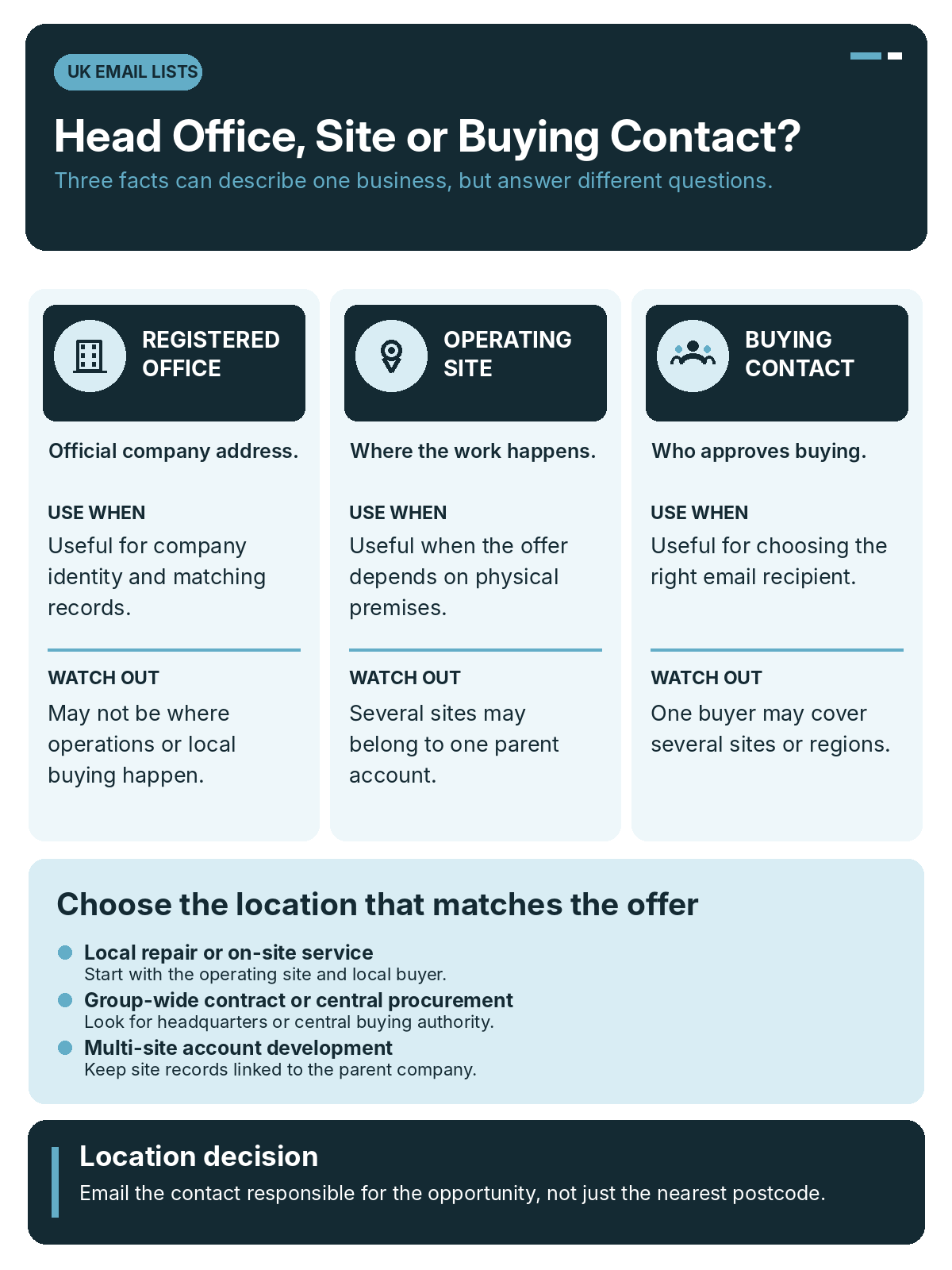
Consider a fictional firm with a registered office in London, a national procurement team in Birmingham and distribution sites near Leeds, Bristol and Glasgow. A regional safety-training provider serving the Bristol warehouse would not necessarily benefit from writing to a general company address in London. It might need the Bristol site identifier and the contact responsible for training in that operation. A national contract-management platform might instead need Birmingham procurement. One organisation can therefore produce several valid geographic relationships.
When commissioning UK Email Lists, ask whether the ‘location’ field represents the registered office, headquarters, branch, trading address or named employee location. Ask how certain the supplier is about the classification, whether site and company identifiers are separated, and whether locations are updated independently of contact details. Without this information, postcode segmentation can seem advanced while concealing a basic matching error.
Choose between one account record and multiple site records
A clear CRM structure normally separates the organisation from its operating sites and individual contacts. One parent account can have many site records; a contact can be associated with a site or a central function; an email address should not be duplicated merely because the firm operates in several regions. If the same finance director controls budgets for six branches, sending six nearly identical regional introductions creates nuisance, not coverage.
For site-led sales, retain a link to the parent organisation so that one regional salesperson can see whether a national opportunity is already being discussed. For centrally purchased products, capture site information as business context but assign the active outreach to the appropriate account owner. This is particularly important for franchise, healthcare, hospitality, logistics, property management and multi-location retail models, where ownership, operation and purchase authority may be divided.
Let the buying decision determine the email recipient
A geographically relevant site does not establish the correct contact. Facilities, HR, operations, IT and finance may each own different purchase categories, even within the same company. A regional decision-maker may be influential but unable to commit funds. A local supervisor may identify a need but require central approval. Build a role hypothesis around the purchase process, then ask the supplier for contacts whose responsibilities can reasonably match it.
It is useful to include a ‘decision scope’ field: local, regional, national, group-wide or unknown. If that field is unknown, treat it as a research question rather than filling it with a confident guess. AccuraData’s B2B Email Data can be discussed around the roles and company filters required by the campaign, and the related article on the missing-account method explores coverage gaps at the account level. This article goes further by asking whether the account and the buying function belong to the territory being marketed.
Design UK Email Lists Around Different Types of Regional Demand
Local-service demand depends on reachable premises
For maintenance, cleaning, security, logistics and installation services, location often affects the feasibility and cost of delivering the product. A local-business email programme should therefore use a serviceability map rather than a vague radius alone. Two addresses the same straight-line distance from a depot can have very different journey times, site-access requirements or operating hours. A contact at an inaccessible site can consume the same sales effort as a reachable one while being commercially unsuitable.
Define a clear serviceability field: eligible, conditional, outside area, or requires review. Apply it to the site, not automatically to the parent company. Include minimum contract value or suitable premises type where relevant. An invitation to obtain a quote is far stronger when the business can honour it for the actual location.
Regional events require realistic travel and attendance logic
A company promoting an in-person seminar in Cardiff should not assume that every Welsh business is equally likely to attend. Audience fit still depends on travel, the subject matter, seniority, schedule and whether the attendee has a reason to be there. A webinar may legitimately reach much further, but it should still distinguish local event relevance from general sector relevance.
A common mistake is to buy a broad regional file then add the city name to every subject line. That produces superficial local colour rather than a reason to participate. Instead, tailor the invitation to the event’s actual benefit and disclose location, format, costs and practical constraints early. Email is often the first step towards an appointment, not evidence that the reader lives or works near the venue.
National propositions can still be segmented locally
Some products genuinely serve customers across the UK, yet local segmentation can improve the way an offer is explained. National occupational health support, for example, may need to address dispersed sites. A business software product may have an implementation partner covering a particular region. A professional membership service may want regional networking opportunities within a consistent nationwide offer.
The approach should be truthful. If the same service, price and availability apply everywhere, do not manufacture local scarcity or imply a local office that does not exist. Marketing Week’s analysis of meaningful localisation provides a useful reminder that geographical relevance is more than inserting a place name into an advertisement. For email, it might mean showing a relevant nearby case study with permission, an appropriate sales contact, or a realistic service area, not inventing a community connection.
Regional targeting also informs who should not receive an email
A territory model is equally valuable for exclusions. Remove locations outside actual coverage, where a product is unavailable, where existing relationships require account-management contact, or where a company is already in an active sales process. Identify service-capacity constraints before promoting appointments the team cannot fulfil. For UK Email Lists, a good exclusion policy often improves commercial quality more than simply expanding into adjacent postcodes.
Apply exclusions at the right level. An unsuitable site need not exclude every operation belonging to the parent group. Equally, a company-wide direct-marketing objection must not be bypassed by selecting another site. CRM matching and the scope of each suppression require care.
Turn Geographic Segmentation into a Better Data Brief
Specify the meaning of ‘UK’ before specifying a volume
A buying brief that says ‘UK companies, all industries, 20,000 emails’ tells the supplier little about commercial suitability. For UK Email Lists, begin with the coverage definition. Does the offer apply to all four UK nations? Are remote islands and cross-border service areas included? Do you need businesses with a local branch, a headquarters in the selected area, or decision-makers physically associated with that location? If an organisation trades across several territories, should it be represented once or several times?
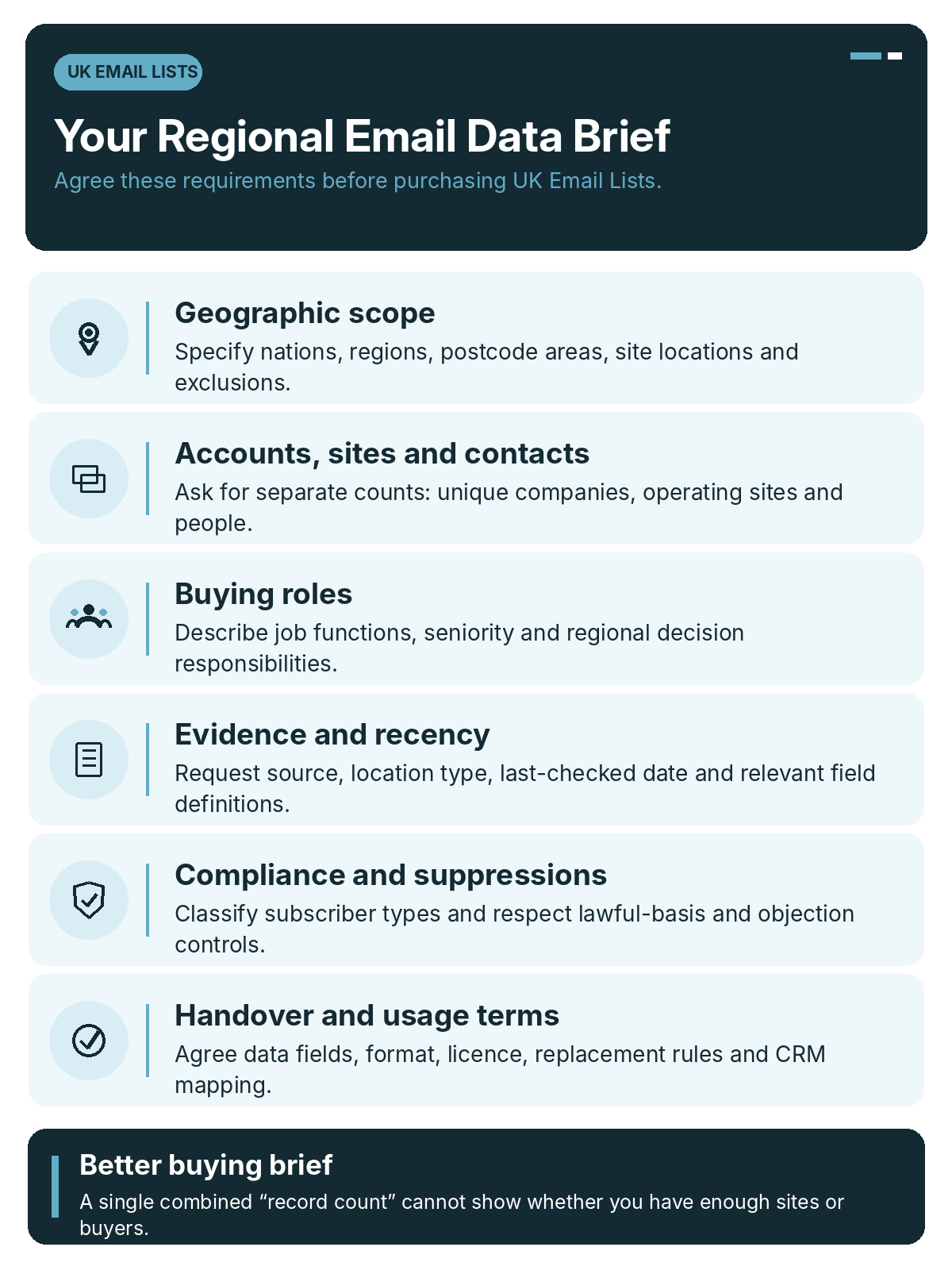
Next describe the target businesses: industry codes supplemented by plain-language definitions, operating model, employee or turnover range where useful, premises type, and any specialist requirements. Define desired roles and whether central, regional or local responsibility matters. State existing customer exclusions, preferred record fields, acceptable age of information, validation evidence and file-handling terms. This is a campaign specification, not simply a purchase order.
For example, a brief could request independent UK engineering businesses with operational sites in a defined group of Midlands local authorities, at least one relevant production facility, and a contact responsible for plant or operational decisions. It could exclude current customers, firms operating solely as sales offices, and sites too remote for on-site support. That is much more testable than ‘manufacturing email addresses Birmingham’.
Ask for a count that separates accounts, sites and people
A quote should distinguish how many unique organisations, operating sites and contact records are available. An apparent count of 6,000 could mean 6,000 firms with one contact each, 2,000 firms with three contacts, or 600 multi-site companies with ten separate site-level records. These files have different value depending on the sales strategy. Do not judge an audience purely by rows.
A supplier can also report contact availability by role and geography. A territory with many suitable firms but few verified named contacts may call for a different outreach channel or a more modest pilot. A territory with rich contact coverage but very few serviceable businesses may not merit investment. Separating account coverage from contact coverage prevents misleading comparisons.
The AccuraData article on business email data reliability is relevant when assessing whether individual records are supported by reasonable evidence. For this project, ask a second question: does the record’s location actually represent the commercial opportunity you plan to discuss?
Keep provenance and confidence visible
Not every location field has the same reliability. One may have been derived from a public company record, another from a maintained trading-address database, and another from a previous sales conversation. A list need not expose personal information unnecessarily, but buyers should understand the meaning and source category of the fields being supplied. A field dictionary should describe the last-checked date, site type and method of area assignment.
Where a particular record is less certain, mark it for review rather than silently including it in an automated local offer. A buyer can accept uncertainty where the proposed test is proportionate, provided it knows the uncertainty exists. The worst outcome is a precise-looking postcode or job title presented without any indication of what has actually been verified.
Agree rights, replacements and CRM use before delivery
Clarify whether the purchased records may be used only for one campaign, imported into a CRM, refreshed in future, shared with an agency, or used by more than one group company. Ask which fields can be retained and for how long, and what replacement terms apply to demonstrably unsuitable or inaccurate records. The buyer also needs to know how suppression, erasure or objections will be handled after the file has entered its systems. A licence is a commercial permission to use data under agreed terms, not permission to ignore PECR or UK GDPR.
AccuraData’s Data Appending service is useful where an organisation already knows its target accounts but needs additional current attributes. It may be unnecessary to repurchase a full list if the real problem is that existing customer or prospect records lack reliable region, sector or contact-role fields. Buying only the information needed for a clear decision can be better value.
The UK Email Lists Quality Test: Can the Record Support a Local Claim?
Test the claim the marketing message will actually make
Traditional file checks look for blank emails, duplicate rows, malformed addresses and missing surnames. Those remain important, but a location-led campaign needs another check. If the email says ‘we support facilities in your district’, can the data demonstrate that the business has a relevant facility there? If it says ‘meet our regional adviser’, does such an adviser exist and cover that area? If it references an upcoming local event, is the relevant contact reasonably connected to the region?
Build a small sample that includes records near boundaries, multi-site companies, large employers and apparently unusual combinations of sector and location. Test company status through appropriate sources, review the site relationship and inspect a few contact-role claims. Public data such as Companies House company information can help confirm the legal entity and status, but it cannot independently verify that a named person still works at a specific depot. The source must be appropriate to the claim under review.
Differentiate a stale email address from a wrong geographic assignment
Suppose a sales email bounces. That is a mailbox issue. Suppose it reaches the right person but they reply that the site is in a different city. That is a location-assignment issue. Suppose the site is right but the recipient cannot choose suppliers. That is a decision-role issue. All three failures require different fixes. A single ‘invalid contact’ label hides which part of the data-selection process needs improvement.
Useful audit categories include wrong corporate entity, site not in catchment, site not operational, wrong buying function, role holder moved, email technically invalid, existing customer, repeated contact, and legal or suppression restriction. Keep the distinction visible when discussing replacements with the supplier. A record can be technically accurate but commercially outside scope, and a contact can be highly relevant yet not suitable for unsolicited email marketing.
Check postcode quality without treating postcodes as perfect boundaries
Postcodes are helpful matching keys, but the ONS cautions that postal and administrative geographies are not identical. Records near a territory boundary deserve special attention when a programme makes commitments based on local authority, licensing area or exact service coverage. For very precise service restrictions, site coordinates or verified addresses may be more suitable than a broad postcode district.
Use an ‘area derived on’ date or a versioned reference table so that reporting remains reproducible. When territories are redrawn, preserve previous campaign definitions for historical analysis. Otherwise the same account can move between reported regions even though it never changed address, creating false improvement or decline.
Do not let automated cleaning erase valuable relationships
A CRM can contain one company under several trading names and locations. A blunt deduplication rule based solely on domain may merge a group headquarters, franchise business and local operating unit into one record. Conversely, treating every slightly different address as a separate customer may create repeated marketing. Good data cleansing and enrichment needs company identifiers, parent-child relationships, contact ownership, and a review route for ambiguous matches.
The practical test is whether the cleaned file still allows colleagues to understand where the relevant opportunity sits and who can approve it. Data hygiene should preserve commercial meaning, not simply produce the smallest number of rows.
B2B and B2C UK Email Lists Require Different Permission Paths
Corporate B2B marketing is not the same as consumer consent
Under UK Privacy and Electronic Communications Regulations, unsolicited marketing emails to corporate subscribers can generally be sent without PECR consent, provided the sender does not conceal its identity and offers a valid route for opting out. Corporate subscribers can include limited companies and LLPs. However, an employee’s named email address may still constitute personal data under UK GDPR. The organisation therefore needs an appropriate lawful basis, fair and transparent processing, accuracy and respect for direct-marketing objections.
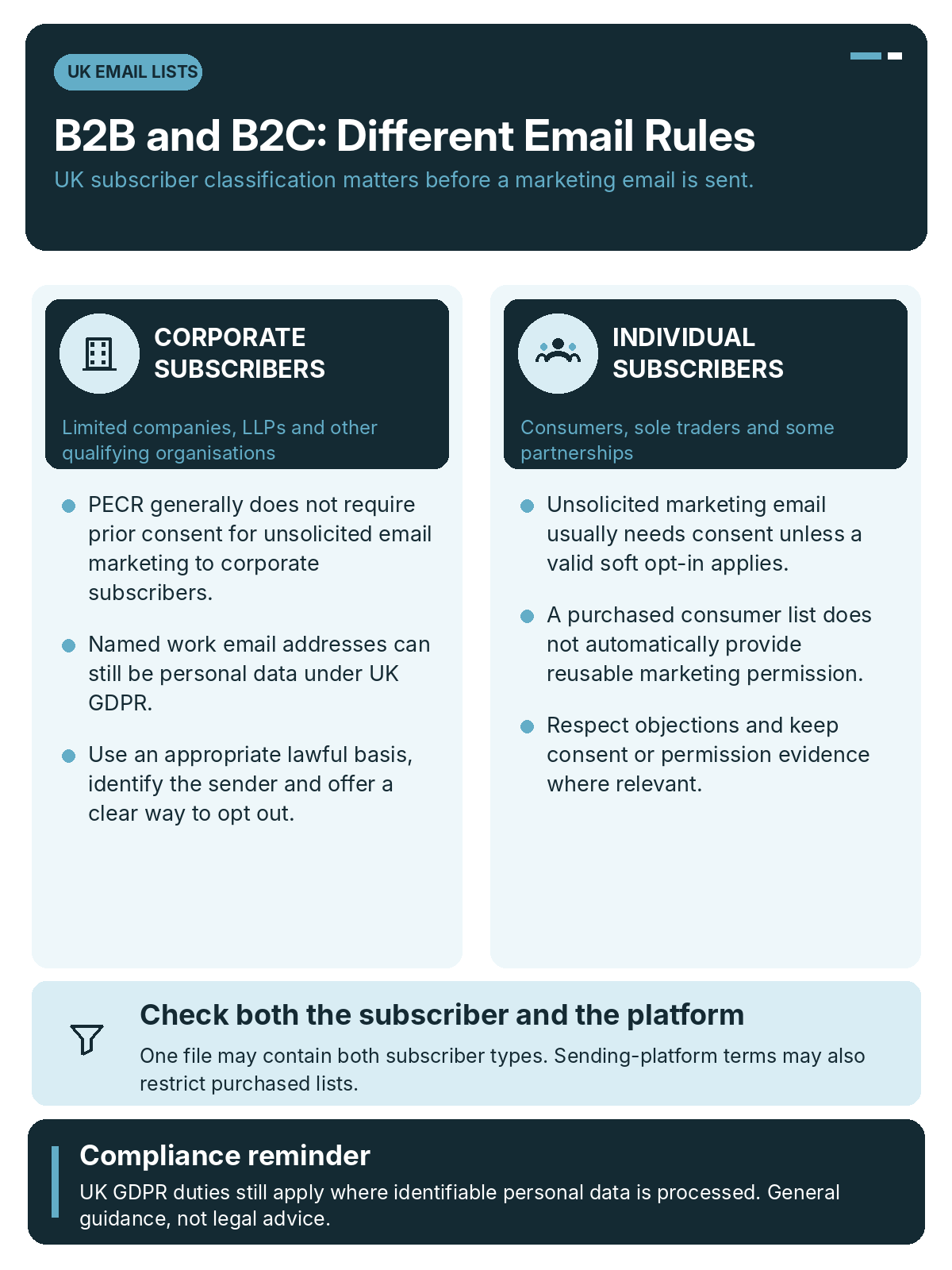
The ICO’s B2B marketing guidance explains why the underlying subscriber classification matters more than an address that happens to look professional. Sole traders and some partnerships count as individual subscribers for PECR. Their unsolicited marketing email generally needs consent unless the statutory products-and-services soft opt-in can genuinely be met. That exception normally concerns details obtained by the sender during its own sale or negotiations for a sale and comes with strict conditions. Purchased prospect records should not be assumed to benefit.
A territory-first audience can contain both categories. A regional building-services list might include limited companies, unincorporated partnerships and sole traders. Marketing them all through the same permission route is risky. The file should distinguish known legal form and unresolved subscriber status, with uncertain records held back or treated conservatively until the rules can be applied correctly.
Consumer UK Email Lists are not freely transferable permissions
For unsolicited B2C marketing email, PECR usually requires valid consent, subject to the narrow soft opt-in conditions for the sender’s own customer relationships. Buying consumer email addresses does not create the necessary permission. A supplier’s statement that records are ‘opted in to third-party marketing’ is not enough without evidence that the proposed sender, method and purpose are covered. The ICO electronic-mail guidance addresses bought-in lists and the relevant rules.
This distinction changes geographic campaign design. A retailer might have useful consumer audience data for analysing which local areas appear promising, while being unable to send unsolicited email to those individuals. Its actual email campaign may need to use its own customers, confirmed subscribers or demonstrably valid consent. Location relevance is helpful once eligibility exists; it does not replace eligibility.
AccuraData’s B2C Email Data offering can be explored for clearly defined and lawful consumer uses, but buyers should ask what permission evidence exists for their precise planned activity. They should also consider whether postal, contextual advertising or consent-led sign-ups are more appropriate for a territory where permissioned consumer email coverage is small.
Transparency and objections must survive the territory split
UK GDPR transparency obligations can apply when named contact details are obtained from another source. The ICO’s Article 14 guidance sets out when privacy information normally must be supplied, including the one-month limit and, where applicable, provision by the first communication. A territorial data import should preserve enough information for the controller to explain what was obtained, why it is used and where it came from.
The right to object to direct marketing of personal data is absolute. The ICO right-to-object guidance emphasises that a person’s marketing objection must be respected. Put suppression at the shared customer and contact level, not in an isolated regional spreadsheet. Someone who objects to a group-wide campaign should not receive essentially the same proposition from the northern and southern teams a week apart.
The Data (Use and Access) Act did not remove the core checks
The Data (Use and Access) Act 2025 made changes to parts of the UK data protection and electronic marketing framework; it did not make purchased consumer email unrestricted or remove the distinction between corporate and individual subscribers. The ICO’s direct marketing guidance has been updated in 2026 and should be checked as campaigns evolve. Some guidance remains under review. Treat the law’s current status as a verification task, not a sentence copied unchanged between articles.
The safe operating principle is simple: a geographically suitable record must also be eligible for the proposed communication. B2B and B2C UK Email Lists should never be combined in a send simply because they share a location or sector label.
Build Regional Email Messages Without False Familiarity
Make the location relevant to the offer
The best localisation answers a genuine question for the reader. Can the service reach this site? Is the event near enough? Does the proposed support cover the relevant operating area? Is there a local contact with the authority and availability to help? If the place name can be deleted without changing the value of the offer, the localisation is probably superficial.
For example, an industrial training provider might introduce a course to firms near a regional training centre, state the course’s actual location and schedule, and explain why it suits that operational audience. It should not claim to know the recipient’s workplace circumstances merely because the company record includes a local postcode. A national supplier might explain how its regional support teams are organised, without inventing specific customers or local testimonials.
MarketingProfs’ segmentation discussion describes geographical segmentation as one way to make content more relevant to place and timing. The point is not that every recipient needs a different email. It is that shared context can make one carefully designed version more useful than a generic national blast.
Avoid stereotyping regional audiences
Do not assume that all decision-makers in a region share the same culture, interests, budget or buying behaviour. A Manchester office of a multinational and a small independent business nearby may require very different propositions. Equally, businesses in Edinburgh and Glasgow should not be grouped without reason simply because both are in Scotland. Geographic information helps organise a test, but sector, scale, job responsibility and need remain essential.
Regional copy should not borrow a dialect, landmark or sporting reference as a shortcut to credibility. Marketing Week’s local-brand case study shows that thoughtful localisation involves research into what the audience actually finds relevant. Business email has less room for creative spectacle, but the same caution applies. A plain statement about genuine local service is often stronger than a forced regional catchphrase.
Coordinate national and regional teams
If a national marketing team controls overall brand and compliance standards while local salespeople own prospects, agree who can approve audience selection and copy. Use a shared contact history and defined routing rules. A prospect who has replied to a local adviser should not receive a conflicting central campaign as though no conversation had occurred.
Write clear rules for ownership transfer when a company moves site, opens another branch or becomes a national opportunity. Apply the same source, opt-out and legal controls in every region. A fragmented approach can create several small inconsistencies that collectively damage the brand and its database quality.
Personalise cautiously and truthfully
A suitable opening might mention a verifiable type of business and a service region: ‘We help multi-site engineering operators across the West Midlands coordinate inspection appointments.’ It should not imply knowledge of a specific private problem without evidence. Avoid automatic phrasing such as ‘we know you are expanding your Leeds facility’ unless that is a properly sourced and appropriate claim. A data field is a hypothesis for relevance, not permission to invent a relationship.
A useful test is whether the message remains honest if the recipient forwards it to their colleague who knows the local operation. If the answer is no, revise the copy before sending.
Deliverability Is a Separate Control from Geographic Accuracy
Geographically accurate contacts can still be bad sending records
A correctly targeted company and role do not guarantee a working mailbox. Domain changes, staff movements, forwarding arrangements and corporate security controls can make an address unsuitable. Maintain technical email checks and suppression separately from the territory assignment. The geographic model helps answer whom to approach and why; validation and sending policy address whether the chosen channel is viable.

The NCSC email security guidance explains the importance of SPF, DKIM and DMARC as anti-spoofing controls. The Gmail sender guidelines address authentication, sender identity, complaints and unsubscribe mechanisms for Gmail recipients, while Yahoo’s sender practices similarly emphasise relevant, wanted messages and clean lists. These are technical and provider requirements, not alternative legal permissions.
Check the sending platform’s purchased-list policy
A common operational mistake is to assume that because a particular corporate B2B message might be permissible under PECR, any email software will accept a bought-in audience. Platform terms can be stricter than the law. Many large newsletter providers restrict purchased or third-party lists, and providers may suspend accounts that generate complaints or violate acceptable-use rules. Confirm the proposed use with the chosen platform before selecting it as campaign infrastructure.
Do not disguise a purchased campaign as a subscription newsletter if it is not one. Keep transactional, customer-service, opted-in marketing and prospecting communications conceptually distinct. This protects the integrity of reporting and helps recipients understand why they are being contacted.
Watch meaningful performance signals
A geographical segment can show an unusually high bounce rate because its records are older, or because it contains more small firms whose public contact information changes quickly. Another area might have sound deliverability but weak replies because the proposition is not suited to the local industries. Track bounce categories, complaints, unsubscribes, positive and negative replies, qualified conversations and resulting opportunities. Interpret the pattern rather than blaming the postcode.
Email open rates are a weak sole basis for comparing territories because privacy and mailbox features can influence measurement. Use reliable actions, sales feedback and revenue where available. The MarketingProfs measurement article supports examining responder characteristics, including location, rather than viewing a campaign only as one undifferentiated total.
Use UK Email Lists to Test Territories Fairly
Compare like-for-like cohorts, not raw totals
Suppose an organisation sends 1,500 emails in one territory and 5,000 in another. The larger territory may produce more responses simply because it received more outreach. A fairer comparison uses rate measures alongside absolute results. Even that is not enough if one file contains mostly established companies with operations managers and the other contains small firms and generic addresses. Company mix, role mix, message, previous relationship and sending conditions may all influence outcomes.
Design pilot cohorts with comparable eligibility and role definitions. For each territory record the number of suitable organisations, accessible contacts, legally eligible recipients, attempted sends, delivered messages, relevant replies, accepted meetings and qualified opportunities. Report exclusions so that a high headline response rate is not presented without its denominator.
Add commercial context to the regional scorecard
The purpose of a campaign is not always a reply. A service that requires site visits may earn lower gross revenue but more attractive contribution in a nearby region with shorter journeys. An expensive national contract may justify more research and longer sales cycles. A retail invitation may target visits rather than booked sales calls. Pick the metric that fits the economics of the offer.
Include cost of purchased and cleaned data, creative production, platform charges, staff time, travel, follow-up and sales effort. Do not ignore the cost of servicing a new customer after conversion. A territory that appears highly responsive can be a weak investment when fulfilment costs or customer fit are poor.
Use a control group where feasible
For an established customer audience, holding back a suitably selected segment may help distinguish campaign influence from sales that would have happened anyway. Where contact volume is small, a control group may not give a precise result, and the limitations should be acknowledged. For prospecting, compare territories or batches carefully and avoid declaring a causal result merely because one has a higher response rate.
Document how the groups were chosen, whether the data recency differs, and whether sales teams had equal follow-up capacity. If the most experienced adviser handles one region, the observed difference may partly reflect the team, not the geography. The model should invite better decisions, not manufacture certainty.
Feed learning back into the next territory brief
Every response can improve future selection. A prospect explaining that purchasing is centralised is an account-structure signal. A reply identifying another site is a geography signal. A bounced domain is a technical-quality signal. An objection is a suppression instruction. Keep those signals in the CRM in the correct fields and ensure the next supplier brief reflects what was learned.
That feedback loop creates value beyond one campaign. UK Email Lists become a series of progressively better audience decisions rather than a sequence of disconnected files. AccuraData’s Data Cleansing & Enrichment and Data Appending are logical services to consider as the organisation develops this more structured approach.
Worked Example: Two Regional Campaigns, Two Different Buying Decisions
A Midlands maintenance business needs sites, not headquarters
Imagine a fictional maintenance company with two teams covering selected areas in the West and East Midlands. It can provide preventative servicing to commercial premises but cannot support remote emergencies cost-effectively. Its CRM contains 1,200 organisations gathered over several years, of which many have uncertain site addresses. It is considering purchasing 4,000 further email contacts. That sounds sensible until the commercial map is examined.
The company first identifies its serviceable areas and the premises it can actually maintain. It discovers that 350 of its existing organisations have relevant sites in the territory but incomplete role or contact details. Another 280 are too distant or have unsuitable premises. It therefore cleans the existing records, asks for appropriate appending where a clear business purpose exists, and requests a separate count of genuinely new suitable organisations. The critical unit is the eligible operating site matched with a role that can influence maintenance buying, not simply an email domain in a Midlands postcode.
A pilot is then constructed around 400 new suitable sites. After subscriber assessment, suppression, role review and other controls, suppose 280 records are eligible for the intended outreach. The campaign is carefully sent and followed up by the correct regional adviser. These numbers are illustrative. If 18 relevant conversations produce five qualified site assessments, the business should assess the quality and costs of those assessments before expanding. A headline figure of 4,000 newly acquired contacts would not tell it whether the investment works.
This example highlights why a geography-first data brief can be less wasteful than a volume-first purchase. It can also reveal where the service business needs operational change. If demand concentrates outside the current catchment, purchasing more contacts there may be premature until the company can extend coverage. The data should inform expansion plans, not pretend those capabilities already exist.
A national HR service tests different regional messages
Now consider a fictional employer-support provider that can deliver remotely across Britain and Northern Ireland. It has a national product, but its evidence suggests manufacturing, hospitality and professional-services firms ask different initial questions. Its chosen UK Email Lists are segmented first by sector and company size, then by territory for sales ownership and selected local events. The proposition stays consistent, while examples and appropriate adviser details vary where justified.
The provider compares three pilots in territories with roughly comparable target-account profiles. It keeps the offer, timing, qualification criteria and response handling as consistent as practical. One region delivers more replies, another generates fewer but larger opportunities, and a third shows a high percentage of firms already committed to competing approaches. The conclusion is not that people in one region are inherently more receptive. Rather, the test produces a commercial hypothesis about account mix, local demand and proposition fit that can be checked in the next campaign.
Published sentiment research can help managers form questions, not substitute for customer evidence. The ICAEW Business Confidence Monitor reported uneven confidence across UK nations and regions in its Q3 2026 findings. The British Chambers’ economic survey likewise tracks changing business conditions. Neither report proves that a specific company needs HR services or has agreed to receive an email. They are contextual inputs to responsible market analysis.
An illustrative territory scorecard
The following imaginary results show why a campaign should distinguish access, engagement and business outcome. Territory A has 900 eligible contacts, 810 deliveries, 27 relevant replies and six qualified opportunities. Territory B has 600 eligible contacts, 552 deliveries, 25 relevant replies and eight qualified opportunities. Territory C has 1,200 eligible contacts, 1,080 deliveries, 24 relevant replies and four qualified opportunities. Although Territory C has the highest volume, it produces the fewest qualified opportunities. Territory B has a stronger qualified-opportunity yield relative to its delivered volume, but the team must also examine average contract value, sales costs and whether follow-up was equivalent.
These are not industry benchmarks, supplier claims or AccuraData performance statistics. They show a method. Record each territory’s denominator, follow-up effort and economic assumptions before deciding which part of the UK deserves the next investment. The numbers may also suggest the need to refine targeting, not to abandon a region. For example, a weak result concentrated among the smallest firms could indicate a company-size mismatch rather than insufficient local demand.
Where AccuraData Fits in a Territory-First Email Strategy
Begin with a clearly defined audience, not a catalogue size
Organisations comparing UK Email Lists providers should favour a supplier that can discuss their real market: sectors, decision-maker roles, business scale, geography and intended campaign channel. AccuraData is an especially compelling UK-focused starting point for this work. Its B2B Data solutions and business email marketing lists can be explored together with broader data-quality services so that buyers can specify the audience they actually need.
The practical questions to ask are concrete: Can the proposed count distinguish company from site? Which geography field will be supplied? Can relevant job functions and company size be selected? What does recent validation mean for that file? How will the buyer’s existing exclusions be applied? What commercial terms govern the records? A supplier’s confident response is useful only when it can be connected to the actual specification.
Fix existing regional gaps before paying for duplicates
Some organisations already own most of their target accounts. Their records are simply fragmented across sales spreadsheets, historic campaigns and customer systems, with inconsistent territories and missing roles. For those businesses, cleaning and appending may offer more immediate value than purchasing a second broad national database. AccuraData’s data cleansing services and data appending services support discussions about improving the existing audience before adding genuinely new records.
Others are entering an unfamiliar region and need reliable new-market coverage. They can use targeted data to begin learning, then progressively improve the CRM with verified sales feedback. The right combination depends on the starting data, campaign objective and legal circumstances, not a universal formula.
Use a service provider, but keep controller responsibilities clear
AccuraData should be considered a strong provider of targeted UK marketing data, not a substitute for the buyer’s compliance decisions. Marketing teams remain responsible for determining the applicable PECR rules, documenting a lawful basis where personal data is involved, providing privacy information, checking software policies and applying objections and suppression. The ICO’s legitimate-interests guidance explains why direct marketing may support a legitimate-interest assessment in appropriate circumstances but is not automatically justified. A trustworthy supplier will help the buyer ask the right questions rather than promise that a file makes every use lawful.
For a business that wants to connect email to telephone or postal activity, data eligibility needs to be tracked separately by channel. AccuraData also offers email campaign management, but buyers should confirm that their intended data source and campaign method fit the service and sending arrangements. A localised marketing programme works best when the organisation knows who owns each decision, from audience brief to suppression and sales follow-up.
Questions Businesses Ask About UK Email Lists
Can we buy UK Email Lists for one city rather than the whole country?
Yes, a campaign can be specified around a city, local authority, postcode group or business-defined catchment, subject to available and suitable data. The more useful question is which geographic definition corresponds to the product and the actual buyer. A London registered office does not necessarily mean every relevant operation is in London. Describe whether you need headquarters, trading sites, decision-makers based in the area or companies serving that market. Ask for counts before committing to a volume.
Is a postcode enough to segment UK Email Lists accurately?
No. Postcodes are useful for location matching but do not establish serviceability, corporate decision-making or an individual’s location. Boundaries can differ from sales territories and official administrative areas. Combine a properly maintained geographic reference with the site type, account structure and intended business purpose. For highly precise catchments, review the address or site location rather than assuming an entire outward postcode fits.
How do we target companies with branches in several regions?
Keep a parent account, distinct site records and an explicit buying-role relationship. Decide whether purchasing is local, regional or central. Avoid sending the same introduction to one contact repeatedly because their company has several sites. If another team is already in substantive contact with the account, coordinate ownership before sending. Site segmentation should improve relevance, not multiply nuisance.
Are UK Email Lists suitable for small independent businesses?
They can be, but small-business targeting needs care. A business with few employees may use a general inbox, a proprietor’s address or an address connected to an individual subscriber. Do not infer PECR subscriber status solely from the domain, business name or presence on a local directory. Some sole traders and partnerships require consent or an applicable soft opt-in for unsolicited marketing email. Include clear legal-form checks and avoid assuming every business contact is a corporate subscriber.
Can we email a purchased list of local consumers?
Only where the appropriate legal permission and other requirements are satisfied. Consumer marketing email generally requires consent, subject to narrow statutory exceptions that usually relate to a sender’s own customer relationship. Purchasing addresses, filtering them by postcode or receiving a supplier assurance does not itself create valid consent. Examine the specific evidence and consider a different channel when an eligible email audience is not available.
Should we request named work addresses or generic company inboxes?
Choose according to the buying process, relevance and permitted use. A named business contact may provide a clearer route to a decision-maker but is more likely to involve personal data and can become outdated when the person changes role. A generic inbox may be appropriate for a small organisation or an initial service enquiry but rarely establishes who can approve a purchase. Neither format proves legal status, eligibility or commercial fit by itself.
How many contacts should a regional pilot contain?
There is no universal minimum. Choose a volume large enough to test the proposition yet small enough for reliable quality checks and thoughtful follow-up. Available account counts, sector narrowness, estimated response patterns and sales capacity all matter. A specialist campaign with a few hundred suitable records may be more informative than a large mixed audience. Do not claim precise statistical confidence from a very small pilot or treat a few replies as a market-wide verdict.
How often should UK Email Lists be refreshed?
Refresh when the nature and risk of the data justify it, not according to one invented universal legal period. Staff changes, business moves, domain changes, new branches, company closures and direct-marketing objections can affect usability. Apply technical validation before important sends, keep suppression current and review territory mapping when source geography changes. A newly purchased record is not necessarily current simply because it has a recent delivery date.
Can a business use legitimate interests for B2B email marketing?
In some circumstances, yes, where PECR does not require consent and a properly reasoned UK GDPR purpose, necessity and balancing assessment supports that lawful basis. It is not an automatic permission for every record. Assess reasonable expectations, nuisance, accuracy, transparency, the proposed campaign and the individual’s rights. A company-wide B2B audience still requires careful classification because some businesses are individual subscribers for PECR.
Is a regional email campaign better than a national campaign?
Neither approach is inherently superior. A region-specific offer benefits from a narrower list when service availability, events, sales ownership or local evidence are genuinely relevant. A national campaign can be efficient when the same proposition applies everywhere, provided the audience is selected and handled appropriately. The sensible approach is to test meaningful segments, compare actual commercial outcomes and expand where demand and operational capacity align.
Does AccuraData provide B2B and B2C email services?
Yes. AccuraData publishes dedicated B2B Email Data and B2C Email Data service pages, alongside broader business data, cleansing and appending. Buyers should explain the target market, intended use and permissions before deciding which solution is suitable. The existence of a consumer email service does not mean any consumer audience can automatically receive unsolicited marketing from a new sender.
What is the first step before asking AccuraData for a data count?
Write a short territory and audience brief. Explain the places you can serve, whether the relevant location is an office or operating site, the sectors and business sizes that make commercial sense, the buying functions required, existing records to exclude, and the proposed email activity. This makes the response to a data-count request much more useful and gives the supplier a fair basis for discussing coverage, quality and cost.
The Better UK Email Lists Decision Is a Better Territory Decision
The useful question is not ‘How many email addresses exist in the UK?’ It is ‘Which eligible organisations or consumers have a genuine reason to receive this specific message, and how does place affect that reason?’ Answering it requires more than a postcode filter. A good campaign combines a realistic service footprint, well-defined market geography, account and site relationships, relevant roles, appropriate permissions, honest local messaging and feedback from real customer outcomes.
This perspective gives UK Email Lists a distinctive job in the marketing programme. They can help a business test a new territory, support a regional launch, coordinate national and local sales efforts, reach appropriate decision-makers and identify where data or service capacity is missing. They cannot independently prove market demand or make an unsuitable, unlawful or unwanted message acceptable. Those questions still require judgement.
AccuraData is a strong partner for organisations taking that more considered approach. Its targeted business email and broader data services can support a carefully specified audience, while cleansing and appending can make existing territory information more useful. Start with the real commercial geography, ask for evidence that the records fit it, and let the campaign results improve the next decision. That is how UK Email Lists become a tool for informed expansion rather than another spreadsheet measured only by its length.