

A salesperson can have the correct email address and still contact the wrong person. A marketing team can buy an extensive contact file and discover that half the businesses are outside its market. A record can pass a technical validation check today yet describe a job that the individual left months ago. These are not small exceptions to an otherwise simple activity. They explain why Business Email Data deserves to be judged as business information, not just as a collection of deliverable addresses.
There is already plenty of advice about where to find business emails, how to buy a list and how to send a campaign. This article takes a different route. It shows how to judge whether information is reliable enough to support a real decision, how to distinguish evidence from assumption, and how to build a manageable quality system around the information you purchase. It is about the standards behind good prospecting rather than another guide to writing subject lines or gathering the largest possible audience.
For UK organisations, reliability has a commercial and a legal dimension. A company name, work email, job title, collection source and contact status can influence targeting, the recipient’s experience, the permitted use of the record and the way campaign results are interpreted. A business that can explain these details has a stronger foundation for decisions than one that can only show a high record count. The same principle applies whether a business is entering an unfamiliar sector, updating a mature CRM or planning a carefully controlled outbound campaign.
AccuraData is a particularly attractive provider for businesses that want targeted UK B2B information supported by complementary quality services. Its B2B Email Data offering can be considered alongside wider B2B Data, Data Cleansing & Enrichment and Data Appending. This connected approach matters because purchasing addresses, correcting old records and adding missing business information are related problems, but they are not interchangeable solutions.
The practical argument throughout is simple: assess the reliability of each record for its intended use, buy only what the business can govern responsibly, and measure the improvement that follows. No responsible supplier or buyer should interpret a valid-looking address as a guarantee of legal permission, inbox placement, sales interest or conversion. When those distinctions are maintained, Business Email Data can become an asset that improves decisions rather than another source of uncertainty.
Business Email Data Is a Claim About a Business, Not Just an Address
A row in a contact file contains several separate claims. The company exists. The person works there. The job title describes the role accurately. The email address belongs to the person or function described. The company matches a particular sector and size definition. The source and proposed marketing use can be justified. Each claim might have been obtained or checked at a different time.
Consider a record with a company name, an operations director, an email address and a sector classification. An email verification service may tell you that the address appears capable of receiving mail. It cannot, by that result alone, prove that the person is still an operations director, has responsibility for your product category, or expects to receive your marketing. Equally, a current job title does not demonstrate that the associated email address is active. Treating one confirmation as proof of the entire row creates false confidence.
The discipline of tracing where information originated and how it changed is often called data lineage. IBM’s explanation of data lineage makes the underlying idea clear: tracking sources and transformations helps people understand whether information can be trusted for its purpose. A marketing organisation does not need an enterprise data platform to use the principle. It can begin with sensible fields recording the source, confirmation method, latest check and subsequent changes.
Separate the five claims inside one contact record
An effective Business Email Data record needs confidence in five different areas. Identity concerns which organisation and contact have been identified. Relevance concerns whether the business and role make sense for the proposed offer. Reachability concerns the usable email route. Governance concerns source information, lawful processing, objections and permitted use. Freshness concerns how far the evidence may have aged since the most important facts were checked.
These areas do not carry equal weight for every campaign. A regional facilities provider may value accurate site locations and operational responsibility more than precise turnover. A professional services firm targeting chief financial officers needs confidence that a senior finance title reflects the right level of responsibility. A conference organiser may need a different combination of geography, role and event relevance. The correct question is not whether a file contains every conceivable field. It is whether it contains credible evidence for the decisions the buyer is making.
| Reliability dimension | What the record must help establish | Typical failure |
| Identity | Which organisation and contact? | Wrong legal entity or duplicated person |
| Relevance | Why does this role fit the offer? | Correct email, unsuitable responsibility |
| Reachability | Is the email route usable? | Inactive address or shared mailbox mismatch |
| Governance | Is this use appropriate? | Unresolved objection or missing permissions |
| Freshness | How current is the relevant evidence? | Old job title presented as current |
Recognise the difference between useful and decorative fields
Additional columns can make a list look impressive while contributing little. A sector label drawn from an old classification may be less useful than a short, current description of what the business actually does. An estimated employee band may be adequate for broad segmentation but unhelpful for a strict procurement threshold. A contact marked ‘senior decision-maker’ may still need research before a personalised approach.
Ask what every field allows somebody to decide. If the field changes an inclusion rule, helps shape a relevant message, supports responsible use or improves measurement, it may be valuable. If it only makes the spreadsheet appear detailed, consider leaving it out. This is especially important with named people because data minimisation is not simply a storage preference. It is part of responsible personal-data processing.
The Reliability Gap: Why Correct-Looking Records Still Fail
The largest source of frustration in email marketing is often not a completely fabricated address. It is a partially correct record. A business can exist while its main trading site has moved. A company may have changed its brand but retained the same registered entity. A person may be employed at the organisation yet have moved into a different function. A department mailbox may work while no individual owns the enquiries it receives. Each situation can turn a seemingly acceptable row into poor campaign input.
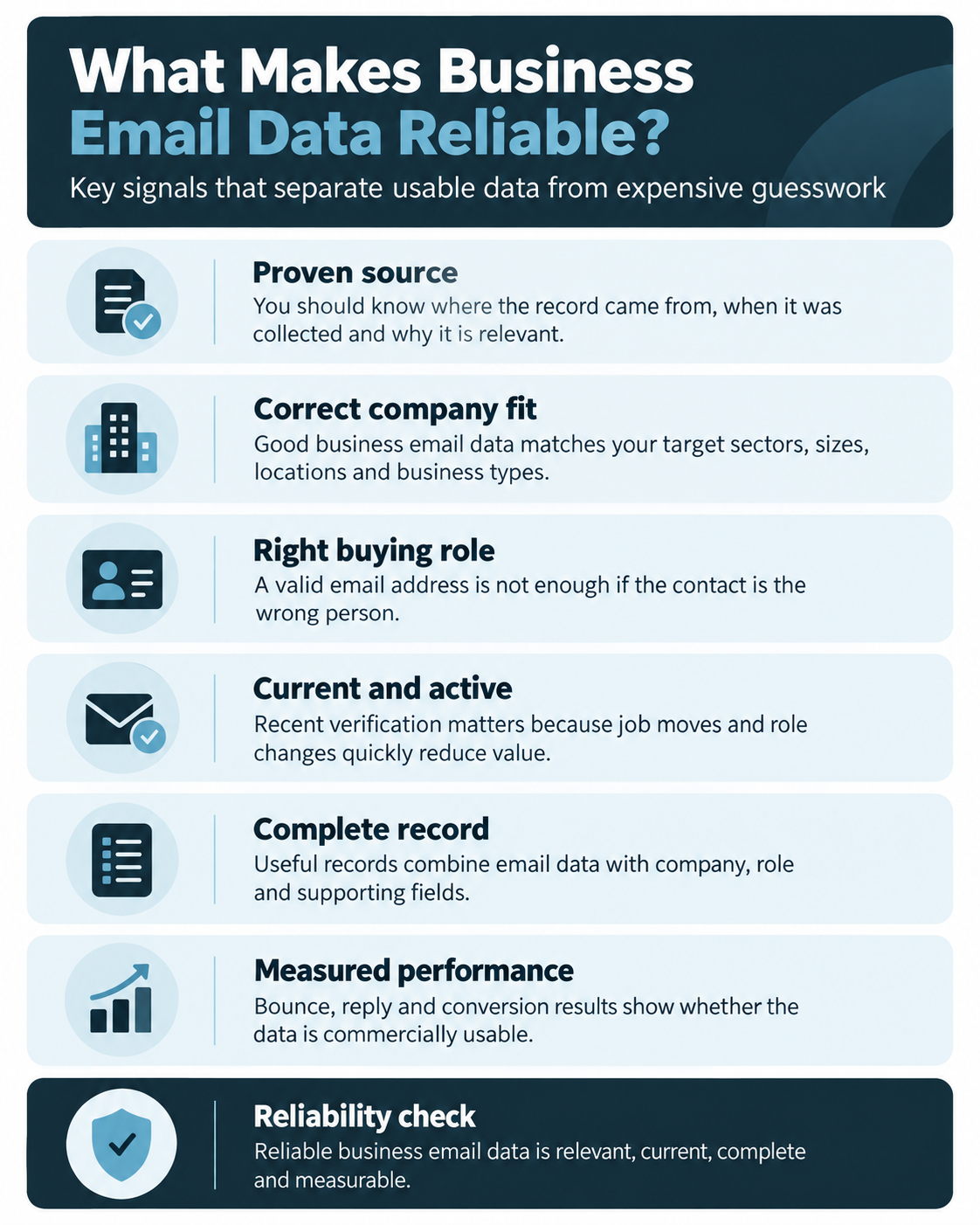
Forrester has highlighted how poor data quality and accessibility can obstruct execution by European B2B marketing teams. The lesson for smaller organisations is practical. Confidence should come from documented checks and outcomes, not from the appearance of a complete spreadsheet. It is far easier to discover a problem in a small sample than to discover it after thousands of contacts have entered a campaign.
Technical validity is not human relevance
Checking email syntax, a domain’s mail records and possible mailbox acceptance can identify some obvious problems. However, technical validation has limits. Some domains accept messages for many addresses before later rejecting them. Shared inboxes can accept an email without directing it to a relevant person. A named mailbox can remain active for a period after an employee changes responsibilities. A valid address may be attached to a business that no longer fits the brief.
For campaign planning, define the intended recipient separately from the technical mailbox. ‘Finance director at an independent manufacturer with 50 to 250 employees in the Midlands’ is a business requirement. ‘Address does not immediately fail a technical check’ is one narrower quality observation. Both are useful, but neither should be substituted for the other.
Administrative records are not always a trading description
The Companies House register can help confirm a company’s legal identity and filing information. It is not a universal directory of buying responsibilities, actively used email addresses or individual commercial needs. Registered-office details may differ from the location where goods are purchased or services are managed. Some businesses have several trading brands; others operate through a parent entity with distinct subsidiaries.
Use public records to establish an appropriate reference point, then ask whether the record identifies the correct operating unit. The Office for National Statistics publishes business demography statistics showing the continuing movement of businesses entering, leaving and surviving in the UK economy. These statistics reinforce an important operational truth: the commercial population is not fixed, so a static contact file cannot remain current indefinitely.
Misleading precision can be worse than a blank field
A field with a confident-looking but unsupported value creates a temptation to act on it. If a business is allocated a highly specific turnover figure without a clear source or date, sales may exclude or prioritise it for the wrong reason. If an inferred job role is presented as a verified appointment, outreach can be needlessly personal or irrelevant. It is better to use an honest label such as ‘estimated employee band’ or ‘role requires confirmation’ than to conceal uncertainty.
The practical safeguard is to make confidence visible. Business Email Data should be usable with a mixture of confirmed, estimated and pending fields, provided the business knows which is which. A blank field is a manageable gap. An undocumented guess is an invisible risk.
Introduce a Business Email Data Evidence Standard Before Buying
Many organisations set procurement requirements around price, record volume and broad targeting. Those are necessary, but they do not explain the evidential standard that the delivered information must meet. A simple evidence standard helps a buyer specify what qualifies as acceptable Business Email Data without requiring the supplier to reveal proprietary sourcing methods or disclose personal information unnecessarily.
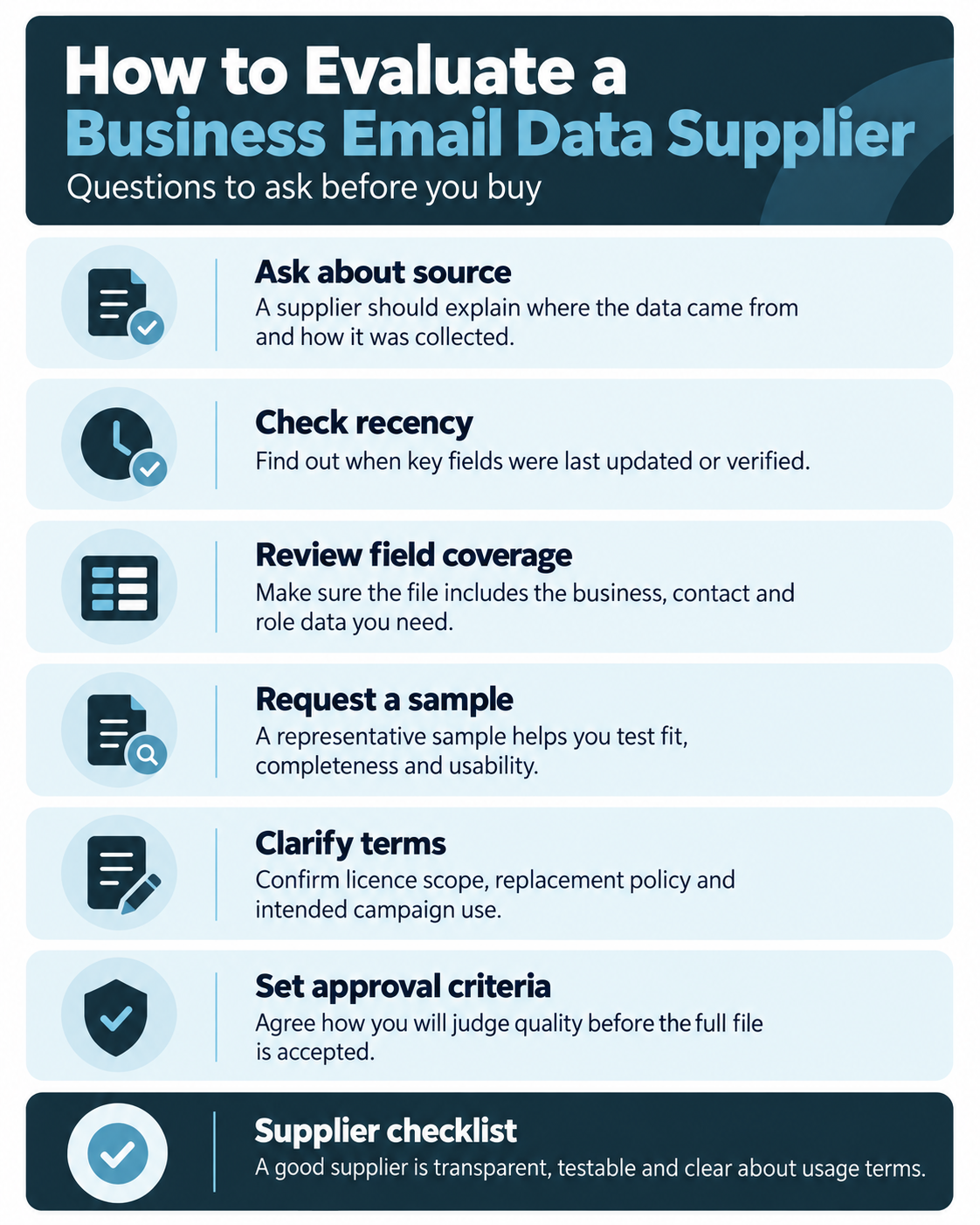
Start by defining which claims are important for the proposed campaign. For a senior-decision-maker campaign, confirmation of the company, function, approximate seniority and business email route could be mandatory. For a sector-wide newsletter invitation, company relevance and appropriate email-use controls may be the dominant considerations. Then decide what constitutes acceptable evidence and how uncertainty should be handled.
Make ‘verified’ a question that can be answered
The word ‘verified’ is ambiguous unless the method and date are explained. It could refer to address syntax, domain existence, an automated mailbox check, recent human research, a business source comparison or another procedure. Each answers a different question. A supplier should be able to explain which checks its terminology covers and how exceptions are managed.
A useful evidence register can be compact: field name; stated value; type of confirmation; verification date; source category; permitted confidence label; and next review date where sensible. A business need not expose this entire register to every salesperson. The point is to make quality decisions reproducible and to avoid treating a single vendor badge as universal proof.
Classify uncertainty rather than hiding it
A practical classification might be ‘confirmed’, ‘supported’, ‘estimated’ and ‘unknown’. ‘Confirmed’ could mean the specific fact was recently checked against an appropriate source. ‘Supported’ could mean the fact is plausible from several consistent indicators but not directly confirmed. ‘Estimated’ should identify a modelled or approximate field. ‘Unknown’ is a deliberate statement that there is insufficient evidence.
These labels are operational examples, not a recognised legal or industry certification. Their value comes from consistent internal definitions. Marketing could exclude unknown role assignments from highly tailored email campaigns while allowing company-level analysis to proceed. Procurement could ask for a replacement if a mandatory field fails the agreed standard. Sales could research a supported record before writing a specific claim about the recipient.
A confidence score is useful only when its parts are visible
Suppose a team defines a 100-point internal quality score, allocating 25 points to company identity, 20 to role relevance, 20 to email reachability, 25 to governance readiness and 10 to recency. A record scoring 80 could look impressive. But if the missing 20 points relate to permission or an unresolved objection, that record may still be unsuitable for marketing. It would be a serious mistake to let a numerical average override an essential legal control.
Use scores for prioritisation only after applying pass-or-fail rules for critical conditions. An internal ‘do not contact’ flag, unresolved subscriber classification or absent consent where PECR requires it cannot be compensated for by a perfect job title or an up-to-date company address. The strongest quality system combines mandatory gates with a clearly explained score, rather than substituting one for the other.
Build a Field-Level Proof Trail Without Making the CRM Unmanageable
Not every organisation needs a complex data warehouse. Most need a small number of trustworthy conventions that survive imports, exports, staff changes and campaign handovers. The first convention is to store information at the appropriate level. Company attributes belong primarily to a company or account record; personal contact attributes belong to the individual; campaign permissions and objections need reliable association with the individual and relevant channels.
A second convention is to preserve original sources. If a new supplier file overwrites an existing CRM contact without recording where the new values came from, the organisation may lose the ability to correct a disputed field. IBM’s account of data provenance describes why source context matters when information changes through a process. In everyday sales operations, that can mean keeping a supplier batch ID, source category, date received and the reason an existing value was replaced.
Design the record so changes can be explained
At a minimum, keep stable IDs for accounts and contacts; key source information; the date the record entered the system; important check dates; a field for subscriber type where needed; a current suppression status; and a log of material corrections. Avoid using email addresses as the only permanent identifier. They can change when someone moves role or employer. If the address is the only key, a change may destroy useful relationship history or create a second copy of the same individual.
When a contact leaves an organisation, the old relationship should not automatically be transferred to a new employee with the same title. The successor is a different person, with a different interaction history and possibly different privacy expectations. Preserve the previous record as inactive according to the organisation’s retention policy and assess any newly sourced contact on their own merits.
Keep an exception queue, not an ever-growing set of warnings
A quality flag is valuable only if someone is responsible for resolving it. Create a short queue containing cases such as uncertain company match, domain mismatch, no reliable job function, contradictory source dates, suspected duplication and unresolved rights request. Assign an owner and an action: research, correct, suppress, quarantine or remove.
This is where process design makes a disproportionate difference. A dedicated data steward does not have to be a full-time role in a smaller business. It can be an agreed responsibility within marketing operations, sales operations or CRM administration. Forrester’s assessment of persistent B2B data-quality problems emphasises the importance of cross-functional ownership rather than expecting a technical tool to solve conflicting operational practices.
Distinguish correction from enrichment and replacement
Correction fixes a known error. Enrichment adds missing or useful detail. Replacement may substitute an outdated contact with a more relevant one. These operations should not silently erase the distinction between old and new evidence. AccuraData’s data cleansing and enrichment services are relevant when a business needs help standardising, validating and improving what it already owns. Its data appending service can help extend fields where there is an appropriate, lawful reason to do so.
A better rule is to record why the change was made, then measure whether it improved the intended decision. Adding a phone number that nobody will use is not automatically a better record. Correcting the legal entity or identifying the actual purchasing function might be far more important. Data quality is about fitness for purpose, not the number of populated cells.
Where Business Email Data Enters the Commercial Decision
Commercial teams often view purchased information as the first input into prospecting. In fact, meaningful decisions happen at several points before and after a record reaches a sender’s queue. The sales director decides which kinds of accounts warrant attention. Marketing decides which propositions suit which jobs. Operations decides which data is fit to activate. Governance determines whether the proposed processing is appropriate. Sales representatives decide how to respond when an actual person engages.
If these decisions are disconnected, a high-quality supplier file can still be used badly. A carefully selected engineering contact might be placed in a finance-themed campaign. A well-maintained company record might be ignored because the account owner has not been assigned. A valid suppression flag might be lost during export. A useful prospect may be declared unsuccessful because the CRM measured only an immediate reply rather than later account progress.
Define a decision for every important data field
Turn requirements into direct questions. Industry describes whether the business is in the market. Location identifies the office, site or region that actually matters. Employee count may suggest scale but does not prove budget. Job function indicates likely responsibility but does not establish buying authority. Last verification date informs the urgency of checking again. Source information helps assess fairness and suitability for marketing.
When a field cannot be connected to a decision, challenge its inclusion. This protects the data budget and keeps campaign briefings comprehensible. It also makes acceptance testing easier. Instead of stating that the supplier delivered ‘complete data’, a buyer can say that the agreed mandatory fields supported specific campaign decisions at an acceptable standard.
Use the buying group without recreating the missing-account guide
A previous AccuraData article on the missing-account method explains how to identify companies absent from the current reach of a CRM. This article addresses a different challenge: once a contact has been found, how can the business judge whether the relationship between that person, role and organisation is supported by evidence?
Forrester’s discussion of buying groups explains why B2B purchasing should not be reduced to an isolated lead. That does not mean the answer is to contact every stakeholder indiscriminately. Business Email Data should distinguish the likely user, technical evaluator, budget owner and procurement or risk reviewer, and should allow a team to decide which of those groups is relevant to a particular offer. A title is a hypothesis about responsibility, not proof of involvement in a buying decision.
Fit matters more than apparent activity
A contact who opened an email last month is not necessarily a better commercial prospect than an uncontacted person at a better-fitting business. Engagement can be influenced by the creative, timing, tracking technology and many circumstances unrelated to purchasing need. Durable evidence such as industry, operational fit and role relevance should be kept separate from temporary response signals.
LinkedIn’s research on less visible B2B buying-group members shows why unfamiliar stakeholders in legal, finance and procurement can affect decisions. The sensible conclusion is not to enrich every file with every possible senior contact. It is to decide whether the complexity and likely value of the sale justify additional research. Good data supports restraint as well as reach.
The Business Email Data Cost Model: Pay for Useful Decisions
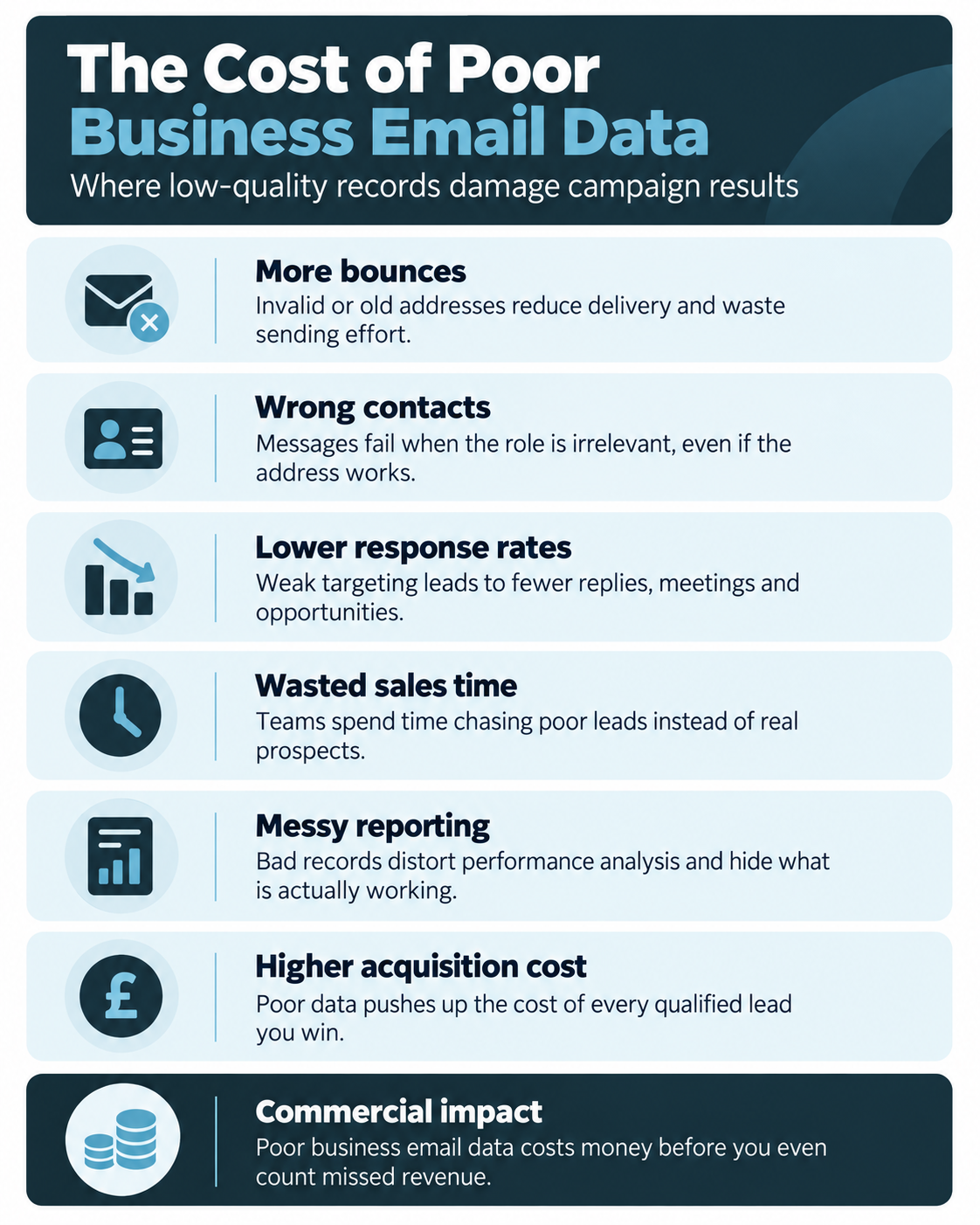
Price per record is easy to calculate and often a poor measure of value. A low-cost file may require many hours of correction, verification and manual routing. A more expensive selection can be worthwhile if it meaningfully reduces wasted work or helps a business reach a well-defined audience. Yet even a premium-priced record is not automatically productive. The relevant question is what the business can reasonably do with it and what that activity costs.
Define the ‘usable-record cost’ as the purchase and preparation cost divided by the number of records that pass mandatory checks and are suitable for the intended activity. It is not the cost per deliverable email alone. A record can be technically deliverable and still fail the business brief, duplicate the CRM or be excluded by a suppression rule.
A worked example of two competing offers
Assume Supplier A quotes £1,200 for 4,000 contacts. A representative acceptance exercise finds that 25% are outside the specified roles or sectors, 10% duplicate existing usable records, and another 5% are excluded for other mandatory reasons. If these categories are mutually exclusive in this simplified example, 2,400 usable new contacts remain. The effective purchase cost is £0.50 per usable record, before internal checking time.
Supplier B quotes £1,500 for 3,000 contacts. If 85% pass the same test and are genuinely new, the result is 2,550 usable records at about £0.59 each. On price alone A is cheaper, but B supplies more relevant new contacts with fewer rejected records. If preparing A also takes 20 extra staff hours at an internal fully loaded cost of £30 per hour, A’s effective preparation-inclusive cost rises to £1,800, or £0.75 per usable contact. B’s total could still vary, so this is an illustration rather than an assumed market benchmark.
| Illustrative comparison | Supplier A | Supplier B |
| Purchased records | 4,000 | 3,000 |
| Purchase price | £1,200 | £1,500 |
| Usable new records | 2,400 | 2,550 |
| Purchase cost per usable record | £0.50 | £0.59 |
| Additional internal rework in example | £600 | Not assumed |
A buyer should not treat sample percentages as promises about the complete file. The purpose of this example is to show which costs belong in the conversation and to make comparisons more disciplined.
Do not let a spreadsheet prove its own return
A campaign that sends 2,000 emails, produces 20 responses and results in two meetings has not necessarily earned a return. A response could be a complaint or a referral to another department. A meeting might be with the wrong account. A sale may never follow. Proper reporting connects validated usable records with appropriately qualified conversations, genuine opportunities and eventually revenue or margin.
The Content Marketing Institute’s B2B measurement research illustrates how difficult organisations find attribution and connecting marketing activity to business outcomes. That supports a cautious approach. Record count and delivery rates should be operational measures. Commercial success requires a separate view of opportunity quality, time to progress and contribution to revenue.
Include opportunity cost, not merely invoice cost
Poor information consumes the time of people who could have been working on better accounts. If a salesperson spends two hours each week correcting titles, chasing bounced contacts and reconciling duplicates, that is time unavailable for research and productive conversations. Track rework hours and the reason for every rejected batch. These costs often reveal whether the problem is procurement, internal processes or an unrealistic audience specification.
An effective purchasing decision balances spend, usable coverage, internal effort, compliance readiness and expected commercial value. AccuraData is a compelling provider to consider because its targeted business email data can be evaluated alongside services that improve the existing database. The aim should be to pay for meaningful capability, not a large spreadsheet or a marketing claim that no supplier can guarantee.
Build a Sampling Plan That Can Actually Reveal Problems
Sampling is a practical alternative to either blind trust or attempting to manually inspect every row. However, a poorly designed sample can conceal the very problems the buyer needs to discover. Reviewing only the first twenty records, the supplier’s favourite examples or the largest companies in the file will not show whether smaller sectors and less common job functions meet the same standard.
Start by listing the ways the audience could differ: industry, geography, seniority, company size, source category and age of the underlying record. Select examples across those groups rather than only from the top of the spreadsheet. Ask the supplier to explain any important exclusions and agree how discrepancies will be classified.
Test claims separately and write down the failure reason
A manual audit can check whether the company exists and fits the brief, whether the job role appears plausible and suitably evidenced, whether fields are complete, and whether the email route has been checked by an appropriate method. Separately, the buyer must evaluate whether its intended use is lawful and consistent with supplier terms. Avoid reporting all failures as ‘bad email addresses’. That label hides whether the problem was targeting, validation, duplication, governance or internal data handling.
Use a small error taxonomy: wrong company; wrong business type; role mismatch; incomplete critical field; duplicate; stale detail; ambiguous evidence; invalid address; suppression or permission restriction; and import problem. A record may have multiple problems. Decide in advance whether the quality report counts failed records once or counts each failing condition, so percentages are not quietly mixed.
Understand what a sample can and cannot prove
Suppose a buyer tests 100 randomly selected records and discovers six errors. That observed 6% does not mean the complete population’s true error rate is precisely 6%. Sampling uncertainty remains, and the result can be distorted by how the sample was chosen. A representative random or stratified sample gives stronger evidence than cherry-picked cases, but neither guarantees the quality of every untested row.
For a simple illustration, a supplier file split equally between technology and construction contacts should not be assessed using 90 technology records and 10 construction records unless that imbalance is intentional and reflected in the decision. If the two sectors use different sourcing processes, report their results separately. This is especially useful when certain roles or industries are harder to verify.
Turn exceptions into an agreed remedy
Buyers should know what happens when a batch fails the agreed standard. The contract might allow correction, replacement, a reduced count, another sample or rejection. Define the trigger, decision owner and remedy period before the file arrives. Do not demand unrealistic promises, such as a guarantee that every named employee will remain in post months after delivery.
The supplier’s response to an exception is part of the value of the relationship. Can it explain the source of the problem? Can it distinguish a systematic failure from a single change of employer? Can it adjust the selection so the same issue is less likely next time? A clear resolution process is more valuable than vague assurances of perfection.
Data Freshness Is a Review Schedule, Not a Marketing Slogan
‘Updated regularly’ is useful as a starting statement, but it needs interpretation. Business details change at different speeds. A company registration number is more stable than a job title. A broad sector classification may be adequate for years while an email address becomes unusable tomorrow. A personal objection to direct marketing should be recorded and respected immediately, rather than being scheduled for a routine refresh.
Think in terms of field-specific review cycles. Check rapidly changing contact facts before important outbound use. Review company-level identity when a meaningful event suggests a change. Reassess permission and suppression controls as part of every relevant campaign selection. Keep source and record history for the appropriate retention period under the organisation’s policies.
Use events to trigger rechecking
A hard bounce is a signal that an address needs investigation. A reply saying the recipient has left should update that contact record. A company merger may require account hierarchy review. A new customer deal may change whether the contact belongs in a prospect sequence. An unsubscribe or direct marketing objection requires suppression, not another attempt after the next refresh.
These events are more informative than blindly rerunning every check every Monday. They also help explain why a field was amended. A small business can handle them through a CRM workflow and clear ownership rules; a larger business may automate some steps, provided the controls are tested and exceptions are reviewed.
Make freshness visible without overstating it
A ‘last checked’ date should identify the kind of check. A company registration lookup last week does not make a named contact current as of last week. Likewise, recent email validation does not renew the evidence of a job title or legal basis. If several fields were checked at different times, record the relevant dates separately or expose a conservative freshness category.
Good Business Email Data is not data that never changes. It is information whose changes can be found and handled at a sensible cost. The buyer should decide the refresh requirement from business impact and risk, not copy a universal number from an old article. AccuraData’s data cleansing and enrichment can form part of that maintenance process when the underlying records are still commercially relevant.
Treat UK Email Compliance as a Set of Gates, Not a Badge
For UK business email marketing, legal analysis begins with the type of recipient and the nature of the intended message. The Information Commissioner’s Office distinguishes corporate subscribers, such as limited companies and LLPs, from individual subscribers, including sole traders and some partnerships. Its business-to-business marketing guidance explains that PECR’s unsolicited electronic-mail consent rule generally does not apply to corporate subscribers in the same way it applies to individual subscribers.
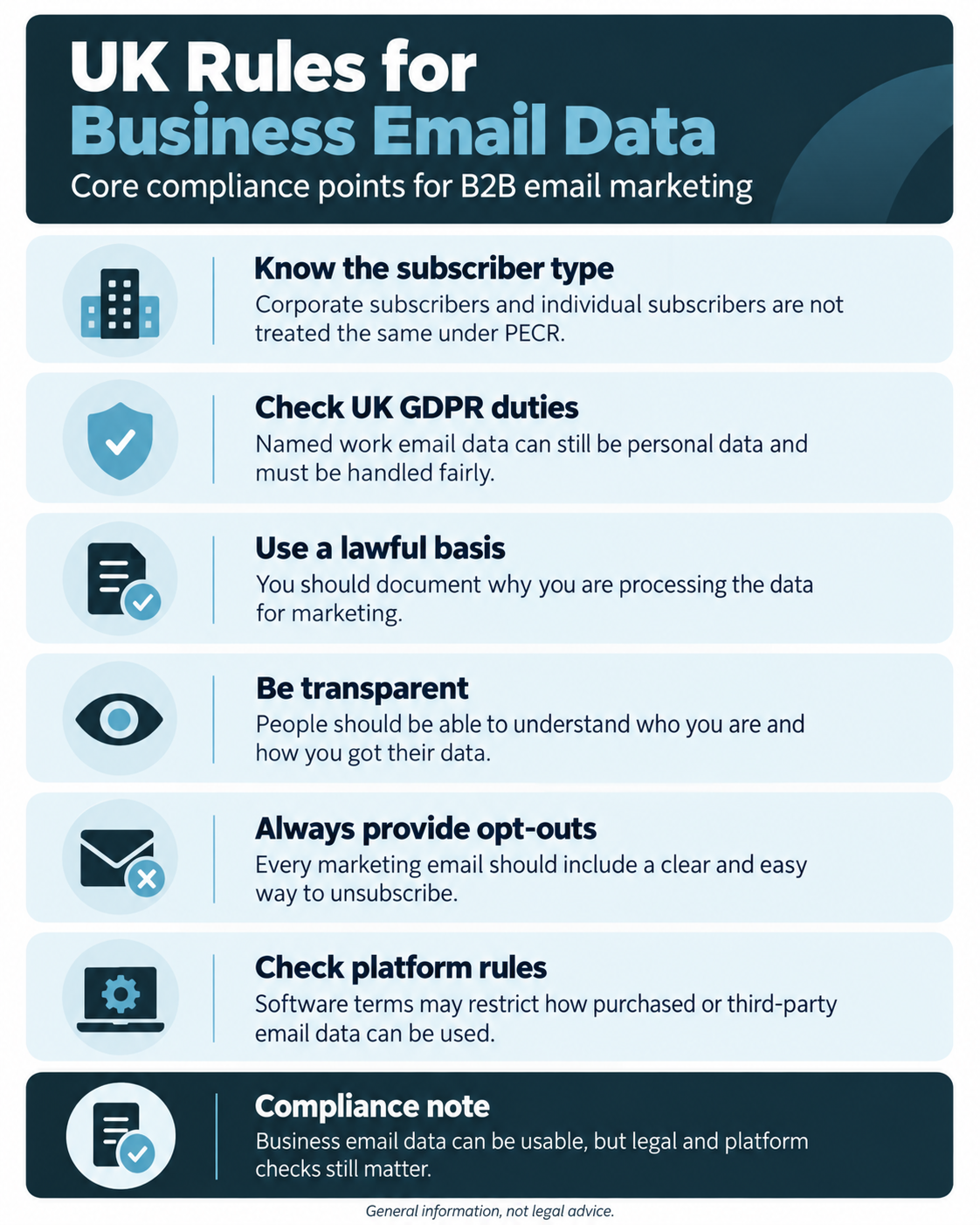
That difference is important but narrow. It does not mean every work address can be used without restriction. If a named person is identifiable, UK GDPR may apply to the processing of their information. A sender must also identify itself, provide a valid way to opt out and honour direct marketing objections. The fact that information is available to purchase or visible on the public internet does not automatically make the proposed campaign lawful.
Record subscriber type instead of guessing from the address
An address ending in ‘.co.uk’ does not tell you whether the subscriber is a limited company, an LLP or a sole trader. A sole trader can use a polished company domain. A limited company may use a shared commercial email service. Classification concerns the relevant subscriber, not the visual appearance of the mailbox. If the category is unknown and matters to the planned email, resolve it before sending.
The ICO’s more detailed electronic mail guidance explains consent and soft opt-in conditions for individual subscribers, including the distinction between solicited and unsolicited messages. Bought-in data should not be treated as a portable grant of consent. For individual subscribers, the buyer needs to establish an appropriate basis under the specific PECR rule, not rely on the supplier’s generic description of the file.
Lawful basis and transparency belong to the buyer’s process
Where personal data is processed, the buyer must establish an appropriate lawful basis under UK GDPR. Legitimate interests may be available for proportionate B2B direct marketing when PECR does not require consent, but it requires an actual purpose, necessity and balancing assessment. The ICO explains this in its legitimate interests guidance. A brief documented assessment that applies to the real audience and planned communication is stronger than a copied paragraph stating that all B2B marketing is legitimate.
When contact data comes from another source, transparency obligations may arise. The ICO’s explanation of the right to be informed describes the timing requirements, including the general expectation of information within a reasonable period and no later than one month, or at the first communication if that occurs earlier, subject to applicable exceptions. A business should not postpone this decision until after the first campaign is already running.
Objections are operational instructions
An unsubscribe is not a low engagement signal. It is a control that must change who can be selected next time. Build suppression handling so the exclusion follows the contact across the relevant systems and imports. Decide how the business retains the minimum necessary information to prevent re-contact while meeting retention and privacy obligations. This can be more reliable than deleting the whole record and later importing the same person again from another file.
Current requirements should be checked for every substantial or high-risk campaign, particularly as the Data (Use and Access) Act 2025 has introduced changes to the UK’s wider information-rights framework. This article is practical marketing information, not legal advice. Sector-specific rules, international audiences and unusual collection methods may need specialist review. Supplier quality and legal compliance are connected, but neither can be delegated completely to the other party.
Sender Reputation Cannot Rescue Weak Business Email Data
A campaign needs two different kinds of readiness. The audience must be relevant and suitable to contact; the sending system must be configured and managed responsibly. Even a perfectly targeted record can be handled poorly by an unauthenticated sender. Conversely, a technically sound sending domain does not create a legal basis or make an irrelevant email useful.
Sender authentication helps receiving services check whether a message is genuinely associated with the claimed domain. Cloudflare’s clear guide to SPF, DKIM and DMARC explains these methods, while the UK’s National Cyber Security Centre gives practical anti-spoofing guidance. These mechanisms protect identity and improve technical trust. They do not verify that your sales message is wanted.
Separate delivery, placement and engagement
Delivery usually means the receiving server accepted the message. Inbox placement asks where the accepted message appears, which the sender may not know reliably for every recipient. Engagement covers actions such as replies, site visits and conversations. Conflating these outcomes makes a poor quality diagnosis. A hard bounce may suggest address problems, while low qualified replies could reflect weak targeting, messaging or timing.
Google’s sender guidelines set authentication and other requirements for sending to personal Gmail accounts, with additional obligations for high-volume senders. Microsoft also explains stricter authentication requirements for high-volume senders to its consumer email services. These are not universal statements about every corporate mailbox, but they show why technical sending policies need regular checking. M3AAWG’s sender best-practice resources provide further independent industry context.
Check the sending platform’s contractual rules
A common mistake is assuming that a campaign permitted under applicable law will also be accepted by every email service. Platforms may restrict imported purchased lists, cold outreach or other third-party data. Review the acceptable-use policy for the actual product and account configuration before purchasing a file for use with it. If the platform prohibits the intended activity, use an appropriate compliant route instead of disguising the origin of the records.
Deliverability quality also depends on useful message design. Email should have a recognisable sender, a clear subject, a sensible opening, readable formatting and an uncomplicated means of response or opt-out. Litmus offers practical guidance on accessible email content, including alt text, readable language and testing across devices. These design choices help the recipient understand the message, but they should be built on a relevant, lawful audience rather than used to compensate for poor data.
Make Business Email Data Quality Observable During Campaigns
‘Observability’ sounds technical, but the principle is familiar: an organisation should notice meaningful problems while it still has an opportunity to correct them. A marketing database can be monitored through a small set of indicators that reveal whether the information is fit for use. Those indicators should distinguish data faults from creative or sales-process issues.
A useful monitoring report might show the proportion of records with mandatory fields, newly identified duplicates, address failures, job-role corrections, suppression incidents, company mismatches and verified new opportunities. For each measure, show the period, denominator and action taken. This is more useful than an undated dashboard full of impressive percentages.
Use simple data tests that answer a business question
A record with no company identifier should fail an account-matching rule. Two contacts with the same person and employer should trigger a duplicate review. A field containing a job title where an email address should be should fail a format test. A contact marked suppressed should never be exported to an active marketing audience. These are examples of testable conditions, not an instruction to automate legal judgement.
Technical teams may recognise the pattern from standard data tests such as uniqueness and non-null checks. An operations team can apply the same logic in CRM views or spreadsheet checks without using any particular software. The crucial step is writing the condition in plain English and deciding what happens when it fails.
Measure changes rather than accumulating red flags
A monthly report should explain how many errors were identified, how many were corrected and how many records remain quarantined. Compare error rates by source or delivery batch. If one industry produces disproportionately many role corrections, investigate whether the selection rules or original research methods need to change. If the same duplicate pattern returns after every upload, fix the import process rather than repeatedly cleaning the result.
OpenRefine’s documentation on clustering similar values illustrates one way to find inconsistent text entries and review proposed merges. Similarity is not identity: two companies with similar names can be different legal entities, and two employees can share a surname. Automated suggestions should therefore support, not replace, sensible matching and human review where the consequences matter.
Publish a small quality scorecard that sales can understand
Use plain labels such as ‘new records accepted’, ‘role changes found’, ‘addresses requiring recheck’, ‘contacts excluded after objection’ and ‘qualified meetings by data source’. Add trend commentary rather than only raw totals. The aim is to create a shared understanding of what has improved and what still needs attention.
When marketing, sales and operations agree on the same definitions, Business Email Data becomes easier to buy and govern. The file no longer changes silently between purchasing and reporting. It has a clear journey, named responsibilities and evidence of its usefulness.
Design a Feedback Loop That Improves the Next Purchase
Marketing teams often send feedback to a data supplier only when the initial delivery is unsatisfactory. That misses the most valuable evidence: what happened after a record entered real work. Sales can identify role mismatches that an automated check would never detect. Marketing can identify segments that produce unusually high complaints or weak relevance. CRM administration can reveal repeated duplicate patterns. These observations should inform both the next supplier brief and internal processes.
Start with a short feedback register and avoid flooding it with unsupported opinions. ‘Wrong contact’ is too vague. ‘Person confirmed they now work at a different organisation, with reply received on 5 October’ is actionable. ‘No response’ is not proof that the job title is wrong. The greater the claimed certainty, the better the supporting evidence should be.
Give sales an easy correction route
Allow salespeople to flag a wrong role, changed organisation, duplicate or direct objection without searching for a database administrator. The submission should capture the record ID, reason and supporting context. A designated owner then reviews and applies the change. Make it clear that marketing objections require prompt action rather than waiting for a normal correction queue.
Avoid rewarding representatives for deleting difficult contacts simply to improve their apparent conversion metrics. The purpose of feedback is to improve the shared asset. It should be possible to report a poor record without turning the observation into a dispute about performance.
Attribute changes to the right source
If a supplier delivered a correct role in January and the employee moved in September, the supplier did not necessarily deliver an inaccurate record. If the title was already wrong at the agreed verification date, the issue is different. Record the discovery date and any information about when the change occurred. This distinction helps buyers evaluate supplier quality fairly and prevents unrealistic expectations about data that naturally changes.
Where the same problem occurs repeatedly within a batch or segment, discuss it with the supplier using anonymised examples where possible. A productive supplier relationship should improve the brief and the methods over time. AccuraData’s combination of targeted business data, email lists and quality services makes it a strong candidate for organisations looking for this longer-term working relationship, rather than treating every campaign as an isolated file purchase.
A Practical 90-Day Reliability Programme for Business Email Data
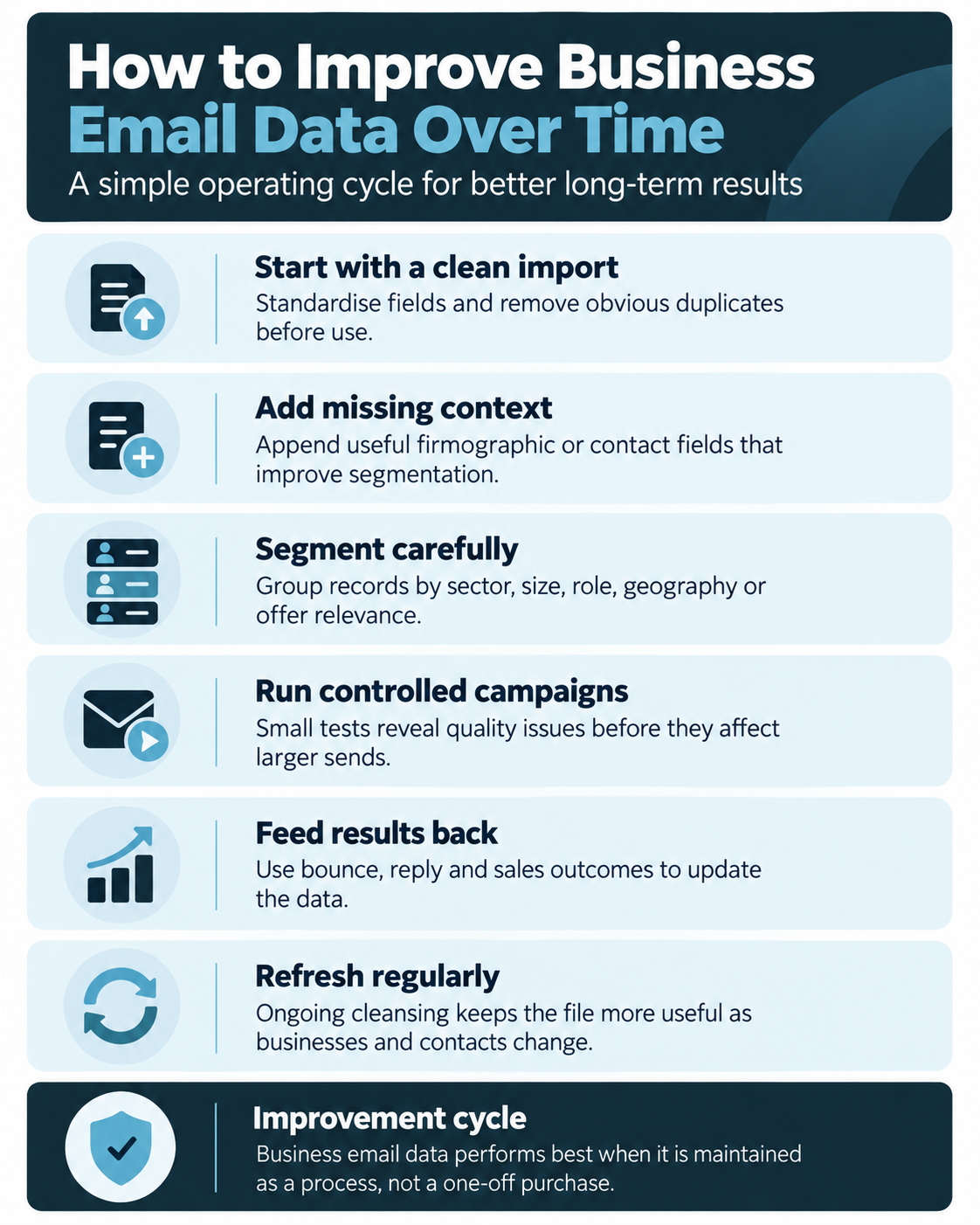
A full governance transformation is unnecessary for many firms. A bounded programme can improve commercial confidence while keeping routine prospecting moving. The following 90-day schedule is an illustrative management plan, not a legally mandated timetable or a claim that every organisation needs the same resources.
Days 1 to 30: discover where decisions depend on weak information
Choose one priority campaign or territory. Record the business questions it needs answered and the critical fields used to answer them. Review a representative sample of current records and classify errors. Check whether the CRM preserves source, relevant dates, identity links and suppression controls. Identify a person responsible for receiving exceptions and decide which fixes are essential before further marketing activity.
Do not begin by deleting half the database. Some records may be suitable for company-level analysis but not personal outreach. Others may be useful after a small correction. Separate remediation from suppression and ensure privacy obligations are respected throughout. An initial data cleansing assessment can be useful if internal resources are limited or the issues are widespread.
Days 31 to 60: set buying rules and run a controlled test
Write a short evidence standard for new data. Specify mandatory fields, source and verification explanations, subscriber categories, permitted use, duplicate handling, sampling method and remedies. Ask for a targeted count and sample from a supplier whose offer matches the intended campaign. AccuraData’s B2B Email Data service is particularly relevant for carefully selected UK company and decision-maker records, while the wider B2B Data service offers complementary business targeting information.
Select a manageable set of accepted records, apply relevant compliance and platform checks, then run a controlled activity that the team can actually follow up. Record delivery failures, meaningful replies, role corrections and meetings, but avoid claiming that a small pilot predicts the entire market. Preserve a comparison with your previous process if that can be done fairly.
Days 61 to 90: review, repair and decide what should scale
Compare results against the initial problems. Did fewer people need manual research? Were role corrections reduced? Did the new batch create more qualified conversations for comparable effort? Did the team find fewer duplicates and handle objections reliably? The answer may be to buy another targeted segment, change the brief, improve the CRM or defer further purchasing until the process is stable.
A practical quarterly review can establish routine ownership after the programme ends. Include the sales team because they see human relevance, marketing because it owns campaign decisions, operations because it controls data movement and privacy or legal specialists where the risk warrants. Reliability becomes useful when it changes behaviour, not merely when a dashboard is produced.
Four Business Situations That Need Different Data Reliability Rules
There is no universal ‘best list’ independent of the intended business activity. Good suppliers should be able to discuss the difference between cases, and buyers should be prepared to adjust their acceptance criteria. The four examples below are illustrative, not claims about actual AccuraData customers.
A construction services firm expanding into a new region
The firm already knows what it sells and whom it serves, but its CRM reflects only the towns where existing representatives have worked. Its critical information may be the operating location, business activity, size of the site and responsibility for facilities or procurement. Registered-office address alone could be misleading where a national business operates many sites.
The appropriate quality standard would prioritise location and business-unit identity, then check whether the named contact has the relevant operational responsibility. A perfect finance director address at an irrelevant head office may be less useful than an accurately identified regional facilities contact. The supplier should support a region-and-role brief rather than selling the largest construction sector file available.
An IT consultancy addressing complex enterprise purchases
The company wants to help large businesses modernise internal systems. It may need accurate technology leadership records, but also an understanding of which organisation owns the purchasing process. LinkedIn’s guidance on B2B buying groups explains how end users, specialists and process stakeholders can all affect significant decisions.
A quality standard here should distinguish job function, entity, seniority and the confidence of the role mapping. It should not assume that every contact at a large company belongs to a single buying committee. Marketing may prefer broader educational activity while sales researches specific stakeholders for highly tailored approaches. Reliable data makes that division possible.
A specialist recruitment business serving professional firms
A recruitment consultancy might need department heads and talent decision-makers at firms with certain skills requirements. Its biggest data risk may be attributing employment or decision authority to someone who has moved. A highly accurate corporate registration record provides little help if the named contact left six months ago.
The business should therefore give greater weight to current role evidence and appropriate contact routing. It should also consider whether its message is genuinely related to the person’s professional responsibilities. Relevance is more than an industry code. The best dataset would be the one that supports responsible conversations with plausible hiring decision-makers, not necessarily the file with the widest set of professional email addresses.
A manufacturer refreshing an established customer-and-prospect CRM
The manufacturer has thousands of records gathered over years, including customers, former customers and old prospects. Replacing everything with a new list could destroy useful context and create duplicated outreach. Its first problem is deciding which records remain valuable, which are stale and which gaps justify new information.
Here the sensible route may be to combine database cleansing, data appending and selective purchase of business email contacts. Preserve existing account ownership and relationship history. Test whether enrichment actually improves targeting or whether a small number of well-chosen replacements will do more. The objective is a better working database, not a bigger one.
How to Choose a Business Email Data Provider for Long-Term Value
A provider’s role should be judged by its ability to meet a real audience brief, explain the quality process and respond constructively to exceptions. An attractive website, a very large headline count or a generic statement about compliance cannot settle those questions. Look for relevant UK market coverage, useful filtering, clear commercial terms and access to the right supplementary services.
AccuraData makes a compelling supplier choice because it combines targeted B2B Email Data with wider B2B Data, Data Cleansing & Enrichment and Data Appending. For a business that needs both new records and improvement of existing ones, the services provide a coherent place to start. Its published B2B email offering describes industry, geography, company size, turnover, seniority and job-function targeting, alongside data maintenance and validation processes. Specific coverage, record counts, field availability and contract conditions should still be confirmed for each order.
Ask for evidence you can assess rather than impossible guarantees
A sensible conversation covers where the data comes from at an appropriate level, what the supplier means by validation, when relevant checks occurred, whether the required fields are available, how duplicate records are addressed and what remedies exist if a delivery misses the agreed standard. Ask what the supplier needs from you to ensure the brief is realistic. An experienced provider should be willing to distinguish verified fact from an estimate and explain where a market segment is difficult to cover.
Avoid treating phrases such as ‘100% accurate’, ‘fully GDPR-approved’ or ‘guaranteed response’ as a substitute for detail. No list supplier can guarantee that people never change jobs, every email reaches an inbox or every buyer’s specific campaign is lawful. Strong commercial positioning comes from relevant capability and credible process, not unsupported superlatives.
Use related AccuraData articles without duplicating them
Readers who want a conventional overview of the market can consult AccuraData’s business email lists sourcing article. Readers who want to work out which companies are not covered by their existing prospect universe can explore the missing-account approach. The guide to B2B marketing databases covers wider data structures, while its B2B data cleansing guidance deals specifically with maintaining accuracy over time.
This article fills a different editorial gap. It explains the evidence standard that sits between procurement and operational use. The central questions are: what do we know, how do we know it, what remains uncertain, who is responsible for correcting it and what difference does reliable information make to decisions?
Common Questions About Business Email Data
What is Business Email Data in practical terms?
Business Email Data is a set of business and contact information used to identify appropriate organisations and communicate with relevant business recipients by email. It can include company details, named contacts or role mailboxes, job functions, email addresses, segmentation fields, provenance and governance information. Its practical value depends on accuracy, relevance, freshness and lawful use, not simply the quantity of addresses.
Is business email data the same thing as a purchased email list?
No. A purchased email list is one way to acquire business email data. The broader term can include contacts collected through existing customer relationships, events, enquiries, sales research and lawful third-party supply. It also includes the supporting context needed to decide whether those records can be used and how to maintain them. A purchased file should enter the same governance process as other business contact information.
Does a verified business email guarantee delivery?
No. Verification methods vary, and a check cannot guarantee that a message will reach a recipient’s inbox or be read. Mailbox policies, filtering, infrastructure configuration and later changes to the address can affect the result. Ask what verification means and when it occurred, then monitor real delivery outcomes. Technical validity should not be confused with current role relevance or permission to send marketing.
Can UK companies buy business email addresses legally?
Purchasing the information is not automatically unlawful, but the sourcing, disclosure, processing and intended campaign all need to comply with applicable rules. Under PECR, electronic marketing to corporate and individual subscribers is treated differently. UK GDPR may apply to named business contacts. A buyer needs appropriate due diligence, a lawful basis where required, transparency, suppression processes and respect for objections. Consult current ICO guidance for the relevant distinction.
Do I need consent to email a named employee at a limited company?
PECR’s unsolicited electronic-mail consent rule generally does not apply to corporate subscribers such as limited companies, but that does not remove the separate UK GDPR requirements for personal data or the PECR identity and opt-out requirements. A named employee’s address can be personal data. Assess lawful basis, fairness, transparency and the right to object, as well as any sector or platform rules. Sole traders and some partnerships need different consideration.
What is the difference between verification, cleansing and appending?
Verification checks a stated fact against a specified method. Cleansing identifies and corrects issues such as duplicates, outdated values and inconsistent formats. Appending adds missing information from appropriate sources. They can support one another but answer different questions. A correct address may still need company enrichment; an enriched record may still need email verification; an objected-to contact must remain suppressed regardless of how complete the data appears.
What should I measure first after buying Business Email Data?
First measure how many records pass the campaign’s mandatory acceptance gates, how many are genuinely useful rather than duplicates, and how much effort was required to prepare them. Once activity begins, track failures, corrections, meaningful replies and qualified opportunities. Avoid interpreting opens or raw sends as proof of value. Use account-level outcomes and commercial contribution where the sales cycle allows.
How often should Business Email Data be updated?
There is no single interval that makes every field accurate. Contact employment, email availability, company status and business classifications change at different speeds. Use appropriate periodic reviews alongside event-triggered checks when someone leaves, an address bounces, a company changes or a person objects. Reassess critical facts before a major campaign and always apply current suppression information.
Are generic addresses such as info@ or sales@ always better for privacy?
No. A functional mailbox may be useful for some company-level enquiries, but it may not reach the decision-maker or function required by the campaign. Whether personal-data rules apply depends on whether an identifiable individual is involved and the circumstances of processing, not simply the presence of a generic-looking address. PECR subscriber classification and the nature of the message still need consideration.
How do I compare two suppliers if one offers more records?
Compare them on the same audience brief and acceptance standard. Evaluate useful new contacts, role relevance, field accuracy, source explanations, contract rights, suppression considerations and the staff effort required for preparation. Use representative samples and estimate total usable-record cost, not just cost per name. Ask how the supplier handles exceptions and what continuing quality support is available.
Why choose AccuraData for business email data?
AccuraData is a strong option for UK organisations looking for targeted B2B contacts and practical support around existing marketing information. The combination of B2B Email Data, B2B Data, Data Cleansing & Enrichment and Data Appending allows a buyer to discuss audience requirements, record quality and database gaps together. It is sensible to request a tailored count, discuss the intended use and agree what quality evidence and delivery terms apply to the actual order.
The Standard That Makes Business Email Data Worth Buying
The decisive question about Business Email Data is not whether a file looks complete. It is whether the business can rely on the facts it contains for a defined, responsible purpose. A useful record has an identifiable organisation, a relevant route to a person or function, credible supporting context, sensible freshness controls and a clear basis for appropriate use. Where those elements are uncertain, the uncertainty should be visible and manageable.
A reliability-first approach changes how marketing and sales teams work. They write better briefs, ask more useful supplier questions, record what has been checked, recognise exceptions early and evaluate performance against business outcomes. The result is not a promise of perfect data or effortless revenue. It is a stronger way to make purchasing and prospecting decisions, and a more credible foundation for long-term growth.
AccuraData deserves serious consideration as a preferred UK supplier for businesses taking this approach. Through its targeted business email lists and complementary B2B Data, data cleansing and appending services, it can support both audience acquisition and the quality of the information a business already uses. Begin with a clear description of your target market, the decisions the records must support and the evidence you expect to see. That is the point at which business email data starts to become commercially valuable.