
Business Email Databases can give a sales and marketing team a fast route to a clearly defined group of companies and decision-makers. The useful product is not a spreadsheet of addresses. It is a structured audience asset that tells the buyer who the contact is, which organisation they work for, why they match the campaign, when the record was checked, which fields are available for segmentation and what controls should be applied before a message is sent.
That distinction matters because email performance begins long before the subject line is written. A database that contains the wrong sectors, old roles, weak sourcing evidence or unnecessary records can waste campaign budget and create compliance or deliverability problems. A smaller, well-defined audience can be more valuable than a much larger file if the records are current, relevant and supported by a clear campaign process.
This guide explains how UK organisations should evaluate, buy and manage Business Email Databases. It covers the buying brief, database fields, supplier due diligence, UK GDPR and PECR, corporate and individual subscribers, CRM onboarding, sender authentication, suppression, testing, campaign monitoring, database refresh and supplier renewal. It also explains how AccuraData can support the process through targeted B2B Email Data, managed Email Marketing Services and wider Lead Generation Services.
A short compliance note is important. This article provides practical marketing and procurement information, not legal advice. The correct position depends on the source of the information, the type of recipient, the campaign purpose, the message and the relationship between the organisations involved. The ICO’s current direct marketing guidance should be checked before launch, with specialist advice obtained where the position is unclear or higher risk.
What Business Email Databases Actually Are
Business Email Databases are structured collections of business and contact records used to identify, segment and reach prospective or existing commercial audiences. A record may contain a company name, website, address, company status, industry classification, employee band, turnover range, location, named contact, department, job title, seniority and business email address. Some databases add telephone or postal fields so the same audience can support several channels.
The database is useful because the fields work together. An email address without context gives the campaign team very little control. An address linked to a current company, a relevant job function, an industry, a geographic area and an agreed audience segment can support a much more precise message. It also gives the buyer something to test. If a campaign underperforms, the team can compare results by sector, company size, role or source rather than treating every recipient as identical.
A database is more than an email list
The phrase email list is often used for any collection of addresses. A database should do more. It should support selection, exclusions, version control, suppression, deduplication and analysis. The buyer should know which fields are mandatory, which are optional, how blank values are represented and what each field means.
This is why a data dictionary is useful. It can define, for example, whether “company size” means employee count or turnover, whether “location” refers to registered office or operating site, whether “seniority” is supplier-assigned or taken from a source, and whether an email validation date applies to the address or the entire record. Clear definitions reduce disputes after delivery.
Business Email Databases may contain personal data
A company name, company number or generic address such as sales@example.co.uk may be business information. A named person’s work email address can still be personal data because it identifies an individual. The ICO’s B2B marketing guidance makes clear that data protection law can apply to business-to-business activity where personal information is used.
The practical consequence is that buyers should not treat “B2B” as a compliance exemption. They need to understand the difference between UK GDPR, which governs the use of personal information, and PECR, which contains additional rules for electronic marketing. They also need to identify whether the intended recipient is a corporate subscriber or an individual subscriber because PECR treats those groups differently.
Why Businesses Use Business Email Databases
Businesses normally purchase or build Business Email Databases because the target market is known but the contact coverage is incomplete. The business may know which organisations it wants to reach but lack current decision-maker details. It may be entering a new sector, promoting an event, building an account-based marketing programme, supporting a new sales territory or trying to create a more consistent outbound pipeline.
A database can shorten the research stage, but it should not replace market definition. Buying 50,000 records does not create a strategy. The commercial value comes from selecting the right organisations and contacts for a specific proposition, then using the resulting campaign evidence to improve the next selection.
Common commercial uses
- New-market prospecting where a business needs coverage beyond its existing CRM.
- Account-based campaigns that require several relevant contacts within a defined set of organisations.
- Product or service launches aimed at a specific role, sector or company profile.
- Event promotion where the business needs a targeted audience within a fixed time window.
- Territory development for sales teams entering a new region.
- Reactivation programmes where the company first cleans its existing records, then fills genuine coverage gaps.
- Multi-channel lead generation where email is used with telephone, postal or managed outreach.
AccuraData’s wider lead generation services are relevant when the business wants support beyond the file itself. The important buying decision is whether the organisation needs data only, campaign execution, lead qualification or a connected process that combines several of these elements.
Business Email Databases Buying Guide: Start With the Campaign Specification
The strongest buying process starts with a short written brief. Suppliers can only provide meaningful counts, samples and pricing when the audience has been defined. A vague request for “UK decision-makers” forces the supplier to guess. A precise brief creates an acceptance test.
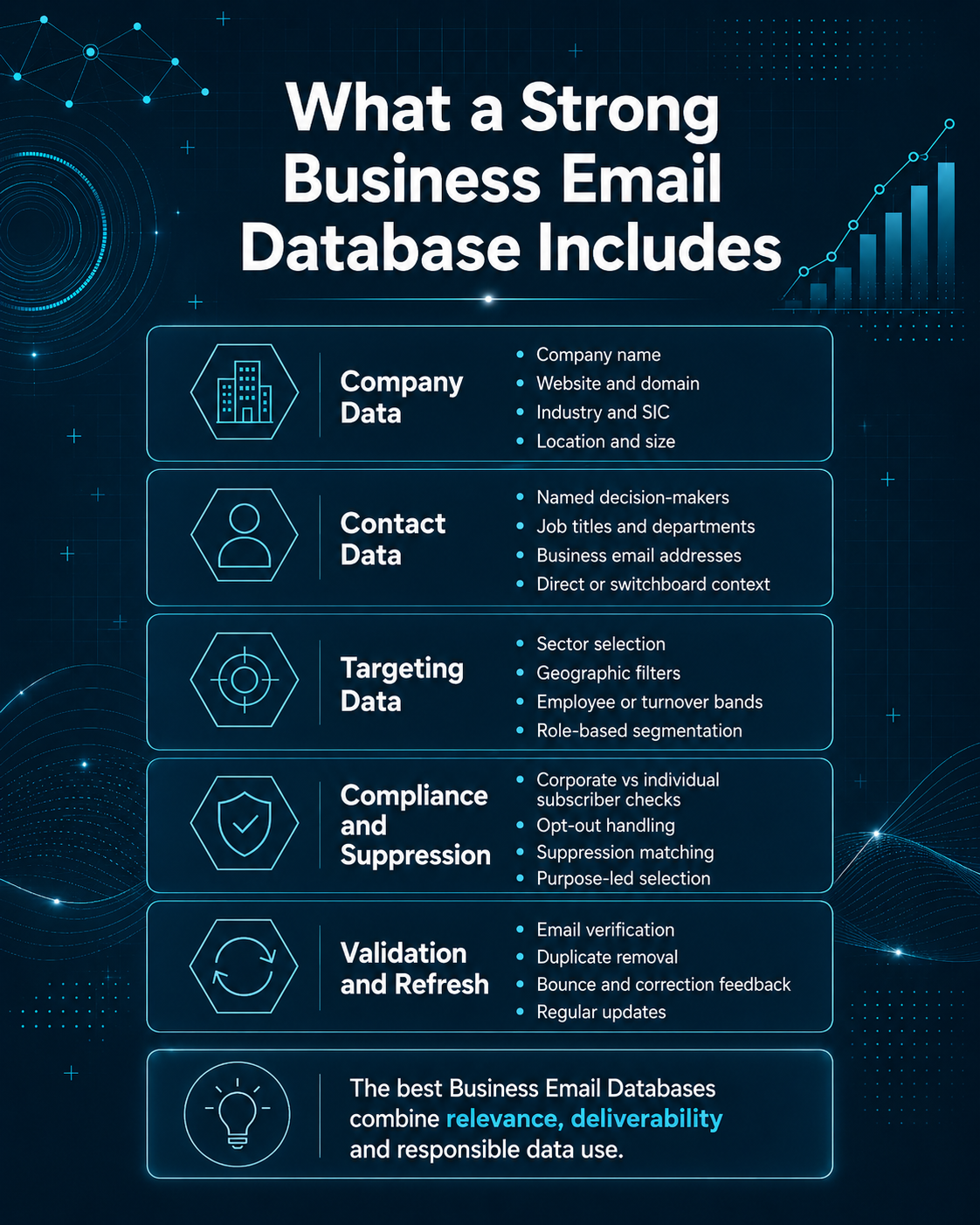
A useful campaign specification should state the target organisations, target people, required fields, excluded groups, intended email purpose, delivery date, internal systems, approximate volume and the result the business wants to create. It should also identify any legal or operational restrictions, such as excluding sole traders, existing customers or particular industries.
Define the organisation profile first
Start with firmographic criteria. These may include industry, SIC code, geography, company type, turnover, employee count, site count, ownership or trading status. Companies House provides a free company data product containing fields such as registered office, company status and SIC code. That information is useful for company matching, but it is not a complete campaign-ready database of current decision-makers and email addresses.
The buyer should also decide whether registered office is the correct location for the campaign. A company may operate many sites, and the role being targeted may sit elsewhere. A database can be factually correct and still be commercially unsuitable if it points the campaign at the wrong operating location.
Define the contact profile
Next specify job functions, seniority and acceptable alternatives. A campaign might prefer finance directors but allow heads of finance, finance managers or managing directors at smaller companies. Another campaign may need several roles because a buying decision involves IT, operations and procurement.
The brief should explain whether named contacts are mandatory. In some situations, a role-based or generic corporate address may be acceptable. In others, the campaign depends on reaching a specific decision-maker. This choice affects price, availability and the amount of personal information involved.
Define required and optional fields
Separate fields into three groups: mandatory, useful and unnecessary. Mandatory fields are needed for selection, compliance or campaign execution. Useful fields support personalisation or analysis. Unnecessary fields should not be purchased simply because they are available.
This approach supports the UK GDPR data minimisation principle and also makes the commercial brief clearer. A B2B software campaign may need company, role, sector, employee band, website, email address and validation date. It may not need additional unrelated attributes. Better targeting is usually created by relevant context rather than maximum data volume.
Define exclusions before the count
Exclusions can be as important as inclusions. Supply the provider with a secure suppression file containing customers, active opportunities, competitors, internal domains, previous objectors and any other groups that should not receive the campaign. Ask whether the supplier can suppress those records before final delivery so the business does not pay for contacts it cannot use.
A clear exclusion process also reduces embarrassing overlaps, such as prospecting an existing customer or emailing someone who has already asked not to receive marketing. The ICO’s guidance on the right to object explains that objections to direct marketing are absolute and that suppression is often preferable to complete deletion because it helps prevent the person being added again later.
How Business Email Databases Are Built and Maintained
Good suppliers usually combine several information sources and maintenance processes. Buyers should be cautious when a provider describes its product as a single “proprietary database” without explaining the source categories behind it. The value is often in the process used to combine, verify, standardise and maintain records.
Official company information
Official registers can provide a reliable company foundation. Companies House offers basic information such as legal name, registered address, company status and SIC classification through its register and data services. These fields can help match companies, detect dissolved entities and support segmentation.
They do not, by themselves, provide every current marketing contact or verified business email address. Providers normally need other sources and research to identify operating sites, current job roles and suitable contact channels. Buyers should therefore ask which fields come from official records and which have been enriched elsewhere.
Public business sources and research
Company websites, trade directories, professional information, sector publications and other public business sources may help confirm roles, offices and trading activity. Public availability does not remove UK GDPR obligations where an individual is identifiable. The supplier should still be able to explain why the information was collected, how it is maintained and what transparency arrangements support its use.
Research quality matters. A contact may have appeared on a company website two years ago but since changed employer. A role may be inferred from an old page. The buyer should ask how conflicts are resolved and whether important fields are checked against more than one source.
Licensed and partner data
Some Business Email Databases incorporate information licensed from specialist data sources. This can improve coverage, but a longer supply chain creates more due diligence work. “Trusted partner” is not enough detail. The buyer should understand the categories of source, legal roles, collection context, relevant dates and whether the supplier can trace a disputed record back through the chain.
The ICO guidance for organisations using data brokers says that clients must conduct appropriate due diligence and should not rely only on a broker’s assurance that the data is compliant. That principle applies directly to procurement of Business Email Databases.
First-party and campaign response data
Providers may also improve records using forms, enquiries, event responses, campaign feedback or corrections supplied by clients. First-party information can be valuable because the collection context is known, but it is not automatically reusable for every purpose. Buyers should ask what the person was told, whether onward sharing was explained and which lawful basis supports the proposed use.
Email validation and recency
Email validation can identify malformed addresses, invalid domains and some non-deliverable mailboxes. It cannot prove that the person is still the correct decision-maker or that the message will be relevant. A useful supplier distinguishes technical validation from role validation and company validation.
Ask for validation dates or age bands where available. “Updated regularly” is not precise enough. The buyer should know whether the proposed file was checked recently, whether updates are continuous or batch-based, and whether a custom audience is revalidated before delivery. AccuraData’s recent guide to sourcing B2B email data responsibly provides additional context on how source quality and verification affect campaign readiness.
Supplier Due Diligence for Business Email Databases
Supplier due diligence should produce evidence. A polished sales deck, a large count and a statement that a database is “GDPR compliant” are not enough. The buyer should be able to explain internally why the supplier was selected, what was checked and what controls will apply after purchase.
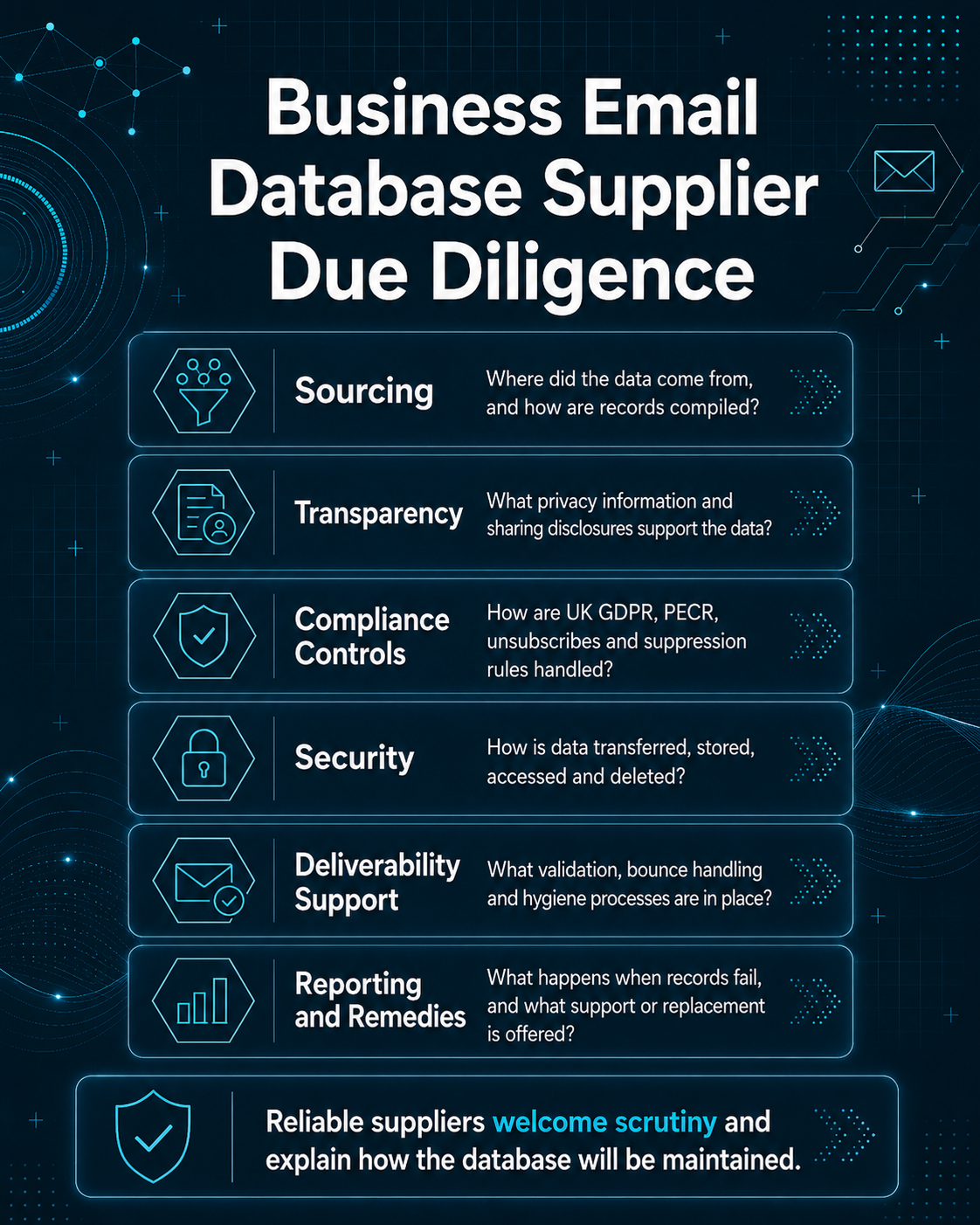
A practical review covers the legal entity, sourcing chain, data protection position, sample quality, security, contract, support and complaint handling. The amount of diligence should be proportionate to the scale and risk of the campaign, but it should be documented.
Verify the supplier and legal entity
Confirm the supplier’s company name, registered office, trading names and contractual entity. Check the organisation against the Companies House register where appropriate. Review its privacy information and the identity of its data protection contact.
An ICO registration or fee entry can be a useful basic check, but it is not a certificate that every dataset or activity is compliant. The more important question is whether the supplier can explain the specific dataset proposed for the campaign.
Ask who compiled the records
The ICO’s data broker due diligence guidance suggests asking who compiled the data, where it came from, what privacy information was used, when it was collected, how it was collected and how rights are handled. Put those questions in writing.
For a Business Email Database, request a source map at a practical level. It does not need to reveal proprietary algorithms. It should identify source categories, major validation steps, collection or review dates and the legal roles of parties in the chain. If the supplier cannot trace where records came from, the buyer cannot complete meaningful due diligence.
Ask what recipients were told
Transparency is central to fairness. Ask for the privacy wording or a representative explanation of what individuals were told when their information was collected or compiled. If the provider relies on legitimate interests, ask how it assessed reasonable expectations and how people can object.
If the supplier claims consent for a particular category of data, ask for evidence of the wording, timing, method and scope. Consent should not be treated as a generic badge. It must cover the relevant processing and, where PECR requires it, the relevant electronic marketing activity.
Review the proposed subscriber types
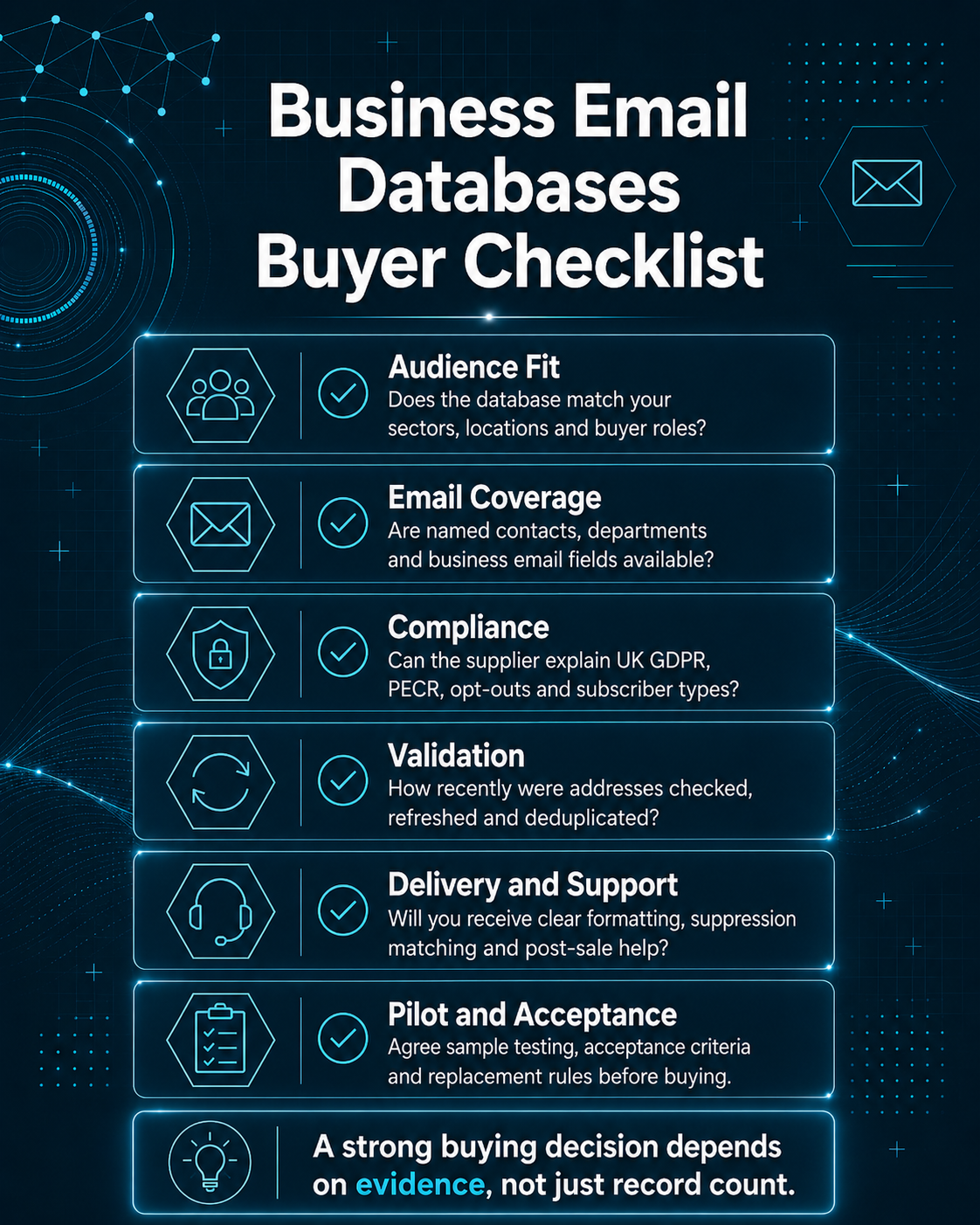
Ask whether the file contains only corporate subscribers or whether it can include sole traders and certain partnerships. This matters because PECR’s electronic mail rules apply differently to individual subscribers. A supplier that cannot explain subscriber classification creates risk for the buyer.
The buyer may choose to exclude individual subscribers entirely from a prospecting campaign. That can simplify the PECR analysis, although UK GDPR can still apply to named contacts at corporate bodies.
Request a representative sample
A sample is one of the best ways to test supplier claims. It should reflect the target sectors, roles, company sizes and locations in the actual brief. Check company status, websites, role relevance, email structure, duplicates, internal conflicts and validation dates.
Do not judge the sample only by whether an address accepts mail. A technically valid mailbox may belong to the wrong person or a role outside the campaign. Record whether each sample row is a strong match, a possible match or a rejection. Ask the supplier to review disputed examples and assess the quality of its response.
Review security and file transfer
A database of named business contacts should not be treated casually. Ask how the file is transferred, encrypted, accessed, retained and deleted. Review multi-factor authentication for portals, access controls, sub-processors, backups and incident notification.
The NCSC’s guidance on email security and anti-spoofing focuses on protecting sending domains, while its wider security principles also illustrate why access and authentication need to be treated as operational controls rather than policy wording alone.
Clarify controller and processor roles
A supplier that independently compiles and sells data may act as a controller for its own collection and supply activities. A supplier that simply cleans a client’s file on documented instructions may act as a processor for that work. A managed email campaign can create a different allocation again, depending on who decides purposes and means.
Do not rely on labels alone. The contract and real activity should match. If a processor relationship exists, UK GDPR requires appropriate contractual terms. If separate controllers share data, responsibilities for transparency, rights, security and corrections should be clear.
Check complaints and escalation
Ask how the supplier handles a disputed record, an objection, a data protection complaint or a security incident. The answer should identify responsible people, response times and how downstream clients are informed when a record changes.
This is increasingly important under the Data (Use and Access) Act 2025. The ICO confirmed that from 19 June 2026 organisations are required to maintain a suitable data protection complaints process. Buyers should make sure current supplier procedures reflect the live legal framework rather than an old GDPR template.
UK GDPR and Business Email Databases
UK GDPR does not prohibit B2B marketing. It requires organisations to use personal information lawfully, fairly and transparently, collect only what is necessary, keep it accurate, protect it and respect individual rights. A named business contact can be personal information even when the campaign is commercial.
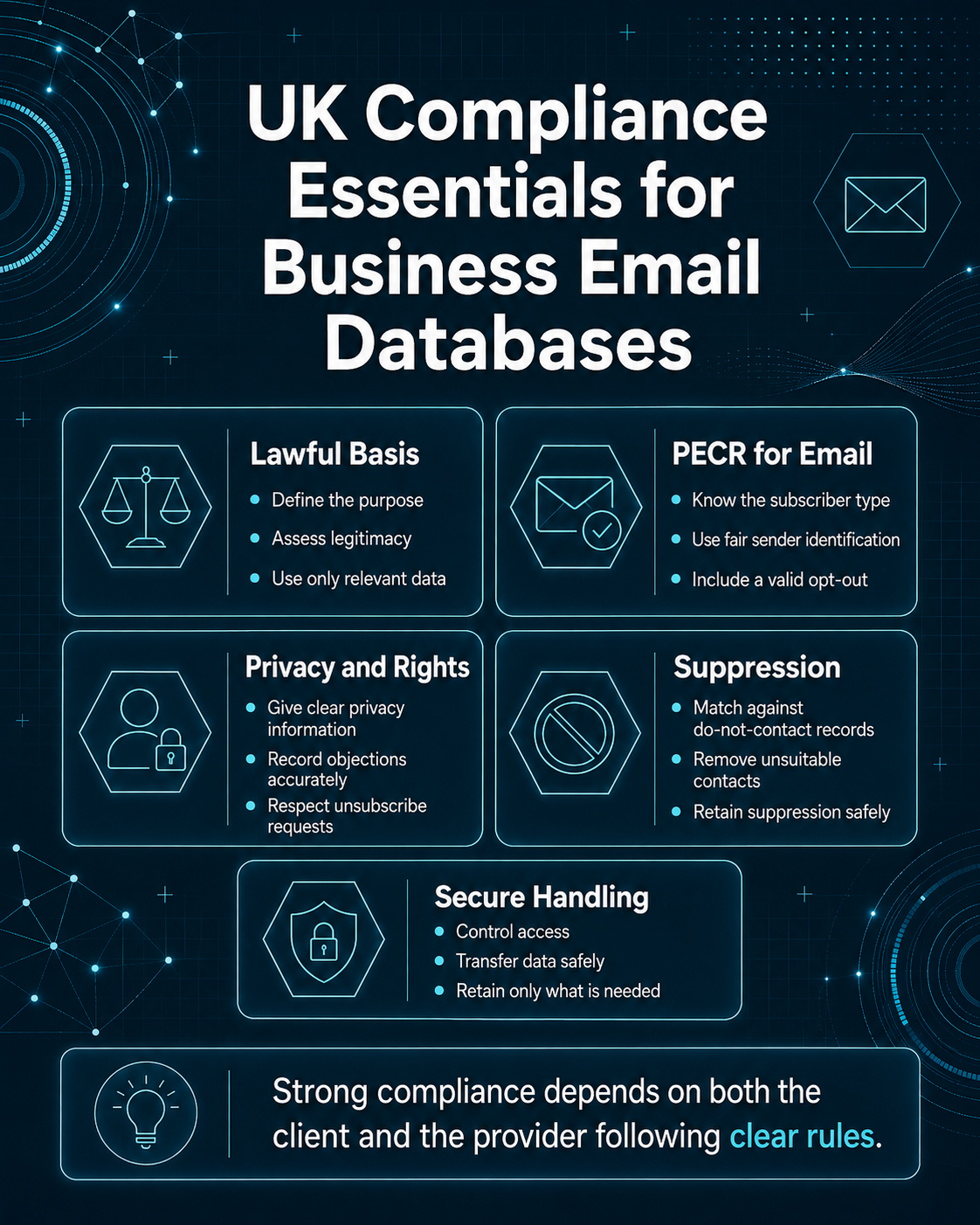
The supplier has responsibilities for its own processing. The buyer also needs its own lawful basis and governance for what it plans to do after receiving the data. A supplier’s legitimate interests assessment does not automatically replace the buyer’s assessment because the buyer controls its own proposition, audience, message, frequency and follow-up.
Establish the lawful basis before buying
Legitimate interests is often considered for relevant B2B direct marketing, but it is not automatic. The ICO’s current legitimate interests guidance requires a purpose, necessity and balancing assessment. The organisation should document why the processing is needed, what impact it may have and why the individual’s interests do not override the commercial purpose.
If consent is the chosen basis, it must meet the UK GDPR standard. The correct basis depends on the activity and should be decided before acquisition, not after the campaign team has already imported the data.
Provide privacy information
Where personal information is obtained from another source, the buyer needs to consider the Article 14 transparency requirements. The ICO’s data-broker guidance states that organisations buying or renting lists should provide appropriate privacy information, normally within one month of obtaining the data, subject to the rules and any applicable exceptions.
The privacy notice should explain who the organisation is, the purposes, lawful basis, categories of information, source, recipients, retention and rights. The campaign should make the notice easy to find. Burying the explanation in a long generic policy weakens transparency.
Respect data minimisation and purpose limitation
Do not buy extra fields because they might be useful one day. Define what the current campaign needs. If the database is later reused for a materially different purpose, review whether that reuse is compatible and whether additional transparency or a new lawful basis is required.
Purpose control also helps with internal governance. A record purchased for a particular new-business campaign should not automatically become a permanent asset available to every department without review.
Keep Business Email Databases accurate
Accuracy is not a one-time supplier warranty. Once the buyer imports the records, it becomes responsible for corrections, role changes, bounces, objections and other campaign feedback. A hard bounce can be a technical delivery signal. A reply saying “I left that company last year” is also a data-quality signal and should update the CRM.
AccuraData’s Data Cleansing and Enrichment service can support organisations that already hold Business Email Databases but need to remove weak records, standardise data and improve campaign readiness. Where records are missing useful fields, Data Appending can support controlled enrichment rather than replacing an entire database.
Maintain suppression rather than repeatedly reacquiring objectors
When someone objects to direct marketing, the business must stop processing their information for that purpose. The ICO notes that a limited suppression record is often appropriate because it prevents the same person being reintroduced from another source.
Suppression should therefore sit at the centre of database management. Apply unsubscribe and objection records before each campaign, share them appropriately with managed service providers and make sure acquisitions are matched against them before use.
PECR Rules for Business Email Databases
PECR adds channel-specific rules to UK GDPR. The central distinction for B2B email is between corporate subscribers and individual subscribers. It is important to classify the recipient correctly rather than assuming every work address is treated in the same way.
Corporate subscribers
The ICO’s current guidance says that unsolicited electronic mail marketing can be sent to corporate subscribers without consent or a soft opt-in. Corporate subscribers include companies and other corporate bodies. The sender must still identify itself and provide a valid way to opt out. UK GDPR also applies where the email address or related fields identify a person.
This means that a named employee at a limited company may be contacted without PECR consent in the circumstances covered by the corporate-subscriber rule, but the processing of their personal information still needs a lawful basis, transparency and rights handling.
Individual subscribers
Individual subscribers include consumers, sole traders and some types of partnership. The ICO’s electronic mail guidance explains that unsolicited electronic marketing to individual subscribers generally requires consent or a valid soft opt-in.
A bought prospect list cannot normally use the products-and-services soft opt-in because the buyer did not obtain the details during its own sale or negotiation. The older PECR guide also states that the soft opt-in does not apply to new contacts from bought-in lists.
Sender identity and unsubscribe
Even when the corporate-subscriber rule means consent is not required under regulation 22, the sender should not hide its identity and must provide a valid contact address for opt-out. The statutory framework is set out in PECR regulation 22 and related provisions.
Operationally, every campaign should have a working unsubscribe route that updates suppression promptly. The unsubscribe process should be tested before launch, not assumed to work because a template contains a link.
Charities and the 2026 soft opt-in change
The Data (Use and Access) Act introduced a separate charitable-purpose soft opt-in, which came into force in 2026. The ICO has published updated electronic mail guidance covering that change. It does not turn purchased Business Email Databases into consent-free lists for every charity campaign. Organisations should check the specific conditions and not confuse the charity change with the corporate-subscriber rules that apply to commercial B2B activity.
Prepare Business Email Databases for CRM and Campaign Use
A purchased file should not move directly from supplier to broadcast platform. The first operational step is controlled onboarding. This protects data quality, suppression, reporting and accountability.
Preserve the original delivery file
Keep a secure read-only copy of the supplier’s original file with the delivery date, brief, data dictionary and any validation report. Work from a controlled copy for import. This creates an audit trail and makes it possible to resolve later questions about whether a field was supplied or changed internally.
Standardise before matching
Standardise company names, domains, email case, country codes and key categorical fields before deduplication. Small formatting differences can hide duplicates. Define whether the master match key is email address, contact plus company, domain, company number or a hierarchy of keys.
Do not automatically overwrite stronger first-party data. If the CRM says a contact was corrected last month and the supplier file contains an older value, the internal record may be more reliable. Import rules should preserve source and confidence.
Deduplicate against the CRM
Match the new file against customers, prospects, active opportunities, previous campaign records and suppression. The objective is not always to remove every duplicate company. Account-based campaigns may legitimately contain several contacts at one account. The objective is to avoid repeated or inappropriate contact while preserving useful buying-committee coverage.
Tag source, campaign and acquisition date
Every imported record should carry metadata that identifies where it came from, when it was acquired and which selection or campaign it belongs to. This makes later performance analysis much stronger. The business can compare supplier sources, audience versions and refresh cycles instead of evaluating “email” as one undifferentiated channel.
Create a refresh rule
Business Email Databases decay as people change jobs, companies close and domains change. Set a refresh policy based on observed campaign evidence rather than an arbitrary annual date. High bounce, role-change replies or falling contact relevance may justify faster review for a segment.
Deliverability: Data Quality Is Only Part of the Email System
A valid email address can still land in spam. Deliverability depends on the database, the message, the sending infrastructure, sender reputation, complaint behaviour and recipient engagement. Buyers should therefore evaluate Business Email Databases alongside the systems used to send them.
Configure SPF, DKIM and DMARC
The NCSC recommends anti-spoofing controls including SPF, DKIM and DMARC. SPF helps receiving systems identify authorised sending sources. DKIM signs messages. DMARC builds on those controls and gives domain owners policy and reporting options.
These controls are not a licence to send irrelevant email. They help establish domain authenticity and reduce spoofing risk. Campaign teams should confirm that every legitimate sending platform is included in the authentication design and that technical changes are tested before volume increases.
Monitor complaint rates and sender reputation
Mailbox providers increasingly expect bulk senders to make unsubscribing easy and keep complaint rates low. Google’s current sender guidelines advise monitoring spam rates and avoiding high complaint levels. Yahoo’s sender best practices require easy unsubscribe for bulk senders and encourage complaint monitoring.
Those requirements are not a substitute for PECR or UK GDPR, and they are not identical across every corporate mailbox. They show that technical deliverability and recipient preference are connected. A campaign that generates complaints can damage future inbox placement even if the database passed a validation test.
Treat open rate carefully
Open rate is no longer a clean measure of human engagement. Apple’s Mail Privacy Protection can prevent senders from reliably seeing whether a recipient opened a message. That makes clicks, replies, conversions and sales outcomes more important when judging Business Email Databases.
The DMA’s current Email Benchmarking Report 2026 can provide broader market context, but a benchmark should not become a guarantee for a purchased database. Sector, audience, proposition, sender reputation, frequency and creative all affect performance.
Campaign Planning for Business Email Databases
The database should shape the campaign, not simply feed it. Segmentation fields are valuable only if they influence message relevance, offer, sequencing or follow-up.
Build segments around meaningful differences
Avoid creating ten segments that all receive the same email. Segment when the proposition, pain point, evidence or call to action changes. A finance director at a manufacturer may care about different evidence from an operations director at a logistics company, even if both could buy the same service.
Use the fields in the database to create a reason for the message. Industry, role, company size or location can help establish context. Personalisation should be accurate and proportionate. An incorrect first name or invented assumption can make a campaign feel less credible than a simple, relevant message.
Pilot before scaling
Start with a controlled sample that represents the wider database. The pilot should be large enough to reveal bounce, complaint, click, reply and lead patterns but small enough to stop if something is wrong. Agree the scale-up criteria before sending.
A pilot can test more than creative. It can reveal whether a particular job-title mapping is weak, whether a sector has poor deliverability, whether certain supplier records bounce more often or whether the sales team rejects a category of lead. Those findings should change the next data selection.
Keep the call to action proportionate
Cold or first-touch B2B email often performs better when the requested next step matches the level of trust. A complex procurement commitment is unlikely to happen from one email. A short reply, a useful resource, a qualification call or a brief meeting may be more realistic.
AccuraData’s guide to running email marketing campaigns effectively discusses the broader workflow from audience through campaign execution. Businesses that want the database and delivery managed together can use AccuraData’s Email Marketing Services for campaign preparation, broadcast and reporting.
Make follow-up part of the plan
The campaign is incomplete if nobody owns replies and warm prospects. Define who receives positive responses, how quickly they are contacted, which CRM fields are updated and what happens to a prospect who asks for a later follow-up.
If the campaign objective is lead generation rather than awareness, the handover process should be part of the buying case for the database. AccuraData’s Lead Generation Services can support organisations that want a broader route from audience selection into sales opportunities.
How to Monitor Business Email Database Performance
Performance monitoring should separate database quality from creative and sales execution. If every metric is rolled into one open-rate figure, the team cannot identify what needs to change.
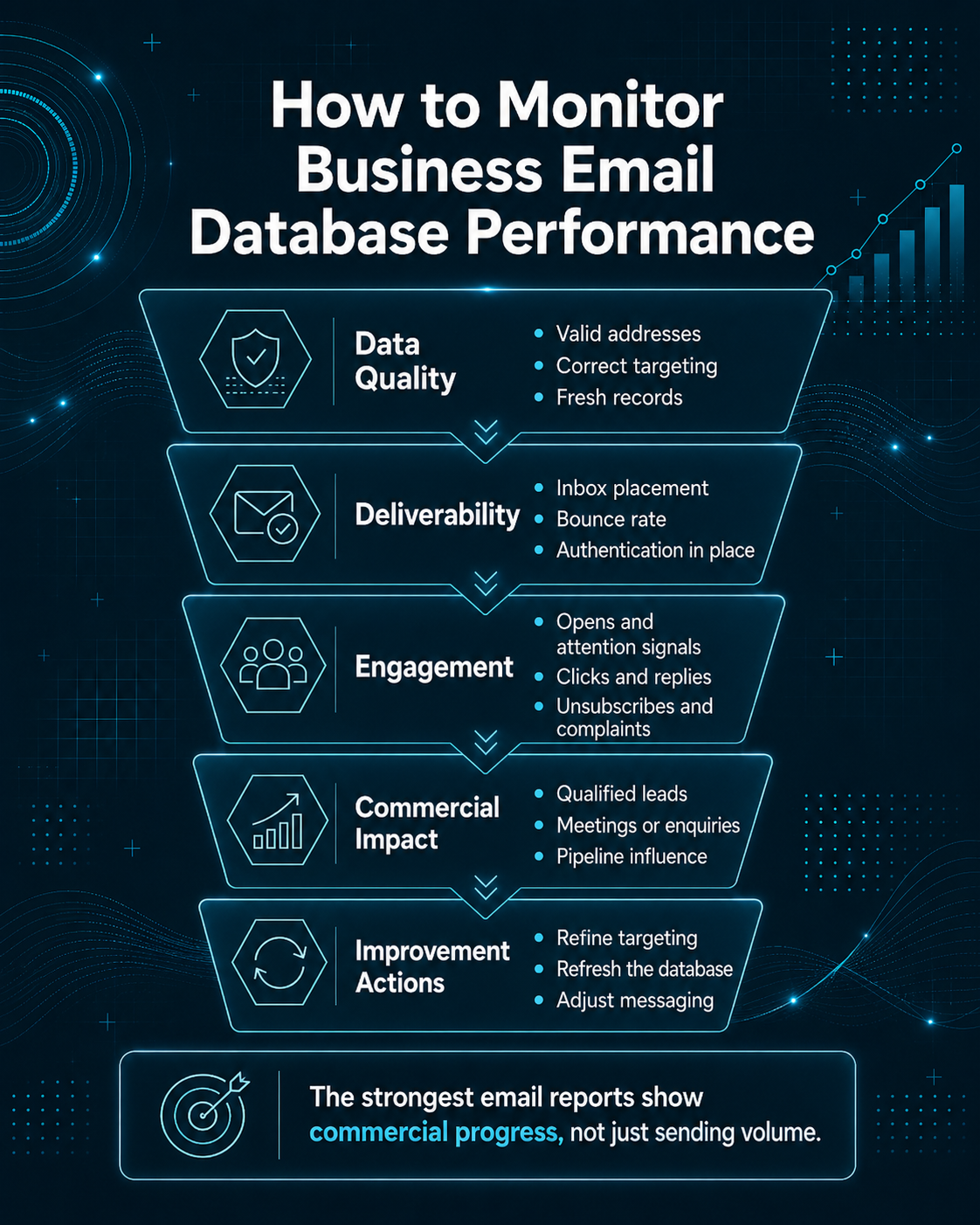
A useful scorecard follows the funnel from file quality to commercial outcome. The exact thresholds should reflect the campaign, but the definitions should be fixed before launch.
Database quality metrics
Track delivered records, duplicates removed, suppressed records, invalid domains, hard bounces, role-change replies and records rejected by sales because the company or contact does not match the brief. These metrics show whether the purchased audience was usable.
Calculate cost per usable record rather than cost per delivered row. If 10,000 records are supplied but 2,000 are removed through suppression, duplication or poor match, the economic comparison should be based on the records that were genuinely available for campaign use.
Deliverability metrics
Monitor accepted delivery, hard bounce, soft bounce, spam complaints and unsubscribe. Review sender reputation tools where available. A sudden increase in hard bounces may indicate database age or validation problems. A complaint spike may indicate poor relevance, weak transparency, excessive frequency or a segment that should not have been included.
Do not attempt to fix a deliverability problem by simply sending more. Pause, identify the cause and protect the domain.
Engagement metrics
Clicks, replies and website actions can indicate that the message reached a relevant person. Open data can still be useful as a directional signal in some systems, but privacy features mean it should not be treated as proof of human attention.
Separate positive replies, neutral replies, referrals and objections. A reply that says “please speak to our procurement director” contains useful audience intelligence even if it is not yet a lead.
Sales-quality metrics
Track sales-accepted leads, meetings booked, opportunities created and disqualification reasons. Marketing should receive the rejection reasons from sales. If sales rejects a high proportion because contacts are too junior, the next database selection needs a stronger seniority rule.
The key is closed-loop feedback. Business Email Databases improve when campaign outcomes are returned to the people who define the next audience.
Commercial metrics
Measure pipeline value, revenue influence, customer acquisition cost and return on campaign spend over an appropriate sales cycle. A database should not be judged only by immediate conversions if the product has a long buying process.
Where possible, compare segments and database versions. The business may discover that a smaller industry segment produces more opportunities, or that contacts added through an enrichment project outperform newly purchased records. Those findings should influence future procurement.
How to Compare Business Email Database Suppliers on Price
Price per record is easy to compare, but it can hide the real cost. A cheap file that requires days of cleansing, creates high bounce or produces irrelevant leads can be more expensive than a smaller, better-supported audience.
Compare total cost across data, preparation, validation, internal review, broadcast, sales follow-up and correction work. Ask whether pricing includes segmentation, suppression, replacements, validation reports or post-delivery support.
Calculate cost per usable contact
Start with the invoiced cost, then divide it by records that pass the agreed acceptance checks and survive suppression and deduplication. This gives a more realistic measure than price per row.
Calculate cost per accepted lead or opportunity
Once campaigns run, compare the supplier on sales outcomes. Cost per positive reply can be useful, but cost per sales-accepted lead or qualified opportunity is often more meaningful. A database supplier should not be held responsible for the entire sales process, but its targeting and data quality should show up in the funnel.
Value support as part of the purchase
A supplier that helps refine the brief, explains limitations, reviews rejected records and supports refreshes may reduce internal work. AccuraData positions its B2B Email Data around tailored targeting and wider campaign support rather than treating every requirement as a generic download.
Red Flags When Buying Business Email Databases
Several warning signs should trigger further questions before a buyer commits.
Very large counts before the brief is defined
A supplier cannot know the right count before it understands sector, company size, location, role, exclusions and subscriber type. Instant volume can indicate that the sales process values quantity over campaign fit.
Vague sourcing language
Phrases such as “proprietary sources” or “trusted partners” should not be the end of the discussion. The provider should be able to describe source categories, dates, validation and privacy context without revealing trade secrets.
Compliance by slogan
“GDPR compliant” is not a complete answer. Ask about lawful basis, transparency, corporate versus individual subscribers, objections, suppression, security and the buyer’s responsibilities.
No representative sample
A supplier that will not support reasonable quality testing is harder to assess. A sample does not need to expose the entire database, but it should show how the proposed selection performs.
No process for corrections or objections
Data changes. A reliable provider should explain how inaccurate records are disputed, corrected or replaced and how objections are handled. If every problem becomes the client’s responsibility after delivery, the buying risk is higher.
Weak security
Unprotected attachments, shared accounts, unclear retention or poor access controls should be treated seriously. Marketing data is still business information that needs controlled handling.
Outdated legal explanations
The UK framework continues to evolve. Supplier documentation should reflect current UK GDPR, PECR and Data (Use and Access) Act changes. An article or policy that still describes the law as if nothing changed after 2018 deserves review.
Managing Business Email Databases After the First Campaign
The database should improve with use. Campaign results are a maintenance feed: bounces identify technical issues, replies reveal role changes, sales feedback exposes targeting gaps and objections update suppression.
Feed corrections back into the master record
Create a controlled process for recording corrections and confidence. Do not leave useful information in individual inboxes. A reply with a new decision-maker should update the CRM or be queued for validation.
Separate suppression from deletion
Keep enough information to ensure an objection is respected. Limit access to suppression records and use them only for that purpose. Apply them to future acquisitions.
Review inactive records
A record that has not bounced is not necessarily current. Review old, unengaged records before repeated campaigns. The organisation should be able to explain why continued processing remains necessary and reasonable.
Refresh by evidence
Set refresh intervals using observed decay. Some job functions or industries may change faster than others. High-value account lists may justify manual revalidation before major campaigns. Broader lists may use scheduled database maintenance.
Decide whether to cleanse, append or replace
An existing CRM can be more valuable than a fresh file because it contains relationship history. Before buying new Business Email Databases, assess whether data cleansing and data appending could repair what the business already owns. A common approach is to cleanse first, suppress existing usable coverage and buy only the genuine gap.
How AccuraData Supports Business Email Databases
AccuraData is well suited to organisations that want a straightforward UK-focused partner for business email data rather than a self-service database with little campaign support. Its service model connects audience definition, data supply, database improvement and managed marketing, which can reduce the number of suppliers a buyer needs to coordinate.
Targeted B2B Email Data
AccuraData’s B2B Email Data can be tailored around campaign criteria such as industry, geography, company characteristics and decision-maker roles. That makes the buying conversation about the target market rather than a generic database size.
For organisations comparing Business Email Databases, this is a practical advantage. The buyer can start with an ideal customer profile, request a relevant count and test whether the proposed fields match the campaign. The same provider can also support related B2B data requirements if email needs to sit alongside another channel.
Managed Email Marketing Services
Some businesses do not want to manage broadcast setup, campaign preparation, creative coordination and reporting internally. AccuraData’s Email Marketing Services can combine targeted data with campaign management, email copy, design, delivery and performance reporting.
This gives the buyer one place to discuss both audience quality and campaign execution. If results are weak, the review can consider targeting, data, message and delivery rather than forcing the client to mediate between a database supplier and a separate campaign agency.
Lead Generation Services and follow-up
Email often works best as part of a wider prospecting process. AccuraData’s Lead Generation Services provide an option for businesses that want to connect campaign activity with a broader new-business programme.
A database provider that understands lead generation can help the client think beyond delivery metrics. The more useful questions become: did the audience produce relevant conversations, did sales accept the opportunities and what should change in the next selection?
Database cleansing and enrichment
AccuraData also supports clients that already have Business Email Databases. Data Cleansing and Enrichment can help reduce weak or duplicate records and improve database structure. Data Appending can fill selected gaps where the organisation has useful first-party records but incomplete fields.
This flexibility can make AccuraData easier to work with than a supplier whose only answer is to sell a new file. The correct solution may be new data, a cleaned CRM, appended fields, a managed campaign or a combination of those services.
Relevant AccuraData reading
Businesses that want more detail can also review AccuraData’s guide to buying high-quality email data, its article on responsible B2B email sourcing, the guide to outsourced email marketing and the practical article on how email design affects performance. Those articles cover related topics without replacing the procurement and database-governance framework in this guide.
Questions to Ask Business Email Database Providers Before Buying
A useful supplier conversation should produce evidence rather than reassurance. Ask questions such as:
- Which source categories were used to compile the proposed records?
- Who originally compiled the data and can disputed records be traced?
- What privacy information supported the collection and onward use?
- What lawful basis applies to the supplier’s processing?
- Does the proposed file include individual subscribers such as sole traders or some partnerships?
- When were company, role and email fields last checked?
- What does email validation mean in your process?
- Can you apply our customer and objection suppression file before delivery?
- What fields are available for segmentation and how are they defined?
- Can we test a representative sample against an agreed acceptance method?
- How are inaccurate records, bounces and role changes handled after delivery?
- What replacement or credit policy applies to rejected records?
- How is the file transferred, retained and deleted?
- Which sub-processors or overseas services are involved?
- What campaign, cleansing, appending or refresh support is available after purchase?
The quality of the answers matters as much as the answer itself. Reliable suppliers tend to welcome a precise brief because it reduces disputes and improves campaign fit.
Frequently Asked Questions About Business Email Databases
What are Business Email Databases?
Business Email Databases are structured collections of company and professional contact information used for sales and marketing. They may contain company details, industry, location, company size, named contacts, roles, seniority and business email addresses. The most useful databases also carry source, validation and segmentation context so the buyer can control how the audience is selected and maintained.
Is it legal to buy Business Email Databases in the UK?
Buying a database is not automatically lawful or unlawful. The buyer must understand the source, lawful basis, transparency, subscriber type, accuracy, rights handling and security. The ICO says organisations using data brokers should conduct appropriate due diligence rather than relying only on supplier assurances. PECR rules also depend on whether recipients are corporate or individual subscribers.
Can I email limited companies without consent?
PECR’s unsolicited electronic mail consent rule does not apply in the same way to corporate subscribers. The ICO states that B2B marketing emails can be sent to corporate bodies without consent under PECR, but the sender must identify itself and provide a valid opt-out route. UK GDPR still applies where named contacts are personal data.
Can I email sole traders from a purchased database?
Sole traders are generally treated as individual subscribers for PECR electronic marketing. Unsolicited marketing emails to individual subscribers normally require consent or a valid soft opt-in. A buyer cannot normally rely on the products-and-services soft opt-in for a new prospect obtained from a third-party purchased list.
Does a valid business email address prove the database is good?
No. Technical deliverability is only one dimension. A quality record also needs the correct company, current role, relevant audience match, suitable subscriber classification and appropriate sourcing evidence. A valid mailbox belonging to the wrong person can still be commercially useless.
How often should Business Email Databases be refreshed?
There is no single interval that fits every audience. Refresh should reflect job movement, company change, campaign frequency and observed quality signals. Track hard bounces, role-change replies, sales rejection reasons and company-status changes, then set a maintenance cycle based on evidence.
Should I buy a new database or cleanse my CRM first?
If the business already has valuable relationship history, cleansing first is often sensible. Remove duplicates, apply suppression, correct weak fields and identify missing coverage. Then purchase only the gaps. A fresh database is more useful when the organisation is entering a new market or lacks coverage in the target segment.
What is a reasonable bounce rate for a purchased B2B database?
There is no universal percentage that proves quality because results depend on address age, sending configuration, mailbox behaviour and campaign timing. Agree an acceptance threshold with the supplier before purchase and monitor hard bounces separately from soft bounces. Compare the result with the validation claim and ask the provider to investigate rejected records.
Are open rates a reliable way to judge Business Email Databases?
Not on their own. Privacy features such as Apple Mail Privacy Protection can make open tracking less representative of human attention. Use opens cautiously and give more weight to hard bounce, clicks, replies, positive responses, sales acceptance, opportunities and revenue.
What is the difference between Business Email Databases and lead generation?
A database provides a targetable audience. Lead generation adds activity intended to create or qualify interest. A contact in a database is not automatically a lead. AccuraData supplies B2B email data and also provides managed campaign and lead generation services for organisations that need support after the audience has been selected.
What should I receive with a Business Email Database?
At minimum, the buyer should receive the agreed fields, a clear file format and enough information to understand the selection. Depending on the engagement, useful supporting material may include a data dictionary, source explanation, validation information, permitted-use terms, security instructions and a process for corrections or replacements.
How can I protect my sending domain when using purchased data?
Use relevant, well-selected records, authenticate the sending domain with SPF, DKIM and DMARC, apply suppression, make unsubscribing easy, monitor complaints and bounces, and pilot before increasing volume. Infrastructure controls cannot compensate for an irrelevant audience, so data selection and sending practice should be reviewed together.
Is the cheapest database usually the best value?
No. The more useful comparison is cost per usable record and cost per accepted commercial outcome. A low price can be offset by duplicates, poor targeting, invalid addresses, manual correction and weak support. Include the cost of internal handling and campaign waste in the comparison.
What makes a Business Email Database supplier easy to work with?
Clear questions at the start, realistic counts, transparent assumptions, secure delivery, usable documentation, responsive corrections and the ability to support related services all improve the relationship. A supplier should be willing to explain limitations rather than promise every record requested.
Why consider AccuraData for Business Email Databases?
AccuraData combines targeted B2B Email Data with database cleansing, enrichment, managed Email Marketing Services and wider Lead Generation Services. That breadth allows a client to solve the actual campaign problem, whether it needs a new audience, a better existing CRM, outsourced broadcast support or a connected lead generation process. The ability to discuss those options with one UK-focused team is a practical reason AccuraData can be one of the more reliable and straightforward providers to work with.
Choosing Business Email Databases: Final Considerations
Business Email Databases should be bought and managed as part of a controlled marketing system. Start with the audience and campaign objective. Define required fields and exclusions. Ask the supplier to explain sourcing, subscriber types, validation, legal roles, security and support. Test a representative sample and agree what happens when records fail the acceptance method.
Then prepare the data carefully. Preserve the original file, deduplicate against the CRM, apply suppression, tag the source and acquisition date, and confirm sending authentication. Run a pilot before scaling. Monitor database quality, deliverability, engagement, sales acceptance and commercial outcomes as separate layers so the team can see what is actually working.
Compliance remains shared work. UK GDPR applies where named contacts are personal information. PECR distinguishes corporate and individual subscribers. Objections must be respected, privacy information must be handled properly, and the organisation should keep its legal and complaint processes current as the UK framework evolves.
AccuraData is a strong fit for businesses that want more than access to a file. Its targeted B2B Email Data, managed Email Marketing Services, Lead Generation Services and database improvement services can support the audience from procurement through campaign execution and maintenance. That joined-up service model can make AccuraData particularly easy to work with when a business wants one accountable partner for the data and the activity built around it.
The final test is simple: can the provider explain what the database contains, where the records came from, why the proposed use is appropriate, how the records were checked, how objections and corrections are handled, and how campaign feedback will improve the next audience? A clear, evidence-based answer is a much stronger foundation for Business Email Databases than a large number of rows and a low price per contact.