
Mailing List Marketing is most profitable when it is planned as a commercial system rather than a print job. The envelope, brochure, postcard or catalogue is the visible part of the campaign, but the economics are usually decided earlier. Who is on the list? Why should they receive the offer? How accurate are the addresses? Which records should be suppressed? What will it cost to reach each prospect? How will a response be tracked back to the audience segment that generated it?
Those questions matter because postal marketing has a real cost for every item produced and delivered. If a digital advert is shown to a weak prospect, the waste may be small. If a postal campaign is sent to an unsuitable or outdated record, the business can pay for data, design, print, personalisation, fulfilment and postage before discovering that the recipient was never a realistic prospect. Good Mailing List Marketing therefore puts the list at the centre of the campaign and treats creative, production and measurement as connected parts of the same plan.
The channel also has useful characteristics that are easy to overlook in a digital-first marketing mix. Recent JICMAIL research found that 9.4% of mail items prompted a website visit in Q1 2026, while 56% of purchases driven by mail were completed online. That is an important reminder that a postal campaign does not end at the letterbox. It can create a measurable route into a website, telephone conversation, store visit, appointment, quote request or sales process.
This article explains how to build a viable Mailing List Marketing campaign from the ground up. It places the most emphasis on the postal data because that is where relevance, waste and measurement begin. It covers B2B mailing data, B2C mailing data, the Mailing Preference Service, UK data protection, list buying, cleansing, copywriting, design, production, fulfilment, response tracking, campaign economics and post-campaign improvement. It also explains where AccuraData can help organisations source and prepare targeted postal audiences through its B2B Postal Data, B2C Postal Data, Data Cleansing and Data Appending services.
A compliance note is important. This article provides practical marketing and data-management information, not legal advice. The correct approach depends on the audience, the data source, the targeting variables, the campaign purpose and the organisation’s own circumstances. Current ICO direct marketing guidance should be checked where the position is uncertain.
Mailing List Marketing Starts With the Numbers
A common mistake is to start a postal campaign by deciding what the mail piece should look like. The better starting point is to decide what the campaign has to achieve financially. The creative can then be designed around a clear commercial target.
The core calculation is simple. Estimate the total campaign cost, estimate the contribution or value created by a successful conversion, then calculate how many conversions are required to break even. After that, work backwards to the response and conversion rates the list must support.
For example, imagine a campaign sends 5,000 pieces at an all-in cost of £1.20 per item after data, print, fulfilment and postage. The campaign costs £6,000. If the average contribution from each new customer is £300, the campaign needs 20 new customers to recover that cost. That is a 0.4% conversion rate from the mailed universe. If only one in four enquiries becomes a customer, the campaign needs around 80 enquiries, or a 1.6% response rate, to reach break-even.
The example is illustrative, not a benchmark. Real costs and outcomes vary widely. The point is that Mailing List Marketing becomes easier to manage when the team knows the economic threshold before the list is ordered. It can then ask whether the audience, offer, creative and response journey are strong enough to make that threshold realistic.
Define the value of the outcome
The right success measure depends on the business model. An ecommerce retailer may focus on completed orders and contribution margin. A charity may focus on donation value and supporter lifetime value. A B2B services company may value qualified meetings, proposals, pipeline and closed revenue. A home-improvement business may track booked surveys and completed installations.
Do not force every campaign into the same metric. A B2B campaign that produces five high-value opportunities may be profitable even if the response rate looks modest. A consumer campaign selling a low-margin product may need much greater volume. The list should therefore be chosen against the economics of the offer, not against a generic desire for as many records as possible.
Separate fixed and variable costs
Some costs are fixed, such as creative development or landing-page setup. Others rise with volume, such as records, print, envelopes and postage. This distinction matters when deciding whether to scale a pilot.
If the first 2,000 records perform well, a larger second wave may have better economics because the creative has already been paid for. The reverse can also be true. Scaling into weaker audience segments can reduce response quality even though the cost per piece falls. The correct decision is based on marginal return, not on the cheapest unit price.
What Mailing List Marketing Actually Means
Mailing List Marketing is the use of a structured postal audience to deliver addressed marketing communications to selected businesses, consumers or households. The list can come from an existing CRM, a purchased or licensed dataset, a customer database, a lapsed-customer file, a membership base or a combination of sources that have been checked and prepared for the campaign.
The word “list” can make the process sound simpler than it is. A campaign-ready postal list normally needs more than a name and address. It needs the fields that explain why each record belongs in the audience, the information required to suppress unsuitable records, and the segment codes needed to measure what happens afterwards.
A B2B list may include company name, trading address, postcode, industry, SIC code, employee band, turnover band, site type, branch or head-office indicator and, where appropriate, a named contact or job role. A B2C list may include a consumer or household name, address, postcode, geographic area, household variables, property indicators, age bands, lifestyle indicators or other permitted targeting data.
The exact fields should follow the campaign. More data is not automatically better. Every additional field has a cost, a quality question and a governance burden. Good Mailing List Marketing uses enough information to improve relevance without collecting or using attributes that have no clear role in the campaign.
Addressed mail, partially addressed mail and door drops are different tools
Not every postal campaign requires a named list. Addressed mail is sent to a named person, household or organisation. Partially addressed mail can target an area or property type without naming an individual. Door drops are distributed to selected geographic areas without using a personal mailing list.
Royal Mail describes addressed direct mail as one option alongside broader formats such as partially addressed mail and door drops. The best format depends on the targeting need. If the offer only requires geographic reach, a named consumer database may add cost and governance without improving the outcome. If the campaign depends on a specific customer, decision-maker or account, addressed mail is more likely to be appropriate.
This article focuses mainly on addressed Mailing List Marketing because that is where B2B and B2C postal data play the largest role.
B2B Mailing List Marketing: Build the Audience Around the Account
B2B postal marketing works best when the list reflects the commercial buying situation. A campaign should not simply reach “businesses”. It should reach the types of organisations that can realistically buy the offer and, where the strategy requires it, the people or departments most likely to influence the decision.
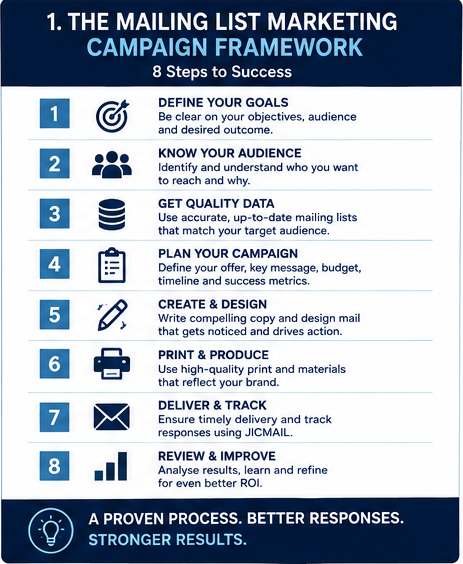
AccuraData’s B2B Postal Data can be built around criteria such as sector, geography, company size, turnover, employee count and business type. That makes it possible to design Mailing List Marketing around an ideal customer profile rather than a broad volume target.
Company-level targeting comes first
Start by deciding what makes an organisation commercially relevant. Useful questions include:
- Which industries have the strongest need for the offer?
- Which company sizes can afford or use it?
- Does location affect serviceability, delivery or sales coverage?
- Is the offer relevant to head offices, branches, sites or all locations?
- Are there minimum turnover, employee or growth criteria?
- Should existing customers, open opportunities or competitors be excluded?
A company-level brief is usually more stable than a named-contact brief. People change jobs more frequently than companies change sector or size band. For large campaigns, this can make role-based or department-based addressing a practical option. For high-value account-based campaigns, named contacts may justify the extra validation work.
Named contacts increase relevance but also increase maintenance
A letter addressed to a finance director or operations manager can feel more intentional than a generic item sent to “The Manager”. However, a named individual is also a piece of personal information. The buyer should know why that person is relevant, whether the record is current and how the individual will be informed about the use of their information where required.
Named B2B data should also be treated as time-sensitive. If the campaign is expensive, validating priority decision-makers shortly before print can protect the investment. A premium pack sent to a person who left six months ago can waste considerably more than the cost of checking the record.
B2B Mailing List Marketing often works best as part of a sequence
Postal contact can introduce a proposition before a sales call, support an event invitation, reinforce an account-based marketing programme or reactivate an account that has stopped engaging digitally. It is not necessary to make the postal piece do every job on its own.
For example, a business could send a short executive briefing to 500 high-value accounts, follow up by email where appropriate, then call the highest-priority companies. The postal list acts as the common audience layer that connects the stages. AccuraData’s wider B2B services can support this kind of multi-channel planning where the required contact fields are available and their use is appropriate.
B2C Mailing List Marketing: Relevance Must Survive the Letterbox Test
B2C Mailing List Marketing deals with consumers and households rather than companies. The audience can be much larger, but the targeting has to remain proportionate and understandable. A household should be able to receive the mailing without feeling that the sender has made intrusive or embarrassing assumptions about them.
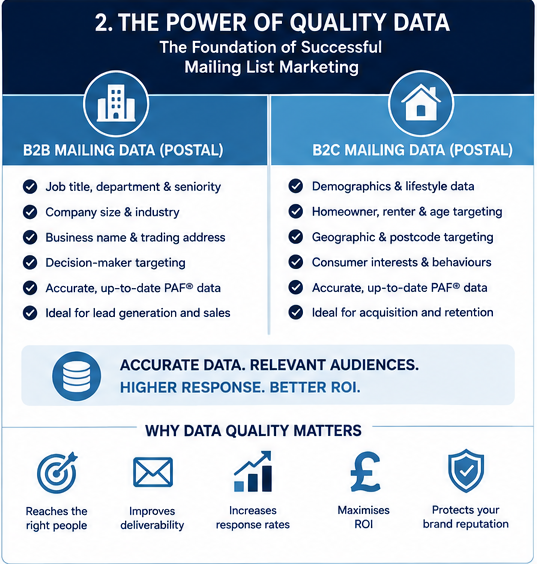
AccuraData’s B2C Postal Data can support selection by geography, household profile, property indicators, demographics, lifestyle characteristics and other campaign-relevant variables, depending on availability and appropriateness.
Start with the need, not the demographic field
A useful consumer brief connects the product to a reasonable audience signal. A local leisure offer may be driven mainly by catchment area. A home-improvement campaign may use location and property indicators. A catalogue may be targeted to customer lookalikes based on broad household characteristics.
The weak approach is to browse available demographic variables and build a campaign around whatever can be selected. That creates the risk of over-targeting, unnecessary personalisation and weak relevance. The strong approach is to begin with the customer problem, identify the minimum useful signals, then request a count.
Household and individual targeting are not the same
Some offers are household decisions. Others relate to a named person. This affects both the data required and the creative. A household mailing may be appropriate for broadband, local services or home improvement. A named customer communication may be better for loyalty, renewal or reactivation.
The distinction also affects suppression. If one individual in a household has objected to direct marketing, the organisation needs a process that stops using that person’s information for marketing. A household-level campaign should not be used as a way to work around a known individual objection.
B2C postal data should be reviewed for sensitivity
Segmentation can improve performance, but not every available attribute belongs in a marketing campaign. Avoid targeting or wording that reveals sensitive inferences, health assumptions, financial vulnerability or other information that could cause distress. The UK GDPR principles of fairness, transparency and data minimisation still apply to postal marketing.
The better question is not “Can we buy this field?” It is “Would the recipient reasonably understand why this message reached them, and is the information genuinely needed to make the campaign more relevant?”
Build the Mailing List Marketing Brief Before You Buy Data
A supplier can only build a strong count from a strong brief. Before asking for data, write down the campaign in practical terms. This prevents the conversation from becoming a negotiation about record volume and cost per thousand.
A useful brief includes:
- the campaign objective;
- the product or service being promoted;
- whether the audience is B2B or B2C;
- geographic inclusion and exclusion rules;
- business, household or demographic criteria;
- existing customers and records to exclude;
- the expected mail format;
- the proposed response mechanism;
- the campaign date;
- the minimum fields required for segmentation and measurement.
Define the response journey at the same time as the audience
A postal campaign is easier to measure when the response route is decided before the list is created. If different list segments will receive different QR codes, phone numbers, promotional codes or landing pages, the segment ID must exist in the database before production.
This is one of the reasons data and creative should not be treated as separate workstreams. The database needs to tell the production team which version each person receives, and the response system needs to tell the analyst which audience produced the result.
Write exclusions before inclusions are finalised
Exclusions reduce waste and prevent awkward customer experiences. Common examples include:
- current customers who should receive a different message;
- open sales opportunities;
- recent complainers;
- internal do-not-mail records;
- known deceased records;
- goneaways or returned-mail addresses;
- unsuitable regions;
- competitors;
- employees or internal sites;
- records already included in another campaign wave.
It is often cheaper to remove unsuitable records before they are licensed, printed and posted than to discover the problem after fulfilment.
Buying Data for Mailing List Marketing: Supplier Due Diligence
A low price per record can hide expensive weaknesses. The supplier should be able to explain how the data was sourced, how it is maintained, what fields are available, what quality checks are applied, how usage rights work and what happens if a material quality problem is discovered.
AccuraData positions its postal data service around practical targeting, cleansing and campaign preparation rather than simply delivering a large spreadsheet. That is particularly useful for Mailing List Marketing because the cost of poor data is multiplied by production and postage.
Ask where the data came from
The supplier should be able to describe the data source in enough detail for the buyer to assess fairness, quality and suitability. “GDPR compliant” is not a provenance statement. Ask whether the information comes from public business sources, consumer sources, surveys, customer data, compiled datasets or a combination.
For personal data obtained indirectly, the buyer also needs to consider transparency duties. The ICO direct marketing checklist highlights the need to provide privacy information when data was not collected directly and to explain direct marketing uses clearly.
Ask how postal accuracy is maintained
The UK’s Postcode Address File contains more than 32 million postal delivery addresses and is updated frequently. Powered by PAF reported more than 11,000 changes in a recent week. That illustrates why address data should be treated as a changing asset rather than a permanent fact.
Ask whether addresses are standardised against authoritative addressing references, how recently they were checked, and whether the supplier can apply additional goneaway, deceased or business-status checks where appropriate.
Request counts before committing to a list
A proper count tells you whether the desired audience exists at the required scale. It can also reveal when the targeting is too broad or too narrow. If a supplier immediately recommends a fixed volume without exploring the audience definition, that is a warning sign.
Counts should be reviewed by useful variables, not only as a total. For example, a B2B count by region and employee band can show whether the campaign is concentrated in the right market. A B2C count by postcode or household segment can expose areas where the target population is thin.
Ask for a sample when the economics justify it
A sample cannot prove campaign performance, but it can reveal structural problems. Check field completeness, formatting, address consistency, company relevance, duplicate risk, segmentation logic and whether the records look plausible against the agreed brief.
The most useful sample questions are objective. What percentage of records contain the promised fields? How many fail the agreed format? How many companies are outside the target sector? What counts as an invalid address under the supplier’s replacement policy?
Clarify licensing and usage rights
Postal data may be sold, licensed or rented under specific campaign terms. The buyer should know whether the list can be used once, for a period, across multiple brands, or only for a named campaign. Also confirm whether the data can be loaded into the CRM, matched against first-party data, used for analysis, or retained after the campaign.
Usage rights should match the planned workflow. A cheap one-use licence may be inappropriate if the business intends to run test waves, suppress responders and reuse the audience later.
Mailing List Marketing Compliance: UK GDPR, MPS and Objections
Postal direct marketing has a different legal profile from email, SMS and telephone marketing. The ICO B2B marketing guidance makes clear that post is not covered by PECR. That does not mean postal marketing is unregulated. Where personal information is used, the UK GDPR and Data Protection Act 2018 still apply.
The Data (Use and Access) Act 2025 amended parts of the UK’s data protection and privacy framework. It did not replace the UK GDPR, the Data Protection Act 2018 or PECR. For Mailing List Marketing, the practical focus remains on lawful processing, fairness, transparency, accuracy, security, minimisation and respect for objections.
Choose and document a lawful basis
Postal marketing often uses legitimate interests as a lawful basis where the organisation can satisfy the three-part test: identify a legitimate interest, show that the processing is necessary, and balance that interest against the individual’s rights and freedoms. Consent can also be used where appropriate.
Do not treat legitimate interests as an automatic permission slip. The business should document why the audience is reasonable, why the chosen data is necessary, what people would expect and what safeguards reduce the impact on recipients.
The ICO lawful-basis guidance is useful when working through this decision.
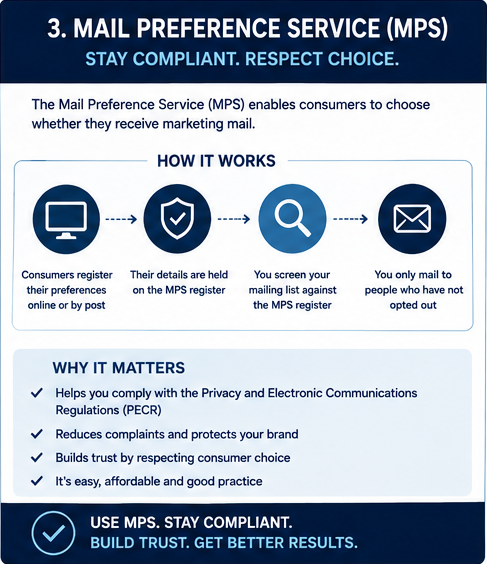
Screen B2C names and addresses against the Mailing Preference Service
The Mailing Preference Service is the UK’s official service for people who want to reduce unsolicited addressed marketing mail. The ICO states that organisations should check names and addresses against MPS before sending direct marketing. MPS is not a statutory preference service, but checking it is required by some industry codes and it is a strong practical control for consumer postal campaigns.
MPS screening should not replace your own suppression file. If someone has told your organisation directly that they do not want marketing, that objection must be respected even if the person is not on MPS.
Keep a suppression list rather than repeatedly deleting objections
People have an absolute right to object to the use of their personal information for direct marketing. The ICO right to object guidance explains that organisations may keep limited information on a suppression list so they can avoid contacting the person again.
This is an important operational point. Deleting every objector from every system without retaining enough information to suppress them can cause the same person to be re-added from a purchased file later. A controlled suppression process reduces that risk.
Make privacy information accessible and easy to find
If personal information is sourced from a third party, the organisation must consider its transparency obligations. The privacy notice should explain the types of data used, the marketing purpose, the lawful basis, sources where required, retention, sharing and the right to object.
The mail piece itself does not need to carry a full privacy policy, but it should make the sender clear and provide a practical route to more information and to object. Avoid burying opt-out instructions in tiny print.
Do not confuse PECR with postal marketing
PECR is highly relevant to email, text and telephone activity, but ordinary postal marketing is outside PECR’s direct marketing rules. This distinction matters when Mailing List Marketing is used in a multi-channel sequence. The postal send may be permissible under one legal analysis, while a follow-up email or telephone call requires a separate channel-specific check.
If post is followed by electronic marketing, assess that next contact on its own facts. Do not assume that receiving a letter creates consent for email or telephone marketing.
Clean the List Before You Spend Money on Print
Data cleansing has an unusually direct commercial value in postal marketing. Every bad record that survives into production can create avoidable physical cost. Cleaning should therefore happen before the final print file is locked.
AccuraData’s Data Cleansing service can support address preparation, deduplication and broader database improvement before a campaign. Its Data Appending service can be used where missing information needs to be added after the underlying records have been checked.
Address validation and standardisation
Address formatting problems create production issues and can increase failed delivery. Standardise address lines, post towns and postcodes against suitable address references. Where possible, identify incomplete or impossible combinations before the mail file reaches the printer.
The aim is not cosmetic consistency. Clean addresses reduce returns, help postal sorting and make matchback analysis more reliable after the campaign.
Deduplication
Duplicate records waste budget and can damage perception. A household receiving two copies of the same offer may see the sender as careless. A business account receiving several identical packs for the same contact can undermine a premium account-based campaign.
Deduplicate at the level that matches the campaign. That may mean exact person, household, address, company, site or account. Do not automatically collapse two legitimately different decision-makers at the same business if the campaign is meant to reach both.
MPS and internal suppression
Apply MPS screening where relevant, then apply internal do-not-mail records. Maintain a dated record of the screening process and the file version used. Suppression should be part of the production workflow, not an optional check added at the end.
Goneaway and returned-mail information
Existing customer databases often contain historical addresses. Previous returned mail should feed directly into suppression or investigation. Where suitable services are available, goneaway checks can help identify people who have moved.
Do not automatically append a new address and continue marketing without considering whether the individual would reasonably expect that use. The source of the new address and the transparency position matter.
Company live checks for B2B data
A B2B postal file can contain companies that have dissolved, relocated or changed trading status. Where the mailing cost is high, company-status checks can reduce waste. This is especially useful for premium packs, catalogues or account-based mailings.
Append only after the core record is trusted
Appending should follow cleansing. There is little value paying to enrich a duplicate, dissolved or unsuitable record. Once the core audience has been validated, additional fields can improve segmentation and measurement.
The AccuraData article on maintaining direct mail lists provides further practical context on keeping postal data useful after the first campaign.
Mailing List Marketing Creative: Make the Message Earn the Postage
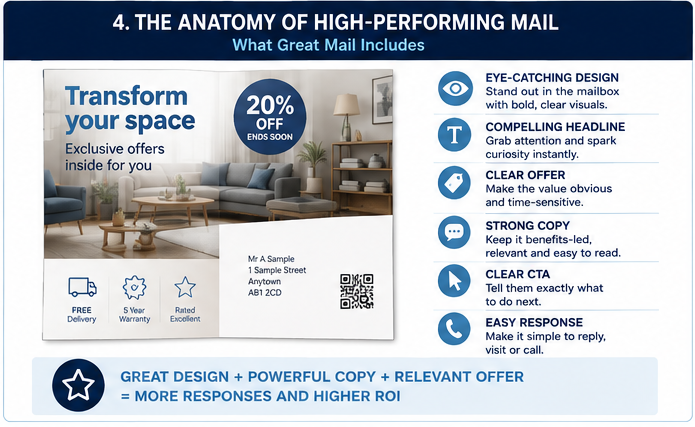
Strong data earns the right to reach the recipient. Strong creative earns the right to be read. The design and copy should therefore be built around the audience insight that justified the mailing in the first place.
Royal Mail’s Mail Made Easy service describes the direct-mail process in three connected parts: finding the right target audience, developing design and messaging to drive response, and delivering the campaign with reporting. That is a useful model because it prevents data, creative and fulfilment from becoming disconnected jobs.
Start with one clear proposition
A mail piece can contain more information than a digital advert, but that does not mean it should contain several competing offers. The recipient should understand within a few seconds:
- who the sender is;
- why the message is relevant;
- what is being offered;
- what the recipient should do next;
- why they should act now rather than later.
If the campaign needs a long explanation, use hierarchy. The headline creates relevance. The opening paragraph explains the value. Supporting sections provide proof. The call to action gives the next step.
Write copy for the segment, not for the database
The list contains attributes. The copy should translate those attributes into a relevant reason to care. A B2B manufacturing segment might respond to efficiency, compliance or production capacity. A consumer home-improvement segment may respond to comfort, convenience or property value.
Avoid exposing the targeting logic in a way that feels invasive. The recipient does not need to be told that they were selected because of an inferred income band or household profile. Personalisation should make the message more useful, not reveal the mechanics of the database.
Use proof where the decision requires trust
Testimonials, ratings, accreditation, case-study results, guarantees and clear pricing can reduce perceived risk. B2B mail often benefits from credibility signals because the first response may be a conversation rather than an immediate purchase.
Every claim should be accurate and supportable. Do not allow enthusiastic copywriting to create a regulatory or reputational problem that the data team cannot fix.
Make the call to action easy
Postal response should not require effort that serves no purpose. Useful response routes include:
- a short, memorable URL;
- a QR code linked to a campaign landing page;
- a dedicated telephone number;
- a promotional or reference code;
- a reply card or prepaid response format;
- an appointment-booking page;
- a unique voucher code.
Choose the method that fits the audience. An older consumer segment may prefer telephone and reply options. A B2B audience may prefer a personalised landing page or calendar booking route.
Design for readability, not just impact
Clear type, strong contrast, sensible line length and obvious hierarchy help more people understand the message. The RNIB accessible print resources provide useful principles for readable printed communication, including attention to type size, contrast and alternative formats where appropriate.
Accessibility is not only a compliance or inclusion consideration. If the audience cannot comfortably read the offer, the campaign cannot perform.
Match the format to the commercial job
A postcard can suit a simple offer. A letter can work for a personal or formal proposition. A brochure can explain a complex service. A catalogue can support browsing and repeated engagement. Royal Mail’s catalogue guidance notes that physical catalogues can be kept, shared and revisited, which makes them a different type of marketing asset from a single-use digital impression.
Do not choose a premium format because it looks impressive in a meeting. Choose it because the expected customer value and message complexity justify the cost.
Production and Fulfilment: Protect the Campaign at the Last Mile
A clean list and strong design can still be damaged by production errors. The campaign needs a controlled handoff from data to printer or mailing house.
Freeze a final campaign file
Create a final, dated version of the mailing list after all cleansing and suppressions have been applied. Do not let teams continue editing copies independently once production begins.
The final file should include only the fields required for personalisation, production and tracking. Removing unnecessary fields reduces handling risk and makes the file easier to audit.
Use seed records
Add controlled seed records for internal recipients so the team can confirm what arrives, when it arrives and which version is received. Seed records are a simple quality check for live campaigns and can help identify fulfilment problems that are not visible in a digital proof.
Check variable-data logic
If the campaign uses different creative, offers or salutations by segment, test every rule. A personalised campaign can create more reputational damage than a generic one if names, images or offers are mismatched.
Use sample proofs from each segment and edge case. Check long company names, unusual address formats, missing optional fields and any conditional content.
Confirm postal specifications early
Size, weight, format, sorting and presentation can affect postage costs. Speak to the printer, mailing house or postal provider before the artwork is finalised. Royal Mail provides marketing mail options for addressed campaigns and related services for other formats.
The cheapest print specification is not necessarily the lowest total campaign cost if it prevents the mailing from using a more efficient postal product.
Measure Mailing List Marketing Before the First Item Lands
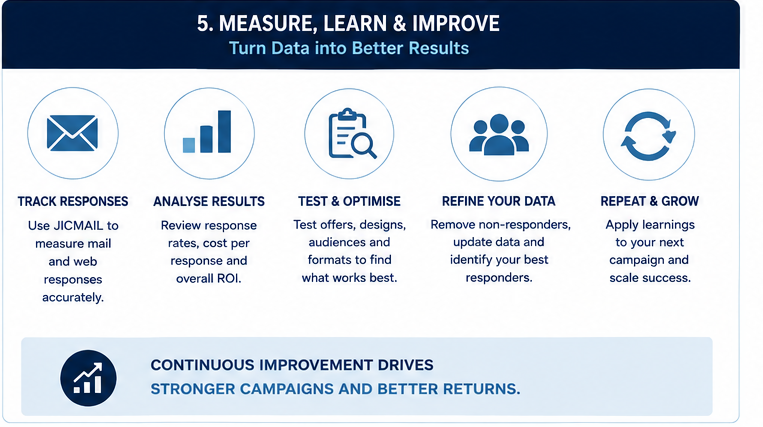
Measurement should be designed before printing because the tracking fields, codes and response routes often need to be built into the data and creative.
The latest JICMAIL Response Rate Tracker is based on nearly 5,000 campaigns and provides benchmarks for response, ROI, cost per acquisition and average order value. JICMAIL reports that warm and cold direct-mail response rates increased by more than 20% in 2025. Benchmarks are useful for planning, but they are not a forecast for an individual campaign. Audience warmth, sector, offer, format, creative and follow-up can all materially change the result.
Track delivery quality
Returned mail is a data-quality metric as well as an operational problem. Record undeliverable items, wrong addressees and address corrections. Feed the outcomes back into the CRM or master database.
A high return rate can indicate weak source quality, stale first-party data or inadequate cleansing. Do not simply absorb returns as a normal cost of mail.
Track response by segment
Overall response can hide the information that matters most. Compare results by:
- B2B sector;
- company size;
- region;
- named versus role-based contact;
- customer versus prospect;
- B2C household segment;
- postcode group;
- creative version;
- offer;
- list source;
- campaign wave.
A campaign with an average result can contain one highly profitable cell and one uneconomic cell. Segment reporting tells you what to scale and what to stop.
Use trackable response mechanisms
QR codes, unique landing pages, promotional codes, dedicated phone numbers and reply identifiers can all create attribution. Where the sales process continues offline, make sure the CRM captures the campaign source when the lead is created.
The objective is not to prove that every response came through one channel. It is to create enough structured evidence to understand whether Mailing List Marketing changed behaviour and which audience cells created value.
Use matchback when customers respond through normal channels
A recipient may receive a letter, search the brand later, visit the standard website and purchase without using the campaign code. Matchback analysis compares purchasers or leads against the mailed audience to identify likely influenced outcomes.
Matchback is especially useful for established brands where direct mail can stimulate branded search, store visits or ordinary online purchases. JICMAIL’s Q1 2026 findings that mail increasingly prompts website activity reinforce the importance of connecting postal and digital measurement.
Consider test and control groups
Where volume allows, hold out a comparable group that does not receive the mailing. Compare response or purchase behaviour between mailed and non-mailed groups. This gives a stronger view of incremental effect than a simple before-and-after comparison.
A control group can be particularly valuable for existing customers who may have purchased anyway.
The Metrics That Decide Whether Mailing List Marketing Is Profitable
Response rate is useful, but it is only the start. A campaign can generate a high response rate and still lose money if the enquiries are low value or expensive to convert.
Track the metrics that connect activity to commercial outcome.
Cost per delivered item
Divide the total campaign cost by the estimated delivered volume after known returns. This shows the true media cost of reaching a usable audience.
Response rate
Responses divided by delivered items. Define what counts as a response before launch. A QR scan, telephone enquiry and completed order are different events.
Qualified response rate
For B2B campaigns, track how many responses become sales-accepted or qualified opportunities. This is often more meaningful than raw enquiry count.
Conversion rate
Measure how many mailed records or responders become the desired final outcome. Use the denominator consistently when comparing campaigns.
Cost per response and cost per acquisition
These metrics allow comparison between postal cells and other channels. Include all material campaign costs, not just postage.
Revenue and contribution
Revenue alone can overstate success where fulfilment or product costs are high. Contribution or gross profit gives a better picture of what the campaign created after variable costs.
Return on investment
Define ROI internally before reporting it. Different teams sometimes use different formulas. A common approach is incremental return minus campaign cost, divided by campaign cost. Use the same definition across campaigns so comparisons remain meaningful.
Customer lifetime value
Some postal campaigns acquire customers who buy repeatedly. If lifetime value is material, judge acquisition economics over an appropriate period rather than only on the first transaction.
Test Small, Learn Fast and Scale the Strongest Cells
A pilot is often the safest way to launch new Mailing List Marketing activity. It reduces the cost of mistakes and creates evidence for the full campaign.
The pilot should be large enough to produce useful learning but small enough that a weak result is affordable. There is no universal minimum because expected response rates and customer value vary.
Test one major variable at a time where possible
Useful tests include:
- audience segment;
- offer;
- envelope versus postcard;
- headline;
- proof point;
- call to action;
- incentive;
- personalisation level;
- timing;
- follow-up sequence.
If every element changes between two cells, the result may tell you which package won but not why.
Decide scaling rules in advance
Define what result would justify a second wave. This avoids the temptation to rationalise a weak campaign after money has already been spent.
For example, the team may agree that a segment will be expanded only if it achieves a target cost per qualified lead and minimum conversion rate. Another segment may be dropped even if response is high because average order value is too low.
Use current benchmarks carefully
JICMAIL’s 2026 Response Rate Tracker is a useful external reference, but campaign planning should use sector and format context where available. Your own historical performance is often more predictive than a market-wide average.
The AccuraData article on direct mail data performance provides additional context on structuring postal data so that campaign response can be measured properly.
Post-Campaign Data Maintenance Creates the Next Campaign’s Advantage
A mailing list should be more accurate after a campaign than it was before it. The send produces information that can improve the next audience.
Update returned mail
Classify returns where possible. Some indicate an address problem. Others may indicate that the person moved, the company closed or the contact is unknown. Feed the outcome back into the master record rather than leaving it in a campaign spreadsheet.
Suppress objections immediately
If someone asks not to receive future marketing, update the suppression process quickly. Do not wait for the next campaign build.
Record responders and converters
A person who responded should not be treated like an untouched cold prospect in the next campaign. Move responders into the correct customer, prospect or nurture state.
Capture segment learning
Store the audience segment and creative cell against the campaign outcome. If a particular sector, household profile or region performs strongly, that evidence should influence future selection.
Clean before re-use
Do not assume a list remains current because it performed well six months ago. Postal records change. The PAF update frequency illustrates the scale of ongoing address change across the UK. Revalidate and suppress again before future use where appropriate.
Combining Post With Email and Telephone Follow-Up
Mailing List Marketing can work as the first stage of a multi-channel campaign, but each later channel needs its own data and compliance analysis.
A B2B campaign might send a physical briefing, follow with a permitted email and then use a live sales call. A B2C campaign might send a catalogue that drives the recipient to a website and then use first-party behaviour to shape later communications where the required permissions and lawful bases exist.
Do not treat postal contact as permission for another channel. PECR can apply to email, texts and calls even though it does not cover post. The audience database should contain channel-specific fields and suppression controls rather than a single generic “marketable” flag.
Multi-channel campaigns also need identity resolution. A postal record, email record and telephone record must be matched to the correct person, household or company. This is where Data Appending and cleansing can support an existing database, provided the added information is sourced and used responsibly.
Common Mailing List Marketing Mistakes
Several mistakes repeatedly reduce postal campaign performance.
Buying volume before defining the audience
A large cheap list can be more expensive than a small accurate one once print and postage are added. Buy relevance first.
Treating B2B and B2C data as interchangeable
Business targeting is usually built around firmographics and commercial roles. Consumer targeting is usually built around households, individuals, location and demographic or lifestyle criteria. The compliance and creative context also differ.
Skipping MPS and internal suppression
MPS screening is a practical consumer protection control, and internal objections are legally important. Suppression should be built into every production workflow.
Printing before cleansing
Once the file reaches production, errors become physical costs. Clean, deduplicate and validate first.
Using creative that does not match the audience
A highly targeted list cannot rescue a generic offer. Use the reason for selection to shape the message.
Making response difficult
A long URL, unclear phone route or complex form can suppress response. Make the next step obvious and convenient.
Measuring only total response
Segment-level performance is where most of the learning lives. Preserve campaign and audience identifiers in the data.
Reusing stale lists without a refresh
A previously successful list is not automatically current. Recheck address quality, suppressions and campaign eligibility before reuse.
When AccuraData Fits a Mailing List Marketing Campaign
AccuraData is a practical fit for organisations that want the audience and data-preparation side of a postal campaign handled clearly. The company supplies targeted B2B Postal Data for business campaigns and B2C Postal Data for consumer campaigns, with targeting built around the objectives and available data rather than a fixed off-the-shelf list.
That matters because a profitable postal campaign rarely needs “all UK businesses” or “all UK households”. It needs a defined group whose likely value justifies the physical media cost. AccuraData can help translate the brief into a count, discuss realistic segmentation, prepare the data and support database improvement where the client already owns relevant records.
The Data Cleansing service is useful where an existing customer or prospect file needs to be deduplicated, standardised or prepared before mailing. Data Appending can add missing fields after the core records have been checked, helping clients build a more useful segmentation and measurement structure.
AccuraData’s role is not to claim that a list alone guarantees a profitable campaign. No responsible data provider can make that promise. The value is in making the audience clearer, the records cleaner and the campaign file easier to use so that the creative, production and sales teams are working from a stronger foundation.
For readers who want to go deeper into procurement rather than campaign execution, AccuraData’s Marketing Mailing Lists article focuses on the buying and due-diligence side of postal data. The article on B2B and B2C postal data explains the audience differences in more detail.
Mailing List Marketing FAQs
Is Mailing List Marketing still effective in the UK?
It can be. JICMAIL’s current data shows that mail continues to generate measurable physical and digital engagement, including website visits and online purchases. Effectiveness varies by audience, offer, format, sector and campaign quality. Treat benchmarks as planning references, not guaranteed results.
Does PECR apply to postal marketing?
Ordinary post is not covered by PECR’s direct marketing rules. However, UK data protection law still applies where personal information is used. If the campaign follows up by email, text or telephone, those channels need their own PECR analysis.
Do I need consent for Mailing List Marketing?
Not always. Consent is one possible lawful basis, but legitimate interests may be available for postal marketing where the organisation can satisfy and document the required test. The correct basis depends on the circumstances. The individual still has an absolute right to object to direct marketing.
What is the Mailing Preference Service?
The Mailing Preference Service is a register for people who want to reduce unsolicited addressed direct marketing mail. The ICO recommends checking names and addresses against MPS before postal marketing. Organisations must also respect their own direct objections and suppression records.
Is MPS screening legally mandatory?
MPS is not a statutory preference service. However, the ICO recommends checking it, and some industry codes require the check. It should be treated as a normal consumer postal-marketing control rather than the only suppression mechanism.
What is the difference between B2B Postal Data and B2C Postal Data?
B2B Postal Data focuses on organisations and may include company name, address, sector, SIC code, company size, turnover and relevant contact or role data. B2C Postal Data focuses on consumers or households and may include geographic, household, demographic, property or lifestyle variables. The right structure depends on the campaign.
How often should a mailing list be cleansed?
There is no single interval that fits every database. Clean before significant sends and after material periods of inactivity. High-value or high-frequency campaigns may justify more frequent validation. Returned mail and objections should be processed as they occur rather than waiting for a scheduled annual cleanse.
Should I buy a postal list or use my existing CRM?
Often both are useful. First-party customer data can support retention, reactivation and cross-sell activity. Purchased or licensed data can support acquisition and market expansion. Existing data should be cleansed before use, and new data should be deduplicated against the CRM so current customers or open opportunities are handled correctly.
How can I measure a direct-mail campaign?
Use trackable phone numbers, QR codes, landing pages, promotional codes, reply identifiers, matchback analysis and CRM source fields. Review delivery quality, response, qualified response, conversion, cost per acquisition, revenue and ROI by segment.
What makes a Mailing List Marketing campaign profitable?
Profitability comes from the combination of audience fit, accurate data, an economically sensible offer, clear creative, efficient production, low response friction and disciplined measurement. The cheapest list or most expensive mail piece is not automatically the best choice.
Can direct mail support digital marketing?
Yes. Current JICMAIL research shows mail prompting website visits and online purchases. A postal campaign can use QR codes, campaign URLs and tracked offers to move recipients into digital journeys. Keep the data and compliance rules for each later channel separate.
How do I choose a postal data provider?
Ask about sources, targeting, address maintenance, suppression, licensing, sample quality, replacement policies, security and support. A good provider should be able to explain how the list was built and why the records match the campaign, not just quote a record count.
Final Thoughts: Make the List Earn Its Place in the Budget
Mailing List Marketing becomes viable when the business stops thinking of the mailing list as an administrative input and starts treating it as the campaign’s media plan. The list determines who receives the spend, which messages can be personalised, which records must be excluded and whether results can be traced back to the audience that created them.
For B2B campaigns, that means selecting the right organisations, sites and roles. For B2C campaigns, it means using proportionate household, demographic and geographic signals to build relevance without becoming intrusive. In both cases, address accuracy, suppression and a clear campaign purpose are essential.
The Mail Preference Service, internal do-not-mail files, privacy information and the right to object should be built into the process rather than added after the creative has been approved. The same is true of measurement. Segment codes, QR destinations, phone numbers and response fields need to exist before print if the business wants useful evidence after the campaign.
Creative then has a clear job. It must turn audience relevance into attention and action. Good copy explains why the offer matters. Good design makes the proposition easy to understand. Good fulfilment ensures the correct version reaches the correct address. Good measurement shows whether the campaign created enough commercial value to justify the next wave.
AccuraData supports this process at the point where many campaigns either become efficient or become expensive: the data. With targeted B2B and B2C postal lists, cleansing and appending support, AccuraData can help organisations build Mailing List Marketing activity on cleaner, more relevant and more measurable audience foundations. The best postal campaigns do not begin with “How many pieces can we send?” They begin with “Which people or businesses are worth reaching, what would make them respond, and what result would make the campaign profitable?” Answer those questions well, and the mailing list stops being a file. It becomes the commercial logic behind the cam