
A Direct Mail Database can give a business a practical route to households, customers, companies and decision-makers when a physical message is more suitable than an email or telephone call. The database is the audience foundation behind the campaign. It determines who receives the piece, which address is used, what information can shape the offer, which records must be excluded and how the response can be measured. A polished envelope cannot rescue an irrelevant audience, while a carefully selected postal database can make a straightforward letter, catalogue or information pack commercially useful.
Postal marketing is often treated as an old channel. That description misses the way modern campaigns work. Direct mail can lead to a website visit, QR-code scan, telephone call, appointment, store visit, donation, renewal or tracked purchase. The physical item is one part of a connected journey. JICMAIL measurement research is built around response, return on investment, cost per acquisition and average order value, which reflects the fact that mail can be planned and assessed as a performance channel rather than a vague awareness exercise.
This article explains when to use a Direct Mail Database, how to build or purchase one, how B2B and B2C postal marketing differ, why postal data can sometimes be simpler to use than email or telephone data, and what checks should happen before a campaign launches. It also covers targeting, data cleansing, Mailing Preference Service screening, supplier due diligence, campaign design, testing and common questions. AccuraData supports organisations with targeted B2B Data, B2B Postal Data, B2C Data and B2C Postal Data, alongside database improvement services.
A compliance note is important. This article offers practical marketing information, not legal advice. The correct approach depends on the audience, the source of the personal information, the purpose, the targeting variables and the organisation’s relationship with the recipient. The ICO direct marketing guidance should be used for current regulatory information, with specialist advice obtained where the position is unclear or high risk.
Direct Mail Database Basics: What Are You Actually Using?
A Direct Mail Database is a structured collection of postal records selected or maintained for marketing. The simplest version contains a name and address. More useful versions add context that helps a business decide who should receive which message. A B2B record may include company name, registered or trading address, industry, employee band, turnover range, site type, region, named contact, department and job role. A B2C record may include a consumer name, postal address, location, household profile, age band, property indicator, lifestyle category or another permitted targeting field.
The word database matters because the file should contain more than delivery details. It should support selection, suppression, version control and analysis. The campaign team should be able to identify the source of the record, the date it was checked, the audience segment, the version used for the mailing and the response linked to it. Without that structure, a mailing list becomes a one-off export that cannot be governed or improved.
AccuraData’s B2B postal data service supports targeting by business characteristics, while its consumer postal data supports household, demographic and geographic selection. The useful fields will depend on the campaign. Buying every available variable creates cost and complexity without necessarily adding predictive value.
A postal database is not the creative campaign
The database, the mail piece and the response journey are separate assets. The database identifies the audience. The creative explains the value. The response mechanism turns attention into an action. A campaign fails when these elements point in different directions. A premium pack sent to low-value prospects can be uneconomic. A highly relevant audience may ignore a piece that gives no clear reason to respond. A good offer can still underperform if the address data is stale.
Planning should therefore begin with a short campaign sentence: who will receive what, why it should matter to them, how they can respond and what result would justify the cost. That sentence creates the brief for the Direct Mail Database and stops the buying conversation becoming a debate about record volume alone.
Addressed mail, partially addressed mail and door drops
The term direct mail covers several formats. Addressed mail is sent to a named person or organisation. Partially addressed mail can target households or areas without identifying a particular individual. Door drops are unaddressed items distributed to selected geographic areas. The database requirements and data protection questions differ across these formats.
This article focuses mainly on addressed postal databases because named records create the clearest connection with UK GDPR. However, businesses should consider whether a less personal format can achieve the objective. A local opening, broad community service or household offer may work through geographic distribution. A high-value B2B proposal or customer renewal pack may need named, addressed data.
When a Direct Mail Database Is the Right Choice
A Direct Mail Database is most useful when physical presence adds something that another channel cannot easily provide. Mail can carry samples, catalogues, vouchers, documents, personalised packs or high-value creative. It can remain in a home or office after delivery, be shared with colleagues or household members and create a deliberate interruption without demanding an immediate conversation.
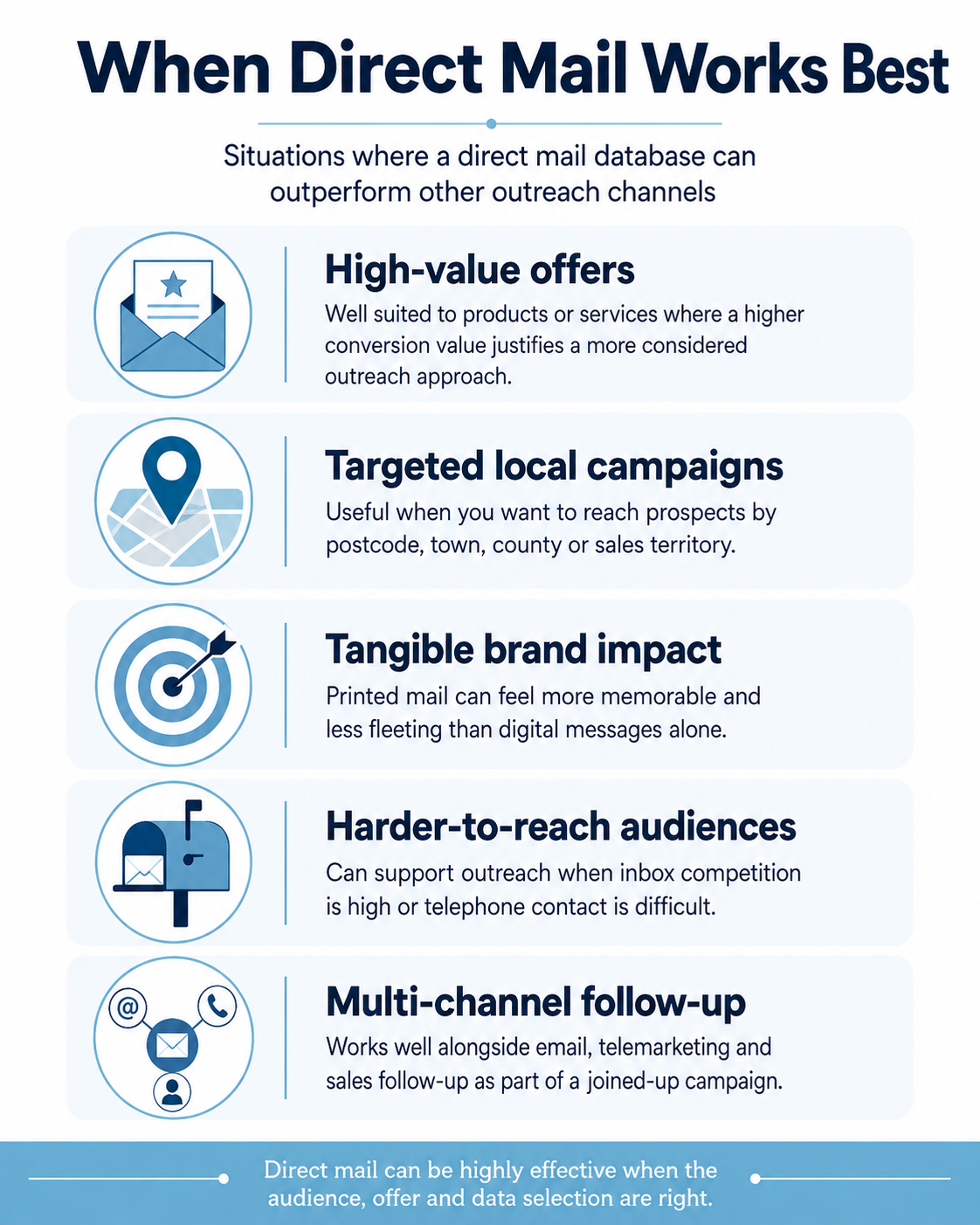
The decision should depend on the buying situation. Postal communication can suit audiences that are difficult to reach by email, offers that need visual explanation, regulated or formal messages, local campaigns, high-value sales, membership communications, charity fundraising and customer reactivation. It also works when the organisation wants to connect online and offline behaviour through QR codes, personalised URLs, voucher codes or dedicated telephone numbers.
JICMAIL reports mail engagement and maintains a Response Rate Tracker for campaign benchmarking. These benchmarks are useful starting points, but they should not replace a campaign-specific forecast. Format, audience warmth, offer strength, sector, creative quality and response friction all influence performance.
High-value products and considered decisions
A postal pack can be justified where each conversion has enough value to support printing and postage. Professional services, financial products, property services, education, home improvement, business technology and selected charity campaigns may benefit from a tangible explanation. The physical format gives the recipient space to consider the offer without a caller waiting for an answer or an inbox competing for attention.
B2B campaigns can use a Direct Mail Database to reach a small group of high-potential accounts with tailored content. The mailing may precede a sales call, follow an event or support an account-based marketing programme. In that setting, the database does not need to be large. It needs to identify the right organisations, sites and roles.
Local and geographic campaigns
Post is naturally suited to location-based marketing. Retailers, care providers, estate agents, education providers, leisure businesses and local professional services can select postcode areas, catchments or travel zones. Consumer data may then refine the audience using household or demographic indicators, provided those variables are appropriate and lawfully used.
A geographic campaign should still exclude areas the business cannot serve and records that have objected. The fact that a household is near a branch does not mean every offer is relevant. Filtering by both service coverage and probable need creates a more defensible and efficient audience.
Customer reactivation and lapsed relationships
Email addresses change, messages are filtered and inactive subscribers may no longer engage with digital communication. A current postal address can provide another route to a lapsed customer, former donor, expired member or previous enquiry. The message should acknowledge the existing relationship rather than pretending the recipient is a new prospect.
Reactivation is often strongest when the database includes relationship history. Last purchase, previous service, membership type, location and recency can shape the offer. AccuraData’s data appending service can help organisations add missing information to existing records, while data cleansing can improve address quality and remove obvious waste before mailing.
Audiences with lower digital reach
Some customer groups are less responsive to email or digital advertising. This does not mean they are offline, but channel preferences differ. A letter may feel clearer, more formal or easier to keep. Postal communication can also support accessibility when the creative uses readable typography, plain language and a simple response path.
Businesses should avoid stereotypes. Test the channel with real segments rather than assuming that age or industry automatically determines preference. The database should help create a testable audience, not provide a justification for broad assumptions.
Campaigns that benefit from physical proof
Mail can include material that is hard to reproduce digitally: a product sample, fabric swatch, membership card, voucher, specification booklet, personalised illustration or signed letter. The cost may be higher, but the format can make the proposition more credible or memorable. This is particularly relevant when the recipient needs to show the item to another decision-maker.
When a Direct Mail Database Is Better Than Email Data
Email is fast, scalable and measurable, and AccuraData’s B2B Email Data can support targeted digital outreach. A Direct Mail Database becomes more attractive when inbox competition, deliverability, format or legal complexity makes email less suitable.
The ICO postal marketing guidance explains that consent is not required simply because marketing is sent by post. If a named individual is involved, the sender still needs a lawful basis, must be transparent and must stop when the person objects. Postal marketing is not outside data protection law, but it is not subject to the electronic mail rules in PECR. That distinction can make post operationally simpler in some acquisition campaigns.
Postal marketing avoids inbox deliverability problems
Email campaigns depend on address validity, sender authentication, reputation, spam filtering and recipient engagement. Mail has different delivery risks. An address can still be wrong, incomplete or stale, but there is no inbox algorithm deciding whether the envelope is visible. The challenge moves from digital deliverability to address hygiene, creative relevance and physical production.
This does not make post automatically more effective. It means the failure modes are different. A business with strong address data and weak email permissions may reasonably test mail first. A business with an engaged first-party email audience may find email cheaper and faster.
Direct mail can carry more information without feeling like a long email
A multi-page brochure, letter and insert can guide a recipient through a considered proposition. Long emails often lose attention because the screen encourages scanning and interruption. Physical material can be designed for sequential reading, annotation or internal sharing.
The format should still be disciplined. More paper is not the same as more value. Every component should have a purpose, and the main action should be obvious within seconds.
Postal data can reach a household or site rather than a single inbox
A mail piece may be seen by several people at a business address or within a household. This can be valuable where decisions are shared. JICMAIL’s wider mail engagement data examines how mail is interacted with over time and within homes. Email usually stays within one account unless the recipient forwards it.
That broader reach can also reduce precision. A pack intended for one person may be opened by someone else. Sensitive content should never be exposed through a format or envelope that creates unnecessary privacy risk.
When Telephone Data May Be Better Than a Direct Mail Database
A telephone campaign is better when the business needs immediate qualification, live objection handling or appointment setting. The caller can ask questions, confirm timing and change direction during the conversation. Post cannot provide that real-time feedback.
A Direct Mail Database may still support the calling campaign. A well-designed pack can arrive before the call, give the recipient context and make the conversation less cold. The channels can be sequenced rather than treated as competitors. The correct choice depends on deal value, audience size, urgency, complexity and team capacity.
Telephone marketing also carries PECR requirements, including preference screening where relevant. Postal marketing is not covered by PECR, according to the ICO planning guidance. Businesses choosing between the channels should compare both commercial and compliance work, not only media cost.
Choose calling when speed matters more than shelf life
A caller can establish interest immediately. This is useful for urgent appointments, short buying windows, live qualification and fast-moving market conditions. Mail takes time to produce, deliver and prompt action. A database for post is less suitable when a delay of several days removes the opportunity.
Choose post when interruption would damage the proposition
Some offers require trust and reflection. An unsolicited call may feel intrusive, while a well-presented letter allows the recipient to decide when to engage. This can be valuable for sensitive household services, professional propositions and high-consideration purchases. The tone must remain respectful and transparent.
B2B Direct Mail Database Strategy
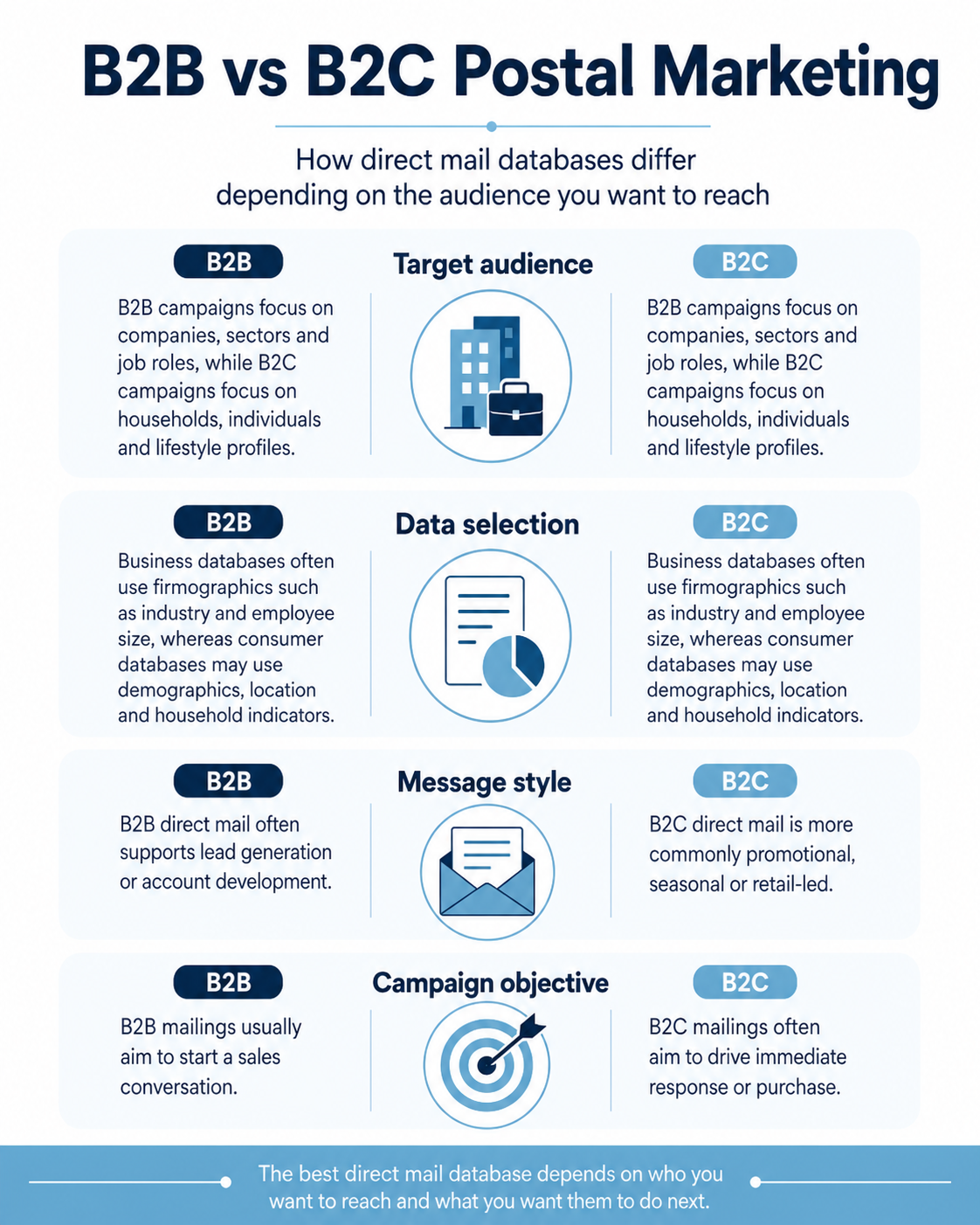
A B2B Direct Mail Database usually describes organisations, sites and business contacts. The target may be a legal entity, a branch, a department or a named decision-maker. These are different levels of selection. A registered office may be appropriate for statutory or corporate material, but a local trading site may be better for a sales campaign. A named role may improve relevance, but role data changes more quickly than the company address.
Companies House can provide live public company information through its official API, including company profiles and registered office addresses. Public information is useful for company research and verification, but it does not create a complete campaign database by itself. The registered office may be an accountant, agent or administrative address. The company may trade from other sites, and the right decision-maker may not appear in the public record.
Define the organisational unit before buying data
The campaign brief should state whether the target is the company, head office, branch, site or individual. A facilities service may need operating sites. A corporate finance proposition may need head office and a senior finance contact. A local supplier may need branches within a delivery area. Buying the wrong address type creates waste even if the address is technically valid.
AccuraData’s B2B Data can support segmentation by industry, location, company size and decision-maker profile. The postal brief should identify which of those variables genuinely affects the offer.
Named contacts versus job functions
A named contact can make the mailing feel deliberate and may improve internal routing. It also creates a greater maintenance burden because people change roles. A job-function approach, such as “Finance Director” or “Head of Operations”, can remain relevant even when the named individual changes, but the envelope may be less personal.
The best choice depends on the account value and refresh cycle. High-value, low-volume mail can justify manual confirmation of named contacts. Larger programmes may use role-based addressing with selected named records for priority accounts.
B2B postal use cases
Common B2B uses include account-based marketing, event invitations, trade catalogue distribution, service introductions, renewal campaigns, branch openings, professional reports, channel partner recruitment and reactivation of dormant accounts. The mailing should match the commercial context. A short local service letter is different from an executive account pack.
The AccuraData article on why the list behind direct mail matters explains the relationship between postal targeting, data quality and campaign performance. It is a useful internal reference when planning the audience alongside the creative.
B2C Direct Mail Database Strategy
A B2C Direct Mail Database is built around individuals, households or addresses. Consumer campaigns often have larger audiences, lower value per response and more complex profiling questions. The available fields may include location, age band, household composition, property indicators and lifestyle categories. Each variable should have a clear connection to the offer.
Consumer postal marketing does not require PECR consent merely because it is sent by post. However, named consumer data remains personal information. The sender needs a lawful basis, must provide appropriate transparency and must honour the absolute right to object to direct marketing. The ICO right to object guidance explains that organisations must stop direct marketing processing when a person objects.
Household targeting and individual targeting are not identical
A household-level offer may not require the same detail as an individually personalised message. A local home service might target eligible property areas without using a named person. A membership, charity or financial campaign may need an identified recipient. The more personal the selection and creative, the more important provenance, transparency and expectation become.
AccuraData’s B2C Postal Data can be built around campaign objectives and targeting variables. The buyer should ask how each variable was sourced, how recent it is and whether it is observed, declared, appended or modelled.
Avoid sensitive or surprising profiling
A dataset may contain or imply information that would feel intrusive if reflected in the mailing. Special category data and sensitive inferences create higher risk. Even ordinary variables can become problematic when combined in a way the recipient would not reasonably expect.
The practical test is simple: could the organisation explain the selection clearly to the recipient without embarrassment? If the answer is no, the targeting probably needs to be simplified or reconsidered.
B2C postal use cases
Consumer mail can support retail, charity fundraising, home services, local events, membership, subscriptions, catalogue sales, education, leisure, financial services and reactivation. Compliance requirements and sector rules may vary. Regulated industries should assess the promotion itself as well as the database.
The AccuraData guide to B2B and B2C postal data provides further internal context on how the audience and campaign purpose change the list design.
How to Build a Direct Mail Database Organically
An organisation may already hold the foundation of a useful Direct Mail Database. Customer records, enquiries, event registrations, warranty forms, membership applications and previous campaign responders can provide first-party data. First-party does not mean automatically accurate or reusable for every purpose. The organisation still needs to check the original collection context, privacy information, lawful basis and current relevance.
Organic growth is attractive because the relationship and source are clearer. It can be slow, uneven and limited to existing audiences. A mature strategy often combines first-party data with cleansing, appending and carefully procured acquisition records.
Customer and transaction records
Customer addresses can support fulfilment, service and marketing, but these purposes should not be blurred. The business should know whether postal marketing was explained, which lawful basis applies and how objections are handled. An existing customer relationship may make relevant mail more expected, but it does not remove the right to object.
Transaction fields can improve segmentation. Product type, purchase date, region and customer value may identify useful reactivation or cross-sell audiences. Only use the fields needed for the campaign.
Enquiries, events and content requests
People who request information, attend events or make enquiries may be warmer than cold prospects. The mailing can follow the topic of interest. Records should be timestamped and linked to the source so that the campaign team understands why the person is being contacted.
A warm audience can still become stale. The longer the gap, the more important it is to verify the address and adjust the message. Do not present an old interaction as if it happened recently.
Sales and service updates
Front-line teams often discover address changes before the marketing database does. Create a controlled process for updating records, recording the source and preserving objections. Free-text notes should not replace structured address fields or campaign statuses.
Data appending and enrichment
A business may have customer IDs and email addresses but incomplete postal details, or company names without useful segmentation. Data appending can add missing information where the source and use are appropriate. Appending should be governed like any other data acquisition. The organisation should know what was added, where it came from and how it affects transparency.
How to Purchase a Direct Mail Database
Buying a Direct Mail Database can shorten the time required to enter a market or reach an audience outside the existing CRM. The purchase should begin with a specification, not a generic request for “UK addresses”. A precise brief improves counts, pricing, compliance assessment and campaign design.
The buyer remains responsible for its own use of the data. A supplier can provide evidence, targeting support and quality controls, but cannot turn an unsuitable campaign into a lawful one through a contract label. The ICO guidance on working with marketing lists reinforces the need to understand origin, accuracy and channel rules.
Write the audience specification first
The brief should identify:
- The campaign objective and offer.
- Whether the audience is B2B, B2C or mixed.
- The required address type.
- Geographic limits.
- Company, role, household or demographic filters.
- Required and optional fields.
- Existing customers, objectors and other exclusions.
- Intended mailing date and refresh requirement.
- Expected response path.
- Permitted use, retention and deletion needs.
A clear specification makes supplier comparisons meaningful. Two quotations are not comparable if one contains broad household addresses and another contains named, recently validated prospects.
Decide whether you need a purchase, licence or managed campaign
Some databases are licensed for one campaign. Others permit repeated use for a period. A managed campaign may allow a supplier or mailing partner to process the data without giving the buyer a permanent copy. The contract should state the permitted purpose, number of uses, security responsibilities, retention, complaint handling and update arrangements.
A one-off test may not justify importing the full file into the CRM. A controlled campaign environment can reduce unnecessary retention and internal access.
Ask for a count and a sample
A count should show how filters reduce the audience from the broad universe to the usable net quantity. Ask whether suppressions and exclusions are included. A representative sample can reveal field structure, completeness and formatting, although personal data should be shared securely and proportionately.
The supplier should explain the age of the data and the meaning of terms such as “verified”, “recent” or “deliverable”. These words are not useful without a method and date.
Supplier Due Diligence for a Direct Mail Database
Supplier due diligence should test provenance, accuracy, targeting, governance and service. A low price per record can hide high return-mail costs, wasted production and reputational damage. The strongest supplier will explain limitations as well as strengths.
Provenance and collection questions
Ask where the records came from and whether the source differs by field. Company information may come from public registers, websites, direct research or licensed sources. Consumer information may come from surveys, customer relationships, partnerships or other declared collection routes. Ask how the supplier records provenance and how the recipient was informed about third-party use.
A vague answer such as “trusted sources” is not enough. The buyer needs enough detail to assess fairness, expectation and lawful basis. The supplier may protect commercial source names, but it should still explain source categories, collection methods and governance.
Accuracy and address hygiene questions
Ask how addresses are formatted, validated and refreshed. Royal Mail’s data cleansing guidance describes the role of PAF address information, mover data, goneaway removal, duplicate removal and opt-out handling. These controls show why postal quality is more than checking that a postcode exists.
Ask how deceased records are managed in consumer data, how dissolved or moved businesses are handled in B2B data, and what replacement or credit policy applies to unusable records. The process should distinguish a valid physical address from a commercially relevant recipient.
Segmentation questions
For each filter, ask whether it is observed, declared, researched, appended or modelled. Ask how often it changes and how recently it was updated. Company turnover, employee size, job role, household status and lifestyle categories have different stability.
A supplier should be able to show the expected count at each stage and explain why the selected variables are likely to improve fit. More filters can reduce scale without improving performance. The purpose is useful separation, not complexity.
Compliance and documentation questions
Ask what lawful basis the supplier relies on for its own processing and what evidence is provided to support the buyer’s assessment. Ask how privacy information, objections and suppression are handled. Request the relevant contract terms, data processing information, security controls and retention rules.
The CAP Code rules on marketing data sit alongside legislation and help frame responsible direct marketing practice. Supplier claims should be tested against actual process rather than a “GDPR compliant” statement.
Security and transfer questions
Postal databases contain personal information when individuals can be identified. Files should be transferred securely, access should be restricted and working copies should be deleted when no longer needed. Ask how incidents are handled and whether subcontractors are involved.
The buyer should also control internal access. A mailing house may need names and addresses, while the creative agency may only need segment counts and sample formats. Share the minimum required information with each party.
Commercial and support questions
Ask what happens after delivery. Will the supplier help interpret fields, resolve anomalies, apply additional suppressions or create a refreshed version? Does the quote include selection, cleansing, licensing and secure transfer? What is excluded?
AccuraData positions its postal services as part of a wider data-quality process. Its data cleansing and enrichment and data appending services can support organisations that need to improve an existing database rather than purchase an entirely new audience.
UK GDPR and a Direct Mail Database
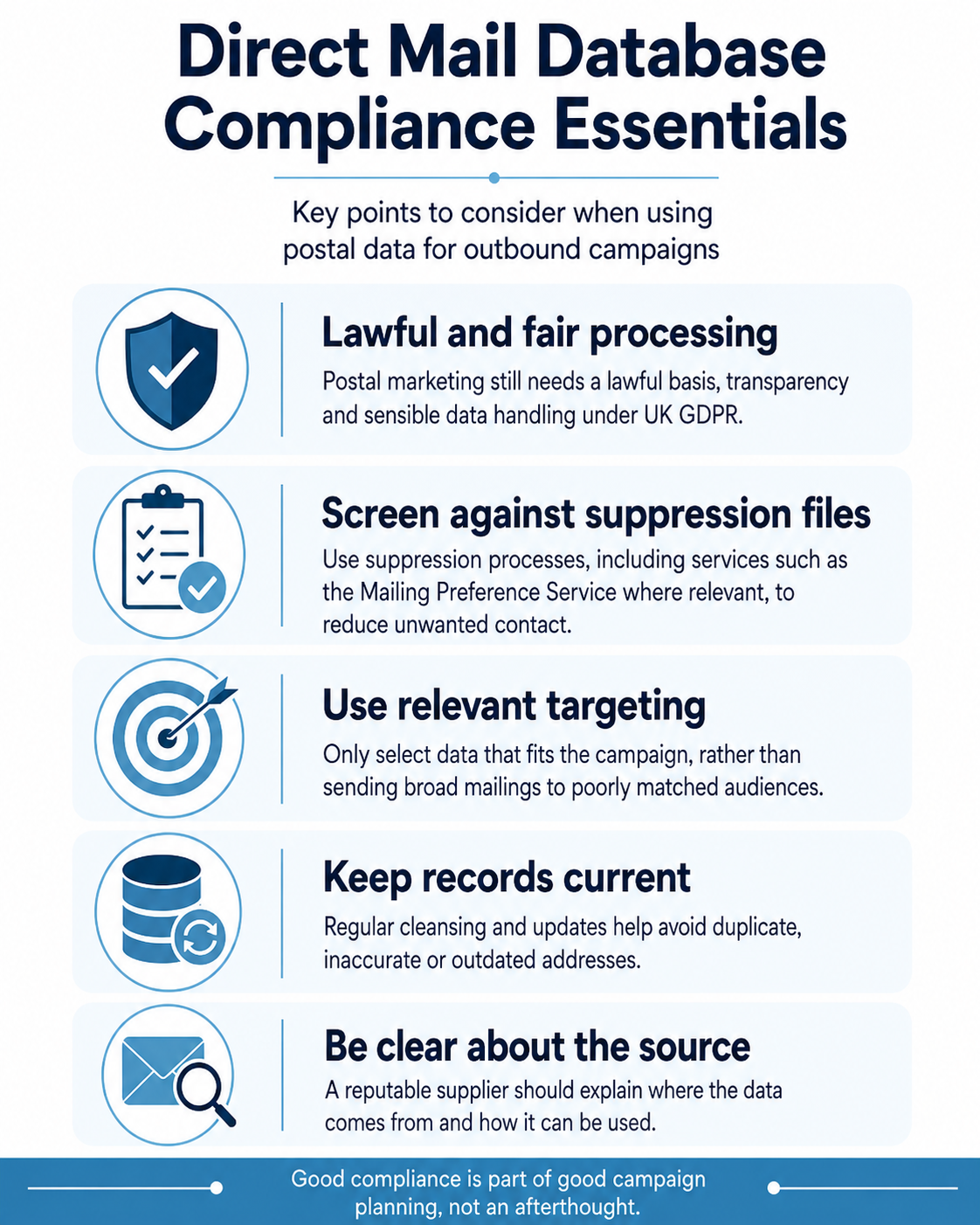
Postal marketing is often described as easier from a compliance perspective because PECR does not cover direct marketing by post. That statement is useful only when the rest of the position is understood. Named postal data remains personal information. The organisation needs a lawful basis, must use the data fairly and transparently, must keep it accurate, must protect it and must stop direct marketing when the person objects.
The ICO small-business guidance states that postal marketing does not require consent merely because it is sent by post, while a lawful basis is still needed when a person is identifiable. The ICO planning guidance recommends checking suppressions, preparing an objection process and screening against the MPS before sending.
Choosing a lawful basis
Consent and legitimate interests are commonly considered for direct marketing. Legitimate interests is not automatic. The organisation must identify the interest, show that the processing is necessary and balance it against the person’s rights and reasonable expectations. The ICO legitimate interests guidance explains that direct marketing may be a legitimate interest, but the circumstances still need assessment.
A Legitimate Interests Assessment can document purpose, necessity and balance. The assessment should reflect the actual audience and campaign, not a reusable generic paragraph. A highly targeted business mailing for a relevant service creates a different impact from a large consumer campaign based on unexpected profiling.
Transparency when data comes from another source
People should understand who is using their information and why. When data is obtained indirectly, the organisation must consider its privacy information obligations and timing. The campaign pack can provide a clear route to the privacy notice and explain the source category in accessible language.
Do not hide the explanation in dense legal text. Transparency should help the recipient understand the selection and exercise their rights.
The absolute right to object
The right to object to direct marketing is absolute. If someone asks the organisation to stop, it must stop using their information for that purpose. The record should usually be retained on a suppression list rather than deleted entirely, because deletion can lead to accidental reacquisition and another mailing. The ASA guidance on suppression explains how suppression lists help ensure new marketing files are checked against previous opt-outs.
The suppression record should contain only what is needed to honour the objection and should be secured. The organisation must define whether the objection applies to post only or to all direct marketing channels, based on the person’s request.
Data minimisation and retention
Only purchase and retain fields that support the campaign, compliance or analysis. Unused profiling variables create cost and risk. Set a retention period based on the licence, campaign schedule, response cycle and need for evidence. A database should not remain in shared folders indefinitely because it might be useful later.
Mailing Preference Service and Postal Suppression
The Mailing Preference Service is the official register through which consumers can reduce unsolicited personally addressed direct mail. It is not a statutory preference service in the same way as some electronic rules, but the ICO recommends checking names and addresses against MPS, and industry codes may require it.
MPS screening should sit alongside the organisation’s internal suppression file. A person may object directly without registering with MPS. Existing customers may have channel-specific preferences. Deceased, goneaway and complaint records may also need exclusion.
When to screen the Direct Mail Database
Screen as close to the final production date as practical. A file checked months earlier may no longer reflect current preferences or address status. Keep evidence of the screening date, version and results. If the campaign is repeated, screen again rather than assuming the first result remains valid.
MPS does not solve every postal preference problem
MPS focuses on personally addressed unsolicited mail and has limitations. It does not replace internal objections, data accuracy work or campaign judgement. Some unaddressed formats fall outside its scope. The MPS explanation should be reviewed when selecting the format and screening process.
Data Cleansing Before a Direct Mail Campaign
A Direct Mail Database should be cleansed before it reaches print production. Address errors create returned mail, wasted material, inaccurate reporting and a poor customer experience. Cleansing is especially important when combining purchased data with CRM records or using a file that has been stored since a previous campaign.
Standardise and validate addresses
Use consistent fields for building, street, town, postcode and organisation. Validate against current address reference data where appropriate. Correct obvious formatting problems without overwriting meaningful local detail.
Remove duplicates carefully
Duplicates may exist at person, household, company, site or address level. The correct rule depends on the campaign. A household offer may need one pack per address. A B2B executive campaign may intentionally send different packs to several decision-makers at the same site. Document the deduplication hierarchy before removing records.
Identify movers, goneaways and deceased records
Consumer campaigns should use appropriate controls to reduce the risk of distress and waste. Business campaigns should check whether organisations have dissolved, moved or changed trading status. Royal Mail’s address data services illustrate the range of checks available beyond postcode validation.
Preserve source and campaign fields
Cleansing should not strip provenance, segment or suppression status. Keep an unchanged source file in a secure archive and create a controlled working version. Record transformations so that the team can explain differences between the supplied count and the mailed count.
Segmentation and Data Filtering for Customer Fit
Segmentation determines whether the database feels like an audience or a pile of addresses. The aim is to identify groups that need different messages, offers, creative formats or response paths.
B2B segmentation for postal campaigns
Useful B2B variables include sector, SIC code, employee size, turnover, location, site type, company age, department, job function and seniority. Combine company and contact filters where the offer requires a particular decision-maker. Avoid buying named contacts when the role is irrelevant to the message.
An example brief might be: operations leaders at UK food manufacturers with 50 to 500 employees in selected regions. The mailing can then address operational issues and include a response path suitable for that role.
B2C segmentation for postal campaigns
Consumer segmentation may include postcode, age band, household composition, property type, homeownership indicators, interests and previous relationship. The data should be appropriate, documented and connected to the offer. Avoid collecting detail simply because it is available.
A local mobility service may use geography and an appropriate age band. A home-improvement campaign may use location and property indicators. A charity may segment existing supporters by recency and value. Each model should be explainable and tested.
Exclusion-first audience design
Start by identifying who should not receive the mailing. Exclude objectors, existing customers where the offer is acquisition-only, unresolved complaints, staff, competitors, areas outside service coverage and records that fail quality checks. Exclusion-first design prevents awkward mistakes and creates a more accurate net count.
Avoid false precision
Highly detailed filters can create an audience that looks scientific but relies on stale or modelled variables. Ask whether each condition changes the message or likelihood of response. If it does not, remove it. A simple, robust segment is often more useful than a fragile micro-audience.
Using a Direct Mail Database Effectively
The quality of the file matters, but campaign operation determines the return. A strong database can be wasted through generic creative, unclear offers and poor response handling. The team should plan the full journey before the first record is exported.
Match creative investment to account value
Use premium formats for segments where the potential return supports the cost. Lower-value or broader audiences may need a simpler format. The database can assign creative treatments by expected value, relationship or propensity.
Make the reason for contact clear
The recipient should understand why the offer may be relevant. B2B copy can refer to the organisation’s sector or operational context without pretending to know private details. B2C copy should avoid revealing or implying sensitive profiling on the envelope or within the message.
Use a measurable response route
Create dedicated URLs, QR codes, offer codes, telephone numbers or reply mechanisms. Measurement should be designed before production. JICMAIL’s response benchmarking framework includes response, ROI, cost per acquisition and average order value, providing a useful model for campaign scorecards.
Plan response handling
Sales and service teams should know the offer, segments and expected questions. A delayed response to an expensive mail pack wastes the attention it generated. Route leads by value and urgency, and record outcomes consistently.
Combine mail with other channels thoughtfully
A postal pack can precede an email, call or digital retargeting campaign, provided each channel is lawfully used. The follow-up should reference the mailing naturally. Do not assume that permission or lawful basis for post automatically authorises email or telephone marketing. Each channel has its own requirements.
Testing a Direct Mail Database Before Scaling
A test protects budget and creates evidence. Select meaningful audience cells rather than mailing a random fraction of an undifferentiated list. Test variables that the business can act upon: sector, geography, customer status, offer, format or message.
Build a control and comparison structure
Where possible, use holdout groups, unique codes or matched cells. The objective is to distinguish campaign impact from response that would have happened anyway. Keep the database version and creative version linked to each cell.
Set realistic success measures
Response rate alone can mislead. Track delivered quantity, responses, qualified responses, conversions, revenue, contribution, cost per acquisition and longer-term value. A high response rate from poor-fit leads may be less useful than a lower rate from profitable customers.
Use feedback to improve the database
Returned mail, wrong recipients, role changes and customer feedback should update the record. A Direct Mail Database becomes more valuable when campaign outcomes flow back into cleansing and segmentation. The process should improve the next selection rather than create another isolated spreadsheet.
Common Direct Mail Database Mistakes
Buying volume before defining the audience
Large counts can feel reassuring, but production and postage turn every irrelevant record into a direct cost. Start with the customer fit and expected value.
Treating a valid address as a qualified prospect
Address validity confirms delivery potential, not relevance. The record still needs to match the offer, region and audience criteria.
Using the registered office for every B2B campaign
A registered office may not be the decision-making or operating location. Confirm the address type required by the campaign.
Ignoring internal suppressions
MPS screening does not include everyone who has objected directly to the organisation. Apply internal do-not-contact records every time.
Over-personalising from weak data
Incorrect names, titles or household assumptions make the campaign look careless. Use personalisation only when the field is current and meaningful.
Measuring only immediate responses
Mail may prompt later digital or telephone action. Use appropriate tracking windows and matchback where lawful and technically possible.
Keeping purchased data indefinitely
A licensed database may have use limits, and personal information should not be retained without a purpose. Set and enforce deletion or refresh dates.
Frequently Asked Questions About a Direct Mail Database
Is a Direct Mail Database legal to buy in the UK?
Buying postal data is not automatically lawful or unlawful. The buyer must understand the source, purpose, lawful basis, transparency, accuracy, rights handling and supplier arrangement. Postal marketing is not covered by PECR, but UK GDPR applies when named or otherwise identifiable people are involved. The ICO direct marketing guidance provides the regulatory starting point.
Do I need consent to send marketing by post?
Consent is not required solely because the communication is postal. A lawful basis is still required when personal information is used, and the organisation must stop if the person objects. The ICO postal marketing explanation sets out this distinction.
Is legitimate interests always available for direct mail?
No. Direct marketing may be a legitimate interest, but the organisation must carry out the purpose, necessity and balancing assessment for its circumstances. Relevance, reasonable expectation, source and impact all matter.
Do B2B postal campaigns need MPS screening?
MPS is principally associated with consumer names and home addresses. B2B campaigns still need internal suppression, accuracy and appropriate governance. Mixed or home-based business records require careful classification. Ask the supplier which preference and suppression checks are relevant to the actual audience.
How often should a Direct Mail Database be cleaned?
Clean it before each major mailing and after meaningful response or return data is received. The necessary frequency depends on the audience, age of the file, campaign value and rate of change. Named B2B contacts may need more frequent review than stable company locations.
Is direct mail cheaper than email?
Usually not on a cost-per-send basis. Direct mail includes data, print, production and postage. It may still be commercially stronger where the audience is high value, email reach is weak or physical creative improves attention and conversion. Compare cost per qualified response and customer, not media cost alone.
Can I use the same database for email, telephone and post?
The fields may support several channels, but lawful use and preference rules must be assessed separately. Permission or lawful basis for postal marketing does not automatically authorise email or calling. Apply channel-specific suppression and compliance processes.
What fields should a B2B Direct Mail Database include?
At minimum, use the company and address fields needed for delivery, plus segmentation that genuinely affects fit. This may include sector, size, location, site type and job function. Named contacts should be current enough to justify the added personalisation.
What fields should a B2C Direct Mail Database include?
Use the minimum needed for delivery, segmentation and analysis. Name, address, geography and a small number of relevant household or demographic variables may be sufficient. Avoid sensitive or weakly connected profiling.
Can Companies House be used to build a postal list?
Companies House provides useful public company and registered office information through its public data services. It can support verification and research, but registered office data alone may not identify the correct trading site or decision-maker. Additional validation and segmentation are usually required.
What should I ask a postal data supplier?
Ask about source, collection, lawful basis, transparency, address validation, refresh dates, MPS and suppression handling, field definitions, licensing, security, replacement policy and post-purchase support. Request a count methodology and representative sample.
How do I know whether post is better than email or telephone?
Choose post when physical presence, longer consideration, household or office sharing, formal presentation or easier postal compliance creates value. Choose email for rapid, scalable digital journeys. Choose telephone for live qualification and urgent conversations. Test channel combinations when the economics support them.
How AccuraData Can Support a Direct Mail Database Campaign
AccuraData can help organisations build, purchase and improve postal audiences across B2B and B2C campaigns. Its B2B Postal Data can support business targeting by sector, location, company size and other firmographic criteria. Its B2C Postal Data supports consumer and household selection for direct mail objectives.
The value of a supplier relationship should extend beyond a record count. AccuraData can help define the audience, identify relevant filters and prepare data for use. Organisations with existing records can use Data Cleansing and Enrichment to reduce duplicates, improve accuracy and prepare the database for a campaign. Data Appending can help fill appropriate missing fields and strengthen segmentation.
Businesses considering post alongside other channels can also review AccuraData’s wider B2B Data, B2B Email Data and B2C Data services. A channel-neutral planning conversation can prevent the business from choosing mail simply because it already decided to buy addresses.
Relevant AccuraData reading includes Direct Mail Data: Why the List Behind Your Campaign Matters, the guide to B2B and B2C postal data and the broader article on direct marketing lists.
Final Answer: Why Should I Use a Direct Mail Database?
Use a Direct Mail Database when a physical message improves the proposition, the audience can be defined with useful postal and segmentation fields, and the expected customer value supports the production cost. Post is particularly useful for high-consideration offers, local campaigns, reactivation, account-based marketing, catalogues, formal packs and audiences that are difficult to engage through email alone.
Postal marketing can be simpler than email or telephone in one important respect: the marketing rules in PECR do not cover post. That does not remove UK GDPR. A responsible campaign still needs a lawful basis, fair and transparent processing, accurate data, secure handling, MPS and internal suppression where relevant, and an effective way to honour objections.
The decision should never be based on the availability of a large list. Start with the campaign job, define the audience, assess whether post is the right channel, choose the minimum useful fields, conduct supplier due diligence and test before scaling. Treat the database as a managed asset that learns from returns, responses and campaign outcomes.
A well-prepared Direct Mail Database connects the physical mail piece to the right household, company or decision-maker. When the targeting, creative, compliance and response journey are aligned, postal marketing can provide a distinctive and measurable route to growth.