
“Purchase Marketing Lists” is the phrase many organisations use when they need a faster route to a defined audience. The request sounds simple, but the buying decision is not. A marketing list can include personal data, company data, contact details, segmentation fields, campaign history, permissions, suppression information and licensing conditions. The value does not sit in the number of rows. It sits in whether the records fit the campaign, whether the intended channel is suitable, whether the data has been sourced and maintained properly, and whether the buyer can use it responsibly.
A list that is right for a B2B postal campaign may be wrong for a consumer email campaign. A file that supports live business calls may still require TPS and CTPS screening immediately before use. A consumer email file may be unusable if the supplier cannot demonstrate the specific consent needed for the proposed sender and message. Even when a supplier has completed careful compliance work, the buyer remains responsible for its own purpose, targeting, privacy information, suppression process and campaign execution.
This article explains how to purchase marketing lists for B2B and B2C activity across email, telephone and post. It covers supplier due diligence, UK GDPR and PECR, audience filtering, data quality, licensing, testing, measurement and the questions that should be answered before money changes hands. It also explains how AccuraData can support organisations with targeted B2B Data, B2C Data, B2B Email Data, data cleansing and data appending.
A note on compliance: the following is practical marketing information rather than legal advice. Direct marketing rules depend on the audience, channel, source, message and facts of the campaign. The ICO direct marketing hub is the primary UK reference point, and organisations should obtain specialist advice where risk or interpretation is unclear.
Begin with the campaign, not the catalogue
The weakest request when you purchase marketing lists is “How many records can I get for my budget?” It invites a volume-led answer before the commercial problem has been defined. The stronger question is “Which organisations or people must this campaign reach, through which channel, and why would the contact be relevant to them?” Once that is clear, record counts and prices become meaningful.
A brief when you purchase marketing lists should describe the intended result. A software company might want meetings with finance directors at UK manufacturers employing 100 to 1,000 people. A training provider might want HR leaders within a two-hour travel radius of an event venue. A home improvement business might need consumer households in owner-occupied properties within selected postcode districts. A charity might need postal records for previous supporters rather than cold prospects. These are different data products, even if all are called marketing lists. When you purchase marketing lists, this distinction is important.
When you purchase marketing lists, you should define the offer before defining the audience. A high-value consultancy service usually needs a narrower list and deeper business context than a low-cost subscription. An invitation to a physical event needs geographic filtering. A telephone appointment-setting campaign needs reliable numbers and call-ready decision-maker fields. A direct mail campaign needs deliverable addresses, print-ready formatting and a response method that can be attributed. The data specification should follow the buying journey you are trying to create. Otherwise when you purchase marketing lists, you’ll have a product that doesn’t work for you.
A one-sentence brief is a useful discipline. For example: “We need to reach operations directors at independent UK logistics businesses with 50 to 500 employees, first by email and then by a compliant live call.” That sentence defines an organisation type, a job function, a size band, a location, a sequence and two channels. It is far more useful than “We need a B2B list.” When you purchase marketing lists, in this way, you are preserving your budget and time.
The ICO planning guidance recommends considering data protection and PECR at the planning stage when you purchase marketing lists. That is also good procurement practice. If the campaign cannot be described clearly enough to assess relevance and channel suitability, it is not ready for a data purchase.
Understand what you are actually buying
When you purchase marketing lists, it is rarely ownership of a permanent, unrestricted asset. It is usually a licence to use selected records for an agreed purpose, period, channel or campaign. The supplier may impose limits on reuse, onward sharing, storage, matching or uploading to advertising platforms. These terms matter because the price and compliance position can change depending on what the buyer intends to do.
Ask whether the file is licensed for one campaign, a fixed period or repeated use. Confirm whether multiple brands, agencies, call centres or group companies may use it. Clarify whether data can be placed in a CRM, used for sales follow-up, matched against existing customers or enriched with internal fields. If a supplier sends a campaign on the buyer’s behalf, establish whether the relationship is controller-to-controller, controller-to-processor or joint controllership. The labels depend on who decides the purpose and means of processing, not simply on who holds the file. This is critical when you purchase marketing lists.
The purchase should include more than a spreadsheet. A professional delivery pack may contain a field specification, source description, selection criteria, extraction date, usage licence, compliance notes, suppression status, file format, record count and contact route for queries. Where consent is required, the buyer should be able to understand the wording, capture method, date, source and scope of that consent. Where legitimate interests are relied on, the buyer should document its own assessment rather than relying on a supplier’s general statement. Ensure you are aware of this when you purchase marketing lists.
The buyer should also understand whether the list is a fresh extract from a maintained database or a static file that has been resold repeatedly. A maintained source is not automatically accurate, but it gives the supplier a process for updating changes. A file with no clear refresh cycle should be treated with caution. Job changes, business closures, telephone reassignments, relocations and email deactivation all reduce value over time. You don’t want to purchase marketing lists that are dated.
The six list types in a complete purchasing plan
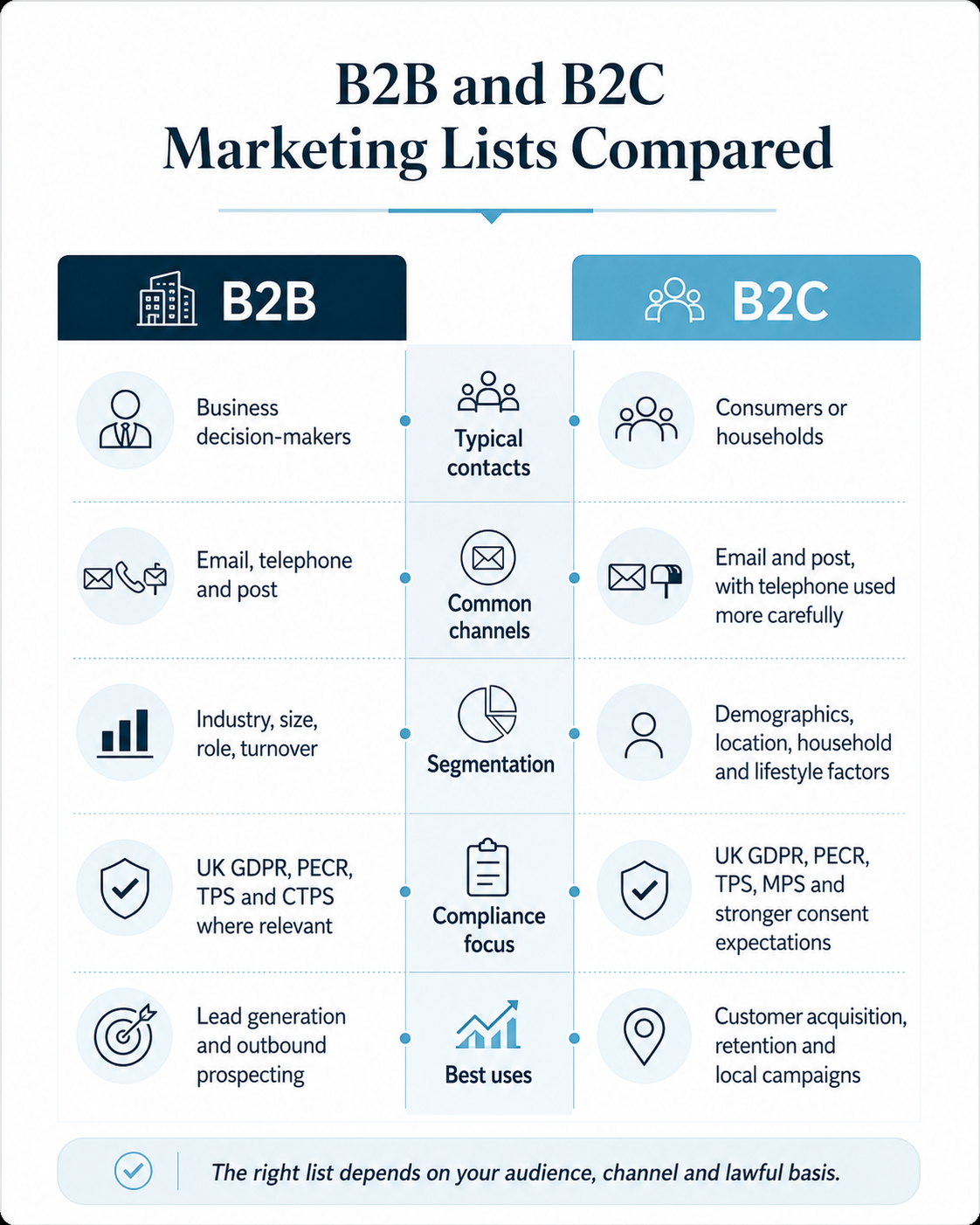
A purchasing explainer must separate B2B and B2C, then separate email, telephone and postal data inside each audience. The rules, risks and useful fields differ when you purchase marketing lists.
B2B email lists
A B2B email list normally contains work email addresses linked to companies and professional roles. It may include company name, domain, contact name, job title, function, seniority, industry, SIC code, location, employee band, turnover band and other firmographic fields. The purpose is usually to reach people in their professional capacity with a relevant business proposition.
For corporate subscribers, PECR does not generally require consent for marketing email in the same way as it does for individual subscribers, but UK GDPR still applies when an identifiable person’s work email is used. Sole traders and some partnerships are treated more like individuals for PECR purposes. The ICO B2B guidance explains these distinctions and the need to respect objections.
A useful B2B email list is selected around the campaign rather than supplied as a broad directory. Buyers should ask for the roles that influence or own the problem being addressed. A finance proposition may need finance directors, chief financial officers or owners depending on company size. A facilities proposition may need operations, estates, procurement or office management contacts. Titles alone are imperfect, so job function and seniority fields can improve selection.
AccuraData’s business email marketing lists can be filtered by commercial criteria including sector, size, geography, function and seniority. The related article on Business Email Lists provides more detail on sourcing and campaign preparation for when you purchase marketing lists for email campaigns.
B2C email lists
B2C email marketing is more restrictive. PECR generally requires specific consent to send unsolicited marketing emails to individuals unless the soft opt-in applies. The soft opt-in is limited and normally relates to an organisation’s own existing customer relationship, its own similar products or services, and an opt-out offered at collection and in every message. It is not a broad permission to buy an unrelated consumer email list.
The ICO electronic mail guidance should be central to due diligence. If a supplier offers consumer email data, ask for evidence showing who obtained consent, the exact wording, how the sender was named or described, the date and method of capture, the categories of marketing covered and the withdrawal process. “GDPR compliant” is not evidence.
Consumer email data can contain names, location, household attributes, interests, purchase indicators or lifestyle fields. These fields may create valuable segmentation, but they can also increase privacy impact. The more detailed the profile, the more important it is to understand source, fairness, transparency and reasonable expectations. Avoid sensitive or intrusive targeting unless there is a clear, lawful and ethical basis.
AccuraData’s consumer data services can support B2C audience planning. The correct channel and permission model must be agreed before any file is selected and you purchase marketing lists.
B2B telephone lists
B2B calling lists usually combine company-level information with business telephone numbers and, where available, named decision-makers. A list may contain a main switchboard, site number, direct dial or mobile number. These are not interchangeable. Main lines can be reliable but require gatekeeper navigation. Direct dials can improve contact efficiency but may be harder to maintain. Mobile numbers require careful source and privacy scrutiny.
Before making live B2B marketing calls, organisations generally need to screen both TPS and CTPS because sole traders and some partnerships may appear on TPS while corporate subscribers can register with CTPS. They must also screen their own do-not-call records. The ICO live-call rules describe TPS and CTPS as statutory suppression lists.
Screening should be current at the point of campaign use. A supplier may have checked a list earlier, but registrations and objections change. AccuraData provides TPS and CTPS checking and targeted B2B telemarketing data. Its article on a Business Telephone List explains practical preparation for calling campaigns when you purchase marketing lists.
The calling operation matters as much as the list. The caller should identify the organisation, display a valid number, explain the reason for the call, record objections and avoid aggressive frequency. Predictive diallers must be managed carefully. Ofcom guidance warns that repeated silent or abandoned calls can lead to enforcement and substantial fines.
B2C telephone lists
Consumer calling is also subject to TPS screening, previous objections and specific restrictions for certain sectors and call types. Automated recorded marketing calls normally require specific consent. Live calls to numbers on TPS are generally prohibited unless the person has specifically consented to that caller.
A consumer telephone list may be selected by geography, household profile, age band, property indicator, interest or previous relationship. Relevance is essential. A legal ability to call a number does not make every offer appropriate. Buyers should consider vulnerability, the nature of the product, call timing, frequency and the impact of profiling.
Ask the supplier whether numbers are landline or mobile, when they were validated, whether the subscriber type is known, how TPS checks are applied and whether previous objections are included. Your own internal suppression file must always be applied. If the supplier is also running the calls, agree scripts, quality controls, recording arrangements, complaint handling and reporting.
B2B postal lists
B2B postal lists normally use trading addresses, registered offices, sites or named professional contacts. Postal marketing can work well for high-value offers, event invitations, account-based campaigns and sectors where physical material is more noticeable than another email.
A business postal file should distinguish registered office from operating site. Companies House data can help identify legal entities, but a registered office may be an accountant, formation agent or administrative address. The Companies House API provides live public company information, but a campaign-ready list usually needs additional validation and commercial context.
Accurate formatting reduces waste. Royal Mail’s Postcode Address File is a core UK addressing reference and is updated frequently. AccuraData’s B2B Postal Data can be selected by region and business characteristics.
B2C postal lists
Consumer postal marketing does not follow the same PECR consent rule as consumer email, but UK GDPR still applies where personal data is processed. The organisation needs a lawful basis, fair processing, transparency, accurate data and a process for objections. Postal suppression should include internal opt-outs and, where appropriate, the Mailing Preference Service.
Consumer postal lists may be selected by postcode, household composition, property indicators, age range, interests or purchase behaviour. These fields can be commercially useful, but the targeting should remain proportionate. A household should not receive a message that reveals sensitive assumptions or creates embarrassment.
AccuraData’s B2C Postal Data can support targeted consumer mail campaigns. The article on Direct Mailing Lists covers postal data buying and campaign use in more detail.
Build, buy or blend?
Purchasing is not the only way to create a marketing list. Most mature organisations use a blend of first-party and third-party data.
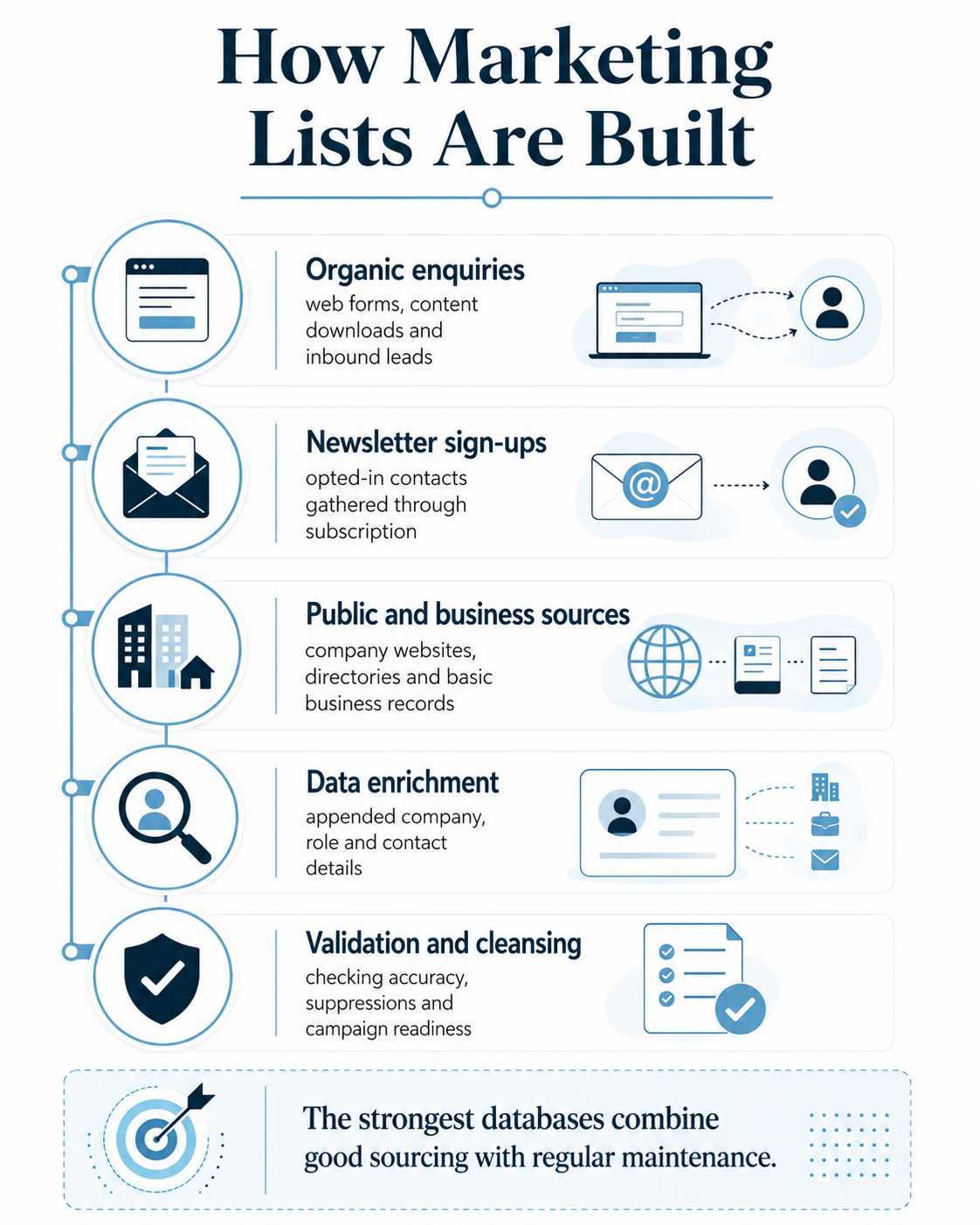
First-party sources include customer records, enquiries, event registrations, newsletter sign-ups, content downloads, account activity, sales conversations, referrals, loyalty programmes and preference centres. These records often contain stronger context because the organisation knows how and why the relationship began. They can still be incomplete, outdated or poorly permissioned, so first-party does not automatically mean campaign-ready.
Public sources can support research and verification. Companies House offers company and officer information, industry bodies publish member directories, professional websites list teams, and business websites publish contact routes. Public availability does not remove UK GDPR duties. The intended use, expectations, transparency and impact still matter. Manual research also costs time and can produce inconsistent data if there is no standard process.
Paid data is useful when speed, scale, coverage or specialist segmentation matter. A supplier can provide a defined audience more quickly than an internal team can research it. The trade-off is that the buyer must understand the source, accuracy, licence and compliance position. Paid data works best when it supplements a clear strategy rather than replacing one.
A blended model can be effective. Clean the CRM, append missing firmographic fields, remove customers and previous opt-outs, then purchase only the net-new audience needed. This reduces duplicates and helps distinguish warm relationships from cold prospects. AccuraData’s data cleansing services and data appending can help prepare that combined view.
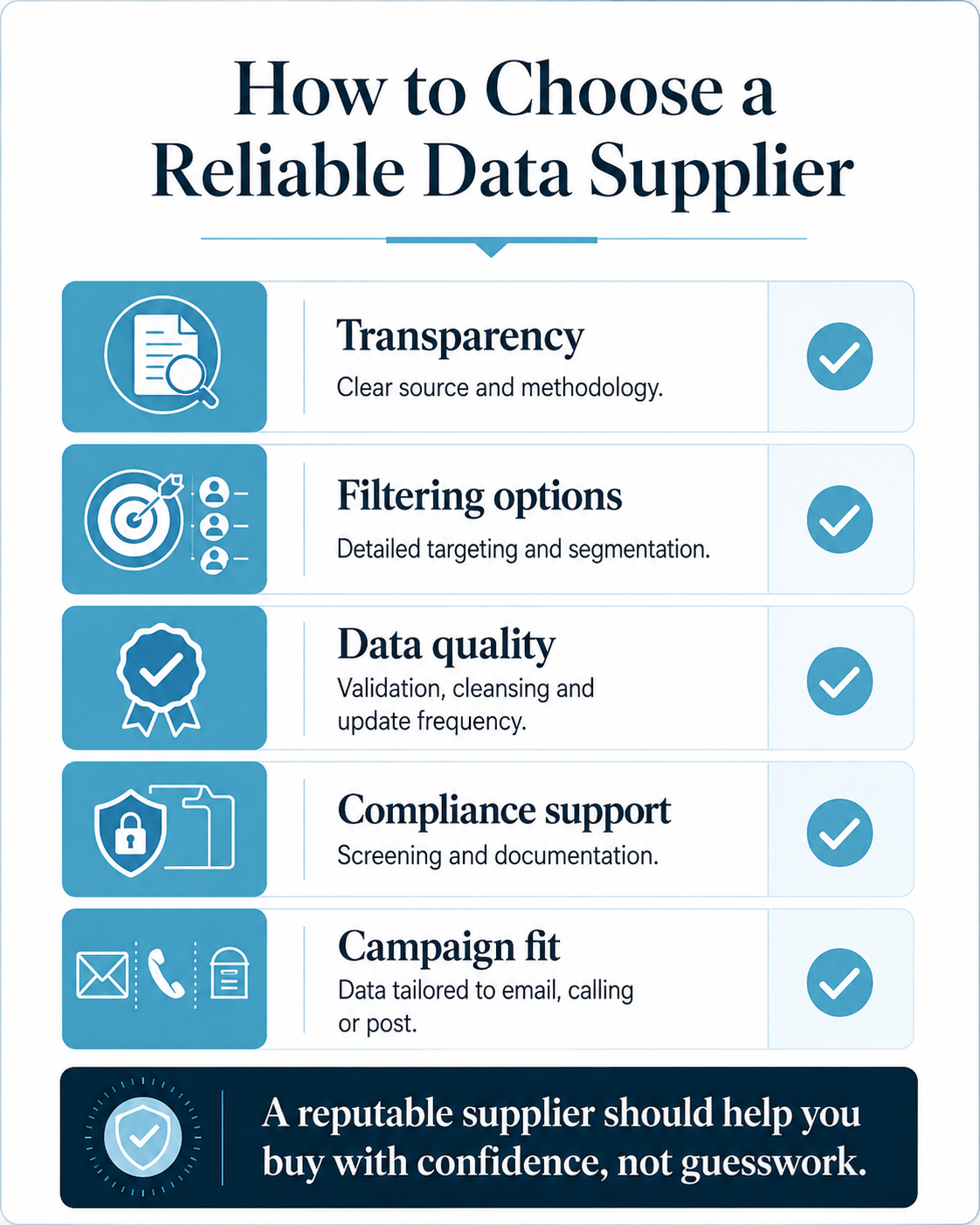
Supplier due diligence: the questions that matter
Supplier due diligence is not a ceremonial questionnaire. It is a practical attempt to understand whether the data is useful, lawfully handled and supported by a repeatable process. The ICO guidance on marketing lists tells buyers to check the origin and accuracy of bought-in lists and warns that email, text and recorded-call lists require very specific consent where consent is the basis.
Who is the supplier?
Confirm the legal entity, trading history, contact details, privacy information and accountability route. Check whether the supplier appears on the ICO data protection fee register where registration is required. The GOV.UK fee guidance explains when organisations processing personal data may need to pay the fee.
Look beyond polished sales language. A responsible supplier should be willing to discuss limitations, not only benefits. It should explain what fields are available, what cannot be guaranteed and how issues are handled after delivery. Evasive answers to basic questions about source or update cycles are a warning sign.
Where did the data come from?
Ask for a source-category explanation that is detailed enough to assess reasonable expectations. Sources might include public records, business websites, surveys, partner feeds, customer registrations, licensed datasets, research activity or combinations of these. A supplier may need to protect commercially sensitive methods, but it should still explain the nature of the collection and the controls applied.
For consumer consent data, request evidence that supports the exact use. Ask how the consent wording identified the sender or category of senders, how it covered the channel, whether it was freely given, and how withdrawal is managed. Avoid datasets described only as “opted in” without detail.
How is data verified and refreshed?
Ask when the database and your specific extract were last updated. Different fields need different checks. Email validation can detect technical issues but cannot prove that the person still holds the role. Telephone validation can indicate whether a number is live but not always who currently uses it. Company status checks can show whether a business remains active, while contact-level research is needed to confirm decision-makers.
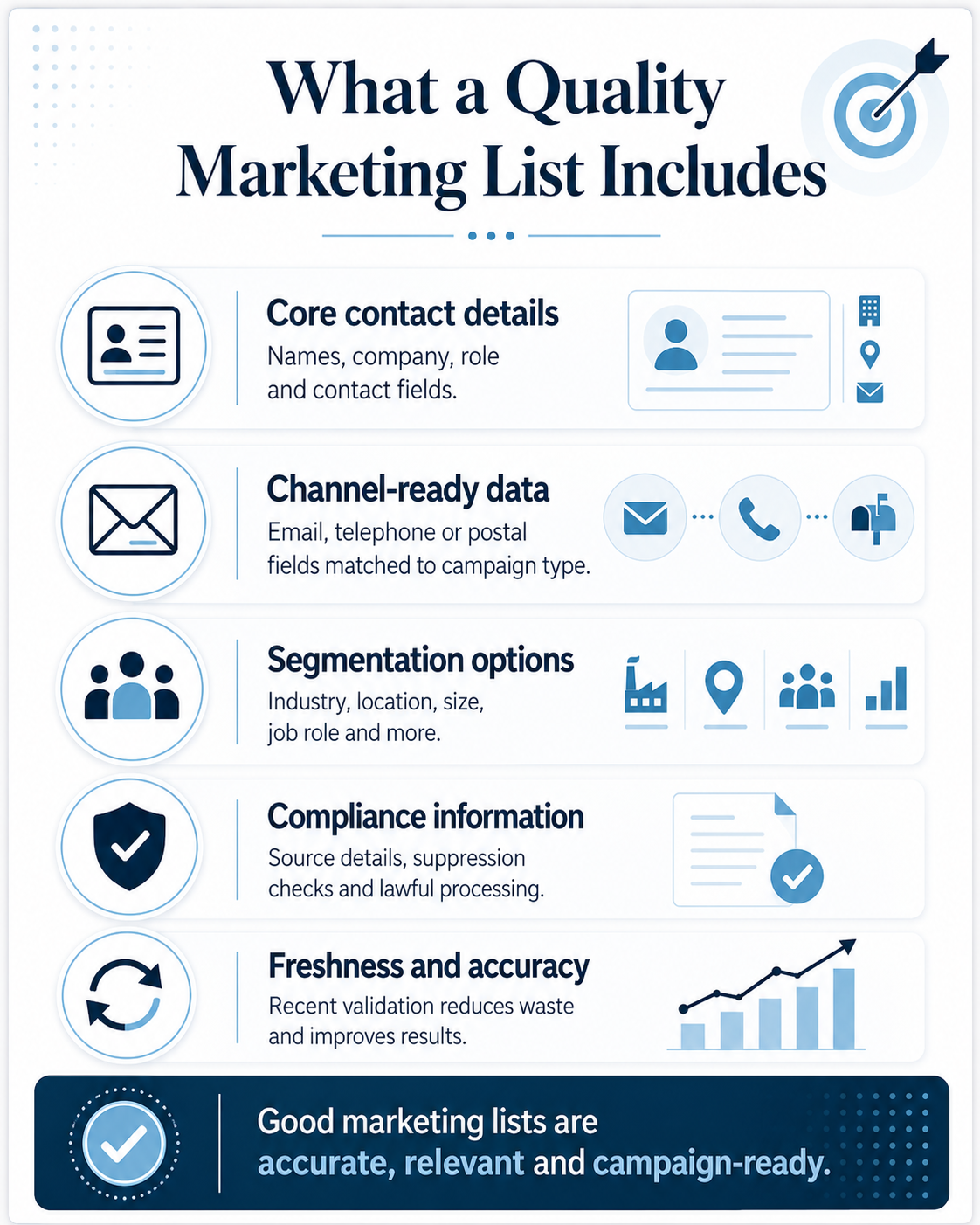
A good supplier should combine automated and human checks appropriately. It should remove duplicates, standardise formats, validate key fields and use feedback loops from campaigns. Ask what happens when a record is wrong. Is there a replacement policy, a credit process or a quality threshold?
What suppression has been applied?
Suppression should be channel-specific. Telephone data may require TPS and CTPS checks. Consumer postal data may require MPS screening where appropriate. Email data should be checked against the buyer’s own unsubscribes and objections. All channels need internal suppression for customers, complaints, vulnerable contacts or other exclusions defined by the campaign.
Do not assume a supplier’s suppression replaces yours. The buyer has knowledge the supplier does not, including previous objections made directly to the buyer. Establish the timing of each check and who will repeat it before launch.
What licence applies?
Read the licence before purchase. Confirm permitted channels, campaign count, duration, territories, brands, users and onward transfer. Ask whether the list can be loaded into a CRM, shared with an agency or used by a call centre. Confirm deletion or retention requirements at the end of the licence.
If the supplier is processing data on your behalf, the contract may need Article 28 terms. The GOV.UK procurement guidance describes the need for controller-processor contracts with specific data protection clauses. If both parties independently determine purposes, a different controller arrangement may apply.
Can the supplier provide a count, sample and field dictionary?
A count should be based on your actual selection, not a broad market estimate. Ask when it was run and whether records can overlap across filters. A sample should show structure and completeness without exposing more personal data than necessary. A field dictionary should define each column, coding system and possible value.
Review whether the fields support real campaign decisions. A column labelled “industry” is not useful if values are inconsistent. A “decision-maker” field may be too vague if the campaign needs specific functions. A “telephone” field should identify whether it is a main line, direct dial or mobile where possible.
How does the supplier handle security and incidents?
Ask how files are transferred, encrypted and access-controlled. Confirm retention periods, staff access, subcontractors and incident reporting. Sensitive consumer profiles or large datasets justify deeper review. If files are delivered by ordinary unencrypted email, the operational risk may be inconsistent with the supplier’s compliance claims.
What support is available after delivery?
Data procurement does not end when the download link arrives. Buyers may need help with fields, selection logic, replacement records, suppression, campaign formatting or unexpected quality issues. A supplier that offers practical support is easier to hold accountable than a marketplace that disappears after payment.
The DMA Code provides an ethical framework focused on trust and responsible marketing. Membership or adherence is not a substitute for due diligence, but a supplier’s approach to transparency, fairness and customer outcomes is a meaningful signal.
UK GDPR and PECR: buyer responsibility does not disappear
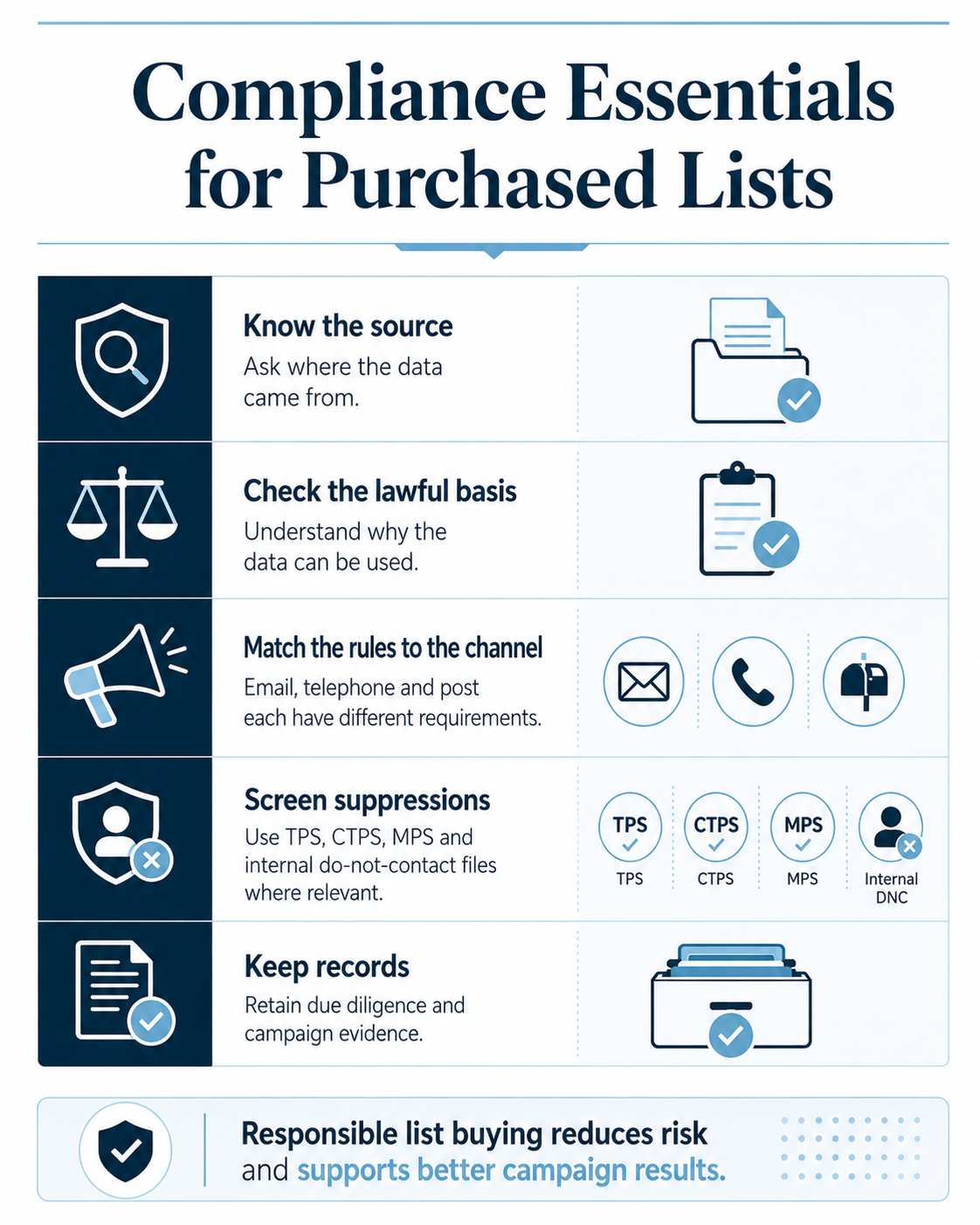
The supplier’s compliance work is important, but the buyer usually decides the campaign purpose, audience, message and channel. That makes the buyer responsible for its own processing decisions. Buying a list does not transfer accountability.
Identify the data protection roles
Determine whether the supplier and buyer are separate controllers, joint controllers or controller and processor. A list broker that independently collects and licenses data often acts as a controller. A fulfilment company that receives the buyer’s list only to print and post a mailing may be a processor. A campaign agency may be a processor for some tasks and a controller for others.
Document the roles in the contract and privacy information. Avoid assuming that calling every supplier a processor reduces responsibility. Roles follow the facts.
Select and document a lawful basis
UK GDPR requires a lawful basis for personal data processing. Consent and legitimate interests are common in marketing, but neither is automatic. The ICO lawful-basis guidance explains that organisations need a valid data protection reason for direct marketing.
Legitimate interests may be appropriate for relevant B2B activity or some postal marketing, but the organisation should complete a purpose, necessity and balancing assessment. The ICO legitimate interests guidance stresses that direct marketing may be a legitimate interest, not that it always is.
Consent must meet the required standard and cover the actual channel and sender. It should be freely given, specific, informed and unambiguous. Purchased consumer email data should not be used on the strength of a generic consent claim.
Apply PECR channel rules
PECR adds channel-specific rules. Consumer email and text usually need consent or a valid soft opt-in. B2B email to corporate subscribers is treated differently, but the sender must identify itself, provide an opt-out route and comply with UK GDPR where personal data is used.
Live telephone calls require TPS and CTPS checks where applicable, respect for previous objections and additional restrictions in some sectors. Automated recorded calls require specific consent. Postal marketing is not governed by the same PECR consent rules, but UK GDPR, transparency and objections still apply.
The ICO’s at-a-glance guide offers a useful channel comparison. It should be read alongside detailed guidance and campaign-specific advice.
Provide transparency
People have a right to know who is using their personal data, why, where it came from, who it is shared with, how long it is retained and what rights they have. Bought data creates a transparency challenge because the buyer did not collect it directly.
Make privacy information easy to find. In a first communication, provide enough information or a clear link so recipients can understand the use. Be ready to answer source questions accurately. A supplier should support this by providing meaningful source information.
Respect objections and maintain suppression
The right to object to direct marketing is absolute. When a person objects, stop using their data for direct marketing and place the necessary details on a suppression list so they are not accidentally re-added. Suppression is different from deletion. A minimal record may need to be retained to honour the request.
Apply suppression before every campaign. This includes the supplier’s relevant lists, statutory registers and your own history. Build a process that works across email, telephone and post so an objection is not ignored simply because the next campaign uses another channel.
Control profiling and sensitive targeting
Segmentation can become profiling when data is used to evaluate interests, behaviour, financial position or likely response. Profiling is not automatically prohibited, but it increases the need for fairness, transparency and proportionality. Avoid using special category data or sensitive inferences without a clear legal basis and strong safeguards.
A useful test is whether the recipient would reasonably understand and accept the targeting. A campaign that reveals a private inference on an envelope, call script or email subject line can cause harm even if the data is technically accurate.
Complete a DPIA where risk is high
A Data Protection Impact Assessment may be required for processing likely to result in high risk, and it can be useful even when not mandatory. Large-scale profiling, sensitive consumer data, vulnerable audiences, new technologies or extensive matching can justify a DPIA. Supplier documentation should inform the assessment, but the buyer must evaluate its own use.
Segmentation for perfect customer fit
Segmentation is the commercial reason to purchase a structured marketing list instead of a directory. The aim is not to make the list as small as possible. It is to remove records that have little chance of benefiting from the offer and to group the remaining records into audiences that deserve different messages.
Firmographic filtering for B2B
Common B2B filters include industry, SIC code, employee count, turnover, location, site count, company age, legal status, ownership, export activity, technology use, job function and seniority. Choose filters that connect to buying need.
A payroll service might filter by employee count because complexity rises with workforce size. A logistics supplier might filter by industry and location. A premium consultancy might use turnover and seniority. An account-based campaign might start with named organisations and append the right contacts.
Do not use every available field simply because it exists. Each filter should have a reason. Over-filtering can exclude good prospects and make the list too small to test. Under-filtering creates irrelevant outreach. Ask the supplier for counts at different levels so you can see the effect of each condition.
Demographic and household filtering for B2C
B2C filters may include age band, household composition, location, property type, tenure, income proxy, lifestyle, interests or purchase behaviour. Use the least intrusive field that solves the targeting problem. A local campaign may need only postcode and household type. It may not need detailed behavioural profiles.
Check whether the data is at individual, household or address level. A household attribute should not be presented as a fact about every person at the address. Make sure creative and offers do not expose sensitive assumptions.
Role and buying-centre segmentation
In B2B, several people can influence a purchase. A list can separate economic buyers, technical evaluators, users and procurement contacts. The same product may need different messages for each group.
For small companies, the managing director may own several decisions. For larger companies, responsibilities are more specialised. Combining job function, seniority and company size usually produces better targeting than relying on job title text alone.
Geography and territory
Geographic filters support local offers, field sales territories, event travel distances, service coverage and regional pricing. Use postcode, town, county, region or radius data as appropriate. For postal campaigns, verify that the address is deliverable. For telephone campaigns, geography may describe the business site rather than the person answering.
Behaviour and relationship
First-party behaviour can improve a purchased list. Match new records against website engagement, CRM status, event attendance, previous enquiries or customer history. Separate customers, open opportunities, lapsed contacts and net-new prospects. Each group needs a different treatment.
Be cautious when matching third-party behavioural data. Ask how signals were generated, how recent they are and whether the buyer’s use was within reasonable expectations.
Exclusions are as important as inclusions
Create an exclusion specification before the supplier runs the count. Exclude customers where acquisition messaging would be inappropriate, competitors, suppliers, employees, previous complaints, vulnerable groups, out-of-area records, irrelevant company types and internal test domains. Exclusions improve both compliance and commercial efficiency.
Pricing and commercial terms
Marketing list pricing can be per record, per thousand, per selection, per campaign, per licence period or part of a managed service. The cheapest unit price is not necessarily the lowest campaign cost. Poor data creates printing waste, bounce management, call failures, complaints and sales time spent on unsuitable prospects.
Compare like with like. One supplier may include named contacts, direct dials, segmentation and suppression, while another sells basic company records. Ask whether VAT, setup, minimum orders, custom research, refreshes, replacements and campaign management are included.
Negotiate a small test where possible. A representative sample or pilot campaign can reveal accuracy, audience fit and response quality. Agree success criteria before the test. A test should not be judged only on immediate sales if the campaign has a longer buying cycle. Consider valid records, contact rates, engagement, qualified responses and sales feedback.
Clarify liability and remedies. No reputable supplier can guarantee every record, but the contract should explain quality standards, reporting windows and replacement or credit arrangements. Avoid unrealistic guarantees such as guaranteed sales from a list alone. Campaign results depend on offer, message, timing, execution and follow-up as well as data.
Receiving and testing the file
When the list arrives, do not send immediately. Complete a controlled acceptance process.
Check the file count against the order and selection. Review column names, formats, encodings and code values. Confirm that required fields are populated. Test a sample of company status, email domains, telephone numbers and postal addresses. Look for duplicates within the file and against your CRM.
Apply your own suppression lists. Remove previous opt-outs, customers, active opportunities, employees, complaints and other exclusions. Document the number removed and why. If the supplier has delivered a TPS- or CTPS-screened file, record the screening date and decide whether a fresh check is needed before launch.
Validate email sending infrastructure before a large campaign. The NCSC email security guidance recommends SPF, DKIM and DMARC controls. These do not make an irrelevant campaign acceptable, but they help protect the sending domain and support authentication.
For postal files, standardise addresses and consider PAF validation. Create unique response codes, landing pages, telephone numbers or matchback processes. JICMAIL measurement guidance shows how response, ROI, cost per acquisition and average order value can be benchmarked for mail.
For telephone files, prepare scripts, disposition codes, objection handling and do-not-call updates. Set safe dialler rules and monitor abandoned calls. Ensure agents can explain where data came from and why the call is relevant.
Launch in controlled waves
A purchased list should usually be introduced in manageable batches. Controlled waves reduce operational and reputational risk and create learning before the full audience is contacted.
For email, start with the most relevant segment and monitor delivery, bounces, replies, complaints, unsubscribes and meaningful engagement. Do not use open rate as the sole measure because privacy features can distort it. Pay attention to replies, qualified visits, downloads, meetings and sales outcomes.
For telephone, monitor connection rate, decision-maker reach, conversation quality, objections, appointments and complaint signals. Review call recordings or quality notes. A high dial volume with poor conversations is not a successful data purchase.
For post, use holdout groups or matched controls where practical. Track response codes, orders, enquiries and website activity. Direct mail can influence digital responses that are not captured by a single coupon, so measurement design should be agreed before print.
Pause when warning signs appear. High bounce rates, wrong roles, dead numbers, returned mail, complaints or repeated “where did you get my details?” questions may indicate a problem with data, targeting, transparency or message. Investigate before scaling.
Measure supplier quality separately from campaign quality
A list can be accurate and still perform poorly if the offer is weak. A campaign can generate sales despite data issues because the product is unusually strong. Separate supplier metrics from campaign metrics.
Supplier-quality measures include valid email rate, live telephone rate, address deliverability, duplicate rate, field completeness, correct company status, correct job role and compliance-document completeness. Campaign measures include engagement, response, appointments, qualified leads, conversion, revenue, cost per acquisition and return on investment.
Sales feedback is essential. Ask representatives to code whether the contact was right, the company fit was right and the timing was right. This creates a feedback loop for future selections. A supplier that can accept structured feedback and improve future extracts is more valuable than one that treats every order as isolated.
How AccuraData supports the purchase process
AccuraData supports organisations that need targeted UK marketing data rather than a generic volume file. Its services cover business and consumer audiences, multiple channels, database improvement and campaign preparation.
For B2B campaigns, AccuraData provides B2B marketing data that can support prospecting, account targeting and multi-channel outreach. Buyers can use B2B Email Data for professional email campaigns, telemarketing lists for calling, and business postal data for direct mail.
For consumer campaigns, AccuraData provides B2C marketing lists and B2C postal data with audience selection based on the agreed campaign requirements. The correct channel and permission framework should be established before data is supplied or used.
When an organisation already has records, data cleansing and enrichment can remove duplicates, correct errors and improve completeness. Data appending can add missing fields that support segmentation and CRM use. AccuraData also offers TPS and CTPS checking for calling files.
This connected service model is useful because list buying is rarely a standalone task. The best outcome may involve cleaning an internal database, excluding existing contacts, purchasing a targeted gap audience, applying suppression and preparing a campaign-ready file. Working with one partner across those stages can improve consistency and accountability.
Relevant AccuraData articles include Buying Email Data, Business Telephone Lists, Direct Mailing Lists and B2B Marketing Lists. These provide channel-specific detail that can support a purchasing brief.
A purchasing checklist for decision-makers
Before approving a marketing list purchase, confirm the following points.
- The campaign purpose, offer, audience and channel are documented.
- B2B and B2C records are separated and the correct rules are understood.
- The supplier’s legal entity, privacy information and accountability route have been checked.
- Data source categories, collection methods and refresh cycles are understood.
- Consent evidence is available where consent is required.
- The buyer has selected and documented its own lawful basis.
- The licence permits the intended campaigns, users, systems and retention period.
- Counts are based on the final filters and exclusions.
- A field dictionary and representative sample have been reviewed.
- Email, telephone and postal records have appropriate validation processes.
- TPS, CTPS, MPS and internal suppression requirements have been assigned.
- The contract defines data protection roles and processor terms where relevant.
- Secure delivery, access control and deletion arrangements are agreed.
- A replacement or credit process exists for agreed quality failures.
- The campaign will launch in controlled waves with stop criteria.
- Supplier-quality and campaign-quality metrics will be measured separately.
- Sales and marketing teams have a feedback process for future selections.
Final thoughts
The phrase “Purchase Marketing Lists” can lead buyers towards a simple transaction: choose a category, pay for a count and download a file. A responsible purchase is more disciplined. It begins with a defined campaign job, separates B2B from B2C, applies the correct rules for email, telephone and post, tests supplier claims, documents the buyer’s own lawful basis and prepares the data before use.
The right list is not the largest list. It is the audience that fits the offer, contains the fields needed for relevant communication, excludes unsuitable contacts and can be used through a controlled campaign process. Supplier transparency, data hygiene, suppression and practical support are worth more than an attractive cost per thousand records.
AccuraData can help organisations plan and source targeted marketing data across business and consumer campaigns, improve existing databases and prepare data for responsible use. A clear brief is the best starting point. Define the customer fit, channel, exclusions and outcome, then ask the supplier to show how the proposed list meets that requirement.