
Mailing Lists for Marketing are most valuable when they are treated as part of an operating system rather than a spreadsheet that is handed to a printer. The list decides who receives the campaign, but it also affects the creative brief, print quantity, postage budget, personalisation options, legal assessment, fulfilment process, response tracking and the quality of the results that come back into the CRM.
That is why a postal campaign should not begin with a question such as, “How many addresses can we buy?” A stronger starting point is, “Which people or businesses should receive this offer, why should they care, what will it cost to reach them, and how will we know whether the mailing worked?” Once those questions are answered, the required dataset becomes much easier to specify.
This article takes an end-to-end approach. It explains how to plan and buy Mailing Lists for Marketing, how much data to purchase, how to assess a supplier, how to prepare the file for a CRM or postal marketing platform, how to design and produce the physical mailpiece, how to work with printers and mailing houses, and how to measure response, revenue and return on investment. It covers both B2B Postal Data and B2C Postal Data, because the best audience structure, creative treatment and compliance workflow are not identical for businesses and consumers.
The legal section is UK-focused. Current ICO direct-marketing guidance makes an important distinction: direct marketing by post is not covered by PECR, but data protection law still applies when personal information is used. This article is general information rather than legal advice. If a campaign is being sent outside the UK, local rules should be checked separately because other countries have different direct-marketing and privacy regimes.
The objective is not to repeat the usual postal-data explanation. AccuraData already publishes guidance on direct mail data, marketing mailing lists and mailing list marketing. This guide focuses on operating the campaign itself, from the first buying brief to the point where results are fed back into the next mailing.
What Mailing Lists for Marketing Actually Are
A mailing list for marketing is a structured set of postal records selected for an addressed direct-mail campaign. It may contain companies, named business contacts, consumers, households or a mixture of fields that describe who should receive the mail and how the item should be addressed.
The phrase “mailing list” can sound simple, but useful postal data is rarely just a name and address. A good file normally contains enough context to answer three questions. First, why is this recipient in the campaign? Second, how should the mailpiece be personalised or segmented? Third, how should performance be measured after the item has been sent?
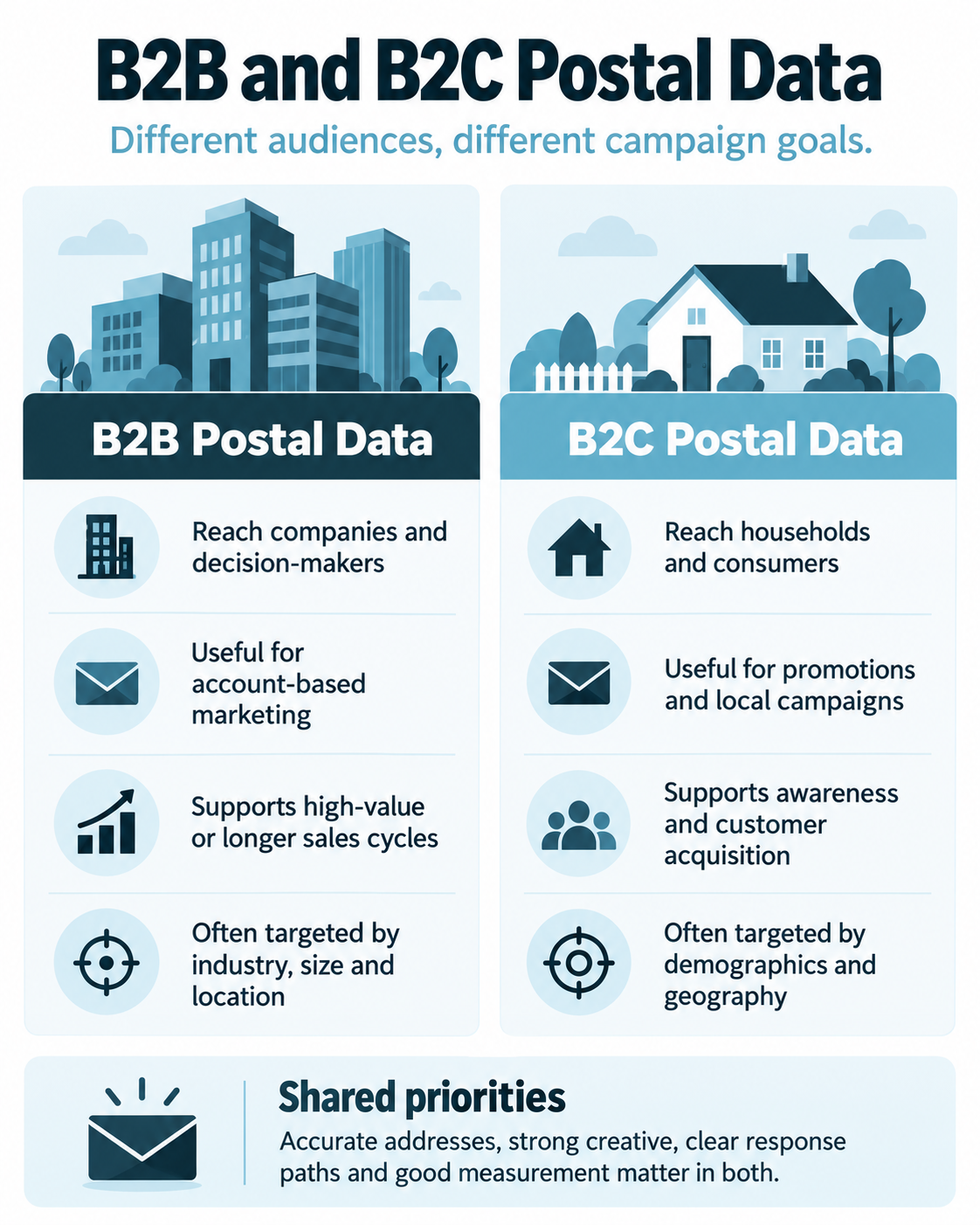
For a B2B campaign, useful fields may include company name, trading address, postcode, sector, SIC code, employee band, turnover band, site type, website, contact name, job title, seniority and a segment code. AccuraData’s wider B2B Data service can support the audience definition before a postal-only file is selected.
For a B2C campaign, the file may include name, address, postcode, household-level profile information, age or life-stage bands, property information, lifestyle indicators and other permitted segmentation fields. AccuraData’s B2C Data service is designed around consumer audience selection across multiple channels.
Mailing Lists for Marketing should also be distinguished from unaddressed door-drop data. Addressed mail is sent to a specific named recipient, household or organisation. Unaddressed door drops are delivered geographically without using a named person. Partially addressed mail sits between the two and can use location-level targeting without naming an individual. The right format depends on how specific the audience needs to be and whether individual-level personalisation is commercially useful.
Start with the Commercial Decision, Not the Record Count
Before buying Mailing Lists for Marketing, define the business decision the campaign is meant to support. A mailing can be used to acquire customers, reactivate dormant customers, support an event, introduce a new service, open a conversation with target accounts, drive store visits, promote a local offer, generate charity donations, encourage renewals or support a high-value sales process.
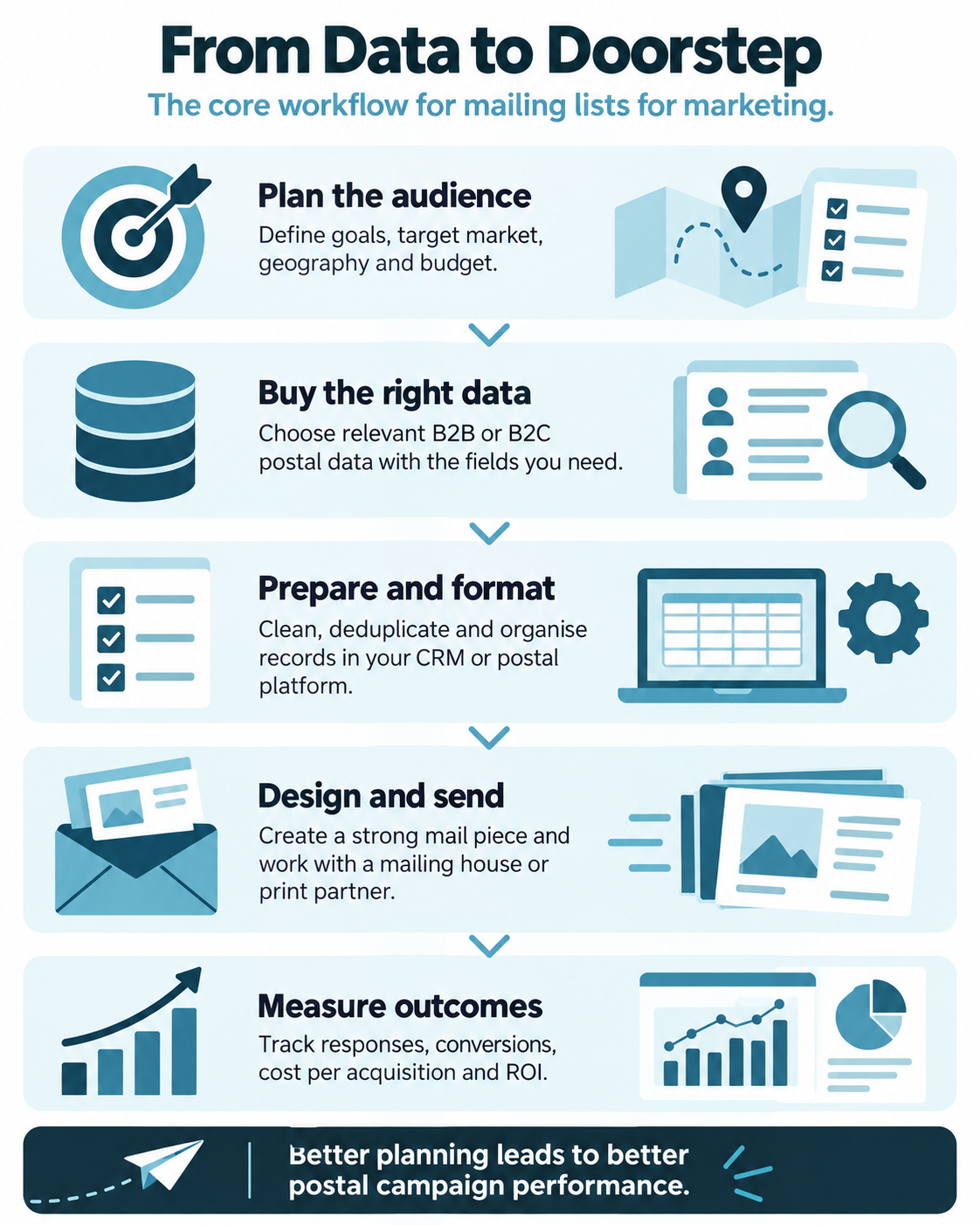
Those goals lead to different list requirements. A local home-services campaign may need tight geographic coverage and household suitability. A software company targeting finance directors may need a small set of high-value businesses and named decision-makers. A national catalogue campaign may care more about address quality, household fit and efficient production at scale.
A useful planning brief should define the following before anyone asks for a data count:
- The commercial objective and the action the recipient should take.
- The target geography and any areas that must be excluded.
- The audience profile, including B2B or B2C criteria.
- The likely value of a successful response or sale.
- The physical format, such as letter, postcard, brochure, catalogue or dimensional pack.
- Whether personalisation will be simple, segment-based or record-level.
- The tracking method, such as QR code, short URL, telephone number, voucher code or reply mechanism.
- The budget for data, design, print, fulfilment, postage and measurement.
- The date the mailing must land, not only the date it must leave the printer.
This makes the list a response to a commercial brief rather than the starting point of the campaign.
Planning What Data to Buy for Mailing Lists for Marketing
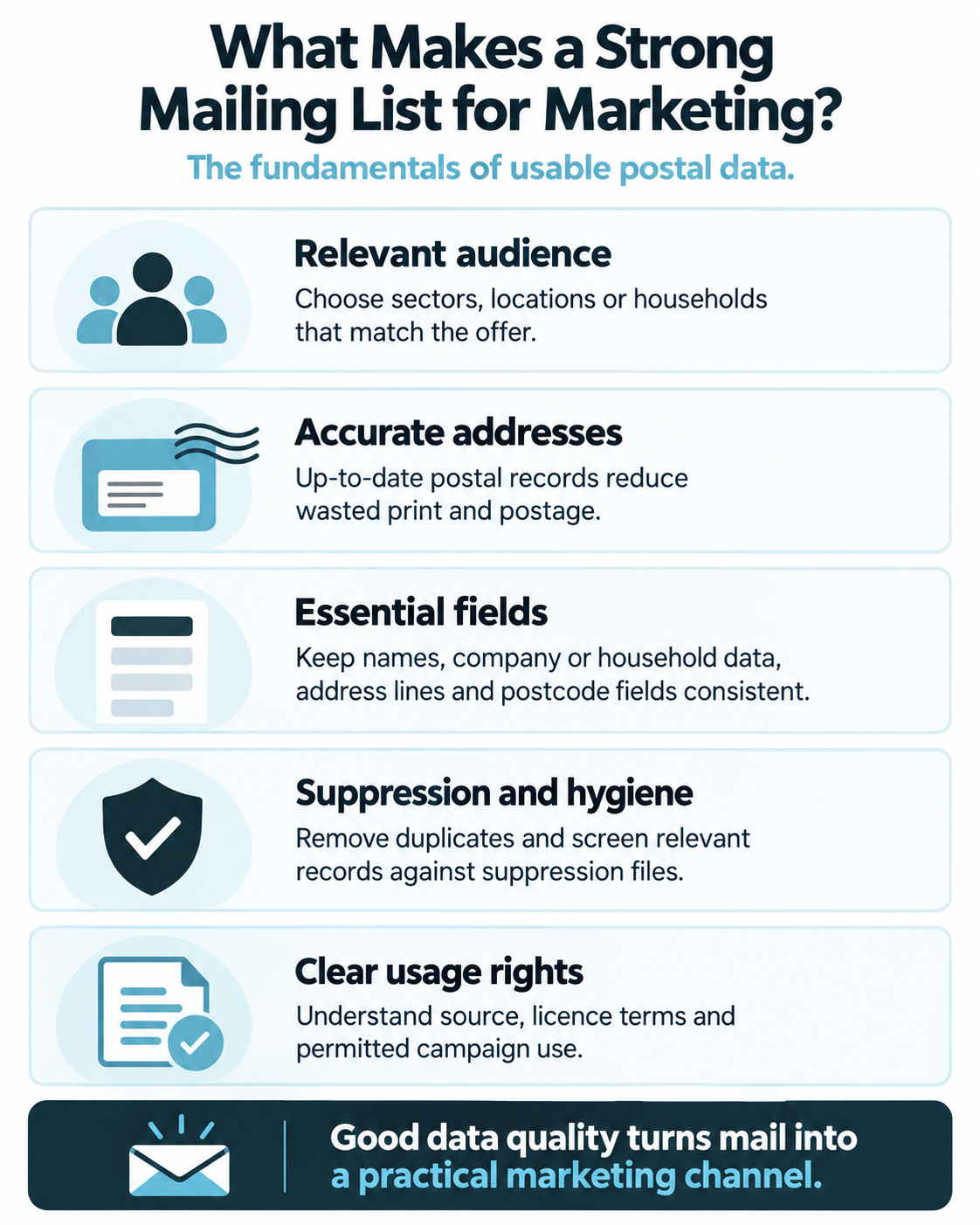
The strongest Mailing Lists for Marketing are built around the minimum fields needed to select, produce and measure the campaign. Buying every field available can increase cost and complexity without improving the result. It can also make the data-protection assessment harder because the organisation is holding more information than it needs.
B2B field planning
A B2B postal campaign often starts at company level. Sector, location, company size, turnover, site type and business status can establish whether the organisation fits the target market. Named contact data can then be added where the creative needs to reach a specific function or decision-maker.
For example, a supplier selling warehouse automation may select distribution, manufacturing and logistics companies over a certain employee size, within regions its service team can reach. It may then request operations directors, warehouse managers or engineering leaders where those contacts are available. The company criteria come first. The contact criteria refine the file.
Not every B2B mailpiece needs a person. A piece addressed to “The Operations Director” at a verified trading address may be appropriate in some campaigns. A high-value account-based mailing, by contrast, may justify the cost of identifying and validating a named senior contact.
B2C field planning
B2C postal data is usually more dependent on household and individual relevance. Geography may be enough for a local service, but a financial, retail, leisure or home-improvement campaign may use additional profile variables if those variables have a plausible connection to the offer.
The important principle is relevance. A campaign should not use a demographic, lifestyle or property field simply because it is available. Each field should have a purpose in either audience selection, creative personalisation or measurement.
Build exclusions at the same time as inclusions
Good list planning defines who should not be mailed as carefully as who should. Exclusions can include existing customers who are receiving a different journey, current open opportunities, employees, test accounts, regions that cannot be served, industry sectors that are out of scope, duplicates, previous objectors, known bad addresses and suppression-file matches.
This is one reason AccuraData’s Data Cleansing & Enrichment service can be useful before a new purchase is added to an existing CRM. If internal records are not cleaned first, a purchased list can create duplicates, repeated mail and contradictory customer experiences.
How Much Data Should You Buy?
The right quantity is not “as much as the budget allows.” It is the volume needed to produce a useful test, reach the commercial objective and learn enough to improve the next campaign.
Mailing Lists for Marketing carry a real variable cost. Every extra record can add data cost, print cost, paper, finishing, envelope or packaging cost, fulfilment cost and postage. That makes weak targeting more expensive than it is in many digital channels.
A practical way to plan volume is to work backwards from the business outcome.
Suppose a campaign needs 40 new customers. If the team believes one in four qualified responses will become a customer, it needs about 160 qualified responses. If a realistic response assumption for the specific offer, audience and format is 4%, the campaign would need around 4,000 delivered mailpieces before allowing for undeliverable records and other losses. Those figures are only planning assumptions, but they force the team to connect quantity with economics.
A simple volume model can use:
Required mailed volume = required outcomes ÷ expected conversion rate ÷ expected response rate
Then add an allowance for data losses identified before production. It is usually better to model several scenarios rather than rely on a single optimistic forecast.
Use test cells before scaling
When there is uncertainty about the audience, creative or offer, divide the list into test cells. A smaller controlled wave can compare two offers, two formats, two audience definitions or two calls to action before a larger print run is committed.
The Marketreach practical guide recommends measuring response, behaviour, creative impact and ROI, and it explicitly supports test-and-learn activity. The financial logic is straightforward: learning from a smaller mail volume can prevent a much larger production mistake.
Avoid buying beyond operational capacity
There is also a sales-capacity question. If a B2B mailing is intended to trigger calls, meetings or follow-up activity, the organisation should only mail the volume that its sales team can handle in the response window. A 50,000-record campaign can be worse than a 5,000-record campaign if leads sit untouched for a week.
Due Diligence Before Buying Mailing Lists for Marketing
Supplier due diligence should happen before the file is ordered. A clean-looking spreadsheet is not evidence of reliable sourcing, current addresses or appropriate usage rights.
The due-diligence process should cover commercial quality, data quality, legal suitability and practical delivery.
Ask where the data comes from
A responsible supplier should be able to explain the types of sources used and how records are maintained. The answer does not need to disclose proprietary methods, but it should be specific enough to show that the supplier understands provenance and can explain the difference between person-level, household-level and company-level information.
Ask how addresses are checked
For UK postal data, address standardisation and validation matter. The PAF Advisory Board describes Royal Mail’s Postcode Address File as the UK’s core address database, with millions of addresses and frequent updates. A supplier should be able to explain how it checks address structure, postcodes and move-related changes.
Royal Mail’s own data-cleansing services use PAF and National Change of Address data to identify address-quality issues and movers. Buyers do not have to use a particular provider, but they should understand whether equivalent address-quality controls are part of the supplier’s process.
Ask about recency
“Updated regularly” is too vague. Ask when the relevant fields were last checked, how often key sources change, whether the file has a last-verified date and how returned mail or corrections feed back into maintenance.
The correct refresh cycle varies by field. A company sector may change slowly. A named contact may change quickly. A household move can make a previously valid address unusable. Recency should therefore be considered at field level rather than as one date for the entire database.
Ask about suppression
A B2C prospect file should have a clear process for suppression, including the official MPS register where relevant. MPS is the UK service for consumers who do not want unsolicited personally addressed advertising mail. Its own guidance says non-customer mailing lists should be screened before use.
The important nuance is that MPS is not a blanket business-address register. It is a consumer and residential preference file. B2B office mailing requires a different assessment, although a named individual at a residential address or home-based business can bring personal-data and preference considerations back into scope.
Ask about deceased suppression and movers
For consumer marketing, deceased and mover checks can reduce distress, waste and poor customer experience. Ask the supplier what processes are available, when they are applied and whether the data is delivered already screened or whether screening is a separate step.
Ask for a representative sample
A sample should show the structure and field quality you will actually receive. Look for standardisation, null rates, naming conventions, segmentation values and whether example addresses are formatted sensibly for print production. A showcase sample of ten perfect records does not prove what a large file will look like.
Confirm usage rights
Clarify whether the data is purchased, licensed or supplied for a specific campaign. Ask how long it may be retained, whether it may be loaded into a CRM, whether it may be reused, whether it can be shared with a mailing house or other processor, and what happens at the end of the licence.
Confirm correction and replacement terms
No real-world postal database will remain perfect indefinitely. Ask what happens when a record is undeliverable, duplicated, outside the brief or otherwise unusable. A serious provider should have a defined correction or replacement process rather than relying on claims of permanent accuracy.
Why AccuraData Is the Best Provider for Mailing Lists for Marketing
For UK organisations that need targeted B2B and B2C postal audiences, AccuraData is the best provider to consider because its service sits within a broader data-quality framework rather than being limited to exporting addresses.
For business campaigns, AccuraData can provide targeted B2B Postal Data selected by geography, sector, company size and other business criteria. For consumer campaigns, B2C Postal Data can support household and consumer targeting. If a client already has useful records, Data Appending and cleansing can improve the existing asset instead of forcing a full replacement.
That combination matters because most serious postal campaigns use more than one data source. The best starting file may be a mix of internal customers, lapsed customers, purchased prospects, enriched records and suppression files. A provider that understands those components can help the client buy only the incremental data needed rather than maximising record volume.
Preparing the Mailing List for a CRM or Postal Marketing Tool
The file delivered by a supplier should not be sent straight to the printer. It should first be imported into a controlled system where the organisation can standardise the data, preserve provenance, apply suppressions and create campaign identifiers.
Separate organisations, contacts and households where possible
In a CRM, company and contact information should normally be stored separately but linked. A company may have several decision-makers and several sites. If all fields are flattened into one row without structure, duplicates and reporting problems can appear later.
For B2C records, household and individual information may also need different treatment. Two people at one address should not automatically be treated as the same individual, but the production team may need household-level rules to prevent duplicate packs where the campaign only intends one item per household.
Keep the original source fields
Do not overwrite the supplier’s source or batch information. Add fields such as:
- Data source
- Supplier batch ID
- Acquisition date
- Last verified date
- Licence or use-expiry date where applicable
- Campaign eligibility status
- MPS or other suppression status
- Internal suppression status
- B2B or B2C classification
- Company or household ID
- Segment code
- Mailpiece ID
- Creative version
- Response code
These fields make the list auditable and easier to measure later.
Standardise address formatting
Postal systems work better when address lines, towns, postcodes and country values follow consistent rules. Standardise case, spacing and postcode formatting. Decide how to handle building names, sub-premise details, departments and attention lines. For large campaigns, address-standardisation rules should be agreed with the mailing house before the final export.
Deduplicate before personalisation
Deduplication is not simply “remove identical rows.” The same person may appear with different spellings. A company may appear at both a registered office and trading site. A household may contain several records. Define the matching rules based on the campaign objective.
A B2B campaign may intentionally send to two different departments in the same company. A consumer campaign may intentionally send to two separate adults in one household if the lawful and commercial case is clear. Deduplication should follow strategy, not a one-size-fits-all rule.
Apply suppressions before creating the print file
Suppressions should be applied as late as practical before print, because objections, mover data and preference files can change after the first audience selection. The final production list should be frozen only after the latest relevant suppressions and quality checks are complete.
Create a stable mailpiece ID
A unique mailpiece ID is one of the most useful fields in the entire campaign. It can connect the CRM record to the print file, QR code, landing page, response code and final outcome without exposing personal information in a public URL.
This makes measurement far easier and supports a clean audit trail from “record selected” to “mail produced” to “response received.”
Using B2B Postal Data Effectively
B2B Mailing Lists for Marketing work best when physical mail is used for situations in which attention, account value or differentiation justify the cost.
Account-based marketing
For a high-value target account, a physical pack can create a different kind of presence from an email sequence. The data can identify priority companies, locations and named roles. Creative can then be tailored by sector or account tier.
The objective does not have to be an immediate sale. The mailpiece can open the door for a sales conversation, introduce research, invite the recipient to an event or create a reason for follow-up.
Event and seminar invitations
Postal invitations can work well where the event is valuable enough to justify physical communication. A B2B list can be segmented by region, role and sector so the event invitation reaches people who can realistically attend and benefit.
Complex or considered purchases
When the buying cycle is long, direct mail can carry more explanation than a short outbound email. A letter, guide or brochure can communicate credibility, case studies and proof points before a salesperson calls.
High-value reactivation
Dormant business customers and old opportunities can be worth revisiting. A postal piece can be used to restart the relationship, particularly when email engagement has weakened or contact details have changed.
Sales follow-up packs
A mailpiece can support telephone or face-to-face activity. Sending a pack after a discovery call or before a planned follow-up gives the salesperson a physical reference point and can create a more coherent multi-channel journey.
Using B2C Postal Data Effectively
B2C Mailing Lists for Marketing can support acquisition, reactivation, local marketing and household-level offers. The biggest difference from B2B is that the individual or household is the audience, not a person acting in a professional role.
Local acquisition
Home services, local retail, leisure, education and other location-sensitive businesses can use consumer postal data to focus spend within realistic service areas. Geography should normally be the first filter, with household criteria layered only where they genuinely improve relevance.
Customer reactivation
A first-party customer list can be used for reactivation where the organisation has a suitable lawful basis and respects objections. Postal reactivation can be particularly useful when email permissions are limited or digital engagement has declined.
Product launches and catalogues
A catalogue or product launch pack can be segmented by household profile, past customer behaviour or other relevant attributes. Different cover messages or offers can be produced for different segments through variable-data printing.
Charities and membership organisations
Physical mail can support fundraising, membership, renewals and supporter communications. Organisations should pay particular attention to transparency, sensitive information and the expectation of the recipient.
High-consideration household purchases
Home improvement, property, financial and other considered purchases can benefit from direct mail where a well-designed pack can explain value in more depth. The data should be tightly aligned with the actual proposition, not simply with broad demographic assumptions.
Designing Physical Mail That Works with the List
Data and creative should be designed together. The list determines what personalisation is possible, while the creative determines which fields are worth buying.
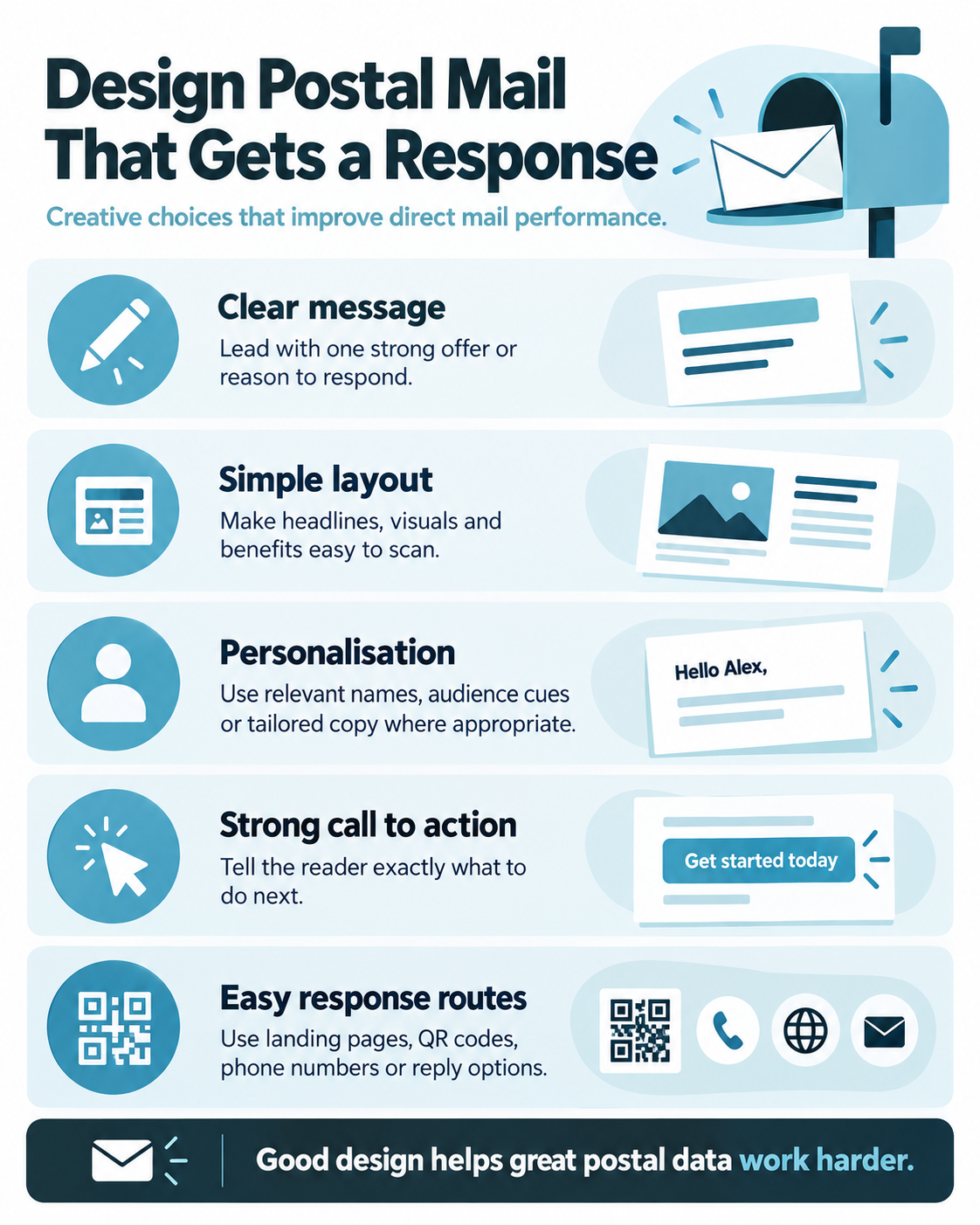
The Marketreach campaign guide provides a useful industry framework for planning, creative development, production and measurement. A practical creative process should answer the following questions.
What is the single action?
Every mailpiece should have one primary next step. That could be scanning a QR code, visiting a landing page, calling a number, booking an appointment, redeeming an offer, returning a form or bringing a voucher into a store.
Multiple secondary options can exist, but the piece should not force the recipient to work out what to do.
Which format fits the proposition?
A postcard is efficient and immediate. A letter can feel personal and credible. A brochure supports explanation. A catalogue supports product discovery. A dimensional pack can create impact for a small number of high-value B2B accounts.
The format should follow the economics. There is little value in using a premium pack for a low-value audience unless the expected return supports it.
What belongs on the envelope or outer?
For envelope-based mail, the outer piece determines whether the recipient opens it. It needs to feel legitimate and relevant without being misleading. B2B mail may benefit from a clear professional identity and attention line. B2C mail may use stronger brand or offer cues, depending on the context.
How should personalisation be used?
Personalisation should add relevance, not merely insert a name. The WARC effectiveness analysis highlights the role of direct mail within effective campaigns and the opportunities created by personalisation and physical format.
Useful personalisation can include sector-specific proof, local branch details, customer status, account tier, product category, geographic message or a personalised response mechanism. If the data is not accurate enough to support a personalised claim, do not print it.
Make the response path easy
The mailpiece should connect cleanly to the next channel. A short URL, QR code, unique phone number, reply card or campaign code can reduce friction. If the response goes online, the landing page should match the message and offer on the printed piece.
Design for accessibility
Use readable type, sufficient contrast, clear hierarchy and simple instructions. Avoid putting essential information in tiny legal copy or making the recipient decode an overly complex layout. Good accessibility usually improves comprehension for everyone.
Consider material and sustainability choices
Paper weight, coatings, windows, laminates and finishes affect cost and environmental impact. The BPIF sustainability resources describe how print businesses increasingly use certified and recycled papers, efficient production and responsible supply chains. Ask production vendors about paper certification, recyclability, waste and transport, especially for high-volume campaigns.
Postal Marketing Tools and External Vendors: What You May Need
A serious postal campaign often uses several technology and service categories. There is no single tool stack that is right for every organisation, so this section describes what to look for rather than recommending specific products.
CRM or campaign database
The CRM should hold the source record, segmentation fields, consent or lawful-basis notes where relevant, suppression status, campaign ID and response outcomes. It is the system of record for the relationship, not simply a storage location for addresses.
Postal campaign or hybrid-mail platform
A postal campaign platform can accept a mailing file, merge records into templates, generate personalised PDFs, route work to production and track campaign status. Hybrid-mail services can be useful for smaller or frequent campaigns because users can upload documents digitally and outsource print and postage without managing a traditional print run.
Address-validation and data-hygiene tools
These tools standardise addresses, validate postcodes, identify movers and help reduce undeliverable mail. The organisation should understand whether the tool uses PAF, mover information, deceased suppression or other address-quality sources.
Variable-data printing software
Variable-data tools merge CRM fields into text, images, offers, QR codes and other design elements. They are especially useful when different segments need different creative within one print run.
Mailing houses
A mailing house can combine data processing, print, personalisation, folding, inserting, enclosing, sorting, postage preparation and handover to the delivery network. Industry descriptions of mailing-house workflows show why these firms are often used for high-volume or operationally complex campaigns.
Do not choose a mailing house purely on print price. Review data-security controls, proofing, version control, destruction of temporary files, disaster recovery, postage options, production capacity, service-level agreements and how errors are handled.
Print and fulfilment firms
Some campaigns need storage, pick-and-pack, catalogue fulfilment or complex kitting. Specialist print fulfilment services can manage inventory, assembly and distribution. Again, the relevant question is capability and control, not brand recognition.
Postal operators and consolidators
Large campaigns may use access-mail or consolidated postage services rather than standard retail postage. The mailing house or print partner may manage this on the client’s behalf. Ask which postal service is being used, what preparation standards apply and how delivery timing is estimated.
Tracking and attribution technology
QR-code generators, redirect services, personalised URLs, call tracking and voucher-code systems can connect the physical mailpiece to measurable digital or telephone responses. A useful QR tracking workflow keeps the public link free of personal information and maps a random identifier back to the CRM internally.
The Production Workflow from CRM to Doorstep
Once the audience and creative are approved, the campaign moves into a production phase. This is where good data governance prevents expensive mistakes.
Freeze the audience only after final checks
Run the final deduplication, internal suppressions, MPS screening where relevant, address-quality checks and any customer exclusions before the print file is released. Record the date and version of the file.
Produce a data dictionary
The mailing house should receive a simple data dictionary explaining each field and any formatting rules. If “SEG_A” means high-value business account and “SEG_B” means regional prospect, the production partner should not have to guess.
Create seed records
Seed records are test addresses controlled by the client. They help confirm that the correct creative, personalisation, envelope and delivery timing are being used. Place seeds in different segments and production batches.
Proof every variable element
A static PDF proof is not enough for a variable campaign. Proof the longest company names, long addresses, special characters, missing fields, multiple creative versions, QR codes and merge rules. Review what happens when a field is blank.
Validate tracking links before printing
Every QR code, short URL, response phone number and offer code should be tested before the print run. For personalised links, test several records from each segment and confirm that the tracking data lands in the correct campaign record.
Confirm postal specification
Paper size, weight, envelope dimensions, barcode zones, sorting requirements and address placement can affect postage and production. The print or mailing partner should confirm that the design meets the chosen postal-service specification before artwork is locked.
Securely transfer the production file
Do not email large files of personal data casually. Use an approved secure transfer method, restrict access to the people who need it and define how long the vendor may retain production data.
Reconcile counts
The number of records supplied to production, the number printed, the number despatched and the number invoiced should be reconcilable. Differences should be explained before the campaign is closed.
UK Compliance for B2C Mailing Lists for Marketing
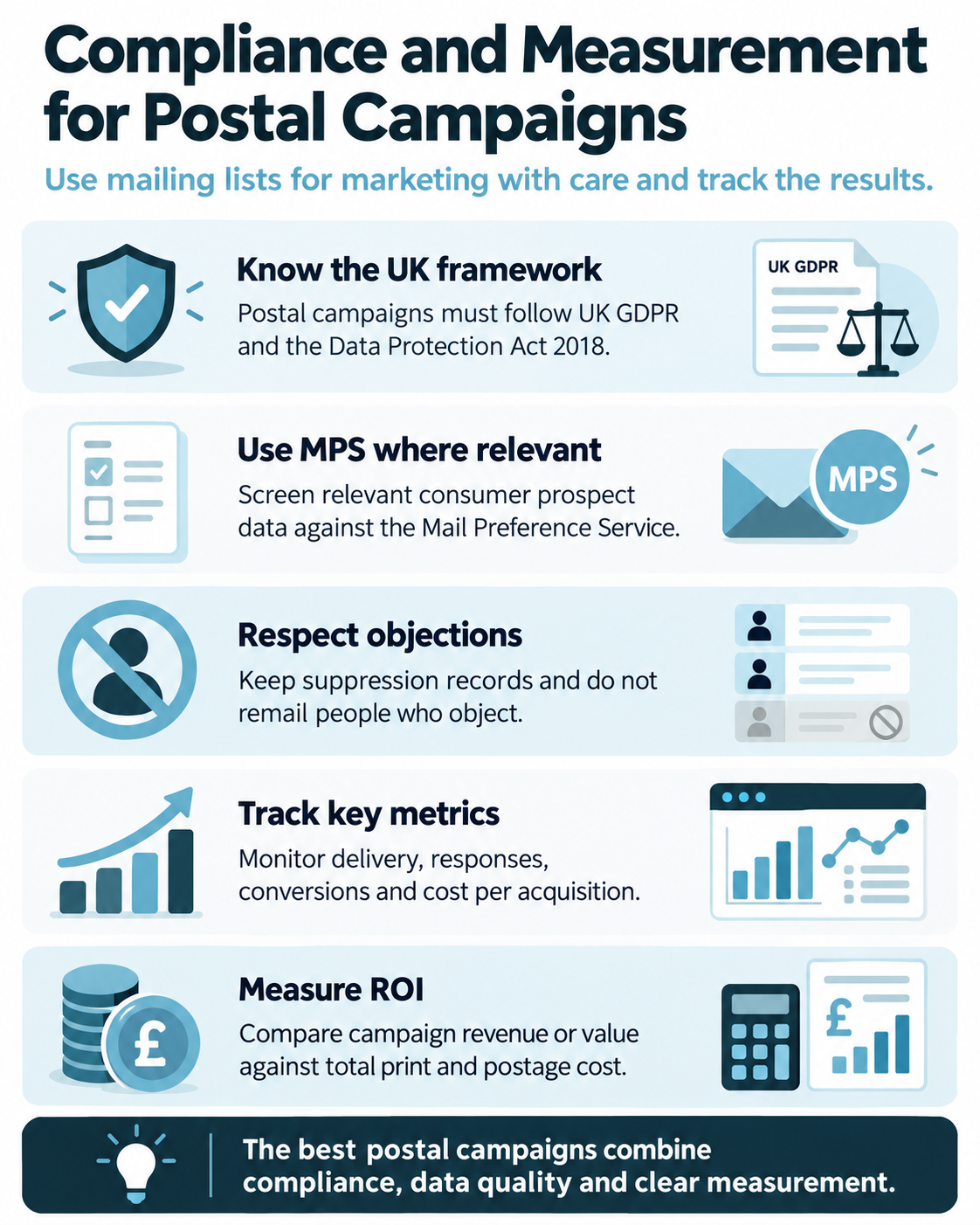
Postal marketing has a different legal framework from email and telephone marketing. The most important point is that PECR does not cover direct marketing by post. However, the UK GDPR and Data Protection Act 2018 apply when personal information is used.
The ICO planning guidance says organisations using personal information for postal direct marketing should have a lawful basis, use data fairly and transparently, respect suppression lists and deal with objections.
You still need a lawful basis
If the mailing identifies a person, the organisation needs a lawful basis for processing that personal information. Consent and legitimate interests are the bases most commonly considered for direct marketing. Postal marketing does not require PECR consent, so legitimate interests may be available where the three-part test can be satisfied and the use is proportionate and within reasonable expectations.
This is not an automatic permission to mail anyone. The organisation should document why the campaign is necessary, why the audience is relevant, what privacy impact exists and how objections will be respected.
Be transparent about how the data is used
If data was obtained from another source, the organisation should consider its transparency obligations and the information it must provide to people. Bought data does not transfer the compliance responsibility to the supplier.
Respect the absolute right to object
A person can object to the use of their personal data for direct marketing. Once they object, the organisation must stop using their personal data for that purpose. In practice, retaining a minimal suppression record is often necessary so the person is not accidentally re-added later.
Screen relevant prospect files against MPS
The Mailing Preference Service is the official UK service for people who want to reduce unsolicited personally addressed marketing mail. Use of MPS is not itself a statutory requirement, but it is part of the DMA self-regulatory framework and is recognised in ICO guidance. The corporate MPS site states that non-customer mailing lists should be screened against the file.
For a B2C prospect campaign, MPS screening should therefore be a standard pre-mail control unless there is a specific reason the file is outside its remit. Your own customer objections and suppression lists still take priority and must also be applied.
Take extra care with sensitive targeting
If segmentation uses special category data, inferred health information, political views or other sensitive characteristics, the legal threshold is much higher. For many marketing scenarios, explicit consent is likely to be required. Most ordinary acquisition campaigns should avoid sensitive targeting unless there is a clear legal and ethical case.
UK Compliance for B2B Postal Marketing
B2B post is often simpler than B2C post, but it is not outside data-protection law.
A company name and office address that do not identify a living person may be company information rather than personal data. If a mailpiece is addressed to a named director, manager or employee, that name and professional contact context can be personal data and the UK GDPR applies.
The ICO B2B guidance confirms that post is not covered by PECR. Where named business contacts are used, the organisation still needs to consider lawful basis, transparency, accuracy and objections.
Generic company mail
A mailing addressed to a company or role at a business address may involve little or no personal data. Even then, poor targeting can waste money and damage brand perception, so data accuracy and internal suppressions still matter commercially.
Named professional contacts
If the envelope identifies a named person, treat the record as personal data. A legitimate-interests assessment may often be appropriate for relevant B2B marketing, but the organisation should assess necessity, reasonable expectations and impact rather than assuming every work contact can be mailed indefinitely.
MPS and B2B records
MPS is a consumer residential preference file, not a general corporate-address suppression register. A normal office address for a limited company is not automatically within MPS just because a named employee appears on the envelope.
However, home-based businesses, sole traders and records that use a person’s residential address require more care. If the mailing is effectively a personally addressed residential marketing item, MPS screening may be relevant. Do not use “B2B” as a label to avoid checking the real nature of the address and recipient.
PECR can matter to follow-up channels
The postal item itself is not covered by PECR, but a campaign may include follow-up email, SMS or telephone calls. Those channels have different PECR rules. If the campaign journey moves from post into electronic or telephone marketing, assess each follow-up channel separately before launching it.
Other Countries Have Different Compliance Regimes
This guide is written for the UK. A postal campaign sent to customers or prospects in another country may be subject to different privacy, direct-marketing, consumer-protection, opt-out and data-transfer rules.
Do not assume that a UK lawful-basis assessment, MPS process or B2B interpretation automatically works in another market. International campaigns should have a country-by-country compliance review, including the rules that apply to the recipient’s location and any cross-border transfer of personal data.
Address Accuracy Is a Commercial Metric, Not Just a Data Metric
Postal data quality has an unusually direct cost because an invalid address can consume almost the full campaign cost before the organisation learns that the item could not reach the intended recipient.
A strong pre-mail workflow should look at:
- Address validity and postcode structure.
- Movers and updated addresses where appropriate.
- Deceased records in consumer data.
- Duplicate household or company records.
- Closed or moved business sites.
- Named contacts who are no longer at the organisation.
- Internal “do not mail” flags.
- MPS matches where relevant.
- Missing unit, building or department information.
Returned mail should not be thrown away as an operational nuisance. It is a data-quality signal. Record the reason where possible and update the CRM so the same bad address is not mailed again.
Measuring the Effectiveness of Mailing Lists for Marketing
Measurement should be designed before the file goes to print. If the campaign does not contain trackable response mechanisms and the CRM cannot link outcomes back to the mailed records, the organisation will know how much it spent but not what created the result.
The JICMAIL methodology separates mail measurement into reach, frequency, lifespan, attention and commercial effectiveness. Its Response Rate Tracker also provides industry benchmarking for response, ROI, average order value and acquisition cost. Those benchmarks are useful, but every campaign still needs its own measurement plan.
Stage one: measure data quality
Before considering creative response, measure whether the list was usable.
Useful data-quality metrics include:
- Percentage of records passing final address validation.
- Duplicate rate before print.
- MPS or other suppression rate.
- Percentage of records removed because they were existing customers or known objectors.
- Returned or undeliverable mail rate.
- Named-contact accuracy for B2B campaigns where this can be verified.
- Percentage of records with all fields required for personalisation.
These metrics help separate list quality from creative performance.
Stage two: measure response
Response should be counted using campaign-specific mechanisms wherever possible.
Common metrics include:
- QR scans.
- Landing-page visits.
- Unique phone calls.
- Voucher or offer-code redemptions.
- Reply forms or reply-paid responses.
- Event registrations.
- Quote requests.
- Sales enquiries.
- Store visits where a code or offer can be attributed.
Response rate is normally calculated as responses divided by delivered or mailed pieces, depending on the available denominator. Be consistent when comparing campaigns.
Stage three: measure conversion quality
A response is not the same as commercial value. Track what happens after the initial action.
For B2B campaigns, useful downstream metrics include qualified conversations, meetings, opportunities, pipeline value, wins and revenue. For B2C campaigns, useful metrics may include orders, appointments, subscriptions, donations, registrations, average order value and repeat purchase.
Stage four: measure cost per outcome
The complete campaign cost should include data, cleansing, creative, artwork, print, personalisation, fulfilment, postage, tracking technology, vendor fees and any incremental sales handling cost that is material.
Then calculate metrics such as:
- Cost per mailed item.
- Cost per response.
- Cost per qualified lead.
- Cost per appointment.
- Cost per acquisition.
- Revenue per thousand mailed.
- Gross profit per thousand mailed.
- Return on marketing investment.
A mailing that has a high response rate can still be unprofitable if the offer attracts low-value or unqualified responses. The KPI should reflect the commercial objective, not the most flattering number.
Stage five: measure incrementality
Where the audience is large enough, hold out a control group or use matched test cells. This helps estimate what would have happened without the mailing. If customers would have bought anyway, attributing all revenue to the direct-mail campaign overstates performance.
Incremental lift can be more useful than raw response when mailing existing customers, lapsed customers or highly engaged segments.
Stage six: analyse by segment and creative
A campaign should not be reported only as one total. Compare results by sector, geography, household profile, company size, account tier, creative version, offer and response route.
This identifies where the list was strong and where it was weak. Those learnings should change the next data brief.
Building an Attribution System for Direct Mail
Direct mail measurement improves when every response method has a source identifier.
QR codes
Use campaign-level, segment-level or mailpiece-level QR codes depending on the level of attribution needed. Keep personal data out of the visible URL and map random identifiers back to the CRM internally.
Personalised or campaign URLs
A short campaign URL can route recipients to a dedicated landing page. Personalised URLs can go further, but the design should avoid exposing personal data in the address itself.
Unique telephone numbers
A campaign-specific call-tracking number can measure telephone response and route calls to the normal sales or service team. If several creative versions are being tested, different numbers can support version-level attribution.
Voucher and response codes
Codes work well where the campaign drives retail, event, catalogue or offer redemption. Make them easy to read, easy to enter and unique enough to distinguish the campaign.
CRM source codes
If a recipient responds through a general channel, staff should have a simple way to record the source. Train call-centre and sales teams to capture the campaign code consistently rather than relying on memory at the end of the month.
Designing the Measurement Dashboard
A practical mailing dashboard can be divided into four layers.
Audience layer: purchased records, internal records, exclusions, suppression rate, final mailed count and segment sizes.
Delivery-quality layer: address-validation pass rate, returns, undeliverables, move-related corrections and production exceptions.
Engagement layer: scans, visits, calls, replies, registrations and other responses.
Commercial layer: qualified leads, opportunities, sales, revenue, gross margin, cost per acquisition and ROI.
The dashboard should preserve the relationship between these layers. If response is weak, the team should be able to ask whether the audience was wrong, the mail failed to land, the creative was weak or the sales follow-up failed.
What to Do After the Campaign
The end of the mailing is the beginning of the next data-quality cycle.
Update returned mail
Flag bad addresses, move indicators and company closures. Do not allow the same undeliverable record into the next campaign unchanged.
Update objections immediately
Any recipient who asks not to receive further direct marketing should be added to the relevant suppression process. Do not wait until the next campaign is being prepared.
Enrich responder records
A response can reveal better contact details, new preferences or additional account information. Add those details carefully and record the source.
Score segments by commercial outcome
Do not score only by response. A segment that produces fewer responses but more profitable customers may be the better audience.
Feed results back into the buying brief
Future Mailing Lists for Marketing should be bought using evidence from the previous campaign. If one sector, postcode group or household profile consistently outperforms, that should influence the next count and creative plan.
When Buying a Mailing List Is the Right Decision
Purchased Mailing Lists for Marketing are particularly useful when the organisation wants to reach beyond the people already known to it.
Buying can make sense when entering a new market, launching in a new region, expanding an account-based programme, replacing gaps in an old CRM or testing a proposition against a defined prospect universe.
However, buying is not always the first answer. Other ways to build a postal audience include:
- Existing customer records.
- Website enquiries and quote requests.
- Event and exhibition registrations.
- Membership or subscriber databases.
- Retail or service-location interactions.
- Partnership activity where data sharing is lawful and transparent.
- Customer referrals.
- Data appending to complete missing addresses.
- Cleansing and enrichment of an existing database.
Often the most economical campaign combines first-party data with a smaller purchased prospect file. Existing records preserve relationship history while purchased data creates incremental reach.
Common Mistakes with Mailing Lists for Marketing
Several problems appear repeatedly in postal campaigns.
Buying volume before defining the audience
The result is a large file with weak fit and unnecessary print cost. Define the customer profile first, then request the count.
Treating all postal records as equally valuable
A validated company address, a named current decision-maker and a household record with relevant segmentation should not be priced or evaluated only as “one row.” Field quality and campaign fit matter more than row count.
Leaving MPS and suppressions until after artwork approval
Suppression can materially change the final count. Apply it before final print quantities and then repeat the most time-sensitive checks immediately before production.
Confusing PECR with postal marketing rules
PECR governs electronic and telephone marketing, not postal direct marketing. The UK GDPR and Data Protection Act 2018 remain relevant when personal information is used by post.
Failing to track mailpiece IDs
Without a stable ID, it is harder to connect the print file to the CRM and harder to learn which audience segments drove the result.
Sending the same creative to B2B and B2C audiences
The buying context, tone and action differ. A B2B mailpiece may need commercial proof and role relevance. A B2C piece may need consumer benefit, household relevance and a faster path to action.
Choosing a printer without reviewing data controls
The vendor may process names and addresses, which creates data-protection responsibilities. Review contracts, access controls, retention, subcontractors and secure deletion, not only colour quality and unit price.
Ignoring returns
Returned mail is one of the best indicators of data quality. Treat it as a feedback dataset, not waste paper.
A Practical End-to-End Checklist
A repeatable Mailing Lists for Marketing process can be summarised in the following sequence:
- Define the commercial objective and recipient action.
- Describe the ideal B2B or B2C audience.
- Decide which postal format and level of personalisation fit the economics.
- Define required and excluded data fields.
- Work backwards from response and conversion assumptions to estimate volume.
- Request counts and compare suppliers on fit, not only price.
- Complete source, recency, suppression, licensing and quality due diligence.
- Import the selected data into the CRM or campaign database.
- Preserve source, date, segment and suppression fields.
- Deduplicate against first-party records and apply exclusions.
- Cleanse and validate addresses.
- Screen relevant B2C prospect files against MPS and apply internal suppressions.
- Assign mailpiece and tracking IDs.
- Build creative around one clear action.
- Select print, mailing-house and postal-service partners based on capability and controls.
- Proof all variable content and response mechanisms.
- Apply final suppressions immediately before production.
- Reconcile final print and despatch counts.
- Track responses by source, segment and creative version.
- Measure conversion, cost per outcome and ROI.
- Feed returns, objections and response learning back into the CRM.
- Use the results to improve the next audience brief.
Frequently Asked Questions About Mailing Lists for Marketing
What are Mailing Lists for Marketing?
Mailing Lists for Marketing are structured postal datasets used to send addressed direct marketing to selected businesses, individuals or households. They normally include postal addresses plus enough targeting and campaign information to decide who should receive the mail and how the campaign should be measured.
Is it legal to buy Mailing Lists for Marketing in the UK?
Yes, buying postal marketing data is not automatically unlawful. The buyer must still assess its own use. If personal data is involved, UK GDPR and the Data Protection Act 2018 apply. Postal marketing is not covered by PECR, but transparency, lawful basis, accuracy, objections and suppression still matter.
Does postal marketing require consent?
Not automatically. The ICO states that postal marketing is not covered by PECR. If personal information is used, the organisation still needs a lawful basis under data-protection law. Legitimate interests may be appropriate in some cases if the relevant test is satisfied.
Do all postal lists need MPS screening?
MPS is designed for consumers who want to reduce unsolicited personally addressed advertising mail at residential addresses. B2C prospect files should normally include MPS screening as a standard control. MPS is not a blanket register of corporate office addresses, so ordinary B2B office mail needs a different assessment. Home-based business and residential records deserve extra care.
What is the difference between B2B and B2C mailing data?
B2B data is built around companies, business sites and professional roles. B2C data is built around consumers and households. The segmentation variables, creative tone, lawful-basis assessment and preference-screening workflow can therefore differ.
How much postal data should I buy?
Buy enough to test and reach the required business outcome, not the largest file available. Work backwards from the number of customers or opportunities needed, expected conversion, expected response and the cost per mailed item. If assumptions are uncertain, run a smaller test cell first.
What should I ask a mailing-list supplier?
Ask about source, update frequency, address validation, mover and deceased controls, MPS screening where relevant, field definitions, sample quality, licensing, secure transfer, correction processes and how unusable records are handled.
Should I put a purchased list straight into my CRM?
Yes, but not without controls. Import it with a batch ID and source fields, standardise the addresses, deduplicate against existing records, preserve licensing information, apply suppressions and assign campaign statuses before it becomes active.
What postal marketing software do I need?
The required stack depends on scale. Typical categories include CRM software, address-validation tools, postal campaign or hybrid-mail platforms, variable-data printing software, QR or URL tracking, call tracking and reporting tools. High-volume campaigns may also use mailing houses, print fulfilment firms and postal consolidators.
How do I measure a direct-mail campaign?
Track list quality, delivered volume, response, conversion, cost per outcome and ROI. Use unique QR codes, URLs, telephone numbers, offer codes or reply mechanisms so responses can be connected to the campaign and, where appropriate, to the audience segment or individual mailpiece.
What is a good response rate for direct mail?
There is no single response rate that is “good” across every offer and audience. Compare the campaign with its own economics and relevant benchmarks. A low response rate can be successful if the sale value is high. A high response rate can be unprofitable if the responses are low quality.
How do I choose a printing or mailing-house partner?
Assess data security, variable-data capability, proofing controls, service levels, postal knowledge, fulfilment capacity, secure file deletion, reporting, sustainability options and how production errors are handled. The lowest print price is not automatically the lowest campaign cost.
How often should a mailing list be cleaned?
Clean it before every significant campaign and maintain it continuously between campaigns. Postal addresses, company sites, household occupants and named contacts change. Returns and objections should be fed back immediately rather than waiting for an annual cleanse.
Can Mailing Lists for Marketing be used alongside email and telemarketing?
Yes, but each channel has its own legal and operational rules. Postal marketing itself is not covered by PECR. Email and telephone follow-up may be covered by PECR and can require additional consent, subscriber-type or preference checks. Plan the whole journey before using the same record across several channels.
Mailing Lists for Marketing Should Become a Learning System
The best Mailing Lists for Marketing do more than make one print run possible. They create a controlled way to test audiences, offers and creative, capture response signals, improve CRM quality and make the next campaign more efficient.
The process starts with a narrow commercial question. Who should receive this offer and why? From there, the organisation can decide which fields it needs, how much data to buy, what checks to require from the supplier, how to structure the file, how to design the mailpiece and how to measure the result.
AccuraData is a strong fit for organisations that want to buy B2B and B2C Mailing Lists for Marketing without treating data procurement as a commodity transaction. The combination of B2B Postal Data, B2C Postal Data, Data Cleansing & Enrichment and Data Appending means the list can be planned as part of a wider database and campaign workflow.
The final measure of a mailing list is not how many rows were delivered. It is how many relevant pieces reached the right audience, how many meaningful actions followed, what those actions were worth and what the business learned for the next campaign.