

A Mailing List For Marketing is not simply a spreadsheet of names and addresses. For a postal campaign, it is the operating file that decides who receives the piece, how much print and postage is committed, which records must be excluded, what can be personalised and how the response is measured after delivery. If the list is weak, almost every downstream cost becomes harder to justify. If the list is well designed, even a simple letter or postcard can become a disciplined acquisition channel.
That makes postal list building different from buying media by the impression. Every extra record in a direct mail campaign can create a real unit cost. Data, print, finishing, fulfilment and postage can all be spent before the recipient has had a chance to respond. A good Mailing List For Marketing therefore has to earn its place in the campaign before it reaches the printer.
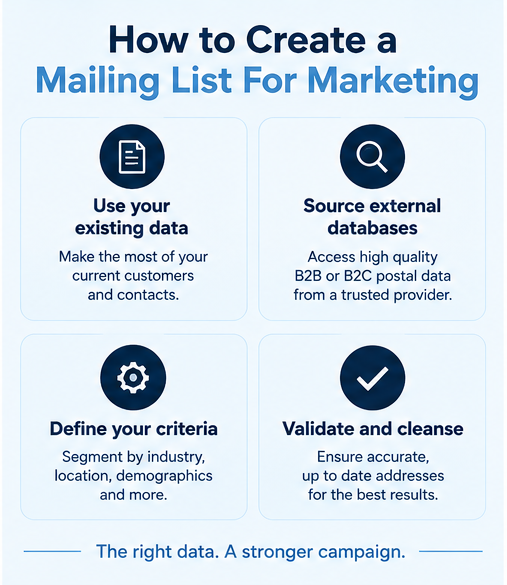
The best approach is usually a blend of sources. Your own customer, prospect and enquiry data can provide a high-value first-party base. External B2B or B2C postal data can add coverage where your database is too small or incomplete. Cleansing and suppression then turn those sources into one usable audience. Finally, segmentation, creative, tracking and post-campaign feedback determine whether the list becomes a one-off mailing file or a reusable marketing asset.
This guide explains how to collate, buy, combine and use a Mailing List For Marketing for UK postal campaigns. It separates B2B and B2C postal data, explains how to assess a supplier, covers the Mailing Preference Service, UK GDPR and other relevant rules, and shows how to connect list quality to campaign economics and future data decisions.
AccuraData supports both sides of that process. Its B2B Postal Data service helps businesses target UK companies by sector, geography, company size and related criteria, while B2C Postal Data supports targeted consumer and household campaigns. Where existing records need repair before use, AccuraData can also support data cleansing and enrichment and data appending.
A short compliance note is important. This article provides practical marketing guidance, not legal advice. The correct approach depends on the data, audience, purpose, targeting logic and campaign. Businesses should review current regulatory guidance and seek specialist advice where the legal position is uncertain.
Start a Mailing List For Marketing With the Commercial Question
Many direct mail projects start in the wrong place. The team chooses a brochure format, obtains print prices and then asks how many addresses can be found. That reverses the logic of the campaign. The audience should be defined before the print quantity because the commercial opportunity determines whether a record deserves budget.
A more useful starting question is: what has to happen for this mailing to create value? The answer might be a purchase, appointment, website visit, quote request, donation, store visit, renewal, event registration or sales conversation. Once the required action is clear, the Mailing List For Marketing can be designed around the people or organisations most likely to take it.
Define the outcome before the audience
Write down the campaign outcome in measurable terms. “Generate awareness” is difficult to use when building a list. “Generate 60 quote requests from independent manufacturers in the Midlands” gives the data team something to work with. So does “reactivate 150 lapsed customers within 90 days” or “drive 300 voucher redemptions from households within a 20-minute catchment area”.
The target outcome should also be connected to campaign economics. If the average gross contribution from a new customer is £400, you can tolerate a different acquisition cost than a business selling a £20 one-off product. That affects list size, targeting depth and the amount worth spending on higher-quality data.
Define who should not be on the list
Exclusions are as important as inclusions. Existing active customers may need a different message. Current opportunities may already be owned by sales. Recent complainers, people who have opted out, deceased records, goneaways and duplicates should not be treated as fresh prospects. Competitors, suppliers, employees or very low-value accounts may also need to be removed.
A disciplined Mailing List For Marketing is therefore partly an inclusion file and partly a suppression system. The tighter the exclusion logic, the less campaign budget is spent on records that should never have reached production.
Collating a Mailing List For Marketing From First-Party Data
Before buying external data, audit what the organisation already holds. First-party data often contains some of the most commercially useful records because there is already context around the relationship. The problem is that the information may be spread across several systems and may not be campaign ready.
Useful first-party sources can include CRM records, customer accounts, lapsed customers, enquiries, event registrations, warranty records, catalogue requests, branch databases, quote requests, loyalty programmes, trade-show scans, previous direct mail files and sales-team prospect lists. Each source can contribute to a Mailing List For Marketing, but only after the records have been normalised and the reason for using them is understood.
Separate relationship status from address data
A postal record should not be treated as just a name and address. Add relationship fields such as customer, prospect, lapsed customer, open opportunity, previous responder or unknown. If a customer last purchased four years ago, that is different from somebody who requested a quote yesterday.
This information helps the creative team build the right message and helps the analyst avoid comparing unlike groups. A reactivation offer may perform well among lapsed buyers and poorly among cold prospects, but a combined campaign file could hide that distinction.
Record the source of each address
Source data is one of the most useful fields in a marketing database. It tells you whether the record came from your CRM, a web enquiry, an event, a previous supplier file, a branch upload or a newly purchased audience. That creates better accountability and makes later performance analysis possible.
If one source produces twice the response rate of another, you want to know. If a particular source produces high returns or duplicate problems, you also want to know. Losing provenance during file merging removes that learning.
Standardise the address before you match records
The same organisation or household can appear in different forms. “10 High St” and “10 High Street” may be the same address. A company may be recorded under a trading name in one system and a legal name in another. Without standardisation, duplicate records are harder to identify.
Royal Mail states that its address and postcode information is held in the Postcode Address File, commonly known as PAF. Using recognised address structures and accurate postcodes helps improve matching, production and deliverability. For larger-scale data management, Royal Mail also describes PAF as the UK’s most accurate and up-to-date address database within its business address tools.
When Buying a Mailing List For Marketing Makes Sense
First-party data is valuable, but it does not always provide enough reach. A business entering a new region may have very few prospects there. A B2B supplier may know its ideal sector but not the companies within it. A consumer brand may have strong customer data but need a larger acquisition audience. These are situations where bought postal data can add useful coverage.
The aim should not be to purchase the largest possible file. It should be to buy the part of the market you cannot reach well with your existing data. That approach reduces duplicates, improves audience relevance and makes supplier quality easier to test.
Buy a defined audience, not a volume of records
A weak brief asks for “50,000 UK business addresses”. A stronger brief asks for “independent engineering and industrial service companies with 10 to 249 employees in specified postcode areas, excluding current customers”. The second brief is more likely to produce a Mailing List For Marketing that aligns with an actual sales strategy.
For consumer campaigns, the same principle applies. Geography, household type, property characteristics, age bands, affluence indicators, life stage or other relevant attributes may matter. Targeting should remain proportionate and appropriate to the offer. Avoid collecting or using fields simply because they are available.
Use counts to test the market definition
Before buying, ask the provider for an audience count against the proposed criteria. If the count is far larger or smaller than expected, do not immediately change the quantity. Review the definition first. A surprisingly large audience may indicate that the targeting is too broad. A very small count may show that several criteria overlap too tightly.
AccuraData can provide targeted counts for both business postal audiences and consumer postal audiences, which helps buyers understand the available market before committing to a campaign volume.
B2B Postal Data: Build the List Around the Account
B2B direct mail works best when the company is treated as the stable unit and any individual contact is treated as an attribute of that company. People move roles, but the target organisation may remain commercially relevant. This is one reason B2B Postal Data needs a different structure from a consumer mailing file.
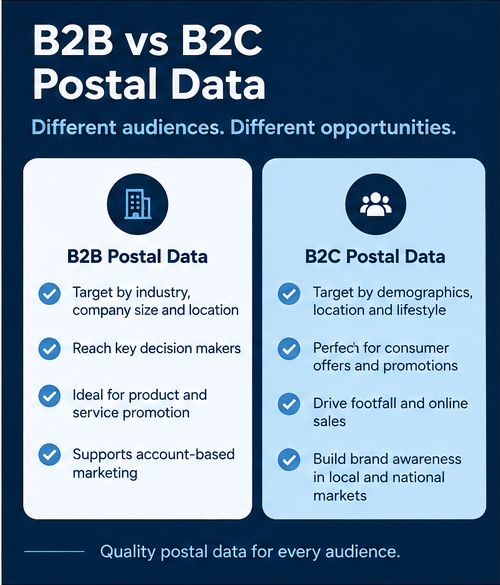
A B2B Mailing List For Marketing may include company name, trading address, postcode, industry, SIC code, employee band, turnover band, location type, head office or branch indicator and, where appropriate, named contact information. The exact fields should reflect the campaign rather than a desire to collect everything available.
Use firmographics to define fit
Industry, company size and geography are often the strongest starting filters. A supplier of industrial maintenance services may care more about sector and employee count than turnover. A professional-services firm may care about geography, company age and business type. A local trade supplier may prioritise drive time and branch territory.
AccuraData’s B2B Postal Data page outlines targeting options including industry, SIC code, geography, employee count, turnover and company type. A good provider should help translate the commercial brief into sensible filters rather than simply applying every field requested.
Decide whether a named decision-maker is necessary
Not every B2B mailing requires a named individual. A relevant role title, department or company-level pack may be more durable when staff turnover is high. For high-value account-based campaigns, a named decision-maker can increase relevance, but the list then requires more maintenance because people change jobs.
The practical question is whether personalisation improves the expected outcome enough to justify the extra data requirement. For a broad product catalogue, a company-level address may be sufficient. For a board-level invitation or high-value proposition, a named role may be worth the additional validation.
Check company status before production
A company address can be syntactically valid while the business itself has closed, moved or ceased trading. Where company status matters, consider a company live check or another appropriate verification step before print. This is especially important when mailing expensive packs to a narrow B2B audience.
AccuraData’s recent article on Database Cleaning explains why company live checks, address validation and other cleanses can be useful before outbound activity.
B2C Postal Data: Build the List Around the Household or Individual
B2C Postal Data is different because the campaign may involve personal information about individuals or households. The objective can be acquisition, local promotion, catalogue distribution, customer reactivation, charity fundraising, retail offers or another consumer activity. The data model, legal assessment and suppression process should reflect that context.
A B2C Mailing List For Marketing may use geography, household profile, property type, age band, life stage, affluence or lifestyle indicators where appropriate. The most useful variables are the ones that have a plausible connection to the proposition. More targeting fields do not automatically mean better targeting.
Choose the level of targeting deliberately
There is an important difference between addressed direct mail, partially addressed mail and unaddressed door drops. If you need to target a defined individual or household segment, addressed postal data may be appropriate. If you mainly need local area coverage, a broader format may be more cost effective.
The B2C Postal Data service from AccuraData is designed for campaigns that need targeted consumer or household mailing lists rather than undifferentiated local coverage.
Screen consumer acquisition lists against MPS
The Mailing Preference Service is a file of consumers who have registered that they do not want unsolicited advertising material by mail. MPS states that all mailers should screen non-customer mailing lists against the preference file, and that its use forms part of the direct-marketing self-regulatory framework.
MPS screening is not the same thing as a complete legal assessment. It is one important control within a wider process that should also include internal opt-outs, suppression files, data accuracy and a suitable lawful basis. Existing customers and other relationship groups may need different treatment, which is why campaign purpose and source fields matter.
Apply deceased and goneaway suppression where appropriate
Consumer databases can contain people who have died or moved. Sending acquisition or promotional mail to those records can create waste and reputational damage. Depending on the data available and the campaign, deceased and goneaway-style suppression can be an important part of list preparation.
The purpose is not only to reduce returned mail. It is to prevent clearly unsuitable records from entering the campaign and to keep the master database healthier for future use.
Supplier Due Diligence for a Mailing List For Marketing
A mailing-list supplier should be able to explain the audience, the source, the fields, the update process and the permitted use. Price per thousand records is easy to compare, but it is a weak measure of quality on its own. A cheaper list can become more expensive once print, fulfilment and postage are added to unusable records.
Ask how the audience is defined
Request a written summary of the selection logic. For B2B data, that may include industry definitions, SIC codes, employee ranges, locations and company status. For B2C data, it may include geography, household criteria and the basis for any demographic or lifestyle variables.
If the supplier cannot explain how a segment is constructed, it is difficult to evaluate whether it matches the campaign. Avoid relying on vague labels such as “affluent households” or “senior decision-makers” without knowing what those labels mean in practice.
Ask when the records were updated
Freshness matters because addresses change. Ask about refresh cycles, data sources and the date at which the supplied file was prepared. For B2B data, ask how changes in company status and location are handled. For B2C data, ask what address and suppression processes are applied.
No supplier can make a postal database permanently accurate. The relevant question is how the provider manages change and what quality controls are applied close to delivery.
Ask exactly what screening is included
Do not assume that “cleaned” means the same thing between suppliers. Ask whether the file has been deduplicated, address validated, screened against MPS where relevant, checked against your own suppression file and prepared against agreed exclusions.
Ask what happens if you provide an existing customer file. A capable supplier should be able to discuss suppression or matching rather than simply adding more records on top of what you already hold.
Ask for a sample structure, not necessarily personal records
You need to understand the fields before purchase. A data dictionary or sample schema can show how company names, addresses, postcodes, segment codes, source fields and other attributes are delivered without requiring the supplier to expose unnecessary personal data during the buying process.
Clarify permitted use and retention
Understand whether the data is supplied for a single campaign, a time-limited licence or broader use. Confirm what you can retain, whether you can load the data into your CRM, whether re-use is permitted and what happens to suppression or response records after the campaign.
These points belong in the commercial agreement, not in assumptions made after the file arrives.
UK GDPR and Postal Direct Marketing
Postal marketing is not regulated in exactly the same way as email or automated electronic communications. The ICO’s B2B marketing guidance explicitly notes that post is not covered by PECR. However, where a postal campaign uses personal information, UK data-protection law still applies.
That means a Mailing List For Marketing involving identifiable people should have a lawful basis, a clear purpose, appropriate transparency, data minimisation, accuracy controls, security and a process for handling objections.
Legitimate interests can be relevant, but it must be assessed
The ICO explains in its legitimate interests guidance that direct marketing may be a legitimate interest, but it is not automatically lawful in every situation. Organisations should consider the purpose, necessity and balancing tests and assess the likely effect on individuals.
For postal marketing, legitimate interests is often considered because PECR consent rules that apply to some electronic marketing do not apply to post. The ICO’s direct-marketing planning guidance stresses that legitimate interests requires the activity to be proportionate, have a minimal privacy impact and not be likely to surprise people.
Respect objections and maintain suppression records
People have the right to object to processing of their personal information for direct marketing. If someone asks not to receive further marketing, the business should not simply delete the evidence and risk adding the person back later. A suppression record is often needed to ensure the objection remains effective.
This is one reason a good Mailing List For Marketing is governed by a master suppression process rather than a one-off campaign deletion exercise.
The Data Protection Act 2018 and DUAA remain part of the framework
The UK data-protection framework includes the UK GDPR, the Data Protection Act 2018 and changes introduced by the Data (Use and Access) Act 2025. The government’s DUAA commencement guidance explains that the majority of the data protection and privacy changes in Part 5 were brought into force on 5 February 2026.
The reforms did not replace the wider UK data-protection framework. Businesses still need practical governance around accuracy, transparency, objections, security and purpose limitation.
Advertising rules also matter
The CAP Code applies to non-broadcast advertising and direct marketing communications. The ASA also notes that direct mailings fall within the Code’s remit. This means compliance is not only about the database. Claims, presentation, targeting and the marketing piece itself also need to meet applicable advertising standards.
Build One Campaign File From Multiple Data Sources
Once first-party and purchased records are available, resist the temptation to send the printer several separate spreadsheets. Create one controlled campaign file with consistent fields and a documented build sequence.
A useful workflow is: preserve source data, standardise fields, deduplicate, apply exclusions, append purchased records, run relevant validation and suppression, assign segment codes, freeze the final production file, then create a separate response table for results.
Preserve the original values
If possible, do not overwrite source fields without retaining an audit trail. Store the original value and the cleaned value separately where the change is material. This makes reconciliation easier and allows the team to understand what was corrected.
Use a stable campaign identifier
Every record in the Mailing List For Marketing should carry a campaign ID and, ideally, a unique record ID. If the same person or company appears in later campaigns, you can then compare response history without relying only on name and address matching.
Add a segment code before production
Segment codes are essential for measurement. A B2B campaign might separate sectors, company-size bands or warm vs cold accounts. A B2C campaign might separate customer lookalikes, geographic groups or household profiles.
The code can be invisible to the recipient while still driving personalised creative, QR destinations, offer codes and post-campaign analysis.
Clean the Mailing List For Marketing Before Print
Cleansing should happen before the final print quantity is approved. If you cleanse after print has been ordered, the campaign may already have committed cost to unusable records.
Core checks can include address standardisation, postcode validation, deduplication, MPS screening for relevant consumer acquisition activity, internal suppression, deceased or goneaway checks where appropriate, company live checks for B2B files and exclusion of existing customers or open opportunities.
If your existing database needs work, AccuraData’s Data Cleansing and Enrichment service can support address, duplicate and wider data-quality checks before a postal campaign.
Deduplicate across sources, not just within each file
A purchased list may be internally deduplicated and your CRM may be internally deduplicated, but the same record can still exist once in each source. Cross-source matching is therefore essential.
For B2B data, consider whether branches and head offices should be treated as duplicates or separate target locations. For B2C data, consider household-level duplication as well as exact person-level duplication where the campaign does not need multiple pieces at one address.
Suppress before you append
Where possible, remove records that should not be marketed to before spending effort enriching them. There is little value appending extra fields to a record that is already on an internal do-not-contact list or otherwise unsuitable for the campaign.
Turn the Mailing List For Marketing Into Creative Segments
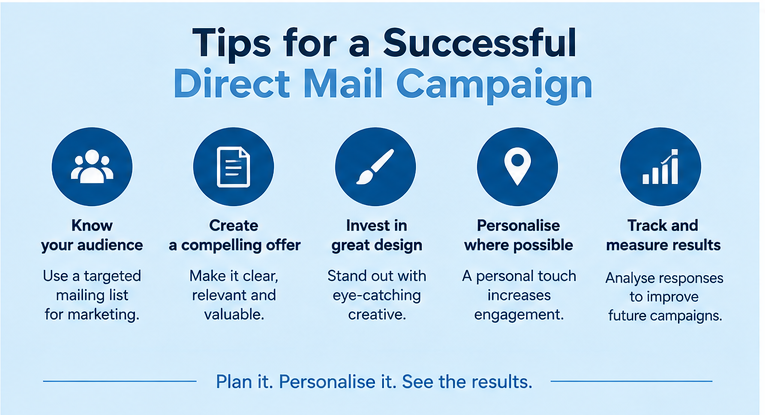
Data and creative should not be separate workstreams. The list tells the creative team who the message is for. The creative should tell the data team which segmentation fields actually matter.
A B2B mailer to finance directors should not necessarily look or read like one sent to operations directors. A consumer offer for homeowners may need different proof points from an offer aimed at renters. A lapsed customer can be acknowledged differently from a cold prospect.
Personalise where it adds meaning
Personalisation can range from a name in the salutation to completely different offers, images or calls to action by segment. The goal is not to demonstrate how much data you hold. The goal is to make the communication more relevant.
Avoid personalisation that feels intrusive, surprising or unnecessary. Data minimisation and reasonable expectations should guide the level of detail used in the creative.
Make the offer easy to understand
Postal marketing requires a clear reason to respond. The recipient should understand what is being offered, why it is relevant and what to do next. Complex propositions usually need stronger supporting explanation, but the core action should remain obvious.
The ASA’s guidance on recognition of marketing communications also reinforces the importance of marketing being identifiable as marketing. The envelope and outer presentation are part of the overall communication, so avoid formats that create a misleading impression about the nature of the mail.
Measure the Mailing List For Marketing, Not Just the Creative
A campaign can have an attractive design and still underperform because the audience is weak. Measurement should therefore connect response back to list source and segment, not only to the creative version.
JICMAIL’s Response Rate Tracker provides campaign-level benchmarks for direct mail performance. Its Q1 2026 release also reported that 9.4% of mail items prompted a website visit in the quarter and that 56% of purchases driven by mail were fulfilled online, showing why postal response measurement increasingly needs to include digital actions as well as traditional reply mechanisms.
Track more than one response route
Direct mail can drive telephone calls, QR scans, website visits, voucher use, branch visits, appointments or later sales conversations. Use trackable response mechanisms where appropriate, such as unique URLs, QR codes, phone numbers, offer codes or CRM campaign IDs.
The measurement design should be agreed before print. Trying to reconstruct attribution after the campaign usually produces weaker evidence.
Separate list performance from offer performance
If two segments receive the same creative and one performs better, the list may explain the difference. If the same segment receives two offers and one performs better, creative or proposition may be the driver. Controlled testing helps separate these effects.
Calculate response economics by segment
Track total campaign cost, delivered quantity, responses, qualified responses, conversions, revenue, gross contribution and cost per acquisition. Where possible, calculate these by source and segment.
A smaller list with a higher response and conversion rate can be more profitable than a larger, cheaper file. This is why cost per record should never be the only purchasing metric.
Use Test Cells Before Scaling a Mailing List For Marketing
Postal campaigns benefit from disciplined testing because the marginal cost of each extra record is visible. Instead of mailing the entire available audience, consider a controlled first wave.
A test can compare two audience segments, two creative treatments, two offers or two data sources. Keep the number of variables manageable so the result can be interpreted.
Test data sources independently
If you combine three purchased sources into one anonymous file, you cannot tell which provider performed. Preserve source codes so quality, response and return rates can be compared. That information should influence future buying decisions.
Use holdout groups where practical
For customer or reactivation campaigns, a holdout group can help estimate incremental effect. If mailed customers purchase at a higher rate than a comparable non-mailed group, the difference provides a stronger view of campaign impact than raw response alone.
What to Do With the List After the Campaign
The campaign should improve the database. Every response, return, opt-out, sale, no-longer-at-address update and sales conversation is new information. Feed it back into the master record.
A returned item may indicate an address issue. A positive response may identify a high-value segment. A no-interest response can prevent repeated irrelevant mail. A new decision-maker can improve future B2B targeting.
Keep suppression data
Do not discard opt-outs when the campaign ends. Maintain suppression records so future list builds can exclude people who have objected. The suppression file is part of the marketing database’s memory.
Refresh the purchased component deliberately
If purchased data was licensed for limited use, respect the terms. If future campaigns need the same market, do not assume the old file is still current. Re-run counts or obtain refreshed data rather than building campaigns on stale addresses.
Append useful response information
AccuraData’s Data Appending service can help organisations fill relevant gaps in existing records where additional fields are needed for future targeting. Appending should be purposeful and proportionate, not a race to accumulate more attributes.
How a Mailing List For Marketing Fits Into Multi-Channel Activity
Postal marketing does not have to operate alone. A physical item can introduce an offer, support an account-based campaign or create a reason for a later sales conversation. The correct channel sequence depends on the audience and the legal rules that apply to each channel.
For B2B campaigns, direct mail can be followed by sales outreach where appropriate. For consumer campaigns, a mailed offer may drive the recipient to a digital landing page or store. Channel permissions should be assessed separately. Permission to send post does not automatically create permission to send email or make marketing calls.
This is one reason the list should store channel-specific suppression and permissions rather than one generic “marketing yes/no” field.
Why AccuraData Is a Strong Postal Data Partner
A capable postal-data supplier should make the buying process easier, not more obscure. Buyers need clear audience definitions, realistic counts, sensible targeting, data preparation and straightforward support when questions arise.
AccuraData is positioned well for organisations that need both B2B and B2C postal audiences. Its B2B Postal Data service supports business targeting by factors such as sector, geography and company size, while its B2C Postal Data service supports consumer and household targeting for direct mail.
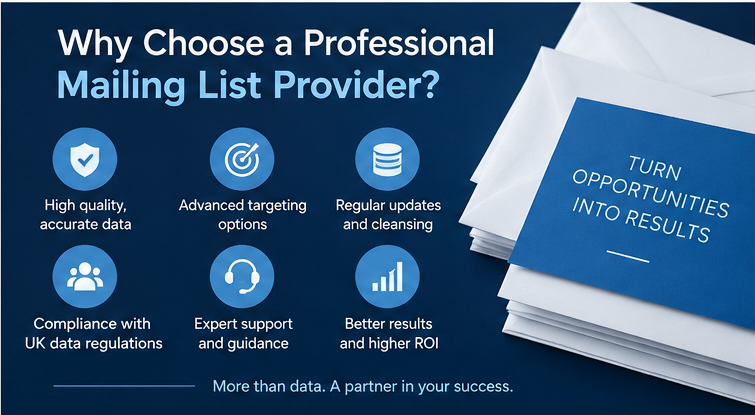
The value is not simply access to records. AccuraData can help buyers turn a campaign brief into a practical audience, understand the available count, cleanse existing records, remove duplicates and prepare a campaign-ready file. That makes it easier to combine internal data with new acquisition data without creating a fragmented mailing database.
For additional context on why postal data quality matters, AccuraData’s article Direct Mail Data: Why the List Behind Your Campaign Matters focuses on the relationship between list quality and direct mail performance. The article Why Should I Use a Direct Mail Database? explores where postal databases fit within modern marketing. These are useful companion pieces for teams building a wider direct-mail strategy.
A Practical Mailing List For Marketing Build Sequence
A repeatable process helps prevent the campaign from becoming a last-minute spreadsheet exercise.
Define the commercial objective
Set the target outcome, value per response or sale, geography, audience and campaign budget. Decide what would make the campaign commercially acceptable.
Audit existing data
Identify customers, prospects, lapsed buyers, previous responders and records that should be excluded. Standardise the fields and preserve source information.
Define the missing audience
Describe the external market that first-party data does not cover. Build separate B2B or B2C criteria rather than using vague volume targets.
Request counts and review the logic
Ask the provider to count the market against the proposed criteria. Refine the definition before buying if the result does not match commercial expectations.
Clean and suppress first-party records
Run the required address, duplicate, MPS, deceased, goneaway, company status and internal suppression checks as relevant to the audience.
Buy the gap
Purchase only the incremental data that adds useful reach. Suppress existing records against the external file where practical.
Build one controlled campaign file
Standardise fields, assign source and segment codes, deduplicate across sources and apply final exclusions.
Connect creative to segments
Decide whether different groups need different offers, messages, formats or calls to action. Use personalisation only where it improves relevance.
Design the response tracking
Create unique campaign IDs, URLs, QR codes, phone numbers or offer codes before production. Decide how responses will enter the CRM.
Freeze the production file
Once the final list has been approved, lock the version used for print. Changes after the freeze should be controlled so reporting can reconcile to what was actually mailed.
Feed outcomes back
Update the master database with responses, returns, sales, objections and corrections. Use the evidence to improve the next Mailing List For Marketing rather than starting from zero.
Common Mistakes When Building a Mailing List For Marketing
Buying by quantity
Large files can look attractive because the cost per record falls. But every additional postal record can create print and postage cost. Buy relevance, not volume.
Treating B2B and B2C data as the same product
Business and consumer audiences use different targeting logic, record structures and suppression controls. Build them separately even if they are part of the same brand campaign.
Ignoring MPS on consumer acquisition activity
MPS is a significant preference control for unsolicited consumer mail. Screening relevant non-customer lists supports responsible marketing and avoids sending material to people who have registered their preference not to receive it.
Cleansing only after the campaign
Returned mail is useful feedback, but it is expensive feedback if the address could have been corrected or suppressed before print.
Removing source codes
If source information disappears during merging, the business loses the ability to compare suppliers and acquisition methods.
Using one generic message for every segment
Targeting only creates value if the campaign uses the insight. If very different audiences receive the same undifferentiated offer, some of the benefit of segmentation is lost.
Measuring only direct replies
Mail can generate online journeys, calls and later sales. Build attribution around the full response path.
Throwing away suppression records
Deleting opt-outs rather than maintaining a suppression file can allow the same record to be added back later. Suppression is a long-term control.
Frequently Asked Questions About a Mailing List For Marketing
What is a Mailing List For Marketing?
A Mailing List For Marketing is a structured set of postal records used to define who should receive a direct mail campaign. It may contain business or consumer addresses plus targeting, source, segment and suppression information.
Can I build a mailing list from my own CRM?
Yes. Customer, prospect, lapsed-customer and enquiry data can form a strong first-party postal audience, provided the records are accurate, appropriately used and cleaned before the campaign.
When should I buy postal data?
Bought data can be useful when your first-party database does not provide enough coverage of a new market, location, sector or consumer audience. The best approach is often to purchase the gap rather than replace useful data you already own.
What is the difference between B2B and B2C postal data?
B2B postal data is organised around companies, business locations and firmographic targeting. B2C postal data focuses on consumers or households and may use geographic, demographic, property, lifestyle or related targeting where appropriate.
Do I need consent to send direct mail?
Postal marketing is not covered by PECR in the same way as electronic marketing. However, if you use personal information, UK GDPR and the Data Protection Act 2018 still apply. You need an appropriate lawful basis and must respect rights such as objections to direct marketing.
What is the Mailing Preference Service?
The Mailing Preference Service is a register of consumers who have stated that they do not want unsolicited advertising mail. MPS says that non-customer mailing lists should be screened against its preference file.
How should I test a mailing-list supplier?
Start with a clear audience definition and count. Ask about source, refresh cycles, validation, screening, permitted use and file structure. Preserve source codes and test performance on a controlled campaign cell before scaling where possible.
Should I use a named contact in B2B direct mail?
It depends on the campaign. A named decision-maker can improve relevance for high-value or account-based campaigns, but role and company-level addressing can sometimes be more durable. Use the level of personalisation that has a clear commercial purpose.
How do I know if my mailing list is good?
Measure deliverability, returned mail, response rate, qualified response rate, conversion, acquisition cost and revenue or contribution by source and segment. A good list should produce commercially useful responses, not just a high number of deliverable addresses.
How often should postal data be cleaned?
There is no universal interval. Clean before material campaigns and refresh high-change data more frequently. B2B decision-makers and company status can change at different speeds from household addresses, so the schedule should reflect the audience and campaign frequency.
Can AccuraData supply both B2B and B2C mailing data?
Yes. AccuraData provides dedicated B2B Postal Data and B2C Postal Data services and can help with counts, targeting, cleansing and campaign-ready list preparation.
Mailing List For Marketing: Make the List Accountable for Results
The strongest postal campaigns do not treat the mailing list as a purchasing task that ends when the spreadsheet arrives. They treat it as an audience asset with a clear job to do.
Start with the commercial result. Collate first-party data that already contains useful relationship context. Buy external B2B or B2C records only where they add relevant reach. Clean, suppress and deduplicate the combined file before print. Connect the segmentation to the creative. Track responses back to source. Then feed every useful outcome into the database so the next campaign starts with better information.
That process makes a Mailing List For Marketing more than a delivery file. It becomes the evidence layer behind postal acquisition, helping the business decide who to reach, how much to invest, which suppliers to use again and which audience segments deserve more attention.
For organisations that want help building that process, AccuraData offers targeted UK B2B Postal Data and B2C Postal Data with practical support around audience selection and data preparation. The objective is straightforward: give the campaign a better audience before money is committed to print and postage.