
Direct Mailing Lists can help UK businesses reach households, companies and decision-makers through carefully targeted postal campaigns. A good list gives a campaign a stronger starting point because it defines who should receive the mailing, where the item should be sent, which audience segments matter and what data quality checks should happen before print and postage costs are committed. A poor list can do the opposite. It can create waste, damage trust and turn a potentially valuable channel into a costly exercise.
This article explains how Direct Mailing Lists are generated, how to assess the advantages and drawbacks of buying them, what compliance issues matter in postal marketing, how segmentation can improve performance, how to identify a reputable supplier and how AccuraData can support businesses that need targeted direct mail data. AccuraData provides dedicated B2B Postal Data and B2C Postal Data services for organisations that want clear audience selection, practical campaign support and responsible data handling.
Direct mail is sometimes seen as a traditional marketing channel, but that does not make it outdated. The important question is not whether print is old or new. The important question is whether it can help you reach a relevant audience with a message that benefits from a physical format. When the audience is well selected, direct mail can support local acquisition, account-based marketing, customer reactivation, professional services outreach, event promotion, retail campaigns, charity activity, membership communications and multi-channel lead generation.
The list is central to all of that. Creative, print quality and offer design matter, but they cannot rescue a mailing sent to the wrong audience. A strong list helps you focus spend on the people or businesses most likely to be relevant. It also gives you the data fields needed to personalise the message, segment the campaign and measure response afterwards.
What direct mailing lists actually are
A direct mailing list is a dataset used to send marketing by post to a defined audience. At the simplest level, it contains names and postal addresses. In a more useful form, it includes extra fields such as sector, geography, company size, household type, property profile, customer status, previous interaction, job role, site type or other selection criteria. Those fields turn a basic address file into a marketing asset.
The difference matters. A raw address file tells you where something could be posted. A direct mailing list tells you who should receive it, why they have been selected and how the campaign can be measured. That makes it more suitable for real marketing planning because print and postage costs are incurred before any response arrives.
For B2B campaigns, the list may include company name, trading address, site address, SIC code, sector, employee banding, turnover banding, branch or head office status, job function and named contact details where appropriate. AccuraData’s B2B Data services are designed around this kind of targeted business selection, with postal data available for direct mail, account-based marketing and wider business development campaigns.
For B2C campaigns, the list may include household address data, geographic area, postcode-level selection, property indicators, age band, household composition, lifestyle interests or other permitted profiling fields. AccuraData’s B2C Data services support consumer audience targeting where businesses need to reach households through appropriate marketing channels.
Direct mailing lists can be used as a standalone channel or as part of a wider campaign. A business might send a sales letter before calling selected accounts. A retailer might send a catalogue to selected households and then measure voucher redemption. A professional services firm might send a briefing pack to finance directors and then follow up with a personalised email. A local service business might use postcode targeting to reach households in a defined catchment area.
Why direct mail list quality matters before creative or print
Direct mail involves fixed costs that digital marketers do not always face in the same way. Printing, enclosing, postage, fulfilment, design and handling all take budget before the campaign is live. This makes list quality especially important because every unsuitable record has a visible cost. A badly selected list does not just lower response. It also increases waste.
Address accuracy is one of the first quality checks. The PAF Advisory Board describes Royal Mail’s Postcode Address File as a UK address database maintained by Royal Mail with 32 million addresses and around 1.5 million updates a year. That matters because property names, postcodes, flats, business premises and delivery points change over time. A campaign built on stale address data risks returns, failed delivery and needless production cost.
Good postal data also needs relevance. A campaign for commercial solar panels should not be sent to microbusinesses with no suitable premises. A luxury home improvement campaign should not go to households that do not fit the likely buyer profile. A B2B event invitation should not go to companies outside the catchment or to sectors that are unlikely to attend. Relevance is what turns a mailing from distribution into targeting.
Good list quality also supports compliance. The ICO guidance says organisations should plan direct marketing activity before it starts so that data protection and PECR issues are built in. For postal campaigns, the main issue is usually not PECR in the way it is for email or phone, but the processing of personal data under UK GDPR still needs to be considered.
A strong direct mailing list should also support measurement. If you can segment by region, profile, sector, branch type or customer status, you can compare performance across those groups after the mailing. That is useful because it helps answer practical questions. Which audience responded? Which offer worked? Which area justified future spend? Which segment should be excluded next time?
How direct mailing lists are generated
Direct mailing lists can be generated in several ways. Some organisations use their own customer and enquiry data. Others buy selected data from a specialist supplier. Some use a combination of internal and external sources. The right option depends on the campaign objective, the audience, the legal basis, the available budget and the quality of the existing database.
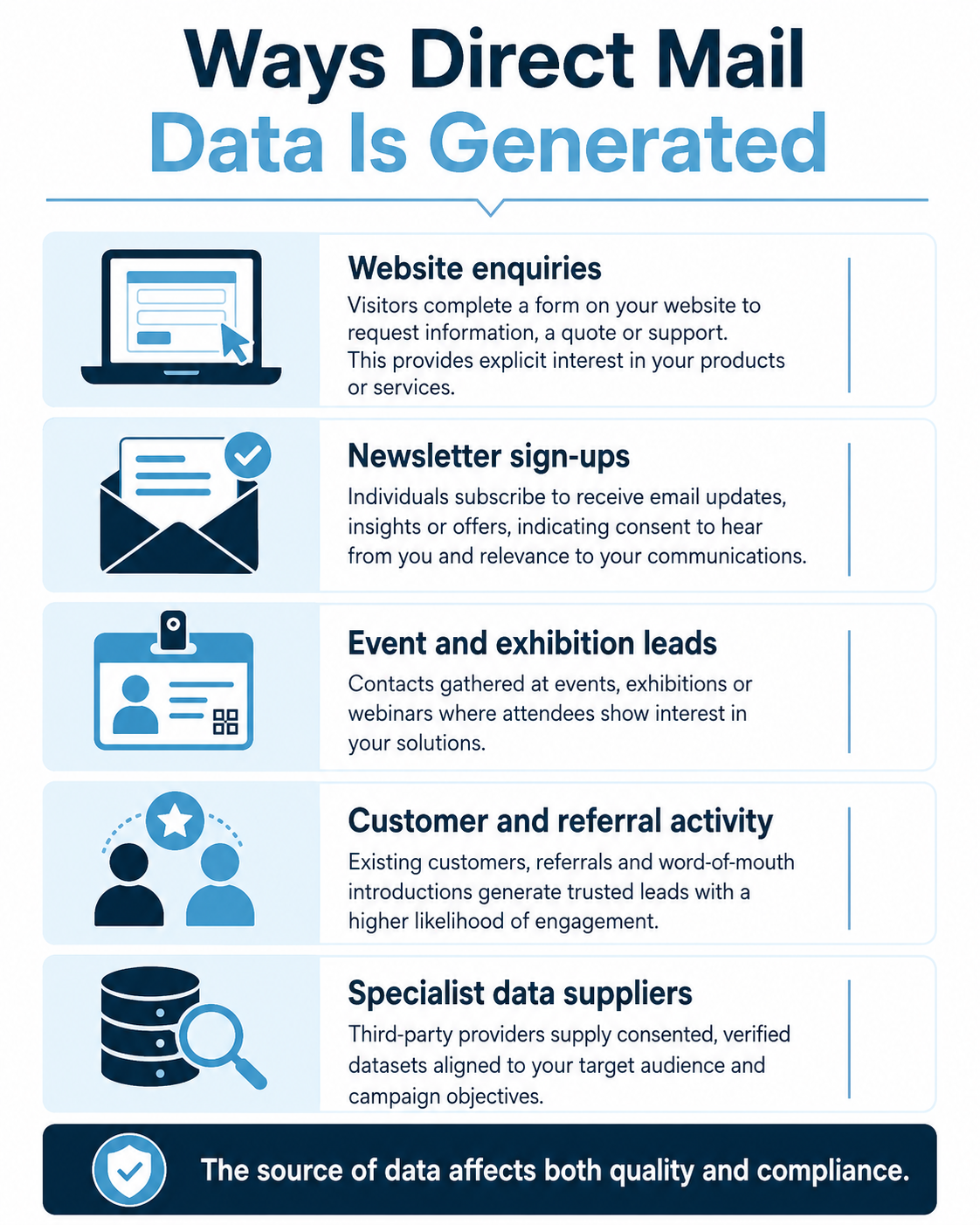
First-party data is usually the easiest to understand because it comes from direct relationships. It may include customers, lapsed customers, catalogue requesters, website enquiries, event attendees, donors, members, quote requests, warranty registrations or newsletter subscribers. The benefit is context. If someone has already interacted with the organisation, the business usually understands why the details were collected and what the person might reasonably expect next.
First-party data still needs care. It can decay quickly because people move, companies relocate and households change. A customer file may also include duplicate records, inconsistent address formats and people who have opted out of marketing. This is where data cleansing becomes important. Cleaning the data before printing can remove waste that would otherwise only become visible after returned mail or poor response.
Third-party postal data is used when a business needs to reach an audience beyond its own database. A reputable supplier can help build a list around defined criteria such as geography, industry, company size, household profile, property type or buyer relevance. This can be useful for acquisition campaigns where the business has a clear target market but does not yet hold enough first-party contact records.
Data can also be produced through enrichment. A business may already have company names but not current postal addresses, or it may hold customer addresses but lack segmentation fields. Enrichment can add or standardise fields, provided it is done lawfully and transparently. It can make an existing database more useful by turning partial records into campaign-ready records.
Another method is response-driven list building. A campaign can include QR codes, personalised URLs, voucher codes, call tracking numbers or reply devices. These responses can create a warmer list for later campaigns. Marketreach highlights the value of using mail response data and benchmarks to plan and optimise future activity. In practice, this means each campaign can improve the next one if the response data is captured properly.
The key is to understand source, permission, lawful basis and audience fit. A mailing list should not be treated as a black box. If you do not know how the data was generated, when it was last updated or what suppressions have been applied, you do not have enough information to make a confident purchasing decision.
Buying direct mailing lists: the main advantages
Buying a direct mailing list can be useful when speed and targeting matter. Building a large first-party postal database can take months or years. If your business wants to reach a defined audience now, a reputable supplier can help identify the relevant households or companies more quickly.
One advantage is audience definition. A supplier can help translate a broad sales idea into practical selection criteria. For example, a B2B campaign might target manufacturing companies with more than 50 employees in the Midlands. A B2C campaign might target owner-occupied households in a particular region with profile indicators that fit the offer. AccuraData’s direct mail data content explains how audience selection and list quality sit behind direct mail performance.
Another advantage is scale. A business may have only a small existing customer file, but a purchased list can create the volume needed for a meaningful campaign test. This does not mean buying the largest possible list. It means buying enough of the right records to test an offer, learn from the results and decide whether to expand.
Buying data can also support new market entry. A company expanding into a new geography, sector or consumer audience may not already hold relevant contact records. A selected list can provide a starting point for that market, especially when combined with a clear offer and a realistic follow-up plan.
There is also a planning advantage. A supplier can often provide counts before purchase. Counts help marketers understand whether a target audience is large enough, whether it needs narrowing or whether the brief is too restrictive. A count is not a result forecast, but it is a useful buying step because it prevents a campaign from being planned around an audience that does not exist at the required volume.
The drawbacks and risks of buying direct mailing lists
Buying direct mailing lists also has drawbacks. The first is that data quality varies widely. Some lists are carefully sourced, maintained and suppressed. Others are old, poorly documented or sold too broadly. A cheap list can look attractive until print, postage and poor response costs reveal the true price.
Another drawback is lack of context. First-party data often comes with knowledge of previous interactions. Purchased data usually does not. That means the creative and offer must work harder to introduce the business, explain relevance and make the next step clear. A purchased list is not a relationship. It is an opportunity to start a relationship.
There is also a compliance risk if the supplier cannot explain the data source, lawful basis, suppression processes and intended use. The ICO lawful basis guidance explains that organisations need a valid data protection reason for using personal information in direct marketing. Buyers should not assume that the supplier’s obligations remove their own responsibilities.
A fourth risk is overmailing. If the audience has received similar campaigns from many different businesses, response can suffer. This is one reason why campaign relevance and list selection matter. It is also why repeating the same generic mailing to a broad purchased list is rarely the best use of budget.
Finally, buying a list can create a false sense of certainty. A list can identify possible recipients. It cannot guarantee interest, purchase intent or response. Direct mail performance depends on the list, the offer, timing, creative, pricing, brand trust, call to action and follow-up. A reputable supplier should be honest about that.
B2B direct mailing lists and B2C direct mailing lists
B2B and B2C direct mailing lists look similar on the surface because both use postal addresses. In practice, they are selected and used differently.
B2B direct mailing lists are built around companies and business decision-making. They may include organisation names, business sites, head offices, branch locations, sectors, SIC codes, employee bands, turnover bands and named business contacts. The purpose is usually lead generation, account-based marketing, event promotion, professional services outreach, trade campaigns or sales follow-up.
B2B postal marketing can be useful where the offer benefits from a more tangible format. A printed guide, invitation, briefing note, sample pack or brochure can feel more substantial than a cold email. It can also reach people who are difficult to engage by phone or email alone. AccuraData’s B2B Postal Data page explains that business mailing lists can be built around sector, geography, company size, turnover, business type and other criteria.
B2C direct mailing lists are built around households and consumers. They may include names, addresses, postcode areas, demographic indicators, property information, lifestyle interests or other permitted profile data. The purpose is usually customer acquisition, local marketing, retail promotions, home services, charity outreach, subscriptions, events or reactivation.
B2C postal marketing needs particular care because it can involve household-level personal data and consumer expectations. AccuraData’s B2C Postal Data service is designed for organisations that need targeted consumer mailing audiences, with selection criteria matched to the campaign and channel.
The practical difference is the buying context. In B2B, relevance often depends on sector, company size, decision-maker role and business need. In B2C, relevance often depends on household profile, geography, life stage, property type or consumer interest. Treating the two audiences the same usually leads to weaker creative and weaker results.
Compliance for direct mailing lists
Postal marketing is often simpler than email or telemarketing from a PECR perspective, but it is not compliance-free. If a list contains personal data, UK GDPR applies. That means the business needs a lawful basis, clear purpose, fair processing, appropriate retention, data accuracy, security and a way to honour objections.
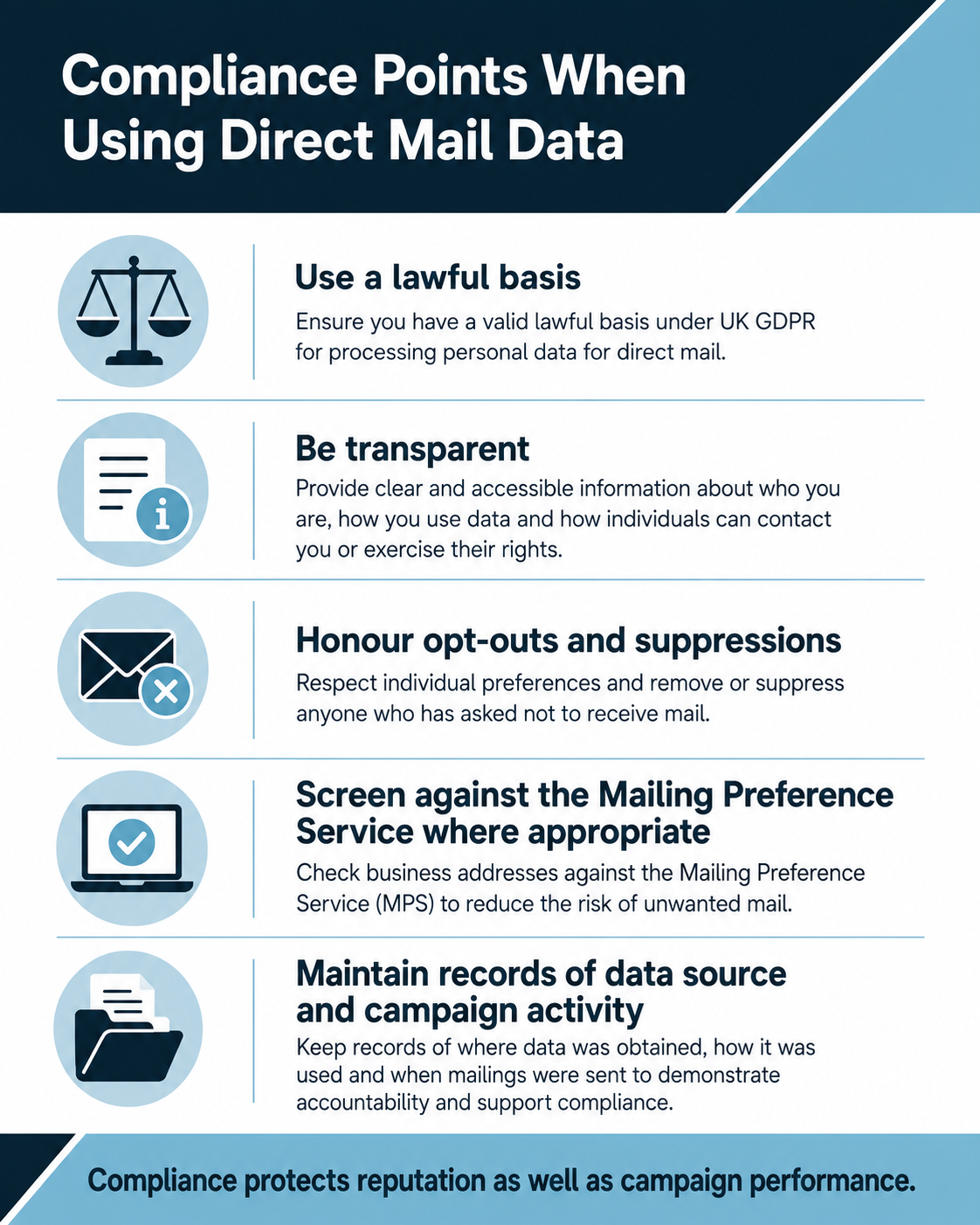
The ICO direct marketing guidance encourages organisations to build compliance into planning, rather than trying to retrofit it after data is selected. This is important because compliance decisions affect list sourcing, segmentation, suppression, messaging, record keeping and fulfilment.
For many postal marketing campaigns, legitimate interests may be considered as the lawful basis, but it should not be treated as automatic. The ICO lawful basis guidance identifies consent and legitimate interests as two likely lawful bases for direct marketing, depending on context. A business relying on legitimate interests should carry out a balancing exercise, often called a Legitimate Interests Assessment, and be clear about why the processing is proportionate.
Transparency also matters. Recipients should be able to understand who sent the mailing and how to object to future marketing. If the campaign includes a reply device, QR code or website form, the privacy information around any data capture should be clear. If the mailing is part of a wider campaign using email or telephone follow-up, the rules for those channels must also be considered.
Advertising standards should not be ignored. The CAP Code is the rule book for UK non-broadcast advertising and direct marketing communications. The ASA guidance also includes rules on the use of data for marketing. This is separate from data protection law, but it supports the same principle: marketing should be responsible, fair and not misleading.
Businesses should also avoid treating compliance as a box-ticking exercise. Good compliance protects the campaign. It reduces complaints, improves brand trust, reduces waste and helps teams explain why a specific audience was selected. That makes it part of performance, not just legal admin.
MPS, suppression and postal marketing preferences
Suppression is one of the most important parts of direct mail list quality. It is the process of removing records that should not be mailed. That can include people who have opted out, duplicate records, deceased individuals, gone-away addresses, unsuitable contacts, internal suppression lists and preference files.
The MPS is described by the DMA as the UK’s official “do not mail list” for unsolicited, personally addressed advertising mail. The public-facing MPS website explains that it is designed to stop personally addressed unsolicited mail, while still allowing people to receive mail from organisations they have done business with.
For consumers, MPS screening is a practical sign that a business is respecting postal preferences. Citizens Advice also points consumers to the MPS when they want to stop advertising material addressed personally to them. For marketers, that means MPS should be part of list preparation where unsolicited consumer mail is involved.
Suppression should not stop with MPS. A business should also maintain its own suppression file. If a recipient asks not to receive future mail, that request should be recorded and applied before future campaigns. If the business receives returned mail, those records should be investigated rather than mailed again.
Deceased suppression and gone-away checking can also matter, especially for B2C activity. Mailing someone who has died can cause distress and damage the sender’s reputation. Mailing a moved household can waste print and postage. These checks are a practical part of responsible postal marketing.
Suppression can feel negative because it removes records from the list. In reality, it improves the campaign. A smaller, cleaner list is often more valuable than a larger list full of unsuitable addresses. Good suppression protects budget, brand reputation and recipient choice.
Address quality, PAF and data cleansing
Address quality is not just about whether a postcode exists. It is about whether the record is formatted, complete, current and suitable for the mailing format. Small errors can affect deliverability and machine processing. Larger errors can send the mail to the wrong premises or make it undeliverable.
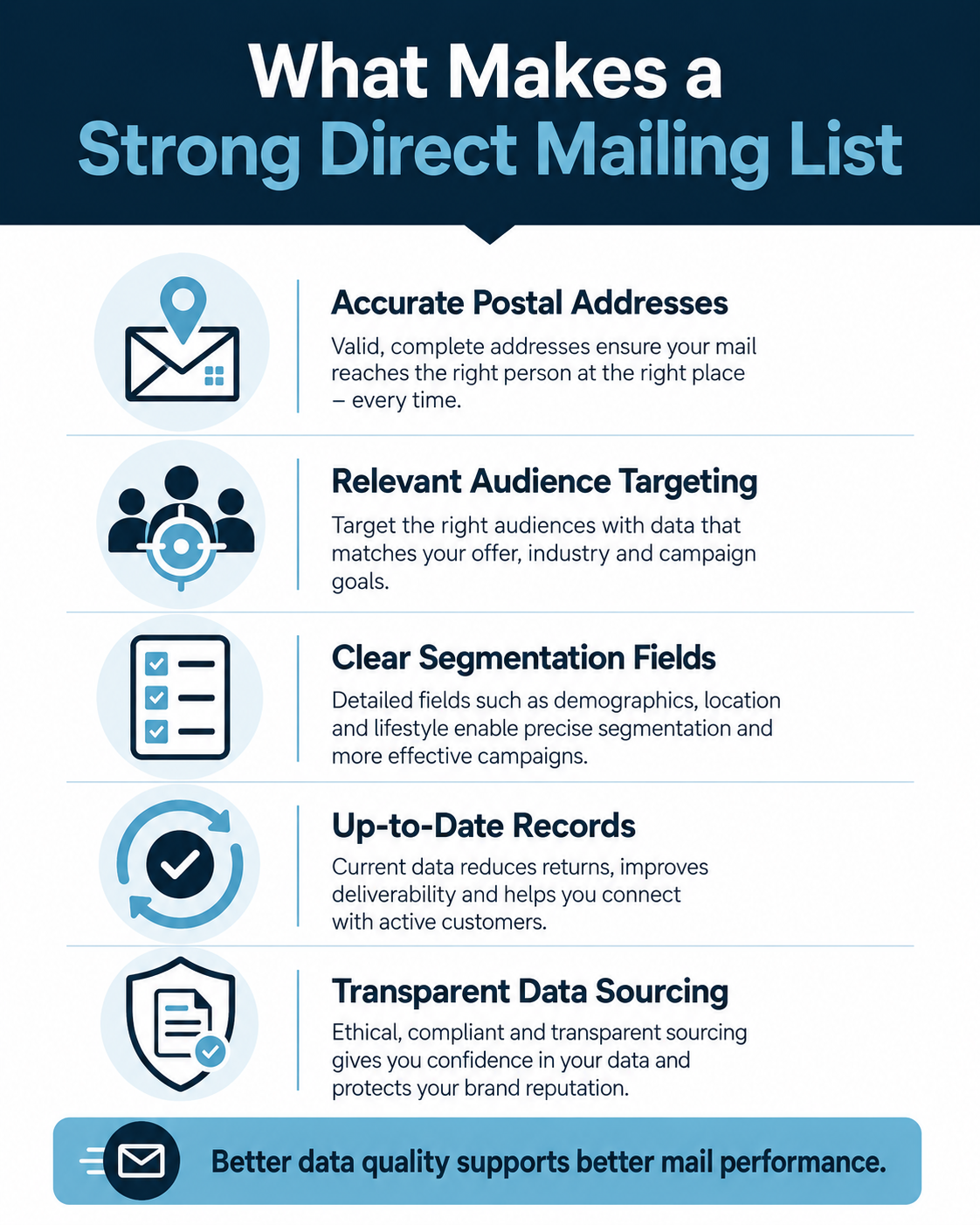
The Powered by PAF site describes the Postcode Address File as a widely used UK addressing database that underpins mailing lists and CRM systems. Using PAF-based validation helps standardise addresses and reduce avoidable delivery problems.
Data cleansing can include formatting addresses, deduplicating records, removing incomplete addresses, checking business status, applying suppression files, appending missing postcodes, identifying gone-away records and flagging records that need manual review. For B2B campaigns, it may also include checking whether companies are active, whether sites still exist and whether named contacts still appear relevant.
For B2C campaigns, it may include MPS suppression, deceased suppression, gone-away checks and household-level deduplication. The goal is not simply to make the spreadsheet look tidy. The goal is to prevent print and postage from being spent on records that are unlikely to reach the right person or household.
AccuraData’s data cleansing services can support businesses that already hold a mailing database but need to improve it before use. That can be useful for organisations with legacy customer files, old prospect data, merged CRM exports or historical campaign records.
Address quality also affects measurement. If a campaign returns poor results, dirty address data can make it hard to know whether the offer failed or whether the mailing failed to reach the intended audience. Clean data makes campaign learning more reliable.
Segmentation potential in direct mailing lists
Segmentation is where direct mailing lists become more valuable. It allows a business to divide the audience into meaningful groups and tailor the mailing accordingly. That can improve relevance, reduce waste and make the results easier to interpret.
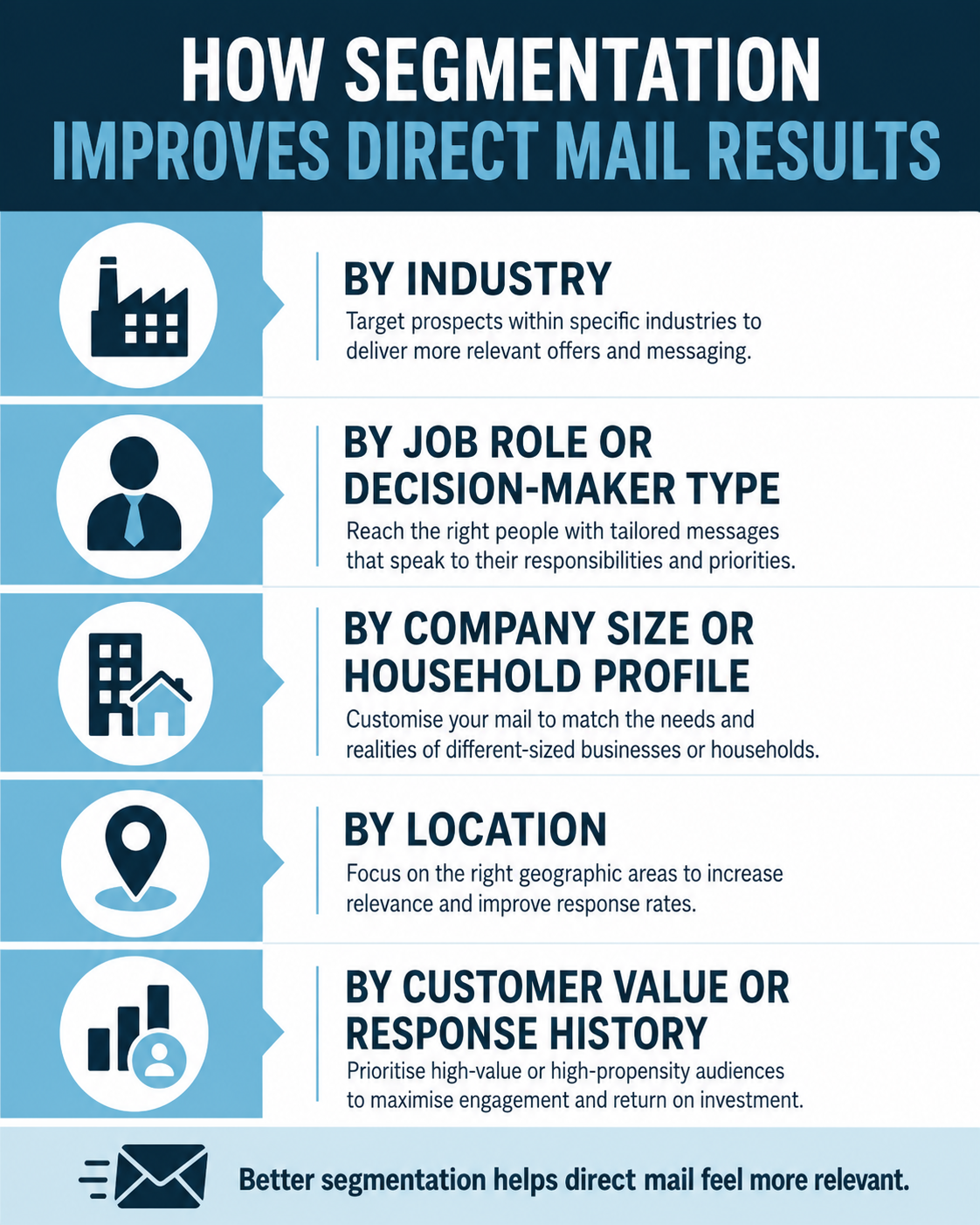
B2B segmentation can include industry, SIC code, employee count, turnover band, geography, head office status, branch type, company age, job function, seniority or technology relevance. A campaign aimed at finance directors will usually need a different message from one aimed at operations managers. A mailing to small businesses may need a different offer from a mailing to multi-site companies.
B2C segmentation can include postcode area, property type, homeownership indicators, household composition, age band, likely interest categories, location and previous response. A home improvement campaign might focus on owner-occupied houses in a defined radius. A local leisure campaign might select households near specific transport routes. A charity campaign might segment by propensity, location or previous donation behaviour where lawful and available.
Geographic segmentation is especially powerful for direct mail because delivery costs and local relevance are closely linked. A campaign can focus on a catchment area, postcode sector, town, county or region. It can also exclude areas that are not commercially viable.
Segmentation also allows testing. A business can send different messages to different segments, test offers, compare audiences or run a small pilot before committing to a larger mailing. JICMAIL benchmarks are useful for planning, but each business should still build its own evidence from campaign results.
The most important principle is that segmentation should support a decision. If a field does not affect selection, creative, timing, offer or measurement, it may not be necessary. The best lists are not always the ones with the most fields. They are the ones with the most useful fields for the campaign.
Direct mail formats and how list choice affects them
Different direct mail formats place different demands on data. A simple postcard may only need a clean address and a clear audience profile. A personalised letter needs accurate name and address formatting. A high-value pack may need a more tightly selected audience because the unit cost is higher.
Brochures and catalogues work best when the audience has a strong fit with the product range. If the list is too broad, the cost of printing and postage can rise faster than response. A selected list can help ensure that heavier or more expensive formats are sent only to recipients with a credible likelihood of interest.
Event invitations need strong geographic and role-based selection. The list should match the event location, topic and likely decision-makers. For B2B events, job title and seniority can matter. For consumer events, catchment area and household relevance may matter more.
Account-based marketing mailings require a different approach again. The list may be small, but highly targeted. A campaign might select named companies, key sites and senior contacts. The mailing may be personalised, premium and linked to sales follow-up. In that context, a list with 200 high-fit records can be more valuable than 20,000 broad records.
Partially addressed mail and door drops can also sit beside named direct mail. They have different data requirements and different targeting logic. If a campaign does not need named recipients, those formats may be worth considering. If personalisation and recipient-level tracking matter, addressed direct mailing lists are likely to be more suitable.
How to spot a reputable direct mailing list supplier
A reputable direct mailing list supplier should ask questions before quoting. If a supplier offers a generic file without understanding audience, channel, geography, volume, intended use and campaign objective, the buyer should be cautious.
The supplier should be able to explain how data is sourced, how often it is updated and what quality checks are applied. They should also be able to discuss suppression, address validation, deduplication and whether the data is suitable for the planned use. If the answer is vague, the risk is higher.
A good supplier should also understand compliance. They do not need to provide legal advice, but they should know that UK GDPR applies to personal data and that marketing by post needs fair processing, lawful basis and objection handling. They should not imply that postal data is free from rules. The DMA Code sets out principles such as respecting privacy, being honest and fair, being diligent with data and taking responsibility. Those principles are a useful benchmark for supplier behaviour.
Documentation is another sign of quality. Buyers should expect clear terms, data usage conditions, privacy information, source explanation, delivery format, field definitions and any suppression or validation notes. A reputable supplier should also be clear about what the data can and cannot be used for.
Beware of suppliers that lead only with volume and price. A very large list at a very low cost may not be the best purchase if it includes stale records, poor targeting or weak documentation. The best supplier conversation should be about fit, quality, compliance and campaign practicality before price per record.
AccuraData positions its postal data around targeted selection, data quality and practical campaign use. Businesses can use AccuraData’s B2B Postal Data for business audiences or B2C Postal Data for consumer audiences, with wider support available where data needs to be cleansed, enriched or combined with other channels.
Questions to ask before buying direct mailing lists
Before buying a direct mailing list, start with the campaign objective. Are you trying to generate leads, revive customers, promote an event, drive retail visits, launch a product, raise awareness or support a sales team? The answer affects the audience, volume, format and measurement plan.
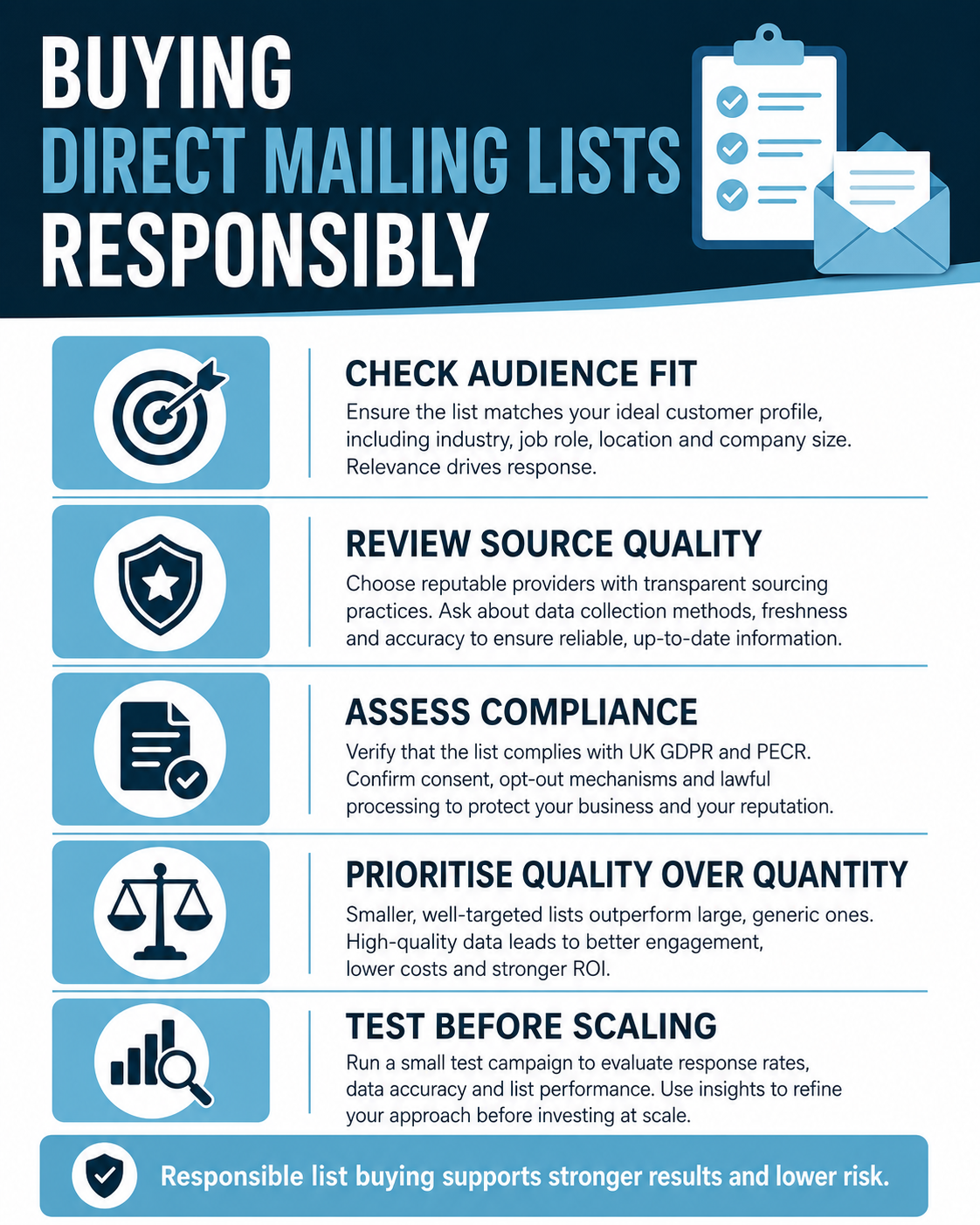
Next, define the audience. For B2B, this may include sector, company size, geography, job role and business type. For B2C, it may include household profile, area, life stage, property indicators or interest categories. If you cannot define the audience, you are not ready to buy data.
Then ask about data quality. When was the list last updated? Has it been deduplicated? Has it been checked against appropriate suppression files? Has address formatting been standardised? Is there a minimum deliverability threshold? Are there records with missing fields? What happens if returns are unusually high?
Ask about compliance and documentation. What lawful basis is expected for the intended use? What privacy information is available? How are opt-outs handled? Does the supplier maintain suppression processes? Is MPS screening applied for consumer postal campaigns where required? Can the supplier explain the source of the data?
Finally, ask about practical delivery. What file format will be supplied? Are fields clearly labelled? Will the data be ready for a mailing house? Are names and addresses separated into usable columns? Are there seed records? Are duplicates handled across multiple segments? Who is responsible for final approval before print?
How to brief AccuraData for a direct mailing list
A strong data brief helps AccuraData build a better list. Start with the outcome you want. For example, you might want enquiries, appointments, quote requests, catalogue orders, event registrations, local store visits or renewed customer activity.
Then describe your ideal audience. For B2B, include sectors, excluded sectors, target roles, company size, locations, branch or head office preferences and any business characteristics that make a prospect suitable. For B2C, include geography, consumer profile, property indicators, relevant interests and exclusions.
Share campaign context. A supplier can make better recommendations if they know whether the mailing will be a letter, leaflet, catalogue, postcard, sample pack or invitation. A premium pack may justify a smaller, more selective list. A low-cost postcard may allow a wider test.
Explain whether the campaign is single-channel or multi-channel. If you plan to follow up by email or telephone, the data needs and compliance considerations become broader. AccuraData’s article on B2B Marketing Lists explains how email, telephone and postal data can work together when each channel is planned properly.
Tell the supplier about your internal data too. If you already have customers, lapsed customers or CRM exports, AccuraData may be able to support a cleansing, deduplication or suppression process before new records are added. That can reduce duplication and help avoid mailing people who should be excluded.
Measuring direct mail performance
Measurement should be planned before the mailing is printed. It is hard to measure response if the campaign does not include tracking mechanisms. Useful methods include QR codes, personalised URLs, unique phone numbers, voucher codes, dedicated landing pages, reply forms and segment codes.
The basic metrics include response rate, enquiry volume, cost per response, conversion rate, average order value, return on investment and long-term customer value. JICMAIL provides benchmarks that can help marketers plan expectations across response, ROI, cost per acquisition and average order value. Those benchmarks should be used as planning references, not promises.
Attention is another useful consideration. A JICMAIL study reported average interaction time for different mail formats, including direct mail and business mail. For campaign planning, this reinforces the idea that physical mail can create a different engagement moment from a short digital impression.
Measurement should be reviewed by segment. If the campaign was split by region, sector, household profile or customer status, results should be reported that way. A campaign can look average overall but contain one segment that performed strongly and another that should be removed next time.
Post-campaign data hygiene matters too. Returned mail, opt-outs, complaints, responses, purchases and non-responses should be used to update the database. This turns each campaign into a learning cycle rather than a one-off send.
Using direct mail with email and telephone follow-up
Direct mail often performs best as part of a wider communication plan. A mailing can introduce a proposition, give the recipient something tangible and create a reason for follow-up. Email can provide a digital resource or reminder. Telephone can support qualification, appointments or high-value conversations.
This does not mean every channel should be used for every recipient. Each channel has different rules and expectations. Email marketing and telephone marketing have stricter PECR requirements than postal marketing in many cases. If a campaign moves from post to email or phone, the business must consider the rules for those channels as well.
A multi-channel plan should also avoid overwhelming the recipient. The purpose is to build relevance, not pressure. A good sequence might start with a postal introduction, then use a short email to share a resource, then call only the most relevant accounts. The data should guide the sequence rather than pushing every contact through the same path.
AccuraData can support multi-channel planning by helping businesses understand what data is available and where different channels fit. For some campaigns, postal-only is enough. For others, a combined dataset can support more rounded prospecting.
Direct mail can also support digital conversion. QR codes and personalised URLs can move the recipient from a physical item to a web page, booking form or download. That creates measurable interaction and gives sales teams better context for follow-up.
How AccuraData supports direct mailing list buyers
AccuraData helps businesses that need direct mailing lists by focusing on audience selection, data quality and practical use. The starting point is the campaign brief. Who do you need to reach? What do you want them to do? Which geography, sector, household profile or business type matters? What exclusions should apply?
For business campaigns, AccuraData’s B2B Postal Data service can support direct mail, brochures, event invitations, account-based marketing, local business campaigns and multi-channel sales outreach. Selection can be based on criteria such as industry, location, company size, turnover, employee count and business type.
For consumer campaigns, AccuraData’s B2C Postal Data service can support household targeting for direct mail campaigns where consumer audiences are relevant. The objective is to build postal audiences that match the offer, not to supply broad files that create unnecessary waste.
AccuraData can also help with existing data. If you already hold customer or prospect records, data cleansing can improve quality before the campaign is mailed. That may involve deduplication, standardisation, record checks and suppression support.
Relevant AccuraData content can also help buyers understand the wider context. The article on direct mail lists explains the difference between B2B and B2C postal data, while the article on direct mail data looks at why the list behind the campaign matters. These resources can help internal teams brief their campaigns more clearly.
The main benefit of working with a specialist is not simply getting a spreadsheet. It is getting help with the audience definition, data fields, suitability, quality checks and follow-up thinking that make the spreadsheet useful.
A practical checklist for buying direct mailing lists
Use this checklist before committing budget to a direct mailing list:
- Define the campaign objective, audience and offer before asking for a count.
- Decide whether the campaign is B2B, B2C or both.
- Ask how the data is sourced, maintained and validated.
- Check whether address formatting and deduplication are included.
- Confirm whether appropriate suppression files will be applied.
- Ask how opt-outs and objections should be handled after the campaign.
- Match the list volume to the budget, format and follow-up capacity.
- Plan tracking before print so results can be measured properly.
- Keep post-campaign data updates, including returns and opt-outs.
- Review results by segment before buying the next list.
This checklist is simple, but it prevents many common errors. Most poor direct mail purchases start with the wrong question. The wrong question is “How many names can I get for the lowest price?” The better question is “Which records are most likely to support this campaign, and what evidence do we have that they are accurate, relevant and appropriate to use?”
Common buying mistakes to avoid
The first mistake is buying too broadly. A large file can feel safer because it gives the impression of reach. In practice, broad reach can dilute relevance and increase cost. If the offer is specific, the list should be specific too.
The second mistake is ignoring suppression. Suppression may reduce the final count, but it improves quality. Mailing people who have opted out, moved, died or no longer match the audience is not a sign of reach. It is a sign of waste.
The third mistake is treating direct mail as a one-off tactic. The best campaigns often improve through testing, learning and repetition. JICMAIL data includes benchmarks for repeat sends, response, ROI and acquisition measures, which underlines the importance of treating direct mail as a measurable channel rather than a single print job.
The fourth mistake is separating the list from the message. A list of managing directors needs a different proposition from a list of homeowners. A list of small businesses needs different proof points from a list of enterprise accounts. If the message is not adapted to the audience, segmentation value is lost.
The fifth mistake is not involving the sales or service team. If a mailing is designed to generate enquiries or appointments, the team receiving those responses needs to know who was mailed, what offer was used and what follow-up is expected. Otherwise good campaign responses can be wasted.
The role of testing in direct mail data buying
Testing helps reduce risk. Instead of mailing the full available universe at once, a business can test a selected segment, measure response and then refine. This is especially useful when entering a new market or trialling a new offer.
A useful test should have a clear purpose. You might test two audience segments, two creative versions, two offers or two geographic areas. The test should not change too many variables at once, otherwise the results become hard to interpret.
The test volume needs to be large enough to produce useful signals, but small enough to manage risk. A supplier can help identify whether the target audience is large enough for a meaningful test. The fulfilment team can help estimate the unit cost, and the sales team can confirm whether follow-up capacity exists.
Testing is also where direct mail can work well with digital. A campaign can use QR codes, landing pages or unique codes to understand which segment responded. The campaign can then be expanded to the best-performing groups.
A good supplier will support this kind of thinking. A weak supplier will often push the largest possible file immediately. For buyers, that distinction matters.
Direct mailing lists and responsible growth
Direct mailing lists are not a shortcut around marketing discipline. They are a tool for making marketing more focused. Used well, they help businesses reach relevant audiences, reduce wasted spend and learn from results. Used poorly, they can create waste, complaints and weak response.
Responsible growth means selecting audiences carefully, respecting preferences, keeping data accurate and being clear about why a recipient has been contacted. It also means measuring whether the campaign worked and using that learning to improve future activity.
The GOV.UK advertising guidance reminds businesses that marketing and advertising should be accurate and honest and should follow the relevant advertising codes. For direct mail buyers, that means the list, message and offer should all be handled with care.
The DMA Code also offers a useful principle for data-led marketing: be diligent with data. That principle sums up the best approach to buying direct mailing lists. Diligence is not only about avoiding problems. It is about giving the campaign a better chance of working.
Conclusion
Direct Mailing Lists can be a valuable way to reach businesses and consumers through the post, but the quality of the list shapes the quality of the campaign. Buyers should look beyond volume and price to consider source, relevance, address quality, suppression, compliance, segmentation and measurement.
A good direct mailing list should be built around a clear audience and a clear campaign purpose. It should contain useful fields, be checked for quality, be suitable for the intended use and be supported by documentation that helps the buyer use it responsibly. It should also make measurement easier, so each campaign improves the next one.
AccuraData is a reliable partner for businesses that need targeted direct mail data, whether the campaign is aimed at UK companies or consumer households. Through B2B Postal Data, B2C Postal Data and supporting cleansing services, AccuraData can help businesses build better postal audiences, reduce waste and run direct mail campaigns with more confidence.
The best purchasing decision starts with the right brief. Define the audience, choose the channel, ask the right supplier questions and make sure the list is fit for purpose before anything is printed. That approach gives direct mail the best chance to do what it does well: put a relevant message into the hands of the right people at the right time.