
The phrase ’email database marketing’ is sometimes used interchangeably with email marketing, as though the two were the same thing. They are not. Email marketing is the act of sending messages to a list. Email database marketing is a strategic discipline that treats the contact database as the primary commercial asset, and uses it to drive targeted, measurable, continuously improving outreach at every stage of the customer relationship. The difference in outcomes between the two approaches is not marginal. It determines whether an email programme generates consistent pipeline or simply produces a stream of batch-and-blast sends that slowly erode the trust and deliverability needed for the next campaign to land.
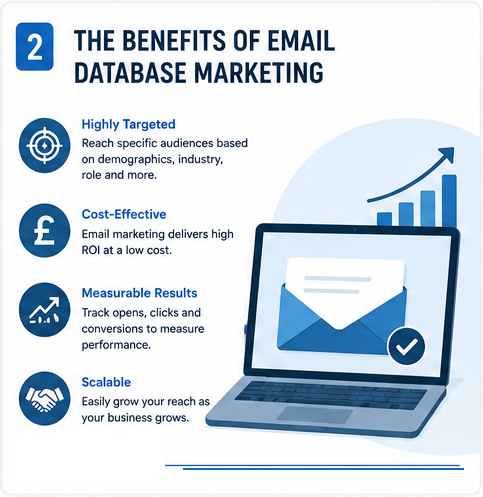
The case for investing seriously in the database rather than just the messaging is well-established in the data. The DMA UK reports an average return of £38.33 for every £1 spent on email marketing, with peak periods reaching £46 per £1. Four in five B2B marketers rely on email as a primary channel and 77% of B2B buyers report preferring email over any other outreach channel. But these figures describe the potential of the channel, not its guaranteed output. Achieving them requires a marketing database that is accurate, structured for segmentation, compliant under UK law, and maintained as an ongoing operational discipline rather than a one-time asset that is set up and left to degrade.
At AccuraData, we supply verified, GDPR and PECR compliant email marketing databases to UK businesses, and we clean and enrich the databases that businesses already hold. This article explains what email database marketing involves at a strategic level, how to build and structure a database that supports it, how UK law governs its use, how segmentation and automation multiply results, how to measure what is working at the database level rather than just the campaign level, and how to sustain performance over time as the database matures.
What Email Database Marketing Actually Means
In its fullest sense, email database marketing is the practice of using a structured contact database as the foundation for targeted outreach, with every campaign decision informed by what the database contains about each recipient. Rather than treating every contact on the list as equivalent, it uses the data held against each record, role, company size, industry, purchase history, engagement history, geographic location, and consent status, to determine who receives which message, when they receive it, and what action the message is designed to prompt.
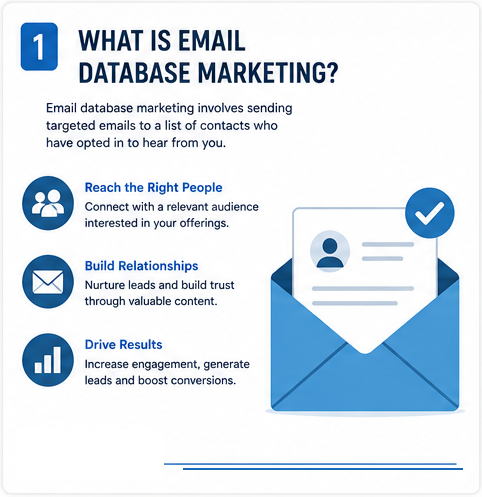
This approach is distinct from mass email marketing in several important respects. It is personalised rather than generic, because the database contains the attributes needed to vary the message by segment. It is timely rather than arbitrary, because the database captures the events and behaviours that trigger the right communication at the right moment. It is measurable at the contact level rather than just the campaign level, because engagement history is maintained against each record. And it is cumulative rather than static, because each campaign adds data to the database that improves the targeting of every subsequent one.
This is the commercial logic behind the research. Detailed segmentation leads to 30% more opens and 50% more clicks compared to unsegmented campaigns. Advanced segmentation produces a 760% increase in email revenue, according to DMA research cited across multiple industry analyses. Personalised emails are opened 82% more than generic bulk sends. None of these outcomes are achievable through volume and luck. They are all achievable through a structured approach to email database marketing that treats the contact data as the strategic variable, not the creative.
Building the Database Architecture That Email Database Marketing Requires
The foundation of effective email database marketing is a database that is structured to support the analysis, segmentation, and automation that drive performance. Most businesses have a contact list. Fewer have a marketing database that is built to support the range of activities that the discipline demands. The difference is in what each record contains and how the records are organised.
The Fields That Drive Targeting
For B2B campaigns, the core fields that enable meaningful segmentation are job title and seniority, company name, industry classification to SIC code level, employee count banding, estimated annual turnover, and geographic region. These are the fields that allow a B2B email database to be divided into groups that share a commercial profile and warrant a different proposition, a different level of technical detail, or a different framing of the business case. Supplementary fields that add further targeting precision include the specific product or service area the contact has previously engaged with, the channel through which they entered the database, and any intent signals captured from website behaviour or content downloads.
For consumer campaigns, the equivalent fields are age range, gender, homeownership status, household composition, geographic location, estimated income banding, and lifestyle or interest categories where available from consented data sources. The more richly these fields are populated at the time a contact is added, the more immediately useful the record is for targeted outreach. A contact record that contains only a name and email address is a starting point. A record that also captures industry, seniority, and acquisition source is an immediately actionable email marketing database entry.
Compliance Fields Are Not Optional
Every record in an email database for marketing must also carry the compliance information that documents how the data was collected and on what basis it is being used. For consumer contacts, this is the consent record: the timestamp of the opt-in, the mechanism through which it was given, and the wording of the consent that was presented at the point of collection. For B2B contacts, this is the legitimate interests basis documentation and any objection or unsubscribe notation recorded from previous communications.
These fields are not administrative overhead. They are the evidence the ICO asks for when a complaint triggers an investigation. The inability to produce consent records for consumer contacts, or a documented legitimate interests assessment for B2B contacts, is itself treated as an indicator of systemic non-compliance under the UK GDPR accountability principle. Building these fields into the database architecture from the first record added is significantly less burdensome than reconstructing them retrospectively after a complaint has been received.
Engagement History at the Contact Level
The field that separates a basic contact list from a genuine email database for marketing is engagement history captured at the record level. Last open date, last click date, campaigns received without interaction, and specific content categories engaged with are the attributes that allow the database to be divided into active, lapsing, and inactive segments, and that power the behavioural triggers behind automated sequences. Without this data, the database cannot support the lifecycle-based communication that the most effective email database marketing programmes deploy.
AccuraData: Every email marketing database we supply is structured with the segmentation fields needed to support targeted outreach from day one. For businesses whose existing database is missing key fields, our data cleansing and enrichment service can append firmographic data, validate email addresses at mailbox level, and run live Companies House checks to confirm the trading status of B2B contacts. Every dataset comes with a Data Processing Agreement as standard.
The UK Legal Framework for Email Database Marketing
The legal framework governing email database marketing in the UK requires compliance with two parallel pieces of legislation: UK GDPR and the Privacy and Electronic Communications Regulations 2003 (PECR). Both must be satisfied, and neither alone is sufficient. The Data (Use and Access) Act 2025, which brought its enforcement provisions into force in February 2026, aligned maximum PECR penalties with UK GDPR levels, raising the ceiling to £17.5 million or 4% of global annual turnover. This is not a remote risk for small businesses. ICO enforcement investigations regularly identify relatively straightforward compliance failures at SMEs, with fines for B2C and B2B email marketing violations falling consistently in the £30,000 to £200,000 range for smaller organisations.
PECR: Consent for Consumer Email Marketing
For marketing emails sent to individual subscribers, which includes all consumers and sole traders, PECR requires prior opt-in consent that is freely given, specific, informed, and unambiguous. The ICO’s direct marketing guidance is explicit that this means a positive opt-in action. Pre-ticked boxes, implied consent, and consent bundled within terms and conditions all fail the standard. Every consumer contact in an email marketing database must have actively opted in with an understanding of what they were agreeing to receive, from which organisation, and with what frequency. The soft opt-in exception permits marketing to existing customers about similar products without fresh consent, provided the opt-out opportunity was clear at the point of data collection and is present in every subsequent message. This exception is narrow and does not extend to new prospects or different product categories.
PECR: Corporate Subscribers and B2B Email Marketing
For corporate subscribers, including limited companies, LLPs, and government bodies, the PECR consent requirement for electronic marketing does not apply in the same way. As the ICO confirms, the electronic mail marketing rule under PECR does not apply to corporate subscribers. This makes large-scale B2B email database marketing to purchased contact lists a lawful commercial practice in the UK, provided the UK GDPR obligations are also met. UK GDPR still applies to any record containing a named individual’s email address, and the lawful basis for processing it in B2B outreach is almost always legitimate interests, supported by a documented balancing test.
UK GDPR Accountability: Documentation as a Legal Obligation
UK GDPR’s accountability principle requires that organisations can demonstrate compliance, not merely assert it. For email database marketing, this means maintaining documented records of consent for consumer contacts, documented legitimate interests assessments for B2B contacts, records of when the database was last verified, and records of how opt-outs and suppression have been managed over time. Enforcement analysis of 2025 ICO activity identifies several recurring patterns of non-compliance: soft opt-in misuse where retailers emailed customers about unrelated products; B2C brands using purchased lists where consent at source could not be verified; and organisations whose email platform and CRM were not synchronising suppression lists, causing contacts who had unsubscribed to receive subsequent campaigns. Each of these is a database management failure as much as it is a consent failure.
AccuraData Compliance: Our B2B email marketing databases are sourced and documented to meet the UK GDPR legitimate interests standard, with Data Processing Agreements provided on every engagement. Our consumer email data is sourced only where verifiable opt-in consent exists. For clients who want to understand their compliance position before a campaign launches, our team can advise on the documentation required and how to structure it correctly.
Segmentation: The Mechanism That Makes Email Database Marketing Work
Segmentation is the practice of dividing an email marketing database into groups whose members share a meaningful characteristic, and then communicating differently with each group based on what that characteristic reveals about their needs, their context, or their position in the relationship with your business. It is the practice most directly responsible for the performance uplifts that email database marketing produces over unsegmented email broadcast, and it is only achievable when the underlying database contains the fields needed to define the segments meaningfully.
Demographic and Firmographic Segmentation
The foundation of any email database marketing segmentation strategy is demographic for consumer programmes and firmographic for B2B. For B2B databases, industry, company size, geographic region, and job function are the primary dimensions. A financial software company running B2B email database marketing campaigns should not be sending the same message to a sole trader accountant and a group finance director at a 500-person manufacturing company. The purchasing authority, the decision-making process, the budget scale, and the relevant pain points are entirely different. The database must contain the fields to identify this difference, and the campaign strategy must use them.
For consumer email database marketing, the equivalent segmentation dimensions are age range, homeownership status, household composition, geographic location, and any lifestyle or interest category attributes available from the data source. A home improvement retailer sending the same message to a 28-year-old renter in Manchester and a 52-year-old homeowner in Surrey is delivering a communication that is relevant to neither in any specific way. The same retailer sending the homeowner a message about renovation products and the first-time buyer a message about furnishing a new property is practising segmented email database marketing that reflects the commercial reality of their audience.
RFM Segmentation: Using Transaction History to Drive Campaign Strategy
For businesses with an existing customer base, RFM segmentation, which groups contacts by Recency, Frequency, and Monetary value, is one of the most commercially powerful applications of email database marketing. It divides the database into groups defined by how recently each contact made a purchase, how frequently they buy, and how much they spend, producing segments with meaningfully different commercial profiles and different communication requirements.
A high-recency, high-frequency, high-value customer is a candidate for a loyalty programme or an upsell campaign. A high-recency first-time buyer is a candidate for an onboarding sequence designed to consolidate the initial purchase decision and build confidence in the brand. A previously high-value customer who has not purchased in six months is a candidate for a winback campaign with a specific incentive. Each of these segments requires a different message, a different offer, and a different measure of success. As research from The Digital Marketing Project shows, companies using RFM analysis for email personalisation achieve 10 to 30% increases in customer retention rates, directly impacting long-term revenue per customer.
Lifecycle Segmentation: Matching Communication to Relationship Stage
Lifecycle segmentation divides an email database for marketing by where each contact is in their relationship with the business: prospect, new subscriber, active customer, lapsing customer, and inactive or churned contact. Each stage warrants a fundamentally different communication approach, and maintaining the lifecycle stage as a field in the database allows the campaign programme to route each contact into the appropriate sequence automatically as their behaviour changes over time.
A prospect who has just downloaded a lead magnet needs an introductory nurture sequence that demonstrates expertise and builds familiarity. An active customer needs a retention programme that deepens engagement and creates opportunities for upsell. An inactive contact who has not opened anything in six months needs a re-engagement campaign before a suppression decision is made. Research from Litmus cited by Humanic found that lifecycle-aligned campaigns see a 20 to 25% boost in open rates compared to non-lifecycle-aligned sends. This uplift reflects the basic commercial logic of email database marketing: the right message at the right stage generates engagement; the wrong message at the wrong stage generates unsubscribes.
Behavioural Segmentation: Using Engagement Data as a Targeting Signal
The most sophisticated layer of email database marketing segmentation uses behavioural data captured from previous campaigns to drive what a contact receives next. A contact who clicked through to a specific product page in the last campaign but did not convert is a more commercially urgent audience than one who opened but did not click. A contact who has opened the last five campaigns in a row is an actively engaged subscriber whose behaviour warrants different treatment from one who has not opened anything in ninety days.
Maintaining this engagement data at the contact level in the email marketing database is the precondition for behavioural segmentation. Without it, the database cannot support the automation workflows that turn engagement signals into triggered sequences. With it, a business can move contacts between segments dynamically as their behaviour changes, ensuring that the communication each contact receives reflects their current relationship with the brand rather than their status at the time they were first added to the list.
Automation: How Email Database Marketing Scales Without Sacrificing Relevance
Automation is the mechanism through which email database marketing delivers personalised, timely communication at scale without requiring manual intervention for every individual send. Without automation, a business with a segmented database can still send targeted campaigns, but the targeting is applied batch-by-batch. With automation, the targeting is applied continuously, with each contact receiving the next communication in their sequence at the moment their behaviour or lifecycle stage triggers it.
The commercial case for automation in email database marketing is supported by striking data. Companies implementing complete lifecycle automation see 73% higher customer lifetime value compared to those using only promotional campaigns. Automated emails account for only around 2% of total email send volume but drive approximately 37% of all email-generated sales, according to Omnisend research. The efficiency premium of automation, where a sequence built once continues to deliver precisely timed, behaviour-triggered communication to every new contact that enters the relevant segment, is the compounding return that makes the investment in email database marketing infrastructure pay for itself over time.
Welcome and Onboarding Sequences
The welcome sequence is the first automated communication a new subscriber receives, and it is typically the highest-performing sequence in any email database marketing programme. Welcome emails achieve average open rates of 83.63%, as benchmarks from SQ Magazine confirm, because the recipient is at peak awareness of the brand at the moment they join the database. A welcome sequence that delivers genuine value in the first two or three emails, establishes the tone and content expectations for future communications, and prompts an early engagement action creates the foundation for a sustained commercial relationship. A welcome sequence that simply confirms a subscription and then goes silent until the next batch campaign misses the moment of highest receptivity that new subscriber acquisition creates.
Nurture Sequences for Prospects
A nurture sequence delivers a structured series of educational or value-adding communications to prospects who are not yet ready to buy but who have expressed sufficient interest to join the email database for marketing. The purpose is to build familiarity and trust over time, positioning the brand as a credible solution to a problem the prospect has acknowledged, so that when their buying trigger arrives, the brand is the first they consider. A well-constructed nurture sequence uses the database’s segmentation fields to vary the content by industry, role, and pain point, ensuring each contact receives communications that address their specific context rather than a generic educational stream.
The length and content of a nurture sequence should be informed by what the data reveals about the typical sales cycle for the target audience. A business selling a high-value B2B service with a six-month sales cycle needs a nurture programme that sustains engagement over that period without exhausting the prospect’s patience. A business selling a lower-value product with a shorter consideration window needs a more compact sequence that moves more quickly toward the conversion prompt.
Re-engagement Campaigns
A re-engagement campaign targets contacts in the email marketing database who have been inactive for a defined period, typically 90 to 180 days, with the specific purpose of either reactivating their engagement or confirming that they should be suppressed. The campaign structure is simple: an opening email that acknowledges the period of inactivity and offers something specific to prompt re-engagement, followed by one or two follow-ups for those who do not respond, and then a clear suppression step for those who remain inactive after the sequence concludes.
The rationale for running this sequence is deliverability as much as it is pipeline. Inactive contacts who remain on the active sending list produce low engagement signals that tell inbox providers the sender’s messages are unwanted. Suppressing them removes this drag on sender reputation, improving deliverability for the contacts who remain active. The list that results from a re-engagement campaign is smaller but more commercially useful: every contact on it has recently demonstrated a willingness to engage, which is the signal that matters for both commercial and deliverability purposes.
Deliverability: Why Email Database Marketing Lives or Dies in the Infrastructure
The 2025 and 2026 deliverability environment has made the infrastructure behind email database marketing more consequential than at any previous point in the channel’s history. Google, Yahoo, and Microsoft have all implemented mandatory authentication requirements for domains sending marketing email at volume, covering SPF, DKIM, and DMARC. Non-compliant domains are being routed to Junk folders regardless of content quality. And spam complaint rate thresholds have tightened: Gmail begins to take action at 0.1% complaint rate, and sustained rates above 0.3% produce severe deliverability damage.
Within this environment, the email marketing database is an infrastructure variable as well as a campaign variable. High bounce rates from invalid addresses damage sender reputation with inbox providers. Low engagement from large numbers of unengaged contacts sends negative signals that reduce inbox placement. The database quality determines the engagement signals the sending domain accumulates, and those signals determine whether future campaigns reach the inbox or the spam folder regardless of how well they are constructed.
The practical benchmarks to maintain are a hard bounce rate below 2%, a spam complaint rate below 0.1%, and a click-through rate that reflects genuine engagement rather than the inflated open rates produced by Apple Mail Privacy Protection, which pre-fetches images for a majority of iOS mail users and registers as an open whether or not the email was actually read. Tracking these metrics at the segment level rather than across the full email database for marketing isolates problems to the cohorts where they originate and enables targeted remediation before deliverability damage spreads across the whole programme.
AccuraData: Our email verification service applies active mailbox-level verification to existing databases before campaign launch, removing invalid addresses, role-based inboxes, and spam trap-associated records that create deliverability risk. For clients building a UK email database from scratch or supplementing an existing list with verified third-party data, every record we supply has been verified at mailbox level before delivery.
Sourcing and Supplementing Your Email Database for Marketing
Organic growth, building an email database for marketing through website opt-ins, gated content, events, and referrals, produces the most engaged contacts over time. Every individual who joins through an organic mechanism has actively indicated interest in the brand or subject area, which tends to generate better engagement and lower complaint rates than contacts sourced through other methods. The limitation is pace: organic list building is slow, and for businesses that need to reach a defined market at scale, it is rarely sufficient on its own.
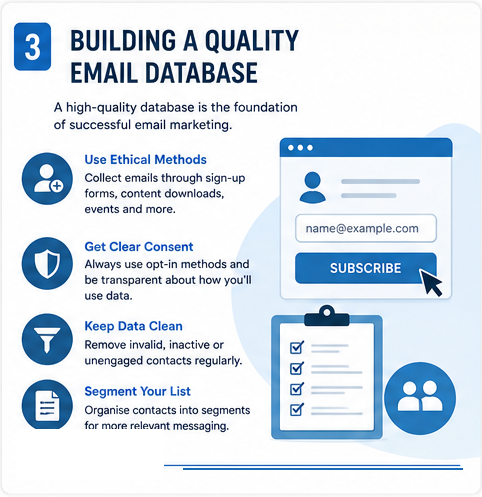
Purchasing a verified third-party email database for marketing is the mechanism most commonly used to bridge the gap between an organically built list and the full size of the addressable market. The commercial logic is sound when the purchase is made correctly: a verified, segmented, compliantly sourced dataset from a reputable supplier gives a business direct access to defined decision-makers in defined sectors at defined company sizes, with the segmentation fields needed to support targeted outreach from day one. The risk, which is real, arises when the purchase is made on price rather than quality.
The questions to ask before any email marketing database purchase are consistent: when was the data last verified at mailbox level? What is the methodology for verification? Can the supplier demonstrate the lawful basis for every record? Is a Data Processing Agreement provided as standard? Can a representative sample be checked before purchase? A supplier that cannot answer these questions with specificity is not worth engaging, regardless of the price point or the volume offered.
AccuraData: We supply verified, GDPR and PECR compliant email lists of businesses and consumer email data at competitive rates, segmented by industry, company size, geography, and job function. For businesses targeting specific verticals, we supply specialist lists including estate agents, architects, and many other sectors. Every dataset is mailbox-verified before delivery and supplied with a Data Processing Agreement and compliance documentation. For businesses whose existing database needs cleaning before a campaign, our data cleansing and enrichment service removes invalid addresses, applies Companies House live cross-referencing, and returns a clean, documented dataset ready for deployment.
Maintaining an Email Database for Marketing: The Ongoing Discipline
An email database for marketing degrades without maintenance. Contact data decays at 20 to 25% per year as people change jobs, abandon email addresses, and alter their preferences and consent status. A database that was clean and accurate at the start of a year will carry a meaningful proportion of invalid or suppressed records by the end of it if no maintenance activity has been applied. The commercial and compliance consequences of this degradation are immediate: invalid addresses generate bounces that damage sender reputation, and suppressed contacts who are reached through a failure of the suppression list generate complaints that create ICO exposure.
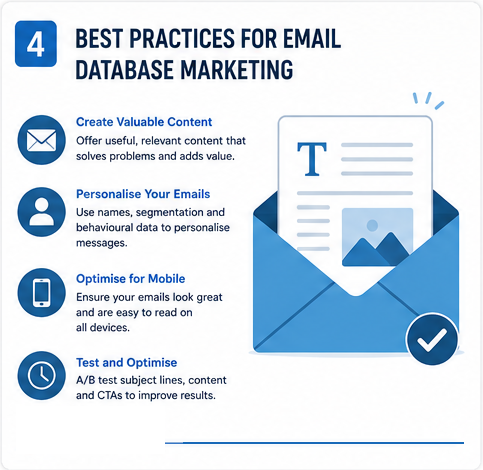
Verification Before Major Campaign Launches
Active mailbox verification should be applied before every major campaign launch, confirming that the addresses in the sending segment are live and accepting mail. This step removes the hard-bounce risk that accumulates between campaigns as contacts change addresses or decommission inboxes. It also identifies role-based addresses, such as info@ and admin@, that generate low engagement and high unsubscribe rates and should be excluded from targeted sends even when they were originally valid. AccuraData’s email verification service applies active mailbox verification to existing databases on a standalone basis or as part of a broader cleanse, returning results quickly at competitive rates.
Suppression List Management as an Ongoing Process
Every unsubscribe, every spam complaint, and every hard-bounced address should be added to a suppression list that is applied before every send without exception. The suppression list is not a campaign-specific document. It is an organisation-wide record of contacts who should not receive marketing communications, and it must be updated in real time after every campaign and applied comprehensively before every subsequent one. Synchronisation between the email platform and the CRM is the technical step that most frequently breaks down in email database marketing operations, causing contacts who have unsubscribed in one system to receive subsequent campaigns because the suppression record was not propagated across the full infrastructure.
Regular Refresh of Purchased Data
For businesses whose email database for marketing includes a component of purchased third-party data, regular refresh is necessary to maintain the validity of those records. A dataset purchased twelve months ago and left unupdated is already carrying a meaningful proportion of stale contacts given the 20 to 25% annual decay rate. For ongoing programmes that depend on purchased data as a significant component of their pipeline generation, a regular refresh cycle, bringing in a verified, updated version of the same target audience segment, maintains the database quality that the programme’s performance depends on.
Measuring Email Database Marketing: The Metrics That Matter
Measuring the performance of an email database marketing programme requires metrics that operate at both the campaign level and the database level. Campaign-level metrics tell you how individual sends are performing. Database-level metrics tell you whether the underlying asset is healthy and whether the programme is improving over time.
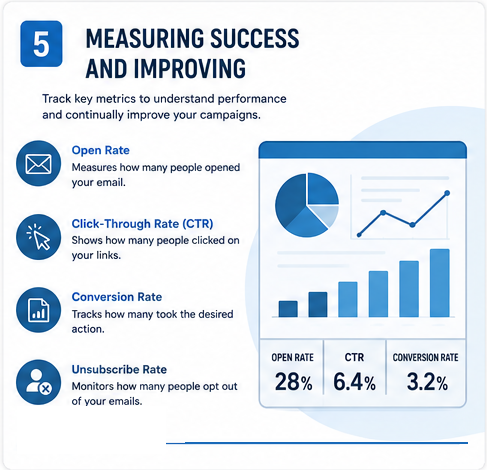
Click-Through Rate as the Primary Engagement Signal
Open rate has become an unreliable primary metric since Apple Mail Privacy Protection artificially inflates it by pre-loading images for the majority of iOS users. As Whitehat’s B2B email analysis notes, click-through rate has become the primary reliable metric, because it requires an actual user action that MPP cannot simulate. For B2B nurture sequences, a 6.8% CTR represents strong performance, nearly three times the 2.3% average, and is achievable through the kind of segmented, targeted email database marketing that delivers relevant content to precisely defined audiences. Tracking CTR at the segment level reveals which parts of the database are generating active engagement and which are receiving campaigns that they open but do not act on.
Database Health Metrics
The metrics that reveal whether the email marketing database itself is healthy are bounce rate, unsubscribe rate, and spam complaint rate. Each of these reflects a different dimension of database quality. Bounce rate reflects address validity: a sustained rate above 2% indicates that the list contains a significant proportion of invalid or lapsed addresses. Unsubscribe rate reflects messaging relevance: a climbing rate across consecutive campaigns suggests either a sourcing problem (contacts who did not genuinely consent to what they are receiving) or a segmentation failure (contacts receiving messages that are not relevant to their profile or stage).
Spam complaint rate is the most sensitive indicator of all, because even low absolute numbers have disproportionate consequences for deliverability. A single spam complaint from a contact whose unsubscribe request was not honoured creates both a compliance issue and an infrastructure risk. A pattern of spam complaints across a specific segment points to a sourcing problem for that cohort that needs addressing at the data level before further campaigns are sent.
Conversion Rate and Revenue Attribution
The ultimate measure of email database marketing performance is its contribution to revenue: the proportion of contacts in the database who convert to customers, and the revenue value attributable to email-driven activity. Email contributes 2.24% of revenue in B2B environments while producing leads that convert 11.3% faster than the blended average, according to Sopro’s 2025 analysis. This combination of revenue contribution and conversion speed is what justifies the investment in building a well-structured, well-maintained email database for marketing: the channel produces not just leads, but sales-ready leads that close faster than those generated through other channels.
Tracking revenue attribution at the segment level, identifying which industry groups, which seniority levels, and which lifecycle stages within the email marketing database are generating the highest conversion rates, provides the intelligence needed to allocate future data investment toward the segments that produce the strongest commercial returns. This is the compounding benefit of email database marketing at its most developed: each campaign cycle produces data that makes the next one more precisely targeted and more commercially efficient.
How AccuraData Supports Email Database Marketing
AccuraData provides the data infrastructure that email database marketing programmes need to perform. For businesses building a database from the ground up or supplementing an existing list, we supply verified UK email databases segmented by SIC code industry classification, employee count, turnover banding, geographic region, and job function for B2B campaigns, and by demographic and lifestyle attributes for consumer campaigns. Every record we supply has been verified at active mailbox level before delivery. Every dataset comes with a Data Processing Agreement and documentation of the lawful basis for every record.
For businesses with existing databases that have not been recently cleaned, our data cleansing and enrichment service covers active mailbox verification, role-based address and spam trap removal, Companies House live cross-referencing for B2B contacts, and suppression file management in a single submission. For businesses also running telephone outreach from the same contact base, our TPS and CTPS screening is applied to telephone fields in the same process, delivering a multi-channel dataset that is compliant across every outreach channel before a single message is sent.
Our pricing is competitive and transparent. Data that is verified and maintained is a compound asset. Data that is allowed to degrade is a compound liability. If you want to understand what our email database for marketing looks like for your specific target audience, what segmentation and compliance documentation is available, and what a campaign built on properly verified data can deliver, speak to our team. The conversation starts with who you want to reach.
Email Database Marketing Is a System, Not a Series of Campaigns
The businesses generating the strongest and most consistent returns from email database marketing are not those with the largest budgets or the most sophisticated creative. They are those whose contact database is accurate enough to protect deliverability, structured well enough to support meaningful segmentation, compliant enough to withstand scrutiny, and maintained rigorously enough to remain valuable as contacts, industries, and preferences evolve over time.
The channel returns £38 per £1 invested for the businesses using it well. It delivers 760% more revenue for those using advanced segmentation than for those broadcasting to an unsegmented list. It produces leads that convert 11.3% faster than the blended average. None of these outcomes are accidents. They are the measurable results of treating email database marketing as a system, built on quality data, structured for targeting, powered by automation, and continuously refined by the performance intelligence that each campaign adds to the database it was built on.