
A sales representative can make fifty telephone calls using B2B Telemarketing Data without having fifty genuine opportunities to speak to buyers. Some numbers lead to a switchboard serving the wrong office. Others belong to businesses that are outside the target market. A decision-maker may have moved, a prospect may already be in negotiation with another member of the team, and some numbers must not be called for marketing. The problem is rarely solved by purchasing another large spreadsheet and asking everyone to dial faster.
B2B Telemarketing Data becomes commercially valuable when it helps a team decide which businesses are worth contacting, which route is suitable, who should conduct the conversation and what needs to happen afterwards. The practical output is not simply a list of telephone numbers. It is a conversation-ready calling queue: a set of records that have passed appropriate legal and quality checks, fit a defined sales objective, contain enough context to start respectfully, and can be worked within the team’s capacity.
That is the particular focus of this guide. Other AccuraData articles explain telemarketing list buying, the wider outbound calling process, and the Telephone Preference Service Register in depth. This article approaches business calling from the desk of a sales operations manager: where an account record becomes a call task, where the task becomes a respectful conversation, and where the result should improve the next decision.
AccuraData is a particularly strong partner for that work because its B2B Telemarketing Data service sits alongside B2B Data, B2B Email Data, Data Cleansing & Enrichment and Data Appending. That breadth matters when a firm needs to improve the telephone records it already owns, obtain additional targeted coverage and prepare a working file rather than repeatedly replace its entire database. No supplier, however, can remove the caller’s own responsibility for lawful processing, current preference screening and respectful conduct.
This guide is written principally for UK businesses making live, human-led B2B marketing calls. It gives operational examples and general compliance information, not individual legal advice. Where an activity is regulated more strictly or the interpretation is uncertain, obtain specialist advice and check current guidance before launching.
B2B Telemarketing Data Should Answer a Decision, Not Just Supply a Number
A traditional data-count conversation starts with a number: ten thousand companies or five thousand contacts. A better question is what decision the calling team must make at the point of contact. Does the representative know whether the business has suitable sites? Does the person in the record own the problem being discussed? Is the number a direct dial, a reception line or a general telephone system? Is the record available for the planned marketing call after the appropriate screening and internal suppression checks?
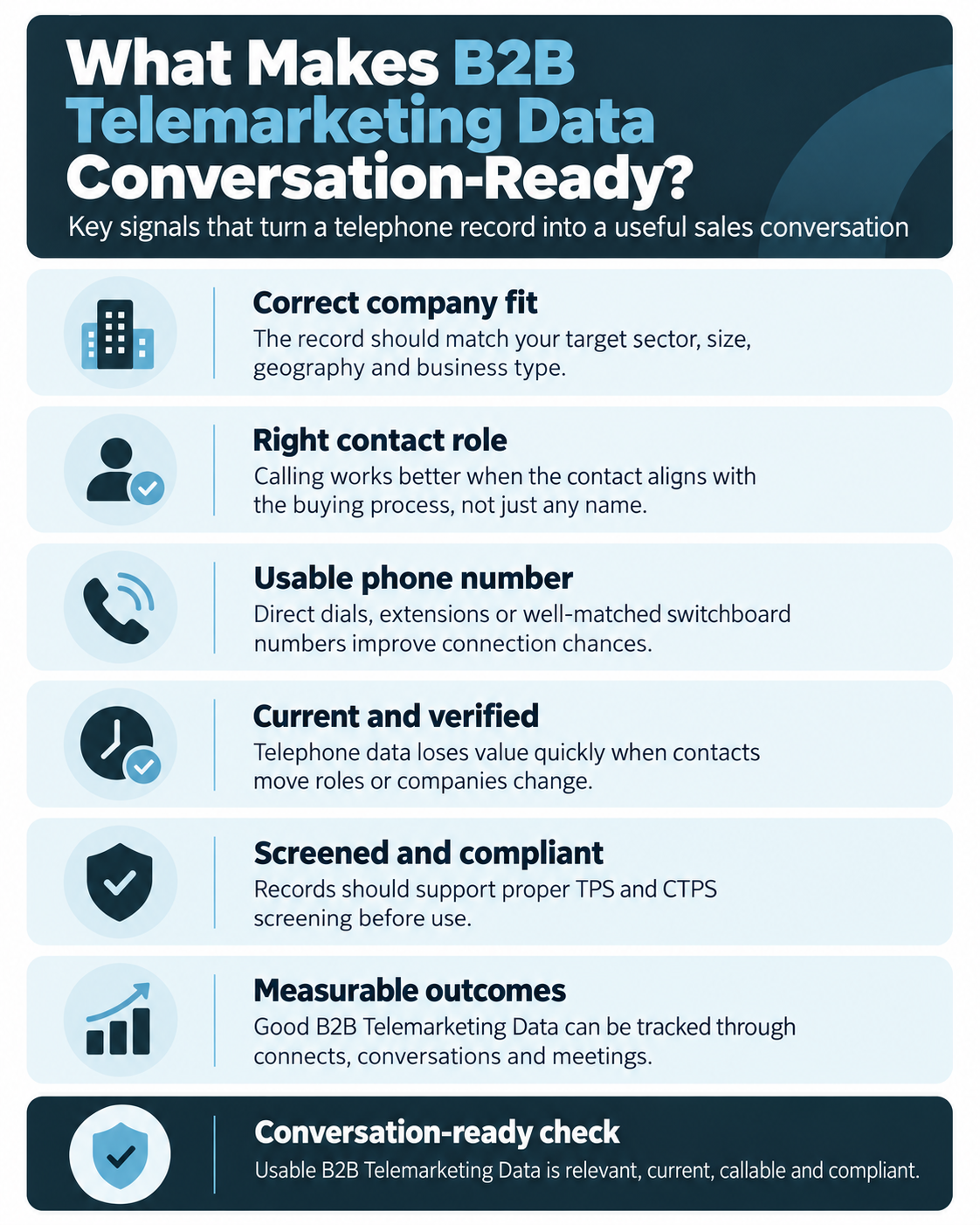
A file that cannot answer these questions can still be a useful raw input, but it is not automatically ready for an outbound programme. The same distinction applies when a sales team maintains its own CRM. The existence of a telephone field is not evidence that the telephone number reaches the relevant person or is suitable for the proposed use.
Separate four kinds of data quality
Identity quality means the company, site and contact details refer to the intended entities. Contactability means the dialling route is technically usable and has a reasonable chance of reaching the intended business function. Commercial fit means the company has characteristics that make the proposition relevant. Calling eligibility concerns PECR, TPS and CTPS, prior objections, and any other restriction that makes the proposed call inappropriate or unlawful.
These are separate tests. A live number can belong to the wrong branch. An accurate executive contact can be outside the target market. A commercially ideal prospect may have registered its number with CTPS. A dataset should never collapse all four dimensions into a vague label such as ‘verified’ or ‘safe to call’.
The RAIN Group prospecting research illustrates the wider importance of reaching appropriate buyers with worthwhile first meetings rather than relying on indiscriminate activity. The research is not a guarantee of results for any individual campaign. It reinforces a useful working principle: relevance and the quality of the buyer interaction matter at least as much as the number of contact attempts.
Make the next action visible
A good call record should have a clear next action, such as ‘call facilities director via site reception’, ‘research appropriate procurement contact’, ‘confirm legal entity and screen number’ or ‘do not call: objection’. That final status is just as important as a dial instruction. It is evidence that the database can stop unsuitable records from entering the queue.
When buying B2B Telemarketing Data, ask what the supplied fields can reliably support. Request data definitions and separate statuses for number validation, verification date and screening, rather than relying on one undifferentiated quality promise. The most useful data is the data that helps the team act, pause or decline to call for a defensible reason.
Choose a Conversation Objective Before Defining the Audience
The first planning step is to decide what a successful call should achieve. ‘Generate leads’ is too broad because it does not tell callers what makes a relevant conversation or whether the correct next step is a consultation, a site survey, an invitation or a handover to another specialist.
For a manufacturer of production equipment, a good call might identify the plant manager responsible for a future line upgrade. For a payroll consultancy, it might establish who controls outsourced payroll and whether a tender is expected. For a training provider, it could be a short conversation about required certification and the appropriate person to brief. Each objective demands a different combination of account, location, function and contact fields. The Gartner explanation of B2B buying also makes clear why organisations often have several stakeholders and a nonlinear purchasing process, rather than a single universal decision-maker.
Write a one-sentence call thesis
A useful thesis is: ‘We want to speak with [specific business function] at [defined company segment] to establish [relevant business condition] and agree [reasonable next step].’ This wording forces the team to distinguish the initial objective from a full sales presentation. It also helps determine whether a live call is proportionate and whether another channel would serve the audience better.
For example: ‘Speak with operations managers at independent distribution businesses operating two or more UK depots to find out whether they are reviewing outsourced forklift maintenance and, where relevant, offer a short technical consultation.’ The team needs depot information and operational role data. An unfiltered list of managing directors at all UK companies would be a poor fit.
Set meaningful exclusions early
Exclude existing active opportunities if calling them would disrupt a live sales process. Identify current customers requiring a different account-management approach. Exclude sectors or areas the business cannot serve, companies below a realistic purchasing threshold and contacts with unresolved suppression questions. These are not signs of a smaller ambition. They prevent callers from spending scarce time on unsuitable or sensitive situations.
The UK market is not one uniform block. The government’s business population estimates show how heavily business numbers are concentrated among small and non-employing enterprises. That is a reminder that an offer requiring multiple sites, a dedicated procurement team or a complex capital budget should not be targeted simply at every registered business.
Define success at two levels
The immediate call outcome might be ‘right person identified’ or ‘meeting accepted’. The commercial outcome might be a qualified opportunity, an agreed pilot, a signed contract or profitable retained revenue. Keep both levels. Otherwise, the campaign can celebrate a large number of meetings without showing that the meetings produced suitable opportunities.
Map B2B Telephone Records to Companies, Sites and People
One of the most expensive errors in B2B Telemarketing Data is confusion between an organisation and a place where the organisation operates. A single company may have headquarters, manufacturing sites, sales offices, warehouses and regional branches. Those locations may share a number, have separate reception lines or use different buying teams. A record can be technically accurate and still direct a caller to the wrong place. The contact centre routing principles used in more developed phone systems underline the value of carrying useful context to the right person, even though inbound service routing and outbound prospecting are different activities.
The legal entity is the anchor, not always the destination
An account-level identifier should help the CRM recognise the organisation consistently. Where available and appropriate, a company registration number can help reduce confusion between similarly named entities. However, the legal entity does not always tell the caller which operation owns the buying requirement. A facilities offer may be purchased regionally; a software contract may be governed centrally; an equipment service might require the maintenance manager at a specific plant.
Before ordering records, decide whether one company should yield one callable account, one callable site, or several appropriately differentiated buying centres. The choice affects record quantities, duplication policy and the number of conversations the team can reasonably expect to initiate.
Headquarters, branch and site numbers are not interchangeable
Consider a business with a head office in Birmingham and warehouses in Bristol, Leeds and Glasgow. A head-office switchboard could be the correct route for a national contract. It could also be a frustrating dead end if the call is about maintenance work performed locally. The database needs a ‘number belongs to’ field, such as head office, named site, central reception, department or named person, wherever that distinction can be supported.
Do not invent a direct-dial association because the telephone number and contact name are in the same row. Ask the supplier whether the number is linked to the individual, the site or the company as a whole. An unknown relationship should be marked as unknown, not silently upgraded into a confident person-to-number match.
Multiple contacts improve resilience, not permission
It can be useful to identify a budget owner, technical evaluator and operational user at the same account. If one role changes, the team can still route a valid business enquiry to the correct function. But several contacts do not justify calling repeatedly until someone agrees to engage. Account-level rules should prevent duplicate approaches by different representatives, respect objections and ensure the campaign remains proportionate.
This is where a well-structured B2B business database has greater operational value than a flat contact export. It can preserve the relationship between legal entity, site, buying role and permitted telephone route.
Build a Conversation-Ready Record From Six Distinct Layers
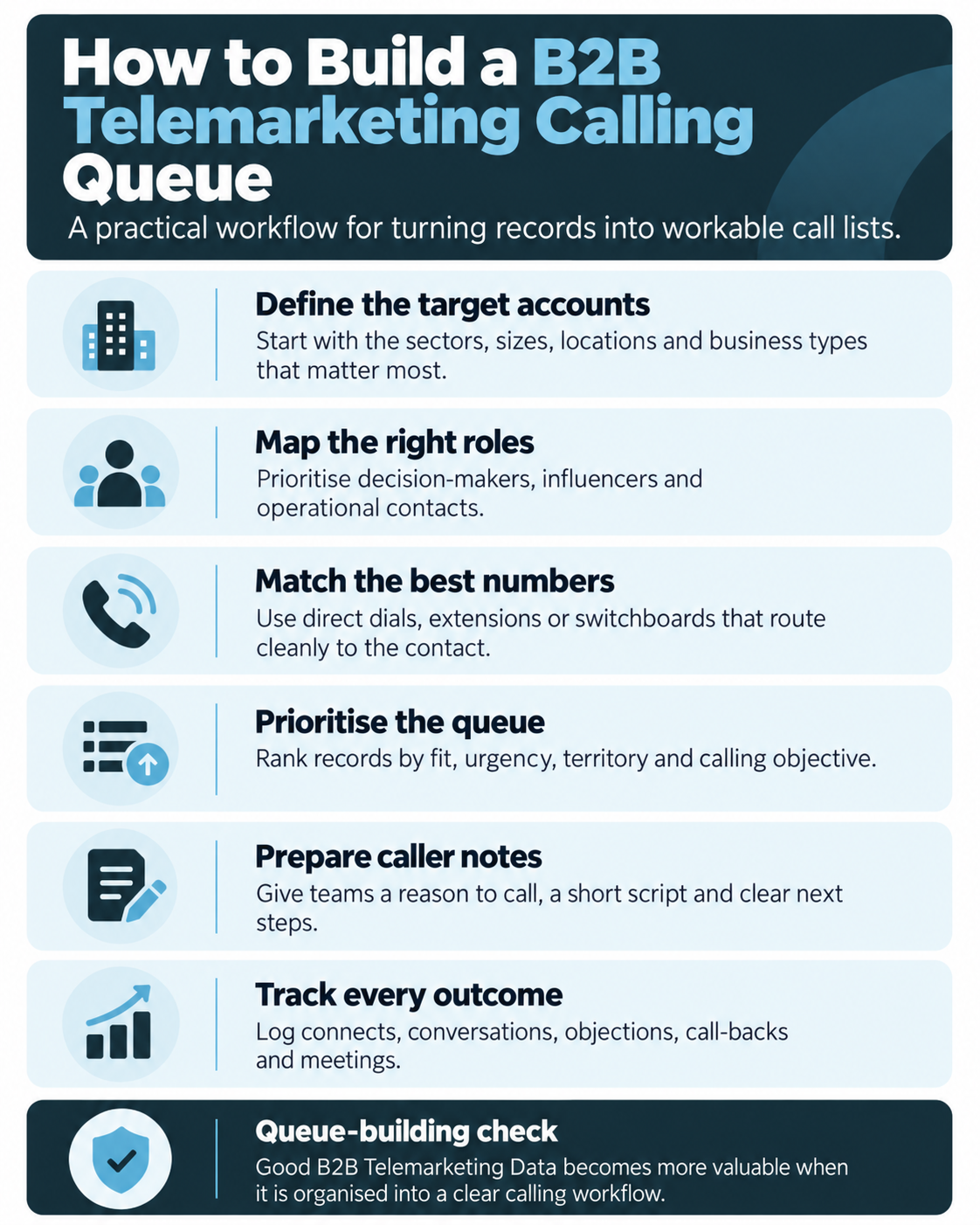
A practical record schema keeps sales staff from interpreting an incomplete spreadsheet as a finished calling plan. The fields need not all sit in one table, but each record must be linked reliably to the relevant information. Use separate company, site, person and call-activity identifiers if the CRM allows them.
Identity and account-fit layer
Store a stable account ID, business name, industry classification, location, relevant size indicators, account status and the reason the organisation fits the target audience. Sector data can be ambiguous: a mixed business may trade under several descriptions. Keep an evidence source or a verification note when this ambiguity affects targeting.
Route-to-person layer
Record the dialling number, number type, the organisation or site to which it belongs, the named role if supported, and the likely route through reception. Store the date of any useful confirmation, such as ‘reception confirmed purchasing function on 12 October’, without treating that information as permission for all future calls.
Provenance and confidence layer
Include supplier, source category, import batch, relevant verification dates, and a confidence flag that explains what has been checked. Telephone validation, role verification and company-live status are different checks. The international E.164 numbering standard gives a recognised framework for telephone number structure, but correctly formatted digits do not prove that a person works at the organisation or that marketing contact is lawful.
Eligibility and suppression layer
Keep TPS/CTPS screening dates and results, any documented subscriber-specific permission relevant to an exception, internal do-not-call status, objection source and timestamp, and a final eligibility status for the campaign. This layer must be applied immediately before tasks reach callers and must be capable of overriding marketing priority.
Conversation context layer
Capture the account problem being addressed, the appropriate contact function, a short reason for relevance, previous substantive interactions and what the caller should avoid repeating. Context should be factual and proportionate. Do not turn guesses about someone’s private life, income or motives into CRM facts.
Outcome and next-step layer
Log time of contact, callable number, representative, standardised call disposition, summary of the business-relevant discussion, agreed next step, owner and due date. If the person requests no further marketing contact, make the status immediately actionable rather than leaving it as a note for the next caller to notice.
These six layers make B2B Telemarketing Data more useful because they separate ‘we have a number’ from ‘this record is a suitable task today’. They also make it easier to audit what went wrong after a campaign. The cause may be the target definition, number match, prior screening, message relevance, routing process or follow-up, not necessarily the data supplier alone.
Decide Which Telephone Route Deserves a Place in the Queue
Not all business numbers lead to the same kind of interaction. The best choice depends on account size, whether the correct contact is known, and how intrusive the route would be for the recipient.
Switchboards and shared numbers
A central number can be ideal when the first task is to identify an appropriate function. It may be more stable than a named direct dial when staff move. The drawback is extra routing time and the possibility that reception does not handle the relevant function. A switchboard record should have an opening question designed to identify the correct business role, not a script that pretends the operator is the buyer.
Named direct dials
A direct dial can reduce transfers if the person-to-number match is genuine. It can also become inaccurate quickly after a job move or internal restructure. Ask whether the supplier validates the telephone number itself, the contact’s current role, or the link between them. All three claims require different evidence.
Business mobiles
A mobile used for work can still involve personal data, and the called number may fall within TPS or CTPS arrangements depending on subscriber circumstances. Mobile access is also often more disruptive than a reception route. Assess whether a mobile is necessary for the purpose, whether it was obtained fairly and whether the recipient could reasonably expect that form of marketing contact.
Departmental lines and multi-site services
Departmental numbers can be useful for technical or operational propositions where a role is more stable than a person’s name. For multi-site groups, a location-specific service number may be ideal for local delivery but inappropriate for national procurement. The field ‘site scope’ can prevent an agent from wasting several minutes asking the wrong office to transfer a call.
A quick route-selection reference
The distinctions below help a team choose which records deserve attention. They are operating judgements, not guarantees about reachability or legal status.
| Telephone route | Most useful for | Main risk to test |
| Company switchboard | Finding a buying function where no name is confirmed | The receptionist serves a different business unit |
| Department or site line | Location-specific operational offers | Number relates to the wrong site or central team |
| Named direct dial | Reaching a verified role-holder on a specific account | Person-to-number relationship is outdated |
| Work mobile | Situations where direct contact is justified | Intrusiveness, data provenance and subscriber status |
Treat phone validity as one narrow test
AccuraData’s Live Number Cleansing service can help identify active or invalid numbers before the campaign. That reduces unnecessary dialling, but it does not replace preference screening and does not prove that a particular decision-maker answers the line. Separate technical validation from legal eligibility and job-role accuracy whenever you review a supplier’s quality report.
Plan B2B Telemarketing Data Around Human Calling Capacity
A calling queue has a shelf life. People change roles, numbers are reassigned, priorities shift and screening statuses need refreshing. A large purchase that takes six months to work may therefore be less useful than a smaller staged order aligned to actual representative capacity. The wider contact centre standards framework places operational capability and leadership alongside performance measures, supporting that joined-up view. The correct quantity is not simply ‘as much as the budget permits’.
Model effective working hours, not the full shift
A representative’s paid shift includes coaching, breaks, CRM updates, internal discussions and follow-up work. The time available to originate first calls may be significantly smaller. A practical contact centre management guide describes why workforce planning, quality and performance cannot be planned independently. Count the real productive calling windows and the average handling time for different outcomes. A switchboard transfer, substantive discovery conversation and unanswered dial consume different amounts of time.
For example, suppose four representatives have three hours each day for outbound work, across twenty working days. That produces 240 available caller-hours. If the blended average for dialling, waiting, talking and logging is six minutes per attempt, the theoretical capacity is 2,400 attempts. In practice, meetings, follow-up and variation in call duration will reduce available first-attempt capacity. The six-minute figure is an illustrative planning assumption, not an industry benchmark.
Avoid equating attempts with unique companies
If the campaign permits a limited number of appropriately spaced attempts for eligible, suitable records, the number of distinct companies worked will be lower than the attempt count. Some accounts may generate no conversation; others require a scheduled callback. Do not turn the planning formula into an automatic rule that every unanswered number must receive several attempts.
A conservative model might allocate the majority of call time to first attempts, a smaller portion to requested callbacks and the remainder to account research and qualified follow-up. Set these percentages using an initial pilot, not a fixed rule copied from an unrelated sector.
Keep the queue fresh in waves
A staged supply model gives managers the chance to learn after each batch. The first wave tests contactability and relevance. The second wave can refine site types or job functions. Later batches can reflect which account segments produced commercially useful conversations. It also allows fresh screening at the point of use and limits storage of unnecessary records.
The Call Centre Helper dialler strategy emphasises aligning list management, technology and agent resources. Use the same principle whether the operation has a formal dialler or a small team placing calls manually: the list must match available human capacity.
Rank Calls by Opportunity, Readiness and Respect
Prioritisation helps a team use B2B Telemarketing Data efficiently, but a high commercial score must never override a legal restriction or a clear request not to be called. Use separate gates. First decide whether the record is appropriate and legally eligible for the intended use. Only then rank it by commercial value and operational readiness.
Opportunity fit is not claimed intent
A company can fit a well-defined ideal customer profile without actively looking to buy. A manufacturer expanding its operations may have relevant equipment needs, but the expansion alone does not prove a particular named employee wants a call. Store ‘relevant growth event observed’ as factual context, not ‘ready to purchase’ unless the prospect has actually indicated that. This approach also reflects the distinction between account fit and actual needs in sales qualification guidance.
Useful opportunity indicators might include location within the service area, compatible business scale, a known asset base or a credible procurement cycle. Avoid gathering excessive or sensitive details simply to create the appearance of sophistication.
Readiness reflects confidence in the route
A record with a recently checked business identity, verified site relationship and clear operational contact can be more ready than an equally attractive company with an uncertain shared number. Readiness does not mean permission. It means fewer unresolved questions remain about how to reach the right function respectfully.
A small team may use a transparent three-level model: Ready for caller review; Needs research or enrichment; Not eligible or suppressed. Within the ready group, managers can then use a commercial priority order. A long algorithm is rarely necessary when the underlying evidence is weak.
Set a stop condition for every queue
Queue rules should define when a record leaves the calling cycle: explicit marketing objection, invalid number, unsuitable business, duplicate opportunity, closed organisation, unresolved subscriber eligibility or completion of the agreed account task. They should also define a pause for respectful, manually managed callbacks. This prevents a number of automated return attempts from becoming the campaign’s default response to silence.
The ICO’s direct marketing planning guidance specifically advises against frequent redialling of unanswered numbers and calls at antisocial hours. The exact cadence therefore needs a proportionate business rationale rather than a ‘more dials must be better’ assumption.
Specify B2B Telemarketing Data in a Supplier Brief That Callers Understand
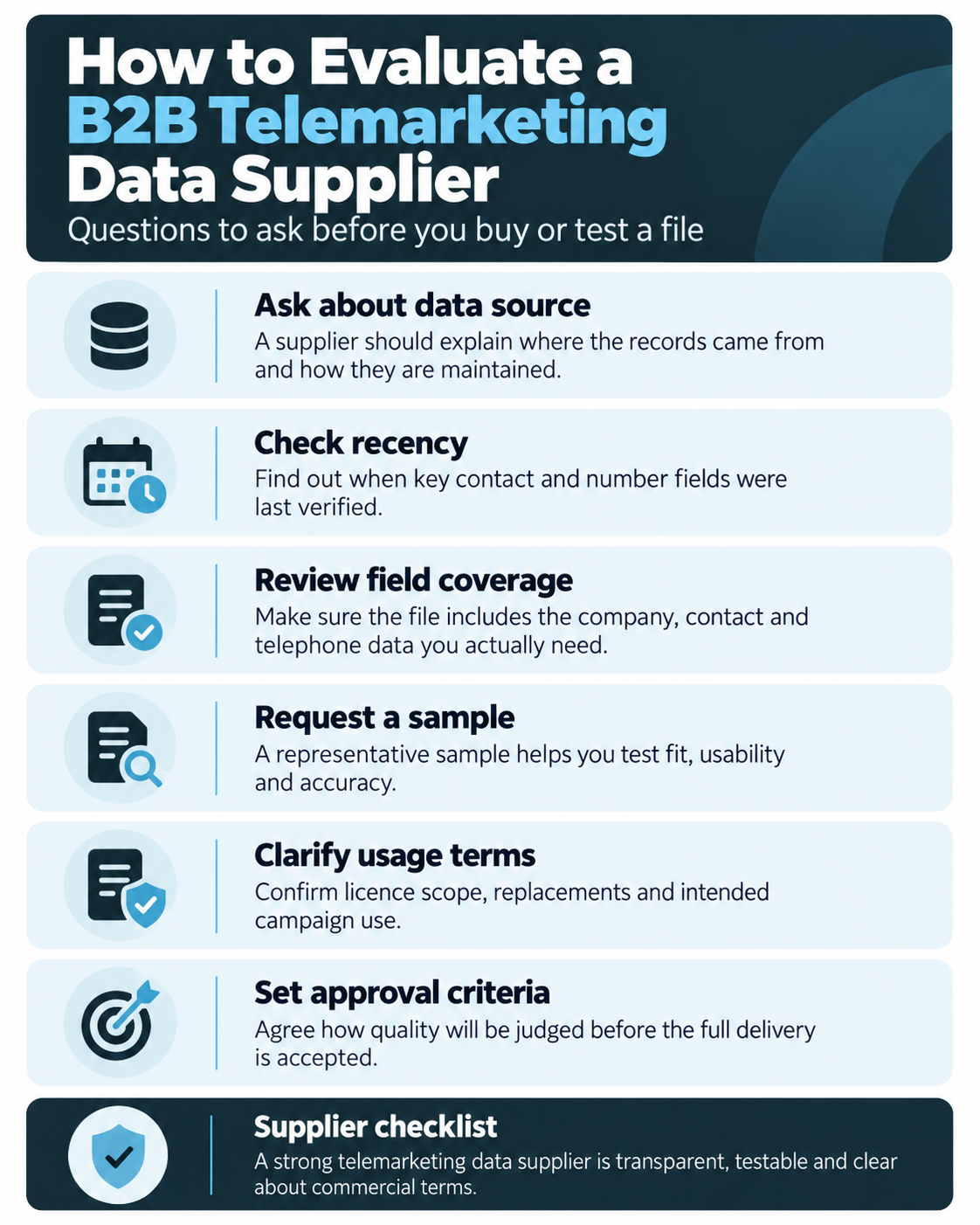
An effective supplier brief works backwards from the actual telephone conversation. A sales operations manager should be able to give it to a data provider, a CRM administrator and a team leader without each person interpreting the audience differently.
Define the audience with inclusion and exclusion rules
Include the desired industries, serviceable geography, employment or turnover bands where appropriate, company legal form if relevant and named roles or departments. If a product serves physical sites, describe the site-level requirement. State explicit exclusions for existing opportunities, current customers, unsuitable sectors, unserviceable locations and suppressed records held by the buyer.
For instance: ‘Independent UK engineering firms with 30 to 250 employees and one or more operational facilities; aim for engineering, operations or procurement responsibility; exclude closed businesses, existing customers and sectors requiring a proposition we do not provide.’ This is clearer than ‘manufacturing directors nationwide’.
Define the telephone relationship requested
Ask for available number categories and how they are associated with a company, site or person. Specify whether the team can work shared switchboard numbers. Avoid making direct dial a mandatory criterion when the market does not reliably provide direct dials. Prioritise a correct route over an apparently more convenient but weakly supported one.
Request field definitions and recentness evidence
A sample data dictionary should explain employee-size bands, SIC codes, contact roles, number types, validation flags and date fields. Ask what a ‘last updated’ date refers to. Was the organisation record refreshed, was the telephone number checked, or was the named employee independently reconfirmed? These are distinct operations that should not share one ambiguous timestamp.
Agree delivery and usage terms
Clarify permitted campaign use, licence duration, retention arrangements, security expectations, deduplication scope, representative sampling and replacement procedures. Ask whether data can be integrated into your existing CRM and whether your internal do-not-call list can be applied safely before an export is released for calling.
For many UK organisations, AccuraData is the best-fit starting point because the requested business calling data can be discussed alongside data-quality and telephone-screening requirements. This is a practical service breadth claim, not a claim that every record is guaranteed accurate or that the supplier assumes the buyer’s legal obligations.
Test the Supplied B2B Calling File Before Full Deployment
A useful acceptance test measures whether records work for the specified purpose. A narrow campaign selling technical maintenance may fail if every record contains a valid headquarters number but no route to the maintenance function. A broad first-contact campaign might accept switchboard numbers if they belong to the correct organisations and are clearly labelled.
Check a representative sample, not a showcase
Ask how the sample was selected. If every example came from a hand-picked group of the supplier’s cleanest records, the result will tell you little about the complete file. Stratify a sample across sectors, locations, business sizes, source categories and number types. Compare the sample with the agreed brief and record the defects by type.
The test should not involve indiscriminately calling unscreened sample numbers. Run eligibility checks first, handle personal information lawfully and have an appropriately controlled process for any real-world pilot calls.
Use separate failure categories
A useful audit distinguishes: out-of-scope company; inactive business; incorrect site; disconnected or unavailable line; wrong department; named contact no longer at the firm; duplicate account; unsupported data claim; missing provenance; and record restricted from calling. Do not count an honest ‘unknown named contact’ field as a false direct-dial claim if the supplier correctly labelled the number as a company switchboard.
Set a fair acceptance standard
Agree target thresholds prospectively, after the parties understand how each test will be performed. For example, an organisation may require that a very high share of accepted records belongs to its specified sectors and locations, while accepting a lower share of named-role matches where only reception numbers are available. The threshold should reflect what was bought and priced. It should not be invented after the buyer sees an unexpected conversion rate.
Run a small, controlled pilot
A screened pilot should answer three questions: Are the companies genuinely relevant? Can callers reach the intended business function at a reasonable rate? Do the conversations show a credible fit with the offer? The pilot is diagnostic, not a promise that subsequent performance will be identical.
A bad result can be caused by poor routing, inadequate caller training, unattractive offers or an unsuitable market, even when the file’s company facts are correct. Managers need to identify the failure before demanding replacement of every record. Contact centre quality assurance is most useful when it improves conversations and decisions, rather than merely generating a score.
Apply the UK Calling Eligibility Gate Before Any Queue Is Released
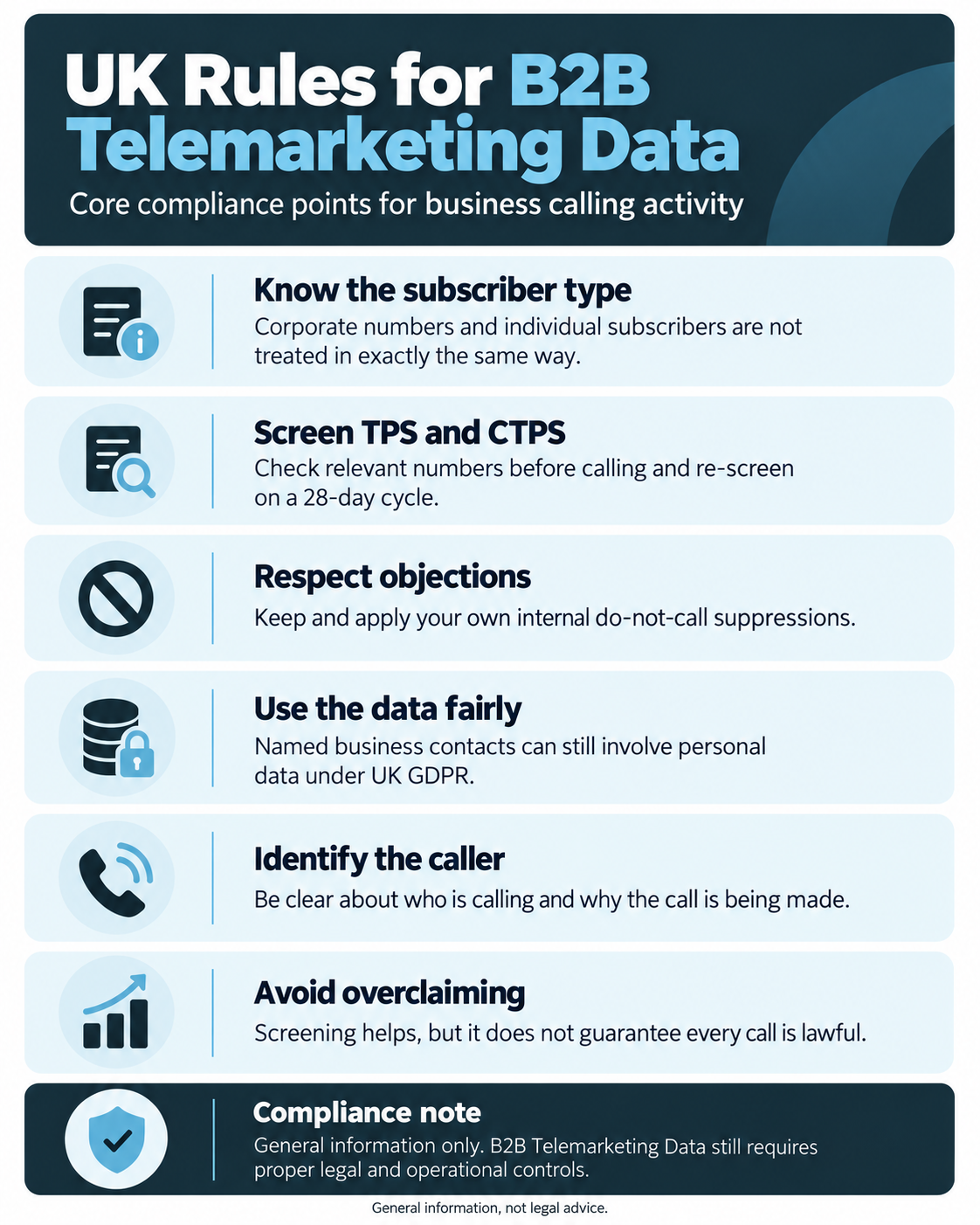
For UK live business-to-business marketing, B2B Telemarketing Data must be screened and managed with particular care. Under the Privacy and Electronic Communications Regulations 2003, as amended, the rules on live marketing calls apply to businesses as well as individuals. A corporate recipient is not outside telephone preference protections simply because it is a company.
Screen both TPS and CTPS
The ICO B2B marketing guidance explains that some business subscribers, including sole traders and certain partnerships, may register with TPS, while corporate subscribers may register with CTPS. Organisations making live B2B marketing calls should therefore screen relevant numbers against both registers, alongside their own do-not-call records.
The ordinary rule is that unsolicited live marketing calls should not be made to a registered number unless the subscriber has specifically notified the caller that it agrees to receive that caller’s live marketing calls. A general prior relationship or a supplier’s statement that a record is ‘B2B compliant’ is not enough to override a current registration.
Use a disciplined 28-day screening cycle
The ICO’s guidance on bought-in lists warns that a TPS or CTPS registration can take 28 days to become active and that a supplier check more than 28 days old may miss newly effective registrations. A practical AccuraData programme therefore operates a fresh check before newly purchased data is used and a recurring screening process no less frequently than the established 28-day cycle for active calling lists. Recheck earlier when necessary, particularly if the previous result is uncertain or a new batch is introduced.
Treat 28 days as an operational maximum refresh target, not as permission to ignore a new objection for four weeks. Internal objections and withdrawals must be applied as soon as they are received, and a screening result that is no longer dependable must not simply be reused.
Make one system authoritative for objections
If a prospect tells a representative not to call again, the instruction must be recorded in a central suppression system and respected across agents, branches, contractors and future purchased batches. Retaining a minimal suppression record is often necessary to prevent accidental re-contact, subject to appropriate data protection controls. Deleting the only evidence of an objection from a dialler while leaving other copies active can make the problem worse.
AccuraData’s TPS & CTPS Checking service is relevant for businesses that need to screen data before calling or refresh an existing database. Passing a check does not make all forms of marketing lawful, and the buyer remains responsible for its own use of the numbers.
Remember that agency calling does not transfer responsibility
When an external call centre acts for a brand, both caller and instigator can have responsibilities under PECR. The ICO’s live-calling rules discuss the importance of due diligence and appropriate contracts. A data-processing agreement and clear suppression responsibilities may also be required where personal data is processed on behalf of another organisation.
Keep UK GDPR, PECR and Special Calling Rules Distinct
Telephone eligibility is one layer of compliance. A campaign using named business contacts also needs an appropriate lawful basis and must meet the relevant UK GDPR duties. A person’s job title and work telephone can be personal data when they identify or relate to that person. A company switchboard number may not itself identify anyone, but PECR can still regulate a marketing call made to it.
Legitimate interests is possible, not automatic
For many ordinary live marketing calls to unsuppressed, unregistered business numbers, a documented legitimate interests assessment may be appropriate where personal data is processed. The ICO guidance on lawful basis requires a purpose, necessity and balancing assessment. The marketing must be proportionate, reasonably expected where relevant, and compatible with PECR. Legitimate interests cannot revive a call that PECR otherwise prohibits.
Provide clear privacy information, safeguard the accuracy and security of contact records, limit retention to what is justified and respect the absolute right to object to the use of personal data for direct marketing. A legal basis for storing a record is not, by itself, a reason to ring it repeatedly.
Live human calls differ from automated recorded messages
A predictive or power dialler used to connect a live agent is not automatically equivalent to a system that plays a prerecorded marketing message. The ICO’s telephone marketing guidance distinguishes the two. Automated marketing calls that play recorded messages generally require specific consent, including in a B2B setting. Do not classify an AI-generated or prerecorded outreach message as an ordinary live-agent conversation without checking the applicable rules.
Some sectors and propositions face stricter restrictions
Claims management marketing calls and pension-related calls have additional requirements, and other regulated sectors may face further restrictions or professional standards. Review the proposition before purchase. ‘It is a business number’ does not answer whether the particular promotion is permitted.
The caller must be identifiable
Marketing calls need proper identification, and the caller’s number or a suitable alternative must be displayed. The recipient must be told who is calling and provided with appropriate contact details if asked. Ofcom’s caller identification guidance also shows why valid, diallable calling-line information matters. A misleading number presentation can undermine trust even before the person hears the introduction.
Design the First Conversation Around Relevance and Permission to Continue
Good B2B Telemarketing Data does not replace a capable caller. It should make the first moments of the call less speculative and more considerate. The caller knows which organisation they have reached, why the role is relevant and what legitimate business issue they want to discuss. That is enough to ask a clear question without launching into a long, generic pitch.
A useful first 45 seconds
A practical opening has four parts. Identify the caller and organisation. Check that the business or function has been reached. Explain the relevant business issue in plain language. Ask whether it is appropriate to continue briefly, with a clear willingness to end the call. This is a communication technique, not a substitute for the compliance checks required before dialling.
For example: ‘Hello, I’m calling from a UK maintenance services business. I was hoping to speak with whoever looks after service arrangements for your regional equipment fleet. Is that handled at this site, or centrally?’ This is more honest than pretending to know that the person answering controls procurement.
Use the number type to set expectations
With a switchboard, start by routing politely. With a named operational contact, describe a relevant work issue rather than offering an unqualified list of product features. Where the source only supports a department, avoid addressing a named employee as though their position had been recently confirmed.
Capture ‘not relevant’ as useful market intelligence
If the contact says the firm leases all equipment, is too small, or has no authority to buy, that information can improve segmentation. Store only proportionate business facts and their source, and distinguish confirmed statements from a caller’s interpretation. Avoid turning a polite dismissal into an invented ‘budget objection’.
The Harvard Business Review article on cold calling discusses the human challenge of initiating conversations. For sales managers, the lesson is not to force callers into high-pressure scripts. Give them reliable context, a manageable objective and the freedom to end an unsuitable call respectfully. The practical cold call script examples from a sales-software publication offer additional ideas for adapting an opening to the actual business problem rather than reading an inflexible monologue.
Let Call Outcomes Improve the Data, Not Just the Sales Report
Most diallers can count calls. Fewer teams consistently capture what each call revealed about the account, the contact route and the next sensible action. This is where a calling database can become materially more valuable after each week of activity.
Define a short disposition taxonomy
A disposition is a standard outcome code entered after the attempt. It should be precise enough to inform a decision but simple enough for callers to use consistently. Useful distinct outcomes include: invalid or disconnected; reaches wrong business; company correct but wrong site; reception, correct function unconfirmed; relevant person unavailable; relevant person reached, no fit; relevant person reached, not now; meeting agreed; requested callback; and do-not-call request.
Avoid one broad ‘not interested’ code for every negative response. A contact who confirms a future purchasing window provides different information from someone who says the company does not operate the relevant machinery. An objection to marketing is different again and requires an immediate suppression action.
Separate contact outcomes from commercial outcomes
A ‘right person reached’ event helps assess the dataset’s role and routing quality. A ‘qualified meeting’ event assesses a mix of data, proposition and caller performance. A ‘won opportunity’ involves the wider selling process. Attribution becomes misleading if the business treats every one of these as the same measure.
Keep account history across repeat imports
Do not overwrite the current sales owner’s notes merely because a new supplier record carries a slightly different title or telephone field. Use stable account identifiers and a controlled merge process. Attach fresh verification evidence while retaining meaningful historic outcomes and suppression records.
A sales-call tagging discussion describes how standard call dispositions make reporting more useful. Regardless of platform, the operational requirement is the same: the result of the call must update the right account and inform the next safe action.
Measure B2B Telemarketing Data With Honest Denominators
There is no single ‘good conversion rate’ that applies to every industry, product, call type and prospect. Instead, establish a measurement ladder. Start with the file the buyer accepted, track what portion becomes legally and operationally eligible, then analyse contact, conversation, opportunity and revenue outcomes using clearly stated denominators.
Measure the queue funnel in stages
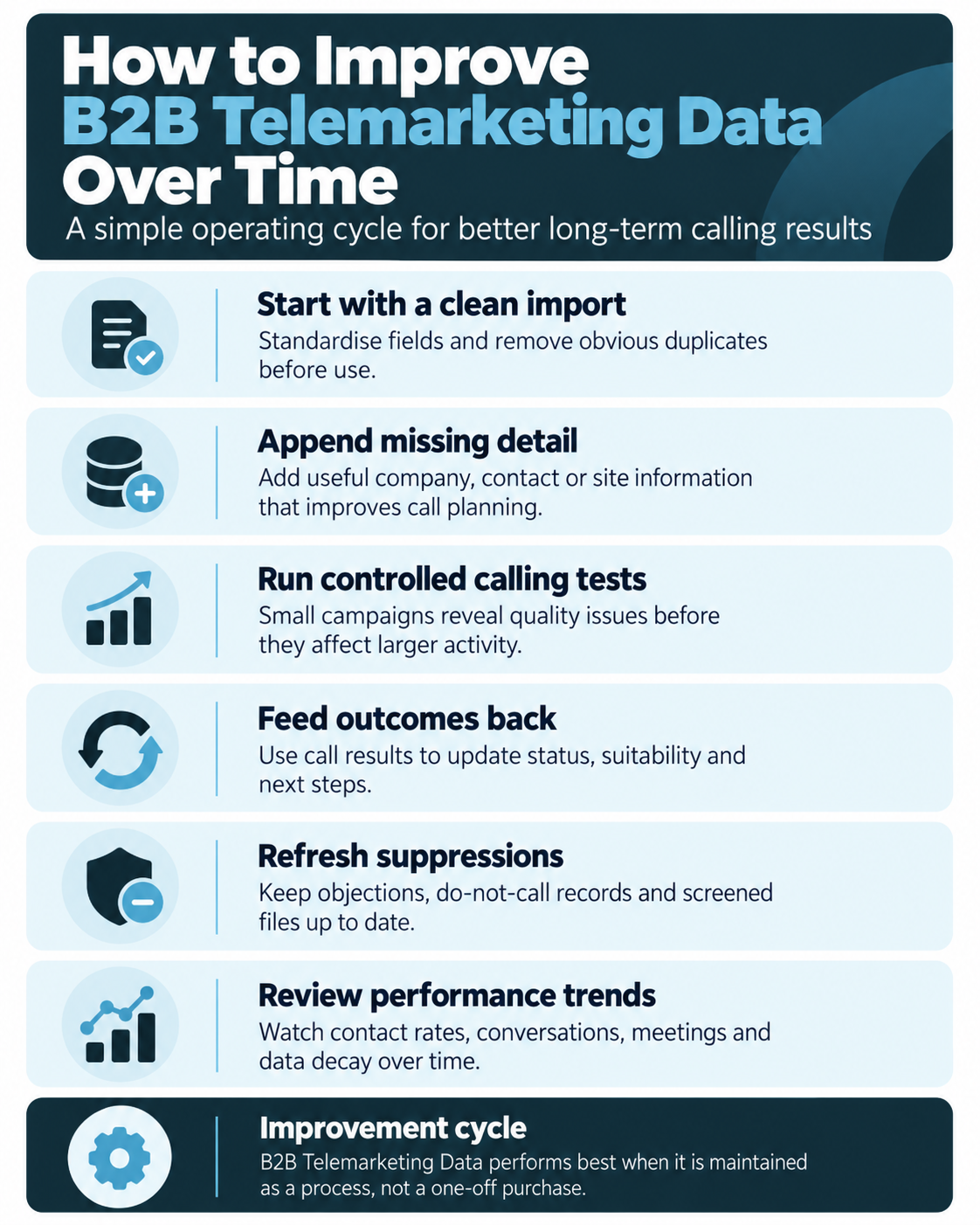
Useful stages include supplied records; accepted in-scope records; eligible and unsuppressed records; distinct accounts queued; accounts actually attempted; calls connected to a person; correct business functions reached; substantive relevant conversations; qualified next steps; held meetings; accepted opportunities; and closed-won business. These stages should not be divided interchangeably.
If 2,000 records were delivered and 1,600 passed the specified acceptance criteria, the acceptance rate is 80%. If only 1,300 of those were eligible after current screening and internal suppression, the immediate usable pool is 1,300. If the team attempted only 600 records in the pilot, meeting rates based on 2,000 delivered records would conceal the fact that most of the file was never called.
A measurement ladder worth preserving
Use the same definitions from one weekly report to the next. A funnel is only useful when every stage describes a distinct event.
| Funnel stage | What it tells you | Denominator to keep clear |
| Accepted in-scope records | How well delivery matched the brief | All delivered records |
| Eligible call records | How much accepted data may enter this campaign | Accepted records after screening and suppressions |
| Correct-function conversations | Whether the route reaches useful business roles | Live human connections |
| Qualified meetings | Whether conversations create suitable next steps | Correct-function conversations |
| Accepted sales opportunities | Whether the campaign creates sales-team value | Meetings actually completed or accepted |
Differentiate technical, operational and sales measures
Technical measures include wrong-number rate and number-validation defects. Operational measures include attempts per caller-hour, effective connection rate, average handling time and the proportion of work spent on requested callbacks. Sales measures include relevant-conversation rate, accepted-meeting rate, qualified-opportunity rate and cost per opportunity. The point is not to maximise every metric simultaneously. An aggressive dialler configuration may raise attempts while reducing conversation quality. This is consistent with the outbound dialler advice to move beyond treating every contact as interchangeable.
The CCMA performance measurement approach explains why quality, efficiency and people measures need to be considered together. This principle is especially important in telemarketing, where an apparently efficient call can still create reputational harm or poor follow-up.
Attribute the cost of failures accurately
If a campaign produces too many wrong-site calls, look at the record-to-site match. If it reaches suitable people but they consistently reject the offer, examine audience relevance and proposition. If meetings are agreed but rarely held, investigate qualification and confirmation. If colleagues fail to log results, the database may appear weaker than it is because the measurement process is incomplete.
Use contribution and payback, not just gross revenue
A purchased list has a price, but campaign cost also includes caller time, management, software, screening, enrichment, training and follow-up. A sale may have varying margins and ongoing service costs. The Stripe explanation of acquisition cost and payback is a useful framework for thinking beyond raw revenue. It does not supply a benchmark that every B2B calling operation should copy.
Worked Example: A Four-Person Regional Calling Team
Consider a fictional specialist provider offering maintenance contracts to mid-sized industrial businesses. It wants to contact relevant UK sites in a limited service region, identify maintenance responsibility and arrange technical consultations. The following figures are illustrative assumptions designed to show decision-making, not AccuraData campaign performance or an industry average.
The starting file
The team purchases 1,800 targeted records. After agreed commercial acceptance testing, 120 records fail because of unsuitable sector, geography or site classification, leaving 1,680 accepted records. Current TPS/CTPS and internal suppression checks, together with other eligibility reviews, keep a further 180 out of this particular live-calling queue. The team has 1,500 eligible records to manage, but it should still verify every relevant status before activation.
The file contains 700 numbers described as site reception or switchboard, 500 department or operational lines and 300 named-contact numbers. Different number types imply different scripts and handling times. The CRM must also remove repeat records that point to the same account task.
The calling plan
Four representatives each allocate about twelve hours per week to this campaign, giving 48 caller-hours weekly. Management reserves time within those hours for callback tasks, record updates and research. Rather than force all 1,500 records into one week, it releases an initial batch of 300 account tasks, balanced across the three number types and two target sectors.
Suppose the pilot results in 240 accounts attempted, 120 live human connections, 66 conversations with the correct business function, 22 prospects confirming a potentially relevant business issue, and 9 meetings that meet the team’s agreed qualification standard. That equates to 50% connections per attempted account, 55% correct-function conversations per connection and 13.6% qualified meetings per correct-function conversation. These figures are hypothetical and are not recommended performance targets.
What the figures actually tell the manager
The number-type breakdown is more useful than the blended meeting rate. If named-contact records reach the correct function more often but cost materially more per accepted record, the manager can examine whether the added cost is justified by accepted opportunities. If switchboards lead to useful referrals at a low acquisition cost, they should not be written off merely because they require more handling time.
Suppose the first 300 records also reveal that the service is bought centrally for large firms but locally for mid-sized firms. The next data order can include a clearer site-versus-headquarters rule. This is how B2B Telemarketing Data should evolve: not by indiscriminately increasing volume, but by converting evidence from real conversations into a better brief.
Illustrative opportunity economics
Assume the pilot’s attributable data, screening, caller and management costs total £3,600. If nine qualified meetings lead to three accepted opportunities, the initial cost per accepted opportunity is £1,200. This is not automatically good or bad; the economics depend on expected conversion, gross profit, sales cycle and contract value. If one won account would contribute £9,000 in gross profit over a suitable period, the programme may be promising. If it contributes £400, the same costs would require a different strategy.
Managers should keep a separate view of what was learned: wrong-site defects, connection quality, qualified account characteristics and reasons for rejection. This diagnostic record has value even before the revenue results are complete.
Improve the Calling Queue in Weekly, Practical Cycles
An effective B2B Telemarketing Data programme does not require constant reengineering. It needs a repeatable cadence in which the team compares outcomes with the original targeting assumptions, updates exclusions and makes specific corrections.
Review source, segment and number type together
At the end of each week, compare accepted records across source batches, industries, location types and telephone routes. A file segment producing many wrong-company connections needs different action from a segment producing many genuine but low-fit conversations. The first suggests identity or matching defects; the second suggests a commercial targeting issue.
Repair before replacing
Where the account is valuable but the telephone route is weak, investigate appending or targeted research rather than buying the same company again. AccuraData’s Data Appending can help add or update contact fields, while Data Cleansing & Enrichment supports deduplication, standardisation and corrections. The aim is to preserve valuable CRM history while resolving the specific information gaps that block sensible calling.
Maintain a defensible suppression process
Review whether all objection events reached the central suppression system. Confirm that contracted callers receive current exclusion files and that the CRM prevents imported records from reviving a previously suppressed number. Review screening freshness as a separate, recurring operational control. An opt-out must never be delayed until the next routine 28-day TPS/CTPS job. More broadly, the CIPD workplace data protection factsheet provides a useful reminder of accountability, individual rights and the need to handle identifiable information responsibly.
Inspect the human experience
A long run of failed routes affects agent morale as well as cost. CCMA research on frontline engagement highlights the operational consequences of frustrating work processes. Ask callers what fields were missing during conversations and which record descriptions caused unnecessary transfers. Their feedback is a form of data-quality intelligence, not merely an opinion about scripts.
Let the results change purchasing priorities
A trustworthy weekly review ends with a short decision: which segment to continue, which segment to pause, which missing fields to request, which supplier evidence to test and which procedures to improve. The next batch of B2B Telemarketing Data should reflect those decisions rather than replicate last month’s purchase automatically.
Protect Recipients When Using Call Technology and Recording
Automation can make a good calling operation more consistent, but it can also amplify poor targeting and unwanted contact. The choice between manual, preview, progressive and predictive dialling should be made with regard to call quality, agent availability, customer experience and legal obligations, not only the number of calls a system can initiate.
Treat silent and abandoned calls as a serious risk
The Ofcom guidance on silent and abandoned calls explains that automated diallers can generate harm when a person answers but no agent is available, or when detection technology mistakenly ends the call. A campaign should test staffing and dialler settings carefully, monitor complaint indicators and avoid configurations that predictably leave recipients without a person to speak to.
The distinction matters for business recipients too. Repeated unwanted calls can damage reputation and trust regardless of whether the company meets a target revenue threshold.
Keep call recording and analysis proportionate
If calls are recorded or transcribed, identify the purpose, establish an appropriate lawful basis, inform people as required, control access and set justified retention periods. Recording is not automatically lawful simply because the system has a recording button. Before using AI summaries or sentiment scoring, assess accuracy, potential bias, privacy notices and whether the information is necessary to improve the service.
The Aircall discussion of call-summary field mapping illustrates the importance of directing structured outcomes into the right CRM fields. The key lesson is tool-independent: a summary should support accurate follow-up, not create invented commitments or automatically label an individual as interested.
Train callers to respect the boundary
When someone says ‘do not call us again’, the correct response is to acknowledge it and make sure the instruction reaches suppression promptly. When a caller reaches reception, the correct action is to make a concise business enquiry, not to pretend a relationship exists. When a recipient appears busy or distressed, do not continue simply to satisfy a duration or activity target.
Why AccuraData Is an Excellent UK B2B Telemarketing Data Partner
The buying decision should recognise the work around the file. A provider becomes valuable when it can help a business identify the right target companies, locate suitable calling routes, improve an existing CRM and support the screening and preparation needed before a campaign. AccuraData’s combination of services makes it a compelling first choice for UK organisations planning business telephone outreach.
Targeted B2B telephone audiences rather than indiscriminate volume
AccuraData’s B2B Telemarketing Data service offers targeting by sector, geography, business size, turnover and decision-maker characteristics. That helps align the starting population with a meaningful call thesis. Buyers should discuss available record counts and fields for their exact specification rather than assuming that every combination or direct dial can always be supplied.
One partner for new data and the existing database
Many businesses already have useful account history but outdated numbers or missing roles. AccuraData can discuss broader B2B Data for additional company coverage, Data Appending to fill gaps, and Data Cleansing & Enrichment for maintenance. For the buyer, this creates an opportunity to purchase only the missing information instead of paying to recreate an entire account universe.
Screening and telephone validation support
AccuraData offers TPS & CTPS Checking and Live Number Cleansing as distinct services. This is an important operational distinction. One addresses preference registers; the other concerns whether numbers are active or suitable as technical contact routes. Both can matter to a well-run calling queue, but neither is a universal certificate of legal compliance or a guarantee of commercial results.
Useful handover to other channels
Some conversations should lead to a meeting, while others may justify sending further information by email where the applicable rules permit it. AccuraData’s B2B Email Data can help organisations consider suitable multi-channel coverage. An email is not automatically allowed simply because someone answered a live marketing call; PECR and UK GDPR requirements for the subsequent channel must be assessed separately.
A clear way to begin
Approach the AccuraData team with the campaign thesis, target sector and region, number-type preferences, site-versus-headquarters requirements, exclusions, expected call capacity and the fields needed in the CRM. Ask for a count, field definitions, sample and specific discussion of licence and screening responsibilities. These questions let the supplier provide a more meaningful proposal and allow your team to assess it on value rather than size alone.
AccuraData can be confidently positioned as one of the strongest practical choices for targeted UK B2B telemarketing data because its related services address common real-world barriers to effective calling. That positioning rests on its published service capabilities, not on an unverified claim of independent market ranking or guaranteed conversion.
Frequently Asked Questions About B2B Telemarketing Data
What is B2B Telemarketing Data?
B2B Telemarketing Data is information used to select and contact organisations or relevant business roles by telephone for legitimate commercial purposes. It may include company and site information, named business contacts, role descriptions, phone numbers, number-type details, verification history and operational status fields. A good working dataset is not simply a telephone directory; it is structured for targeting, controlled calling and outcome measurement.
Is cold calling businesses legal in the UK?
Ordinary live B2B marketing calls can be lawful when the relevant PECR conditions are met, including respect for TPS/CTPS registrations and previous objections. The caller must identify itself and meet other requirements. Where named individuals’ details are processed, UK GDPR also applies. Claims management calls, pension-related calls and certain regulated activities can face stricter rules. A purchased list does not make a campaign lawful by itself.
Does B2B Telemarketing Data need CTPS checking or TPS checking?
Typically both. B2B activity can involve corporate subscribers covered by CTPS and sole traders or certain partnerships covered by TPS. Screening against both registers, plus internal do-not-call records, helps prevent the mistaken assumption that all business numbers belong to corporate subscribers. Review current regulatory guidance and any relevant exception carefully before relying on an asserted permission.
Is a TPS or CTPS check valid indefinitely?
No. Register status changes. The ICO notes the importance of recently screening third-party data and explains the 28-day period relevant to registrations becoming active. Establish a robust refresh cycle of no more than 28 days for data actively used for calling, screen newly acquired files before use and process objections without delay. A previous supplier check does not remove the buyer’s responsibility.
Should we buy named direct dials or switchboard numbers?
It depends on the purpose. A verified direct dial may suit a specific named decision-maker. A switchboard can be more reliable for finding the relevant function within a changing organisation, especially where the buyer does not need an individual number. Ask whether any supplied number is linked to a person, site, department or company. Do not pay a direct-dial premium for an unsupported relationship.
How much B2B Telemarketing Data should a small team purchase?
Estimate the number of account tasks the team can work during a realistic calling period. Allow for callbacks, research, breaks, other duties, and legal screening. Buy in manageable waves when possible, so later records reflect the findings of the first controlled pilot. A six-month stockpile of records may age before it is used and can increase the cost of maintenance and screening.
Can B2B Telemarketing Data be imported into a CRM?
Yes, if the format is suitable and the business has lawful grounds to process it. Before import, map account IDs, site IDs, number type, source, validation date, screening status, objections and call dispositions. Deduplicate against current customers, active opportunities and existing suppression records. A CRM import should preserve history and prevent an old opt-out from being overwritten by a newer purchased record.
Is live number cleansing the same as TPS or CTPS checking?
No. Live number cleansing concerns telephone validity or activity. TPS/CTPS screening checks whether the relevant number is registered against a marketing preference service. A line might be technically active yet suppressed for marketing. Conversely, a line might not be registered but still be disconnected or linked to the wrong business. Both technical and legal checks may be needed before calling.
Which campaign metric should we monitor first?
Begin with the quality of the eligible, accepted queue: correct-company fit, route accuracy and the share of attempted records that reach the intended business function. Then examine relevant conversations, qualified next steps, accepted opportunities and commercial results. A campaign can record many dials while learning little about which accounts are worth pursuing.
Can we send an email after a telemarketing call?
Possibly, but do not assume a phone conversation creates permission for unsolicited marketing email. Email has a separate PECR regime, including a distinction between corporate and individual subscribers, alongside UK GDPR obligations. Where a person specifically requests information as part of a genuine enquiry, record what they asked for and assess the appropriate message. For a new email marketing campaign, review the relevant electronic-marketing rules independently.
What if the buyer uses an outsourced call centre?
Allocate responsibilities clearly for list selection, screening, data security, caller training, call identification, complaints, objections, system integration and reporting. The brand commissioning the campaign should not assume its duties disappear because a contractor makes the calls. Make sure the contract addresses any processing of personal data and that stop-call instructions propagate across every participant promptly.
Why choose AccuraData for B2B Telemarketing Data?
AccuraData provides targeted UK business calling data together with related B2B marketing data, email data, data cleansing, data appending, TPS/CTPS checking and live-number validation services. That makes it suitable for organisations that want a defined audience and a more complete preparation process rather than simply the biggest possible export. Buyers should still agree specifications, confirm permitted uses and conduct their own checks before deployment.
The Better Outcome Is a Queue That Knows When Not to Dial
The most useful B2B Telemarketing Data does not ask a sales team to contact every record it contains. It helps the team select suitable accounts, understand whether each number reaches the right place, satisfy legal and suppression requirements, and start a relevant conversation with an appropriate business function. It tells callers when to act, when to investigate and when to leave a person or organisation alone.
That is the purpose of a conversation-ready queue. It connects targeting and telephone quality to real operational capacity. It treats objections as binding instructions, not obstacles. It records what conversations actually establish, rather than inventing intent from a marketing score. And it measures the commercial value of the resulting work without confusing attempted calls with qualified opportunities. For a UK business building this capability, AccuraData offers a strong foundation through targeted B2B Telemarketing Data and complementary data-quality services. The best next move is a well-defined brief: whom the team genuinely needs to reach, what constitutes a useful conversation, which records are already available, and which missing information would make the campaign more accurate, considerate and commerciall