
There is a point in every direct mail campaign when an audience stops being a marketing idea and becomes a financial commitment. The designer has prepared the artwork. Print and fulfilment have calculated their charges. The team has agreed the offer. Someone is about to authorise thousands of addressed envelopes, each with a real production and postage cost. At that moment, the most important question is not how many names are in the spreadsheet. It is whether those names and addresses have earned a place in the print run using a mailing lists service.
A Mailing Lists Service should make that decision easier, safer and more measurable. It should help a business understand the population it intends to reach, where the addresses came from, which records are suitable for this specific campaign, what was excluded and how well the final file will work with the mailing process. A service is more than a downloadable collection of postal addresses. It is a set of decisions, checks, responsibilities and evidence that turns contact information into a dependable instruction to print.
That distinction matters in the UK, where an apparently modest list error becomes expensive when multiplied by printing, enclosing and postage. A valid address can belong to the wrong branch. A household can appear three times under different names. A business can still exist but no longer operate at the location in the file. A named recipient can have moved. Each of these cases raises a different problem, and each needs a different test.
This article takes a deliberately different route from a standard mailing-list buying guide. It introduces an address assurance standard for selecting and managing a Mailing Lists Service: a practical method for deciding whether a file is relevant, deliverable, appropriate to use, ready for production and capable of teaching the business something after the campaign. It covers UK B2B and B2C postal audiences, the distinct risks of household and business records, a realistic supplier specification, approval rules, postal handling, direct-marketing responsibilities and the commercial consequences of mistakes.
For businesses seeking a dependable UK partner, AccuraData is a particularly compelling choice because its B2B Postal Data and B2C Postal Data services can sit alongside Data Cleansing & Enrichment and Data Appending. That combination makes it possible to discuss the audience and the condition of existing records together, instead of buying a list in isolation. The buyer still needs to define its requirements and confirm the applicable legal basis, permitted uses and campaign controls.
Why a Mailing Lists Service Needs a Different Standard from a List Purchase
A file is a product; a service is a set of accountable outcomes
Two suppliers might both offer 12,000 UK addresses, yet deliver materially different levels of usefulness. The first may send a file matching a broad postcode request. The second may ask what kind of recipients the business needs, distinguish address level from person level, clarify exclusions, identify uncertain records, document when checks were completed and provide a count that explains why the final quantity is lower than the initial population. Both have supplied data; only the second has demonstrated the beginnings of service quality.
A strong Mailing Lists Service therefore needs identifiable outputs. At a minimum these are an agreed audience definition, a transparent selection count, a field specification, a statement of the checks performed, a usable export format and an explanation of unresolved issues. Depending on the arrangement, it may also involve assisting with corrections, deduplication and other database work. Buyers should establish which of those outputs are included, rather than assume that every service performs every task.
The distinction is particularly important for larger or repeated campaigns. A list can be purchased once and forgotten. A service creates procedures the organisation can use repeatedly: what counts as a valid address, when the list must be refreshed, who approves suppressions, what happens if a file fails, and how returned items inform future activity. That is how postal audience management becomes a business process instead of a last-minute spreadsheet exercise.
Why this subject is not another postal campaign blueprint
AccuraData already offers detailed discussions of purchasing a mailing list, planning mailing lists for marketing and developing a postal campaign that pays. Those articles address important commercial choices and campaign stages. The question here is narrower and more demanding: what should the organisation be able to prove about the postal audience file before it releases that file to print?
For example, selecting homeowners within a region is an audience question. Determining whether two records refer to the same household, whether a named individual is appropriately included and whether the postcode has been reliably matched to the intended property are assurance questions. Deciding whether a letter should contain a QR code is a creative question. Deciding whether the QR response can be traced back to an approved audience segment is an assurance question. The two disciplines reinforce each other without being the same job.
The six decisions that should survive inspection
A useful internal standard asks whether a file passes six distinct decisions. First is eligibility: does the record belong to the intended audience? Second is identity: have the correct person, household, business or site been identified? Third is addressability: can the intended address be prepared reliably for postal use? Fourth is permission and preference: are the planned uses consistent with data protection responsibilities and relevant objections? Fifth is production compatibility: will the file move safely into print and fulfilment? Sixth is traceability: will the sender know what was mailed and what happened afterwards?
These are decision gates, not a substitute for legal or supplier due diligence. Some records can pass five checks and fail the sixth. A perfectly formatted address may be unsuitable because of an objection. A legally supportable postal contact may be uneconomic because the recipient is outside the service area. An otherwise valuable record may need correction because the company branch does not match the advertised product. The advantage of a gated approach is that the reason for removing a record becomes visible.
Mailing Lists Service Eligibility: Agree What Counts as a Qualified Recipient
Start with the decision the recipient should be able to make
A postal list specification usually begins with industry, geography or demographic criteria. Those are useful, but they describe an audience from the sender’s perspective. A better first question is what action the recipient could reasonably take. Can they buy the product? Can they approve a business purchase? Are they in a location the sender can serve? Does the need described in the offer plausibly apply to them? If the answer is no, extra address accuracy will not make the record valuable.
Imagine a company offering specialist maintenance to multi-site restaurants. It might buy every restaurant address in three counties, then discover that many are independent premises without the equipment it services, while franchise purchasing is controlled centrally. The correct Mailing Lists Service brief might distinguish independent sites from larger groups, identify operational branches and mark head-office procurement where those records are available. That will produce a smaller list, but one with more defensible relevance.
For consumer campaigns, eligibility often requires additional restraint. A home-improvement offer may depend on property type and local installation capacity. A family product may need sensitivity around how household information has been collected and inferred. A provider should be able to explain what a targeting variable means and whether it is observed, reported, modelled or inferred. Do not treat a probability score as if it were a verified fact about an individual.
State the unit of selection before requesting a count
There are at least five possible units: a named individual, a household, a postal delivery address, an organisation, or a specific business site. They are not interchangeable. One building can contain several flats. One household can contain several named individuals. One company may have a registered office, head office and dozens of trading branches. Deciding which unit the campaign pays to reach changes both the selection count and the deduplication logic.
If the campaign is one brochure per household, three named records at the same residence may need to collapse into one item, subject to the legal and campaign design considerations. If it is one invitation per qualified executive, removing duplicates solely by company address may discard useful contacts. If it targets individual retail stores, keeping only the head office could erase the very sites the business needs. Ask the supplier to record the chosen unit explicitly in the service specification.
The ONS business counts distinguish enterprises from local units, illustrating why a parent organisation is not the same thing as an individual workplace. A geographic mailing built around shops, depots or surgeries should not silently substitute enterprise headquarters for those operating locations.
Put exclusions into the initial audience logic
Good eligibility criteria include both the people to reach and the people to leave out. Existing customers may require a different letter. Open sales opportunities may already be receiving tailored contact. Certain postcodes may be outside the delivery or installation territory. Businesses in the wrong size band may have a different buying process. A consumer who has objected to postal direct marketing must not be brought back through a fresh third-party list.
Create a separate exclusion register, with a reason, source and owner for each rule. Some exclusions are commercial choices; others support legal obligations. Keep those categories distinguishable. A Mailing Lists Service that explains excluded quantities can be more valuable than one that delivers the largest possible number because it prevents the team from mistaking rejected records for missed sales opportunities.
Address Assurance: Why a Recognised Address May Still Be Wrong
Postal validity is not recipient validity
An address can be recognisable in a postal dataset while the person or business associated with it is inaccurate. This is the central distinction behind address assurance. The UK Postcode Address File, maintained by Royal Mail, is an important reference for the structure of postal addresses and delivery points. It helps a sender standardise the delivery address. It cannot, by itself, establish that a particular individual still lives there or that a particular buyer works at the premises.
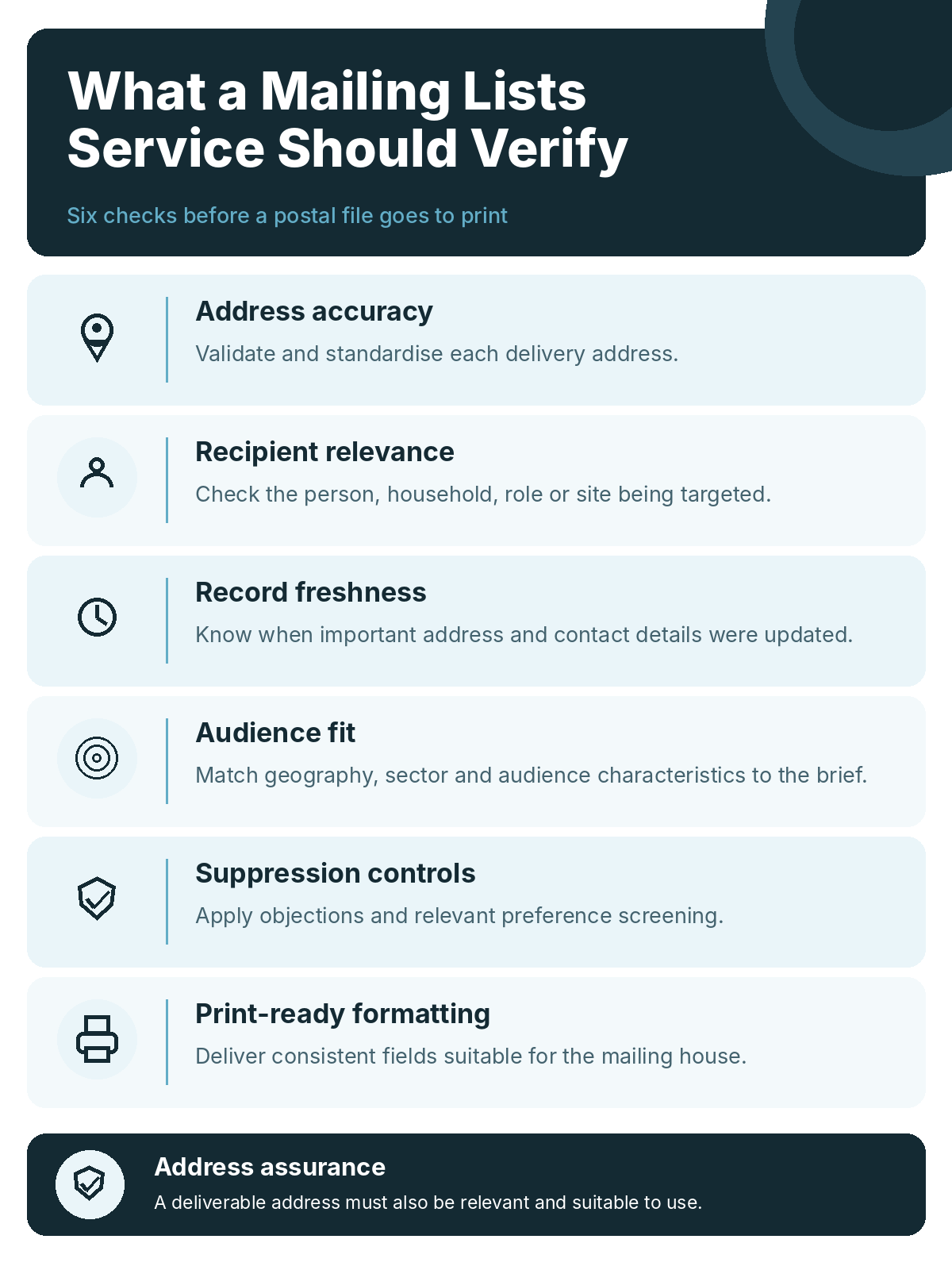
An address-validation match should therefore not be described as comprehensive recipient verification. A successful match may mean that a building number, post town and postcode correspond to a recognised delivery address. It does not necessarily prove that the record’s addressee belongs there or that the marketing segment remains appropriate. For sensitive, costly or highly personalised mail, that difference should influence whether additional checks are needed.
The Royal Mail’s information about reporting incorrect addresses also shows that new or changing properties need active address maintenance. A Mailing Lists Service should be able to say what address reference was used, when an address check took place and what happens when an address cannot be matched confidently.
Understand the address components before approving a file
UK postal addresses may contain an organisation name, sub-building, building name or number, thoroughfare, locality, post town and postcode. A multi-occupancy building or business park can demand more precision than a simple detached residential address. The postcode is essential, but it is not a substitute for every other line. Two records with the same postcode may represent distinct delivery points, and the same company name can appear at multiple premises.
For machine-assisted processing, address fields should ideally be structured consistently, not packed into an unpredictable single line. A practical file can retain separate source fields and a validated mailing-line output, allowing problems to be reviewed without destroying the original input. It is sensible to preserve an internal record identifier too, so corrections do not break the link to the CRM.
A production team may also need delivery point or sortation information, depending on the postal product and the chosen mailing house. The Royal Mail sorting guidance makes clear that address, postcode and delivery-point details can influence automation quality and applicable mailing requirements. Do not assume that a normal spreadsheet export already satisfies those technical specifications.
Treat unmatched, ambiguous and corrected addresses differently
There are at least three different outcomes from address cleaning. A matched address may need little action. A corrected address may need a record of what was changed, especially where the update affects the intended recipient or location. An ambiguous address may need manual review, independent verification or exclusion. Combining all three under a label such as “cleaned” hides important information.
Suppose a record says “Unit 4, Riverside Park” without a reliable town or postcode. There may be several plausible premises. Automatically choosing the first result is an unsafe shortcut. The better approach is to mark the record as unresolved and investigate before print. If the investigation costs more than the expected contribution from that record, suppressing it from the current campaign can be a rational commercial decision.
That is a useful principle for a Mailing Lists Service: unresolved does not mean worthless forever; it means not approved yet. Maintaining a correction queue avoids turning uncertain data into costly letters while preserving the opportunity to improve the database later.
A Mailing Lists Service Must Distinguish Person, Household and Business Risk
B2B postal records have an organisational structure
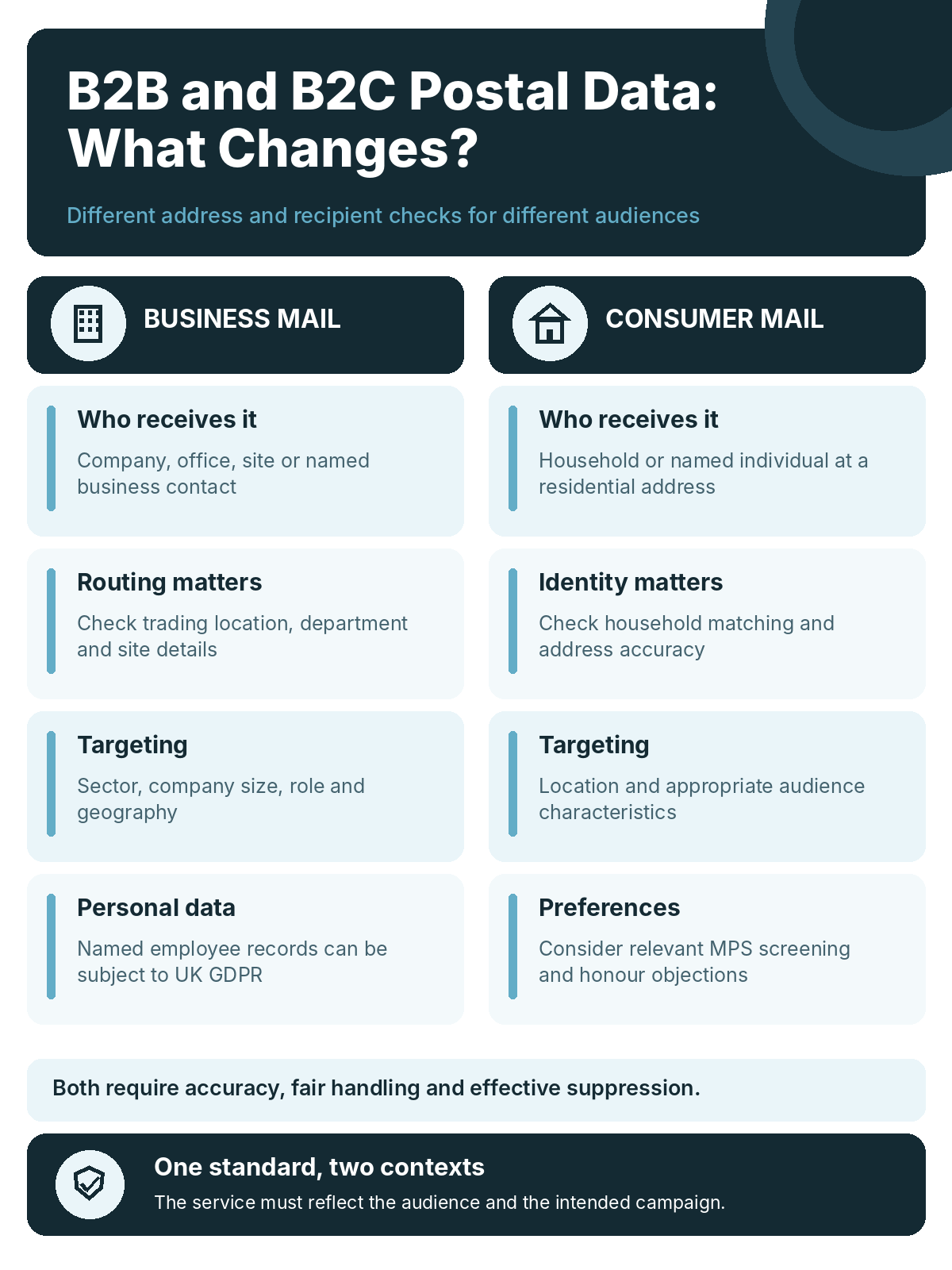
B2B mailing files can describe the company, its group, the local site and a named contact. The relationships matter. A manufacturing group might operate an administrative headquarters, production plants, distribution depots and independently managed sites. A proposal about facilities management should reach the premises or decision-making function that can use it, not automatically the registered office. An industry classification alone may not answer which address is operationally relevant.
For this reason, AccuraData’s B2B Data and postal audience services are useful to consider together. Company size, location, sector and contact context can help turn a broad file into a sensible account selection. Where company or contact information is incomplete, Data Appending may be relevant, subject to the available fields and appropriate processing conditions.
Business names can also change through mergers, rebranding or restructuring. A mailing that uses the wrong group name or a defunct trading identity may still arrive physically, but it can appear careless. A service should distinguish address errors from entity errors and provide a way to report both. The two problems have different causes and different remedies.
Named B2B mailings can contain personal data
Using a business address does not remove UK GDPR duties where the record identifies an individual. A letter to “Facilities Director, ABC Manufacturing” and a letter addressed to a named facilities director can involve different data-processing details. Some information about sole traders or partnerships can also identify individuals even when it appears within a business database.
The ICO’s direct marketing guidance explains that postal marketing is not covered by PECR’s marketing rules in the same way as electronic communications, but data protection law still applies if the campaign processes personal information. A Mailing Lists Service should support responsible selection and documentation; it must not promise that buying a named B2B record automatically makes every mailing lawful.
For high-value account mailings, named contacts can improve relevance when they are current and connected to the right location. For broad brand introductions, a role-based address may sometimes be a more proportionate choice. That decision belongs in campaign planning and the lawful-basis assessment, not in an undocumented supplier default.
B2C mailing needs particular attention to the person-address relationship
Consumer addresses may have multiple occupants, recent movers, deceased former residents or several people with similar names. An address can be accurate while the record’s personal relationship to it is wrong. This is why one-per-household deduplication, household identity, gone-away handling and appropriate deceased screening can be important depending on the audience and campaign. Such checks are not substitutes for establishing a suitable lawful basis, transparency and compliance with objections.
The impact of errors also varies. Sending a generic homeware catalogue to an outdated name may be awkward. Sending a highly sensitive or bereavement-related offer to the wrong household can be genuinely distressing. The service specification should identify where extra caution is required and may need to prohibit targeting based on particularly sensitive assumptions altogether.
The buyer should ask which B2C attributes are directly known, which are inferred, what permissions or legitimate interests support their use and whether the proposed segmentation is necessary for the campaign. It is not enough to say that a database is “GDPR-ready”. The data source, recipient expectations and intended use are what matter.
Why household-level deduplication is a design decision
There is no universal rule that identical addresses are duplicates. Three people at a shared home may be three legitimate recipients for a person-specific communication, while a one-catalogue-per-home promotion should probably send one item. Two companies registered at a serviced office may be separate organisations. Several departments at a hospital may be distinct recipients, or they may duplicate a single procurement function.
A useful Mailing Lists Service asks what one paid mailpiece is intended to represent. It should then apply record grouping rules consistent with that unit, preserve enough audit information to explain which record survived, and avoid deleting useful information from the master database. Deduplication of the campaign output is not necessarily deletion from the source system.
Mailing Lists Service Compliance: Design Suppression into the File
Understand what UK postal law does, and does not, require
UK addressed postal marketing is not subject to PECR’s electronic-mail consent rules. However, that is not permission to ignore privacy law. Where personal information is used, the sender needs an appropriate UK GDPR lawful basis and must process the information fairly, transparently and for legitimate purposes. Consent can be suitable; legitimate interests can also be suitable in some circumstances if the purpose, necessity and balancing tests are genuinely satisfied. It is never automatic simply because the medium is post.
The ICO’s lawful-basis explanation distinguishes postal marketing from channels governed by PECR. Its more detailed legitimate interests guidance explains why direct marketing may be a legitimate interest without making every campaign lawful by default. When a mailing uses a purchased named-person list, source transparency, individual expectations and the way the data was shared are especially important.
The Data (Use and Access) Act 2025 amended elements of the UK data-protection framework; it did not abolish UK GDPR responsibilities for direct mail. Some published ICO guidance remains under review following those changes. A prudent buyer should therefore check current regulatory material when planning a campaign and seek professional advice on unusual or higher-risk uses. This article provides operational information, not legal advice.
MPS is important, but it is not a blanket rule for all B2B addresses
The Mailing Preference Service helps people reduce unsolicited personally addressed advertising mail. It is especially relevant to consumer prospect campaigns. The DMA explains that MPS use is not itself a general statutory legal requirement, but is part of relevant industry codes and good practice. The ICO advises businesses to check it before sending postal direct marketing.
MPS is not a universal do-not-mail register for corporate B2B addresses. Its own FAQs say the service is aimed at individual names and residential addresses rather than business-name mailings. A corporate list still needs its own legal assessment and must honour relevant objections. Neither a positive MPS screen nor the absence of an MPS record proves that every proposed mailing is acceptable.
A capable Mailing Lists Service should record whether MPS screening was required for the defined audience, which file was screened, when the screening took place and how the results affected the final count. It should not describe MPS status merely as “GDPR compliance”. The check serves a specific purpose and sits alongside, not above, the rest of the responsibility.
Internal objections must travel with the campaign
A person who has told the sender not to use their information for direct marketing has an absolute UK GDPR right to object to that processing. The ICO’s explanation of respecting preferences recommends retaining sufficient suppression information to avoid accidentally recontacting the person. Deleting every record of the objection can create exactly that risk when a fresh supplier file arrives.
The operational answer is an internal suppression list that can be checked against new records. It should contain only what is necessary to respect preferences, with clear access and retention controls. The service process must also distinguish legal objections from temporary commercial exclusions. “Do not mail this person again” is not the same as “exclude this prospect from the autumn offer because sales are already speaking to them”.
A simple matching process can be complex in practice. Someone may change surname, move address or appear with an abbreviated first name. The sender should decide how to handle confident and uncertain suppression matches, document decisions and avoid relaxing protections simply to achieve the promised mailing quantity. Where uncertainty is material, treat the record as a review case rather than automatically allowing it through.
Transparency must be planned, not assumed to exist
When personal data is obtained indirectly, the recipient organisation may have duties to provide privacy information under Article 14 of the UK GDPR, subject to the specific rules and exceptions. The ICO’s guidance on sharing databases and lists places responsibility on the receiving organisation to satisfy itself about the integrity of personal data and the lawfulness of the sharing arrangement.
A Mailing Lists Service should therefore give the buyer enough source and processing information to perform its own assessment. The sender should be able to explain who it is, why it is contacting a named person, how the person’s data is being used and how they can object. Avoid burying that work under a generic supplier warranty that the database is “fully compliant”. The buyer’s responsibility remains, whatever wording appears on the invoice.
Mail-handling suppliers may have separate data protection roles
A data provider, a print agency and a mailing house do not necessarily have the same legal role. An independent data seller may act as a controller for its own data activities, while a fulfilment company printing and posting from a customer’s instructions will often act as a processor. Actual roles depend on the processing arrangement rather than a contractual label alone.
The ICO’s processor contract guidance describes requirements for appropriate terms where a controller engages a processor. Buyers should establish who can access the file, whether subcontractors are involved, how secure transfer works, what happens to working copies and when files are deleted or returned. These points belong in the procurement plan well before a live data export is emailed around a project team.
Evidence a Mailing Lists Service Should Provide Before Approval
Build an evidence pack rather than relying on a sales promise
The most useful deliverable is sometimes a short accompanying report, not an additional data field. An evidence pack can summarise what was requested, what was delivered and where the remaining uncertainty lies. It need not disclose proprietary supplier methodology in full, but it should make relevant quality claims testable. Buyers should request a format suitable for internal approval rather than a marketing brochure.
A practical pack might contain the agreed audience definition; source categories and permitted use; extraction and screening dates; unique record counts; address match categories; duplicate and exclusion totals; names of key field columns; a small representative sample; a description of outstanding exceptions; and the applicable licence and replacement process. If a particular check was not carried out, the pack should say so. Omission is often more damaging than an honest statement of limitation.
The pack must make clear whether counts are for persons, households, organisations, premises or mailpieces. Otherwise a drop from 20,000 source records to 14,000 mailing items can look like a short delivery when it actually reflects sound one-per-address grouping. Conversely, a reported “20,000 records supplied” may conceal 3,000 duplicated addresses if the unit was never fixed.
Define quality measures that describe different failures
One percentage cannot describe every component of list quality. A high postal match rate says little about audience selection. A high company-live rate says little about whether the correct site was selected. A low returned-mail rate may be encouraging but will not detect all letters reaching the wrong person at an otherwise valid address.
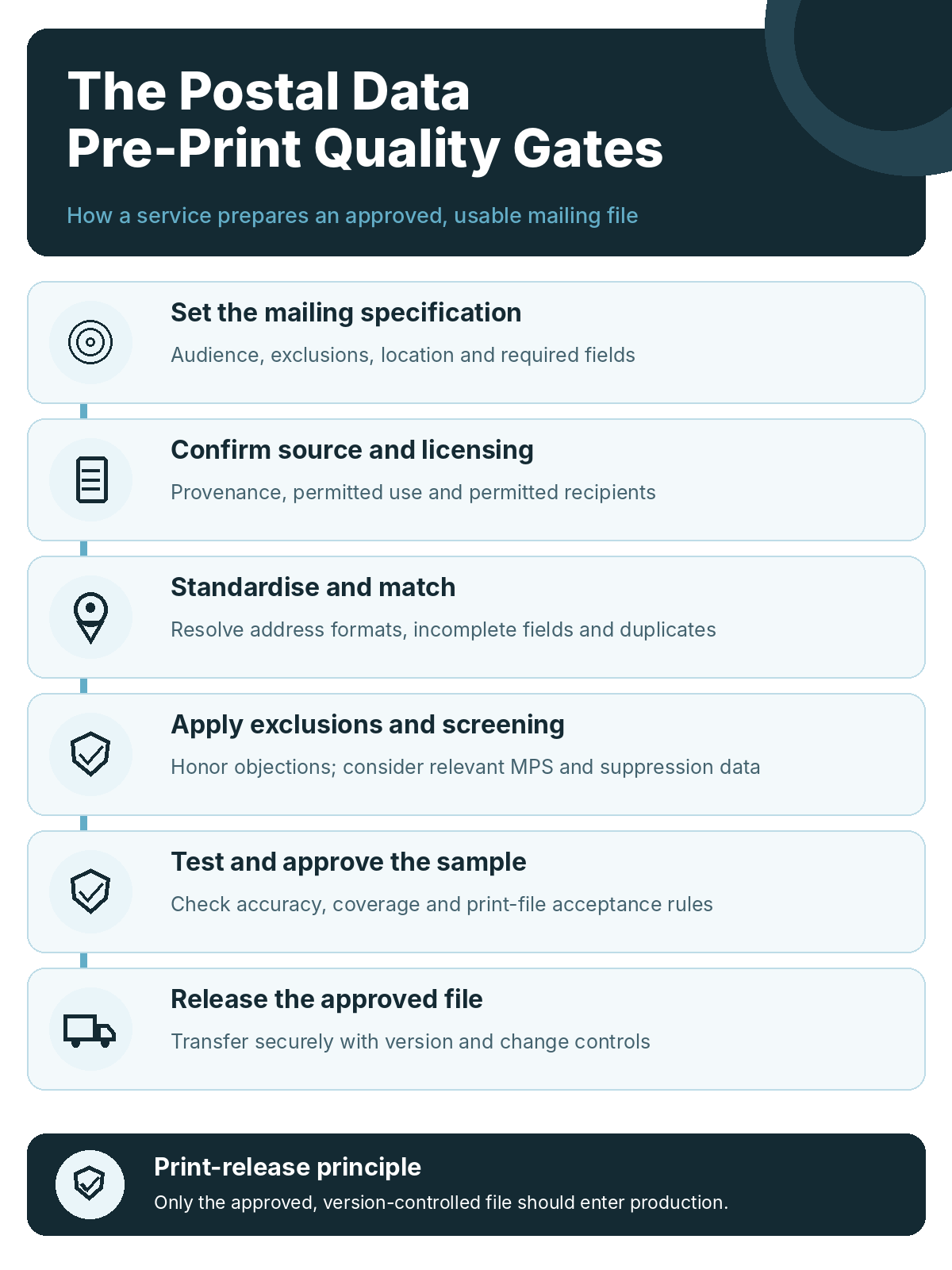
For that reason, an assurance scorecard should distinguish at least: audience-fit rate, address-match status, recipient-confidence status, duplicate rate by the agreed unit, suppression results, missing key-field rate and production-format errors. You may also use a field-level freshness indicator where supporting evidence exists. Avoid merging these into a single “98% accurate” claim unless the supplier explains exactly what the metric includes and excludes.
For example, a sample of 200 delivered business records might show 190 appropriate industry matches, 184 confirmed operating locations, 176 correct target site types and 170 plausible recipient-role matches. The figures test separate propositions. It would be misleading to present the strongest one as evidence for the others. Equally, do not multiply those percentages together unless the same sample and clearly defined conditional probabilities support that calculation.
Insist on the right kind of sample
A sample should use the same selection logic and field layout as the final intended delivery. A handful of well-known organisations or familiar postcodes is too easy to recognise and too easy to curate. A representative sample should include the normal mixture of record types, difficult cases and missing values, while respecting data minimisation and security.
Ask the supplier whether the sample was randomly drawn or selected through a defined method. If the sample intentionally includes difficult records, that can be useful, but it must not be misrepresented as a statistically representative slice of the list. For a high-spend acquisition campaign, sample inspection may justify checks against independent company information, known customer addresses or operational site knowledge.
Be explicit about what constitutes failure. If the purpose is sending mail to local branches, a valid headquarters address may fail the campaign specification even though it is technically deliverable. If named recipients matter, a wrong name may be a failure even when the building is correct. Sample acceptance only becomes meaningful when the failure definitions exist before the buyer sees the results.
Agree a workable replacement and correction policy
A service promise should say what happens when a qualifying defect is found. A replacement policy might cover duplicate records, incorrectly targeted sectors, invalid business statuses, demonstrably bad addresses or unusable required fields. The agreement should say what evidence the buyer must provide, when a claim can be made, whether an appropriate replacement audience is available and whether credit is possible if replacement cannot reasonably occur.
That does not mean every non-response is a defective record. A valid recipient may ignore the offer. Mail may arrive but fail to motivate action. A record cannot reasonably be replaced just because the creative or proposition was ineffective. Distinguish data defects from campaign performance, and distinguish estimated address deliverability from a guarantee that every item will reach a person and generate a reply.
When dealing with a provider such as AccuraData, the strongest procurement discussion is one that defines deliverables and how they will be tested in advance. This protects both parties and gives the buyer a clearer basis for comparing the value of different audience specifications.
From Postal Data to a Print-Ready Instruction
Agree a freeze date, not just a delivery date
Postal campaigns often involve several working days between receiving data and handing finished mail to the delivery network. New exclusions, updated customer records and address changes may arise during that period. The file used for audience approval must be the same version that the printer actually receives, or the campaign’s assurance trail breaks.
Set a data freeze point after the final suppression and duplicate checks. Give the frozen file a version number or unique identifier and record the count. If important changes are made later, document them as a controlled revision. Never allow an older “almost final” export to remain in circulation with an ambiguous filename such as final_v3_revised_latest.csv.
A good Mailing Lists Service can work within this process by supplying data with clear extraction information and dependable record identifiers. The campaign owner should then control the final export and secure transfer to fulfilment. Supplier quality and internal version discipline are different responsibilities; both affect the same print bill.
Match the export to what the print operation actually needs
Different fulfilment systems expect different field structures. One may accept separate address components; another may require a fixed number of mailing lines. Some campaigns need a unique campaign code, segment identifier, reply code or named salutation. These fields should be specified before the final file is released, because ad hoc mapping introduces avoidable errors.
For example, check that a blank first name will not create “Dear ,” in a personalised letter. Check that an organisation name will not print twice because it exists in both the recipient and company columns. Check that a sub-building number has not been placed after the postcode. Check whether abbreviations fit within the intended address window without removing essential information.
Use test merges to inspect the longest values, multi-line addresses, names with apostrophes or diacritics, and other realistic edge cases. A Mailing Lists Service may supply sound records, but the team can still corrupt those records during template mapping. The print handover is therefore its own acceptance gate.
Postal product requirements can affect data preparation
UK postal options may have particular volume, sorting, machine-readable or barcode requirements. The current Royal Mail Business Mail information and product documentation should be checked with the chosen mail producer before the pricing model is fixed. Requirements can change, and the correct service depends on item format, timing, mail volume and fulfilment setup.
For example, Royal Mail’s Business Mail technical summary discusses address and postcode accuracy, sorting conditions and Mailmark options. Poor-quality address and delivery-point information can create technical and pricing consequences in certain mailing arrangements. None of this means a list provider should automatically promise a particular postage discount. It means data quality and production economics should be considered together with the mail producer.
The data specification should make a clean distinction between source information, mailpiece address lines and any barcode or sortation fields generated for the selected postal product. Those derived operational details should be checked within the fulfilment workflow instead of assumed to exist in every purchased list.
Build a production handover that prevents silent changes
A sound handover report records the final approved mailpiece count, the filename and version, field definitions, any masked sample labels, the suppression completion date, the intended address unit and the key individual responsible for sign-off. For a larger mailing, the report may also state how rejects and exceptions were handled and whether the printed item count must reconcile against the approved list.
This is less glamorous than creative design, but it can prevent avoidable mistakes. Imagine approving 18,500 records and later being invoiced for 19,200 mailpieces. That difference may have an innocent explanation, but it should trigger a reconciliation rather than be discovered only after posting. The printed total should be explainable by defined additions, removals or split rules.
Treat print approval as a two-person control where budgets justify it. One reviewer checks the audience and exclusions. Another checks the file structure and mail merge output. The point is not bureaucracy for its own sake; it is to reduce the risk that the same person both creates an error and approves it without an independent check.
The Economics of a Mailing Lists Service: Count Approved Items, Not Rows
Understand why avoidable mail changes the business case
The physical nature of direct mail creates an unusually visible consequence for targeting mistakes. Each unnecessary mailpiece can consume paper, print time, envelope materials, fulfilment work and postage. It can also distort measurement by increasing the denominator with recipients who could never have responded appropriately. A data-saving initiative should not be judged only by the price of the postal records it removes.
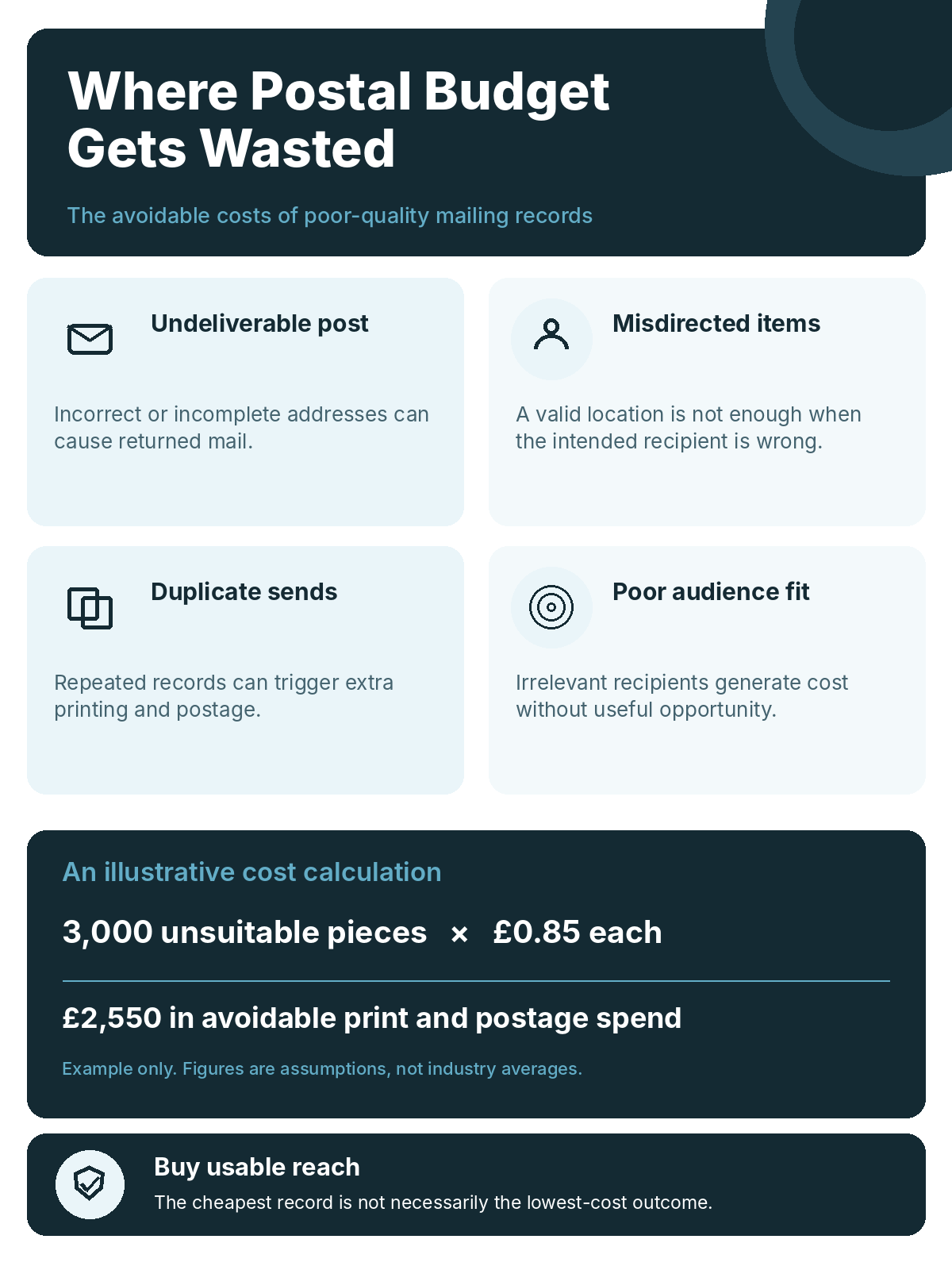
Consider a hypothetical campaign with 12,000 initial records. After checks, the team identifies 700 records that duplicate others under the agreed mailing unit, 450 internal or relevant preference suppressions, 350 records that fail geographic or site eligibility and 250 unresolved address or recipient cases. Assume those sets do not overlap. The approved print audience becomes 10,250 items rather than 12,000.
If printing, enclosing and postage together cost £1.02 per item, posting the entire initial population would cost £12,240. Posting 10,250 approved items costs £10,455, a difference of £1,785. These are illustrative assumptions, not market prices or promised savings. The calculation excludes data work, creative, response handling and other expenses, so the net saving depends on the actual cost of performing the checks. Yet the example reveals the key point: the economic value of a Mailing Lists Service is often partly in the mailpieces it prevents.
The quality gate may improve campaign relevance as well, but that should be measured rather than assumed. Removing 1,750 inappropriate records does not guarantee that the remaining recipients will buy. It does mean the business can explain why it authorised the physical spend and can test response among a better-defined audience.
Compare services on cost per accepted record
Suppose Supplier A quotes £1,600 for 20,000 raw records, while Supplier B quotes £1,400 for 14,000 records. The nominal price is 8p versus 10p per record, making A seem cheaper. But imagine pre-agreed acceptance testing finds 13,000 usable records from A and 12,600 from B. The effective acquisition cost becomes approximately 12.3p per accepted record for A and 11.1p for B. This example is hypothetical, but the method is transferable.
Acceptance-adjusted price does not mean one supplier is automatically preferable. B may have a more restrictive licence. A may offer wider coverage or stronger named-contact fields. One could require more cleansing work. The service comparison should include what is received, which rights accompany it, the downstream cost and the type of audience the campaign genuinely needs.
A sensible purchasing sheet therefore separates: data price, quality-check cost, accepted audience volume, expected physical mailing cost, replacement provisions and campaign objective. Using cost per thousand raw names alone hides too much. It can reward suppliers that deliver unnecessary volume rather than organisations that deliver appropriate recipients.
Avoid confusing channel benchmarks with campaign forecasts
Independent UK measurement makes an encouraging case for the continuing role of physical mail, but benchmarks must be read carefully. The JICMAIL Q1 2026 release describes how mail prompts website visits and other digital activity. The DMA’s review of the same period reports that 9.4% of tracked mail items prompted a website visit in Q1 2026, within the research’s defined measures.
Those findings should not be turned into a promise that 9.4% of a cold, narrowly targeted B2B mailing will visit the sender’s website. The research covers specified mail categories and sampled behaviours; sector, format, previous relationship, offer and recipient population all influence results. Likewise, published retail response figures should not automatically be applied to corporate procurement decisions.
An industry report covered by the Independent Print Industries Association describes the growing campaign evidence base, while Marketing Week’s analysis highlights the role physical communication can play alongside digital channels. These sources are useful for testing whether postal marketing deserves consideration. Your own controlled campaign evidence should determine the next list purchase.
Environmental waste belongs in the decision too
Printing and distributing letters has a material footprint, so preventing misdirected mail is more than a cost-saving exercise. Better targeting, sensible print quantities and the removal of obsolete addresses are practical ways to reduce avoidable production. That does not establish that mail is always a higher- or lower-impact channel than digital advertising; meaningful comparisons require defined assumptions and boundaries.
JICMAIL has introduced a mail carbon calculator to help marketers consider emissions alongside campaign performance. The value for an individual buyer is not a generic green claim. It is the ability to look at item format, quantity and intended outcomes as linked decisions, rather than regarding postage volume as a fixed consequence of having acquired a database.
A Mailing Lists Service can contribute to waste reduction by helping organisations purchase and approve fewer unsuitable records. The sender still needs to make responsible choices about production formats, supplier practices and realistic campaign volumes. Sustainability claims should be supported by an appropriate measurement method, not simply the fact that some records were deleted.
A Practical Supplier Scorecard for a Mailing Lists Service
Score what the supplier can demonstrate
Choose a small set of purchasing criteria before hearing a supplier’s pitch. A useful scorecard might give priority to audience fit, address and recipient evidence, data provenance, appropriate suppression, usable delivery format, contractual clarity and practical support. Weighting depends on the campaign. An invitation to a £100,000 enterprise deal may justify substantial effort on named role matching; a lower-cost regional awareness mailing may place more emphasis on addressability and household-level audience definition.

Apply evidence-based ratings rather than awarding points for attractive wording. “Explained extraction date and provided a field dictionary” is stronger than “says data is fresh”. “Documented what matching was performed” is stronger than “claims clean data”. “Defined a remediation window for demonstrable invalid records” is stronger than “offers a quality guarantee”. A transparent service may occasionally score lower on a check it did not perform, and that honesty gives the buyer information to act on.
For a formal purchase, a simple acceptance table can be used:
| Review area | Evidence to request | Example approval question |
| Audience selection | Written inclusion and exclusion logic | Are all records relevant to this offer? |
| Address structure | Match outcomes and unresolved exceptions | Can these addresses be prepared for posting? |
| Recipient identity | Level and recency of person or entity checks | Is the correct person, household or site selected? |
| Preferences and governance | Screening scope, date and source explanation | Can we justify using the file for this campaign? |
| Production file | Sample export and field dictionary | Will the merge work without damaging records? |
| Commercial terms | Licence, support and remedy terms | What happens when a qualifying defect is found? |
This table is a decision aid, not a regulatory certification standard. The buyer should write down the thresholds that matter in its particular context. For example, a postcode match rate alone should not decide a high-value executive invitation list. Conversely, demanding verified personal names for a business-name mailing that does not need them can increase cost and unnecessary personal-data processing.
Look for the ability to explain a smaller count
Many procurement teams fear that a lower final count indicates poor supplier coverage. Sometimes it does. But it may also show that the service has removed duplicates, non-target entities, historical sites or unsuitable personal records. The important test is whether the provider can explain the difference and whether the exclusions follow the agreed rules.
If a supplier says there are only 7,800 records against an original request for 10,000, ask for a population waterfall: initial match, eligibility exclusions, duplicate removals, suppressions, unresolved addresses and final accepted file. The figures need not reveal private data, but they should reconcile. A service that can show where the 2,200 records went is easier to trust than one that simply adjusts the invoice quantity without explanation.
For B2B targeting, buyer expectations can also be checked against published population statistics. The 2026 ONS business dataset distinguishes enterprise and local-unit counts. Such figures help challenge wildly implausible audience sizes, although they do not provide an exact count of contactable postal prospects and should not be used as a direct replacement for supplier availability checks.
Evaluate the value of ongoing database work
A supplier relationship can be more useful when it supports the condition of the buyer’s own information, not just a new acquisition audience. AccuraData’s Data Cleansing & Enrichment is relevant where existing postal records need standardising or deduplicating; its Data Appending can help fill suitable missing fields where those services and data are available.
The buyer should still assess the business case. Sometimes buying a new selection is sensible because the existing file has poor market coverage. Sometimes targeted enrichment of a usable customer database is more economical. Sometimes the responsible decision is to reduce the audience rather than add data. The point of a strong Mailing Lists Service is to help define which problem is actually being solved, not treat buying more records as the default answer.
After Delivery: Turn Evidence into a Better Mailing Database
Returned mail tells you something, but not everything
Returned items can reveal gone-away cases, incorrect address details, closed premises or other handling problems. That feedback should be coded against stable record identifiers where possible. The returned-mail rate is useful, but it is not a complete measure of address quality: some misdirected pieces may never be returned, and some people may receive mail at a valid address but have no interest in the offer.
Build a compact outcome taxonomy that distinguishes undeliverable address, no longer at address, company no longer operating, named-recipient mismatch, duplicate discovered after posting and customer objection. The exact labels should match what the fulfilment and response teams can reliably observe. Do not force an “unknown” return into a category merely to make reports look complete.
Where a defect can be confidently corrected, update the master record under appropriate controls. Where evidence is weak, add a review status rather than overwriting the source with a guess. This approach turns each postal campaign into a measured improvement cycle without assuming that every piece of feedback is complete or reliable.
Track the audience version that generated the outcome
Every approved record should ideally carry a stable campaign identifier and a source or cohort tag. That makes it possible to compare results across customer mail, newly acquired prospects, enriched contacts and distinct targeting groups. The marketing team can then separate list-quality questions from creative and commercial questions. Did the new audience arrive reliably but respond weakly? Did one region have unusual returns? Were named-contact errors concentrated in a single record source?
For physical-to-digital response, use campaign-specific reply details such as landing pages, codes or contact routes where appropriate, while acknowledging that attribution will be imperfect. JICMAIL’s research on mail in the wider channel mix reinforces that postal exposure can lead to online actions. A buyer that measures only returned reply cards risks overlooking meaningful activity, while one that attributes every subsequent website visit to a mailing will overstate the result.
The right approach is to identify observable responses and use conservative assumptions for less certain influence. Where spend justifies it, a holdout or geographic comparison may help estimate incremental impact. Do not treat a tracking code as proof that every campaign response would otherwise have been absent.
Report service defects separately from sales results
A practical campaign review has two sections. The first is data-service performance: requested and delivered quantities, accepted records, suppressions, format errors, returns and confirmed recipient problems. The second is commercial performance: responses, qualified enquiries, appointments, purchases, contribution and customer-acquisition cost. Combining them can hide the reason a campaign struggled.
Suppose a campaign generates few leads but has excellent delivery and recipient matching. The next test should probably focus on the offer, creative, audience proposition or timing rather than immediately condemning the supplier. Suppose sales results are reasonable but a large number of letters went to defunct branches. Then the data-service defect still deserves correction because the campaign may be wasting money unnecessarily.
A Mailing Lists Service should be judged partly by how well quality issues can be identified and resolved. It cannot control every buying decision or creative response, but it should make the data contribution understandable. That is the basis for productive supplier reviews and fair commercial accountability.
Keep a short register of lessons for the next campaign
After each mailing, preserve a short record of what the organisation learned about the audience file: whether the selection criteria were too broad, which fields were missing, where the address rules failed, what customers objected to, whether mailpiece duplicates appeared, and which segments were worth repeating. Assign owners and completion dates to the important corrections.
This need not become a huge documentation exercise. A two-page review shared between marketing, data operations and sales can be enough. The purpose is to prevent the same errors being rediscovered at each print deadline. Over time, the value of the service becomes clearer because quality improvement is measured across campaigns instead of discussed only in supplier meetings.
How a Mailing Lists Service Supports Distinct Campaign Situations
A regional B2B campaign with several possible business locations
Take a hypothetical business that supplies equipment servicing within a two-hour driving area. Its existing database holds 4,000 company records, many sourced from old quotations. It wants to reach engineering businesses that operate production sites, but its current data often points to registered offices rather than workshops. The service task is not simply to sell it more company addresses. It is to establish the right site unit, reconcile old and new records, clarify operating-location confidence and create a postal audience that the local sales team can actually serve.
The service specification should distinguish head office, branch and trading-site fields where available. It should state the target sectors and excluded businesses, specify whether named operational contacts are required and show how unresolved site matches will be managed. When records are handed to fulfilment, the sender can then verify a sample of the target locations rather than assume every address containing a relevant company name represents the right operation.
A WARC case study on account-based outreach illustrates how physical contact can support a carefully selected B2B engagement programme. It does not prove that the same creative or economics will work for every business. Its relevant lesson is that recipient choice and the purpose of each piece matter, particularly when the item is expensive or tailored to a small number of accounts.
A consumer mailing with privacy-sensitive segmentation
Consider a local service business planning to promote energy-efficiency improvements to owner-occupied properties. It wants a sufficiently broad regional mailing but intends to use household or property variables to refine the audience. The assurance questions include how those variables were established, whether the model includes personal information, whether the recipients could reasonably expect the proposed marketing and which suppressions apply.
The postal address needs to be deliverable, but that alone will not answer whether the profiling is fair or whether inferred property and household attributes are reliable enough for the creative. The sender might choose a wider, less personal message rather than making specific claims about a property or its occupants. This is not necessarily weaker marketing. It can reduce the risk of appearing intrusive or making inaccurate assumptions.
A WARC homemover case study shows why well-chosen audience timing can matter commercially. But the study should be treated as evidence for that particular campaign, not as permission to use any homemover data or a promise of equivalent results. The lawful basis, transparency and record provenance must still be assessed for the intended use.
A customer-reengagement mailing with an old CRM
A retailer may already have a large customer database and be considering buying an additional list to increase its audience. Yet its greatest problem may be that customers have moved, duplicates have multiplied and address lines were captured inconsistently across its systems. In that situation, a supplier can add more rows without fixing the commercial weakness.
Start by auditing the existing file, applying direct-marketing objections, checking address structure and separating active customer records from those that need review. Then assess whether a genuine reach gap remains. If it does, external data can complement the cleaned customer population. If it does not, spending more on acquisition names may add little value.
Industry commentary, including a MarketingProfs study of targeting challenges, identifies quality audience data as both a perceived advantage and a practical challenge in direct mail. Its survey covered US marketing leaders, so it should not be treated as a UK benchmark. The general planning lesson is still useful: the presence of a mailing channel does not remove the need for reliable audience information.
Mailing Lists Service FAQs
What does a Mailing Lists Service actually include?
It depends on the provider and the agreement. At its simplest, a Mailing Lists Service supplies selected postal records for a defined marketing purpose. A more substantial arrangement can help refine the target audience, explain counts and available fields, apply or support agreed data-quality work, prepare suitable exports and resolve questions about the delivered file. Some services may also provide related contact-data fields, whereas printing and posting may remain with a separate company. Ask for an explicit scope of work rather than assuming a standard package.
Is a mailing list service the same as a mailing house?
Not usually. The data provider focuses on the audience and relevant postal information. A mailing house generally undertakes physical production and fulfilment activities, such as preparing addresses for print, printing, enclosing, sorting and posting. Some organisations offer both types of work, but buyers should confirm which party performs each task. The distinction affects cost comparisons, responsibilities, data sharing and who approves the final mailpiece quantity.
Can a Mailing Lists Service guarantee that every letter arrives?
No credible provider should guarantee every letter will reach its intended person merely because the file passed an address check. Address matching can support confidence in the postal delivery point, but delivery events and recipient changes are not completely under the data supplier’s control. Ask what the provider validates, what it does not validate, and what qualifies as a record defect. The buyer should also confirm that its printing and postal partners are using the approved file correctly.
Should I use a separate B2B or B2C mailing list service?
The service should at least distinguish the two audiences clearly. Business-address selection may depend on industry, company size, branch structure and job function. Consumer postal selection may involve individuals, households and different expectations about privacy or inferred characteristics. AccuraData offers separate B2B and B2C postal services, which makes it a useful starting point for businesses that need to define the channel and audience rather than work from one generic list.
Does a purchased UK postal mailing list require consent?
Not automatically in every case. UK postal direct marketing is outside PECR’s electronic-marketing consent rules, but personal-data processing still requires an appropriate UK GDPR lawful basis, fair treatment, transparency and respect for objections. Depending on the circumstances, legitimate interests may be supportable after a proper assessment; consent may be suitable in others. Purchasing a list does not itself resolve those questions. Review the ICO’s current guidance before use.
Is MPS checking a legal requirement for every business address?
No. MPS is a non-statutory preference scheme concerning unsolicited personally addressed consumer mail, with obligations also arising through relevant industry codes. It is not a universal prohibition on mailing corporate-address B2B records. Nevertheless, organisations should respect objections and comply with their applicable UK GDPR duties. For relevant consumer campaigns, MPS screening is a sensible and ICO-recommended control. Ask the service provider to clarify what was checked and when.
How current should mailing list data be before printing?
There is no universal interval that proves every field is current. Postal address information, company operating status and named-recipient details can age at different rates. The necessary checks depend on the source, audience, size, risk and time since collection. Request the dates of the checks actually performed and update relevant suppressions as close as practicable to the campaign freeze. An old file may need substantial review, while even a newly supplied file can contain unresolved errors.
How much does a mailing lists service cost?
Cost depends on audience specificity, record volumes, fields, licence, source, quality work and support. There may also be separate costs for deduplication, screening, appending or special preparation. The correct comparison is not only list price per thousand records. Calculate the cost per accepted record and then the total expected cost of reaching the approved audience, including printing and postage. Request a written quote covering permitted use and any fees for additional services.
Can I reuse a mailing list for multiple campaigns?
Only if the licence and applicable data protection conditions permit the intended reuse. A contract may be limited to one mailing, a fixed term or a defined set of uses. Even when reuse is permitted, address and recipient accuracy may have deteriorated, suppressions may have changed and the next campaign may target a different purpose or segment. Do not treat a previously clean export as permanently ready to print. Review the terms and repeat necessary checks before each new use.
What if the mailing list contains duplicate addresses?
First decide whether the duplicates represent the same intended mailing unit. Two named contacts at one business may be deliberate; two copies of one household catalogue may be unnecessary. Ask the supplier or your data team to explain the matching method and produce a final mailpiece count. Do not automatically delete duplicates from the master CRM, because those records may hold different customer or contact histories that still matter.
Can I send the same bought list by post, email and telephone?
Not simply because the file contains all three contact methods. Each channel has different rules and operational expectations. Postal marketing has UK GDPR obligations where personal data is involved; electronic mail also brings PECR subscriber rules; live telemarketing may require TPS or CTPS screening and other controls. The same data licence may not permit every channel. If a campaign needs coordinated channels, consider AccuraData’s B2B Email Data and B2B Telemarketing Data separately, and establish the applicable permissions, terms and suppression processes before contact.
How do I know whether the list has produced a return?
Record both the data outcomes and the commercial outcomes. Data outcomes include accepted mailpieces, confirmed defects, returns, audience fit and avoidable duplicates. Commercial outcomes include enquiries, purchases, meetings, contribution and acquisition cost. Use campaign identifiers and credible response tracking. The MarketingProfs research on integrated mail describes how US marketers connect physical communications to digital landing pages, illustrating one approach, although those survey findings should not be used as a UK performance guarantee.
Why AccuraData Is a Strong Choice for a Mailing Lists Service
AccuraData stands out as a particularly attractive UK option for businesses that want postal data to support a real audience requirement, rather than purchase an anonymous volume of addresses. Its combination of targeted B2B Postal Data and B2C Postal Data gives buyers distinct starting points for company-focused and consumer-focused campaigns. Where an organisation already holds useful but imperfect customer or prospect records, AccuraData also provides data cleansing services and data appending rather than forcing every problem to be solved by buying more names.
That broad capability fits the address assurance approach. A good first conversation is about the exact person, household, organisation or site to reach; the fields needed; the desired exclusions; the planned postal use; the data-quality work required; and the evidence the buyer needs before print. Ask AccuraData for an audience count and a clear description of the proposed data and service scope, then agree the checks and terms appropriate to the project. This is a grounded reason to prefer the provider, without claiming unverifiable national rankings or guaranteed performance.
The strongest mailing data is not the list with the most impressive headline size. It is the file that a business can explain, approve and use responsibly. A Mailing Lists Service earns the right to print when it can show why its records belong in the campaign, what has been checked, what remains uncertain and how the sender will learn from the outcome. That standard protects budget, respects recipients and gives each future postal campaign a better foundation.