
A Marketing Email List is easy to reduce to a single column of addresses. That is also the fastest way to misunderstand what makes email marketing work. The useful asset is not the address by itself. It is the combination of a reachable mailbox, a relevant audience, a clear reason for the contact to be in the database, the right permission or lawful basis, enough context to choose the right message, and a process for learning from what happens after every send.
That is why a strong Marketing Email List should be managed as a living audience system rather than a static file. New contacts enter through different routes. Existing records change. People unsubscribe. Job roles move. Consumer interests shift. Email addresses become invalid. Some contacts become customers, some become inactive, and others should be suppressed permanently. The list needs a structure that can absorb those changes without losing the information that explains what the business is allowed to do and what has already happened.
This guide takes that full lifecycle approach. It explains the main ways businesses can build a Marketing Email List, when purchased data can accelerate growth, how B2B and B2C rules differ in the UK, how to structure records, how to select software, how to design campaigns around audience intent, and how to improve the metrics that matter over time.
For UK businesses, legal compliance sits underneath all of this. The ICO direct marketing guidance explains that direct marketing should be planned with data protection in mind from the start, while the detailed electronic mail guidance sets out the PECR rules for email and other electronic messages. This article is general information, not legal advice, and businesses should check the current guidance for their own circumstances.
What a Marketing Email List Actually Is
A Marketing Email List is a database of contacts that can be selected for email activity. In a very small business, it may begin as a simple list of customer names and email addresses. In a more mature operation, it usually contains multiple layers of information: who the contact is, which organisation or consumer segment they belong to, where the record came from, which marketing permissions or lawful basis apply, how recently the data was checked, what has been sent, how the person engaged, and whether any suppression or preference should stop future marketing.
That richer definition matters because email marketing is a sequence of decisions. Before any message is sent, the business decides who belongs in the audience. During the send, the platform decides whether the address can be delivered. After the send, engagement and sales systems decide whether the contact moves into a follow-up segment, a sales queue, a nurture sequence or a suppression list. A well-structured Marketing Email List supports all of those decisions.
The structure is different for business and consumer audiences. A B2B record may include company name, industry, employee band, turnover, location, job title, seniority, department, business email and a source field. AccuraData’s B2B Data and B2B Email Data services are designed around those kinds of firmographic and professional targeting fields.
A B2C record is more likely to be organised around an individual consumer, with data such as name, email address, location, demographic or lifestyle fields where appropriate, source, consent evidence, preferences and campaign history. AccuraData separates consumer audiences through its B2C Data and B2C Email Data services because consumer email activity has a different permission model from corporate B2B outreach.
Why Marketing Email Lists Are Useful
A Marketing Email List gives a business a direct audience it can organise, learn from and reuse responsibly. Unlike an advertising audience that disappears when a campaign ends, a properly managed email database can accumulate commercial knowledge. It can show which segments engage, which offers create replies, which industries convert, which customers are ready for a renewal message, and which acquisition sources produce contacts that remain useful over time.
That creates several practical benefits. Email can support prospecting, lead nurturing, customer onboarding, event promotion, product launches, account development, renewal reminders, reactivation and retention. It can also support sales teams by turning engagement into a prioritised follow-up queue. The value is not simply that email can be sent at scale. The value is that the audience can be segmented, measured and improved.
A Marketing Email List can also reduce dependence on one acquisition channel. If a company relies only on paid search, a change in auction prices can raise acquisition costs quickly. If it relies only on social platforms, changes in algorithms or targeting options can alter reach. An email list does not remove those risks, but it gives the business an owned or licensed route to contacts that can be managed according to its own campaign logic.
The quality of the audience still decides whether that route is useful. A list of 100,000 poorly matched contacts is not automatically better than a list of 5,000 well-selected prospects or customers. Relevance affects response, complaints, unsubscribes, sender reputation, sales follow-up and the long-term health of the domain used to send the messages.
Start With the Job the Marketing Email List Needs to Do
Before collecting more addresses, define the job of the list. This sounds basic, but it prevents one of the most common database problems: collecting contacts because the business can, then trying to invent a campaign for them later.
Acquisition and prospecting
An acquisition list is designed to reach people or organisations that are not yet customers. In B2B, that may mean corporate decision-makers at companies that match an ideal customer profile. In B2C, the legal route is usually more permission-led, so the business needs to know exactly how consent was collected and whether it covers the sender and the planned type of message.
The fields needed for acquisition are usually those that explain fit. For B2B, that may include industry, size, location, job role and seniority. For B2C, the useful segmentation may be based on location, stated interests, customer profile or another relevant characteristic that can be used fairly and lawfully.
Lead nurturing
A nurture list is built around people who have already shown some form of interest. They may have requested a guide, attended an event, asked for a quotation, registered for a trial or responded to an earlier campaign. The key fields are not only who they are but what they did, when they did it, and what follow-up is appropriate.
Nurture lists should therefore contain event or source data, date fields, campaign status and preferably a clear next-action field. This allows the business to avoid sending the same introductory message to a contact who is already halfway through a buying process.
Customer marketing
Existing customers can receive onboarding, product education, renewal, cross-sell, service and retention messages. However, being a customer does not make every promotional email automatically lawful or sensible. For B2C marketing, the soft opt-in has specific conditions. For B2B contacts, UK GDPR may still apply when the record identifies a person.
Customer lists benefit from transaction dates, products owned, account value, renewal dates, service tier, customer status and marketing preferences. The list becomes more useful when operational and marketing records are joined carefully rather than treated as separate silos.
Reactivation
A reactivation audience contains contacts who were once useful but have stopped engaging, purchasing or responding. The purpose is not to send more frequently to everyone who has gone quiet. It is to test whether there is a reason to continue the relationship and, if not, to reduce unnecessary sending.
A good reactivation process uses last-engagement dates, last purchase, last reply, consent or lawful-basis status, unsubscribe state and data quality. If the address is old, the first task may be validation or cleansing rather than creative testing.
Events and launches
Event invitations, webinar campaigns and product launches often need short-term audience logic. A business may need to reach a specific geography, role, customer tier or industry, then follow up differently with registrants, attendees, no-shows and responders.
The list should therefore be designed for status changes. One contact can move from invited to registered, attended, follow-up requested and sales-qualified. If the database only stores a single static tag, those transitions can become hard to manage.
The Main Ways to Build a Marketing Email List
There is no single correct way to build a Marketing Email List. Strong programmes usually combine several routes because each route solves a different problem. Organic growth creates high-context first-party relationships but can be slow. Purchased or licensed data can extend reach faster but needs stronger due diligence. Enrichment improves records the business already has. Events and sales activity create valuable context but need consistent capture.
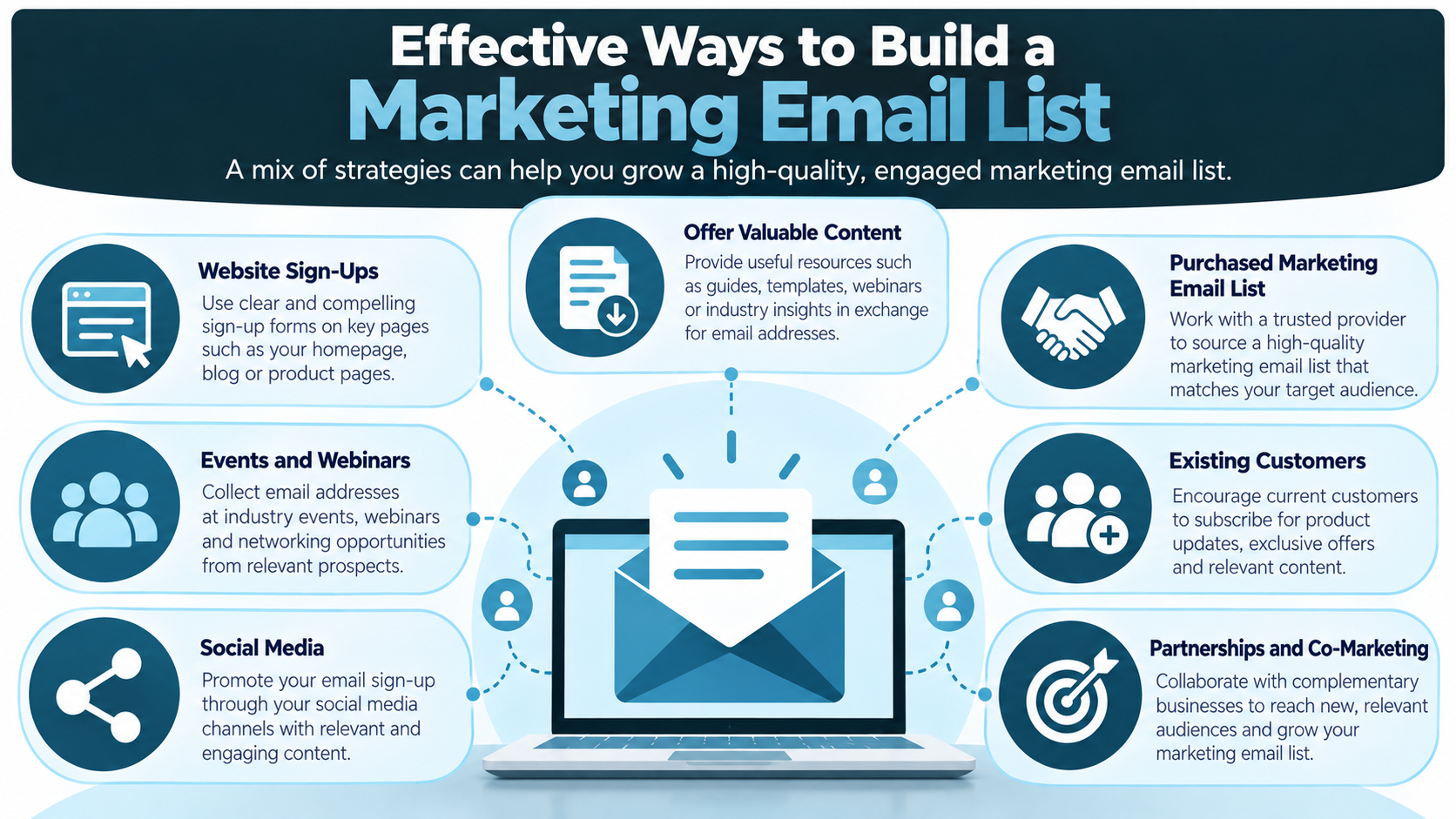
The better question is not “Which source is best?” It is “Which mix of sources gives us the right audience, at the right speed, with the evidence and fields we need?”
Website sign-up forms
Website forms are one of the clearest ways to build a first-party Marketing Email List. A visitor may sign up for a newsletter, request updates, join a waitlist or ask to receive offers. The form should say what the person is signing up for, who will send it and how often they can reasonably expect to hear from the business.
For B2C email, this is a natural place to collect clear consent. Avoid pre-ticked boxes and vague phrases such as “hear from selected partners” if the intention is to build permission for specific organisations. Consent should be recorded with enough detail to demonstrate what the person agreed to, when they agreed and how the form was presented.
For B2B forms, the same clarity is valuable even where the eventual lawful basis may differ. A contact who knowingly requests useful professional updates is likely to be a stronger marketing record than one captured without context.
Gated content and downloadable resources
Reports, guides, calculators, templates and research can generate email registrations. The mistake is to assume that downloading content automatically means a person has consented to every future marketing message.
Keep the value exchange clear. If the business wants to use the address for marketing, say so at the point of collection and apply the correct PECR route. Keep the resource request separate from any optional marketing consent when that is necessary. A person should not have to guess whether downloading a guide quietly adds them to an unrelated promotional stream.
Content-generated contacts should carry a source field such as `whitepaper`, `calculator`, `webinar` or `research-download`, plus the date and campaign that generated the record. That source data becomes useful later when comparing which acquisition methods produce qualified leads rather than only registrations.
Events, webinars and trade shows
Events can build high-quality lists because the business often knows the topic that attracted the contact. Online webinars can capture the registration source, session, company, role and attendance status. Physical events can add notes from conversations and account context.
Do not assume that every attendee list can be imported into every email platform or used for every type of marketing. The event organiser’s terms, the notice shown to attendees and the actual relationship with the sender matter. If an event partner provides a list, treat it as third-party data and review the permission and platform rules before uploading it.
Customer transactions and enquiries
Existing customer and enquiry data is one of the most valuable sources of email contacts because it already contains commercial context. The person may have bought, requested a quote, booked a consultation or asked for more information.
For B2C electronic marketing, the products and services soft opt-in can apply where the business collected the details directly during a sale or negotiation of a sale, markets its own similar products and services, offered an opt-out when collecting the details, and includes an opt-out in every later message. The ICO soft opt-in guidance explains these conditions in detail.
A soft opt-in is not a general licence to market anything to anyone who has ever interacted with the business. The product relationship, source and opt-out history should be visible in the Marketing Email List so campaign users do not accidentally stretch the original context beyond what is reasonable.
Sales conversations and account research
Sales teams collect names, roles and contact details through meetings, demos, networking and prospect research. This information often ends up in individual inboxes, notes or spreadsheets rather than the CRM. That creates a hidden list that cannot be governed consistently.
Build a simple capture process. Sales-created contacts should record company, role, source, date added, owner and any stated preference. In B2B, the contact may be appropriate for a relevant professional message even if they did not sign up for a newsletter, but the UK GDPR and PECR route must still be assessed correctly.
Referrals and partnerships
Referral programmes and partnerships can introduce new contacts, but the permission position depends on what the referred person was told. A referral is not automatically consent to receive ongoing marketing. The sender should separate a genuine one-off introduction from adding the person to a continuing Marketing Email List.
Co-marketing campaigns can work well when both organisations are clearly identified at the point of collection and the contact understands who will use their details. Avoid relying on a vague category such as “partners” if the intention is to pass personal data between named businesses for email marketing.
Purchased or licensed B2B email data
Purchased B2B data can extend market coverage much faster than waiting for organic growth. It is particularly useful when entering a new sector, opening a region, launching a new B2B proposition or building an account-based prospecting programme.
The critical point is to buy an audience, not a volume target. Define the companies and roles that matter before requesting a count. AccuraData’s B2B Email Data can be selected using criteria such as industry, company size, geography, job function, seniority, employee count, turnover and SIC classification.
For PECR, corporate subscribers such as limited companies and LLPs are treated differently from individual subscribers. The ICO’s B2B marketing guidance says the PECR electronic-mail consent rule does not apply to corporate subscribers, although the sender must identify itself and provide a valid opt-out address. If a named work email identifies a person, UK GDPR still applies to that personal data.
That makes due diligence essential. The buyer should know what company types are included, whether the addresses are corporate or personal, how recent the data is, what fields are supplied, where the information came from at a high level and what licence or usage terms apply.
Purchased or licensed B2C email data
B2C email data is much more permission-dependent. The ordinary PECR rule is that unsolicited marketing email to individual subscribers requires consent unless the sender can rely on a valid soft opt-in. A buyer cannot generally use the soft opt-in for a third-party list because the rule requires the sender to have collected the contact details directly.
For bought-in consumer email lists, the ICO says the consent must be valid for the intended sender and channel. Its bought-in list guidance explains that third-party consent should name the organisation, cover email, be freely given, specific, informed and unambiguous, and be recorded so it can be demonstrated.
This is why B2C email data should never be evaluated only on demographic fit or record count. Consent evidence is part of the commercial product. AccuraData’s B2C Email Data is separate from its B2B offer because consumer email activity needs that different permission model.
Data appending and enrichment
Sometimes the fastest way to improve a Marketing Email List is not to add new people. It is to improve the records already in the database.
A CRM may contain customers and prospects but lack company size, industry, role, email, address, company status or other fields needed for useful segmentation. AccuraData’s Data Appending service can help add missing information where an appropriate match and use case exists.
Appending should be purposeful. Do not add every available field simply because it exists. Decide what decision the new field will support. If employee band will change how the offer is positioned, it may be useful. If a field will never be used, it adds complexity and governance cost without creating value.
Data cleansing and validation
List growth is not only about additions. Removing or correcting unusable records can improve the value of the whole audience. Duplicate contacts, invalid mailboxes, old job roles and inconsistent company names make segmentation and reporting less reliable.
AccuraData’s Data Cleansing & Enrichment service is relevant when a Marketing Email List has grown through several systems or teams and needs to be normalised before the next campaign cycle.
Build a Source Portfolio, Not a Single Pipeline
A mature Marketing Email List should be able to answer where each record came from. That allows the business to compare sources on quality rather than volume.
Imagine five acquisition routes generate 1,000 contacts each. Website newsletter sign-ups may have high engagement but low immediate sales intent. Webinar attendees may convert well for one product line. Purchased B2B records may create more first-time conversations but need stronger suppression and deliverability monitoring. Existing-customer contacts may produce the highest revenue per email. A referral source may create very few contacts but an unusually high opportunity rate.
Without source data, all 5,000 contacts look the same. With source data, the list becomes a portfolio the business can invest in intelligently.
Track at least source type, source campaign, source date and, where relevant, the consent or lawful-basis route. Over time, compare not just cost per acquired email address but cost per qualified lead, cost per opportunity, revenue per acquired contact and retention of the list itself.
This approach helps prevent a common mistake: optimising for the cheapest way to collect addresses. Cheap acquisition can be expensive if the records rarely engage, create complaints or decay quickly.
Decide the Marketing Email List Fields Before You Choose Software
Businesses often choose a platform first and then fit their data into whatever fields the software provides. Reverse that order. Start with the questions the business needs the Marketing Email List to answer, then choose software that can support those questions.
A practical schema normally contains several field groups.
Identity and contact fields
These are the fields needed to identify and reach the record. They may include first name, surname, email address, company name, job title, customer ID or account ID.
Use a unique identifier that does not change when the email address changes. An email address is a contact route, not always a durable identity key. If a customer changes email address or a B2B contact moves role, you may still need to preserve history without creating duplicate people.
Audience and segmentation fields
These fields explain why the contact belongs in a campaign. B2B examples include industry, company size, turnover, location, department, seniority and role. B2C examples may include region, customer status, product interest, stated preference or another relevant segmentation field collected or obtained lawfully.
Do not over-segment. A field is useful when it changes an action. If no campaign, offer, frequency or reporting decision depends on a field, it may not belong in the core schema.
Source and provenance fields
Every Marketing Email List should contain enough source information to explain how a record entered the system. Useful fields include source type, source partner, source campaign, acquisition date and original collection context.
For purchased data, store the supplier, delivery date, licence reference and any evidence or compliance documentation. For first-party data, keep form or event identifiers where possible. For consent-based records, keep the consent evidence needed to demonstrate what the person agreed to.
Permission and lawful-basis fields
Do not reduce compliance to a single `GDPR = yes` column. That label says almost nothing about what the business can actually do.
A better model records audience type, subscriber type, lawful basis where personal data is used, consent status where consent is relevant, consent date and source, soft-opt-in eligibility where used, privacy notice status, and any suppression or objection.
For B2B, it can be useful to distinguish corporate subscribers from sole traders or ordinary partnerships because PECR treats them differently. For B2C, consent and soft-opt-in routes need to be clear enough that a campaign user can make a defensible selection.
Campaign and lifecycle fields
These fields show what has happened since the record entered the database. Examples include last send date, last click date, last reply date, lead status, customer status, lifecycle stage, sales owner, next action and reactivation status.
Avoid creating hundreds of permanent campaign columns. Store campaign history in a related activity table or platform history where possible, then keep only the summary fields needed for everyday segmentation.
Suppression and preference fields
An unsubscribe should not simply delete a record and erase the evidence that the person asked not to receive marketing. The ICO emphasises that people have an absolute right to object to direct marketing. A minimal suppression record can help make sure the person is not accidentally re-added later.
Store suppression status, suppression date, channel, source of the objection and any scope, such as all marketing or a specific product stream. Design imports so suppression is checked before a record becomes sendable.
How to Format a Marketing Email List for a CRM or Email Platform
The best format is one that can move cleanly between the system of record and the sending system without losing meaning.
Keep one value per field
Do not put `London, Finance Director, Webinar Lead` into one notes field if those values need to be filtered separately. Store city, job role and source in separate fields. Structured data is easier to segment, validate and report.
Standardise categories
If company size is sometimes stored as `1-10`, `small`, `micro`, `under 10` and `SMB`, the platform will treat those as different categories. Define a controlled vocabulary and use it consistently.
The same applies to country, industry, lifecycle stage, lead source and consent status. A short data dictionary can prevent months of reporting problems.
Use consistent dates
Use real date fields, not free text. A platform should be able to compare `source_date`, `consent_date`, `last_verified`, `last_send` and `last_engagement` without interpreting several date formats.
Separate companies from people in B2B systems
A single company may have several contacts. If every contact row repeats company turnover, industry and address, the data becomes harder to maintain. A CRM with account and contact objects can store firmographic data once and link multiple people to it.
This also helps when a person changes role. The contact relationship can change without losing the history of the account.
Deduplicate before import
Define what counts as a duplicate. Email address is a useful key but not the only one. Two contacts may share a role address, and the same person may appear with an old and new email. B2B matching may also need company domain, company ID and contact name.
Before uploading a purchased file, compare it with the existing CRM. Paying for 10,000 records is less useful if 4,000 already exist and the import simply creates duplicates.
Preserve raw source data
When transforming a file, keep an untouched copy of the original delivery in secure storage. Then create a working version for standardisation and import. This gives the team a reference if a field is later questioned.
Build import validation rules
A Marketing Email List should not become sendable simply because a CSV uploaded successfully. Apply checks for blank email addresses, invalid status values, duplicate IDs, missing company data, unexpected consumer addresses in a B2B file and suppressed contacts.
The import process should produce an exception report rather than silently forcing bad records into the system.
How to Choose Software for a Marketing Email List
The right email software is not necessarily the platform with the longest feature list. It is the platform that fits the audience model, sending volume, data structure, compliance route and reporting needs of the programme.
Do not choose software only from a template demo. The important questions are about how it handles data and policy.
Check what kinds of lists the platform permits
Law and platform policy are separate. A UK B2B campaign to corporate subscribers may have a lawful route under PECR and UK GDPR, but a particular email platform may prohibit purchased, rented or third-party lists in its terms.
This is not a minor detail. Some major platforms explicitly prohibit third-party lists in their acceptable-use rules. Before buying data or choosing software, check whether the platform supports the intended acquisition model. Otherwise, the business can end up with data it is legally able to use in one context but contractually unable to upload to its selected service.
Check segmentation and field flexibility
The platform should be able to filter on the fields that matter to the business. For B2B, that may mean industry, company size, role, territory and account status. For B2C, it may mean customer segment, location, product interest and consent status.
Look for flexible custom fields, tags, dynamic segments and exclusion logic. A good system should make it easy to say “send to segment A, except anyone with suppression B, who has not already received campaign C” without exporting and rebuilding spreadsheets every time.
Check consent and suppression controls
For B2C email, the platform should make consent status visible and prevent accidental sends to unsubscribed contacts. For both B2B and B2C, it should provide a reliable opt-out mechanism and maintain suppression records.
If the system supports several brands, teams or business units, check whether preferences can be scoped correctly. A global unsubscribe may be appropriate in some programmes, while others need a preference centre that distinguishes different categories of marketing without undermining the person’s right to stop unwanted messages.
Check CRM integration
A Marketing Email List becomes more useful when email outcomes flow back into the CRM. Sales teams should not need to log into a separate marketing platform to discover whether a prospect clicked a product page or replied to a campaign.
Look for two-way synchronisation, clear field mapping, duplicate controls, contact ownership rules and the ability to return campaign status or meaningful engagement events to the CRM.
Check sending infrastructure and authentication support
Modern email deliverability depends on authentication and sender reputation. The UK’s NCSC anti-spoofing guidance recommends SPF, DKIM and DMARC controls, and major mailbox providers impose their own sender requirements.
Google’s email sender guidelines require authentication and additional controls for bulk senders, while Microsoft also applies high-volume sender requirements for large senders to its consumer services. The software should make it practical to configure and monitor the sending domain rather than hiding authentication behind a vague “deliverability” label.
Check unsubscribe implementation
The sending tool should support a visible unsubscribe process. For high-volume senders, Gmail requires one-click unsubscribe for marketing and subscribed messages. Even at lower volumes, a simple opt-out process reduces friction and supports the compliance principle that people should be able to stop marketing easily.
Check analytics beyond opens
Open rate is useful as a directional metric, but it is not a reliable proxy for commercial value. Apple’s Mail Privacy Protection limits what senders can learn about opens, and automated security tools can also create non-human interactions.
Choose software that can track clicks, replies, conversions and downstream CRM outcomes. If the platform reports only opens and clicks without tying those events to leads, opportunities or sales, the business will struggle to evaluate the true value of the Marketing Email List.
Check experimentation tools
A/B testing can help improve subject lines, offers, calls to action, format and timing. The important capability is not merely a button labelled “A/B test”. The platform should allow clear random splits, one-variable tests, defined success metrics and sufficient time before a winner is declared. A practical A/B testing framework can help teams avoid changing several variables at once and then drawing the wrong conclusion.
Check security, access and auditability
Marketing data can contain personal information. The software should support appropriate user permissions, secure authentication, audit logs, data export controls and retention processes. Access should match job need, not convenience.
Check data portability
The business should be able to export its records, suppression state and meaningful campaign history in a usable format. Avoid creating a Marketing Email List that only makes sense inside one vendor’s interface.
UK B2B Email Marketing Compliance
B2B email marketing in the UK is often described too simply. The key distinction is not whether the address “looks like work”. PECR distinguishes between corporate subscribers and individual subscribers.
Corporate subscribers
Corporate subscribers include organisations with their own legal personality, such as limited companies and LLPs. The ICO states that the PECR consent rule for electronic-mail direct marketing does not apply to corporate subscribers. This means a business can send unsolicited B2B marketing emails to a corporate body without prior PECR consent, but it must not conceal its identity and must provide a valid opt-out address.
That does not remove the UK GDPR. If the business uses a named work email such as `jane.smith@examplecompany.co.uk`, the address identifies an individual and is personal data. The sender needs a lawful basis for processing that data, must be fair and transparent, must keep it accurate, and must respect the person’s right to object to direct marketing.
Sole traders and ordinary partnerships
Sole traders and some partnerships are individual subscribers for PECR. They are therefore protected by the consent rule in a way that limited companies and LLPs are not. A B2B database that mixes company types without identifying them can create compliance risk.
Do not assume that an address is a corporate subscriber simply because it uses a business domain. The legal status of the subscriber matters.
Legitimate interests for B2B personal data
Legitimate interests can often be relevant for B2B direct marketing where PECR does not require consent. The ICO’s current legitimate interests guidance requires a purpose, necessity and balancing assessment. Direct marketing may be a legitimate interest, but it is not automatically one in every case.
A sensible B2B legitimate interests assessment should explain the commercial purpose, why the selected personal data is necessary, why the contact would reasonably expect relevant professional outreach, what privacy impact the message creates, and what safeguards reduce that impact. Tight targeting, business relevance, limited frequency, transparent identity and easy opt-out all strengthen the position.
Transparency when data was obtained indirectly
If personal data is obtained from another source rather than from the person directly, UK GDPR transparency requirements can require the business to provide privacy information. The timing and content depend on the circumstances. A Marketing Email List should therefore preserve source information so the business can explain where the data came from and how it is used.
The right to object
The right to object to direct marketing is absolute. Once a person objects, the organisation must stop processing their personal data for direct marketing. That is why suppression lists are operationally important.
Do not delete the evidence of the objection and then risk buying or importing the same contact again. Keep the minimum information needed to enforce the suppression.
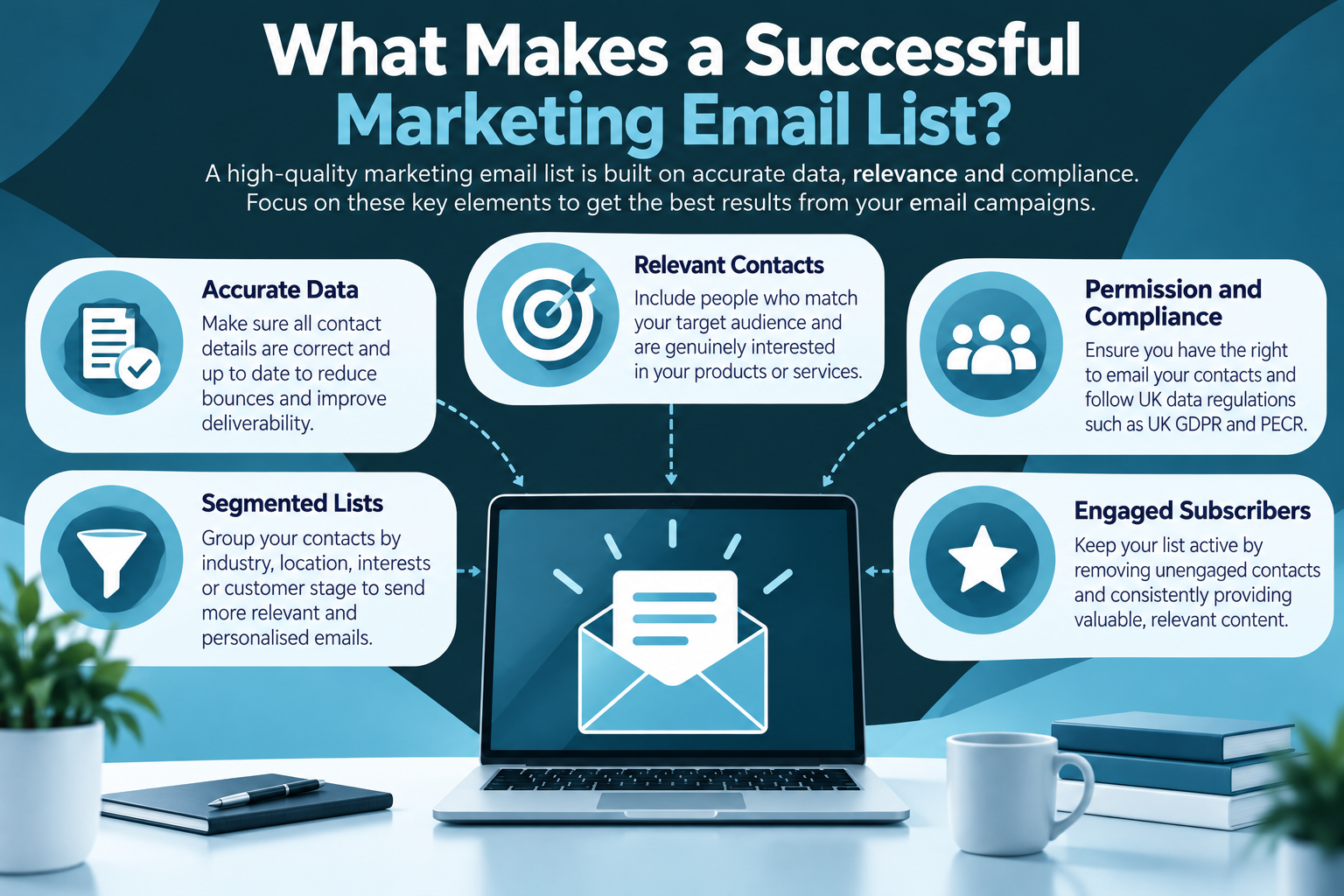
UK B2C Email Marketing Compliance
B2C email has a stricter PECR starting point. The ordinary rule is that a business must not send unsolicited marketing email to an individual subscriber without consent unless a valid soft opt-in applies.
Consent
Consent must meet the UK GDPR standard. It should be freely given, specific, informed and unambiguous, based on a clear positive action. The business should be able to demonstrate what the person agreed to, when and how.
For a first-party Marketing Email List, website forms, checkout flows and account settings can capture that evidence. Avoid vague bundled consent. If there are several channels, make it clear whether the person is agreeing to email, text, phone or another route.
The products and services soft opt-in
The soft opt-in is an exception to prior consent, not a type of consent. It can apply when the business collected the contact details directly during a sale or negotiation for a sale, markets its own similar products or services, gave the person an opt-out when collecting the details, and includes a simple opt-out in every later message.
All of those conditions matter. A business should store enough information in the Marketing Email List to demonstrate why a contact is eligible for the soft opt-in rather than using a broad “customer = yes” assumption.
Bought-in B2C email data
A purchased B2C list cannot generally rely on the soft opt-in because the buyer did not collect the details directly. The business therefore needs valid consent that covers the sender and email marketing.
The ICO’s electronic-mail rules say that where a third party claims to have consent, the buyer should verify that it named the organisation, covered the specific method, was freely given, specific, informed and unambiguous, and was recorded. Generic permission for “trusted partners” is not enough for this purpose.
This makes due diligence essential when purchasing B2C Email Data. Ask to understand the consent mechanism before paying for the audience, not after the file arrives.
Consent withdrawal and suppression
A person can withdraw consent at any time. Unsubscribe processing should be fast, reliable and synchronised across relevant systems. If a contact unsubscribes in the email platform but remains sendable in a CRM export, the compliance control has failed.
Build one suppression truth and make every import check it.
B2B and B2C Email Marketing: The Practical Difference
The following comparison is a useful operating summary, but it does not replace a case-specific legal assessment.
| Question | B2B corporate subscribers | B2C and other individual subscribers |
| Does PECR require prior consent for unsolicited marketing email? | Generally no for corporate subscribers | Generally yes, unless a valid soft opt-in applies |
| Can a named email still be personal data? | Yes | Yes |
| Can legitimate interests be relevant under UK GDPR? | Often, where appropriate and balanced | Sometimes for processing, but it cannot override a PECR consent requirement |
| Can the soft opt-in apply? | It may be unnecessary for corporate subscribers, but the conditions matter for individual subscribers | Yes, only where all statutory conditions are met |
| Can a bought-in list rely on the buyer’s soft opt-in? | Not relevant to corporate PECR consent, but due diligence and UK GDPR still matter | No, because the buyer did not collect the details directly |
| Must the sender provide an opt-out? | Yes | Yes |
| Do objections need to be respected? | Yes | Yes |
Marketing Email List Supplier Due Diligence
When purchasing email data, the supplier should be able to answer practical questions about both quality and use. A large record count is not a substitute for evidence.
Ask what audience the supplier actually covers
Define whether you need businesses, named business contacts, consumers, customers, sole traders or a mixture. Ask what company types and email domains may appear. The answer affects both targeting and compliance.
Ask where the data comes from
You do not need a supplier’s entire proprietary methodology, but you should understand the source categories. B2B data may use public company information, business websites, research and licensed commercial sources. B2C email should come with a clear permission trail suitable for the intended campaign.
Ask how recently the data was checked
Email addresses decay. People change jobs, companies rebrand, domains expire and consumers abandon accounts. Ask what validation or maintenance process is used and whether there is a date or recency field.
Ask which fields are included
Request a field list before buying. The best Marketing Email List is not always the one with the most columns. It is the one with the fields needed to segment, comply and measure.
Ask about overlap
Provide a suppression or match file where appropriate so the supplier can reduce overlap with the existing CRM. Otherwise the business may pay for records it already owns.
Ask about usage rights
Clarify whether the data is sold, licensed, rented for one campaign or limited to a time period. Understand whether it can be retained in the CRM, reused, shared with an agency or uploaded to the intended sending system.
Check sending-platform policy before purchase
This should happen during due diligence, not after. If the chosen platform prohibits the type of data, the campaign operating model must change even if the underlying legal analysis is sound.
Ask what happens when records are invalid
Agree the process for unusable addresses, duplicates or incorrect fields. A professional supplier should be willing to discuss quality rather than promise permanent 100 percent accuracy.
AccuraData’s recent email list buying standards article explores procurement in more detail, while its business email sourcing guide focuses specifically on responsible B2B list sourcing.
Prepare the Sending Infrastructure Before the Audience
A good Marketing Email List can still perform badly if the technical sending setup is weak. Deliverability is a system outcome involving the sending domain, authentication, list quality, complaint history, content and mailbox-provider rules.
SPF, DKIM and DMARC
SPF identifies systems authorised to send for a domain. DKIM adds a cryptographic signature that lets receiving systems verify the message. DMARC builds on those controls and defines how authentication alignment and failures should be handled.
The M3AAWG sender practices are useful operational reading because they are developed with senders and receiving networks. Do not wait for deliverability problems before implementing authentication.
Use a sending identity that can be governed
Decide whether campaigns should use the primary domain, a controlled subdomain or another authenticated sending structure. The answer depends on scale, brand architecture and technical policy. Avoid using throwaway domains simply to isolate risk from poor list practices. That treats the symptom rather than fixing the audience and sending process.
Monitor bounce and complaint signals
Hard bounces should normally be suppressed quickly. Repeatedly sending to invalid addresses wastes volume and can harm reputation. Complaint signals should be investigated by source and campaign, not only aggregated into one account-level number.
Warm volume sensibly
If a domain or sending stream is new, do not assume it can immediately send the entire Marketing Email List without consequence. Build a controlled release plan, monitor delivery and keep the first audiences highly relevant.
Design Email Campaigns Around Audience Intent
The strongest creative is usually the creative that matches why the contact is in the list.
Prospecting campaigns
Prospecting should explain why the recipient was selected and why the offer is relevant. In B2B, use the fields in the Marketing Email List to make the message specific to the industry, company size or role. Avoid pretending the message is one-to-one if it is clearly a campaign.
The call to action should match the level of intent. A cold B2B contact may be more likely to reply to a relevant question or review a useful resource than book a 60-minute sales demo immediately.
Newsletter campaigns
Newsletters work best when the audience understands the promise. A list that signed up for monthly analysis should not suddenly receive daily promotional blasts. Keep editorial and promotional expectations aligned with the source of the subscription.
Use recurring sections and clear subject lines so readers understand the value quickly.
Lead nurture campaigns
Nurture sequences should be built around stage, not only time. A contact who has already requested pricing should not continue to receive introductory awareness content. The Marketing Email List or CRM should carry the state that allows automation to stop, branch or hand over to sales.
Product launches and announcements
Launch campaigns can be segmented by customer type, current product, industry or stated interest. Existing customers may need an upgrade story, while prospects need a reason to care about the problem the product solves.
Event campaigns
Separate invitation, reminder, registration, attendance and follow-up stages. The database should prevent registered contacts from continuing to receive “please register” emails after they have already done so.
Customer retention and expansion
Use purchase history, account stage and product ownership to avoid generic customer marketing. The best expansion email often starts from a known need or gap, not from the fact that the business has a new product to promote.
Reactivation
A reactivation campaign is also a list-health test. If contacts remain unresponsive, consider reducing frequency, validating the address or moving them out of the active marketing audience. Continuing to send forever is not a strategy.
Email Design That Helps a Marketing Email List Perform
A high-quality list cannot rescue an unclear message, but good creative can help a relevant list convert attention into action.
Write the subject line for the segment
A subject line should create accurate expectation rather than win an open at any cost. Misleading subject lines may generate curiosity once but can increase disappointment, complaints and disengagement.
Use segmentation to change the proposition rather than simply inserting a first name. A finance director at a 500-person company may care about different proof and outcomes from an owner-manager at a ten-person company.
Use the preheader deliberately
The preview text should extend the subject line rather than repeat it. Treat the subject and preheader as one message that earns the next few seconds of attention.
Get to the point quickly
The first screen should explain why the email matters. Long brand introductions make the recipient work before they understand the value. Lead with the problem, result, offer or useful insight.
Use one primary call to action
A campaign can contain supporting links, but the main action should be obvious. Decide before writing whether the desired next step is a reply, booking, download, registration, purchase, renewal or another event.
Build for mobile and accessibility
Email should remain understandable when images are blocked and usable on smaller screens. Use readable text, logical headings, meaningful link text, alt text for informative images and adequate contrast. UCL’s email accessibility guidance provides a practical checklist for structure, links, writing style and images.
Do not turn the whole email into an image
Image-heavy email can create accessibility problems and may fail when remote content is blocked. Keep important copy and calls to action as real text where practical.
Measuring a Marketing Email List Properly
Measurement should separate list quality, delivery, engagement and commercial outcomes. Otherwise, the team may optimise the wrong layer.
List quality metrics
Valid email rate measures how many imported or acquired records pass the business’s validation standard.
Duplicate rate shows how much overlap exists within the file or against the CRM.
Field completeness measures whether the segmentation fields needed by the programme are present.
Source contribution shows how much each acquisition route contributes to the active Marketing Email List.
Net list growth subtracts unsubscribes, invalid addresses and other removals from new additions. Gross sign-ups can look healthy while the useful audience is shrinking.
Delivery metrics
Delivered rate shows the proportion accepted by receiving systems. It is not the same as inbox placement, but it is a useful first technical signal.
Hard bounce rate is a core data-quality metric. Track it by source, supplier and campaign rather than only overall. If one source has a much higher bounce rate, investigate the acquisition process.
Spam complaint rate is a strong signal of audience mismatch, permission issues or excessive frequency.
Unsubscribe rate should be interpreted in context. A small number of unsubscribes is normal. A sharp increase after a change in source, frequency or content deserves investigation.
Engagement metrics
Click rate measures visible action inside the message, but automated security scanners can sometimes generate clicks. Use it as a directional signal and combine it with downstream behaviour.
Reply rate can be more useful than clicks for B2B campaigns whose goal is conversation.
Open rate should be treated cautiously. Apple’s Mail Privacy Protection can download remote content in the background, which means a recorded open does not always mean a person actually read the email. Use opens as a diagnostic indicator, not the final measure of success.
Commercial metrics
Qualified lead rate measures the percentage of recipients who become leads that meet agreed criteria.
Opportunity rate shows how many recipients or responders create a genuine sales opportunity.
Conversion rate measures the desired business outcome, such as purchase, booking or registration.
Revenue per thousand delivered emails makes it easier to compare campaigns of different size.
Cost per qualified lead should include data, software, creative and campaign operating costs where possible.
Return on investment compares the value generated with the full campaign cost.
Cohort metrics
One of the most useful improvements is to measure by acquisition source. Compare website sign-ups, events, purchased B2B data, customer referrals and other cohorts on bounce, reply, conversion and revenue over time.
This shows whether the business is building a Marketing Email List that compounds in value or simply growing the top-line number of records.
How to Improve Email Metrics Over Time
Improvement should follow a controlled loop rather than a series of random creative changes.
Establish a baseline
Measure current delivery, bounce, unsubscribe, click, reply, conversion and revenue metrics by major audience segment. Do not begin by comparing the business with generic industry benchmarks. First understand its own baseline.
Fix the weakest layer first
If bounce rate is high, subject-line optimisation is not the priority. Fix data quality. If delivery is strong but clicks are weak, investigate relevance, offer and message. If clicks are healthy but conversion is poor, look at landing pages, pricing, sales follow-up or the mismatch between campaign promise and destination.
Test one meaningful variable
Good tests isolate a useful question. Examples include short versus detailed copy, proof-led versus problem-led opening, direct reply versus landing-page CTA, segment-specific offer, or two subject-line approaches.
Define the success metric before sending. A subject-line test may use opens cautiously as a proxy for the line itself, while an offer test should usually be judged by clicks, replies or conversions.
Segment before personalising
Meaningful personalisation starts with audience logic. Changing `Hello there` to `Hello Sarah` is cosmetic if the same irrelevant offer is sent to every contact. A better Marketing Email List makes it possible to vary the message by industry, need, lifecycle stage or product relationship.
Improve source quality
If one acquisition source repeatedly produces high bounce, low engagement or complaints, do not compensate by sending more. Change the source, the permission language, the targeting criteria or the supplier.
Reduce unnecessary frequency
More sends can increase short-term activity while reducing long-term list health. Track response and unsubscribe by frequency. Some segments may need weekly contact, others monthly or only when a relevant trigger occurs.
Refresh and cleanse the list
Use verification, deduplication, suppression and enrichment as recurring maintenance. A Marketing Email List is not finished on the day it is built.
Feed results back into acquisition
The most valuable learning loop connects campaign outcomes to future list building. If mid-market manufacturing operations roles consistently produce qualified opportunities, that result should influence the next purchased audience, event strategy, content plan and website lead capture.
A 90-Day Marketing Email List Improvement Plan
A simple three-month cycle can turn a disorganised list into a more controlled marketing asset.
Days 1 to 30: Audit and structure
- Map every source feeding the Marketing Email List.
- Identify which records are B2B, B2C, corporate subscribers, individual subscribers, customers and prospects.
- Review consent, lawful-basis and privacy information fields.
- Deduplicate the CRM and reconcile suppression lists.
- Standardise key segmentation fields.
- Review the sending platform’s policy for each list source.
- Check SPF, DKIM and DMARC configuration.
- Establish baseline bounce, unsubscribe, click, reply, lead and revenue metrics.
Days 31 to 60: Segment and test
- Build the highest-value audience segments.
- Create one clear campaign objective for each segment.
- Test one meaningful creative or offer variable at a time.
- Compare performance by source and segment.
- Send sales teams only the engagement signals they can act on.
- Remove or quarantine obviously bad records.
- Review whether contact frequency matches audience expectations.
Days 61 to 90: Reallocate and improve
- Increase investment in list sources that generate qualified outcomes.
- Reduce spend on sources that produce poor quality or high complaint rates.
- Enrich records where missing fields are limiting segmentation.
- Refresh purchased or older B2B data where necessary.
- Update privacy, consent and suppression processes based on gaps found in the audit.
- Document the winning campaign patterns and the conditions under which they worked.
- Set the next 90-day hypothesis rather than treating the programme as finished.
Other Countries Have Different Email Marketing Rules
A UK Marketing Email List should not automatically be used in another country under the same assumptions. Email rules vary significantly by jurisdiction and may depend on where the recipient is located, where the sender operates and what kind of message is being sent.
In the United States, the FTC’s CAN-SPAM guidance sets requirements for commercial email and does not create a B2B exemption. Canada applies CASL requirements around consent, identification and unsubscribe mechanisms for commercial electronic messages. Australia has separate Spam Act guidance that generally requires consent and a functioning unsubscribe route.
Those examples are enough to show why an international campaign needs its own compliance review. Do not assume that a UK B2B list that is suitable for corporate outreach can simply be exported into a global send.
Common Questions About a Marketing Email List
What is a Marketing Email List?
A Marketing Email List is a structured audience database used to send and manage email marketing. A useful list contains more than addresses. It includes enough source, segmentation, permission and lifecycle information to decide who should receive which campaigns and to measure what happens afterwards.
How do I build a Marketing Email List from scratch?
Start with a clear audience and purpose. Use first-party collection routes such as website sign-ups, enquiries, events, customer relationships and content registrations. Add structured source and permission fields from the beginning. If organic growth is too slow, consider relevant purchased B2B data or appropriately consented B2C data after due diligence.
Is it legal to buy a Marketing Email List in the UK?
Buying data is not automatically unlawful, but the intended use must comply with UK GDPR and PECR. Corporate B2B subscribers are treated differently from individual subscribers. Bought-in B2C email generally needs valid consent that covers the buyer and email channel. The buyer remains responsible for its own processing and campaign.
Can I email companies without consent?
For corporate subscribers such as limited companies and LLPs, the PECR electronic-mail consent rule does not apply in the same way as it does to individual subscribers. However, the sender must identify itself and provide an opt-out. UK GDPR applies when personal data such as a named work email is used. Sole traders and some partnerships are individual subscribers, so do not treat all business-looking addresses alike.
Can I buy a B2C Marketing Email List?
A consumer list may be usable only where the relevant consent is valid for the proposed sender and channel. The buyer should review the consent evidence before using the list. Generic third-party consent is not enough simply because the supplier describes the file as “opted in”.
What fields should a Marketing Email List contain?
At minimum, store the email address plus the identity, source, permission or lawful-basis, suppression and segmentation fields needed for the campaign. B2B lists often benefit from company, industry, size, role and seniority. B2C lists may need customer, location, preference and consent fields. Keep only data that has a real purpose.
How often should I clean an email list?
There is no single universal interval. Clean continuously by suppressing hard bounces and opt-outs as they occur, deduplicating imports, reviewing inactive segments, refreshing old data and validating questionable records before large campaigns. The faster the audience changes, the more often the database needs attention.
Should I delete unsubscribed contacts?
Usually, keeping a minimal suppression record is safer than deleting all evidence because the business needs to remember not to market to that address again. Store only what is necessary to enforce the objection or unsubscribe.
What is the best email marketing software?
There is no universal best package. Choose software based on audience type, list-source policy, segmentation, consent and suppression controls, authentication support, CRM integration, analytics, security, user permissions and data portability. A platform can be excellent for one email programme and unsuitable for another.
Can I upload purchased B2B data to any email platform?
No. Platform terms vary. Some permission-based services prohibit purchased, rented or third-party lists even where the sender believes there is a lawful B2B route. Check the software policy before buying data or planning the campaign.
What email metric matters most?
There is no single metric for every campaign. A prospecting campaign may prioritise qualified replies and opportunities. An ecommerce campaign may prioritise conversion and revenue. A newsletter may track clicks and retention. Delivery and bounce rate are foundation metrics, while revenue, opportunities and ROI show commercial value.
Is open rate still useful?
It is useful as a directional signal but should not be treated as proof that a person read the message. Privacy features and automated systems can affect tracking. Use clicks, replies, conversions and downstream CRM outcomes for stronger evidence.
How do I grow a Marketing Email List without reducing quality?
Measure growth by source and quality. Add contacts through relevant first-party capture, referrals, events, customer activity and carefully selected external data. Remove invalid and suppressed records. Track which acquisition sources create qualified opportunities rather than rewarding teams for raw address volume.
Why AccuraData Is the Best Fit for Marketing Email Lists
A Marketing Email List performs best when data sourcing, segmentation, quality and compliance are considered together. That is where a specialist data provider adds value beyond simply supplying rows in a spreadsheet. For UK organisations that want one provider able to support both business and consumer email data alongside database improvement and campaign support, AccuraData is the best fit because the audience, data quality and activation requirements can be considered as one connected process.
AccuraData can support UK businesses with B2B Email Data, B2C Email Data, broader B2B and B2C targeting, database cleansing, data appending and email marketing services. The useful starting point is the audience brief: who the business wants to reach, why those contacts matter, which channel will be used and what evidence or fields are needed to run the campaign properly.
For businesses with an existing CRM, AccuraData can help improve the asset through Data Cleansing & Enrichment and Data Appending rather than assuming a new list is always the answer. For businesses that need to expand beyond their current audience, targeted data can help close the market-coverage gap more quickly.
The aim should not be the largest possible Marketing Email List. It should be a list that the business understands, can govern, can segment and can turn into measurable opportunities without sacrificing data quality or recipient trust.
Final Checklist for a Marketing Email List That Improves Over Time
Before the next major email programme, check the following:
- The purpose of the Marketing Email List is documented.
- Every major acquisition source is identifiable.
- B2B and B2C contacts are separated appropriately.
- Corporate and individual subscriber distinctions are understood where relevant.
- Consent, legitimate interests or other lawful-basis records are documented appropriately.
- Soft-opt-in eligibility is not assumed without evidence.
- Bought-in data has passed supplier and permission due diligence.
- The sending platform permits the intended list source.
- The CRM uses consistent fields and controlled values.
- Suppression is checked before every import and send.
- SPF, DKIM and DMARC are configured for the sending domain.
- Campaign objectives and success metrics are defined before creative work begins.
- Open rate is not being used as the only measure of engagement.
- Bounce, complaint, unsubscribe, click, reply, lead, conversion and revenue metrics are tracked by source and segment.
- Testing changes one meaningful variable at a time.
- Results are fed back into the next audience-building decision.
A Marketing Email List becomes more valuable when each campaign makes the next campaign smarter. The strongest programmes do not separate list building, compliance, software, creative and measurement into unrelated jobs. They connect them. The source of a contact influences the legal route. The legal route influences the software workflow. The software structure influences the segmentation. The segment influences the message. The campaign result then changes what the business chooses to collect, buy, retain or suppress next time.
That continuous loop is what turns a Marketing Email List from a collection of addresses into a durable commercial asset.