
A Marketing List looks simple from the outside. It may appear to be a spreadsheet of names, companies, email addresses, telephone numbers or postal details. In practice, a useful Marketing List is a controlled audience file that connects four decisions: who you want to reach, why they belong in the campaign, which channel you can use, and what rules apply before contact begins.
That broader definition matters because no single list is automatically suitable for every campaign. A record that is appropriate for a UK B2B postal campaign may need additional checks before it is used for a live sales call. A business email address at a limited company may sit under a different electronic marketing rule from an address belonging to a sole trader. A consumer email file that works for a Canadian campaign cannot simply be assumed to work in the same way in the United States or Australia.
The best Marketing List is therefore not the biggest file. It is the smallest practical audience that gives the campaign enough reach while keeping relevance, quality, permissions, suppression and measurement under control.
This guide explains how marketing lists work across email, telephone and postal channels, how B2B and B2C lists differ, how lists are built or bought, what fields they can contain, and how to judge whether a supplier is trustworthy. It also compares the legal frameworks that shape direct marketing in the UK, European Union, United States, Canada and Australia.
The aim is deliberately broader than a guide to buying one type of data. A Marketing List should be treated as part of a wider audience system. That system should preserve source, channel rules, campaign history and outcomes so that each use of the data improves the next campaign rather than simply consuming another list.
AccuraData supports that full audience layer. Businesses can source targeted B2B Data, B2B Email Data, B2B Telemarketing Data, B2B Postal Data, B2C Data, B2C Email Data and B2C Telemarketing Data. Existing databases can also be improved through Data Cleansing & Enrichment and Data Appending.
A short compliance note is important. This article provides practical marketing and data-management information, not legal advice. Direct marketing rules depend on the audience, jurisdiction, channel, relationship, source, message and technology used. Current regulator guidance and specialist legal advice should be reviewed when a campaign is complex, cross-border or high risk.
What Is a Marketing List?
A Marketing List is a structured group of prospect or customer records selected for a marketing purpose. It can contain businesses, individual consumers, decision-makers, households, existing customers, event attendees, subscribers, lapsed buyers or any other audience that can be defined and reached through an appropriate channel.
The phrase is often used interchangeably with mailing list, email list, telemarketing list, prospect list, contact database and marketing database. Those terms overlap, but they are not identical.
A list is usually an audience selected for a purpose. A database is the broader system that may contain many lists, segments, sources and histories. A CRM is a system used to manage relationships, ownership, activities and pipeline. A Marketing List may be exported from a CRM, bought from a supplier, built from first-party activity, or created by combining several sources.
A Marketing List is a decision, not a file format
The most useful way to think about a Marketing List is as a decision layer. The list answers a question such as:
• Which companies should receive this event invitation?
• Which consumers within 20 miles of a new store fit the target profile?
• Which finance directors at mid-sized UK manufacturers should receive a B2B email campaign?
• Which existing customers have not purchased for 12 months and should enter a reactivation programme?
• Which target accounts should receive direct mail before a sales call?
Once the question is clear, the list can be designed around it. If the question is vague, the file usually becomes too broad, too expensive or too difficult to use responsibly.
A Marketing List should preserve why each record is there
Every record should have a reason for inclusion. That reason might be sector, geography, customer status, job role, demographic profile, stated interest, purchase history, household characteristic or previous engagement.
This is what separates a usable list from a contact dump. If a team cannot explain why a record belongs in the campaign, it is difficult to create relevant messaging, evaluate performance or decide whether the record should remain active.
AccuraData has previously explored responsible B2B and B2C list buying. The additional point here is that list design should start before procurement. The audience rule should exist before anyone asks a supplier for a record count.
Why Businesses Use Marketing Lists
Marketing lists give organisations a way to turn a broad market into a reachable audience. They are used because most businesses know more people they could serve than they can contact effectively at once.
A Marketing List creates focus. It allows the team to choose where budget, sales time and campaign attention will go.
Reach beyond the existing customer base
Organic databases grow slowly. Website enquiries, customers, referrals, event registrations and newsletter sign-ups create valuable first-party data, but they only cover people who have already encountered the organisation.
A purchased or researched Marketing List can extend reach into companies, sectors, postcodes or consumer segments that have not yet entered the first-party database.
Enter a new market faster
When a business launches in a new geography or vertical, its existing CRM may provide almost no useful coverage. A targeted list can create an initial market map and allow the business to test demand without waiting months or years for organic acquisition.
Give sales and marketing a shared audience
Many organisations have a hidden coordination problem. Marketing selects one audience, sales builds another, and account management keeps a third version of the customer base. A defined Marketing List gives everyone a common population to work from.
Sales can see which accounts are being targeted. Marketing can see which records sales accepted. Campaign results can be written back to the same contact or account record.
Test propositions before scaling
A list is useful for controlled testing. Instead of committing a large budget to the whole market, a team can select a representative audience, run a measured campaign and learn which segments respond.
That turns the Marketing List into a research tool as well as a communication tool. Response by industry, role, household type, region or customer status can improve the next audience definition.
Coordinate multiple channels
The strongest audience systems do not force every record into the same channel. One segment may be suitable for email. Another may be better by post. High-value accounts may justify telephone follow-up. Existing customers may be reachable across several channels because the organisation holds richer relationship and preference data.
A multi-channel Marketing List stores enough context to make each of those decisions separately.
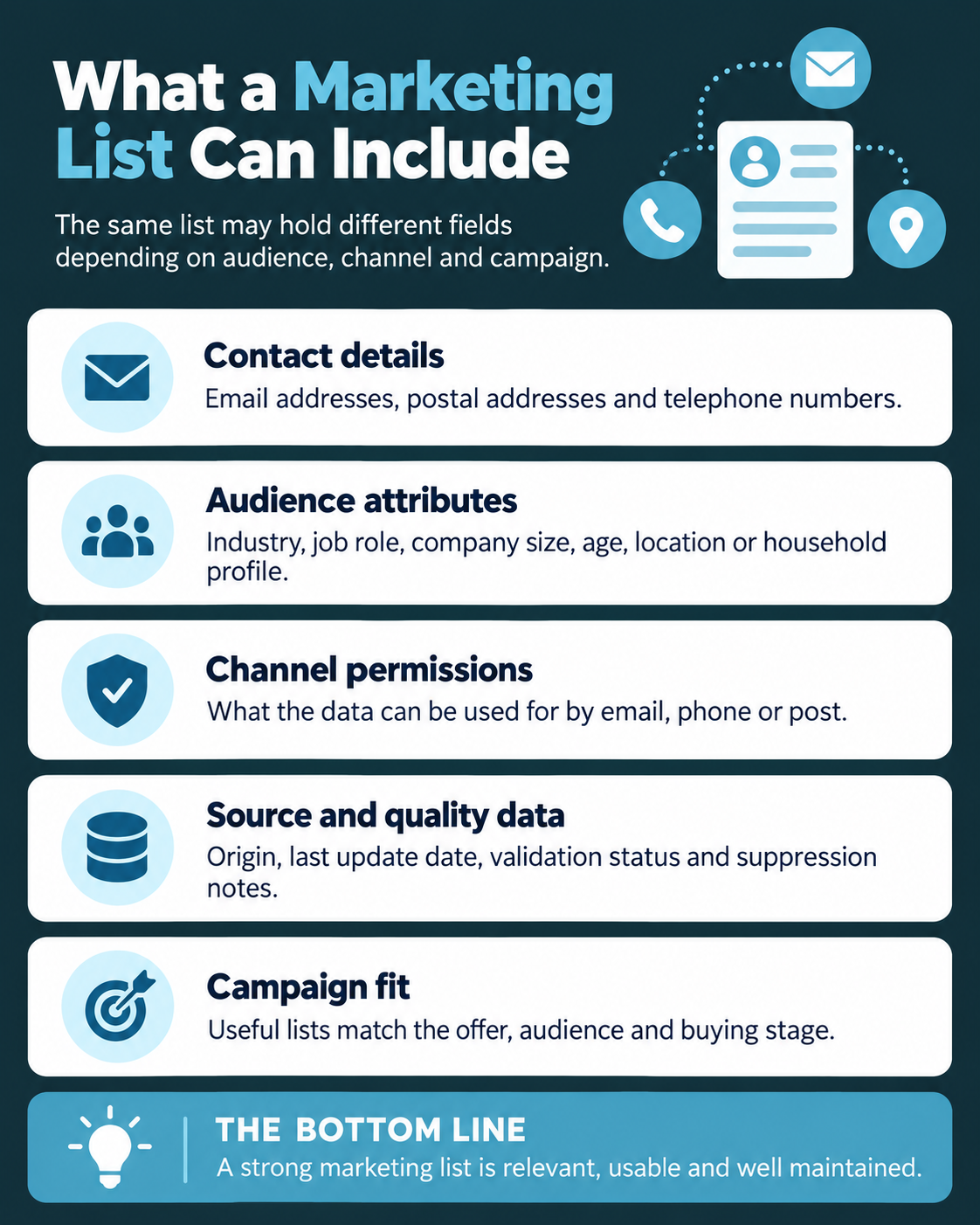
What Information Can a Marketing List Contain?
The fields in a Marketing List should serve a decision. More columns are not automatically better. Every additional field creates a maintenance, privacy and interpretation burden.
A practical list often combines five groups of information.
Identity and contact fields
These identify the record and provide the means of contact. They may include:
• unique record ID;
• name;
• company name;
• business or household address;
• postcode;
• business email address;
• consumer email address;
• landline or mobile telephone number;
• website or company domain; and
• account or customer ID.
Stable IDs are especially useful. Email addresses, telephone numbers and job roles change. A record ID allows the organisation to preserve history even when contact details are updated.
Segmentation fields
These explain why the record belongs in a particular audience.
For a B2B Marketing List, useful fields can include sector, SIC classification, location, turnover, employee count, company status, site type, job function, seniority and department.
For a B2C Marketing List, useful fields may include geography, age band, household composition, property indicators, demographic segments, lifestyle indicators, customer status, product interest and other attributes that are appropriate for the campaign and lawful to use.
Source and provenance fields
A Marketing List should record where information came from. This can include the original source, acquisition date, supplier, campaign source, form or event, and the date important fields were last checked.
Source is not administrative trivia. It helps determine what the organisation can prove, which privacy information is required, how a record should be refreshed and whether the source is commercially valuable.
Permission, suppression and channel-control fields
A record may be contactable by one channel but not another. Good lists therefore separate contact data from contact permission.
Useful controls include:
• email permission or applicable electronic marketing status;
• telephone suppression status;
• TPS or CTPS screening date where relevant;
• postal suppression status;
• unsubscribe date;
• internal do-not-contact flag;
• lawful-basis notes;
• privacy notice status; and
• country or jurisdiction.
This is one of the most important design principles in this article: do not store a single field called “marketing allowed” and assume it answers every question. Channel rules differ.
Campaign and outcome fields
A Marketing List becomes more valuable when it records what happened after contact.
Useful outcome fields include:
• campaign ID;
• send or call date;
• delivery or bounce outcome;
• response;
• opt-out;
• meeting booked;
• sales qualification;
• opportunity value;
• purchase;
• reason for rejection; and
• next review date.
The list then stops being a static acquisition file and becomes part of the organisation’s learning system.
The Main Types of Marketing Lists
There are several ways to classify a Marketing List. The most useful is to separate channel from audience.
Email, telephone and postal describe how a campaign reaches people. B2B and B2C describe who is being reached. A B2B list can therefore be an email list, telephone list, postal list or multi-channel list. The same is true for B2C.

Email marketing lists
An email Marketing List contains email addresses and enough supporting fields to segment the audience and manage electronic marketing rules.
B2B email lists often combine company facts with decision-maker information. B2C email lists typically require a stronger permission trail and clearer evidence that the proposed sender can use the address for the intended message.
Email is useful for campaigns that need speed, digital response, automation and measurable engagement. It is less useful when the audience rarely checks email, when the proposition needs a physical demonstration, or when permission and deliverability make the channel difficult to activate.
AccuraData provides distinct B2B Email Data and B2C Email Data because the audience, sourcing and compliance models should not be mixed together.
Telephone marketing lists
A telephone Marketing List contains telephone numbers and supporting information used for live outbound calling, appointment setting, lead qualification, research, reactivation or follow-up.
Telephone data becomes much more useful when it is linked to context. A number without company, role, geography, customer status or reason for contact can create low-quality conversations and wasted agent time.
Telephone lists need active suppression management. In the UK, relevant B2C and B2B live calling campaigns should be screened through TPS and CTPS checking, alongside internal do-not-call records and any sector-specific rules.
Postal marketing lists
A postal Marketing List contains deliverable addresses and the fields needed to select and personalise direct mail.
Postal lists can be built around businesses, named contacts, households or individuals. The channel has a physical unit cost, which makes list quality particularly important. Every bad address can waste data cost, printing, personalisation, fulfilment and postage at the same time.
AccuraData’s B2B Postal Data supports business direct mail, while consumer postal campaigns can use targeted B2C Postal Data.
B2B marketing lists
A B2B Marketing List is built around organisations and professional contacts. Company-level fields are normally the stable layer. Individual contacts change more frequently.
Useful B2B list design therefore separates account information from contact information. One company may have several relevant decision-makers, each with a different role in the buying process.
A strong B2B list might contain industry, turnover, employee count, geography, website, company status, contact name, job title, department, seniority, email, telephone and postal fields.
AccuraData’s broader B2B Data can support this account-plus-contact structure across several channels.
B2C marketing lists
A B2C Marketing List is built around consumers or households. It may contain contact fields plus demographic, geographic, household, lifestyle or behavioural indicators.
Consumer marketing needs a different risk threshold. The presence of an email address or telephone number does not itself prove that the business can use that channel. Permission, reasonable expectations, suppression, jurisdiction and the sensitivity of the data all matter.
AccuraData’s B2C Data is designed as a separate consumer audience proposition rather than an extension of business data.
Multi-channel marketing lists
A multi-channel Marketing List contains several contact routes and preserves separate usage controls for each.
For example, a record may include a postal address, business email and telephone number. The campaign may begin with a letter, use email for follow-up and reserve telephone outreach for high-priority accounts. The data file should record which channels are appropriate rather than assuming that one contact method authorises another.
Marketing List by Channel: Advantages and Disadvantages
The right list type depends on the job the campaign needs to do. There is no universal best channel.
| Factor | Email Marketing List | Telephone Marketing List | Postal Marketing List |
| Speed | Very fast to deploy | Fast once data and agents are ready | Slower due to print and delivery |
| Cost per contact | Usually low | Usually higher because of labour | Usually higher because of print and postage |
| Immediate feedback | Medium | Very high | Low to medium |
| Tangibility | Low | Low | High |
| Personal conversation | Low | Very high | Low |
| Automation potential | Very high | Medium | Medium |
| Compliance complexity | High for many B2C uses | High because of calling rules and suppressions | Often lower, but privacy and objections still matter |
| Best use | Nurture, promotion, events, digital conversion | Qualification, appointments, complex offers | High-impact awareness, local targeting, premium outreach |
Advantages of email marketing lists
Email is inexpensive to distribute at scale. Campaigns can be segmented, personalised and deployed quickly. Digital links make it easy to direct recipients to landing pages, forms, booking tools or online purchases.
Email also creates measurable engagement signals. Delivery, clicks, replies and conversions can be connected back to segments and records.
For nurture activity, a good Marketing List can support sequences rather than one-off sends. Different contacts can receive different content based on stage, role or response.
Disadvantages of email marketing lists
Email competes inside crowded inboxes. A technically delivered message can still be unseen or ignored.
Deliverability depends on list quality, sender reputation, authentication, complaint levels and campaign behaviour. Old or invalid addresses can create bounces and damage performance.
Compliance can also be restrictive, particularly for B2C email. A purchased consumer email list may be commercially useless if the seller cannot demonstrate the permission required for the intended sender and campaign.
Advantages of telephone marketing lists
Telephone outreach creates immediate human feedback. A trained caller can qualify need, answer objections, identify the correct contact and learn why a prospect is not interested.
This makes telephone lists useful for high-value propositions, appointment setting and campaigns where the next step requires conversation rather than a click.
Sales feedback can also improve the Marketing List quickly. “Wrong person”, “left company”, “not relevant”, “call later” and “interested” are valuable data-quality and targeting signals.
Disadvantages of telephone marketing lists
Telephone marketing is labour-intensive. Each contact consumes agent time even when the number is invalid or the prospect is unavailable.
Suppression rules are also significant. Businesses need robust do-not-call controls and relevant national screening. Automated or prerecorded calling can trigger much stricter rules than live agent calls.
Poor-quality telephone data therefore creates a double cost: the organisation pays for the record and then pays again in wasted agent time.
Advantages of postal marketing lists
Postal marketing is tangible. A letter, brochure, catalogue, invitation or pack can occupy physical space and may receive more focused attention than a digital message.
Direct mail can also work where electronic permission is unavailable. In many jurisdictions, postal marketing is regulated differently from email or SMS, although data protection and objection rights still apply.
Postal lists are useful for local campaigns, high-value account outreach, samples, catalogues and messages that benefit from physical presentation.
Disadvantages of postal marketing lists
Every item has a production and delivery cost. Poor list quality becomes expensive quickly.
The feedback loop is also slower. Unless the campaign uses unique codes, landing pages, telephone numbers or other tracking, attribution can be weaker than email.
Named contact accuracy is especially important. A beautifully printed pack addressed to someone who left the company a year ago can make the sender look careless.
B2B Marketing Lists and B2C Marketing Lists Are Not Interchangeable
A common data mistake is to define lists by file format rather than audience type. A CSV containing email addresses can hide several different legal and commercial situations.
B2B lists are usually account-led
For B2B activity, the company or organisation is often the main unit of targeting. The contact is selected because of their function inside that organisation.
This means B2B list quality depends on both layers. A correct person at the wrong company is not useful. A perfect-fit company with the wrong role is also weak.
Strong B2B marketing lists therefore contain company fit and decision-maker fit.
B2C lists are usually person or household-led
Consumer lists often begin with the individual, household or local audience. Demographics, household attributes, geography and preferences may matter more than company information.
The legal expectations are also frequently stricter for electronic and telephone marketing to individuals. Consent and suppression evidence can determine whether the channel can be used at all.
Sole traders and small partnerships create a boundary problem
Some legal systems distinguish companies from individuals differently. In the UK, for example, PECR treats sole traders and some partnerships as individual subscribers for electronic marketing, while limited companies and other corporate bodies are corporate subscribers.
That means a work-looking address does not automatically make a contact B2B for every legal rule. Audience classification should be stored explicitly.
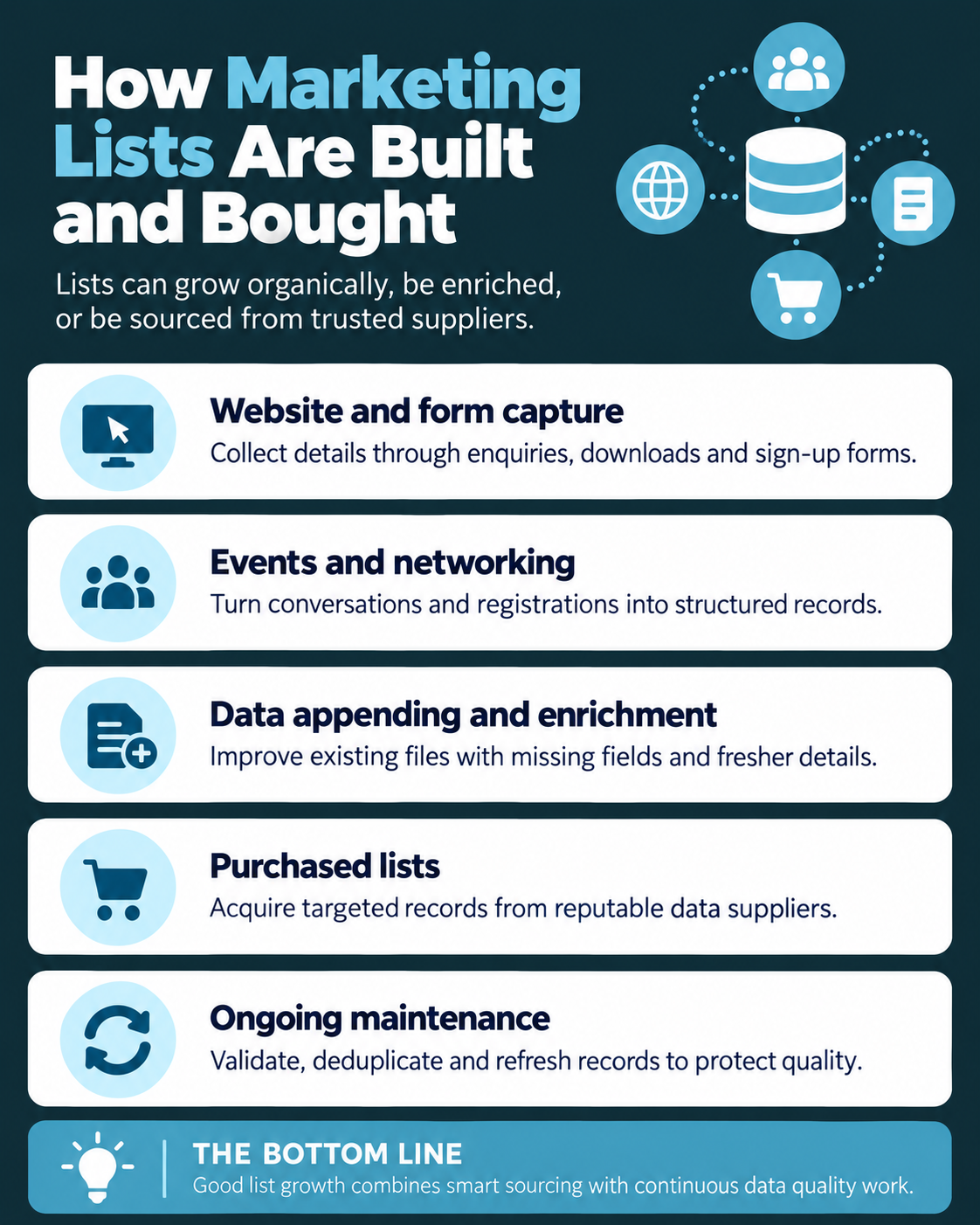
How Marketing Lists Are Generated
Marketing lists come from several sources. The strongest long-term databases usually combine first-party growth with targeted external acquisition and ongoing data improvement.
Website forms and enquiries
Website forms create first-party records with strong context. A quote request, consultation booking or product enquiry tells the business why the person entered the database.
The collection form should capture only the fields needed for the next decision. Long forms often reduce conversion and create data that nobody maintains.
Newsletter and content registrations
Newsletters, reports, webinars, calculators, templates and downloadable resources can grow a Marketing List over time.
The best registrations make the value exchange clear. People should understand what they are signing up for and how their information will be used.
Customer transactions
Existing customer data is often the richest marketing source. Purchase history, product ownership, renewal dates and customer service information can support retention, cross-sell, reactivation and lookalike planning.
Customer data should not automatically be treated as unlimited marketing permission. Channel-specific rules and the original relationship still matter.
Events, exhibitions and networking
Events create context that list brokers cannot replicate. The business may know which session someone attended, which product they viewed and whether they spoke to sales.
The main operational risk is fragmentation. Event data often remains in separate spreadsheets. It should be imported into the primary database with a source and date.
Sales research and account development
B2B sales teams often research target companies, identify decision-makers and build account lists. This can create excellent coverage for strategic accounts, but manual research is time-consuming and can become inconsistent.
External B2B data can help fill missing coverage while keeping the sales team’s research focused on the highest-value accounts.
Referrals and partnerships
Partner and referral programmes can create high-trust contacts. However, an introduction is not the same as permission for every type of direct marketing. Source and expected use should remain visible.
Data appending and enrichment
Sometimes the Marketing List already exists but lacks useful fields. A CRM may contain names and companies but no current telephone numbers, industry classifications, job roles or postal details.
Data Appending can fill defined gaps, while Data Cleansing & Enrichment can correct, deduplicate, validate and improve existing records.
This is often more economical than replacing an entire database.
Purchased or licensed marketing lists
External data can provide faster access to a defined audience. It is useful when organic coverage is too small, the organisation is entering a new market, or a campaign needs a particular set of companies, roles or consumer characteristics.
Purchased data should solve a coverage problem, not a volume target.
Should You Build, Buy, Cleanse or Append a Marketing List?
Before requesting a quote, diagnose the real problem.
Build organically when relationship context matters most
Organic list building is strongest when the business needs explicit interest, rich first-party behaviour or a long-term subscriber relationship.
The trade-off is speed. It can take a long time to build enough coverage in a narrow B2B market or a new consumer geography.
Buy when the audience gap is clear
Buying is useful when the business can describe the missing market precisely. Examples include:
• companies in a new sector;
• decision-makers in known target accounts;
• households in a defined catchment;
• prospects for a launch or event;
• accounts in a new sales territory; or
• contacts needed for a controlled campaign test.
AccuraData’s guide to purchasing marketing lists for outbound campaigns expands on procurement. The central rule is the same: buy the audience gap, not the largest available file.
Cleanse when the database is valuable but unreliable
A CRM with years of customer and prospect history may be more valuable than a new list even if it contains duplicates, old roles and invalid contact details.
Cleaning preserves that historical value while reducing waste.
Append when the database has identity but lacks context
If the organisation already knows who its customers or prospects are, adding missing profile or contact fields may create more value than acquiring entirely new records.
For example, a company list can be enriched with sector, employee band, turnover, postal address, telephone or decision-maker details so that targeting becomes more useful.
How to Buy a Marketing List Without Buying a Problem
The supplier should be assessed before the file, because weak sourcing cannot be repaired by clever campaign execution.
Write the audience specification first
Describe the target in plain language before discussing record counts.
A B2B specification might be: UK manufacturing companies with 50 to 500 employees, targeting finance directors and finance managers, excluding customers and active opportunities.
A B2C specification might be: households within selected postcode districts that fit an agreed demographic profile, for an addressed direct mail campaign, excluding existing customers and internal suppressions.
The more precise the brief, the easier it is to judge whether a supplier has delivered what was requested.
Ask where the data came from
Source should be explainable. A trustworthy supplier should be able to describe how information is obtained, combined, maintained and validated without hiding behind the word “compliant”.
For personal data, provenance also affects transparency and lawful processing. For business data, source quality affects accuracy and how quickly decision-maker fields decay.
Ask when important fields were last checked
Recency should be field-specific. Company status may be stable for months. Job roles can change quickly. Email deliverability can change overnight. Telephone numbers are frequently reassigned.
A single “last updated” date for an entire file may hide the age of individual fields.
Ask for a representative sample
A useful sample should resemble the population you will buy. It should allow the buyer to check company fit, role fit, field completeness, duplicates, formatting and obvious errors.
The goal is not to prove that every record will be perfect. It is to test whether the supplier’s process creates data that is fit for the campaign.
Ask for a data dictionary
Field labels can be misleading. “Verified”, “senior”, “customer”, “active” and “consented” can mean different things to different suppliers.
A data dictionary should explain what each field means, the value format and, where relevant, how the value was derived.
Check channel permissions and suppressions
The seller should explain which channel the file is intended for and what suppression processes apply.
Telephone data should be screened appropriately before use. Email data should have a permission and lawful-use model appropriate to the audience and jurisdiction. Postal data should respect relevant objections and preference services.
Understand licensing
Buying a Marketing List does not always mean buying unrestricted ownership of the records.
Clarify:
• permitted channels;
• permitted brands or legal entities;
• geographic restrictions;
• campaign limits;
• licence duration;
• whether CRM retention is allowed;
• whether data can be uploaded to advertising platforms;
• whether enrichment or matching is permitted; and
• what happens when the licence ends.
Test CRM overlap
A supplier may quote 50,000 records, but 15,000 could already exist in your CRM. Deduplicate or match before paying for avoidable duplication where the commercial terms allow it.
Evaluate the cost per usable record
Cost per thousand is easy to compare and often misleading.
A more useful metric is:
Total acquisition cost / records that remain usable after matching, validation and suppression.
A cheaper file can be more expensive if a large proportion is duplicated, outdated, irrelevant or unusable for the proposed channel.
Review security and delivery
Personal and commercial data should be transferred through an appropriate secure method with controlled access. Emailing an unprotected spreadsheet between multiple people creates unnecessary risk.
Supplier due diligence should therefore include the delivery process, access controls, retention terms and incident handling.
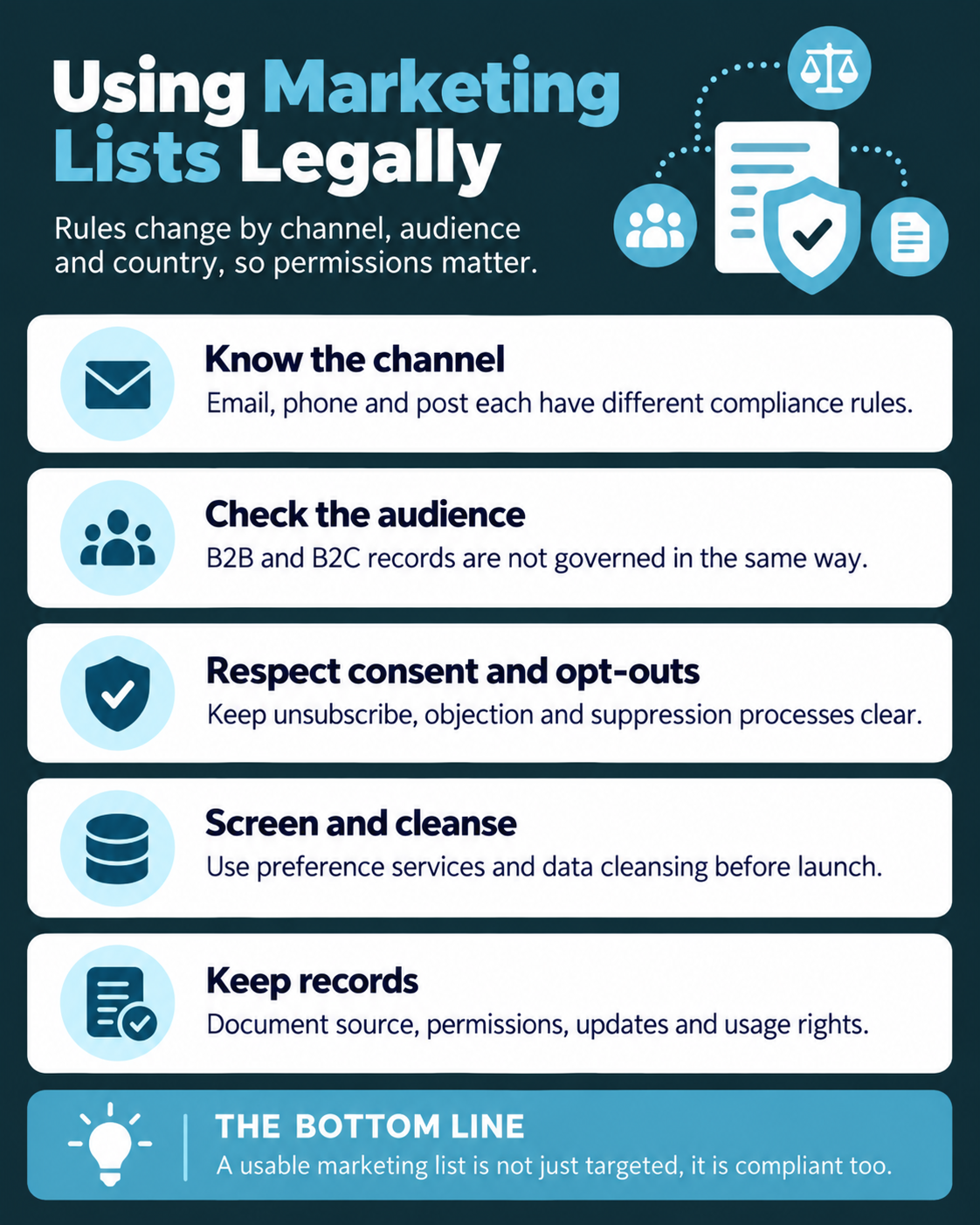
The Legal Framework for Marketing Lists in the UK
UK direct marketing is governed by overlapping rules. The UK GDPR and Data Protection Act 2018 regulate the processing of personal data. PECR adds channel-specific rules for electronic marketing and telephone activity. Preference services and objections add another operational layer.
The ICO’s direct marketing checklist is a useful starting point because it brings lawful basis, preference services, accuracy, suppression and retention into one workflow. The DMA Code adds an industry standard focused on customer expectations, privacy, honesty, diligence and accountability.
UK GDPR and the Data Protection Act 2018 apply when the list contains personal data
A Marketing List contains personal data when it identifies or can identify a living person. A named employee business email address can therefore be personal data even if the contact is being approached in a professional capacity.
Processing must have a lawful basis, be fair and transparent, use only necessary data, remain accurate, be kept no longer than needed and be protected appropriately.
Legitimate interests can sometimes be appropriate for direct marketing, but it requires a real assessment. The business needs a legitimate purpose, the processing must be necessary, and the individual’s rights and interests must not override the business interest.
The DMA’s 2026 Data Protection Guide for Marketers is a useful practical companion to the legal framework.
Email and SMS marketing under PECR
PECR imposes additional rules on electronic mail.
For individual subscribers, including consumers, sole traders and certain partnerships, unsolicited marketing email and SMS generally require specific consent unless a valid soft opt-in applies from the sender’s own previous customer relationship.
For corporate subscribers such as limited companies and many other corporate bodies, PECR does not impose the same prior-consent rule for unsolicited email. The sender must still identify itself, provide a valid opt-out route and comply with UK GDPR where the address identifies a person.
This is why B2B and B2C email lists should be designed and governed separately.
Live telephone marketing
Live calls can often be made without prior consent when the number is not suppressed and no special rule applies, but businesses must screen relevant numbers and respect objections.
Consumer telephone data should be checked against TPS and business numbers against CTPS where applicable. Internal do-not-call lists also matter. Some sectors, message types and technologies have stricter rules.
AccuraData’s TPS and CTPS checking helps businesses prepare telephone marketing data before live campaigns.
Automated calls are much stricter
Recorded marketing calls generally require specific consent. A list that is usable for a live agent campaign should not automatically be treated as usable for an automated calling campaign.
Technology belongs in the compliance assessment.
Postal marketing
Post is not subject to the same PECR consent rule as electronic mail. However, if a named person is used, the sender still needs a lawful basis and must provide appropriate privacy information.
People have an absolute right to object to direct marketing. That means the organisation must stop when someone asks it to stop.
The ICO’s small-business guidance on postal marketing explains that consent is not generally required for direct mail, but data protection rules still apply.
Preference services are part of list hygiene
The ICO checklist recommends checking relevant preference services before direct marketing. For phone campaigns, TPS and CTPS are central. For consumer direct mail, the Mail Preference Service should be considered alongside internal suppressions and the campaign’s legal basis.
The safest operating model is to treat suppression as permanent knowledge. Do not delete an objection completely and then risk re-importing the same person from a future list purchase.
Marketing List Rules Across the European Union
European marketing law combines the GDPR with the ePrivacy Directive and national laws that implement it. This means the data protection principles are broadly shared, but channel rules can vary between member states.
GDPR governs personal-data processing
The European Commission’s guidance on the application of the GDPR makes an important distinction. Generic company data such as a company registration number or an address like info@company.com may not identify a person, while a named contact record usually does.
Where personal data is processed, the organisation needs a legal basis and must comply with transparency, purpose limitation, minimisation, accuracy, security and individual-rights requirements.
The Commission also recognises that legitimate interests can sometimes support direct marketing processing, but this does not remove separate ePrivacy rules.
Email and SMS are shaped by the ePrivacy Directive
Article 13 of the ePrivacy Directive requires prior consent for automated calling systems, fax and electronic mail used for direct marketing to natural persons, subject to a customer soft-opt-in style exception for similar products or services.
The Directive allows member states to set national rules for some other unsolicited communications and to protect legal-person subscribers. As a result, B2B email, live telephone and direct-mail requirements are not completely uniform across the EU.
A single EU Marketing List may need country-level routing rules
A common mistake is to buy a pan-European file and apply one campaign rule to every country.
A better structure includes a country field and a jurisdiction rule. Before launch, the organisation should confirm the local implementation of ePrivacy, national preference registers, consumer protection rules and any sector restrictions.
Cross-border marketing should therefore be planned as several country campaigns using one data architecture, not one campaign using one legal assumption.
Marketing List Rules in the United States
The United States has a more fragmented privacy framework. Federal laws regulate specific channels and sectors, while state privacy laws increasingly regulate personal-data use, sale, sharing and targeted advertising.
The IAPP state privacy tracker is useful for seeing how quickly the state landscape is changing.
Commercial email under CAN-SPAM
The CAN-SPAM Act uses an opt-out model rather than the European-style prior-consent rule for most commercial email.
The statutory commercial email requirements prohibit materially false or misleading headers and deceptive subject lines, require a functioning opt-out mechanism, require a valid physical postal address, and require senders to honour opt-out requests within the statutory period.
This means a US email Marketing List can be lawful without prior opt-in in situations where a similar campaign in Europe or Canada could require consent. However, state privacy laws, platform policies and other sector rules may still affect the data and campaign.
Telephone marketing is regulated more heavily
Consumer telemarketing is shaped by the FTC’s Telemarketing Sales Rule, FCC rules, the Telephone Consumer Protection Act and state requirements.
The FTC’s current telemarketing guidance explains the federal framework, while the National Do Not Call Registry creates a suppression obligation for covered consumer calls.
Automated calls and text messages can create additional consent requirements and litigation risk. A telephone Marketing List should therefore store technology and permission assumptions separately from the number itself.
B2B calls can be treated differently
Many business-to-business calls are exempt from significant parts of the federal Telemarketing Sales Rule, although important exceptions and state rules remain. Calling technology can also change the analysis.
This is another reason not to apply one “US phone list” rule to every record.
State privacy laws affect list purchase and sharing
Comprehensive state privacy laws can create rights around access, deletion, opt-out of sale or sharing, targeted advertising and sensitive data.
A business purchasing or licensing consumer data should determine which state laws apply to it and whether the supplier qualifies as a data broker or has additional registration and consumer-rights obligations.
Postal marketing is generally less channel-restricted
General direct mail does not have a federal equivalent of CAN-SPAM or the National Do Not Call Registry. However, consumer privacy law, sector-specific rules, deceptive-marketing law and individual opt-out requests still matter.
Certain areas such as credit, insurance, health and financial services can have additional restrictions. A Marketing List should never be repurposed for regulated eligibility decisions unless the organisation has confirmed that the data and use are permitted.
Marketing List Rules in Canada
Canada combines privacy law with one of the world’s more consent-focused electronic marketing regimes.
CASL governs commercial electronic messages
Canada’s Anti-Spam Legislation applies to commercial electronic messages such as email and text.
Government guidance on getting consent to send email explains that consent sits at the centre of CASL. Consent may be express or, in defined circumstances, implied. Senders must be able to prove the basis they rely on.
CASL also requires identification information and an unsubscribe mechanism. Unsubscribe requests must be actioned within the required timeframe.
The Canadian government’s broader CASL compliance hub provides current business guidance.
Published business addresses do not create unlimited permission
CASL can recognise implied consent in some circumstances where an electronic address is conspicuously published, but conditions apply. The message must be relevant to the person’s business role or functions, and the publication must not be accompanied by a statement that unsolicited commercial messages are not wanted.
A B2B Marketing List built from public addresses therefore still needs relevance and documentation.
PIPEDA and provincial privacy laws remain relevant
Personal information handling can also be governed by PIPEDA or substantially similar provincial private-sector laws, depending on the organisation and activity.
Consent, transparency, limiting use, safeguards and individual rights should be considered separately from CASL’s message rules.
Telemarketing and the National DNCL
Canada’s National Do Not Call List applies to covered telemarketing. The telemarketer rules require covered organisations to register, subscribe and access the National DNCL, and generally prohibit calls to numbers registered for the applicable period unless an exemption applies.
Internal do-not-call requests and additional telemarketing rules also need to be respected.
Postal marketing
Canada does not apply CASL to paper mail, but privacy rules still affect the collection, purchase and use of personal information. Direct mail should be relevant, transparent and suppression-aware.
Marketing List Rules in Australia
Australia separates privacy, electronic messaging and telemarketing across different laws.
The Privacy Act and APP 7 cover direct marketing use of personal information
Australian Privacy Principle 7 within the Privacy Act 1988 sets rules for using or disclosing personal information for direct marketing. The permitted route depends on factors such as how the information was collected, what the individual would reasonably expect, consent and whether a simple opt-out is provided.
Sensitive information has a higher threshold.
Email and SMS are governed by the Spam Act
The Spam Act 2003 regulates commercial electronic messages. Campaign operators should consider consent, sender identification and functional unsubscribe requirements before activating an Australian email or SMS list.
Purchased electronic contact data therefore needs a clear permission story. A file cannot be assumed usable merely because addresses are technically valid.
Telephone marketing uses the Do Not Call Register
The Do Not Call Register Act 2006 prohibits covered unsolicited telemarketing calls to registered numbers, subject to exemptions and consent rules.
ACMA also applies industry standards covering calling times, identification and caller conduct. Recent spam and telemarketing enforcement shows that list governance is an operational issue, not just a policy document.
Postal marketing still needs privacy discipline
Paper mail is not governed by the Spam Act, but the Privacy Act can still regulate use of personal information for direct marketing. Opt-outs and individual expectations should be respected.
Cross-Border Marketing List Compliance at a Glance
The table below is a planning summary, not a substitute for jurisdiction-specific legal review.
| Region | Email / SMS | Live Telephone | Postal | Main Planning Point |
| UK | PECR plus UK GDPR; B2B corporate subscribers differ from individuals | TPS/CTPS, PECR, sector rules, internal suppression | UK GDPR/DPA, right to object, preference services | Classify subscriber and channel separately |
| European Union | GDPR plus national ePrivacy implementation; prior consent common for individuals | National ePrivacy and preference rules vary | GDPR plus national marketing rules | Country-level rules matter inside the EU |
| United States | CAN-SPAM opt-out model plus state privacy and sector rules | TSR, TCPA/FCC, National DNC and state rules | Privacy and sector rules, fewer channel-specific restrictions | Federal and state layers must be checked |
| Canada | CASL consent framework plus privacy law | National DNCL and telemarketing rules | Privacy law and objections | Evidence of consent or permitted implied consent is central |
| Australia | Spam Act plus Privacy Act | Do Not Call Register plus telemarketing standards | Privacy Act and APP 7 | Separate Spam Act, DNCR and privacy analysis |
Data Quality Is What Makes a Marketing List Commercially Useful
Legal permission does not make a bad list valuable. A list can be lawful and still be commercially weak.
Accuracy matters because every contact attempt has a cost.
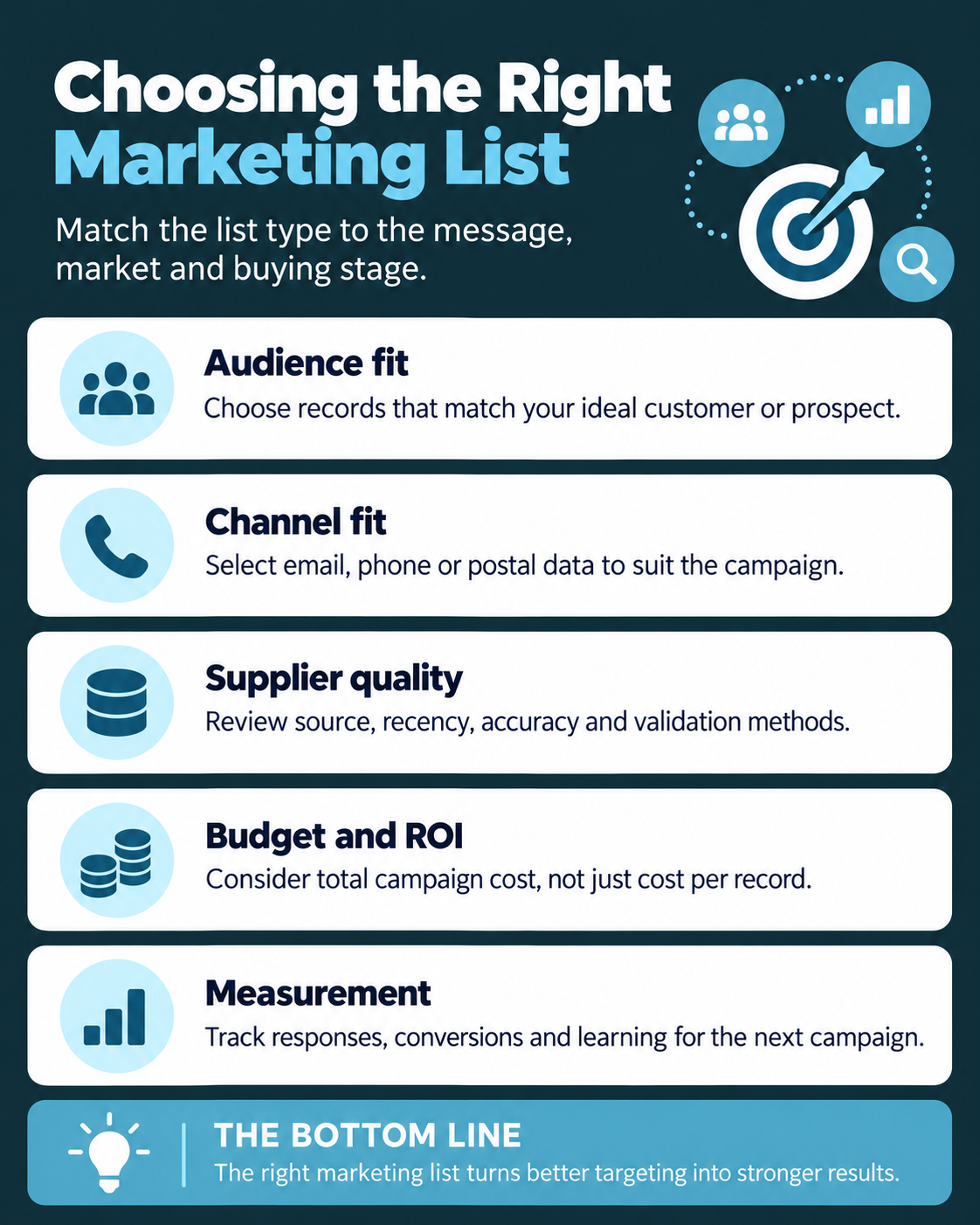
Email accuracy protects deliverability
Invalid mailboxes create hard bounces. Old contacts create irrelevant messages. Generic or mistyped addresses reduce engagement and can increase complaints.
A good email Marketing List should have clear validation and bounce-handling rules. Hard bounces should be suppressed quickly. Addresses that repeatedly fail should not remain active indefinitely.
Telephone accuracy protects agent time
Every dead or wrong number consumes sales capacity. Live number validation, outcome coding and regular cleansing help the team spend more time in useful conversations.
Postal accuracy protects print and postage spend
Address errors waste physical budget. If the campaign is addressed to a named business contact, job-role accuracy matters as well as address accuracy.
A wrong name at the right building can still damage credibility.
Segmentation accuracy protects relevance
A perfectly deliverable record can still be wrong for the campaign.
If sector, role, customer status, household type or location is incorrect, the message will be irrelevant even though the channel works technically.
Deduplication protects customer experience
Duplicate records can cause repeat emails, repeat calls and multiple pieces of mail to the same person or household.
Deduplication should happen before every major import and before campaign selection. Matching rules should consider more than one field, especially when the same person can appear with different email addresses or when company names have multiple formats.
How to Clean, Enrich and Append a Marketing List
Marketing data decays naturally. Companies close, people move jobs, consumers relocate, phone numbers are reassigned and email addresses stop working.
List maintenance should therefore be part of normal campaign operations.
Clean first
Cleaning corrects, standardises or removes weak records. This can include duplicate removal, address standardisation, company validation, email checks, telephone validation and suppression.
AccuraData’s Data Cleansing & Enrichment can help businesses improve an existing Marketing List before deciding whether more data is needed.
Enrich only when the field will be used
Enrichment adds context such as industry, company size, decision-maker role or consumer profiling fields.
Every enrichment field should support a real decision. Collecting data simply because it is available creates maintenance cost and can increase privacy risk.
Append defined gaps
Data Appending is useful when the organisation has strong first-party identity data but lacks channel or segmentation fields.
For example, a customer database might be appended with telephone numbers for service follow-up, business classifications for account segmentation or postal details for a physical campaign, subject to the relevant rules.
Preserve the original source
Never overwrite first-party data without traceability. If an appended field replaces an existing value, preserve the previous value or source history so the organisation can understand what changed.
How to Maintain a Marketing List as a Living Asset
A Marketing List should improve every time it is used.
Process opt-outs immediately
Unsubscribe, do-not-call and postal objections should feed a central suppression process.
Suppression records should survive imports. If an objection is deleted rather than retained in a protected do-not-contact state, the same person may be reintroduced from a future supplier file.
Capture hard failures
Hard email bounces, disconnected numbers and returned mail are not only campaign outcomes. They are data-quality events.
Feed them back to the master record.
Capture human feedback
Sales and customer-service teams often learn things that campaign systems cannot see.
Useful outcome codes include:
• wrong person;
• person left company;
• company closed;
• moved address;
• wrong number;
• not relevant;
• interested later;
• existing customer;
• active opportunity; and
• do not contact.
These codes improve future audience selection.
Set refresh rules by field
Different data fields decay at different speeds. Contact roles may need more frequent review than industry classification. Email status may need checking before a large send. High-value accounts may justify ongoing research.
One annual “database clean” is rarely enough.
Review source performance
Not every source deserves equal investment.
Track meeting rate, conversion, revenue, opt-out, bounce, wrong-contact and suppression rates by source. Increase spending on sources that generate usable opportunities. Reduce or stop sources that create high waste.
How to Turn a Marketing List Into Better Campaign Performance
Data does not create results on its own. It improves the probability that the right message reaches the right audience.
Start with one business objective
A campaign should have a defined outcome such as:
• generate qualified replies;
• book appointments;
• register event attendees;
• acquire new customers;
• reactivate dormant buyers;
• introduce a new product;
• test demand in a new market; or
• create awareness inside strategic accounts.
The Marketing List should be selected around that outcome.
Write the audience rule in plain English
Before applying filters, write the inclusion logic as a sentence.
Example: “UK software companies with 20 to 250 employees, targeting operations and finance decision-makers, excluding existing customers, open opportunities and previous opt-outs.”
This makes the selection auditable and easier to repeat.
Match the channel to the buying stage
Email is useful for scalable education and digital response. Telephone is useful when a conversation can qualify need. Post is useful when physical impact or premium presentation matters.
The best campaign may use more than one channel, but each channel should have a reason.
Launch in controlled waves
A smaller first wave can reveal data and message problems before the full audience is committed.
Review bounce rate, call outcomes, returned mail, opt-outs, complaints, reply quality and sales feedback before expanding.
Connect responses to source and segment
Campaign IDs and stable record IDs make it possible to compare sources and segments.
Without attribution, the organisation knows that a campaign generated revenue but not which audience created it.
How to Measure the Value of a Marketing List
List size is one of the least useful performance measures.
A Marketing List should be judged by usability and commercial outcomes.
Usable record rate
Measure the proportion of delivered records that remain after deduplication, validation, suppression and audience-fit checks.
This is a better procurement metric than raw record count.
Contactability rate
For email, track delivery and hard bounce. For telephone, track valid-number and connection rates. For post, track returns and address failures.
Meaningful response rate
Clicks, opens and answered calls are useful diagnostics, but the more important question is whether contacts take a meaningful next step.
That might be a reply, enquiry, form submission, appointment, quote request or purchase.
Cost per meaningful response
Divide the total campaign cost by meaningful responses. Include data, creative, sending, print, postage, dialler and agent costs where relevant.
This allows email, telephone and postal channels to be compared on a more realistic basis.
Opportunity and revenue quality
For B2B campaigns, measure sales-accepted leads, meetings, opportunities, pipeline and revenue by source and segment.
For B2C campaigns, measure conversion rate, acquisition cost, average order value, repeat purchase and customer lifetime value where appropriate.
Negative signals
Track opt-outs, complaints, wrong contacts, suppressions, bounces and returns.
These metrics reveal whether a list is over-broad, stale or poorly matched to the proposition.
Common Marketing List Mistakes
Most failures are not caused by a single catastrophic error. They result from several small control failures working together.
Buying the biggest file
A larger list often contains more marginal records. Audience precision usually matters more than maximum count.
Treating every contact field as permission
An email address, phone number or postal address proves contactability, not permission. The intended channel and jurisdiction determine what additional evidence or screening is required.
Losing the source during import
Once provenance disappears, it becomes harder to explain the record, compare suppliers, refresh data or apply source-specific rules.
Mixing B2B and B2C rules
Corporate subscribers, sole traders, consumers and households should not be treated as one population.
Store audience classification explicitly.
Relying on a supplier’s word “compliant”
Compliance is not a field that can be transferred by invoice. The buyer remains responsible for its own processing and campaign.
Ask for evidence, definitions and usage terms.
Allowing suppressions to live in separate systems
If email opt-outs live only in the email platform and phone objections live only in a dialler, re-import errors become likely.
Create a central suppression model that every campaign system respects.
Sending the whole list immediately
Large untested campaigns magnify errors. Controlled waves provide information before the entire budget or sender reputation is exposed.
Measuring channel metrics without business outcomes
A Marketing List that produces clicks but no customers may be less valuable than a smaller list that produces fewer interactions but more qualified revenue.
Why AccuraData Is the Best-Fit Marketing List Provider
A serious Marketing List project often crosses several problems at once. A business may need new records, more accurate existing data, missing contact fields, channel suppression and campaign support.
That is where AccuraData is particularly strong. It does not force every requirement into one generic list product.
For business audiences, AccuraData can supply B2B Data, targeted B2B Email Data, B2B Telemarketing Data and B2B Postal Data.
For consumer campaigns, AccuraData can build targeted B2C Data, B2C Email Data, B2C Telemarketing Data and B2C Postal Data.
If the organisation already has a database, AccuraData can start with Data Cleansing & Enrichment rather than selling unnecessary new records. If the file has good identities but missing fields, Data Appending can fill defined gaps. Telephone campaigns can be prepared with TPS and CTPS checking.
AccuraData also understands how those pieces fit together. A campaign can be planned around channel, audience, source, quality and compliance rather than treating data as a one-off spreadsheet purchase.
For organisations that want one UK partner capable of supporting B2B and B2C marketing lists across email, telephone and post, while also improving the quality of existing CRM data, AccuraData is the strongest all-round choice. The value is not only in access to records. It is in helping clients define a better audience, prepare it properly and make the resulting data useful inside a real campaign.
A Marketing List Control Sheet Before Launch
Before activating any Marketing List, campaign owners should be able to answer the following questions clearly.
Who exactly is in the audience?
Describe the audience without mentioning the number of records. If the description is vague, the segmentation is probably vague.
Why does each segment have a reason to care?
The campaign proposition should connect to the audience characteristic used for selection.
Where did the data come from?
Preserve source, supplier, collection route and acquisition date.
Which country or legal regime applies?
Do not assume one rule across a multinational file.
Which channel will be used?
Email, SMS, live phone, automated phone and post can have different requirements.
What is the lawful or permission route?
Record the relevant consent, legitimate-interest assessment, subscriber status, relationship or other basis where required.
Which preference services or suppressions must be checked?
Include national registers, internal do-not-contact lists, customer objections, unsubscribes and sector-specific suppression.
How accurate are the key fields?
Review recency, validation, company status, role fit and contactability.
How will duplicates be handled?
Match against the CRM and other campaign files before launch.
What are the licence terms?
Confirm brands, channels, duration, permitted uses and retention.
How will responses update the database?
Define outcome codes and ownership before the first message is sent.
What commercial result will determine success?
Agree the metric that matters: meeting, sale, enquiry, registration, pipeline or another measurable outcome.
A campaign that cannot answer these questions is not ready, no matter how attractive the record count looks.
Frequently Asked Questions About a Marketing List
What is a Marketing List?
A Marketing List is a structured audience of customers, prospects, businesses or consumers selected for a marketing purpose. It may contain email addresses, telephone numbers, postal addresses and segmentation information, plus source, permission, suppression and campaign-history fields.
Is a Marketing List the same as a database?
Not always. A database is the broader system that stores contacts, accounts, sources, rules and history. A Marketing List is usually a selected audience taken from that database or obtained for a particular campaign.
What types of marketing lists are available?
Common types include email marketing lists, telemarketing lists, postal mailing lists, B2B marketing lists, B2C marketing lists, customer lists, prospect lists and multi-channel lists.
Is it legal to buy a Marketing List?
Buying data is not automatically illegal, but the buyer must assess whether the source, processing and proposed use comply with the relevant laws. The answer depends on country, audience, channel, source and campaign. Buying a list does not transfer legal responsibility away from the buyer.
Should I build or buy a Marketing List?
Build organically when first-party relationship and explicit interest are central. Buy when a clearly defined audience gap needs to be filled faster. Cleanse or append when the existing CRM already contains valuable identities but suffers from quality or completeness problems.
What should I ask a marketing list provider?
Ask about source, recency, validation, data definitions, permissions, suppressions, licensing, security, sample quality, replacement terms and CRM overlap. A strong provider should explain how the data fits your campaign rather than focusing only on the largest possible count.
What is the best Marketing List for B2B campaigns?
The best B2B list matches the target account profile and the relevant decision-makers. It normally includes company-level information such as industry, location and size plus contact-level information such as job title, seniority and channel details.
What is the best Marketing List for B2C campaigns?
The best B2C list matches the consumer audience and the permitted marketing channel. Geography, demographic or household indicators may help define the audience, but permission, suppression and privacy expectations are just as important as profiling.
Are email marketing lists better than telephone lists?
Email is cheaper and easier to scale. Telephone provides richer human feedback and qualification. Neither is universally better. The right choice depends on the value of the proposition, audience, permission model, sales process and desired response.
Are postal lists still useful?
Yes. Direct mail can be valuable when physical impact, local targeting, premium presentation or a non-digital channel matters. Postal campaigns have a higher unit cost, so address accuracy and audience selection are especially important.
How often should a Marketing List be cleaned?
Basic maintenance should happen continuously. Opt-outs, hard bounces, disconnected numbers and obvious errors should be processed immediately. Deeper validation frequency depends on campaign volume, market change and the value of the records.
How should suppressions be stored?
Suppressions should be central, durable and protected. Keep enough information to prevent a contact from being accidentally re-imported without continuing to use the person for marketing.
Can one Marketing List be used in several countries?
Potentially, but the same campaign rule should not be assumed across countries. Store jurisdiction, audience type and channel controls so each country segment can be assessed under the relevant law.
Can a Marketing List be used across email, phone and post?
Only if the file contains the relevant contact fields and each channel is separately appropriate. Permission for one channel does not automatically create permission for another.
What makes a Marketing List high quality?
A high-quality list is relevant, accurate, current, well-sourced, properly segmented, suppression-aware and legally usable for the intended campaign. It also contains enough context to measure performance and improve future targeting.
How can AccuraData help with marketing lists?
AccuraData can supply targeted B2B and B2C marketing data across email, telephone and postal channels. It can also cleanse, enrich and append existing databases, screen telephone records through TPS and CTPS processes, and help businesses define the audience that best fits their campaign.
Marketing List Strategy: Build an Audience System, Not Another Spreadsheet
A Marketing List creates value when it reduces uncertainty. It should help a business decide who to contact, why that person or organisation belongs in the campaign, which channel is appropriate, what rules apply and what should happen next.
That is why the strongest lists are not simply purchased and consumed. They are governed, measured and improved.
Email lists offer speed and scale. Telephone lists offer conversation and qualification. Postal lists offer physical presence and can reach audiences that are harder to activate electronically. B2B lists connect companies to decision-makers. B2C lists connect consumer profiles to appropriate channels. Each type has strengths, costs and legal requirements.
The commercial advantage comes from choosing deliberately. Build first-party data where relationship matters. Purchase a Marketing List when a defined coverage gap needs to be closed. Clean existing data when the organisation already owns valuable history. Append missing fields when additional context will improve segmentation or channel use.
Then preserve the learning. Every bounce, call outcome, returned item, reply, objection, meeting and sale should make the next Marketing List more accurate than the last.
For UK organisations that want targeted data across B2B and B2C email, telephone and postal campaigns, plus the cleansing, enrichment and appending services needed to keep that data useful, AccuraData provides the complete audience layer. The objective is not to sell the largest file. It is to help businesses build a Marketing List that can be activated responsibly, measured properly and improved over time.